



Abstract
Interdisciplinary research has proposed a multifaceted view of human cognition and morality, establishing that inputs from multiple cognitive and affective processes guide moral decisions. However, extant work on moral cognition has largely overlooked the contributions of episodic representation. The ability to remember or imagine a specific moment in time plays a broadly influential role in cognition and behavior. Yet, existing research has only begun exploring the influence of episodic representation on moral cognition. Here, we evaluate the theoretical connections between episodic representation and moral cognition, review emerging empirical work revealing how episodic representation affects moral decision-making, and conclude by highlighting gaps in the literature and open questions. We argue that a comprehensive model of moral cognition will require including the episodic memory system, further delineating its direct influence on moral thought, and better understanding its interactions with other mental processes to fundamentally shape our sense of right and wrong.
Our minds frequently shift away from the present sensory environment, recalling events from our past and creating new events that anticipate possible futures to guide decision-making and behavior. But what would happen if your mind was locked in the present?
You can perceive the world directly in front of you, and your capacities to experience emotion, to understand social norms, to learn through conditioned reinforcement learning, and to maintain general knowledge of the world are intact. Despite these abilities, your mind is unanchored in time, lost in the sea of the present moment. When you try to remember or imagine events, fragmented details flicker through your mind—an isolated person here, a single floating object there. Yet, you are unable to cohesively combine and integrate these detailed fragments to create a coherent scene, unable to vividly reexperience important moments from your past or imagine moments that could come in your future. How might your ability to imagine and remember specific moments change your moral decisions, your thoughts about what is right and wrong? How might impairing or improving this ability influence your decisions to help or hurt others?
Here, we will argue that the ability to remember or imagine specific moments in time (episodic simulation and episodic memory, respectively; Schacter & Addis, 2020; Schacter & Tulving, 1982) plays an important but understated role in how we make moral decisions. As such, a comprehensive model of moral cognition will require the inclusion of episodic processes and an examination of both their distinct contribution to morality and their interactions with other mental processes to gain a more thorough understanding of the human moral mind.
Moral Cognition
Combining methods in psychology, cognitive neuroscience, and philosophy, researchers investigating morality have begun to uncover the dynamic and distributed nature of how morality is calculated in our minds. Although the consequences of moral behavior may be unique, the underlying cognitive computations draw on a variety of mental processes not exclusively engaged by moral content (Cushman & Young, 2011; Greene, 2015; Schein & Gray, 2018; Theriault et al., 2020). In evaluating a given moral action, be it right or wrong, we integrate input from multiple mental processes that are supported by distributed networks of brain regions recruited for cognition and decision-making more broadly (Greene & Haidt, 2002; Moll et al., 2005; Van Bavel et al., 2015). Such cognitively inclusive efforts to understanding morality have been intellectually productive with implications for better informing public policy and mental health, altering moral behavior in humans, and coding morality in machines (Contreras-Huerta et al., in press; Darby et al., 2018; Darby & Pascual-Leone, 2017; Gray et al., 2011; Malle, 2016).
Despite these advances, work on both moral cognition (Greene, 2015; Van Bavel et al., 2015; Yu et al., 2019) as well as memory and imagination (Abraham, 2020; Addis, 2020; Andrews-Hanna & Grilli, 2021; Schacter et al., 2017) has largely overlooked the important link between episodic processes and human morality. Here, we will provide a theoretical background for the role of episodic processes in morality, discuss the emerging body of work that has been done at this intersection, and argue that our understanding of human morality is incomplete without the consideration of memory and, in particular, imagination.
The Constructive Episodic Memory System: A Shared Cognitive Basis of Imagination and Memory
Episodic memory can be thought of as the ability to engage in “mental time travel” and revisit a previous event, experiencing it unfolding in time and place (Tulving, 2002). Classical models of cognition have distinguished episodic memory from semantic memory, with the latter constituting the ability to recall general information and factual knowledge (Schacter & Tulving, 1982). Although this distinction has been pervasive and lead to productive advancements in the understanding of memory, recent work has demonstrated that the distinctions between episodic and semantic memory are blurred, with overlap in the underlying neural networks supporting both processes (for review, see Renoult et al., 2019). Some researchers have suggested abandoning the episodic–semantic dichotomy in favor of conceptualizing these forms of memory as existing on a gradient (Irish & Vatansever, 2020). Although there is increasing emphasis on the intertwined nature of these memory systems, episodic processes contribute in unique ways to an array of cognitive functions and behaviors, such as solving problems (Madore & Schacter, 2014), creative thinking (Madore et al., 2015), and communication (Mahr & Csibra, 2018).
Episodic memory plays an important role not just in one’s understanding of their personal past, but in their ability to imagine their future. A large body of evidence has established a tight link between an ability to imagine and remember events, suggesting that both processes draw on a shared cognitive-neural foundation (Schacter & Addis, 2007). Episodic simulation and episodic memory recruit activity in many of the same brain regions, including the hippocampus, parahippocampus, retrosplenial cortex, medial prefrontal cortex (mPFC), dorsal medial prefrontal cortex, precuneus, posterior cingulate cortex (PCC), angular gyrus, temporoparietal junction (TPJ), and lateral temporal cortex (see Figure 1). In a meta-analysis of research on episodic simulation and episodic memory, Benoit and Schacter (2015) referred to these regions that were coactivated when remembering and imagining events as the “core episodic network,” a set of regions often referred to as the default network (Buckner & Carroll, 2007; Raichle et al., 2001; see Figure 1).
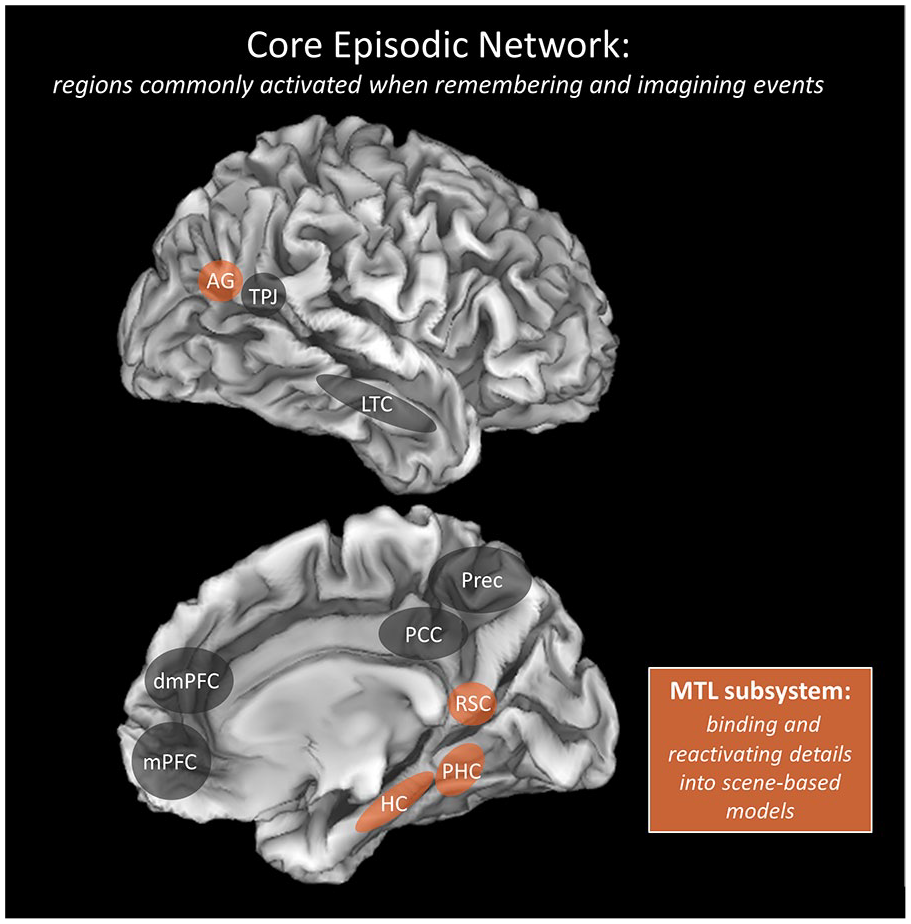
Shown above is a core episodic network of regions that are coactivated for episodic simulation and episodic memory, including the HC, PHC, RSC, and the AG, the mPFC and dmPFC, the Prec, the PCC, the TPJ, and the LTC. Regions comprising the medial temporal lobe subsystem (highlighted in orange) play a critical role in episodic representation, allowing people to form scene-based models that bind together details (i.e., embedding people, objects, and action–outcome sequences) into an integrated event that is specific in time and place. While contributions of regions in gray to moral cognition have been previously emphasized in extant literature, the contributions of the medial temporal lobe subsystem and the mental processes they support have been largely overlooked.
Recent work has revealed that this network consists of multiple, individual, interwoven subsystems that specialize in supporting distinct but interactive content (Andrews-Hanna et al., 2014; Andrews-Hanna & Grilli, 2021; Buckner & DiNicola, 2019; Gaesser, 2020). Although the nature and specific boundaries of these subsystems are currently a point of active discussion, one default-network subsystem (Buckner & DiNicola, 2019), referred to as default-network subsystem B and identified as the dorsal medial prefrontal cortex (dMPFC) subsystem by Andrews-Hanna et al. (2014), is preferentially recruited by mentalizing and person-centered judgments (DiNicola et al., 2020). Indeed, these regions, including the dorsal medial prefrontal cortex and TPJ, will be familiar to researchers studying social neuroscience and moral cognition, as they are the focus of research on the contributions of mental state reasoning and perspective-taking in guiding moral judgment and behavior (Hutcherson, Bushong, & Rangel, 2015; Tusche et al., 2016; Young et al., 2007).
Less familiar will be the regions highlighted in orange in Figure 1. These regions comprise the medial temporal lobe subsystem (Andrews-Hanna et al., 2014), identified as default-network subsystem A (DN-A; Buckner & DiNicola, 2019). This subsystem overlaps extensively with the posterior medial episodic network (Ritchey & Cooper, 2020) and is fundamental to episodic representation, enabling the construction of scene-based models that integrate and bind together details into a specific time and place when we remember or imagine events (i.e., embedding people, objects, and action–outcome sequences within a spatial context; Addis, Cheng, et al., 2011; Andrews-Hanna et al., 2010; Burgess et al., 2002; Hassabis, Kumaran, & Maguire, 2007; Hassabis & Maguire, 2007; Madore et al., 2016; Palombo et al., 2018; Tamir et al., 2016; Thakral et al., 2020).
Episodes, whether imagined or remembered, both fundamentally involve an unfolding sequence of associated details (e.g., people, actions, objects) embedded in a specific place and consciously experienced as a mental movie of sorts playing out in one’s mind (e.g., Eichenbaum & Cohen, 2014; Hassabis et al., 2013; Szpunar et al., 2013). The spatial context of an episode is thought to serve as a platform on which fragmented details can be combined into an integrated representation and vividly experienced (Addis & Schacter, 2012; Maguire & Hassabis, 2011; Maguire & Mullally, 2013; Robin, 2018; Robin et al., 2016, 2018; Suddendorf & Corballis, 2007). In this way, episodic simulation involves reconfiguring details stored in memory. Specific details of previously stored episodes can be retrieved and flexibly recombined in new ways, creating novel configurations to form hypothetical simulations of what might occur. Neuroimaging research has provided evidence for this connection between episodic memory and simulation, showing that the posterior hippocampus is engaged in the retrieval of details from memory, while the anterior hippocampus is engaged in the recombination of these details into a novel and coherent simulation (Thakral et al., 2017).
Support for this model of episodic simulation can be observed even at the level of individual details. For example, neuroimaging evidence demonstrated that imagining novel events consisting of experimentally re-combined people, places, and objects from different autobiographical memories broadly activated the core network to a similar extent as remembering intact past events (Addis et al., 2009). What’s more, multivoxel patterns within the hippocampus, in particular, have been shown to be strikingly similar between imagined and remembered events when they share individual details such as the same location (e.g., an ocean beach pier) or person (e.g., Otis W.), indicating that the hippocampus supports the reinstatement of detail-specific information from episodic memory during episodic simulation (Thakral et al., 2020).
Further support for the connection between memory and imagination can be found by considering that declines in memory (e.g., in Alzheimer’s disease, amnesia, and more mildly in healthy aging) are usually accompanied by declines in imagination (Gaesser et al., 2011; Hassabis, Kumaran, Vann, & Maguire, 2007; Klein et al., 2002; Race et al., 2011). Further evidence of the reliance of episodic simulation on episodic memory comes from a behavioral paradigm using the episodic specificity induction (ESI; Madore et al., 2014). The ESI is a structured memory-training protocol in which participants practice recalling as many episodic details as possible of recently viewed video clips depicting everyday experiences, after which people are better able to retrieve additional episodic details for other events. Work using this paradigm has shown that participants who complete an ESI subsequently not only remember more episodic detail for unrelated past events, but they also imagine new experiences in more episodic detail. The ESI increases activity within the core network, including the hippocampus (Madore et al., 2016). Critically, the ESI does not affect the amount of detail generated when describing a photo while viewing it, and does not affect external, semantic details, suggesting the effect of the ESI is processes-specific to episodic detail shared by memory and simulation (see Madore & Schacter, 2016, for review).
In terms of function, both remembering and imagining provide information that can be used to infer, evaluate, and prepare for future experiences—whether those experiences are echoes of past events or novel events that have not been directly experienced before. For example, participants who had intact episodic memories associating a given stimulus (e.g., a person) with a particular value made more adaptive choices than participants who simply recognized the stimulus, suggesting that the associative process of binding together details, a central computational feature of the constructive episodic memory system, plays a vital role in guiding value-based choice (Bakkour et al., 2019; Murty et al., 2016). Further evidence for the role of episodic representation in guiding decision-making comes from work in temporal discounting. When participants are given the choice of receiving a given sum of money now or a relatively large sum of money in the future, those who were instructed to imagine an episode of spending that sum of money in the future were more likely to make the farsighted decision than those who were instructed to estimate what the sum of money could purchase (Benoit et al., 2011). These studies, among others, demonstrate how both imagined and remembered episodes as well as individuals’ subjective experiences of these representations inform decision-making and behavior in a manner distinct from contributions of reinforcement learning and semantic knowledge (Benoit et al., 2011; Duncan & Shohamy, 2016; Murty et al., 2016; Peters & Büchel, 2009; Schacter et al., 2017; Wimmer & Büchel, 2016).
Despite the broad importance of episodic representation for human cognition and behavior, the role of episodic representation has been largely overlooked in the more specific context of morality. However, in the coming sections, we will discuss emerging findings from moral cognition that point to the critical role of memory and imagination.
Episodic Models of Moral Dilemmas
Hypothetical Dilemmas and Philosophy
Is it acceptable to trade one life to save many? Consider the following seminal moral dilemma: A trolley is careening toward five workers down the tracks. To save them, you can push a heavy man standing next to you onto the tracks, killing him, but stopping the trolley and saving five workers. Philosophers have long used hypothetical thought experiments such as the trolley dilemma to debate over what is right and wrong (Foot, 1978; Thomson, 1985). To illuminate different cognitive inputs to moral decision-making, psychological theories were initially built from empirical laboratory findings using different iterations of hypothetical dilemmas from philosophy and experimental manipulations (Greene et al., 2001, 2009). These findings began to reveal how the contributions of distinct mental processes systematically change moral choices.
One example of this dynamic relationship is the tension between people’s intuitive emotional aversion to harmful actions and the controlled reasoning of cost–benefit analysis regarding number of lives saved (Greene et al., 2004). These dueling forces map onto classic models of morality that pit rational calculus that seeks to achieve the greatest benefit for the greatest number of people, referred to as utilitarianism (Mill, 1998), against rule-based, absolute moral maxims, referred to as deontology (Kant, 1959). Recent work has further differentiated utilitarian approaches into a positive and unbiased concern for all, or impartial beneficence, and a negative and permissive tolerance of harm as a means to an end, or instrumental harm (Kahane et al., 2018), with classifications of dilemma responses based on sensitivity to norms, sensitivity to consequences, and a general preference for action or inaction (Gawronski et al., 2017).
Morality research has expanded to encompass a broader range of methods that have allowed for a greater understanding of cognitive moral inputs than could be accomplished with hypotheticals alone. Through the use of techniques such as natural language processing (Hoover et al., 2018, 2020) and ecological momentary assessment (Hofmann et al., 2014), these methods have enabled researchers to better understand moral cognition in everyday, naturalistic settings. Although these advances in experimental design are not to be undervalued, hypothetical dilemmas remain a useful starting point for conceptualizing moral decisions and understanding the cognitive mechanisms behind them. Although little work on hypothetical dilemmas has directly examined the role of episodic representation, certain findings in this work can be viewed through the lens of episodic processes. For example, the “simulated motor plan” hypothesis suggests that when we make a judgment of the morality of harming someone to save many others, we imagine ourselves performing that harmful action (Cushman & Greene, 2012). Further work has supported this line of thought, demonstrating that judging others’ actions involves simulating how we would feel if we performed that action ourselves (R. M. Miller et al., 2014). Regardless of what judgment or decisions are made, the information to guide the decision may be gained through episodic simulation. Although there are multiple inputs into moral judgments in such dilemmas, this work makes clear that our ability to simulate a specific event that includes harmful actions, supported by the episodic system, has the potential to guide moral judgments and decisions.
Model-Based Input to Moral Decision-Making and Theoretical Relevance of Episodic Simulation
There has been considerable emphasis on distinct systems related to evaluating the action of harming an individual versus the outcome of saving many. Our theoretical understanding of moral judgments in these dilemmas has been productively advanced by incorporating cognitive models of reinforcement learning and decision-making (Crockett, 2013; Cushman, 2013; Yu et al., 2019). This approach views decisions in moral dilemmas as driven by two systems with separable but convergent neural underpinnings. One system is “model-free,” a retrospective decision-making approach determining the value of an action based on implicit associations with prior experiences. In contrast, a forward-looking “model-based” system is thought to generate a conceptual decision-tree representing “if”-“then” contingencies between actions and outcomes. Each action–outcome relationship can then be evaluated, allowing one to determine the action sequence most likely to produce the best outcome (Crockett, 2013; Lockwood et al., 2020).
This process of comparing values within the decision-tree is associated with neural activity in the caudate, which pairs planned actions with planned values (Wunderlich et al., 2012). The hippocampus has also been proposed to play a role in model-based decision-making (Chersi & Pezzulo, 2012; Doll et al., 2012; Vikbladh et al., 2019), using its ability to encode relational information to represent task-relevant contingencies and generate a cognitive map of information from previous experiences to guide decision-making (Doll et al., 2015). In contrast, values of actions in the model-free system (learned through state–action associations) are represented in the posterior putamen (Wunderlich et al., 2012). Values from both the model-free and model-based systems are incorporated and compared by the individual striatal subsystems before a choice is made, while the ventromedial prefrontal cortex (vmPFC) encodes the action that is ultimately chosen in the decision process and represents the value of all choices relative to this chosen option (Wunderlich et al., 2012). There is also evidence that the vmPFC acts to integrate input from distinct appraisals of a moral dilemma, incorporating an affective assessment from the amygdala with a utilitarian assessment to represent an overall “all things considered” moral value judgment (Hutcherson, Montaser-Kouhsari, et al., 2015; Shenhav & Greene, 2014). This work has suggested that the anterior cingulate cortex, insula, and superior temporal gyrus provide input to the vmPFC that elicits an emotional appraisal, while the TPJ and dorsomedial prefrontal cortex provide information that elicits a utilitarian appraisal (Hutcherson, Montaser-Kouhsari, et al., 2015). The integrative role of the vmPFC has also been found to generalize beyond hypothetical dilemmas to real moral behavior, with data suggesting that the vmPFC encodes stimulus values to guide choice in economic giving decisions (Hutcherson, Bushong, & Rangel, 2015). This research suggests that the vmPFC plays a critical role in decision-making, representing the value of choices from both model-free and model-based systems.
Intriguingly, the functional role of the model-based system strikingly resonates with one of the primary functions of episodic simulation, as both enable us to imagine how a future event might play out. However, previous considerations of model-based contributions to morality have focused on semantic “if”-“then” representations thought to be supported by striatal–PFC connections. This work has overlooked contributions of episodic processes and bilateral loops from the medial temporal lobes, critical in episodic representation, to striatal subsystems and the PFC (Dayan, 2012; Wunderlich et al., 2012).
In considering the role of hypothetical dilemmas in extant research, it is important to consider that people are unlikely to have prior experience with scenarios that resemble such hypotheticals, and thus are unlikely to have a specific relevant memory to draw on to inform their moral decisions in these situations. Work on autobiographical memory and moral cognition has demonstrated a complex interplay between memory and moral behavior (Escobedo & Adolphs, 2010), such that our memory for personal moral events has broad consequences for moral cognition in the present (Kouchaki & Gino, 2016; Stanley et al., 2017). Perhaps, even when responding to a moral dilemma that lacks naturalistic validity and does not resemble any previous experiences, an individual’s moral choice may still be broadly swayed by how they remember previous moral or immoral actions and, thus, how they asses their own identity.
Although moral dilemma judgments may be broadly influenced by episodic memory, such judgments are also likely influenced by the ability to imagine new events through constructing a coherent scene of action sequences within a specific location (i.e., episodic simulation). Indeed, one of the primary functions of episodic simulation is that it enables individuals to imagine episodes of what might occur, providing the opportunity to “test out” one or more versions of what might happen and the subsequent outcomes of these hypothetical events (Ingvar, 1979; Schacter & Addis, 2007; Suddendorf & Corballis, 2007; Wang et al., 2015). What is imagined and how vividly it is experienced provide information that guides judgments about what could occur (Szpunar & Schacter, 2013). In addition, the affective signal that arises from episodic simulation serves an important functional role, enabling one to evaluate the subjective value of hypothetical events and induce motivational incentives that inform decision-making (Benoit et al., 2011, 2014; Wimmer & Büchel, 2016). Vividly experiencing hypothetical episodes and the affective-value signals associated with these episodes thus serve an important role in judgment, decision-making, and subsequent behavior.
Novel Contributions of an Episodic Model Beyond Basic Imagery and Construal Level
Understanding how various features of representations guide moral decision-making requires considering multiple theoretical perspectives. Amit and Greene (2012) drew from both construal level theory (CLT) and traditional dual-process models in testing the effect of concrete visual imagery on moral judgments. Evidence from dual-process models shows that visual compared with verbal representations preferentially engage emotional responses (Houwer & Hermans, 1994; Kensinger & Schacter, 2006; Mathews et al., 2013), leading the authors to suggest that visual representations will facilitate affect-driven deontological judgments over calculated utilitarian judgments. The authors derived the same prediction from CLT, which focuses on the differing cognitive and behavioral effects that arise from representing an object or event at varying levels of abstraction (Liberman & Trope, 2008; Trope & Liberman, 2010). High-level construals are relatively abstract and decontextualized representations that include superordinate, gist-like features, whereas low-level construals are relatively concrete and contextualized representations that include subordinate or idiosyncratic features of a representation. As such, high-level construals can be seen as representing overarching goals, whereas low-level construals represent the means to achieve such goals (Amit & Greene, 2012).
While the theoretical distinction between abstract and concrete construals does not necessitate that the generation of vivid visual representations map exclusively onto a given level of abstraction, Amit and colleagues (2009) did show a relationship between abstraction and visual imagery; specifically, visual representations preferentially facilitated concrete construals, whereas verbal representations preferentially facilitated abstract construals. Amit and Greene (2012) thus proposed that visual representations may facilitate means-focused deontological judgments over ends-focused utilitarian judgments because a concrete visual representation comprised of low-level features (e.g., the use of personal force, Greene et al., 2009) would be less likely to integrate high-level information on the ends that motivated a harmful action (e.g., the abstract goal of saving lives). Indeed, the authors found evidence that generating visual imagery made participants less willing to sacrifice one for many (Amit & Greene, 2012).
The authors concluded that this deontological response bias arising from visual imagery was driven by a tendency to visualize the harmful means over the more abstract beneficial ends (Amit & Greene, 2012). This conclusion leads to the prediction that imagining harming another person will elicit an aversive reaction that will generally lead one to avoid and condemn the harmful behavior, a perspective long held in traditional accounts of harm aversion in moral cognition (Crockett et al., 2014; Cushman et al., 2012; R. M. Miller et al., 2014).
Interestingly, new research on episodic simulation provides contradictory evidence. Recent work has found that participants who imagine concrete and specific episodes that involve performing commonplace harmful actions report a greater likelihood of performing such acts in the future (Morris et al., 2022). Importantly, this effect was only observed when participants felt that this harmful act was justified, an effect partially mediated by increased positive affect after imagining committing the harm. It is difficult to reconcile these findings with the traditional dual-process model and CLT on their own, both of which predict that, given the largely concrete and visual nature of episodic simulation, imagining harming another person will elicit an aversive response that will lessen willingness to commit the act. However, Morris et al. (2022) found no evidence of negative affect or decreased willingness to commit harm following episodic simulation, regardless of perceived justification of harm. Instead, these effects are better accounted for by the theoretical framework of an episodic model, which has demonstrated that episodic representations and how they are subjectively experienced can influence not only how an individual feels about an event and its constituent elements (Benoit et al., 2019; Jing et al., 2016) but also how likely they perceive that event to be (Garry & Polaschek, 2000; Szpunar & Schacter, 2013). An episodic model thus suggests that when an individual imagines harming another person, this can change their affective response to that harmful act, which can shift their perceived likelihood or willingness to commit that act. This line of thought is consistent with Morris et al.’s (2022) findings that participants who imagined committing harm spontaneously generated justification for the harm and this simulation of justified harm improved affect and contributed to greater perceived likelihood of committing harm.
An episodic model thus offers an account for these discrepant results (Amit & Greene, 2012; Morris et al., 2022), by providing a theoretical framework distinct from that focused on by Amit and Greene. While CLT is focused on the differing effects of low-level, concrete representations versus high-level, abstract representations (Liberman & Trope, 2008; Trope & Liberman, 2010), an episodic model forgoes such distinctions in favor of focusing on the dynamic and multifaceted process of binding together individual details into a cohesive representation of a specific event (Hassabis, Kumaran, Vann, & Maguire, 2007; Maguire & Hassabis, 2011; Mullally et al., 2012; Summerfield et al., 2009, 2010; Zeidman & Maguire, 2016). Although low-level, concrete construals may be likely to engage episodic process relative to high-level, the constructs of a concrete versus episodic representation are neither mutually exclusive nor mutually overlapping, due to these fundamental differences in their theoretical foundations. The unique focus of episodic representation on how individual details are integrated into a unified event representation not only incorporates low-level, concretely construed details but may also facilitate and guide generation of what may be considered relatively abstract, high-level details, such as others’ mental states (Gaesser, 2020).
The unique explanatory power of an episodic model can also be observed in evidence from amnesic populations’ moral judgments. McCormick and colleagues (2016) examined responses to a moral dilemmas task in patients with selective bilateral hippocampal damage following seizures caused by autoimmune disorder limbic encephalitis. Patients with bilateral hippocampal damage show no deficits in high-level reasoning (Mullally & Maguire, 2014), theory of mind (Rosenbaum et al., 2007), and basic emotion processing (I. A. Clark & Maguire, 2016). However, such patients have a severely impaired ability to imagine and remember specific events (I. A. Clark & Maguire, 2016). Given the important contributions of the hippocampus to vivid visual imagery (Geib et al., 2017), such deficits in the ability to generate vivid visual representations should mean that these patients’ representations are relatively abstract (Amit et al., 2009), consisting of an impoverished experience of the concrete and visual details previously shown to facilitate emotional, deontological decisions (Amit & Greene, 2012). As such, dual-process theory and CLT would suggest that amnesic patients should show an increase in utilitarian, ends-focused judgments.
However, the findings from McCormick and colleagues (2016) provide a different picture. These amnesic patients showed a decrease in utilitarian responses, an effect that was later replicated in a separate patient group with medial temporal lobe lesions (Verfaellie et al., 2021). In both studies, compared with healthy control participants, amnesic patients were less likely to say they would be willing to take a single life with their own hands to save the lives of multiple others. These findings run contrary to the predictions that arise from considering the dual-process model and CLT but can be explained within an episodic framework.
Evidence from both McCormick et al. (2016) and Verfaellie et al. (2021) show that amnesic patients’ deontological bias was largely driven by their unchecked emotional aversion to harming the individual. Patients showed an enhanced emotional response to the harmful actions in moral dilemmas relative to controls, as measured by both galvanic skin response (McCormick et al., 2016) and self-reports of emotional intensity (Verfaellie et al., 2021). Although healthy controls also experienced an aversion to harming the individual, their intact episodic systems enabled them to imagine the broader scene of the entire moral dilemma and how that scene would play out over time. This means that healthy controls not only visualized the individual to be harmed but also integrated this into a broader scene including individuals to be saved. However, amnesic patients’ episodic deficits restricted their ability to imagine the broader scene beyond the isolated fragment of an individual being harmed. Thus, while healthy controls simulated the act of harming the individual and the positive outcome of lives saved, amnesic patients’ decision-making did not incorporate this positive outcome or the subsequent emotional response to it.
These findings of a deontological bias in individuals with impaired episodic abilities (McCormick et al., 2016; Verfaellie et al., 2021) are consistent with work on age-related changes in moral judgments. Previous work has shown that older adults, who generate less detailed episodic representations than younger adults (Addis et al., 2008), also experience greater negative affect in response to sacrificial utilitarian decisions (McNair et al., 2019). This negative affect is associated with a tendency for older adults to rate a utilitarian decision as less acceptable than younger adults (McNair et al., 2019), particularly when the utilitarian decision is likely to generate an aversive emotional response (e.g., as in the trolley dilemma; Huang et al., 2021).
Taken together, the work on both amnesic and aging populations suggests that, under certain circumstances, episodic simulation may enable healthy individuals to engage in emotion regulation strategies when making moral dilemma judgments by integrating information from the broader context of an episode. This ability to integrate disparate details into a coherent and detailed scene that can be reexperienced is thought to play a critical role in our ability to consider others’ mental states (Gaesser, 2020). Consistent with this line of thought, amnesic individuals with episodic deficits show diminished levels of empathy, possibly resulting from an impoverished ability to vividly imagine another person’s circumstance (Beadle et al., 2013; I. A. Clark & Maguire, 2016). This work, as well as evidence demonstrating episodic simulation’s role in reducing anxiety about negative future events (Jing et al., 2016), suggests that episodic simulation may play a broad and influential role in enabling individuals to better regulate negative emotions and better share in others’ emotions.
However, the evidence from Morris et al. (2022) makes clear that the effects of episodic simulation on affect and resulting moral judgments do not lead to uniformly prosocial outcomes (see “Moral ‘Dark Side’ of Imagination” section in Future Directions below). What is clear from these studies, however, is that the theoretical framework of an episodic model has a unique ability to explain findings that contradict certain predictions arising from the dominant theories in moral cognition. Rather than calling into question the theoretical validity of either CLT or a dual-process model, we simply suggest that an episodic model provides its own, unique theoretical contribution to a more comprehensive understanding of moral cognition and is best viewed alongside existing theoretical frameworks rather than fully opposed to them.
Moral Emotions
Researchers studying episodic simulation and episodic memory have long recognized how imagination and memory influence emotions in healthy individuals. The vividness, valence, and significance of imagined and remembered episodes broadly heighten attributions of emotions arising from these representations (Barsics et al., 2016; Szpunar et al., 2012). Further work in this area has begun to uncover the role of imagination and memory in shaping specific emotions related to morality. Recent research has explored the role of memory in empathy for others’ pain, demonstrating that empathy for another’s pain is greater when people recall having experienced a similar situation themselves (Meconi et al., 2019; Wagner et al., 2020). Wagner and colleagues found similar patterns of activation for firsthand pain and empathy for another’s pain in the hippocampus, TPJ, retrosplenial cortex, and anterior insula. Notably, connectivity between the hippocampus and the fusiform gyrus during the pain empathy task scaled with increased self-reported perspective-taking skills (Wagner et al., 2020).
Further support for the association between memory and empathy comes from work on patient populations with severe deficits in imagination and memory, such as patients with amnesia or Alzheimer’s disease with hippocampal damage. This work has found preliminary evidence that patients with such episodic deficits have lower trait empathy scores relative to healthy comparisons (Beadle et al., 2013; Dermody et al., 2016). These amnesic patients (N = 3) also showed no increase in empathy or prosocial behavior following an empathy induction (Beadle et al., 2013).
These findings are supported by recent data from patients who have undergone resection of medial temporal lobe tissue to treat severe epilepsy (mTLE patients; Sawczak et al., 2019). In this study, participants read a vignette describing someone in need, after which they were asked to imagine helping that person in need or, in the control condition, complete a word generation task. Results showed that when healthy control participants imagined helping the person in need, they showed greater willingness to help and increased empathic concern compared with when they completed the control task. However, mTLE patients did not show increased empathy or willingness to help following the imagination task (Figure 2A). Furthermore, subjective vividness both predicted empathic concern and mediated the effect of episodic simulation on willingness to help, although this mediating effect was significantly weaker in mTLE patients (Sawczak et al., 2019). These findings suggest that having an intact ability to vividly simulate a helping episode may play a key role in how imagination influences moral emotions such as empathy.

(A) When healthy control participants were instructed to imagine helping an individual in need (imagine condition), they showed greater empathic concern for the individual in need as compared with when they were instructed to complete a control task (words condition). Notably, participants who had undergone resection of their medial temporal lobe tissue to treat severe epilepsy (mTLE patients) did not experience a boost in empathic concern following the imagination condition (Sawczak et al., 2019). (B) Participants who receive an ESI showed greater affective empathy as compared with participants who received a control task. This effect was mediated by spontaneously generated episodic details, with no effect of nonepisodic details (Vollberg et al., 2021).
Dovetailing with these findings of clinical deficits in episodic simulation is emerging work revealing that upregulating episodic detail generation subsequently increases empathy for others’ plights on an independent task (Vollberg et al., 2021; see also Wilson-Mendenhall et al., 2022 for related discussion about compassion). Specifically, participants who were trained to generate more episodic details about neutral, everyday events (such as preparing dinner in a kitchen) using the aforementioned ESI subsequently experienced greater empathy for others experiencing negative events unrelated to the scenarios used during ESI (e.g., someone stubbing their toe; Vollberg et al., 2021). The ESI led to people spontaneously generating more episodic detail surrounding others’ plights, and as a consequence, increased empathy for that individual. The ESI increased empathy even when the person suffering was an out-group member. This work is consistent with research showing that learning contextual details about the situation of someone in need prompts individuals to engage in episodic simulation of that person’s mind, a process supported by the temporal poles and the anterior hippocampus (Pehrs et al., 2018).
Considered together, these studies suggest that episodic representation and how it is subjectively experienced may help to heighten and tailor emotional responses directed at others’ welfare. Episodic representation is not an essential component of affectively responding to an event, as indicated by the fact that individuals lacking episodic abilities (e.g., amnesic individuals, mTLE patients) still report feeling emotions, such as empathy. However, the fact that these emotions seem to be tempered in such populations (Beadle et al., 2013; Dermody et al., 2016; Sawczak et al., 2019), considered alongside empirical evidence suggesting that upregulating episodic simulation can heighten emotions such as empathy (Vollberg et al., 2021), illustrates the influential role that episodic representation can play in our emotional lives. Left unaddressed in these studies, however, is whether the empathic effects of imagination and memory guide moral decision-making and behavior.
Episodic Thinking and a Willingness to Help Others
Work from researchers at the intersection of morality and memory has begun to establish a direct link between episodic representation and a willingness to help others. Imagining and remembering a specific episode of helping someone in need increased intentions to help the person in need (Figure 3; Gaesser & Schacter, 2014) and the amount of money donated to help in that situation (Figure 4; Gaesser et al., 2018) compared with conditions that controlled for exposure to the person in need and conceptual priming of helping. Both the imagination and memory conditions required the construction of episodes that are specific in time and place, while control conditions involved thinking about the situation of need and recruiting semantic generation of helping behaviors (Gaesser, DiBiase, & Kensinger, 2017; Gaesser & Schacter, 2014).
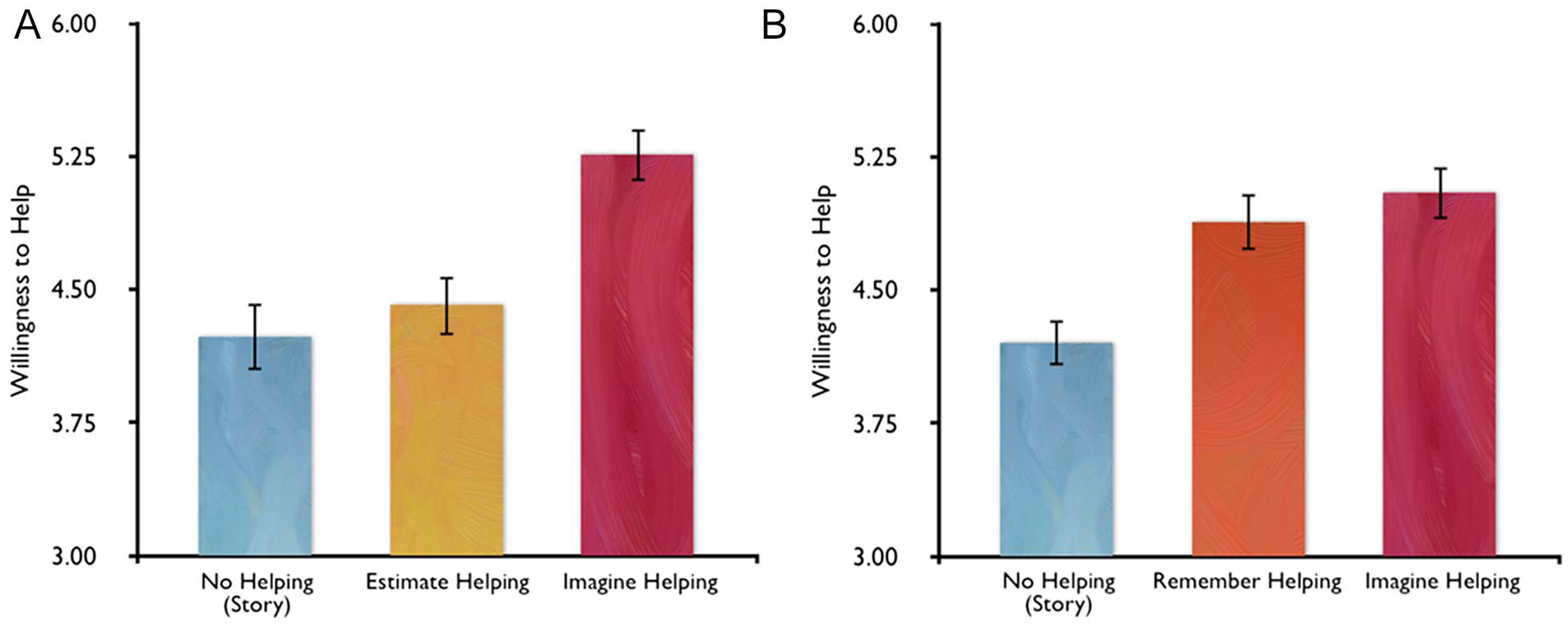
Participants who imagine (Imagine Helping) (Figure 3A and 3B) or remember (Remember Helping) (Figure 3B) a specific episode of helping others reported greater willingness to help someone in need compared with control conditions that account for thinking about the situation of need (No Helping [Story]) and semantic generation of helping behaviors (Estimate Helping; Gaesser & Schacter, 2014).
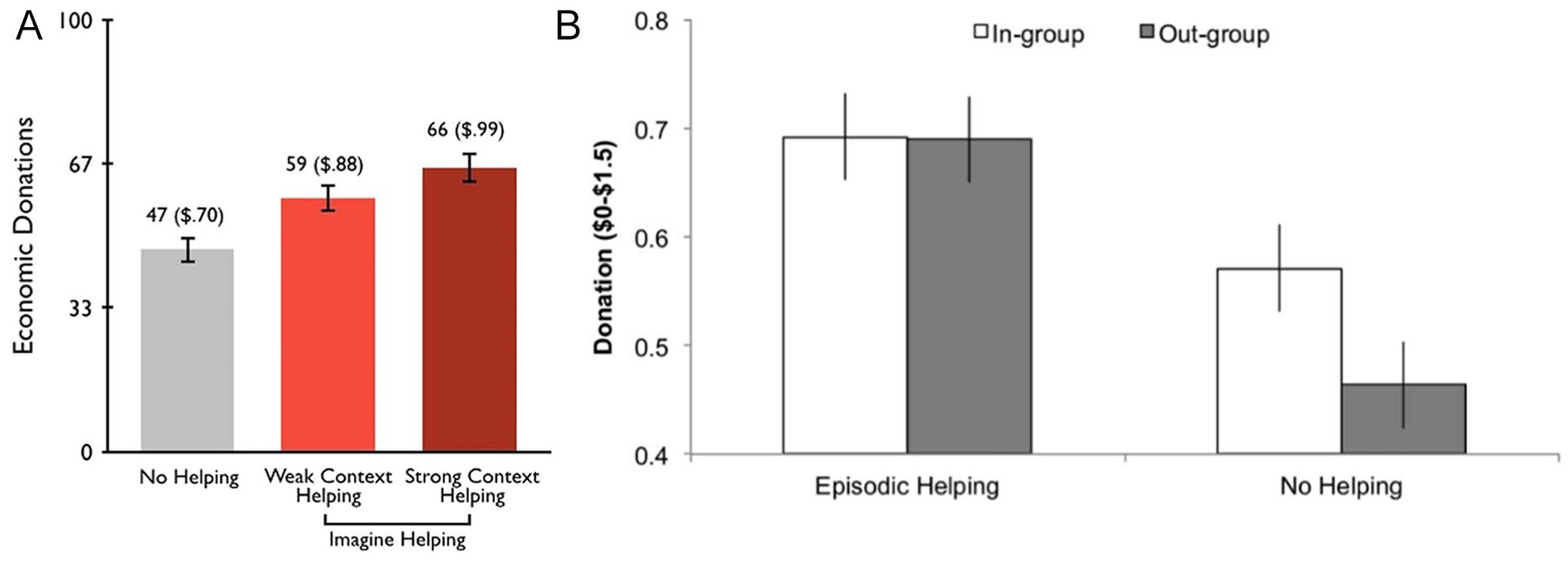
(A) Participants who imagined a helping episode in a familiar location (Strong Context Helping) were more likely to donate to help the individual in need than those who imagined helping in an unfamiliar location (Weak Context Helping) and those who did not imagine a helping episode (No Helping; Gaesser et al., 2018). (B) Participants who imagined a helping episode (Episodic Helping) were more likely to donate to help the individual in need than those in the control condition who did not imagine a helping episode (No Helping). Participants in the control condition were more likely to donate to in-group members than out-group members; however, this in-group bias was eliminated when participants imagined helping the individual in need (Gaesser et al., 2020).
There are a number of mechanisms that may underlie the prosocial effect of episodic simulation and memory (see Figure 5). It seems this effect is partially driven by how the episode itself is represented and subjectively experienced. For example, manipulating the location a helping episode is set in, a key component of episodic representation (Maguire & Mullally, 2013; Robin, 2018), affected the vividness of the imagined scene and, in turn, the willingness to help in that situation. Specifically, imagining helping episodes set in familiar locations with strong spatial context increased how vividly the scene was subjectively experienced and increased both a willingness to help and economic donations to people suffering in those situations—even when controlling for individual differences in trait empathy and prosocial tendencies (Figure 4A; Gaesser et al., 2018). Strengthening the spatial representation and vividness of the imagined episode likely makes the helping scene more accessible at the time of decision, thereby increasing the perceived plausibility that one would be willing to help in that situation.
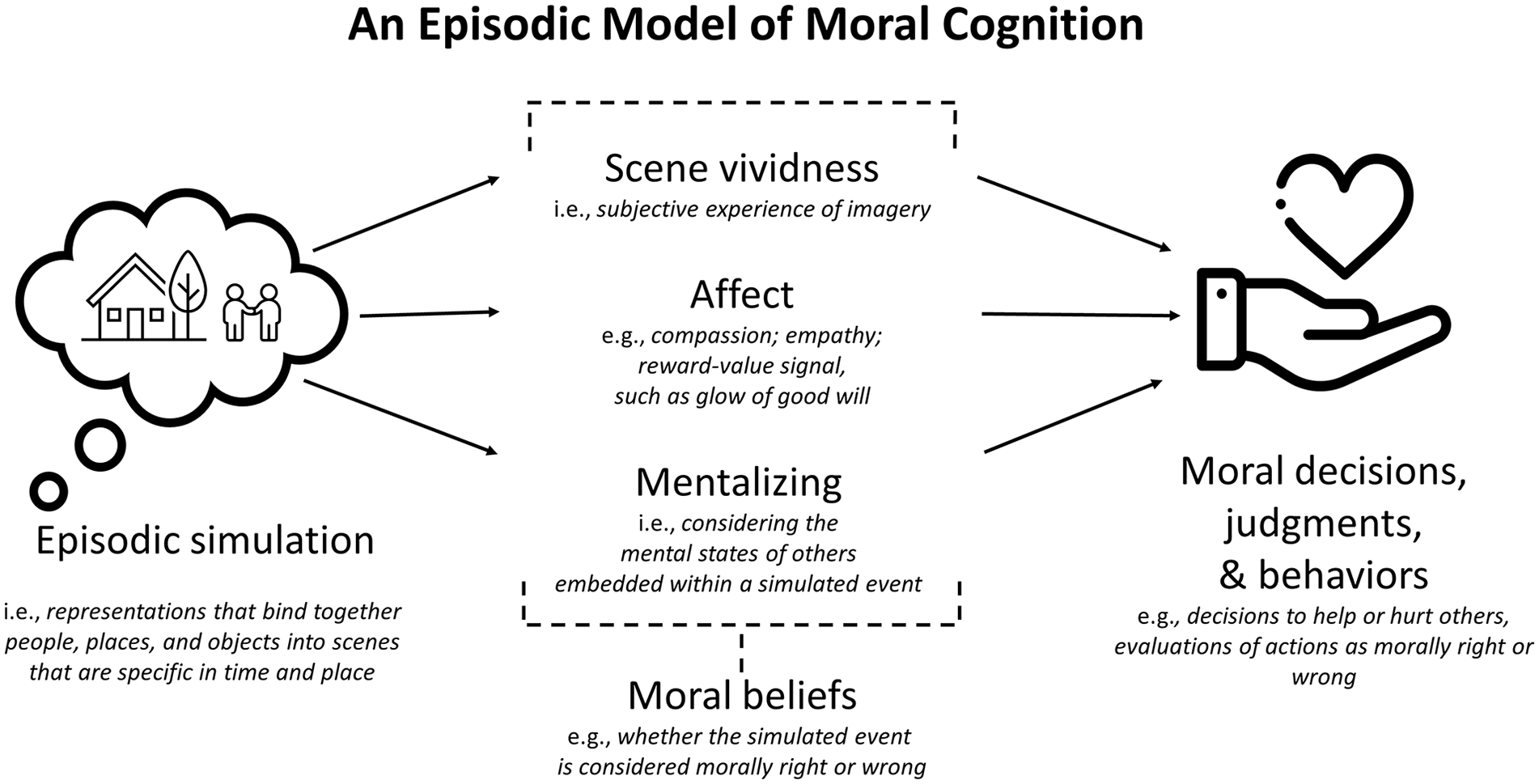
Episodic simulation influences moral decisions, judgments, and behaviors through multiple avenues, and research suggests that scene vividness, affect, and mentalizing all play important roles. Imagining a helping scene more vividly can increase willingness to help others (Gaesser et al., 2018), and such imagined episodes can also elicit an affective signal that can guide moral decisions and behaviors (Gaesser, DiBiase, & Kensinger, 2017). Importantly, both vividness and affect are also associated with increased mentalizing, demonstrating the complex and interrelated nature of these phenomena (Gaesser, DiBiase, & Kensinger, 2017; Gaesser et al., 2018; see Gaesser, 2020). Each of these paths, however, may be influenced by an individual’s moral beliefs and values, which can guide how an imagined action is perceived (e.g., construing a harmful act as morally justified; Morris et al., 2022). This can influence how the phenomenology of the episode is experienced, and thus how that imagined episode influences judgments and behaviors.
These behavioral results converge with neuroimaging evidence revealing that activity within the medial temporal lobe subsystem of the default network, the parahippocampus and hippocampus, predicted willingness to help when participants imagined and remembered helping episodes (Gaesser et al., 2019). This suggests that the neural regions supporting episodic processes and scene construction may directly inform prosocial intentions; however, it is not episodic representation and its subjective experience alone that contributes to this prosocial effect. How episodic representation engages and interacts with other social-cognitive and affective systems relevant to moral decision-making also plays a role.
Although episodic processes do not always involve social cognition, research suggests that episodic memory and simulation make important contributions to one’s ability to interact and engage with others (Laurita & Spreng, 2017; Rubin et al., 2014 for reviews). This deep connection between episodic and social processes is also reflected in the materials used for episodic inductions, which frequently reference social events (Addis et al., 2009; Addis, Roberts, & Schacter, 2011; Hach et al., 2014; Weiler et al., 2010). Memory seems to play a significant role in the creation of shared experiences with others, as well as the process of social learning and adaptive social choices (Alea & Bluck, 2003; Bluck et al., 2005; Coman et al., 2009; Fivush et al., 1996; Meyer et al., 2018; Murty et al., 2016; Pillemer, 1992; Rasmussen & Berntsen, 2013).
Despite the wealth of research illuminating how episodic processes interact with social cognition, little work has focused on how episodes allow one to better understand another’s mind and thoughts. Taking the mental perspective of someone by considering their thoughts and feelings is referred to as mentalizing or theory of mind, and extant research has demonstrated that mentalizing with someone in need can increase altruistic behavior (Batson, 2011). Further work has found that brain regions commonly activated when people mentalize, including the right and left TPJ, precuneus, and dorsomedial prefrontal cortex (Gallagher et al., 2000; Saxe & Kanwisher, 2003), are robustly engaged during moral and altruistic decisions (Rameson et al., 2012; Tusche et al., 2016; Young et al., 2010).
Work in this area has shown that participants instructed to imagine a specific helping episode experienced a greater degree of mentalizing for the person in need (i.e., they reported adopting the thoughts and feelings of the person in need) relative to nonepisodic control conditions, despite the lack of explicit directions to mentalize in the episodic condition (Gaesser, DiBiase, & Kensinger, 2017; Gaesser et al., 2018). The more vividly the scene imagery of a helping episode was experienced, the greater the mentalizing for the person in need embedded within that episode (Gaesser et al., 2018; see Gaesser, 2020). Mapping the relationship between changes in scene imagery, perspective-taking, and willingness to help revealed a multipath scene-and-mind model, such that the increase in willingness to help from engaging in episodic simulation was partially explained by the indirect increase in perspective-taking. Further research suggests this scene-and-mind association holds even if the person in need belongs to an out-group (Gaesser et al., 2020; Figure 4B).
Recent research exploring the role of episodic processes in the link between mentalizing and morality has started to uncover the neural basis of this relationship. Specifically, activity in the hippocampus, parahippocampus, and right temporoparietal junction (RTPJ) predicted willingness to help judgments more strongly in conditions that instructed participants to imagine or remember a helping event (episodic conditions) than in control conditions that did not recruit episodic processes (Gaesser et al., 2019). Interestingly, when activity in the RTPJ was disrupted by transcranial magnetic stimulation, participants in the control condition reported lowered perspective-taking of the person in need; however, participants in the episodic conditions did not show any change in perspective-taking. One intriguing, though admittedly speculative, possibility is that episodic processes may recruit mentalizing in such a way that it is resilient to disruption in the TPJ.
In addition to causing increases in mentalizing, there is also behavioral evidence that episodic processes contribute to a willingness to help others through the affective signal that arises from an episodic representation. Manipulating whether an imagined helping episode elicits overall positive, neutral, or negative affect revealed that imagining positive helping episodes increased willingness to help above neutral and negative helping episodes (Gaesser, DiBiase, & Kensinger, 2017), consistent with previous work finding that feeling positive affect preferentially fosters decisions to help others (Andreoni, 1990; M. S. Clark & Waddell, 1983; Isen et al., 1978). Moreover, there was evidence that the positive emotion of helping episodes heightened mentalizing for the person in need, hinting at a dynamic relationship between episodic representation and mentalizing that is dependent upon affect (Gaesser, DiBiase, & Kensinger, 2017).
In sum, while there is more work to be done, this line of research has begun to illuminate a role for episodic processes in guiding prosocial decisions, delineating the component features of how imagined and remembered episodes drive this effect and how they interact with other social-cognitive and affective systems.
Open Questions and Future Directions
Research on moral psychology has rapidly advanced since the turn of the century, quickly dispelling the notion that there is a single cognitive and neural system exclusively dedicated to morality. Instead, moral decision-making draws on the input from multiple mental processes that are supported by distributed networks of brain regions. Extant theories in moral psychology, however, have overlooked the fundamental role of imagination and memory in shaping how people think, feel, and behave. Here, we have argued that a comprehensive model of moral cognition will require the inclusion of episodic simulation and episodic memory. Although researchers have begun to make progress delineating episodic processes’ distinct contribution to moral cognition and how they interact with other mental processes, much still remains to be discovered. Below, we highlight burning open questions and new avenues for future research to explore.
Moral Implications of Episodic Thinking in Healthy Populations
Healthy development and decline across the life span
Researchers have long been interested in how morality develops as a person ages, particularly in childhood (Eisenberg, 2000; Eisenberg-Berg & Mussen, 1978; Kohlberg & Hersh, 1977). Like moral decision-making, episodic abilities also change across development. Although independent lines of research have shed light on the development of either episodic abilities or moral decision-making, next to nothing is known about how the formation of episodic simulation and memory influences the development of moral decision-making in childhood.
At the other end of the developmental spectrum, research has begun to examine how episodic simulation and memory in older adults influence a willingness to help others (Gaesser, Dodds, & Schacter, 2017). Investigating older adults is a potentially interesting test case for teasing apart an effect of the objective amount of episodic detail from an effect of how vividly those details are subjectively experienced on moral decisions. This is because older adults show a decline in the episodic specificity and detail of their imagined and remembered events, consistently providing fewer “who, what, when, where” details for imagined and remembered events compared with younger adults (Schacter et al., 2013), yet older adults report that their imagined and remembered events are similarly as vivid as younger adults (e.g., Gaesser, Dodds, & Schacter, 2017). How does this developmental asymmetry in episodic representation and subjective experience shape both a willingness to help others and moral decision-making more broadly?
Individual differences in episodic abilities
In considering the role of episodic processes in moral cognition, it is important to understand how episodic abilities vary among healthy adults. The wide range of episodic abilities is marked by extremes at each end, from the capacity to recall an abundance of details pertaining to autobiographical memories (highly superior autobiographical memory; LePort et al., 2012), to difficulty in vividly recalling past personal experiences (severely deficient autobiographical memory; Palombo et al., 2015; for review, see Palombo et al., 2018). Stable individual differences across this spectrum of episodic abilities have been documented using a variety of experimental methods (Levine et al., 2002; M. B. Miller et al., 2002; Palombo et al., 2013; see also Setton et al., 2022), with evidence that this variation in ability is associated with both the subjective experience of an episode (Setton et al., 2022) and distinct patterns of functional connectivity (Sheldon et al., 2016). It remains an open question how these individual differences in episodic ability among healthy individuals may moderate the effect of episodic representation on moral judgments and behavior.
Episodic representation involves binding together individual details into a coherent scene and individuals can also vary in how they visually represent and experience these individual details. Individuals report a wide range in both the ability (Zeman et al., 2020) and tendency (Greenberg & Knowlton, 2014) to utilize visual imagery. At the extremes, certain individuals demonstrate an inability to engage in object imagery almost entirely, referred to as aphantasia (Dawes et al., 2020), while others experience visual imagery so vividly that it is life-like, referred to as hyperphantasia (Zeman et al., 2020). These differences in visual imagery have been recently revealed to track with marked differences in episodic memory (Zeman et al., 2020) and simulation (Milton et al., 2021) abilities, with hyperphantasia being associated with greater performance on episodic tasks and aphantasia being associated with reduced performance on episodic tasks.
An episodic model of moral cognition makes unique predictions about how these differences among healthy adults with hyperphantasia and aphantasia may influence moral cognition. For example, consider work from Vollberg and colleagues (2021) showing that upregulating episodic detail via an ESI was associated with increased empathy on an unrelated task. This work raises the intriguing possibility that differences in healthy individuals’ ability to generate rich, vivid, and detailed episodic representations may play a role in individual differences in empathy. Understanding the relationship between episodic processes and empathy will require considering both the unique contributions of visual imagery and episodic ability as well as how they interact to shape moral judgments and decision-making.
Interactions Between Episodic Processes and Facets of Health and Well-Being
The effects of stress on episodic simulation
In seeking to understand the effects of episodic representation on moral cognition, it is important to consider situational features, such as stress and lifestyle, that may play a role in this relationship. Research has shown that acute psychological stress impairs episodic retrieval (for review, see Schwabe et al., 2022), partially by disrupting activity in the hippocampus (Schwabe et al., 2007; Simon-Kutscher et al., 2019; for review, see Wirz et al., 2018). Furthermore, stress can shift cognitive inputs to behavior, from relatively flexible, medial temporal lobe-supported representations to “habitual,” striatal-dependent representations (Brown et al., 2020). This shift in neural activity under stress is accompanied by an increased reliance on familiar routes and decreased utilization of novel and efficient shortcuts.
These studies provide evidence of the negative effects of stress on the engagement of episodic systems, such that acute psychological stress inhibits the use of simulation-based decision strategies (Brown et al., 2020). Considering the connection between episodic detail and empathy (Vollberg et al., 2021), might acute stress diminish one’s empathy for another’s suffering through inhibiting one from vividly imagining another’s circumstance?
Another intriguing question is what effect acute stress has on the use of episodic representation in moral dilemma judgments. Previous research has provided mixed answers regarding how stress alters moral decision-making. The traditional dual-process model, which maps deontological judgments onto rapid, intuitive “System 1” processes and utilitarian judgments onto controlled, deliberative “System 2” processes (Greene, 2014; Greene & Haidt, 2002), predicts that stress will facilitate rapid, emotional, deontological judgments. Although this prediction has received some empirical support (e.g., Youssef et al., 2012), recent work has called into question the mapping of System 1 versus 2 processes onto deontological and utilitarian judgments, respectively (Bago & DeNeys, 2019; Huang et al., 2021). Bago and DeNeys (2019) found that the majority of participants who gave a utilitarian response when given time to deliberate had previously provided a utilitarian response when under time pressure and cognitive load. This work suggests that there may be a multitude of cognitive mechanisms that could drive a utilitarian response, even under stress-inducing conditions.
Consistent with this line of thought, the effects of stress on moral behavior in everyday contexts are also mixed. Although work by Starcke and colleagues (2011) found no evidence of a causal relationship between stress and altruistic decisions, N. Singer et al. (2017) found that young men who experienced acute stress were more likely to make altruistic decisions. Future work may explore whether an episodic model may partially explain these discrepant results. If experiencing stress increases the difficulty with which one generates novel episodes and shifts one toward relying on habitual, familiar responses (Brown et al., 2020), the effects of stress on the generation of episodic representations may vary between individuals in complex ways that depend on a multitude of factors.
The role of episodic processes in anxiety
Extant research connects abnormalities in episodic memory to both trait anxiety (Pajkossy et al., 2017) and clinical anxiety (for review, see Zlomuzica et al., 2014). Individuals with anxiety disorders show deficits in episodic memory, which seem to be due to impairments in the encoding process (Airaksinen et al., 2005). A parallel deficit has also been observed for episodic simulation. Specifically, individuals with generalized anxiety disorder generate less detailed future simulations (Wu et al., 2015) and individuals high in subclinical anxiety generate fewer future episodes (Marsh et al., 2019). Paired with these general episodic deficits, however, are enhanced episodic abilities for negative stimuli. For example, individuals high in trait anxiety exhibit improved recall for negative stimuli over neutral (Eden et al., 2015), preferentially recalling information pertaining to threats or negative self-evaluations (for review, see Mitte, 2008). This negativity bias is also observed in episodic simulation, such that high-anxiety individuals show greater ease in simulating negative future events (Wu et al., 2015).
It is clear that episodic memory and episodic simulation play a critical role in anxiety. However, it remains unclear how these abnormalities in episodic processing influence moral decision-making. Recent work shows that individuals with social anxiety show reduced memory for social events with positive outcomes (Romano et al., 2020). Previously discussed work shows that instructing participants to recall an episode in which they helped someone increases prosocial behavior (Gaesser et al., 2018). Given that helping others often elicits positive affect (Aknin et al., 2018), do individuals high in anxiety have impoverished memory for episodes that involve helping others? Furthermore, does the reduced memory for positive social events diminish or eliminate the prosocial effect of episodic memory in individuals high in anxiety?
Anxiety can also affect imagination, such that individuals high in anxiety have greater difficulty simulating positive future events (Wu et al., 2015). Considering that simulating helping episodes that elicit positive affect leads to greater engagement with theory of mind, which in turn leads to more prosocial responses to someone in need (Gaesser, DiBiase, & Kensinger, 2017), future work may explore these effects in individuals high in anxiety. Does anxiety dampen the prosocial benefits of imagining helping others, and what role does perspective-taking play in this relationship? These questions present exciting avenues for new research to pursue, with important ramifications for cognitive work on episodic processes and morality as well as clinical work on anxiety.
Patient populations
As discussed earlier, research using patient populations with severe deficits in episodic simulation and episodic memory, such as patients with amnesia and Alzheimer’s disease, is beginning to shed light on the contributions of episodic processes to guiding decisions in moral dilemmas and shaping moral emotions. Although there is evidence that amnesic patients are less likely to endorse taking a single life with their own hands to save the lives of multiple others compared with healthy control participants (McCormick et al., 2016), another study using a similar moral dilemma paradigm and a different sample of amnesic patients did not observe a difference in moral judgments between amnesic patients and healthy controls (Craver et al., 2016). A more recent study aimed to reconcile these conflicting results and found that amnesic patients with hippocampal lesions endorsed the deontological choice in moral dilemmas more often than did healthy controls (Verfaellie et al., 2021).
It remains an open question what may have driven the inconsistent evidence from Craver et al. (2016). An intriguing possibility is that moral judgments in amnesic patients may resemble the pattern of findings observed over the last decade from amnesic patients and healthy controls on intertemporal choice tasks (i.e., delayed discounting tasks). When faced with the option of selecting a smaller reward now or a larger reward later, people will often select the smaller and temporally closer reward rather than wait longer for the larger reward (Kable & Glimcher, 2007). Subsequent work discussed above has shown that explicitly instructing people to imagine specific future events that involved using the larger and more temporally distant reward promotes more farsighted decisions with people more likely to wait for a larger reward after episodic simulation (Benoit et al., 2011). Further work has shown that episodic simulation of future events unrelated to the reward still reduces discounting of the more distant reward, regardless of whether the simulated event is positive or negative (Bulley et al., 2019; for review, see Bulley et al., 2016).
A natural question that arose at the time was whether amnesic patients with deficits in episodic simulation would be spontaneously impaired on the intertemporal choice task, selecting the smaller and temporally closer reward more frequently than healthy controls. The evidence for this was mixed. Amnesic patients’ temporal discounting decisions seemed to show similar patterns as healthy controls during standard intertemporal choice tasks (Kwan et al., 2012, 2013). However, subsequent work found that whereas healthy controls made more farsighted decisions after being explicitly instructed to imagine specific future events, amnesic patients’ decisions remained the same because they could not engage in episodic simulation and thus shift toward selecting the larger and more temporally further reward (Palombo et al., 2016).
Moral decisions in amnesic patients may end up showing a somewhat similar pattern such that episodic representation may not always be spontaneously deployed on moral dilemma tasks. Where the greatest and most consistent differences in moral decisions between amnesic patients and healthy controls may lie is where episodic simulation is explicitly recruited as in Benoit et al. (2011) and Palombo et al. (2016). Although research has begun to uncover how these deficits in episodic simulation and memory influence moral decisions, there is much about episodic memory and imagination’s effect on morality that remains unknown. We suspect that episodic representation, while not necessarily required for moral decision-making, instead modulates and informs these choices.
Moral “Dark Side” of Imagination
Imagining harm and violence
The extant literature has focused on positive benefits of episodic thinking to morality, showing how episodic simulation and episodic memory can shift moral decisions toward maximizing welfare gains, heightening feelings of concern for others, and enhancing prosocial intentions and behavior. Yet, new lines of research are starting to investigate whether episodic simulation and episodic memory could also have a moral dark side.
Does imagining episodes of oneself harming others increase or decrease a willingness to hurt others? People generally have a strong emotional aversion to harm and judge it as morally wrong (Blair, 1995; Cushman et al., 2012; Greene et al., 2001; Mikhail, 2008). However, other research suggests that imagining any event will increase the perceived, and in some cases actual, likelihood of the event, by making the event more accessible and diagnostic of what one will do (Gaesser, 2013; Garry et al., 1996). Emerging work has found that imagining harming an individual increased the participants’ perceived likelihood of performing the harming action themselves, as well as actual harm behavior in an economic game (Morris et al., 2022). Furthermore, imagining performing this harm increased positive affect in participants, which partially mediated the effect of imagining harm on the perceived likelihood of performing the action. This work focused on mild harms (e.g., stealing, pushing). Thus, it is an open question whether episodic simulation may motivate mild harms but elicit an aversive signal and decrease the likelihood of harming behavior as the severity of the harm and moral violation increases (e.g., killing) and becomes more difficult to justify. Alternatively, episodic simulation of an event that involves inflicting severe harm may in fact contribute to realizing even the most heinous and immoral harms.
Episodic processes and psychopathy
Beyond the consequences of imagining immoral acts, imagination can have dark ramifications depending on the subjective features of the episodic representation and how it is experienced. Research has demonstrated that imagining others’ plights increases empathy (Vollberg et al., 2021; see also Sawczak et al., 2019 and Wagner et al., 2020) and can promote prosocial behavior (Gaesser et al., 2018). However, this empathic response to episodic simulation of others’ pain is markedly absent in individuals with psychopathy and is one of the hallmark features of the clinical condition (Decety et al., 2013).
This empathic deficit may be, at least in part, a result of an episodic deficit. Neuroanatomical studies have shown that the degree of psychopathology is negatively correlated with regional volume in the hippocampus (Cope et al., 2014; Laakso et al., 2001), which is particularly important in creating detailed representations (Addis, Cheng, et al., 2011; Burgess et al., 2002) and preferentially engaged in episodic processes (Renoult et al., 2019). In addition to these volumetric differences, individuals with psychopathy also demonstrate reduced activation in brain regions engaged by episodic processes, such as the hippocampus and parahippocampal gyri, medial temporal gyrus (Müller et al., 2003), and the posterior cingulate gyri (Kiehl et al., 2001). Given that individuals with psychopathy show memory deficits for emotional stimuli (Dolan & Fullam, 2005) and that certain psychopathic traits are positively associated with a sense of feeling “stuck in the present,” (Petrican & Burris, 2011), it is possible that the lack of empathy characteristic of psychopathology may be tied in with an impoverished ability to generate rich and vivid episodic representations. However, what features of episodic representation contribute to this empathic deficit remain to be explored. Furthermore, much of the research identifying reduced neural activity in brain regions engaged in episodic processes used affective stimuli (e.g., Dolan & Fullam, 2005; Müller et al., 2003). As such, it is an open question whether psychopathic individuals have impoverished representations for affective content exclusively or episodic representations more broadly.
Although psychopathy has unique features and consequences, it is closely related to other personality disorders, such as antisocial personality disorder (Werner et al., 2015) or conduct disorder (Salekin et al., 2004; Ribeiro da Silva et al., 2019). Interestingly, reduced temporal lobe volume, and specifically hippocampal volume, has been observed in individuals with antisocial personality disorder (Kaya et al., 2020), as well as individuals with conduct disorder (Stevens & Haney-Caron, 2012), borderline personality disorder (Driessen et al., 2000), and individuals with schizophrenia who have a history of violence (Barkataki et al., 2006). This suggests that these brain regions may play an important role in modulation of violent behavior (Barkataki et al., 2006).
Can part of the connection between reduced temporal lobe volume and the presence of antisocial or violent personality traits be explained by impoverished episodic representations? What specific elements of episodic representations are diminished due to these volumetric abnormalities? Future work may consider addressing these open questions. One potential approach could involve having individuals with psychopathy or antisocial personality disorder complete the autobiographical interview, which allows for analysis of the level of episodic detail provided in descriptions of memories (Kopelman et al., 1989; Renoult et al., 2020). Researchers could then analyze whether the level of episodic detail predicts symptoms of psychopathology or tendencies toward violent conduct. This would provide insight into the qualitative nature of episodic representations in individuals with psychopathy or antisocial personality disorder and allow a greater understanding of the role that episodic representation plays in these dark personality traits.
Why the Hypothetical, and How It Is Represented, Matters Even Though It Is Not Real
Leading moral psychologists have recently called for the field to move beyond studying moral judgments of hypothetical events to examine actual moral behavior in real-world settings (Hofmann et al., 2014; Hoover et al., 2018, 2020). This trend is partly motivated by research showing a disconnect between choices in hypothetical moral situations and actual behavior in real moral situations (Baumert et al., 2013; Bostyn et al., 2018; FeldmanHall et al., 2012; Teper et al., 2015). For example, people report that they would help others in hypothetical situations more than they actually do (Baumert et al., 2013; FeldmanHall et al., 2012; Gaesser et al., 2018). People faced with a hypothetical situation of losing money for oneself to avoid hurting someone else through electric shock report that they would forgo the money. In contrast, people in the real situation were 7 times more likely to keep the money at the expense of the other person’s pain (FeldmanHall et al., 2012). However, affect may play an important role in how the hypothetical translates to the real. One relevant study found that intervention behavior in a staged theft scenario was predicted only by anger, and not by guilt or general mood (Halmburger et al., 2015).
This picture is made more complex by the meta-analytic finding that psychological distance manipulations have a greater effect on the level of abstraction in hypothetical versus real contexts (Soderberg et al., 2015). The authors suggest that this effect may be the result of imaginary contexts engaging more effortful processing, thus leading to more abstract representations. There is evidence that greater psychological distance, and thus a higher level of abstraction, leads to more extreme moral judgments across cultures (Choi et al., 2012; Eyal et al., 2008; Lammers, 2012), heightening the importance of personal moral values (for reviews, see Alper, 2020 and Mårtensson, 2017). Furthermore, recent work found evidence supporting this perspective in the context of bone marrow donation. When individuals sign up for the donation registry, the actual donation is statistically unlikely, and thus the decision to donate resembles a hypothetical choice. Accordingly, representations of donating at the time of registration are abstract and homogeneous. However, when chosen to move forward with donation, individuals who opt out were found to have more concrete and varied representations than those who completed the next step in donating (Vekaria et al., 2020). This work suggests that some of the discrepancy in hypothetical and real decisions may be driven by the nature of the representation. In hypothetical contexts, representations are likely more abstract and thus are more likely to engage value-based moral reasoning. It remains to be explored whether manipulating the vividness or episodic detail of hypothetical representations could cause hypothetical and real moral judgments to converge.
Although this work has provided insight into the nature of hypothetical decisions and how they differ from real decisions, the conclusion that this gap provides reason to move beyond studying hypothetical choices is misguided. Research utilizing hypothetical dilemmas has been criticized for a lack of external validity (Bauman et al., 2014) and for failing to be a significant predictor of real-world decisions (Bostyn et al., 2018); however, this research was never purported to replace the study of real choices. Rather, hypothetical dilemmas provide an opportunity to better understand the opposing processes within individuals that contribute to our capacity for moral reasoning—a purpose that such dilemmas serve well (for review, see Plunkett & Greene, 2019).
Research on both the utility and limitations of hypothetical dilemmas has emphasized the gap between what people say they would do in the hypothetical situation versus what people actually do in real situations. What is missing from this perspective is consideration of research showing that the way an individual represents and experiences a hypothetical episode can increase the likelihood that an individual engages in the imagined behavior when faced with a real situation (e.g., D’Argembeau & Garcia Jimenez, 2020; Szpunar & Schacter, 2013). Indeed, a central adaptive function of episodic simulation is that vividly imagining specific episodes of hypothetical situations prepares those who are imagining for the actual behavior. This is consistent with evidence that episodic simulation can increase both helping intentions and helping behavior (Campbell et al., 2021; Gaesser et al., 2019), and that participants’ helping intentions predict the same participants’ subsequent economic donations (Gaesser et al., 2018). Although there are differences in the cognitive mechanisms underlying hypothetical versus real decisions, these studies suggest that episodic simulation of a hypothetical scenario may nonetheless influence actual behavior (Campbell et al., 2021; Gaesser et al., 2018, 2019).
Although moral psychology often emphasizes a gap between hypothetical and real moral choices, there is much we still do not understand about how hypothetical choices may inform real behavior. Here we modestly suggest that the field should not be too quick to dismiss the potential importance of the hypothetical to change the real. The extent to which hypothetical considerations are connected to and influence real moral choices may partially depend on the quality and subjective experience of the episodic representation of the hypothetical situation.
Conclusion
How do we navigate between moral choices of right and wrong? Underneath the psychological hood of human morality lies the sophisticated integration of inputs from multiple mental processes and brain networks. Here we have argued that episodic simulation and episodic memory are a missing piece of that puzzle. Episodic simulation and episodic memory fundamentally guide what people think, how they feel, and ultimately what they do. Despite this, researchers studying human morality have largely overlooked the contributions of episodic processes to moral decision-making. However, that is beginning to change. The evidence reviewed above suggests episodic processes may be a key component underlying not only one’s own moral decisions but also how one comes to evaluate and judge the moral decisions of others. Gaining a deeper and more comprehensive understanding of how imagination and memory shape morality will require further illuminating the contributions of the episodic memory system and its interactions with other systems in guiding moral decisions and behavior. It seems we may come to navigate morality, in part, by imagining and remembering how to do so.
Footnotes
Declaration of Conflicting Interests
The author(s) declared no potential conflicts of interest with respect to the research, authorship, and/or publication of this article.
Funding
The author(s) received no financial support for the research, authorship, and/or publication of this article.
