




Abstract
Most nonwestern researchers regard the field of indigenous psychology as an intellectual movement across the globe to resist the hegemony of Western psychology in representation of the human mind, and in investigations of local mentality. Other than avoiding the hegemony of Western psychology, scholars may still wonder why they need to construct indigenous theories or conduct indigenous research. The answer usually is that existing theories and constructs (especially Western mainstream ones) cannot explain or clarify the local phenomena that they observe or want to talk about. They have to find a new way to describe the local phenomenon they want to describe. An indigenous (new) theory or construct is the solution; the local phenomenon is the basis of reality and needs to be explored and clarified, rather than applying existing theories and constructs. There are several ways to construct indigenous theories or conduct indigenous research. One of the most common ways is the emic approach. However, this paper wants to go a step further to distinguish two different approaches: reflective emic and reflexive etic approach. This paper elaborates on application of these two approaches and advocates a multiple paradigm perspective for constructing an indigenous psychological theory from a global perspective.
A Phenomenon can Provide the Premise for Constructing a Theory
Most nonwestern researchers regard the field of indigenous psychology as “an intellectual movement across the globe to resist the hegemony of Western psychology in representation of the human mind, and in investigations of local mentality” (Yeh & Sundararajan, 2019). However, other than avoiding the hegemony of Western psychology, scholars may still wonder why they need to construct indigenous theories or conduct indigenous research. Usually, the answer is that existing theories and constructs (especially mainstream Western ones) cannot properly explain or clarify some local phenomena you have observed or want to talk about. Therefore, the existing theories and constructs are inappropriate or invalid.
In this situation, you have to find a new way to describe the local phenomenon you want to talk about. An indigenous (new) theory or construct is the solution to reach your goal. You suppose that a local phenomenon is the basis of reality and that it needs to be explored and clarified, rather than applying existing theories and constructs. In other words, identifying a phenomenon is the premise of all theories and constructs in the academic community. If one cannot capture the nuances in a particular phenomenon between or among cultures, one needn’t create an indigenous (new) construct or theory.
Surface Versus Deep Structure Level of Phenomena
There are at least two levels of phenomena to be investigated: one is surface level, and the other is the deep structure or mechanism level of phenomena. For instance, we notice that Americans use knives and forks, Chinese use chopsticks, and Indians use hands to have their meals. This is the surface phenomenon we have observed. However, at the deep level or mechanism level of this phenomenon, they are all ways to meet the same basic need of hunger or survival by using tools to satisfy a need.
When academic scholars investigate the surface level of a given phenomenon, they can focus on a lot of culturally different behaviors, and if they want, they can create many indigenous psychological constructs and corresponding theories for each specific culture. In this case, we usually use “indigenous psychologies,” a plural term, to name this kind or level of indigenous psychology. This is why Marsella (2013) claimed that “all psychologies are indigenous psychologies.”
But, when academic scholars investigate the deep mechanism level of a given phenomenon, they can identify only few cultural differences at this level, and can create few or even only one universal psychological construct and its corresponding theory for all cultures. In this case, can we still call it an “indigenous psychology,” a singular term? This paper will elaborate and discuss this question with a main appeal later by clarifying how to construct an indigenous psychological theory from a global perspective.
Reflective Emic and Reflexive Etic Approaches to Constructing an Indigenous Theory
In the past, there were several ways to construct an indigenous theory or conduct indigenous research. One of the most common ways was the emic approach, which refers to the insider’s account or perspective (Pike, 1954) and was seen as being more subjective and culture-specific. The goal of the emic approach was to understand the culture and phenomena studied through a deep anthropological perspective and full immersion. However, this paper wants to go a step further to differentiate two approaches—reflective emic and reflexive etic--and to elaborate on them for constructing an indigenous psychological theory from a global perspective.
The other condition is concern with social change, especially that due to significant social or global trends such as technological innovation, disaster (e.g., COVID-19 pandemic) or population aging. Under these conditions, each culture would cope with the impact and figure out its own solutions to the pressures of social and global change. Then, researchers create new constructs or theories to explain the new and changing situation and phenomena within their own societies. For example, neoliberalism is a term used to describe the late 20th century resurgence of 19th century economic ideas associated with the free-market and capitalism. Neoliberal ideas have had a huge impact on the global economic situation and have been created to describe the new phenomena that have happened.
The Dual Filial Piety Model is another example. At first, the dual filial piety model was constructed with a reflective emic approach to build the original model. That is, this model is a reflection via the emic approach in order to prevent the imposition of existing mainstream frameworks on elucidating the whole picture of Chinese parent-child interaction and their daily dynamic relationship. At beginning of the model, filial piety (xiao) was defined as a Chinese family cultural norm that represents two historical stages of Chinese filial piety concept (Bedford & Yeh, 2019; Tsao & Yeh, 2019; Yeh, 2003): the stages of relativism and absolutism. In the first or relativism stage during the era of the pre-Chin dynasty in China, filial piety was considered to be a reciprocal relationship between parents and children. During this era (521–221 BCE), the fundamental attributes of Chinese filial piety were affection and the reciprocal nature of virtue. Filial obligations were understood to be reciprocal (generosity should be returned in kind), and not based on the hierarchy of role status and authority. However, in the second or absolutism stage, from the Han to the Qing Dynasty in China (206 BCE–1911 AD), filial ideas were transformed into an absolute authority that children (inferiors) must conform to parents (superiors) and became more significant and important. Filial requirements became stricter and more rigid and violating the filial norm required severe punishment.
The dual filial piety model was constructed with two key aspects of Chinese family norms, reciprocity and authoritarianism, which co-exist in current Chinese societies and represent two filial regulations for modern Chinese children to apply when they interact with their parents. Based on the reflective emic approach, the dual filial piety model was treated as a culture-specific theory. It’s built to avoid the “imposed etic” or the presumed universality of the parent-child relationship theories developed in mainstream psychology, and to reflect cultural compatibility in applying the model to the Chinese family context. With this approach, another appeal of the dual filial piety model was to correct outsiders’ stereotype of the Chinese filial piety (xiao) concept, which treated it as an authoritarian and benefit-to-parent only norm.
The reflective emic approach has been criticized as having a “cultural encapsulation” bias, which refers to an ignorance or lack of knowledge of another’s cultural background. This term is often applied to Western counseling theories applied to interpreting the problem behaviors of a minority client, or the failure to recognize the significance that the client’s cultural background plays in the current life situation and view of the world (Wrenn, 1962). Actually, when an indigenous theory discounts variation between individuals within a society (Tsao & Yeh, 2017), or rejects dialog with other (such as mainstream) cultural viewpoints by isolating under the native perspective, it is also another kind of “cultural encapsulation.”
Although the dual filial piety model at its early stage had reached the appeal goals, such as clarifying broader aspects and precise meanings in the Chinese family and society context, it still had some restrictions. For a similar example, based upon the approach of sociological inquiry, Zhai (2019) intensively elaborated how origin of filial piety under Confucian ideology is regarded as a path to fulfill morality of benevolence, and can be recognized as an actionable manifestation of benevolence as well. From the meaning of “repay the gift of life and return to the origin” and the notion of “Linking between Heaven and Man” embedded in the profound connotation of Chinese filial piety, Zhai argued that Chinese filial piety by causing children’s guilty conscience and the forever gratitude toward their parents, it not only contains cognitive, static, and short-term but also emotional, dynamic, and long-term elements between parent-child interaction. These elements of Chinese filial piety encourage the Chinese focusing their entire social life on family continuity, social harmony, moral behavior, relational networking, and authority supremacy in order to promote social bonds in society. However, no matter the early stage of the dual filial piety model or Zhai’s sociological model of Chinese filial piety, they all adopted reflective emic approach to construct their indigenous theory. The limitations of the reflective emic approach are that these models can explain family or parent-child interaction phenomena only within the Confucian cultural and Chinese societal norms; it is just a culture-specific model. This restricts its external or ecological validity when applying the model to non-Confucian and non-Chinese societies. In addition, it cannot handle social change issues because the theory is based on and created from traditional Chinese history and contexts rather than current Chinese social contexts, and might not be able to catch future trends.
In addition, when applying a culturally specific indigenous theory to interpret the differences in observed phenomenon (such as individuals’ values, beliefs, attitudes or behaviors) between or among cultures, the theory usually assumes that there is a within-culture consensus and also cross-cultural variability (specific values or phenomena are characteristic for one population but not others). But, culture is a latent hypothetical construct. It cannot be observed directly, but can be inferred from its manifestations. The rich complex of meanings, beliefs, practices, symbols, norms, and values prevalent among people in a given society can manifest the underlying characteristics of the culture. But, they are still not culture itself. This means that the beliefs and values of a specific culture’s members are not identical, but varied and diverse. Fischer and Schwartz’ (2011) empirical findings support this claim. They analyzed three datasets (the Schwartz Value Survey in 67 countries with 41,968 participants, the Portrait Values Questionnaire in 19 European countries with 42,359 participants, and the World Value Survey in 62 countries with 84,887 participants) that each measured different kinds of values. All three empirical results of the datasets revealed that there was more consensus than difference in value priorities across the different countries, and refuted the claim that culture determines individuals’ beliefs and values. In other words, individual differences within country or culture are more salient than the differences across cultures. These results remind us that a good indigenous theory, in addition to describing differences in cultural levels, should be able to interpret differences in individual levels, especially the differences in individuals’ minds or motivations.
The reflective emic approach is a way doing indigenous research via heavy reliance on a specific cultural inheritance, but in my perspective, a comprehensive indigenous theory must be able to examine the variability of beliefs and values both within and across cultures simultaneously. Constructing an indigenous theory using the reflexive etic approach, rather than a reflective emic approach, may help us reach the goal of concerning both individual differences within a culture and society and cultural differences among cultures together. The reflexive etic approach constructs an indigenous theory through considering how to integrate cultural differences and individual differences into a systematic and synthetic framework.
To overcome the limitations of the reflective emic approach, Yeh (2017) applied the reflexive etic approach to re-conceptualize the filial piety concept in terms of contextualized personality, which refers to “the individual’s stable patterns of thought, feelings, and behavior that occur repeatedly within a given context” (Heller et al., 2007, p. 1229). This conceptualization emphasizes that one’s filial personality emerges from interaction with one’s parents, and is the expression of one’s goals and motivations through a specialized psychological mechanism that exists in addition to personality traits (Dunlop, 2015).
The Dual Filial Piety Model: Psychological Schemas for Interaction With Parents.
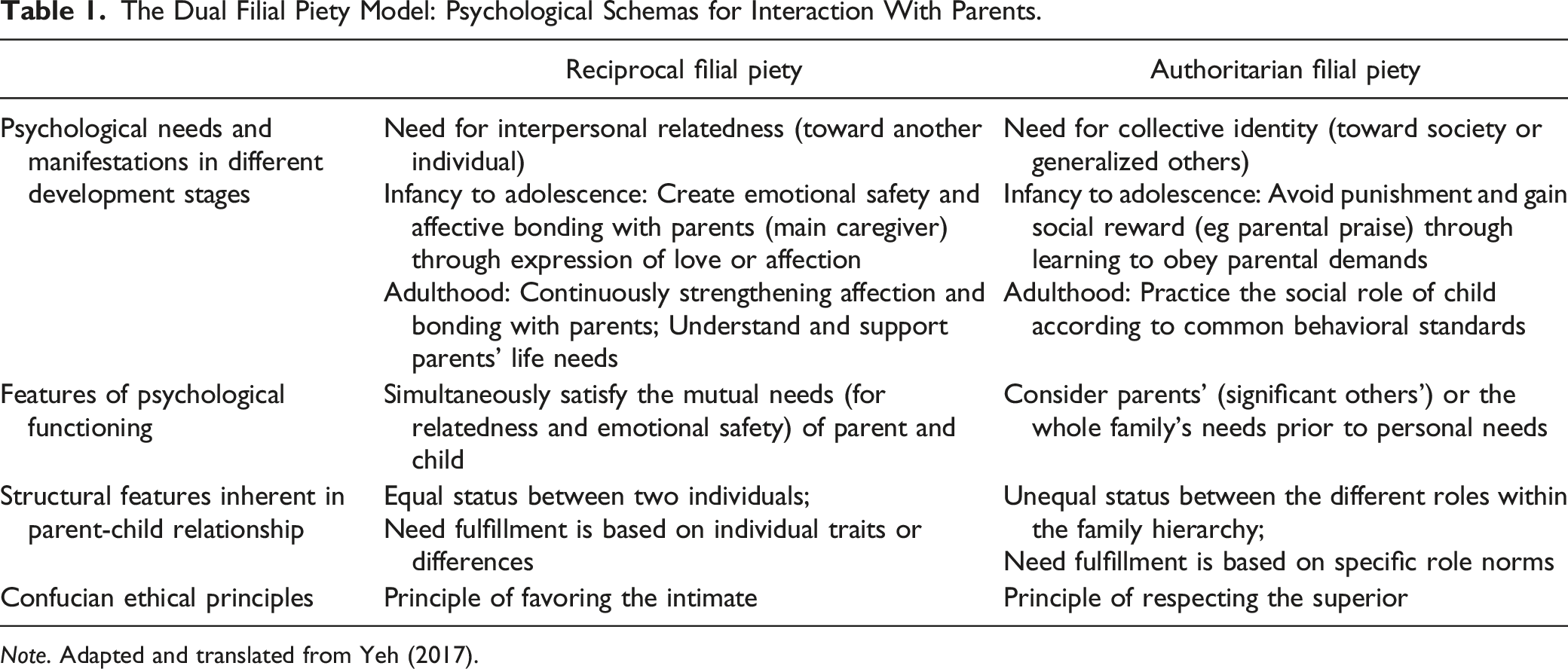
Note. Adapted and translated from Yeh (2017).
Table 1 summarizes the psychological features of the dual filial aspects. As a contextualized personality concept, the filial personality develops from infancy to adulthood and has an enduring influence on the individual’s interaction and relationship with his or her parents. Conceptualizing filial piety in terms of a psychological personality construct does not decrease its profound implications in Chinese culture. For example, RFP and AFP correspond respectively to two ethical principles in Confucianism: the principle of favoring the intimate (preferential treatment of parents out of gratitude for their affection, love, and selfless giving); and the principle of respecting the superior (to respect and obey parents’ demands because of their higher status in the family hierarchy) (see Yeh, 2017). Both RFP and AFP have the social function of sustaining family solidarity and the duty of elder care, but the mechanism underlying each aspect is distinctive at the individual level (Bedford & Yeh, 2019; Tsao & Yeh, 2017). From the perspective of filial personality, RFP facilitates intergenerational support for parents through the accumulation of affection; AFP does it by behavior regulation in order to meet the social expectations for the role of good children. Nevertheless, these two aspects of filial personality and their corresponding psychological functioning and mechanisms can be suitably applied to non-Chinese societies (Bedford & Yeh, 2021).
Theoretical Implications of the DFPM at Different Levels of Analysis.
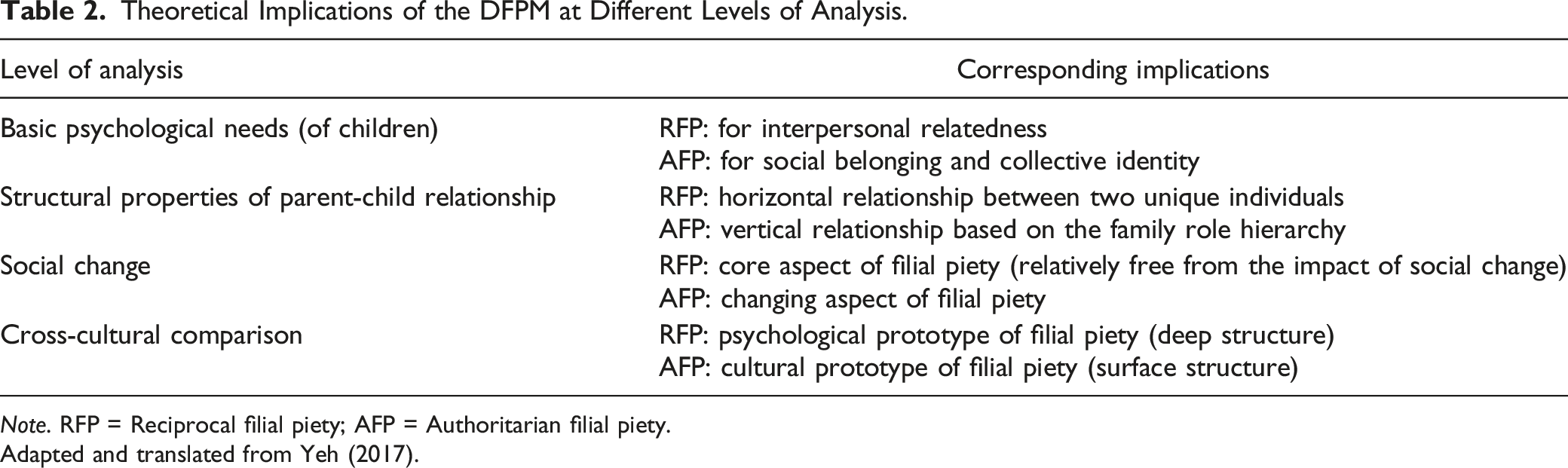
Note. RFP = Reciprocal filial piety; AFP = Authoritarian filial piety.
Adapted and translated from Yeh (2017).
Constructing a Comprehensive Indigenous Theory via a Multi-Scientific-Paradigm
Psychology is interdisciplinary. It simultaneously belongs to the natural sciences and the social sciences/humanities. Thus, this paper advocates the use of multiple scientific paradigms to construct indigenous theories to reconcile the debate between the empirical and predictive methodologies of the natural sciences and the critical and hermeneutic methodologies of the social sciences/humanities approach (Yeh, 2011; 2020).
Based on the reflective emic approach, an indigenous theory always contains some original construct or perspective identified through an initial criticism of the existing construct or perspective. When a researcher has created an indigenous construct to describe a phenomenon which has not yet been explained or investigated in the scientific community, there is great potential for the scholar to provide a nomological network (rationale of a hypothesis or prediction between/among constructs) for the indigenous construct with other existing variables, such as gender or age differences, or relationships between this construct and other psychological constructs (Cronbach & Meehl, 1955; Leary et al., 2013).
Whether the indigenous theory can survive depends not only on the acceptability of the rationale for the provided nomological network, but also on evidence supporting the hypotheses in the theory. These two aspects are not easy to achieve. However, they are easier to achieve if one adopts a multi-scientific-paradigm perspective that combines the three knowledge interests (analytical-predictive, communicative-hermeneutic, and critical-liberating) (Habermas, 1971). Use of a multiple scientific paradigm strategy is best for constructing indigenous theory.
For example, although the humanities and social sciences use communicative-hermeneutic and critical-liberating approaches as their core appeals, many social scientists or psychologists prefer to adopt an analytical-predictive and empirical approach to construct and verify their theoretical knowledge and viewpoints. When researchers want to create an original indigenous construct or theory, they should first adopt a critical-liberating approach to break through existing ideas and highlight new ideas or perspectives. The critical-liberating paradigm encourages researchers criticizing the present thinking style and trying new viewpoints to look into existing theories or constructs. However, for the critical argument to be accepted by the academic community, it still needs to convince colleagues and peers in a clear communicative way. At this point, a communicating-hermeneutic approach is needed. In addition, when researchers criticize and liberate existing psychological theories, they still need empirical evidence as a referent for their criticism and reflection; they cannot rely on subjective and aimless arguments. At this point, the analyzing-predicting approach is most appropriate.
There is no need to take existing theories and empirical evidence for granted, especially when knowledge of some existing theory or interpretation of some scientific empirical data involves epistemological violence. Epistemological violence refers to the knowledge of some existing theories or interpretation of scientific data on showing the inferiority of or problematizing some specific groups, even if the data allow for equally plausible alternative interpretations (Teo, 2010). Researchers can criticize or give new interpretations to existing theories and empirical evidence from new perspectives (Kao, 1982). In this way, innovative knowledge becomes possible and epistemological violence can be reduced. To maintain a critical scientific orientation to knowledge, the basis of critical discussion must encompass the analyzing-predictive and communicative-hermeneutic approaches. The implication is that when enacting a critical-liberating paradigm of knowledge, there can be no critical argument without the support of the analyzing-predicting and communicative-hermeneutic paradigms of knowledge.
The development of any scientific knowledge must preset some basic rules and commonly acceptable principles for communication, otherwise the rules for discussing knowledge cannot be established, the academic community cannot exist, and the innovation of scientific knowledge cannot occur. Only when scholars in the same field establish a consensus on communication and acceptable communication rules can they construct mutually understandable and discussable theories and models so that scientific knowledge can be explored and evolve. The implication is that acceptance of a critical argument by the academic community requires interpretive communication as a persuasive media. At the same time, a current consensus on rules about how to construct scientific knowledge cannot be proved or disproved only through analysis of empirical evidence—a new consensus can only be established through the communication and interpretation of members of the academic community. Even if the development of knowledge is based on analyzing and predicting empirical evidence, this knowledge cannot be established without communicating and interpreting it. Similarly, knowledge developed through interpreting and communicating cannot remain only in the consensus and tacit understanding of a few persons. It still needs to be expanded into some principles established through analyzing and predicting interests in order to be shared on a broader or global scale.
The three kinds of interest-oriented knowledge just described are not only complementary to one another, but also inseparable from the development of global knowledge or a comprehensive indigenous theory. In other words, constructing a comprehensive indigenous theory requires adopting a multi-scientific-paradigm perspective that combines critical-liberating, communicating-hermeneutic, and analyzing-predicting knowledge interests; each is indispensable.
Conclusion: An Enduring Process for Constructing a Comprehensive Indigenous Theory
The field of indigenous psychology is committed to constructing a knowledge system or theories that may reflect the influence of the surrounding social and cultural context. This is an enduring process of self-improvement and evolution because from a long-term viewpoint, the social and cultural context will change gradually over time. In order to reflect and fit into changes in the environmental context, established indigenous psychological knowledge systems or theoretical perspectives need to be adapted in accordance with these changes in the surrounding environment. With the premise of emphasizing the influence of context on the operating mechanisms of people’s thinking and behavior, encompassing this change by adapting knowledge and theories is even more necessary.
When initially created, a given indigenous psychological theory is usually limited to the perspective of a specific culture. In order to progresses to its next stage, it is necessary to expand and deepen the theory, and even evolve it to achieve universal application. To face and resolve the key demands of different stages of a comprehensive indigenous theory development requires adopting different research paradigm viewpoints. An ambitious indigenous psychologist needs to possess multiple research paradigms, so as to continuously refine and adjust established theories to fit changes in the external context and as well as the internal demands of expansion and application across nations.
Footnotes
Declaration of Conflicting Interests
The author(s) declared no potential conflicts of interest with respect to the research, authorship, and/or publication of this article.
Funding
The author(s) received no financial support for the research, authorship, and/or publication of this article.
