




Abstract
Background. Distressing imagery may inhibit health communications by inducing audiences to reduce distress by avoiding attention to persuasive messages. Method. This study used eye-tracking methods to compare gaze time allocated to a persuasive textual message, accompanied by either distressing high-resolution color images or less distressing two-color images with degraded outline and detail. Results. Participants in the distressing images condition showed lower intentions to reduce drinking in the following 3 months, which may have been mediated by lower gaze time to textual elements of the message. The effect was stronger in participants who both scored lower on dispositional mental disengagement and were more vulnerable to alcohol-related problems. Conclusions. These findings suggest that distressing imagery may inhibit persuasion by reducing audience attention to message components. Implications for message design are discussed.
In most national populations, mortality and morbidity patterns are heavily influenced by population prevalences of risk behaviors, such as smoking, drug and alcohol misuse, unsafe sexual practices, fat consumption, and physical inactivity (Kromhout, Bloemberg, Feskens, Menotti, & Nissinen, 2000). Many national and regional public health authorities use marketing approaches to deliver persuasive communications using print and electronic mass media, inclusion of messages on product packaging, or community-level interventions (Emery, Szczypka, Powell, & Chaloupka, 2007). A common tactic involves vivid and disturbing images of the outcomes of unhealthy or unsafe behaviors, including graphic portrayals of diseased organs, severe injuries, or severe pain (Slater, 1999). This approach is intended to both draw audience attention to messages (Baron, Logan, Lilly, Inman, & Brennan, 1994) and elicit an emotional response that contributes toward decisions to reduce risk behavior (Hill, Chapman, & Donovan, 1998).
However, the full potential of emotive message styles may not be realized because some audience members use various perceptual and cognitive defenses to avoid negative emotional responses (Blumberg, 2000; Ruiter, Abraham, & Kok, 2001). These defenses can reduce aversive emotion but may do so at the cost of inhibiting persuasion (Freeman, Hennessey, & Marzullo, 2001; Gleicher & Petty, 1992; Jemmott, Ditto, & Croyle, 1986). One defense, attentional avoidance, involves the allocation of attention away from messages that cause distress. Avoidance appears to operate with a high degree of immediacy and is triggered by stimuli that are both emotive and self-relevant (Mendolia, 1999). Use of avoidance causes weaker and less elaborate memory representations of threatening stimuli, which reduces their later accessibility (Hansen, Hansen, & Shantz 1992) and persuasiveness (Keller & Block, 1996).
There are theoretical reasons why attentional avoidance should be a particularly effective defense against overtly emotive stimuli. Dual-processing theories (Loewenstein, Weber, Hsee, & Welch, 2001; Slovic, Finucane, Peters, & MacGregor, 2003) describe an emotional form of information processing that is characterized by primary and automatic associations between stimuli and the emotional responses that they elicit. Avoidance responses appear to be automated, and their speed offers protection against emotive stimuli (Blumberg, 2000). There is some evidence for a link between emotive health stimuli and attentional avoidance. In an event-related potential study, Kessels, Ruiter, and Jansma (2010) showed smokers to have relatively lower P300 amplitudes when viewing distressing smoking-related images compared with less distressing images. Nonsmokers did not show this pattern. This suggests that smokers were more prepared than nonsmokers to disengage attention from distressing compared with less distressing, smoking-related images.
Two studies have examined the hypothesis that attentional avoidance mediates a negative relationship between distressing imagery and persuasion. Keller and Block (1996) instructed participants to process self-referent health messages in either an imaginative and visual way or an objective and detached manner. They found that participants in the imaginative condition showed less persuasion when confronted with a high- than low-threat message. This was mediated by poorer cognitive elaborations of the message, suggesting that participants avoided attending to it. Brown and Locker (2009) presented a textual message with highly distressing antialcohol medical imagery. Compared with a control condition, participants who were both heavier drinkers and scored higher on a denial coping scale read the message for less time and were consequently less persuaded that they were at risk of alcohol-related problems.
These studies do not provide direct evidence of avoidant processes. Keller and Block (1996) inferred avoidance through participants’ cognitive elaborations of stimulus material, whereas Brown and Locker (2009) relied on covert recordings of elapsed time between opening and closing a printed information pamphlet. Eye-tracking methods provide a direct and objective assessment of attention by mapping the direction of the participant’s gaze. In this study, we used eye tracking to examine whether distressing imagery reduces attentional allocation to a health message and whether this is related to persuasion.
Current Study
Alcohol misuse causes some of the most damaging health and social problems in the United Kingdom (Academy of Medical Sciences, 2004), and audiences can respond defensively to antialcohol messages (Brown & Locker, 2009; Leffingwell, Neumann, & Leedy, 2007). We presented two groups of participants with identical textual antialcohol messages, providing information concerning the risks of hazardous drinking and the benefits of reducing drinking. These were accompanied by either distressing medical images or the same images presented in a less distressing way.
One criticism of previous work is that researchers (e.g., Brown & Locker, 2009; Brown & Smith, 2007) use differing images to manipulate distress. This may be a particular problem in gaze-tracking studies, because differing images will have unique physical and semantic characteristics that affect their capacity to attract gaze, possibly confounding experimental effects. A better option is to present the same images in distressing and less distressing formats. Vividness and clarity are the key components of the risk perception process (Greening, Dollinger, & Pitz, 1996), and stimulus avoidance appears to be activated by vivid presentations (Hansen, Hansen, & Shantz, 1992). Thus, we chose to influence distress by manipulating the vividness and clarity of images.
However, vividness affects the processing of persuasive messages in other ways. When vivid components are message congruent, they can enhance persuasiveness (Smith & Shaffer, 2000). Conversely, vivid content can elicit counterargumentation (Keller & Block, 1997). Both effects run counter to our avoidance model because they predict either a different outcome (greater persuasion) or a different process (greater attention rather than attentional avoidance) and cannot be mistaken for avoidance effects. More concerning, a study by Frey and Eagly (1993) demonstrates that vivid stimuli may inhibit message persuasiveness because they distract attention from other message components, such as text. By definition, a distractor must attract and hold attention itself. On the face of it, this is incompatible with our avoidance view that audiences disengage from distressing stimuli. Nonetheless, we examined correlations between attention to images and text. Negative correlations between gaze time at images and text would suggest a distraction effect, which can be eliminated by statistically controlling image gaze time.
Hypotheses
We predicted that distressing images would reduce gaze allocated to accompanying persuasive textual messages, which would, in turn, inhibit persuasion, assessed by lower perceptions of alcohol-related risk (Brown & Locker, 2009), poorer evaluation of messages (Freeman et al., 2001), and lower intentions to reduce drinking. A defensiveness interpretation would be strengthened if avoidant responses are shown to be more prominent in participants who consistently employ defensive coping strategies (e.g., Brown & Locker, 2009). Using the dispositional mental disengagement scale of the COPE inventory (Carver, Scheier, & Weintraub, 1989), we expected that any avoidance effect caused by the manipulation would be greater in higher mental disengagement scorers. A defensiveness explanation also requires evidence that avoidance is stronger in participants who are more vulnerable to the threat (Brown & Locker, 2009; Kessels et al., 2010). Any avoidance effect should be facilitated by greater objective vulnerability to alcohol-related problems. Thus, we predicted that lower text gaze times would be associated with either a three-way or 2 two-way interactions between the distressing images condition and higher mental disengagement scores and Alcohol Use Disorders Identification Test (AUDIT) scores. This lower text gaze should then inhibit persuasion.
Method
Participants
Participants were staff and student drinkers at a U.K. university, recruited via personal approaches in public areas (n = 35) or through an electronic bulletin board (n = 65). Ethical clearance was obtained from that institution. Exclusions from the sample were only made for those who reported that they do not drink alcohol. Data were obtained from 31 males and 69 females with a mean age of 31.32 (SD = 9.12). A total of 49 reported drinking once per week or less, 39 reported drinking 2 to 3 times per week, and 12 reported drinking 4 or more times. In total, 36 reported drinking one to two drinks per session, 32 reported drinking three to four drinks, and 30 reported drinking four or more.
Materials
Antialcohol message
We used a computer-mounted presentation titled “The Menace of Alcohol” (used by Brown & Locker, 2009), consisting of 10 screens produced using MS PowerPoint and presented consecutively. GazeTracker™ (Eye Response Technologies, Charlottesville, Virginia) software was used to synchronize the screens with eye movement recordings. Participants were able to move forward, but not backward, through the screens at their own pace. Identical textual information was included in both conditions. Section 1 (269 words) consisted of three text-only screens providing a general introduction to the topic of alcohol misuse. The first explained that the materials are designed to encourage the drinker to consider reducing drinking and that all statements contained within are supported by reliable sources. The second and third screens defined alcohol misuse and government drinking guidelines and provided general information on the consequences of misuse (e.g., “alcohol affects alertness and judgment, therefore increasing the risk of falls and accidents”).
Section 2 (311 words) consisted of four screens providing information on specific health consequences: liver disease, vascular disease, cancer; pancreatic disease, traffic accidents, antisocial behavior, and skin disease. The proportional relationship between risk and alcohol consumption was emphasized. The text was accompanied by images of a male with a severely swollen liver visible outside the body, a male with a distended abdomen, a female with severe burns after a drunk driving accident, and a close-up image of a drinker with severe dermatitis. High-resolution color images were used to enhance negative emotion. The distressing nature of the images was reduced by using an ordered dither color reduction algorithm to create a two-color version with reduced clarity of detail.
An additional 20 students participated in a manipulation check. The color images were rated as being more distressing (distress mean = 3.70, SD = 1.34; nondistress mean = 1.90, SD = 1.10; t = 3.29, df = 18, p < .01) and vivid (distress mean = 4.10, SD = 1.29; nondistress mean = 2.20, SD = 1.23; t = 3.37, df = 18, p < .01). There were no differences for novelty (distress mean = 4.30, SD = 1.34; nondistress mean = 3.70, SD = 1.42; t = 0.97, df = 18, p = .343), interest (distress mean = 2.60, SD = 0.84; nondistress mean = 2.30, SD = 1.34; t = 0.60, df = 18, p = .556), attractiveness (distress mean = 1.90, SD = 0.74; nondistress mean = 2.10, SD = 0.99; t = 0.51, df = 18, p = .511), or personal relevance (distress mean = 3.10, SD = 0.99; nondistress mean = 2.70, SD = 0.68; t = 1.05, df = 18, p = .307).
Section 3 (309 words) encouraged drinkers to consider alcohol reduction and provided resources that could help them to do so. Statements described the increased risk faced by younger drinkers and the proximal and distal benefits of reducing consumption. References and contact details for further information on alcohol and health were provided. Section 3 text did not contain any imagery.
Eye movement–tracking apparatus
Eye movements were recorded using a Cambridge Systems Video Eyetracker Toolbox, an infrared reflection eye tracker that consists of a headrest that incorporates the camera, illumination, and optics, connected to a dual-screen RM 2.8GHz Pentium PC running Microsoft Windows 2000 Professional SP4. Stimulus presentation and data analysis were undertaken using the software package GazeTracker. Participants viewed stimuli on a 15-inch monitor placed directly in front and 47 cm away from their eye line.
Premanipulation questionnaire
We used a five-item version of the AUDIT to assess vulnerability to future alcohol-related problems. The AUDIT is a well-used and validated instrument that predicts future alcohol-related problems (Allen, Litten, Fertig, & Babor, 1997; Connigrave, Saunders, & Reznik, 1995). The version we used was developed for younger drinkers and tested on a British college sample (Miles, Winstock, & Strang, 2001). It is based on the frequency of drinking days, the quantities of alcohol drunk on those days, and the presence of drinking-related problems. The range of possible scores is 0 to 20 and Cronbach’s α is .71. We used the dispositional mental disengagement scale of the COPE (Carver et al., 1989) to assess disposition toward avoidant coping. The mental disengagement scale is associated with a lower uptake of preventive health behaviors and poorer illness outcomes (Burker, Evon, & Sedway, 2005; Gray & Hedge, 1999). This scale asks participants to state their usual coping responses to “difficult or stressful events” and consists of four items assessing individuals’ habitual use of mental disengagement (e.g., “I turn to work or other substitute activities to take my mind off things”). Scores are recorded on a 4-point scale with the following items: “I usually don’t do this at all,” “I usually do this a little bit,” “I usually do this a medium amount,” and “I usually do this a lot.” The range was 4 to 16, with higher scores representing greater disengagement. Reliability was poor, with Cronbach’s alpha of .56.
Postmanipulation questionnaire
Outcome variables were chosen because they had been shown to be sensitive to defensive processing in previous studies. Participants were asked to evaluate the pamphlet on the following dimensions: persuasive/not persuasive, bad/good, clever/stupid, and not effective/effective on a 7-point scale from −3 to 3 (Brown & Smith, 2007; Freeman et al., 2001). Scale range was −12 to 12 with positive scores denoting positive evaluations. The scale showed Cronbach’s α of .96. Drinking-related risk perceptions were measured on a scale developed by Brown and Morley (2007) and used by Brown and Locker (2009). Participants rated the likelihood of their ever experiencing eight outcomes (e.g., “becoming addicted to alcohol”). Estimates were rated on a 7-point Likert-type scale anchored by the terms no chance and certain, with higher scores denoting greater risk. Cronbach’s alpha was .88. Intentions to reduce drinking were measured using two items pertaining to whether participants intended or were willing to reduce drinking in the next 3 months (e.g., “To what extent are you willing to reduce drinking in the next three months?”). Responses were made on a 7-point Likert-type scale anchored by the terms not at all and completely. Correlation between the two items was .51.
Procedure
A cover story, provided during recruitment, stated that the research was intended to test audience acceptability of antialcohol messages. Posttest debriefing confirmed that participants believed this. Participants completed the pretest questionnaire, were introduced to the apparatus, performed a familiarization task, were exposed to the message, and completed the posttest questionnaire. These tasks were performed consecutively, although a 5- to 10-minute break between the pretest and introduction to the apparatus was taken to set up the eye-tracking equipment. Paper-based pretest questionnaires contained demographic information and the AUDIT and mental disengagement scales. A randomizer program was used to assign 50 participants to each condition. They were then seated at the eye movement–recording equipment, the function of which was explained and a demonstration made. To familiarize themselves with the task and equipment, participants were given a practice trial using non–health-related illustrated material. This trial was also used to calibrate the eye tracker. They were told that they were not expected to attend to any aspect that they did not wish to. The message was then presented and gaze time recorded for each section. Participants subsequently completed questionnaires relating to their perceptions of the message, risk estimates, and intentions.
Derivation of eye-tracking data
Data processing was handled by the GazeTracker software. The raw data were the x, y position of participant gaze on each slide every 20 milliseconds. The GazeTracker software calculated the total gaze time spent examining the text or image through the use of “look zones” corresponding to text and images. The look zones were determined by the experimenter for each slide using the mouse to outline the desired area. Thirty-five percent of gaze time was unaccounted for, almost entirely because participants gazed outside the text and image look zones. Attentional avoidance processes cannot be differentiated from mere inattention, and it is difficult to ascribe theoretical meaning to this. It is important to determine whether unaccounted gaze could confound the interpretation of study results. We conducted t tests on unaccounted time for each screen by experimental condition, finding no bias to either condition. We also computed correlations with mental disengagement and AUDIT scores. None were significant.
Results
Preliminary analyses were conducted to identify the optimal combination of variables for causal modeling. MacKinnon, Fairchild, and Fritz (2007) suggest that a precondition of mediation is that the independent variable be associated with both the outcome 1 and putative mediator and that the mediator is associated with the outcome. Multivariate analyses were used to apply a single significance test. A multivariate analysis of variance showed an experimental effect on a linear combination of intentions to reduce drinking, message evaluation, and risk perceptions, F(4, 95) = 2.70, p < .05, r = .30. Table 1 shows means and effect sizes, the largest effect being higher intentions to reduce drinking in the nondistressing image condition. We used intention to reduce drinking as the outcome variable in the causal analysis.
Means and SDs (in Parentheses) of Outcome Variables and Gaze Time (in Seconds) by Condition
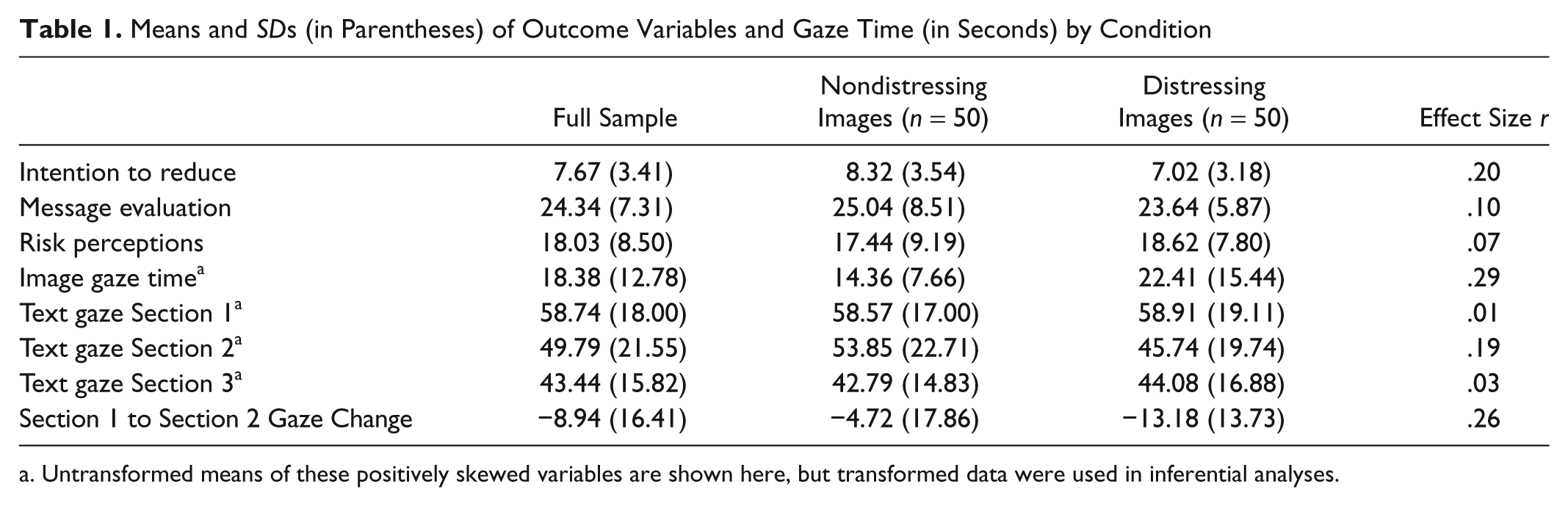
Untransformed means of these positively skewed variables are shown here, but transformed data were used in inferential analyses.
Another multivariate analysis of variance was conducted to assess the direct effect of the experimental manipulation on a linear combination of Sections 1, 2, and 3 gaze times. 2 A significant multivariate effect was observed, F(4, 95) = 4.51, p < .01, r = .28. Table 1 shows that, as would be expected, the experimental condition had no effect on Section 1 text time. Greater gaze time was allocated to Section 2 text (which contained images) in the nondistressing images condition, but no differences were detected for Section 3 (which did not contain images). To reduce variance attributable to individual differences in overall gaze time, we computed a change score by subtracting the Section 1 text gaze time from Section 2 gaze time. Table 1 shows greater Section 1 to Section 2 text gaze reductions in the distressing images condition. A final precondition of mediation is that the mediator is associated with the outcome. Both Section 2 text gaze and Section 1 to Section 2 gaze changes were correlated with intention (r = .26 and r = .21, respectively; df = 98, p < .05).
Table 1 shows that greater gaze time was allocated to the images in the distressing images condition. This raises the possibility that the experimental effect on text gaze was caused by the vivid images distracting attention from the text. However, there were no correlations between image gaze time and Section 2 text gaze time, r(98) = −0.10; Section 3 text gaze time, r(98) = −0.06, p = .430; Section 1 to Section 2 gaze time changes, r(98) = −0.08, p = .414; or intention, r(98) = −0.03, p = .749. This suggests that allocation of attention to images did not occur at the expense of text as would be predicted by a distraction explanation.
Causal Analysis
A structural model was constructed to test the proposition that text gaze and changes in text gaze mediate any effect of the experimental manipulation on intentions to reduce drinking and that any gaze reduction is facilitated by higher vulnerability and denial scores. Three two-way and 1 three-way interaction effects were created by computing the products of condition (coded as 0 = nonemotive message, 1 = emotive message) and centered AUDIT and mental disengagement scores. We used two structural models, using either Section 2 text gaze or Section 1 to Section 2 gaze changes as mediators (Figures 1 and 2). Separate facilitation of the mediational path by mental disengagement or audit scores would be suggested by prediction of gaze or gaze change by either or both of the two-way interaction terms involving condition. Prediction by the three-way interaction suggests facilitation or moderation of experimental effects by a combination of mental disengagement and AUDIT.
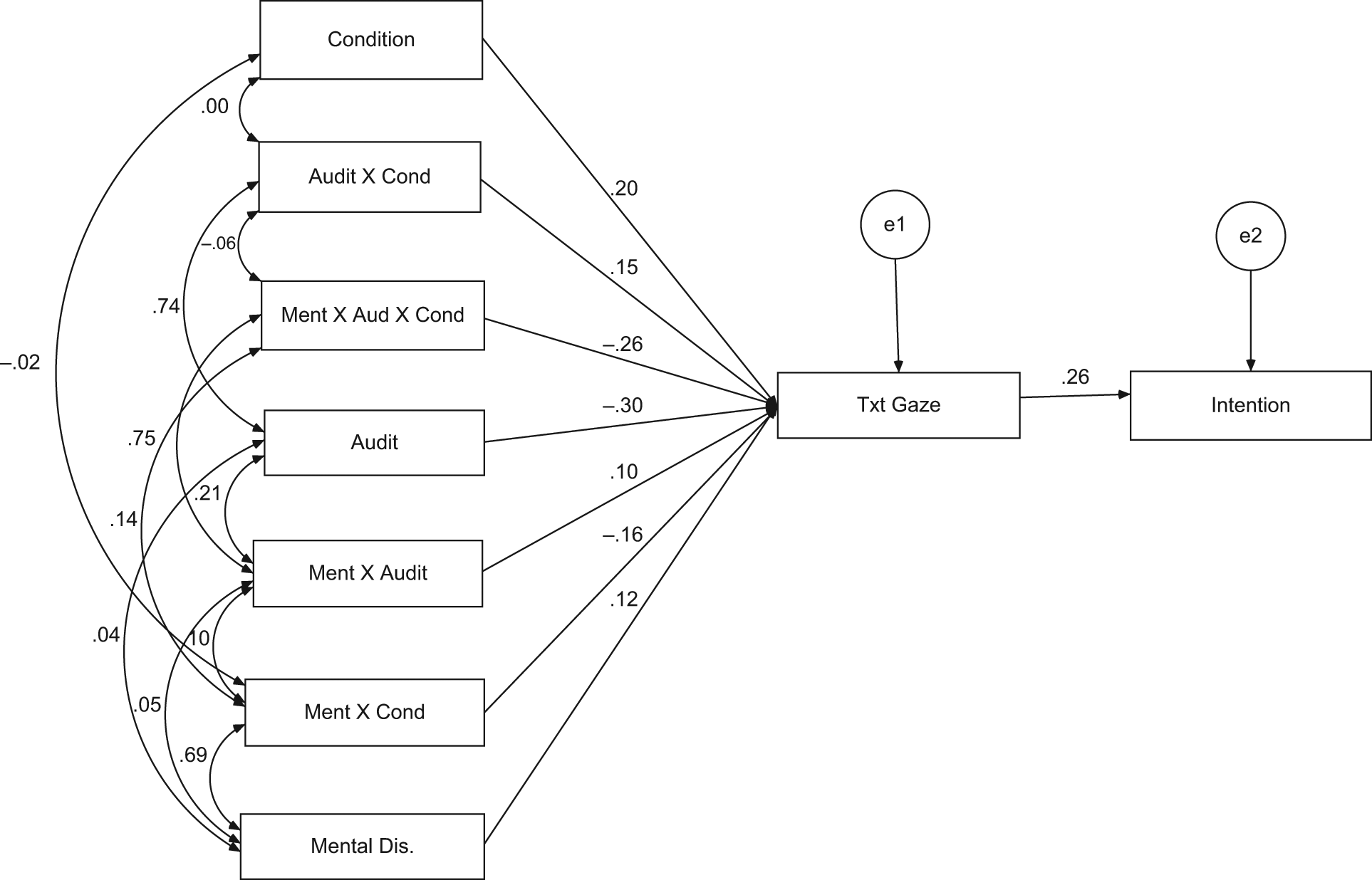
Structural model with Section 2 text gaze as the mediator variable
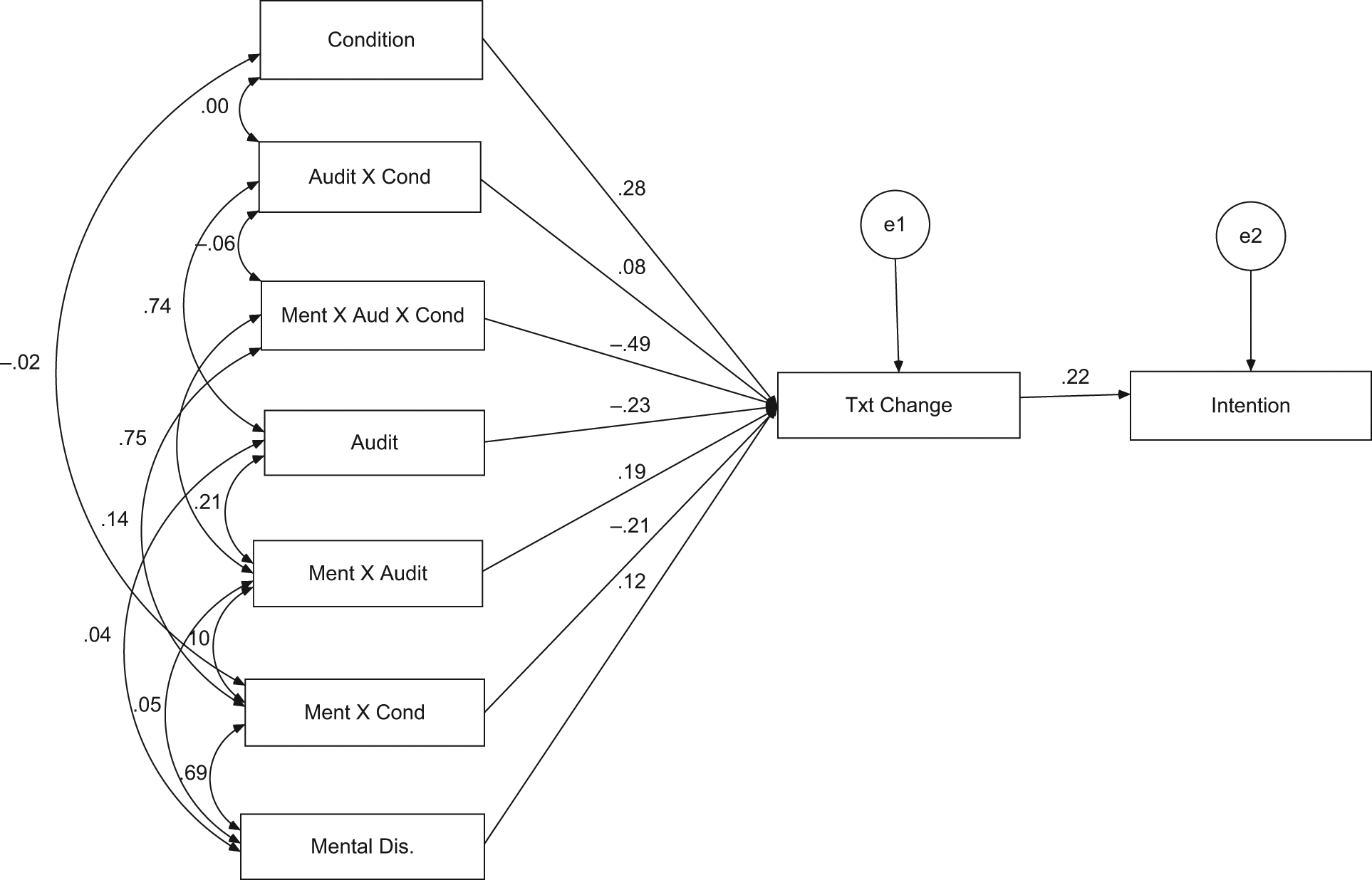
Structural model with Section 1 to Section 2 text gaze change (increase) as the mediator variable
When the duration of Section 2 text gaze was used as a mediator, a maximum likelihood model showed good fit to the data, χ2 = 18.84, df = 17, p < .01, root mean square error of approximation (RMSEA) = .030 (90% confidence limit [CL] = 0.000, 0.100), comparative fit index (CFI) = .992. Parameter estimations are presented in Figure 1, showing that text gaze was greater in the nondistressing images condition, p < .01, and that text gaze was positively related to intentions to reduce drinking, p < .05. This is consistent with an indirect path between the presentation of distressing images and lower intentions, mediated by greater text gaze. Neither mental disengagement nor AUDIT scores influenced the above path. Text gaze was not predicted by the three-way interaction, p = .080; or by any of the two-way interactions involving condition: mental disengagement p = .199, AUDIT p = .408.
The model specifying Section 1 to Section 2 text gaze change as a mediator (Figure 2) also showed good fit to the data, χ2 = 18.10, df = 17, p < .01, RMSEA = .025 (90% CL = 0.000, 0.960), CFI=.996; and suggests that an indirect relationship between exposure to distressing images and lower intention was mediated by lower Section 1 to Section 2 text gaze changes. Gaze was also predicted by the three-way interaction modeled by condition, mental disengagement, and AUDIT, suggesting that the above path was influenced by a combination of mental disengagement and AUDIT scores.
We used simple slopes analyses (Aiken & West, 1991) to probe the three-way interaction. Four slopes were calculated, representing the regression of condition onto Section 1 to Section 2 gaze change at one standard deviation above and below the mean for mental disengagement (±2.50) and AUDIT (±2.41). The slopes are presented in Figure 3, showing that the experimental manipulation had its greatest effect on gaze times in lower mental disengagement and higher AUDIT scorers. These participants showed the least deterioration in text gaze times between Sections 1 and 2 (with some showing a slight increase) in the nondistressing images condition but were among those who showed some of the greatest decreases in the distressing images condition.

Interaction between condition and mental disengagement predicting changes in text gaze time (in seconds) between Sections 1 and 2
Predictors of Section 2 to Section 3 Changes in Text Gaze
The experimental effect on text gaze did not extend to Section 3 text. It is relevant to determine whether this represents participants returning their attention to Section 3 after reducing attention to Sections 2 text. To test this hypothesis, we computed a Section 2 to Section 3 text gaze increase variable by subtracting Section 2 text gaze time from Section 3. This was regressed onto Section 1 text gaze, Section 1 to Section 2 text increase, condition, mental disengagement, AUDIT, and the two- and three-way interaction variables. The regression was significant, R2 = .66, df = 9,90, p < .01. Significant multivariate predictors were Section 1 gaze, β = −.27, p = .01; Section 1 to Section 2 increase, β −.80, p = .01; and AUDIT, β = .23, p = .05. This suggests that the effects of the distressing imagery were only temporary, with those affected by the manipulation returning their attention to the remainder of the message.
Discussion
We examined the effect of distressing imagery on gaze allocation to text in an antialcohol health message and the resultant effect of gaze on persuasion. Consistent with predictions, the message containing distressing images was associated with lower intentions to reduce drinking within 3 months, mediated by less gaze times at the text accompanying those images. The experimental effect on test gaze times persisted only for as long as the images were present. Participants also allocated greater gaze times to the distressing images, but the lack of correlation between image gaze time and text gaze time suggests that this did not distract them from the text. The effect of the experimental manipulation on text gaze time was greater among participants scoring both higher on an objective measure of vulnerability to alcohol-related health problems and lower on a measure of mental disengagement coping style.
These findings are consistent with those of previous studies finding that distressing imagery reduced participants’ attention to messages. Rather than using indirect measures of attentional allocation, such as message elaboration (Keller & Block, 1996) or lower reading times (Brown & Locker, 2009), we used a direct and objective measure of attention. Thus, we can provide support to the idea that distressing imagery can inhibit attention to the text that reduces the persuasiveness of health messages.
One alternative explanation may be that the nondistressing images were not sufficiently interesting to hold attention, and participants increased gaze at text by default. We are unconvinced by this for two reasons. First, this view would be valid if viewing times were fixed. However, participants were able to move (forward) between screens and were informed that they did not have to look at components that they did not wish to. Second, similar to the distraction explanation dealt with earlier, this interpretation would suggest a negative correlation between the image and Section 3 text gaze times. This was not observed.
To test a defensiveness interpretation, we predicted that the experimental effect would be greater in participants who commonly use a defensive coping strategy (mental disengagement) and those with greater vulnerability to alcohol-related problems. However, the interaction differed from our prediction. Rather than high mental disengagement and high vulnerability facilitating higher Section 1 to Section 2 gaze reductions, a combination of low disengagement and high vulnerability was associated with the least reduction. One interpretation is that images (or the combination of images and text) induced attentional disengagement in all participants except those with both an interest in the message (vulnerable participants) and those who are resistant to disengagement. Thus, it could be argued that the effect of the distressing images in reducing text gaze time broadly supports a defensive interpretation.
However, this interpretation has several problems. First, the mental disengagement findings must be viewed as somewhat untrustworthy because of the poor reliability of the measure. Thus, effects may be attributable to either defensive disengagement or other constructs such as general uninvolvement. Second, it is not clear why high disengagement/high vulnerability scorers were not also affected by the experimental manipulation. One possible explanation for this is that defensive responses are inherently self-limiting and do not increase beyond a certain point. Several researchers have noted that people limit defensive responses because their value declines as the defensive intention becomes more obvious to themselves and others (Baumeister & Cairns, 1992; Lundgren & Prislin, 1998). Thus, we suggest that the moderation analysis provides some support for a defensiveness interpretation, but this evidence is weaker than what would have been provided had the original hypothesis been fully supported and the mental disengagement measure been more reliable.
We also found that greater gaze time was allocated to distressing than nondistressing images. It is not clear whether this is a function of any emotive response that the images invoked or whether participants simply preferred them to the more pallid control images. This creates a paradox, whereby we infer that distressing images stimulate an attentional avoidance response but they attract greater attention. Lang (2000) suggests that emotive stimuli have survival value, which attracts attention and increases the resources that people allocate to encoding and storing stimulus components. This is of interest to researchers but needs to be reconciled with studies showing attentional disengagement from distressing stimuli (e.g., Kessels et al., 2010). It should be noted that this is epiphenomenal to the text avoidance effect observed in this study.
Limitations
We used a convenience sample of participants from a university population, with the majority being self-selected. This has obvious problems in generalizing to the wider population, and findings may be particularly distorted by self-selection in participants with an interest in alcohol or health issues. One possible distortion caused by the self-selection process is that our sample may consist of participants who are interested in health issues and are ready to consider change. Another barrier to generalization, and one that affects the majority of research on defensive responses to health messages, is that the implicit social demands and physical environment of the laboratory and the single presentation of a message with forewarning of persuasive intent do not provide a strong representation of the world in which people experience health messages. Work is needed to test the generalizability of findings.
The 35% of unaccounted time (where the apparatus cannot track gaze or gaze is outside image and text zones) is concerning. Most of this will represent time spent outside the look zones, which may suggest a lack of involvement with the experiment. Any uninvolvement can be confused with avoidance, meaning that avoidance cannot be measured in an absolute sense. However, uninvolvement cannot be confused with experimentally induced avoidance, as it is not correlated with condition, mental disengagement, or vulnerability. Thus, low involvement is unlikely to confound our findings.
Using eye-tracking methodology, we were able to objectively measure gaze. However, gaze cannot entirely be taken as direct measure of information processing. electroencephalograms (e.g., Kessels et al., 2010) or neuroimaging indicators of attention would be useful. In particular, we cannot discriminate reading from mere gaze at the text. We also did not examine other known correlates of attentional avoidance, such as physiological and behavioral indicators of anxiety (Derakshan, Eysenck, & Myers, 2007). These could be incorporated into future research programs. Also, much remains to be understood about the nature of the avoidance response itself. In particular, we cannot provide insight into the extent to which this is an automated or deliberative response (Mendolia, 1999).
Implications for Practice
These findings have implications for the use of imagery alongside textual information in persuasion campaigns, but they need to be considered within the constraints of the methods used. We used a long and detailed message, finding that distressing imagery has a short-term inhibitory effect on attention to the text and subsequent persuasion. It is difficult to generalize this to shorter messages, slogans, or the use of imagery alone. Some theoretical models suggest emotional stimuli are processed separately but interactively with analytic material (e.g., Witte, 1992), which implies that images might elicit emotional responses that contribute directly to persuasion, without the need for textual messages. However, we note that other researchers have shown that presentations of distressing imagery alone facilitate attentional disengagement (Kessels et al., 2010).
Advertisers might be advised to be sparing with the use of material that is likely to create negative emotional responses in those to whom the message is relevant. However, such a recommendation must heed the view that distressing imagery does not always elicit avoidant responses (Baron et al., 1994). Moreover, negative emotion often increases persuasion (Witte & Allen, 2000), and emotive imagery is an effective means of eliciting this. Thus, it can be difficult to know in advance what responses a message might engender. Given this uncertainty, a first step in overcoming resistance processes is to explicitly search for them when testing advertising campaigns. Most campaigns undergo formative testing in front of audiences, who give qualitative feedback. Skilled interviewers can uncover message components that elicit avoidance.
An obvious issue pertains to the identification of factors that determine whether emotive imagery is or is not effective. Block and Keller (1997) found their effect to be moderated by self-efficacy. Brown and Locker (2009) found that distressing images reduce risk perception only among those with high vulnerability and those who report more regular use of denial as a coping strategy. Klein and Harris (2009) showed that a self-affirmation treatment moderated defensive responses to emotive imagery specifically by reducing the tendency for attentional disengagement.
In terms of improving the effectiveness of health messages, it is important to identify moderators that can be incorporated into a message. One well-known strategy is to provide clear and easily implemented behavioral recommendations (Job, 1988). As attentional avoidance processes appear to show automated characteristics (Mendolia, 1999), this would need to precede, rather than follow, the delivery of distressing images. Gleicher and Petty (1992) improved persuasion by reassuring participants about the efficacy of remedial actions before presenting a fear-arousing textual threat, although they did not specifically apply this to attentional avoidance. We found that experimental effect on text gaze time in this study persisted only while the images were present. Another strategy could be to separate emotive imagery from key informational components of the message and place it at a point where it precedes or follows information that communicators wish audiences to elaborate. This approach is untested but may be worth consideration in future research.
The possible negative implications of using emotive images for the presentation of public health messages should be carefully considered. We found that images created attentional avoidance effects that appear to inhibit persuasion. However, imagery can also be of critical importance in attracting attention to messages in a competitive environment, and further investigations are required to better understand the nature and implications of avoidance processes and message-related factors that moderate their effects.
Footnotes
The authors declared no potential conflicts of interests with respect to the research, authorship, and/or publication of this article.
The authors disclosed receipt of the following financial support for the research, authorship, and/or publication of this article:
The University of Derby provided funding for the conduct of this study.