



Abstract
This article examines constructs, propositions, and assumptions of the extended parallel process model (EPPM). Review of the EPPM literature reveals that its theoretical concepts are thoroughly developed, but the theory lacks consistency in operational definitions of some of its constructs. Out of the 12 propositions of the EPPM, a few have not been tested explicitly and not a single one received unequivocal empirical support. This article proposes alternative operationalization for some of the constructs and examines some assumptions of this theory, such as additive relationship between the constructs, the role of time and issue of thresholds, and disregard for the existing state of the audience. Finally, the role of the EPPM as a potential foundation for a general theory of negative emotional appeals is addressed.
Keywords
Scaring people to motivate them to change their behavior has been practiced for millennia. Systematic empirical investigation of fear appeals, on the other hand, is less than 60 years old (Dillard, 1994). Since the 1950s, several theories have been proposed to explain the processing and effects of fear appeal messages, and the extended parallel process model (EPPM; Witte, 1992) is one of the latest developments in this area. The EPPM integrates previous research on fear appeals in an attempt to answer a long-standing question of why fear appeals sometimes fail and sometimes succeed.
The EPPM has many strong points that make it appealing to both scholars and practitioners of public communication campaigns. It was able to reconcile contradictory predictions and findings of its predecessors, it has an elegant and easy to understand structure, it is useful in guiding many decisions of public communication campaigns, and it served as a foundation for more than 50 empirical studies (Witte, Girma, & Girgre, 2003).
But has the EPPM been supported to the extent it is assumed? A closer examination of the EPPM research—presented in this article—demonstrates that contrary to the common beliefs, none of the EPPM’s propositions received unequivocal support, some important assumptions remained unexamined, and the same constructs were measured in various ways in different studies making it difficult to pinpoint the explanation for disparate findings. The EPPM can still illuminate a great deal about responses to fear appeals if additional and more rigorous tests of the theory are undertaken with consideration for the diverse findings of past research.
This article is organized in five sections. First, the EPPM is introduced through the brief history of its theoretical development. Second, the conceptual and operational definitions of the 11 constructs are presented. Third, research on each of the 12 propositions is summarized. Fourth, the assumptions underlying the EPPM are discussed. Finally, the last section provides recommendations for extending the model into the foundation for the covering law theory of negative emotions and persuasion.
Brief Genealogy of the EPPM
The EPPM borrows heavily from its three ancestors: fear-as-acquired drive model (Hovland, Janis, & Kelly, 1953), parallel process model (Leventhal, 1970), and protection motivation theory (PMT; Rogers, 1975, 1983). This section outlines the main postulates of each of these theories (for more detailed account of the history of fear appeals research, see Dillard, 1994; Witte, 1992). The overall organization of the EPPM is presented in Figure 1.
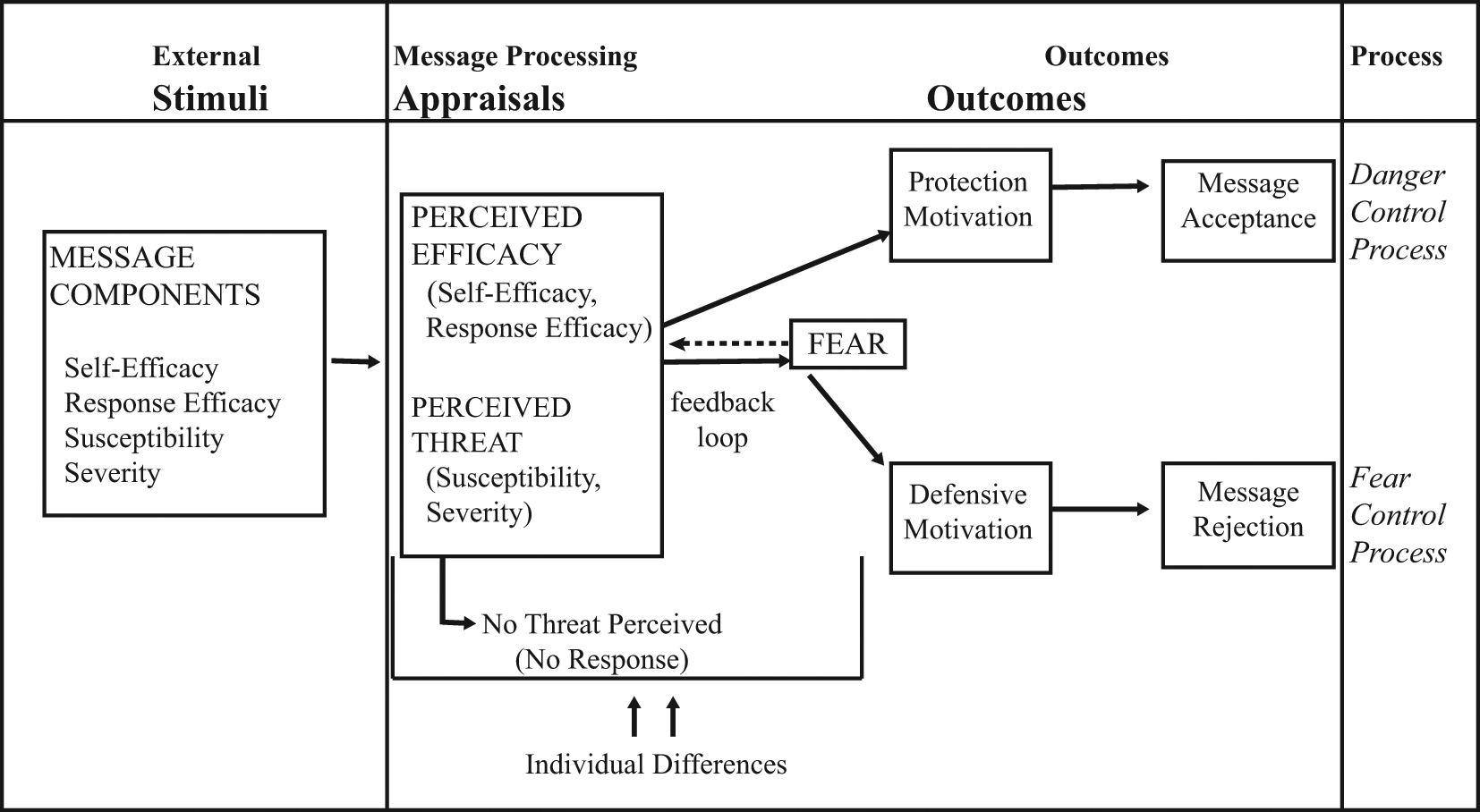
The extended parallel process model
Fear-as-acquired drive model (Hovland et al., 1953) comes from the family of learning theories, which tried to explain human behavior in terms of learned responses and subsequent rewards. This model posited that people have to first learn to fear a threat and then they will become motivated to reduce the unpleasant state of fear by taking some action. If an action resulted in reduction of the unpleasant state (fear), then this action became a habitual response to the threat. In the future, whenever people were faced with a similar threat, they would resort to the habitual response because of the rewards it offers in a form of reduced fear. Hovland et al. (1953) noted that fear could be reduced either by “adaptive” action in accordance with “reassuring recommendations” or by “maladaptive” defensive avoidance. The choice between the two actions was explained by the amount of fear. Janis (1967) proposed a family-of-curves model (representing inverted U-shapes), arguing that the optimal level of fear is moderate, and increase in fear would increase maladaptive responses, such as defensive avoidance. However, no empirical support was found for the curvilinear inverted U-shape relationship between fear levels and message acceptance (e.g., Leventhal, 1970; Rogers & Deckner, 1975), and the researchers generally abandoned this theory. From this model, the EPPM (Witte, 1992) inherited the maladaptive responses and used them to describe what happens when individuals are in fear control mode. In addition, the EPPM’s Proposition 5 is reminiscent of Janis’s (1967) inverted U-shaped curves. The idea that sometimes greater fear leads not to greater message acceptance but to message rejection stems from this theory. The unique contribution of the EPPM is its specification of the conditions under which this occurs.
With the ascendance of cognitive revolution in social sciences (Greenwood, 1999), attention in fear appeals research shifted from emotional processing to cognitive processing. Leventhal (1970) extended the ideas of the duality of responses proposed by the fear-as-acquired drive model. His parallel process model (originally dubbed “parallel response model”) distinguished between two independent reactions to fear appeals: (a) a primarily cognitive, danger control process, resulting in thoughts about threat and actions to avert it, and (b) a primarily emotional, fear control process, resulting in people controlling their fear through denial, avoidance, reactance, and so on. However, this model did not explain when and why each of the processes is evoked. The EPPM used the parallel process model as its overall explanatory framework and extended it (hence the name “extended parallel process model”) by specifying some of the determinants of the two reactions to fear appeals.
Protection motivation theory (PMT; Rogers, 1975, 1983) built on the parallel process model but specifically focused on the danger control response. Rogers (1975, 1983) extracted four components of a threat message: probability of occurrence of a threat, magnitude of a threat, effectiveness of a recommended response, and (added at a later time) one’s ability to perform a recommended response. These four message components were supposed to evoke corresponding cognitions: one’s vulnerability to the threat, severity of a threat, assessment of response efficacy, and self-efficacy. High levels of all four cognitions produced the highest protection motivation resulting in the greatest amount of adaptive change in attitudes and behavior. The EPPM incorporated the PMT into the danger control side of the model.
Constructs of the EPPM
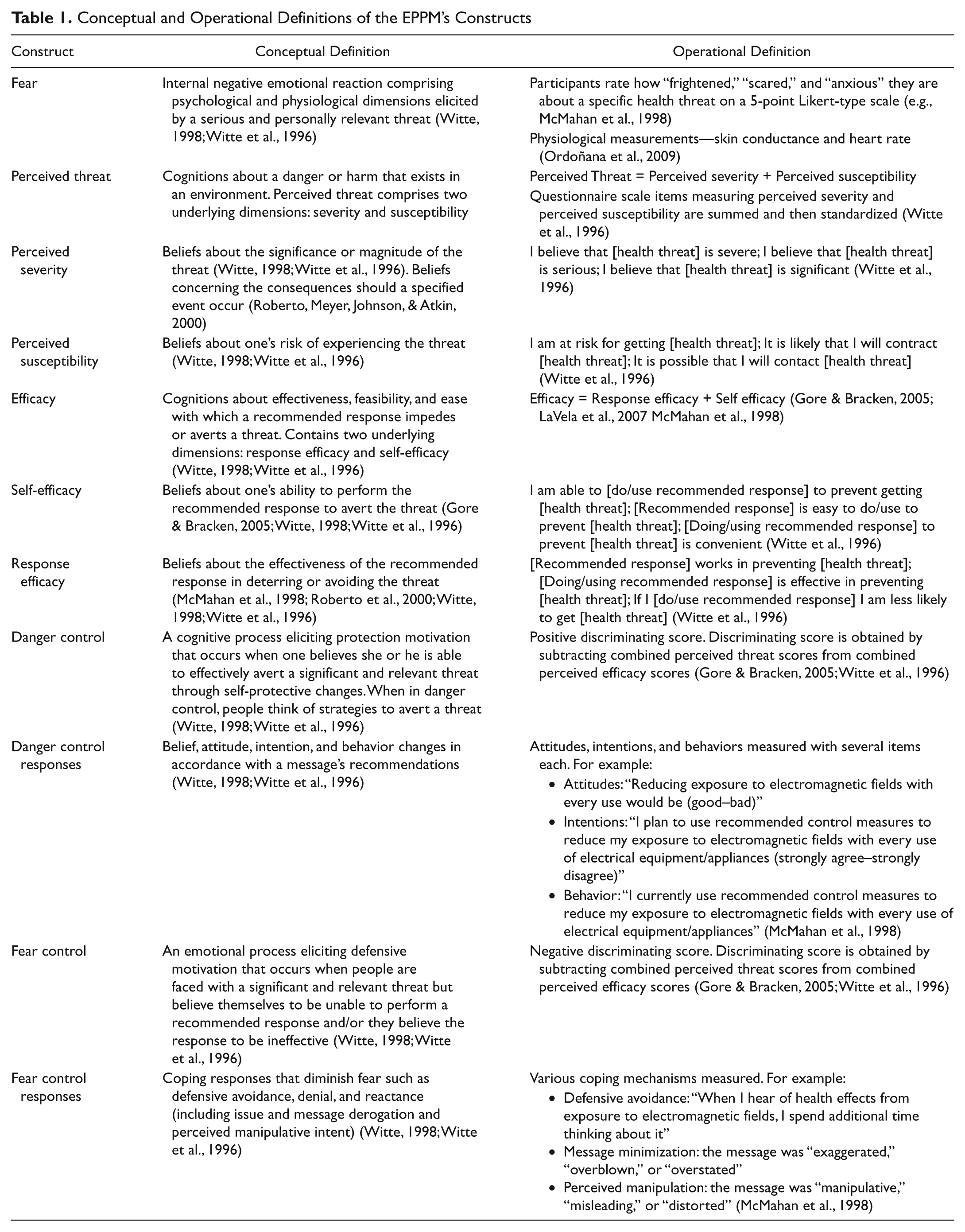
The following constructs are central to the EPPM: fear, threat (with its two components—perceived severity and perceived susceptibility), efficacy (comprising self-efficacy and response efficacy), and two types of responses (danger control and fear control). The ways in which they have been conceptualized and measured in empirical tests of the EPPM are summarized in Table 1. The following discussion provides a more detailed review and critique of the conceptual and operational definitions of the EPPM’s constructs.
Conceptual and Operational Definitions of the EPPM’s Constructs
Fear
Fear is conceptualized as a negative emotional reaction to a perceived threat. Some studies provide an explicit definition of fear (Gore & Bracken, 2005; Witte, 1998; Witte, Cameron, McKeon, & Berkowitz, 1996), whereas others treat fear as a primitive concept (McMahan, Witte, & Meyer, 1998; R. A. Smith, Ferrara, & Witte, 2007). When fear is measured in an empirical study, it is usually assessed by participants indicating how “frightened,” “scared,” and “anxious” they are about a specific health threat (e.g., McMahan et al., 1998). At least one study assessed fear through physiological measurements—changes in skin conductance and heart rate (Ordoñana, González-Javier, Espín-López, & Gómez-Amor, 2009). However, a fear-arousing message could produce diverse physiological reactions such as fight, flight, freezing, or simply increased attention depending on the situational and individual differences (Bradley & Lang, 2007). Witte (1992) used self-reports of fear precisely because self-repot items evaluated the subjective experience of fear, which fit her conceptualization of fear. In addition, Mewborn and Rogers (1979) found that physiological (cardiovascular and electrodermal) and self-report measures of fear were correlated. Furthermore, because they observed interactive effects of time and reassurance only on self-report—but not physiological—measures of fear, they suggested that “the verbal measure may be more sensitive than heart rate or skin conductance” (Mewborn & Rogers, 1979, p. 250). Therefore, for the purpose of measuring fear as a result of the EPPM-based interventions, self-report measures of fear have the highest utility because they have high validity and are the easiest to administer.
Threat
The EPPM conceptually distinguishes between threat as a message component and perceived threat (see Figure 1). Threat as a message component comprises message features that provide factual or visual information about the severity of the threat and the target population’s susceptibility to the threat. Both severity and susceptibility of the threat as message features are often manipulated in experimental studies. For example, in the high threat condition, AIDS was described using vivid language (“On admission, the patient complained of fatigue and bleeding, oozing sores all over his body”), and personal susceptibility was emphasized by presenting rates of HIV in college students (Witte, 1994). In comparison, the low threat condition contained neutral language (“On admission, the patient complained of fatigue and a rash”) and described how AIDS affects the noncollege age-group, particularly in Africa (Witte, 1994). The EPPM posits that message threat causes perceived threat (Witte, 1992).
Perceived threat is the subjective evaluation of the threat contained in the message. Perceived threat is a cognitive construct that comprises two dimensions: perceived severity of the threat and one’s perceived susceptibility to the threat. Perceived severity is beliefs about the magnitude or significance of the threat and the gravity of its consequences. Even though it has been defined in terms of emotions, for example, “one’s feelings concerning the seriousness” of a threatening event (Gore & Bracken, 2005, p. 29), perceived severity refers to cognitions and not emotions. To measure perceived severity, participants rate how “serious,” “significant,” and “severe” a threat is (Witte et al., 1996). Perceived susceptibility is beliefs about the probability of personally experiencing the threat (Witte, 1998; Witte et al., 1996). Perceived susceptibility is measured by items such as “I am at risk for getting [health threat]” (Witte et al., 1996). To obtain the overall index of perceived threat, the answers to perceived severity and susceptibility questions are usually summed up.
The conceptual difference between threat as a message characteristic and perceived threat is often overlooked in practice. This conflation is not a problem because manipulation checks—that are usually performed—reveal that, in general, messages designed as high threat elicit higher levels of perceived severity and susceptibility (e.g., Witte, 1994). Likewise, meta-analyses found that level of threat or fear in the message is consistently related to perceived threat or perceived fear (Boster & Mongeau, 1984; Witte & Allen,2000). However, in the study by Dillard, Plotnick, Godbold, Freimuth, and Edgar (1996), only 61% (19 of 31) of the fear-arousing public service announcements actually increased self-reported fear. Therefore, researchers need to measure both fear and perceived threat, perform manipulation checks, and assess effects of perceived threat on outcome variables, which will be further discussed in the section on the EPPM propositions.
Efficacy
As is the case with threat, the EPPM conceptually distinguishes between efficacy as a message characteristic and perceived efficacy (Witte, 1992, 1994). Efficacy as a message feature (see Figure 1) comprises response efficacy (message features that emphasize the effectiveness of a response in averting the threat) and self-efficacy (information about the ability of the target audience to carry out the recommended response). As such, efficacy is often manipulated in the EPPM experiments (e.g., McKay, Berkowitz, Blumberg, & Goldberg, 2004; Witte, 1994). In the high-efficacy group, both response and self-efficacy are presented as substantial. For example, Witte (1994) emphasized that condoms are very effective in preventing HIV/AIDS transmission and that they are easy to use. In the low-efficacy condition, participants learned about studies that showed that condoms are not always effective and that their use could be problematic (awkward, messy, etc.). Recently, however, researchers became concerned about ethical implications of presenting participants with low-efficacy messages (McMahan et al., 1998; Muthuswamy, Levine, & Weber, 2009). Giving a low-efficacy message to target audiences, especially in a real campaign aimed to remedy social ills, is believed to be equivalent to denying sick people a potentially life-saving drug. Due to these ethical concerns, in some published studies the tendency has been not to manipulate efficacy but either to present it consistently as high (Witte & Morrison, 1995) or to measure existing efficacy and then to divide participants into low- and high-efficacy groups on the basis of a median split (e.g., McMahan et al., 1998). In this case, perceived efficacy is measured.
Perceived efficacy is defined as cognitions about the effectiveness, feasibility, and ease with which a recommended response alleviates or helps in avoiding a threat (Bandura, 1977). It comprises two dimensions: perceived response efficacy (beliefs about how effective a response is in averting a threat) and perceived self-efficacy (beliefs about one’s ability to carry out the recommended response). Questions such as “[Recommended response] works in preventing [health threat]” are used to measure response efficacy (see Table 1). To measure self-efficacy, participants rate how able they are to use the recommended response and how easy and convenient it is for them (Witte et al., 1996). The answers to the response efficacy and self-efficacy questions are then combined to create the general score for perceived efficacy.
The EPPM posited that efficacy as a message feature may lead to perceived efficacy (Witte, 1992). Therefore, researchers need to ensure that their efficacy manipulations produce high efficacy, both for the purpose of testing the propositions and for applied research. To verify the effects of message manipulations on perceptions of efficacy, high-efficacy messages could be compared with low-efficacy messages or with existing perceptions of efficacy; alternatively, qualitative methods could be used to assess if specific messages produce high levels of efficacy.
Responses
The EPPM proposes three types of responses to fear appeal messages: danger control, fear control, and no response. This section will describe the first two responses, which received wide coverage in the EPPM literature. The third route—no response—has been presented as a more subtle point in the EPPM articles (e.g., Witte, 1992), and its discussion will be incorporated into the analysis of the theory’s propositions.
Danger control is conceptualized as a cognitive process inducing protection motivation that occurs when one believes she or he is able to effectively avert a significant and relevant threat through self-protective changes. To determine whether an individual is in danger control or in fear control, the EPPM suggests an easy calculation of a discriminating value. An individual’s overall threat score is subtracted from the overall efficacy score. If the resulting number is positive, the individual is deemed to be in danger control. If the number is negative, the individual is in fear control. This discriminating value has been sometimes referred to as critical point (Witte et al., 1996) or critical value (Hullett & Witte, 2001). However, the critical point as introduced in Witte (1998) and discussed in subsequent publications is not a value but a point in time. This will be further addressed in the section on assumptions.
When in danger control, individuals engage in danger control responses, which include beliefs, attitudes, behavioral intentions, and behavior in line with the message recommendations (Witte, 1998). Attitudes, intentions, and behavior are each measured by several items (see Table 1). For example, attitudes are usually assessed by semantic differential scales where the respondents judge the recommended response (e.g., use of condoms for preventing genital warts) as bad/good, desirable/undesirable, and unfavorable/favorable. Beliefs have been named as one of potential danger control responses; however, they were never included in the measurements due to the difficulty in separating beliefs resulting from message recommendation from beliefs about threat and efficacy.
If the discriminating value (obtained by subtracting perceived threat score from combined perceived efficacy score) is negative, the person is believed to be in a fear control mode. Unlike danger control, which is a cognitive process, fear control is an emotional process (Witte, 1994). When people are faced with danger and they believe they can do nothing about it, people engage in a defensive mechanism aimed at reducing fear rather than at taking protective action to lessen the threat. Fear control responses include avoidance, denial, and reactance (Witte, 1998). Rippetoe and Rogers (1987) suggested additional defensive mechanisms, such as wishful thinking, religious faith, fatalism, and hopelessness. Fear control responses often happen on a subconscious level, making them hard to measure. Still, fear control responses such as defensive avoidance, message minimization, and perceived manipulation have been measured (see Table 1).
Although determining the mode of response by subtracting total threat scores from total efficacy scores seems appealing on the grounds of simplicity and ease, the conceptual logic behind this step is faulty. To demonstrate, imagine two people, Person A and person B. On a five-point scale, Person A rates perceived threat as 4 and efficacy of response as 5. Person B gives respective categories 0 and 1. By subtracting threat from efficacy, the result is equal for both Person A and Person B. Both get a positive score of 1 and are deemed to be in danger control. However, it makes intuitive sense that Person A is likely to take more protective action than Person B.
In fact, Witte (n.d.) suggested a model for threat by efficacy interaction, presented in Table 2. (A similar classification was put forth by Rimal, 2001; Rimal & Real, 2003.) Using the discriminating value approach collapses Quadrants I and III and mixes them up with either Quadrants II or IV depending on whether threat or efficacy is higher. This shows internal inconsistency of the model.
Effects of Threat by Efficacy Interaction to Produce Danger Control and Fear Control Responses
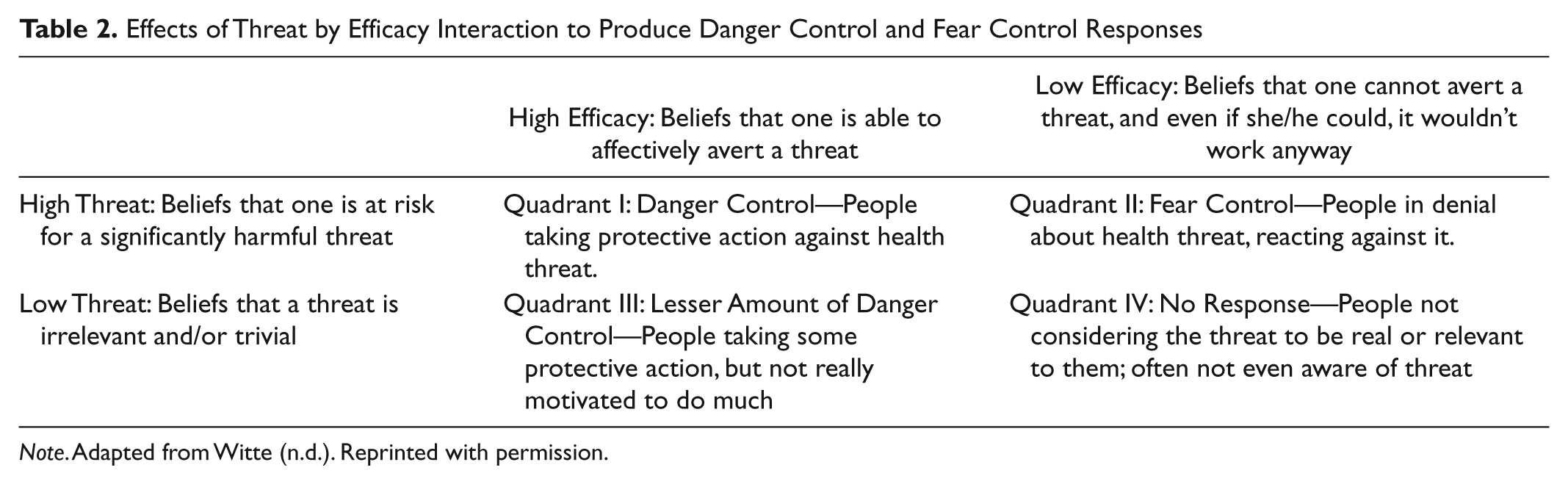
Note. Adapted from Witte (n.d.). Reprinted with permission.
A better way to operationalize fear control and danger control would be to combine the traditional measure of discriminating value with the measures of fear. Thus, a small negative or positive discriminating value in combination with high fear should be indicative of danger control (Quadrant I), and a small positive or negative score accompanied by absence of fear should indicate lack of involvement in the issue (Quadrant IV). To further confirm the correct state, the results should be correlated with the danger control responses, operationalized as changes in attitudes, intentions, and behavior in line with message’s recommendations. People who are deemed to be in danger control (Quadrant I) should exhibit danger control responses, such as positive attitudes toward the recommended action, greater intentions to perform it, and actual behavior. This operationalization would be useful for both researchers and practitioners of communication campaigns. It would give practitioners more precise tools to assess the audience’s states before and after campaigns. It would also allow for more accurate testing of theoretical propositions, which—as the next section shows—received only mixed support so far.
Propositions
Twelve propositions are articulated in the revised theoretical review of the EPPM (Witte, 1998). Unfortunately, their empirical tests are scattered across studies with no clear summary of the extent to which they have been supported. This article attempts to remedy this shortcoming by giving researchers and practitioners a comprehensive summary of the theory’s criticisms and suggestions for improvements and future research all in one place.
Method
A systematic review of literature was undertaken with the explicit purpose of determining whether the 12 propositions of the EPPM have been supported to the extent that has been believed and claimed (Witte & Allen, 2000; Witte, Meyer, & Martell, 2001). This review is not a meta-analysis in which findings of every study are incorporated to present an overall effect (see Boster & Mongeau, 1984, Mongeau, 1998, and Sutton, 1982, for meta-analyses of studies of fear appeals prior to EPPM; and Witte & Allen, 2000, and de Hoog, Stroebe, & de Wit, 2007, for meta-analyses that include the EPPM studies).
The articles included in this systematic review were obtained in the following way. A literature search was conducted using the Social Sciences Databases via CSA with the keywords Extended Parallel Process Model and EPPM. In addition, meta-analyses (Witte & Allen, 2000; de Hoog et al., 2007) were searched for publications that dealt with the EPPM and reference lists of the EPPM articles were examined.
To be included in this review, a study had to be published in English since 1992 (the year the EPPM was introduced), to be explicitly guided by the EPPM, and to present an empirical test of at least one of the EPPM’s proposition. Unpublished doctoral theses (e.g., Witte, 1991), qualitative studies (e.g., Cameron et al., 2009; Witte, Berkowitz, Lillie, et al., 1998), studies that focused on testing other fear appeal theories (e.g., a meta-analysis on protection motivation theory; Floyd, Prentice-Dunn, & Rogers, 2000), EPPM-based studies that did not actually test the propositions or did not provide enough information to make a conclusion (e.g., Cho & Witte, 2005; Roberto, Zimmerman, Carlyle, & Abner, 2007), and fear appeal research published prior to 1992 were not included. Twenty-nine studies met the inclusion criteria. A single reviewer (the author) coded each study for the topic, study design, message manipulation, presence of manipulation checks, and the extent of support for each of the 12 propositions of the EPPM. The extent of support for each study was coded as “supporting the proposition,” “contradicting the proposition,” “mixed support,” and “not tested.” For illustration, Proposition 2 posits: As perceived threat increases when perceived efficacy is high, so will message acceptance. If any of the three constructs—threat, efficacy, and message acceptance—were not measured or manipulated or the relationship between them was not reported, the study was coded as not being a test of this proposition. If the constructs were measured and the results presented evidence in line with the proposition, the study was coded as providing support for the proposition. If the results did not match the prediction—for example, if as threat increased when efficacy was high the message acceptance decreased—the study was coded as contradicting the proposition. If the results were both in support and against the prediction—for example, attitudinal message acceptance increased but behavioral message acceptance decreased—the study was coded as providing mixed support.
Results
The following review summarizes research findings that support or contradict the 12 propositions of the EPPM. Table 3 lists the results by study and by proposition.
Summary of Empirical Support for the EPPM’s Propositions

SEV = severity; SUS = susceptibility; RE = response efficacy; SE = self-efficacy. Bold = manipulation check was performed on this variable. hi = high; lo = low; med = medium; ctr = control.
— = proposition was not tested; √ = findings support the proposition; ○ = findings provide mixed support for the proposition; × = findings contradict the proposition.
Proposition 1 When perceived threat is low, regardless of perceived efficacy level, there will be no further processing of the message
This proposition has not been tested explicitly as no studies within the EPPM framework directly measured the extent of message processing. However, lack of changes in attitudes, intentions, and behavior has been used as indication of lack of message processing. Such implicit support for this proposition was provided in Witte, Berkowitz, Cameron, and McKeon (1998), who found that for individuals with low threat perception, it did not matter whether they were even exposed to fear appeal or not; there was no significant difference in either danger control responses (attitudes and intentions) or fear control responses (defensive avoidance, perceived manipulation, issue derogation). In addition, Wong and Cappella (2009) in an experiment in which both threat and efficacy were operationalized as message attributes and manipulated, found that when message threat was low, intentions to quit smoking did not vary as a function of perceived level of message efficacy.
However, taking lack of attitudinal or behavioral change in response to the message as evidence of lack of message processing is erroneous. Lack of attitudinal and behavioral change can also be accounted for if the message was processed but the responses were deemed unnecessary due to the lack of threat. Furthermore, some responses to low threat were still found; for example, in Witte, Berkowitz, Cameron, et al. (1998), although there was no difference in attitude or intentions to use condoms between individuals with low threat perceptions who were or were not exposed to the fear appeal, those exposed to the fear appeal message had significantly greater condom-related behaviors when compared with those not exposed to the fear appeal. This finding casts further doubt on Proposition 1.
To test Proposition 1 explicitly, measures of message processing need to be obtained. For example, participants could write the thoughts or feelings they had while watching or reading the message. The total number of message-relevant thoughts is an indicator of the depth of message processing (Nabi, 2002). Other measures of the depth of message processing include physiological measures to assess attention to the message, secondary task reaction time to determine the amount of mental resources allocated to message processing, and different measures of memory—recognition, cued, and free recall (see Lang, 2000, for more details). If it was found that message processing happens, but threat is deemed not high enough to warrant any protective action, then this proposition should be modified appropriately.
The issue of the depth and mode of processing of fear appeals has been raised outside the EPPM (e.g., Block & Williams, 2002; Hale, Lemieux, & Mongeau, 1995; Liberman & Chaiken, 1992). For example, the stage model of the processing of fear-arousing communications (Das, de Wit, & Stroebe, 2003; de Hoog, Stroebe, & de Wit, 2005, de Hoog et al., 2007) took the EPPM’s tenets and combined them with dual process theories of persuasion. By examining the components of perceived threat—perceived severity and perceived susceptibility—separately, Das et al. (2003) found that “respondents who perceived themselves as not very vulnerable processed the information about the action recommendation in a systematic and unbiased manner, whereas high-vulnerability individuals processed systematically and biased” (p. 659). Thus, this proposition of the EPPM could be further developed by including the ideas of the stage model of the processing of fear-arousing communications.
Proposition 2. As perceived threat increases when perceived efficacy is high, so will message acceptance
The support for this proposition is mixed. On one hand, Witte (1992) cites that many investigators have found that fear appeals with high levels of perceived threat and perceived efficacy produced message acceptance (e.g., Kleinot & Rogers, 1988; Maddux & Rogers, 1983; Rogers & Mewborn, 1976). Similarly, if message acceptance is operationalized as danger control responses (i.e., changes in attitude, intentions, and behavior in line with message recommendations), then McMahan et al. (1998) found some support. In this study, message threat was manipulated, but manipulation checks confirmed that it adequately produced low- and high-threat perceptions in different groups. Existing perceptions of efficacy were measured and high- and low-efficacy groups were created on the basis of median split. For groups that were high in efficacy, high threat resulted in higher attitudes and higher intentions but not behavior to avoid exposure to electromagnetic fields from household appliances.
Some recent studies found support for Proposition 2. Smalec and Klingle (2000) in an experiment on the effects of an interpersonal message to persuade bulimics to seek help, in which levels of threat and efficacy were manipulated as attributes of the message, found that at high levels of efficacy perceived threat was positively correlated with cognitive message acceptance and behavioral message acceptance. Roberto and Goodall (2009) focused on threat to others and found that the highest behavioral intentions and actual behavior (physicians proscribing kidney tests to their patients) was highest in the high threat–high efficacy group. This study was a survey, so perceptions of both threat and efficacy were measured and then median split was used to create four groups. Wong and Cappella (2009) had mixed findings. In their experiment, when message threat was high, smoking cessation intentions were greater for participants with high levels of perceived message efficacy than for participants with low levels of perceived message efficacy, but only for intent to seek help for quitting, not for intent to quit smoking. Thus, some support has been found that when efficacy is high, high threat produces greater response along the lines of message acceptance than low threat.
On the other hand, several studies found no effects of threat on attitudes, intentions, or behaviors. In a survey of Texas farmers, Witte et al. (1993) found no effect of threat, only of efficacy: People with high efficacy perceptions had higher attitudes, intentions, and behavior regarding tractor safety. In an experimental study, Witte and Morrison (1995) assessed the effects of threat (operationalized as message attribute) on attitudes, intentions, and behavior regarding condom use, abstinence, and monogamy. Efficacy was kept consistently high. In almost all their tests, no significant effect of threat on dependent variables emerged. However, in two cases the findings were the opposite of this proposition: Students in the low-threat group had more positive attitudes toward monogamy and reported slightly greater use of condoms during the month since the presentation. Thus, some studies either found no evidence for Proposition 2 or actually found evidence against it.
It should be noted that although the proposition’s language implies continuous variable (“as perceived threat increases”), it is generally tested using categorical variables, that is, threat is manipulated to be either low or high (e.g., Gore & Bracken, 2005; McMahan et al., 1998). This is also the issue with Propositions 4 and 5. Even when threat and efficacy are not manipulated as message features, but measured as existing perceptions, the general practice is to create high and low groups through median split (see Table 3 for examples of studies). The practice of dichotomizing continuous predictor variables (such as through a median split) is very common in the EPPM research—as well as in communication and other social sciences in general. However, this practice has received a lot of criticism (e.g., Cohen, 1983; Irwin & McClelland, 2003; MacCallum, Zhang, Preacher, & Rucker, 2002). For example, Irwin and McClelland (2003) remarked that “dichotomization of predictor variables has serious costs and no benefits” (p. 371). Costs include loss of variance (from one fifth to one third of variance; Cohen, 1983), loss of power and effect size, and, as a result, failure to detect actual relationships among the variables and the potential to overlook nonlinear relationships (MacCallum et al., 2002). Therefore, researchers testing the EPPM propositions should go beyond median splits—“this practice of our grandparents” (Cohen, 1983, p. 252)—and increase the use of regression and correlational analysis on original (undichotomized) measures. For example, Smalec and Klingle (2000) used multiple regression to test Proposition 2 and found support.
Furthermore, to test the effects of continuous increase in threat, future tests of Propositions 2, 4, and 5 could use within-subject measures, with a variety of messages with different levels of threat while keeping efficacy at a constant level.
Testing of this and almost every other proposition is further complicated by possible reciprocal relationships between perceived threat or perceived efficacy and message acceptance or message rejection outcomes. For example, behavioral change in line with message acceptance can lead to greater perceptions of efficacy and lower perceptions of threat, whereas fear control responses, such as denial, might reduce fear and lead to lower perceptions of threat. Researchers should be mindful of that.
Proposition 3. Cognitions about the threat and efficacy cause attitude, intention, or behavior changes (i.e., danger control responses)
This proposition has only been tested correlationally and even then it received only partial support. Witte (1994) found that cognitions about efficacy were significantly correlated with attitudes, intentions, and behavior changes in use of condoms to prevent AIDS. However, cognitions about threat were significantly correlated only with intentions to use condoms and not with attitudes or actual behavior. Allahverdipour et al. (2007) in a survey of Iranian high school students found that cognitions about perceived severity were significantly correlated with antidrug attitudes and intentions to avoid drug abuse; perceived susceptibility cognitions were negatively correlated with attitudes and intentions; response- and self-efficacy cognitions were positively related with attitudes and intentions. However, McMahan et al. (1998) found that neither threat group (low vs. high) nor cognitions about severity of health effects was predictive of intent to implement control measures. Thus, only limited support has been found for Proposition 3.
The reason why this proposition has not been explicitly tested is because in order to make a causal claim like that, ideally, an experiment should be conducted. However, in most experimental tests of EPPM the researchers manipulated threat and/or efficacy. Cognitions about threat and efficacy were measured, and although they were correlated with the conditions (or there was a main effect of condition on perceptions of threat and efficacy) the direct effects of cognitions on danger control responses were not assessed. To test this proposition, main and interaction effects of cognitions should be calculated. A better test would be a longitudinal study in which perceptions of threat and efficacy at Time 1 would be used to predict attitudes, intentions, and behavior at Time 2.
Proposition 4. As perceived threat increases when perceived efficacy is low, people will do the opposite of what is advocated
Witte (1992) cites support for this proposition by stating that in some studies it was demonstrated that high perceived threat coupled with low perceived efficacy resulted in message rejection and boomerang responses (e.g., Kleinot & Rogers, 1982; Rippetoe & Rogers, 1987; Rogers & Mewborn, 1976). Additional support could be summoned from Witte and Allen’s (2000) meta-analysis, which showed that fear control responses increased as fear appeals got stronger (r = .195, k = 13, N = 1,431). Smalec and Klingle’s (2000) findings both support and challenge this proposition: At low levels of efficacy, threat was negatively correlated with cognitive message acceptance, but under the same conditions threat was also positively correlated with behavioral message acceptance.
Other studies found no support for this proposition. In an experiment (McMahan et al., 1998), efficacy was presented as high to all groups, and participants were divided into high- and low-efficacy groups based on a median split. There was no difference between those with low-efficacy perceptions, regardless whether they perceived threat as low or high. Furthermore, a survey (Witte et al., 1993) found that farmers with low efficacy and low (not high as predicted by the proposition) threat perceptions had the most defensive avoidance, manipulative intent perceptions, and derogated safety issue the most. However, this finding could indicate that for these farmers, fear control responses were effective in reducing their fear and causing them to have lower perceptions of threat.
Thus, support for Proposition 4 is mixed. In future empirical tests of this proposition, perceived efficacy should be either kept low (which raises ethical questions as discussed previously) or simply measured in its original variety (and followed-up by a high-efficacy debriefing) while threat should be presented at variable levels. The resultant perceptions of threat should be used to predict fear control responses, such as defensive avoidance, fatalism, and reactance.
Proposition 5. As perceived threat increases when perceived efficacy is moderate, message acceptance will first increase, and then decrease, resulting in an inverted U-shaped function
This proposition so far has only been tested in meta-analyses and received no support. Boster and Mongeau (1984) concluded that for the effects of fear on attitudes and behavior, “there is little evidence consistent with the curvilinearity hypotheses, and there is considerable evidence inconsistent with these hypotheses” (p. 365). Similarly, Witte and Allen (2000) found no evidence for any kind of curvilinear relationship between fear appeals and outcomes, stating that “the shape of the effects is most consistent with a positive linear-shaped function” (p. 598).
To test this proposition in individual studies, participants with moderate level of efficacy should be looked at separately, and the relationship between perceptions of threat and danger control responses should be plotted. It would be interesting to see if indeed a curvilinear relationship exists. The issue of continuous perceptions of threat and efficacy is addressed further under assumptions of the EPPM.
Proposition 6. Fear causes fear control responses
Only limited support for this proposition has been found so far. Witte (1992) posited that empirical support for it was offered in Rippetoe and Rogers (1987), where fear was found to directly increase avoidance coping patterns. However, Rippetoe and Rogers (1987) measured five maladaptive responses in their experiment, only one of which (avoidance) was directly related to fear. Fear increased avoidance, and avoidance, in turn, reduced fear. In addition, fear was increased by wishful thinking and feelings of hopelessness. So, only limited support for this proposition could be found in Rippetoe and Rogers (1987). Similarly, Witte (1994) found that fear was negatively associated with defensive avoidance and message minimization and positively with perceived manipulation. This is consistent with findings of Rippetoe and Rogers (1987) that fear is reduced by some of the fear control processes. Furthermore, in Tay and Watson (2002), fear arousal was positively and significantly related to message rejection. In a meta-analysis, Witte and Allen (2000) showed that as fear appeals intensified, so did fear control responses. However, the experimental study by Lewis, Watson, and White (2010) found that greater levels of fear were associated with less message rejection and that effect was mediated by response efficacy.
This proposition is ripe for further testing; however, direct tests of it are problematic. First, manipulations of fear are often conflated with manipulations of threat. Thus, it is necessary to perform manipulation checks to ensure groups with different levels of threat actually differ in their levels of fear. A better solution would be to use measured fear to predict fear control responses using regression. Second, detangling the relationship between fear and fear response processes is complicated because the relationship between them is reciprocal (i.e., nonrecursive or bidirectional). Fear affects fear control responses, and fear control responses, by their nature, reduce fear. Depending on what time in this cycle the measurement is taken, different findings might emerge. For example, if a person is already managing fear through defensive avoidance, exposing him or her to the message might not arouse high levels of fear, but he or she would demonstrate defensive avoidance, invalidating this proposition. The EPPM often assumes lack of previous knowledge of the problem, and this assumption is addressed in this article as well.
Future research should look into measuring fear on a continuous basis, either through dial (by continuously turning a dial during the exposure to indicate their feelings of fear) or physiological measurements (e.g., Ordoñana et al., 2009).
Proposition 7. When perceived efficacy is high, fear indirectly influences danger control outcomes, as mediated by perceived threat
Here, perceived threat is conceptualized as an intervening variable between fear and danger control responses. Under the high-efficacy condition, fear is cognitively appraised and used as a cue that affects threat judgments, which, in turn, influence danger control responses. Support for this proposition is mixed. Studies generally measure up to three danger control outcomes: attitudes, behavioral intentions, and behavior. The proposed intervening relationship was observed only for behavioral intentions in two studies and behavior in one study. Rogers and Mewborn (1976) found that fear affected perceived severity, which, in turn, affected intentions, but fear arousal did not predict intentions directly. Witte (1994) found that for people with high perceived efficacy, neither fear nor perceived threat was related to attitude changes. However, fear both directly and indirectly affected behavioral intentions and only indirectly affected behavior as predicted (Witte, 1994). Lewis et al. (2010) found a significant direct effect of fear on message acceptance.
Proposition 8. When perceived efficacy is high, there is a reciprocal relationship between perceived threat and fear
The relationship between fear and threat in a condition of high efficacy is described as nonrecursive, that is, bidirectional (Witte, 1992). A threat in the message leads to perceived threat, which arouses fear. Fear, in turn, is appraised as a cue signaling that the threat indeed is significant and that one’s assessment of threat might even need to be increased. Then higher threat leads to greater changes in attitudes, intentions, and behavior in line with the message recommendations. Although the EPPM alludes to only one “feedback loop,” in reality the back-and-forth influence between fear and threat could be continuous.
This proposition has not been tested within the EPPM framework (Table 3). The empirical support for this proposition provided by the pre-EPPM studies is, again, mixed. Rogers and Mewborn (1976) found that relationship between fear and behavioral intentions was mediated by perceived threat. Witte (1992) cites low correlations between fear arousal and attitudes (r = .21) and fear arousal and behavior (r = .10) found in Boster and Mongeau’s (1984) meta-analysis of fear appeals as evidence in support of this proposition. She suggested that such low correlations could be explained by the effect of threat as intervening variable.
However, Rippetoe and Rogers (1987) in their path analysis did not find a path from fear to threat, only from threat to fear. Thus, the support for Proposition 8 is mixed, and further studies might need to employ structural equation modeling and tests of nonrecursive relationship between fear and perceptions of threat.
Proposition 9. Cognitions about efficacy are unrelated to fear control responses
A few studies that tested this proposition provide mixed support. Witte (1994) found no relationship between perceived efficacy and defensive avoidance, perceived manipulation, and message minimization. Tay and Watson (2002) found that in line with this proposition self-efficacy was not related to maladaptive behavioral intentions (such as switching channels when fear appeals appear on television), yet contrary to this proposition they found a weak negative effect of response efficacy on message rejection. Contrary to this proposition, McMahan et al. (1998) and Witte et al. (1993) found main effect of efficacy on all three fear control responses—message derogation, defensive avoidance, and perceived issue manipulation. Furthermore, a meta-analysis found a negative correlation between efficacy and fear control responses (Witte & Allen, 2000).
It should be noted that this proposition deals with null relationship. To test it, equivalence testing should be employed, because simply finding no significant correlations does not mean that the relationship is indeed nonexistent (Levine, Weber, Hullett, & Park, 2008).
Proposition 10. Cognitions about threat are indirectly related to fear control responses
This proposition treats fear as intervening variable between cognitions about threat and fear control responses. As is the case with Proposition 7, while some studies found support for the intervening relationship, others discovered a direct relationship between cognitions about threat and fear control responses. Rippetoe and Rogers (1987) found some support for an indirect relationship (through fear), but they also found a direct relationship between perceived susceptibility and hopelessness and a nonrecursive relationship between perceived severity and wishful thinking. Perceived severity increased wishful thinking, and wishful thinking, in turn, decreased perceived severity. In addition, Witte (1994) found significant negative correlations between perceived threat and defensive avoidance and message minimization. These findings suggest a direct relationship between threat and fear control responses. On the other hand, they might indicate that the analysis was not robust enough to reveal a more complex relationship.
Proposition 11. Perceived threat determines the intensity of a response (how strong the response) and perceived efficacy determines the nature of the response (either fear or danger control)
This proposition has received only limited testing. Witte, Berkowitz, Cameron, et al. (1998) found some indirect support for it by showing that among those exposed to a high-threat message, people with high efficacy demonstrated greater danger control than those with low efficacy, and those with low efficacy demonstrated greater fear control responses than those with high efficacy. However, danger control responses and fear control responses were not compared directly. A direct comparison could be performed by looking at the means of danger control responses and fear control responses across the various groups. For example, McKay et al. (2004) presented two groups of older adults with either high- or low-efficacy message, keeping level of threat consistently high. In both high- and low-efficacy groups, most of the indicators of the danger control responses (five out of six) were above the midpoint of the scale. For instance, attitude towards eating food rich in vitamin B was 6.18 (out of 7) in the high-efficacy group and 6.24 in the low-efficacy group. On the other hand, the mean values of all three fear control responses were below the half-point of the scale (if defensive avoidance was reverse coded). For example, issue/message derogation was 1.88 (out of 7) in the high-efficacy group and 2.14 in the low-efficacy group. This indicates that both high- and low-efficacy groups were engaged in danger control responses and not so much in fear control responses.
McMahan et al. (1998) found that “consistent with EPPM predictions, threat motivated stronger or weaker attitudes, but efficacy determined whether the attitudes were positive or negative” (pp. 254-255). However, this was found only for attitudes toward electromagnetic field control measures and not for any other danger control or fear control responses. Finally, Witte and Allen (2000) list the negative correlation between fear control responses and danger control responses (r = −.18, p < .05, k = 7, N = 955) found in their meta-analysis as evidence for this proposition.
Proposition 12. Individual differences influence outcomes indirectly, as mediated by perceived threat and efficacy
The theory posits that individual differences influence the appraisal of threat and efficacy; they will be responsible for the thresholds and critical points, determining in what type of response a person engages (Witte, 1992). Research has examined a variety of individual differences, such as predisposition to anxiety, sensation seeking, coping skills, self-esteem, self-control, masculinity, need for cognition, and health status (see Table 3). This proposition is very broad because it incorporates any individual-level variable that might affect perceptions of threat and efficacy. Some studies found support for it while others did not. For example, Witte and Morrison (1995) found that sensation seeking had direct influence on intentions to practice safe sex and monogamy (such as low sensation seekers intended to use these protective measures more). Millar and Houska (2007) found effect of masculinity on behavioral intentions and attitudes toward the message; however, because perceptions of threat and efficacy were not measured, it was impossible to assess the mediation effect. Ruiter, Verplanken, De Cremer, and Kok (2004) demonstrated that need for cognition was related to danger control but not fear control responses; only people high in need for cognition were motivated to adopt the recommended response after being presented with a high-threat message. However, the mediation hypothesis was not tested. In a meta-analysis, Casey, Timmermann, Allen, Krahn, and Turkiewicz (2009) found that for gay men and for persons who were HIV-positive, the correlation between efficacy and outcome was stronger than for the overall sample. McKay et al. (2004) discovered that individual differences, such as age and health status, had an effect on threat and efficacy perceptions only in high-efficacy groups.
Several studies looked at trait anxiety. For example, Witte and Morrison (2000) found that although one’s level of anxiety has an effect on perceptions of both the threat and the efficacy of recommended responses, “trait anxiety/repression-sensitization appears to have no influence—either directly, indirectly, or interactively—on attitudes, intentions, behaviors, perceived manipulation, or message derogation” (p. 1). In a meta-analysis, Witte and Allen (2000) likewise found that trait anxiety was not related to persuasive outcomes either directly or indirectly through interaction with fear appeal characteristics. Furthermore, Witte and Allen (2000) concluded that “individual differences such as personality traits or demographic characteristics (e.g., gender) do not appear to influence processing of fear appeal messages, except on rare occasions” (p. 606) and recommended that practitioners do not need to address individual differences in their campaigns.
To summarize, the EPPM articulates 12 theoretical propositions. However, review of the empirical tests of the EPPM’s propositions reveals that none of them received strong support. For most, support has been mixed, and some have barely been tested within the EPPM framework (Table 3). The next step in the development of this theory should be to explicitly test those propositions that have not been tested extensively before (Propositions 1, 5, 7, 8, 10, and 11). These propositions are more conceptually complex and require correct operationalization of their components (such as “lack of message processing” in Proposition 1). Next, for those propositions with mixed support, a closer examination needs to be undertaken to find out why under certain conditions support was found and in other cases expected results were not obtained. One of the reasons for such diversity of findings could be the difference in the use of predictor variables. Although the EPPM propositions deal with the effects of perceived threat and perceived efficacy on persuasive outcomes, in practice, the propositions are tested as the effects of message manipulations (threat and efficacy as message variables) on outcome variables. Therefore, a greater use of tests of propositions using actual perceptions of threat and efficacy as predictor variables is needed. Methodologically, this can be achieved through greater use of regression and correlational methods in tests of propositions instead of median splits and ANOVAs that have been prevalent in the EPPM research (and in research on other fear-appeals, see O’Keefe, 2003).
Assumptions of the EPPM
The EPPM, like many other theories, relies on assumptions about the nature of human beings and their mental processes. To further theory development, these assumptions need to be reexamined. For the purpose of this article, the assumptions that are specific to the EPPM will be examined, leaving aside assumptions that the model shares with other communication theories, such as the assumption that attitudes exist and individuals are capable of accurately reporting them. The assumptions specific to the EPPM include additive relationship between severity and susceptibility and between response- and self-efficacy, the role of time, and the assumption that people are not aware of the threat prior to exposure to fear appeal messages.
Assumption of an Additive Relationship
Two central concepts of the EPPM, perceived threat and perceived efficacy, are conceptualized as higher-order structures comprising two underlying dimensions each. Those dimensions are assumed to combine in an additive manner to produce the overall index of threat or efficacy. This assumption is paradoxical because it seems more logical that the elements combine in a multiplicative manner. For example, no matter how harmful an event is judged to be, if it has zero probability of occurring, it would be irrational to take precautionary actions. Similarly, if an event is likely, but the threat of it is nonexistent, no protective measures need to be taken. Thus, severity and susceptibility should combine in multiplicative way. Indeed, multiplicative relationship was advanced by Rogers (1975) and Witte (1994), who indicated that “the EPPM proposes (and studies have shown) that the relationship between threat and efficacy is multiplicative” (p. 116).
However, empirical evidence from both correlational and experimental research did not corroborate a multiplicative relationship. Therefore, later theoretical pieces (e.g., Rogers, 1983; Witte, 1998) described the relationship as additive: “individuals first appraise the severity of the threat . . . and their susceptibility to the threat . . . in an additive manner” (Witte, 1998, p. 428). Almost every EPPM study that created a general score for perceived threat or perceived efficacy combined their elements in additive manner by summing up or averaging the scores on individual items (e.g., Gore & Bracken, 2005; LaVela, Smith, & Weaver, 2007; Muthuswamy et al., 2009; R. A. Smith et al., 2007). Rimal and Real (2003) were an exception by using the multiplicative relationship; yet, the resultant measures were only used as manipulation checks and not as predictors for other variables. It should be noted that perceived severity and susceptibility also appear as central constructs in the Health Belief Model (HBM; Janz & Becker, 1984). But within the HBM framework—particularly in its more recent applications (e.g., Sheppard, Solomon, Atkins, Foster, & Frankowski, 1990)—researchers treated severity and susceptibility as separate constructs without combining them in additive or multiplicative way (Weinstein, 1993).
The assumption of an additive relationship has not been challenged directly within the EPPM framework. However, Weinstein (2000) “investigated the paradox of a likelihood by severity interaction that seems logically necessary but is rarely observed” (p. 66). He had 12 participants indicate how interested they were in obtaining protection for 201 hazards; a week later the same participants rated the hazards for severity and likelihood of happening. The results revealed the elusive severity by susceptibility multiplicative effect for within-subject analyses. When either likelihood or severity was zero, the motivation to act was essentially nonexistent. This implies multiplicative relationship because under additive relationship motivation to act would be zero only if both severity and susceptibility were zero. He also found that the best predictor for the protection motivation was different at different levels of severity and susceptibility. Regardless of the level of severity, when susceptibility was low (i.e., the chances of event occurring were below 50%), a simple model containing only severity by susceptibility interaction provided a good explanation. When likelihood was high and severity was low, the model with severity only explained the motivation to act the best. Although within-subjects interaction effects were high, when Weinstein (2000) conducted between-subject analyses, he found that the median additional variance explained by the interaction term was about 1%. He calculated that with this effect size, to achieve a power of .80 at significance level of .05 would require a sample of 400 people. Most experimental studies of EPPM used sample sizes between 100 and 200 people. A survey study by LaVela et al. (2007) had 968 veterans in their sample, but they did not test for multiplicative relationship.
Therefore, instead of calculating perceived threat as the sum of the perceived severity and perceived susceptibility, researchers should explore also calculating it as a product of the two. The same should be done with response efficacy and self-efficacy; the averaged items should be multiplied to create the index of perceived efficacy. To do that, new measuring scales with nonarbitrary zero points need to be introduced. Instead of measuring susceptibility by having people agree or disagree (on a scale from one to five) with a statement “I am at risk for getting [health threat],” they should be asked to rate, on a scale from 0 to 10, the likelihood of this health threat happening to them. This scale would be anchored by 0 (no chance) and 10 (certain to happen) points (Weinstein, 2000), similar to ratings of probability (from 0% to 100%).
Multiplicative relationships between variables have been proposed and worked well in other theories. For example, Fishbein and Ajzen’s (1975, 2010) conceptualization of attitudes as product of strength of beliefs and their evaluations, and Vroom’s (1964) model of job satisfaction, in which job motivation is the product of the likelihood of the outcome and its valence, could serve as useful guide for the EPPM researchers.
The Issue of Thresholds and the Role of Time in the Model
The EPPM assumes that individuals take time appraising threat and efficacy. These appraisals are assumed to happen in a continuous manner, and once the levels of perceived threat or efficacy reach certain thresholds (critical points), subsequent processes are triggered. This assumption has not been clearly stated nor challenged empirically as studies never measured thresholds.
The concept of thresholds is used in communication theories (e.g., sufficiency threshold in heuristic-systematic model; Eagly & Chaiken, 1993) to describe the switch along the continuum into a categorically different state, that is, a threshold is a point or a value above which a certain effect is present and below which it is absent. In the EPPM there are two thresholds: a threat threshold and an efficacy threshold.
According to the EPPM, on encountering the fear appeal message, an individual goes through two appraisals—a threat appraisal and an efficacy appraisal. An individual first judges the level of threat—how severe it is and how susceptible he or she is to this threat. If the threat is appraised as low, Witte (1998) argues, no subsequent processing happens (Proposition 1). The first threshold, thus, is a high enough level of threat so the threat is not ignored and the appraisal of efficacy is initiated. Witte (1998) alludes to this first threshold as the point at which fear comes into the picture—individuals become scared once their appraisal of the threat reaches a certain threshold.
In the second appraisal, people evaluate efficacy of the recommended response. The perceived efficacy is compared against perceived threat. As long as perceived efficacy is higher than perceived threat, individuals engage in danger control. Thus, the EPPM hints that a danger control mode is the default. However, if at some “critical point” (another threshold) threat outweighs efficacy, individuals switch to fear control mode.
The question is, do these processes operate sequentially and take a certain amount of time? The language of the model implies that they do. For example, consider the following phrases (with italics added): a critical point “occurs when perceptions of threat begin to outweigh perceptions of efficacy” (Witte et al., 2001, p. 68); at this point “individuals begin to believe” they cannot avert a threat (p. 68); when efficacy is at a moderate level, “people may initially believe that they can prevent the threat. But as the threat increases in magnitude and relevance, individuals may begin to give up any hopes of averting the threat” (Witte, 1992). Using vocabulary that alludes to processes in time implies that appraisals are not instantaneous.
Witte (1998) argued that “two appraisals operate sequentially” (p. 433). This claim seems to be supported by findings of the studies in which the order of information presentation was varied. By presenting either information about the threat or about efficacy first, it was found that adherence to message recommendations (protective response) was greater when efficacy information was presented immediately following the information about threat than when it was presented before, during, or long time after the fear appeal (Skilbeck, Tulips, & Ley, 1977, and Leventhal & Singer, 1966, as cited in Witte, 1998). Witte (1998) presented the results of these studies as evidence of the order of appraisals, arguing that threat appraisal occurs first, followed by efficacy appraisal. However, these findings could also be explained by the fact that when efficacy is assessed first and deemed great, then the subsequent threat is appraised as low, leading to zero response. This possibility is not addressed in the EPPM. However, if the appraisal is simultaneous, as will be discussed next, then there exists a possibility of a reciprocal relationship between threat and efficacy.
Alternatively, Witte (1998) proposed that “the appraisal processes occur at lightning-fast speed, which makes experimental study a challenge” (p. 433). Instantaneous appraisal of threat seems more plausible from an evolutionary point of view. Thus, the issue of thresholds and the role of time in the appraisal processes need to be clearly specified within the EPPM literature.
Disregard for Previous Emotions and Cognitions About the Issue
By focusing on fear message processing, the EPPM assumes that audiences are not aware of either the threat or the effective responses prior to message exposure (Nabi, Roskos-Ewoldsen, & Carpentier, 2008). The theory alludes to previous emotions and cognitions by including them in “individual differences” that affect message processing, but it does not specify how preexisting fear or knowledge about threat or efficacy might interact with the message. However, previous familiarity with the threat and/or responses would affect message processing in important ways. For example, McKay et al. (2004) found that participants who reported having hypertension (high blood pressure) at the beginning of the study also had lower perceptions of threat and less fear than those who had normal blood pressure.
Recently, studies began to challenge this assumption (e.g., Gore & Bracken, 2005; Muthuswamy et al., 2009; Nabi et al., 2008; Roskos-Ewoldsen, Yu, & Rhodes, 2004). Nabi et al. (2008) proposed a notion of “implicit” fear appeals, in which mere mention of the threat should evoke past cognitions about the threat in the audience and result in an emotional reaction of fear. Similarly, Muthuswamy et al. (2009) found that when audience is already scared, level of threat in the message makes little difference in the subsequent level of fear and does not have an effect on attitudes, intentions, and behavior.
Toward a More Encompassing Theory
Fear is not the only emotion that was used as a potential motivator of desired behavior. Appeals to guilt (Huhmann & Brotherton, 1997), anger, disgust, compassion, and sadness (Kaid & Johnson, 1991; Marmor-Lavie & Weimann, 2006) have been used as well. In addition, fear is not the only response aroused by messages that appeal to fear. Studies have found that fear is often accompanied by anger (Dabbs & Leventhal, 1966; Leventhal, Singer, & Jones, 1965) and is correlated with feelings of surprise, puzzlement, sadness, and decreased happiness (Dillard et al., 1996).
Theories exist that explain the functions and effects of negative emotions in persuasion. Some of them adopt a broad perspective (e.g., cognitive functional model; Nabi, 1999), whereas others focus on a specific discrete emotion (e.g., the targeted anger appeals processing model; Turner, Wang, Yao, & Xie, 2009). However, Dillard (1994) argued that instead of developing a theory for each emotion and simply controlling for effects of other emotions in empirical tests, “a far more productive task would be to broaden our sights beyond a single emotion and to aim for a general theory of affect and persuasion” (p. 316).
The EPPM could serve as a foundation for a covering law theory of negative emotions and persuasion. Indeed, the EPPM could be used to build bridges between the disparate theories of emotions and persuasion. As Rippetoe and Rogers (1987) noted, “the dichotomy of maladaptive and adaptive is similar to the dichotomies of intrapsychic and direct action, internal and external adjustments, and emotion-focused and problem-focused coping, respectively; the reader may prefer one of these terms” (p. 598). Thus, the same principle of parallel process seems to apply to the messages designed to arouse other negative emotions, such as guilt, anger, disgust, and even compassion. In fact, some of these bridges have already been built. The EPPM’s principles were used to bridge the persuasion and interpersonal communication literature when they were applied to explain the processes involved with Gudykunst and Hammer’s anxiety/uncertainty management (AUM) theory (Hullett & Witte, 2001; Witte, 1993).
It should be noted that there are important differences between emotions (e.g., discrete emotion models view various affects as associated with distinct signal values and functions; see Dillard & Meijnders, 2002; Dillard & Peck, 2000), and the implications of these differences for the EPPM’s core constructs and propositions should be carefully considered. However, for the purpose of this article, the focus will be kept on their similarities in ways pertinent to the EPPM. All of them are negative emotions, that is, they are unpleasant states that motivate people to do something to reduce them (Dillard, 1994). When the evoked levels of emotions are too high, this might lead to reactance and counterargument (e.g., guilt; Coulter & Pinto, 1995).
The EPPM would work well with other negative emotions. In fact, it has already been used as a foundation for assessing guilt appeals (Basil, Ridgway, & Basil, 2008), and a model with the EPPM constructs was found to explain almost 60% of behavioral intentions. The EPPM should also be tested on other emotions, such as anger and compassion. It makes intuitive sense that a dual process model will be applicable to both of these emotions.
Compassion is a complex emotion that comprises feelings of sadness, distress, and empathy (Fultz, Schaller, & Cialdini, 1988). Negative-state relief model (Cialdini et al., 1987) posits that people help others to relieve personal discomfort stemming from the negative components of compassion—sadness and distress. Compassion could also be covered by the EPPM framework.
To summarize, although the EPPM has room for further development based on the lack of consistent empirical support for its theoretical propositions, its conceptual structure is strong and could be used to cover other negative emotions besides fear.
Implications for Research and Practice
The EPPM is one of the latest developments among theories that explain the role of fear in persuasion. The purpose of this article was to survey the constructs, propositions, and assumptions of the EPPM in order to illuminate the gaps in research that hamper further development of this theory. With at least 11 constructs and 12 propositions that conceptualize the relationship between these constructs, the EPPM has a complex structure, yet the model is clear and easy to understand. The usefulness of this theory to communication researchers lies in its ability to generate research and to potentially serve as a foundation for the general parallel process model of negative emotional appeals. First, however, the EPPM’s internal inconsistencies need to be resolved through empirical research that incorporates more sophisticated operationalization of constructs and refinement of the model.
The usefulness of the EPPM to the health communication practitioners lies in its ability to guide decisions at almost every step of the communication campaign’s design, implementation, and evaluation. It is particularly suitable to the assessment of the target audience and evaluation of the campaign’s effects (Valente, 2002). During the formative evaluation stage practitioners should measure the current state of the target audience by assessing audience’s perceptions of severity, susceptibility, response- and self-efficacy, fear, attitudes, behavioral intentions, and behavior. Based on these measurements, the current state of the audience can be determined. For example, the audience can be (a) unaware of the threat; (b) aware of the threat, scared, and engaged in fear-control responses, such as defensive avoidance; or (c) aware and scared, but cognizant of a solution they believe to be effective in averting the threat and engaged in danger control processes. Depending on where the audience stands, different interventions should be used. For example, for the unaware audience it will be necessary to include information about the threat, but for the scared audience it will be necessary to provide efficacy-related information while simply reminding them of the threat (Muthuswamy et al., 2009; Nabi et al., 2008). During the evaluation of the campaign’s effects, the same careful measurements need to be taken in order to determine whether the audience’s state changed. It should be stressed that fear should be measured explicitly. Measuring fear will allow for more precise classification of people into danger-control and fear-control groups and for explicit testing of the EPPM’s propositions for which only limited support has been found so far.
Footnotes
Declaration of Conflicting Interests
The author declared no potential conflicts of interest with respect to the research, authorship, and/or publication of this article.
Funding
The author received no financial support for the research, authorship, and/or publication of this article.
References
Supplementary Material
Please find the following supplemental material available below.
For Open Access articles published under a Creative Commons License, all supplemental material carries the same license as the article it is associated with.
For non-Open Access articles published, all supplemental material carries a non-exclusive license, and permission requests for re-use of supplemental material or any part of supplemental material shall be sent directly to the copyright owner as specified in the copyright notice associated with the article.
