



Abstract
Background. To influence adolescent health, a greater understanding of time use and covariates such as gender is required. Purpose. To explore gender-specific time use patterns in Australian adolescents using high-resolution time use data. Method. This study analyzed 24-hour recall time use data collected as part of the 2007 Australian National Children’s Nutrition and Physical Activity Survey (n = 2,200). Univariate analyses to determine gender differences in time use were conducted. Results. Boys spent more (p < .0001) time participating in screen-based (17.7 % vs. 14.2% daily time) and physical activities (10.7% vs. 9.2%). Girls spent more (p < .0001) time being social (4.7% vs. 3.4% daily time), studying (2.0% vs. 1.7%), and doing household chores (4.7% vs. 3.4%). Conclusions. There are gender-specific differences in time use behavior among Australian adolescents. The results reinforce existing time use gender-based stereotypes. Implications. The gender-specific time use behaviors offer intervention design possibilities.
Time use, including physical activity, sleep, social, cognitive, and sedentary behaviors, influences both physical (Baronowski, Anderson, & Carmack, 1998) and psychological (Bungum, Dowda, Weston, Trost, & Pate, 2000) aspects of youth health. To successfully model and effect change in behaviors, and thus influence health status, interventions should be informed by detailed use of time information, with particular attention to covariates such as gender.
There are substantial age, gender, and socioeconomic differences in how children and adolescents allocate their time (Bungum et al., 2000). Boys in developed countries spend more time watching television or in screen-based activities and less time performing domestic work than girls (Larson & Verma, 1999). Consistently, boys are shown to be more physically active than girls (Olds et al., 2009) especially in sport (Larson & Verma, 1999). Many of the existing data on adolescents’ time use are low resolution: The range of activities is often limited; broad activity descriptors such as “physical” are used; and minimum time slices are large (30 minutes to 1 hour) or only frequency is recorded. This may result in inadequate granulation of activity sets masking underlying variability, with time slices too large to detect differences in time use.
Therefore, the aim of the study was to describe gender-specific time use patterns in a representative sample of Australian adolescents (9-16 years) using a high-resolution use of time recall.
Method
Sample and Design
This study analyzed 8,800 twenty-four–hour time use recalls from 2,200 Australians aged 9 to 16 years, who were interviewed as part of the National Children’s Nutrition and Physical Activity Survey, conducted between March and August 2007. The study has been detailed elsewhere (Department of Health and Ageing, 2008). Clusters of postcodes were selected to ensure that the sample would be representative of Australian adolescents and to help reduce sampling error. The numbers of sample adolescents in each cluster were representative of the overall number of target adolescents in that area of Australia. Extremely geographically remote postcodes (<3% of the Australian population) were excluded from the study. Families dwelling within the postcode clusters were randomly selected and contacted using random digit dialing, and eligible families (i.e., those with a least one child aged 2-16 years) were invited to participate. Families were not obliged to participate, but if willing, only one child per participating household was surveyed. The survey response rate was 41%. Subject characteristics are shown in Table 1. All appropriate ethical approvals and informed consent were obtained.
Sample Characteristics

Note. SEIFA = Socio-Economic Indexes for Areas. Data shown as percentages or mean (SD). The index used here is the Index of Relative Disadvantage, which is based on a postcode-level basket of economic indicators such as income and education. The national average is 1,000 and the standard deviation is 100 (GISCA, 2010).
Outcome Measures
Adolescents aged 9 to 16 years completed four 24-hour time use diaries. Use of time data were collected using the Multimedia Activity Recall for Children and Adults (MARCA; Ridley, Olds, & Hill, 2006), a computerized 24-hour recall. The software allows young people to recall everything they did on the previous day. The MARCA has excellent test–retest reliability (Ridley et al., 2006) and moderate convergent validity (Olds, Ridley, & Maher, 2010). Minutes spent participating in each of the MARCA’s 259 activities were averaged, such that the resultant value was the weighted average of school and nonschool days.
Data Treatment
Use of time data
This study classified activities using a hierarchical tree structure. High-resolution MARCA data were collapsed hierarchically into broader categories so that there were five levels of analysis (259 individual activities, 39 “microdomains,” 17 “mesodomains,” 11 “macrodomains,” and 6 “superdomains”; Table 2). The superdomains are sleep, screen time, social activities, school-related activities, physical activity, and others. The benefit of collapsing the data in such a way is that it allows identification of differences at different levels of agglomeration of time use. In addition, a hierarchical approach allows representation of use of time data in a format comparable to previous studies.
Comparisons Across Gender for the Superdomain-, Macrodomain-, Mesodomain-, and Microdomain-Level Activity Sets
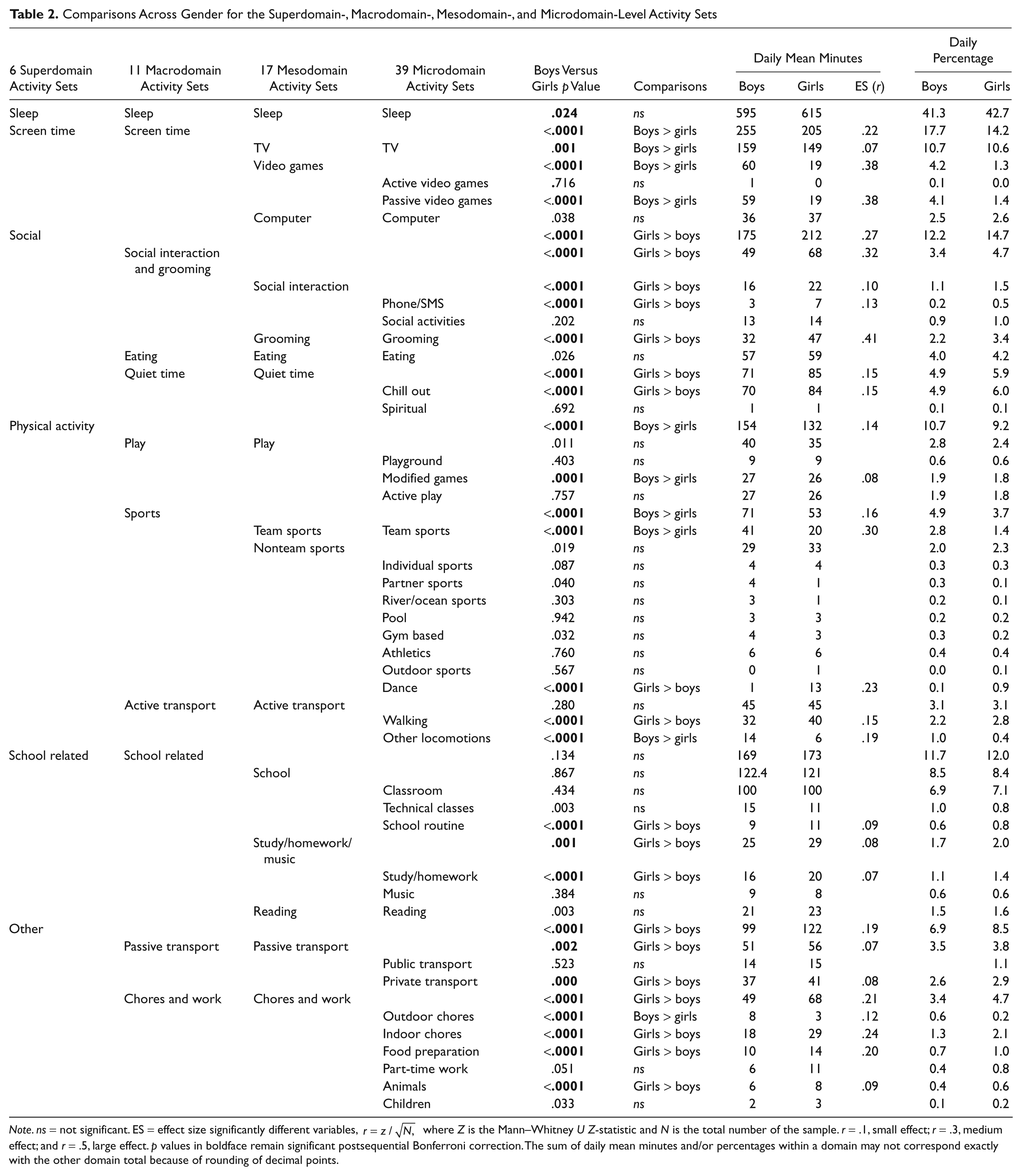
Note. ns = not significant. ES = effect size significantly different variables, where Z is the Mann–Whitney U Z-statistic and N is the total number of the sample. r = .1, small effect; r = .3, medium effect; and r = .5, large effect. p values in boldface remain significant postsequential Bonferroni correction. The sum of daily mean minutes and/or percentages within a domain may not correspond exactly with the other domain total because of rounding of decimal points.
Sociodemographic data
The sex of the target adolescent was recorded as “boy” or “girl.” Decimal age was determined based on the reported date of birth and the date of the interview. Two categorical age groups were also used: younger (9-12 years old) and older (13-16 years old).
Statistical analysis
Data analysis consisted of both descriptive and comparative components. As several of the activity sets at the mesodomain and lower levels of the hierarchy were strongly skewed, nonparametric statistics were used. Both mean and median time use values (minutes/days) are presented when reported in text as [mean (median)]. To compare gender differences in time use within domains, Mann–Whitney U tests were used. Age-group–specific gender comparisons were also conducted using Mann–Whitney U tests. Alpha was set at .05. Sequential Bonferroni correction was applied to allow for alpha slippage. Effect sizes were calculated as described in Table 2.
Results
Comparisons Across Genders
Table 2 compares participation by gender within the different domains and describes the direction of the relationship the duration and the percent of the day spent in each activity set.
Screen
The adolescent boys in this sample spent significantly more time on screen-based activities (17.7% daily time use) than girls (14.2% daily time use; Table 2). Although TV watching time differed significantly with sex, boys spent only 10 minutes longer [159 (152) minutes] watching TV than girls [149 (132) minutes]. Daily computer use was not significantly different between the sexes. The most distinctive gender-specific screen time difference was for video game playing, adolescent boys spent on average 60 (35) minutes each day playing video games, compared with girls, who averaged 19 (0) minutes each day. Of the hour that adolescent boys spent playing video games, 59 minutes were spent playing passive video games and 1 minute was spent playing active games.
Social
Adolescent boys spent 37 minutes less each day [175 (167) minutes] socializing than their female peers [212 (202) minutes]. Adolescent boys spent on average 15 and 14 minutes less each day participating in grooming and quiet time activities when compared with girls. Within quiet time, it was the microdomain level chill out activity set (e.g., sitting, listening to music, or talking) that showed a significant relationship with gender [boys 70 (58) minutes/day vs. girls 84 (74) minutes/day; Table 2].
Physical activity
Boys were more physically active [154 (145) minutes/day] than girls [132 (120) minutes/day; Table 2]. Boys spent significantly more time playing team sports than girls [boys averaged 41 (29) minutes/day and girls averaged 20 (9) minutes/day; Table 2].
School-related
Approximately 12% of an adolescent’s day was spent participating in the school-related superdomain activities (Table 2). Yet the corresponding mesodomain activity sets indentified gender variation within the study/homework/music activity set [girls 29 (15) minutes/day vs. boys 25 (10) minutes/day; Table 2].
Other
At the mesodomain level, girls accumulated fractionally more passive transport time than boys (Table 2) and spent on average 19 minutes more participating in activities related to chores and work than boys. The difference was related to the slightly longer time girls spent on food preparation (4 minutes more) and indoor chores (11 minutes more) when compared with boys.
Comparisons across genders by age group
The patterns of gender differences in time use domains remain strikingly similar when stratified by age. Of the nine activity sets analyzed (sleep, screen, social and grooming, study/homework/music, TV, physical activity, sport, video games, and play), only three of the comparison analyses showed a different pattern. In older adolescents, there was no significant difference in the amount of study/homework/music (p = .59), but there was in fact a difference in playtime, with girls playing 5 minutes more each day than boys. In younger adolescents, the only different pattern was identified in relation to TV, with no time difference between boys and girls.
Discussion
Key Findings
The findings add weight to the common stereotypical beliefs held about gender differences in time use. Australian adolescent boys spent more time participating in screen-based and physical activities. Australian adolescent girls spent more time “chilling out,” studying, and doing household chores. At the same time, there was a great deal of overlap between the distributions of activities by gender. Typical effect sizes were in the order of 0.1 to 0.4, indicating a modest but significant displacement of distributional curves. Differences between boys and girls were quite consistent across age-groups. The data also offer detailed insights about which activities account for gender differences in time use, information that may result in more effective intervention design.
Strengths and Limitations
A major strength of this study compared with existing research is the range of data resolution. The use of 24-hour recall, with 5-minute time slices and a register of 259 possible activities, yielded high-resolution time use data, which enabled localization of differences in time use behavior between groups under the broader time use rubrics (i.e., physical activity) used to date. For example, the resolution of these data enabled distinction between active and passive video game participation, information that could have overall implications for the health and well-being of the participants and that may also assist with tailoring of interventions.
Gender-Related Patterns of Time Use
The bulk of the screen time gender difference can be attributed to the time boys spent playing video games. What is unclear is why adolescent boys, regardless of age group, play more video games than girls. One theory relates to the gender-specific content of video games; most video game characters are male, and when females are portrayed, it tends to be as bystanders (Douglas, Dragiewicz, Manzano, & McMullin, 2002). Furthermore, girls who play video games prefer games that center on a story line and are noncompetitive, but the majority of video games available are competitive in nature (Douglas et al., 2002).
Another theory centers on the disparity in mental and physical skills that improve video game playing such as mental rotation, where boys tend to outperform girls. Yet research has shown that the gender-related–skill gap closes with practice (Feng, Spence, & Pratt, 2007), so this may not necessarily explain the differences. Video games have been shown to have positive outcomes such as improvements in spatial awareness and hand–eye coordination (Feng et al., 2007), so girls may be missing out on valuable skill development.
Boys participated in approximately 2½ hours more physical activity each week than girls, a pattern that does not change with age (groups). Boys are not only more physically active but also display higher physical activity–associated energy expenditure than girls (Olds et al., 2009; Ryan & Dzewaltowski, 2002), which could have direct well-being associations. Higher energy expenditure suggests that boys participate in more vigorous types of activity than girls, which ties in with the gender-related differences apparent in the team sports mesodomain. Sporting participation has been linked with many positive adolescent health and well-being factors, including improved academic achievement (Fox, Barr-Anderson, Neumark-Sztainer, & Wall, 2010). Theories regarding boys’ higher sports participation range from attitudes regarding masculinity and sport to social norms (Vilhjalmsson & Kristjansdottir, 2003). Research has also shown organized team sports to also be more appealing to boys because of their competitiveness and the high proportion of male role models, perhaps reducing girls’ enjoyment. This may explain the reported lower female enrolment rates and higher withdrawal rates from team sport organizations (Vilhjalmsson & Kristjansdottir, 2003).
The findings from this study that girls walk more than boys whereas boys spend more active transport time using alternative locomotions such as bikes and skateboards are supported by previous literature (Leslie, Kremer, Toumbourou, & Williams, 2010). The lack of gender difference in overall active transport time is somewhat surprising if the safety consciousness of Australian parents is considered, which would typically restrict girls independent mobility more so than boys. Yet gender differences in overall active transport times are in fact inconsistent in the literature, even within Australia (Leslie, Kremer, Toumbourou, & Williams, 2010; Olds et al., 2009).
Within the social superdomain, gender differences again reinforce stereotypes. Girls spent significantly more time performing domestic tasks than did boys, a discrepancy that is well supported in the literature (Larson & Verma, 1999). Girls in this sample spent more time completing indoor domestic tasks such as cooking, and boys spent more time performing outdoor jobs such as lawn mowing, a pattern reported in many postindustrial countries (Larson & Verma, 1999). The extent to which this discrepancy is based on individual preferences, cultural stereotypes, or parental expectations is unknown, though each of these factors is likely to contribute (Gager, Cooney, & Call, 1999).
Girls allocated more time to study/homework/music than boys did, a variation that reflects differences in study- and homework-based activities rather than in music. A possible explanation for this gender difference is that girls may have a stronger work ethic and higher levels of self-reliance than boys, causing them to dedicate more time to homework and study (Xu, 2006). Interestingly, older adolescents participated in the same amount of homework/study/music each day, perhaps a reflection of increasing school requirements and reduced personal choice.
Implications
Greater understanding of adolescent gender-specific time use patterns permits identification of particular activity domains requiring intervention and provides valuable information regarding possible retention strategies.
Gender-specific interventions could focus on targeting either gender-specific deficits or strengths. Those targeting deficits would aim to increase the level of participation in a particular activity or domain. An example of this would be to encourage girls to play more team sports or active video games, as both domains of activity have shown positive associations with some aspects of adolescent well-being. To improve compliance, gender-related “sensitivities” could be incorporated. For example, if an intervention aim were to encourage girls to play team sports, it would be prudent to select sports high in energy but that appeal to girls’ interests.
An alternate intervention strategy would be to target gender-related strengths—activities that are already “preferred” by a particular gender—and modify them to benefit health and well-being. An example of this would be to encourage boys to play active rather than passive video games. A complete reversal in the active–passive allocation of time to video games could result in Australian boys spending nearly an hour a day longer being physically active, increasing overall physical activity levels (Mhurchu et al., 2008). Awareness of gender-specific activity preferences could enable development of an intervention designed to increase time spent on activities typically “avoided” by incorporating them with activities of choice. For example, the data from this study showed that boys play more video games and study less than girls. It follows that combining homework with video game playing (i.e., educational video games) may be one way of increasing study time in a manner more appealing to boys.
Conclusion
There are significant gender-specific differences in time use behavior among Australian adolescents. The results of this study reinforce existing time use stereotypes, while offering possibilities related to intervention design that may help improve adolescent health and well-being.
Footnotes
Declaration of Conflicting Interests
The authors declared no potential conflicts of interests with respect to the research, authorship, and/or publication of this article.
Funding
The authors disclosed receipt of the following financial support for the research, authorship, and/or publication of this article: