



Abstract
Objective. To quantify the presence of health behavior theory constructs in iPhone apps targeting physical activity. Methods. This study used a content analysis of 127 apps from Apple’s (App Store) Health & Fitness category. Coders downloaded the apps and then used an established theory-based instrument to rate each app’s inclusion of theoretical constructs from prominent behavior change theories. Five common items were used to measure 20 theoretical constructs, for a total of 100 items. A theory score was calculated for each app. Multiple regression analysis was used to identify factors associated with higher theory scores. Results. Apps were generally observed to be lacking in theoretical content. Theory scores ranged from 1 to 28 on a 100-point scale. The health belief model was the most prevalent theory, accounting for 32% of all constructs. Regression analyses indicated that higher priced apps and apps that addressed a broader activity spectrum were associated with higher total theory scores. Conclusion. It is not unexpected that apps contained only minimal theoretical content, given that app developers come from a variety of backgrounds and many are not trained in the application of health behavior theory. The relationship between price and theory score corroborates research indicating that higher quality apps are more expensive. There is an opportunity for health and behavior change experts to partner with app developers to incorporate behavior change theories into the development of apps. These future collaborations between health behavior change experts and app developers could foster apps superior in both theory and programming possibly resulting in better health outcomes.
Keywords
The prevalence of obesity in the United States has increased dramatically in recent decades to an alarming 33.8%, leading to increased research and interest in treatment and prevention (Flegal, Carroll, Ogden, & Curtin, 2010). Physical activity is a key element to losing weight and maintaining weight loss (Wing et al., 2008). The benefits and importance of physical activity have been well documented (U.S. Department of Health and Human Services, 2008), particularly the role that regular physical activity plays in lowering obesity rates. According to Physical Activity and Health: A Report of the Surgeon General, theory-based programs promoting physical activity are effective and essential in changing behavioral patterns associated with obesity (U.S. Department of Health and Human Services, 1996). Theory can improve interventions by identifying which theoretical constructs should be targeted and by determining fundamental behavior change techniques that should be incorporated (Webb, Joseph, Yardley, & Michie, 2010).
Americans are constantly looking for new sources of health-related information and the Internet and mobile devices are two potential purveyors (Pew Internet & American Life Project, 2009). The emergence of smartphones has provided a platform for freelance developers to design third-party applications (apps), which greatly expand the functionality and utility of these mobile devices. Apps are pieces of software that can run on mobile devices. In the Health & Fitness category on Apple’s App Store, developers have created thousands of downloadable apps for Apple’s mobile devices, which include the iPhone, the iPad, and the iPod (touch). Since the launch of the App Store in July of 2008, approximately 550,000 apps have become available with more than 25 billion downloads (Apple, Inc., 2012). By 2016, it is anticipated that more than 44 billion apps will have been downloaded—which is equivalent to six app downloads for every man, woman, and child in the world (International Association for the Wireless Telecommu-nications Industry, 2011). Considering the recent trend in app downloads, this estimate may be low. Currently, the average American’s smartphone has 22 apps (International Association for the Wireless Telecommunications Industry, 2011).
With increasing smartphone ownership, many users are actively seeking health-related information applications for these mobile devices (Smith, 2011). App developers have responded by producing thousands of health-related apps (Dolan, 2010). According to Fox (2010), nearly 1 in 10 smartphone users have downloaded a health-related app. The rapidly expanding category of health-related apps raises important public health questions regarding the quality of available apps and their potential for influencing behavior change. To date, only one study has explored apps related to physical activity. Breton, Fuemmeler, and Abroms (2011) conducted an analysis to determine if evidence-based practices were present in descriptions of weight loss apps. Whereas their study provides useful information and insight, it was based on developers’ descriptions of the app alone and did not include an analysis of the actual app. Insomuch as the description page is the marketing point by which app developers sell their product, it is possible that descriptions alone do not adequately represent app content and functionality. The purpose of the current study was to conduct a content analysis of the actual apps in the App Store’s Health & Fitness category. In particular, this analysis sought to examine the inclusion of health behavior theory constructs in apps and explore factors associated with greater inclusion of these theoretical constructs.
Method
Study Design
This study design involved a content analysis of health behavior theory contained in physical activity apps selected from among the apps available in the App Store’s Health & Fitness category on iTunes. Three graduate students trained in health behavior theory coded the apps.
Sample
The study sample was identified through apps available for download at www.apple.com/itunes on October 17, 2011. Apps were selected from the category Health & Fitness. The researchers identified apps within this category by querying the iTunes database with the keyword, “exercise,” which returned 1,336 possible apps. Only apps designed for use with the iPhone were considered because iPhone apps are more numerous and are mostly compatible with both the iPhone and the iPad. All apps were downloaded to an iPad due to the requirement of a contract and data plan for the iPhone. The sample included only apps with a user rating of four or five stars (N = 226). The star rating system provides an estimate reflecting the extent to which users liked the apps. Using this methodology, which has been used in previous research on apps (Breton et al., 2011), led to a sample inclusive of well-liked apps, regardless of the apps’ date of release.
Several of the 226 apps either were not in English or were designed to address multiple behaviors in addition to exercise (e.g., both exercise and diet). Apps addressing multiple behaviors were excluded because of the difficulty in discerning which behavior the theoretical content was intended for. Using these inclusion and exclusion criteria, the final sample was composed of 141 apps. After the 141 apps were downloaded, 14 additional apps were excluded because of compatibility issues. Of the 14 that were excluded, four apps had a diet component that was not mentioned in the description page, thus making them ineligible. One app malfunctioned after being downloaded, and therefore could not be coded. One app required additional equipment connected to the iPad to run, so was also eliminated. Two of the apps were only timers for exercise and did not actually contain any exercise components. Six apps required the use of cameras and GPS, features that were not compatible with the first-generation iPad used for coding. Following all exclusions, the final sample size of all coded apps was N = 127.
Procedure
The coders downloaded each app to an iPad and thoroughly explored each one to increase familiarity with the user interface and available functions. Next, the coders used all apps’ functions such as diagrams, videos, record keeping, and reminders. Then the coders used a theory-based instrument to conduct the content analysis of each app. Coding data were entered into an electronic database as they were collected.
Measurement
The instrument and methodology used for coding were adapted from an instrument developed by Doshi, Patrick, Sallis, and Calfas (2003) designed to evaluate the theoretical content of physical activity websites. Constructs from four prominent theories of behavior change were included in the coding instrument. These theories were the health belief model, the theory of reasoned action/planned behavior, the transtheoretical model, and the social cognitive theory/social learning theory. The instrument included a total of 100 theory-based items. This included 20 constructs of the four behavior change theories assessing theoretical constructs such as self-efficacy, goal setting, stimulus control, social support, relapse prevention, and perceived barriers. For each of the 20 constructs, 5 dimensions of interaction were assessed for the app’s ability to assess the user, individualize the program, and provide feedback (5 dimensions of interaction × 20 constructs = 100 total theory score). The instrument included 20 intervention strategies; 5 items assessed each strategy for a total of 100 theory-based items. Additionally, descriptive data collected for each app included the price, the number of fitness activities each app included (e.g., yoga, jogging, etc.), the extent to which an app allowed users to post data externally (e.g., upload data directly to a social networking site—Yes/No), and affiliation with a fitness organization (Yes/No).
Interrater Reliability
To verify the level of interrater reliability, each coder independently coded 14 common apps. A Cohen’s kappa coefficient was calculated to measure interrater agreement (κ = .57). This coefficient is categorized as high-moderate agreement, which includes a division ranging from .41 to .60 and is an acceptable level of interrater agreement (Landis & Koch, 1977).
Similarly, correlation coefficients were calculated with an average interrater correlation coefficient of r = .97. Following the coding of the sample of apps, the coders coded an additional 14 common apps to test for rater drift. The Cohen’s kappa was .56 and the correlation coefficient was .98, indicating no drift. Coding discrepancies were resolved by using the responses from the coder that had the highest level of agreement with the other two coders.
Analysis
Each app was coded with a total of 100 theoretical items, each accounting for 1 point (Yes = 1, No = 0). A total theory score was calculated by summing each app’s theoretical items, for a possible score ranging from 0 to 100. Multiple regression analysis was used to determine the relationship between theory and price and the number of exercise-related behaviors the app was attempting to influence. Furthermore, an interaction between price and the number of exercise behaviors was tested and found to be significant and therefore left in the model.
Results
Characteristics of study apps are presented in Table 1. The majority of apps (70%) were $1.99 or less and most (89%) were not affiliated with a fitness organization. Almost half (47%) of the apps promoted a single exercise behavior, and 42% allowed users to post information to external sources.
Characteristics of Study Apps
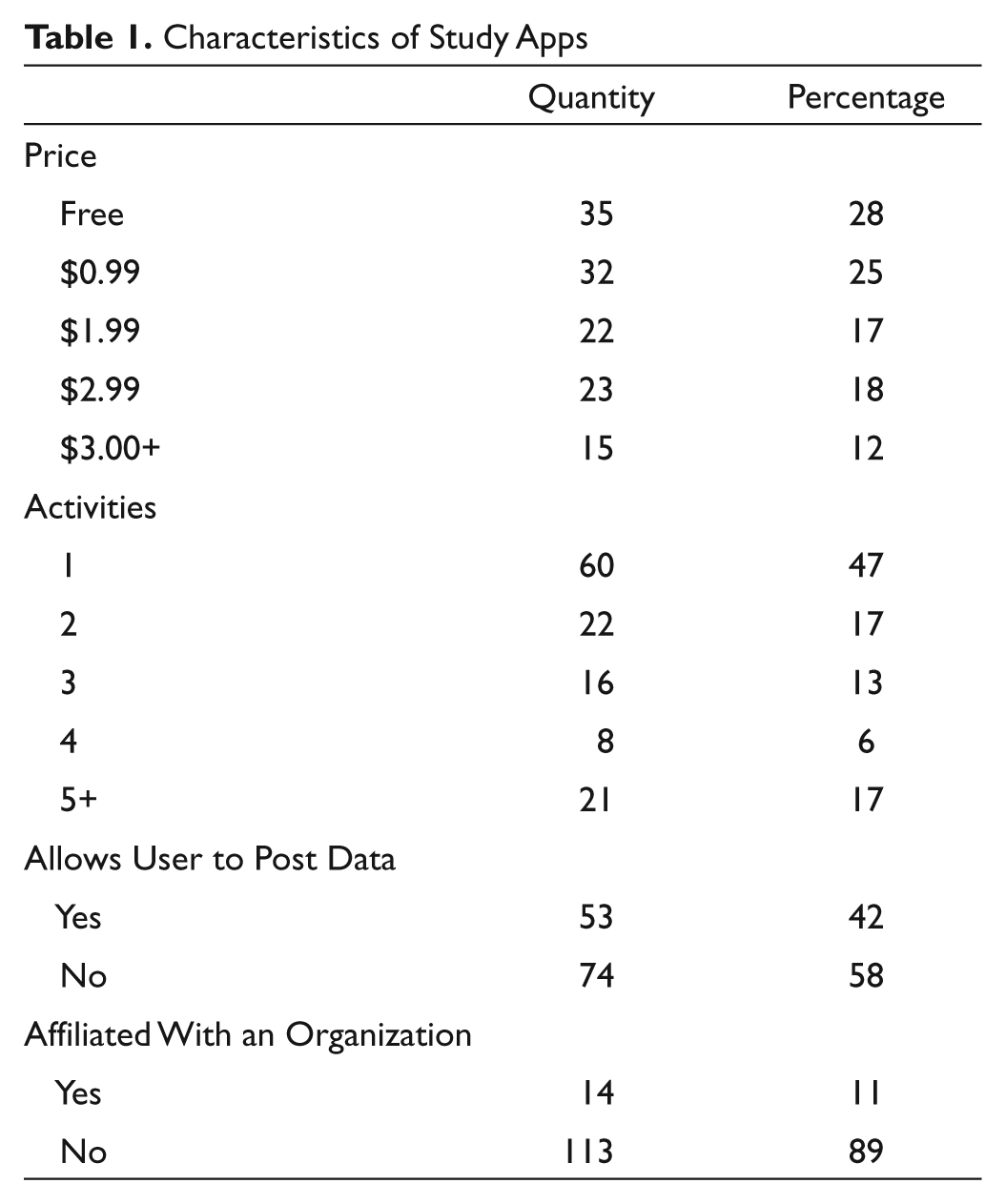
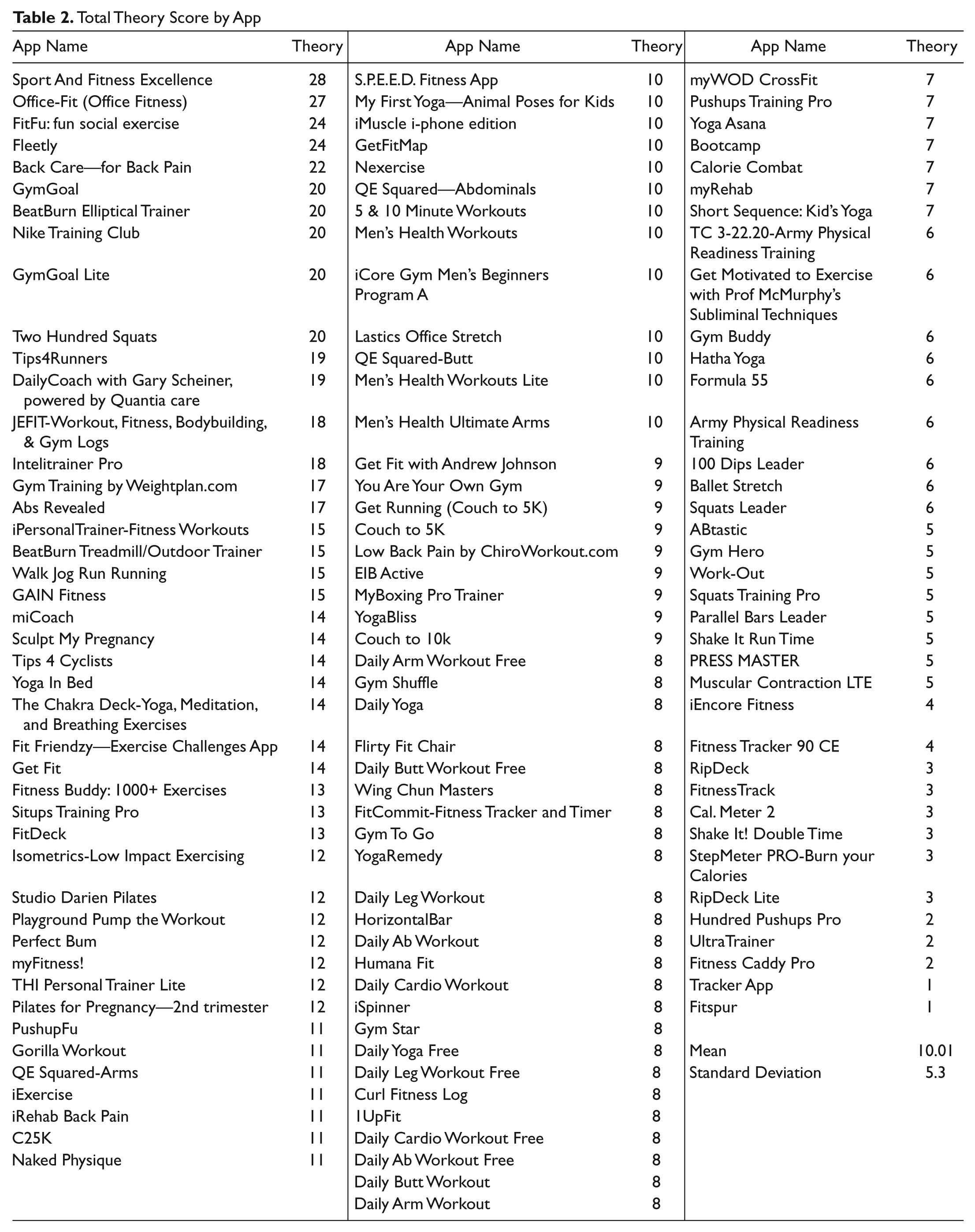
Table 2 shows the total theory score for each app. Sport and Fitness Excellence had the highest score with 28, whereas Tracker App and Fitspur both shared the lowest score of 1. The mean score was 10.01 with a standard deviation of 5.3. A square root transformation was done to correct for the skewness of this variable.
Total Theory Score by App
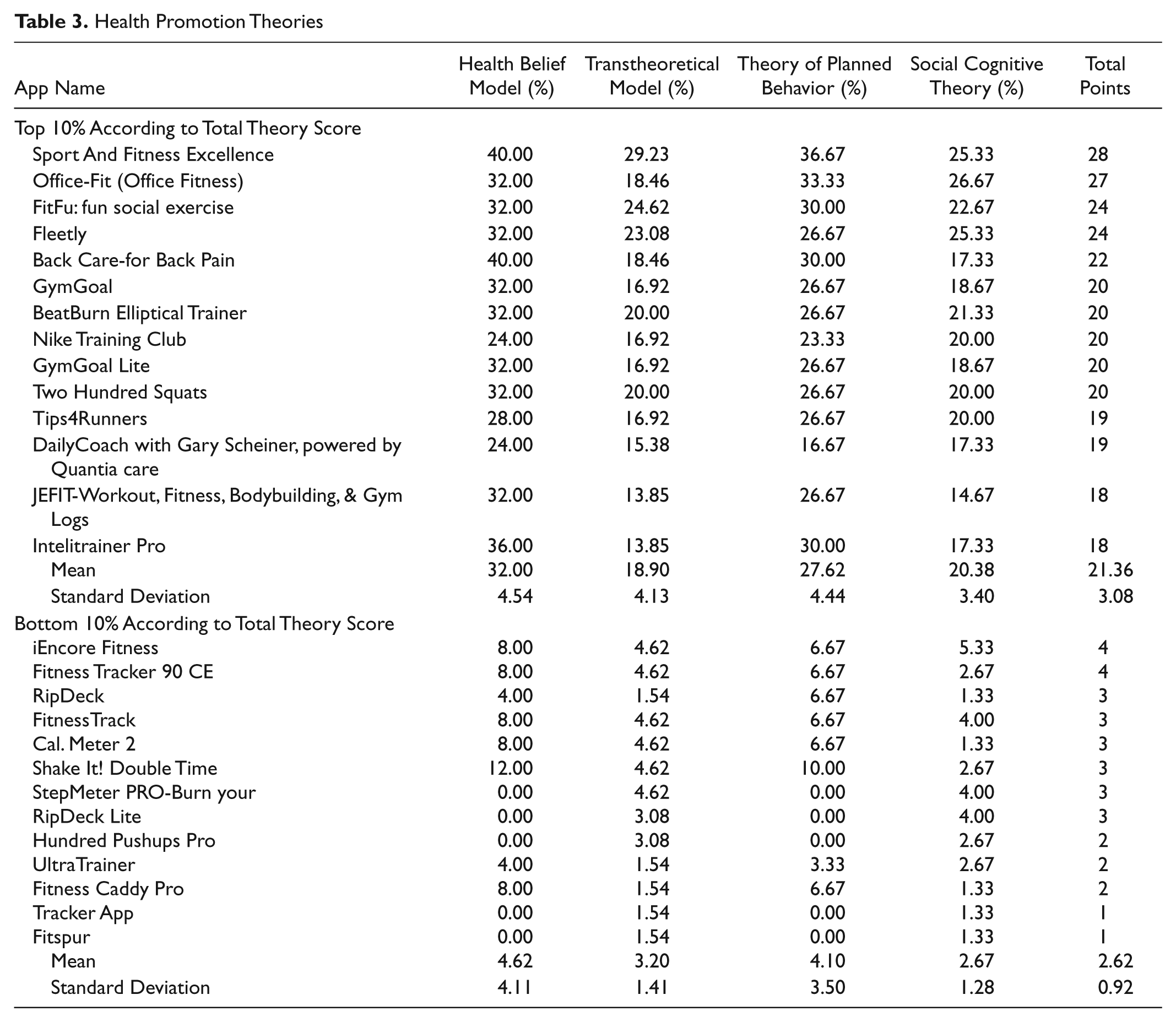
Study apps were compared by their use of the four major health behavior theories (Table 3). The top 10% and bottom 10% of apps according to total theory score are shown in the table. Among the top 10% of apps, constructs from the health belief model were coded most, accounting for 32% of present constructs. Apps in the lowest scoring 10% of apps had little representation across the behavior change theories.
Health Promotion Theories
Results from the multiple regression analysis (Table 4) revealed that price ( p < .05) was positively associated with the inclusion of health behavior theory constructs. Theory was also positively associated with the number of exercise-related behaviors the app was designed to address (p < .05). The interaction between price and the number of exercise-related activities was significant ( p < .05) and negatively associated with theory.
Multiple Regression Analysis Results
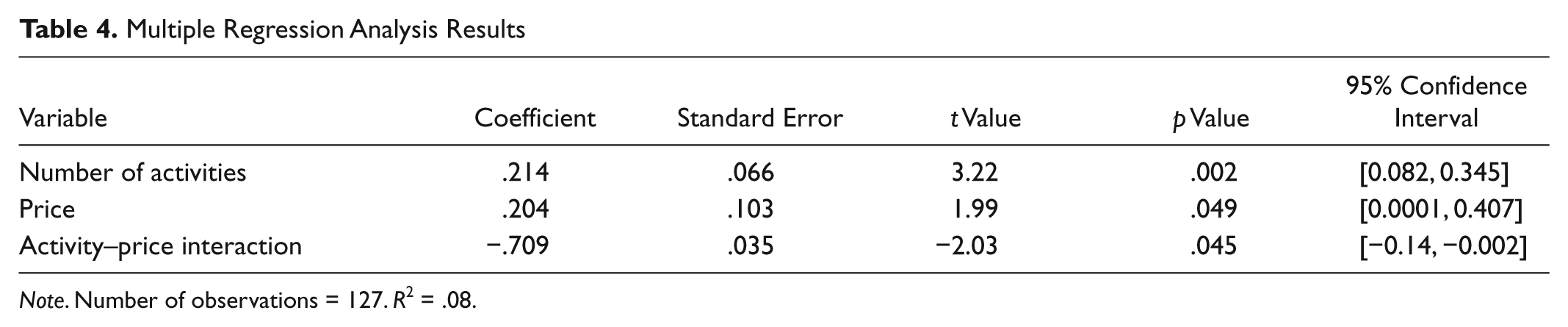
Note. Number of observations = 127. R2 = .08.
Discussion
The current study used a content analysis of 127 apps from the App Store’s Health & Fitness category to determine the extent to which these apps included health behavior theory constructs. Results indicate that most study sample apps did not include theoretical constructs. Theory-based interventions have been shown effective in changing behavior (Glanz, Rimer, & Viswanath, 2008) and in the future may provide a framework for app developers. The general lack of theoretical constructs included in apps in this study sample is not entirely unexpected given that app developers’ expertise relates to software development and may not include health behavior theory. Regardless of the background and training of developers, they are not thoroughly incorporating health behavior change theory into their apps. Findings from the current study highlight the need for collaboration between health behavior change experts (i.e., public health professionals and certified health education specialists) and app developers.
The results of the current study support earlier work by Doshi et al. (2003) that identified a deficiency of theoretical content present in technological applications, including Internet websites. In their research evaluating physical activity websites, Doshi et al. concluded that although many websites provided knowledge-based information and guidelines, as well as general assistance to help users participate in physical activity, most did not incorporate theory-based strategies. The study authors concluded that there was a need for websites to improve interaction and tailored assistance for users (Doshi et al., 2003). Similarly, in their content analysis of weight loss app descriptions, Breton et al. (2011) concluded that few apps appeared to incorporate important theoretical constructs such as social support.
Results of key importance from this study were analyzed using the multivariate regression model to determine which variables were significantly related to theory score. Although the regression model included only price and number of activities as independent variables, the design of the study controlled for a wide variety of potential confounders. The study sample was selected using exclusive criteria and apps selected for analysis had to have a user rating of four stars or higher to be considered, thus creating a sample of high-quality apps. The positive primary associations of both variables on the level of theoretical content indicate that as developers incorporate theory into their apps, value will be added, which may result in the opportunity to market their apps for a higher price. Likewise, the association is positive between the number of activities and the theoretical content. Including more activities in a theory-rich environment will raise an app’s theory score thus increasing the value and the potential effectiveness of the app.
The significant interaction of price and number of activities was associated with decreased theory score. This is interesting because the direction of the interaction is opposite that of both main effects. The findings suggest that the impact of price is reduced as the number of apps increases. This may be attributable to developers of expensive apps marketing their apps to users of a broad range of activities without supporting each activity with theoretical content. Previous research has shown that intervention components may work well individually, but have the opposite effect when combined with other components because of negative synergy (Collins, Murphy, Nair, & Strecher, 2005). Thus, app developers should be sensitive to how the number of activities affects the overall potency of the app. Since this relationship was both weak and in an unexpected direction, replication by independent investigators is warranted. Examples of apps from this study that integrated theory include apps that contained reminder systems whereby the apps could remind users about their next scheduled workout. The reminders show up similar text messages and visually remind users to exercise. These cues to action are part of the health belief model. Only 19% of the apps included cues to action. Another 55% of apps contained video clips of models exercising. This type of vicarious modeling is specific to social cognitive theory/social learning theory. Another construct emphasized in social cognitive theory/social learning theory, reinforcement, was present in nearly 9% of apps. An example of reinforcement can be found in the Nike Training Club app. This app awards points to the user for each completed workout. As points accumulate, users are able to redeem them for new workouts led by celebrity athletes.
The absence of health behavior theory constructs in the App Store’s Health & Fitness category apps identified by the current study reveals a great opportunity for health behavior change specialists. The wide popularity of mobile device applications combined with the pressing need for theory-based physical activity interventions, should be incentive for health behavior change specialists to team with app developers in creating theory-based apps. Public health professionals and health educators can provide expertise in health behavior change theory and could advise app developers during the developmental process. Likewise, app developers could provide their expertise and creativity to generate apps with consumer appeal. Combinations of these skills could ultimately produce higher quality apps with improved effectiveness. Although such partnerships may be an ideal in the long term, the short-term implications of this study should not be ignored. iPhone users are downloading exercise apps, many of whom may intend to lose weight. Clinicians may also recommend using apps to patients as a resource for weight loss. Results presented here may provide a realistic perspective about apps’ current potential for affecting behavior change, as a means to losing weight. App users and clinicians should be cautious when evaluating which app(s) to use. Furthermore, they should be realistic about their expectations for the app to result in behavior change.
Strengths and Limitations
Although previous studies have assessed health-related apps and websites for adherence to evidence-based practices, this is the first documented study to evaluate the presence of theoretical constructs in apps. Compared with the evaluation methods of a similar previous study (Breton et al., 2011), this study used a more rigorous methodology and involved a more in-depth analysis. Cost was not a limitation or a factor in exclusion criteria for this study, which allowed for a more comprehensive and representative study sample. Another strength of this study is the use of a comprehensive evaluation tool adapted from Doshi et al. (2003). This instrument was developed and modified to assess apps for use of established theories of health promotion, for level of user interaction, and for tailoring characteristics inherent in the software.
The results of this study should be interpreted in the context of several key limitations. First, the analysis was limited to iPhone apps in the App Store. Future studies may consider similar analyses of apps created for other platforms such as Android or Windows. This study was limited to iPhone apps that were downloadable to the iPad. Although most iPhone apps are compatible with the iPad, 14 apps in the sample had to be excluded because of their requiring features not included in the iPad. Furthermore, the analysis was limited to English language apps only. There is a great need to tailor health-related interventions to multicultural audiences and there is value in analyzing apps for non-English language speakers, but the coders were limited in their ability to speak languages other than English. The decision to code only highly rated apps may have resulted in the inflation of the estimates of average theoretical content because of the elimination of lower rated apps, which may be considered a limitation to the current study. However, the researchers determined that studying popular apps, which users actually appear to be using, would enhance this study’s relevance to the field.
Finally, study procedures were sufficiently rigorous and an acceptable interrater reliability was established, however, content analysis is a research methodology prone to rater bias. Despite these several limitations, this study provides the first detailed content analysis of health behavior theory constructs in actual exercise-related apps available at the iTunes App Store. This study focused on the inclusion of theoretical constructs present in existing Health & Fitness apps. The frequency and extent to which individuals are using their apps cannot be ascertained using these research methods. Further research, possibly using qualitative methods aimed at understanding how individuals actually use apps is warranted.
Conclusion
Although most of the apps studied for this analysis incorporated few theoretical constructs, an enormous potential for future partnerships exists. Future steps in this direction may involve randomized controlled trials of apps that are theory based to determine their efficacy in everyday settings. Lessons learned from such research, combined with the results presented here, would inform future health behavior change experts who desire to adopt emerging technologies in an effort to enhance behavior change. Whereas this may result in a higher cost associated with the development, results from this study indicate that the higher cost may be warranted considering the greater likelihood for including theoretical constructs.
Footnotes
Declaration of Conflicting Interests
The authors declared no potential conflicts of interest with respect to the research, authorship, and/or publication of this article.
Funding
The authors disclosed receipt of the following financial support for the research, authorship, and/or publication of this article:
This research was supported by internal funding from Brigham Young University.