




Abstract
State and national organizations recently developed policies focused on increasing physical activity (PA) in afterschool programs (ASPs). These policies emphasize “activity friendly” environment characteristics that, when present, should lead to higher levels of PA and reduce the amount of time children spend sedentary during an ASP. Currently, little is known about the impact of existing PA policies on children’s PA and sedentary behaviors in ASPs. A sample of 18 community-based ASPs serving 1,241 children (5-12 years) were audited for environment features outlined in existing PA policies (i.e., presence of a written policy to promote PA, collecting child feedback, staff training to promote PA and the quality of that training, holding parent workshops, use of PA curricula, evaluating PA, allocating time in the schedule for PA opportunities, and providing activities that appeal to both boys and girls). Children’s PA and sedentary behavior were measured via accelerometry. Unexpectedly, the presence of a written policy, collecting child feedback, and receiving 1 to 4 hours of staff training for PA was associated with an increase in time spent sedentary and a decrease in PA. Conversely, allocating 50% or more time in an ASP schedule for PA and providing activities that appealed to boys and girls was associated with a decrease of time spent sedentary and an increase in PA. The present state of practice in ASPs suggests that policy environment characteristics are largely unrelated to the amount of PA children accumulate while attending ASPs.
Afterschool programs (ASPs) have garnered considerable attention over the past decade as a setting that can contribute to reducing childhood inactivity (Beets, 2012a; Beets, Wallner, & Beighle, 2010; Moore et al., 2010). To help children be more active, state and national organizations developed policies to promote physical activity and reduce sedentary behavior within the ASP setting (Beets, Wallner, et al., 2010). These policies focus on the amount of activity children should accumulate while attending an ASP, as well as detailing environment characteristics related to supporting “activity-friendly” environments. These characteristics range anywhere from having a written policy in place that supports physical activity, to ensuring that staff receive sufficient amounts of professional development training for promoting physical activity, to monitoring and evaluating the physical activity of children attending their program (Beets, Wallner, et al., 2010; Weaver, Beets, Webster, Beighle, & Huberty, 2012).
Few studies have evaluated the association of environment characteristics and children’s physical activity in the ASP setting. Environment characteristics such as scheduling physical activity indoors versus outdoors is linked to the amount of physical activity children accumulate during ASPs (Rosenkranz, Welk, & Dzewaltowski, 2011). Additionally, providing more time for physical activity during the program and including activities that children find fun and enjoyable is related to increased total daily physical activity of those children attending ASPs (Gortmaker et al., 2012).
Although informative, these studies only examined the association of a narrow range of policy environment characteristics and children’s physical activity. Moreover, these studies have included a limited number of ASPs or did not examine the association of the environment characteristics to physical activity during the ASPs. Given the extensive policy documentation outlining such characteristics (Beets, Wallner, et al., 2010), additional investigation is necessary. This information could have a broad impact on existing policies by identifying where areas of support are required, guiding the refinement of existing policies, and helping inform the development of new policies. Therefore, the purpose of this study was to evaluate the association of policy environment features on the physical activity and sedentary behaviors of children attending ASPs.
Method
Participants
A total of 18 ASPs from Columbia, South Carolina, Lexington, South Carolina, and Omaha, Nebraska, serving 1,241 children (K to fifth grade) with an average 1:12 staff to student ratio took part in this study. ASPs ranged in organizations (e.g., YMCA, Boys and Girls Club, individually operated) and locations (i.e., school-based, faith-based, community-based). The average duration of an ASP was 208 minutes per day (range 60-240 minutes). The information presented represents a cross-sectional association of physical activity and time spent sedentary to ASP policy environment characteristics. All procedures were approved by the Institutional Review Board at the University of South Carolina and the University of Nebraska Medical Center.
Physical Activity Policy Environment Characteristics
A conceptual framework identifying modifiable elements within the ASP setting was used to guide the selection of policy environment characteristics in this study (Beets, Webster, Saunders, & Huberty, in press). This framework was informed by complex systems change (Foster-Fishman, Nowell, & Yang, 2007), social ecology (Stokols, 1992), systemic capacity building (Potter & Brough, 2004), and the emerging literature on the impact of public health policy (Brownson & Jones, 2009; Brownson, Seiler, & Eyler, 2010) that identifies key elements of systems to be targeted as well as possible influences on those elements. The policy environment characteristics identified were taken directly from an extensive review of existing physical activity environment quality rating scales in both child care and the ASP settings (Ammerman, Benjamin, Sommers, & Ward, 2004; Ammerman et al., 2007; Bower et al., 2008) and a review of standards and policies from state and national organizations related to promoting physical activity (Beets, Wallner, et al., 2010). Additionally, characteristics were identified from existing recommendations, accreditations, and policies from the Council on Accreditation (www.coastandards.org), the School-Age Care Environment Rating Scale (http://ers.fpg.unc.edu/node/151), the New York State Afterschool Network Program Quality Self-Assessment Tool (www.nysan.org/userfiles/file/nysan), and recently endorsed physical activity standards from the National Afterschool Association (Wiecha, Gannett, Hall, & Roth, 2011).
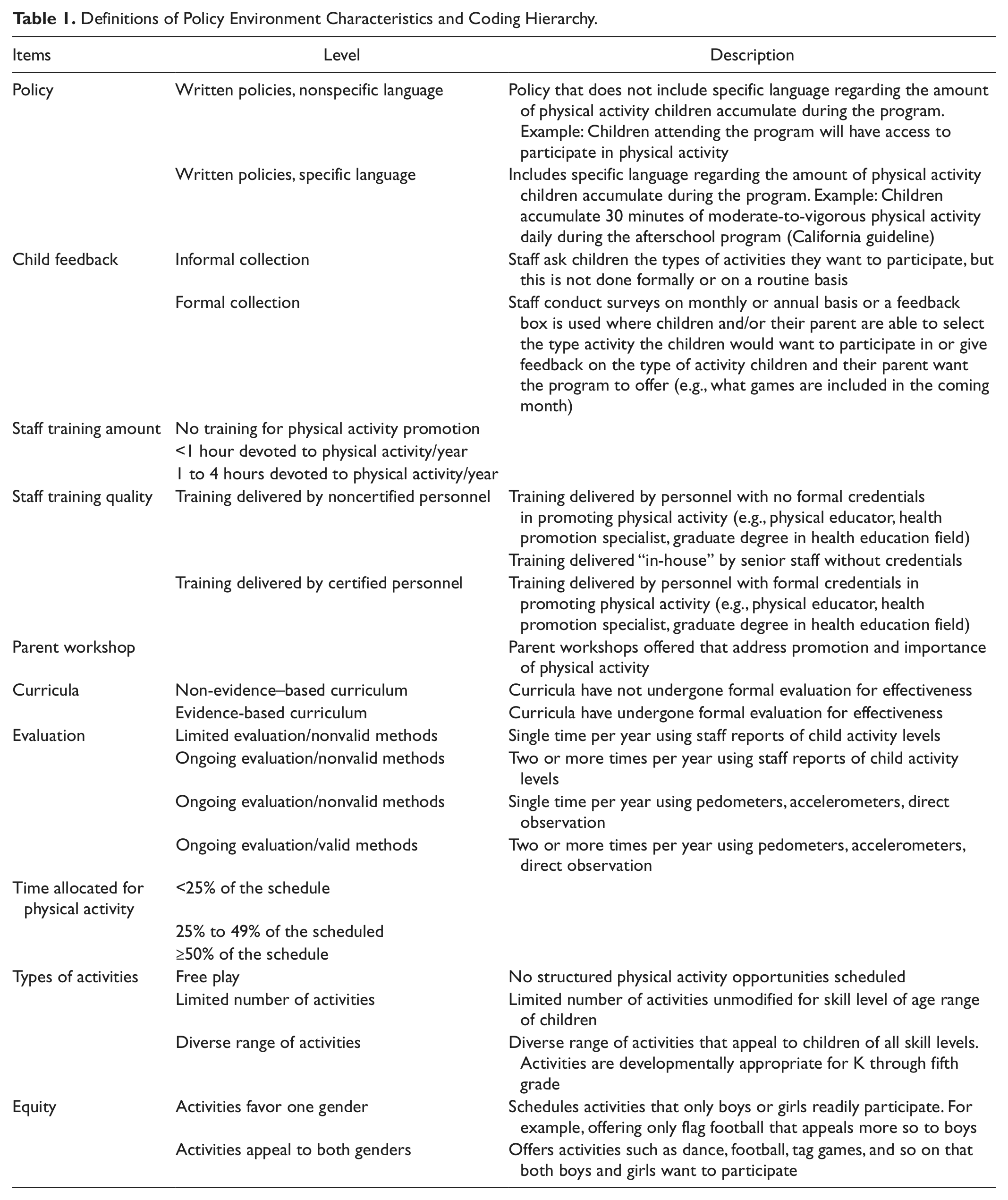
A total of 10 items were identified and collected in the current study. The definitions of these are presented in Table 1. The possible score for each item was based on existing policy language and, where appropriate, tiered to reflect increasing compliance with the policy directive. For example, staff training to promote physical activity received over the past year was tiered to reflect receiving none, less than 1 hour, 1 to 4 hours, and more than 4 hours. All responses were collected during a single day’s site visit that consisted of an interview with the ASP leader, review of existing documents, and observation of the ASP activities. Site visits were conducted by two trained researchers. Reliability (percentage agreement and kappa) across the items was 85% to 100% (median percentage agreement = 95%) and 0.70 to 1.00 (median κ = .92).
Definitions of Policy Environment Characteristics and Coding Hierarchy.
Physical Activity Measurement
Physical activity data were collected objectively using the ActiGraph GT1M accelerometer (Shalimar, FL). The epoch was set at 5-second intervals to account for the intermittent and sporadic nature of children’s physical activity (Bailey et al., 1995) and to improve the ability to capture the transitory physical activity patterns of children (Baquet, Stratton, Van Praagh, & Berthoin, 2007; Vale, Santos, Silva, Soares-Miranda, & Mota, 2009). On arrival to the programs, children were fitted with an accelerometer and the arrival time was recorded (start time). After affixing the accelerometer to the participants’ waist with an elastic belt, the children were allowed to participate in their normal ASP activities. Research staff continuously monitored the entire ASP for compliance in wearing the accelerometers. Before children departed from a program, research staff removed the elastic belt and recorded the time of departure (stop time). This procedure was performed throughout the duration of the study. physical activity data were collected on Mondays through Thursdays, with each child having the opportunity to wear the accelerometer for a total of 4 days. Consistent with a recent large-scale study of accelerometry and cardiometabolic risk factors in youth (Ekelund et al., 2012), cutpoint thresholds associated with moderate and vigorous activity (~4.6 METs) were used to distill the physical activity intensity levels (Puyau, Adolph, Vohra, & Butte, 2002) and sedentary behavior (Matthews et al., 2008). Children were considered to have a valid day of accelerometer data if their total wear time ([stop time − start time] − nonwear time) was equal to or greater than 50 minutes. This is 10 minutes less than previously established inclusion criteria and was adjusted downward because of a single ASP being 60 minutes of total program duration (Beets, Huberty, & Beighle, 2012; Beets, Rooney, Tilley, Beighle, & Webster, 2010).
Analysis
All analyses were conducted on only the observations where a child attended an ASP for a minimum of 50 minutes. To account for different lengths of time a child could attend on any given day the total amount of time a child was in attendance for a given day was included as a time-varying covariate in all models. Descriptive means, standard deviations, and ranges were computed for boys’ and girls’ physical activity and sedentary behaviors, separately. Likewise, the number of ASPs reporting a policy environment feature was calculated. Before conducting the outcome analyses, comparisons between the two geographical locations was made to determine activity and sedentary comparability. The association between the presence of an environment feature and time spent physically active or sedentary for boys and girls, separately, was evaluated using mixed model regressions accounting for multiple measurement days nested within child nested within ASP. The dependent variable in the models was the number of minutes spent physically active or sedentary, with the independent variable being the policy environment characteristic. For each characteristic, the lowest category (i.e., absent) was used as the reference group. Where more than two levels of response were possible for a characteristic, these were dummy-coded and entered into the model (e.g., less than 25% of schedule dedicated for physical activity [reference group] vs. 25% to 49% of the schedule and 50% or more of the schedule). Bootstrapped standard errors were used due to the nonnormal distribution of the dependent variables. All analyses were conducted using STATA (v.12.0, College Station, TX).
Results
Of the 1,241 children enrolled across the programs, 841 children wore an accelerometer for one or more days. Of these, 785 children had one or more days with 50 minutes or more of total wear time for an average of 2.5 days (range 1-4 days). This resulted in a total of 1,774 days of complete accelerometer data. The primary reason for less than 4 days of complete accelerometer data was leaving the program within an hour of arrival. The final sample of children were 50% girls, 59% White, 37% Black, and 5% Other (i.e., Hispanic, Asian), 64% with a body mass index below the 85th percentile, with an average age of 7.7 years (±1.8). There were no systematic differences between those children with complete accelerometer data and those without. Moreover, there were no differences in the amount of moderate-to-vigorous physical activity or sedentary behavior between the two locations. The descriptive characteristics of the amount of time children spent active and sedentary behaviors are presented in Table 2. Overall, boys spent more time in moderate-to-vigorous physical activity than girls (13.9 minutes vs. 10.1 minutes per day) and, conversely, less time in sedentary behaviors (63.1 minutes vs. 70.4 minutes per day).
Physical Activity Levels of Boys and Girls Attending Afterschool Programs.

Estimates adjusted for total time in attendance.
The descriptive characteristics of each ASP type, grouped by faith-based, organization (i.e., YMCA or Boys and Girls Club), or general ASPs, are presented in Table 3. Differences among the ASP types were observed for the amount of time allocated for physical activity opportunities in the programs’ schedule and the average amount of time a child was in attendance. All final models included these as covariates. No differences were observed across the policy environment characteristics among the ASP types. The number of ASPs with each policy environment characteristic is presented in Table 4. None of the ASPs were implementing all of the policy environment characteristics and all had at least two characteristics. Across the policy environment characteristics, only seven had some form of a policy related to physical activity, with the policy containing nonspecific language such as “children have a chance to play outside everyday” or “children enjoy age appropriate exercise activities.” Half of the programs reported receiving staff training for promoting physical activity, but it was delivered exclusively by an individual with no certification or formal training in promoting physical activity (i.e., no formal training in promoting physical activity). No programs reported having a parent workshop related to promoting physical activity. Only 11 programs reported using physical activity curricula and they were all non–evidence based. Two programs reported evaluating the physical activity of children attending their programs using nonvalid methods (e.g., staff observing activity). Most of the programs provided at least 25% of their daily schedule for activity opportunities, with seven programs reporting that 50% or more of their schedule was for physical activity. Half of the programs provided activities designed to appeal to both boys and girls and seven provided a diverse range of activities (e.g., dance, noncompetitive and competitive sports). Eleven programs collected feedback from the children on the types of activities they would want to play.
Descriptive Characteristics Across Afterschool Program Type.

Mean ± standard deviation.
Minutes/day.
Association of Afterschool Program Policy Environment Characteristic on Boys’ and Girls’ Accelerometer-Derived Time (Minutes) Spent Sedentary and in Moderate-to-Vigorous Physical Activity.
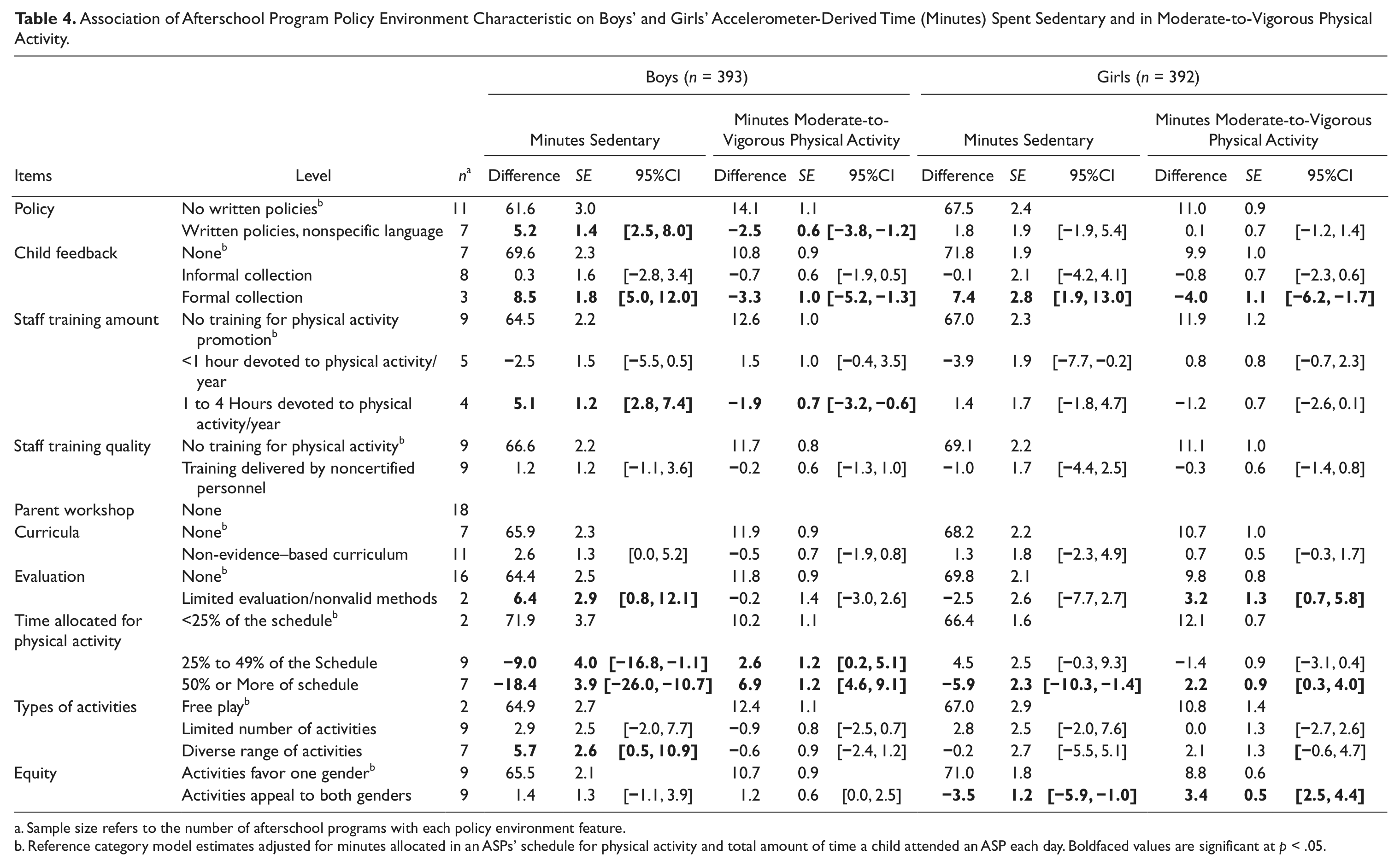
Sample size refers to the number of afterschool programs with each policy environment feature.
Reference category model estimates adjusted for minutes allocated in an ASPs’ schedule for physical activity and total amount of time a child attended an ASP each day. Boldfaced values are significant at p < .05.
The association of the policy environment characteristic and the amount of time boys and girls spent in sedentary and moderate-to-vigorous physical activity is presented in Table 4. Unexpectedly, for boys, the presence of a nonspecific written policy, a program formally collecting feedback, providing a diverse range of activities, limited evaluation, and providing staff with 1 to 4 hours of physical activity training was related to higher levels of time spent sedentary (+5.1 to +6.4 minutes/day) and lower levels of the amount of time spent in moderate-to-vigorous physical activity (−1.2 to −3.3 minutes/day). For girls, ASPs with formal collection of feedback were related to a lower level of the amount of time spent in moderate-to-vigorous physical activity and a higher amount of time spent sedentary. Conversely, allocating more time in the schedule for physical activity opportunities was related to higher levels of moderate-to-vigorous physical activity for boys and girls (+2.2 to +6.9 minutes/day) as well as a lower amount of time spent sedentary (−5.9 to −18.4 minutes/day). Programs that provided activities that appealed to both boys and girls (i.e., equity) and used limited evaluation had girls with higher levels of moderate-to-vigorous physical activity.
Discussion
This is the first study to describe the cross-sectional association of policy environment characteristics to objectively measured physical activity in a large number of diverse ASPs across two geographically unique metropolitan areas. Overall, the findings indicated that few characteristics had the desired association with activity levels, and in several instances, the associations were in the opposite direction. The results suggest that ASPs with these policy environmental characteristics do not necessarily have children that accumulate more physical activity while attending. This may lead to the minimization of the intended impact of policies—increases in children’s physical activity. One of the potential reasons for these findings is the limited accountability of ASPs to implement existing physical activity policies. For the ASPs in this study, policy adoption was on a voluntary basis or was initiated by the ASP leaders in the form of writing their own policies. Given the limited association to children’s activity, additional work is needed to identify ways to support implementation.
One possible solution is the assurance that ASP staff receive sufficient amounts of professional development training delivered by qualified personnel. As evident in Table 4, only half of the ASPs provided training related to promoting physical activity, and of these, none were delivered by individuals with some form of physical activity promotion certification. Additionally, none of the ASPs had a policy that explicitly benchmarked the amount of physical activity children should accumulate on a daily basis. Policies such as California’s minimum of 30 minutes of moderate-to-vigorous physical activity daily or North Carolina’s 20% of time spent in moderate-to-vigorous physical activity (Moore et al., 2010) may provide clearer goals for ASPs to reach, rather than simply stating that children engage in physical activity daily. Finally, the use of feedback, which serves as an indicator for quality ASPs, may result in lower activity levels when children request playing elimination games (e.g., dodgeball) or non-physical activity–related activities (e.g., charades) that they really like, yet do not allow all participants to be active throughout the entire game or do not promote physical activity at all. To limit this, staff need to be trained to identify inactive activities and modify them, such as eliminating lines from traditional games, such as kickball, to promote activity while ensuring that children recognize their feedback has been taken into consideration.
Although 11 ASPs indicated using a physical activity curriculum, all were non–evidence based (e.g., Triple Play, developed in-house), and none were associated with greater amounts of time spent in moderate-to-vigorous physical activity. These data suggest that the mere presence of a curriculum does not appear to be associated with overall physical activity levels. One might suggest that the afterschool sites purchase and use evidence-based, commercial curricula. However, the identification of effective prepackaged commercialized curricula is often difficult for ASPs (Beets, 2012a; Hall & Gruber, 2006) and existing prepackaged programs that have one or more published evaluations have found that their use does not necessarily translate into higher levels of physical activity when compared with programs that do not use a prepackaged program (Dzewaltowski et al., 2010; Kelder et al., 2005; Nigg, Battista, Chang, Yamashita, & Chung, 2004; Sharpe, Forrester, & Mandigo, 2011). This creates a situation where ASPs are investing resources in potentially ineffective or limited effective programs and it is likely that ASPs are unaware that their investment in programming does not translate into increases in physical activity (Beets & Huberty, in press). It is likely that a “one-size-fits all” curriculum does not address the diversity among ASPs and the resources that they have available to promote physical activity (Beets, 2012a). Hence, considerable effort is needed to identify why existing prepackaged programs are ineffective and refine them where appropriate and for studies to determine for whom they are effective for and under what circumstances.
Despite these unexpected associations, allocating time in the ASP schedule for opportunities for children to be active and providing activities that appeal to both boys and girls were related to higher levels of moderate-to-vigorous physical activity. This suggests that simple changes—allocating 50% of the programs’ time for physical activity—can have a sizable impact on children’s physical activity levels. More important, it suggests that simply identifying “physical activity time” as suggested in the California or North Carolina Standards might be effective in increasing time spent in moderate-to-vigorous physical activity in ASPs. Yet there is more to increasing activity than simply increasing time in an ASP schedule for it. It is equally necessary to maximize the amount of physical activity accumulated during already scheduled time, in addition to ensuring that enough time is scheduled for activity. Allocating 50% of a programs’ schedule for physical activity opportunities, however, may not be realistic for all ASPs. It is important that an adequate amount of time is allocated in an ASP schedule for activity, such as scheduling a minimum of 60 minutes in order for children to accumulate 30 minutes of moderate-to-vigorous physical activity (Beets, 2012a,2012b). Thus, both the amount of time and maximizing activity levels within scheduled time are important to ensure that children meet existing physical activity recommendations within ASPs (Beets, Wallner, et al., 2010; Weaver et al., 2012).
The average amount of minutes children accumulated in moderate-to-vigorous physical activity and sedentary represent the largest study conducted to date on the prevalence of activity within the ASP setting. It is clear that, in this sample of ASPs, low levels of moderate-to-vigorous physical activity are accrued, whereas a large amount of time is spent sedentary. These findings highlight the importance of maximizing physical activity levels within ASPs, especially since all programs allocated 25% or more of their daily schedule for physical activity (nine allocated 25% to 49%, seven allocated 50% or more). This translates into an average of 52 minutes (for 25% of an ASP schedule) to 104 minutes (for 50% of an ASP schedule) of schedule activity time across the programs. Thus, efforts need to focus on maximizing the amount of activity that children accumulate within this already scheduled time.
There are several strengths to this study. First, this study included a wide range of ASPs and large number of children across two midsize U.S. cities. Second, the policy environment characteristics were drawn from existing state and national documents and demonstrated a high level of interrater reliability. Third, an objective measure was used to assess physical activity. However, there are several limitations. Although a large number of ASPs were audited, it is unclear how representative they are of all ASPs nationwide. The study design was cross-sectional and no information was collected on when policies were adopted/implemented in those programs that indicated they had some form of physical activity policy. If those programs only recently adopted the policy, they may require additional time to fully implement it with fidelity, thereby resulting in the nonassociation with policy and children’s physical activity. Furthermore, other ASP characteristics, such as presence of equipment, staff involvement in and verbal promotion of activity, and physical resources (e.g., amount of gym and outdoor play space) were not collected. Other studies have found these characteristics to be linked to children’s activity in ASPs (Beets, Huberty, & Beighle, in press; Huberty, Beets, Beighle, & McKenzie, in press; Rosenkranz et al., 2011; Weaver et al., 2012) and these are likely operating within this sample. Moreover, there could be other reasons why activity levels were not different or in the opposite direction, other than the policy environment characteristics measured herein. Thus, continued investigation into the association of policy and physical activity is necessary.
In conclusion, although policies have been developed as a means to increase physical activity of children attending ASPs, the presence of policy environment characteristics were largely unrelated to the amount of physical activity children accumulated while attending an ASP. Additional work is needed to develop support systems to assist ASPs in the implementation of physical activity policies.
Footnotes
Declaration of Conflicting Interests
The authors declared no potential conflicts of interest with respect to the research, authorship, and/or publication of this article.
Funding
The authors disclosed receipt of the following financial support for the research, authorship, and/or publication of this article:
The project described was supported by Award Number R21HL106020 from the National Heart, Lung, And Blood Institute. The content is solely the responsibility of the authors and does not necessarily represent the official views of the National Heart, Lung, And Blood Institute or the National Institutes of Health.