



Abstract
The alarming obesity prevalence in Black women is well documented yet poorly understood. Obesity interventions for Black women have failed to produce long-term reductions in weight. Recommendations to incorporate a lifestyle and behavioral modification approach have been made to address obesity in this population. The purpose of this article was to provide a comprehensive review of the literature to identify lifestyle and behavioral modification obesity intervention studies for Black women. We included articles published between February 1992 and January 2013. This search identified 28 articles from the PsycInfo, MEDLINE, CINAHL, and SPORTDiscus databases. Results of these studies were summarized primarily into six categories. The importance of modest improvements in health outcomes that result from adapting healthier behaviors was highlighted. Future research is required for identifying the most salient intervention component or combination of components that lead to the best outcomes for ensuring intervention success and minimizing weight regain postintervention.
Keywords
Obesity prevalence has increased dramatically over the past two decades. Although one in three U.S. adults is obese, racial/ethnic, and gender disparities in obesity prevalence are even more alarming (Kumanyika et al., 2007). Blacks have one of the highest rates of obesity (44%) and Black women have the greatest prevalence of any group with nearly 50% (Ogden et al., 2006). There is a lack of consistency about the relationship between obesity and income compared with obesity and other sociodemographic variables (McLaren, 2007). In general, lower income groups have the highest rates of obesity, especially among women (Ogden et al., 2006; Wang & Beydoun, 2007). Blacks have some of the lowest household incomes; therefore, it is not surprising that rates of obesity are higher for this group. However, the race and income association is quite complex. Black women across all income levels are at increased risk for obesity and may find challenges to enrolling in lifestyle and behavioral modification obesity interventions. Obesity trends by income among Black women show an inverted U-shaped pattern, with middle-income Black women having a higher prevalence of obesity compared with low-income Black women (Wang & Beydon, 2007). It has been postulated that structural barriers (e.g., time constraints, inconvenient health club facility location and hours, safety, and social/professional activities) are perceived barriers to weight loss among middle-income Black women (Walcott-McQuigg, 1995).
Although data suggest that approximately 68% of obese Black women are attempting to lose weight, few weight loss interventions focus primarily on Black women (Bish et al., 2005). Intervention strategies, such as diet and physical activity, have been used to address these high rates. Despite these efforts, rates of obesity continue to rise within this population. Several factors have been cited for contributing to increased rates of obesity among Black women. First, overeating has been considered a means of coping with stressors associated with poverty (Kumanyika, 2008) and perceived racial discrimination (Cozier, Wise, Palmer, & Rosenberg, 2009). Second, occupational segregation frequently experienced by Blacks is another contributing factor that is associated with increased rates of overweight and obesity in this population. For example, along with other racial/ethnic minorities, Blacks tend to be overrepresented in low-wage occupations that frequently involve shift work (Chung-Bridges et al., 2008; McKinnon, 2003). Shift work has been implicated in disrupting circadian rhythms and is associated with fewer hours of continuous sleep (Mezick et al., 2008), both of which are risk factors for overweight and obesity. Similarly, food stores that are open to accommodate second shift workers (shift from approximately 3:00 p.m.-11:00 p.m.) tend to be 24-hour drive-thrus at fast food restaurants and 24-hour convenience stores. Along the same line, Blacks who maintain busy lifestyles that result from family, work, and church obligations, perceive their lifestyle as being physically active (Newton, 2008). Third, studies suggest that compared with other racial/ethnic groups, Blacks are more accepting of larger body sizes and view larger sizes as more attractive (Gipson et al., 2005; Gross, Scott-Johnson, & Browne, 2005; Katz et al., 2004), which may limit weight loss efforts. Another potential factor for increased rates of overweight and obesity among Blacks pertains to poor supermarket access. There is an extensive body of literature that support claims that these neighborhoods that do not have access to affordable, healthy, and nutritious foods—referred to as “food deserts”—are disproportionately located in predominantly Black and racial/ethnic minority neighborhoods (Moore & Diez-Roux, 2006; Powell, Slater, Mirtcheva, Bao, & Chaloupka, 2007; Raja, Ma, & Yadav, 2008). Oftentimes, these “obesogenic” neighborhoods contain more fast food restaurants and convenience stores thereby exposing residents to energy-dense, nutrient-poor foods that are readily available at inexpensive prices.
Given the aforementioned factors, it is reasonable to consider the importance of weight reduction interventions for Black women. However, Black women are recruited in weight reduction interventions in dismal numbers. Ethnic minorities are less likely than their White counterparts to participate in health behavior research, which presents challenges to and the need for addressing the most appropriate methods for designing and implementing weight reduction programs geared toward this population (Kumanyika, 2005; Levkoff & Sanchez, 2003). Additionally, many interventions show modest improvements in weight reduction in the short term, but fail in providing long-term weight loss (Jeffrey et al., 2000; Miller, 1999). The absence of (a) culturally appropriate intervention activities (Banks-Wallace & Conn, 2002; Melnyk & Weinstein, 1994), (b) lifestyle and behavioral modification approaches (Blocker & Freudenberg, 2001; Miller, 1999), and (c) social support have been implicated in the failure of obesity interventions to have a long-term impact on Black women (Baturka, Hornsby, & Schorling, 2000; Melnyk & Weinstein, 1994). Previous studies suggest these components may be the best practices for improving long-term weight loss and maintenance (Blocker & Freudenberg, 2001; Jeffrey et al., 2000).
As we have presented, addressing obesity among Black women is of public health and medical importance. The question remains how practitioners can best reduce and ultimately eliminate the high rates of obesity among this population. This question can, in part, be addressed by identifying best practices for recruitment into and retention of Black women in weight reduction programs. The goal of this article is to provide a comprehensive review of the literature surrounding lifestyle and behavioral modification approaches to weight reduction among Black women. This approach has been cited as essential for addressing high rates of overweight and obesity among Black women (Fitzgibbon et al., 2012). In doing so, an in-depth exploration of lifestyle and behavioral components will be presented. It is expected that identifying the most successful lifestyle and behavioral components for Black women may lead to the design of implementation of programs that can lead to improved clinical measures, better quality of life, and reduced risk of chronic disease onset.
Lifestyle and Behavioral Change Approach
Obese individuals often live with chronic comorbidities, including heart disease and type 2 diabetes, all of which have obesity as a risk factor (Must et al., 1999). A modest reduction of 5% to 10% of initial body weight has been known to improve these comorbid conditions (Blackburn, 1995; Knowler et al., 2002). Lifestyle and behavioral modification approaches have been identified to induce changes of this magnitude (Jones-Corneille, Stack, & Wadden, 2011). The terms lifestyle and behavioral modification are frequently used interchangeably (Jones-Corneille et al., 2011; Wadden, McGuckin, Rothman, & Sargent, 2003). For this article, the phrase “lifestyle and behavioral” will be used to describe the actions and reactions in which a person engages that influence his or her way of living.
Lifestyle and behavioral interventions are valuable in that they assist obese patients in identifying and modifying foods that sabotage weight loss, activity level, and cognition surrounding health habits that exacerbate excess weight (Wadden & Butryn, 2003; Wadden & Foster, 2000). Wadden and Foster (2000) assert that specific triggers lead to certain behaviors, which is a fundamental principle of conditioning. This principle posits that stimuli before and during a specific behavior become associated with that behavior. For example, feelings of stress and anxiety can be a trigger for overeating. Repeated eating when stressed or anxious will become tightly associated in such a way that stress and anxiety will trigger eating despite the absence of real hunger. Behavioral treatment addresses this behavior by identifying harmful triggers. Wadden and colleagues describe frequently used lifestyle and behavioral approaches as (a) goal-centric, (b) process oriented, and (c) known to yield small changes (Wadden & Butryn, 2003; Wadden & Foster, 2000). Lifestyle and behavioral modifications are centered on defining a specific goal and a plan for assessing attainment of the goal. For example, increasing exercise duration by 5 minutes. Process-oriented interventions allow participants to identify facilitators and barriers to attaining the specified goal. In doing so, participants identify the skills needed to succeed in achieving the goal. Last, small changes typically result in increased likelihood of weight-loss maintenance, and are made to ensure that small successes are celebrated and additional goals can be built on progress already made.
In a historical account of weight loss techniques, Miller (1999) reported that over a 40-year period (1959-1999), the most widely used weight loss programs were fad diets that incorporated harmful diet strategies. These harmful strategies and inadequate follow-up data showing long-term effects have been implicated in the need for lifestyle and behavioral modification interventions. These interventions do not focus on weight reduction per se; rather encourage the development of a healthy lifestyle. This approach is more appropriate when taking into account the complex factors surrounding the social and environmental context of Black women that impede weight loss goals.
Method
Selection of Review Articles
Studies included in the review involved various phases of obesity interventions using a lifestyle and behavioral modification approach. Participants were primarily Black women in the studies, and where Black women were not recruited exclusively, analyses were stratified by race. Citations from 195 articles were retrieved. After removing eight duplicates, additional exclusions were made. These exclusions are found in Figure 1. Studies that had an existing comorbid condition as an inclusion criterion were not included in the study. It is widely accepted that obesity is a risk factor for a variety of comorbid conditions, including diabetes, heart disease, stroke, and certain cancers. Although it is important to explore how lifestyle and behavioral modification interventions affect those with existing conditions, findings may not be generalizable to individuals without these diagnoses. Excluding these studies may offer insight into potential primary prevention strategies geared toward addressing obesity prior to the onset or diagnosis of chronic conditions. Twenty-eight articles were included in this review. Samples ranged from 16 to 1,162 participants.
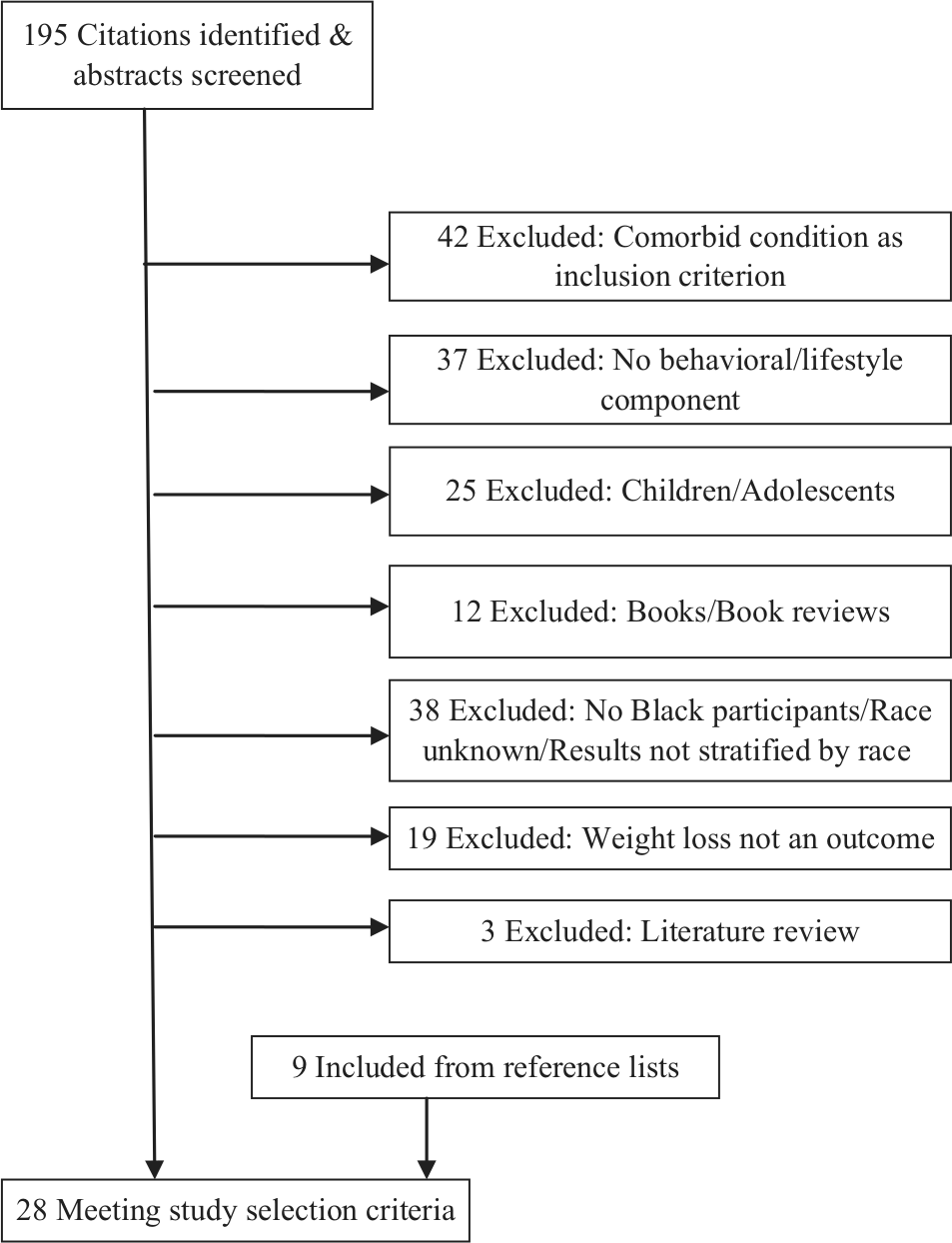
Schematic of exclusion criteria that yielded the final articles selected for the review.
Results
Success of lifestyle and behavioral interventions can be attributed to the components of the intervention used (Jeffrey et al., 2000; Stuart, 1967; Wadden & Butryn, 2003), the duration of the intervention (Wadden & Butryn, 2003), and the setting where the intervention occurred (Jones-Corneille et al., 2011; Martin et al., 2006). These features are summarized in Table 1.
Description of Interventions Included in the Review.
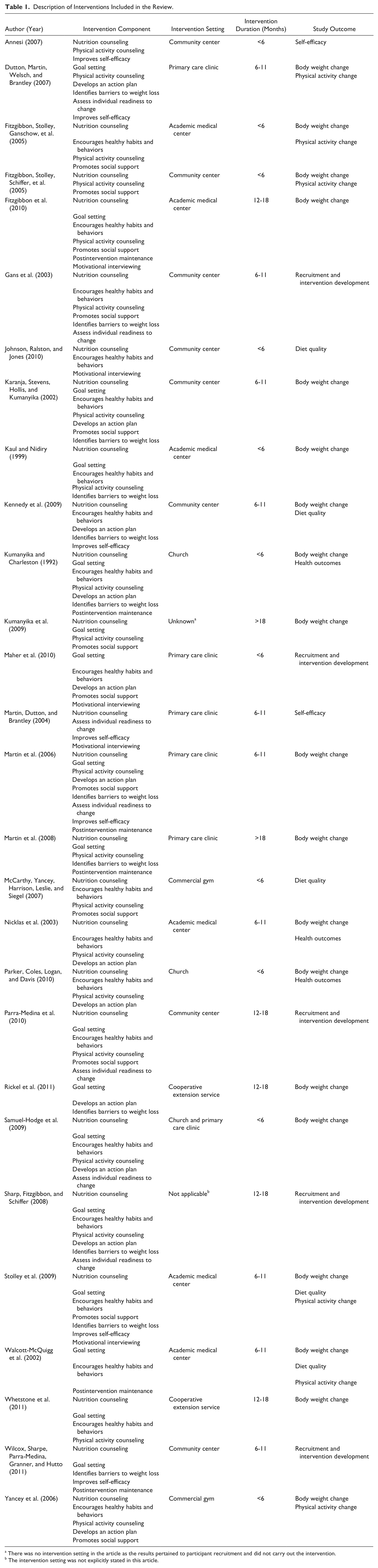
There was no intervention setting in the article as the results pertained to participant recruitment and did not carry out the intervention.
The intervention setting was not explicitly stated in this article.
Components of Lifestyle and Behavioral Interventions
Intervention components geared toward promoting lifestyle and behavioral modification for Black women fall primarily into 11 categories. Each of the 11 intervention components along with a description or goal is as follows:
Nutrition counseling—Instruction on eating behavior, portion control, portion size, and so on. Additional recommendations on making healthier food choices
Goal setting—Creates realistic personalized goals in alignment with participant’s concerns
Encourages healthy habits and behaviors—Identifies best practices for promoting healthy behaviors including stress management and addressing binge eating. Behavioral counseling was the approach used most frequently
Physical activity counseling—Tailored strategies to incorporate more physical activity into lifestyle based on activity preferences and current activity level
Develops an action plan—Provides detailed recommendations with the participant’s input, on ways to successfully achieve each goal
Promotes social support—Intervention activities take into account the importance of familial and social relationships and how these relationships can foster lifestyle and behavioral modifications
Identifies barriers to weight loss—Identifies personal and environmental barriers (e.g., boredom, changes in health status) to weight loss
Assesses individual readiness to change—Uses theories of health behavior to gauge likelihood of success based on participant’s readiness to change health behaviors
Improves self-efficacy—Teaches participants how to resist eating in high-risk situations (e.g., negative emotions, social pressure, etc.)
Postintervention maintenance—Discusses ways to stay motivated during weight loss efforts, specifically postintervention
Motivational interviewing—Personalized interview specific to each participants’ food preferences, current dietary, and physical activity habits, and so on.
Components were personalized for each participant in a culturally appropriate manner. For example, a culturally relevant, personalized nutrition counseling session would begin with assessing the participant’s knowledge, attitudes, and beliefs about diet/nutrition. The intervention staff member would then describe ways to prepare cultural foods using healthier methods. This would be achieved in the context of understanding the food guide pyramid, portion sizes, a balanced diet, and ways to overcome barriers to proper diet and nutrition. For the 11 intervention components presented in the included articles, it is unknown whether one component is more crucial for weight reduction maintenance, or if a combination of intervention components is required.
Intervention Duration
Intervention duration is a key feature of an intervention that plays a role in the success of an intervention (Banks-Wallace & Conn, 2002). Given constraints (e.g., time, personnel, budget, etc.) by researchers and interventionists to design culturally appropriate studies, and concerns regarding participant burden, oftentimes it is necessary to design, implement, and evaluate an intervention within a specific time frame.
Short-term success is common in interventions with a shorter duration (less than 6 months; Fitzgibbon, Stolley, Ganschow, et al., 2005; Samuel-Hodge et al., 2009; Yancey et al., 2006). Wadden and Butryn (2003) described challenges to long-term weight loss using behavioral treatment. Participants lost weight 6 months postintervention, but weight regain was common 12 months postintervention. The optimal duration or frequency was not known. On one hand, researchers must contend with participant fatigue in dealing with intervention duration. On the other hand, concerns about sufficient time for observing intervention benefits must be considered (Wadden & Butryn, 2003). For this review, intervention duration included the duration of the intervention, and for certain studies, follow-up periods. Follow-up periods were included in the intervention duration if multiple interactions with participants occurred (e.g., telephone calls, intervention-related mailings, face-to-face counseling, weight loss maintenance, etc.) from the end of the formal intervention period through each follow-up period. These activities, though beyond the intervention program itself, could potentially influence motivation postintervention, and encourage participants to remain proactive in their health. Follow-up periods were not included in the duration if the follow-up was a one-time interaction with participants (e.g., one assessment 6 months postintervention).
Intervention Setting
Various settings have been used to improve adherence to intervention activities and to maximize intervention success. Churches serve a central role in the Black community because of the social and religious networks they provide. As a result, church-based interventions have been used for preventive health services (Kumanyika & Charleston, 1992). In addition to churches, community organizations and primary care clinics are common locales for conducting intervention programs. Community organizations can include barber shops or beauty salons (Johnson, Ralston, & Jones, 2010; Linnan et al., 2005), and senior centers (Hendrix et al., 2008). Community organizations are frequently used to carry out interventions because of the ease of access these organizations afford participants who reside nearby. Increasingly, primary care facilities are sites for obesity interventions because of the frequent visits adults make each year. An estimated 75% of adults visit a primary care physician approximately five times each year (Goldberg, Ockene, Ockene, Merriam, & Kristeller, 1993). Although these sites cater to a “captive audience”—individuals who visit their primary care physician—a specific target audience may be missed, namely individuals who are uninsured or underinsured who are unable to receive regular care because of the lack of transportation, time, or monetary resources.
Outcomes of the Intervention Studies
Interventions included at least one of the aforementioned components to address obesity among Black women. The results can be summarized into six main outcomes (Table 1): (a) body weight change, (b) diet quality, (c) recruitment and intervention development, (d) physical activity change, (e) health outcomes, and (f) self-efficacy. Findings from each study with study characteristics are presented in Table 2.
Summary of Findings Included in the Review.
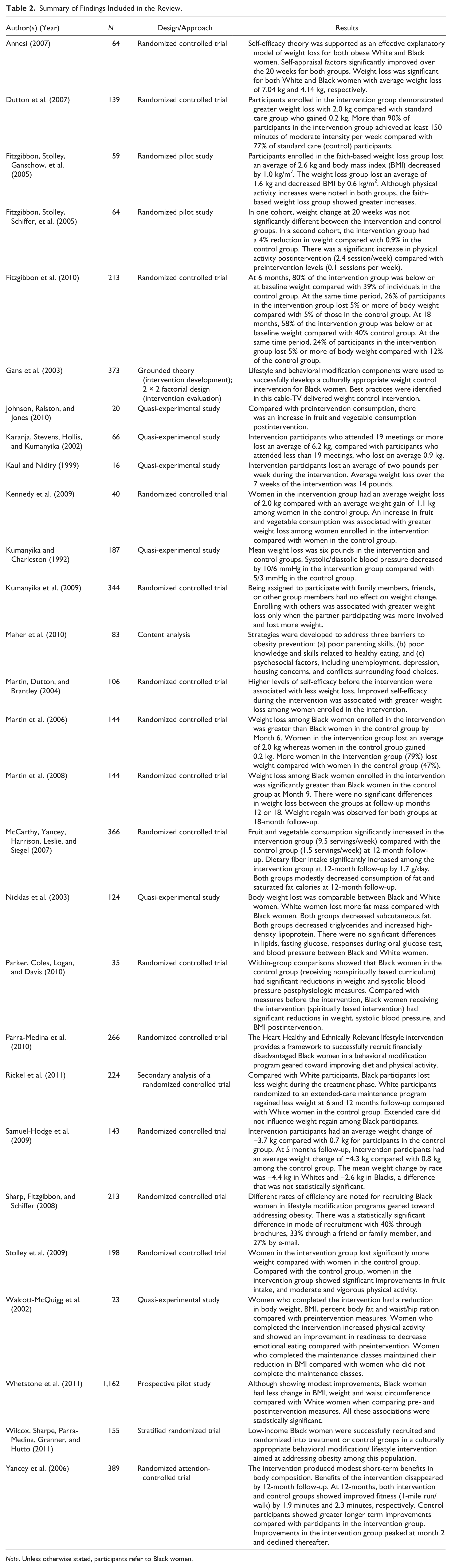
Note. Unless otherwise stated, participants refer to Black women.
Body weight change
It is not surprising that lifestyle and behavioral modification interventions produce modest changes in body weight due to the difficulty and time-consuming nature of modifying human behavior, especially in high-risk populations. In addition to “modest” referring to a 5% to 10% reduction in body weight (Blackburn, 1995; Knowler et al., 2002), weight loss between 1 pound (0.45 kg) and 2 pounds (0.90 kg) per week is also considered modest (National Heart, Lung, and Blood Institute Obesity Education Initiative, 1998). Results with this degree of improvement were common in this review (Whetstone et al., 2011; Yancey et al., 2006). For example, in a 20-week intervention testing the feasibility and efficacy of a weight loss and breast health intervention for Black women, Fitzgibbon, Stolley, Schiffer, et al. (2005) observed a 4% decrease in body weight among intervention participants. Weight loss is often a secondary goal of these interventions with modifying behaviors a primary goal. It is suggested that interventions that focus entirely on weight loss have greater losses in the short term and weight regain in the long term. Although lifestyle and behavioral modifications also produce short-term weight loss, studies show that with the appropriate postintervention maintenance, these effects can be sustained over a longer term as a lifestyle approach was undertaken.
Diet quality
Lifestyle and behavioral modification approaches were shown to affect diet quality by improving fruit and vegetable consumption in the intervention group compared with the control group. Although modest improvements in diet quality were noted, these improvements are a step in the right direction for gradually increasing these food groups into the diet. This is best illustrated in study findings from two studies that reported changes in diet quality. In a study testing the effectiveness of a 6-week intervention on diet, physical activity, and water consumption in Black women, Johnson et al. (2010) reported a nearly twofold increase in fruit and vegetable consumption in the intervention group from 12.6 to 23.8 servings per week. The weekly fruit and vegetable intake recommendations outlined by the U.S. Department of Agriculture has been 35 to 63 servings of these food items per week (Lin, Allhouse, & Lucier, 2004). Similarly, McCarthy, Yancey, Harrison, Leslie, and Siegel (2007) tested the efficacy of a nutrition and physical activity intervention in healthy Black women. Pre- and postintervention findings showed an increase in fruit and vegetable consumption in the intervention group from 30 servings per week to 39.5 servings per week. Additionally, intervention components that addressed diet quality improved harmful eating behaviors including emotional and binge eating.
Recruitment and intervention development
Studies described the challenge in recruiting Black women in weight loss interventions (Banks-Wallace & Conn, 2002; Sharp, Fitzgibbon, & Schiffer, 2008). Social–contextual factors have been implicated in these challenges. For example, Black women tended to be more accepting of larger body sizes compared with their White counterparts (Baturka et al., 2000) and perhaps less interested in participating in weight loss programs. This acceptance has resulted in a positive body image in Black women that has potentially modified cultural norms of standards of beauty (Baturka et al., 2000; Chandler-Laney et al., 2009). Additionally, distrust of research (Bates & Harris, 2004; Brown & Topcu, 2003), skepticism of the intervention program (Yancey, McCarthy, & Leslie, 1998), caregiving responsibilities (Eyler et al., 2002; Frank, Stephens, & Lee, 1998), lack of time (Carter-Nolan, Adams-Campbell, & Williams, 1996; Fitzgerald, Singleton, Neale, Prasas, & Hess, 1994; Nies, Vollman, & Cook, 1999), feeling self-confident engaging in intervention activities in front of others (Karanja, Stevens, Hollis, & Kumanyika, 2002), and concerns about maintaining hairstyles (Airhihenbuwa, Kumanyika, Agurs, & Lowe, 1995; Carter-Nolan et al., 1996) have been documented in the literature as barriers to recruiting Black women in obesity interventions. However, studies have identified successful means for recruiting and retaining Black women in obesity interventions that incorporate lifestyle and behavioral modification components. Results of these studies speak to the different modalities that are used to identify and encourage potential participants. For instance, Sharp et al. (2008) identified appropriate measures to recruit obese Black women in an obesity reduction intervention. Specifically, a mixed recruitment approach incorporating brochures, family and friend referrals, and mass e-mail distribution with ethnically diverse study staff, were shown to successfully screen 690 obese Black women and recruit 213 into a physical activity and nutrition intervention program (Sharp et al., 2008).
Physical activity change
There appears to be a benefit enrolling in an intervention as study participants receiving the control arm of an intervention have shown improvements in study outcomes. In comparing physical activity changes among sedentary overweight and obese individuals, it is not surprising that although the intervention group had greater increases in physical activity levels, both groups showed improvement pre- and postintervention (Fitzgibbon, Stolley, Ganschow, et al., 2005; Yancey et al., 2006). For sedentary individuals, simply enrolling in an intervention may be impetus enough to become cognizant of one’s physical activity level, thereby leading to improvements in physical activity. In the case of Yancey et al. (2006) who found modest improvements in physical activity in treatment and control groups, a complimentary 1-year fitness membership may have been the incentive that sedentary Black women required to improve fitness levels. Similar findings were observed by Walcott-McQuigg et al. (2002) in a study identifying factors associated with weight and weight loss maintenance in a 32-week lifestyle intervention for Black women. The authors reported that women who completed the weight loss component of the intervention had a significant increase in physical activity compared with women who did not complete this phase (Walcott-McQuigg et al., 2002). These findings support the use of lifestyle and behavioral modification for modest improvements in physical activity among sedentary obese Black women.
Health outcomes
Consuming a nutrient-dense diet and engaging in modest to vigorous physical activity has been associated with better health. Specifically, it is widely accepted that these health behaviors are known to reduce risk factors for obesity and other chronic disease outcomes (Hendrickson, Smith, & Eikenberry, 2006; Lewis et al., 2005; McCullough et al., 2002; Zenk et al., 2005). These risk factors include elevated blood pressure, cholesterol, triglycerides, and blood glucose. All the studies in this review that looked at clinical measures showed improvements postintervention compared with baseline measures. For example, two studies reported decreases in blood pressure. Parker, Coles, Logan, and Davis (2010) observed decreases in systolic blood pressure, and Kumanyika and Charleston (1992) reported changes in both systolic and diastolic blood pressures in intervention and control groups, with a greater reduction among women in the treatment group. This underscores the saliency of modest improvements in diet and physical activity on health outcomes that may be clinically significant.
Self-Efficacy
Self-efficacy is defined by Bandura (1977) as a person’s belief that she or he is capable of performing a behavior to achieve a goal. Self-efficacy is a construct that has received attention in the behavioral literature as a predictor of success in obesity interventions containing lifestyle and behavioral modification components. Two studies sought to determine if self-efficacy was a predictor for weight change in obese women. Annesi (2007) examined how changes in three self-appraisal factors (Body Area Satisfaction Scale, Exercise Self-Efficacy Scale, and Physical Self-Concept Scale) affected body weight change over a 20-week period in Black and White obese women. Findings showed that improved self-efficacy was associated with weight change in both Black and White women. However, improvements differed between Black and White women depending on the self-efficacy indicator used. For Black women, improvements in self-regulatory efficacy—assessed from the Exercise Self-Efficacy Scale—was the strongest predictor of weight change. For White women, improvements in body satisfaction—assessed from the Body Area Satisfaction Scale—was the strongest predictor of weight change (Annesi, 2007). The second study by Martin, Dutton, and Brantley (2004) reported two different findings: (a) women with high levels of self-efficacy for weight loss before the intervention showed poorer treatment outcomes and (b) improving self-efficacy as a part of the intervention resulted in greater weight loss. One possible explanation the authors offered was that cross-cultural differences may exist in how self-efficacy is associated with eating behaviors.
Discussion
This article sought to provide a comprehensive review of lifestyle and behavioral modification obesity interventions for Black women. The review included articles published between February 1992 and January 2013. Overall, findings support the use of lifestyle and behavioral modification obesity interventions for Black women as a viable and essential approach for this population rather than a focus on losing weight by itself. The benefit of proximal goal attainment has been shown to increase adherence to a physical activity regimen in Black women opposed to an outcome goal attainment. For instance, exercise adherence is more likely in Black women when there is a gradual increase in time or intensity of an exercise rather than a focus on amount of weight lost. Realistic short-term goals can serve to assist in adherence. Given this finding, interventionists may consider a refocus from “how much weight have I lost” to “how much activity have I done.” In other words, more attention to promoting a healthier lifestyle and improved health behaviors can ultimately result in weight change and long-term maintenance of weight loss.
A noteworthy finding from the articles pertaining to body weight change is that although significant changes occurred, weight regain was common at 12- and 18-month follow-up. Only six of the studies included an intervention component on postintervention maintenance. This highlights the need for better postintervention maintenance long-term. Examples of strategies that have shown to reduce weight regain postintervention include self-monitoring, self-efficacy, and stimulus and portion control (Fitzgibbon et al., 2010). Using face-to-face interactions, motivational interviewing sessions, telephone delivery, e-mail, text messaging, and other modalities for increasing interaction with intervention participants and staff, have been identified for improving postintervention maintenance long-term (Fitzgibbon et al., 2010; Martin et al., 2006). These techniques were shown to prolong adherence, although for each study, weight regain was reported. A question that remains to be seen is whether or not longer obesity intervention studies will lead to improved long-term outcomes and increased adherence to health behavior change. Only two studies in the review (see Table 1) included an intervention that exceeded 18 months. Additional studies are needed to explore this further.
A challenge identified in the literature relates to recruiting ethnic minorities, including Black women in clinical trials. To address this concern, the National Institutes of Health Revitalization Act of 1993 mandated the inclusion of minority participants in randomized clinical trials (Mastroianni, Faden, & Federman, 1994). Despite this mandate, numerous studies conduct lifestyle and behavioral modification interventions but do not include Black women, or research findings are not stratified by race (Rejeski, Mihalko, Ambrosius, Bearon, & McClelland, 2011; Rimmer, Rauworth, Wang, Heckerling, & Gerber, 2009; Shuger et al., 2011; Smith, Heckemeyer, Kratt, & Mason, 1997). For this review, 38 of the 195 abstracts screened were excluded due to the inability to determine intervention impact strictly on Black women. Additional data on racial/ethnic differences in obesity intervention outcomes is warranted.
Furthermore, compared with low-income Black women, middle-income Black women report more major life stressors, including work and family responsibilities, and financial and educational pursuits that makes it difficult to engage in physical activity and convenient to obtain food prepared outside the home (Walcott-McQuigg, 1995).
Income and Body Image
When exploring perceptions of body image in Black women of various income strata, studies suggest that perceptions of weight control and body image are similar between middle-income and low-income Black women. For example, compared with low- and middle-income White women, fewer low- and middle-income Black women perceive themselves as being overweight or obese. Additionally, both low- and middle-income Black women believe that it is not necessary to be thin to be attractive (Walcott-McQuigg, 1995). Despite these findings, only 10 studies had an income-specific inclusion criterion that was exclusively for low-income participants (Dutton, Martin, Welsch, & Brantley, 2007; Fitzgibbon, Stolley, Ganschow, et al., 2005; Kaul & Nidiry, 1999; Maher et al., 2010; Martin et al., 2004; Martin et al., 2006; Martin et al., 2008; Parra-Medina et al., 2010; Samuel-Hodge et al., 2009; Wilcox, Sharpe, Parra-Medina, Granner, & Hutto, 2011). Although these studies highlight the importance of ensuring that lifestyle and behavioral modification obesity interventions are accessible to low-income Black women as they have been shown to produce modest improvements in weight change in this demographic, additional studies are needed to substantiate this claim because of the small number of studies identified that included low-income Black women, an apparent gap in the literature. An additional gap identified from this review includes identifying the most salient, relevant, and appropriate intervention component or combination of intervention components for Black women. Nutritional counseling was the most frequently used intervention component. Nearly 86% of the studies (n = 24) used this technique to encourage healthier food choices. Interventionists and health care providers must balance healthier food recommendations with the social and environmental context in which the women live, work, and play, as conditions to promote healthier food choices may be challenging.
Best Practices for Obesity Prevention Interventions Designed for Black Women
Based on the findings from this review, we have identified five “best practices” for maximizing success in lifestyle and behavioral modification obesity interventions for Black women:
Improve self-efficacy, which has been associated with influencing motivation and health behaviors associated with overweight and obesity prevention.
Set realistic and achievable short-term and long-term goals that will keep the participant engaged during the intervention while feeling a sense of accomplishment.
Create an action plan with the participant’s input to identify activities that are likely to be maintained to maximize success of the intervention.
Incorporate intervention activities that allow for familial and social relationships to thrive as these relationships can be sources of support for the participant, or conversely, obligations that are frequently identified as barriers to intervention adherence.
Ensure adequate interaction postintervention to increase the likelihood of maintaining or continuing efforts postintervention.
Implications for Practice
Lifestyle and behavioral modification obesity interventions have salient implications for practice. This review identified the importance of primary care providers in reducing obesity prevalence among Black women. Despite having a brief encounter with patients, this review highlighted the influence primary care physicians may have in promoting and encouraging healthy behaviors associated with weight gain. Additionally, these studies underscore the importance of acknowledging modest changes in weight on clinical outcomes, and identifying ways to sustain these effects long-term. From a public health perspective, the design of culturally appropriate lifestyle and behavioral modification obesity interventions can address the intergenerational transmission of obesity from Black women to their children. Additional research is needed to identify which intervention component, or combination of components, are most effective in addressing obesity in Black women. To our knowledge, no meta-analytic studies have been done to answer this question, thereby identifying a gap in the literature and an area for future research. These lifestyle approaches will afford families and communities the capacity needed to engage in healthier behaviors in hopes of mitigating obesity prevalence in Black women.
Footnotes
Declaration of Conflicting Interests
The authors declared no potential conflicts of interest with respect to the research, authorship, and/or publication of this article.
Funding
The authors received no financial support for the research, authorship, and/or publication of this article.