




Abstract
Scientific integrity is necessary for strong science; yet many variables can influence scientific integrity. In traditional research, some common threats are the pressure to publish, competition for funds, and career advancement. Community-based participatory research (CBPR) provides a different context for scientific integrity with additional and unique concerns. Understanding the perceptions that promote or discourage scientific integrity in CBPR as identified by professional and community investigators is essential to promoting the value of CBPR. This analysis explores the perceptions that facilitate scientific integrity in CBPR as well as the barriers among a sample of 74 professional and community CBPR investigators from 25 CBPR projects in nine states in the southeastern United States in 2012. There were variations in perceptions associated with team member identity as professional or community investigators. Perceptions identified to promote and discourage scientific integrity in CBPR by professional and community investigators were external pressures, community participation, funding, quality control and supervision, communication, training, and character and trust. Some perceptions such as communication and training promoted scientific integrity whereas other perceptions, such as a lack of funds and lack of trust could discourage scientific integrity. These results demonstrate that one of the most important perceptions in maintaining scientific integrity in CBPR is active community participation, which enables a co-responsibility by scientists and community members to provide oversight for scientific integrity. Credible CBPR science is crucial to empower the vulnerable communities to be heard by those in positions of power and policy making.
Keywords
Scientific integrity is absolutely essential for the good practice of all scientific endeavors (Drenth, 2010). Although no simple definition captures the complexity of scientific integrity, the Panel on Scientific Responsibility and the Conduct of Research (1992) defines it as the “adherence by scientists and their institutions to honest and verifiable methods in proposing, performing, evaluating, and reporting research activities” (p. 4). Scientific integrity also reflects the ethical obligation for scientists and institutions:
. . . integrity embodies above all the individual’s commitment to intellectual honesty and personal responsibility . . . moral character and experience. For an institution, it is a commitment to creating an environment that promotes responsible conduct by embracing standards of excellence, trustworthiness, and lawfulness. (Institute of Medicine National Research Council of the National Academies, 2002, p. 4)
The European Science Foundation (2011) identified specific principles as the underpinning for scientific integrity, including honesty, reliability, objectivity, impartiality, open communication, duty of care, fairness, and responsibility for future science generations.
However, every investigator confronts threats to scientific integrity. Some threats are competition for funds, pressure to publish, commercialization, and career advancement (Drenth, 2010). The frequency of scientific misconduct, such as data falsification, fabrication, and plagiarism occurs from 0.1% to 1.0% in the literature (Steneck, 2006, 2007), and is suggested to be increasing (Drenth, 2010, 2007). In the United States, studies suggest misconduct could involve as many as 1 in every 100 researchers (Steneck, 2006).
While the majority of science that is undertaken follows the traditional path with scientists in control of research, more recent approaches, such as community-based participatory research (CBPR), provide a different context for scientific integrity. CBPR is an equitable partnership between professional and community investigators in all aspects of the research process, including definition of research questions, data collection and analysis, and interpretation and dissemination of findings, while co-sharing all responsibilities in the endeavor (Israel et al., 2005; Viswanathan et al., 2004; Wallerstein & Duran, 2006). This equal partnership leaves behind traditional academic hierarchies (Minkler, 2004). The shift in power sharing builds trust (Holkup, Tripp-Reimer, Salois, & Weinert, 2004; Wallerstein, 1999) and mitigates the knowledge imbalances between professional and community investigators (Leung, Yen, & Minkler, 2004). It is an approach to research that enables investigators to obtain internally valid, culturally specific insights into the environmental and social contexts surrounding health and disease of minority and vulnerable communities by involving the community in the research process. One of the main tenets of CBPR is action toward social change in the community along with the production of knowledge (Minkler & Wallerstein, 2003). While several sets of principles and guidelines for CBPR exist for forming collaboration (Blumenthal, 2011; Green et al., 1995; Israel et al., 2005; Viswanathan et al., 2004), no one standard exists for evaluating CBPR practice.
At the same time, concern about scientific integrity in CBPR projects is growing (Hueston et al., 2006; Minkler, 2004; Wallerstein & Duran, 2006). Three areas of concern for CBPR scientific integrity have been discussed: (a) different amounts of methodological and research training by team members; (b) availability and access to resources such as time, equipment, and money for team members; and (c) variability in agendas, expectations, and norms associated with each team member’s community, discipline, and culture (Cargo & Mercer, 2008; Horowitz, Robinson, & Seifer, 2009; Minkler, 2004; Quandt, Arcury, & Pell, 2001). These concerns could limit the validity and utility of CBPR. For example, if team members have limited time, this could affect their participation in the process and thus negatively affect the study. Methods that have been suggested to maintain and improve scientific integrity in CBPR are the implementation of rigorous research methods, open communication between team members, clear definition of team members’ roles, promoting talents of each team member, promoting colearning that creates balance, and promoting discussion of the needs and interests of all involved emphasizing compromise (Buchanan, Miller, & Wallerstein, 2007; Cargo & Mercer, 2008; Wallerstein & Duran, 2006).
Understanding the perceptions that promote and threaten scientific integrity in CBPR identified by professional and community investigators provides insight on problem areas for investigators and aspects that could be implemented to maintain scientific integrity. The wide variation present in the implementation and definition of scientific integrity in CBPR among professional and community investigators highlights the importance of identifying barriers and facilitators to scientific integrity (Kraemer Diaz, Spears Johnson, & Arcury, 2013). This article explores perceptions that promote and discourage scientific integrity in CBPR among a sample of professional and community CBPR investigators.
Method
We used a qualitative design to understand perspectives on scientific integrity for CBPR investigators conducting projects in nine states in the southeastern United States. In-depth interviews were held with professional and community investigators from 25 different projects in 2012. The research protocol was approved by the Wake Forest School of Medicine Institutional Review Board and all participants provided signed consent.
A list of current CBPR projects in the southeastern United States (Virginia, Kentucky, North Carolina, South Carolina, Georgia, Florida, Mississippi, Alabama, Louisiana, Puerto Rico) was compiled from the NIH Reporter (http://projectreporter.nih.gov/reporter.cfm) and the Centers for Disease Control and Prevention Research Centers (http://www.cdc.gov/prc/). Projects were identified if their abstracts indicated funding, at least in part, to conduct CBPR. From the list of 121 projects, 50 projects were identified and the contact principal investigators (PIs) were invited to participate in the study. From the 50 PIs we contacted, 9 failed to reply, and 8 declined to participate (Table 1). Of the 33 who expressed an interest in participating, 1 agreed to participate but was later unable due to a natural disaster, 2 were early in their development, 2 projects were located in communities geographically located outside the Southeast, although the institution that employed the PI was located in the Southeast, and 3 accepted after the goal of 25 had been achieved. Eleven projects focused on largely African American communities, nine focused on communities of mixed ethnicities, and five focused on immigrant or refugee populations.
Sample Disposition.

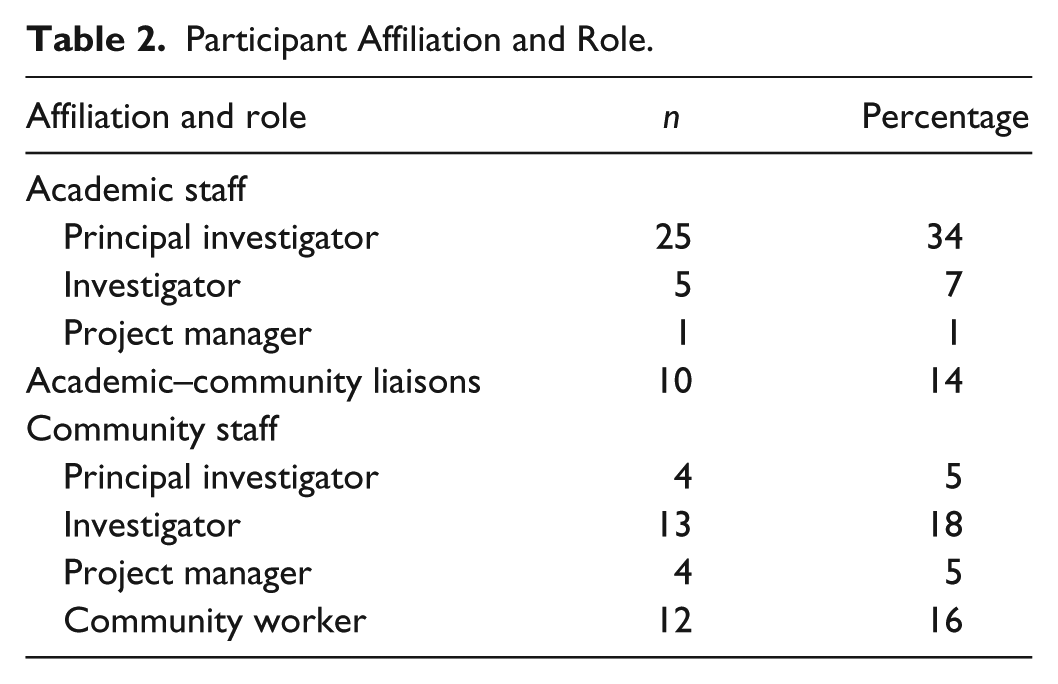
The contact PIs (all professional investigators) were asked to complete an interview and suggest two team members to complete interviews, at least one needed to be a community investigator. All participants were at least 18 years old and fluent in Spanish or English. Project participants included three groups: 31 professional investigators, professionally trained in research, who work in academia, a nonprofit, or practice-based research networks; 10 academic–community liaisons, community members employed by the university; and 33 community investigators, with diverse backgrounds in research training, involved as an individual or from a community-based organization (Table 2). Partnerships between professional and community projects ranged from 1 to 13 years (mean = 6.6 years).
Participant Affiliation and Role.
Data Collection
All data were collected using in-depth, semistructured interviews. Interviewers traveled to each participant for the interview but for one, which was conducted via telephone. Each interview consisted of questions regarding experience with CBPR, perspectives on CBPR and scientific integrity, and general questions about educational and occupational background. Participants were asked to share suggestions on the format and content of future CBPR-specific education modules. Participants received a $20 incentive. The development and subsequent reviews of the interview guide was aided by the project advisory committee (composed of 15 CBPR investigators from outside the southeastern United States), and five pilot interviews. During data collection, project investigators reviewed the interview recordings and discussed variations or deviations from the interview guide.
A common definition was necessary to understand the threats and facilitators to scientific integrity in CBPR. All participants were asked for their own description of scientific integrity and then were provided with a description of scientific integrity characteristics provided by the National Institute for Environmental Health Sciences (NIEHS; Kraemer Diaz et al., 2013). This description stated:
proper adherence to responsible research practices. That includes use of honest and verifiable methods of proposing, performing and evaluating research and reporting research results . . . [R]research conducted with scientific integrity emphasizes adherence to the rules, regulations, guidelines and commonly accepted professional codes or norms that direct collection and interpretation of data from societies, organizations, groups, and individuals. (NIEHS, 2010)
All interviewed participants accepted the description, even though some raised questions about “commonly accepted codes or norms” and if norms were from professional investigators or community representatives.
Analysis
All interviews were audio recorded, transcribed verbatim, and edited for accuracy and to remove identifying personal information. Team members identified patterns, perceptions, and issues present in the narratives that were then discussed by the team as the basis for the coding dictionary. At least two research team members coded each transcript. All transcripts were subjected to saliency analysis with the aid of Atlas.ti qualitative data analysis software (ATLAS.ti Scientific Software Development GmbH, Berlin, Germany). Saliency analysis consisted of reviewing thematic patterns across all interviews and evaluating the recurrent perceptions based on frequency of recurrence, descriptive capacity of the perception recognized by the research team, or participant’s emphasis on the perceptions (Buetow, 2010; Arcury, Quandt, & Pell, 2001). Each participant may not have discussed salient perceptions; however, they were discussed in detail and with emphasis throughout the sample or were found to provide insight or explanation of a given phenomenon. Through this iterative process, quotations that demonstrate the barriers and facilitators of scientific integrity in CBPR were identified and analyzed. Noted perceptions were listed according to frequency, participant’s emphasis, and explanatory capacity. In our results, we have only included the perceptions that were both important and recurrent.
Results
Participants explained the perceptions that promote and discourage scientific integrity in CBPR. Perception salience varied by team member identity as professional or community investigators; however, the overall perceptions were similar between the two groups (Table 3). Perceptions that promote and discourage scientific integrity in community-based participatory research are follows:
External pressures Community participation Funding Quality control and supervision Communication Training Character and trust Quotes About Perceptions That Promote and Discourage Scientific Integrity in CBPR. Note. CBPR = community-based participatory research; PI = principal investigator.

External Pressures
One of the most recurrent perceptions for CBPR scientific integrity among professional and community investigators were external pressures that could affect scientific integrity. These pressures manifested in different ways.
Professional investigators explained that CBPR made it inherently more difficult to advance as an academic. The long-term commitment and slow-moving nature of CBPR placed publication, tenure, and further grant awards at risk. These pressures could lead to the manipulation of results in order to publish or seek full funding following pilot studies. CBPR was viewed as a particular concern for junior and midlevel faculty investigators as its slow nature could be a risk to their careers. There was also pressure of the dual obligation for professional investigators, which was maintaining the commitment to the scientific community and being active in creating change in the research community. Professional and community investigators noted the pressure to manipulate data to reflect a better outcome, to create an outcome instead of a null result, or for an outcome that created community buy-in.
Community investigators expressed concern about external pressures professional investigators confronted that directly affected CBPR scientific integrity. The common concern was the pressure professional investigators have to publish to promote their career. While community members understood the need for publication and dissemination of results, they believed that publication pressures could lead professional investigators to publish without community input and interpretation or the manipulation of data. Community members linked professional investigators’ need for career advancement as their focus rather than community needs. Community investigators explained that external pressures pushed professional investigators to have control over many aspects of the project especially data collection, data ownership, and data analysis.
Community Participation
Community investigators felt that scientific integrity was maintained when the community had more ownership and participation. This occurred through open communication, with team members having opportunities to share ideas and opinions, and valuing the community investigators’ expertise even though their research training differed from that of the professional investigators. However, when professional investigators did not return results to the community or communicate about the project’s progress in a timely fashion, community investigators saw this as a lack of trust and a threat to scientific integrity.
Funding
The lack of funding was a primary concern for scientific integrity. This could inhibit the ability to do the research correctly. A lack of financial support threatened scientific integrity because it increased the possibility to manipulate data by professional or community investigators. Community investigators explained that without sufficient funds to pay staff appropriately, the data collection and overall research protocols were at risk. Insufficient salaries or reimbursement for expenses meant community investigators were not able to work. It was important to provide the community-based organizations with enough money to make the investment of time and resources worthwhile.
Control of finances was another threat to scientific integrity. Professional investigators discussed that it was vital to provide enough support to the community-based organizations in order to have buy-in, while at the same time dispersing it fairly to different people and groups in the project. It was also important to acknowledge the large power differential that often professional investigators had because they controlled the funding source.
Quality Control and Supervision
Overseeing quality control in large CBPR projects was perceived as a serious threat to scientific integrity. Supervision of academic and community staff was necessary and each had different risks to consider. Professional investigators explained that it was very difficult to know when to relinquish control and when to micromanage. Specific concerns focused on community members falsifying data due to pressures to meet deadlines or quotas, having academic project managers in charge of research functions, trusting a community staff member to be in charge of research, and relinquishing power to community partners who did not share the same background, research training, education, or experience of professional investigators. Professional investigators also explained that providing feedback and oversight could come across as too critical, so it was important to empower the community while also having rigorous quality control standards. Professional and community investigators explained that it was important to have the professional investigator as an active part of the project, not just a figurehead managing from afar.
Communication
Professional investigators explained that communication with all team members was important for maintaining scientific integrity in a CBPR project. This did not mean informing but rather engaging and involving the community. Good communication was built from mutual respect, shared work balance, and formal agreements. When communication was fluid and formal agreements were in place describing the data collection protocol, team member roles, data storage and data sharing, dissemination, and financial transparency, investigators explained that they had a strong foundation for scientific integrity.
Training
Training was identified as important for maintaining scientific integrity. Professional investigators acknowledged that training community and academic staff was a vital part of obtaining good data. If community members were not well prepared, they could start data collection at the wrong times, do it incorrectly, and put the study at risk. It was emphasized by community investigators that training was not a onetime activity, but ongoing throughout research to facilitate learning and scientific integrity. The majority of community investigators agreed that community members did not have the background to direct research, but that did not mean they should not be involved. Rather, professional investigators needed to train community members how to participate as investigators. Community investigators felt a classroom setting was beneficial but hands-on experiential training was just as important. Importantly, training was not unidirectional; community investigators felt that they must teach professional investigators the proper behavior and customs of the community.
Character and Trust
Maintaining scientific integrity for community investigators was founded on the character of the team members. Community investigators believed that working with people of integrity focused on a common goal helped maintain trust, ethics, and scientific integrity. Part of trust was built on communication and information sharing. Professional investigators must share information with the community to build trust. For community investigators, trust between professional and community investigators translated into successful projects that maintained scientific integrity.
Discussion
Professional investigators confront risks and pressures when undertaking scientific research, and maintaining scientific integrity is vital to the credibility of science (Drenth, 2010). Professional investigators identified external pressures as the main barrier to scientific integrity in CBPR and traditional research (Drenth, 2010; Minkler, 2004). Publishing, obtaining new research funding, and career advancement are real pressures professional investigators experience, but that are often not placed on community investigators. These pressures are real and difficult. They promote traditional research structures, which leave out community collaboration. In traditional research, professional investigators make project decisions; however, CBPR attempts a paradigm change to share power between professional and community investigators (Israel et al., 2005; Leung et al., 2004; O’Fallon & Dearry, 2002; Savage et al., 2006). Yet external pressures discourage CBPR scientific integrity by undermining the foundation of CBPR: community participation.
The community investigators’ perception demonstrated that community participation was paramount and could promote or discourage CBPR scientific integrity. Community participation was also identified as necessary in the definition of CBPR scientific integrity (Kraemer Diaz et al., 2013). The coinvolvement by professional and community investigators in the major components of research projects is fundamental for CBPR (Israel et al., 2005; Minkler, 2004). Community investigators’ role in data collection, data management, analysis, and publication is as necessary as the professional investigators. However, the actual participation of community partners in CBPR varies greatly.
Nevertheless, it is the involvement of community investigators that Mitcham (2003) described as co-responsibility by scientists and society in the oversight of scientific integrity. Mitcham (2003) explains that scientists cannot be the only ones responsible for scientific integrity since scientific projects can greatly affect society. Ethics and integrity are meaningful only when applied and discussed between everyone who can be affected by the results. Having professional and community investigators (science and society) performing oversight of science provides the best situation for scientific integrity.
Positive and frequent communication was identified by professional and community investigators as critical to promote CBPR scientific integrity. Communication is a principle of scientific integrity by the European Science Foundation because it enables discussion with other scientists and sharing with the public (Drenth, 2009). Communication and trust have been identified as important components of CBPR (Cargo & Mercer, 2008; Kraemer Diaz et al., 2013) and are part of the process of cosharing projects in CBPR (Holkup et al., 2004; Wallerstein, 1999). Strong communication enables coresponsibility between both partners for each project step.
For professional investigators, their supervision and quality control of a project was important to maintaining scientific integrity. Relinquishing control of a project was difficult for fear that the scientific integrity would suffer. To do CBPR and ensure strong oversight and quality control, professional investigators must communicate well and invest in training for community investigators. Training in all aspects of research provides a foundation for trust and enables the community investigators to participate fully in the project. Full participation of professional and community partners enables the co-responsibility in the oversight of scientific integrity that should be inherent in CBPR projects (Mitcham, 2003).
Ideally, CBPR is well positioned to promote co-responsibility of scientific integrity. Yet community members identify their lack of participation as a main barrier to scientific integrity in CBPR. Without the participation of community investigators in the science, scientific integrity is jeopardized. This may negatively affect not only CBPR projects but also the populations involved in the research and the CBPR approach. Full participation of professional and community partners enables the coresponsibility in the oversight of scientific integrity (Mitcham, 2003) that should be inherent in CBPR projects. Uniquely, CBPR is in the position to strengthen science by improving the rigor, relevance, and reach of research and the scientific enterprise (Balazs & Morello-Frosch, 2013).
The study should be evaluated in light of its limitations. This is a qualitative study based on a nonrandom sample. Because of the structure of funding databases only the contact PIs were listed, they were always professional investigators. This could have biased recruitment, as it limited direct entry contact to the professional investigators. However, analysis was conducted among a diverse group of carefully selected projects with participants including investigators in the professional and community realms in nine states that provide a good foundation for a broader investigation. Few studies have considered how professional and community members view scientific integrity CBPR.
Conclusion
The perceptions that promote and discourage scientific integrity in CBPR identified by professional and community investigators reveal that the real and ideal in CBPR are still a work in progress for the majority of projects (Kraemer Diaz et al., 2013). Understanding the perceptions that promote and discourage CBPR scientific integrity can lead to better scientific integrity and support for the CBPR approach. These results demonstrate that the overall most important perception in maintaining scientific integrity in CBPR is active community participation. Participation cannot only be idealized; it must be realized through training, shared funding, and community trust and engagement at every step, including oversight of scientific integrity.
CBPR is a political activity that addresses threats to vulnerable populations who do not have the power to access resources like health care. Credible, scientific CBPR is a means by which vulnerable voices can be heard and taken seriously by those in positions of power and policy making. Consequently, it is vital to understand the perceptions that promote and discourage scientific integrity within the particular context of CBPR. The perceptions clearly show that scientific integrity can be maintained and enhanced through the participation of the community that is facilitated by communication and trust, coupled with training, which enables the co-responsibility for scientific integrity. It is the co-responsibility of scientific integrity that ensures CBPR projects truly are reflections of and directed toward what is best for the community and for science.
Footnotes
Acknowledgements
We appreciate the input from our advisory committee that included Christine Makosky Daley, PhD; Juliet Lee, PhD; Molly Martin, MD; James Allen, PhD; Sharon Cooper, PhD; Linda Sprague Martinez, PhD; Judith Albino, PhD; Jayna Dave, PhD; Deborah Parra-Medina, PhD; Olivia Carter-Pokras, PhD; and in particular Joseph Gallo, MD, for his review and comments on this article.
Declaration of Conflicting Interests
The authors declared no potential conflicts of interest with respect to the research, authorship, and/or publication of this article.
Funding
The authors disclosed receipt of the following financial support for the research, authorship, and/or publication of this article: The research was supported by Grant No. R21 ES 020967 from the National Institute of Environmental Health Sciences.