



Abstract
Objective. To test the impact of a minimal, online planning intervention on physical activity in Australian office workers. Method. Employees were randomized to an implementation intention intervention (n = 124) or health information control group (n = 130). Measures of physical activity, past behavior, and motivation were taken at baseline and 6 weeks. Results. Analysis revealed both groups increased weekly physical activity sessions (intervention M = 1.12, control M = 0.78) at follow-up, but no significant difference was found between groups. Because the sample consisted of experienced exercisers, secondary analyses investigated differential effects for those who had lapsed over the previous year (nonmaintainers) and those who had maintained their previous level of activity (maintainers). For nonmaintainers, both planning and information provision successfully changed behavior, but only planning significantly increased physical activity in maintainers over the study. Conclusion. Different minimal intervention approaches may be useful for preventing long-term relapse and assisting people to improve regular exercise routines. The practical and theoretical implications are discussed.
Despite the well-established health benefits of regular exercise, the World Health Organization (2011) reports that approximately half of the population in industrialized countries fail to achieve minimum physical activity recommendations. Many interventions to promote exercise to date have used intensive, closely supervised programs that demonstrate short-term effects but poor maintenance when support is withdrawn (Fjeldsoe, Neuhaus, Winkler, & Eakin, 2011; Greaves et al., 2011; Linke, Gallo, & Norman, 2011). Such programs are often costly in terms of time and expense, demonstrating a clear need for minimal yet efficacious physical activity interventions that are able the reach the broad population in a cost-effective way (Linke et al., 2011).
In addition to a need for strategies that are inexpensive and easy to disseminate, there is growing recognition in the public health community that the development and implementation of behavior change interventions are enhanced by a strong theory base (Michie & Prestwich, 2010). One theory-based strategy that has received empirical support in recent years is the concept of implementation intentions (Gollwitzer, 1996), a planning technique used to facilitate the adoption and maintenance of health-enhancing behaviors. Implementation intentions work by asking participants to specify the when, where, and how they will act to pursue their goal, ensuring that the appropriate behavioral response will be triggered at the appropriate time and place in the future (Gollwitzer, 1996). Meta-analyses have shown implementation intentions to have a medium to large effect (d = 0.65) on behavior (Gollwitzer & Sheeran, 2006).
Implementation intentions have several advantages over more traditional information provision approaches to health promotion. First, they represent a minimal yet effective self-tailored strategy that encourages independent behavior change. Second, implementation intention–based techniques have demonstrated utility when delivered online (Chapman & Armitage, 2010). This is important because web-based studies represent a highly accessible, low-cost method of promoting physical activity in large segments of the population (Davies, Spence, Vandelanotte, Caperchione, & Mummery, 2012). Third, this approach recognizes that awareness and motivation alone are often insufficient for health behavior change. Several factors, such as competing distractions and goals, forgetting, or unwanted habits often impede action, even when intentions are strong. As such, interventions that target only motivational variables (such as attitudes) are generally successful in increasing intentions to engage in health behaviors but not the behavior itself (Gollwitzer & Sheeran, 2006). Implementation intentions provide a way of overcoming the intention–behavior gap by having a strategy in place to overcome future obstacles and enact specific goal-directed responses when the situation arises—a process that serves to both break “bad” habits and form new health-enhancing routines.
Experimental studies have generally indicated positive effects of implementation intentions on physical activity promotion, demonstrating promise in this domain (Milne, Orbell, & Sheeran, 2002; Prestwich, Lawton, & Conner, 2003). However, many of these studies are conducted in young adult, student populations, who are suggested to be more susceptible to planning manipulations than other groups (Jackson et al., 2007). The broad aim of this study was to evaluate the impact of a minimal, theory-based intervention to promote exercise in a workplace setting, which represents a potentially important site for health behavior change (Hutchinson & Wilson, 2012). More specifically, the study aimed to compare the effects of a web-based implementation intention intervention with health information provision on levels of physical activity in Australian public sector office workers. In accordance with the extant literature, it was predicted that implementation intentions would lead to increased activity over the course of the study, but there would be no change in behavior in the health information condition.
Method
Participants
The sample comprised South Australian public sector office workers who responded to a group list email asking if they were interested in increasing their current levels of exercise. Three hundred and seventeen online questionnaires were completed at baseline, with 254 participants completing a follow-up online questionnaire at 6 weeks (attrition rate 20%). Ages of participants ranged from 18 to 60 years, and approximately one third of respondents were in the 41 to 50 age range (31.5%, n = 100). Seventy-one percent of the sample were female (n = 224).
Design
A randomized controlled design was used with the between-persons factor of condition, which had two levels: (1) implementation intention (n = 124) and (2) health information control (n = 130). The dependent variable was weekly exercise behavior, measured at baseline and again at 6-week follow-up.
Procedure
Data were collected from public sector office workers who were invited via group list email to participate voluntarily in a study of “exercise habits.” The email contained a link to an online questionnaire, which randomly allocated participants to one of the two conditions. Participants were contacted again for follow-up 6 weeks later via their individual email address, which they were asked to provide at baseline if they wished to continue with the study. In the follow-up email, a link was provided to a second online questionnaire. All participants gave informed consent and were informed that participation was voluntary and that they were free to withdraw their data at any point. The study was approved by the Human Research Ethics Committee of the University of Adelaide.
Questionnaire Content
All questionnaires began with a section that defined an exercise session as “vigorous exercise lasting at least 20 minutes that elicits a noticeable increase in heart rate, or moderate exercise lasting at least 30 minutes.” This definition was based on updated American Physical Activity Guidelines suggested by Haskell et al. (2007). This was followed by measures of intention to increase weekly exercise and self-efficacy for achieving this goal, as well as measures of current exercise behavior, past exercise behavior, and the intervention manipulation, where relevant. All of these are described as follows.
Measures
Motivation
Behavioral intention, representing readiness to perform the behavior, and self-efficacy, representing belief in one’s own ability to act, have been shown to provide a good account of the factors underpinning motivation to exercise (Koring et al., 2012). Measures of behavioral intention and self-efficacy were taken at baseline. Both constructs were measured on 5-point Likert-type scales (0 to 4) using three items. Examples of these are the following: “My intention to increase my weekly amount of exercise is strong” (strongly disagree to strongly agree) and “I am confident I can increase my weekly amount of exercise” (strongly disagree to strongly agree). Internal reliabilities of the behavioral intention and self-efficacy scales were high (α = .88 and .82, respectively).
Exercise Behavior
Participants were required to report their average weekly exercise behavior using the following open-ended item based on updated American Physical Activity Guidelines (Haskell et al., 2007): “Over the past week, how many vigorous 20-minute or moderate 30-minute exercise sessions did you do?” followed by a blank space to write the answer. This item is similar to those applied in previous implementation intention studies that were sensitive to intervention effects (Milne et al., 2002).
Past Exercise Behavior
Past exercise behavior was assessed at baseline with the open-ended item: “In a typical week-long period in the last year, how many vigorous 20-minute or moderate 30-minute exercise sessions did you do?” This question was asked to get a broad indication of previous activity habits and takes a similar format to items used in previous studies (Hagger, Chatzisarantis, & Biddle, 2010).
Interventions
Implementation Intention
Based on standard elicitation guidelines for successful implementation intention formation (Gollwitzer & Sheeran, 2006), participants randomized to the planning condition were asked to stipulate when, where, and how they would exercise over the coming weeks. Participants were presented with the following open-ended questions: “On which day(s) will you exercise?” “What times of the day will you exercise?” “Where will you exercise?” “What type of exercise will you do?” followed by a space for the participants to formulate their own self-generated plans. Participants were then prompted to print a copy of their plan and keep it in a prominent location.
Health Information Control
Participants randomized to the health information control condition received a brief educational statement designed to inform and encourage them to increase their exercise over the next 6 weeks. The information described the value of exercise in relation to health benefits and the prevention of chronic disease, for example, “Regular exercise can strengthen the musculoskeletal system, enhance physiological functioning, and has proven psychological benefits.” Participants again were prompted to print and store the statement in a prominent location.
Results
Representativeness, Randomization, and Attrition
Means and standard deviations for all variables in each condition and time point are presented in Table 1. For the sample as a whole, the mean number of exercise sessions per week at baseline was 2.58 (SD = 2.09); all respondents reported engaging in at least one session of exercise per week on average in the past year (M = 3.22; SD = 2.15); and strong intentions and high self-efficacy were reported in relation to increasing current weekly exercise. Taken together, this indicates that the present sample can be described as experienced exercisers who were more active than the general Australian adult population, where national prevalence of low level or no weekly exercise is 72.4% (Australian Bureau of Statistics, n.d.). To check that randomization was achieved, the two conditions were compared on past and current exercise behavior, motivational variables, gender, and age. No significant differences were found (all p values >.59). Attrition checks found no significant differences between responders and nonresponders on current or past exercise behavior, motivational variables, gender, age, or by condition (ps > .12). The following analyses are therefore based on the 254 participants for whom full data were available.
Means and Standard Deviations for all Variables in Each Condition at Baseline and Follow-Up.
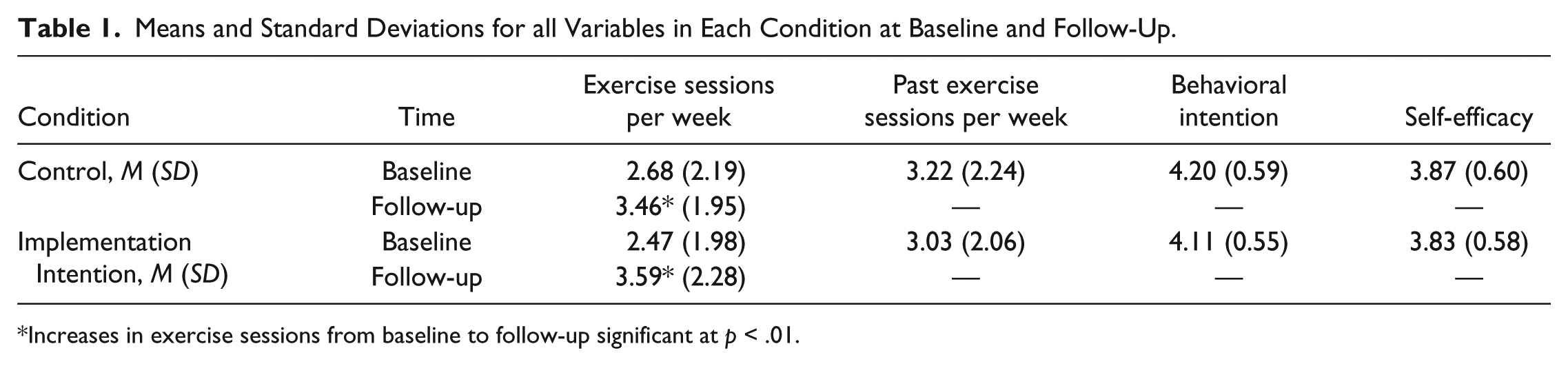
Increases in exercise sessions from baseline to follow-up significant at p < .01.
Effects of the Intervention
Between-persons ANCOVAs controlling for baseline exercise behavior were used to examine the effects of condition (implementation intention vs. health information control) on weekly exercise behavior at follow-up. Results revealed that both groups had significantly increased their exercise over time (intervention M = 1.12 and control M = 0.78, ps < .01,;Table 1); however, the difference between the groups at follow-up failed to reach significance, F(1, 253) = 3.04, p = .10,
Comparing the Effects of the Intervention on Maintaining Versus Nonmaintaining Exercisers
Contrary to the hypothesis, the preceding analyses showed that planning was not significantly more effective than health information provision for increasing exercise behavior. Given that all participants in the current sample were experienced exercisers, it is likely that favorable goal intentions and self-efficacy were sufficient in promoting performance, leaving implementation intention formation superfluous (Gollwitzer & Brandstätter, 1997). However, an interesting question then arises as to whether the planning intervention had differential effects for those who had lapsed over time in comparison to those who had maintained their previous level of activity. To investigate this, participants were categorized as “maintainers” or “nonmaintainers” based on the difference between their reported past exercise behavior and baseline exercise behavior. A new variable was dummy-coded such that participants who reported fewer exercise sessions per week than in the past year = 0 (nonmaintainers, n = 84) and those who reported the same or more exercise sessions per week than in the past year = 1 (maintainers, n = 170). 1
The analyses were then repeated using a 2 (maintenance status: nonmaintainers vs. maintainers) × 2 (condition: implementation intention vs. health information control) ANCOVA controlling for baseline exercise behavior. A two-way interaction was found between maintenance status and condition, F(1, 253) = 4.71, p = .03,
Planned contrasts showed that nonmaintainer participants in both the planning and control groups had increased their weekly exercise sessions significantly more than maintainer participants in the control group (ps < .01). However, maintainer participants in the planning group had also increased their weekly exercise sessions significantly more than maintainer participants in the control group (p < .01). No further differences were found (ps > .22). Figure 1 shows the differences between groups in terms of change in exercise sessions per week and number of participants in each group.

Change in exercise behavior at follow-up in lapser and maintainer participants in control and implementation intention groups.
Discussion
The initial aim of the present study was to compare the effects of a minimal, theory-based planning intervention with health information provision on physical activity promotion, delivered in a nontargeted way to employees in an Australian workplace setting. It was predicted that implementation intentions would be significantly more effective than the health information, but this was not demonstrated in the main analysis. While no significant difference was found between groups at follow-up, both planning and information provision increased exercise by an average combined mean of 0.95 sessions per week. From a public health perspective this is significant, as small increases in physical activity—if sustained—can reap considerable health gains (Hutchinson & Wilson, 2012). However, it should be noted that the participants in the current sample all had experience with engaging in physical activity; they engaged in higher baseline activity than the general population and were highly motivated to do more. Therefore, from a theoretical perspective, this finding is somewhat unsurprising, particularly in light of previous work that suggests the mere measurement of behavioral intentions can be enough to affect significant change in participants who are already experienced with the health behavior in question (Godin, Sheeran, Conner, & Germain, 2008).
Although generalizability cannot be assumed from this study, the unexpected characteristics of the sample presented a further opportunity to investigate differences in planning effects between those who had maintained steady levels of exercise over the past year and those who had lapsed. This is an important distinction because gaining insights into ways to promote exercise adherence and keep people “on track” are key priorities for health agendas. Secondary analysis found that both planning and information provision again served to increase exercise in nonmaintainers by an average combined mean of 1.74 sessions per week, with no significant difference between groups at follow-up. Lapsing from regular exercise is common (Linke et al., 2011), and the practical implications of these findings are that simple initiatives such as engagement with information or a questionnaire may be sufficient to prompt re-uptake in a motivated sample.
For participants who reported maintaining their level of exercise from the past year, however, only those in the implementation intentions condition engendered a corresponding increase in behavior over the 6-week period (0.86 sessions per week). Where behavior is already consistent, and scope for improvement therefore constrained, significantly greater improvements are achieved by providing guidance on how to plan for change. This is significant given the dose–response relationship between physical activity and health, and recent reports that 5 to 15 minutes of sustained exercise per day can lead to a 3-year extension of life expectancy (Wen, Wai, Tsai, & Chen, 2014). Individuals who manage to achieve a more consistent level of activity can also reduce their risk for chronic diseases and unhealthy weight gain by improving on existing activity levels or minimum guidelines, but these groups are often overlooked in health education activities (Haskell et al., 2007).
Implications for Theory and Practice
The findings regarding maintaining and nonmaintaining exercisers are interesting in that they provide intuitive support for the processes underlying the intervention. Implementation intentions are essentially a habit-creating technique; by identifying situational opportunities for action in advance, new behavioral patterns can be established swiftly and easily once the situational cue is encountered (Gollwitzer & Sheeran, 2006). A likely explanation of the results is that the re-uptake of physical activity—in terms of those who had lapsed—is more closely associated with remembering and reactivating dormant behavioral patterns than creating new ones. Information prompts appear sufficient for this purpose. For those in a more consistent routine, however, the specific identification and planning of novel situational opportunities was required to successfully incorporate new activities alongside existing patterns—a task that information provision alone was unable to achieve despite high levels of motivation. This finding provides potential insights into the distinct challenges faced by those looking to increase exercise, and speaks to the idea that different intervention approaches may be useful for (1) getting people “back on track” and (2) assisting people in improving their regular routines. This is the first study to consider this distinction. In addition, the intervention indicates the potential of a minimal intervention delivered online in the workplace that demonstrates effects even with workers who already exercise. Again, to our knowledge, this has not been demonstrated previously and shows promise as an adherence strategy, which, as previously discussed, is important for health benefits to accrue.
The study could be improved in a number of ways. For example, objective measures of behavior would be desirable in future work to validate self-report, as well as a higher level of specification in relation to exercise, for example, leisure time, commuting, or work activities. Future studies may benefit from focusing on a more population-based sample from different workplaces with a broad range of skill and education levels, and improved methods of engaging sedentary individuals with study trials are timely, particularly given that current recruitment materials may attract participants who are interested in the study content. Notwithstanding these limitations, the study represents a well-controlled test of a minimal planning intervention and offers previously unexplored insights into potential strategies for exercise adherence and improvement. Further research on the scope and efficacy of these strategies is needed in order to realize this potential for broader physical activity promotion.
Footnotes
Declaration of Conflicting Interests
The authors declared no potential conflicts of interest with respect to the research, authorship, and/or publication of this article.
Funding
The authors received no financial support for the research, authorship, and/or publication of this article.