




Abstract
Introduction. ParticipACTION’s 2011 “Think Again” campaign aimed to draw parents’, and specifically mothers’, attention to the amount of physical activity (PA) their children do relative to the national guidelines (physical activity guidelines [PAG]). Purpose. To evaluate ParticipACTION’s “Think Again” campaign in the context of the hierarchy of effects model. Methods. Data were drawn from “Think Again” campaign evaluations conducted among two cohorts of parents with children ages 5 to 11 years (3 months postcampaign launch [T1], n = 702; 15 months postlaunch [T2], n = 670). Results. At T2, campaign awareness was weakly associated with parents agreeing that their children were not active enough (p = .01, d = .18). Parents who were aware of the campaign showed greater knowledge of PAG (ps < .01, ϕs > .14), had higher outcome expectations about their children engaging in PA (p < .01, d = .16), had stronger intentions to help their child meet the guidelines (p < .01, d = .18), and engaged in more parental support behaviors (p < .001, d = .31) as compared with parents who were not aware. At T1, parents aware of the campaign had greater perceived behavioral control (PBC) to influence their child’s PA participation (p < .01, d = .22), whereas parents not aware of the campaign had greater PBC to find practical ways to help their child be active (p < .01, d = .26). Parental awareness of the campaign was not associated with children meeting the PAG at either time point (ps > .05). Conclusions. The campaign appeared marginally effective for increasing parental knowledge of PAG and for creating realistic awareness of children’s PA levels. Additional intervention strategies are needed to produce larger effects and to change parental behavior.
Evidence-based physical activity (PA) guidelines are an important component of a national policy and action plan (Global Advocacy Council for Physical Activity, 2010). Accordingly, the Canadian Physical Activity Guidelines (PAG) for Children and Youth recommend that children and youth aged 5 to 17 years accumulate 60 minutes of moderate-to-vigorous PA each day (see www.csep.ca/guidelines). While the guidelines are a first step to promote PA, systematic efforts are needed to disseminate PAG (Brawley & Latimer, 2007).
Mass media campaigns are a means of promoting awareness of PAG and of emphasizing behavior change (Bauman et al., 2008; Grier & Bryant, 2005; McGuire, 1984). It is recommended that mass media campaigns be included as one component of a broader community-wide approach to behavior change (Brown et al., 2012). While the effectiveness of stand-alone mass media PA campaigns have been questioned due to modest and inconsistent findings (Abioye, Hajifathalian, & Danaei, 2013; Brown et al., 2012), meaningful population-level changes can be created with a small effect in a large group of individuals (Rose, 1995). Accordingly, mass media campaigns that have been implemented concurrently with appropriate resources have shown positive effects. For instance, the Center for Disease Control’s VERB campaign positively influenced American children’s perceptions of PA and behavior (Huhman et al., 2007).
Though parents are an important target group for mass media campaigns that aim to promote child PA (Sallis, Prochaska, & Taylor, 2000; Trost et al., 2003; Welk, 1999), only a few campaigns have targeted them directly. The VERB campaign targeted parents with print and radio messages. Awareness of the campaign predicted parents’ positive attitudes and beliefs toward children’s PA and the number of days parents were active with their child (Price, Huhman, & Potter, 2008). ParticipACTION, a national not-for-profit organization dedicated to increasing PA in the Canadian population (Latimer-Cheung, Murumets, & Faulkner, 2014), has also launched a series of campaigns targeting parents (Craig, Bauman, Gauvin, Robertson, & Murumets, 2009). The basic issue is that while only 7% of Canadian children meet the PAG (Colley et al., 2011), 88% of parents believe their children are sufficiently active (Active Healthy Kids Canada, 2009).
In 2011, ParticipACTION attempted to address this disconnect between parents’ perceptions and the PAG recommendations by developing the “Think Again” campaign. The campaign aimed to motivate parents, and in particular mothers, to get their children active by increasing parents’ awareness that their children may not be active enough to meet the guidelines. This aim is consistent with several models of health behavior that emphasize that if people do not believe a problem exists, they are unlikely to change their behavior (Bauman et al., 2008; Michie, West, Campbell, Brown, & Gainforth, 2014).
ParticipACTION’s evaluation of the “Think Again” campaign was guided by the hierarchy of effects model (HOEM; Bauman et al., 2008; McGuire, 1984), which has been used to design and evaluate previous mass media PA campaigns (Cameron, Craig, Bull, & Bauman, 2007; Craig, Bauman, & Reger-Nash, 2010; Huhman, Heitzler, & Wong, 2004; Spence et al., 2009). The HOEM conceptualizes the impact of a mass media campaign as a chain of links between proximal factors and distal outcomes. Most proximal is initial awareness of a campaign, followed by changes in beliefs about the behavior (e.g., outcome expectancies, self-efficacy), intentions to engage in the behavior, and at the most distal point, behavior change. The model recognizes that campaign success becomes increasingly difficult as the process moves from proximal outcomes to distal outcomes. However, evaluations of mass media PA campaigns have demonstrated associations with both proximal and distal outcomes of the HOEM (Craig et al., 2009; Price et al., 2008; Spence et al., 2009).
The current study aimed to evaluate ParticipACTION’s “Think Again” campaign in the context of the HOEM. Although the campaign was targeted toward mothers, the key message was relevant to fathers, and the campaign effects were expected to carry over and have some influence on fathers as well. Thus, it was hypothesized that parents who were aware of the campaign would be more likely to agree that their children were not active enough. It also was hypothesized that parents who were aware of the campaign would have higher scores for both proximal and potentially distal outcomes within the model. Consistent with previous evaluations of mass media campaigns using the HOEM (Craig et al., 2009; Price et al., 2008; Spence et al., 2009) in the context of PA interventions (Conn, Hafdahl, & Mehr, 2011; Foster, Hillsdon, Thorogood, Kaur, & Wedatilake, 2005), we hypothesized that the effects observed would be small, but significant.
Method
The evaluation and data collection were completed by a company independent of ParticipACTION. Because of the financial constraints wherein a repeated assessment of the same cohort exceeded budget allowances, the study employed a cross-sectional design with two independent cohorts of participants being surveyed at two time points throughout the campaign. Therefore, comparison of data over time is limited as the same participants were not used in each evaluation.
Procedure and Participants
National web-based surveys were conducted by Angus Reid Public Opinion, a hired vendor, at two time points: March 2011 (T1) and March 2012 (T2). Two independent cohorts of participants were recruited from an existing online panel of approximately 120,000 consumers. Parents with at least one child, aged 5 to 11 years, were eligible. The age range requested relates to the audience targeted by the “Think Again” campaign. Participants completed the measures described below. To evaluate the “Think Again” campaign advertisements and the ParticipACTION brand, participants were also randomly assigned to view one of the “Think Again” advertisements. Results related to the advertisements and brand evaluations are published elsewhere (Berry et al., 2014; Jarvis et al., 2014). The study was approved by the Queen’s University General Research Ethics Board.
“Think Again” Campaign
The campaign launched in January 2011 and concluded in March 2012. The campaign included television and print advertisements targeting mothers with children between the ages of 5 and 11 years. 1 For example, one television advertisement featured a mother standing in front of a plain backdrop stating, “My Jaymi plays soccer twice a week. That’s plenty of activity.” She then gets hit in the head by a soccer ball and the words “Think Again” appear on the screen. The ad then emphasizes the PAG by stating, “Fact is, kids need at least 60 minutes of PA per day. Every day.” To view the ads, see http://www.youtube.com/watch?v=vX_Hyqp-3ac&list=SPn9ck0OZhxkYVlk_itMNGnDdS5pqmcTOX.
Measures
The measures developed to assess the HOEM outcomes and the goals of the campaign have been previously described (Rhodes et al., 2013) and are briefly outlined below. All measures, except for the “parental support” and “knowledge of guidelines” measures, were completed before participants viewed one of the “Think Again” advertisements.
Demographics
Parents self-reported their province of residence, gender, age, employment status, household income, role as a caregiver, number of children in their house, and education.
Campaign Awareness
One yes-or-no item was used to assess parents’ awareness of the “Think Again” campaign. Participants were asked, “Have you seen any recent advertisements about the specific amount of physical activity that is appropriate for children?”
Knowledge of Guidelines
To assess the campaign’s goal to raise parents’ awareness that their children were not active enough to meet the PAG for children and youth, two yes-or-no items were used to assess parents’ knowledge of PAG. Participants were asked (1) “Have you heard of any physical activity guidelines for children and youth?” and (2) “Have you heard of the Canadian Physical Activity Guidelines for Children and Youth?”
Perceptions of Child PA
One item rated on a scale from 1 (strongly disagree) to 4 (strongly agree) was used to assess parents’ perceptions of their child/children’s PA at T2. Participants responded to the statement, “My child already gets enough PA every day.”
Outcome Expectations
Three items, rated on a scale from 1 (strongly disagree) to 4 (strongly agree), were used to assess parents’ outcome expectations toward child PA. An example item is, “Participating in physical activity helps my child to be healthy.” Similar items have been validated previously in the literature (Huhman et al., 2007). Cronbach alphas were .66 and .74 for T1 and T2, respectively. Responses to each item were summed to create a composite outcome expectation score.
Intentions
Two items, rated on a scale from 1 (strongly disagree) to 4 (strongly agree), were used to assess parents’ intentions toward providing parental support for their child/children’s PA. An example item is, “Over the next 6 months, I intend to help my child be more physically active.” Both items have been validated previously (Rhodes, Blanchard, & Matheson, 2006). Cronbach’s alphas were .71 and .69 at T1 and T2, respectively. Responses to each item were summed to create a composite intentions score.
Perceived Behavioral Control (PBC)
Two measures were used to assess parents’ PBC toward providing parental support for child PA. The first measure used three items, rated on a 4-point scale (1 = not at all confident to 4 = very confident), to assess parents’ confidence in their ability to influence their child to participate in more PA. Items began with the stem, “If you really wanted to, how confident are you that you can influence your child to participate in more physical activity . . . ?” End points included (1) “no matter how busy your day is?” (2) “on a day when you don’t really feel like doing it?”; and (3) “and still spend the time you want with your family?” Cronbach alphas were .80 at both T1 and T2. Responses to each item were summed to create a composite score representing parents’ PBC to influence child PA.
The second measure used five items (1 = not at all confident to 4 = very confident) to assess parents’ confidence in their ability to help their child find ways to be active when faced with barriers often reported by parents engaging in PA (Bellows-Riecken & Rhodes, 2008). Items began with the stem, “If you really wanted to, how confident are you that you can find ways to help your child be active . . . ?” End points included (1) “. . . on a day when he/she doesn’t really feel like doing it?” (2) “and still spend time doing things he/she wants to do?” (3) “and still spend time doing things with the family?” (4) “when you have other chores and time responsibilities?” and (5) “on days when you are fatigued from work/chores?” Cronbach alphas were .87 and .84 for T1 and T2, respectively. Responses to each item were summed to create a composite score representing parents’ PBC to find ways for their children to be active.
Parental Support
Eight yes-or-no items were used to assess parental support behavior. The items began with the stem, “As a result of seeing these ads on television have you done any of the following? Please check all that apply . . .” Endpoints are listed in Table 2 and reflect types of parental support activities identified in the literature and the behavioral outcome goals of the campaign (Gustafson & Rhodes, 2006; Trost et al., 2003). The number of parental behaviors engaged in was summed to create a continuous measure of parental support.
Child PA Behavior
One item was used to assess whether or not parents’ children were meeting the PAG. The item stated, “Over the past 7 days, on how many days was your child physically active for a total of at least 60 minutes per day?” Responses were made using a drop-down menu ranging from 0 to 7 days. Parents were instructed to think about their child between the ages of 5 to 11 years. If parents had more than one child in the age range, they were instructed to answer for the child whose birthday occurs next. Parents who indicated their child was active for 7 days were recoded as yes for child meeting the guidelines. All other values were recoded as no.
Analysis
To identify potential covariates, we conducted 2 (Time) × 2 (Awareness) analyses of variance (ANOVAs) on continuous demographic variables and chi-square tests of independence on categorical demographic variables. To test our hypotheses, 2 (Time) × 2 (Awareness) analysis of covariance (ANCOVAs) were conducted on continuous variables and chi-square tests of independence were conducted on categorical variables. In all cases, test statistics with p < .05 were deemed statistically significant, and only highest order effects are reported. Significant two-way interactions were decomposed by time point. For ANCOVAs, Cohen’s d was calculated to determine effect sizes with values of .20, .50, and .80 considered small, medium, and large effects, respectively. For chi-square tests of independence, Phi (ϕ) was calculated with values of .10, .30, and .50 being considered small, medium, and large effects, respectively.
Results
Participants
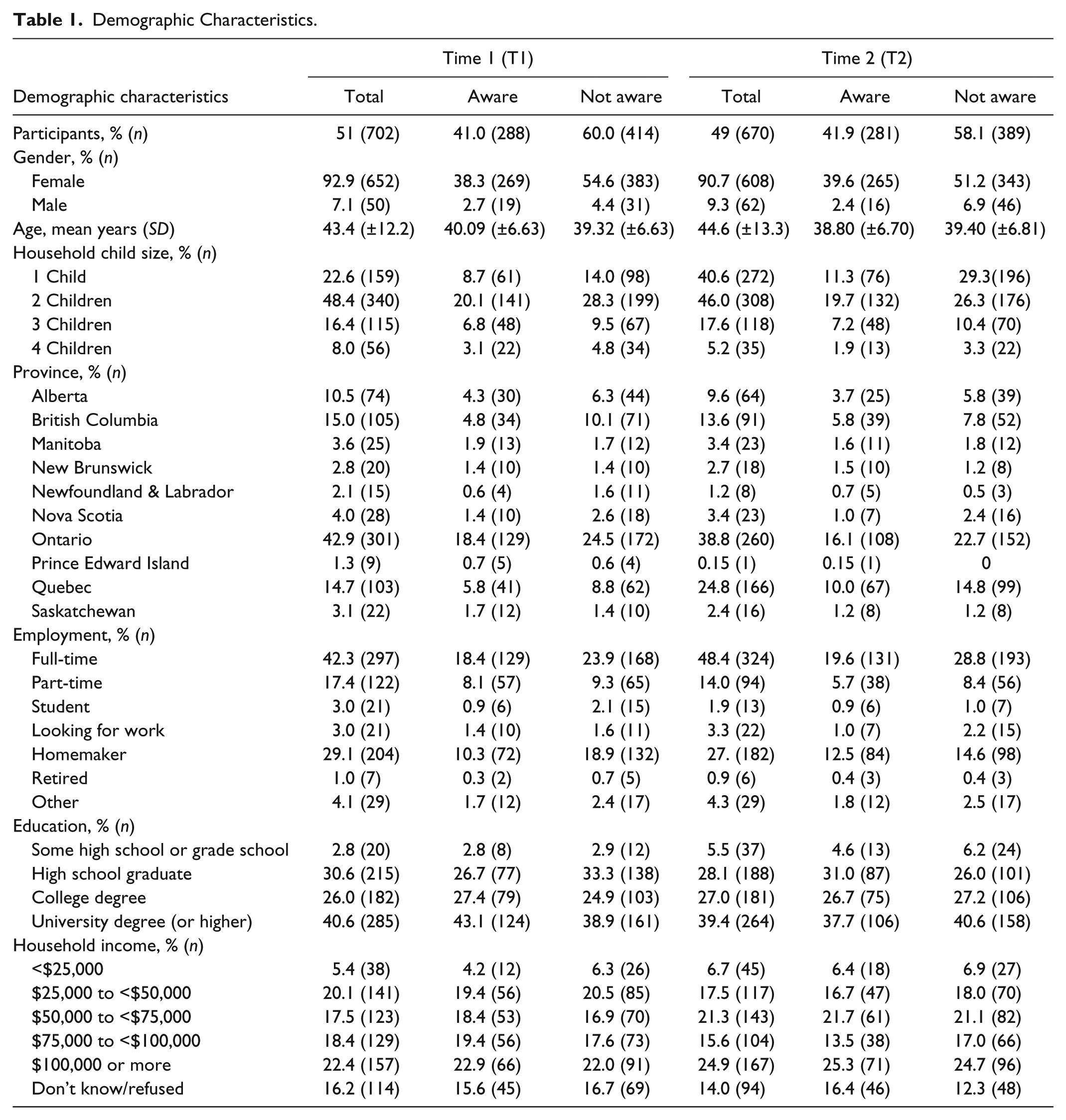
Of the parents recruited for T1 (n = 712) and T2 (n = 694), 1.4% (n = 10) and 3.5% (n = 24) were, respectively, excluded due to technical difficulties (i.e., being unable to see/hear one or both of the ads), leaving samples of 702 (T1) and 670 (T2) for the analyses. Demographic information is presented in Table 1. Across both time points, 42% of the sample indicated they were aware of the campaign. At T1, 41% of the sample indicated they were aware of the “Think Again” campaign, and at T2, 42% of the sample indicated they were aware of the campaign. The proportion of parents aware of the campaign was not different at T1 as compared with T2, χ2(1, 1,372) = .12, p = .74 (see Table 1).
Demographic Characteristics.
Covariates
Chi-square tests of independence revealed that a lower proportion of fathers were aware of the campaign than mothers at T2, χ2(1, N = 670) = 7.30, p < .01, ϕc = .10. No differences between mothers and fathers were observed at T1. In terms of awareness, no group differences were found in the number of children in the household, parent age, employment status, household income, education, or the province in which the parent resided (ps >.05). Therefore, only parental gender was used as a covariate in the analysis.
Knowledge
Results of chi-square tests of independence revealed that more parents who were aware of the campaign had knowledge of any PAG for children at both T1, χ2(1, N = 702) = 112.45, p < .001, ϕ = .40, and T2, χ2(1, N = 670) = 26.85, p < .001, ϕ = .20. Likewise, more parents who were aware of the campaign had knowledge of the Canadian PAG for Children and Youth at both T1, χ2(1, N = 702) = 24.83, p < .001, ϕ = .19, and T2, χ2(1, N = 670) = 12.87, p < .01, ϕ = .14 (see Table 2).
Knowledge of the Campaign and Guidelines, Parental Support Behaviors, and Child’s Physical Activity (PA) Behavior Among Parents Who Were Aware Versus Not Aware of the Campaign.

Perception of Child’s PA
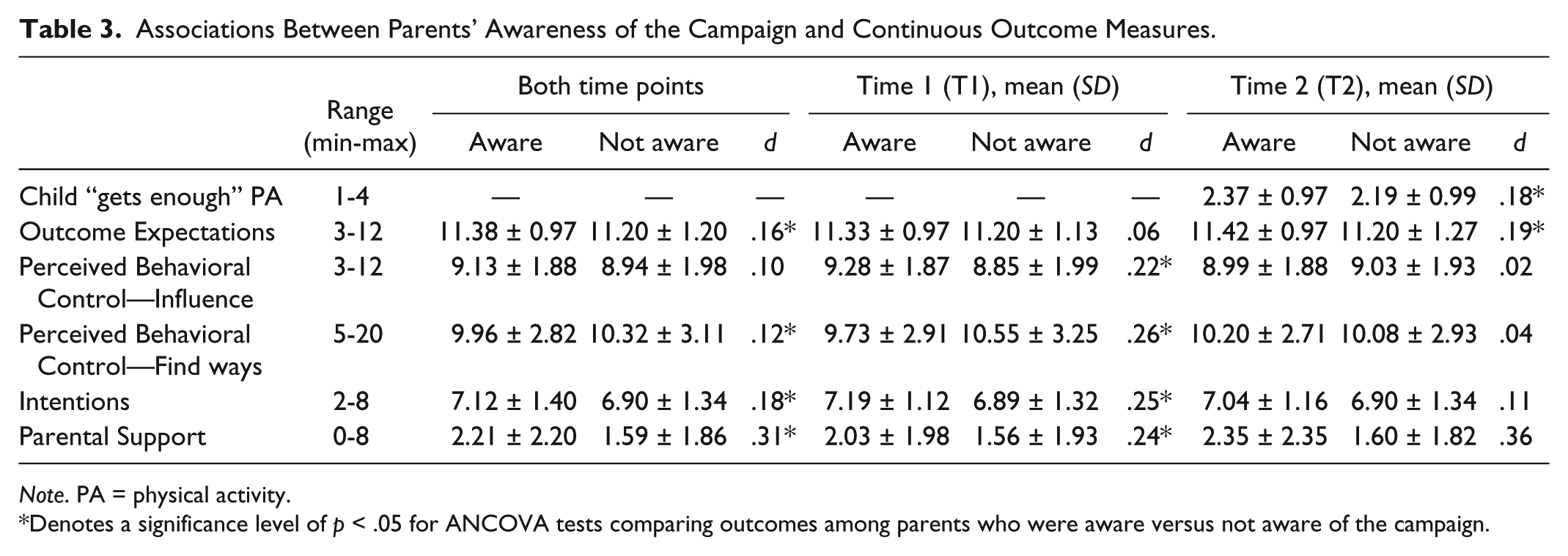
An ANCOVA revealed a main effect for campaign awareness, F(1, 667) = 6.15, p = .01, d = .18. When compared with parents not aware of the campaign, parents who were aware of the campaign were more likely to agree that their children were not active enough (see Table 3).
Associations Between Parents’ Awareness of the Campaign and Continuous Outcome Measures.
Note. PA = physical activity.
Denotes a significance level of p < .05 for ANCOVA tests comparing outcomes among parents who were aware versus not aware of the campaign.
Outcome Expectations
A 2 (Time) × 2 (Awareness) ANCOVA revealed a main effect for awareness in that parents who were aware of the campaign had greater outcome expectations toward their child engaging in PA compared with parents not aware of the campaign, F(1, 1,349) = 8.02, p < .01, d = .16 (see Table 3).
Perceived Behavioral Control
A 2 (Time) × 2 (Awareness) ANCOVA revealed a two-way interaction for parents’ confidence in their ability to influence their child to participate in PA, F(1, 1,340) = 4.68, p = .03. When the interaction was decomposed by time point, separate ANCOVAs revealed a main effect for awareness at T1 only, F(1, 687) = 8.05, p < .01, d = .22, indicating that parents who were aware of the campaign had greater PBC to influence their child to participate in PA compared with parents not aware of the campaign (see Table 3).
A 2 (Time) × 2 (Awareness) ANCOVA revealed a two-way interaction for parents’ confidence in their ability to find ways to help their child be active, F(1, 1,367) = 8.43, p < .01. When the interaction was decomposed by time point, separate ANCOVAs revealed a main effect for awareness at T1 only, F(1, 699) = 11.61, p < .01, d = .26, indicating that parents who were not aware of the campaign had greater PBC to find ways to help their child be active compared with parents who were aware of the campaign (see Table 3).
Intentions
A 2 (Time) × 2 (Awareness) ANCOVA revealed a significant main effect for awareness, F(1, 1,331) = 8.87, p < .01, d = .18. Parents who were aware of the campaign had greater intentions to support their child’s PA compared with parents not aware of the campaign (see Table 3).
Parental Support
On average, parents engaged in two parental support behaviors. The proportion of parents who engaged in each parental support behavior is presented in Table 2. A 2 (Time) × 2 (Awareness) ANCOVA revealed a significant main effect for campaign awareness on parental support, F(1, 699) = 14.35, p < .001, d = .31. Parents who were aware of the campaign engaged in more parental support behaviors compared with parents who were not aware of the campaign.
Child PA Behavior: Meeting Guidelines
Chi-square tests did not reveal an association between parents’ awareness of the campaign and their children meeting the guidelines at T1, χ2(1, N = 702) =.07, p = .80, ϕ = .01, or T2, χ2(1, N = 670) = 2.74, p = .10, ϕ = .06.
Discussion
Among parents surveyed, 42% were aware of the ParticipACTION “Think Again” campaign. Associations between parents’ awareness of the campaign and campaign outcomes were observed. Though these associations were weak, they remain promising. Consistent with the campaign’s primary aim of addressing the disconnect between parents’ perception of their children’s PA behavior and reality, awareness of the campaign was associated with parents agreeing that their children were not active enough. Campaign awareness was also associated with both proximal and distal outcomes within the HOEM. Parents who were aware of the campaign showed greater knowledge of PAG, outcome expectations about their children engaging in PA, intentions to help their child meet the guidelines, and engaged in more parental support behaviors. Findings regarding parents’ PBC were mixed. Consistent with hypothesis, at T1, parents who were aware of the campaign had greater PBC to influence their child’s PA participation compared with parents not aware of the campaign. Yet contrary to hypothesis, at T1, parents who were not aware of the campaign had greater PBC to find practical ways to help their child be active compared with parents aware of the campaign. Moreover, parental awareness of the campaign was not associated with children meeting the PAG.
Our findings are generally consistent with previous evaluations of mass media PA campaigns that have demonstrated associations with both proximal and distal outcomes of the HOEM (Craig et al., 2009; Price et al., 2008; Spence et al., 2009). Proximally, campaign awareness was related to parents encouraging PA among their children. Distally, awareness of the campaign was associated with parental support behaviors. This finding is particularly encouraging as achieving success in public health mass media campaigns becomes increasingly difficult as HOEM outcomes become more distal (McGuire, 1984). However, the small effect sizes reinforce the argument that future mass media campaigns need to be implemented concurrently with programs, policies, environmental changes, and appropriate resources to foster positive outcomes (Bauman et al., 2008; Brown et al., 2012).
Findings indicating that awareness of the campaign was not associated with children meeting the PAG or improving and maintaining parents’ PBC were surprising and we can only speculate as to their meaning. Among parents who were aware of the campaign at T1, the campaign may have been associated with decreases in their PBC to help their child find ways to be active because the campaign highlighted that parents’ current strategies were ineffective. Accordingly, awareness of the disconnect between their perception and reality may have led to initial increases in parents’ PBC to further influence their children to become physically active. The positive relationship between the campaign and parents’ PBC at T1 may not have been observed at T2 due to parents’ failed attempts to help their children meet the PAG. This finding highlights the need for future studies investigating how to maintain or improve PBC through campaign messages over time (Rhodes et al., 2013).
The present evaluation is not without limitations. The parental support measure only accounted for parental support behaviors that were adopted “as a result of seeing the ads on television.” This measure does not account for instances in which parents were unaffected by the ads and may have been already engaging in the behaviors. Likewise, the campaign awareness measure was not specific to the “Think Again” Campaign and all physical activity measures were self-reported. Given the cross-sectional design, we cannot determine causality or changes over time. Thus, we could not be sure whether parents who had greater awareness were more receptive to PA messages as they, or their children, are perhaps more active themselves. Future evaluations of campaigns should be developed to allow for baseline measures to be taken prior to the campaign launch and a stronger, longitudinal, repeated measures design.
Conclusion
Overall, awareness of the “Think Again” Campaign was associated with both proximal and distal outcomes within the HOEM. Further efforts and research are needed to ensure that small positive effects achieved by PA mass media campaigns are incorporated with broader strategies to foster sustained behavior change.
Footnotes
Declaration of Conflicting Interests
The authors declared no potential conflicts of interest with respect to the research, authorship, and/or publication of this article.
Funding
The authors disclosed receipt of the following financial support for the research, authorship, and/or publication of this article: Amy E. Latimer-Cheung and Tanya R. Berry are supported by the Canada Research Chair Program. Ryan E. Rhodes is supported by a Canadian Cancer Society Senior Scientist Award and the Right to Give Foundation.