



Abstract
American Indians and Alaska Natives (AI/ANs) bear a disproportionate burden of diabetes and associated long-term complications. Behavioral interventions play a vital role in promoting diabetes medical and psychological outcomes, yet the development of interventions for AI/AN communities has been limited. A systematic review was conducted of studies focused on the psychosocial and behavioral aspects of diagnosed diabetes among AI/ANs. Ovid and PubMed databases and published reference lists were searched for articles published between 1987 and 2014 that related to the psychosocial and behavioral aspects of type 1 or type 2 diabetes in the AI/AN population. Twenty studies were identified that met the inclusion criteria. Nineteen studies were observational and one study was intervention based. Two of the studies used community-based participatory research methodology. Of the 20 studies, 2 discussed cultural influences associated with diabetes self-management and 10 identified the specific tribes that participated in the study. Tribal affiliations among the studies were broad with the number of AI/AN participants in each study ranging from 30 to 23,529 participants. Emotional and behavioral topics found in the literature were adherence (n = 2), depression (n = 9), physical activity (n = 3), psychosocial barriers (n = 1), social support (n = 3), and stress (n = 2). Relatively few studies were identified using AI/AN populations over a 27-year period. This is in stark contrast to what is known about the prevalence and burden that type 1 and type 2 diabetes mellitus place on AI/AN communities. Future research should promote community engagement through the use of community-based participatory research methodologies, seek to further understand and describe the emotional and behavioral context for diabetes self-management in this population, and develop and test innovative interventions to promote the best possible diabetes outcomes.
Diabetes is a chronic illness affecting 29.1 million people (including both diagnosed and undiagnosed cases) in the United States, approximately 9.3% of the population (American Diabetes Association, 2014). More than 90% of these individuals have type 2 diabetes mellitus (T2DM), while the remainder have type 1 diabetes mellitus (T1DM; Centers for Disease Control and Prevention, 2014). American Indians and Alaska Natives (AI/AN) are 2.2 times more likely to be diagnosed with T2DM than non-Hispanic Whites, with prevalence variability across tribal groups, giving this population the highest rate of diabetes among all racial and ethnic groups (American Diabetes Association, 2014; Centers for Disease Control and Prevention, 2014; O’Connell, Wilson, Manson, & Acton, 2012). AI/AN populations also have a disproportionate burden of diabetes complications (U.S. Department of Health & Human Services, 2012).
Individuals managing diabetes have daily challenges that require lifestyle modifications affected by a variety of factors, including their emotional (e.g., depression, anxiety), behavioral (e.g., medication adherence, physical activity, dietary choices), and contextual environment (e.g., family, culture, physical environment). To date, the majority of the literature that has examined the relationship of these factors in diabetes has focused on non-Hispanic White samples. Given the burden and outcome of diabetes in AI/AN populations, it is important to understand the role these factors play in AI/AN communities, especially in the context of their unique historical, political, social, geographic, and economic backgrounds. This article reports on a systematic review of the literature to identify published studies on the emotional and behavioral aspects of diabetes among AI/ANs.
Method
The method used in this literature review included a systematic search for published articles relating to the emotional and behavioral aspects of diabetes using Ovid and PubMed databases. To focus the search returns, the key words used were the following: type 1 diabetes, type 2 diabetes, diabetes mellitus, noninsulin dependent diabetes, insulin dependent diabetes, Native American, American Indian, Alaska Native, adherence, depression, anxiety, stress, family, support, psychosocial, intervention, prevention, nutrition, diet, physical activity, and exercise. A hand search of reference lists of relevant studies was also conducted to locate additional published literature. In addition, a Web search was performed to identify academic centers that may have conducted research among AI/ANs. As a follow-up, directors of academic centers were then contacted and asked to identify additional articles from their libraries. Publications meeting the following criteria were included in the review: (1) evaluation of emotional and/or behavioral aspects of diabetes, (2) study sample that included AI/AN participants, and (3) published in the English language between 1987 and 2014. We only included articles from 1987 to 2014 to reflect current recommendations for treatment of T1DM and T2DM. These have changed significantly since the release of the findings from the Diabetes Complications and Control Trial and the United Kingdom Prospective Diabetes Study, studies that began in the late 1980’s. Studies were excluded if the focus was on prediabetes, gestational diabetes, or prevention of diabetes.
The initial search yielded 195 articles published between 1987 and 2014. An additional seven articles were identified through hand searches and personal communications with directors of academic centers. A total of 20 articles were duplicates and were removed, which yielded 182 articles. An additional 12 articles were removed on the basis of their titles and abstract content. Results were narrowed to 170 articles, which were then compared against the inclusion criteria and were further winnowed to the 20 articles described below. Excluded studies were narrative reviews (n = 21), those focused on diseases other than diabetes (n = 48), those not including AI/AN participants (n = 13), or those reporting on other aspects of diabetes (n = 68; e.g., pathophysiology). Figure 1 is a flow diagram outlining the review process reported in this manuscript.
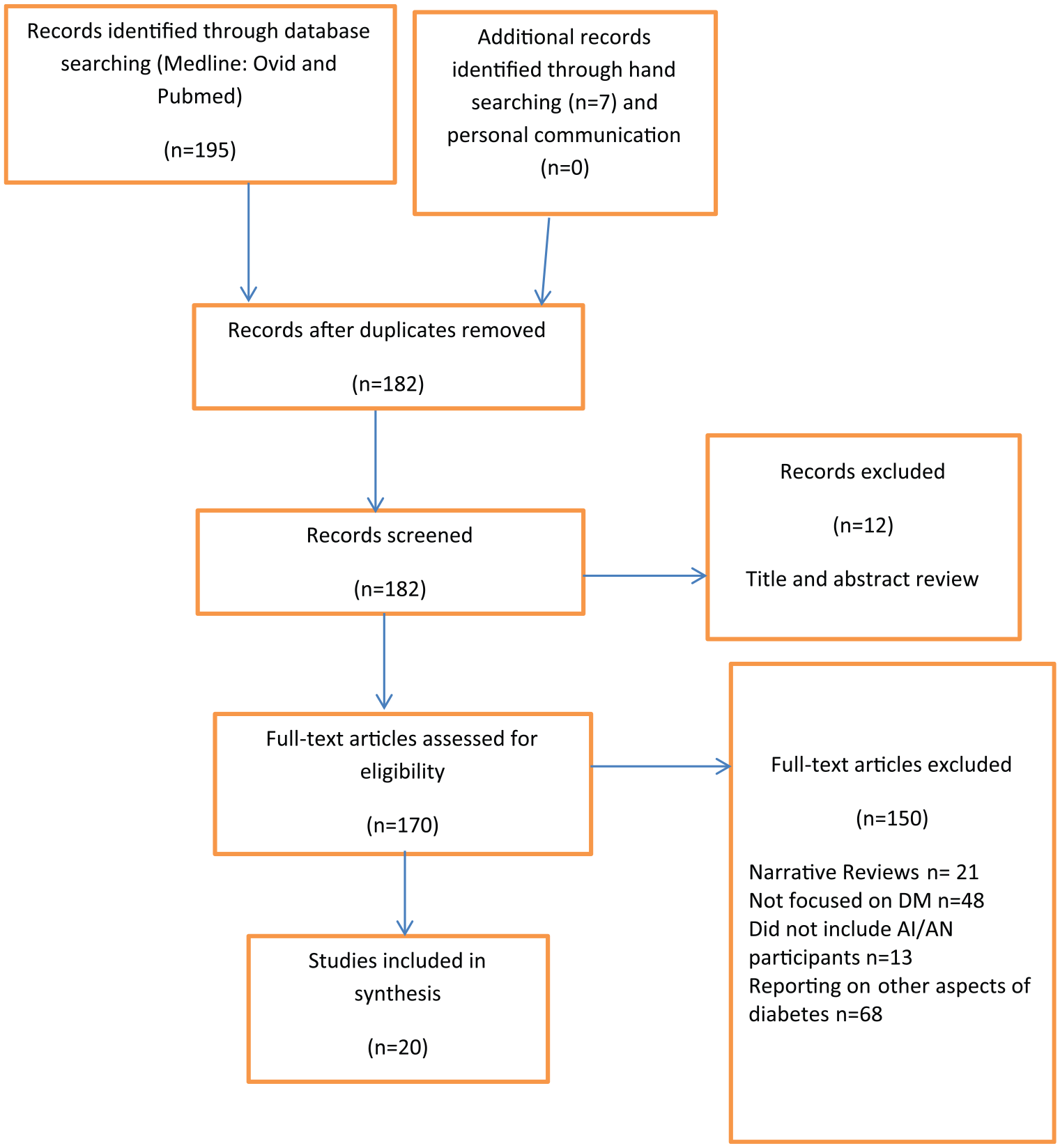
Flow diagram of study selection.
Results
Study Characteristics
The characteristics and outcomes of the 20 articles that met the inclusion criteria for this review are summarized in Table 1. Each article was reviewed and coded for bias. We rated articles as having low, medium, or high likelihood of bias on the basis of method of sample selection (e.g., convenience vs. stratified sampling frame) and rigor of the study design (e.g., observational data vs. randomized controlled trials). Discrepancies in coding were discussed until consensus was achieved. Articles were categorized by topic: adherence (n = 2), depression (n = 9), physical activity (n = 3), psychosocial barriers (n = 1), social support (n = 3), and stress (n = 2). Seven of the studies did not designate diabetes type in the sample, two studies used mixed type 1 and type 2 diabetes patient samples, while the remaining studies (n = 11) examined only adults with T2DM. None of the studies examined emotional or behavioral aspects of diabetes in individuals younger than 15 years of age.
General Study Information.

Note. AI = American Indians; ELDER = Evaluating Long-Term Diabetes Self-Management Among Elder Rural Adults; B = Black; W = White; CES-D = Center for Epidemiological Studies–Depression; A1c = glycemic control; HbA1c = hemoglobin glycemic control; T2DM = type 2 diabetes mellitus; AI-SUPERPFP = American Indian Services Utilization, Psychiatric Epidemiology, Risk and Protective Factors Projects; OR = odds ratio; CI = confidence interval; BRFSS = Behavioral Risk Factor Surveillance System; AI/ANs = American Indians and Alaska Natives; BMI = body mass index; CBPR = community-based participatory research; FF = family and friends intervention; OO = one-on-one intervention.
Nineteen studies were observational designs, and all but two were cross-sectional study designs. The remaining two studies were longitudinal designs (Gilliland, Azen, Perez, & Carter, 2002; Heath, Leonard, Wilson, Kendrick, & Powell, 1987). Of the studies reviewed, only one study tested behavioral intervention effects.
Use of a community-based participatory research (CBPR) framework, a collaborative approach in which communities are treated as equal partners during all stages of the research process was reported in two studies (Gilliland et al., 2002; Walls, Aronson, Soper, & Johnson-Jennings, 2014). One additional study did not use formal CBPR methodology but aligned its research questions with tribal health priorities (Shaw, Brown, Khan, Mau, & Dillard, 2013). Walls et al. (2014) used this approach to build trust between researchers and the community and to encourage the community to be an active research partner. Tribal affiliation among the study participants was broad, with AI/AN participants in each study ranging from 30 to 23,529 participants.
Summary of Studies by Topic
Complete details of aims and outcomes for studies within each topic are shown in Table 1. We present a summary of the results organized by topic.
Adherence
Two studies examined factors that may affect medical regimen adherence of AI adults diagnosed with T1DM or T2DM (Henderson, 2010; Miller, Wikoff, Keen, & Norton, 1987). In a study of AI elders with T2DM, Henderson (2010) examined the impact of cultural identification on regimen adherence. Findings indicated that elders who identified with traditional AI ways of life, as assessed by a self-report cultural identification item, were less likely to adhere to their primary care provider’s recommendations for diet, physical activity, and medication due to lack of trust in the medical profession and social pressures from other AIs that encouraged nonadherence (Henderson, 2010).
Another study examined factors contributing to diabetes regimen adherence in two groups: individuals who met glycemic treatment targets and fasting blood sugar values between 70 and 140 mg/dL and those who fell outside the treatment target range (Miller et al., 1987). In those who did not meet glycemic treatment targets, an individual’s favorable attitude toward his or her diagnosis correlated positively to adherence related to diet, medication, smoking, physical activity, and control of stress. Attitude for this study was defined as the individual’s favorableness or unfavorableness toward the mentioned behaviors (e.g., diet, mediation, smoking, and physical activity). The strongest relationship was observed between medication adherence and glycemic control (Miller et al., 1987). The authors found that participants in both groups had positive attitudes toward regimen adherence, and these attitudes were most predictive of adherence in taking medications regardless of glycemic values (i.e., whether or not they reached their target range for blood sugar control). Perceptions of others’ beliefs about the importance of self-care behaviors were influential to adherence to all self-care behaviors (Miller et al., 1987).
Depression
Nine of the 20 studies focused on depression and diabetes (Bell et al., 2005; Calhoun et al., 2010; Dillard et al., 2013; Jiang, Beals, Whitesell, Roubideaux, & Manson, 2007; Sahmoun, Markland, & Helgerson, 2007; Sahota, Knowler, & Looker, 2008; Singh et al., 2004; Tann, Yabiku, Okamoto, & Yanow, 2007; Walls et al., 2014). Two population-based surveys were used to determine rates of depressive symptoms among ethnic minorities compared to non-Hispanic Whites (Bell et al., 2005; Sahmoun et al., 2007). Bell et al. (2005) recruited 696 older adults diagnosed with diabetes who self-identified as Black, American Indian, or White. Findings indicated that rates of depressive symptoms did not significantly differ across ethnic groups in older rural adults with unspecified diabetes (White, 13.6%; Black, 14.6%; American Indian, 21.0%; p = .08; Bell et al., 2005). Sahmoun et al. (2007) conducted a study that examined the relationship between depression and diabetes among American Indians and Whites. Their findings revealed participants (AI and White) who rated their mental health as “not good” for 2 weeks or more had a 48% increased risk of diabetes. AIs who rated themselves as having poor mental health for 2 weeks or longer had a higher risk of diabetes than other AIs. AIs also had a higher rate of diabetes compared to Whites (Sahmoun et al., 2007).
Additionally, two studies examined the prevalence of comorbid diabetes, depression, and alcohol abuse in AI/ANs (Jiang et al., 2007; Tann et al., 2007). Tann et al. (2007) explored the relationship among alcohol abuse, depression, and diabetes in a sample of 262,381 participants, including AI/ANs (n = 2,886) diagnosed with T1DM or T2DM. Findings revealed that AI/ANs had a greater chance of having diabetes compared to Whites (odds ratio [OR] = 2.02, 95% confidence interval [CI; 1.50, 2.70]), and AI/ANs were more likely to have five or more poor mental health days in the previous month compared to Whites (OR = 1.22, 95% CI [1.02, 1.47]); however, the predictive risk for heavy drinking for AI/ANs was similar to Whites. Findings revealed that few participants across ethnic groups (n = 91) had all three risk factors (depression, alcohol abuse, and diabetes). AI/ANs had the highest risk for experiencing all three risk factors compared to other populations (Tann et al., 2007).
In a sample of 3,084 AI/AN individuals with T1DM or T2DM, Jiang et al. (2007) examined the relationship between depressive disorders, alcohol abuse, and the likelihood of having diabetes. Those diagnosed with a depressive disorder during their lifetime had an 84% increased risk of being diagnosed with diabetes. Participants with a lifetime history of alcohol abuse were 2 times more likely to be diagnosed with diabetes (OR = 2.17, 95% CI [1.34, 3.50]; Jiang et al., 2007).
Last, five articles addressed the relationship among depression, diabetes, and glycemic control in AI/ANs with T1DM or T2DM (Calhoun et al., 2010; Dillard et al., 2013; Sahota et al., 2008; Singh et al., 2004; Walls et al., 2014). Findings were mixed. Two studies reported a small nonsignificant association between depression and diabetes in the sample (Sahota et al., 2008; Singh et al., 2004). Calhoun et al. (2010) found individuals with diabetes had higher rates of depressive symptoms than those without diabetes (p < .05). Additionally, four studies found participants who had been diagnosed with diabetes and had depressive symptoms were more likely to have worse glycemic control (A1c) than participants who were not depressed (Calhoun et al., 2010; Sahota et al., 2008; Singh et al., 2004; Walls et al., 2014). For example, Sahota et al. (2008) conducted a study to determine the association of depressive symptoms and diabetes in a sample of 2,902 Pima Indians. Findings indicated that participants with diabetes had mean glycosylated hemoglobin levels that were significantly higher among individuals with depressive symptoms compared to those without depressive symptoms (9.0% in those with depressive symptoms vs. 8.4% in those without depressive symptoms, p = .02). In contrast, Dillard et al. (2013) did not find a significant difference in glycosylated hemoglobin levels between 23,529 T2DM participants with and without a depression diagnosis in their medical record.
Physical Activity
Three of the 20 studies focused on various aspects of physical activity related to diabetes (Arcury et al., 2006; Heath et al., 1987; Stolarczyk et al., 1999). Two studies found that the majority of participants did not meet physical activity recommendations at the time of the study (Arcury et al., 2006; Stolarczyk et al., 1999). Arcury et al. (2006) found that Black (n = 220), American Indian (n = 181), and White (n = 297) older adults with T1DM or T2DM who lived in rural areas had not been physically active in the previous year.
More than a decade earlier, Heath et al. (1987) conducted a retrospective evaluation of a community-based exercise program for AI/ANs diagnosed with T2DM (n = 30) compared to controls (N = 56). Participants had significant weight loss and decreased fasting glucose compared to controls. Findings from this study revealed a dose–response effect between the length of time participants had been involved in exercise and changes in the participants’ weight (Heath et al., 1987).
Psychosocial Needs and Barriers
Shaw et al. (2013) conducted a qualitative evaluation of psychosocial needs and barriers to managing T2DM for Alaskan Natives. Using a CBPR approach, the authors conducted focus groups and individual interviews for 13 Alaskan Natives (tribal affiliation unidentified) living in Anchorage. One study finding included the difficultly that participants had in finding support from their family and friends in helping them meet their nutritional needs. Additionally, their family and friends lacked general diabetes knowledge (Shaw et al., 2013). Last, self-efficacy was reported as an important component to successful diabetes self-management (Shaw et al., 2013).
Social Support
Three studies examined the relationship of social support and diabetes self-management (Arcury et al., 2012; Epple, Joish, Wright, & Bauer, 2003; Gilliland et al., 2002). All three studies found that social support had a positive impact on diabetes outcomes (Arcury et al., 2012; Epple et al., 2003; Gilliland et al., 2002). For example, Arcury et al. (2012) conducted a study focused on older Black (n = 190), American Indian (n = 168), and White (n = 205) adults with either T1DM or T2DM. Differences were noted in demographic characteristics by ethnicity. American Indian participants were more likely to be female (71.4%) compared to Black (57.4%) and White (58%) participants and more American Indian participants had less than a high school education (44.6%) compared to Black (38.1%) and White (28.3%) participants. Differences in social network sizes were also noted across ethnic groups. American Indian participants had a larger social network size (mean number of people in the network, N = 22) compared to Black (N = 19.9) or White (N = 18.0) participants. Additionally, American Indian participants spoke with their children on the telephone (N = 6.7) and other relatives (N = 6.1) more often each week than did Black (N = 5.5 and N = 5.6, respectively) and White (N = 5.2 and N = 3.8, respectively) participants. Findings revealed that social support, specifically telephone calls to the patient from relatives other than his or her children, had the greatest positive impact on provider A1c monitoring and foot examinations across all ethnic groups. Arcury et al. (2012) postulated that this finding could be the result of other relatives having similar experiences and therefore relating better to the needs of the patient.
Gilliland et al. (2002) conducted a nonrandomized community-based study to examine the effects of a culturally tailored social support intervention on self-care behaviors and A1c in 104 AIs with T2DM living in New Mexico. The study compared two intervention arms to usual care: friends and family versus individual support. During the 10-month intervention period, mentors in the friends and family arm encouraged family members to participate with their loved ones in physical activities and healthy meals. Participants in the one-on-one intervention arm had individual sessions with their mentors. The findings revealed no differences between the two intervention groups; however, when the findings from the intervention arms were combined, there was a statistically significant (p = .05) decrease in weight compared to the usual care group. Additionally, participants in the intervention groups had a smaller rise in A1c levels than those in the usual care group at the 1-year follow-up.
Epple et al. (2003) examined the relationship between nutritional support and diabetes outcomes for Navajo individuals with T2DM (n = 163). Their findings revealed that participants who had others cook for them were most likely to be in the best tertile for triglycerides (OR = 3.86, CI [1.0, 15.3]), cholesterol (OR = 4.48, CI [1.3, 15.7]), and A1c levels (OR = 9.01, CI [1.7, 47.9]; Epple et al., 2003). When findings were stratified by sex, the nutritional support variables for men were not significantly associated with any of the diabetes outcomes. Women who had others cook for them were in the best tertile for A1c (OR = 43.98, CI [1.7, 1,153]).
Stress
Two studies examined levels of stress burden in AIs and the potential negative impact of stress on diabetes self-management. Jiang, Beals, Whitesell, Roubideaux, and Manson (2008) interviewed 3,084 randomly selected members from two American Indian tribes (Northern Plains and Southwest) who had been diagnosed with T1DM or T2DM. Findings revealed that Northern Plains tribal members who experienced early-life interpersonal trauma were nearly 3 times as likely to be diagnosed with diabetes. Participants from the Southwest tribe who experienced discrimination or who lived in communities with addiction problems were more than twice as likely to be diagnosed with diabetes (OR = 2.74, 95% CI [1.52, 4.96]; Jiang et al., 2008).
Jacob et al. (2013) used data from the Strong Heart Study to measure the association of psychological trauma symptoms, diabetes, traumatic stress, glucose control, and type of treatment. Findings in this study (n = 3,776) did not reveal a relationship between trauma symptom categories and diabetes prevalence or glucose control. However, participants who experienced psychological trauma symptoms were 3 times more likely to either receive no diabetes medications or combination therapy compared to oral agents or insulin alone (OR = 2.9, 95% CI [1.5]; Jacob et al., 2013).
Culture and Diabetes
The development of culturally tailored diabetes management materials was reported in two studies (Epple et al., 2003; Gilliland et al., 2002). Epple et al. (2003) developed nutritional support concepts that were culturally sensitive and relevant to the Navajo culture by first conducting an ethnographic study. These findings formed the foundation for a culturally relevant questionnaire that evaluated the association between family nutritional support and metabolic outcomes in Navajo individuals (Epple et al., 2003).
Gilliland et al. (2002) conducted a community-based lifestyle intervention study that used focus groups to design a lifestyle intervention. Culturally relevant materials were developed and used in storytelling, in discussion of traditional American Indian foods, and in videos featuring AI individuals demonstrating healthy life choices (Gilliland et al., 2002). Findings from this study suggest that American Indians with T2DM who participate in community-based lifestyle interventions using culturally relevant materials may experience improvement in glycemic control (Gilliland et al., 2002).
Discussion
This literature review identified 20 studies that examined the emotional and behavioral aspects of diabetes in the AI/AN population and illustrated the paucity of literature in this area across multiple domains.
Adherence
Diabetes regimen adherence is central to preventing long-term complications (Asche, LaFleur, & Conner, 2011), yet only two studies were found that examined factors that could affect adherence in the AI/AN population. This limited number of observational studies and paucity of intervention research (n = 1) lie in stark contrast to the high rates of severe diabetes complications in AI/AN communities. Culturally consonant evidence-based interventions that promote adherence across the full range of diabetes self-management behaviors are needed for AI/AN communities. The Institute of Medicine (2012) has called for multifaceted intervention research to decrease health disparities and improve health care qualities for vulnerable populations, such as AI/ANs. Specifically, more research is needed to identify self-care behaviors that need the greatest levels of support, the role of family and community in support adherence, and environmental resources that can be leveraged in these communities (e.g., health care services, community centers, tribal governance, etc.).
Depression
Nearly 50% of all published studies reviewed focused on depression and diabetes in AI/ANs. Prevalence rates of comorbid depression and diabetes among AI/AN samples are consistent with those among non-Hispanic White populations and among racial and ethnic minority populations (Holt, de Groot, & Golden, 2014). However, the paucity of intervention literature highlights the need to assess the effectiveness of treatment interventions currently available in the general population and the development of culturally tailored approaches as needed.
Physical Activity
Only three studies in this review focused on physical activity related to diabetes management in the AI/AN population. More intervention studies are needed to examine the role of physical activity in diabetes management and prevention of complications for AI/AN communities. Future research should focus on the physiologic impact of various exercise training regimens on glycemic outcomes, as well as effective physical activity programming for families and ways to leverage community resources to enhance physical activity.
Psychosocial Needs and Social Support
Social support has been shown to be influential in self-management of diabetes and on diabetes outcomes (Van Dam et al., 2005); however, few such studies have been conducted in the AI/AN community. The four studies in this review that focused on social support found that it had a positive impact on diabetes outcomes, but only one study tested a culturally tailored intervention. The emerging literature suggests that diabetes-savvy family support is helpful in A1c monitoring and outcomes. More research is needed to test the effects of culturally tailored social support interventions on patient self-management, lifestyle modifications, and diabetes outcomes.
Stress
Both physical and mental stress can be a barrier to diabetes management. Stress has been noted to be especially high in the AI/AN population due to early-life events, discrimination, community or family dysfunction, and community economic distress (Jiang et al., 2008). Further research is needed to identify contributors to resiliency and interventions to mitigate the effects of stress on physiological and psychological outcomes.
Other Considerations
Another important consideration in the existing AI/AN diabetes psychosocial literature is the characterization of study samples by diabetes type. The majority of studies did not identify individuals as having T1DM or T2DM. Although T2DM is more prevalent in the AI/AN population, T1DM was present in some study samples. It has been well-documented in mainstream patient populations that T1DM and T2DM represent significantly different psychosocial trajectories and experiences over the life course, ranging from the impact of diagnosis on developmental level based on age of onset, the role of family support over the life course, and the impact of disease experience on individuals at different ages and life stages (Anderson & Rubin, 2003). Characterization of diabetes type in research provides an important context for both psychosocial and medical research findings and should be explicitly identified and reported in all diabetes-related studies.
Study Methodologies
Two of the 20 studies used CBPR methodology to conduct their research (Gilliland et al., 2002; Walls et al., 2014). Trust between researchers and communities is an essential element of all behavioral research. Traditional investigator-initiated, noncollaborative research has resulted in the loss of trust among AI/AN communities through perceived loss of confidentiality, manipulation of community members, and lack of cultural sensitivity (Quigley, 2006; Walls et al., 2014). In the shadow of the historical legacy of oppression and cultural genocide of AI/ANs in the United States, CBPR provides a framework for researchers to partner with AI/ANs to identify community priorities, explore health questions found valuable by the community, and disseminate findings in ways that promote dignity, trust, and community empowerment. CBPR and/or community-engaged research can be applied to the full range of study methodologies and research questions. This approach involves collaborating with communities to ensure equality of influence over the process, course, and dissemination of research projects. When successful, this approach results in the development of culturally competent tools and resources and increased confidence that study findings can be trusted by the community (Horn, McCracken, Dino, & Brayboy, 2008; Mackety, 2012).
We recognize that some gaps in the literature observed in this review may be attributable to the lack of published findings (i.e., publication bias) rather than the absence of studies themselves. Indeed, publication of poor health or mental health findings can be experienced by communities as stigmatizing and disempowering and may be perceived to reinforce U.S. mainstream cultural stereotypes that characterize AI/AN communities as deficient or incapable of managing their own health. This is both understandable and unfortunate. The paucity of published findings has the unintended consequence of making significant needs and struggles of these communities less visible and limiting social and economic resources both within and outside the community that could be garnered to promote and support their health.
Tribal Identification
Another gap observed in this literature is the limited number of studies that explicitly identified tribal communities who participated in the research. Fifty percent of the articles did not discuss these details, with several opting to identify geographic region rather than tribal identity. Two articles that used the National Behavioral Risk Factor Surveillance System did not give any information about tribal affiliation. Specific tribal affiliation may have been withheld to uphold tribal sovereignty to protect the rights of the tribes to regulate access to this information. It also can be difficult to protect the confidentiality of tribal members in small communities of AI/AN individuals. Sample sizes for individual tribes may be too small to justify subgroup analysis.
With these considerations in mind, it is important to note that there are 566 different federally recognized AI/AN tribal entities (Bureau of Indian Affairs, 2014), each with unique historical and cultural characteristics. While some similarities exist across tribes, there are also many variances in traditions, values, health beliefs, and health practices. Dissimilarities also exist between individuals who reside on Indian reservations and those residing in urban settings. Researchers should be cognizant of the complexities of AI/AN communities with regard to issues of tribal self-identification.
Finally, research that combines AI/AN communities with mainstream samples provides relatively little insight into the variables and issues that may distinguish these communities. Studies should strive to enroll robust AI/AN sample sizes when designs call for multiple ethnic group comparative research so that within-group analyses can be conducted with the same rigor as between-group analyses.
Implications for Health Research and Practice
Findings from this review have implications for both health research and practice with AI/AN populations. From a health research perspective, many lines of investigation are needed to enhance diabetes outcomes in AI/AN communities across all emotional and behavioral topics in diabetes. These include the following: the meaning of T1DM and T2DM in each community, particularly in the context of diabetes prevalence rates that can affect a significant proportion of community members; cultural theories of health, illness, and self-care and the ways that these mental models intersect with medical recommendations developed in U.S. mainstream patient populations; identification of effective sources of social support for disease management and diabetes self-care within the structure of each AI/AN community; effective ways to identify and intervene when patients and families are struggling with diabetes self-care behaviors; effective means of promoting healthy nutrition and physical activity in the context of individual, family, and community life; and effective and culturally consonant ways to discuss and treat depression in AI/AN communities. Future research should be directed to filling knowledge gaps related to these aspects of diabetes. In addition, longitudinal intervention studies that use a CBPR approach are needed to inform strategies that will eliminate health disparities in this important but often neglected population.
From a health practice perspective, there remains a clear need to use state-of-the-art health promotion and health intervention tools to improve the emotional, behavioral, and medical outcomes of AI/AN individuals and communities. Health practitioners will be most effective in achieving medical outcomes by building trust with AI/AN patients and their families (Henderson, 2010). Positive attitudes toward health care providers and diabetes can be promoted by working with patients and their families to make incremental changes in medication prescriptions paired with problem solving about barriers to adherence (Miller et al., 1987).
Health practitioners can play an important role in facilitating diabetes education for both patient and family members. As noted by Shaw et al. (2013), AI/AN individuals may have extended social networks, but lack of diabetes education can limit or impede these natural sources of social support for diabetes self-care. Miscarried helping based on misinformation or lack of information can be address through multiple forms of communication, including through clinic visits, educational brochures, and multimedia programming (e.g., educational websites and video presentations in waiting areas). Health practitioners should ask patients about their preferred sources of support for self-care behaviors (e.g., dietary choices), recognizing that individuals outside the family may also serve an important role (Arcury et al., 2012).
Finally, depressive symptoms and diabetes distress are present for a substantial number of AI/AN patients (Jiang et al., 2007, 2008). Screening for depressive symptoms and diabetes-related distress will assist health providers, diabetes educators, and patients to effectively address impediments to diabetes self-care and psychiatric issues that contribute to the burden of disease. Such screening has the potential to empower patients to engage in meaningful dialogue with providers about treatment options, preferences, and expectations for improved functioning, and diabetes outcomes, all of which can lead to healthier lives for the patient living with diabetes.
Footnotes
Acknowledgements
The authors are grateful for the assistance of the Kathryn M. Buder, Center for American Indian Studies and the Center for Diabetes at Brown University. Additionally, the authors would like to thank William Knowler, MD, PhD, MPH, NIDDK, and Felicia Hodge, DrPH, University of California, Los Angeles, for their expertise and review of a previous version of this article.
Authors’ Note
The authors wish to note that Dr. Lisa Scarton is a member of the Choctaw Nation of Oklahoma.
Declaration of Conflicting Interests
The authors declared no potential conflicts of interest with respect to the research, authorship, and/or publication of this article.
Funding
The authors disclosed receipt of the following financial support for the research, authorship, and/or publication of this article: Support provided to Dr. Lisa Scarton from Indiana University School of Nursing and the Jonas Center for Nursing Excellence and the National Institute of Diabetes and Digestive and Kidney Diseases and support provided to Dr. Mary de Groot (R18DK092765).