



Abstract
Objectives. Physical activity, including some form of vigorous activity, is a key component of a healthy lifestyle in young people. Self-efficacy and social support have been identified as key determinants of physical activity; however, the mechanism that reflects the interplay of these two factors is not well understood. The aim of the current study was to test social cognitive theory’s notion that self-efficacy relates to intention that translates into behavior and to investigate whether friend support and self-efficacy synergize, interfere, or compensate for one another to predict vigorous physical activity in adolescents—a population at risk of rapid decreases in physical activity. Method. A survey at two points in time was conducted in 226 students aged 12 to 16 years. In a conditional process analysis, friend support and physical activity self-efficacy were specified as interacting predictors of intention. The latter was specified as a mediator between self-efficacy and later vigorous physical activity, controlling for sex and age. Results. Self-efficacy emerged as the dominant predictor of intention, followed by friend support, and an interaction between support and self-efficacy. In adolescents with high self-efficacy, intention was independent of support. In those with low self-efficacy, receiving friend support partly compensated for lack of self-efficacy. The effect of self-efficacy on vigorous physical activity was mediated by intention. Conclusions. Adolescent vigorous physical activity was indirectly predicted by self-efficacy via intention, and this mediation was further moderated by levels of friend support, indicating that friend support can partly buffer lack of self-efficacy.
Engaging in regular physical activity may help control body weight, develop a healthy cardiovascular system, and improve psychological well-being and is associated with improved school performance, a greater sense of personal responsibility, and group participation among adolescents (Department of Health, 2014; Hills, Dengel, & Lubans, 2015). Thus, physical activity is a key component of a healthy lifestyle in young people, and it is recommended that youth aged 13 to 17 years should accumulate at least 60 minutes of moderate-to-vigorous intensity physical activity every day. It is further recommended that the physical activity undertaken should include a variety of aerobic activities including those that are of vigorous intensity (Department of Health, 2014). This is because vigorous activities over and above moderate activities have been shown to have added benefits for adolescents, including higher index for cardiovascular fitness and lower percentage of body fat (Department of Health, 2014; Gutin, Yin, Humphries, & Barbeau, 2005). Despite its benefits, the empirical literature suggests that physical activity declines across the life span, particularly during adolescence. A recent systematic review assessing physical activity levels throughout adolescence (age 10-19 years) found a mean annual decline of 7% in physical activity change, which could infer a global physical activity decline of 60% to 70% (Dumith, Gigante, Domingues, & Kohl, 2011). As a consequence, 9 in 10 young Australians do not move enough (Department of Health, 2014).
Social cognitive theory tries to explain psychological antecedents of engagement in health behaviors (Bandura, 1997). Bandura postulates that self-efficacy and social support are among the key determinants of physical activity, and a recent review of reviews supports this assumption for adolescents (Sterdt, Liersch, & Walter, 2014). However, many studies investigate the effects of self-efficacy and social support without testing for their assumed interaction. Given that researchers have found self-efficacy and social support to act synergistically (synergistic effect; Dishman, Saunders, Motl, Dowda, & Pate, 2009; Warner, Ziegelmann, Schüz, Wurm, & Schwarzer, 2011a), whereas others have found social support to compensate for lack in self-efficacy (compensatory effect; Warner, Gutiérrez-Doña, Villegas Angulo, & Schwarzer, 2015) and that receiving support despite having high levels of self-efficacy might cause negative reactions in recipients (interference effect; Warner, Ziegelmann, Schüz, Wurm, Tesch-Römer, et al., 2011b), the interplay of these two factors is an issue that deserves further research. The aim of the current analysis was to examine how self-efficacy and social support operate jointly in the prediction of intention and vigorous physical activity behavior in adolescents—a population at high risk of declining physical activity levels (Dumith et al., 2011).
Self-Efficacy for Physical Activity
Self-efficacy is an individual’s belief in his or her ability to perform a specific action required to attain a desired outcome. People with strong self-efficacy beliefs set higher goals, invest more effort into the pursuit of their goals, and are more likely to try harder if barriers and setbacks emerge (Bandura, 1997). Translated to physical activity this means that self-efficacy relates to individual perceptions about being able to perform physical activity regularly, to adopt and maintain it even if the conditions are difficult, and to reinitiate it when lapses occur (Bandura, 1997). Accordingly, studies using motion detectors monitoring physical activity have shown that self-efficacy is related to a high level of physical activity among 10- to 16-year-old adolescents (Strauss, Rodzilsky, Burack, & Colin, 2001). In general, adolescents with higher levels of self-efficacy for physical activity were found to report higher physical activity levels and to maintain the practice for an extended period of time (Dishman et al., 2004; Rovniak et al., 2002; Sterdt et al., 2014). As expected by social cognitive theory, self-efficacy was found to be a major instigating force in forming an intention to be active (Bandura, 1997; Luszczynska et al., 2010). Studies comparing constructs from different health behavior change theories show that the effects of self-efficacy on physical activity are stronger than those of other social cognitive determinants in adolescents (Rovniak et al., 2002).
Received Friend Support
Many of those who are regularly physically active do so in groups rather than alone—reflecting the fact that physical activity is a behavior performed mainly in social contexts among adolescents (Smith, 2003). Accordingly, social support has been identified as an important predictor of physical activity in this age group (Sterdt et al., 2014). Social support refers to the function and quality of social relationships, such as either perceived availability of help or support actually received (Schwarzer & Knoll, 2007). Studies examining physical activity outcomes have found that social support adds predictive value to both intention and behavior and has a stronger influence in predicting physical activity intention than subjective norms (Rhodes, Plotnikoff, & Courneya, 2008). In addition, the sources of support (e.g., parents, teachers, friends) can make a difference. Support provided by friends can be considered a key variable because many physical activities are performed in a social peer group context among adolescents. Furthermore, peer support was found to become more important than parental support at that age group (adolescents aged 12-16 years; Edwardson, Gorely, Pearson, & Atkin, 2013). Underlining these assumptions, studies in the physical activity domain have reported on the importance of friends as sources of social support for adolescents (Duncan, Seeley, Gau, Strycker, & Farmer, 2012; Sallis, Prochaska, & Taylor, 2000; Sterdt et al., 2014, Voorhees et al., 2005).
The Interplay of Self-Efficacy and Social Support
Social cognitive theory (Bandura, 1997) suggests various possible interactions of self-efficacy and social support. On the one hand, they could strengthen one another. This synergistic interaction was found for older adults who, when reporting to have high levels of both resources, were most active (Warner, Ziegelmann, Schüz, Wurm, & Schwarzer, 2011a). On the other hand, they could interfere with each other if very self-efficacious adolescents also receive large amounts of support, which makes them feel overprotected or controlled. This possible interaction has, to date, only been tested in the elderly, who showed preference for lower support levels if self-efficacy was high (Newsom & Schulz, 1998; Warner, Ziegelmann, Schüz, Wurm, Tesch-Römer, et al., 2011b). The third possible interaction—the compensation hypothesis—posits that both resources could compensate for that lacking in the respective other (Bandura, 1997; Dishman et al., 2009). A study that tested this compensation hypothesis in young girls, however, found that receiving lower social support for physical activity could not be mitigated by self-efficacy beliefs—only if both resources were high, girls between 13 and 18 years of age kept their activity levels—favoring the synergistic view in which both resources combined have a stronger effect than one alone (Dishman et al., 2009).
The Current Study
We aimed to examine the role of personal (self-efficacy) and social (friend support) resources and how they relate to vigorous physical activity and the intention to practice it. The first question, then, was whether both self-efficacy and friend support combined need to be present for vigorous physical activity (synergistic effect; Dishman et al., 2009; Warner, Ziegelmann, Schüz, Wurm, & Schwarzer, 2011a). The second question was whether one single resource is sufficient, which would reflect a compensatory effect of one for the other (compensatory effect; Warner et al., 2015), or whether they might interfere among adolescents (interference effect; Warner, Ziegelmann, Schüz, Wurm, Tesch-Römer, et al., 2011b). The first hypothesis pertains to a simple mediation effect. It was expected that intention to be physically active would serve as a mediator between self-efficacy and the behavioral outcome, which is in line with social cognitive theory (Bandura, 1997). The second hypothesis addressed the conditional effect that was expected when friend support comes into the equation as a putative moderator of the self-efficacy–intention relationship, as the effect of self-efficacy on intention may depend on levels of received friend support.
Method
Participants
Participants (N = 226) were Grade 9 students recruited from 10 schools across South East Queensland, Australia. The sample comprised female (61%, n = 137) and male (39%, n = 89) students, ranging in age from 12 to 16 years (M = 13.50, SD = 0.59) and who engaged in some form of vigorous physical activity in the previous week. A majority of the participants reported coming from an English-speaking background (88%).
Design and Procedure
The Human Research Ethics Committee from the university and relevant school educational authorities approved the study. The results reported in this article are part of a larger study (N = 423) investigating social cognitive processes of adolescent physical activity intention and behavior. This article focuses solely on the role of personal (self-efficacy) and social (friend support) resources, and how they relate to vigorous physical activity and the intention to practice it among a cohort of adolescents who had recent experience of engaging in vigorous physical activity. A prospective design with two waves of data collection, spaced 1 week apart, was adopted (main questionnaire Time 1 [T1] and behavior questionnaire Time 2 [T2]; Hamilton & White, 2008). The main measures in the current study (self-efficacy, friend support, intention) were assessed at T1, whereas vigorous physical activity was assessed at T2. The data from T1 and T2 were matched with a personal code identifier created by the participant.
Selected schools were based on availability and convenience. Once approval was sought from the school principal for student participation in the study, an information package was sent home to parents. Written consents from both parent and child were required for participation. Following the return of signed consent forms, questionnaire distribution commenced. Verbal and written instructions were given to participants for both waves of data collection, and students completed the questionnaires at their own pace and in selected class times. To thank students for their participation, all received either a water bottle or a pen.
Materials
Self-Efficacy
Self-efficacy was measured by three items reflecting the participant’s sense of confidence about being capable of performing physical activity (e.g., “I am confident that I could do moderate-to-vigorous physical activity. . . ,” scored strongly disagree [1] to strongly agree [7]). Cronbach’s alpha for the current study was .75.
Friend Support
Friend support was measured by four items adopted from Prochaska, Rodgers, and Sallis (2002) assessing the weekly frequency with which their friends provide encouragement, praise, and participation concerning their physical activities, and the adolescent’s encouragement of their friends to be physically active (e.g., “During a typical week, how often do your friends encourage you to do physical activity or sports,” scored never [0] to daily [4]). Cronbach’s alpha for the current study was .77.
Intention
Three items assessed the strength of intention to perform physical activity (e.g., “I expect that I will do moderate-to-vigorous physical activity . . . ,” scored strongly disagree [1] to strongly agree [7]). Cronbach’s alpha for the current study was .84.
Behavior
Because children and adolescents have been shown to accurately recall their physical activity for no longer than periods of 24 hours (Sallis, 1991), vigorous physical activity was assessed with a simplified version of the validated Previous Day Physical Activity Recall (Weston, Petosa, & Pate, 1997). Vigorous physical activity was operationalized as “activity at a higher intensity that causes your heart to beat rapidly and make you huff and puff.” To help students conceptualize these activities, examples were provided (e.g., running, vigorous swimming, skipping, aerobic dance, athletics). Students were then asked to write down the type of vigorous intensity physical activity they engaged in “yesterday” and indicate the time in minutes they performed the activity. A total vigorous physical activity score was measured as the total time in minutes for all the vigorous activities reported by the participant. Such 1-day recall of physical activity has been found to reflect pedometer- and accelerometer-assessed activity and heart rate monitoring (Welk, Dzewaltowski, & Hill, 2004; Weston et al., 1997), and 24-hour recalls were found to be more valid than 7-day recalls in young samples (Van Hoye, Nicaise, & Sarrazin, 2014).
Analytic Procedures
Computations are performed with SPSS 23 as well as with the SPSS PROCESS macro by Hayes (2012). PROCESS is a publicly available free add-on to analyze mediation, moderation, and conditional processes (www.processmacro.org). It can estimate single or multiple mediation models, moderation models, and moderated mediation models, and it can determine direct and indirect effects and allows for bootstrapping procedures (Hayes, 2013, 2015). The term conditional process analysis is used as an umbrella term for the wide range of moderated mediation analyses that can be undertaken.
To examine the first hypothesis, a simple mediation model was carried out. Intention as a putative mediator was regressed on self-efficacy whereas the dependent variable (T2 vigorous physical activity) was regressed on the independent variable self-efficacy, on the putative mediator intention, and on sex and age as covariates. To test the second hypothesis, once the simple mediation was corroborated, a conditional process analysis was conducted that integrates mediation and moderation analyses (Hayes, 2013). Thus, intention was regressed on self-efficacy and social support as well as on the interaction term of these two variables; and vigorous physical activity was regressed on self-efficacy, intention, and the covariates. Confidence intervals (95%) were generated by bootstrapping with 5,000 re-samples.
Results
Means, standard deviations, and intercorrelations are displayed in Table 1.
Means (M), Standard Deviations (SD), and Correlations.
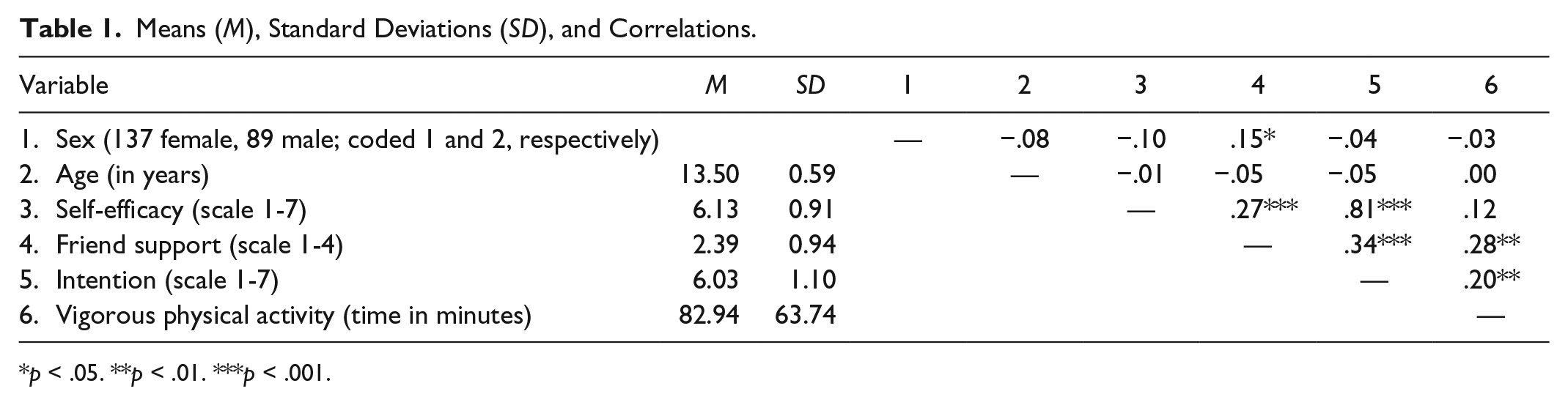
p < .05. **p < .01. ***p < .001.
Testing the simple mediation hypothesis for the relationship from self-efficacy to vigorous physical activity via intention yielded an indirect effect of b = 12.83, 95% confidence interval (CI) [2.24, 24.40]. This confirmed the assumptions and allowed to proceed to the conditional process analysis, examining the second hypothesis. Figure 1 displays the conditional process model with standardized parameter estimates, in which a moderated mediation takes place, as reflected by the interaction term of self-efficacy and friend support on intention.
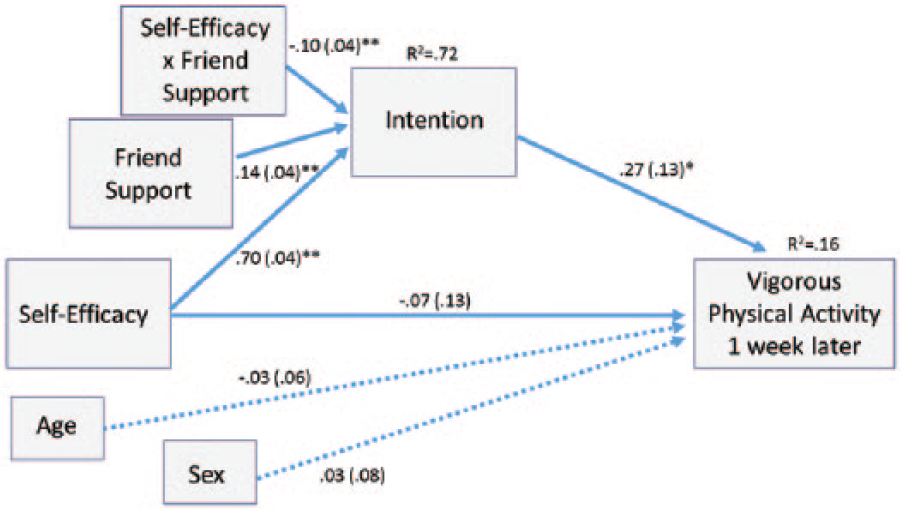
Interaction between self-efficacy and received friend support on vigorous physical activity.
In detail, the following unstandardized parameters were estimated. The effect of self-efficacy on intention was b = 1.17, 95% CI [0.97, 1.36]; the effect of friend support on intention was b = 0.93, 95% CI [0.40, 1.46]; and their interaction was b = −0.13, 95% CI [−0.21, −0.04]. Of the intention variance, 72% were accounted for by this set of three predictors, which, however, was mainly due to self-efficacy (while also controlling for age and sex). On the right side of the model, the effect of intention on vigorous physical activity was b = 13.37, 95% CI [0.32, 26.42]; the direct effect of self-efficacy on vigorous physical activity was not significant, b = −4.08, 95% CI [−19.62, 11.45]; and sex and age were nonsignificant.
To probe the interaction, the regression lines were plotted using three specific values of the moderator friend support, namely, those at the mean of the moderator, and at ±1 standard deviation from the mean (−1 SD, M, +1 SD). Figure 2 illustrates that at high levels of self-efficacy, there was also a high level of intention, independent of support. At this level of self-efficacy, it did not matter how much friend support was received, self-efficacy predicted intention. On the other hand, at low levels of self-efficacy, support made a difference: If students lacked self-efficacy as well as support, they were less likely to form an intention for vigorous physical activity. In adolescents with low self-efficacy, who received above average friend support, intention to engage in physical activity was facilitated. This interaction confirms the second hypothesis that the resources do not only add up but also interact in a way that friend support partly compensates for low levels of self-efficacy in adolescents. However, the high support slope was significant as well, indicating that support could not fully buffer lack of self-efficacy. The conditional indirect effect of self-efficacy on vigorous physical activity was highest in the subgroup of students receiving lower levels of support, pointing to the fact that highly supported individuals’ self-efficacy was mediated less strongly via intention on vigorous physical activity.
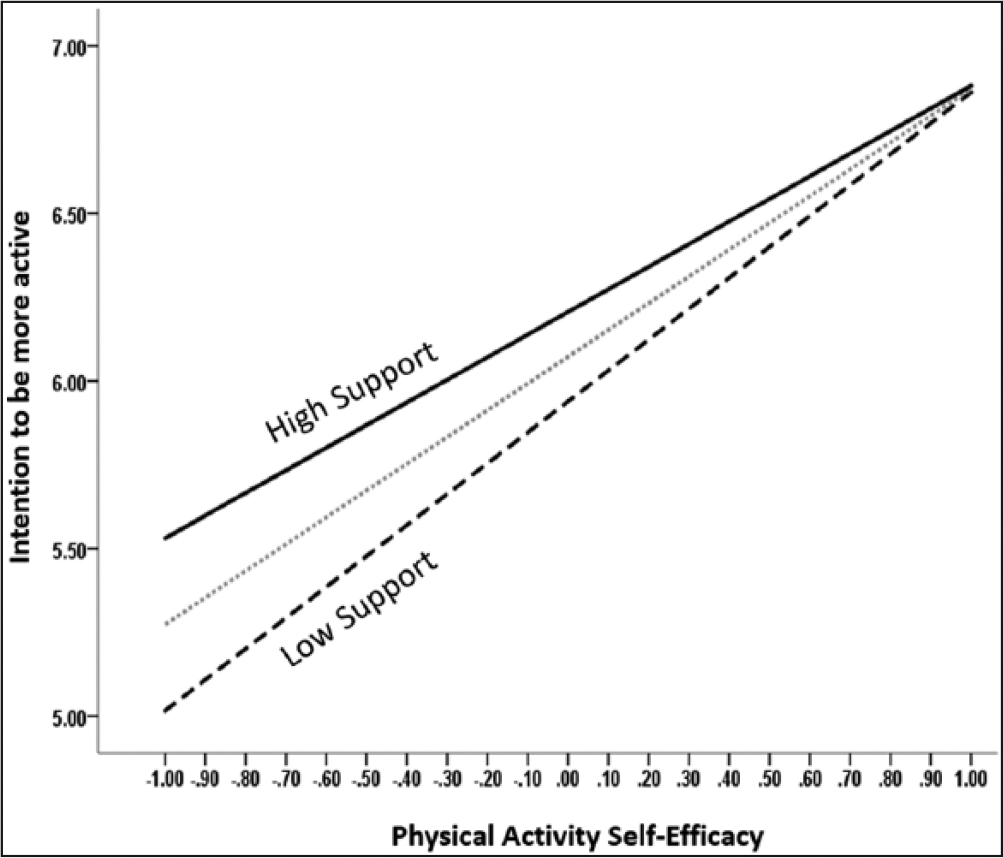
Interaction between physical activity self-efficacy and received friend support on intention.
Discussion
The current study examined the joint effects of friend support and self-efficacy as predictors of intention and vigorous physical activity in adolescence—a phase in life that is known to be characterized by decreasing physical activity levels (Dumith et al., 2011) and where additional vigorous activity can have added benefits (Department of Health, 2014; Gutin et al., 2005). The first hypothesis examining the simple mediation between self-efficacy and vigorous physical activity by intention was confirmed, which is in line with most health behavior theories such as social cognitive theory (Bandura, 1997). Moreover, there was a direct effect of self-efficacy and social support on intention and also an interaction, demonstrating that the strength of relationship between self-efficacy and intention depended on how much support was received from friends. The conditional process analysis was performed to examine the second hypothesis pointing to a moderated mediation. If adolescents have low levels of self-efficacy, they need friend support to build their intention, and indirectly, vigorous physical activity at a later point in time. Lack of friend support, however, is no disadvantage when adolescents harbor a high level of self-efficacy. This means that high self-efficacy compensates for low support, but high friend support can only partly buffer low self-efficacy. Overall, the results of the current study provide initial support for the suggestion of a synergistic effect (Dishman et al., 2009; Warner, Ziegelmann, Schüz, Wurm, & Schwarzer, 2011a) as well as compensatory effect (Dishman et al., 2009; Warner et al., 2015) between self-efficacy and social support for adolescent vigorous physical activity. High levels of both resources were found to be beneficial in forming an intention to be active among adolescents and did not lead to adverse side effects due to possible reactance of high self-efficacious and highly supported individuals. The current study did not find evidence for the interference hypothesis between self-efficacy and social support, which was found in older adults, who showed lower levels of autonomy if they reported to have high levels of both resources (Warner, Ziegelmann, Schüz, Wurm, Tesch-Römer, et al., 2011b).
A meta-analysis on the effects of physical activity interventions on body mass index of children found that these interventions often fail to increase the amount of physical activity and, therefore, did not result in the expected health benefits (Metcalf, Henley, & Wilkin, 2012). A recent review and meta-analysis on the effects of interventions that aimed to increase moderate and vigorous physical activity in school lessons, however, indicated that interventions during physical education lessons can increase the proportion of time that students spend exercising (Lonsdale et al., 2013). Along these lines, integrating physical activity in a peer context might be especially important in adolescence. To inform future interventions for vigorous physical activity in adolescents, the results of the current study add some practical suggestions: interventionists who target either self-efficacy, peer support, or both to increase physical activity among adolescents do not have to worry about “overdosing” friend support, since even students who believed in their ability to perform physical activity regularly showed no adverse effects of additional friend support. This beneficial effect of support should, however, not be taken for granted from all sources of support (e.g., not be transferred to parents and teachers) as Bandura (1997) warns that verbal persuasion might cause opposite effects in recipients if it is perceived as controlling (Verloigne et al., 2014).
The results of the current study also suggest that it is most important in adolescents to target self-efficacy, because self-efficacy can make up for low support from friends (compensation effect). For adolescents with low self-efficacy, increasing friend support will, however, only partly increase their intention—a combined support and self-efficacy intervention might show better effects for adolescents with low self-efficacy. Furthermore, the indirect effect of self-efficacy on physical activity was highest in the subgroup of students with low support, which means that they needed a strong intention to be physically active, whereas those with much support did not necessarily need a strong intention to translate their self-efficacy into physical activity. This finding can be interpreted in the way that those adolescents, who reported a great deal of support, were the ones who were socially motivated for action. This motivation is possibly due to participation in group programs or memberships in sports teams where commitment to the group activity plays a major role and time and place are predefined—potentially making individual self-regulatory processes less important. Taken together, these results strengthen previous research that found peer support to be a key resource for physical activity in adolescents and that suggested to make parents aware of this strong effect of peers, support exercising in groups and clubs, and trying to increase adolescents’ ability to provide adequate support for one another (Edwardson et al., 2013).
Some conceptual and methodological limitations of the current study need to be mentioned to evaluate these results and their implications for future research and practice. Given the main focus of this article was to investigate the interplay of self-efficacy and friend support on intention and vigorous physical activity, the behavior measure only assessed the vigorous physical activity performed “yesterday.” To investigate changes in naturally occurring vigorous physical activity over time, baseline measures of behavior as well as longer follow-ups would be advisable. In addition, behavior was assessed using a self-report 1-day physical activity recall. This decision was based on research suggesting that young people are better able to report their physical activity more accurately if asked for a 24-hour recall rather than longer periods (Van Hoye et al., 2014). Although such self-reports are a frequently utilized practice in research on physical activity, and the validity of single-item self-reports has been shown to be satisfactory (Hamilton, White, & Cuddihy, 2012; Prince et al., 2008), measuring physical activity with daily diaries of several 24-hour recalls or objective methods such as accelerometry may be less prone to memory bias or social desirability bias (Van Hoye et al., 2014; Welk et al., 2004). A further limitation was the study population only consisting of one grade level (i.e., Grade 9) and those who had recent experience of engaging in vigorous physical activity. Given that previous research has found school grade–level differences among social cognitions (Mummery, Spence, & Hudec, 2000) as well as potential differences among active and nonactive individuals (Bauman et al., 2012; Hamilton & White, 2010), future research should investigate if these effects hold across a broad range of school grade groups and different physical activity intensity levels. Finally, the prospective design of the current study does not eliminate mechanisms of reversed causation, for example, that more vigorous physical activity leads to building more sustained self-efficacy and positive responses from friends and also intention to maintain that level of physical activity.
In conclusion, despite the added benefits of vigorous physical activity, adolescents do not engage in such exercise enough. Self-efficacy and social support are identified as key determinants of physical activity; however, the mechanism that reflects the interplay of these two factors is not well understood. The current study sheds some light on this relationship. In sum, this study confirms the assumption of an interactive resource mechanism that has been found in some of the literature on physical activity in older adults suggesting a synergistic effect between both resources as well as a compensation of low support by high self-efficacy and partly also the other way round. Further research needs to manipulate either self-efficacy or support or both factors to unveil possible causal pathways that may be responsible for such mechanisms.
Footnotes
Declaration of Conflicting Interests
The authors declared no potential conflicts of interest with respect to the research, authorship, and/or publication of this article.
Funding
The authors received no financial support for the research, authorship, and/or publication of this article.