




Abstract
Background. Recent efforts supporting children’s dietary behaviors suggest the importance of food literacy (FL), which is a multidimensional concept that encompasses food-related knowledge, skills, and behaviors. To date, FL has been largely informed by adult and adolescent research. Aims. To assess the FL experiences, perceived skills, and knowledge of school-age children to inform FL educational opportunities. Method. Six focus groups were conducted with children (age 9-12 years) from three Massachusetts elementary schools. Two team members independently reviewed and coded a portion of the transcripts to assess interrater reliability. Predominant themes connected to children’s perceived FL skills and knowledge were identified using an inductive and deductive content analysis approach. Results. There were five central FL themes identified during the focus groups (n = 31 children), including (1) food systems concepts; (2) food safety and food freshness; (3) gardening environment, perceived skills, and knowledge; (4) cooking environment, perceived skills, and safety; and (5) autonomy of meal preparation. Discussion. The themes that emerged in these focus groups with children provided new information surrounding children’s perceived FL skills and knowledge as well as important context regarding the food environment (school vs. home). These findings captured important concepts across the “farm to plate” spectrum and highlight potential school-based opportunities where FL topics could be expanded upon most successfully. Conclusion. This formative research informed educational opportunities for a FL curriculum, which holds promise for improving food-based education and programs, designing more effective interventions, and developing measurement tools.
Decades of policy and program efforts have failed to close the gap between recommendations for the diets of U.S. children and what they actually consume, including too few fruits and vegetables, and excessive calories from energy-dense, nutrient-poor foods and beverages (Slining, Mathias, & Popkin, 2013). Potential consequences of these unhealthy dietary patterns include overweight and obesity in childhood (Ludwig, Peterson, & Gortmaker, 2001) and chronic disease in adulthood (Maynard, Gunnell, Emmett, Frankel, & Smith, 2003). Indeed, the prevalence of childhood obesity in the United States has become one of the most critical public health issues facing our nation (Ogden, Carroll, Kit, & Flegal, 2014).
Food literacy (FL), is a multidimensional concept that encompasses food-related knowledge, skills, behaviors, and has been described as the “everyday practicalities associated with navigating a food system and using it to ensure regular food intake consistent with nutrition recommendations” (Vidgen & Gallegos, 2014). While nutrition education emphasizes food intake and its role in promoting health and well-being, FL takes a wider, more comprehensive view of these behaviors by educating individuals about where foods come from and how to prepare and enjoy them (Murimi, 2013; Vidgen & Gallegos, 2014). Addressing FL early in life offers promise as a compelling way to persuade individuals to engage in positive dietary behaviors (Vidgen & Gallegos, 2014). In fact, a review of FL in adolescents indicated a positive relationship between dietary behaviors and FL topics such as food knowledge, cooking skills, and food preparation (Vaitkeviciute, Ball, & Harris, 2015). The literature on FL is growing in terms of defining this concept and addressing it in interventions (Ronto, Ball, Pendergast, & Harris, 2016; Vaitkeviciute et al., 2015; Vidgen & Gallegos, 2014) with more recent work underscoring the need for rigorous tools to evaluate and monitor FL (Azevedo Perry et al., 2017). However, much of this research has been conducted with adults (Colatruglio & Slater, 2016; Vidgen & Gallegos, 2014) and adolescents (Brooks & Begley, 2014; Ronto et al., 2016; Vaitkeviciute et al., 2015). Understanding and developing age-appropriate FL at a younger age may be critical for empowering children to make healthier food choices that ultimately could improve lifelong eating patterns.
Schools represent a promising setting for promoting FL. Previous food and nutrition education approaches have focused mainly on nutrition knowledge, which alone is not sufficient for supporting dietary behaviors (Hayes-Conroy, 2013; Velardo, 2015). Food-based programs such as Farm to School (F2S), school gardens, and cooking programs that incorporate different facets of FL are increasing across the United States and demonstrate promise for supporting youth FL. FL has potential for integration into core academic subject areas, which may enhance the feasibility and sustainability of teachers delivering these topics in the classroom setting. However, there is not a standardized survey for measuring children’s FL.
To broaden our understanding of FL in children with an eye toward developing educational and measurement tools, we qualitatively assessed the food-related experiences, perceived skills, and knowledge of Massachusetts children (Grades 4-6). For purposes of filling critical gaps in our understanding of FL educational opportunities in youth, we assessed children’s perceived skills and knowledge across a variety of topic areas within the “farm to plate” spectrum including food systems, gardening, and cooking.
Method
Setting and Participants
School principals and assistant principals from three Massachusetts schools were contacted during Spring 2016. Schools were selected because of their varied racial/ethnic and socioeconomic characteristics. A convenience sample of children enrolled in Grades 4 to 6 (ages 9-12) were recruited to participate in the FL project. Study staff conducted presentations in schools to explain the study and enrollment procedures and to distribute recruitment packets. Parents and children provided written informed consent and assent, respectively. Focus groups were held in an unoccupied room at the school (e.g., cafeteria or classroom). Each session targeted 5 to 6 children and lasted approximately 30 to 45 minutes. Children received a $10 gift card for their time. The Tufts University Institutional Review Board approved the study protocol.
Measures
Demographic data were obtained from parents via a self-administered, 10-item questionnaire included with the recruitment packet and returned with informed consent documents. The school principal or assistant principal provided information regarding food-based programming (e.g., F2S, school gardens, and cooking). Focus group questions were informed by the FL definition and domains identified through empirical research with adults by Vidgen and Gallegos (2014). The research team thus operationalized FL as a term that describes “everyday practicalities associated with navigating a food system and using it to ensure regular food intake consistent with nutrition recommendations” (Vidgen & Gallegos, 2014). The adult FL domains of planning and management, selection (e.g., food access/quality), food preparation and cooking, and eating foods informed four child-level FL categories and corresponding questions that were developed with guidance from a child development expert and nutrition expert to ensure that they were appropriate for fourth- to sixth-grade children.
Child FL domains discussed during focus groups included: food systems concepts (adult FL concept: selection), growing foods (adult FL concept: selection), and cooking skills (adult FL concept: food preparation and cooking; Table 1). Planning and management were not included since this domain addresses topics such as prioritizing money and time for food, planning food intake, and making food decisions that balance needs with available resources (Vidgen & Gallegos, 2014) which do not readily translate to age-appropriate FL content for children. We further captured the language/terminology children used for purposes of the FL survey development, which will be presented separately.
Food Literacy Questions Used in Focus Groups With Massachusetts Elementary School Children (n = 31).

All focus groups were conducted in English. Questions were semistructured and moderated by a member of the university research team. Probing and clarifying questions were incorporated to promote additional discourse and obtain more detailed information surrounding FL concepts. Another research team member served as a note taker during each focus group session. To establish saturation, notes were reviewed against a grid of key FL concepts to determine whether new information was emerging during the sessions (Brod, Tesler, & Christensen, 2009).
Analyses
Each focus group was audiotaped and subsequently transcribed verbatim. Three team members including a team member who was not involved in conducting the focus groups reviewed the transcripts and developed the codebook. This was done using an iterative process such that preliminary codes connected to key FL concepts were identified a priori and then new codes were added in based on further observations of emerging themes and discussions with the research team.
Two team members, including a graduate student and postdoctoral fellow with previous coding experience, independently reviewed and coded portions of two transcripts. Interrater reliability was measured using Cohen’s kappa and was between 80% and 100% across all domains, thus, remaining transcripts were coded independently. Peer debriefing was implemented as a routine measure to discuss emerging themes throughout the coding process (Long & Johnson, 2000). Predominant themes were identified using an inductive and deductive content analysis approach such that key FL topics (i.e., cooking and growing foods) were captured as well as additional concepts that emerged from the data (Fereday & Muir-Cochrane, 2006). QSR International’s NVivo 10 software (QSR International Pty Ltd. Version 10, 2012) was used for coding and further analyses.
Results
Six focus groups were conducted with children (n = 31) at three urban racially/ethnically and socioeconomically diverse Massachusetts schools (hereafter referred to as School A, School B, School C). Of these participants, 65% were female, 43% were non-White, and 43% qualified for free or reduced price lunch with school-level data supporting that these were racially/ethnically and socioeconomically diverse schools (Massachusetts Department of Elementary and Secondary Education, 2016; Table 2). An overview of food and nutrition programming was obtained from the principal at each school (Table 2).
Study Sample Descriptive Statistics (n = 31), School-Level Demographic Characteristics, and Food/Nutrition Programming for Three Massachusetts Elementary Schools (Grades 4-6).
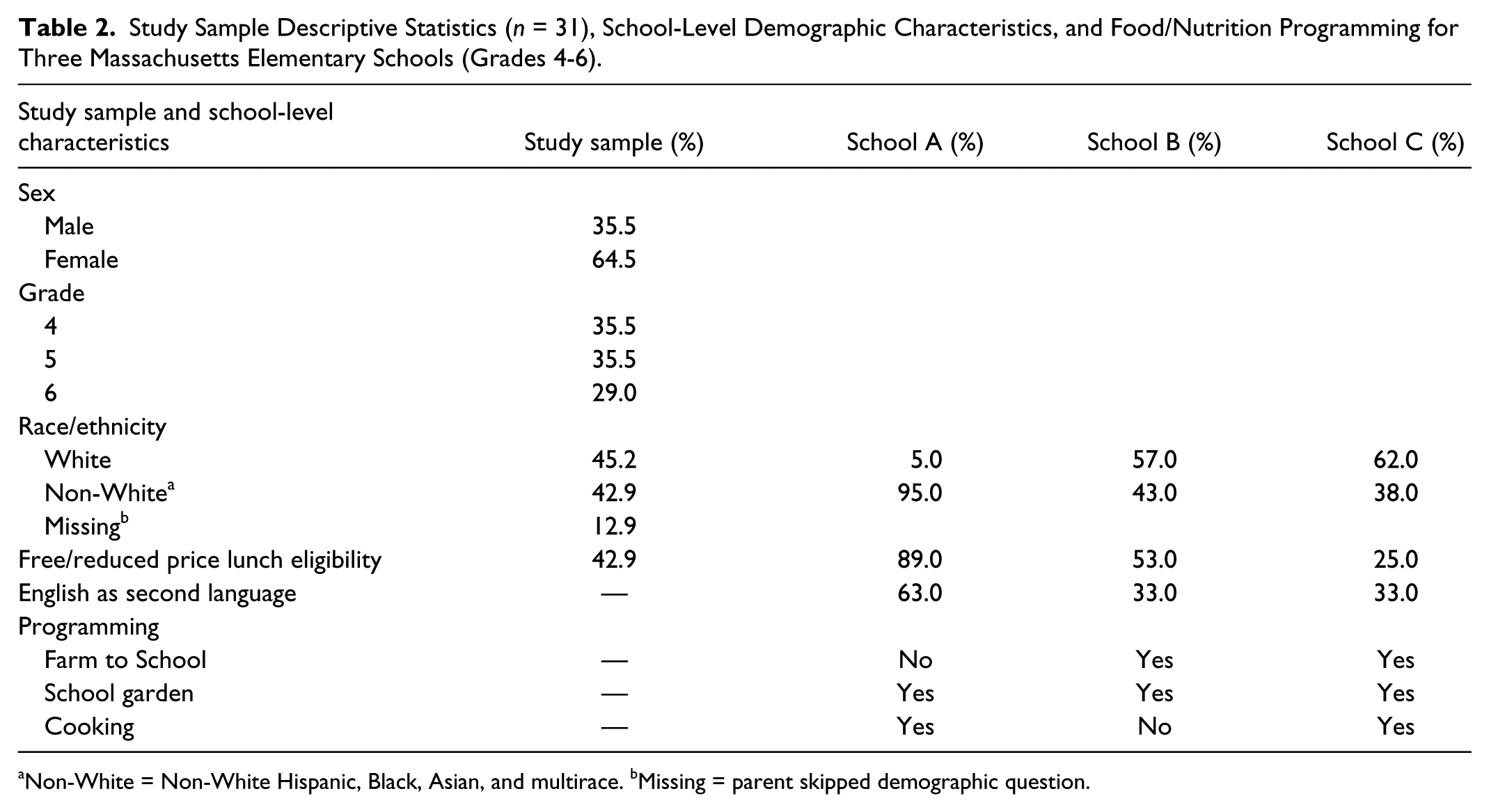
Non-White = Non-White Hispanic, Black, Asian, and multirace. bMissing = parent skipped demographic question.
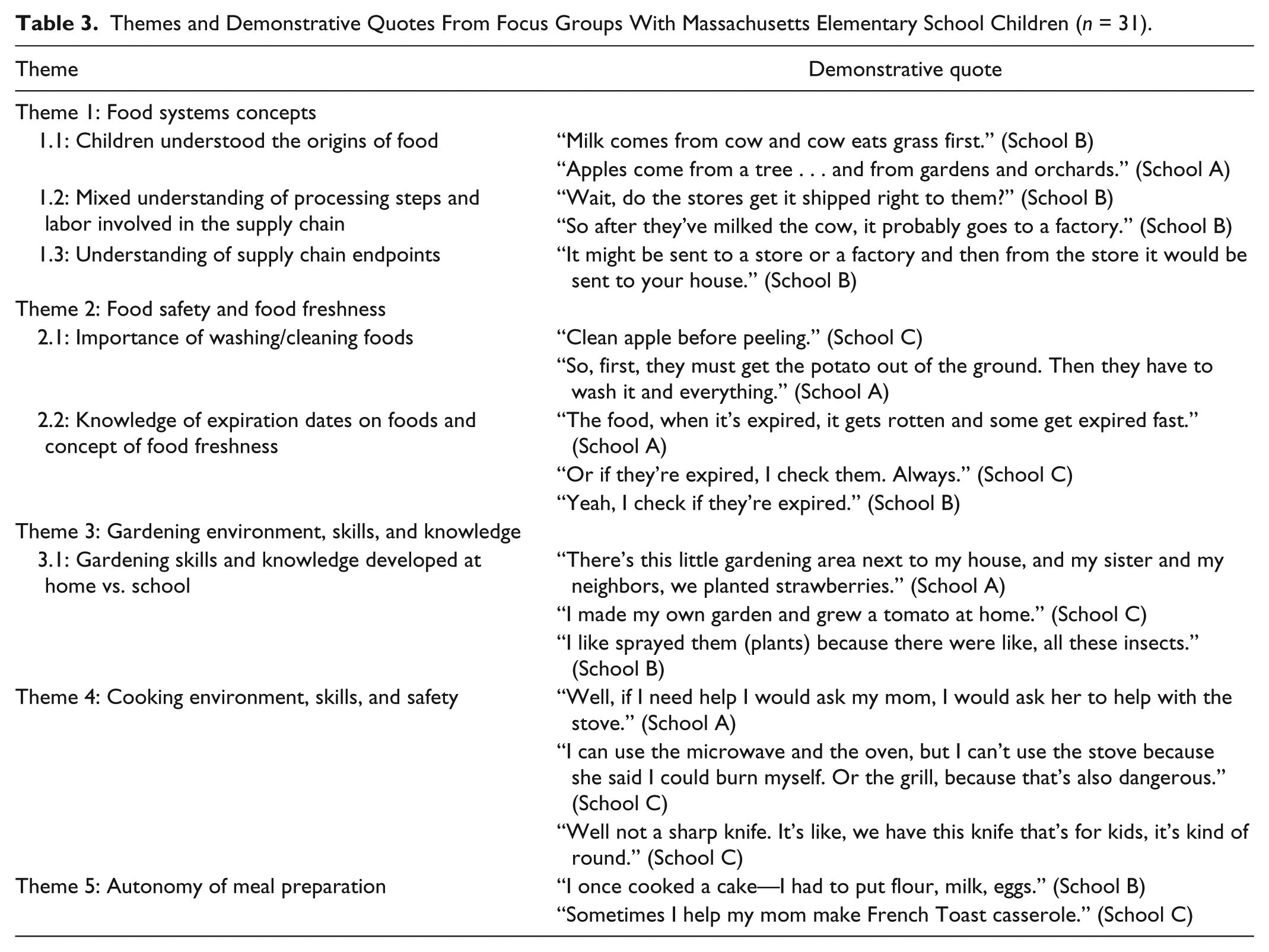
The analysis confirmed five central themes and captured additional context surrounding children’s FL experiences, perceived skills, and knowledge as well as information regarding the food environment (school vs. home). For purposes of this work, we focused on the spectrum of “farm to plate.” Nutrition knowledge and dietary behaviors are an important domain of FL; however, there is a vast amount of well-developed programming, educational resources, and measurement tools in this area (Dudley, Cotton, & Peralta, 2015). The five themes included the following: (1) food systems concepts; (2) food safety and food freshness; (3) gardening environment, perceived skills, and knowledge; (4) cooking environment, perceived skills, and safety; and (5) autonomy of meal preparation (Table 3).
Themes and Demonstrative Quotes From Focus Groups With Massachusetts Elementary School Children (n = 31).
Theme 1: Food Systems Concepts
The food systems questions used the examples of applesauce, French fries, and milk to explore children’s understanding of the supply chain. Overall, children grasped the beginning steps (origins of food) and end points (grocery store and plate) of the supply chain, but a few either missed and/or exhibited confusion surrounding the middle steps.
Children clearly communicated the origins of food in terms of the labor and process. For example, many explained that milk comes from a cow, and the cow must eat grass first. Children also expressed that fruits and vegetables come from seeds that grow in the ground and ultimately need to be harvested by farmers. A few children demonstrated a mixed understanding of the processing steps that occur in factories for an apple to become applesauce and a potato to become a French fry. A child from School C explained, “People that own the potato farms take the potato and put it into a bag and the stores and restaurants buy them.”
In general, children missed that foods need to be transported from factories to the endpoint (70.9%; n = 22). There was also little reference to the labor or individuals involved in the middle steps of this process; for example, those who work in factories to process foods or drivers involved in transporting foods. However, other children expressed clarity around the middle steps in the supply chain: “. . . goes to a factory after the farm and gets washed there” (School A). As far as supply chain endpoints, children communicated a variety of different examples, including a grocery store, restaurant, and home.
Theme 2: Food Safety and Food Freshness
The importance of food safety emerged while children were discussing the food systems topics, and children connected this both to themselves as consumers as well as to actors upstream in the supply chain. Children recognized the importance of washing/cleaning foods, expiration dates on foods, and food freshness. They explained that fruits and vegetables need to be washed before they are cut up, peeled or eaten, and some connected not washing foods to getting sick: “If you do it at your house, you have to wash them. If you pick like an orange or if you plant like a carrot or something, you wash it” (School B).
There was a perception that foods that came straight from a farm were more desirable in terms of freshness. Some children were cognizant of the importance of expiration dates: “The food, when it’s expired, it gets rotten and some get expired fast” (School A). Two children mentioned personally checking the expiration date on foods. Food safety was also referenced in the supply chain: “You can’t just load up your own truck and then drive off in the middle of a summer day. You have to refrigerate it, which is why you need a closed space” (School B). Food safety was linked to the milk pasteurization process at Schools A and C: “The milk goes through a lot of machines to get it clean” and “Yeah, they pasteurize it. So you can like clean it out because it has germs.”
Theme 3: Gardening Environment, Perceived Skills, and Knowledge
Though all three of the schools had a school garden and two schools participated in F2S programming, most children conveyed their perceived gardening knowledge and skills through experiences at home or at a family member’s garden or farm. This was exhibited in the frequency of gardening experiences shared that were out-of-school (37 references) compared with at school (9 references). A variety of different experiences with family members—including parents, aunts, uncles, and cousins, and grandparents—were provided for growing foods including basil, tomatoes, blueberries, strawberries, and potatoes. Gardening tasks were a regular activity for some children, with two children mentioning weeding as part of their chores: “I have chores and one of my chores is to pick out of the weeds” (School B). Three students at School A mentioned their experiences helping on family farms or gardens in El Salvador, Puerto Rico, and the Dominican Republic: “I’ve grown like, chocolate, like where it comes from. . . . I don’t know the name. I grew it in the DR and I had to water them” (School A).
Moreover, children discussed being involved in a variety of gardening tasks, including planting seeds, weeding, watering, picking fruits and vegetables, and spraying for pests. For example, one child mentioned, “I wanted to answer for how I keep weeds out. So actually, clipping it doesn’t always work even if you clip right at the base. Know why? Because it just grows back” (School B). The majority of children (80.6%; n = 25) were able to provide at least one example of a gardening activity, and through their explanations, many communicated a deeper understanding and “self-efficacy” surrounding these concepts.
Theme 4: Cooking Environment, Perceived Skills, and Safety
Children shared perceived cooking skills that were developed at home (83.8%; n = 26) through an experience with an adult or older sibling, and this topic generated excitement during the focus groups. For example, when children expressed that they could crack an egg, three qualified that this was “fun.” The level of independence associated with children’s involvement in cooking varied, especially with tasks where safety might be a concern. Children generally expressed self-efficacy surrounding basic cooking skills such as helping parents gather ingredients, adding ingredients to meals, and using measuring cups.
Cooking skills that involve a heightened concern for safety such as using the oven/stovetop and using a sharp knife were mixed in terms of children being permitted to perform these tasks. Five children (16.1%) across the three schools were permitted to preheat the oven, turn on the stovetop, or take food out of the oven. Some children mentioned being allowed to stir pasta and boil water. However, other children were either strictly forbidden from using the oven/stovetop or mentioned that they would ask for help. When explaining this a few students noted the safety aspect of using the oven or stovetop: “So, my mom usually says if I’m stirring pasta, hold the end of the spoon and stay back, bubbles . . . so the hot water doesn’t hit me” (School C).
As far as knife skills, many children shared that they were able to cut foods themselves, including cutting fruits and vegetables and peeling potatoes. Two children mentioned that their family has “kid-friendly” knives for them to use. Children expressed that in certain scenarios, they needed adult assistance: “When I was slicing eggplant, when I got to the end of it my mom would usually do the rest so I wouldn’t cut myself” (School C). Overall, children conveyed an interest in helping out in the kitchen and developing more cooking skills. One child even mentioned the importance of developing cooking skills: “It’s good learning because you grow up and you don’t know how to cook” (School A).
Theme 5: Autonomy of Meal Preparation
Many of the cooking skills that children mentioned corresponded with experiences helping an adult to prepare desserts, primarily through baking. This theme emerged even without the moderator prompting children to discuss desserts specifically. Children (32.2%; n = 10) across the three schools were eager to explain in detail their involvement in preparing desserts including pies, cookies, a French pastry, cakes, brownies, and s’mores. One child shared, “I help make an apple pie. At first I get some flour and get some water and just stir it up” (School C).
In contrast, few children (9.7%; n = 3) referred to helping to make dinner (e.g., pasta and pizza) or breakfast (9.7%; n = 3). Children primarily prepared meals under the supervision of an adult with two children sharing that they prepared a meal alone. One child mentioned preparing “something simple,” like a peanut butter and fluff sandwich for lunch (School C). Finally, involvement in cooking was expressed as an occasional activity, usually as part of a special event. Only one child mentioned that cooking was a weekly activity: “Every Friday and mostly every night I cook with my mom because I want to be a cook when I grow up and I wanted to try out for Master Chef Junior” (School C).
Discussion
Children provided a breadth of insight into their perceived food-based skills and knowledge by describing the food environments and experiences that shape their FL. Children connected their FL experiences to the home environment and parent/family members despite the three schools having school gardens and/or cooking programs. This overarching theme and evident gaps in children’s perceived skills and knowledge in different FL topic areas, augment the importance of using school-based opportunities to deliver FL content. Potential FL lesson topic areas that further research may clarify and expand on including the supply chain, food safety, growing foods, and cooking skills are discussed.
Using the Supply Chain to Convey Food Systems Concepts
The nexus of the foods we eat and the environment is of interest to researchers, practitioners, and policy makers in terms of ensuring a safe and abundant food supply as well as how this corresponds with American’s dietary patterns (Dietary Guidelines Advisory Committee, 2015). In the current study, children (age 9-12 years) had a mixed understanding of the middle steps of the supply chain including labor, processing, and transportation, highlighting the need for clarity in this area. F2S programs provide an opportunity to address food systems concepts but the actual lessons and “dose” of this content across programs remains unclear. Moreover, there is a deficit of comprehensive school-based programs that explicitly address this topic (Black et al., 2015; Jones et al., 2012) supporting the need to both measure and address food systems as part of contextually adaptable FL-focused educational resources that teachers can integrate across the curriculum.
Communicating Food Safety Concepts
Food safety was a theme that was not explicitly addressed in the focus group questions but emerged in reference to food systems issues and personal practices related to preparing and eating foods. Children grasped the connection between food safety and personal health by associating the importance of washing foods and checking food expiration dates with not getting sick. However, there were other food safety topic areas that were not mentioned, including hand washing before eating or preparing foods, separating foods to prevent cross-contamination, the importance of cooking foods thoroughly (proper temperature), and chilling foods (U.S. Department of Agriculture, 2007). Since food safety emerged across focus groups but was not included as a specific question prompt, future work should clarify children’s knowledge and awareness of these topics. Further FL lesson development may consider strategies for communicating food safety to children, potentially through actionable skills to which children can be introduced.
Identifying Opportunities to Enrich Children’s Experiences With Growing Foods
Despite schools featuring school gardens and/or F2S programs, children discussed a variety of gardening skills and connected these experiences to the home environment and family members. This may point to either issues with the reach of these school-based programs or that the home environment simply provided memorable and individualized experiences for children. Furthermore, how school-based programs incorporate more skills-based concepts surrounding growing foods can vary based on a number of school and environmental factors. School gardens and F2S programs have attained national recognition for their potential to influence children’s fruit and vegetable consumption (Bontrager Yoder et al., 2014). Furthermore, other organizations like Slow Food Denver have explicitly recognized the importance of FL as a scaffolding for positive dietary behaviors (Nowak, Kolouch, Schneyer, & Roberts, 2012). Nowak et al. (2012) developed FL-focused programming that incorporates both cooking and gardening, but have not evaluated its impact on FL or dietary behaviors. F2S and school garden programs may provide a strong foundation that could be enhanced with additional FL content. Therefore, future work in this area should understand how a FL curriculum can potentially complement existing efforts in schools that have these programs.
Supporting Cooking Skills Through Regular Involvement in Healthy Meal Preparation
Cooking and meal preparation experiences in the home environment fostered an enthusiastic discourse among children. It was apparent that there were specific basic cooking skills that children felt confident doing and variability in skills that have safety precautions such as using a knife and stovetop/oven. Furthermore, parent rules often dictated children’s perceived skills as safety became a factor.
Interestingly, even though we did not specifically prompt children to discuss desserts, these were the types of foods that the majority of them referred to when discussing their cooking experiences. Moreover, this was typically an occasional event as opposed to a regular activity. Though baking provides the opportunity to teach basic cooking skills (e.g., using a measuring cup and stirring), it is important to incorporate cooking skills that relate to healthier meals. There are a variety of school cooking programs that have been developed to promote healthy dietary behaviors (Caraher, Seeley, Wu, & Lloyd, 2013; Cunningham-Sabo & Lohse, 2013; Davis, Ventura, Cook, Gyllenhammer, & Gatto, 2011; Hersch, Perdue, Ambroz, & Boucher, 2014). However, because of variation in the study measurements, it has been challenging to identify best practices in this area (Hersch et al., 2014). Cooking is an important FL skill to target and schools should identify feasible and structured opportunities for teaching healthier meal and snack preparation.
This study had limitations. Focus groups were conducted with children (age 9-12 years) attending three urban elementary schools which may weaken the generalizability of the study findings to other communities. Furthermore, future work may benefit from exploring these FL concepts with younger children. A strength of our study is that the children were racially/ethnically and socioeconomically diverse, fostering a variety of perspectives on a novel topic area. Given that FL is a nutrition- and health-related topic, there may have been selection bias in terms of the children who participated in the focus groups. Social desirability bias may have led to children overreporting positive food-related perceived skills and behaviors. It is also important to recognize that child-reported FL and school-level FL programming (e.g., F2S, school gardens, and cooking) may not represent the extent to which FL is addressed in the school environment. For example, specific FL topics may be incorporated into existing classroom curricula. Therefore, teacher perspectives and an evaluation of current lesson plans are integral to future efforts to promote FL in schools. Nonetheless, the breadth of insight gathered on a variety of FL topic areas was invaluable to the study team’s future research endeavors in this area.
Conclusions
Overall, focus groups increased our understanding of children’s perceived FL knowledge and skills across a variety of key “farm to plate” topic areas and set the stage for the development for FL measures among children. FL holds promise as a potential strategy for improving youth dietary behaviors by transcending nutrition knowledge alone and honing in on key food-based knowledge, skills, and behaviors. Our findings point to potential educational opportunities where FL may be addressed in the school setting. Therefore, next steps for this work will be dedicated to developing educational resources that support the development of FL, including lesson types, content, and delivery. Long-term research should rigorously evaluate the impact of FL curricula on children’s dietary behaviors.
Footnotes
Acknowledgements
We would like to thank the project staff who helped with data collection efforts including Elizabeth Langevin and Katie Tong. We would also like to thank our school contacts including principals and afterschool program coordinators who worked with us to schedule and organize the focus groups with children.
Authors’ Note
SAA, ML, JMS, SBC, and CDE conceptualized the project; SAA, CP, and ML conducted the focus groups; CP transcribed the focus groups; SAA and CP coded and analyzed the data; SAA drafted the manuscript with contributions from JMS; all authors reviewed and commented on subsequent drafts of the manuscript.
Declaration of Conflicting Interests
The authors declared no potential conflicts of interest with respect to the research, authorship, and/or publication of this article.
Funding
The authors disclosed receipt of the following financial support for the research, authorship, and/or publication of this article: This research was supported by a grant from the Newman’s Own Foundation.
