



Abstract
Little is known about the correlates of physical activity and sedentary behavior in Hispanic adolescents. This study examined at baseline and 2-year follow-up: (1) the relationship between self-efficacy for physical activity and physical activity, (2) the association of weight perception with physical activity and sedentary behavior, and (3) whether sex moderated these associations. Hispanic adolescents (N = 483 at baseline; age 15-17 years; 55.1% girls) completed questionnaires that assessed their self-efficacy for physical activity, weight perception, and time spent in physical activity and sedentary behavior. Multiple-group path analyses were conducted to examine the proposed relationships and determine whether they were moderated by sex. Models controlled for body mass index, weight loss intention, participation on a sports team, language spoken at home, parental education, and country of birth. Self-efficacy was related to time spent in physical activity in boys (b = .35, p < .001) and girls (b = .41, p < .001) at baseline, but not 2 years later. No association was found for weight perception and time spent in physical activity and sedentary behavior. Post hoc analyses for overweight participants at baseline showed that weight perception was associated with time spent watching television. Overall, the findings suggest that self-efficacy is an important correlate, but not a predictor, of physical activity among Hispanic adolescents. Including strategies to address and enhance self-efficacy for physical activity in lifestyle interventions may increase adherence to physical activity recommendations and help reduce the high prevalence of obesity in this population.
Childhood obesity is a significant public health concern given its association with hypertension, type 2 diabetes, and increased risk of obesity in adulthood (Daniels, Jacobson, McCrindle, Eckel, & Sanner, 2009). In 2011-2014, 22.8% of Hispanic adolescents had obesity compared with 19.6% of non-Hispanic White adolescents (Ogden et al., 2016). Two lifestyle factors that may contribute to the etiology of obesity are decreased physical activity (PA) and increased sedentary behavior (SB), which is characterized by excessive sitting, minimal movement, and low levels of energy expenditure (Marshall & Ramirez, 2011; Olvera, Kellam, Menefee, Lee, & Smith, 2010). Of note, SB is different from PA, and the two are not on opposite ends of one continuum (Marshall & Ramirez, 2011). While Hispanic adolescents have higher rates of obesity than non-Hispanic White adolescents, findings have been inconsistent when comparing these groups on PA and SB (Belcher et al., 2010; Carson, Staiano, & Katzmarzyk, 2015).
To address the high obesity prevalence and the health consequences of excess weight, efforts have been made to identify modifiable correlates of PA and SB that can be targeted in interventions (Norman, Schmid, Sallis, Calfas, & Patrick, 2005; Sallis, Prochaska, & Taylor, 2000). Two correlates previously identified are (1) self-efficacy for PA (referred to herein as self-efficacy), which is belief in one’s ability to carry out a PA and achieve a desired result (Spence et al., 2010), and (2) weight perception, which is perception of one’s weight status (Duncan et al., 2011).
Although the prevalence of obesity among Hispanic youth is high and Hispanics are the fastest growing minority group in the United States, data on PA and SB correlates in this population are scarce (Butte, Puyau, Adolph, Vohra, & Zakeri, 2007; Wright, 2011). In addition, whether self-efficacy and weight perception are associated with these lifestyle habits in Hispanic adolescents remains unknown. Examining PA and SB correlates in Hispanic youth is important since studies often fail to conduct separate analyses for this group (Sanchez et al., 2007). This makes it difficult to determine whether findings for other ethnic populations can be generalized to Hispanic youth. Furthermore, understanding factors related to these lifestyle habits in Hispanic adolescents is necessary to facilitate prevention efforts and the development of obesity interventions. As such, this study examined the association of self-efficacy and weight perception with time spent in PA and SB in Hispanic adolescents.
The social ecological model served as a framework for identifying correlates of PA and SB. The model posits that health behaviors, such as PA and SB, have multiple levels of influence: intrapersonal (e.g., self-efficacy), interpersonal (social, cultural, e.g., language spoken at home), organizational/community (school or school teams), and policy (Sallis, Owen, & Fisher, 2008). Although it is generally difficult to account for all the possible variables contributing to a behavior, researchers have used ecological approaches to measure factors from some of the levels of the model that could lead to a better understanding of which ones are associated with PA and SB (e.g., Wright, 2011). In this study, self-efficacy and weight perception, factors from the intrapersonal level, served as the primary correlates of interest, while covariates were factors from the intrapersonal, interpersonal, and organizational/community levels.
Previous research indicates that self-efficacy may be a key determinant of adolescents’ PA levels (De Bourdeaudhuij et al., 2005). According to Bandura, self-efficacy may influence how much effort individuals expend to complete a task and how long they endure when faced with obstacles (Bandura, 1977). Consistent with this notion, studies show that high levels of self-efficacy are associated with increased PA among adolescents (De Bourdeaudhuij et al., 2005; Spence et al., 2010; Van der Horst, Paw, Twisk, & Van Mechelen, 2007). Interestingly, self-efficacy is a stronger predictor of PA in girls than in boys; however, boys have higher levels of self-efficacy than girls (Spence et al., 2010). No study, however, has examined whether self-efficacy is associated with PA in Hispanic adolescents or whether these sex differences are present in this population.
Weight perception may also influence engagement in PA and SB (Duncan et al., 2011; Foti & Lowry, 2010; Yaemsiri, Slining, & Agarwal, 2011). While a few studies have examined the association of weight perception with these lifestyle habits (Edwards, Pettingell, & Borowsky, 2010; Khambalia, Hardy, & Bauman, 2012; Talamayan, Springer, Kelder, Gorospe, & Joye, 2006), none have focused on Hispanic youth. Evidence suggests that normal weight adolescents who believe they are overweight are more likely to exercise to lose weight than those who do not believe they are overweight (Talamayan et al., 2006). For adolescents with overweight and obesity, accurate weight perception has been associated with a greater likelihood of being physically active, compared with inaccurate weight perception (Ayala, Mickens, Galindo, & Elder, 2007; Edwards et al., 2010). This suggests that awareness of one’s weight status may lead to more attempts at weight control behaviors such as being physically active.
In terms of the association between weight perception and SB, one study found that overweight adolescents, who accurately perceived their weight status, were more likely to spend less time watching television, but more time using a computer for entertainment, compared with inaccurate perceivers (Khambalia et al., 2012). For adolescents with obesity, no significant difference in television or computer time was reported (Khambalia et al., 2012). As few studies have investigated whether weight perception is associated with PA and SB, research examining these relationships is needed to determine the impact of targeting weight perception in future obesity prevention efforts among Hispanic adolescents.
The sex of participants also warrants consideration when examining determinants of PA and SB in youth. Studies that included Hispanics (age 11-22 years) consistently showed that boys and young adult men spend more time in PA than girls and young adult women (Belcher et al., 2010; Gordon-Larsen, McMurray, & Popkin, 1999). Studies using both self-report and objective measures of SB have often indicated that boys spend more time in SB than girls (Gordon-Larsen et al., 1999; Norman et al., 2005; Van der Horst et al., 2007). In addition, one study found that Hispanic boys reported spending more time playing computer and video games than Hispanic girls (Butte et al., 2007). However, one study using accelerometers reported that Mexican American girls, like non-Hispanic girls, spend more time in SB than boys (Belcher et al., 2010).
In light of the gaps in the literature identified above, this study of Hispanic youth examined whether (1) baseline level of self-efficacy was positively associated with PA at baseline and 2-year follow-up, (2) significant differences in PA and SB at baseline and 2-year follow-up would be found when comparing those who overestimated and underestimated their weight status to those with accurate weight perception at baseline, and (3) sex would moderate the associations noted in the first two aims.
Method
Sample
Participants were 483 Hispanic adolescents (age 15-17 years; 55.1% girls) at a public high school in Florida. Students took part in a larger study on health promotion and were eligible to participate if (1) written parental consent and student assent were obtained and (2) they were enrolled in a 10th-grade personal fitness or physical education class at the time of data collection. All 10th-grade students (N = 1,013) were required to take one of these classes and were invited to participate in the larger study. Of the 549 (54.2%) students who participated, 483 were Hispanic and were included in this current study. Students were from 23 classes (12 physical education, 11 personal fitness), and data were available for 274 participants (54.4% girls) at follow-up. The study was approved by the University of Miami Institutional Review Board and the Miami-Dade County Public Schools Research Review Committee. All participants were given the opportunity to visit the local science museum free of cost.
Procedure
In the larger study, participants completed assessments at baseline, 7 weeks, and 2-year follow-up. During the baseline assessment, research assistants met with those students whose parents provided written informed consent. After the purpose of the study was described, written informed assent was obtained, and participants completed the self-report measures. The baseline and 2-year follow-up measures used in this study are described below.
Measures
The Heart Smart Demographic and Habits Questionnaire, a 27-item measure developed by University of Miami researchers, assessed at baseline participants’ age, sex, height, weight, body mass index (BMI), self-efficacy, weight perception, PA, SB, ethnicity, parental education, primary language spoken at home, country of birth, weight loss intention, and sports team participation in the past year. Several variables were categorized: level of education (1 = bachelor’s degree or above; 0 = less than a bachelor’s degree); primary language spoken at home (1 = Spanish; 0 = English or another language), country of birth (1 = United States; 0 = not in the United States), and weight intention (1 = trying to lose weight; 0 = not trying to lose weight).
BMI was determined at baseline using self-reported height (converted to meters) and weight (kilograms), and the Centers for Disease Control and Prevention growth chart cutoffs for age and gender that classify underweight (BMI < 5th percentile), normal weight (5th to <85th percentile), overweight (85th to <95th percentile), and obesity (⩾95th percentile; Kuczmarski et al., 2000). To estimate the accuracy of participants’ self-reported data, measured height and weight (available only at the 2-year follow-up) were correlated with self-reported height and weight at the 2-year follow-up. The Pearson correlation between actual and reported height was r = .97, and was r = .91 for actual and reported weight. Although self-report has limitations, it yielded results that were consistent with previous research demonstrating a high concordance between measured and self-reported height and weight (Elgar, Roberts, Moore, & Tudor-Smith, 2005; Strauss, 1999).
Self-efficacy for PA was assessed at baseline using the 3-item self-efficacy subscale of a 15-item Confidence measure. The Confidence measure was created by University of Miami researchers for the original study and consists of two other subscales—nutrition and stress. The self-efficacy subscale asked participants, “How confident or sure are you that you can (1) exercise regularly, (2) increase your PA, and (3) make time to exercise.” Items were rated on a 5-point Likert-type scale (1 = cannot do at all; 5 = completely sure can do) and possible scores ranged from 3 to 15. The three subscale items were summed, and higher scores indicated higher levels of self-efficacy. The self-efficacy subscale demonstrated good internal consistency reliability (Cronbach’s α = .87) and 7-week test–retest reliability (r = .72).
Weight perception was measured at baseline by asking participants to indicate if they were “very underweight,” “slightly underweight,” “about the right weight,” “slightly overweight,” or “very overweight.” Inaccurate weight perception was calculated by taking the difference between participants’ perceived and actual weight status to determine whether they overestimated or underestimated their weight status (Wharton, Adams, & Hampl, 2008). For example, individuals who were normal weight but described themselves as overweight were labeled as overestimating their weight. Dummy coded variables were created to provide a more detailed description of weight perception [overestimate weight status (0, 1); underestimate weight status (0, 1); accurate weight perception (0, 0)].
Time spent in PA and SB were assessed at baseline and 2-year follow-up by asking participants to indicate (1) the number of days per week they engaged in ⩾60 minutes of moderate PA, (2) the number of hours per school day spent watching television, and (3) the number of hours per school day spent playing computer/video games or using a computer for something unrelated to school work. These three questions were taken from the Youth Risk Behavior Survey and have been shown to be moderately reliable in assessing these behaviors in adolescents (Brener et al., 2002). To determine the reliability of the participants’ responses, the intraclass correlation (ICC) for the questions related to SB and PA was computed. To calculate the ICC, data available for participants at baseline, 7-weeks, and 2-year follow-up were used. The ICC for sedentary time was .63 and was .58 for PA. This suggests that the participants were relatively consistent over time in reporting the time spent in these behaviors.
Data Analysis
Descriptive statistical analyses were performed using Statistical Analysis Systems (SAS) Program Version 9.2. Differences on demographic and outcome variables by sex were evaluated using chi-square (χ2) tests for categorical variables and analysis of variance for continuous variables. An α level of .05 (two-tailed) was used to determine statistical significance.
Multiple-group path analysis (boys and girls) was performed using Mplus v7 (Muthén & Muthén, 1998–2012) to simultaneously examine the following relationships at baseline and 2-year follow-up and determine whether sex moderated them: (1) self-efficacy and PA; (2) weight perception and PA; and (3) weight perception and hours per day playing computer/video games and watching TV. The full information maximum-likelihood estimation method was used to account for missing data, assuming data were missing at random. Parameter estimates were tested for statistical significance using an α < .05, two-tailed, and 95% confidence intervals. The unstandardized coefficients, controlling for other predictors in the model, were reported and are interpreted as regression coefficients. For follow-up analyses, models controlled for baseline levels of PA and SB.
To assess the moderating role of sex, two models were compared—a baseline model and a constrained model. The baseline model, in which all paths were freely estimated across groups, was specified first. Next, a model in which a specific path was constrained to be invariant across the two groups was tested. The paths constrained were the ones that sex was posited to moderate (e.g., self-efficacy → PA). Chi-square difference tests for nested models were used to compare each of the constrained models to the baseline model. A significant χ2 change value indicated that sex moderated the proposed relationships.
PA covariates were selected based on research indicating that PA is associated with a number of factors from the intrapersonal, interpersonal, and community/organizational levels of the social ecological model: BMI (Thorp, Owen, Neuhaus, & Dunstan, 2011); parental education (Singh, Yu, Siahpush, & Kogan, 2008; Van der Horst et al., 2007); weight loss intention (Ayala et al., 2007); language spoken at home (Liu, Probst, Harun, Bennett, & Torres, 2009); country of birth (Singh et al., 2008); and participation in team sports (Van der Horst et al., 2007). The following SB covariates were selected based on previous studies: parental education (Van der Horst et al., 2007); BMI (Marshall & Ramirez, 2011; Thorp et al., 2011; Tremblay et al., 2011); and country of birth (Singh et al., 2008). Baseline measures of the covariates were included for both cross-sectional and follow-up analyses. Additionally, post hoc path analyses were performed for adolescents with overweight and separately for those with obesity to examine the association of self-efficacy and weight perception with PA and SB. These analyses were conducted to facilitate comparisons with prior studies that carried out similar subgroup analyses for youth with overweight and obesity (e.g., Khambalia et al., 2012).
Results
Table 1 depicts the baseline sample characteristics by sex. Approximately 30% of participants were born outside the United States, and most were normal weight. Table 2 shows the results for comparisons between boys and girls on PA, sedentary time, self-efficacy, BMI, and weight perception at baseline. Results indicated that boys spent more time per week engaging in PA than girls and reported higher levels of self-efficacy than girls. Boys tended to underestimate their weight status, whereas girls were more likely to overestimate their weight status. No significant differences were noted between boys and girls for television time or computer/video game time. Similar results were observed at 2-year follow-up. PA was significantly higher, F(1, 262) = 20.50, p < .001, in boys (M = 4.33, SD = 2.29) than in girls (M = 3.08, SD = 2.20). There were no significant differences, F(1, 266) = 0.48, p =.49, in computer time for boys (M = 1.63, SD = 1.38) and for girls (M = 1.51, SD = 1.38). Additionally, boys (M = 1.68, SD = 1.27) and girls (M = 1.62, SD = 1.28) spent a similar amount of time watching television, F(1, 263) = 0.15, p = .70.
Baseline Sample Characteristics by Sex.

N = 483.
Baseline Descriptive Statistics for Comparisons Between Boys and Girls.

Number of days engaging in at least 60 minutes of moderate physical activity. bNumber of sports team participated on in the past year. Response options ranged from 0 to 3 or more. cWeight status perception: participants who overestimated, underestimated, and accurately perceived their weight status.
p < .05. **p < .001.
Multiple Group Path Analyses
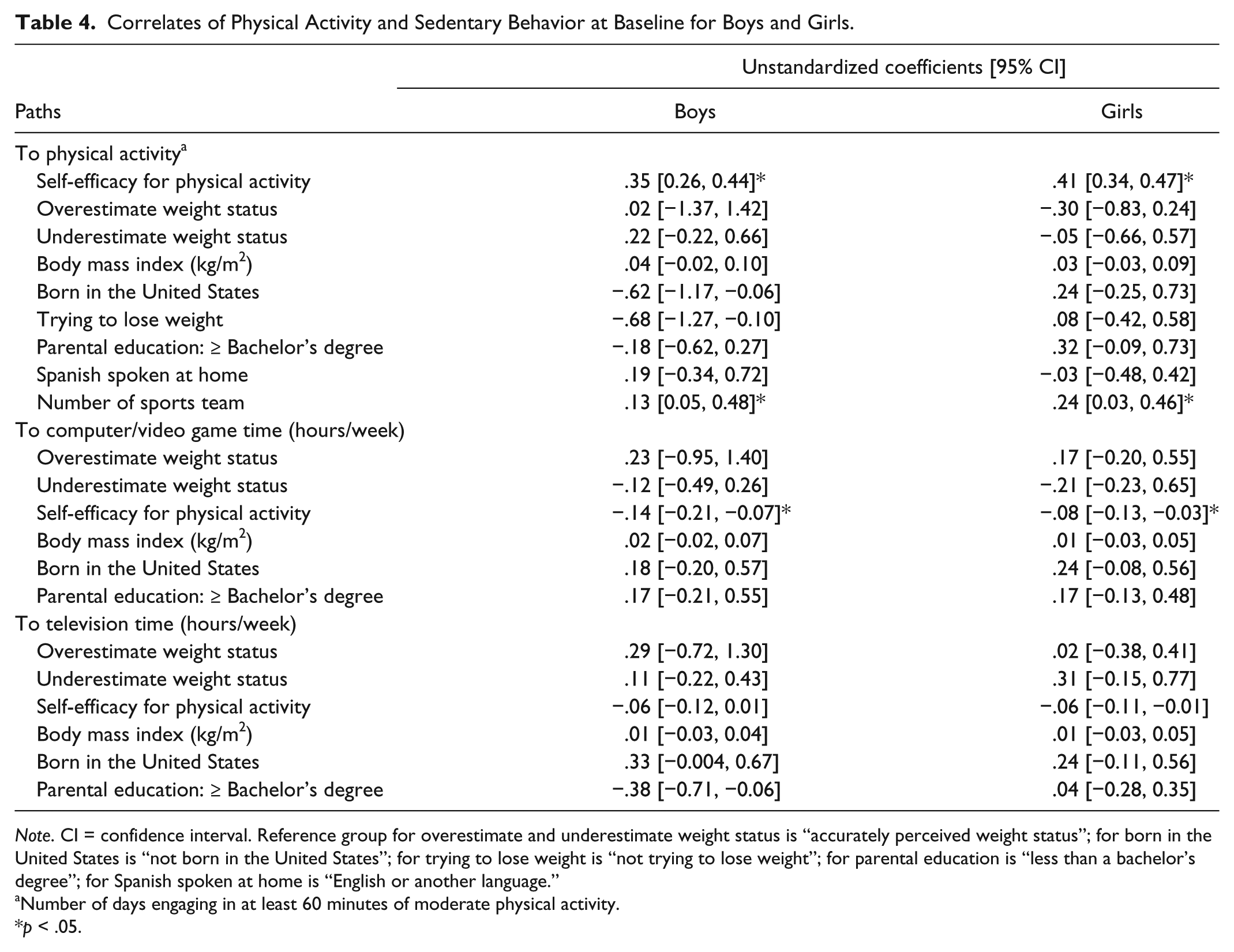
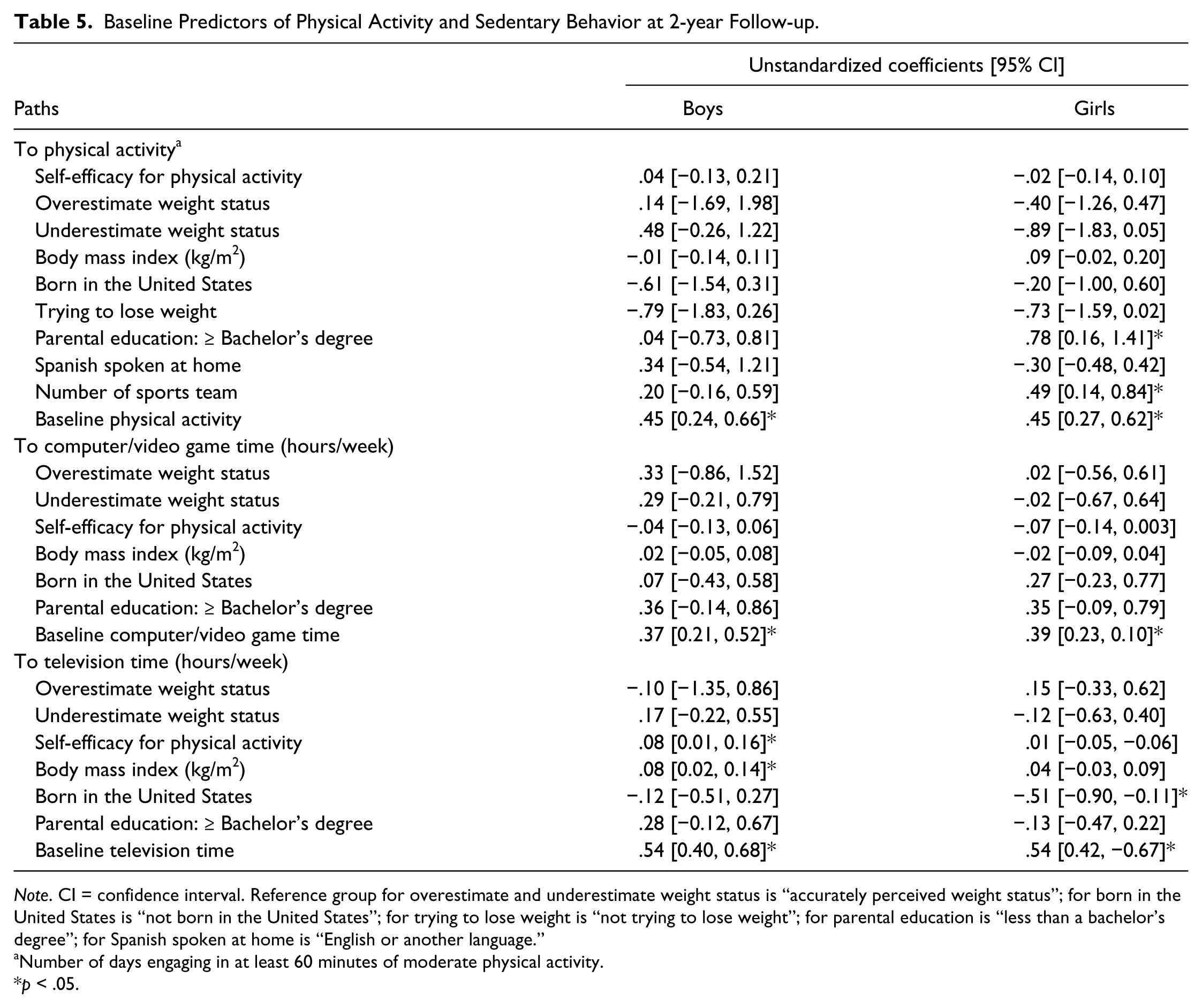
A conceptual model of the relationships examined in the study is shown in Figure 1. The models with the specified covariates fit the data. See Table 3 for correlations among the variables used in the models for boys and girls. The unstandardized coefficients are presented in Tables 4 and 5 to aid in comparing results for boys and girls at baseline and follow-up, respectively. It was hypothesized that self-efficacy would be positively associated with PA and the association would be stronger for girls. Partial support for this hypothesis was found, as self-efficacy was positively related to PA for girls and boys at baseline (ps < .001; Table 4). Specifically, a 1-point increase in self-efficacy score was associated with an increase of .35 and .41 in the number of days spent in at least 60 minutes of moderate PA for boys and girls, respectively, controlling for covariates. However, self-efficacy was not associated with PA at follow-up for boys and girls (Table 5) and sex did not moderate the strength of the relationships at either time points. Interestingly, participation on sports teams was associated with time spent in PA at baseline and follow-up for girls.

Conceptual path analysis model of the correlates of physical activity and sedentary behavior.
Baseline Correlation Coefficients for Boys and Girls.

Note. Correlations for girls are reported in the shaded region above the diagonal; correlations for boys are reported below the diagonal. Unit for computer/video game time and television time is hours per week. PA = physical activity (number of days engaging in at least 60 minutes of moderate physical activity); OWS = overestimate weight status; UWS = underestimate weight status. For the parental education variable: 1 = bachelor’s degree or above, 0 = less than a bachelor’s degree.
p < .05. **p < .01.
Correlates of Physical Activity and Sedentary Behavior at Baseline for Boys and Girls.
Note. CI = confidence interval. Reference group for overestimate and underestimate weight status is “accurately perceived weight status”; for born in the United States is “not born in the United States”; for trying to lose weight is “not trying to lose weight”; for parental education is “less than a bachelor’s degree”; for Spanish spoken at home is “English or another language.”
Number of days engaging in at least 60 minutes of moderate physical activity.
p < .05.
Baseline Predictors of Physical Activity and Sedentary Behavior at 2-year Follow-up.
Note. CI = confidence interval. Reference group for overestimate and underestimate weight status is “accurately perceived weight status”; for born in the United States is “not born in the United States”; for trying to lose weight is “not trying to lose weight”; for parental education is “less than a bachelor’s degree”; for Spanish spoken at home is “English or another language.”
Number of days engaging in at least 60 minutes of moderate physical activity.
p < .05.
It was expected that time spent in PA would differ significantly when comparing those who accurately and inaccurately perceived their weight status, and that sex would moderate these associations. There were no significant differences in PA time at baseline and follow-up when comparing boys and girls who overestimated and underestimated their weight status with those who accurately perceived their weight status (see Tables 4 and 5). In addition, sex did not moderate these relationships (ps > .05).
It was hypothesized that (1) computer/video game and television time would differ when comparing those who overestimated and underestimated their weight status to those who accurately perceived their weight status and (2) sex would moderate these relationships. No significant differences in sedentary time at baseline and follow-up were found for boys and girls who accurately perceived their weight status compared with those who did not (ps >.05; see Tables 4 and 5). Moreover, sex did not moderate the relationship between weight perception and sedentary time (ps > .05).
Post Hoc Path Analyses
Analyses conducted separately for youth with overweight and obesity at baseline revealed that self-efficacy was associated with PA (b = .43, p < .001 and b = .21, p = .02, respectively); however, weight perception was unrelated to PA and time spent playing computer/video games (ps > .05; see Supplemental Table S1, available in the online version of this article). Among adolescents with overweight, those who overestimated their weight status spent more time watching television (M = 3.75 hours/day, SD = 1.26) than accurate perceivers (M = 1.93 hours/day, SD = 1.43; p < .05). In contrast, weight perception was unrelated to television time among youth with obesity (ps > .05). Because of missing data and the small sample size of individuals with overweight (n = 50) and obesity (n = 18), models were deemed unreliable and not estimated at follow-up.
Discussion
This was the first study to examine the cross-sectional and longitudinal relationship between self-efficacy and PA, and the association of weight perception with PA and SB in a sample of Hispanic adolescents. Most notably, self-efficacy was found to be a key correlate of participants’ activity levels at baseline, but not at follow-up. This was consistent with findings from previous studies (De Bourdeaudhuij et al., 2005; Spence et al., 2010; Van der Horst et al., 2007), including those suggesting that self-efficacy may play less of a role in the maintenance of PA (McAuley & Blissmer, 2000). In contrast to results from another study (Spence et al., 2010), however, there was no sex difference in the strength of the association between self-efficacy and PA, suggesting that self-efficacy is equally important for Hispanic girls and boys.
In line with prior research, boys were found to be more active (Sallis et al., 2000; Van der Horst et al., 2007) and involved in sports teams than girls (Marques, Ekelund, & Sardinha, 2016). However, participating in team sports was only associated with more time in PA at baseline and 2-year follow-up among girls. Studies indicate that the gender difference in PA may be due to barriers that girls face such as teasing, body image concerns (Slater & Tiggemann, 2011), the competitive nature of team sports, and a lack of confidence (Wetton, Radley, Jones, & Pearce, 2013). Our findings suggest that if girls can overcome these and other barriers, their participation in team sports may facilitate higher levels of PA over time.
Weight perception, unlike self-efficacy, was unrelated to PA and the strength of the associations did not vary by sex. Our inability to detect a relationship may have been due to the inclusion of stronger correlates in the model (e.g., self-efficacy) or the large proportion of adolescents of normal weight in the sample. Similar results were reported in a study of adolescents from all weight status categories. In particular, there was no difference in the likelihood of being physically active when comparing those who accurately and inaccurately perceived their weight status (Viner et al., 2006). In contrast, one study reported that adolescents with overweight and obesity who accurately perceived their weight were more likely to be physically active than inaccurate perceivers (Khambalia et al., 2012). Overall, the available evidence is mixed and more studies are needed to better characterize the nature of the relationship between weight perception and PA.
No association between weight perception and time spent watching television and playing computer/video games was found for the entire sample. When examining the relationship among adolescents with overweight at baseline, however, those who perceived themselves as having obesity (i.e., overestimated their weight status) spent more time watching television than accurate perceivers. This finding was similar to those in another study, where adolescents with overweight who accurately perceived their weight status spent less time watching television than those who underestimated their weight status (Khambalia et al., 2012). No relationship, however, was found for adolescents with obesity in this previous study (Khambalia et al., 2012) and the current one. Taken together, these results may suggest that weight perception is related to television viewing in youth with overweight only, and that those who accurately perceive their weight status spend less time watching television than inaccurate perceivers.
Although the findings on weight perception were variable, there is evidence to indicate that it is related to weight gain and, thus, may still be important to address. It has been shown that adolescents with normal weight, who perceived themselves as being overweight, gained more weight into young adulthood (Cuypers et al., 2012) and had a greater likelihood of having obesity 12 years later compared with adolescents who accurately perceived their weight status (Sutin & Terracciano, 2015). More studies are needed, however, to examine whether these findings generalize to Hispanic adolescents and whether correcting adolescents’ weight perception affects their PA and SB.
In addition to the areas for future research previously identified, more prospective studies are needed to substantiate the findings in this study. This would allow researchers to examine the direction of the relationships identified in this study and further assess how PA and SB in Hispanics change over time. Since proxy measures of acculturation (language spoken at home, country of birth) were used in this study, future research should include better measures to critically examine the impact of culture and acculturation in precipitating an obesogenic lifestyle among Hispanic adolescents.
Although this study had novel findings, it should be viewed in light of its limitations. First, participants’ narrow age range and high household education levels may limit the generalizability of the findings to other Hispanic youth. Second, the kinds of PA participants did, apart from being on a sports team, were not assessed, making it difficult to determine what types of activities contributed to their overall time spent being active. Last, the subjective reports of PA and SB may have produced inaccurate estimates of these behaviors (Adamo, Prince, Tricco, Connor-Gorber, & Tremblay, 2009; Pate, Mitchell, Byun, & Dowda, 2011). A recent review, however, indicated that estimates of sedentary time are similar between self-reported and accelerometer studies (Pate et al., 2011). While these limitations are important to consider, this study has several strengths, such as the use of a large sample of Hispanic adolescents, a prospective design, the examination of two types of SB, and the use of a statistical technique that allowed for the relationships explored in this study to be assessed simultaneously.
Implications for Practice
The results from this study indicate that self-efficacy is an important, modifiable correlate of PA among Hispanic adolescents. This finding suggests that it may be beneficial for researchers and health educators to incorporate and assess self-efficacy enhancing components in PA interventions for Hispanic youth. Doing so may serve as a promising means of increasing PA in this population, especially given previous evidence suggesting that changes in self-efficacy leads to changes in PA (Lubans, Foster, & Biddle, 2008). As participation in team sports was associated with PA in girls at baseline and follow-up, addressing barriers to PA engagement may help increase it and ensure that it is sustained in the long term. Educators may address barriers such as a lack of confidence by providing opportunities and safe settings for girls to participate in team sports, regardless of their athletic abilities (Wetton et al., 2013). In addition, since studies indicate that PA declines during adolescence (Nelson, Neumark-Stzainer, Hannan, Sirard, & Story, 2006), it is worth examining whether equipping youth with tools to enhance their self-efficacy and participation in team sports may help them maintain adequate levels of PA.
Footnotes
Declaration of Conflicting Interests
The authors declared no potential conflicts of interest with respect to the research, authorship, and/or publication of this article.
Funding
The authors disclosed receipt of the following financial support for the research, authorship, and/or publication of this article: This study was supported by a Science Education Partnership Award (SEPA) grant from the National Institutes of Health (NIH), 5 R25 RR023279.
