



Abstract
Background. Little research has been conducted on relations between challenging working and living conditions and psychological distress in Latino migrant day laborers (LMDLs), a particularly marginalized Latino population in the United States. Aims. Consistent with a structural-environmental framework of LMDL vulnerability to health and mental health problems, this study tests a model of hypothesized pathways between working and living conditions and multiple forms of psychological distress. Method. Structural equation modeling was used to test the conceptual model with 344 LMDLs who participated in a cross-sectional survey in the San Francisco Bay Area. Results. As hypothesized, results reveal pathways between (1) working and living conditions; (2) working and living conditions and depression, as well as desesperación (desperation), the latter a Latino cultural idiom of distress frequently expressed by LMDLs; and (3) between living conditions and alcohol use. Discussion. Findings increase understanding regarding how challenging working and living conditions contribute to the same, as well as different, forms of psychological distress in LMDLs. Conclusions. Implications for mitigating structural vulnerability to psychological distress can be addressed at multiple social-ecological levels ranging from community-based support for enhancing LMDL employment (e.g., via day labor centers) to expanding the availability of work authorization for undocumented workers.
Keywords
Predominately undocumented Latino migrant day laborers (LMDLs) seek informal work on street corners, in front of paint and hardware stores, exchanging labor for cash to support families in countries of origin. They are primarily Mexican and Central American, in their late 30s and early 40s, average 8 years of education, about half are married/partnered, and have lived in the United States between 8 and 14 years on average earning a little more than $200 per week (Arellano-Morales, Liang, Ruiz, & Rios-Oropeza, 2016; Galvan, Wohl, Carlos, & Chen, 2015; Negi, 2013; Ojeda & Piña-Watson, 2013; Organista, Arreola, & Neilands, 2016). Such meager earnings thwart the goal of providing for families and result in marginal housing and occasional homelessness.
The Structural Vulnerability of Latino Migrant Day Laborers
This study tests a model of pathways through which challenging working and living conditions result in psychological distress in LMDLs consistent with a structural–environmental framework of LMDL vulnerability to health and mental health problems (Organista et al., 2012). This perspective views LMDL positionality in the United States as characterized by difficult living and working conditions produced and reproduced by particular sets of global economic, political, social, and cultural factors. For LMDLs, such political and economic factors include extremely low access to work authorization resulting in a predominately undocumented labor population earning informal poverty wages. For instance, Bier’s (2018) critique of U.S. immigration policy is relevant to the predicament of LMDLs: antiquated visa quotas of only up to 7% of green cards per country, consequent backlogs of applications in Mexico resulting in decades of waiting, an annual limit of only 5,000 visas for workers without college degrees, and no temporary visas for such year-round workers.
Furthermore, U.S. neoliberal economic policies not only pull labor migrants into our vast service sector but can also push workers out of their countries of origin when free trade policies, such as the North American Free Trade Agreement (NAFTA), decrease employment in important sectors. For example, in the decade following the implementation of NAFTA in 1994, more than two million jobs were lost in Mexico’s agricultural sector (e.g., while corn remains Mexico’s most important crop, it has become cheaper to import subsidized corn from the United States than it is for hundreds of thousands of small farmers to continue growing it) (Alvarado, 2008; Fox & Haight, 2010).
Given the above circumstances, many displaced workers migrate undocumented to the United States and this is especially true for men who feel culturally obligated to provide for their families by making the sacrifice to leave home to seek work in the United States (Organista et al. 2013). Once in the United States, LMDLs frequently experience social dislocation, stigma and discrimination, and vulnerability to occasional labor exploitation (Organista & Ngo, 2018).
Thus, structural vulnerability appears to be inversely related to the health and well-being of LMDLs (Organista et al., 2016) and a structural–environmental framework advances our understanding of psychological distress by taking the above multilevel context into consideration. In contrast, the studies reviewed below often examine fewer variables and relationships between them with limited attention to environmental factors.
Challenging Working Conditions and Psychological Distress
Considering the centrality of work in the lives of LMDLs, who have migrated to the United States to support families in country of origin, the handful of studies reviewed here represents the limited extent of research linking working conditions and psychological distress. For instance, Organista and Kubo (2005) noted in their study of HIV risk that LMDLs rated lack of work and money as their highest source of distress followed by sadness and racism. Recently, Galvan et al. (2015) found lack of money to cover basic needs and worsening work hours were associated with high chronic stress in their survey of 725 LMDLs. A smaller study of 89 LMDLs found that work-related problems and missing family back home were inversely related to self-reported health, which was in turn negatively related to depression (Bacio, Moore, Karno, & Ray, 2014). The current study operationalizes LMDL working conditions by focusing on the poverty wages that typically result from underemployment and frequent unemployment while acknowledging the need to study other conditions of day labor such as its physical difficulty and dangerousness.
Desesperación
Interestingly, Negi (2013) found that unemployment and wage theft resulted in LMDLs avoiding communication with family which resulted in feelings of isolation and what the men called desesperación (desperation), a popular Latino cultural idiom of distress. A scale of desesperación was recently validated on LMDLs that captures the frustration and disappointment of not progressing economically in the United States (Organista et al., 2016). Thus, desesperación warrants further research along with depression, anxiety, and use of alcohol, which is the substance of choice among Latino migrant workers in general according to a review of the literature (Worby & Organista, 2007).
Alcohol Use
While Latino farmworkers were the most studied population in the above review, urban-based workers were also noted in ways relevant to LMDLs: In summary, exploring drinking patterns of amount and frequency among farmworkers and urban-based im/migrants indicates . . . notable groups of men (10% to 25%) engage in periodic high volume consumption and/or frequent (6 to 7 days/week) consumption . . . In settings where men are housed in groups as a consequence of their occupational status and scarce resources (both farmworkers and urban workers), ethnographic studies have evidenced widespread heavy drinking. (Worby & Organista, 2007, p. 432)
One such ethnographic study of drinking in LMDLs found that alcohol was viewed as highly available, affordable, and a culturally acceptable way to socialize with peers drinking frequently after work (Worby et al., 2014). However, such drinking was also found to occur in response to lack of work and money to support families: Sometimes you drink because you can’t find a job, there’s no work here. And so you spend the time drinking. (Julio, 42-year old Mexican; Worby et al., 2014, p. 1298).
Surprisingly, only two recent empirical studies examined alcohol use in LMDLs and found associations with depression and anxiety (Organista, Arreola, & Neilands, 2017; Ornelas, Torres, & Serrano, 2016). This pair of studies underscores the need to examine multiple indices of psychological distress in LMDLs in addition to the roles of working and living conditions.
Challenging Living Conditions and Psychological Distress
Only one study in the LMDL literature examined living conditions in relation to health, while a second study examined its relation to psychological distress. Again, this is surprising given how challenging living conditions can be for this generally impoverished population of Latinos. For instance, Nelson, Schmotzer, Burgel, Crothers, and White (2012) examined working and living conditions and health in 217 LMDLs in San Francisco. Results revealed infrequent work and poor living conditions: two thirds shared apartments, 20% were in homeless shelters, and 9% were living on the streets. Seventy percent of those housed shared a room with 2.5 people on average, and 12% shared a bed with a nonpartner/spouse. Interestingly, poor to fair self-perceived health was associated with supporting many family members, longer time as a day laborer, and poor English, rather than housing instability per se.
Organista, Ngo, Neilands, and Kral (2017) found similar living conditions for LMDLs in the San Francisco Bay Area and psychological distress related to interpersonal housing-related factors such as not trusting or getting along with roommates. That is, even though the majority of LMDLs had found housing, they reported distressing circumstances within their living situations that warrant further research. Such research should also include the role of working conditions given how determinant they can be of housing for LMDLs.
Conceptual Framework
This study tests a hypothesized model specifying the pathways through which the challenging working and living conditions of LMDLs result in psychological distress: (1) working and living conditions will be related to each other and (2) working and living conditions will each be related to psychological distress. This study is part of a larger ongoing project theorizing and testing increasingly complex structural equation models based on the findings in this article.
Method
Study Design
A cross-sectional survey of the six busiest LMDL work pick-up sites in San Francisco and Berkeley. The four San Francisco sites included one large site connected to our community partner, the San Francisco Day Labor Program (about four to six dozen LMDLs waiting each morning), two small sites (12 to 18 workers on average), and a medium-sized site (two to three dozen on average). A fifth site was added to recruit younger day laborers from San Francisco that frequented a medium-sized site in Colma bordering San Francisco. In Berkeley, the one large site surrounding our community partner agency was surveyed.
Structural equation modeling (SEM) was selected to test hypothesized pathways between study constructs because it is a test of causal modeling that estimates multiple and interrelated dependence between constructs in a single analysis to represent a theory. Advantages of SEM include the construction of latent variables that by definition allow us to impute relationships between major unobserved constructs in the daily lives of LMDLs (i.e., working and living conditions) and observed variables measured in our survey. For example, the logic involved in constructing our working conditions latent variable involved both conceptual and statistical considerations. Conceptually, we privileged working conditions as most important to LMDLs as ascertained from the ethnographic phase of our study and the literature reviewed above (i.e., low availability of work and earnings). Statistically, survey items that assessed current earnings, and the greater amount of time waiting for work than actually working, had the highest factor loadings on the latent variable for working conditions as compared with other working conditions assessed in the survey.
Thus, SEM allowed us to test hypothesized relationship between working and living conditions and between each of these independent variables and several psychological distress outcome variables typically studied separately in the literature with little regard for context. Hence, another advantage of using SEM was to test a model composed of several mental health variables simultaneously in relation to central environmental contextual factors in the lives of LMDLs. Finally, it was important to demonstrate the veracity of the current SEM to continue theorizing and testing SEMs of increasing complexity that can be built on the paths demonstrated in the current study.
Participants
Participants were 344 LMDLs, 261 from San Francisco/Colma and 83 from Berkeley. LMDLs had to be Latino male day laborers aged 18 years or older, speak Spanish, earn more than 50% of their income from day labor, and have worked at least three different jobs in the past 6 months, none more than 2 months. Inclusionary criteria intended to approximate “full time” day labor status. A power calculation yielded a sample size of 300 needed to conduct structural equation modeling (SEM) based on the root mean square error of approximation (RMSEA)–based approach of MacCallum, Browne, and Sugawara (1996) using a SAS program supplied in their appendix. This study was approved by the institutional review board at the University of California, Berkeley, approval number 2010-02-726.
Procedures
Our three subcontracted LMDL-serving community partner agencies facilitated convenience sampling by introducing our research team to LMDLs both inside the agency and at outside at pick up sites, for 3 years prior to survey during which time we conducted ethnography to develop our survey instrument. In addition to the Day Labor Center mentioned above, our other two LMDL-serving community partners were the Mission Neighborhood Health Center, which provides basic health care and services to indigent populations, and the Dolores Street Community Center which conducts organizing around immigrant and worker’s rights.
Interviewers screened survey participants by reading a script describing study, inclusion criteria, voluntary and anonymous nature of study, and offering a $40 incentive. The majority were escorted to private offices within our partner agencies, read informed consent, and administered the survey in Spanish using laptop computers. About 10% of interviews (i.e., when agency far from pick-up site) were conducted in cafes screened for quietness, privacy, and owner consent. There were no refusals to participate and all participants provided verbal consent before the interview.
Measures
Background Characteristics
Age, education, marital status, and other background demographic variables were collected in addition to country of origin, language fluency (e.g., Spanish, English), ethnicity (e.g., indigenous), history of United States migration. Documentation status was assessed by inquiring into citizenship, work authorization, asylum status, U-visas for victims of violent crime; and Deferred Action for Childhood Arrivals.
Items assessing working and living conditions were generated by triangulating (1) qualitative data from ethnographic phase of study, (2) the LMDL literature, and (3) six lengthy 2- to 3-hour long cognitive interviews with LMDLs to refine new scales described below. The ethnographic phase used semistructured in-depth interviews to inquire about theoretical model variables. For instance, when asked about living conditions, participants complained about lack of privacy, not having places to secure personal belongings, and not being able to trust some roommates. When asked about work, the chief complaint was too little work available consistent with the literature (Organista et al., 2012). Thus, items were drafted to assess such aspects of living and working conditions.
Next, as recommended by Willis (2005), cognitive interviews assessed comprehension of survey items by informing participants of the purpose of the interview and encouraging them to think-aloud as they respond to items in order to share any confusion or suggestions for improving items, and to respond to any interviewer follow-up questions. For example, after each item assessing living conditions was read aloud (e.g., How much trust is there between the people with whom you currently live?), participants were asked to share what they understood the item to mean. One interviewee asked if the people with whom he currently lived included neighbors as well as roommates and described trust issues with both. Hence, the final item inquired about both types of people as part of living conditions.
With regard to working conditions, items were drafted to assess earnings during the week prior to the survey, including days and hours worked and waiting for work, to capture the low availability of work frequently asserted by LMDLs during the ethnographic phase of study. During cognitive interviews, participants were able to recollect such information for each day of the week prior to being administered the survey (e.g., “Beginning with last [name of day 1 week prior to survey], did you look for work that day? If so, did you find work? If so, how many hours did you work and how much were you paid? If not, how much time did you spend waiting for work?). Participants had no problem understanding this assessment of current work, wages, and waiting, data used to construct the latent variable of working conditions described below.
Independent Latent Variables
Working conditions
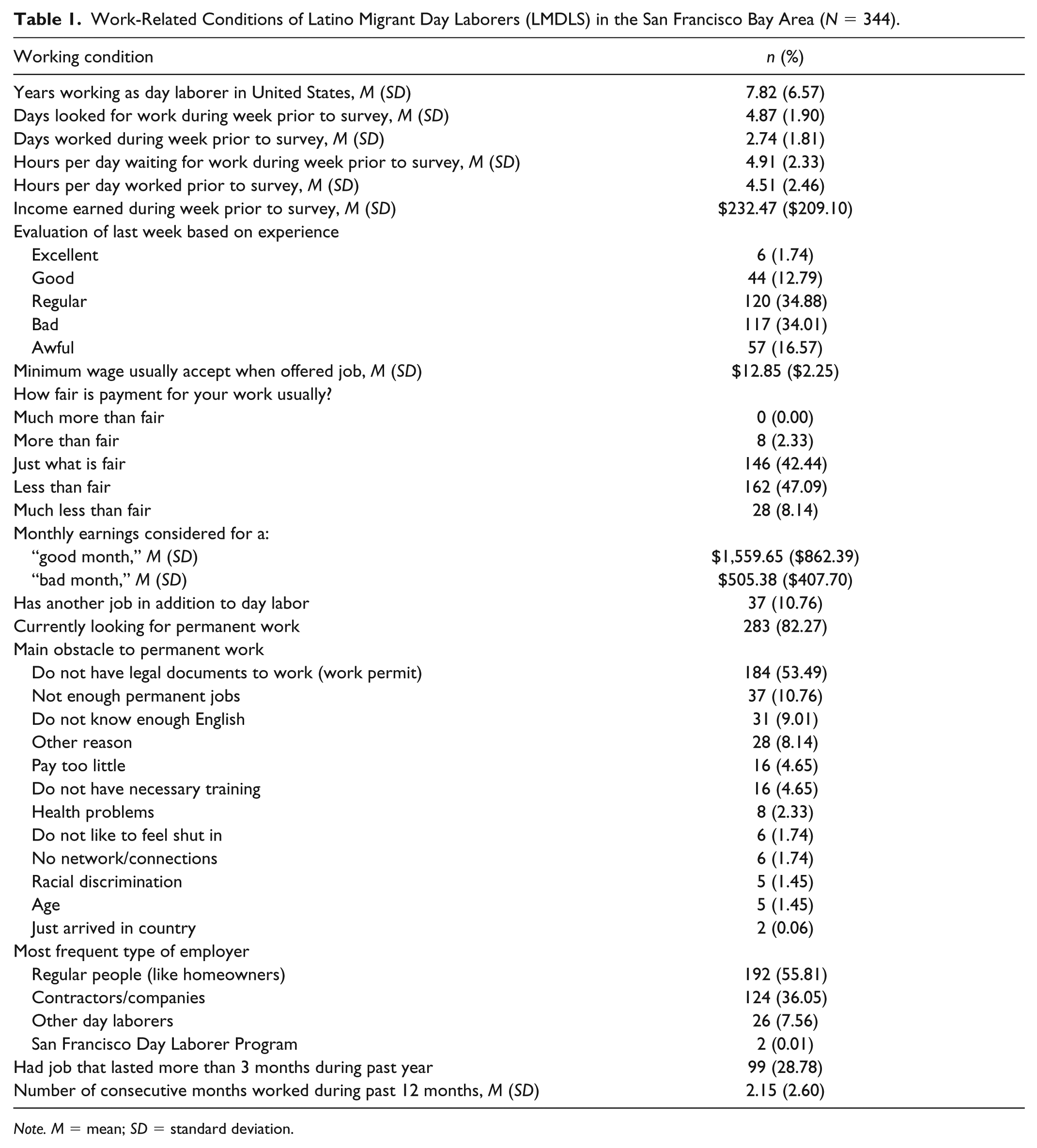
A latent variable of working conditions was captured by combining three indicators assessed in our survey: earnings during past week, proportion of days, and proportion of hours, worked during past week. Conceptually, this latent variable is intended to capture some of the most challenging characteristics of day labor: poverty wages and erratic number of days, and hours within days, working as well as waiting for work. Statistically, these three items also had the highest standardized factor loadings on the working conditions latent variable as compared with other aspects of working conditions assessed in the survey and described in Table 1 (e.g., distress experienced while working or while waiting for work).
Work-Related Conditions of Latino Migrant Day Laborers (LMDLS) in the San Francisco Bay Area (N = 344).
Note. M = mean; SD = standard deviation.
Living conditions
A latent variable of living conditions was captured by combining three indicators from our survey: How much LMDLs trust roommates, how well they get along with roommates and others in the area where they live, and how much they feel like where they are living is home (items on 5-point scales ranging from Not at all to Very much). Conceptually, these items represent distressing areas of concern for the majority of housed LMDLs and had the highest standardized factor loadings on the living conditions latent variable as compared with other aspects of living conditions assessed in the survey (e.g., How safe is the area you live in?).
Dependent Variables
Depression
Depression symptoms were assessed with the 10-item version of the Center for Epidemiological Studies–Depression Scale (CES-D), known as the Boston short-form CES-D (Kohout, Berkman, Evans, & Cornoni-Huntley, 1993), derived from Radloff’s (1977) original 20-item version. This version has satisfactory psychometrics when used with Mexican migrants (Grzywacz, Hovey, Seligman, Arcury, & Quandt, 2006) and assesses how often, over the past week, a person has experienced symptoms such as sadness, crying spells, and poor appetite on 4-point scales ranging from Rarely or none of the time to Most or almost all the time. The CES-D evidenced good internal reliability consistency with our sample as indicate by a coefficient alpha of .82. For the purpose of the SEM, we modeled the CES-D as a latent version of depression as recommended by Hayduk and Littvay (2012). This involved fixing the scale’s observed score to 1 (indicator’s factor loading) and its error term to 1 minus the scale’s reliability multiplied by its variance or .005. This adjustment corrects for imperfect reliability as needed in latent variable construction.
Desesperación
Organista et al.’s (2016) scale of Desesperación, developed for LMDLs, was used to assess this popular Latino idiom of psychological distress. Thirteen items assess frustration and disappointment in response to thwarted migration-related goals such as not progressing in life or not earning money. Organista et al. (2016) report a two-factor structure labeled Frustration and Dissatisfaction. Desesperación has good internal consistency reliability in current sample (coefficient alpha of .84).
Items from the Frustration subscale include, How often do you feel frustrated by the lack of progress in your life? How often do you feel angry about not earning the money that you need? Examples of reverse scored items from Dissatisfaction subscale include, How often do you feel satisfied with the progress in your life? How often do you feel content with your situation here in the United States? Items are on 5-point scales ranging from All of the time to Never. For the purpose of the SEM, the 13 items were modeled as a latent indicator of desesperación as recommended by Hayduk and Littvay (2012). This involved fixing the scale’s observed score to 1 (indicator’s factor loading) and its error term to 1 minus the scale’s reliability multiplied by its variance or .007. This adjustment corrects for imperfect reliability as needed in latent variable construction.
Anxiety
Anxiety symptoms were assessed by the seven-item Generalized Anxiety Disorder screening instrument (GAD-7; Spitzer, Kroenke, Williams, & Löwe, 2006), Spanish version (http://www.phqscreeners.com/). Items are on 4-point scales ranging from Not at all to Nearly every day. The GAD-7 evidenced high internal reliability with our sample (alpha coefficient of .85). As with the above outcome variables, The GAD-7 was modeled as a latent indicator of anxiety by fixing the observed indicator’s factor loading to 1 and error term to 1 minus the scale’s reliability multiplied by its variance or .05 to correct for imperfect reliability as needed in latent variable construction.
Alcohol use
The 10-item Alcohol Use Disorder Identification Test (AUDIT; Saunders, Aasland, Babor, de la Fuente, & Grant, 1993) is a popular measure of problem drinking. The first three items measure current frequency of drinking (How often do you have a drink containing alcohol?) on a 5-point scale ranging from Never to 4 or more times a week; number of drinks per episode (How many drinks containing alcohol do you have on a typical day when you are drinking?) on a 5-point scale from 1-2 to 10 or more; and frequency of six drinks or more at a time (How often do you have 6 or more drinks in one episode?) on a 5-point scale from Never to Daily or almost daily.
The next 5 AUDIT items assess negative consequences of drinking during the past year on 5-point scales ranging from Never to Daily or almost daily. Examples include, How often during the past month have you found that that you couldn’t stop drinking once you had started? Have you been unable to remember what happened the night before because you had been drinking? The final two items (Have you or someone else been injured as a result of your drinking, Has a relative, friend, doctor, or another health professional expressed concern about your drinking or suggested you cut down?) are assessed on 3-point scales from No to Yes during the past year, with Yes but not during the past year as the mid-point. The AUDIT has been translated into Spanish and used with United States Latino populations, including LMDLs (Ornelas et al., 2016).
The AUDIT was used in the current study to assess drinking during the past month versus past year for Items 4 through 8 to assess more recent alcohol use. We also altered the 5-point scales for Items 4 through 8 to Yes/No, and If yes, how often, to assess frequencies of related problems (e.g., How often during the past month, did you ever find that you couldn’t stop drinking once you had started?). Frequencies obtained on Items 4 through 8 were recoded back to values consistent with original 5-point scales. An alpha coefficient of .86 was obtained for the current sample indicating very good internal consistency reliability. These 10 items were modeled as a latent indicator of alcohol use using the same procedure described for outcome variables above.
Analysis of Data
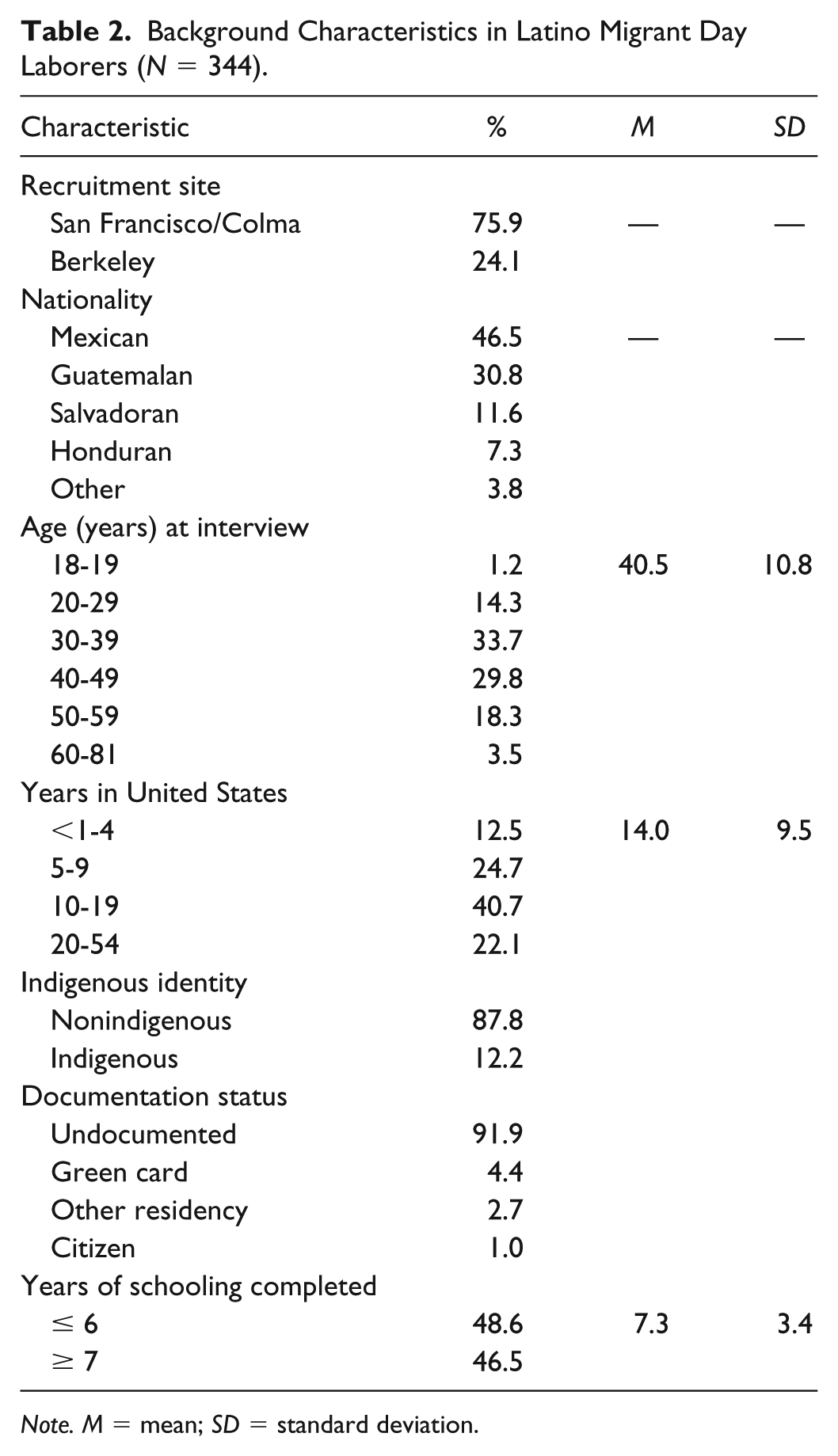
One-way frequencies, measures of central tendency and variability describe background demographics, migration-related characteristics (Table 2), and other characteristics of working conditions from the survey (Table 1). To test our hypothesized model, SEM was employed to link working and living conditions to each other and each to the psychological distress outcomes. Using SEM, correlations and regression parameters are estimated simultaneously and thereby control for the presence of each other (Fisher & Woodward, 2014). We modeled each of the four psychological outcome variables as separate latent indicators rather than one latent variable composed of the four outcome variables. Such variable constructions allowed us to examine which specific psychological outcome variables are related to working and living conditions as well as with one another.
Background Characteristics in Latino Migrant Day Laborers (N = 344).
Note. M = mean; SD = standard deviation.
We designed an initial SEM in which working and living conditions are related to each other, and each directly related to the four indices of psychological distress. Model estimation and evaluation was conducted by generating both a saturated pathway model, allowing for examination of all pathways between independent and dependent variables, followed by a parsimonious model displaying only remaining significant pathways after removing all nonsignificant pathways one at a time. Missing data are handled by list wise deletion, default for Linear Structural Relations (LISREL), the program used for SEM analysis, under the assumption of data missing at random (MAR; Enders, 2010). This produces conservative results and unbiased estimations as MAR is met.
Regarding model estimation and evaluation of model fit, we used Theil, a FORTRAN program for Robust Covariance Matrix Estimation (Theil & Laitinen, 1980), available in LISREL 8.80, to estimate parameters, standard errors, and test statistics (Jöreskog & Sörbom, 1996). Theil provides better estimates when the assumption of normally distributed multivariate data is met, but is robust enough to handle data frequently falling short of this assumption. Exact model-data fit was evaluated via the Chi-square test of exact fit, and approximate model-data fit was evaluated with the following descriptive measures: the comparative fit index (CFI; Bentler & Bonett, 1980) and the root mean square error of approximation (RMSEA; Browne & Cudeck, 1993). CFI values of .95 or larger and RMSEA values of .06 or lower indicate satisfactory model fit (Hu & Bentler, 1999). Additionally, standard mean square residual (SRMR) values of .08 or lower are considered reasonable fit. For each estimated parameter, we report its unstandardized estimate, standardized parameter estimate, standard error, and p value.
Results
Background Characteristics
Participants surveyed in 2014 were about half Mexican and Central American, 92% undocumented, average 40 years of age, 7.3 years of education, 12.5 years in the United States, and 48% are married/partnered (see Table 2).
Descriptive data on working conditions show that participants averaged about 8 years of day labor despite more than 80% seeking full time work (see Table 1). Regarding obstacles to employment, 54% cite lack of work authorization while 20% cite lack of English and jobs. During the week prior to survey, participants averaged $232 in wages, almost 5 days looking for work versus 2.74 days finding work, and almost 5 hours a day waiting for work versus 4.5 hours a day when working. Half of participants considered their earnings “Bad” or “Awful” while 14.5% considered them “Good” or “Excellent.” Most considered their pay “Less than fair” or “Much less than fair.”
Structural Equation Model Testing
Measurement Model
The fit of the initial saturated model containing all paths, suggested a good fit: χ2 = 56.09 (N = 344; df = 24), p ≤ .001; CFI = .98, RMSEA = .061, and SRMR = .039, meeting target model fit criteria. Next, a parsimonious model was generated by removing all nonsignificant paths, one-by-one, to derive only significant pathways at the .05 level. The most parsimonious model provides satisfactory model fit: Chi-square difference between the full (χ2 =56.09, df = 24) and nested model (χ2 = 58.79, df = 27) was 2.7 (df = 3) with a p value of .44. No significance difference in fit indicates that extra predictors do not improve the model. Thus, our parsimonious model accomplishes a desired level of fit with as few paths as possible.
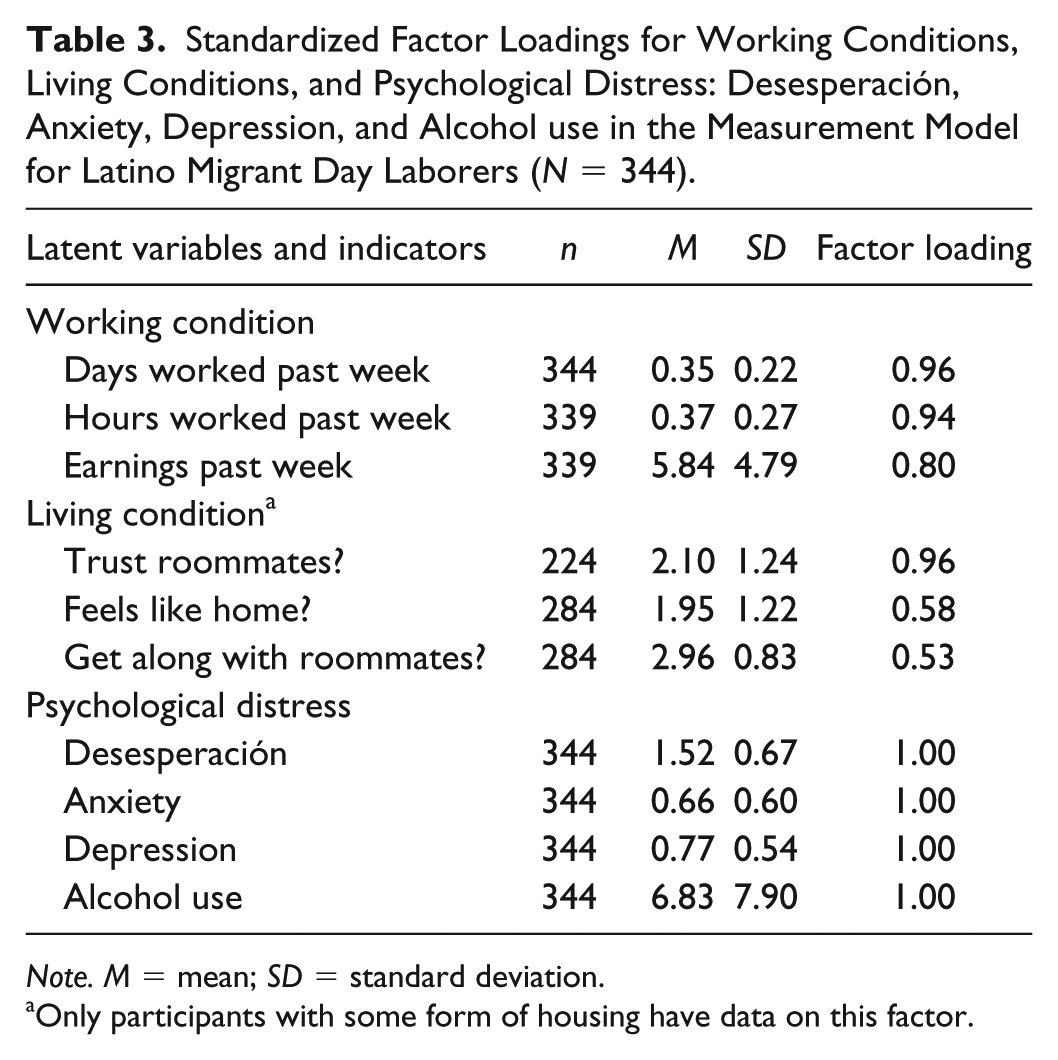
The final model contained the six latent factors described in Measures. All factor loadings were statistically significant (p ≤ .001), large, and ranged from standardized values of λ = 0.53 to λ = 0.96 (see Table 3). Factor loadings for the working condition latent variable were very high with all values greater than λ = 0.80. The fit of the parsimonious structural equation model, χ2 = 58.79 (N = 344; df =27) = 0.00038; CFI = .98, and RMSEA = .056, and SRMR = .051, was very good.
Standardized Factor Loadings for Working Conditions, Living Conditions, and Psychological Distress: Desesperación, Anxiety, Depression, and Alcohol use in the Measurement Model for Latino Migrant Day Laborers (N = 344).
Note. M = mean; SD = standard deviation.
Only participants with some form of housing have data on this factor.
Path Model
As can be seen in Figure 1 and Table 4, working and living conditions are linked to each other as indicated by a significant and positive bidirectional link (ψ = 0.22, standard error [SE] = 0.06, p ≤ .001), indicating that as working conditions improve, so do living conditions and vice versa. Five direct paths in the model also link both working and living conditions to desesperación and depression, and link living conditions to alcohol use. More specifically, direct paths linking working conditions to desesperación (β = −0.10, SE = 0.03, p ≤ .01) and depression (β = −0.11, SE = 0.02, p ≤ .01) are negative indicating that as working conditions worsen, desesperación and depression increase. Direct negative paths linking living conditions to desesperación (β = −0.19, SE = 0.03, p ≤ .001), depression (β = −0.17, SE = 0.02, p ≤ .001), and alcohol use (β = −0.13, SE = 0.43, p ≤ .01) indicate that as living conditions worsen, these three forms of psychological distress increase. Finally, all four forms of psychological distress were interrelated as indicated by positive bidirectional nondirected links between all possible pairwise combinations of these outcome variables indicating co-occurrence of multiple, related indices of psychological distress.

Structural equation modeling (SEM) of hypothesized pathways between working and living conditions and psychological distress in Latino Migrant Day Laborers (LMDLs; N = 344).
Unstandardized Regression Coefficients (B), Standardized Regression Coefficients (β), Standard Error (SE), and R2 of Outcome Variables in Latino Migrant Day Laborers (N = 344).

p ≤ .05. **p ≤ .01. ***p ≤ .001.
Discussion
SEM revealed pathways linking challenging living and working conditions to each other, and both to depression and desesperación, the latter a culture-based idiom of distress frequently expressed by LMDLs (Organista et al., 2016). A direct path linking living conditions to alcohol use was also found. While links between living conditions and distress are consistent with past research (Organista, Ngo, et al., 2017), current results extend past findings by linking distressing living conditions to alcohol use. Problem drinking in LMDLs is concerning given its associations with depression, anxiety (Organista et al., 2016; Organista, Arreola, et al., 2017; Ornelas et al., 2016), and work injury (Walter, Bourgois, Loinaz, & Schillinger, 2002). The possibility that living conditions may be indirectly related to alcohol use through indicators of poor mental, such as depression and anxiety, and poor physical health, warrants future exploration.
This study also underscores the importance of examining the central role of work in the lives of LMDLs given their goal of earning money to support families against formidable odds of success. For example, working conditions were characterized by low and infrequent wages, more time waiting for work than actually working, and meager earnings rated by most participants as unfair as well as “Regular” (35%), “Bad” (34%), or “Awful” (17%). Thus, we should expect such work be a central driver of poor living conditions, feelings of depression (e.g., sadness, low enjoyment of life), and desesperación (frustration with not earning money, supporting family).
Limitations
Cross-sectional survey data precludes causal interpretations and generalizability of findings are limited by convenience sampling. However, Organista et al. (2012) note, in their structural vulnerability framework, that the working and living conditions of LMDLs are remarkably similarly across the country. In fact, California provides relatively better conditions versus states such as Arizona that prohibit soliciting work in public and operating day labor centers.
Research implications include developing more measures of working and living conditions. While our latent index of working conditions captured current poverty wages while factoring in more time waiting for work than actually working, future measures could benefit by including the frequently difficult physical conditions of day labor, including dangerousness, to address this important gap in the literature. Similarly, while our latent index of living conditions captured common concerns of housed LMDLs, data regarding homelessness and marginal housing (e.g., in shelters) could improve such measures.
While significant, working and living conditions accounted for small amounts of variance in the psychological distress outcome variables, warranting consideration of other theoretical variables that might improve future SEM testing. For instance, including discrimination as an environmental factor might help explain more variance in mental health outcomes beyond working and living conditions. Also, variables that may mediate the above relationships should also be studied, including potentially protective cultural and community factors such as culturally competent services and access to cultural resources such as foods, fiestas, and paisanos from country of origin.
While the inclusion of such theoretically driven variables may improve future SEM testing, it is worth noting that results of the current model, based on a structural vulnerability framework, help to contextualize psychological distress in LMDLs by demonstrating associations with living and working conditions, central structural–environmental factors in the life of LMDLs. Furthermore, the significant model found represents more than the sum of its pathways in helping to synthesize the past LMDL research reviewed that examined fewer relationships (i.e., working conditions and stress, living conditions and self-reported health, depression and alcohol use) with limited to attention to environmental contextual factors.
Conclusion
Previous research demonstrates that distress related to living conditions is mitigated by use of community services perceived by LMDLs to be culturally competent and contact with family (Organista, Ngo, et al., 2017). Thus, implications include expanding culturally competent services and encouraging LMDLs to remain in contact with family even when distressed. The latter is important given research demonstrating that LMDLs often avoid family contact when experiencing financial hardship, discrimination (Negi, 2013), and work injury (Walter et al., 2002). LMDL-serving agencies can also help mitigate work-related distress by enhancing LMDL marketability via work injury prevention training, advertising LMDLs for hire, pursuing wage theft recovery from unscrupulous employers, and advocating on behalf of undocumented people during a particularly hostile political climate for immigrants.
However, the above interventions, while laudable, are likely to be stop–gap measures unless the quagmire of day labor is remedied (i.e., poverty wages earned by undocumented Latinos). Unless work authorization is expanded, LMDLs will remain structurally vulnerable to health compromising working and living conditions.
Footnotes
Acknowledgements
The authors thank members of the research team who contributed to survey development and implementation: Sonya Arrelola, Sahar Khory, Alex Kral, James Quesada, and Paula Worby.
Declaration of Conflicting Interests
The authors declared no potential conflicts of interest with respect to the research, authorship, and/or publication of this article.
Funding
The authors disclosed receipt of the following financial support for the research, authorship, and/or publication of this article: The study was funded by the National Institute on Alcohol Abuse and Alcoholism (5R01AA017592-04; Principal Investigator: Kurt C. Organista).
