



Abstract
Scholars and researchers are increasingly calling attention to the need for community-based coalitions to become more inclusive of local residents and engage those most directly affected by the issues. One population, however, often remains the recipient of services as opposed to partners or leaders in community change initiatives: youth. Over the past several years in Ohio, adults convening and facilitating youth-led programs have been transforming their work by utilizing the Youth Empowerment Conceptual Framework and the Substance Abuse and Mental Health Services Administration’s Strategic Prevention Framework to empower young people and ensure their equitable participation in community change efforts. This article provides an overview of Ohio’s statewide youth-led initiative, highlighting how adult allies engaged young people in a data-driven strategic planning process and intentionally selected and implemented strategies designed to affect the health of their local communities. This initiative provides key insights into the Collaborating for Equity and Justice Principles 4, 5, and 6.
Researchers and scholars are calling attention to the need for community-based coalitions to become more inclusive of local residents and engage those most directly affected by the issues, including young people (Wolff et al., 2017). At the same time, the power of youth voice took center stage in our national conversation as young people across the country organized around the issue of gun violence following the school shooting in Parkland, Florida. While this moment helped illuminate the contributions young people are capable of making in a democracy, the reality is that youth are still most often viewed as recipients of services as opposed to partners or leaders in community change efforts.
Over the past 5 years, the Ohio Department of Mental Health and Addiction Services (OhioMHAS) 1 has invested in developing and strengthening youth-led programs that seek to address substance abuse prevention and promote mental health. The adults involved in the initiative began with an understanding that youth-led programs were unique because they embrace young people as resources who are capable of contributing to their communities instead of as a collection of problems that need to be “fixed.” However, adults who convene and facilitate youth-led programs (termed “adult allies” in Ohio) needed more than a unifying philosophy in order to successfully engage their young people in community change efforts. Through an iterative process that included feedback from both adult allies and young people engaged in youth-led programs, two frameworks were identified to guide and inform the work of youth-led programs in Ohio: the Youth Empowerment Conceptual Framework (YECF; Holden, Messeri, Evans, Crankshaw, & Ben-Davies, 2004) and the Substance Abuse and Mental Health Services Administration’s Strategic Prevention Framework (SPF; Substance Abuse and Mental Health Services Administration [SAMHSA], Revised 2017).
This article provides a brief overview of youth-led initiatives in Ohio and then explicates how the current initiative aligns with several of the Collaborating for Equity and Justice (CEJ) principles. It concludes with recommendations and reflections on how to create spaces for young people to collaborate to create community change.
Youth-Led Initiatives in Ohio
Ohio has a rich history of youth-led programs. Ohio Teen Institute (OTI) began in 1965, and Youth to Youth International (Y2Y) was founded in Columbus in 1982. The purpose of these programs is to provide training and education for youth, while encouraging them to develop skills to make drug free, healthy lifestyle choices; become resilient and responsible adults; and positively affect their schools and communities (King et al., 2015; Wade-Mdivanian et al., 2016). Because adult allies from OTI and Y2Y encouraged and honored youth voice in planning and implementing substance abuse prevention activities, these programs became coined “youth-led.” Ohio’s adult allies hailed from a variety of helping professions (e.g., social work, education, counseling, criminal justice) and were often certified prevention specialists. However, there was no unifying training process to become an adult ally; this nuance remains true today. Similarly, while OTI and Y2Y each considered themselves youth-led prevention programs and had affiliated groups at the local level, there was no consistency in activities and program evaluation either within or between the groups (V. Connolly Leach, personal communication, June 8, 2018).
In 1993, the federal Alcohol and Drug Abuse and Mental Health Service Block Grant (45 CFR § 96.125) directed each state/territory to develop comprehensive prevention programming that was directed at both the general population and individuals who were at high risk for substance abuse. Throughout the rest of that decade, prevention, as a science, began to formalize and prevention research started identifying promising approaches, best practices, and model programs (Hogan, Gabrielsen, Luna, & Grothaus, 2003). While the intent of creating spaces for young people in Ohio to create community change was always there, youth-led programs were locally driven; as a result, there was little or no consistency across the state. In the early 2000s, it became clear to OhioMHAS that there needed to be a more rigorous approach to youth-led programs (M. Stone, personal communication, June 20, 2018).
While there were many microefforts (i.e., changes in funding requirements, establishing “think tanks,” and providing training opportunities) to shift Ohio to a more rigorous approach to youth-led programs, it was not until 2011 that OhioMHAS funded the nonprofit organization Prevention Action Alliance to form the Ohio Youth-Led Prevention Network (OYLPN). OYLPN provided infrastructure for youth-led programs to network and also established a statewide youth council to represent a vision for youth-led programs in Ohio. In 2014-2015, OhioMHAS invested $1 million to develop and strengthen youth-led efforts at the state and local levels. This allowed the state agency to further partner with Prevention Action Alliance and the authors of this manuscript to serve as developmental evaluators for Ohio’s youth-led efforts and ultimately develop a training and technical assistance (T/TA) platform for adults who facilitate youth-led programs.
Method
OhioMHAS funded the authors of this article to evaluate youth-led programs in Ohio. At that time, there was no consistent approach or definition of youth-led programs in Ohio. This task, therefore, proved challenging within traditional evaluation frameworks because the underlying assumption of formative and summative evaluation is that object is fully described (Fitzpatrick, Sanders, & Worthern, 2010). As such, the authors selected a developmental evaluation framework because the initiative was in a state that Patton (2011) describes as “performative development of a potentially scalable innovation” (p. 22). The intent was to utilize developmental evaluation (Patton, 2011) as an initial framework to support the funder, stakeholders, and adult allies as they collectively conceptualized Ohio’s definition and approach to “youth-led programs” and then transition to a more traditional evaluation framework as the work progressed.
During this developmental evaluation, the authors of this article were seen as part of the project team, acting as facilitators and conveners, initiating evaluative thinking and learning (Patton, 2011). We used the inquiry approach of reflective practice because it allows groups to be systematic in capturing experiences and shared, tracking meanings that are explored, and facilitating a deeper understanding of these experiences (Patton, 2011). Methodological rigor was obtained through the application of the following validation strategies suggested by Creswell and Miller (2000): prolonged engagement in the field, triangulation, peer review and debriefing, and rich, thick description. Prolonged engagement in the field was a key validation strategy used in this study. The authors spent extensive time in the field with Ohio’s adult allies learning from and documenting their ideas and experiences.
To develop this manuscript, we utilized the method of document analysis (Bowen, 2009). Records from the work included agenda and notes from each meeting and training that was facilitated and completed youth-driven strategic plan maps. A systematic analysis of the collected evidence then occurred. The authors used a deductive coding process (Miles & Huberman, 1994), beginning with the six core CEJ principles (Wolff et al., 2017) and reviewed the documents for elements of each principle. The authors met regularly to discuss their reflections on the existing data and the CEJ principles. The weekly meetings allowed the authors an opportunity to engage in conclusion drawing and verification process with one another (Miles & Huberman, 1994). Through this process, it was determined that the work of Ohio’s youth-led initiative related to three core CEJ principles.
Results
Building on the Extensive Community-Engaged Scholarship and Research to Create a Theory-Driven Approach for Youth-Led Programs
To ensure that Ohio’s approach to youth-led programs was grounded in the foundations of theory and research (Wolff et al., 2017), the authors of this manuscript consulted the literature base on youth empowerment, youth participatory action research, youth organizing, and substance abuse prevention. Equally important, as developmental evaluators, we shared this literature with adult allies and engaged them in discussions to determine their core beliefs about working with young people and generate a collective understanding of the core tenets of youth-led programs in Ohio. The adult allies involved in the process included social workers with less than 2 years in the field to certified prevention specialists with over 10 years in the field.
Feedback from the adult allies and the young people engaged in youth-led programs regarding the structure and function of effective programs led to the conceptualization of Ohio’s youth-led programs as a community-based process. Because the history of this work is rooted in substance abuse prevention, the federal Alcohol and Drug Abuse and Mental Health Service Block Grant (45 CFR § 96.125; 1993) provides the framing for the definition of community-based process as a strategy to prevent substance abuse: This strategy aims to enhance the ability of the community to more effectively provide prevention and treatment services for alcohol, tobacco and drug abuse disorders. Activities in this strategy include organizing, planning, enhancing efficiency and effectiveness of services implementation, inter-agency collaboration, coalition building and networking.
By framing youth-led programs as a community-based process, Ohio further demonstrated its commitment to viewing youth as partners and leaders in community change efforts. Because this vision is vastly different from viewing young people as the recipients of a prevention strategy (e.g., an educational curriculum aimed to influence life skills—e.g., decision making, refusal skills, and critical analysis), it was necessary to find a theory-driven approach for engaging youth in community-based processes.
Consequently, the YECF (Holden et al., 2004) was identified as a valuable framework for conceptualizing the core structures and processes needed for young people to create change. The YECF was developed in order to guide the evaluation of a statewide youth movement against tobacco use; the developers utilized empowerment theory (Zimmerman, 2000) as the foundation for creating this evaluative framework. The framework depicts adult allies as being responsible for establishing empowering settings that allow for equitable decision-making processes and cohesive group climate in order for young people to collectively engage in community change efforts. The concept of empowerment resonated with the adult allies because it helped distinguish the work of youth-led programs from traditional leadership development programs given its emphasis on creating population-level change. While traditional leadership programs seek to build the skills and assets of their individual participants, empowerment-based programs seek to collectively engage young people in community change efforts (Zimmerman et al., 2018). By utilizing the YECF as a framework for guiding youth-led programs in Ohio, it also helped ensure that the work of the adult allies was theoretically grounded.
The YECF clearly articulates that youth-led community change efforts produce impacts at multiple levels. Consistent with the literature base on youth organizing and empowerment-based efforts (e.g., Christens & Dolan, 2011; Gardner, Roth, & Brooks-Gunn, 2008; Zimmerman & Eisman, 2017), the YECF identifies that change occurs on three levels: the individual, the group, and the community. By engaging in empowerment-based approaches, young people are exposed to experiential civic education (Kirshner & Ginwright, 2012). At the individual level, participating in these efforts promotes positive youth development, including critical thinking skills, psychological empowerment, and sociopolitical development (Christens & Peterson, 2012; Holden et al., 2004; Speer, 2008; Zimmerman et al., 2018). As young people work with members of their group to create change, they learn how to accomplish tasks and become critically aware of how change occurs in their local communities (Holden et al., 2004). The actions of the group produce systems change, including changes in local policy and program implementation. This highlights one of the most potent and compelling reasons for promoting empowerment-based programs for youth: There are beneficial effects even for young people who are not directly involved in the programs (Christens, Collura, Kopish, & Varvodic, 2014).
Once a framework was established that accurately identified the core structures, processes, and anticipated outcomes of youth-led programs, the primary question became, “How do young people effectively plan and implement community change efforts?” While a variety of tools and frameworks are available to guide community change efforts in different contexts, in the field of substance abuse prevention, the SPF provides communities with a comprehensive planning process to address substance misuse and related behavioral health issues (SAMHSA, 2017). The SPF is data-driven, requiring communities to gather and use data to guide their prevention decisions, and explicitly focuses on creating population-level change to address substance use (Florin et al., 2012). The SPF involves assessing community needs, mobilizing and building capacity to address prevention priorities, developing a comprehensive strategic plan, implementing evidence-based strategies, and evaluating prevention efforts (SAMHSA, 2017). When youth enact this process, they engage in three primary planning steps to develop a strategic plan: determine a problem of practice, identify the root cause of the problem, and select and implement evidence-based strategies to address those root causes.
Constructing Core Functions for Youth-Led Programs Based on Equity and Justice That Provide Basic Facilitating Structures and Build Member Ownership and Leadership
The identification of the YECF (Holden et al., 2004) and the SPF (SAMHSA, 2017) as the grounding for youth-led programs in Ohio provided adult allies the necessary basis to clearly articulate the overarching purpose of this statewide initiative: for young people to collectively engage in a planning process to create and implement a strategic plan that uses evidence-based strategies to create community-level change. However, gaps in implementation existed. One primary challenge to effectively implementing youth-led programs was a lack of understanding about the role of adults in youth-led initiatives. Consistent with past research and evaluation on youth empowerment initiatives, we found that adult allies initially held several misconceptions about their role. The majority of adult allies believed that they simply needed to “get out of the way” to allow young people to lead (Camino, 2005). While it was evident that this belief was intended to highlight the value adults placed on youth voice, it also undermined the adult role in the initiative. In an effort to allow young people to lead, adult allies were not providing the leadership and support needed for young people be successful. For youth to be effective agents of change, adults need to provide instrumental support and guidance (Kirshner, 2008; Zeldin, Larson, Camino, & O’Connor, 2005; Zeldin, Petrokubi, & Camino, 2008).
T/TA opportunities for adult allies were developed and intentionally structured in light of this knowledge. A key focus of the T/TA was helping adult allies identify and articulate their roles and the role of young people in community change efforts. During this process, we utilized the YECF as not only a theory-driven evaluative framework but also a tool to help adult allies conceptualize and articulate their programs, including the role of adults and young people. The YECF (Holden et al., 2014) highlights that adults are responsible for creating the group structures and climate needed to ensure that young people are equipped to create community change. Similar to the role of the convening group in the CEJ approach, a key role for adult allies of youth-led programs is to build leadership in others, not to be the sole leadership (Wolff et al., 2017). As conveners, adult allies serve as centralized communicators for youth members as well as community stakeholders, manage the administrative details, and provide the expertise and resources required to sustain youth-led programs and their community change work (Wolff et al., 2017).
The adult allies responsible for facilitating OYLPN’s Youth Council were the first in Ohio to ground their program in the YECF and clearly articulate the roles and responsibilities of the adults and youth in relation to this model (see Figure 1).
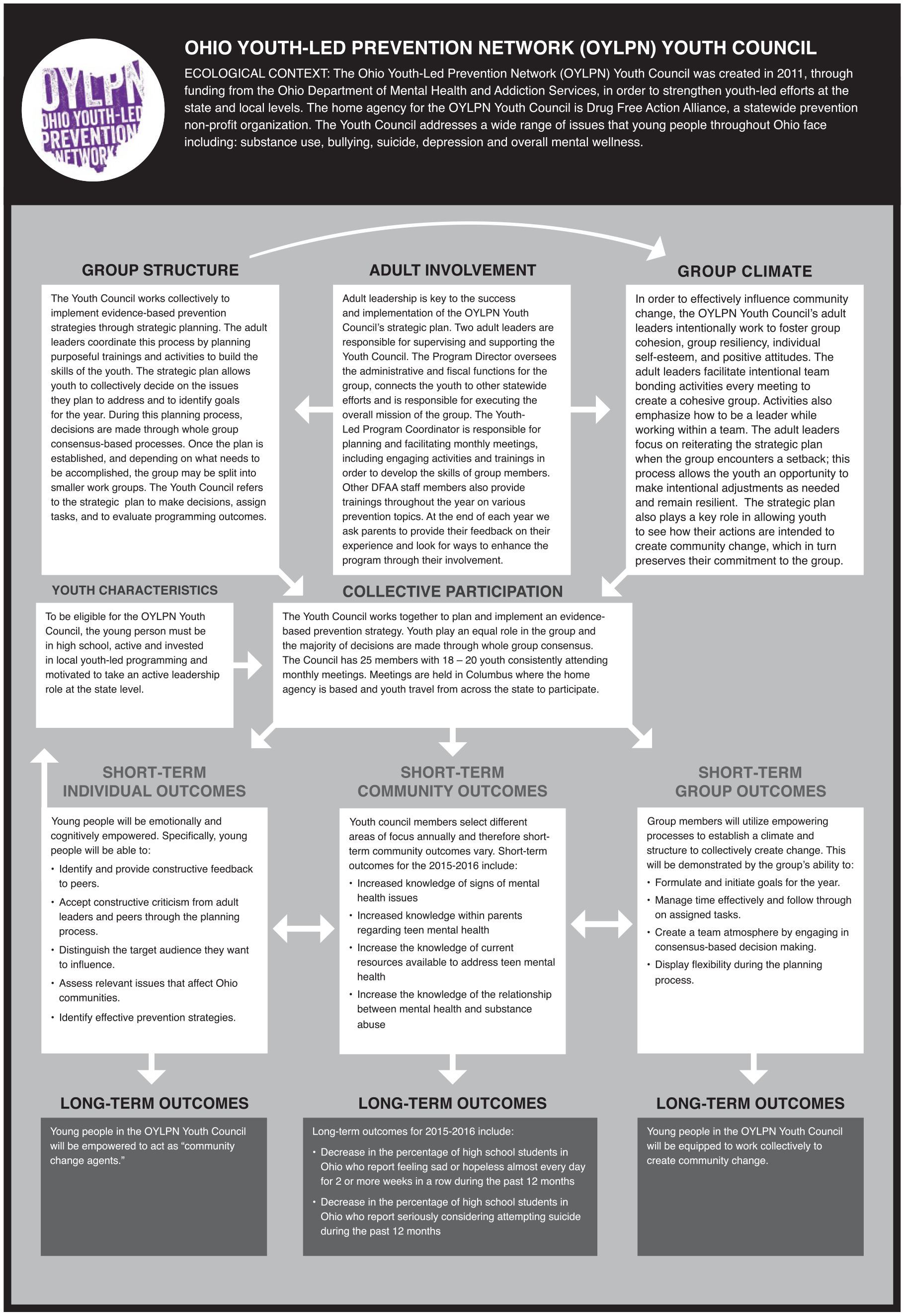
Ohio Youth-Led Prevention Network (OYLPN) Youth Empowerment Conceptual Framework (YECF).
Articulating their programs in relation to the YECF provided opportunities to engage in conversations and critically reflect on how adult allies were engaging youth and determine what was needed as young people lead community change efforts. Adult allies are constantly stepping forward and stepping backward in an ongoing dance with youth to create space and structure, build capacity, encourage participation, support and nurture youth voice, and provide resources (Richards-Schuster & Timmermans, 2017). T/TA focused on how engaging young people in this work is akin to an improvised, modern dance where adults are deliberate in planning their work with youth yet adjust their experiences with youth responsively and effectively (Krueger, 2005). Emphasis was placed on ensuring that the adult allies carried out their role with consideration to the power dynamics between themselves and youth members (Wolff et al., 2017).
Youth Leading Systems and Structural Change
Framing the vision for youth-led programs and establishing the role of adults in these initiatives were key steps in solidifying Ohio’s youth-led movement. As a result of grounding youth-led programs in the YECF (Holden et al., 2004) and the SPF (SAMHSA, 2017) and facilitating T/TA to prepare adult allies to successfully convene these programs, spaces for young people to collaborate in order to create community-level change were becoming established. Ohio’s youth-led movement was also able to build on the learnings of the broader prevention field in order to determine appropriate strategies for creating population-level change.
Ohio began taking steps toward emphasizing environmental prevention strategies in 2009, when OhioMHAS was awarded the SAMHSA’s Strategic Prevention Framework—State Incentive Grant (SPF SIG). As part of the initiative, all funded communities were required to use the SPF (SAMHSA, 2017) to select and implement evidence-based environmental strategies that were a practical and conceptual fit for their community. Environmental strategies target the community context that encourages substance use and includes activities such as policy reform and media campaigns (Pentz, 2000; Pentz, 2003). The federal Alcohol and Drug Abuse and Mental Health Service Block Grant (45 CFR § 96.125; 1993) defines an environmental approach to substance abuse prevention abuse as [A] strategy [that] establishes or changes written and unwritten community standards, codes and attitudes, thereby influencing incidence and prevalence of the abuse of alcohol, tobacco and other drugs used in the general population. This strategy is divided into two subcategories to permit distinction between activities which center on legal and regulatory initiatives and those which relate to the service and action-oriented initiatives.
In 2014, OYLPN’s Youth Council identified mental health, specifically depression and suicide, as a problem of practice. As the Youth Council worked on their strategic plan map (see Figure 2), they identified the following key root causes: lack of awareness of mental health; lack of competency among parents, teens, and educators about mental health (signs, symptoms, etc.); and lack of knowledge on the signs of mental illness. To address their problem of practice, the young people chose to create a media campaign, 2 which have been found to produce positive changes or prevent negative changes in health-related behaviors across large populations (Perkins, Linkenbach, Lewis, & Neighbors, 2010; Wakefield, Loken, & Hornik, 2010; Wright, McGorry, Harris, Jorm, & Pennell, 2006).
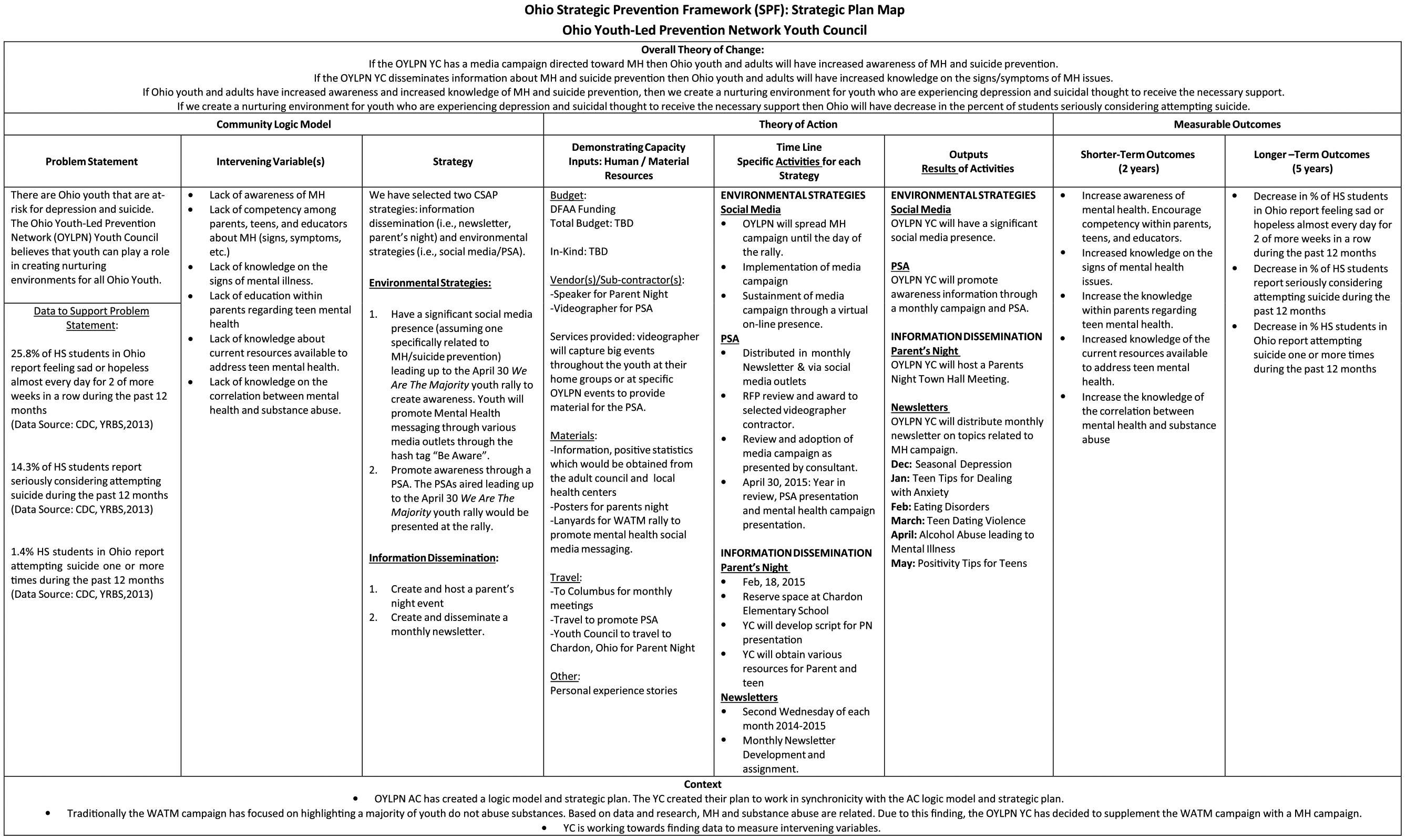
Ohio Strategic Prevention Framework (SPF): Strategic plan map Ohio Youth-Led Prevention Network Youth Council.
Supported by adult allies, the young people worked at designing a media campaign aimed at changing young people’s (aged 12-17 years) attitudes toward depression (specifically) and mental health (more generally). The young people created a 90-second video campaign with the tagline #BeAware. The campaign’s main message was, “Mental health is a real health issue. And it’s time we talk about it.” While the Youth Council’s strategic plan map did not explicitly mention stigma, stigma is clearly a focus of their primary strategy. As such, the #BeAware media campaign is a concrete example of young people working to create societal transformation by reducing the stigma surrounding mental illness.
Subsequently, OhioMHAS contracted with a social marketing firm specializing in public health messaging to extend the #BeAware campaign started by the Youth Council. True to their youth-centered philosophy, OhioMHAS required that the firm work with the Youth Council and engage a wide variety of young people across Ohio to further develop the campaign. After a 2-year developmental process, the #BePresent campaign (http://bepresentohio.org/) was officially launched in 2017. While the name of the campaign was changed due to market research, the intent and audience of the campaign remains the same: to educate and empower peers, friends, classmates, and siblings of youth at-risk for depression and other mental health issues to “step up” and provide needed support. The campaign was delivered through a variety of outlets including the use of a multiplatform social media (Facebook, Twitter, YouTube, Instagram and, Snapchat), print ads, and digital public service announcements on Pandora Radio. The website was part of the campaign as well and included an online toolkit to encourage young people to get involved as a friend, advocate, and leader. Information sessions were hosted across Ohio to further promote the campaign and ensure that local communities were aware of the resources.
Wolff et al. (2017) highlighted the successes that collaboratives had in tobacco control and prevention through their focus on policy, systems, and structural change. OYLPN’s Youth Council example highlights the role that young people can play in transforming community norms, systems, and structures. Through the Youth Council’s efforts, they were able to initiate a sustainable media campaign aimed at reducing stigma associated with mental illness with the intent of decreasing barriers to treatment for individuals with mental and behavioral health disorders. As indicated on their developed strategic plan map, the long-term outcomes of the campaign are to decrease the percentage of high school students in Ohio who report feeling sad or hopeless almost every day for 2 or more weeks in a row during the past 12 months. Statewide data from the Youth Risk Behavior Survey is used to track this outcome. While other statewide efforts also affect these long-term outcomes, this is the most feasible form of evaluation for this campaign at this time. Data were also collected to assess the reach of the campaign.
The Youth Council was the first to enact the vision of youth-led programs, however, there are now 13 youth-led programs in Ohio that have developed and implemented strategic plans designed to create population-level change; nine additional programs are prepared to begin implementation this year.
Discussion
The overarching goal of youth-led programs in Ohio is for young people to collectively engage in a planning process to create and implement a strategic plan that uses evidence-based strategies to create community-level change. To enact this vision, adult allies determined that youth-led programs are community-based processes in which young people engage in determining a problem of practice, identifying the root causes of the problem, and then select and implement strategies to address those root causes. By engaging in this process, young people are developing innovative strategies for collaboration, addressing substance abuse prevention, and promoting mental health statewide.
In order for young people to work collectively and successfully lead these initiatives, it was necessary to first identify theoretical frameworks to guide the purpose and work of youth-led programs. Through an iterative process with adult allies and young people, two frameworks were identified to inform the work of youth-led programs in Ohio: the YECF (Holden et al., 2004) and the SPF (SAMHSA, 2017). These theoretical models helped ground the work and unify the field of youth-led prevention, but adult allies needed assistance translating the theory to practice. A key struggle was clearly establishing and defining the role and responsibilities of adults in youth-led initiatives and determining how to effectively guide young people in implementing environmental strategies designed to create population-level change. Through a T/TA platform, we were able to support adult allies as they worked through the tensions involved in translating theory to practice. The work in Ohio demonstrates several key lessons for those interested in collaborating for equity and justice.
Implications for Practice
Consistent with the CEJ principle of building on the extensive community-engaged scholarship, it was necessary to first ground the work of youth-led programs in the literature base. Importantly, for collaborations to be more equitable, it is the practitioners of the work who need to access, reflect, and incorporate this scholarship into their practice. We quickly learned that in order for this to occur, mass trainings were insufficient. For this scholarship to be palatable and accessible for adult allies, trainings were developed utilizing a learning community format. Consistent with Wenger, McDermott, and Snyder’s (2002) vision of a community of practice, meetings engaged adult allies who shared an interest and passion in enhancing their practice through collective learning and regular interaction. This format provided formal and informal opportunities for adult allies to bolster their skills in establishing appropriate group structures in order to empower young people and ensure their equitable participation in community change efforts. As facilitators of these trainings, the authors of this article presented core concepts and ideas from the literature for the adult allies to grapple with and discuss in order to examine some of the tensions involved in this work and develop a shared understanding of how to guide youth-led programs in a manner that ensures equitable participation.
Equally important, we found that the conveners of youth-led programs (i.e., the adult allies) needed ongoing support and guidance as they sought to establish basic facilitating structures and develop youth ownership and leadership. Participation in the learning community meetings became a 2-year process. The first year focused on conceptually grounding youth-led programs in the two evidence-based frameworks (viz., the YECF and the SPF). The second year provided support and coaching as the adult allies implemented their youth-led program in accordance with these two frameworks. This work is essential in order to create spaces for young people to lead community change efforts and highlights the importance of ongoing learning. It is not enough to invest only in the initiative; funding should also be allocated to support the convener in learning how to lead in a collaborative manner and provide an intentional space for them to discuss the challenges involved in facilitating equitable structures. Interestingly, Ohio’s example also highlights that not all conveners seek to enact top-down approaches; guidance is also needed for those who may not know how or when to step forward and provide structure and support.
Conclusion
Moving forward, Ohio’s youth-led movement hopes to have young people prepared to also serve alongside adults in community coalitions. It was necessary, however, to first create spaces for adults to learn how to interact with young people and to prepare young people with the necessary knowledge, skills, and attitudes to lead community change efforts.
Footnotes
Declaration of Conflicting Interests
The authors declared no potential conflicts of interest with respect to the research, authorship, and/or publication of this article.
Funding
The authors disclosed receipt of the following financial support for the research, authorship, and/or publication of this article: This work was supported by the Ohio Department of Mental Health and Addiction Services (OhioMHAS) under grants # 1664, 162019, 1700315, 1800274, 1800551, 1900157, and 1900462. The information, conclusions and opinions expressed in this product are those of the authors and no endorsement by OhioMHAS is intended or should be inferred.
