




Abstract
Flavored tobacco products appeal to youth, and jurisdictions have implemented policy interventions to reduce youth tobacco initiation. This study reviews the process, challenges, and compliance monitoring of a flavored tobacco sales restriction. New York City (NYC) passed a policy restricting the sale of flavored non-cigarette tobacco products in 2009. To describe the policy’s passage, legal defense, implementation, and enforcement, we conducted stakeholder interviews, reviewed legislative and legal records, and analyzed administrative data on retailer inspections and violations. Extensive public and policy maker education efforts preceded this policy. Barriers included opposition to the policy’s passage and a tobacco manufacturer’s lawsuit that sought to halt the law’s implementation and to establish that NYC lacked the authority to restrict the sale of flavored products. The city implemented the flavored tobacco policy as intended and it withstood legal challenges. NYC integrated enforcement into the city’s retailer compliance monitoring infrastructure, and the violation rate is low. Our investigation of NYC’s experience with flavored tobacco policy implementation and enforcement can provide policy makers and health professionals with insights relevant to policy implementation, expand understanding of the potential impact of these kinds of policies, and inform compliance monitoring efforts.
The 2009 Family Smoking Prevention and Tobacco Control Act (Tobacco Control Act) granted the Food and Drug Administration (FDA) authority to regulate the manufacture, marketing, and distribution of tobacco products (Public Law 111-31, H.R. 1256). The Tobacco Control Act included a ban on the sale of cigarettes with a characterizing flavor, excluding menthol and tobacco flavor (21 U.S.C.A. § 387g(a)(1)(A)), but did not restrict the sale of other flavored tobacco products. Flavorings in tobacco products can mask the harshness and irritation of smoking, making these products easier to use and more appealing to youth (Carpenter, Wayne, Pauly, Koh, & Connolly, 2005; Delnevo, Giovenco, Ambrose, Corey, & Conway, 2015; Klein et al., 2008; Manning, Kelly, & Comello, 2009; U.S. Department of Health and Human Services, 2012). Flavored tobacco products may play a role in young adults’ initiation and maintenance of tobacco use (Villanti et al., 2017; Villanti, Richardson, Vallone, & Rath, 2013). In 2014, 70.0% of middle and high school students who used tobacco reported using flavored tobacco (Corey, Ambrose, Apelberg, & King, 2015).
In October 2009, New York City (NYC) became the first U.S. jurisdiction to pass a law (referred to as “policy” hereafter) restricting the sale of flavored non-cigarette tobacco products by retailers (NYC Admin Code § 17-713 et seq.), applying to smokeless tobacco, cigars, little cigars, and cigarillos. The NYC flavored tobacco policy aimed to reduce youth and young adult initiation and use of tobacco products by reducing access to flavored products. The NYC flavored tobacco policy is one of relatively few such policies in the United States, and is the only one with published controlled outcome evaluation results supporting the effectiveness of the policy (Farley & Johns, 2017; Rogers et al., 2017). Although e-cigarettes were not included in the 2009 NYC flavor policy, the extraordinary growth in sales and use of these products in the United States (Gentzke et al., 2019; King, Gammon, Marynak, & Rogers, 2018), especially increases in youth use of flavored e-cigarettes (Tsai et al., 2018), have prompted regulatory responses. Even as planned federal actions to restrict youth access to flavored tobacco products are being formulated (Abram & Zeller, 2019; FDA, 2018), there continues to be interest in advancing policies to restrict sales of these products at state and local levels. However, limited information is available on how local flavored tobacco sales restriction policies are implemented and enforced (Tobacco Control Legal Consortium, 2018).
We studied NYC’s policy implementation, legal challenges, and infrastructure for monitoring policy compliance. Understanding NYC’s experience with flavor tobacco policy implementation can inform potential regulatory and enforcement actions at the local, state, or federal level. This study used stakeholder interviews, legal documents, and tobacco retailer inspection enforcement data to address the following questions:
To what extent has the policy been implemented as intended?
How have retailers been educated about the policy?
How did the lawsuit that challenged the policy affect policy implementation?
What are barriers to implementation of the policy?
How has the policy been enforced?
Methods
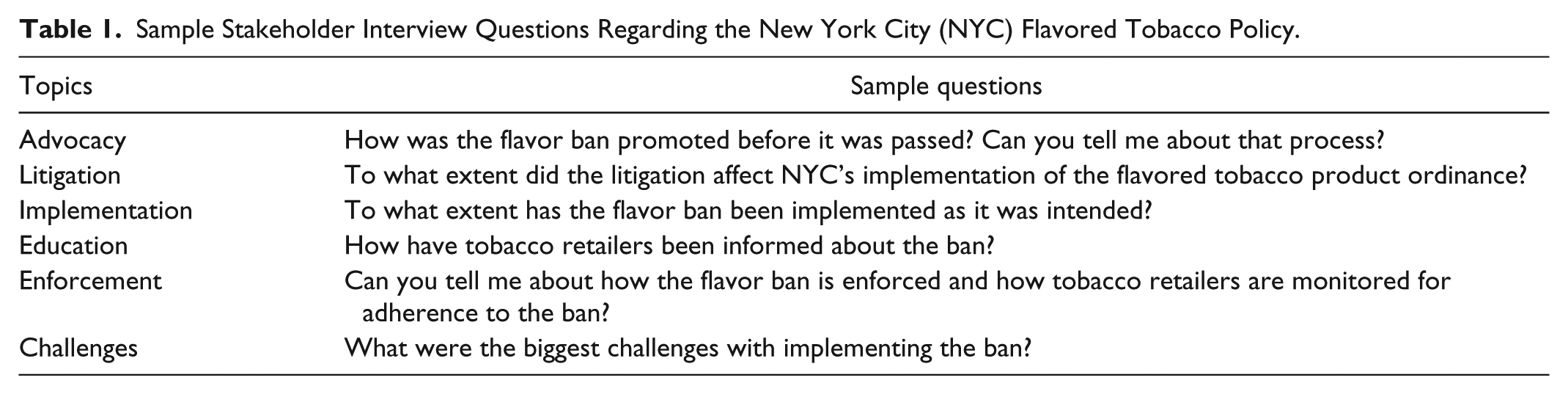
NYC Department of Health and Mental Hygiene (DOHMH) staff identified relevant stakeholders in three groups: DOHMH staff involved in the development or litigation defense of the policy, NYC’s Department of Consumer Affairs (DCA) officials involved in the enforcement of the policy, and nongovernmental tobacco control advocates involved in educational efforts related to the policy. We tailored interview protocols and instruments for each stakeholder group. Institutional Review Boards at RTI International (Number 13701) and FDA (Number 15-015CTP) determined these protocols to be exempt. In April 2015, we obtained verbal informed consent and interviewed three DOHMH staff, three DCA officials, and four tobacco control advocates. We asked DOHMH stakeholders about policy development, litigation, and retailer education. We asked DCA stakeholders about compliance monitoring and enforcement. We asked advocates about efforts in support of the policy and challenges encountered with implementation. Sample interview questions are listed in Table 1. We audio-recorded these interviews and coded the transcriptions using QSR NVivo 10 software, applying predetermined codes related to core study constructs within the areas of policy development, litigation, and retailer education. Three researchers conducted thematic analysis (Fereday & Muir-Cochrane, 2006; Gibbs, 2007), and each transcript was read by at least two researchers. We aggregated text by code and identified common themes and subthemes surrounding our evaluation questions. The researchers met regularly during the coding and analysis process to resolve any discrepancies and ensure agreement on key themes.
Sample Stakeholder Interview Questions Regarding the New York City (NYC) Flavored Tobacco Policy.
We reviewed legislative and legal documents, including the flavored tobacco policy, the associated rules, and lawsuit-related documents. Our review of these documents informed the summary of policy implementation and challenges and allowed us to clarify the timeline of events regarding the policy and the ensuing litigation.
For the enforcement data, we obtained DCA records of tobacco retailer inspection actions. These records included the number and type of tobacco-related inspections conducted, flavor policy-related violations reported, and resulting license suspensions and revocations. We reviewed inspection records for November 22, 2010 (the date of the first compliance inspection), through February 28, 2015 (the latest date through which inspection records were available when requested), and summarized the number of tobacco retailer inspections resulting in a policy violation by inspection type.
Results
We present findings on policy implementation, retailer education, the lawsuit, other challenges, and enforcement.
Policy Development and Implementation
Stakeholders reported that the NYC flavored tobacco policy was preceded by years of education and advocacy. Initial efforts focused on flavored cigarettes in particular and shifted to flavored non-cigarette tobacco products after the federal Tobacco Control Act banned the sale of cigarettes containing characterizing flavors except tobacco or menthol in 2009.
In 2005, the American Lung Association of NYC partnered with the American Cancer Society, American Heart Association, Campaign for Tobacco-Free Kids, The Point Community Development Corporation, and NYC Smoke-Free to raise awareness about flavored cigarettes in NYC among policy makers and the public. Advocates from these organizations worked to educate the NYC City Council about the rationale for a flavored tobacco policy to prevent youth tobacco initiation, while stimulating community support for the policy. Advocates conducted educational and press events, developed position papers outlining the scientific evidence regarding flavored tobacco products’ role in the initiation and maintenance of tobacco product use, and pressed for the passage of an ordinance to restrict the sale of these products. Stakeholders noted that youth participated in many of these education and advocacy efforts.
An initial ordinance restricting the sale of flavored tobacco products was introduced to the City Council on September 13, 2006, but the Committee on Health chose to take no action. Over the next several years, tobacco control advocates continued education efforts regarding flavored tobacco products in NYC. In May 2009, an amended version of the original ordinance was submitted and again the Committee on Health took no action.
On June 22, 2009, the federal Tobacco Control Act was signed into law and banned cigarettes containing characterizing flavors except tobacco or menthol. NYC tobacco control advocates realigned their focus to address non-cigarette flavored tobacco products. The City Council passed an amended ordinance on October 14, 2009, which was signed into law on October 28, 2009 (Figure 1). This policy restricts NYC retailers from selling flavored non-cigarette tobacco products, with the exception of menthol-flavored products. The policy excludes e-cigarettes, which are not defined as tobacco products under NYC law. The policy exempted the city’s eight tobacco bars (i.e., bars that generated at least 10% of their annual gross income from on-site tobacco sales and the rental of on-site humidors) in operation at the time of policy enactment and prohibited the granting of new exemptions.

Timeline of New York City flavored tobacco policy.
The policy placed enforcement responsibility with DCA (N.Y.C. Admin. Code § 17-717) and gave authority to DOHMH and DCA to promulgate “any rules as may be necessary for the purposes of carrying out the provisions of this section” (N.Y.C. Admin. Code § 17-718). NYC planned to enforce the policy after these implementation rules for the policy were in effect. DOHMH published the final version of the rules on July 28, 2010. In NYC, rules generally cannot become effective until 30 days after official public notification; however, DOHMH agreed to allow 60 days before implementation to allow retailers sufficient time to adjust to the policy. Therefore, the earliest possible enforcement start date was September 26, 2010, and DCA conducted the first inspection to assess compliance with the policy on November 22, 2010. Despite these delays, stakeholders reported that the flavored tobacco policy was implemented as intended.
Retailer Education
NYC agencies announced the enactment of the new policy to licensed tobacco retailers via a letter mailed in late 2009. Additionally, city “retailer detailers” tasked with educating newly licensed retailers about relevant laws communicated the flavor policy and visited retailers that had been cited for a tobacco-related violation in the past year. Retailer detailer observations of flavored products available for sale in stores prompted DCA to send an additional educational letter in 2012 to reinforce the policy.
In 2014, DCA and DOHMH launched a retailer education effort related to new tobacco control policy changes; among the policy changes was an increase in the dollar amount for violations related to the sale of flavored tobacco products (Moreland-Russell, Combs, Schroth, & Luke, 2016; Roche et al., 2015). The DOHMH and DCA educated retailers and wholesalers through letters, online materials, and informational sessions. Although the new element of the flavor policy related to an increase in financial penalties, the education materials served as an opportunity to reinforce basic information about the underlying policy.
Legal Challenge
U.S. Smokeless Tobacco Manufacturing Company LLC and U.S. Smokeless Tobacco Brands Inc., wholly owned subsidiaries of Altria Group, Inc. (referred to in the aggregate as USST), filed a lawsuit on December 28, 2009, challenging the legality of the flavored tobacco policy under the Tobacco Control Act (see Figure 1). The Tobacco Control Act prohibited state and local governments from establishing tobacco product standards or manufacturing standards, but preserved local authority to enact more stringent restrictions on the sale or distribution of tobacco products (21 U.S.C. § 387p(a)). USST claimed that the sales restriction was a tobacco product standard in disguise and was therefore preempted by federal law. In addition, USST claimed that the policy violated the Commerce Clause of the U.S. Constitution and that the policy was unconstitutionally vague, but USST voluntarily withdrew the claims on the Commerce Clause and vagueness early in the lawsuit.
On January 26, 2010, USST filed a motion for preliminary injunction, asking the court to put the policy on hold until the lawsuit was resolved. The court denied USST’s motion on March 23, 2010 (U.S. Smokeless Tobacco Mfg. Co. v. City of New York, 2010). Although the lawsuit was continued, this decision opened the door for NYC to proceed with rulemaking as it planned to enforce its policy. On November 15, 2011, the district court decided the case in favor of NYC, holding that the policy was not preempted by the Tobacco Control Act (U.S. Smokeless Tobacco Mfg. Co. v. City of New York, 2011). USST appealed the case, but the appeals court upheld the policy, affirming the district court ruling that the policy was not preempted (U.S. Smokeless Tobacco Mfg. Co. v. City of New York, 2013). Thus, USST lost at the trial court and on appeal.
Challenges
Nongovernmental organizations that promoted the policy and governmental agencies that conducted education and enforcement faced challenges to the policy’s passage and implementation, including resistance from those opposing the policy, uncertainty among retailers regarding the policy’s implementation date, and ambiguity regarding what constituted a characterizing flavor.
According to stakeholders, opponents of the policy argued that flavored tobacco products were legal and intended only for adults and that the policy would have a negative financial impact on small businesses. They asserted that the Tobacco Control Act’s prohibition of flavored cigarettes did not include sales of other tobacco products and therefore neither should NYC. Tobacco control advocates reported needing to sustain significant education efforts to counter the influence and information coming from policy opponents. In addition, changing the focus of the proposed policy from cigarettes to non-cigarette tobacco products following implementation of the Tobacco Control Act proved challenging because some City Council members perceived these other products to pose less of a public health problem. Stakeholders noted, however, that the flavored tobacco policy faced less resistance than other NYC legislative efforts, such as smoke-free air policies.
The lawsuit created uncertainty regarding when the policy was to be implemented. Stakeholders reported that, ultimately, after the March 23, 2010, decision, the litigation did not delay policy implementation. The litigation delayed rulemaking by several months, but the rulemaking process itself, which necessarily involved drafting rules and providing an opportunity for public comment, postponed implementation even longer. Although the lawsuit was not the primary cause of the delay, stakeholders said that retailers were confused about the implementation date.
Stakeholders reported that defining flavors was a challenge. The policy restricted all products with a “characterizing flavor”: [A] distinguishable taste or aroma, other than the taste or aroma of tobacco, menthol, mint or wintergreen, imparted either prior to or during consumption of a tobacco product or component part thereof, including, but not limited to, tastes or aromas relating to any fruit, chocolate, vanilla, honey, candy, cocoa, dessert, alcoholic beverage, herb or spice . . . (N.Y.C. Admin. Code § 17-713b)
NYC inspectors reported basing their determination of whether a product is flavored on packaging text or images. Under the law, a product package with text or imagery consistent with a flavor could not be sold in NYC. However, tobacco products sold with names that did not indicate that the product was flavored, such as “bold,” “poco loco,” or “purple,” were not captured by enforcement practices even though these products may have a characterizing flavor. City regulations allowed DOHMH to convene a panel of trained sensory experts to identify and characterize additional flavors not explicitly included in the policy’s flavor definition. However, due to a number of challenges related to the creation of such a sensory testing process, DOHMH had not yet exercised this authority.
Some stakeholders expressed disappointment that the policy excluded menthol and e-cigarette products. Stakeholders acknowledged that the menthol exclusion occurred because the NYC policy was modeled after the Tobacco Control Act’s ban on flavored cigarettes, which excluded menthol and explicitly called for additional study of menthol. FDA and its Tobacco Products Scientific Advisory Committee released detailed studies on menthol in 2011 and 2013, after NYC passed its law. The NYC policy did not restrict the sale of flavored e-cigarettes because e-cigarettes were not widely available in 2009. City law did not address e-cigarettes at all until 2013 when it covered them with its smoke-free air and Tobacco 21 minimum legal sales age laws, but not the policy on flavors.
Enforcement
DCA conducted unannounced tobacco retailer inspections throughout NYC to enforce a variety of tobacco-related policies, including the flavored tobacco policy. These inspections included sale-to-minor compliance checks, borough-level store patrols, tobacco retail licensing checks, and inspections in response to consumer complaints. DCA inspectors were trained to identify and cite violations of the flavored tobacco policy in any inspection, regardless of inspection type.
In addition, the NYC Department of Finance’s (DOF) Sheriff’s Office regularly inspected tobacco retailers for compliance with the city’s cigarette excise tax, including searches of retailers’ premises for hidden packs of untaxed cigarettes. Stakeholders reported that DOF found flavored cigars hidden with untaxed cigarettes, but they lacked statutory authority to enforce the flavor policy. This information contributed to an amendment to the law in 2013, authorizing DOF’s inspectors to issue notices of flavor policy violation starting in 2017.
Retailers were in violation of the policy if they had flavored tobacco products available for sale in their store. Violations of the flavored tobacco policy resulted in monetary fines that increased with cumulative violations. The first violation incurred a penalty of $1,000 per count up to 10 counts, a second violation increased to $2,000 per count, and additional violations incurred a penalty of $5,000 per count, with the possibility of license suspension and/or sealing (i.e., padlocking) of premises.
NYC had approximately 9,500 tobacco retailers at the time of this study. DCA staff inspected each NYC tobacco retailer every year and could target retailers for additional inspections when violations were reported. From the November 2010 start of enforcement of the NYC flavored tobacco policy through February 2015, DCA conducted 78,670 tobacco retailer inspections, an average of 1,513 inspections per month. DCA detected 3,222 flavor violations during this period (average of 62 per month), a violation rate of 4.1% (Table 2). Rates of violations varied by inspection type, from a low of 0.9% for sale-to-minor inspections to a high of 10.2% for other types of inspections. Between November 2010 and February 2015, DCA recorded 36 cases in which a guilty charge for a flavor policy violation resulted in a suspension or revocation of a retailer’s tobacco license.
Tobacco Retailer Inspections and Flavored Tobacco Ordinance Violations, by Inspection Type, New York City, November 2010 to February 2015.

Stakeholders reported that some tobacco retailers intentionally violated the law by selling flavored tobacco products covertly, whereas others were unaware of the law and violated it unintentionally. Findings from aggregate inspection and violation data suggested high compliance with the policy.
Discussion
Results from this evaluation indicate that the NYC flavored tobacco policy was largely implemented as intended. NYC’s policy was preceded by years of educational efforts by tobacco control stakeholders. Policy implementation challenges included counterarguments to tobacco control policy efforts, such as potential negative impact on retailers. Another challenge involved classifying tobacco products based on the policy’s definition of flavor, especially ambiguous flavor descriptions. This finding is consistent with a recent study that, using chemical analysis, detected flavors in ambiguously labeled tobacco products purchased in NYC (Farley et al., 2018). Other research shows that the challenge of classifying products as flavored or unflavored can be a problem for surveillance of tobacco product availability and enforcement or evaluation of flavored tobacco product sales restrictions (Viola, Giovenco, Miller Lo, & Delnevo, 2016). After NYC passed the policy, the city educated retailers about the policy and published rules regarding enforcement. Even though there was a USST lawsuit to block implementation of the policy, the city was able to proceed with rule-making (U.S. Smokeless Tobacco Mfg. Co. v. City of New York, 2010). Early wins in court paved the way for NYC to enforce the policy during the protracted course of litigation, in which the city ultimately prevailed (U.S. Smokeless Tobacco Mfg. Co. v. City of New York, 2011; U.S. Smokeless Tobacco Mfg. Co. v. City of New York, 2013). NYC’s efforts to educate retailers about the policy have likely aided in limiting the violations reported by enforcement agencies.
There are few published studies of flavored tobacco policy implementation, enforcement, and effects. In an examination of NYC retail scanner sales and youth population survey data, researchers from DOHMH (Farley & Johns, 2017) found that sales of flavored tobacco products decreased by 87% after the policy and that the prevalence of ever trying such products among youth declined from 19.6% in 2010 to 15.6% in 2013. Another evaluation of the NYC flavored tobacco policy found that sales of flavored cigars declined 22.3%, sales of flavored smokeless tobacco declined 97.6%, and sales of flavored roll-your-own tobacco declined 42.5% in NYC following policy implementation, and these trends differed from comparison areas (Rogers et al., 2017). The relatively small reduction in flavored cigar sales following implementation of the NYC law indicates the need for more support for enforcement to ensure greater policy compliance (Rogers et al., 2017). Our process evaluation provides information about the passage, legal defense, implementation, and enforcement of the policy, which helps contextualize the outcome results. These findings suggest that the decrease in flavored tobacco product sales and use may be attributable to changes in the policy environment in NYC.
Our study has several limitations. First, the NYC policy was implemented several years before our key informant interviews, introducing the possibility of recall bias as stakeholders’ recollection of details regarding policy implementation and challenges could have faded with time. Second, although we spoke with stakeholders involved in NYC tobacco control and policy implementation, some respondents were not directly involved in efforts to communicate or enforce the policy when it was first implemented. Third, we were unable to obtain a copy of the letter sent to retailers shortly after the policy’s adoption in 2009, or even confirm the exact distribution date. Nevertheless, multiple stakeholders affirmed that a letter was sent to all licensed NYC tobacco retailers and that the communication was reinforced through inspections, detailing visits, and policy educational activities.
NYC tobacco control stakeholders reported that the NYC flavored tobacco policy was implemented as intended. They indicated that only a small proportion of retailers violated the law. Guidance on best practices for comprehensive tobacco control programs (Centers for Disease Control and Prevention, 2014), coupled with evidence from studies of youth access policies (Stead & Lancaster, 2000), show that sustained compliance with tobacco retailer policies requires ongoing, systematic monitoring and enforcement. Findings from retailer inspection data and interviews with DCA representatives suggest that there is a robust infrastructure for monitoring compliance with the NYC policy, and there are substantial penalties for violating the policy. Overall compliance with the policy is high: on average, more than 95% of all inspections conducted in the 52 months following initiation of enforcement resulted in no detectable policy violations.
As with flavored cigars and smokeless tobacco, sales of flavored e-cigarettes have grown significantly in recent years (King et al., 2018; Kuiper et al., 2018), as has reported use by youth; indeed, 67.8% of high school students who used e-cigarettes reported flavored e-cigarette use in 2018 (Cullen et al., 2018). Concerns about youth use of e-cigarettes have prompted additional proposed legislation prohibiting flavored vapor products in NYC (N.Y.C. Int. No. 1362 (2019)) and New York State (S.B. 428, 242nd Gen. Assemb., Reg. Sess. (N.Y. 2019)), as well as planned action at the federal level (FDA, 2018). Additionally, proposed legislation in NYC (N.Y.C. Int. No. 1345 (2019)) would prohibit the sale of cigarettes and other tobacco products with menthol, mint, and wintergreen flavors.
Implications for Policy and Practice
Understanding local experiences with flavored tobacco policy implementation can inform potential regulatory and enforcement actions at the local, state, or federal level, including FDA regulatory actions with respect to tobacco products with flavors (Federal Register, 2018). This study reports on concerns of enforcement officials about the challenges classifying flavors and identifying products in violation of policy provisions, a perspective relevant for those involved in policy development and enactment. The implementation processes and challenges described here can inform communication, education, and enforcement efforts for other public health policies. Although the NYC flavor policy did not restrict sales of flavored e-cigarettes, our findings are relevant to flavored tobacco products broadly and are consistent with other studies assessing local restrictions on sales of flavored e-cigarettes (Chen, Green, Chen, Hoke, & Borzekowski, 2018). Moreover, by confirming that the policy was largely implemented as intended and by documenting the low violation rate, our findings strengthen confidence in analyses that attribute changes in flavored tobacco products sales and use to implementation of the NYC policy.
Footnotes
Declaration of Conflicting Interests
The authors declared no potential conflicts of interest with respect to the research, authorship, and/or publication of this article.
Funding
The authors disclosed receipt of the following financial support for the research, authorship, and/or publication of this article: This work was supported by the U.S. Food and Drug Administration, Center for Tobacco Products (Contract Number HHSF223201310007). The findings and conclusions in this report are those of the authors and do not necessarily represent the official position of the U.S. Food and Drug Administration or the City of Bloomington, Minnesota (current employer of Maureen O’Brien). The contents are the responsibility of the authors alone.
