




Abstract
Background. With its growing popularity, inclusion of image and text, and user-friendly interface, Instagram is uniquely positioned for exploring health behaviors and sources and types of informational exposure related to the human papillomavirus (HPV) vaccine. Aims. To characterize public Instagram posts about the HPV vaccine and quantify the impact of sentiment and context on engagement via likes. Method. Using Netlytic, 3,378 publicly available English-language posts were collected using the search terms “#HPV,” “#HPVVaccine,” and “#Gardasil.” We randomly selected 1,200 posts to content analyze. Our final analytic sample included 360 posts after excluding posts whose links were no longer active (n = 221) or that were not relevant (n = 619). Results. A higher proportion of posts were pro-vaccine (55.8%) than anti-vaccine (42.2%). Pro-HPV vaccination posts were liked significantly less than anti-vaccination posts (24 vs. 86 likes; p < .001). More posts contained actionable information/resources (63.9%) than personal narrative elements (36.1%). Less than one in three posts (30.0%) came from health-related sources. Discussion. Pro-vaccine posts were more prevalent on Instagram, and anti-vaccine posts had higher engagement and typically included misleading information about the HPV vaccine. Personal narratives skewed toward anti-vaccine sentiments and most were produced by individual users. Pro-vaccine narratives portrayed individuals who received the vaccine, but provided limited details on vaccine experiences, starkly contrasting with the depth of details in anti-vaccine personal narrative posts. Conclusion. On Instagram, individuals and organizations have an opportunity to promote HPV vaccination by continuing to provide informational resources in addition to creating more narrative-style posts.
Social media use in the United States is vast and continues to grow. In 2018, the majority of U.S. adults indicated using YouTube (73%) and Facebook (68%), followed by the popular and growing platform Instagram (35%; Smith & Anderson, 2018). Social media is used to engage with friends; follow trends in news, politics, and popular culture; as well as to look for information, including information related to health. Health websites continue to be an important resource for those seeking health information online; however, more and more people use social media platforms to look for and share health information and experiences (Benetoli, Chen, & Aslani, 2017). On the other hand, social media’s ubiquity is increasingly recognized as a potential source of exposure to false or misleading information (“misinformation”) that has been associated with the spread of anti-vaccine sentiments (Broniatowski et al., 2018; Lazer et al., 2018). Posts containing vaccine misinformation that “go viral” and posts from so-called social media “influencers” may have a disproportionate influence on vaccine uptake by legitimizing anti-vaccine sentiments, yet evidentiary gaps about prevalence, patterns, and reach of misinformation on social media persist (Chou, Oh, & Klein, 2018).
With its growing popularity, inclusion of image and text, and user-friendly interface, Instagram is uniquely positioned for exploring emerging health behaviors and sources of informational exposure (Allem, Chu, Cruz, & Unger, 2017; Ben Taleb, Laestadius, Asfar, Primack, & Maziak, 2018). Instagram users are a diverse cross-section of the population, including adolescents ages 13 to 17 years (Greenwood, Perrin, & Duggan, 2016) and parents/caregivers (Duggan, Lenhart, Lampe, & Ellison, 2015). In light of social media’s growing utility for information seeking, diversity of users, and implications for health behaviors and outcomes, we sought to examine how Instagram is used to communicate information related to child and adolescent health; specifically, to describe how information about human papillomavirus (HPV) vaccine is communicated on Instagram.
In the United States, HPV is the most common sexually transmitted infection (STI) and is linked to cancer in both males and females, including 91% of cervical, anal, and rectal cancers as well as 70% of oral cancers (Centers for Disease Control and Prevention [CDC], 2018a). Gardasil® is an effective HPV vaccine (Huh et al., 2017) that protects against cancer-causing HPV strains and is recommended for children ages beginning 9 to 11 years (CDC, 2018a). Only two doses are required if a child begins the HPV vaccination series before their 15th birthday; after age 15 years, three doses are recommended. Nationally, 66% of adolescents are vaccinated with at least one dose of the HPV vaccination, yet only 49% were fully vaccinated (Walker et al., 2017), well below the Healthy People 2020 (HP2020) goal of 80% (U.S. Department of Health and Human Services, 2010). Beyond achieving HP2020 goals, more must be done to increase national HPV vaccination rates for population-level cancer prevention. Complementing traditional vaccine-promotion activities, social media platforms offer an important information source and communication channel to raise awareness about the HPV vaccine.
An analysis of HPV vaccine content on Instagram adds to social media research about how online information and misinformation is presented, consumed, and acted upon, as well who creates such content. Previous reports have characterized general vaccine content across diverse social media platforms, including YouTube (Basch, Zybert, Reeves, & Basch, 2017; Song & Gruzd, 2017), Pinterest (Guidry, Carlyle, Messner, & Jin, 2015), and Twitter (Broniatowski et al., 2018; Chen & Dredze, 2018); reports specific to the HPV vaccine have also been published, primarily analyzing Twitter data (Massey, Budenz, Leader, Klassen, & Yom-Tov, 2017; Surian et al., 2016), as well as Reddit data (Lama, Hu, Jamison, Quinn, & Broniatowski, 2019) and blog posts (Burke-Garcia, Berry, Kreps, & Wright, 2017). HPV vaccine educators, advocates, and providers primarily target platforms such as Twitter and Facebook to increase vaccine awareness and uptake (American Academy of Pediatrics [AAP], 2015a, 2015b). Only recently have best practices mentioned Instagram (AAP, 2018); however, even with Instagram-inclusive guidelines, few Instagram-specific recommendations have been made, compared with broad approaches intended for general social media adoption.
Whereas prior relevant social media research has analyzed text content, studies of salient vaccine-related imagery and visualizations are less common and few published studies—if any—explore HPV vaccine content on Instagram. Chen and Dredze (2018) examined general vaccine images on Twitter and found that vaccine sentiments predicted odds of a post being retweeted. The majority of YouTube videos mentioning vaccinations, although not specifically the HPV vaccine, advocated against vaccination (Basch et al., 2017). Pro-vaccine YouTube videos were more “ill-received”—measured by a video’s number of dislikes—than anti-vaccine videos (Song & Gruzd, 2017). Pinterest posts were also more likely to be anti-vaccine than pro-vaccine (Guidry et al., 2015).
There is a growing body of literature on vaccination-related visual analyses (e.g., image, video) across social media platforms. Amid a backdrop of recent public interest in understanding the influence of social media content on health behaviors, such as vaccine uptake, our research analyzing HPV vaccine posts on Instagram will contribute evidence to this conversation and scholarship. Accordingly, we collected and analyzed Instagram posts relevant to the HPV vaccine to answer the following research questions:
Method
We conducted a descriptive study to characterize Instagram posts about the HPV vaccine. Using Netlytic (Gruzd, 2016), publicly available posts (n = 29,763 posts) were collected with hashtag search terms “#HPV,” “#HPVVaccine,” and “#Gardasil” beginning April 30, 2018, through August 20, 2018, although the final sample included posts that were created as far back as November 2, 2011, because Instagram API did not have a retrospective time limit on data collection. A total of 3,378 posts (Figure 1) were eligible for content analysis after excluding duplicates (n = 924), non-English posts (n = 21,415 posts), and posts that did not mention HPV (n = 4,046). R Studio’s “Google’s Compact Language Detector (version 3)” identified English-language posts (Ooms, 2018). We randomly selected 1,200 posts to content analyze. Our final analytic sample included 360 posts after excluding posts whose links were no longer active (n = 221) or that were not relevant (n = 619).
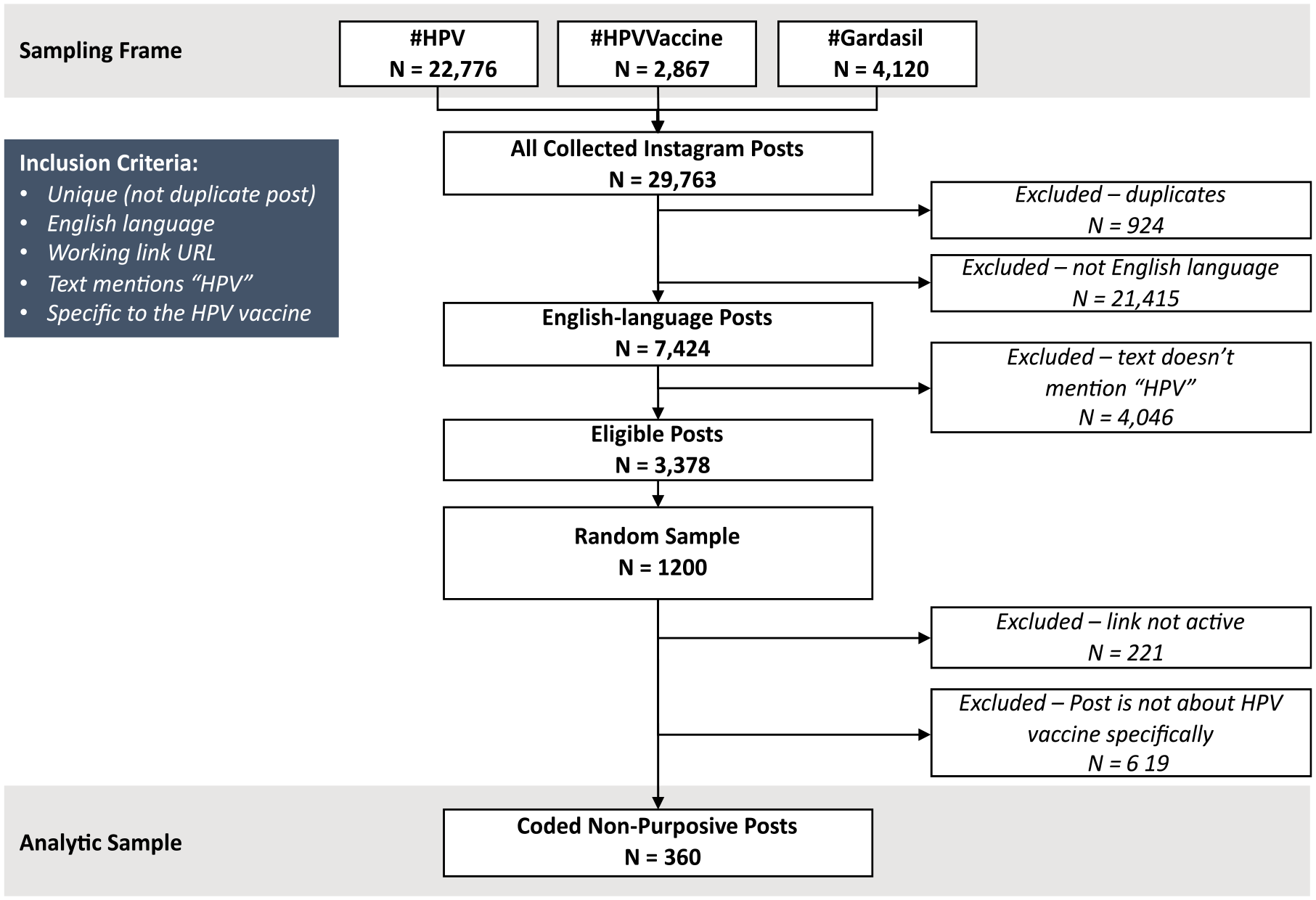
Data collection and sampling strategy
Codebook Development
Informed by prior social media work related to the HPV vaccine (Massey et al., 2016; Massey et al., 2017), we developed a codebook to determine if the post was relevant to the study and categorize aspects of a relevant post’s image, caption text, and user. Posts whose links were no longer active were not coded. Relevant posts mentioned or depicted the HPV vaccine—posts that only discussed HPV, cervical cancer, or vaccines in general were not considered relevant and were not further categorized using the codebook. Post image was coded as imagery (no text), text (no imagery), combination imagery and text, and infographic if it included a design element. Images were coded for number and type of people present, as well as if an image depicted an actual vaccine. Post source (i.e., type of user account) was coded as either “organizational” or “individual” based on their username and profile image. Organizational users included organizations (e.g., @JoCoHealthDept) and groups of users (e.g., @FreedomFaction). User accounts were subcoded as being either “health-related” or “general” (i.e., nonhealth), yielding four total categories of user types. Post context was coded as either personal narrative or information/resource (including misinformation). HPV vaccine sentiments were coded positive/pro-vaccine for promoting receipt of the HPV vaccine (e.g., “Make sure to get the #HPV #vaccine to prevent cervical cancer!”), negative/anti-vaccine for discouraging receipt of the HPV vaccine (e.g., “#Gardasil is truly a disgusting vaccine.”), or neutral/no sentiments expressed if the post took no overt stance toward individuals receiving the HPV vaccine (e.g., “Is #HPVvaccine necessary for your daughter?”). The term sentiments is used to distinguish our qualitative content analysis from machine learning-style sentiment analyses. All coding categories in this study were mutually exclusive.
Coding Process and Analysis
A sample of 52 posts were coded during codebook and protocol development over five iterations by all study authors. Facilitated by NVivo 12 software (QSR International), interrater reliability (IRR) was assessed using the average of pair-wise comparisons for the Kappa coefficient. Given Kappa’s propensity for conservative reliability estimates (McHugh, 2012), percentage agreement was also calculated; percentage agreement is commonly used as a measure of IRR in medical coding, which may be more appropriate for coding of social media posts where entire observations are coded, as opposed to transcript coding, where codes may be applied in more diffuse fashion. Percentage agreement ranging from 97.6% (image type) to 80.1% (HPV vaccine relevance), and average percentage agreement was 89.0% (SD = 4.4%). Kappa scores ranged from .40 (gender of vaccine-eligible individual—“fair” agreement) to .71 (image type—“substantial” agreement), and average Kappa was .52 (SD = .09). IRR metrics indicated moderate to substantial overall agreement (Viera & Garrett, 2005). Discrepancies were resolved by group consensus. On reaching saturation of new coding categories and completing codebook testing, 1,200 posts were randomly sampled and divided among five coders. Examples are provided of posts from organization (Figure 2) and individual (Figure 3) Instagram users, further stratified by vaccine sentiments and context.
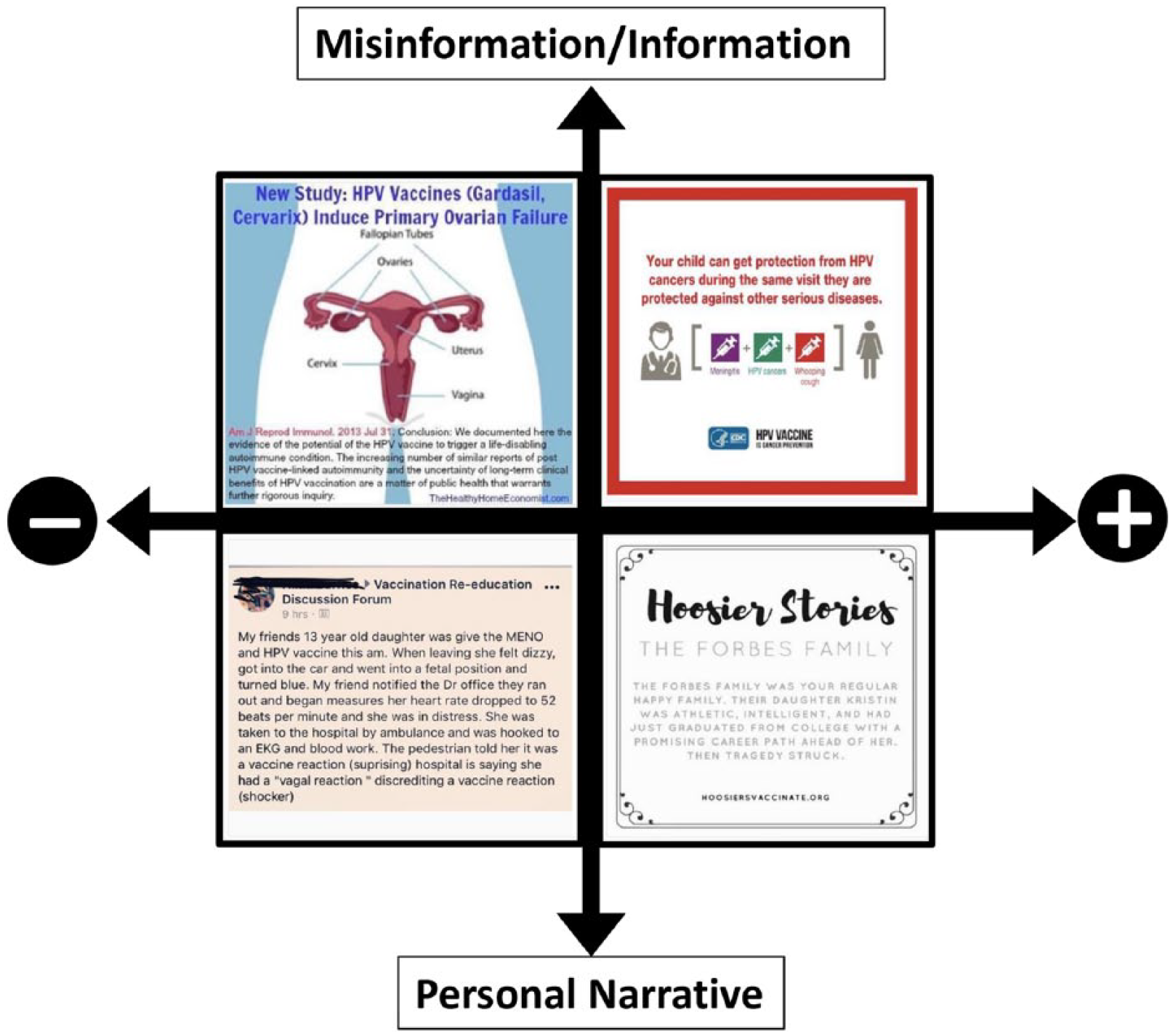
Examples of posts from organizational Instagram users, stratified by post sentiment (x-axis) and post context (y-axis). Includes both health-related and general users.

Examples of posts from individual Instagram users, stratified by post sentiment (x-axis) and post context (y-axis). Includes health-related and general users.
Statistical Analysis
For Research Question 1, qualitative codes were operationalized as categorical variables and descriptive statistics were generated. For Research Question 2, we excluded posts that contained no sentiments toward the HPV vaccine (i.e., neutral, neither pro- nor anti-vaccine; n = 7). Pro- and ant-vaccine posts were cross-tabulated with other post characteristics, and chi-squared or Fisher’s exact tests assessed significant differences. For Research Question 3, we used both parametric (ANOVA/t test) and nonparametric (Wilcoxon rank sum/Mann–Whitney U) statistical analyses to assess differences in, respectively, mean and median like count between post characteristics. Statistical analyses were conducted in SAS Studio 3.7 software (SAS Institute, Inc.).
Results
The final analytic sample comprised 360 unique posts from 292 Instagram users. Of the 1,200 randomly sampled posts, 979 (81.6%) had active links, and one in three (n = 360 out of 979; 36.8% posts with working links) was relevant to the HPV vaccine.
Post Content Characteristics
Most posts (Table 1) included actionable information/resources (64.5%), compared with featuring personal narrative elements (35.5%). Few posts included location (n = 56; 15.6%) or URL links (n = 84; 23.3%). Combinations of text and imagery were most common (n = 124; 34.4%), followed by imagery-alone/no-text (n = 100; 27.8%) and text-alone/all-text (n = 50; 13.9%). Half showed a human face (n = 184; 51.1%) or depicted age-eligible individuals for the HPV vaccine (n = 185; 51.4%). Girls were shown more frequently than boys (47.3% vs. 18.5%). One in five posts depicted the HPV vaccine (e.g., a needle or Gardasil packaging; n = 78; 21.7%), and few included parents/caregiver figures (n = 13; 3.6%) or health care professionals (n = 45; 12.5%).
Frequency and Proportion of Coded Categories From Qualitative Content Analysis (n = 360 Posts).

Note. HPV = human papillomavirus. Cross-tabulations shown for coded categories by posts with HPV vaccine sentiments (n = 353); posts with no sentiment (n = 7) toward the HPV vaccine were excluded. Significant differences between pro- and anti-vaccine posts were assessed using the chi-squared or Fisher’s exact text (α = .05). Categories are shown in descending order by total percent coded.
Pro-vaccine posts were more prevalent than anti-vaccine posts (55.8% vs. 42.2%, respectively). A small number of posts (n = 7; 1.9%) did not express any sentiments toward the HPV vaccine (i.e., neutral sentiments). Compared with pro-vaccine posts, anti-vaccine posts more often included web links (p < .001) and were more likely to omit a user’s location (p < .001). Videos and combinations of text and imagery express significantly more anti-vaccine sentiments than posts that were image-only, text-only, or infographics (p < .001). Posts with faces were more negative than positive (51.1% vs. 48.9%; p = .0052). Images showing males separately or males and females combined were more anti-vaccine than pro-vaccine, and posts with females separately were more commonly pro-vaccine than anti-vaccine (p = .0073). Personal narratives were significantly more anti-vaccine than informational posts (p = .0008).
Post source (Table 2) was split between individual and organizational users (50.1% individual vs. 49.9% organizational). Among organizational users, two in five (43.9%) were health-related; among individual users, less than one in five (15.6%) were health-related. The majority of posts from organizational sources were either pro-vaccine information (55.6%) or pro-vaccine narratives (11.7%), and the majority of posts from individual sources were either anti-vaccine information (27.8%) or anti-vaccine personal narratives (26.0%). Health-related users created significantly more pro-vaccine content than general users, among both individuals (p < .001) and organizations (p < .001), and more than four in five health-related user posts (80.2%) were pro-vaccine information/resources. The majority of posts (59.9%) from general (i.e., nonhealth) sources expressed anti-vaccine sentiments and were split between personal narratives (27.5% of all general source posts) and information/resources (32.4%).
Cross-Tabulations With Row Percentages for Post Source by Post Context and HPV Vaccine Sentiments (n = 353 Posts).

Note. HPV = human papillomavirus. Posts with no sentiment toward the HPV vaccine (n = 7) were excluded. Broad categories (A-D) shown on top, and subcategories shown below. Row percentages sum across “narrative” and “information” columns to 100% for each post source type. Chi-squared or Fisher’s exact tests assessed significant differences in proportions of posts.
Number of Likes
Table 3 describes measures of central tendency and includes both parametric and nonparametric tests of association. We discuss parametric findings in the results but have also included nonparametric in Table 3. The average number of likes was 50 (SD = 130; Table 3). Pro-vaccination posts were liked significantly less than anti-vaccination posts (24 vs. 86 likes; p <.001). Compared with all other post image types, combinations of text and imagery received the highest number of likes (average = 87 likes; SD = 201; p = .0023). On average, posts depicting vaccine-eligible individuals received double the number likes compared with posts not showing vaccine-eligible individuals (71vs. 28 likes; p = .0015). Posts featuring males received significantly more likes than posts depicting females (130 vs. 70 likes; p = .0004). Personal narrative posts received nearly twice as many likes as informational posts (70 vs. 39 likes; p = .0268). Among all types of users, posts from general organizations received the highest number of likes (average = 85 likes; SD = 171; p < .001).
Mean and Median Like Counts by Content Characteristics of Coded Instagram Posts (n = 360).
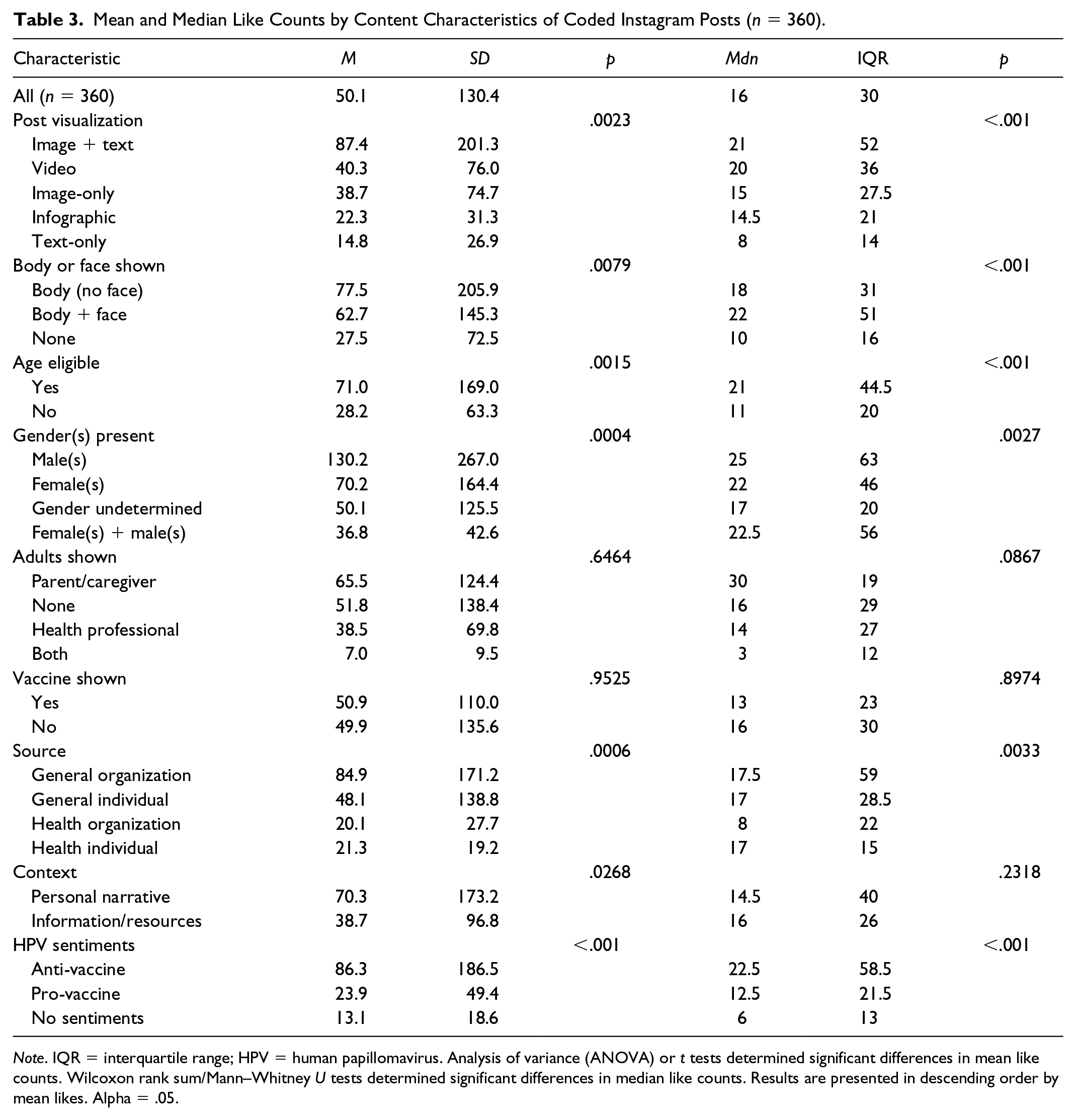
Note. IQR = interquartile range; HPV = human papillomavirus. Analysis of variance (ANOVA) or t tests determined significant differences in mean like counts. Wilcoxon rank sum/Mann–Whitney U tests determined significant differences in median like counts. Results are presented in descending order by mean likes. Alpha = .05.
Discussion
Instagram is a social media platform and health information resource yet to be explored through the lens of HPV vaccine promotion. To the best of our knowledge, this is the first study to characterize HPV vaccine content on Instagram, and one of just a handful of studies analyzing visual and textual HPV vaccine content (Chen & Dredze, 2018; Guidry et al., 2015). We discuss four specific findings: (1) the current state of Instagram content, (2) characteristics associated with more likes on Instagram, (3) Instagram features associated with content credibility, and (4) a role for narrative engagement. These findings have practical and theoretical implications germane to the design of effective health communication content on social media broadly, as well as within the narrow context of Instagram.
Post Content
Information shared about the HPV vaccine on Instagram is largely pro-vaccine and produced by health-related individuals and organizations. Personal narratives about the HPV vaccine skew toward anti-vaccine sentiments, and most are created by general users, including individuals and organizations. Posts that were authored by health-related users were more likely pro-vaccine, for both informational and personal narrative types. Our findings align with previous Instagram analyses reporting that information is shared by mostly non-individual users (i.e., commercial, organizational) relating to hookah pipe use (Ben Taleb et al., 2018) and Zika vaccine uptake (Guidry, Jin, Orr, Messner, & Meganck, 2017).
Post Engagement
Likes are a common social media metric of engagement and reach (Cho et al., 2018; Hong, Chen, & Li, 2017). Through our analysis of likes, we identified several high-engagement post characteristics, adding to a “sparse” body of literature on content characteristics that predict the number of likes (Cho et al., 2018). The prototypic “most popular” post was anti-vaccine, showed a vaccine-eligible male, featured a combination of text and imagery, and included personal narrative. First, negative vaccine sentiment was associated with more likes, similar to previous research demonstrating that “emotionally charged” or overtly negative posts garner more attention (Song & Gruzd, 2017; Stieglitz & Dang-Xuan, 2013). Short of promoting anti-vaccine content, we suggest exploring the impact of negative emotional appeal and how this can be applied constructively toward strengthening HPV vaccine uptake. Next, posts with images of vaccine-eligible individuals, males in particular, and posts that included elements of personal narrative (e.g., Positive: “The HPV vaccine saved my life,” Negative: “Gardasil ruined my daughter’s health”) were associated with more likes. Finally, posts with combination of imagery and text were most popular. A visual combination may increase initial appeal for users who do not read post captions, such as users scrolling through their Instagram feed on mobile devices. If their goal is to create content that collects to more likes, HPV vaccine content creators on Instagram may consider adopting these practices to their current social media roster.
Social Media Content Credibility and Verification
Anti-vaccine posts contained more links than pro-vaccine posts, and pro-vaccine posts provided (i.e., “tagged”) their location more often than anti-vaccine posts. Public relations research suggests that inclusion of diverse social media features increases content consumers’ perceived trust and reliability of users creating posts (i.e., content creators) through implicit suggestion of an online user’s resources and capacity (Kimmons, Veletsianos, & Woodward, 2017; Wirtz & Zimbres, 2018). Users posting anti-vaccine posts may be aware of the deceptive nature of their content and thus seek credibility by incorporating additional social media features, including links. Posts that included locations were rare, but skewed toward pro-vaccine sentiment, suggesting that users creating such content are more transparent regarding their credentials or the origin of their information. Practically speaking, health educators and promoters could frame the absence of available features, such as missing location data, as an indicator of social media misinformation in educational materials for engaged audiences on social media practices. Furthermore, in 2018 Facebook announced that users with “large audiences” must provide their location to be a “verified user account” (Bell, 2018).
In the age of “fake news,” a growing body of literature explores media misinformation—also known as “junk” news (Marchal, Neudert, Kollanyi, & Howard, 2018), or “iffy” news (Resnick, Ovadya, & Gilchrist, 2018). Despite estimates that the majority of Americans receive recommended immunizations (CDC, 2018b), anti-vaccine organizations and individuals are a vocal minority adept at disseminating misinformation with potentially devastating consequences. For example, recent reports suggest anti-vaccine organizations and bots may be leveraging anti-vaccine sentiments to legitimize the vaccine debate and advance anti-vaccination policies among potential voters (Broniatowski et al., 2018; Molteni, 2018). Whether Instagram posts contain science- and/or evidence-based information versus misinformation, they may be taken at face value by even the most skeptical users, consistent with observational learning processes (Bandura, 1986). In the context of the current study, engaged Instagram users may be more likely to believe anti-vaccine misinformation and less likely to seek HPV vaccination, creating an opportunity for social media companies to highlight credibility and transparency of user-generated content.
Until social media companies have the ability to reliably identify “iffy” content about HPV vaccination, health communications campaigns should convey their organizational credibility and trustworthiness by taking advantage of existing social media features, including location and other platform credentials. Increasingly, platforms have adopted additional vetting processes to verify user identities and provide verified users with visual “badge” icons (Facebook, 2013; Twitter, 2016). On Twitter, unverified users have been shown to post more polarizing and anti-vaccine content (Broniatowski et al., 2018). In August 2018, after data collection for concluded for the current study, Instagram introduced user verification badges as one of several tools to increase the perceived credibility of user posts (Instagram, 2018). While Instagram badges did not exist during our study time frame, future research may consider exploring their role in social media behaviors.
When anti-vaccine misinformation makes demonstrably false or fraudulent claims, such content may be removed. Instagram is owned and operated by Facebook. As of April 2019, Facebook is one of several social media platforms—including YouTube, Amazon, Pinterest, and Twitter—that are considering and implementing stronger enforcement mechanisms for regulating the prevalence and reach of misinformation on their platforms (Dickson, 2019). Social media platforms are private entities, and not public spaces, and therefore users’ freedom of speech rights are superseded by their consenting to Facebook’s terms of service, which grant Facebook absolute permission to remove content for any reason, or no reason at all (Crews, 2003; Facebook, 2018). And as private entities, social media platforms have rights that protect their ability to filter—and not censor—content from their platforms (Goldman, 2018). Social media users have the right to share their views and opinions, but they also have the choice to not use Facebook or Instagram (or other social media platforms) if they want to share fraudulent or inaccurate content.
Communicating HPV Vaccine Information Through Narrative
On Instagram, HPV vaccine information was mostly positive and pro-vaccine, but personal narratives were decidedly more negative and anti-vaccine. Content creators from all backgrounds seeking to promote the HPV vaccine on Instagram should consider how their posts compare to existing content and how to effectively share their message if the goal is ultimately increasing rates of HPV vaccination. We propose that positive posts continue to provide the necessary information and evidence to advance HPV vaccination uptake, and also that this information be communicated more often through the narrative lens. That is, more elements of narrative storytelling could be integrated with externally directed health communication materials, such as highlighting individuals, families, and communities, and their stories. Integrating narrative into Instagram posts that focus on evidence-based HPV vaccine information may increase post popularity, through likes and shares, but also further engage parents or caregivers and lead to pro-vaccine decisions. In his book Contagious: Why Things Catch On, Jonah Berger (2016) identifies storytelling as one of six factors that make social media trends go viral. Given that posts featuring personal narratives and vaccine-eligible boys and girls received significantly higher numbers of likes than other types of posts, narrative-focused posts offer both an explanation for our findings and a justification for our practical recommendations. This approach is aligned with the long tradition of the application of narrative engagement in health promotion activities (Kreuter et al., 2007; Murphy, Frank, Chatterjee, & Baezconde-Garbanati, 2013; Rimer & Kreuter, 2006).
One of the great risks of Instagram posts, and social media in general, is that content may be perceived as more credible because it includes images and stories of people that content consumers can readily relate to and trust, even if the information presented is false or misleading. Our study identified an opportunity to create pro-HPV vaccine narratives that could be disseminated broadly as a mechanism to counter the prevalence of anti-HPV vaccine narratives. Testing and evaluation of narrative-based health communications on social media may be a promising direction for public health advocates to create counternarratives to anti-vaccine misinformation while increasing uptake of the HPV vaccine.
Limitations
Social media engagement metrics are typically right-skewed because very a small number of posts receive a disproportionate amount of user engagement, such as likes or comments (Hong et al., 2017; Wang, Callan, & Zheng, 2015). Our use of random sampling may have biased our sample toward typical versus high engagement posts, based on number of likes (mean = 50 likes; median = 16). However, our study sought to create findings that were generalizable to all Instagram posts, regardless of popularity. Future research may choose to focus specifically on high engagement posts and exclude typical/low engagement posts. We also used both nonparametric and parametric statistical analyses to demonstrate the right-skewed nature of likes. “Viral” posts with extremely high numbers of likes may be limited in volume yet their reach is expansive, and nonparametric analyses dampen this important and ever-present social media phenomenon by obscuring posts that may be statistical outliers. Post characteristics that were most skewed for number of likes may indicate factors associated going “viral” on social media. For example, personal narratives, or stories, have been previously associated with viral posts on social media (Berger, 2016), and posts with personal narratives were heavily right-skewed in our study sample.
We comprehensively coded a corpus of posts relevant to the HPV vaccine and identified significant findings, yet a larger sample may have provided additional statistical power and led to additional or different results. That said, the 360 posts that we coded represented more than 10% of eligible posts, exceeding sampling ratios observed for Twitter analyses (Wang et al., 2015), and is comparable to sample sizes analyzed in recent Instagram content analyses (Barry et al., 2018; Ben Taleb et al., 2018; Cho et al., 2018). Finally, while we did not seek to identify, nor did we identify, social media bots among Instagram users in our sample, future studies may consider how best to identify bots and characterize their impact on general social media discourse related to the HPV vaccine.
Conclusion
On Instagram, discussions about HPV vaccination are often characterized by emotionally charged expressions of personal beliefs, personal narratives, information, and misinformation. Pro-vaccine posts are more prevalent on Instagram, and anti-vaccine posts have higher engagement. We found that personal narratives about HPV vaccination were more likely to promote anti-vaccine sentiment and were produced more often by individual users who were not health-related or health professionals. At the same time, we observed that posts from health-related sources were predominantly in favor of the HPV vaccine, but posted pro-vaccine personal narratives far less often than information or resources. Pro-vaccine narratives tended to show individuals who had recently received the vaccine, but rarely provided long-term details about their experience with vaccination, such as recognition or appreciation of an individual’s personal role in life-long cancer prevention, highlighting stark contrasts with the depth and scope of details included in anti-vaccine personal narrative posts.
Within the context of HPV vaccination, our research contributes meaningfully to gaps in the study of misinformation on social media (Chou et al., 2018) by offering an estimate for the prevalence of misinformation on Instagram, as quantified by the proportion of anti-vaccine posts, and we also identified important characteristics of misinformation-containing anti-vaccine posts. More broadly, by equipping pro-vaccine advocates with concrete recommendations to improve the engagement, via likes, of their Instagram content, our findings may apply to combatting vaccine hesitancy in general, an emerging and global health threat identified recently by the World Health Organization. In comparison to other social media platforms, such as Pinterest (Guidry et al., 2015) and YouTube (Basch et al., 2017), Instagram posts were more evenly divided between pro- and anti-vaccine expressions, creating an opportunity for pro-vaccine individuals and organizations to promote HPV vaccination through the use of effective content, such as narrative-style posts. With sufficient resources, organizations such as patient advocacy groups, health departments, and government agencies could create a portfolio of positive pro-vaccine narratives with accompanying visuals (e.g., photo) to disseminate, filling an essentially unoccupied field of Instagram content.
Footnotes
Declaration of Conflicting Interests
The authors declared no potential conflicts of interest with respect to the research, authorship, and/or publication of this article.
Funding
The authors disclosed receipt of the following financial support for the research, authorship, and/or publication of this article: This study was supported by funding provided by the National Cancer Institute (Grant ID: 3P30CA056036-18S3).
Supplement Note
This article is part of the Health Education & Behavior supplement issue, “Advancing the Science and Translation of Digital Health Information and Communication Technology.” The printing and dissemination of the supplement was supported by the Office of Behavioral and Social Sciences Research, National Institutes of Health (Contract No. HHSN276201800167P). No federal funds were used in the development of these supplement manuscripts, and the views and findings expressed in them are those of the authors and are not meant to imply endorsement or reflect the views and policies of the U.S. Government. The entire supplement is available open access at  .
.