



Abstract
The public increasingly searches for and discusses health information online, but few studies have examined breast cancer–related posts on visual social media platforms. To shed light on cancer-focused posts on the visual social media platform Pinterest, this study analyzed a random sample of 476 breast cancer–related posts (also referred to as “pins”). Using a quantitative content analysis, pins were coded for type of visual and textual information included and user engagement with pins (i.e., frequency of repins and comments). This novel research supports the current use and potential future utility of Pinterest as a venue for health communication related to breast cancer. Study results have important implications for the development of future health promotion programs on Pinterest aimed at reducing breast cancer risk among women.
Keywords
Prior research suggests that people seeking cancer-related information frequently use the Internet (Huerta, Walker, Johnson, & Ford, 2016; Shea-Budgell, Kostaras, Myhill, & Hagen, 2014). Cancer survivors report the Internet as their second most trusted source of cancer information after their health care professional (Shea-Budgell et al., 2014). With social media growing as a preferred method of communication and potentially playing a more significant role in health information–seeking behaviors, it is important to better understand the specific information and discussions occurring on social media as they relate to health (Moorhead et al., 2013; Xiao, Sharman, Rao, & Upadhyaya, 2014). A better understanding of disease-specific public conversations on social media and how this health information spreads could be useful in informing both preventative and risk communication strategies.
Within the broad area of cancer prevention and control, there has been an increasing interest in better understanding how social media might be leveraged to improve survivorship or as a means of improving risk communication. For instance, a study of Twitter dialogues related to lung cancer clinical trials found that while some posts related to clinical trials (18%), a higher proportion of content was related to lung cancer prevention (28%; Sedrak, Cohen, Merchant, & Schapira, 2016). With regard to breast cancer, social media research has primarily examined treatment and social support (Attai et al., 2015; Xu et al., 2016). A reason for focusing on social support is because it has been linked to health-promoting characteristics (Uchino, 2006) and breast cancer–related outcomes, including higher quality of life (Mols, Vingerhoets, Coebergh, & van de Poll-Franse, 2005), shorter episodes of anxiety and depression (Burgess et al., 2005), and lower mortality rates (Kroenke, Kubzansky, Schernhammer, Holmes, & Kawachi, 2006). Social media may increase perceived social support and interconnectivity among individuals (Moorhead et al., 2013). While many breast cancer survivors do not attend traditional support groups, cancer survivors are likely to use an online support group (Chou, Hunt, Beckjord, Moser, & Hesse, 2009). Evidence suggests that social media may help fill gaps in supportive care for breast cancer survivors (Bender, Katz, Ferris, & Jadad, 2013). Whether social support is present on breast cancer–related posts on Pinterest and, if so, what types of social support are present is not known.
Of note, the few social media studies on cancer survivorship and risk communication have primarily focused on Facebook and Twitter, with less work directed at understanding newer, visual-based social media platforms such as Pinterest and Instagram (Falisi et al., 2017; Moorhead et al., 2013; Strekalova & Krieger, 2017). This is likely due in part to the age and popularity of Facebook and the relative ease of data collection on Twitter through their application programming interface (a set of functions allowing the creation of applications aid in the collection of social media posts, among other things). Another possible explanation for the lack of health research on Pinterest is that public health researchers may dismiss the platform because it is known as a source for viewing images (i.e., pretty and/or inspirational pictures) and accessing information on special interests (e.g., hobbies, recipes, and home décor; Gilbert, Bakhshi, Chang, & Terveen, 2013; Statista, 2017). However, the use of visual-based social media platforms is rapidly expanding (Pew Research Center, 2018), and researchers have begun to examine health topics on Pinterest, including vaccines (J. P. Guidry, Carlyle, Messner, & Jin, 2015), chronic obstructive pulmonary disease (Paige, Stellefson, Chaney, & Alber, 2015), and depression (J. Guidry, Zhang, Jin, & Parrish, 2016). Thus, expanding research to include visual-based social media platforms could provide a more complete understanding of the role that social media might play within the field of cancer prevention and control.
Pinterest is a visual social media platform that allows people to collect visual bookmarks (i.e., “pins”) containing ideas and information on different topics and interests. Pinterest users create collections (i.e., “boards”) to file pins containing information, ideas, images, quotes, and so on. Measures of engagement with posts are critical to understanding how information is spread on social media and informing the development of health promotion campaigns. As in other social media platforms, pins and boards are easily shared through “repinning” or “saving.” Pinterest users can also comment on pins.
As of late 2017, Pinterest had grown to more than 200 million users (Pinterest, 2017), including roughly one third of all Caucasian and one quarter of all African American and Hispanic adults in the United States (Pew Research Center, 2018). The Pinterest user base consists of more than 80% women (Omnicore, 2019). To our knowledge, only two studies to date have examined cancer conversations on Pinterest (Park, Tang, Bie, & Zhi, 2018; Tang & Park, 2017). The earlier study conducted a quantitative content analysis of the textual information about skin cancer on Pinterest. In this study, the majority of pins were informative and mentioned treatment, especially alternative therapies, in 30% of pins. Skin cancer causes, such as sun exposure and tanning beds, and prevention methods were mentioned less frequently. Highly repinned posts were examined descriptively and were found to be more information dense than other posts. Using the same sample of skin cancer pins, the latter study explored information richness and visual characteristics (e.g., whether the pin depicted a person or fear-invoking image) as predictors of user engagement with skin cancer pins. Results of this study revealed different predictors of participant engagement with pins, including a positive association between information richness and the number of repins in three out of four models assessed. Nevertheless, despite the growing consumer popularity of Pinterest, few studies have evaluated cancer prevention and control topics on this newer social media platform.
With its predominantly female user base, Pinterest may provide a useful context to explore breast cancer conversations and, ultimately, a channel to disseminate preventive messages. Furthermore, understanding more about how cancer-related content is shared on Pinterest is important because visual information is processed differently than text (Smith, Moriarty, Kenney, & Barbatsis, 2004). For example, visual communication leads to better attention to and recall of health information, especially among individuals with low health literacy (Houts, Doak, Doak, & Loscalzo, 2006)—thus making it a particularly appealing platform to reach individuals from all literacy levels.
This content analysis of the public’s voice on Pinterest examined constructs of the health belief model (HBM). The HBM is a well-known and commonly used health behavior theory focused on six constructs to explain a variety of long- and short-term health behaviors (Janz & Becker, 1984) that has been widely used to guide health promotion interventions, including cancer prevention and education programs (Carpenter, 2010; Glanz, Rimer, & Viswanath, 2015). The underlying premise of the HBM is that those who believe themselves to be at risk (i.e., perceived susceptibility) for a serious health threat (i.e., perceived severity) will take preventive actions to reduce the threat if perceived benefits outweigh the perceived barriers. Furthermore, the model posits that the balance of benefits and barriers can be tipped in favor of behavioral change when self-efficacy to overcome barriers is increased and cues to action are provided. In the context of breast cancer, interventions based on the HBM have been effective in improving knowledge about prevention and health beliefs related to mammography screening (Hyman, Baker, Ephraim, Moadel, & Philip, 1994; Myers et al., 2007).
To further expand our understanding of the role of visual-based social media platforms on cancer-related health communication, this study sought to address three primary questions: (1) Who is pinning and what is the content of breast cancer posts on Pinterest, and how do users engage with these messages?, (2) How are health belief model constructs portrayed in breast cancer–related Pinterest content, and how do users engage with these messages?, and finally, (3) How are breast cancer–related messages visualized on Pinterest, and how do users engage with these messages? Characterization of Pinterest posts about breast cancer, including the presence of information across the cancer control continuum, content related to social support, and the frequency of information related to modifiable risk and protective factors, could be useful in addressing a gap in the literature on social media and cancer prevention and control. In addition, an analysis of engagement with breast cancer–related content and message characteristics (e.g., message framing and visual type) could help inform the development of health promotion programs aimed at reducing risk among women.
Method
In the summer of 2017, a sample of 500 breast cancer–related Pinterest posts (referred to as “pins”) were collected from a single search using the keyword “breast cancer.” The selection of 500 pins is consistent with other health-related Pinterest content analyses (Carlyle, Guidry, & Burton, 2018; Guidry et al., 2015; Paige et al., 2015; Wilkinson, Strickling, Payne, Jensen, & West, 2016). After setting the keyword for “breast cancer,” a random number generator was used to select a starting point for the collection between 1 and 10. To approximate systematic random sampling, once the first pin was selected, every fifth pin was collected until the full sample was reached. This manual collection took place over a 2-day period. However, because Pinterest does not list pins chronologically, we were able to collect a broader sample of posts compared with other social media platforms using a similar timeframe. Among the pins collected, 24 (5%) were excluded as ineligible or duplicates. Using a quantitative content analysis, the remaining 476 pins were analyzed, focusing specifically on the type of visual and textual information included as well as user engagement (i.e., frequency of repins and comments). All pins were publicly available and no personal health information was collected; therefore, the study was considered “exempt” from institutional review board review.
Content Analysis Categories
The codebook included four main categories of codes pertaining to (1) poster characteristics, (2) pin content, (3) visual characteristics of pins, (5) constructs of the health belief model, and (6) post engagement. A comprehensive list of codes is provided in Table 2 and Tables 4-5.
Poster Characteristics
Data were collected on the identity of the poster. Pinner identity was coded according to the following subcategories: (1) individual, (2) commercial entity, (3) public health/nongovernmental organization, (4) government, (5) pharmaceutical company, (6) other, and (7) unknown or unable to determine. Information was also collected regarding whether the post linked to an external website and if so, characteristics of the associated website were recorded.
Pin Content
Pin content was coded for applicability to phases of the cancer continuum (i.e., prevention, screening, diagnosis, treatment, and survivorship). These five categories were not mutually exclusive. References to three types of social support were coded as present or absent (i.e., emotional, informational, and instrumental; Gottlieb & Bergen, 2010). Emotional social support conveys that a person is esteemed and accepted and may involve, for example, listening to and comforting someone, whereas informational support is help in defining, understanding, and coping with problematic events (Cohen & Wills, 1985). Instrumental support refers to assistance with financial or tangible needs, such as household chores. Cancer survivors are likely to look to the Internet for emotional and informational support (Hong, Pena-Purcell, & Ory, 2012), and furthermore, instrumental support could be vital to the needs of cancer patients (e.g., transportation to medical visits). Codes for social support were not mutually exclusive. Pins were coded for whether they met each of the following criteria: focused on educational content (e.g., information on “What you should know about breast cancer”), mentioned the word awareness explicitly, provided support or encouragement explicitly (e.g., an image of “Rose the Riveter” and the pink awareness ribbon, along with the phrase, “We can do it”), or contained slogans (e.g., “Save the tatas”), inspirational quotes (e.g., “Never underestimate the power of a woman”), or alternative language for breasts (e.g., “boobies” or “hooters”). Finally, messages were coded (present vs. absent) for episodic or thematic framing. Episodic frames present an issue by offering a specific example or experience (e.g., a firsthand narrative about one’s cancer journey), while thematic frames place issues into a broader context (e.g., cancer facts and statistics; Gross, 2008). Message framing was not mutually exclusive; pins could contain both episodic and thematic framing.
Visual Characteristics of Pins
The visual type of pins was coded as one of the following: (1) primarily text, (2) primarily image, (3) mixed image (i.e., containing both text and image), (4) infographic, (5) drawing, and (6) video. The presence/absence of specific visual content (i.e., the color pink, the awareness ribbon, a breast image or anatomical diagram, and the characteristics of individuals depicted) was also coded.
Health Belief Model
Pinterest posts were coded for each of the six constructs of the health belief model (present vs. absent). Specifically, posts containing content on the severity/seriousness of breast cancer (e.g., side effects of treatment or mortality rates) and susceptibility (e.g., “Breast cancer is the most common cancer in women worldwide”) were identified. The presence/absence of content on benefits (e.g., the benefits of a prevention method or early detection), barriers (e.g., self-care challenges or barriers to treatment), cues to action, and self-efficacy were also coded for each of the following breast cancer–related areas: (1) prevention, (2) screening, (3) diagnosis, (4) treatment, (5) survivorship, and (6) self-care. Codes for HBM constructs were not mutually exclusive. For example, a pin could provide prevalence rates (i.e., susceptibility) and both information to boost self-efficacy for screening (e.g., “Everything you need to know about mammograms”) and a cue to action (e.g., “Talk to your doctor about getting screened today”).
Engagement With Posts
Engagement is an important indicator of performance and describes the audience’s participation with the content. The frequency of comments and repins of each post were used to assess engagement.
Intercoder Reliability
Coding protocols were developed a priori, then tested and revised, prior to being fully implemented. The initial training session took place in person, and additional discussions took place by phone. In all, five training and revision sessions were held to review codes and establish intercoder reliability between two coders. After coding three sets of five pins and discussing any discrepancies, both coders analyzed the first 10% of the sample (n = 50) using the revised coding scheme. The intercoder reliability test using the ReCal statistical program showed an average Scott’s Pi (Scott, 1955) of 0.78. All coefficients were considered to be reliable (Table 1). For the remainder of the sample, each coder analyzed 50% of the remaining posts (n = 213).
Scott’s Pi Values.

Results
Pinner Identities and Content of Breast Cancer–Related Pinterest Messages
As shown in Table 2, the majority of posts were published by individuals (68.7%, n = 327) and linked to an external website (77.7%, n = 370). Eleven percent were posted by a commercial entity, while less than 10% were posted by either a public health organization or government agency. The linked website was usually an official medical website (40.3%, n = 149) or a blog (37.0%, n = 137). Twenty-three percent (n = 107) of the time, the actual detailed post content was available in the linked website only; for example, the post contained the headline, “Tips for Preventing Breast Cancer,” but a user had to visit the website to read the tips.
Pinterest Poster and Pin Descriptives.
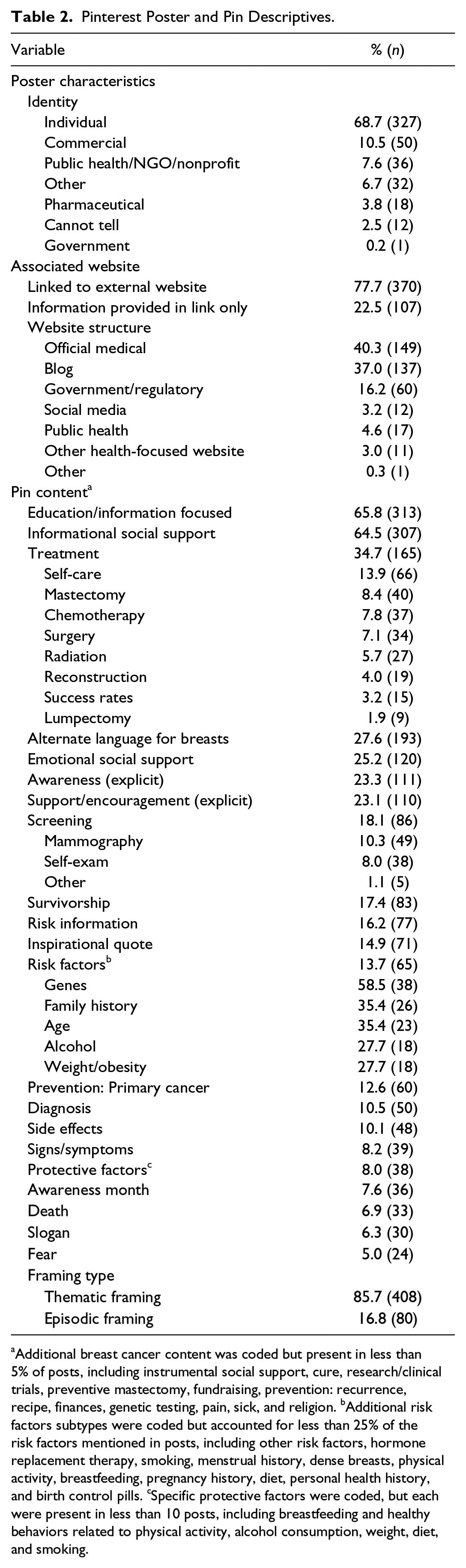
Additional breast cancer content was coded but present in less than 5% of posts, including instrumental social support, cure, research/clinical trials, preventive mastectomy, fundraising, prevention: recurrence, recipe, finances, genetic testing, pain, sick, and religion. bAdditional risk factors subtypes were coded but accounted for less than 25% of the risk factors mentioned in posts, including other risk factors, hormone replacement therapy, smoking, menstrual history, dense breasts, physical activity, breastfeeding, pregnancy history, diet, personal health history, and birth control pills. cSpecific protective factors were coded, but each were present in less than 10 posts, including breastfeeding and healthy behaviors related to physical activity, alcohol consumption, weight, diet, and smoking.
Table 2 also contains a comprehensive list of the breast cancer–related content coded. The most common breast cancer content present in posts was related to education/information (65.8%, n = 313), informational social support (64.5%, n = 307), and treatment (34.7%, n = 165). Approximately one quarter of posts contained an alternative term for breasts, such as “tatas” and “boobies” (27.6%, n = 193); emotional social support (25.2%, n = 120); explicit language related to awareness (23.3%, n = 111); and support/encouragement (23.1%, n = 110). Other less common, but nonetheless frequently occurring, content included screening (18.1%, n = 86), and survivorship (17.4%, n = 83), risk information (16.2%, n = 77), and inspirational quotes (14.9%, n = 71). Information related to risk and protective factors was somewhat common (13.7% and 8.0% of posts, respectively). Pins containing slogans (e.g., Race for the Cure) were infrequently present (6.3%, n = 30). Recipes were present in a nominal number of posts (1.5%, n = 7). Finally, most posts utilized thematic framing (85.7%, n = 408). For instance, a thematic pin may provide a summary of mammography screening guidelines. On the other hand, 16.8% (n = 80) contained episodically framed content (e.g., a personal account of one’s experience with chemotherapy).
Engagement variables were not normally distributed, and thus, we report the median. The median number of repins within the sample was 177.0, and the median number of comments was 0.0. Mann-Whitney U tests found that repin frequencies were statistically significantly higher in posts that mentioned other terms for breasts (p = .003), contained an inspirational quote (p = .023) or slogan (p=.003), specific treatment components (e.g., chemotherapy [p = .014], radiation [p = .041], and treatment self-care [p = .042]), and emotional social support (p = .047). See Table 3 for complete significant results. Kruskal Wallis tests were executed to test for differences in engagement between different types of Pinterest poster identities (i.e., the individual or entity that created the post). There was a significant difference based on visual type for repin frequency, χ2(6) = 14.415, p = .025, with posts published by public health/nonprofit entities yielding a higher median number of repins (442.50, p = .049) than posters whose identity could not be confirmed (Mdn = 50.50).
Dichotomous Independent Variables and Median Engagement on Pinterest.

Note. Significant results for variables with less than five observations were not reported.
Health Belief Model Constructs on Pinterest
As depicted in Table 4, content related to the severity of and susceptibility to breast cancer was relatively common (21.2%, n = 101, and 20.2%, n = 96, respectively). The frequency of information related to each of the remaining HBM constructs was coded for the following subareas: prevention, screening, diagnosis, treatment, survivorship, and self-care. For example, the most frequent benefits mentioned were related to self-care (8.8%, n = 42), prevention (4.8%, n = 23), and screening (5.0%, n = 24). Similar results were present regarding self-efficacy (self-care [9.2%, n = 44], prevention [6.7%, n = 32], and screening [5.5%, n = 26)]) and cues to action (self-care [17%, n = 81], prevention [7.1%, n = 34], and screening [13.0%, n = 62)]). Barriers related to breast cancer were not often referenced in posts. Mann-Whitney U tests indicated that repin frequencies were significantly lower for pins that mentioned a cue to action for diagnosis (p = .045). None of the other constructs of the health belief model were associated with differences in engagement.
Health Belief Model Descriptives.

Visual Characteristics of Breast Cancer–Related Pinterest Messages
Table 5 shows the visual characteristics of posts. The visual type of posts was most often mixed—including both text and an image (35.1%, n = 167), followed by infographics (27.7%, n = 132), and primarily text (23.5%, n = 112). The color pink (59.9%, n = 285) and the breast cancer awareness ribbon (35.7%, n = 170) were frequently present. An image of a person was represented in one quarter of the posts (25.0%, n = 119). The person visualized was usually an adult, Caucasian female, although a minority was represented in 14.3% (n = 17) of the posts portraying a person. Mann–Whitney U tests showed that pins using the color pink were significantly more likely to be repinned (p = .002). None of the other visual characteristics were associated with significant differences in engagement. Kruskal–Wallis tests were carried out to test for differences in engagement between different visual types. There was a significant difference based on visual type for repin frequency, χ2(5) = 27.264, p < .001, with both infographics and mixed visuals (text and image) yielding a higher median number of repins (199.00 and 253.00, both p < .001) compared with visuals consisting of primarily an image (Mdn = 53.00). In addition, there was a significant difference based on visual type for comment frequency, χ2(5) = 18.414, p = .002, with drawings associated with a higher median comment frequency (1.00) than either visuals consisting of primarily image (0.00, p = .044) or primarily text (0.00, p = .045).
Visual Characteristics of Breast Cancer–Related Posts on Pinterest.

Note. Categories under person present heading are not mutually exclusive due to the presence of multiple people in posts. Thus, frequencies of categories do not sum to total number of posts containing a person.
Discussion
This study focused on how the public discusses breast cancer on the visual social media platform Pinterest. Analyzing over 475 pins, our results overall showed that the majority of breast cancer–related messages contained information-dense visuals posted by individual Pinterest users. Furthermore, results revealed that information-rich visuals were more likely to be repinned than posts consisting primarily of an image. Findings such as this support the use of visually rich information in public health messaging on visual-based social media platforms, such as Pinterest, to achieve greater dissemination of the message. Pinterest also provides a venue for conducting “social listening” studies to examine individuals’ perspectives related to health (Cole-Lewis et al., 2015). Analyzing posts on Pinterest may be a useful first step to developing evidence-based media campaigns focused on improving breast health. To date, this social media platform has been overlooked within the growing literature base examining social media and health. For breast cancer messaging, this is unfortunate since nearly 80% of Pinterest users are women and thus, this medium would be ideal for promoting health messaging targeting women’s health. To our knowledge, this is the first study to analyze breast cancer messaging on Pinterest.
Results related to the first research question regarding pinner identities and content of messages revealed that individuals are the primary voice of breast cancer–related Pinterest posts; only a small number were created by public health and government organizations. This finding highlights that public health organizations may have a unique opportunity to engage the large Pinterest user base with evidence-based risk communication messaging. There were minimal posts containing trivial content (e.g., recipes and slogans). Consistent with prior research on skin cancer and Pinterest, a high proportion of educational posts were identified, but this study on breast cancer pins had a higher proportion of pins consisting of infographics, an information-dense visual type (27.7% compared with 6.9%; Park et al., 2018). Compared with the study by Tang and Park (2017), the present study had a higher proportion of primarily text visuals and a lower proportion of primarily image visuals. Taken together, these results suggest that the breast cancer conversation currently present on Pinterest contains more than just superficial content and inspirational images, and provides support for Pinterest as a possible channel for promulgating health education and promotion.
Results of the second research question regarding the presence of the theoretical constructs of the Health Belief Model were relatively similar to prior research focused on skin cancer (Tang & Park, 2017). The proportion of pins referencing susceptibility and severity related to breast cancer was highest among the HBM constructs and was similar to other research on Pinterest examining vaccine and diet-related content (J. P. Guidry et al., 2015; Wilkinson et al., 2016). Compared with these studies, however, the present study had less content coded for benefits and barriers. In addition, relatively few posts referred to self-efficacy and cues to action. Collectively, this provides a somewhat concerning picture, because in order to take a recommended action on a health issue (e.g., get a mammogram), both perceived threat as well as self-efficacy for the preventive behavior are necessary. Messages that contain primarily perceived threat components (i.e., severity and susceptibility) are more likely to result in people ignoring the message and not adhering to the recommendation.
Finally, the third research question explored the visual characteristics of posts and found that the majority of posts contained rich visual content (e.g., infographics and posts including both text and an image) and common breast cancer awareness components (e.g., the color pink and pink awareness ribbon). Messages including rich visual content were associated with higher engagement, as were messages that included the color pink. The presence of a person (i.e., image of a body showing a face) in the visual image in this sample of breast cancer pins was greater than prior research examining skin cancer pins (25.0% vs. 13.6% of pins, respectively; Park et al., 2018). Within both studies, the person depicted in the visual was predominately Caucasian in appearance. This lack of diversity may limit the acceptance and impact of messages among the racially diverse Pinterest user base.
Social media, while still a newer communications method, has shown promise in the area of health communication—e.g., more available, shared, and tailored information; increased levels of social support; and public health surveillance (Moorhead et al., 2013). On the other hand, there are some apparent pitfalls to health communication on social media, most distinctly the presence and spread of misinformation (Chou, Oh, & Klein, 2018). Chou and colleagues recently highlighted two primary areas for future study: evaluating potential links between exposure to misinformation and health behaviors as well as a need to help clinicians identify and respond to patients’ misconceptions. It is notable that while the focus of this study did not explicitly attempt to code messages that were false or misleading, we did not see instances of this in our review. Given the potential for viral “fake” messaging on social media platforms, continued research is needed in the area of cancer to evaluate the potential for misinformation.
By focusing on a platform that has been understudied, this study provides formative insights and a foundation for other researchers to build on. Our analysis of engagement with breast cancer–related pins indicated several message components that may serve to increase pin engagement. In particular, health information could be paired with an alternative term for breasts, the color pink, and either an inspirational quote or slogan to increase engagement by other Pinterest users. Posts including information on treatment, especially related to chemotherapy, radiation, and self-care during treatment, will likely yield higher engagement relative to posts that do not contain this content. Posts with a visual type of either mixed (i.e., both text and image) or infographic and those containing elements of emotional social support were also associated with higher repin frequency.
Strengths and Limitations
This research is among the first studies to explore cancer communication on a visual social media platform. The high proportion of female users of Pinterest made this platform an appropriate forum to explore breast cancer discussions. This research was strengthened by examining the conversation through the lens of a health behavior theory. However, this study was focused on a single cancer type and social media platform. Future research is needed to continue the exploration of cancer communication focused on other cancer types and include other visual social media platforms such as Snapchat and Instagram. Next steps for research on cancer communication on visual social media include conducting a more detailed, qualitative content analysis, as well as examining the visual and textual content of posts separately. Future research should also consider utilizing a theoretical background other than the health belief model, such as the social ecological model, visual communication theory, or the theory of planned behavior. Finally, there are limitations to the study’s sampling method, since Pinterest does not make its application programming interface publicly available. The manual collection method used in this paper has limitations, both because a complete list of the population is not available, and because the sample was selected from a search powered by Pinterest’s algorithm, which may mean that popularity and other factors have played a role in the ultimate sample selection (Pinterest, 2014).
Conclusion
In conclusion, findings from this study provide insights for public health researchers about communication related to breast cancer on the visual social media platform Pinterest. In particular, the results support the use and potential utility of Pinterest as a source of information on breast cancer. While Pinterest is often considered a platform primarily used for searching recipes, decorating ideas, and travel destinations, this study encourages an increased presence by public health organizations in breast cancer–related conversations on the platform. This would serve to enhance the quality and credibility of available information, which may be particularly important given the higher level of engagement with information-rich posts. To increase public awareness and knowledge of risk-reducing behaviors in the Pinterest population, public health organizations and health professionals should consider providing more information on risk and protective factors and include specific content from evidence-based theories of risk communication and behavior change. Seemingly superficial communication tactics such as using the color pink in visuals may prove useful to elicit message engagement. Particular care should be taken to include a broader cultural representation in breast cancer–focused visuals. Taken together, this review of content and engagement with breast cancer–related posts provides novel information on the nature of health communication on Pinterest and affords an imperative first step in informing Pinterest-based breast cancer health promotion programs. Future research is needed to develop effective messages for public health organizations to use and participate in the conversation.
Footnotes
Declaration of Conflicting Interests
The authors declared no potential conflicts of interest with respect to the research, authorship, and/or publication of this article.
Funding
The authors disclosed receipt of the following financial support for the research, authorship, and/or publication of this article: Financial support was provided in part to the corresponding author (C.A.M.) by a Graduate Training in Disparities Research award GTDR14302086 from Susan G. Komen and a National Cancer Institute T32 award (2T32CA093423).
Supplement Note
This article is part of the Health Education & Behavior supplement issue, “Advancing the Science and Translation of Digital Health Information and Communication Technology.” The printing and dissemination of the supplement was supported by the Office of Behavioral and Social Sciences Research, National Institutes of Health (Contract No. HHSN276201800167P). No federal funds were used in the development of these supplement manuscripts, and the views and findings expressed in them are those of the authors and are not meant to imply endorsement or reflect the views and policies of the U.S. Government. The entire supplement is available open access at  .
.