




Abstract
Most of the health interventions designed to increase athletes’ reporting of potential concussion symptoms have focused only on the individual athlete. Unfortunately, interventions targeted at athletes’ knowledge and understanding of concussion risk has not reliably increased their reporting behavior, leading to increased calls for “changing the culture of concussion reporting.” To date, no studies have examined the role of organizational safety climate has on concussion-symptom reporting behavior. We hypothesized that players’ perception of organizational safety climate would be indirectly related to their concussion symptom reporting intentions, via the influence of safety culture on supportive social norms and self-efficacy, two well-known predictors of concussion reporting intentions. We used structural equation modeling techniques to create robust latent measures of our model variables and then examined the indirect influence of football program safety climate on football players’ symptom reporting intentions. Surveys were completed by NCAA Division I football players (N = 223) before and after the 2017 football season. We tested a confirmatory factor analysis and hypothesized latent variable model with preseason data, made small adjustments to our model (adding correlated error terms), and then confirmed using postseason data. We also examined a competing, alternative model. Results support the indirect and influence of perceived safety climate on concussion reporting intentions primarily via the relationship between safety climate and social norms, and to a lesser extent between safety climate and self-efficacy. Discussion focuses on the importance of considering the addition of interventions aimed at systems-level influences to facilitate supportive social norms and athlete self-efficacy regarding concussion symptom reporting.
Some preventive health behaviors are largely under our own personal control whereas others are influenced more prominently by social norms (Reid, Cialdini, & Aiken, 2010) and organizational contexts (Casey, Griffin, Flatau Harrison, & Neal, 2017; Neal, Griffin, & Hart, 2000). Most of the health interventions to date have focused on the individual student-athlete. As a result, football players know that concussions are dangerous, should be avoided, and if they experience symptoms, should seek immediate medical attention. Unfortunately, possessing this knowledge by itself, has not substantially increased football players’ willingness to report potential concussion symptoms (Chrisman, Schiff, Chung, Herring, & Rivara, 2014; Conway et al., 2018; Kroshus, Daneshvar, Baugh, Nowinski, & Cantu, 2013; Register-Mihalik, Guskiewicz, et al., 2013). Accordingly, there have been many calls to “change the culture of concussion reporting” to increase concussion reporting (Kroshus, Garnett, Baugh, & Calzo, 2016; Torres, Galetta, & Phillips, 2013), yet no studies have investigated the potential influence of organizational safety climate on student-athlete intentions to report concussion symptoms. Organizational climate is defined as “the policies, practices, and procedures as well as the behaviors that get rewarded, supported, and expected in a work setting and the meaning those imply for the setting’s members” (Schneider, Ehrhart, & Macey, 2011, p. 373). Accordingly, organizational climate can influence widespread attitudes and behavior among its members (e.g., Seibert, Silver, & Randolph, 2004). In industry, it is well known that a “safety” climate is critically important to the well-being of both employees and the organization (Beus & Taylor, 2018)—it is related to safety behavior (Nahrgang, Morgeson, & Hofmann, 2011) and safety incident reporting (Probst, Brubaker, & Barsotti, 2008).
Safety climate has been found to be related to two key variables that are predictive of behavioral safety intentions: social norms and self-efficacy (e.g., Johnson & Hall, 2005). Zohar (2003) asserts that “climate perceptions are related to enacted policies that indicate the true priorities of key task facets, it follows that climate perceptions will influence outcome expectancies” (p. 126). Following this reasoning, we suggest that these climate perceptions will affect expectancies related to attitudes and behavior within the teams (social norms). For example, if a team has a policy that requires student-athletes to follow specific safety guidelines when conducting specific tasks, and the leadership is committed to this task, the expected safety behaviors become part of the perceived norm to complete this task and other tasks associated with safety behavior. It should be noted that norms can be descriptive or injunctive in nature. In terms of concussion reporting norms, both descriptive (i.e., student-athletes actually report concussions) and injunctive (i.e., student-athletes feel they ought to report concussions) are important since the desired behavior is most likely to occur when both of these norms are present. Self-efficacy, on the other hand, is a type of perceived behavioral control (Bandura, 1982). If climate perceptions are related to clearly stated safety policies, student-athletes will believe that they have control over their own behavior related to the safety behaviors.
The importance of social norms and self-efficacy in relation to safety climate and behavioral intentions has not been lost on organizational researchers. Safety researchers have provided evidence that two key variables (i.e., norms and self-efficacy) are related to safety intentions (Fogarty & Shaw, 2010; Johnson & Hall, 2005). Concussion researchers have provided clear evidence that social norms and self-efficacy are key factors in predicting intentions to report a concussion (Kerr, Register-Mihalik, Kroshus, Baugh, & Marshall, 2016; Kroshus, Baugh, Daneshvar, & Viswanath, 2014; Kroshus, Garnett, Hawrilenko, Baugh, & Calzo, 2015; Register-Mihalik, Baugh, Kroshus, Kerr, & Valovich McLeod, 2017), yet these studies did not assess organizational safety climate as a systems-level influence on social norms, self-efficacy, and players’ reporting intentions. Prior research provides indirect support for the importance of safety climate in that coaches’ concussion-related knowledge impacts student-athletes’ concussion-related attitudes and behavior (Bramley, Kroft, Polk, Newberry, & Silvis, 2012; Chrisman et al., 2014; Kroshus et al., 2015; Rivara et al., 2014). Given that most athletic organizations share similar characteristics with work organizations (To, Kilduff, Ordoñez, & Schweitzer, 2018), we argue that perceptions of organizational climate safety could be an important predictor of perceived social norms and self-efficacy regarding concussion reporting intentions. Thus, we hypothesize that players’ perception of their program’s safety climate would be related to social norms and self-efficacy, two extremely well-studied predictors of concussion-symptom reporting behavior (Kerr et al., 2016; Kroshus et al., 2014; Kroshus et al., 2015).
Taken together, we argue that recognizing safety climate is crucial to understand and change concussion reporting behavior for several reasons. First, there is strong evidence supporting the relationship between safety climate and safety outcomes (Casey et al., 2017), yet to our knowledge no studies have examined the relationship between safety climate and concussion reporting behavior. Second, according to Lee, Huang, Cheung, Chen, and Shaw (2018), “theory of planned behavior (Ajzen, 1991) provides theoretical grounds for the idea of how improved safety climate can promote organizational safety” (p. 2), suggesting there are important links between factors within the theory of planned behavior model (i.e., social norms and self-efficacy) and concussion reporting behavior. Third, although most of the safety climate research is based on traditional work-related organizations, examining the safety climate of football programs will expand the understanding of safe working environments, how interventions can build a stronger safety climate, and how a safe climate can lead to positive organizational outcomes (Lee et al., 2018; Zohar, 2003). Finally, and in a similar vein, organizational safety climate is related to objective organizational measures (e.g., policies, procedures) that are specifically related to safety (Colley, Lincolne, & Neal, 2013), thus providing researchers with specific targets when trying to develop intervention strategies to increase positive health behaviors. With this in mind, the goal of the current study is to understand the role that a football program’s safety climate has in student-athletes’ concussion reporting intentions. We based our predictions on previous theory and supported work that stresses the importance of social norms and self-efficacy on reporting intentions. Specifically, we predict that program safety climate will be positively related to both social norms (Hypothesis 1) and self-efficacy (Hypothesis 2) and reporting intentions will be predicted by social norms (Hypothesis 3) and self-efficacy (Hypothesis 4). We expect an indirect relationship between safety climate and reporting intentions (Hypothesis 5) via social norms and self-efficacy.
Method
Participants and Procedures
This study used data collected before and after the 2017 football season in samples of convenience from three NCAA Division I American football programs (Institutional Review Board approved study at all three schools; names not released to protect confidentiality). Two of the schools were in Football Bowl Subdivision (FBS) schools and one was a Football Championship Series (FCS) school. Initial recruitment of participants was initiated by the athletic trainers who were investigators on the project. The student-athletes were given the opportunity to participate in the study and those who participated were compensated with $20 gift cards. Depending on the school they either met at one time in a large auditorium and completed the surveys, or they were given times in which they could go and complete they survey at their convenience.
Survey instruments were administered to 303 participants at preseason and 223 participants at postseason (21.7% attrition rate). Our analyses included those players who had data from both time points (N = 223). Nearly half (46%) of the players identified as Caucasian, 50% were freshmen or sophomores, and were equally divided as offensive and defensive players.
Measures
The preseason survey assessed demographic variables such as race, year in school, and whether a member of the offense or defensive team. We constructed latent variables with multiple indicators of four constructs measured at two time points (pre- and postseason). Table 1 lists the items from the measures used in this study.
Description of Subscale and Scale Items for Key Measures.

Note. EMT = emergency medical technician. Response items are 1 (strongly disagree) to 5 (strongly agree), unless footnoted.
Response items: 1 (extremely unlikely) to 5 (extremely likely). bResponse items: 1 (not very likely) to 7 (very likely). cResponse item: 1 (very unlikely to report concussion) to 9 (very likely to report concussion).
Program Safety Climate
Safety climate was assessed with three indicators from an adapted version of Beus, Bergman, and Payne’s (2010) 8-item organizational safety climate scale. We adapted the 8-item measure by replacing the term “supervisor” with “head coach,” the term “workgroup” with “team,” and the term “employees” with “players.” We repeated this adaptation for the coordinator coach and position coach for a total of 24 items. The adapted items are listed in Table 1. Responses ranged from 1 (strongly disagree) to 5 (strongly agree). Coefficient alphas for the three indicators were high at both time points: head coach (.93, .96), coordinator (.96, .98), position coach (.97, .98). The items for each subscale were averaged and used as indicators to form a latent variable called “Program Safety Climate.”
Social Norms
Social norms was assessed with three indicators: (1) a two-item indicator regarding support for teammates’ reporting (adapted from Kroshus et al., 2015), “I support the players who report their symptoms to a coach and/or an athletic trainer” (T1: r = .77, T2: r = .86); (2) a three-item indicator that measured important others’ expectations that they report (Register-Mihalik, Linnan, Marshal, McLeod, et al., 2013), “People I know think I should report” (T1: α = .88 T2: α = .86); and (3) a four-item indicator that assessed teammate approval (Kroshus et al., 2014), “If I report what I suspect might be a concussion, my teammates will respect me” (T1: α = .88, T2: α = .74). These three subscales were used as indicators to form a latent variable called “Social Norms/Support for Reporting.”
Self-Efficacy to Report Symptoms
Self-efficacy to report was assessed with four items from an adapted version of Kroshus et al. (2014) reporting self-efficacy scale. Items began with “I am confident in my ability to report symptoms of a concussion . . . ,” followed by a situation such as “even when I really want to keep playing.” Responses ranged from 1 (strongly disagree) to 5 (strongly agree). We used each item as a separate indicator of our latent variable (T1: α = .93; T2: α = .95). The four items were used as indicators to form a latent variable called “Self-Efficacy to Report Symptoms.”
Intentions to Report Symptoms
Intentions to report concussion symptoms was assessed with three indicators: (1) Torres et al.’s (2013) three-item scale that assess intentions to report during a game and practice (T1: α = .78, T2: α = .79; e.g., “If you had concussion symptoms during a game, how likely would you be to report your symptoms to your athletic trainer or coach during that game?”); (2) Register-Mihalik, Linnan, Marshall, McLeod, et al.’s (2013) three-item scale that measures general concussion reporting intentions (T1: α = .96, T2: α = .98; e.g., I intend to report); and (3) a one-item scenario-based item that describes a scenario where the individual knows they are experiencing symptoms, know that no one else knows, and then asks how likely would they report the concussion (D’Lauro, Johnson, Foster, McGinty, & Campbell, 2017). This item is rated on a 9-point scale from “very unlikely to report concussion” to “very likely to report concussion.” These three indicators were used to form a latent variable called “Intention to Report Symptoms.”
Preliminary Analyses
For all study variables, univariate indices of skewness and kurtosis were normal (skewness ranged from −.79 to .14; kurtosis ranged from −.95 to .18). Prior to all structural equation modeling analyses, we conducted a confirmatory factor analysis (CFA) for four factors at two time points (EQS; Bentler, 1995; see Table 2). Safety climate was modeled with three multi-item indicators, social norms was modeled with three multi-item indicators, self-efficacy to report symptoms was modeled with four single-item indicators, and intentions to report symptoms was modeled with two multi-item indicators and one single-item indicator.
CFA-Derived Correlations Among Latent Variables for Preseason, Postseason, and Intraseason.

Note. All p values are <.001. CFA = confirmatory factor analysis. Correlations among latent variables were observed with a CFA on data using indicators measured at both time points, and allowing across time and within time correlations among all of the latent variables (CFA: χ2[271] = 532.51, p < .000, comparative fit index = .95, nonnormed fit index = .95, root mean squared error of approximation = .06, 90% confidence interval [.058, .075]). Bolded text represent autocorrelations over time.
All latent factors were all created in similar fashion: variance was fixed at 1.0 with freely loading unique indicators (no cross loadings: Hooper, Coughlan, & Mullen, 2008). We also allowed the four preseason latent factors and four postseason latent factors to intercorrelate. Multiple global fit indices were used including the traditional overall chi square test of model fit, the root mean square error of approximation (RMSEA), the comparative fit index (CFI), the Bentler-Bonett non-normed fit index (NNFI), and the standardized root mean square residual (SRMR; Bollen & Long, 1993; Kline, 2011). The eight-factor CFA provided a good fit to the data, χ2(266) = 356.63, NNFI = .98, CFI = .98, SRMR = .04, RMSEA = .04, 90% confidence interval [CI; .028, .050]. All indicators loaded significantly and uniquely onto their respective factors (p < .0001) and are depicted in Figure 1. The average absolute standard residual was .04, and the average off-diagonal absolute standardized residual was .05. Within their respective time frames, the four factors were significantly correlated with one another, and in expected directions. Correlations within and between the T1 and T2 latent variables are presented in Table 2.
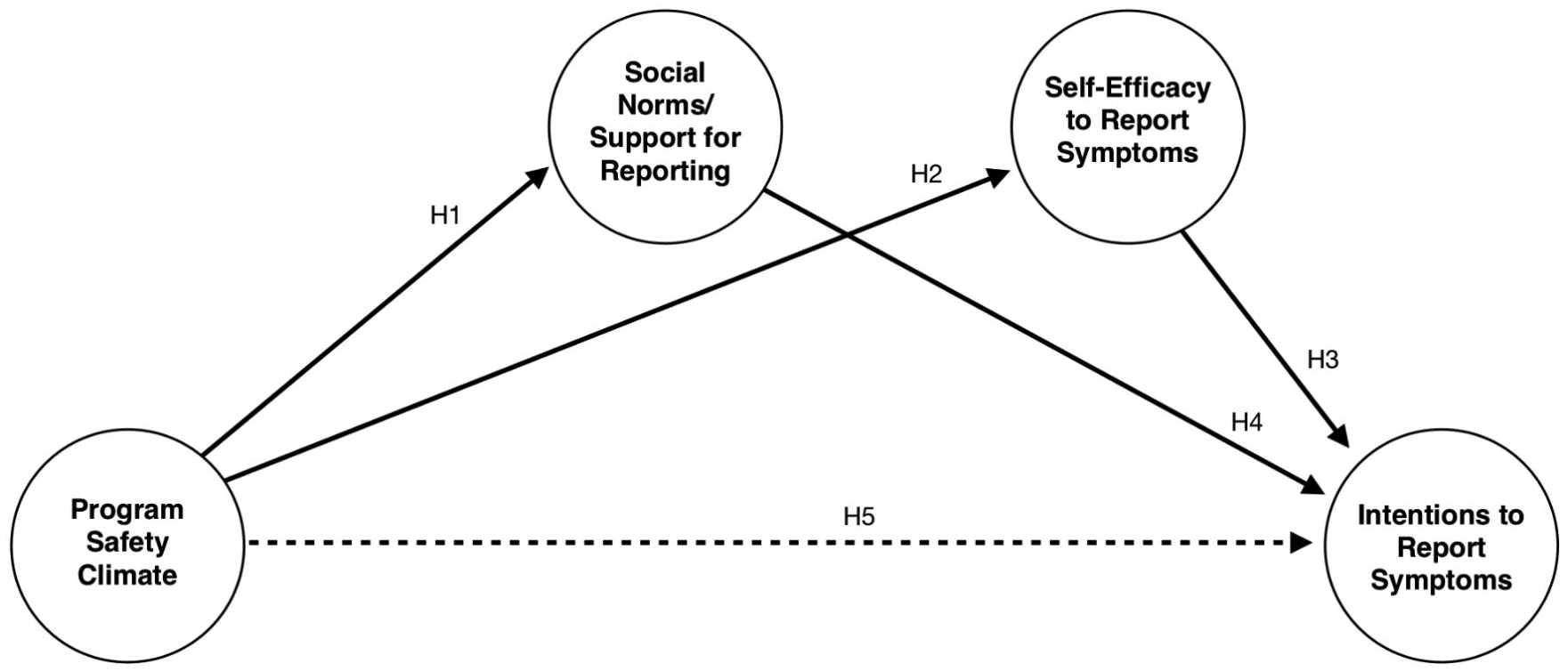
Hypothesized model. Circles reflect latent variables. Solid paths represent direct effects. The dashed line reflects indirect effects.

Confirmatory factor analysis. Circles represent latent variables; rectangles are indicator variables. All latent variables were modeled for Preseason (T1) and Postseason (T2) measurement. All indicator variables loaded significantly onto their designated latent variable, p < .0001. For each indicator loading on a factor, the T1 factor loading is listed first, followed by the T2 factor loading.
Results
We examined our hypotheses regarding the direct and indirect role of safety climate perceptions on concussion-symptom reporting behavior intentions by testing a structural equation model using maximum likelihood estimation. Our analytic strategy was to test our hypothesized model with preseason data, optimize model fit, and perform a confirmatory test of the final model using postseason data. The initial model hypothesized four direct paths, correlated error terms of the social norms and self-efficacy latent factors, with no cross-loadings or correlated error terms among indicators (Breckler, 1990). The initial model had a minimally acceptable fit, χ2(60) = 184.52, p < .00000, NFI = .917, NNFI = .925, CFI = .942, RMR = .059, SRMR = .070, RMSEA = .10, 90% CI [.083, .116]. LaGrange tests indicated that the model fit could be improved with the addition of three pairs of correlated error terms. 1 The final model fit extremely well, χ2(57) = 72.92, p = .076, NFI = .967, NNFI = .990, CFI = .993, RMR = .030, SRMR = .039, RMSEA = .037, 90% CI [.000, .059], and was a significantly better fitting model than the initial model, χ2(3) = 111.60, p < .001.
All hypothesized relationships were strongly supported and are depicted in Figure 3: climate safety predicted social norms and self-efficacy. In turn, social norms and self-efficacy predicted reporting intentions. The indirect relationship between climate safety and reporting intentions was significant (.276, p < .0001). The model was confirmed in the postseason data, χ2(57) = 69.29, p = .127, NFI = .973, NNFI = .993, CFI = .995, RMR = .040, SRMR = .042, RMSEA = .032, 90% CI [.000, .056]. Both models provided a better fit than an alternative model that reflected the theoretically plausible competing hypothesis that student-athletes who intend to report have more favorable perceptions of the safety climate. 2
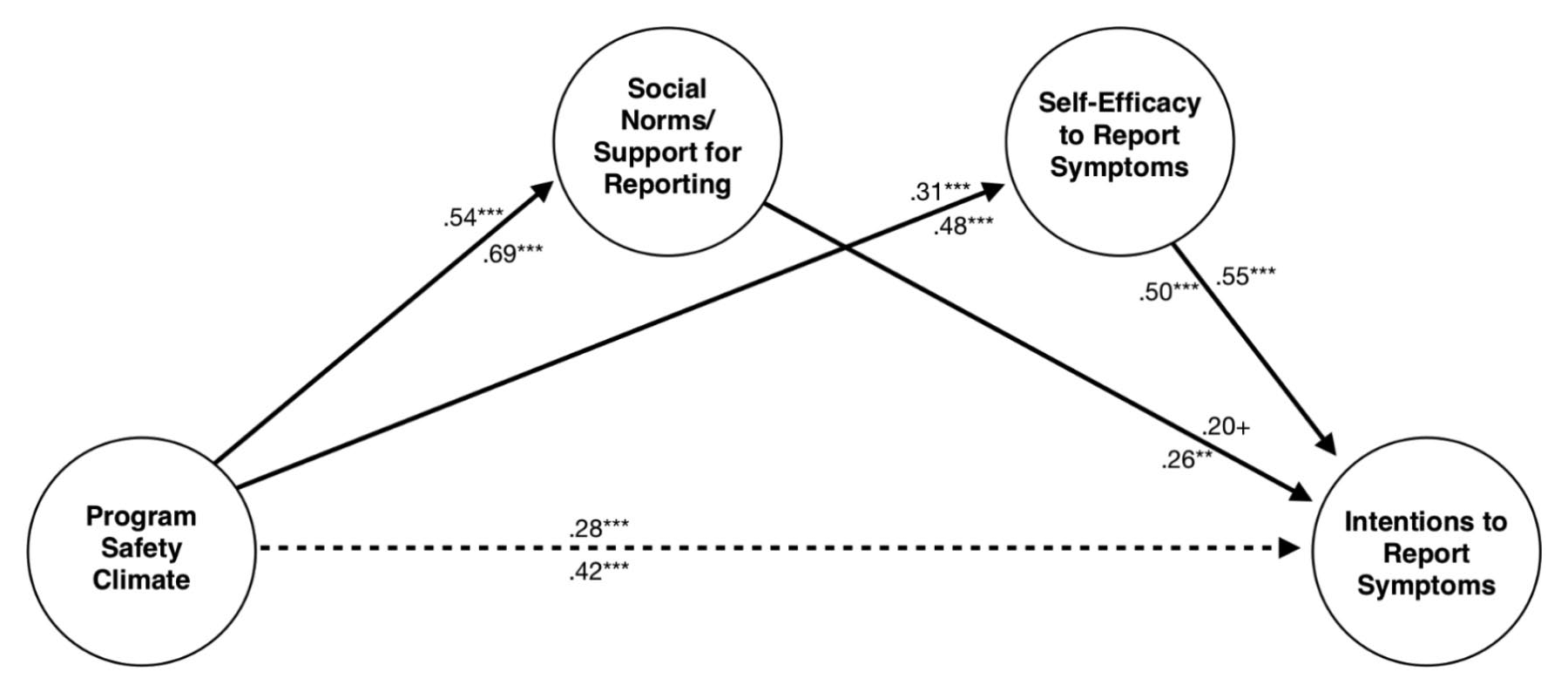
Model results. Model on the top is the serial mediator model; the model on the bottom is the two-mediator model.
Discussion
Although safety climate plays a major role in organizational members’ safety intentions and behavior, to our knowledge there are no studies that have examined student-athletes’ perceptions of program safety climate in the context of concussion reporting behavior. The goal of the current study was to extend previous organizational safety research and assess the role that safety climate has on social norms and self-efficacy, with the ultimate goal of increasing student-athletes’ reporting intentions.
Based on the theory of planned behavior and Zohar’s (2003) contention that climate perceptions are related to policies and procedures associated with outcome expectancies, we predicted that safety climate would be related to social norms and self-efficacy—two variables that have been shown as among the most robust predictors of concussion-symptom reporting behavior intentions (Kerr et al., 2016; Kroshus et al., 2014; Kroshus et al., 2015). Results supported our prediction that safety climate was related to both social norms and self-efficacy. First, similar to previous research in the general safety literature (e.g., Fogarty & Shaw, 2010), when collegiate student-athletes perceive a safe climate they are more likely to have shared social norms associated with reporting concussions. Second, following previous general safety climate research (e.g., Johnson & Hall, 2005), our results provided evidence that safety culture in the collegiate football environment is related to concussion reporting self-efficacy.
More important, our study provides evidence that there is an indirect effect between safety climate and concussion-symptom reporting behavior intentions. Interestingly, safety climate was more associated with social norms than it was related to self-efficacy, and in turn, self-efficacy was more related to concussion-symptom reporting behavior intentions than social norms was related to concussion-symptom reporting behavior intentions. That safety climate appears one step “removed” from the behavior, leaders may not immediately see the connection between safety climate and student-athlete behavior.
Implications
The primary implication of this study is that safety climate influences players’ concussion-related intentions. Knowing this, researchers and practitioners can work toward designing interventions that focus on safety climate to support the organization’s commitment to player safety. In a meta-analytic review of safety climate interventions, Lee et al. (2018) found that successful training usually focuses on leadership commitment to safety and safety leadership (Beus, Payne, Bergman, & Arthur, 2010). For the collegiate football environment this suggests that leaders should be trained on how to integrate safety climate issues into their organization’s football program. Leaders do not necessarily need to make major changes in their leadership style or behavior to effect change. For example, leaders could provide encouragement when one reports, and stress to the team that healthy practices are valued for the team performance. Similarly, the coaching staff could thank the players who come forward to be checked for a concussion, or coaches should be encouraged to increase the visibility of their support to concussed student-athletes (Wayment & Huffman, 2019). This type of behavior will not only increase the perceived safety climate but will also increase the social norms for reporting within the team, both factors that were found to increase concussion-symptom reporting behavior intentions.
A safety climate that demonstrably encourages supportive social norms and student-athletes’ self-efficacy to report concussion symptoms is one that helps student-athletes not only know the dangers of concussion, but a climate that helps them understand the reporting process, demonstrable support for the process, how to report, and the consequences of reporting. In recent years, several different innovative interventions have been developed that could be used. For example, Wayment, Craig, Huffman, and Lininger (2019) developed a smartphone-based reporting system that provides the athletic trainers with an onsite reporting mechanism to report all potential concussions in real time. This tool allows teams to keep a comprehensive record of reporting behavior and provides data that can be shared with student-athletes, likely reducing the barrier to reporting.
Finally, organizational safety climate refers to multiple factors: personal, social, and organizational. Casey et al. (2017) argue that we need to position “climate as part of a dynamic work system in which perceptions of safety act to constrain and shape employee behavior” (p. 341). There are four different strategies that can be differentially used by organizations (defend, adapt, leverage, energize) according to need. This phase-directed system could be very helpful for football programs that are trying to initiate or sustain a safety climate. For example, teams that are experiencing major coaching changes might want to use an energizing strategy since this type of culture encourages a shared vision, something that is needed when there are personnel changes. To ensure perceptions of a safety climate, they might want to focus on creating a shared vision of safety through player involvement when developing concussion reporting systems. A stable football program that has been fairly successful in their concussion reporting goals might benefit from a leverage strategy in which they work to optimize concussion reporting behavior. In this case they would develop aspirational goals (e.g., 90% of all suspected concussions reported to athletic training staff) by, for example, rewarding position groups with the highest reporting rates. Although these are just two examples, the point is to match the safety climate intervention with the current state of the football program.
Limitations
Although our study had many strengths (e.g., we tested our models using latent constructs [Bentler, 1995], tested and confirmed our hypothesized models in two sets of data, and collected data over the course of a football season), we would be remiss to not mention some of the study’s limitations. First, although we measured concussion reporting intentions, we did not examine actual reporting behavior. Although both types of measurement are important, ultimately the actual reporting behavior is the important variable of interest. Like many health behaviors, capturing behavior is challenging, and because reporting can affect key outcomes such as playing time, is especially difficult in this population. Researchers might have to be creative and develop systems in which they assess different nuances related to reporting intentions (Wayment et al., 2019). Whereas we attempted to learn more about who players said they would report to (level of coaching staff) and in what condition (game vs. practice), future studies might want to examine how actual reporting behavior is associated with intentions to report. One approach might be a postgame or postseason interview in which student-athletes can discuss their thought patterns regarding what they understand as “intention to report” and what situations led them to actually report concussion symptoms.
Our study suggested that student-athletes’ perceptions regarding coaches’ safety climate behavior was high (between 4.2 and 4.3 on a 5-point scale), yet we did not ask questions about the program and features within the program that communicate this support for reporting behavior. Furthermore, we do not know if the supportive behavior is the result of policy changes or due to personal characteristics and motivation of coaching leadership. Thus, it could be fruitful for future research to examine the types of policies that would nudge leaders to act in ways that players perceive as supportive. For example, in a substudy of concussed football players during the 2017 season (N = 26), we found that players perceived the least amount of emotional support from their head football coach—but those who said they received more emotional support from their head coach also reported being more likely to report concussion symptoms in the future (Wayment & Huffman, 2019). Understanding the types and sources of symptom-related support players perceive may improve the safety climate of a program if it extends beyond the emphasis placed on concussion reporting during the preseason and is evident in the context of actual injury.
We also note that although we assessed social norms, we did not examine the different types of social norms (e.g., injunctive, descriptive). We suggest that future studies conduct a more thorough examination of different types of social norms because each type can differently affect behaviors and intentions (e.g., Cialdini, Kallgren, & Reno, 1991). For example, there might be a strong injunctive norm associated with hiding potential concussion symptoms that are at odds with actual descriptive norms. If this is the case, organizations might utilize a social marketing approach (Andreasen, 1995) to help change individual player’s injunctive norms, by providing the player with information and data from their own program that supports a safety climate. For example, athletic trainers could report their in-house data about shorter recovery times when players report sooner (Asken et al., 2016) or about the number of players that report symptoms and the outcomes of their reports (Wayment et al., 2019). Understanding what type of norms are present can help the organization develop strategies to increase concussion reporting.
Finally, our analyses were cross-sectional. This is particularly important for the current study because football programs are very dynamic and change not only season to season, but also throughout the season. 3 What types of intervention efforts are able to improve safety climate over the course of a season? Do such changes help strengthen reporting intentions? Longitudinal study would help provide a better picture of the potential influence that safety climate has on reporting intentions.
Conclusion
The goal of our article was to demonstrate that important predictors of players’ reporting intentions are positively influenced by their perceptions that the leaders of their program are invested in their safety and health. We encourage collegiate football programs, and especially leadership, to be mindful of how the organizations structure and leadership behavior are the key determinants of their program’s safety and their players’ health and well-being.
Supplemental Material
HEB879216_suppl_mat – Supplemental material for The Indirect Influence of Organizational Safety Climate on Football Players’ Concussion Reporting Intentions
Supplemental material, HEB879216_suppl_mat for The Indirect Influence of Organizational Safety Climate on Football Players’ Concussion Reporting Intentions by Heidi A. Wayment and Ann Hergatt Huffman in Health Education & Behavior
Footnotes
Acknowledgements
We gratefully acknowledge our Mind Matters research team (Co-PIs Debbie Craig, PhD, LAT, ATC, Monica Lininger, PhD, LAT, ATC, and graduate assistants Taylor Lane, Patrick Doyle, and Keragan Cavolo).
Declaration of Conflicting Interests
The authors declared no potential conflicts of interest with respect to the research, authorship, and/or publication of this article.
Funding
The authors disclosed receipt of the following financial support for the research, authorship, and/or publication of this article: This research was supported by the National Collegiate Athletic Association and the U.S. Department of Defense on a programmatic research project investigating NCAA football programs’ efforts to increase concussion reporting behavior. The sponsors of this research had no input in any aspect of study design, data collection, analysis and interpretation, writing of the report, or submitting for publication.

Notes
References
Supplementary Material
Please find the following supplemental material available below.
For Open Access articles published under a Creative Commons License, all supplemental material carries the same license as the article it is associated with.
For non-Open Access articles published, all supplemental material carries a non-exclusive license, and permission requests for re-use of supplemental material or any part of supplemental material shall be sent directly to the copyright owner as specified in the copyright notice associated with the article.
