



Abstract
Background. Electronic cigarettes (e-cigarettes) are the most commonly used tobacco product among adolescents. We aimed to identify factors associated with e-cigarette susceptibility and curiosity among adolescents who are and are not susceptible to cigarette smoking. Method. Data were drawn from the 2018 U.S. National Youth Tobacco Survey. The study sample comprised 13,428 never cigarette or e-cigarette users. Four distinct weighted multivariable regression models were performed to assess associations between covariates and e-cigarette curiosity and susceptibility. Results. Among adolescents susceptible to smoking cigarettes, non-Hispanic (NH) Black participants were less likely to be susceptible to (adjusted odds ratio [aOR] = 0.42, 95% confidence interval [CI] [0.26, 0.67]) and curious about (aOR = 0.61, 95% CI [0.39, 0.95]) e-cigarettes than NH Whites. Among adolescents nonsusceptible to smoking cigarettes, Hispanics were more susceptible to (aOR = 1.33, 95% CI [1.04, 1.71]) and curious about (aOR = 1.29, 95% CI [1.02, 1.62]) e-cigarettes than NH Whites. Among adolescents (both susceptible and nonsusceptible to smoking cigarettes), being female, exposure to e-cigarette aerosol in public places, exposure to e-cigarette ads at point-of-sale, and having low perceived harm and addictiveness of e-cigarettes versus cigarettes were associated with having greater odds of susceptibility toward and curiosity about e-cigarette use. Conclusions. Future regulatory policies and tobacco control prevention campaigns should focus on increasing health awareness (e.g., potential harm and addictiveness) of e-cigarettes among adolescents and restrict marketing and the use of e-cigarettes in public places.
Originally touted by manufacturers as potential cessation tools for adult cigarette smokers, electronic cigarettes (e-cigarettes—or “vaping”) have been widely adopted by nicotine-naive U.S. adolescents (Cullen et al., 2019; Glantz & Bareham, 2018). Recent released findings from the 2019 National Youth Tobacco Survey (NYTS) indicate that more than 5 million (M) adolescents reporting having used e-cigarettes currently (past 30 days) and nearly 1M reporting daily use (Cullen et al., 2019). Overall, an estimated 4.1M high school students and 1.2M middle school students in the United States currently use e-cigarettes. Longitudinal evidence revealed that exposure to e-cigarette ads on the social media among youth who had never used e-cigarettes increases the likelihood of subsequent e-cigarette use (Camenga et al., 2018). Other evidence also demonstrated youth e-cigarette use leads to smoking combustible cigarettes (Berry et al., 2019). Thus, ending the youth e-cigarette epidemic should be a priority for regulators (e.g., U.S. Food and Drug Administration) and health care professionals. Moreover, up to 90% of adults smokers beginning to smoke as adolescents and it is vital to prevent nicotine addiction among this vulnerable population (Siqueira, 2017; U.S. Department of Health and Human Services, 2016).
Among adolescents, e-cigarette curiosity and susceptibility are important predictors of future e-cigarette use (Bold et al., 2017; Margolis et al., 2016; Nicksic & Barnes, 2019). Previous studies identified susceptibility toward e-cigarette use as stronger predictors of e-cigarette experimentation among tobacco/nicotine naive adolescents (Bold et al., 2017; Margolis et al., 2016; Nicksic & Barnes, 2019; Seo et al., 2019). Also, evidence suggest that the most common reason for youth to experiment e-cigarettes is out of curiosity (Kong et al., 2014; Patrick et al., 2016). Curiosity and susceptibility are distinct constructs; curiosity refers to interest—even in the absence of clear intentions to initiate use—and can be considered an early warning indicator (Gentzke, Wang, Robinson, et al., 2019; Margolis et al., 2016; Portnoy et al., 2014). Susceptibility refers to an existing intention to use (e-cigarettes) in the future (Pierce et al., 1996), which may indicate increased likelihood of experimentation compared with curiosity. Furthermore, earlier studies (Kwon et al., 2018; Mantey et al., 2016; Margolis et al., 2016; Springer et al., 2018; Villanti et al., 2016) reported several sociodemographic and environmental factors (e.g., gender, race, school level, exposure to e-cigarette ads, second-hand arousal, and use of noncigarette tobacco products) associated with susceptibility to and curiosity about e-cigarettes.
The rapidly changing e-cigarette marketplace (Ben Taleb & Ebrahimi Kalan, 2018; Collins et al., 2018) and the 2016 Surgeon General’s report calling for a multipronged approach to address e-cigarette use (U.S. Department of Health and Human Services, 2016), point to the need to identify potentially modifiable factors associated with e-cigarette susceptibility and curiosity among e-cigarette-naive adolescents at low and high risk for cigarette use. An in-depth understanding of the preparation and initiation stages of e-cigarette use has strong potential to help guide tobacco/nicotine control strategies and prevention efforts to prevent never-smoking adolescents from starting their first e-cigarette. Prior work, in our knowledge, has not examined factors associated with e-cigarette susceptibility and curiosity using a nationally representative sample of e-cigarette-naive adolescents stratified by susceptibility to cigarette smoking. Therefore, this study aimed to identify correlates of e-cigarette susceptibility and curiosity among e-cigarette-naive adolescents who are susceptible and nonsusceptible to cigarette smoking in the future.
Method
Study Population
Data were drawn from the 2018 US NYTS (N = 20,189, response rate 68.2%). Details for the methodology of this survey, such as sample design and weighting procedures, are available elsewhere (Cullen et al., 2019; Gentzke, Creamer, et al., 2019). The current analysis focused on adolescents reporting never having used a cigarette and/or e-cigarette by answering “no” to the questions, “Have you ever used a [cigarette, e-cigarette], even once or twice?” (“never-users”; n = 13,428). As this study analyzed deidentified publicly available data, human subjects review was not required.
Measures
Consistent with the literature (Chen et al., 2017; Kowitt et al., 2018; Margolis et al., 2016; Minaker et al., 2015; Portnoy et al., 2014) to categorize participants as “nonsusceptible” or “susceptible” to using cigarettes or e-cigarettes three analogous items as if participants thought they would: (1) try a cigarette/e-cigarette soon? (2) try a cigarette/e-cigarette in the next year? and (3) use a cigarette/e-cigarette if one of their best friends offered it to them? Response options were “definitely yes,” “probably yes,” “probably not,” and “definitely not.” Those who answered all three questions “definitely not” were classified as nonsusceptible; those remaining as susceptible. The aforementioned questions were asked separately for cigarettes and e-cigarettes. Curiosity was measured with the item; “Have you ever been curious about using an e-cigarette?” Those who answered “definitely not” were classified as not curious; those remaining as curious (Bahelah, 2017). Participants were classified as exposed to e-cigarette aerosols in a public place if they answered breathing e-cigarette aerosols on 1 or more days in past 30 days or, if otherwise, not exposed (Gentzke, Wang, Marynak, et al., 2019). Participants were classified as exposed to e-cigarette at home if they answered “yes” to the question “Does anyone who lives with you now use e-cigarettes? (Chen et al., 2017). Exposure to e-cigarettes advertising on “Internet,” “point-of-sale,” “TV,” and “newspapers or magazine” were measured with items: When you (are using the Internet/go to the convenience store, supermarket, or gas station/watching TV/reading newspapers or magazine) how often do you see ads or promotions for e-cigarettes? Response options to all items were: never, rarely, sometimes, most of the time, or always. Similar to previous study (Dai & Hao, 2016), all respondents were classified as low (never/rarely), moderate (sometimes), and high (most of the time/always) exposure. E-cigarette harm perception was measured with the question, “How much do you think people harm themselves when they use e-cigarettes some days but not every day?” Response options included the following: no harm; little harm; some harm; and a lot of harm (Margolis et al., 2016). Perception of e-cigarettes addictiveness vs cigarettes was measured with the question, “Do you believe that e-cigarettes are less addictive, equally addictive, or more addictive than regular cigarettes?” (Margolis et al., 2016). Ever use of any tobacco products other than cigarette and e-cigarette was measured with question “ Have you ever tried cigars, hookahs, smokeless tobacco (chewing tobacco, snuff, or dip), snus, pipe tobacco, and/or bidis? (Gentzke, Creamer, et al., 2019). Current use of any tobacco products other than cigarette and e-cigarette was defined as use on ≥1 day during the past 30 days (Gentzke, Creamer, et al., 2019). Demographic characteristics (sex [female/male], race/ethnicity [non-Hispanic (NH) White, NH Black, Hispanic, and NH “other”], and school level [middle or high school] were collected (Margolis et al., 2016; Springer et al., 2018).
Statistical Analysis
Significant differences between levels within covariates were examined by χ2 tests. Four separate multivariable logistic regression models were performed to estimate odds of e-cigarette susceptibility and curiosity. All analyses were weighted using SAS 9.4 (SAS Institute Inc.) survey procedure (PROC SURVEYFREQ & PROC SURVEYLOGISTIC) to account for survey design, offset nonresponse bias, and to produce nationally representative estimates (Gentzke, Creamer, et al., 2019). National prevalence estimates with corresponding 95% confidence intervals (95% CIs) were calculated for e-cigarette susceptibility and curiosity overall and for each covariate; the U.S. adolescents population totals were estimated from extrapolated probability weights (Gentzke, Creamer, et al., 2019). Adjusted odds ratios (aOR) and 95% CI are reported and statistical significance was set at p < .05.
Results
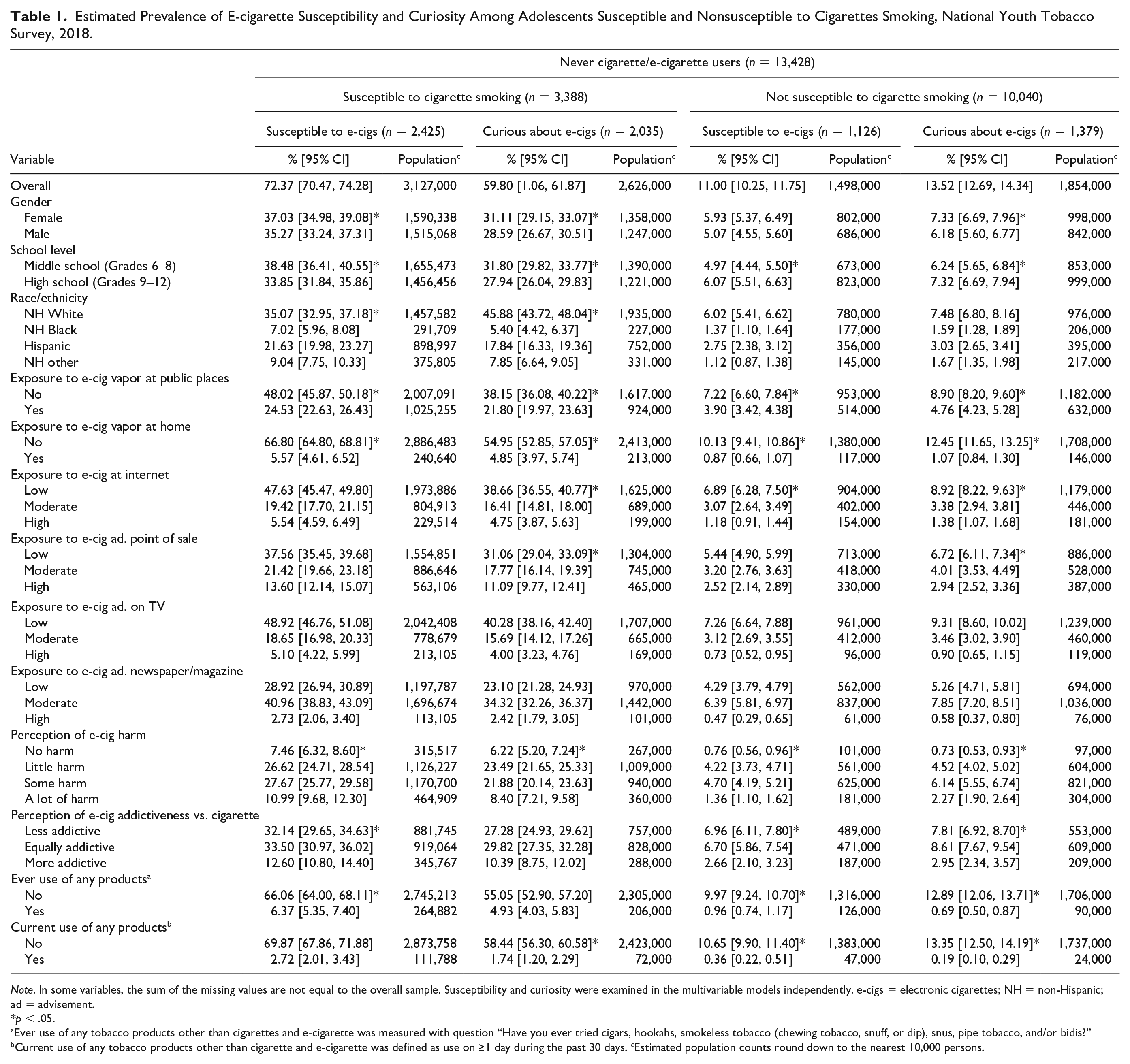
Never-users of cigarettes and/or e-cigarettes (n = 13,428) were 51.1% female, 45.4% high school students, 44.4% NH White, 14.1% NH Black, 29.8% Hispanic, and 11.7% NH “other.” Among never-users, 25.2% (n = 3,388) were categorized as susceptible to cigarette smoking, and among them, 72.3% (estimated to represent >3M U.S. adolescents at the population level) and 59.8% (an estimated 2.5M) were susceptible to and curious about e-cigarettes, respectively. Among adolescents nonsusceptible to cigarette smoking, 11% (an estimated 1.5M) and 13.5% (an estimated 1.9M) were susceptible to and curious about e-cigarettes, respectively (Table 1). Of the 13 428 never-smoking youth, 25.2% (n = 3,388) was found to be susceptible to cigarette smoking and the rest (74.8%; n = 10,040) nonsusceptible.
Estimated Prevalence of E-cigarette Susceptibility and Curiosity Among Adolescents Susceptible and Nonsusceptible to Cigarettes Smoking, National Youth Tobacco Survey, 2018.
Note. In some variables, the sum of the missing values are not equal to the overall sample. Susceptibility and curiosity were examined in the multivariable models independently. e-cigs = electronic cigarettes; NH = non-Hispanic; ad = advisement.
p < .05.
Ever use of any tobacco products other than cigarettes and e-cigarette was measured with question “Have you ever tried cigars, hookahs, smokeless tobacco (chewing tobacco, snuff, or dip), snus, pipe tobacco, and/or bidis?”
Current use of any tobacco products other than cigarette and e-cigarette was defined as use on ≥1 day during the past 30 days. cEstimated population counts round down to the nearest 10,000 persons.
Adolescents Susceptible to Smoke Cigarettes
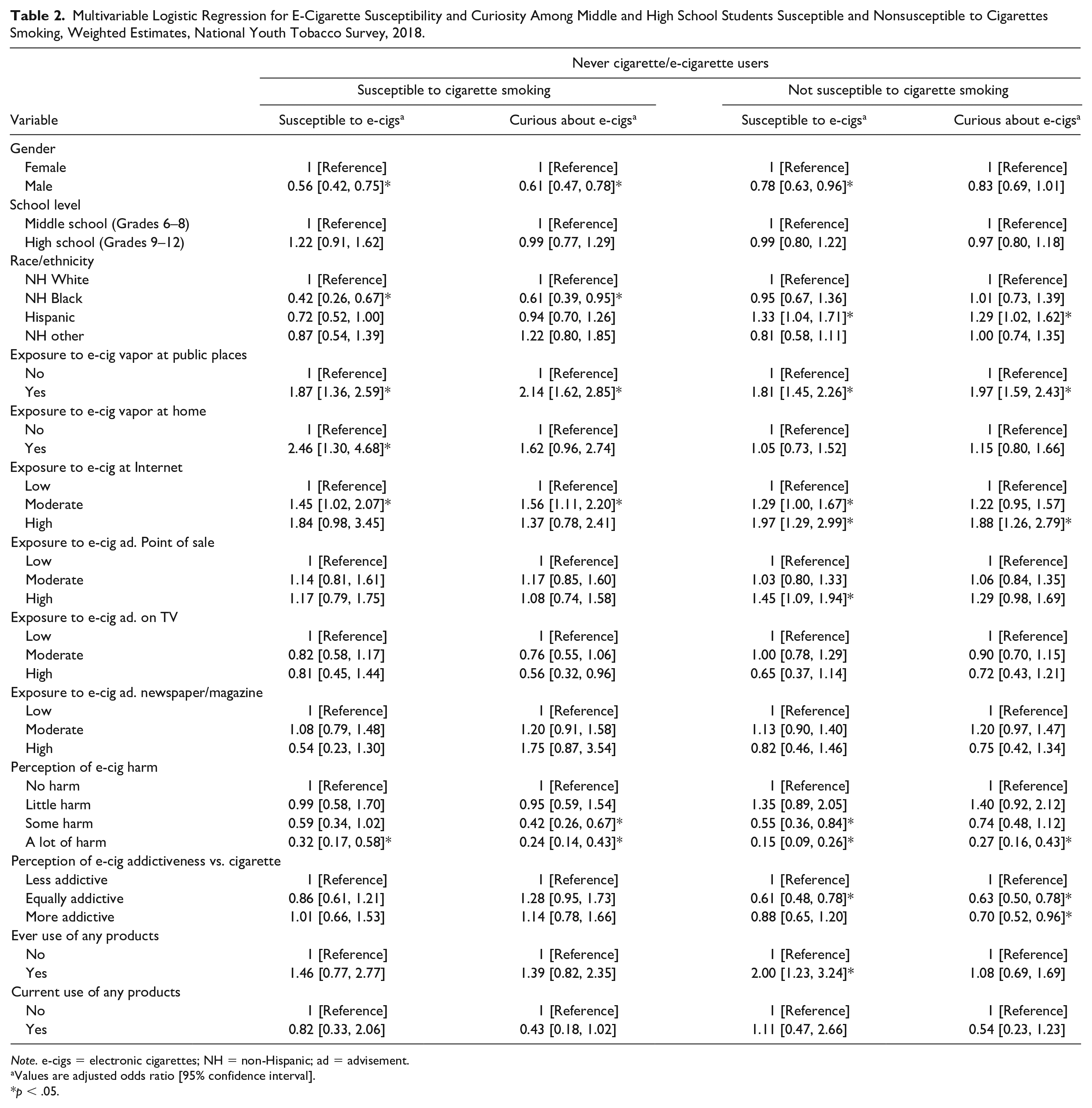
Overall, 38.5% (an estimated 1.7M) of adolescents who were susceptible to e-cigarettes (n = 2,425) were middle school students and 33.9% (an estimated 1.7M) high school students. Also, 31.8% (an estimated 1.4M) of adolescents who were curious about e-cigarettes (n = 2,035) were middle school students and 28% (an estimated 1.2M) high school students (Table 1). Males were less likely to be susceptible to (aOR = 0.56, 95% CI [0.42, 0.75]) and curious about (aOR = 0.61, 95% CI [0.47, 0.78]) e-cigarettes than females (Table 2). NH Black participants were less likely to be susceptible to (aOR = 0.42, 95% CI [0.26, 0.67]) and curious about (aOR = 0.61, 95% CI [0.39, 0.95]) e-cigarettes than NH Whites. Greater odds of susceptibility to e-cigarettes were observed for adolescents who had been exposed to secondhand e-cigarette aerosol in public places (aOR = 1.87, 95% CI [1.36, 1.59]) and at home (aOR = 2.46, 95% CI [1.30, 4.68]). Greater odds of curiosity about e-cigarettes were observed only for adolescents who had been exposed to e-cigarette aerosol in public places (aOR = 2.14, 95% CI [1.62, 2.85]). Moderate exposure to e-cigarette ads and promotions on the internet was associated with greater odds of susceptibility to (aOR = 1.45, 95% CI [1.02, 2.07]) and curiosity about (aOR = 1.56, 95% CI [1.11, 2.20]) e-cigarettes than low exposure. Lower odds of susceptibility to (aOR = 0.32, 95% CI [0.17, 0.58]) and curiosity about (aOR = 0.24, 95% CI [0.14, 0.43]) e-cigarettes were observed among adolescents with high perceptions of e-cigarette harm (vs. no harm). Comparative addictiveness (e-cigarettes vs. cigarettes) was not a significant factor for e-cigarette curiosity nor susceptibility.
Multivariable Logistic Regression for E-Cigarette Susceptibility and Curiosity Among Middle and High School Students Susceptible and Nonsusceptible to Cigarettes Smoking, Weighted Estimates, National Youth Tobacco Survey, 2018.
Note. e-cigs = electronic cigarettes; NH = non-Hispanic; ad = advisement.
Values are adjusted odds ratio [95% confidence interval].
p < .05.
Adolescents Nonsusceptible to Smoke Cigarettes
Overall, 4.9% (an estimated 673,000) of adolescents who were susceptible to e-cigarettes (n = 1,126) were middle school students and 6.1% (an estimated 823,000) high school students. Also, 6.2% (an estimated 853,000) of adolescents who were curious about e-cigarettes (n = 1,379) were middle school students and 7.3% (an estimated 999,000) high school students (Table 1). Males were less likely to be susceptible to (aOR = 0.78, 95% CI [0.63, 0.98]) e-cigarettes than females. NH Black participants were more susceptible to (aOR = 1.33, 95% CI [1.04, 1.71]) and curious about (aOR = 1.29, 95% CI [1.02, 1.62]) e-cigarettes than NH Whites. Greater odds of susceptibility to (aOR = 1.81, 95% CI [1.45, 2.26]) and curiosity about (aOR = 1.97, 95% CI [1.59, 2.43]) e-cigarettes were observed for adolescents who had been exposed to second-hand e-cigarette aerosol in public places. High (vs. low) exposure to e-cigarette ads on the internet was associated with greater odds of susceptibility to (aOR = 1.97, 95% CI [1.29, 2.99]) and curiosity about (aOR = 1.88, 95% CI [1.26, 2.79]) e-cigarettes; similarly, high (vs. low) exposure to e-cigarette ads at point-of-sale correlated with increased odds of e-cigarette susceptibility (aOR = 1.45, 95% CI [1.09, 1.94]). Lower odds of susceptibility to (aOR = 0.15, 95% CI [0.09, 0.26]) and curiosity about (aOR = 0.27, 95% CI [0.16, 0.43]) e-cigarettes were observed among adolescents with high perceptions of e-cigarette harm (vs. no harm). Adolescents perceiving the addictiveness of e-cigarettes and cigarettes as equal were less susceptible to e-cigarettes (aOR = 0.61, 95% CI [0.48, 0.78]) than those perceiving e-cigarettes as less addictive. Adolescents who perceived e-cigarettes as equally addictive or more addictive than cigarettes were less likely to be curious about e-cigarettes than those who perceived it as less addictive than cigarettes. Ever-use of any tobacco product was associated with greater odds of e-cigarette susceptibility (aOR = 2.00, 95% CI [1.23, 3.24]).
Discussion
Extrapolated, our findings indicate that an estimated 8M e-cigarette-naive middle and high schoolers were susceptible to and curious about e-cigarette use in 2018. This is alarming given a recent report from the Centers for Disease Control and Prevention (CDC) indicating the number of adolescents who reported “current” use of e-cigarettes increased by 32.2% among high school students and 114.2% among middle school students between 2018 and 2019 (Cullen et al., 2019). In our study, exposure to second-hand e-cigarette aerosol in public places was associated with greater odds of e-cigarette susceptibility and curiosity among adolescents who both were and were not susceptible to future cigarette smoking. In 2017 alone, the CDC found that an estimated 1.2M U.S. middle and high school students reported being exposed exclusively to secondhand aerosol from e-cigarettes (Gentzke, Wang, Marynak, et al., 2019). As of July 1, 2019, a comprehensive smoke-free policy that includes e-cigarettes had been enacted in only 20 U.S. states (American Nonsmokers’ Rights Foundation, 2019). E-cigarette use in public places may thwart the enforcement of existing smoke-free policies and contribute to the renormalization of tobacco use behaviors (Gentzke, Wang, Marynak, et al., 2019); therefore, extending smoke-free laws to include outdoor and indoor public places is critical to reduce e-cigarette susceptibility and curiosity among nicotine-naive adolescents, to protect bystanders from aerosol emissions, and to help curb the growing e-cigarette epidemic. Although more research is needed to evaluate the effects of second-hand exposure to e-cigarette aerosols on bystanders, exposure among vulnerable populations, including adolescents, could still be dangerous and exacerbate the current e-cigarette epidemic among this population.
Approximately 5% of U.S. adult e-cigarette users live in a household with adolescents (Carwile et al., 2019) and adolescents who live in household with active e-cigarette users are more likely to initiate themselves (Barrington-Trimis et al., 2015). We found that e-cigarette exposure at home puts nicotine-naive adolescents at greater risk for future e-cigarette initiation, particularly among those susceptible to cigarette smoking. For example, a study found that the saliva cotinine of nonsmokers exposed to e-cigarette aerosol at home was higher than in those not exposed (Ballbè et al., 2014). Parents and household members who are aware of the health risks of e-cigarettes could aid in preventing youth e-cigarette use and subsequent smoking in young adulthood by setting a good example (e.g., If they use e-cigarettes, the best thing to do is quit or at a minimum, don’t use around their children), maintaining a dialogue regarding potential risks of e-cigarette use, and preparing them for peer pressure (e.g., discussing what they might say if a friend offers an e-cigarette] (American Heart Association, 2019; Reynolds et al., 2019).
Our findings of an association between e-cigarette susceptibility and exposure to internet e-cigarette advertisements is consistent with prior work (Dai & Hao, 2016; Nicksic et al., 2017; Unger & Bartsch, 2018). Indeed, the latest generation of e-cigarettes such as JUUL, is widely marketed to youth on Twitter, Instagram, and YouTube (Huang et al., 2019; Kim et al., 2019). To protect nicotine-naive adolescents and curb the rising tide of e-cigarette advertisements, online e-cigarette marketing should be strictly regulated.
That we found e-cigarette harm perception inversely related to e-cigarette susceptibility and curiosity in adolescents both susceptible and nonsusceptible to cigarette smoking also comports with previous studies (Kowitt et al., 2018; Margolis et al., 2016). Perceptions about tobacco products are associated with youth tobacco use and initiation (Goniewicz et al., 2013; Sherratt et al., 2016); hence, these perceptions should be monitored over time. As youth perceptions change, appropriate awareness campaigns can be developed to correct them, perhaps targeting e-cigarette addictiveness and other health effects of use among youth.
Our finding that girls were more susceptible to and curious about e-cigarettes than boys could be an indication that future prevalence among girls could be rising, despite recent reports that current e-cigarette prevalence is slightly higher in boys or the same as in girls (Cullen et al., 2019; Gentzke, Creamer, et al., 2019; Springer et al., 2018). Relatedly, our findings of different levels of e-cigarette susceptibility and curiosity by race/ethnicity among those both susceptible and nonsusceptible to cigarette smoking point to a need for future qualitative and quantitative studies designed to disentangle the effect/s of biological sex and race/ethnicity and how they may also correlate with initiation. Such information will inform future prevention campaigns by accounting for these and other sociodemographic factors when targeting e-cigarette susceptibility and curiosity among adolescents.
Our study is not without limitations. The 2018 NYTS does not specifically assess susceptibility to and curiosity about JUUL, which has among the highest nicotine concentrations commercially available and is one of the most commonly used brands among U.S. adolescents (Cullen et al., 2019; Huang et al., 2019; Kim et al., 2019). Still, our measures are widely used (Dai & Hao, 2016; Kowitt et al., 2018; Margolis et al., 2016; Nicksic & Barnes, 2019; Seo et al., 2019) and capture susceptibility to and curiosity about e-cigarettes among a nationwide sample and should thereby account for most e-cigarette brands. The cross-sectional nature of this study does not allow us to deduce causality or determine the direction of the observed associations. Despite these limitations, our study delivers guidance to help with developing preventive interventions and regulatory actions. The high level of e-cigarette susceptibility and curiosity among naive U.S. adolescents who are both susceptible and nonsusceptible to cigarette smoking highlights the urgent need to develop effective tobacco control efforts to curb e-cigarette use.
In conclusion, we found that low perception of harm and high exposure to online e-cigarette advertising and second-hand e-cigarette aerosols in public places were associated with higher odds of susceptibility to and curiosity about e-cigarettes among adolescents both susceptible and nonsusceptible to cigarette smoking. Regulatory agencies and preventive interventions should address these factors. Such regulations and interventions could curb increasing rates of e-cigarette use and the risk of initiation among e-cigarette-naive adolescents who otherwise would not be exposed to nor become dependent on nicotine.
Footnotes
Declaration of Conflicting Interests
The authors declared no potential conflicts of interest with respect to the research, authorship, and/or publication of this article.
Funding
The authors disclosed receipt of the following financial support for the research, authorship, and/or publication of this article: KM was supported by NIH/National Institute on Drug Abuse (F32DA044733) and Stanford Maternal and Child Health Research Institute (1111239-440-JHACT).
