



Abstract
There is growing implementation of storytelling as a specific application of narrative in public health. As the field’s latest epoch evolves to consider cultural determinants, reimagination of how scientists conceptualize, operationalize, and capture populations’ unique elements is necessary, and storytelling provides a genuine and efficacious methodology that can assist with that reimagination. Professionals are creating more spaces that demonstrate how storytelling elucidates, promotes, and supports contextual factors that are not captured by orthodox methodologies. However, more opportunities are needed to exhibit storytelling’s impact on capturing the nuances in human experiences, such as those of historically and systemically underrepresented populations. This study synthesizes the past decade of research in public health and related fields that primarily utilized storytelling and reports significant implications. Additionally, this study highlights explorations in public health that primarily use storytelling as a research and practice approach. Each case study includes a description of the background and aims, elaborates on storytelling’s utilization, and discusses findings, observations, and future directions. Finally, this study discusses conceptual issues in public health raised by use of storytelling, such as how to best capture impact on human beings and the importance of context. This article’s goal is to present current evidence of critical reevaluations to the epistemological, conceptual, and practical paradigms within public health through storytelling. Additionally, this article aims to provide support and empowerment to public health scientists considering creative approaches to better acknowledge and appreciate humanity’s inherent subjectivity.
Keywords
Ring-a-ling-ling! Ring-a-ling-ling! My bells are ringing! My soul is singing! WELL OH WELL WELL! IT’S STORYTELLING TIME! Gather ‘round my people! Gather ‘round!
Gail E. Haley’s 1970 book A Story, A Story: An African Tale introduced the world to Anansi, a prominent folktale character from Ghana’s Ashanti people told in stories throughout the African Diaspora (Haley, 1970). Considered the original Spiderman, Anansi is depicted as human, animal or both, and always known for his trickery and creativity. In this tale, Anansi asks Nyame, the Sky God, for all his stories. Nyame responds that the price of his stories is paid by capturing three legendary creatures: Osebo, the leopard with terrible teeth, Mmoboro, the hornets with a sting like fire, and Mmoatia, the fairy no one can see. Despite the seemingly impossible nature of Nyame’s challenge, Anansi utilized his cunning to capture the creatures for Nyame, who gave Anansi a chest containing his stories as promised. However, Anansi selflessly shared Nyame’s stories with the children of the world so they could experience its power and wonder.
Fifty years after A Story, A Story, storytelling as an applied approach under the conceptual framework of narrative is being embraced in public health (Banks, 2012; Banks-Wallace, 2002; Banks-Wallace et al., 2007). The events of 2020—highlighted by the COVID-19 pandemic and worldwide uprisings against systemic oppression—have further catalyzed the “fifth wave” of public health, demonstrating need to better capture and understand the depths and influences of lived experiences and of cultural context, on the health and well-being of increasingly diverse populations (Davies et al., 2014).
Storytelling is a perpetual global cultural practice utilized to convey knowledge, wisdom, perspective, and skills. Additionally, storytelling emphasizes the importance of individual and collective human experiences. The collection of individual and group narratives is not a new practice in public health and is utilized particularly within qualitative research, which intentionally captures nonnumerical data. Additionally, it is utilized in community based participatory research (CBPR), defined as “focusing on social, structural, and physical environmental inequities through active involvement of community members, organizational representatives, and researchers in all aspects of the research process” (Israel et al., 2001, p. 182; see also Pathak et al., 2013). However, a conspicuous limitation is the restriction of participants’ insights through conventional techniques. Specifically, participants often engage with instruments like surveys or questionnaires that may include open-ended questions allowing for free expression but are constructed in a quasi-objective manner that reflects both an antiquated pedagogy and the researcher’s context, otherwise known as bias (Galdas, 2017). The result is a public health field that perpetuates epistemic injustice due to historic White male power structures, including scientific methods overly dependent on quantitative statistics and conceptual frameworks solely focused on acquiring impartial knowledge (Fricker, 2007). In particular and in response to public health’s hermeneutical injustice, or lack of understanding and conceptualization of human experiences due to historical exclusion from scientific research, some researchers are demonstrating how narrative techniques explain, promote, and support contextual information not captured by mainstream approaches (Medina, 2012; Smiley & Fakunle, 2016). However, further evidence is necessary to increase awareness of storytelling’s ability to elucidate the nuances of human experiences, such as those of historically and systemically underrepresented populations.
This article begins to fill the gap by exploring the utilization and impact of storytelling in public health research, with foci on these populations. Specifically, this article provides a literature review of recent research and highlights two case studies of public health projects and initiatives that prominently utilize narrative and storytelling within their conceptual framework and methodology, respectively. Each case study includes a description of the background, aims and goals, explains how storytelling is utilized in the methodology, and synthesizes findings. Finally, this article considers conceptual issues public health that storytelling is raising, such as what approaches best encapsulate impact on human beings and the importance of cultural relevance.
Literature Review
To assess storytelling in health, a literature review was conducted and evaluated by two coauthors. The impact of storytelling on health outcomes was examined by answering the following questions:
How was storytelling specifically used?
What outcomes did researchers focus on?
What were the results?
What were the implications of the results?
Method
Whittemore and Knafl’s method of integrative review and guidelines in the Preferred Reporting Items for Systematic Reviews and Meta-Analyses statement were used to search health-related databases, including Google Scholar, Science Direct, PubMed/MEDLINE, EBSCOhost, AnthroSource and Scopus. Various Medical Subject Headings were used to account for storytelling’s recent emerging, including “impact of storytelling in health,” “impact of storytelling on health,” “storytelling and health impacts or health effects,” and “narrative story impacts on health.” These terms yielded a total of 76,851 articles, of which 69,890 were removed after screening for “storytelling” or “narrative” in the title. Inclusion criteria included publication between 2010 and 2020, free access, explicit use of storytelling in the methodology, and reporting of storytelling’s impact on health. Of the 6,691 remaining articles, 48 remained after inclusion criteria was applied. Finally, twenty-four articles were removed for not having storytelling as part of its primary methodology, three for duplication, and four for lack of relevance to the research questions. As a result, seventeen articles were included for review (see Figure 1).

Flow diagram of literature review inclusion and exclusion process.
How Was Storytelling Specifically Used?
Different words were interchangeably used for storytelling such as narratives, illness narratives, public narrative, narrative medicine, narrative journalistic stories, digital storytelling, and edutainment. However, operationalization of each term varied by the author. For this article, storytelling refers to an individual telling their individual or community story to another person or group of people (Haigh & Hardy, 2011; Kaplan-Myrth, 2007). Storytelling was used in quantitative, qualitative, mixed methods, and community-based participatory research, and designs ranged from observational to randomized control trials. Study settings included countries on every continent excluding Antarctica, and storytelling platforms included in-person (first or third), digital media (video, television, or radio), or written approaches. Studies covered topics such as advocacy, racial justice, health equity, health promotion, trauma research, chronic diseases, and palliative care (Appleton, 2008; Banks, 2012; Cueva et al., 2015; Davidson & Falola, 2020; Delker et al., 2020; Drew et al., 2010; Elk et al., 2020; Le et al., 2017; Marsters & Meaghan, 2019; Roche et al., 2005; Wipfli et al., 2015). Additionally, storytelling as the primary modality was found in communicable disease research in public health and medical anthropology (Frank et al., 2015; Gilliam et al., 2012; Kleinman & Benson, 2006; Le et al., 2017; Mohammadhosseini et al., 2016; Willis et al., 2014). Finally, the literature showed that primarily public health researchers and medical anthropologists implemented storytelling in their studies, with a few identified in criminology and agriculture (Bove & Tryon, 2018).
What Outcomes Did Researchers Focus On?
There was little variability in the foci of storytelling studies. Primary foci were on the participants’ attitudes, knowledge, behavior, or clinical outcomes, either singularly or in combination. The range of participants included parents, adolescents, young adults, seniors, essential service workers, survivors of traumatic experiences, health care professionals, and health care professional students. Variables included low-health literacy, high school education, ethnic minority status, low-socioeconomic status, aging population status, and English not as a first language (Kleinman & Benson, 2006; Lipsey et al., 2020; Roche et al., 2005; Stargatt et al., 2019).
What Were the Results?
Literature showed that storytelling, when utilized as either an element of qualitative methodology or the primary research modality, allowed for more in-depth, rich data collection, and improved comprehension (Kaplan-Myrth, 2007; Kleinman & Benson, 2006; Lipsey et al., 2020; Stargatt et al., 2019). Storytelling interventions, compared with nonstorytelling interventions, effectively improved participants’ attitude, knowledge, behavior, or clinical outcomes. Positive changes were noted in health behaviors such as healthy eating, smoking cessation, decreased drug usage, vaccinations, and improved foot care. Regarding clinical outcomes, storytelling affected lowering blood pressure and A1C levels. Additionally, participants’ attitudes on self-efficacy, disease management, and risk prevention increased in storytelling interventions compared with control groups. Finally, studies utilizing storytelling demonstrated that life quality improved (Gilliam et al., 2012; Gregory 2006; Roche et al., 2005; Wipfli et al., 2015).
What Were the Implications of the Results?
Storytelling positively affected health-related outcomes by being therapeutic for the storyteller, eliminating barriers between physician and patient, and promoting health behavior change (DiFulvio et al., 2016). Additionally, storytelling reduced the burdens experienced by low-income patients and racial/ethnic minorities (Lipsey et al., 2020). The primary implication is that storytelling should be further utilized in public health and related fields like medical anthropology, with both fields recognizing the novelty it adds to research as a relatively new tool while acknowledging that more research is needed to fully demonstrate the benefits (Davidson & Falola, 2020; Kaplan-Myrth, 2007; Lipsey et al., 2020; Palacios et al., 2015). Finally, storytelling can provide new insight on current health issues, decrease researcher bias, and advance the quality of health care for patients and practitioners.
Having provided background on recent use, an effective way to transition from the conceptual to the translational is by presenting current examples of storytelling’s utilization in researching the health of underrepresented populations. Through the exploration of two distinct case studies, the aim is to demonstrate creative approaches to storytelling in research focusing on generative and transformative, rather than formulaic, applications.
Explorations
Case Study #1: StoryMapping
StoryMapping is an asset-mapping methodology initially developed for evaluation of Future Baltimore, a “flagship partnership between Bon Secours Community Works and Kaiser Permanente that will address the socio-economic and health needs in the 21223 zip-code of West Baltimore” (Bon Secours Health System, 2019). The primary investigator (Fakunle) saw an opportunity to promote epistemic justice by utilizing a more authentic approach and decided to make group storytelling the primary modality by which residents within Future Baltimore’s catchment area could express their awareness and opinions of the initiative. Specifically, the principal investigator (PI) investigated residents’ insights on salient assets and resources within their neighborhoods while indirectly inquiring whether Future Baltimore was considered among them. Consultation with colleagues led to the inclusion of group mapping, which in combination with storytelling is aligned with qualitative geographic information systems (stylized as qualitative GIS), a developing field that utilizes mapping techniques to provide a geospatial visualization of qualitative data (Pavlovskaya, 2017; Teixeira, 2018).
StoryMapping sessions lasted approximately 90 minutes and were limited to a maximum of 15 participants to assure adequate opportunity for participants to share. Participants were at least 18 years old and lived, worked or were closely associated with a resident in the Future Baltimore neighborhoods—Fayette Street Outreach, Boyd-Booth, or Franklin Square. Recruitment was conducted via fliers shared with major touchpoints such as faith institutions, neighborhood associations, and community centers. Additionally, the PI engaged in direct recruitment through community events. Every StoryMapping session was conducted at a neighborhood touchpoint to recognize community salience and to further establish trust. A videographer was used in each session to capture individual and collective communication (verbal and nonverbal), and notetakers served as backup recorders. Participants were provided refreshments at the beginning of the session and were compensated $25 cash at the end.
Four StoryMapping sessions were conducted between May and October 2019 with 40 total participants (35 unique). All participants identified as Black or African American, women comprised a slight majority (54%), and most were active residents within catchment area. Sessions began with the PI telling an interpretation of the traditional folktale “The Four Wives” (see Figure 2). The story was intentionally chosen because it is an allegory for physical, economic, interpersonal, and spiritual health, thus conceptually related to social determinants Future Baltimore aimed to address: education, nutrition, economic development, mental health, and safety. After the story was told, participants were given 5 minutes for personal reflection and were then led through an exercise where they explicitly interpreted what each of the “wives” meant to them. Any interpretation shared by participants was written down and displayed for future reference. After all interpretations were recorded, the session transitioned to collective mapping in which participants were asked to physically mark locations in their neighborhoods where they felt the elaborated “wives” were nurtured. A 30 × 40” paper map of the catchment area and color-coordinated game pieces were utilized, and participants were encouraged to assist each other with marking locations with the game pieces as accurately as possible (see Figure 3). The session concluded with participants sharing stories about their decisions to explicitly mark touchpoints on the map, explaining how and why the locations were currently conducive to satisfying their core needs.

“The Four Wives.”
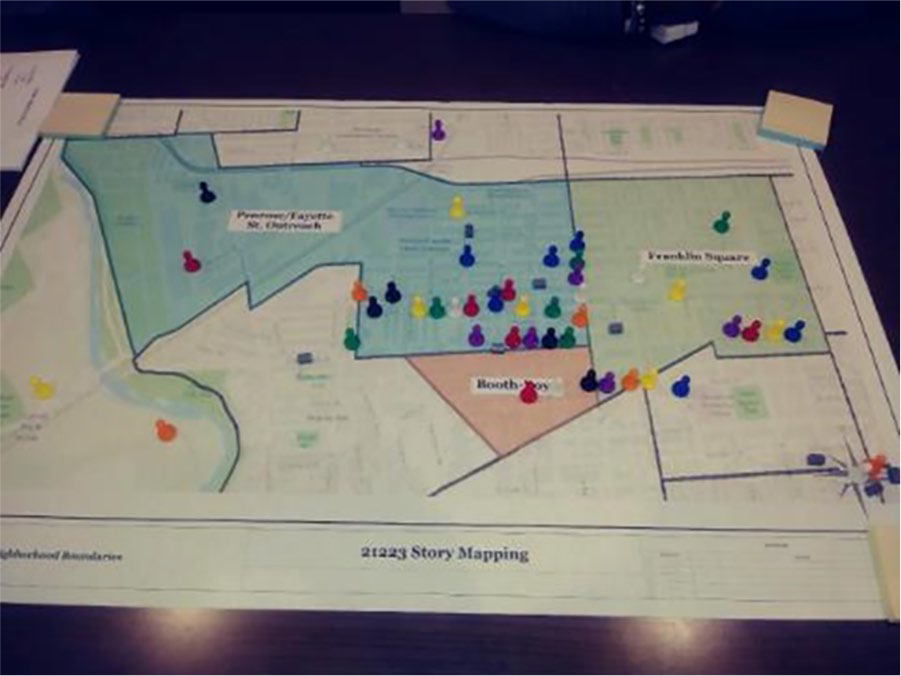
Photograph of community generated map from StoryMapping session in 21,223 Neighborhoods—2019.
Preliminary observations indicated participants’ limited awareness of Future Baltimore, and that their homes and faith institutions were the most identified assets and resources. Additionally, the most common themes were the importance of an asset or resource’s personal value, and proximity to participants. Therefore, the primary recommendation was that Future Baltimore’s success would depend in part on residents feeling a personal connection to the initiative, and the initiative being within close proximity—specifically, blocks—to their primary locations. Anecdotal evidence indicated positive feedback to StoryMapping, with participants stating it felt more natural and appreciative of their personal insight. Facilitator observations indicated participants’ challenges with grasping the approach during the initial session and greater ease with subsequent sessions after some adjustments. Additionally, older participants were more likely to discuss past assets and resources and thus required more encouragement to presently view their neighborhoods. Formal analysis of session data was to be conducted via groupwisdom, a group concept mapping platform, but was indefinitely postponed due to lack of funding and the COVID-19 pandemic.
Nevertheless, StoryMapping was able to yield useful information for Future Baltimore, providing insights that could benefit program planning in terms of understanding community needs and salient points of reference. Future direction for the methodology is to serve as an organizing tool for developing collective efficacy among systemically divested communities, empowering its residents to challenge inequitable development practices like gentrification.
Case Study #2: “Poetic, Practical, Personal, and Political”
In her poem “A Litany for Survival,” poet and cancer survivor Audre Lorde (2000) reassures those at the intersection of life and death that it is “better to speak remembering we were never meant to survive” (p. 256). For Black women in the United States, efforts to speak and share their stories have often been suppressed by acts of structural racism in schools, at work and in clinical settings. Because of provider racism and early death their stories of cancer have been also suppressed, yet statistics tell a cruel truth. According to the American Cancer Society (2019), the 2012–2016 death rates for Black women compared with White women were 28.9% versus 20.6% for breast cancer, 16% versus 11.9% for colorectal cancer, and 33.3% versus 37.9% for lung and bronchus cancer. Previous research tells its own story for how Black women are experiencing cancer. The possible biological and genomic causes for Black women’s disparities are well-studied but increasing attention has turned to nonmedical contributions to disparities: “structural racism—the combination of institutions, culture, history, ideology, and codified practices that generate and perpetuate inequity among racial and ethnic groups—also contributes to disparate health outcomes” (American Cancer Society, 2019, p. 2).
There are other narratives to tell, and this project aims to illuminate those stories. COVID-19 has laid bare structural racism’s deep, far-reaching roots, and Black communities are facing a perfect storm of preexisting conditions and lack of access to health-promoting life conditions resulting in their disproportionate deaths. Cancer patients, often facing financial distress and potentially experiencing compromised immunity, are living in an emotionally and physically perilous situation, balancing on the craggy shoreline separating life and death that Lorde speaks of in her poem. Thus there appears no worse time to be a Black cancer patient, and yet Black women survive and have a story to tell (Villarosa, 2020).
The PIs (Johnson & Gonzales) designed this project to use three methods conducive to epistemic justice for Black women in the United States, amplifying their voices through qualitative interviews, virtual focus groups and poetic transcription. Useful to the method design was the “collaborative poetics” method featured in Helen Johnson et al.’s (2018) pilot. Collaborative poetics is an amalgam of storytelling techniques fueled by a cocreative partnership with research subjects that borrows “from poetic inquiry, the use of poetry as a research tool,” “from autoethnography, a focus on personal experiences to describe and transform the world,” and from “social scientific understandings which frame these approaches” (p. 4). The practical parts of the study design were based on the PIs’ previous experience with art-based evaluation with juvenile justice and foster care engaged youth in Nebraska, and adaptive cocreation of Black cancer outreach (L. Johnson, 2020; TerraLuna Collaborative, 2017). The project combines methods from CBPR, which emphasize partnership between researchers, community members and others at all stages of research, and health research’s “participatory turn” which allows researchers to use digital and visual methods to make the research process and its outcomes more accessible to relevant communities (Gubrium et al., 2016).
To execute this pilot, Black women across the United States were recruited through listservs, a project website, and snowball sampling. Women were first recruited to participate in a virtual interview to discuss their experiences with “practical distress,” as defined in the National Comprehensive Cancer Network (2020) distress thermometer, during their cancer journeys. After completing the interview, respondents are invited to participate in virtual focus groups with other Black women who were past and/or present participants in the PIs’ projects. Once those focus groups are completed, the PIs and coinvestigator (Fakunle) will collaborate on the creation of poems telling stories of the Black experience along the cancer continuum. A group meeting of a sample of the survivors will be called to review both the interview and focus group data summaries, as well as the emerging poetic narratives (Dahlstrom, 2014). Subsequently, the team will work with a visual artist to make a plain-language, visually appealing and culturally relevant graphic representation of the high-level themes from the qualitative data collection. The PIs and coinvestigator will collaborate with community members to select an appropriate public forum for presenting the poems, and the PIs intend to share the poetry with health science students as part of their health humanities training.
The project is currently online only due to COVID-19 and the planned snowball sampling has proven challenging due to the weakening of some ties to in-person Black cancer support and education communities. Nevertheless, 10 interviews have been conducted as of this writing. Preliminary high-level themes revealed through respondents’ stories reflect perspectives of women from various geographic, economic, and biological (i.e., tumor type) backgrounds. Additionally, stories reflect the participants’ proactive engagement as patients, consistent with Sacks’ (2018) work on Black cancer survivors. Unsurprisingly COVID-19 has come up in all interviews, as Black women have concerns with the pandemic in parallel with the pandemic of structural racism as manifested through police violence against Black bodies, the mass loss of Black jobs, and the “digital divide” affecting Black students, families, and patients. Aside from the possible personal impact on their access to screening and treatment options, respondents indicated long-term concerns about Black women cancer patients postpandemic. Specifically, they indicated that if Black women were struggling to access affordable, high quality, and timely cancer screening and treatment prepandemic, then Black women are going to experience even later diagnoses and grimmer prognoses post-pandemic. There are also concerns about the diversion of social safety net and screening funds to COVID-related projects, concerns about delayed screening for Black women with comorbidities that put them at greater risk for COVID-related complications, and concerns that already beleaguered “strong Black women” are becoming increasingly isolated after losing unique in-person Black breast cancer spaces that often offered social, spiritual, emotional, and practical support. Poetry’s deep and democratic roots in diverse cultures can encourage public health use to connect those on varying sides of the wellness and illness, and the methodology offers unique opportunities to facilitate community-engaged, accessible and culturally responsive meaning making, education and professional development.
Discussion
The cited literature, which only focused on peer-reviewed sources, and presented studies, serve as evidence that storytelling is being more acknowledged, appreciated and utilized in public health. This study’s authors propose that storytelling, when used collaboratively with other methodologies, can be powerful tools to both elucidate personal and population-level experiences in health and promote empowerment by illuminating contextual data, thus facilitating significant impact on research and practice. Related fields have embraced and incorporated various components of narrative in their pedagogies and methodologies to acquire and activate context. For example, Castellano et al. (2008) raise the idea of using nonfiction books to help sociology students grasp C. Wright Mills’ (2000) theory of sociological imagination, described as “awareness of the relationship between personal experience and the wider society.” Additionally, one of the aims of culturally responsive racial equity evaluation is to orient the examination of policies and interventions around the context of the most affected populations (Bryan & Lewis, 2019).
As a more nuanced understanding of narrative’s impact in public health emerges and in the pursuit of improved scholarship, professionals are increasingly creating space for storytelling in their work, and it is resonating with the field. Narrative-minded approaches like CBPR continue to gain greater recognition through increased acceptance in top peer-reviewed journals like the American Journal of Public Health. Additionally, as previously highlighted, Lipsey et al. determined through their scoping review that interventions including first-person storytelling as part of the methodology correlated with improved attitudes, health knowledge, health behaviors, and clinical outcomes compared with controls, regardless of whether the study was a randomized control trial. Observing theCOVID-19 pandemic, storytelling is explicitly utilized for both beneficial and detrimental purposes as was done previously (Caulfield et al., 2019). For example, some health professionals are recommending storytelling as a coping mechanism for children, and some government officials are espousing misinformation that both encourages unsupported medical treatments and discourages empirically supported prevention approaches such as wearing masks and social distancing. (Freckelton, 2020; Sullivan & Paccione-Dyszlewski, 2020).
Both past and present circumstances affirm that subjective context, be it personal, institutional, cultural, or otherwise, is needed to thoroughly understand experiences with health. Moreover, personal insight as germane knowledge is now an unavoidable necessity. COVID-19 has revealed a notable division, exhibited in part by the rejection of scientific guidance by millions of Americans: how public health’s epistemology, specifically the tenet of objectivity, has influenced what is essential to exploring humanity’s mechanisms, versus the epistemology of humanity—subjective experience—which best explains humanity’s mechanisms.
Taking inspiration from Anansi’s courage, this article’s authors unapologetically proclaim that complete understanding of and commitment to the public’s health will not happen without genuine insight from the public. Additionally, it behooves our colleagues to accept that under many circumstances the public can most effectively provide their critical knowledge, wisdom, and contextual data through narrative. Therefore, it is our hope that public health broadly considers storytelling as a germane research and practice tool, especially for the equitable design, planning, and implementation of policies and interventions. Be it COVID-19 or structural racism, the time is now for public health to respect, appreciate and elevate the lived experiences of the people whose well-being we are called to improve. If utilized, storytelling is positioned to help navigate the vital reckoning with the field’s history of oppression and suppression, for which demand for greater acknowledgement of underrepresented populations’ perspectives and life experiences can result in healing and justice for all.
Spreading the gospel of storytelling depends on reading, but story reading is not story telling. (Mother Mary Carter Smith, Cofounder, National Association of Black Storytellers)
Footnotes
Acknowledgements
We acknowledge, with respect and gratitude, “Dr. Mama” Deborah Pierce-Fakunle and Mr. Taiwo Fakunle, Drs. Elmer and Joanne Martin, Mother Mary Carter Smith, Baba Stanley “Bunjo” Butler, Mama Linda Goss, Ms. Deborah Agus, Dr. Kim Sydnor, Dr. Lawrence Brown, Ms. Raneitra Grover, Dr. Joanne Banks, and Dr. Sadandaula (Rose) Muheriwa.
Authors’ Note
David O. Fakunle is also at the University of Florida Center for Arts in Medicine.
Declaration of Conflicting Interests
The authors declared no potential conflicts of interest with respect to the research, authorship, and/or publication of this article.
Funding
The authors disclosed receipt of the following financial support for the research, authorship, and/or publication of this article: Research was funded by Kaiser Permanente and the Midwest Sociological Society Research Grant Initiative.
