




Abstract
Purpose. Historical trauma has been widely applied to American Indian/Alaska Native and other Indigenous populations and includes dimensions of language, sociocultural, and land losses and associated physical and mental disorders, as well as economic hardships. Insufficient evidence remains on the experiences of historical trauma due to waves of colonization for mixed-race Mexican people with indigenous ancestry (el pueblo mestizo). Research Question. Drawing from our critical lenses and epistemic advantages as indigenous feminist scholars, we ask, “How can historical trauma be understood through present-day discourse of two mestizo communities? What are public health practice and policy implications for healing historical trauma among mestizo populations?” Methodology and Approach. We analyzed the discourse from two community projects: focus groups and ethnographic field notes from a study in the U.S.–Mexico border region (2012–2014) and field notes and digital stories from a service-learning course in northern New Mexico (2016–2018). Findings. Our analysis describes the social and historical experiences of Mexicans, Mexican Americans, Chicanas/os, and Nuevo Mexicano peoples in the southwestern border region of the United States. We found four salient themes as manifestations of “soul-wound”: (1) violence/fear, (2) discrimination/shame, (3) loss, and (4) deep sorrow. Themes mitigating the trauma were community resiliency rooted in “querencia” (deep connection to land/home/people) and “conscientizacion” (critical consciousness). Conclusion. Historical trauma experienced by mestizo Latinx communities is rooted in local cultural and intergenerational narratives that link traumatic events in the historic past to contemporary local experiences. Future public health interventions should draw on culturally centered strength-based resilience approaches for healing trauma and advancing health equity.
Keywords
Historical trauma has been widely applied to American Indian/Alaska Native (AI/AN) and other Indigenous populations and includes dimensions of language, cultural, social, economic and land losses and associated outcomes (i.e., physical and mental disorders, economic and educational barriers and hardships, etc.). However, there remains insufficient evidence dedicated to the meaning and impact of historical trauma (genocide, forced acculturation and hostile acquisition of land by Spanish and European colonizers) for Latino populations in the United States. To address this gap, our community-based participatory research and service-learning projects with mestizo communities in New Mexico (defined as having mixed European/indigenous heritage) serve as a case example to illustrate the embodiment of historical trauma and community resilience.
Drawing from our own critical lenses and epistemic advantages as indigenous feminist scholars, we interrogate the meaning of historical trauma as it is embodied in current day lived experiences and the discourse of “el pueblo mestizo.” We ask, “How can historical trauma be understood through the present-day discourse of two mestizo communities? What are the public health practice and policy implications for healing historical trauma among mestizo populations in the United States?
El Nacimiento del Pueblo Mestizo
The southwest border region, including New Mexico, is the location where generations of communities have resisted and flourished through multiple waves of colonization, genocide and political and economic dominance by White racial superiority and oppression. “El pueblo mestizo” is a geographic and cultural space defined by migratory journeys and transitional family ties, complex social and historical experiences of Mexicans, Mexican Americans, and Chicanas/os. The terms mestizo and metis (as well as such comparable words as half-caste, half-breed, ladino, choli, coyote, and so on) have been and are now frequently used in Anishinabe-waki (the Americas) to refer to large numbers of people who are of mixed European and Anishinabe (Native American) racial background and culture (Forbes, 2005). The pueblo mestizo reflects both the history of real “peoples” tribes, villages, bands, colonias, barrios, towns, regions, and nations who co-“occupied” the land spanning north and south of the Rio Grande river and the trade route of the Camino Real del Tierra Adentro (Acuña, 2007).
Our intersectional positionality as coauthors are as first-generation college-educated women with mixed-race ancestry: southeastern tribes of Opelousas/Coushatta and Mexican tribes of Guachichiles (Guaxabanes, San Luis Potosi) and Purepecha (Tarascan, Michoacan). As scholars, we recognize the praxis between knowledge and activism, placing justice and healing as central to our role in the academy. Our lived experiences function as assets (queer Chicana/working class/storyteller, Chicana campesina/sundancer, cisgender female/Buddhist mindfulness practitioner and teacher). This “epistemic advantage” (Harding, 2004) is a critical intellectual, social capital that while disregarded in the White-male academy, empowers us to bridge the worlds between the oppressed and oppressor. From these places, we draw from one significant cultural story that marks the birth or “nacimiento” of the mestizo people.
Malintzin: A Legacy of Colonization and Resiliency
As children growing up in Mexican and Mexican American families, our elders recounted the legacy of La Llorona (the wailing woman) in order to warn us of the consequences of “bad” behavior. They’d say, “Don’t stay out too late at night or ‘La Llorona’ will get you, so get home before dark.” Abuelos/as (grandparents) would also scare us about the dangers of drinking, womanizing and gallivanting out in bars. La Llorona embodied the negative stereotypes of women: sexual and evil (la mujer maldita). It is told that she drowned her own children in the river and was banished by the Catholic Church, forcing her to an eternal afterlife wandering the earth, wailing tragically in deep sorrow.
Coming of age as “mestizas,” our conscientizacion (critical awakening of the soul) was embodied in the story of La Llorona who we later learned was called “Malintzin” or “Malinalli.” As recorded in ancient indigenous codices, Malintzin was revered as a wise woman, a scholar, a healer and the people’s leader who spoke many Mexican tribal languages. Due to her social prominence, Hernán Cortés sought her out as a trusted adviser and translator with one goal: to conquer the Nahuatl people as well as the thousands of other tribes in Mexico (Muñoz Camargo, 1852). She birthed two male sons from him and soon after he conquered the Aztec empire, he plotted to kidnap their children and return to Spain where he had another lover. Devastated by the genocide, mass systematic rape of women and the enslavement of indigenous Mexican peoples, Malintzin followed the guidance of her Gods (Nahuatl deities) who instructed her to sacrifice her own children in the river as a symbolic act of reconciliation. Today, “Malinche” is also called the “traitor” of her people. This male superior conquest of Mexico (1519–1521) through the “feminine” created the DNA of the Spanish colonization of the “New World” (Mexico, Latin America and the southwest)—the birth of the mestizo people. Figure 1 shows the large stone on top of the sacred grounds of the Nuahatl people where the Spanish Basilica stands today. It says “that the conquest was not a triumph or a defeat, but is the suffering of the pueblo mestizo.”

The birth of the Pueblo Mestizo, Basilica of Our Lady of Guadalupe, National Shrine, Mexico City, Mexico. Dona Elena Avila, Curanderismo Apprentice Program, December 12, 1999.
Conceptual Model of Historical Trauma and Indigenous Communities
The historical trauma (HT) paradigm which (B. Duran, 1998; Brave Heart et al., 2011; Sotero, 2006; Walters et al., 2002) is salient to indigenous scholars is considered a social movement and approach to healing that has had a groundswell of support and appeal across “Indian Country.” Many have emphasized that American Indian/Alaska Native mental health must be understood within the context of tribal histories of collective traumas and the damages those and subsequent traumas have caused in terms of culture, identity, and spirituality (Gone et al., 2019; Nutton & Fast, 2015; Skewes & Blume, 2019; Walls & Whitbeck, 2011; Ward, 2013). HT has been applied in measures of historical loss and related symptoms (anxiety, posttraumatic stress disorder, depression, anger, and other symptoms; Whitbeck et al., 2004).
Indigenous scholars have documented the link between the historical loss of culture, land and genocide and on-going intergenerational exposures and transmission of social, physical, and psychological disorders (Burton et al., 2011; Walters, Beltran, et al., 2011; Walters, Mohammed, et al., 2011). The majority of the literature on historical trauma is predominantly based on AI/AN populations but to borrow from Forbes (Forbes, 2005), the Anishinabe-waki (Americas) and Anishinable (Native Americans) have a historical bond of continuity with their past. Historical trauma can be about brute force trauma as well as the trauma that is indelible, that which wraps the soul and spirit of a people with such tremendous sadness and loss that they feel lost, uprooted, and hurt by a constant, indefinable pain. While HT research with AI/AN and global indigenous tribes has flourished, there remains insufficient evidence on the concept of historical trauma among Latinx communities who have known and unknown indigenous ancestry. Work by Estrada (2009) remains the sole piece that described the link between HT and Latinx populations (Estrada, 2009). He affirms that historical and social experiences of the Mexican population living in the U.S. have many parallels that lend themselves to the application of historical trauma theory to multiple levels of influence on access to health care, physical health status, and mental health status, including substance abuse among Mexican Americans. (p. 330)
While a growing body of literature has established the consequences of immigration policies on fear, stress, anxiety and other behavioral health outcomes (Hatzenbuehler et al., 2017; Martinez et al., 2015), the link to HT remains overlooked.
Conceptual models of historical trauma concur that it is not just one event but is delineated as a constellation of features in reaction to the collective, historical, and cumulative psychic wounding over time, both over the life span and across generations (Brave Heart, 1998). Mourning that has not been completed and the ensuing depression are absorbed by children from birth and throughout the lifespan (Brave Heart & DeBruyn, 1998). The model by Sotero (2006) illustrated in Figure 2, emphasizes the interconnectedness between past and current responses: (1) historical trajectories of long-term oppression and subjugation through segregation, mass displacement, and multiple forms of violence and economic and cultural dispossession; (2) a trauma response is triggered (physical, social, psychological); and (3) these trauma responses are transmitted to subsequent generations via multiple mechanisms (i.e., social discrimination, political systems) (Sotero, 2006). Solomon et al. (1988) also underscored the depressive and emotional breakdown of children who are descendants of Holocaust survivors always being linked to Holocaust experiences (Solomon et al., 1988). These seminal concepts guide our analysis of how historical trauma can be understood through the present-day discourse of two mestizo communities.
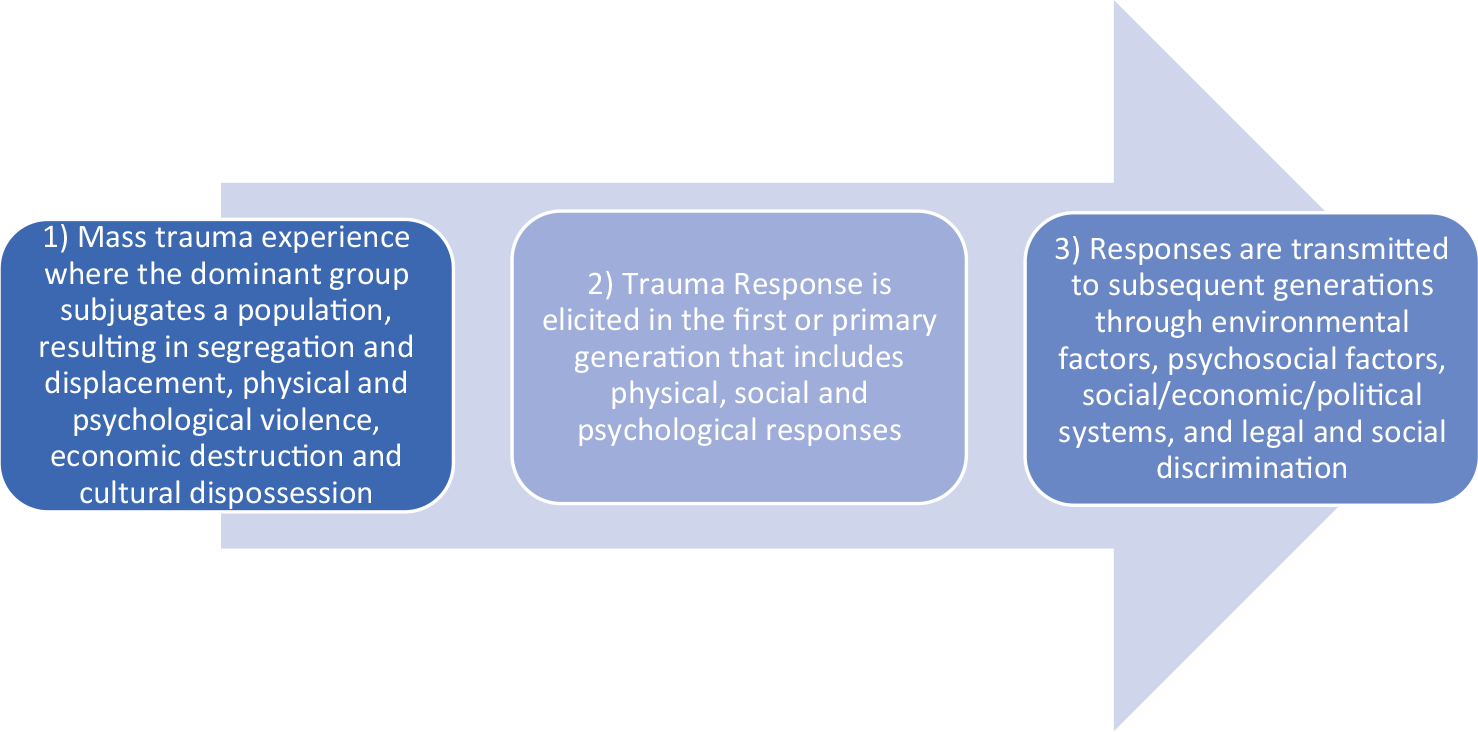
Conceptual model of historical trauma (Sotero, 2006).
Method
Our work draws from long-term engaged scholarship with community partners in northern and southern New Mexico. As formative inquiry into the link between HT and the pueblo mestizo, we partially draw on the larger narrative from two community engaged projects in southern New Mexico colonias (2010–2014) and in northern New Mexico (2016–2018).
Data
The secondary data used for our analysis draws from two studies. The first is a U.S.–Mexico study funded by the Health Initiatives of the Americas (PIMSA) and was approved by the Human Research Review Committee at the University of New Mexico and the Instituto Mexicano del Seguro Social y Universidad Autónoma de Ciudad Juárez (UNM HRRC#11601). The study employed a community-based participatory research approach with a binational research team and a community advisory council composed of an existing network of promotores and border public health leaders. The academic–community partners collaborated on all phases of the research from the development of the proposal, conceptualization of a theoretical framework to the data collection, analysis, and translation of results. In this study, women were the primary subjects of interest in order to compare their lived experiences, which drew on a theoretical model of gendered health effects of constrained choices (Bird & Rieker, 2008). Nine focus groups were conducted in two unincorporated communities (colonias, rural and urban). Each focus group included 4 to 12 Spanish-speaking women aged 18 to 65 years. Focus group sessions took 2 to 3 hours each and were conducted at community centers. The secondary data used for our analysis draws from a second project in northern New Mexico which is part of a Community Based Learning Field School originally funded by the McCune Foundation and the Southwest Hispanic Research Institute. The field school employs service-based learning to train students on culturally centered community engagement. The secondary data come from the educational field notes of students, faculty and transcribed digital interviews with local community leaders.
Analysis
Grounded in critical feminist Chicana discourse, Latina critical race and epistemic justice theories and methods (Anzaldúa et al., 2012; Fricker, 2013; Solorzano & Yosso, 2001), we analyzed the transcribed focus groups and interviews from both projects. Iterative coding included multiple readings and review of written transcripts by two of the authors followed by reflective discussions comparing common and unique themes from each region. Auto-ethnographic processes were used to share personal inter-generational stories of trauma and resilience, investigation and reflection as they relate to the community discourse, traditional teachings and scientology of Mexican medicine and spirituality, and the extant literature on historical trauma. Auto-ethnography is a decolonized method that fosters epistemic knowledge from “within” (Allen-Collinson, 2013). It involves critical self-reflexivity as part of the analysis, debunks the use of “dominant culture discourse” and centers the voice that is typically marginalized in Western health and social science research.
Community Context
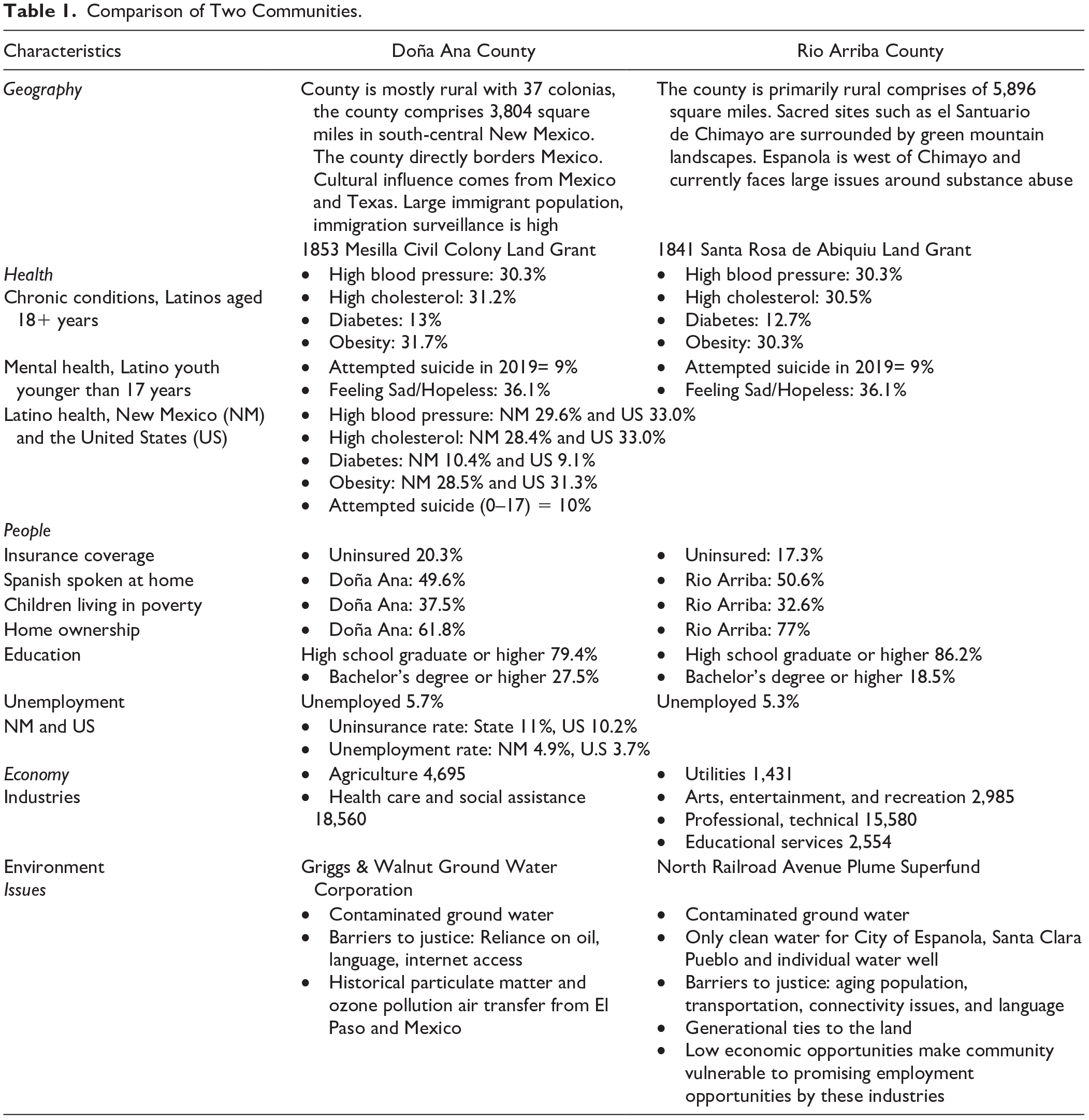
New Mexico is an ideal place for understanding historical trauma across diverse mestizo communities where the land and political-scape of settler colonialism (Barker, 2012) persist through forced assimilation, outsider land acquisition, displacement of local residents and environmental racism. New Mexico consists of diverse ecosystems and cultural and linguistic assets. It is also home to 23 Indian tribes (19, three Apache tribes and the Navajo Nation; New Mexico Indian Affairs Department, 2020) and 33 unincorporated communities (colonias), with minority groups comprising 67.5% of the population (49.3% Latino, 11% American Indian/Alaskan Native, 2.6% African American, 2% Asian/Pacific Islander, 2.6% mixed race (U.S. Census Bureau, 2019). Table 1 compares both communities by geography (rurality, land grants dating back to the 1800s), sociodemographics (lack of insurance coverage, child poverty, over half speak Spanish), health (high rates of teen suicide, blood pressure, diabetes), economy (high unemployment, reliance on agricultural and utility industries), and environment (superfund sites, ground and water contamination, air pollution) (County Health Rankings, 2020b, 2020a; Dona Ana County, New Mexico, 2017, 2020; Limon et al., 2019; New Mexico Department of Health, 2020a, 2020b; New Mexico Department of Workforce Solutions, 2020; New Mexico Environment Department, 2020; New Mexico History, 2020; New Mexico Humanities Council, 2009; NM Counties, 2020; Southwest Research and Information Center, 2004; U.S. Census Bureau, 2019; U.S. Environmental Protection Agency, 2020). In the north, communities are separated by private lands, and federal jurisdictions, which leave land grants vulnerable to shifts in political power and ownership rights for land and water. In the south communities, where residents identify themselves by colonias, land is owned by wealthy corporations and landowners who do not hide their exploitation of the poor. Colonias are areas in which basic infrastructure—water, wastewater, improved roads, access to utilities, and so on—is inadequate or nonexistent (United States Code, 2013). Scarcity of local and federal government resources diminishes the quality of life and health in unincorporated colonias where residents lack basic necessities, and they suffer from social problems due to illegal immigration and drug trafficking.
Comparison of Two Communities.
Results
The discourse from the two regions exposes how trauma is present in the daily lives of the pueblo mestizo in four ways: (1) violence and fear, (2) tristeza (deep sorrow), (3) maltratos (shame and discrimination), and (4) loss (home, land and culture).
Violence and Fear
Women in southern New Mexico recounted how the constant presence of Immigration and Customs Enforcement (ICE) creates stress and fear. For instance, one woman disclosed, We put up a fight but we also deal with that stress, that fear that says ran into the migra. This is happening and it’s a stress that one goes through, you can’t be comfortable if you are at work, you just can’t.
Another woman expressed her pride in being able to build a home for her family despite the stressor of the ICE: Here you have the possibility to open bank accounts, you have that possibility, you can get documents, cars with the title under your name, land to your name. Here people live at the level they want live, the migra comes, and even sees them, and even takes them. But, I mean, here, in the United States, it gives you that, opportunities that you don’t get over there.
In northern New Mexico, multiple generations experience community violence and police surveillance related to drug use and trafficking. In one community, a local woman who serves as a matriarchal healer shared a disturbing account: My neighbors were shooting at each other and guns would be going off and I knew. I knew it was bigger than business as usual but we didn’t know that until the big bust went down. It just kept going on, for years it got worse and worse, I had next-door neighbors dropping dead from bad heroin. And then kids were getting buried regularly and it was getting worse. This sorrow fell upon the village and I was crying for days about it.
“Tristeza”—Deep Sorrow
Structural violence and fear due to militarization, ICE and drug enforcement were intertwined with a sense of desolation. In the north, residents painfully described much of the trauma as a crisis due to the multiple family members dying from overdoses. A local director of a nonprofit serving the community explains, Our people are dying and you don’t come back from the dead. But we don’t get over it. I’ve seen so many moms that come through here that have lost a son or daughter, you know other family members and you see the pain, and you feel it. You hear it in their voices, we need to need to tackle this, for the here and now and for the future.
One local leader who lost her daughter to addiction shared both her own deep sorrow and her compassion for another local resident who she just met, You have buried your daughter today, so sorry. She grabbed me . . . and I put my arms around her and she began to weep in my arms. Then she jumped back and she said I’m sorry, I’m sorry, I don’t know you. I’m so sorry. I said no, please don’t be sorry. But, it was really a hard to shake off that moment. That exchange between two people that have never met. That was so deep.
A Chicano man who works with other men to help them heal and transition from incarceration revealed the weariness of the sorrow: You know Chicano that is not from my community can speak my truth. Even my brother, my sister can speak my truth, we’re so beaten down. We are so bogged down by addiction and what was done was done by all kinds of generations and generational trauma, that as colonization we know, and when the Europeans came a lot of our indigenous culture was taken away.
These accounts, while painful, demonstrate a deep sense of interconnectedness and compassion within and outside of the mestizo kinship networks. However, in contrast, Mexican women in the southern colonia shared their experiences of intra-racial discrimination from other “Hispanic” or Latino residents.
“Maltratos”—Shame and Discrimination
Women shared multiple accounts of being treated differently, indifferently or discriminated against for speaking Spanish. They described experiences within the community at-large that, according to what the women shared, showed grave disrespect coming from the longer-term residents of New Mexico toward more recent Mexicans. One woman shared, It always happens to me when I go to the stores, wherever I go, my daughter and husband laugh at me when we go there together, and then since I am the one who pays I always tell them, “you speak Spanish? Then [he/she] tells me no, but you are the same as me, Mexican, but of course said no. I always tell them, you.
Another woman shared, The worst is that it is sadder that it’s people who are Latinos, that is what hurts the most-Among other Latino people it’s the worst and saddest, that is what hurts the most.
Several women expressed concern about the demeaning behavior shown to them by other Latinos from the area as expressed in their refusal to learn or if able to speak Spanish to them. In one focus group, the women shared their concern about the loss of or lack of trying to speak Spanish by the young people in the community as a manifestation of shame about being Latino or Mexican: The kids should have educational support so that they don’t feel ashamed of speaking Spanish, because a lot of times it’s in the home where they don’t let then speak Spanish.
Despite these interpersonal experiences of discrimination or “maltratos” (being treated poorly) by other Latinos living in the area, Mexican women were deeply concerned about all Latino/Mexican children not being shamed for speaking Spanish and took care to assure their own children were not culturally suppressed at home.
Loss (Home, Land, and Culture)
Up north, community leaders refer to their community as . . . a Chicano Pueblo with the pain, lots of trauma, that comes with heavy drinking and drug use as a way to self-medicate and soothe the deep loss and struggle for home and land.
A northern landowner explains, “Many people still have their own homes and lots of land but are burdened with poverty and a constant feeling of being invaded.” An activist explained, We still have to fight to keep what’s ours. People think they can just take over our towns, our land, and they try to make us invisible.
Another leader discusses the form of oppression that involves the mechanism of erasure through acquisition of lands from local people: These outsiders come in thinking that there is nothing going on here in our towns. That we are invisible. They don’t know our history, how we have history all over this land, es nuestra Tierra (it is our land). They just come in and then want to build things and do things their own way with no regard to the community, to those of us who have been here for years and generations.
In the northern rural communities, local leaders also took precautions to preserve their land and investments for the next generation. One landowner and activist explained.
I think my wife and I, somos herederos (we are landowners), might have to put our land in a trust because our own children don’t know how to value it. Once they are in their 40’s or 50’s they might come to understand the important of what they have, of what we have. Our Tierra, our herencia.
Discussion
Healing Malintzin’s Children: Discourse of Pain and Community Resilience
The discourse of the mestizo people in two communities illustrates the lived experiences that embody the dichotomy of pain and resiliency. Despite structural violence, communities find ways to cope and creatively navigate their circumstances. The deep tristeza of death is soothed by acts of human compassion and efforts to do healing work with the youth. Discrimination and shame by other local Latinos are mitigated with women’s efforts to maintain the Spanish language. Loss of land and home are met with resistance and legal protections to guarantee land trust to the next generation.
The experiences of violence, fear, deep sorrow, shame, discrimination and loss of land, home and culture reflect a haunting betrayal transmitted in the legacy of Malinche. Collectively, the responses bridge across generations and exist within historically oppressive social, economic, and political systems. Chicanas/os and Mexicanos of the southwest frame and describe historical trauma from many different perspectives and lived experiences. Many times, these communities will refer to trauma as a “soul wound” or “una enfermedad del alma.” For many U.S.-born and immigrant New Mexicans, a soul wound is manifested in the emotional and mental health conditions of a people, in their history, in their political consciousness and lived experiences as a Pueblo Mestizo. Figure 3 illustrates the four manifestations of soul wound within the center of the human spirit. Present day traumas perpetrate and inflict harm to the individual and collective well-being of the mestizo people. The soul wound has been an integral part of indigenous (Avila & Parker, 2000; Torres & Miranda, 2017) knowledge from Mexico ever since colonization began for the indigenous peoples of the world. The knowledge of the soul wound has been present in Indian Country for many generations and was first discussed by E. Duran and Duran (1995) in their seminal work on post-colonial psychology where they link the soul wound back to “indigenous knowledge since Columbus landed in this hemisphere and Cortez arrived in Vera Cruz, Mexico” (E. Duran et al., 1998, p. 341). Current synonymous terms include historical trauma, historical legacy, American Indian holocaust, intergenerational posttraumatic stress disorder and cultural trauma.
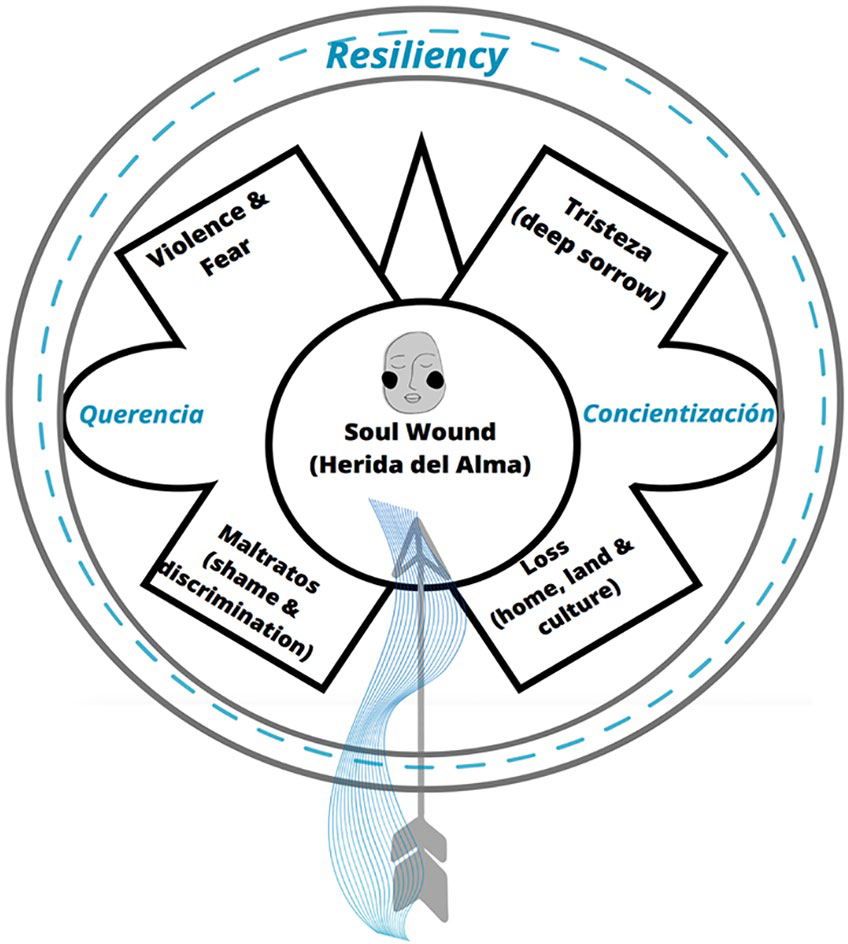
Duality of soul wound and resiliency among the pueblo mestizo.
Also shown in Figure 3 is the overarching theme of cultural medicine as healing. Up north, a local healer/activist explained, The lived experience is the medicine we need to help heal individuals, such as those going through the addiction crisis, through the trauma. Not only the individual but the family, because it is that lived experience; It’s that spirit; it’s that medicine through our heartaches through our struggles that we are better able to help that individual.
A deep connection to land is central to cultural medicine for communities grappling to transform the past trauma. The pueblo mestizo has an abundance of cultural pride and historical legacy that creates a collective force of resiliency stemming from the profound belief in “querencia.” Querencia is a beloved place; it is the physical and spiritual essence of home (Quintana, 2014). The concept of querencia is well captured by Estevan Arellano’s (1997) well-known definition “our memory has now assumed the form of the landscape itself,” where the people are one with the land. A land-grant leader explained, “This land right here was shared by us all; we’d walk to the river and fish, play or cool down in the water.”
Interwoven with “querencia” is the powerful thread of awakening or “conscientización” of the pueblo mestizo. Freire and Ramos (1970) explained the process of conscientization as an intrinsic part of cultural action for freedom. They define critical consciousness, an awakening for freedom and transformation by humanizing one’s own reality (Freire & Ramos, 1970). In this sense, agency and self-determination become a fuerza (driving force) for social transformation and collective liberation in examining our past, taking pride in cultural survival and reinventing our future.
In examining the discourse of historical trauma in the pueblo mestizo, it is imperative to also draw on the work of Anzaldúa (1987, 1999). Caught in the dilemma of being mixed breed, “la consciencia de la mestiza” is a duality of oppression and healing. Embracing one’s own power as a transmitter of cultural and spiritual values as equal or superior to oppression and shame is healing to the collective psychic of the pueblo mestizo (borderlanders, Mexicanos, immigrants, mari-machas/mariposas, Chicanos, indios). Sandoval (1991) broadens la “conscientización” to “self-conscious production of political opposition” to White supremacy and oppression (Sandoval, 1991). Refusing to internalize or succumb to the oppressor or oppression, an oppositional ideology embraces equal rights and revolution that is in allegiance with Anzaldúa’s nueva mestiza and broadens a sense of collective purpose beyond the pueblo mestizo toward universal healing.
Relevance to Historical Trauma Processes for Other Indigenous Populations
Similar to research documenting the impact of coloniziation on the health of AI/AN populations, our analysis of the pueblo mestizo mirrors the core concepts of historical trauma as an intergenerational transmission process and legacy of systematic colonial brutality that pierces the communal soul of a people (Brave Heart, 2003; E. Duran & Duran, 1995; E. Duran et al., 1998). The discourse also embodies a spirit of community resilience that breaks free from oppression and draws from the love of home, land and people (querencia) and oppositional consciousness toward liberation. Historical Trauma is seen in many ways by historically colonized peoples; as a mental health outcome, a form of posttraumatic stress disorder, and as a social movement. One important use of HT is as a theory of etiology. Most Western science social and health theories assume disparities are a result of inherently inferior or uncivil culture, or lack of enculturation into western cultures norms and values. HT, as a theory of etiology proposes that all inequities are routed in the horrific history of extermination and exploitation that settler colonialism wrecked on Indigenous peoples. Historical Trauma explains the health, economic and social inequities so prevalent in Latino and Indigenous communities in north and south America.
The application of HT as a theory of etiology, is an important pathway toward eliminating epistemic injustice (Fricker, 2007). Epistemic injustice, or wrongs done against a person specifically as a knower, applies to colonized peoples through the colonial eradication of language and family, community, cultural and spiritual practices and understandings. The doctrine of discovery is an essential law enacting epistemic injustice. Any peoples encountered through colonization, that did not believe in a Christian God, were thought to be expendable.
Practice and Policy Implications
Given the growing structural racism, anti-Mexican and immigrant sentiment and systematic acts of violence, including the caging of children and family separation policies, HT is a public health epidemic. HT is the experience embodied across generations while the acts of racism are embedded in the structures, policies and systems that are ruled by White dominant culture oppressive ideologies which negate and disenfranchise the pueblo mestizo. Rather than interrogate racism as an external phenomenon outside of the field of public health, we must reflect inward into the injustices and abuses inherent in the U.S. health care system.
As an example, for decades, the U.S. health authorities used noxious, often toxic chemicals to delouse Mexicans seeking to cross the border into the United States. Dating back to 1917, transnational workers going/returning to work in the E Paso-Juarez region were stripped naked and fumigated with chemical agents (i.e., Zyklon B, gasoline, sodium cyanide) in order to “disinfect” them. This practice led by the Public Health Services was in response to the outbreak of typhus in central Mexico (1915) and a year later to reports of new cases in Los Angeles and in El Paso. Although the threat of the disease subsided within a few months, the practice of disinfecting continued until the 1930s (Markel & Stern, 1999; McKiernan-González, 1999; Stern, 1999). Today, the negative medicalization of “Mexicans” and the idea of the “dirty Mexican” remains a part of medical discourse. Later, these practices were adopted by Nazis Germany and Zyklon B was used to fumigate Jews in the gas chambers (National Public Radio, 2006).
In the 1960s, public health discourse regarding Latina sexuality, fertility, and reproduction culminated in a systematic public health policy and practice aimed at controlling population growth through normative sterilization and abortion as a common birth control method among Latina women living in Puerto Rico. The outcome of these policies made women of childbearing age in Puerto Rico more than 10 times more likely to be sterilized than were women from the United States (Cacari-Stone & Avila, 2012). Today, Latina refugees and immigrants who have been taken into ICE custody at the detention camps (i.e., Irwin County Detention Center, Georgia) are the recent victims of forced sterilization (National Public Radio, 2020).
In 1990, the Centers for Disease Control and Prevention (CDC) and Kaiser Permanente of Southern California injected 1,500 six-month-old Black and Hispanic babies in Los Angeles with an “experimental” measles vaccine that had never been licensed for use in the United States (Cimons, 1996). In a Los Angeles Times article (Cimons, 1996) the CDC’s chief Dr. Satcher referred to the failure to tell the parents in Los Angeles that the EZ vaccine was experimental as a “little mistake” and not a deliberate attempt to deceive them. Kaiser Pharmaceuticals maintains that the failure to inform the parents was an administrative “oversight.” However, CDC grant announcements in 1989 clearly state that the vaccine trials are experimental, developmental, test and research work.
Finally, while academic health centers and public health teaching institutions are at the forefront of delivering care to the diverse medically underserved and uninsured populations in the United States, organizational policies undermine the ethical oath to serve all regardless of race, language and immigration status. Regardless, some organizational policies reflect an ideology of exclusion and discrimination against certain classifications of immigrants that mirrors a reoccurring and recent sentiment that “Latinx and other racial/ethnic immigrants” are a public charge to the health and social welfare state of our nation (Stone et al., 2014). This ongoing pejorative public narrative regarding immigrant, Latinx and Mexican communities permeate every aspect of society, generating myths, shaping public opinions, sustaining discrimination, and more recently fueling immigration policies that call for massive deportation and incarceration of refugees (including children and families) who are fleeing violence and persecution (Mohatt et al., 2014).
Conclusion
If we are to tackle structural racism, then it is imperative that public health leaders, practitioners and researchers embrace hermeneutical justice (Fricker, 2007). We call for the field of public health to reject marginalization of cultural and community ways of knowing and acknowledge and render the experiences of the pueblo mestizo as legitimate, intelligent, and human. The public health lens must expand and address the HT of indigenous peoples and integrate the culture, ways of knowing and resilience as part of evidenced- based practice derived from locally based community-based science. Resiliency and assets are fundamental strategies necessary for indigenous-based public health interventions - this is the foundation of frontline social justice driven public health.
Footnotes
Acknowledgements
We also recognize the review and feedback of Nina Wallerstein, DrPH and Steve Verney, PhD as part of the TREE Center Writing Studios. We acknowledge the technical support and assistance from the TREE Center program manager and students at the University of New Mexico (Selene Vences, Carlos Linares Koloffon, Alexandra Villegas, and Angel Fernando Gutierrez). We drew our inspiration from the interconnectedness of the people, land, and earth of the southwest as well as the deep roots of our Mexican and mestizo bloodlines. A great honor to have the space to weave in the voices of our communidades and to have their trust in us to write a piece that brings forth our collective spiritual scholarship for the purpose of deeper understanding of who we are, where we’ve been and a path for healing-juntos.
Declaration of Conflicting Interests
The authors declared no potential conflicts of interest with respect to the research, authorship, and/or publication of this article.
Funding
The author(s) disclosed receipt of the following financial support for the research, authorship, and/or publication of this article: We appreciate the grant funding from the Health Initiative of the Americas (PIMSA), University of California, Berkeley (2012–2014) and the support of the Transdisciplinary Research, Equity and Engagement Center for Advancing Behavioral Health, NIMHD Grant No. U54 MD004811-08.
