



Abstract
Maternal health-seeking behavior (MHSB) is crucial for maternal health. However, little is known about MHSB in the Democratic Republic of the Congo (DRC). This study aims to evaluate the situation and socioeconomic associates of MHSB in the DRC. Based on the responses of 8,360 participants in a nationally representative survey, we adopted a K-modes cluster analysis algorithm to categorize women into three groups (i.e., infrequent service-users, partial service-users, and full service-users) according to their recent MHSB. Multinomial logistic regression was applied to identify the associated predictors of MHSB. The results show that most women (90.29%) did not receive integral maternal health services, including antenatal care, institutional delivery, and postnatal care. Compared with their counterparts, women who received higher maternal educational attainment, had good HIV-related knowledge, lived in urban regions, and lived in wealthier households were more likely to be partial service-users or full service-users. Women exposed to mass media at least once a week were more likely to be full service-users rather than infrequent service-users. The majority of participants who lived in Kasai and near provinces were infrequent service-users, indicating poor MHSB status in the region. Interventions to promote maternal health knowledge and awareness are highly recommended to improve MHSB in the DRC.
Keywords
Maternal health is defined as the health of women during pregnancy, delivery, and the postnatal period. According to current literature, maternal health-seeking behavior (MHSB) is considered as the health-seeking behaviors among pregnant women, including decisions and actions to seek maternal health services (Dapaah & Nachinaab, 2019; Kifle et al., 2017). It is well recognized that universal and comprehensive maternal health services during MHSB could help reduce maternal mortality ratio and help achieve Sustainable Development Goals Target 3.1 (World Health Organization, 2015). In particular, pregnancy and delivery care coverage were set as important tracer indicators to reflect coverage of essential health services in Sustainable Development Goals Target 3.8 (United Nations, 2020).
Women’s MHSB is a composite result of personal needs, social forces, and access to services. As the most cited model in health-seeking behavior study, Andersen’s health behavior model and its extensions suggest that health service use is a function of predisposing characteristics (including gender, age, and health beliefs), enabling characteristics or resources that facilitate access to health services (such as wealth, social support or community characteristics), and personal healthcare need (Andersen, 1995; Boerleider et al., 2013). Empirical research in low-income countries (LICs) produced evidence supporting the general Andersen’s Health Behavior model. However, most of these studies focused on only one aspect of MHSB, such as antenatal care (ANC), institutional delivery or skilled birth attendance, and postnatal care (PNC). Studies in Ethiopia found that maternal age, maternal educational levels, maternal health-related knowledge, and awareness were major predictors of antenatal care service utilization (Abosse et al., 2010; Kifle et al., 2017). Acharya et al. (2015) in Nepal found that mass media exposure was positively associated with women’s utilization of ANC. Wang et al. (2016) utilized demographic and health data in Ghana, Rwanda, and Ghana to demonstrate that having health insurance would increase the number of women who attended ANC visits and increase the chance of delivering birth in health facilities. What is more, previous studies also showed that women’s environment such as the region of residence (Jayaraman et al., 2008), household head’s sex (Jayaraman et al., 2008), household head’s education attainment (Navaneetham & Dharmalingam, 2002), and household wealth can also affect women’s MHSB (Woldemicael & Tenkorang, 2010).
As one of the most impoverished and conflict-affected LICs (Laokri et al., 2018), the Democratic Republic of the Congo (DRC) cannot provide widespread quality health care. The reported health expenditure per capita invested by the DRC government was 19.43 U.S. dollars in 2017, below the level of other LICs (World Bank, 2020), making maternal health services less accessible for women in the country. According to the latest United Nations Children’s Fund (UNICEF) report, only 42.9% of women attended ANC visits at least four times during their last pregnancy (UNICEF, 2019b). This percentage is below the lowest average regional level in South Asia (49%) reported by the UNICEF (2019a). However, limited research has explored the MHSB situation in the DRC and discussed factors associated with the low MHSB. Also, little is known about which groups of women are the most vulnerable in the country.
The present study aims to demonstrate the current MHSB situation using the data from the sixth Multiple Indicator Cluster Surveys (MICS6), which is the fourth MICS conducted in the DRC conducted from 2017 to 2018. A wide range of factors, including female fertility history, women’s educational attainment, household wealth, and the region of residence, were considered in our research. Findings from this study will contribute to the evidence on the determinants of MHSB and help identify the most vulnerable pregnant women in the DRC, facilitating the design of future intervention strategies.
Method
Data Source and Participants
This study was based on the MICS6 in the DRC, a nationwide survey to assess maternal and child health. As a part of the global MICS, the survey was conducted by the National Bureau of Statistics, DRC, with technical support from the UNICEF between 2017 and 2018. A two-stage sampling method was used. At the first stage, three strata in each province except Kinshasa were created. Within each stratum, primary sample units were selected with probability proportional to population size. In the second stage, 30 households were drawn from each of the 721 clusters, with 21,630 households in total. A detailed description of the sample design can be found in the MICS report (UNICEF, 2019b).
We retrieved data from the surveys for women and their households. In line with the questionnaire’s intrinsic structure, only women who had given live birth in the past 2 years before the survey were included, reaching a total of 8,467. Among the original sample, 93 participants were excluded due to any missing value of women’s last childbearing age, birth order, marital status, education attainment, HIV-related knowledge, mass media exposure, pregnancy tendency, children death history, health insurance coverage, the region of residence, household heads’ sex, household heads’ ethnicity, household heads’ religious beliefs, household heads’ education attainment, and household’s wealth group. Finally, 8,360 women were included in our analysis.
Exposures
Female Fertility History
Childbearing age was calculated using the women’s documented birthday and the year of their last birth. Female parity was a continuous variable and was calculated using the total number of births during the woman’s life. Women’s tendency for the last delivery was a binary variable and was measured by whether the woman wanted to get pregnant when she got pregnant.
Socioeconomic Characteristics
Values about women’s educational attainment, HIV-related knowledge, marital status, mass media exposure, and health insurance coverage were retrieved from the survey. Women’s educational attainment was a categorical variable with three groups (1) no education or preprimary school, (2) primary school education, and (3) secondary or higher education. Women’s HIV-related knowledge was included as a binary variable to reflect their maternal health awareness and literacy. According to UNICEF’s definition, having good HIV-related knowledge was defined as (1) knowing ways of preventing HIV (i.e., having only one faithful partner who is uninfected and who always uses a condom), (2) knowing that a healthy person can be HIV positive, and (3) disagreeing with incorrect information about HIV (i.e., that people will get HIV by sharing food with a person who has HIV, or that people will get HIV from supernatural means; UNICEF, 2019b). Otherwise, the woman was regarded as not having good HIV-related knowledge. Women’s marital status was a categorical variable with three groups: (1) married, (2) unmarried but living with a partner, and (3) not in a union (single). Exposure to mass media was a binary variable (exposed vs. not exposed). Being exposed to mass media was defined as having used any of the three forms of mass media (newspapers, television, or radio) at least once a week. Otherwise, the woman was regarded as not being exposed to mass media. Whether the participants have health insurance was also collected in the questionnaire as a binary variable.
Household Environment
Household head’s sex, educational attainment (i.e., no education or preprimary school, primary school, and secondary or higher), ethnicity (i.e., Bantu, Nilotic, Sudanese, Pygmy, and others), and religious belief (i.e., Catholic, Protestant, Revival Churches, without religion and other religions) were included in the data set and were considered as covariates in the analysis. According to an asset-based wealth index, households in the DRC were classified into five quintiles from the poorest to the wealthiest to assess their wealth status. Household residence region (i.e., rural vs. urban) and provinces were also included in the analysis.
MHSB Outcomes
Antenatal Care
Two variables were used to assess ANC utilization. A binary variable, ANC attendance, was constructed to indicate whether the women received any facility-based ANC during their pregnancy. Then, another binary variable called ANC4+ was generated. For women who had attended ANC at least four times, ANC4+ was defined as Yes and coded as 1. For women who had never attended ANC or attended ANC for less than four times, ANC4+ was defined as No and coded as 0.
Institutional Delivery
Institutional delivery was a binary variable (yes vs. no). Having an institutional delivery was defined as giving birth in a health institution and coded as 1. In this study, health institutions included hospitals, clinics or health centers, health posts, and other health care centers. If women gave birth in other places, then they were considered as not having an institutional delivery and coded as 0.
Postnatal Care
Three binary variables assessing PNC (within 48 hours after birth) were used, including whether the infant’s cord was examined (yes vs. no) include, whether someone examined the infant’s temperature (yes vs. no), and whether someone counseled the mother on breastfeeding (yes vs. no).
Statistical Analysis
Based on the recall of participants, we conducted a cluster analysis to develop a classification of their last MHSB (i.e., having attended ANC or not, having attended ANC at least four times or not, having institutional delivery or not, having had someone examine the infant’s cord, the infant’s temperature, and counsel the mother on breastfeeding within 48 hours or not). Cluster analysis, a multivariate statistical technique for grouping data, was used to find existing patterns within data to generate groups by minimizing within-group and maximizing between-group variability. In this study, a K-modes algorithm was used. K-modes algorithm is an extension from the K-means and was developed to deal with categorical variables (Huang, 1997). The optimal number of clusters was set as three based on the silhouette index (see Supplemental Material Section A). After clustering women into three groups, we calculated the weighted proportion for clusters in each province. Then, the weighted proportions of groups were ranked to identify the dominant group within each province. A map was made to visualize the MHSB features in each province.
To explore significant predictors associated with MHSB, analysis of variance and chi-square testing were first conducted to compare group characteristics between groups. Following the bivariate analysis, a multinomial logistic regression was employed. Female fertility history, women’s socioeconomic characteristics, household wealth group, and residence regions were independent variables. Household head’s sex, age, ethnicity, religious belief, education attainment, and the provinces they lived in were adjusted as a fixed effect. The primary sample unit was adjusted as a random effect. Data processing and cluster analysis were carried out by R 4.0.0 (R Core Team, 2020). Multinomial logistics regression was carried out by Stata 15 (StataCorp, College Station, TX, USA). The statistical significance level was set as p < .05.
Results
Demographic and Socioeconomic Characteristics of Participants
In total, 8360 women were included in the study. The average childbearing age was 28.06 years (SD = 7.06). About three quarters of the whole sample were married, and the median birth order for the last birth was 3. Regarding educational attainment, only 38.16% of women have attended secondary school or higher. Of these participants, only 17.98% had been exposed to any sort of mass media at least once a week. Health insurance only covered 1.88% of participants. More details about women’s demographic and socio-economic characteristics in each group can be found in Table 1.
Demographic, Socioeconomic Characteristics for Participants (N = 8,360).
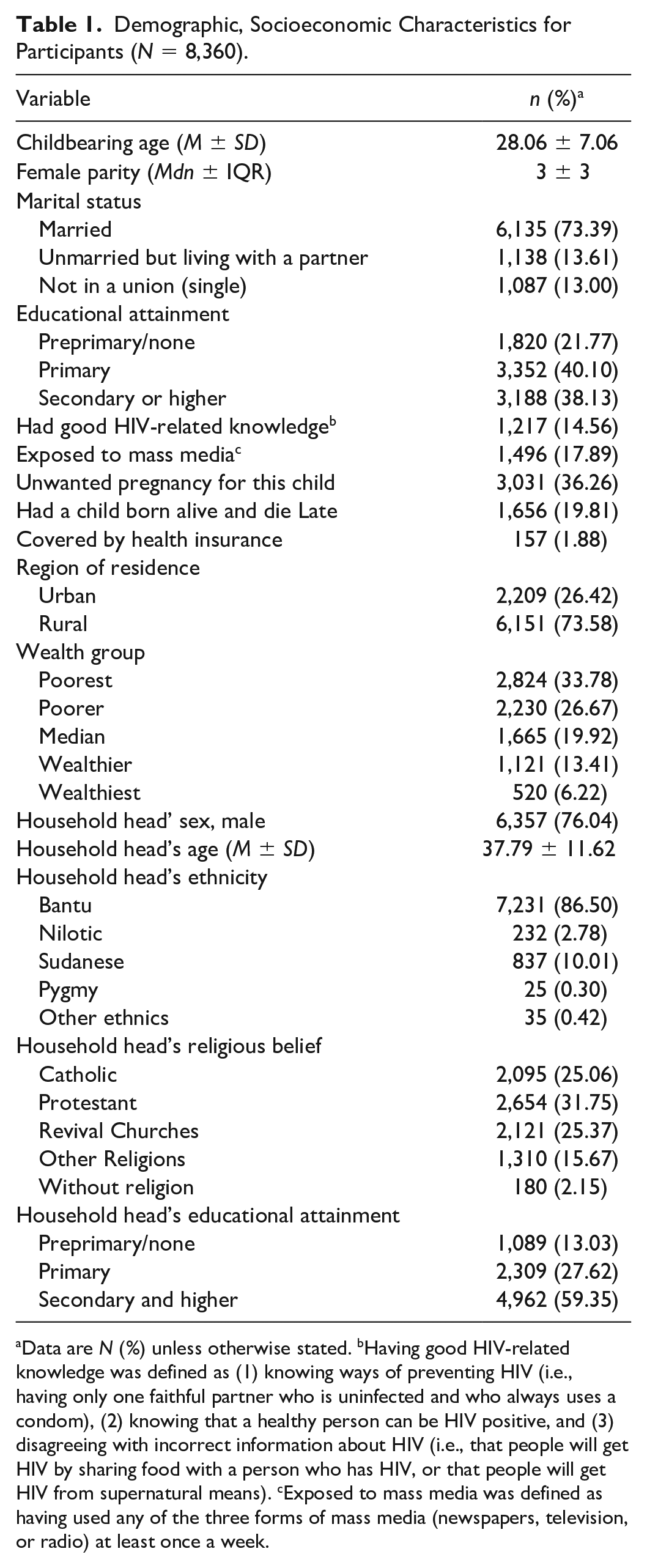
Data are N (%) unless otherwise stated. bHaving good HIV-related knowledge was defined as (1) knowing ways of preventing HIV (i.e., having only one faithful partner who is uninfected and who always uses a condom), (2) knowing that a healthy person can be HIV positive, and (3) disagreeing with incorrect information about HIV (i.e., that people will get HIV by sharing food with a person who has HIV, or that people will get HIV from supernatural means). cExposed to mass media was defined as having used any of the three forms of mass media (newspapers, television, or radio) at least once a week.
Maternal Health-Seeking Behaviors and Clustering Findings
Among participants, the majority (83.2%, 95% CI [81.9%, 84.0%]) have attended ANC, but less than half of them (43.3%, 95% CI [41.5%, 45.0%]) attended ANC at least four times. Regarding the most recent childbirth, 81.6% (95% CI [80.4%, 83.0%]) of participants gave birth in a health facility. However, only 17.5% (95% CI [15.9%, 19.0%]) of participants received all three PNC services within 48 hours after delivery. In total, only 9.71% (95% CI [2.5%, 11.0%]) of participants received complete maternal health services (i.e., attending ANC at least four times, gave their most recent birth in a health facility, and received all three PNC services).
Results of the K-modes cluster analysis are presented in Table 2. Infrequent service-users (n = 2,861) are those who have rarely used maternal health services. Partial service-users (n = 3,290) all had attended ANC at least once and given their last births in a health facility. However, less than half of them attended ANC at least four times, and few attended any PNC. Full service-users (n = 2,209) had the ideal MHSB. More than 90% of them have attended ANC at least once, given their last birth in a health institution, and had attended at least one kind of PNC.
Maternal Health-Seeking Behavior Characteristic by Clusters (N = 8,360).

Note. ANC = antenatal care; PNC = postnatal care.
Infrequent service-users barely utilized none of maternal health services. bPartial service-users all have attended ANC and given birth in health institutions, but few of them have good PNC utilization. cFull service-users seek maternal health services from the prenatal period to the postnatal period.
Figure 1 shows the dominant group in each local province. Out of 26 provinces, six provinces were dominated by the full service-users. Seven provinces were dominated by infrequent service-users, including Kasai, Kasai Central, Kasai Oriental, Sankuru, Tanganyika, Haut-Lomami, and Lualaba. These provinces were located in the Kasai region or near the region, where new violence erupted in 2016. Detailed proportions of groups in each province are shown in Supplemental Material Section B Table S2.

Geographic distribution for each maternal health-seeking behavior group (N = 8,360).a
Factors Associated With MHSB
Bivariate analysis showed a significant difference in all demographic and socioeconomic factors with a p value less than .05, except for the household head’s sex (Table 3). Most infrequent service-users lived in rural regions and came from poor households. Unlike infrequent service-users, partial service-users and full service-users received higher level education, had better HIV-related knowledge, and got more mass media exposure. Also, women who lived in the urban regions and lived in wealthier and the wealthiest households were more likely to be partial service-users and full service-users rather than infrequent service-users.
Demographic and Socioeconomic Characteristics by Clusters (N = 8,360).
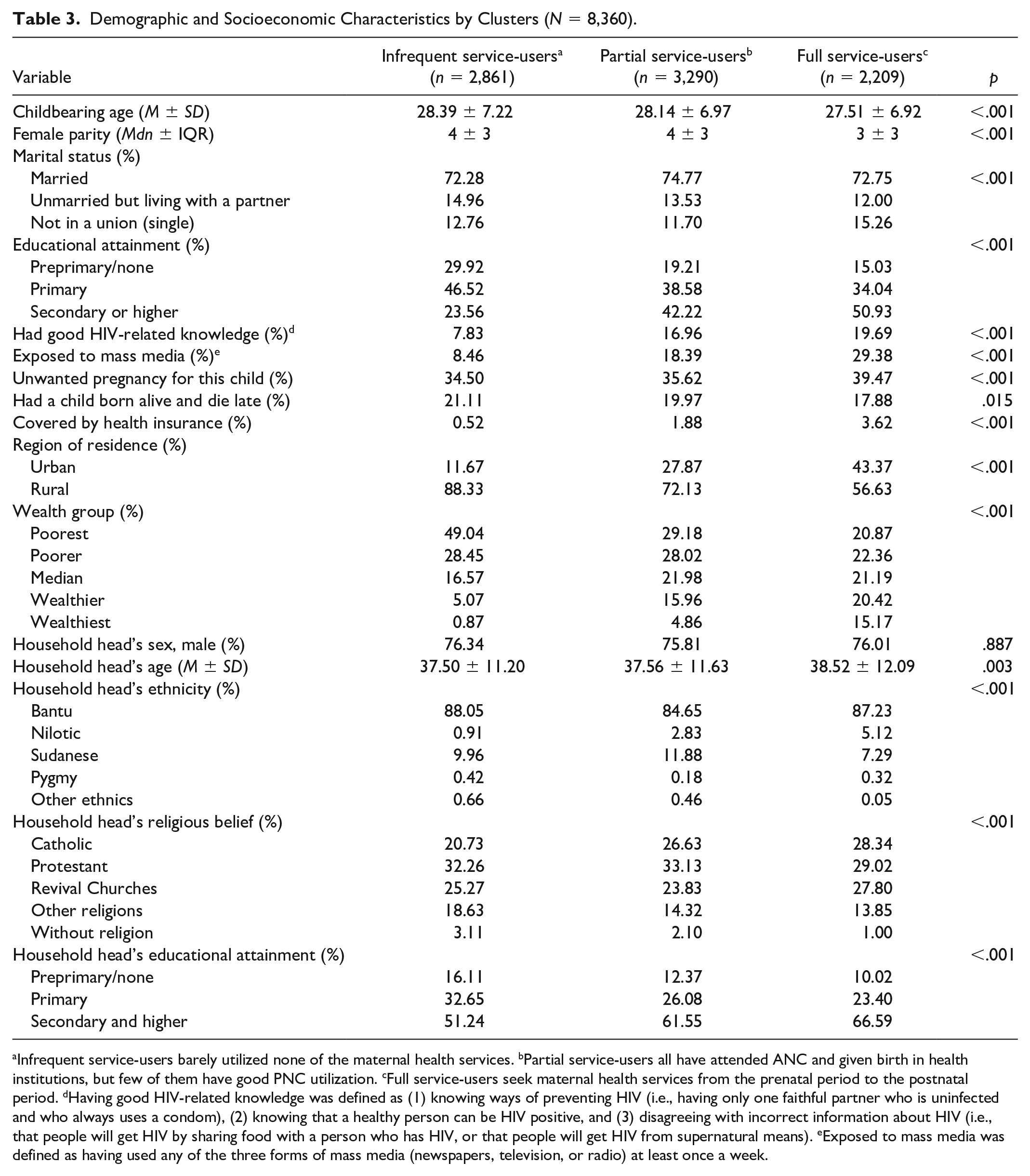
Infrequent service-users barely utilized none of the maternal health services. bPartial service-users all have attended ANC and given birth in health institutions, but few of them have good PNC utilization. cFull service-users seek maternal health services from the prenatal period to the postnatal period. dHaving good HIV-related knowledge was defined as (1) knowing ways of preventing HIV (i.e., having only one faithful partner who is uninfected and who always uses a condom), (2) knowing that a healthy person can be HIV positive, and (3) disagreeing with incorrect information about HIV (i.e., that people will get HIV by sharing food with a person who has HIV, or that people will get HIV from supernatural means). eExposed to mass media was defined as having used any of the three forms of mass media (newspapers, television, or radio) at least once a week.
Adjusted risk ratios (ARRs) of multinomial regression are shown in Table 4. ARR is the ratio of the probability of being in one outcome group over the probability of being in the reference group. Thus, compared with women with no education or preprimary school education, the probability of women attending primary school being partial service-users and full service-users is 45% and 51% higher than infrequent service-users. Having secondary school or higher level education is shown with a larger probability of being partial service-users (ARR = 2.23, 95% CI [1.82, 2.74]) and full service-users (ARR =2.43, 95% CI [1.90, 3.12]). Having good HIV-related knowledge is also found to increase the probability of being partial service-users (ARR = 1.44, 95% CI [1.17, 1.78]) and whole process-seekers (ARR = 1.55, 95% CI [1.21, 1.98]). Having exposed to mass media at least once a week is found to increase the probability of being full service-users (ARR = 1.34, 95% CI [1.04, 1.73]).
Maternal Demographic and Socioeconomic Factors Associated With Maternal Health-Seeking Behavior, Using Multinomial Logistics Regression (N = 8,360). a
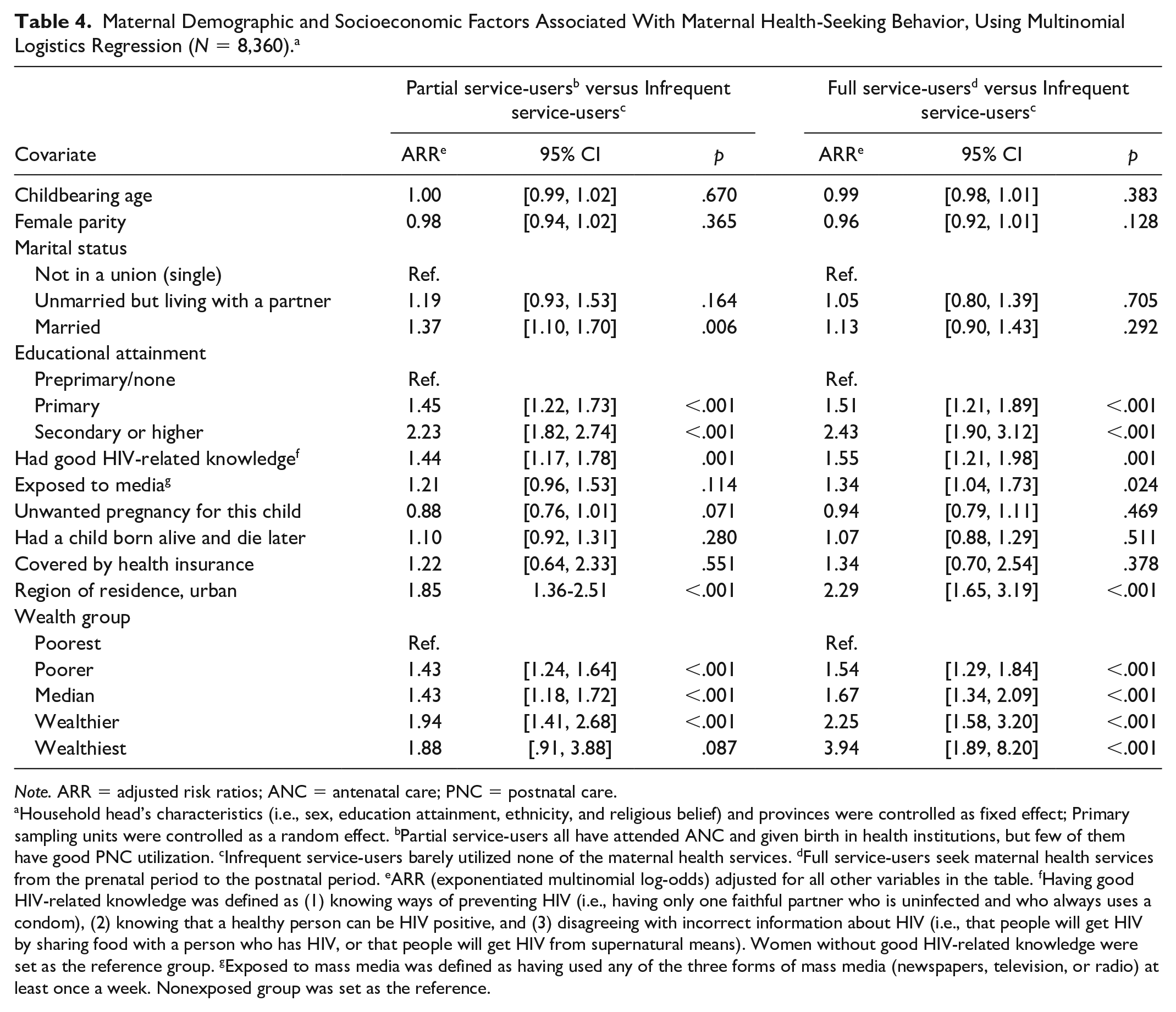
Note. ARR = adjusted risk ratios; ANC = antenatal care; PNC = postnatal care.
Household head’s characteristics (i.e., sex, education attainment, ethnicity, and religious belief) and provinces were controlled as fixed effect; Primary sampling units were controlled as a random effect. bPartial service-users all have attended ANC and given birth in health institutions, but few of them have good PNC utilization. cInfrequent service-users barely utilized none of the maternal health services. dFull service-users seek maternal health services from the prenatal period to the postnatal period. eARR (exponentiated multinomial log-odds) adjusted for all other variables in the table. fHaving good HIV-related knowledge was defined as (1) knowing ways of preventing HIV (i.e., having only one faithful partner who is uninfected and who always uses a condom), (2) knowing that a healthy person can be HIV positive, and (3) disagreeing with incorrect information about HIV (i.e., that people will get HIV by sharing food with a person who has HIV, or that people will get HIV from supernatural means). Women without good HIV-related knowledge were set as the reference group. gExposed to mass media was defined as having used any of the three forms of mass media (newspapers, television, or radio) at least once a week. Nonexposed group was set as the reference.
The region of residence is also found to be associated with women’s MHSB. Living in the urban region increases the probability of being partial service-users (ARR = 1.85, 95% CI [1.36, 2.51]) and full service-users (ARR = 2.29, 95% CI [1.65, 3.91]). Also, wealthier households are found to increase the likelihood of being partial service-users and full service-users.
Discussion
Overall, this study finds that the situation of MHSB in the DRC is very poor. Less than one in 10 participants received complete maternal health services from ANC to PNC. The situation is more difficult in the Kasai region (i.e., Kasai, Kasai Central, Kasai Oriental, Sankuru, and Lomami) and surrounding provinces than in the rest of the DRC. Several demographic and socioeconomic factors are found to be associated with women’s MHSB. As maternal education attainment increased, women’s MHSB improved. Additionally, more mass media exposure is positively associated with better MHSB. Living in urban regions and living in wealthy households are also found positively associated with better MHSB.
In this study, we find that most female participants accessed skilled antenatal care at least once. In terms of ANC, four in five women have visited ANC at least one less time in comparison to other sub-Saharan African countries, including Kenya (92%), Ghana (92%), and Malawi (98%; Pell et al., 2013). The situation is worse concerning adequate ANC visits (at least four) and PNC (at least one). The percentage of having four ANC visits and PNC drops to 37% and 11%, respectively. ANC is important in reducing the risk among pregnant mothers, fetuses, and infants by offering advice on maternal diet, exercise, medication as well as avoiding substance abuse (U.S. Department of Health and Human Services National Institutes of Health, 2017), while PNC is found helpful supporting the initiation of key healthy behaviors during the early life, which can lead to lasting beneficial effects (Lawn & Kerber, 2006). Considering the dangerously low levels of adequate ANC and PNC in the DRC, further efforts to improve MHSB are urgently needed. Promoting ANC and PNC visits should be prioritized in future interventions.
In different regions in the DRC, the situation of MHSB varies. Women’s MHSB is worse in the Kasai Region (i.e., Kasai, Kasai Central, Kasai Oriental, Sankuru, and Lomami) and surrounding provinces than in other parts of the DRC. The violence that erupted across the Kasai region in 2016 is considered an important contributor to their poor MHSB. Intense conflicts in these provinces, such as attacks on health centers, hindered women from having essential MHSB (UNICEF, 2018). More attention should be paid to the Kasai region, and practical health-promoting projects targeted at MHSB in this area should be further explored.
Education attainment is positively associated with MHSB, consistent with previous studies (Chandwani & Pandor, 2015; Chatterjee & Sennott, 2020; Dutta & Sengupta, 2018; Navaneetham & Dharmalingam, 2002; Ochieng & Odhiambo, 2019). Women with high educational attainment are assumed to have good abilities to decipher medical instructions for their health (Gopalakrishnan et al., 2019; Kifle et al., 2017; Latunji & Akinyemi, 2018). Additionally, HIV-related knowledge is found to be positively associated with MHSB. HIV-related knowledge was used to reflect women’s maternal health literacy and awareness. Women with good maternal health literacy and awareness of maternal health intend to seek more comprehensive maternal health services. One explanation for this finding is that with better maternal health literacy, women will gain higher acceptance of maternal health care (Cleland & Van Ginneken, 1988), and avoid confusion in understanding their health problems and directions from health workers (Bourne, 2010). A previous study in Nepal has demonstrated that practical health education, including maternal and newborn danger signs, could increase women’s maternal health knowledge and promote their MHSB (McPherson et al., 2006). Therefore, related education for illiterate women to increase their awareness and knowledge of maternal health is needed in the future.
In addition to women’s literacy, mass media exposure is positively associated with MHSB in the DRC. Women exposed to any source of mass media at least once a week demonstrate a better level of MHSB in their last birth, which is consistent with previous studies in sub-Saharan Africa (Edward, 2011). Mass media was found to play an essential role in providing health care information (Godlee et al., 2004). For women in developing countries, consulting doctors or nurses may be too expensive (Nwagwu & Ajama, 2011). Thus, mass media becomes the main source of health information (Mtega, 2012). However, insufficient access to mass media and lack of health care information may result in indecision or delays in adopting health care intervention and may lead to higher maternal and infant mortality (Pakenham-Walsh & Godlee, 2020). The 70th World Medical Association General Assembly in 2019 advocated promoting initiatives to improve access to timely, current, evidence-based health care information for the whole public (World Medical Association, 2019).
Household wealth status and the region of residence are also found to be useful predictors of MHSB. First, the wealth group to which the family belongs is positively associated with a better level of MHSB, as shown in previous studies (Aremu et al., 2011; Benova et al., 2014). This may be because wealthy households are more likely to afford health costs. Additionally, without sufficient government financing of health care services, the poor have to borrow money to meet health expenditure (Banerjee & Duflo, 2007; Maini et al., 2014), which could hinder them from seeking maternal health care. Second, the region of residence is associated with MHSB in the DRC. Mothers residing in urban regions are more inclined to seek maternal health care than their counterparts in rural regions. Similar results are observed in Rwanda (Jayaraman et al., 2008) and Nepal (Chalise et al., 2019). Distance and travel time to the nearest health facility are identified as essential factors influencing MHSB in rural regions (Fenta, 2005). If their living space is relatively far from health facilities, mothers may take more effort to seek health services. Given that most of the DRC are rural regions, this problem becomes more serious. Affordable and accessible maternal health services are sorely needed in the DRC. Measures such as offering special subsidies and wide-covering health insurance could be helpful but difficult to implement in the short-term. Reducing the price of maternal health care services without impairing service quality is an issue of paramount importance. It is also important to implement practical interventions at the critical time point during prepregnancy and the postpartum period.
This study exhibits several strengths. First, this is one of the first studies to focus on MHSB in the DRC with a national survey. The data covers a wide range of socioeconomic, demographic, lifestyle, and health outcome characteristics, allowing for comprehensive analysis and subnational comparisons. Second, MICS is a set of consistent and standardized survey tools, making our results in the DRC comparable with other developing countries. Finally, we adopt a cluster analysis approach to study an integrated set of health-seeking behaviors for ANC and PNC, as opposed to most previous studies, which only use a single indicator as the outcome.
Nevertheless, there are some limitations to this research. On the one hand, without panel data, a causal inference was not possible from the cross-sectional study. On the other hand, due to the intrinsic structure of the MICS6 questionnaire, only women who gave a live birth in the past 2 years preceding the survey answered the questions related to their MHSB. Therefore, women who had stillbirths were omitted, which may introduce selection bias to our study. Eventually, as the survey questionnaires relied on self-reported information, there could be potential recall bias. In the current study, we only included women who had given birth in the past 2 years, which can reduce recall bias to some extent.
Implications for Research and Practice
Our study demonstrates that more than 90% of women in the DRC did not have integral maternal health services from ANC to PNC. The MHSB situation in Kasai and the surrounding regions, where a new conflict had erupted, is the worst in the DRC. While the effort to improve health care access and quality for women is a high priority in the DRC, interventions designed to promote women’s health literacy and improve media exposure should also be considered. Also, special attention should be paid to the Kasai region while carrying out maternal and reproductive health interventions. Additionally, the results show that women living in rural regions with lower education attainment, fewer mass media exposure, and lower household wealth status are less likely to have essential MHSB. However, the underlying mechanism of how these socioeconomic factors affect women’s MHSB is still unclear. Future work on measuring women’s health-related knowledge is crucial.
Supplemental Material
sj-docx-1-heb-10.1177_10901981211010438 – Supplemental material for Maternal Health-Seeking Behavior and Associated Factors in the Democratic Republic of the Congo
Supplemental material, sj-docx-1-heb-10.1177_10901981211010438 for Maternal Health-Seeking Behavior and Associated Factors in the Democratic Republic of the Congo by Fuyu Guo, Huayi Xiong, Xinran Qi, Rie Takesue, Siyu Zou, BM, Qiwei He, PhD, Eric Frasco, Hanyu Wang and Kun Tang in Health Education & Behavior
Footnotes
Author Contributions
FG contributed to the study concept and design, statistical analysis, results interpretation, and drafting and revision of the manuscript and approved the final version of the manuscript. HX and XQ contributed to the study concept and design, results interpretation, and drafting and revision of the manuscript. RT, SZ, QH, EF, HW, and KT contributed to study concept and design and revision of the manuscript. KT is the guarantor of this work and, as such, had full access to all the data in the study and takes responsibility for the integrity of the data and the accuracy of the data analysis. All authors approve the final version to be submitted.
Declaration of Conflicting Interests
The authors declared no potential conflicts of interest with respect to the research, authorship, and/or publication of this article.
Funding
The authors disclosed receipt of the following financial support for the research, authorship, and/or publication of this article: This work is supported by National Natural Science Foundation of China (No. 72074130) and Spring Breeze Foundation of Tsinghua University (No. 20203080035).
Ethical Approval
The data used in the study consisted of a publicly available deidentified data set, which was retrieved from the UNICEF MICS website with permission. This study is thus exempted from further ethical review.

References
Supplementary Material
Please find the following supplemental material available below.
For Open Access articles published under a Creative Commons License, all supplemental material carries the same license as the article it is associated with.
For non-Open Access articles published, all supplemental material carries a non-exclusive license, and permission requests for re-use of supplemental material or any part of supplemental material shall be sent directly to the copyright owner as specified in the copyright notice associated with the article.
