




Abstract
Background
Concussion underreporting is endemic, and social norms are an established predictor of concussion reporting behavior. However, pluralistic ignorance—a situation in which most individuals in a group hold the belief that their peers’ views differ from their own, despite views actually being similar—has not been studied in this context.
Aim
To assess whether pluralistic ignorance contributes to concussion underreporting.
Method
We surveyed 2,504 military service academy cadets. Each cadet was presented with a survey asking about their willingness to self-report a concussion, their perception of other cadets’ willingness to report a concussion, and personal and demographic factors.
Results
Most cadets viewed themselves as more willing to report a concussion than others (mean difference = 1.12, 95% CI [1.02, 1.21]), a belief consistent with pluralistic ignorance. Demographic characteristics were associated with holding this belief. For example, female cadets and upper-class cadets were more likely to show this disparity than male or under-class cadets, respectively. Collegiate athletes not only showed similar willingness to report concussion as nonathletes but also perceived other cadets as less likely to report concussions. Meanwhile, future pilots showed less self-report willingness and perceived that others were similarly unwilling to report concussions.
Discussion
A majority of this economically and geographically diverse population displays characteristics of pluralistic ignorance: They largely share proconcussion reporting sentiments but incorrectly perceive that others do not. This belief is not held uniformly in all subpopulations, which may inform how these beliefs are developed and maintained.
Conclusions
Pluralistic ignorance is an important consideration in concussion education efforts.
A growing body of literature suggests that concussions are underreported and underdiagnosed (Baugh et al., 2015; Foster et al., 2019; McCrea et al., 2004; Meehan et al., 2013). As a result, there have been numerous attempts to understand the motivations behind underreporting of concussion (Baugh et al., 2019; Chrisman et al., 2013; Kerr et al., 2016; Kroshus, Baugh, et al., 2015; Kroshus et al., 2016; Kroshus et al., 2017; Kroshus, Garnett, et al., 2015; Register-Mihalik et al., 2013; Schmidt et al., 2020; Warmath & Winterstein, 2019). Across a variety of theories of health behavior, including those previously used to describe concussion reporting and nonreporting behavior, social norms are thought to influence individual behavior (Ajzen, 1991; Bandura, 1986). Indeed, in the context of concussion reporting specifically, social norms have been asserted as an influential factor (Cook & Hunt, 2020; Corman et al., 2019; Kroshus et al., 2014; Kroshus, Kubzansky, et al., 2015; Register-Mihalik et al., 2021).
Social norms are based on an individual’s observations of those around them. Perceived injunctive norms describe beliefs about which behaviors would be approved or disapproved by a group. Perceived descriptive norms characterize beliefs about typical behaviors in a group. Although individuals rely on their perceptions of social norms to inform their behaviors, reality and perceptions are not always aligned. When reality and perception of norms are misaligned, it is perception—the social construction of reality—that influences individual behavior. One situation that can arise when there is a discrepancy between perceived and actual norms, sometimes called pluralistic ignorance, may contribute to concussion underreporting.
The concept of pluralistic ignorance describes a situation in which the majority of individuals in a group hold the belief that their peers’ views differ from their own, despite views actually being similar (Grant et al., 2009). The difference in perceived versus real group norms can lead to a situation in which the majority of individuals in a group are acting against their personal beliefs in order to conform to an incorrectly assumed group norm (Bjerring et al., 2014). Practically, the term pluralistic ignorance is typically used to describe a situation when misperception of social norms leads to individuals engaging in risky behavior that they otherwise would not have chosen to participate in. One example of pluralistic ignorance is drinking on college campuses. The visible behavior of drinking among college students, and the infrequent public disapproval of this behavior by college students, can lead to a widespread misperception among students that this behavior is widely socially accepted even when this is not the case. Although a variety of definitions exist for pluralistic ignorance, we will adopt the definition of Bjerring et al. (2014) which has four critical components:
that individuals in a group have a privately held belief about a situation;
that they believe that others in the group hold different beliefs about the situation;
that individuals act contrary to their privately held beliefs, but in line with their perceived beliefs of others; and
that members of the group take an individual’s actions to be representative of that individual’s beliefs.
Pluralistic ignorance may serve as an explanation for college athletes’ behavior in underreporting possible concussions to medical personnel (Kroshus, Kubzansky, et al., 2015). Were this the case, it could be conceptualized as follows. Most athletes hold a private belief about concussion reporting that may be positive, but they think that others’ do not hold positive concussion reporting beliefs. Thus, it begins a cycle whereby they act contrary to their privately held beliefs and refrain from reporting a concussion. Then members of the group view other individuals in the group refraining from reporting a concussion (and/or refraining from indicating their support for concussion reporting) and take that behavior as representative of the individuals’ beliefs. In other words, the pluralistic ignorance effect is really two things—a social cognitive failure to account for the situational influence and the corresponding influence on personal behavior and attitudes. The perpetual cycle of pluralistic ignorance occurs because social norms have a strong influence on concussion reporting intention and behavior (Kroshus et al., 2014; Kroshus et al., 2017; Kroshus, Kubzansky, et al., 2015). Thus, when individuals believe that others are less supportive of concussion reporting than they really are, they inhibit their expressed support for concussion reporting and their concussion reporting behavior, which in turn inhibits others from doing the same.
Without intervention, the disparity between privately held and publicly displayed beliefs as well as between individual beliefs and individual actions that defines pluralistic ignorance would continue. This may be a factor underlying recent findings that individuals’ concussion reporting intentions and behaviors do not improve over the course of their college years and in many cases worsen (Baugh et al., 2014; Baugh et al., 2019; Baugh et al., 2020). Indeed, if pluralistic ignorance is an underlying factor, we would expect persistence and possibly even strengthening of the discrepancy in privately held and externally perceived beliefs.
In this article, we use the results of a 2015 survey of a cohort of United States Air Force Academy (USAFA, 2015) cadets to assess whether pluralistic ignorance may contribute to concussion underreporting, which has been previously documented in this population (Foster et al., 2019). We assess whether cadets’ personal views about concussion reporting differ from the views they perceive others to hold about this behavior. We then evaluate whether there are individual demographic characteristics associated with holding this discrepancy in views and whether these views persist across cadets’ class years. We hypothesized that views consistent with pluralistic ignorance would be nonuniformly present among cadets.
Method
Participants and Procedure
Participants were 2,504 cadets actively enrolled at the USAFA. The USAFA is a federal military service academy where cadets receive a Bachelor of Science degree on graduation. Graduates typically incur a 5- to 12-year service commitment to the U.S. Air Force. We initially included all participants who responded to at least one of the nondemographic items (N = 2,531) listed below; however, we removed 27 participants who responded with one number (e.g., 9) for all 12 of survey items querying perceived rewards and costs (on the survey front page) or with the same number for all 17 of the Identity, Attitude, Subjective Norms, Social Support, and Self-Efficacy items (on the second page of the survey).
The survey was part of a broader research study: Concussion, Assessment, Research, and Education (CARE) at the USAFA (Broglio et al., 2017). Participants completed surveys when time permitted before, during, or immediately after the process for concussion baseline testing during the summer of 2015. The survey began with instructions informing participants that the survey examined cadets’ feelings about reporting concussions. Participation was voluntary and anonymous. The survey was limited to the front and back of one 8.5-by-11-inch sheet of paper. This protocol was approved and declared exempt by the USAFA institutional review board. Further details on survey development can be found elsewhere (Foster et al., 2019).
Measures
Demographics and Personal Characteristics
Cadets were asked to select their gender, indicate whether they participate in intercollegiate athletics (Yes/No), and indicate whether they want to be a pilot after graduation (Yes/No). These latter subgroups were specifically queried because of commonly circulated beliefs at the time of survey administration regarding the impact of concussion on the activity/career choice.
Willingness to Report
Cadets were presented a scenario (Foster et al., 2019) where they suffered an unseen concussion and asked to indicate their willingness to report this concussion to medical personnel using a 1 to 9 Likert-type scale ranging from 1 = very unlikely to report a concussion to 9 = very likely to report a concussion. When describing the percentage of cadets who had a positive perception of willingness to report (themselves), we grouped responses 6, 7, 8, and 9.
Perceived Average Willingness of Others to Report
Cadets were asked how likely an average cadet is to report a concussion in this same scenario using a 1 to 9 Likert-type scale ranging from 1 = very unlikely to report a concussion to 9 = very likely to report a concussion. When describing the percentage of cadets who had a positive perception of others’ willingness to report, we grouped responses 6, 7, 8, and 9.
Reporting Discrepancy
A measure of the discrepancy between the individual’s stated willingness to report and his or her perceptions of others’ willingness to report was created by subtracting each individual’s perceived average willingness of other cadets to report (1–9) from their personal willingness to report (1–9). The range of possible values for this discrepancy measure was −8 to 8. Here, a positive value indicates that an individual views himself or herself as more willing to report than others. A negative value indicates the opposite. This variable was dichotomized (>0 vs. ≤0) as a binary indicator of the discrepancy in beliefs that characterizes pluralistic ignorance.
Analysis
Descriptive statistics illustrate the characteristics of the participants in this survey and the range of responses to our outcome measures of interest. We evaluated within-participant discrepancy between personal willingness to report a concussion and perceived willingness of others to report a concussion using a paired-samples t test. To assess for group-level differences in individual and perceived group beliefs, we compared the means of our concussion reporting measures (individual willingness to report, perceived willingness of the average cadet, reporting discrepancy) across groups. Independent samples t tests were used for dichotomous groups (pilot status, intercollegiate athlete status, gender) and analysis of variance was used for groups with greater than two categories (class year). Then we used multiple logistic regression to evaluate the association between seeing yourself as more likely to report a concussion than others, as indicated by a positive reporting discrepancy (binary), and individual characteristics such as gender, wanting to become a pilot, and participating in intercollegiate athletics. Robust standard errors were used to account for nonindependence of cadets at the USAFA. An analysis-level complete cases approach was used to handle missing data. All analyses were conducted in R, Version 3.5.1. Statistical significance is indicated by p < .05 or a 95% confidence interval (CI) that does not include one.
Results
Sample Characteristics
A total of 3,680 cadets were given the opportunity to participate in this survey-based research study. Of those, 2,504 cadets (68.0%) participated in the survey and 1,919 cadets (76.6% of participating cadets) completed all items included in the regression analysis. Those who responded with their gender (n = 2,388, 95.4%) identified predominantly as male (n = 1,815, 76%), which is line with the population of the USAFA demographics (73.5% male; USAFA, 2015). Most respondents were interested in becoming a pilot (n = 1,479, 62.5%, total responses = 2,365) and only a minority of respondents participated in intercollegiate athletics (n = 520, 21.7%, total responses = 2,391; again, in line with USAFA demographics 24.4% recruited athletes; USAFA, 2015).
Concussion Reporting Tendencies
Cadets viewed their own willingness to report a concussion as greater than the willingness of the average cadet. Most cadets indicated willingness to report a possible concussion (n = 1,503, 64.5%). Less than half of cadets viewed their peers as willing to report a possible concussion (n = 861, 42.2%). A paired t test substantiated that, on average, individuals saw their willingness to report a concussion as greater than that of other cadets (t = 22.96, df = 1,963, p < .001, mean difference = 1.12, 95% CI [1.02, 1.21]).
Differences Between Male and Female Cadets
Male and female cadets had different views on concussion reporting (Table 1). Female cadets viewed themselves as more likely to report a concussion than did male cadets (t = −2.65, df = 927.10, p = .008), and they also viewed the average cadet as less likely to report a concussion than did male cadets (t = 2.47, df = 849.32, p = .014). Thus, female cadets tended to have greater average reporting discrepancies than did male cadets (t = −4.3, df = 756.31, p < .001).
Concussion Reporting Characteristics and Differences in These Characteristics Between Male and Female Participants.

Note. Individual reporting and others’ reporting are measured from 1 to 9 with higher values indicating greater likelihood of reporting. Reporting discrepancy is measured on a −8 to 8 scale with more positive values indicating you see yourself as more likely than others to report. The t tests compare differences between male and female participants. Analytic samples by item: individual reporting n = 2,229, others’ reporting n = 2,027, reporting discrepancy n = 1,952.
Differences Between Cadets Participating in Intercollegiate Athletics and Cadets Who Do Not
Cadets who participate in intercollegiate athletics held different concussion reporting beliefs than those who did not. Although cadets’ personal willingness to report did not vary significantly by intercollegiate sport status (mean intercollegiate athletes = 6.12, mean nonintercollegiate athletes = 6.08, t = 0.31, df = 768.49, p = .76), cadets who participated in intercollegiate sports saw their peers as more willing to report a concussion than did cadets who did not participate in intercollegiate sports (mean intercollegiate athletes = 5.17, mean nonintercollegiate athletes = 4.88, t = 3.00, df = 638.71, p = .003). Driven by this difference in the perceptions of others’ willingness to report, intercollegiate athletes had significantly lower average reporting discrepancies than did cadets who did not participate in intercollegiate athletics (mean intercollegiate athletes = 0.89, mean nonintercollegiate athletes = 1.18, t = −2.19, df = 557.50, p = .03).
Differences Between Cadets Interested and Uninterested in Becoming a Pilot
Cadets interested in becoming pilots were both less willing to report a concussion themselves (mean pilot = 5.85, mean nonpilot = 6.49, t = −6.07, df = 1834.10, p < .001) and viewed their peers as less willing to report a concussion (mean pilot = 4.88, df = 1604.40, mean nonpilot = 5.05, t = −2.11, p = .03) than cadets who did not express interest in becoming a pilot. Because pilot-interested cadets viewed both themselves and others as less willing to report than cadets uninterested in becoming pilots, pilot-interested cadets tended to have a lower reporting discrepancy than their peers (mean pilot = 0.95, mean nonpilot = 1.41, t = −4.39, df = 1332.70, p < .001).
Differences in Concussion Reporting Beliefs Across Class Years
Concussion reporting beliefs varied by cadets’ class years. Individual willingness to report a concussion, F(3, 2234) = 40.2, p < .001; perceptions of others’ willingness to report a concussion, F(3, 2030) = 22.0, p < .001; and the discrepancy between those two beliefs, F(3, 1955) = 7.2, p < .001, all varied by class year (Table 2). Individual willingness to report increased more over time than did perceptions of others’ willingness, driving an increase in concussion reporting discrepancy across class years.
Concussion Reporting Characteristics Across Class Years.
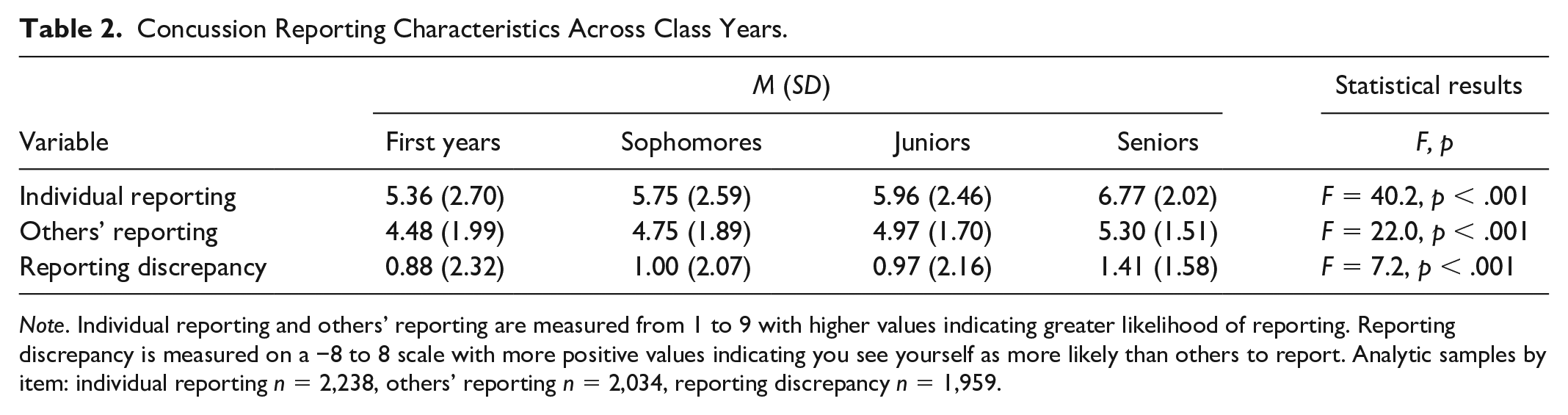
Note. Individual reporting and others’ reporting are measured from 1 to 9 with higher values indicating greater likelihood of reporting. Reporting discrepancy is measured on a −8 to 8 scale with more positive values indicating you see yourself as more likely than others to report. Analytic samples by item: individual reporting n = 2,238, others’ reporting n = 2,034, reporting discrepancy n = 1,959.
Factors Influencing Pluralistic Ignorance
Well over half of cadets viewed themselves as more willing to report a concussion than their peers (n = 1,212, 61.7%). Multiple logistic regression confirms that a variety of characteristics were influential in this perception (Table 3). Controlling for other factors, females and cadets in higher class years (junior and senior) had greater odds of viewing themselves as more likely to report than others than did males and cadets in lower class years. On the other hand, cadets interested in being a pilot and cadets who participated in intercollegiate athletics were less likely to hold the view that they were more likely than their peers to report a concussion (Table 3).
Results of Multiple Logistic Regression Evaluating Associations Between Positive Reporting Discrepancy and Cadet Characteristics.

Note. Results from a multiple logistic regression with binary reporting discrepancy (holding the belief that you are more likely than the average cadet to report a concussion) as the primary outcome. Statistical significance indicated where 95% CI does not include 1. Analytic sample n = 1,919. REF = referent category.
Discussion
This study finds that USAFA cadets tend to view their personal willingness to report a possible concussion as greater than their perception of their peers’ willingness to report a concussion. If the collective combination of individually held beliefs is taken to represent the “true” descriptive norm, then this finding suggests that there is a fundamental misalignment between cadets’ perceived and actual norms around concussion reporting. This discrepancy is greater among females and those in higher class years. Holding this disparate view is a necessary component of pluralistic ignorance (Bjerring et al., 2014) suggesting that this phenomenon may be an explanatory factor in persistent concussion underreporting in college-aged students, including those beyond the elite athlete populations that are typically sampled.
Understanding whether pluralistic ignorance is an explanatory factor in concussion underreporting is helpful for considering future interventions. Previous research suggesting social norms’ influence on concussion reporting frequently suggests that the “culture” needs to be improved so as to positively influence concussion reporting (Kroshus, Kubzansky, et al., 2015; Register-Mihalik et al., 2021). If social norms are influential but misperceived, then the relevant intervention would look much different. An effective intervention would simply need to assist in aligning individual perceptions with the truly held beliefs of others. Bringing a group to a common understanding that they actually hold the same (positive) belief around concussion reporting both seems both very feasible and highly impactful for behavioral change. This could be informed by pluralistic ignorance interventions across other health behavior topics in college-aged students such as binge drinking (Perkins et al., 2005). In this well-studied area, research has shown that personalized messaging from more proximal referent groups is more likely to yield the intended results of aligning perceived and true underlying norms (e.g., reducing pluralistic ignorance; Lewis & Neighbors, 2006).
Several demographic characteristics of cadets influenced whether they held beliefs consistent with pluralistic ignorance around concussion reporting. First, females held these beliefs more than males. Some previous research in college-aged athletes has found increased concussion reporting in females compared with males (Torres et al., 2013), while other research has attributed this difference to conformity with traditional masculine norms rather than individual gender (Kroshus et al., 2017). Second, those in higher class years (the juniors and seniors in civilian institutions) had greater odds of holding these views than first-year students. This is relatively consistent with previous research in intercollegiate athletes (Baugh et al., 2014; Baugh et al., 2020; Baugh et al., 2019), which finds differences in concussion reporting attitudes and intentions across class years. However, this research in college athletes examined athletes’ concussion reporting intentions for themselves, rather than the discrepancy measure between their intention and their perception of others’ intentions. It is also in line with expectations around the persistence of pluralistic ignorance in the absence of intervention. That is, pluralistic ignorance is self-perpetuating. Interestingly, intercollegiate athletes and cadets interested in becoming a pilot had lower odds of holding views consistent with pluralistic ignorance, controlling for other factors. Both future pilots and athletes tended to believe, more than the average cadet, that their nonpilot and nonathlete peers were less willing to report a concussion. Mechanisms underlying this finding are unclear; it is possible that cognitive dissonance plays a role in these lower perceived social norms. Future pilots reduce the dissonance in their willingness to conceal concussions by believing this view is commonly held among their peers. Regardless of mechanism, it seems likely that there is a lower discrepancy because these groups—and future pilots in particular—both have lower overall reporting intentions, which they presume others share.
Despite the cohort nature of this sample, it may be instructive in how spoken and unspoken social norms create pluralistic ignorance. There were differences between subpopulations in this sample. For example, both future pilots and athletes had lower odds of holding views consistent with pluralistic ignorance. These groups may be more vocal in their expression of concussion reporting skepticism, while others who are more sanguine about concussion reporting may be less likely to vocalize it. The increasing skepticism seen in upper-class athletes (Baugh et al., 2014) and future pilots (Foster et al., 2019) is consistent with an acculturation process that tends to discourage concussion reporting. This acculturation may be formal (e.g., learning about different Air Force jobs) or informal (e.g., more senior cadets teach more junior cadets what kinds of things are perceived to be good or bad for their USAF careers). Furthermore, pilots tended to view both themselves and others as less likely to report a concussion than nonpilots. This may be driven by cohort effects of pilots thinking primarily of other pilots as their referents, which in turn reinforces the norm of low self-intention to report. Subcultures, such as pilots, may require additional, alternative, or subgroup-specific intervention to improve concussion reporting.
Limitations
This study evaluates whether beliefs of cadets are in line with the concept of pluralistic ignorance. It is limited in that it did not measure behaviors, which would have further enhanced our ability to understand the phenomenon of pluralistic ignorance in this context. That said, there are obvious challenges to measuring nonreporting behavior (the absence of concussion reporting behavior) and to nonanonymously soliciting information on socially undesirable behavior, which may limit the feasibility of a behavioral approach. This study uses responses of cadets at the USAFA, which is a unique population. However, this sample is geographically and socioeconomically diverse and includes many nonathletes, enhancing its generalizability compared with a competitive college sport athlete-only sample, which is typical of the concussion reporting literature. As a cross-sectional survey study, we are limited in our ability to assess mechanisms underlying our findings or make any causal claims. Furthermore, although participation within the academy was high, and measured demographics of participants and the total population are similar, we cannot know whether the responses of participating cadets would differ from those of nonparticipating cadets.
Conclusion
This study finds that many college-aged students enrolled at the USAFA view themselves as more willing than others to report a possible concussion. Demographic characteristics including gender, intercollegiate athlete status, pilot status, and class year were associated with holding this view. The concept of pluralistic ignorance describes scenarios such as this—where individuals’ misperceptions of others’ beliefs lead to inappropriate understanding of social norms—and may be helpful when considering interventions to improve concussion reporting behavior.
Footnotes
Acknowledgements
The authors would like to thank the cadets who participated in this research and Emily Jones, ATC, for her logistical support.
Authors’ Note
Craig A. Foster is now at SUNY Cortland, Cortland, NY, USA. Material has been reviewed by the Walter Reed Army Institute of Research. There is no objection to its presentation and/or publication. The opinions or assertions contained herein are the private views of the author and are not to be construed as official, or as reflecting true views of the Department of the Army, United States Air Force, or the Department of Defense.
Declaration of Conflicting Interests
The author(s) declared the following potential conflicts of interest with respect to the research, authorship, and/or publication of this article: Dr. Baugh has previously received funding from the National Collegiate Athletic Association as a graduate student research grant recipient, the Datalys Center for Sports Injury Research and Prevention as a graduate student research grant recipient, and through the Football Players’ Health Study at Harvard, which is funded by the National Football League Players’ Association. Dr. Foster, Dr. Johnson, and Dr. D’Lauro all received a National Collegiate Athletic Association —U.S. Department of Defense Mind Matters Challenge grant to investigate the culture surrounding concussion reporting.
Funding
The author(s) disclosed receipt of the following financial support for the research, authorship, and/or publication of this article: This work received partial financial and logistical support from the NCAA and Department of Defense through a Mind Matters Challenge Award.
