



Abstract
Lesbian, gay, bisexual, transgender, and nonbinary, and queer people (LGBTQ+) experience significantly higher levels of stressors due to discrimination, stigma, and marginalization than do cisgender heterosexual people. These high levels of stressors have impacts on health and well-being as well as career impacts. Limited research suggests that within higher education LGBTQ+ faculty experience bullying, discrimination, and harassment within the workplace. There is also data to suggest that research on marginalized populations is perceived to be less objective and valuable than research on majority populations. Research on the challenges of being a member of a marginalized population who conducts research on the same population suggests potentially negative career and personal impacts. To my knowledge, there has been little to no research on the double marginalization related to being an LGBTQ+ researcher doing research within the LGBTQ+ community. To describe the potential impacts of being an LGBTQ+ researcher who does LGBTQ+ research, I apply the extant literature on marginalized researchers who do research among marginalized populations to LGBTQ+ researchers. I also describe the potential minority stressors that LGBTQ+ researchers may face and how that may impact careers. Finally, I offer multiple recommendations for improvements for our research community and argue that senior faculty, leadership, and mentors can take specific actions to lessen stressors for LGBTQ+ researchers studying LGBTQ-related topics.
Let me start with a story. My team and I launched my National Institutes of Health (NIH) K-funded study in 2021. We wanted to be inclusive of any adults in the LGBTQ+ (lesbian, gay, bisexual, transgender/nonbinary, queer) community who were in couple relationships. We created advertisements and began recruiting through multiple venues, including paid social media advertisements. We were excited about the study and learning more about LGBTQ+ relationships. Instead, we got a crash course on the risks of doing LGBTQ+ research, perhaps particularly the risks of doing LGBTQ+ research while being LGBTQ+ ourselves.
In reaction to our paid ads, we received comments that were disturbing to many of us on the research team. Men wrote to us about how “sick” we were. Women sent us bible quotes ostensibly with the intent of shaming—or converting—us. We received hate-filled comments and disgusting photos. As principal investigator of the study, I felt a responsibility to check social media constantly and to remove comments before my research assistants saw them. But the ads had effects on me as well, and the thought of checking social media filled me with dread. There is no way to know whether commenters knew—or intuited—our identities, or if the images in our ads (queer, trans, and nonbinary people in relationships) and/or the focus of our study were enough to create such strong reactions. Ultimately, it does not really matter, as the reactions to our research would be disturbing to anyone and particularly disturbing and harmful for LGBTQ+ researchers.
I asked the LGBTQ+ research community for advice on how to advertise on social media in a way that did not result in homo/transphobic messages and sexual harassment. The suggestions I got ranged from solely advertising within the community (e.g., LGBTQ-specific Facebook pages) to advertising just within our own social networks. Some made rueful comments about the impossibility of avoiding sexually harassing or homo/transphobic messages, noting that our only options were to delete constantly or turn off the ability to comment (impossible for paid advertising). My options seemed to be either: (A) get the sample we wanted but sacrifice our well-being by exposing us to harassing messages; or (B) choose a recruitment strategy that was less likely to reach a diverse community, including those who might be at the highest risk (e.g., less connected to LGBTQ+ communities) but that protected the mental health of my team.
At that moment, I realized the unique position LGBTQ+ researchers are in when conducting LGBTQ+ research. Choosing a recruitment strategy based on researcher safety or well-being is not a decision researchers should have to make, but it is one that researchers with marginalized or minoritized identities (e.g., BIPOC: Black, Indigenous, and People of Color; women; LGBTQ+) who do research within the selfsame communities likely face not infrequently. I have since wondered about the broader impacts of these and other unique stressors on LGBTQ+ researchers. Specifically, I endeavor to understand the psychological consequences and career impacts related to being an LGBTQ+ researcher doing research within our community. In exploring this, I rely on the tradition of reflexivity or positioning essays found within feminist, BIPOC, disability, LGBTQ+, and other literatures (e.g., Bowleg, 2021; Choi, 2020; Collins, 1986; Creef, 2000; Davis & Khonach, 2020; Eliason, 2016; Mustanski, 2021; Nelson, 2020) to embed my experiences within a discussion of the marginalization of LGBTQ+ researchers as well as what happens when we are doubly marginalized for both our work and identities. This essay is divided into three main parts: marginalization due to our research, marginalization due to our identities, and double marginalization for both our LGBTQ+ research and identities. It concludes with a discussion about the lack of data on LGBTQ+ faculty and some suggestions for improvement in the structures and values that support LGBTQ+ faculty and LGBTQ-focused researchers.
To help readers evaluate my own positionality (Davis & Khonach, 2020; Keene & Guilamo-Ramos, 2021; Secules et al., 2021) in this discussion, I note that I am a cisgender white queer woman and an early career researcher focusing on queer women’s relationships. At the time of writing this article, I was on the academic job market and not yet in a tenure-track position. Although I currently work at an Ivy League (private) university, all of my education from kindergarten through my doctoral training was in public schools, all but one of which were urban. I have received NIH funding for my postdoctoral (NIH F32) and current research (NIH K99/R00). As such, my identities are both privileged and marginalized giving me a mix of insider and outsider perspectives. Together these impact my lived experiences and my interpretations of these experiences—as well as how others perceive, interpret, and value (or not) my perspectives.
I also want to note how my positionalities lead to some key limitations of this article. As I am a cisgender, white, queer woman who is an early career researcher, my lived experiences provide a specific lens on what it is like to be an LGBTQ+ researcher. Thus, this article does not fully address the experiences of BIPOC LGBTQ+ researchers, transgender and nonbinary researchers, and researchers with other marginalized identities (e.g., non-native English speakers, people with disabilities) who are also LGBTQ+. It also does not address concerns of more senior researchers who may have faced more discrimination and harassment, and who may also have been more actively pushing for change within the academy (and may, or may not, have received backlash for doing so). These are all important perspectives, and I hope that this article spurs more writing on these experiences.
Being Marginalized Because of Our Research
I recently submitted a paper to a high-impact journal not solely focused on LGBTQ+ people (to avoid “preaching to the choir” in an LGBTQ+ journal). In their email desk rejecting the paper, the editor suggested that my study’s findings were not generalizable, lacked broad appeal, and thus did not “fit” the journal—the intimation being that this editor did not consider LGBTQ+ research as a whole to be generalizable. LGBTQ+ research may be perceived as being on the fringe or on too inconsequential of a group to truly have an impact on science and the human condition. People’s implicit or explicit biases about LGBTQ+ people may also tinge their perceptions of our research. LGBTQ+ research and research on other marginalized groups may further be dismissed as being “political” or “activist” simply due to their focus.
It may then come as no surprise that LGBTQ-related research comprises a small fraction of articles in non-LGBTQ-specific journals and may be less likely to be published in high-impact journals that reach broad audiences (J. L. Harris, 2021). Within psychology, of the journals that published the highest numbers of LGBTQ-related articles, more than half were LGBTQ-, HIV/AIDS-, or sexuality-specific journals (Walch et al., 2020). Similarly, in a bibliometric review of transgender health-related research, despite a steep rise in this research over time, 8 of 10 of the journals that published the most transgender-related health research were LGBTQ, sex/sexuality-, or HIV/AIDS-related journals (Sweileh, 2018). In reviews of the public health (Boehmer, 2002) and nursing (Eliason et al., 2010) literature, <0.2% of all articles were focused on LGBTQ+ health. More recent research suggests that the numbers of LGBTQ+ published articles are increasing, yet the proportion of the literature they comprise is not. In the aforementioned review of LGBTQ-related psychology research, from 2000 to 2015, the number of LGBTQ-focused articles quadrupled (Walch et al., 2020). However, the overall proportion of LGBTQ-related articles in the literature remained static (~0.2%) over time. Our research may thus be relegated to more niche and lower impact journals. Consequently, although we may wish to not just “preach to the choir,” we may face difficulties in reaching more general audiences. In turn, our research is further marginalized because it rarely reaches a broader audience.
An examination of NIH funding suggests similar proportions of LGBTQ+ to non-LGBTQ+ funded research. Between 1989 and 2011, only 0.5% of all funded NIH projects were related to LGBTQ+ health (Coulter et al., 2014). When HIV- and sexual health-related studies were excluded, this number dropped to 0.1%. Even within LGBTQ+ research, there may be differences in rates of funding depending on the focus of the research. Of the total number of LGBTQ-related NIH studies, 13.5% included sexual minority women, 6.8% included transgender people, and 31.4% examined race/ethnicity (Coulter et al., 2014). Within the field of LGBTQ+ research, some areas and populations may be more valued leading to further marginalization of topics focused on, and possibly researched by, women, transgender and nonbinary people, and BIPOC. The NIH and other funding agencies are working to redress grantmaking disparities, and hopefully, shifts in funding and publication trends occur as a result.
Our research may also have value only insofar as our findings compare with those of majority (e.g., cisgender, heterosexual, and white) populations. I have gotten this feedback on manuscripts and grant applications, and journal editors and grant reviewers have told me that my findings would be of greater interest if I had a comparison group of sexual minority men (instead of within-group research on sexual minority women). Similarly, research among BIPOC LGBTQ+ people may not be seen as important unless there is a white comparison group (Bowleg, 2021). I have a sense that authors of articles focused on majority groups like sexual minority men rarely get told they ought to have comparison samples of women, although I may be wrong. Similarly, I imagine that studies focused on cisgender heterosexual samples are not asked to include an LGBTQ+ comparison group. However, including a comparison group from a majority population is not always practicable nor ideal. When white researchers conduct research among BIPOC communities, white people are typically framed as the norm (J. L. Harris, 2021). Arguably, this is likely the case whenever a majority group is included as a comparison or referent group (see Johfre & Freese, 2021 for an important discussion about choosing a referent group)—every other group is compared against the majority group (Bowleg, 2021) and divergences or convergences are interpreted in comparison to “normative” experiences. To LGBTQ+ researchers, this sends the message that LGBTQ+ people are only of interest to the dominant group because we deviate from the norm. 1
Yet, within-community research is important and illuminating; just as it is unnecessary to understand cisgender heterosexual people’s experiences by including an LGBTQ+ sample, it is unnecessary to understand LGBTQ+ people only in comparison to cisgender heterosexual people. There is ample diversity within the LGBTQ+ population to warrant within-community research. Relatedly, on my NIH grant applications, reviewers have questioned whether my research is discrete enough from my mentor’s; both of us do research on queer women’s health, although our foci and approaches are very different. It is hard to parse whether reviewers would also level the non-independence critique against us were we to research cisgender heterosexual populations. I know senior researchers whose mentees’ work is focused on the same cisgender heterosexual populations and who have similar research approaches, predictors, and outcomes. Yet, their research is seen as unique, and the mentees are viewed as being independent scholars. Out-group heterogeneity research (Brauer, 2001) would suggest that those in majority groups may see little heterogeneity in marginalized groups. That is, perhaps those outside of the LGBTQ+ community see little variation within it and thus think that any research among LGBTQ+ populations is too similar to be truly independent and novel. More research on within-group diversity is important (Mitchell et al., 2021) and may help shift these perceptions, though given the segregation of LGBTQ+ research from research among the general population it is likely these perceptions will persist.
Being Marginalized Due to Our Identities
Despite improving attitudes toward LGBTQ+ people (Jones, 2022; Mccarthy, 2021), LGBTQ+ faculty may still experience challenges in academia. Extant research suggests a chilly climate in many universities due to such factors as microaggressions, violence, bullying, and lack of institutional support (Blockett, 2017; Crane et al., 2020; DeKeseredy et al., 2019; J. C. Harris & Nicolazzo, 2020; Kortegast & van der Toorn, 2018; Lu et al., 2020; Mathies et al., 2019; Nadal, 2019; Prock et al., 2019; Rankin et al., 2019; Simons et al., 2021; Simpfenderfer et al., 2020; Tetreault et al., 2013; Weise et al., 2021). Conceivably, this lack of support in academic environments may lead to a “leaky pipeline” (Freeman, 2018; Hughes, 2018) or even a “hostile obstacle course” (Berhe et al., 2021). Research on the academic impacts (e.g., retention, performance) of a chilly or hostile climate for LGBTQ+ faculty is lacking (Rankin et al., 2019). However, LGTBQ+ faculty may be more likely than their cisgender heterosexual peers to contemplate leaving their jobs or fields (Cech & Waidzunas, 2021).
We rarely talk within the LGBTQ+ research community about the impacts of the marginalization—career or personal—that come from being a marginalized (or multiply marginalized; i.e., experiencing multiple and overlapping sources of marginalization related to sexual identity, gender, race/ethnicity, etc.; Cyrus, 2017) researcher. Yet, almost every paper we write about LGBTQ+ health and well-being uses minority stress (Brooks, 1981; Hendricks & Testa, 2012; Meyer, 1995) as the central theoretical frame. We know that the stressors related to being marginalized or minoritized have sizable impacts on the health and well-being of LGBTQ+ people (Brooks, 1981; Hatzenbuehler, 2009; Meyer, 2013). However, these minority stressors have impacts on us as well. As researchers, we are not safe from microaggressions, discrimination, heterosexism, bullying—and even violence. We may have experienced these growing up, and we may experience them today. We may even experience minority stressors in the workplace (Boustani & Taylor, 2020; Cech, 2015; Cech & Waidzunas, 2021; Freeman, 2018, 2020; Mattheis et al., 2019; Sinton et al., 2021; Yoder & Mattheis, 2016).
Minority stressors in academia may lead us to feel as though we are what Patricia Hill Collins calls the “outsider within” the academy (Collins, 1986); although we are within the academy, marginalization makes us feel as though we do not belong. LGBTQ+ faculty report feeling isolated, experiencing hostility, feeling pressured to fit in, and being socially marginalized (Bilimoria & Stewart, 2009; Cech & Waidzunas, 2021; Reinert & Yakaboski, 2017). We may feel excluded from collaborations and opportunities (Bilimoria & Stewart, 2009; Cech & Waidzunas, 2021) and as though others’ biases about LGBTQ+ people alter evaluations of us and our work (Cech & Waidzunas, 2021). Some fear that raising concerns about LGBTQ+ issues may be perceived as “political” and thus inconsistent with objectivity expected of scholars/scientists (Cech & Waidzunas, 2021). All of this may additionally have disproportionate impacts on BIPOC LGBTQ+, transgender/nonbinary, and LGBTQ+ women faculty—and likely vary by field, institution, and geographic region (Cech & Waidzunas, 2021). Notably, even if an environment is largely affirming, just a few unsupportive people in the environment can negatively affect comfort and perceived safety (Patridge et al., 2014).
LGBTQ+ faculty can paradoxically feel invisible (Purdie-Vaughns & Eibach, 2008; Remedios & Snyder, 2018) and too visible—and outness may be associated with a mix of risks, rewards, and responsibilities (J. C. Harris & Nicolazzo, 2020; Prock et al., 2019). The invisibility of identity, for some, may mean that faculty have to “come out” in the workplace—sometimes multiple times. For those with more visible identities, there may be suggestions to conceal or “tone down” their LGBTQ+ identities in order to better fit the academic environment (Boustani & Taylor, 2020) or warnings that their identities may create career obstacles (Means, 2017). Similarly, LGBTQ+ faculty recount being urged to “fit in” by dressing more conservatively or more (or less) gendered, hiding evidence of a same-gender partner by not displaying photos on desks, and avoiding using pronouns for partners—or evading personal discussions altogether (Bilimoria & Stewart, 2009). LGBTQ+ faculty also report pressure (internal and external) to not come out at all (Bilimoria & Stewart, 2009).
Not disclosing identities may help some avoid risks of discrimination and stigma; however, it may also lead to stress from having to keep a part of oneself hidden (LaSala et al., 2008; Sedlovskaya et al., 2013). Avoiding discussions of one’s personal life can have negative career impacts by lowering the likelihood of creating personal connections with colleagues, which can in turn lower networking success and reduce opportunities (Beagan et al., 2021), not to mention hinder the development of a research reputation—which is critical for tenure. At the same time, visibility related to minoritized statuses may also heighten scrutiny and criticism, along with pressure to perform at a higher level than majority counterparts (LaSala et al., 2008). For those with multiply marginalized identities (which may mean both visible and invisible identities; Mitchell et al., 2021), intersectionality theorists would argue all of these impacts are even keener (Bowleg, 2008; Bowleg et al., 2003; Crenshaw, 1991; Vaccaro & Koob, 2019).
How do we cope with stressors related to our LGBTQ+ identities? Do we internalize them, thus putting ourselves at risk of feeling even more marginalized as researchers and people? Or do we just tamp down our reactions so that we can keep moving forward? Faculty who have internalized minority stressors may grapple with stigma turned inwards, perhaps leading to anxiety, posttraumatic stress disorder, difficulty regulating emotions, and unhealthy behaviors (Burton et al., 2018; Fitzpatrick et al., 2020; Hatzenbuehler, 2009; Keating & Muller, 2020; Pellicane & Ciesla, 2022; Riggle et al., 2021). At work, we may experience isolation, low confidence, low self-efficacy, imposter syndrome, and may struggle with a sense of belonging in the academy (Beagan et al., 2021; Bilimoria & Stewart, 2009; Cech & Waidzunas, 2021; Dyer et al., 2019). Faculty who are not fully out may be extra-vigilant due to feeling a need to monitor themselves constantly to avoid risks (Beagan et al., 2021). Faculty may also make decisions about gender, sexuality, and identity out of fear of potential career repercussions (e.g., postponing gender-affirmation surgery until tenure is achieved—or even until retirement) (Bilimoria & Stewart, 2009). Together, these minority stressors may have impacts on physical and emotional health (Cech & Waidzunas, 2021); Figure 1 presents a conceptual framework of minority stressors and their potential impacts on LGBTQ+ researchers.
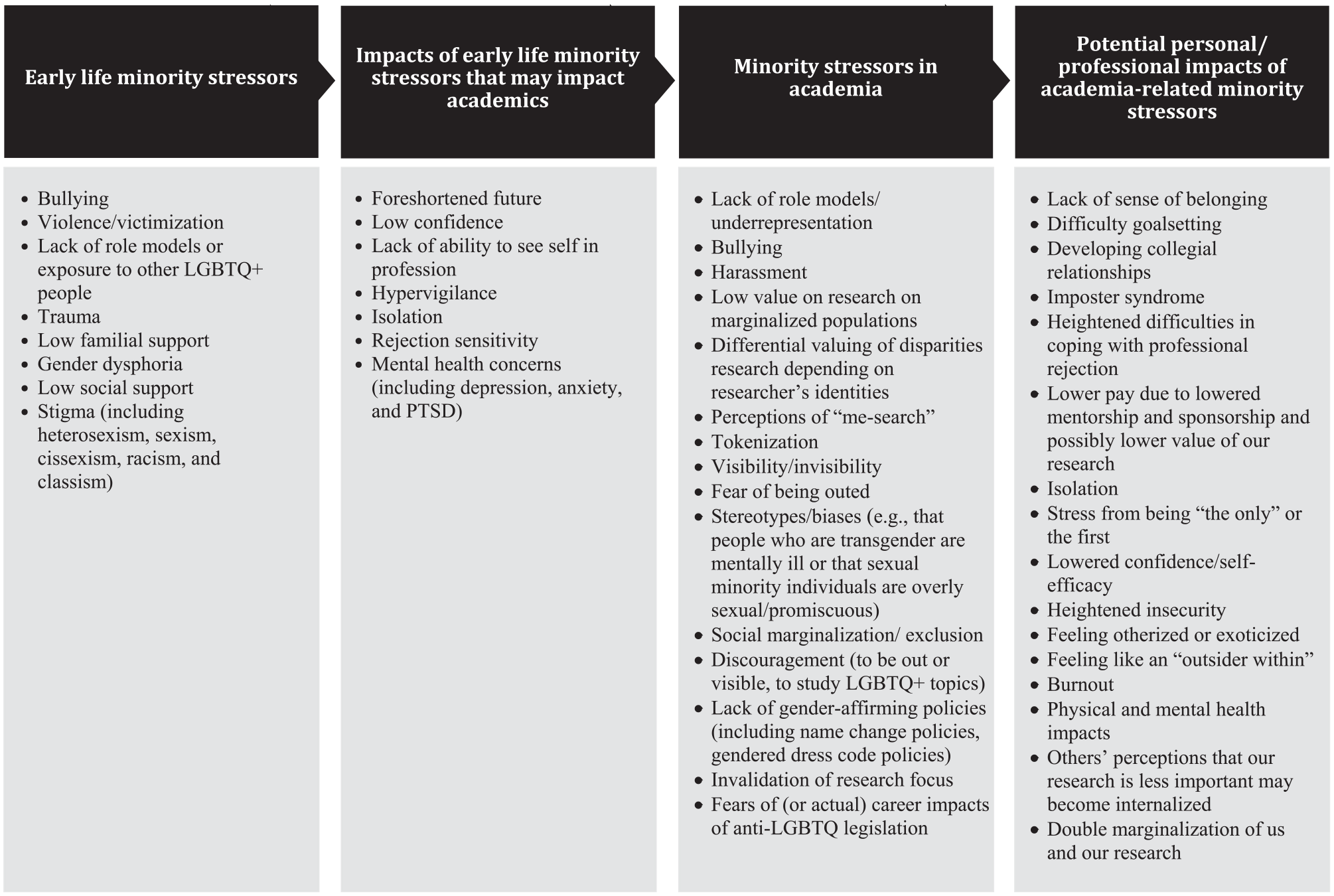
Conceptual model of the theorized impacts of early minority stressors and academia-related minority stressors on LGBTQ+ researchers.
More covert forms of bias may lead people to distrust their own perceptions of interactions, particularly when there is low support around them or when those in the surrounding environment actively deny their experiences (Cardona et al., 2021; Smith & Freyd, 2014). Rejection sensitivity, a common experience related to minority stressors (Feinstein, 2019), may also lead LGBTQ+ faculty to feel as though they will not be supported if they talk about the challenges they face (Weise et al., 2021), thereby increasing isolation. When the discrimination, bullying, and microaggressions come from within one’s own community (e.g., LGBTQ+, racial/ethnic), cultural betrayal theory would suggest unique, and possibly more severe, impacts (Gómez, 2019a, 2019b; Gómez & Freyd, 2018). There is little research, however, on the impacts of within-LGBTQ-community bullying and microaggressions (Misawa, 2015; Vaccaro & Koob, 2019).
There is a discussion to be had as well about the high value placed in academia on separating from one’s mentor and the unique impacts of that for doubly marginalized researchers. Reviewers of my NIH K99/R00 application criticized me for still working so closely with my postdoctoral fellowship mentor and expressed concern about my continuing to work with her as a primary mentor during the K99/R00. Yet, some of my colleagues (not doing LGBT research) listed NIH K mentors who had been both their doctoral and postdoctoral mentors. They received no criticisms from reviewers about their independence or lack thereof. Independence is important, but for those of us who belong to marginalized groups who are underrepresented in the academy, sometimes our mentors are among very few people we know who have similar identities/experiences—and possibly perhaps the only senior person at our institution doing LGBTQ+ research. Independence, when you have a bevy of potential mentors and peers who hold similar identities as you and do somewhat similar research, is likely qualitatively different than when the person mentoring you is the first role model from your marginalized group you have ever had in academia. That is not to say that broadening our networks, developing our own independent lines of research, becoming experts in our own right is not important. It is. But it may not be easy to find other people who can model for us what a future as an LGBTQ+ faculty can be and how to navigate minority stressors in academia. And unlike our majority group peers, we may not have had a history of people being in our corners, encouraging us, or even seeing that we have potential.
Doubly Marginalized Due to Both Our Research and Our Identities
When I was a PhD student, I met with the director of a center for women’s health research to talk about doing a postdoctoral fellowship there. The director said that research on queer women’s health had nothing to do with research on women’s health. Did this mean they believed queer women were not women? Or that research on queer women had no applicability to the population of women? I was too stunned to ask questions. More recently, I was turned down for a faculty position because, I was told, my work was “not important or novel.” As a queer woman doing research on queer women, these comments strike me on multiple levels; in essence, they indicate to me that both I and my research are perceived of as less-than.
Indeed, research on marginalized groups by marginalized researchers faces bias and may be less likely to receive funding than similar work conducted by majority group researchers (Carnethon et al., 2020; Hoppe et al., 2019). The marginalization specifically of BIPOC researchers has led to a devaluing and marginalization of their research—particularly research focused on equity and disparities (Bowleg, 2021; J. L. Harris, 2021). Concomitantly, some who do research on marginalized communities (e.g., cisgender white men researching marginalized communities) may be rewarded for their research whereas others (e.g., women, LGBTQ+ people, BIPOC) studying the same groups may get penalized. And, as noted earlier, some research topics are more valued (e.g., HIV/AIDS research among cisgender men) than others (e.g., research on racism, cissexism, and sexism within the LGBTQ+ community), suggesting within-LGBTQ+ research differences in levels of research marginalization.
One way that our research is marginalized is that people who belong to minoritized groups may get accused of doing “me-search”—self-relevant research that is considered to be indulgent or navel-gazing and thus not objective science (Bowleg, 2021; Devendorf, 2020; Devendorf et al., 2021; Gardner et al., 2017; J. L. Harris, 2021; Heath, 2015). This criticism is levied although cisgender heterosexual white men have historically centered the experiences of men like themselves in their own research. But, being a cisgender heterosexual white man is considered universal, neutral, and normative—the default or prototype (Purdie-Vaughns & Eibach, 2008)—and thus wholly generalizable to other groups and experiences. This lens is additionally deemed as uniquely objective and unbiased. Yet, marginalized people who do research within our own communities add just as much—if not more—to our fund of knowledge as do those from outside (Collins, 1986; Haraway, 1988). Both insider and outsider perspectives are needed. Neither is inherently better, more objective, more rigorous, or better science than the other (Eliason, 2016; Hayfield & Huxley, 2015), and some people may be both insiders and outsiders depending on multiple identities (Hayfield & Huxley, 2015; Nelson, 2020; Wilkinson & Kitzinger, 2013).
Thus, there is a clear marginalization that comes with being an LGBTQ+ person doing research on LGBTQ+ communities (J. C. Harris & Nicolazzo, 2020). Not only do we not fit hegemonic ideals ourselves, our research does not either—leading to double marginalization. Doing LGBTQ+ research can additionally open us up to having to hear others’ perspectives on LGBTQ+ research, including misinformed or biased opinions (Beagan et al., 2021). Recently, I was asked to review a paper that, from the abstract, seemed highly relevant to my own work. When I started to read the paper, however, it became clear that it was filled with prejudice against sexual minority people, particularly sexual minority women. I felt unprepared for the minority stressors of reviewing a paper that was fairly hostile to both my research topic and my own identities—not to mention the amount of emotional labor it took to craft a review that was balanced and helpful.
Furthermore, people who have negative attitudes toward LGBTQ+ people may be less likely to see LGBTQ+ research by LGBTQ+ researchers as credible (Altenmüller et al., 2021). Although this is not entirely unsurprising, it does suggest that when negative views about our research field are expressed, they reflect biases about LGBTQ+ people. This makes negative statements about LGBTQ+ research feel like double microaggressions and doubly invalidating (Cardona et al., 2021) and can make researchers who are LGBTQ+ fear that simply being out in the workplace may make others believe that their research, irrespective of topic, is biased.
For people who do LGBTQ+ research, it is likely that others will assume, rightly or wrongly, that they are LGBTQ+ (LaSala et al., 2008; Prock et al., 2019) and thus engaging in “me-search” or biased, indulgent research. This may create barriers to doing LGBTQ+ research for people who are less out or are questioning their identities. Alternatively, it may feel safer to more-or-less passively “let their LGBT-related work ‘out’ them” (LaSala et al., 2008, p. 256) rather than actively disclosing identities. In graduate school, I knew I wanted to focus on queer women’s health and well-being, but there were no opportunities to do so in my program, so I centered my research broadly on women’s health. After I accepted a postdoctoral fellowship focused on queer women’s health, a colleague told me that I needed to come out to my doctoral mentors. I was unsure why knowing my sexual identity was necessary for others to understand my research path, but eager to please, I awkwardly came out in a meeting and was met with silence. This left me uncomfortable and isolated as this rather vulnerable and personal disclosure received no support—or even acknowledgment. It is still unclear to me exactly what was going on behind the scenes. I have wondered since then if my mentors could have only understood my research shift if it aligned with my own identities—as though only people who are LGBTQ+ themselves would want to do research in this area. Some colleagues at varying institutions have actually been told that LGBTQ+ research is tantamount to “career suicide” due to broader perceptions that this research is of lower quality and value. For LGBTQ+ researchers, this is not just a microaggression against a career path, it is a microaggression against one’s self and community.
Until We Are Counted, We Do Not Count
Much of what we know about the experiences of marginalized researchers comes from scholarship on BIPOC faculty. We lack data on the experiences of LGBTQ+ faculty within the academy, including comparing those who do LGBTQ+ research and those who do not. Given the dearth of research, and given that much of what exists on LGBTQ+ faculty is qualitative, we do not fully know the scope of the issues; we lack data on the actual numbers of LGBTQ+ faculty given that these data are not routinely collected (Freeman, 2020). The NIH and the National Science Foundation (NSF) do not yet collect data on sexual identity nor gender outside of man/woman among applicants or in the NSF’s surveys of college graduates and earned doctorates (Langin, 2020). Some universities in the United States now ask questions during online job applications about sexual identity and have broadened gender questions to be inclusive of transgender and nonbinary people, which is a step toward documenting our presence (or absence) in university settings. Current estimates obtained from research studies on LGBTQ+ faculty range from 2% (at a “Catholic Marianist Institution”; Bradshaw, 2020) to 5% who identified as LGB in a survey of more than 400 colleges and universities (BrckaLorenz et al., 2019). In a survey of more than 25,000 STEM faculty, 4.5% identified as LGBTQ+ including 0.9% of the total sample who identified as transgender/nonbinary (Cech & Waidzunas, 2021).
We need more research on what it is like to be an LGBTQ+ researcher across disciplines and research on what it is like to do LGBTQ+ research, as either a cisgender heterosexual person or as an LGBTQ+ person. This research needs to be intersectional to understand the potentially compounding and disproportionate career and personal impacts of multiple sources of oppression (Bowleg, 2008; Bowleg et al., 2003; Crenshaw, 1991; Griffin et al., 2011 J. C. Harris et al., 2021; Keene & Guilamo-Ramos, 2021; Nadal, 2019; Pérez Huber & Solorzano, 2015; Thacker & Barrio Minton, 2021; Vaccaro et al., 2021; Vaccaro & Koob, 2019). We also need to understand whether there are impacts related to the double marginalization of us and our research on getting tenure-track jobs, promotion and tenure, leadership positions, and commensurate pay. In Table 1, I have included recommendations that may serve as a starting point for addressing some of the challenges of being an LGBTQ+ researcher.
Recommendations.
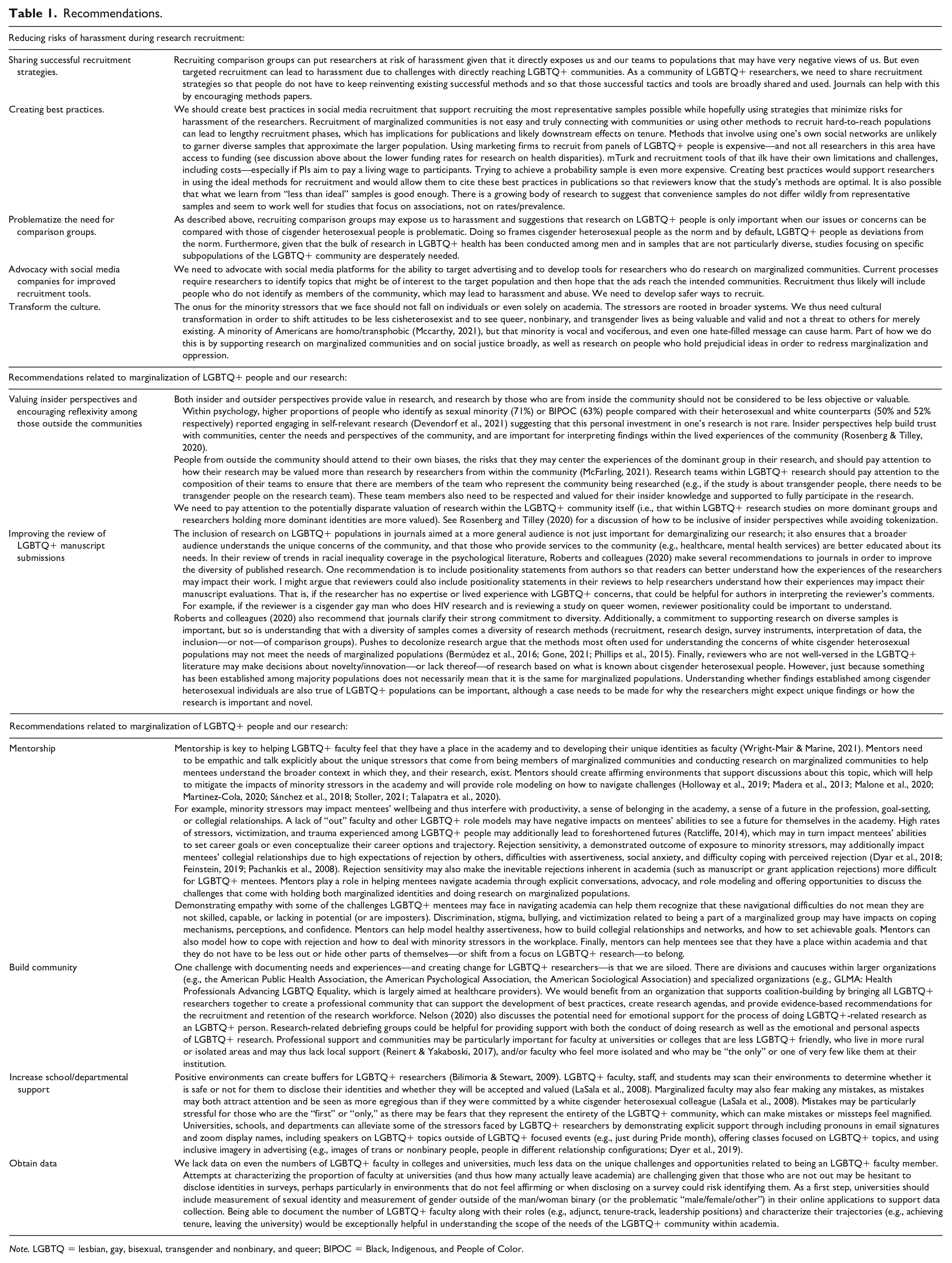
Note. LGBTQ = lesbian, gay, bisexual, transgender and nonbinary, and queer; BIPOC = Black, Indigenous, and People of Color.
Conclusion
Across the United States currently, there are more than 300 anti-LGBTQ+ pieces of legislation being considered in 28 states (https://www.hrc.org/campaigns/the-state-legislative-attack-on-lgbtq-people). Most of these are aimed at transgender youth (e.g., restricting the ability to play sports or access gender-affirming health care); as of June 2022, eight states have signed anti-LGBTQ+ bills into law. For LGBTQ+ academics, this can be at best unnerving and at worst terrifying, given that many of us work in these states, and research demonstrates that anti-LGBTQ+ bills and the rhetoric surrounding the bills have negative impacts on LGBTQ+ people’s well-being (Fingerhut et al., 2011; Flores et al., 2018; Frost & Fingerhut, 2016; Horne et al., 2022; Paceley et al., 2021).
In some of these states, there are also bills aimed at restricting what can be said about LGBTQ+ people in classrooms (e.g., Florida’s “Don’t say gay” bill). This can have a chilling effect even among college and university faculty, as it could make talking about LGBTQ+ people or doing research among the LGBTQ+ community risky. States that are anti-LGBTQ+ may decide to shut down or censure our research (and teaching), which may threaten our employment. For those of us on the academic job market, this can mean that we feel a need to restrict our applications to those states where there are explicit LGBTQ+ protections (according to the Movement Advancement Project, only 15 states and Washington DC have high levels of LGBTQ+ protective policies; https://www.lgbtmap.org/equality-maps), which means much higher competition for fewer academic positions. This, in turn, makes it likely that even more LGBTQ+ faculty will not get tenure-track positions. It also means that LGBTQ+ students and postdoctoral fellows in states without legal protections may lose opportunities to be mentored and taught by LGBTQ+ faculty, which has further downstream implications for representation in the academy.
My goal with this article is to in some way help prevent the LGBTQ+ academic pipeline from leaking any further by starting conversations about being multiply marginalized due to our identities and our research. One way to do this is by creating an intersectional pipeline (see Nadal, 2019). Concurrently, we should discuss as a field that minority stressors affect us and our sense of belonging in the academy—and to discuss the costs of these to us as academics and people. The marginalization of us and our work may lead to difficulties publishing in top journals, which then may affect how often we are cited, leading to lower h-indices and lowered perceptions of the importance of our research—all of which have implications for employability, tenure, professional power, and career development—as well as role modeling within the academy. Figure 2 describes this theorized cycle of career impacts of minority stressors in academia.
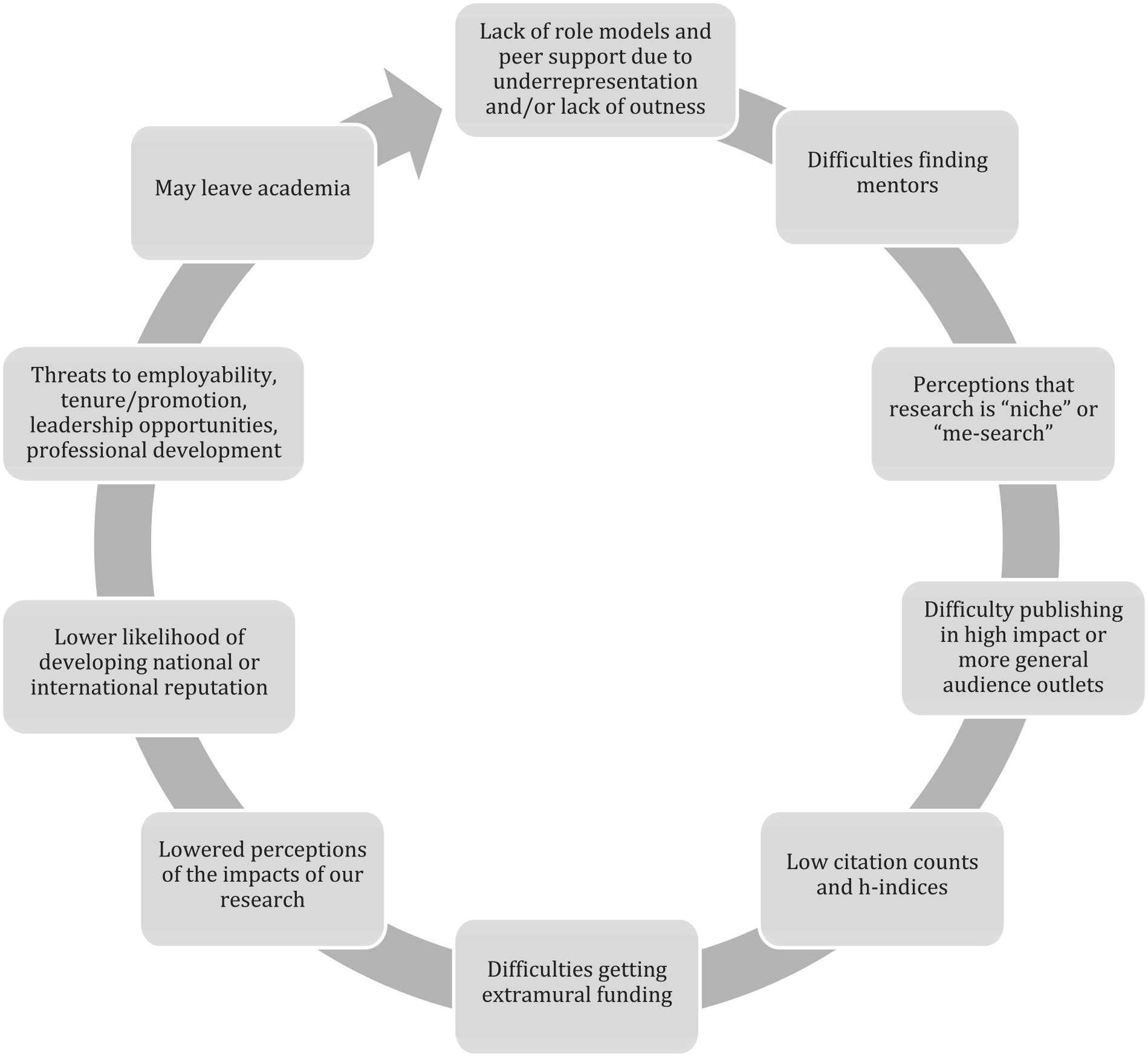
Cycle of potential professional impacts of academia-related minority stressors.
I will end with one final story. At a recent campus event for LGBTQ+ faculty, the topic of outness came up. Despite being in a progressive city at an LGBTQ+ positive university, some faculty still wondered whether they should come out—and whether it was even important to do so. I argued that for at least some of us, role models were scarce in our own educational backgrounds. This likely meant we had few to no LGBTQ+ role models during our own identity development processes and lacked models for futures as LGBTQ+ academics. To my knowledge, although I had multiple queer men professors, I have never had a queer woman teacher/professor. That absence has had implications for my own sense of belonging in the academy and my ability to visualize my professional future. Navigating academia with no one who has similar experiences is challenging for anyone from a minoritized or marginalized group. Although representation matters, it is not enough to remove barriers for those who are underrepresented in academia. To disrupt the effects of double/multiple marginalization and the associated minority stressors we face, we need explicit support, mentorship, opportunities, and affirmation that we belong in the academy—and that we add value, as does our research.
Footnotes
Acknowledgements
I would like to very heartily thank Drs. Sa-keira Hudson, Alison Cerezo, Eric Schrimshaw, Dirk Davis, Kristine Kulage, and Donna Drucker, as well as anonymous reviewers, for their exceptionally helpful comments on earlier drafts of this paper. I would also like to thank my research assistants: Elizabeth Cavic, Brennah Fallon, Ryan Herman, Erin McConocha, Jasmine Mueller-Hsia, and Laur Rubino.
Declaration of Conflicting Interests
The author(s) declared no potential conflicts of interest with respect to the research, authorship, and/or publication of this article.
Funding
The author(s) disclosed receipt of the following financial support for the research, authorship, and/or publication of this article: C.B.V.’s work on this manuscript was supported by a National Institutes of Health (NIH)/National Institute on Alcohol Abuse and Alcoholism (NIAAA) Pathway to Independence Award (K99AA028049; C.B.V.: Principal Investigator). The content is solely the responsibility of the author and does not necessarily represent the official views of the NIH or Columbia University.
