



Abstract
In this article we compare the dynamics and long-run outcomes of an overlapping generations closed economy under exogenous and endogenous fertility. Individuals have myopic foresight, and pay-as-you-go (PAYG) public pensions exist. Although large PAYG transfers may cause endogenous fluctuations in both contexts, cyclical instability and deterministic chaos more likely occur when fertility is an economic decision variable. We find that the existence of endogenous fertility and PAYG pensions can explain the occurrence of demographic oscillations that mimic the baby boom and baby bust, in contrast with the unrealistic case of constant population, and also economic cycles. We also show that an increase in the social security contribution rate under endogenous fertility, often advocated as a remedy against the crisis of public pension budgets, may prolong both the phases and size of demographic (economic) cycles around a lower (higher) long-run level of population growth (income per worker) than under exogenous fertility.
Unfunded pay-as-you-go (PAYG) social security is a controversial issue in the economic literature. Some authors highlight the effects of pensions in reducing either saving (Feldstein 1974) or welfare if the capital stock is not too much larger (Diamond 1965), while others find that the crowding out effect of pensions on voluntary saving does not occur if individuals take care of their future infinite progeny via private intergenerational transfers (Hansson and Stuart 1989).
Although the existence of the PAYG system has been justified on equity grounds in a political equilibrium model because of an intergenerational redistribution effect as in Tabellini (1990), it has also been criticised due to the perils of unviable budgets, especially in countries facing demographic changes because of population ageing (e.g., Italy, Japan, and Spain). This has raised debates on the role PAYG pensions can play in overlapping generations (OLG) growth models when fertility changes (e.g., van Groezen, Leers, and Meijdam 2003). While in this class of models, the issue of PAYG pensions has usually been studied under exogenous fertility (Samuelson 1975a), a recent body of theoretical literature, pioneered by the seminal article by Becker (1960), argues that fertility should actually be considered as a decision variable influenced by economic incentives and constraints (Becker and Barro 1988; Barro and Becker 1989; Becker, Murphy, and Tamura 1990) rather than being left out of the economic sphere.
However, to the best of our knowledge, most studies have not yet explored the dynamic features of an economy with endogenous fertility in comparison with those of the standard case of exogenous fertility when PAYG pensions are in existence. In particular, less attention has been paid to the role of PAYG pensions and endogenous demographic changes on long-run demoeconomic outcomes and economic and demographic stability. The aim of this article, therefore, is to fill this gap by reconsidering the issue of unfunded social security in the neoclassical OLG growth model à la Diamond (1965) under exogenous and endogenous fertility.
In particular, as in Eckstein and Wolpin (1985) and Galor and Weil (1996), the choice of fertility is assumed to be motivated by the so-called weak form of altruism of parents (Zhang and Zhang 1998), in which individuals draw utility from the number of descendants they have and choose fertility by comparing the benefits and costs of children. Moreover, since childbearing can reasonably be considered either a time-based or income-based activity irrespective of whether fertility is endogenous or exogenous (due, for instance, to religion belief, customs, unchecked sexuality, and the like), in this article we assume that raising children is costly even under exogenous fertility.
Given the difficulty of studying the dynamics of OLG models with endogenous fertility, we postulate a lognormal utility function and a Cobb–Douglas production function, which permit closed form analytical solutions as well as economic interpretations of the dynamical outcomes, otherwise prevented by the use of other more general functional forms.1,2 These assumptions are standard, and, beyond the analytical simplification, they have much empirical support. 3
Our results reveal that PAYG pensions strongly matter for both the steady-state and dynamical events depending on whether fertility is endogenous or exogenous. In particular, in the absence of public pensions, fertility still remains constant even when it is an economic decision variable, and thus the model is not suited to explain the observed population dynamics in such a case. Indeed, the working of pensions generates endogenous population dynamics that may mimic the observed evolution of fertility, especially in Western countries. Moreover, PAYG pensions are crucial to determine the long-run level of population growth as well as the appearance of permanent and chaotic phases of baby booms and baby busts.
Therefore, the interaction between PAYG pensions and endogenous fertility significantly matters for stability, and the destabilizing effect of public pensions is higher than when fertility is exogenous. The economic reasons for this result are several.
First, regardless of whether fertility is exogenous or endogenous, the existence of a PAYG transfer crowds out voluntary savings because of the need to sustain consumption when old becomes lower than in the absence of it. As a consequence, when individuals are shortsighted, raising pensions beyond a certain critical level may determine a sharp reduction in savings and capital accumulation as well as the destabilization of the equilibrium point. Second, the negative crowding out effect of public pensions on private savings is lower, the higher is the subjective discount factor because, ceteris paribus, the relative weight of old-age consumption increases as the intergenerational discount factor becomes larger. Third, in the case of endogenous fertility, the individual discount factor also reduces the weight of the positive effect of pensions on the demand for children. (Note that the positive relationship between fertility and PAYG pension exists because individuals save less than when intergenerational transfers are absent, and thus the disposable income for childbearing increases in such a case.) Moreover, the weight of the subjective discount factor on saving and fertility through public pensions is exactly the same. Finally, since capital accumulation per worker is determined as the ratio between savings and fertility, the subjective discount factor does not affect the public pension component on capital accumulation when fertility is endogenous, while affecting in a negative way saving and the public pension component on capital accumulation when fertility is exogenous.
The present article, therefore, contributes to three strands of literature: the neoclassical OLG growth literature with public pensions, the theory of endogenous population dynamics (Manfredi and Fanti 2006), and endogenous economic cycles framed in the OLG context (Grandmont 1985). In this regard, the article studies an issue so far not explored, such as dynamic and steady-state demoeconomic outcomes with PAYG pensions, by contrasting models with exogenous and endogenous fertility, while also focusing on the effects of increasing the contribution rate (Cigno 2007; Liikanen 2007). Although it is well known that OLG economies with myopic expectations may typically show cyclical (and even chaotic) dynamics when the elasticity of substitution in production (Farmer 1986; Reichlin 1986) and in utility functions (Michel and de la Croix 2000; Fanti and Spataro 2008) are fairly low and high, respectively, it is remarkable that cyclical instability and deterministic chaos can occur in the standard double Cobb–Douglas economy because of the financing of PAYG pensions.
Our findings can have interesting policy implications. In particular, to the extent that fertility is an economic decision variable, a rise in the contribution rate, often invoked as a remedy against the crisis of public pension budgets, may reduce the desired number of children of individuals and trigger baby booms and baby busts around the long-run level of fertility. 4
The rest of the article is organized as follows: the section Exogenous Fertility analyzes the steady-state and local stability properties of an OLG economy with exogenous fertility and is followed by a section on Endogenous Fertility. The section Exogenous Versus Endogenous Fertility: Some Analytical and Numerical Results compares the dynamic and steady-state outcomes under exogenous and endogenous fertility and is followed by the Conclusion.
Exogenous Fertility
Firms are identical and markets are competitive. Aggregate production at time


At time


Note that the negative effect of future pensions on current savings depends on the relative weight between the subjective discount rate (ρ) and the market interest rate (r). The higher the relative importance of the former, the higher the negative effect of pensions on savings.
Given the government budget equation (3) and knowing that


While our economy does not exhibit any interesting dynamic events (i.e., the steady state is locally stable and the dynamic path is always monotonic) if expectations are rational, nonmonotonic dynamics and cyclical instability may occur if expectations are myopic. Therefore, in the following section we concentrate on the case of shortsighted agents to study the complex dynamic properties of this stylized economy.
Exogenous Fertility: Steady-State and Local Stability Analyses with Myopic Foresight
With myopic expectations, both the expected interest and wage rates depend on the time t stock of capital per worker, or


From equations (12) and (13), therefore, the following proposition holds:
Indeed, a rise in the capital stock causes a twofold effect. It increases saving because the current wage raises, while also decreasing it because of the rise in the present value of next period transfers. Moreover, the lower the capital share in production and the subjective discount factor (or, alternatively, the higher the relative weight of both the labor income in production and the public pension component in capital accumulation), the more likely in


Endogenous Fertility
In this section, we assume that individuals enjoy to have children and choose the number of descendants (e.g., the so-called weak form of altruism, as in Zhang and Zhang [1998]) by comparing between benefits and costs of upbringing.
The public pension budget and the individual budget constraints when young and old are still determined by equations (3),(4), and (5), respectively, with the only difference that the number of children is now an economic decision variable, and, as can easily be ascertained below (see equation (19)), it depends on both the wage and interest rates, which in turn depend on the dynamic variable
Individuals have preferences toward material consumption over the life cycle and the number of children, as in Eckstein and Wolpin (1985) and Galor and Weil (1996). The typical agent that enters the working period at t chooses fertility and saving to maximize the utility function:


From equation (19′), we note that fertility is constant at
Using equations (9), (19′), and (20′), the equilibrium in the capital market is:

Endogenous Fertility: Steady-State and Local Stability Analyses with Myopic Foresight
Exploiting equations (1), (2), (11), and (21), the dynamic path of capital accumulation becomes
Indeed, a rise in the contribution rate causes a negative income effect that reduces the disposable income irrespective of whether fertility is exogenous or endogenous. However, while in the former case such a negative effect only reduces savings, in the latter case it causes the same identical reduction in both savings and fertility, and then the negative income effect on capital accumulation is sterilized in such a case. An illustration of this result is postponed to the section on Change in PAYG Pensions: Policy Experiment.


We now proceed with the steady-state analysis of the relationship between fertility and the pension contribution rate. Using equations (1), (2), (19′), (20′), and (23), the long-run fertility rate can be written, after some straightforward algebra, as


Note that the output elasticity of capital
As regard local stability, the analyses of equations (22) and (23) give the following proposition:


Similar to the case of exogenous fertility, large PAYG transfers may destabilize the economy when the output elasticity of capital is fairly low. However, we note the subjective discount rate now plays no role on stability. Indeed, comparison of propositions 1 and 3 reveals that the stability properties dramatically change depending on whether fertility is endogenous or exogenous, as shown in the next section.
Exogenous versus Endogenous Fertility: Some Analytical and Numerical Results
In order to compare exogenous and endogenous fertility economies focusing specifically on dynamical features, we now assume that the same steady-state number of children is raised in both contexts. This amounts to saying that the same unique steady-state capital stock is achieved.
11
First of all, it is important to remark that
In contrast, when PAYG pensions exist
Indeed, when fertility is exogenous, a rise in
Figure 1 illustrates the content of proposition 4 and displays the different size of the cyclically unstable regions under exogenous and endogenous fertility.
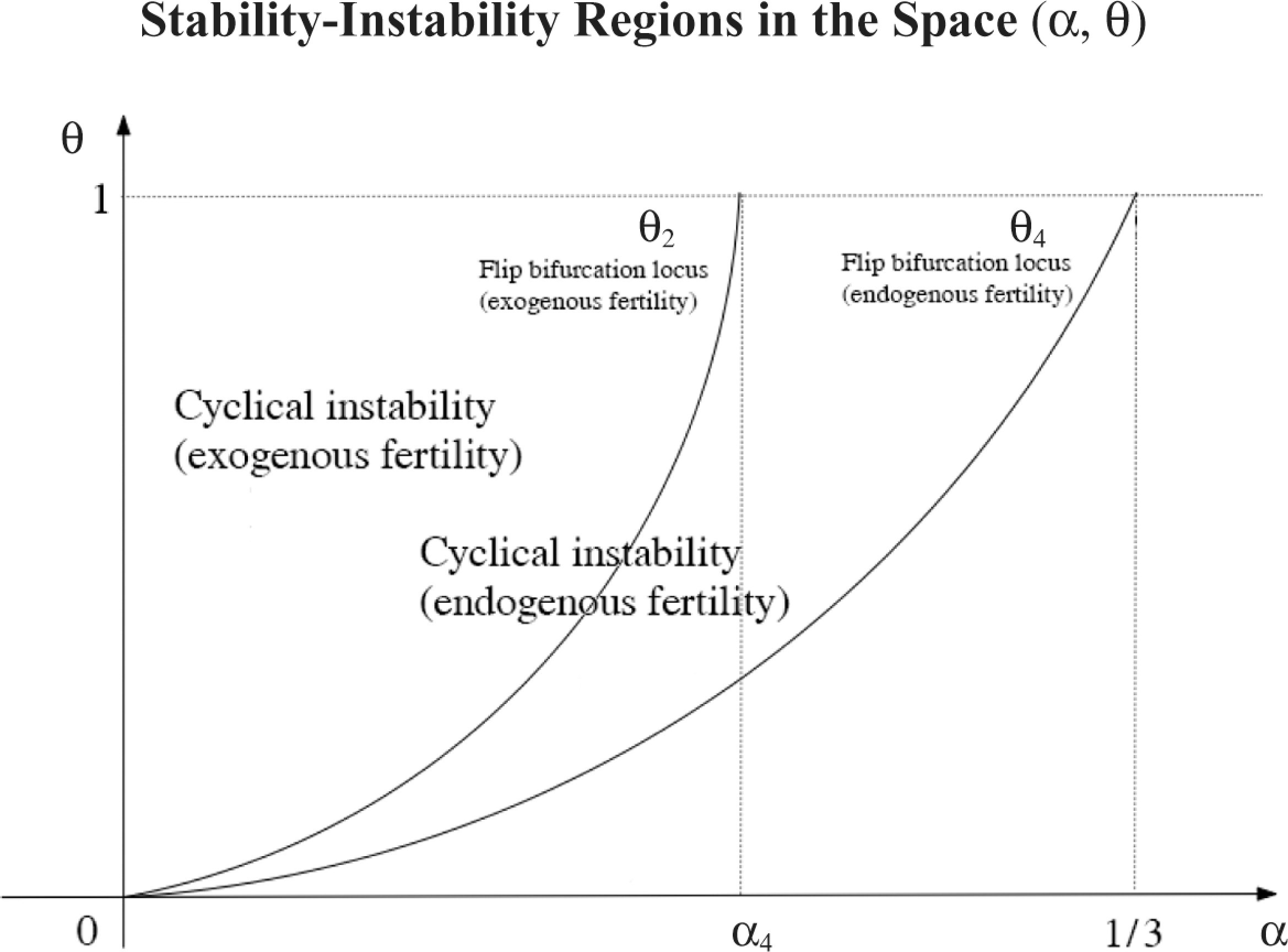
Stability-instability regions in the space
In the following two sections (Change in PAYG Pensions When the Number of Children is the Same Under Exogenous and Endogenous Fertility and Change in PAYG Pensions: Policy Experiment), we compare the dynamic evolution of demoeconomic variables and long-run outcomes in both economies when
Change in PAYG Pensions When the Number of Children Is the Same Under Exogenous and Endogenous Fertility
While the previous section has presented some analytical results, the quantitative implications will be better seen through numerical simulations, which can help to reveal other effects of social security when ambiguity exists in the analysis (e.g., the effects of the pension contribution rate on the population growth).
To illustrate the different dynamic adjustment processes under exogenous and endogenous fertility, we take the following parameter set:
Monotonic and convergent dynamics (the pension contribution rate is fairly low). Figure 2A illustrates the phase map under exogenous and endogenous fertility when θ = 0.05 and q = 0.1745. Figure 2B represents the corresponding time plot for nt
(k
0 = 0.01 and n
0 = 0.7), showing that under endogenous fertility population increases in the first stages of development and then approaches the stationary state. Nonmonotonic dynamics, which may result in (i) nonmonotonic convergence toward the stationary state in capital and fertility (for intermediate values of the contribution rate). Figure 3A displays the phase map of capital accumulation, which is unimodal in both cases, when θ = 0.35 and q = 0.133. The steady state is approached with dampened oscillations. (Given the different slopes of the phase maps at the equilibrium point, fluctuations in demoeconomic variables under endogenous fertility are larger than under exogenous fertility, as shown in the corresponding time plot for both n
t and k
t; see Figure 3B through D, where k
0 = 0.01 and n
0 = 0.7); (ii) irregular fluctuations in capital and fertility (e.g., the pension contribution rate is fairly high). Figure 4A displays the phase map when θ = 0.46 and q = 0.1124. The corresponding time plots for n
t and k
t reveal that oscillations are permanent also in the very long run when fertility is endogenous, while converging toward the stationary state when fertility is exogenous (see Figure 4B–D, where
The economic intuition is the following. In the first stages of development saving grows faster than fertility, the latter being univocally of the Malthusian type (endogenous fertility); that is, the higher income, the higher the number of children. When economies develop, however, the reduction in saving is on average larger than that of fertility, and fluctuations are larger under endogenous fertility. It is important to note that when

A, Phase map (

A, Phase map (

A, Phase map (
Therefore, the existence of large PAYG transfers is sufficient to generate realistic predictions about demoeconomic outcomes in an OLG model with endogenous fertility, such as the observed phase of fertility drop, which has otherwise been explained, for instance, by the quantity–quality theory of fertility (Becker and Lewis 1973; Becker and Tomes 1976; Barro and Becker 1989) or by the theory of female labor participation (Mincer 1962).
Change in PAYG Pensions: Policy Experiment
In the current political debate in several developed countries, there is wide consensus to increase pension contributions with the aim to balance public pension budgets. What are the effects of an increase in pension contributions on the time evolution of capital accumulation and fertility?
Taking into account some forecasts on the social security contribution rate, such as Liikanen (2007), we conduct a policy experiment using the same values of technological and preference parameters as in the section Change in PAYG Pensions When the Number of Children is the Same Under Exogenous and Endogenous Fertility, in order to compare the short- and long-run outcomes in fertility and capital corresponding to a change from

A, Endogenous fertility: change from
Fertility
Figure 5A represents the time plot for nt portrayed from t = 2 (the time when θ changes) onward. Note that the upper curve (θ = 0.1) started out at t = 0 (not shown in the figure), with k 0 = 0.01 and n 0 = 0.7 as initial conditions. Then we assume k 2 = 1.42 (see Figure 5C) as the initial condition for k at the time of the change in θ. Case θ = 0.1: after a few oscillations, fertility approaches the stationary state (n = 1). Case θ = 0.3: the rise in θ causes an 18 percent reduction in fertility (i.e., almost 2 children per couple when θ = 0.1 against 1.65 children per couple when θ = 0.3) followed by phases of baby booms and baby busts, dampened over a dozen generations, until the new and lower long-run fertility rate is approached.
Capital
Figure 5B and C show that the capital stock installed at t = 2 when θ = 0.1 is k 2 = 1.35 (k 2 = 1.42) under exogenous (endogenous) fertility. In the short run (t = 2), the rise in θ causes a 48 (24) percent reduction in the capital stock under exogenous (endogenous) fertility. This is because the reduction in saving is mitigated by the reduced number of children when fertility is endogenous. In the long run, there are phases of small and fast (wide and slow) oscillations under exogenous (endogenous) fertility until the new low (high) steady state is achieved around the seventh (thirtieth) generations.
Conclusion
This article dealt with the study of the dynamical and steady-state outcomes of a double Cobb–Douglas OLG economy with public PAYG pensions and shortsighted individuals under exogenous and endogenous fertility. We showed, ceteris paribus, that an economy is likely to be exposed to endogenous fluctuations when fertility is an economic decision variable. Indeed, in such a case our model generates a population dynamics that mimic the historical evolution of population with an increasing trend with increasing income (i.e., the Malthusian-type fertility observed in the first stages of development) and phases of baby booms and baby busts before either approaching the steady-state level of fertility or permanently oscillating around it. 12 Indeed, such oscillations may be consistent, in a broad sense, with the baby boom and the subsequent fertility drop observed in some actual developed economies in the last sixty years (Greenwood, Seshadri, and Vandenbroucke 2005). Moreover, the existence of an endogenous population dynamics allows for a novel realistic explanation of regular and even chaotic demoeconomic cycles. Therefore, to the extent that fertility choices are based on a comparison between benefits and costs of children, the effects of PAYG pensions may be markedly different from those expected in the case in which fertility is determined out of the economic sphere.
Since the rational choice of fertility may be considered going hand to hand with the stages of economic development, and since social security reforms are currently high on the political agenda in several developed economies, our findings constitute policy advice about the economic and demographic effects of raising pension transfers when fertility is endogenous. 13
Footnotes
Appendix A
Appendix B
Appendix C
Notes
We gratefully acknowledge the editor Prof. James Alm and two anonymous referees for valuable comments on an earlier draft. The usual disclaimer applies.
The author(s) declared no potential conflicts of interest with respect to the research, authorship, and/or publication of this article.
The author(s) received no financial support for the research, authorship, and/or publication of this article.