



Abstract
This study explores the impact of balanced-budget rules on states’ fiscal policy outcomes and tests whether this impact depends on the political and economic environments in light of the American states’ experience from 2004 to 2010. The findings suggest that (1) budget rules are more binding in recessions as compared with “normal” times; (2) the impact of the rule depends on the political environment, especially on the party identity of the governor; (3) a divided government influences the rule’s impact, particularly when one party controls the governorship and another controls the legislature; and (4) states’ responses, as measured by total budget cuts, to unexpected revenue shocks (such as unexpected decreases in tax revenue) tend to be larger than states’ responses to unexpected expenditure shocks.
The emergence and persistence of the fiscal crisis in many industrial countries has generated widespread concern and an interest in fiscal policy. Many states in the United States are also facing a fiscal crisis unprecedented in modern American government, with this fiscal situation contributing to an increase in their perceived risk of default. Nadler and Hong (2011) report that among the many economic variables of the states, the budget deficit of real gross domestic product (GDP) was identified as one of the three economic variables having the greatest explanatory effect of the increase in the US state bond yield spread during 2008–2009. 1 For this reason, although the 2008 financial crisis might have been caused by reasons having little to do with poor management of government finances, 2 many policy makers are seeking to introduce a policy solution that can provide their countries (or states) with more stable fiscal outcomes and can prepare them for the debt crisis that could follow the financial crisis (Reinhart and Rogoff 2011).
As a solution for effectively managing the fiscal crisis, fiscal rules such as a “balanced-budget rule” have recently attracted the attention of many public policy makers of industrial countries as a solution to the unprecedented fiscal crisis. 3 Research on balanced-budget requirements has been focused mainly on testing the macroeconomic consequences of the rule: whether balanced-budget rules amplify business cycles by stimulating demand during the boom via an increase in expenditures and by reducing demand during recessions via a decrease in expenditures. For instance, King, Plosser, and Rebelo (1988) proposed a theory showing that the amplitude of the business cycle may increase when the government follows a balanced-budget rule. Schmitt-Grohé and Uribe (1997) also show a model in which market participants’ expectations can make this trend even worse.
This Keynesian notion that a reduction in budget deficits is always contractionary, a notion regarded as an unquestionable “stylized fact” (Giavazzi and Pagano 1990; Taylor 2011), has not always been clear-cut when it comes to empirical evidence. A study by Levinson (1998) supports the theoretical models by reporting evidence that the stringent balanced-budget rules enforced in some large US states have exacerbated business cycles in those states. 4 However, Fatás and Mihov (2003, 2006) present evidence that constraints on fiscal policy may reduce the volatility of the business cycle, because, with stringent rules, less discretion is given to politicians in making fiscal policy. Empirical evidence is even more mixed if we focus on data from times of “fiscal stress.” A number of studies (Perotti 1990; Alesina et al. 1998; Giavazzi and Pagano 1990) show that in times of fiscal stress, deficit cuts may have very different effects on aggregate demand than during “normal” times and that they may well have an expansionary effect. Parker (2011) concludes that during recessions, the effectiveness of fiscal policy in either stabilizing or destabilizing the economy is highly questionable.
Compared to the attention given to the macroeconomic impact of budget rules, however, relatively little attention is given to how states respond to these rules, and whether these responses depend on political and economic environments. In fact, it is possible that budget rules are often difficult to enforce (Poterba 1995), as most states have no formal rule for enforcing their balanced-budget requirements (Gold 1992). The US General Accounting Office (US GAO, 1993) also reports that no lawsuits have challenged state budgets, even when states have failed to balance them. Although a number of studies (e.g., Alt and Lowry 1994; Bohn and Inman 1996; Hou and Smith 2010; Mahdavi and Westerlund 2011; Poterba 1994, 1995; Primo 2007; Smith and Hou 2013) have already reported some evidence of the association between budget rules and fiscal policy outcome, the existing evidence either is largely outdated or focuses mainly on whether specific components of fiscal rules have impacts on fiscal policy.
Thus, previous studies have done relatively little to explain how and whether the impact of state budget rules on fiscal policy outcomes depends on political institutions or the economic situations of the states. This is an important omission, because understanding how fiscal rules interact with political institutions may have important policy implications for the design and reform of fiscal rules. Further, understanding whether fiscal rules become more or less binding depending on states’ economic situations may expand our understanding of the macroeconomic impacts of these rules and provide important policy implications.
This article provides a new estimate of the role of budget rules as well as its dependence on political and economic environments. The variation in fiscal as well as political institutions across states within the United States provides a valuable opportunity to test the potential interplay between the budget rule and political situation. Furthermore, the recent experience of the 2008–2010 financial crisis provides a unique opportunity to observe how states adjust their fiscal outcomes in response to a change in economic situations.
Hypothesis
Fiscal rules such as balanced-budget rules, for which there is no formal mechanism in place to enforce them (Gold 1992; Poterba 1995), are always present but are generally less binding during normal periods, because they are overshadowed by other policy issues. During normal periods, fiscal adjustments are not a major policy issue either for the public or for the politicians. However, those rules are likely to matter more during a fiscal crisis, because fiscal adjustments become one of the major interests of the public, media, and markets.
5
That is, during a fiscal crisis, public sentiment often forces both opposing political parties to work together around fiscal adjustments that “need to be done.” This is when the ever-present fiscal rules become highlighted. Therefore, during a fiscal crisis period, I expect that fiscal rules such as balanced-budget rules will become more binding and have greater impacts on states’ fiscal policy outcomes.
Although the public sentiment can force both parties to work together on a common issue, it cannot guarantee that those opposing parties will reach consensus as a result of the negotiation. In fact, as the opposing political parties sit together at the negotiation table and make known their own preferences, it is more likely that the differences between the two parties will become increasingly obvious. In other words, the level of political opposition around the issue of fiscal adjustments, which were inherent before the crisis, surfaces during fiscal turmoil.
To be more specific, I expect that the costs of reaching political consensus will be higher (1) when the state government is “divided” and (2) when the executive or legislative branch is controlled by a left-leaning political party. The latter prediction is because of previous evidence that, in successful fiscal adjustments, a significant part of the spending cuts generally derives from cuts in government wages and programs such as education, public assistance, and Medicaid (Alesina et al. 1998; National Association of State Budget Officers [NASBO] Fiscal Survey of States 2009–11). I expect that the increased costs of reaching political consensus will be shown as less binding balanced-budget rules.
Empirical Framework
This study aims to estimate the impact of budget rules on fiscal policy outcomes and its dependence on the political and economic environments. More specifically, I first estimate the association between the budget cuts made by the US states and the stringency of the balanced-budget rules adopted by those states. Then, I show whether and how these estimated associations depend on the political and economic environments. In this article, I follow Poterba and Rueben (2001) in measuring “fiscal shocks.”
6
That is, the unexpected revenues should equal the difference between the revenues that would have been collected with the tax system that was in effect at the beginning of the fiscal year and the revenues that the tax system was forecasted to collect at the beginning of the fiscal year. Thus, I subtract the change in tax revenue and spending during the fiscal year. Unexpected expenditures are defined in a similar way. Specifically, fiscal shocks are defined as follows:



where
I first test whether a state with a more stringent balanced-budget rule reacts differently to unexpected fiscal shock than a state with a less stringent rule. To do so, I interact the measured unexpected deficit shock (

where Budgetcut it denotes the amount cut from the budget after the budget of that fiscal year has passed the legislature. A positive number for Budgetcut it refers to either a decrease in spending or an increase in taxation. BBR i is the measured level of balanced-budget rule stringency, as shown in Table 1, and Xit is a set of economic covariates of state i in fiscal year t. Among various economic variables, I control for the following economic variables that turn out to have the most significant effect on the dependent variable (Nadler and Hong 2011): 7 unemployment rate and the overall size of a state’s economy as measured by real GDP. The set of covariates Xit also includes the ratio of states’ expenditures covered by states’ “rainy-day” reserves. States usually have rainy-day reserves that allow them to set aside excess revenue for use in times of unexpected revenue shortfall or budget deficit, 8 and thus, a state’s attempt to balance its budget may have been significantly affected by them. Si is a set of unobservables that is specific to state i but is time invariant. As Si is unobservable, (4) is first differentiated to get rid of Si and to obtain the following equation:
Balanced-Budget Rule Stringency.

Note: GAO = General Accounting Office; ACIR = Advisory Commission on Intergovernmental Relations. The higher the number, the more stringent the rule is. The ACIR classification comes from the ACIR (1987) and Poterba and Rueben (2001). The GAO classification comes from US GAO (1993). In California, the voters approved constitutional amendments in 2004 that require the Legislature to enact a balanced-budget and prohibit borrowing to manage an end-of-year deficit. Those amendments moved California into the “most rigorous” category (National Conference of State Legislatures [NCSL] 2010).

where Δ denotes a time-difference operator. By focusing on changes rather than on the level of the included variables, I can effectively control for the time-invariant but state-specific unobservables (see Poterba and Rueben 2001). Table 2 provides summary statistics for all the variables used in this study.
Summary Statistics.

Note: GAO = General Accounting Office; ACIR = Advisory Commission on Intergovernmental; GDP = gross domestic product.
Economic Factors
The central question of this study is to test whether states’ responses to budget rules depend on the political and economic environments. I first check whether states’ responses to budget rules differ during an economic recession as opposed to normal times. The data set used in this article covers the period from 2004 to 2010. The period from 2004 to 2008 is defined as normal times, and the period from 2008 to 2010 is defined as “economic recession.” I estimate equation (5) separately for normal times and economic recession and conduct Chow tests in order to see whether the estimated coefficients for the two periods are statistically different.
Political Factors
I also test whether the effect of budget rules is moderated by political institutional variables, such as the party identity of the governor and legislature and divided control over the government. In this study, I follow Alt and Lowry (1994) to categorize the level of control over the government as follows: (1) unified party government in which one party controls executives as well as both chambers of the legislature, (2) split-legislature government in which one party controls each chamber, and (3) split-branch government in which the same party controls both chambers of the legislature, but the other party holds the governorship. Alt and Lowry (1994) find a significant effect of the balanced-budget rule in unified government but a smaller effect or none in divided governments. In this study, to test whether this finding holds in the recent data, I estimate the following equation:

where Zit is the political variable. Thus, estimating equation (6) examines whether the association between budget rules and the amount of the budget cut after the budget is passed is any different among states with different political institutions. 9 The estimated results are reported in tables 3 and 4.
The Balanced-Budget Requirement (BBR) and Political Environments, 2004–08.

Note: GAO = General Accounting Office; ACIR = Advisory Commission on Intergovernmental; BBR = balanced-budget requirement; GDP = gross domestic product. Robust heteroscedastic standard errors in parentheses. Change in GDP, unemployment rates, and rainy-day reserves to expenditures are controlled. I used year fixed effect in all specifications. Balanced-budget rule variable is mean centered.
*p < .10. **p < .05. ***p < .01.
The Balanced-Budget Requirement (BBR) and Divided Government, 2004–08.

Notes: GAO = General Accounting Office; ACIR = Advisory Commission on Intergovernmental; BBR = balanced-budget requirement; GDP = gross domestic product. Robust heteroscedastic standard errors in parentheses. Change in state real GDP, unemployment rates, and rainy-day reserves to expenditures are controlled. I used year fixed effect in all specifications. Balanced-budget rule variable is mean centered.
*p < .10. **p < .05. ***p < .01.
Unexpected Revenue and Expense Shocks
Another interesting point to consider is whether the two different components of
Data
The dependent variable of this study, Budgetcut it , in equations (4) through (6) is the total amount cut from the budget after the fiscal budget had passed. This variable comes from the NASBO's 2004–2010 Fiscal Survey of States.
The fiscal shock variable is constructed as in equations (1) through (3), and the state revenue and expenditure data also come from the NASBO’s Fiscal Survey of States. 10 The economic variables controlled, state real GDP, and state unemployment rates, come from the US Bureau of Economic Analysis (BEA) and the Bureau of Labor Statistics (BLS), respectively. The rainy-day reserves data comes from the NASBO’s Fiscal Survey of States. The party identity of the governor and the state legislature is obtained from state government websites and National Conference of State Legislatures (NCSL, 2010).
The balanced-budget rule, which is our independent variable, comes from the 1987 Advisory Commission on Intergovernmental Relations (ACIR, 1987), in which the stringency level of balanced-budget rules adopted by US states are categorized into four groups, depending on the stage in the budget process at which balance is required (Poterba and Rueben 2001). 11 Yet, as in some states, voters have approved amendments that require the legislature to enact a balanced-budget requirement (NCSL 2010). Thus, I revised the ACIR data to incorporate these changes. Table 1 shows the estimated stringency of the balanced-budget requirements in US states.
More recently, however, some scholars have questioned the validity of the ACIR (1987) data as a quantitative measure of the balanced-budget rules. For instance, Krol and Svorny (2007) propose the GAO classification of balanced-budget stringency as an alternative measure of balanced-budget rules. Although it is debatable whether the GAO classification is superior to the ACIR (1987) classification (e.g., see Levinson 2007), I still present, as a robustness check of my finding, both the estimates with the GAO classification of balanced-budget rules and the estimates with the ACIR classification. As will be explained, the estimated coefficients of the two different classifications yielded similar estimates.
Table 1 shows and compares the two classifications of balanced-budget rule stringency. The ACIR (1987) classification varies substantially on a scale of 0 to 10, with 10 representing the most stringent requirement. Only one state, Vermont, does not have a formal balanced-budget requirement (Poterba and Rueben 1999). Twenty-seven states have the most rigorous requirement: a constitutional prohibition against carrying a deficit forward that requires a balanced budget to be passed by the legislature. The low-scoring states tend to have only a requirement that the governor submit a balanced budget or that the legislature enact a balanced budget, without a prohibition on carrying forward the deficit into the next budget cycle. The GAO classification has only two groups (0 or 1), with 1 representing the more stringent requirement. The two classifications showed a highly positive Pearson correlation (.5365). 12
Findings
The main empirical result is presented in tables 3 through 5. Tables 3 and 4 show the results of testing whether the balanced-budget requirement is associated with the amount the budget is cut after the fiscal budget has passed and whether the impact of the requirement is moderated by political environments. The political factor includes the party identity of the governor (table 3), the Democratic Party share in the state legislature (table 3), and a measure of split government (table 4), which is either a split-legislature or split-branch government. Table 5, along with figure 1, shows whether the association between the balanced-budget requirement and fiscal policy outcome is any different between normal times and in times of recessions. Tables 3 to 5 have two different panels: the first (panel A of tables 3, 4, and 5) are the main test results with the ACIR (1987) balanced-budget data, as well as robust checks with the GAO balanced-budget data; and the second (panel B of tables 3 to 5) decomposed the Defshock it variable into two subparts, Expshock it and Revshock it , to see whether these two parts have different impacts on fiscal policy outcome.
The Balanced-Budget Requirement (BBR): Normal Times (2004–08) versus Recessions (2008–10).

Note: GAO = General Accounting Office; ACIR = Advisory Commission on Intergovernmental; BBR = balanced-budget requirement; GDP = gross domestic product. Robust heteroscedastic standard errors in parentheses. Change in state real GDP, unemployment rates, and rainy-day reserves to expenditures are controlled. I used year fixed effect in all specifications. Balanced-budget rule variable is mean centered. The null hypothesis of the Chow test is that the coefficients of ΔExpshock × Crisis, ΔRevshock × Crisis, ΔExpshock × BBR × Crisis, and ΔRevshock × BBR × Crisis are all zero.
*p < .10. **p < .05. ***p < .01.
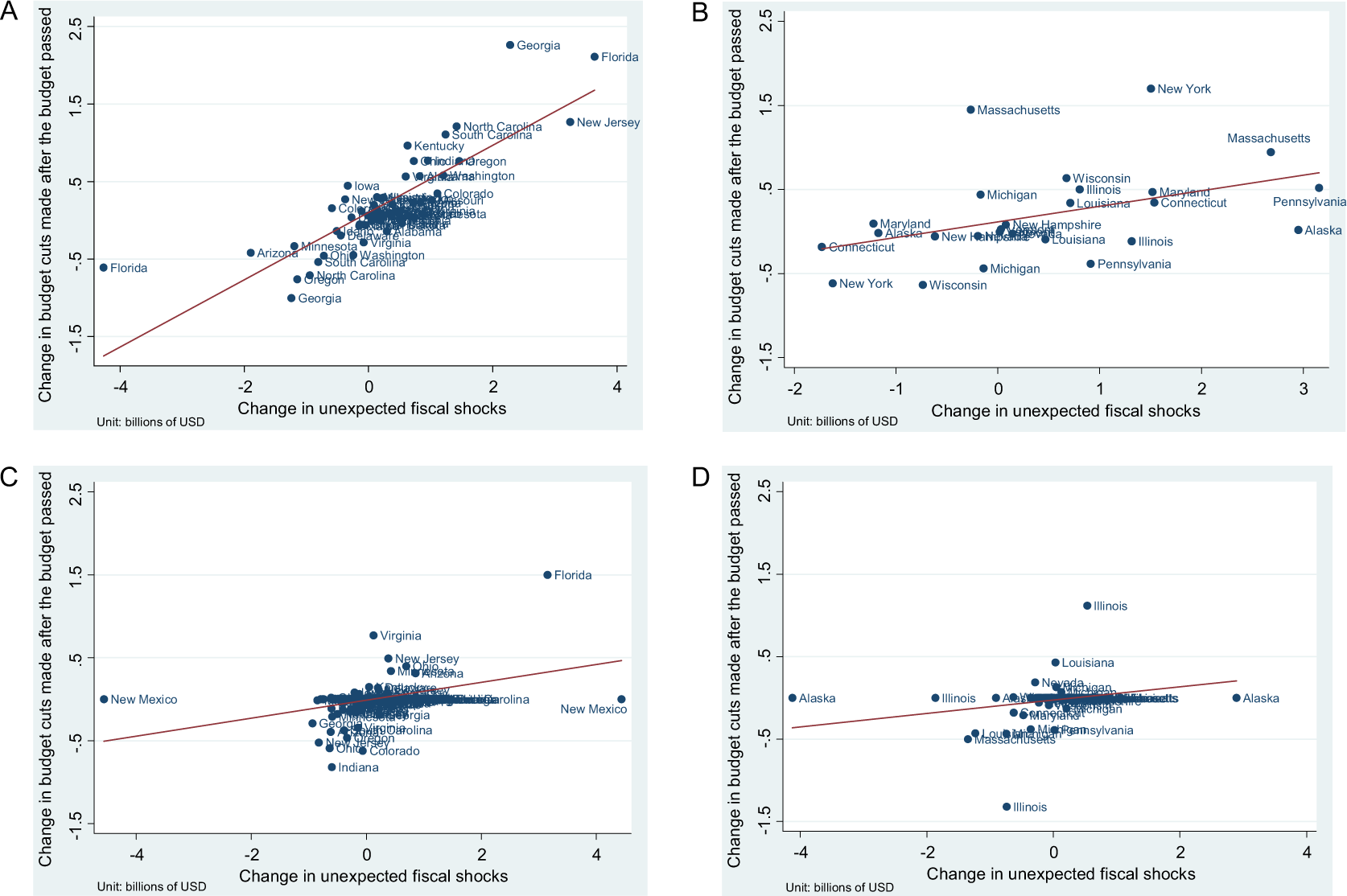
Change in budget cuts versus change in fiscal shocks. A, States with stringent rule (recessions: 2008–10). B, States with lenient rule (recessions: 2008–10). C, States with stringent rule (normal times: 2004–08). D, States with lenient rule (normal times: 2004–08).
As can be seen in table 3 (panel A), the amount by which the budget is cut has a strong positive association with the amount of deficit shock. An increase of 1 billion USD in deficit shock is associated with an approximately 0.3 billion USD increase in budget cuts (column 1), and this estimated coefficient is greater when the state has a more stringent balanced-budget rule (column 2). Concerning whether the requirement depends on political environments, the impact of the requirement is greater in states where a Republican is the governor. As can be seen in column 3 of table 3 (panel A), in such states, an increase in deficit shock is associated with an additional increase in budget cuts during the fiscal year. The party identity of the legislature had no impact on fiscal policy outcome. Columns 5 through 8 of table 3 (panel A) confirm that the main conclusion of columns 1 through 4 is unaffected even when the ACIR (1987) data are replaced with the GAO data.
Table 4 (panel A) tests whether the effect of the rule is different in divided governments. Following Alt and Lowry (1994), two forms of divided government were tested: divided branches, in which one party controls the governorship and another controls the legislature, and divided legislatures, in which different parties control each legislative chamber. The estimated result suggests that the rule becomes significantly less effective in divided branch governments, but not in divided legislatures. This result is slightly different from Alt and Lowry’s (1994) findings, which showed a divided government as less able to react to budget deficits, particularly in divided legislatures. Again, this main result still holds in columns 3 and 4 when the ACIR (1987) data are replaced with the GAO data.
Table 5 (panel A) compares the estimated impact of the balanced-budget rule during the 2008–2010 crisis with its impact during the precrisis period of 2004 to 2008. That is, I tested whether budget rules become more or less binding in times of economic recessions. Columns 1 and 2 of table 5 (panel A) show that budget rules are clearly more binding in times of economic recessions. In fact, the estimated association between the amount of deficit shocks and fiscal policy outcome is moderated by the stringency of state budget rules only in times of recessions, and not in normal times. In column 3, I conducted a Chow test to determine whether the estimated coefficients in columns 1 and 2 were significantly different and discovered that they were. Here again, the use of the GAO measurement of budget rules in columns 4 through 6 did not have significant impacts on overall results in columns 1 through 3.
Results in tables 5 (panel A) are obvious even in the simple scatterplots shown in figure 1. Figure 1 plots the amount of deficit shocks against fiscal policy outcome (the amount of budget cuts) separately for two different groups: states with relatively strict balanced-budget rules and those with relatively lenient rules. States are classified as “stringent states” (the group of states with stringent rules) if the stringency of the rule is equal to or higher than eight in terms of the ACIR (1987) measure of budget rules in table 1. The rest of the states are classified as “lenient states” (the group of states with lenient rules). Figures 1C and 1D show the association between the two variables during normal times, while figures 1A and 1B reflect their association during times of recession. In order to control for the state-invariant omitted variables, both figures plot changes instead of the levels of the two variables. Figure 1 shows that the association between balanced-budget rules and budget cuts made by the states is greater during recessions.
In panel B of tables 3 to 5, I decomposed the amount of deficit shock into two subparts, the expenditure and revenue shocks, to see whether the two different parts have impacts on fiscal policy. The estimated coefficients in panel B of tables 3 and 4 show that the amount of revenue shock has greater impacts on fiscal policy outcome than the amount of expenditure; that is, the positive association between the amount of deficit shock and fiscal policy outcome we observed previously is largely driven by the unexpected revenue shock (e.g., a decrease in tax revenue leads a state government to cut its expenditures). In addition, the result in table 5 (panel B) shows that the relative importance of the unexpected expenditure and revenue shocks may change in normal times and recessions. The finding that governments’ budget cuts are largely in response to a decrease in revenue (e.g., tax revenue) holds only in times of recession.
Conclusion
This study seeks to understand how states response to budget rules and whether the responses depend on the political and economic environments. The first finding of this study is that “balanced-budget rules matter”; that is, the amount of budget cuts is associated with the measured stringency of the states’ budget rules. This study also suggests that the impact of budget rules depends greatly on political environments, especially on the party identity of the executive power. Budget rules are much more binding when the governor is a Republican, but the identity of the party controlling the state legislature did not have a significant impact. Further, the impact of budget rules also depends on whether the government is divided. Budget rules were less binding in divided branch government, in which one party controls the governorship and another controls the legislature, while the impact of the rules was largely unaffected under divided legislatures, in which different parties control each legislative chamber. This finding differs slightly from that of a previous study (Alt and Lowry 1994), which presented evidence that the rule was not effective, especially in divided legislatures. Another finding of this study, which has not been reported anywhere so far, is that balanced-budget rules are much more binding in times of recession than in normal times. In fact, the estimated impact of balanced-budget rules on fiscal policy outcome was not statistically significant when I limited observations to normal times (table 5).
This study also tested whether the estimated results with the two most widely used measures of budget rules stringency, the ACIR (1987) and GAO measures, yield different conclusions. Krol and Svorny (2007) proposed the GAO classification of balanced-budget stringency as an alternative measure and challenged previous studies on budget rules by showing that the finding by Levinson (1998), which used the ACIR (1987) data, is not robust with the GAO data. In this study, however, the main results were largely unaffected by the use of either source as a measure for budget rules stringency.
This study has explored the impact of balanced-budget rules on fiscal policy outcomes in the US states, and tested whether this impact depends on the political and economic environments. The variation in fiscal as well as political institutions across states within the United States provides a valuable opportunity to test the potential interplay between the budget rule and the political situation. Further, the recent experience of the 2008–2010 financial crisis provides a unique opportunity to observe how states adjust their fiscal outcomes as a response to a change in economic situations. In sum, the finding of this study suggests that the impact of fiscal rules such as balanced-budget rules is largely affected by the rules per se, the political institutions, and the economic situations of the states.
Footnotes
Appendix
Declaration of Conflicting Interests
The author(s) declared no potential conflicts of interest with respect to the research, authorship, and/or publication of this article.
Funding
The author(s) received no financial support for the research, authorship, and/or publication of this article.