



Abstract
Micro, Small and Medium Enterprises (MSMEs) contribute significantly to a sustainable society but often face challenges in implementing sustainable technologies due to limited resources and the need for specialized knowledge. During the early design phase, including the needs elicitation process, MSMEs struggle in articulating their real needs, while experts may misunderstand these needs due to inherent biases. This paper proposes a novel framework to reduce biases, enhance accuracy of needs elicitation, and foster better communication and understanding between MSMEs and experts. The framework integrates storytelling, the Five Aggregates Model of Buddhism, Bradshaw's Taxonomy of Needs, and the distinction between needs and wants. Storytelling combined with the Five Aggregates Model reduces biases and articulation difficulties by improving understanding of user's cognitive process of thought and action. Bradshaw's Taxonomy of Needs provides a holistic understanding of needs from the perspectives of both the user and expert (engineer). Differentiating between needs and wants establishes a common understanding and prioritization of needs. A User Needs Elicitation Template is developed to assist in applying the framework. The effectiveness of the framework is demonstrated through the design of agricultural post-harvest drying systems in a developing country. This case illustrates how the framework enables engineers to balance empathy with contextual evaluation. By connecting the Five Aggregates elements with MSME contexts, the framework enhances empathy without compromising technical expertise. Clear characterization of needs and wants ensures accuracy and mutual understanding in prioritization of actual needs and preferred needs (wants).
Keywords
Introduction
Micro, Small and Medium Enterprises (MSMEs) are significant contributors to the global economy, the sustainable development, and the sustainability transition (European Commission, 2022a; Sage, 2023), across all societal segments whether urban, rural, developed or developing countries. In the European Union (EU) and the United States of America (US), small businesses, including MSMEs, represent approximately half of the overall GDP and nearly half of total jobs (European Commission, 2020; U.S. SBA, 2023). In developing countries worldwide, MSMEs provide more than half of the countries’ full-time employment and generate more new jobs than large and mature firms (Ayyagari et al., 2011). However, they are also major contributors to negative environmental impact as they are responsible for about 60% of all greenhouse gas emissions by companies in the EU (European Commission, 2022a), generating an estimated 60% of carbon dioxide emissions, and 70% of overall global industrial pollution (Kasiri et al., 2020). Given these facts, there is an urgent need for MSMEs to actively participate in and engage with sustainability. Despite the urgency and interest in adopting sustainability measures, MSMEs face several challenges in applying sustainability in their operations, with the top three barriers being lack of resources, high initial capital cost, and lack of expertise (Álvarez Jaramillo et al., 2018).
One of the most common actions among small businesses, up to 250 employees, to achieve carbon neutrality is adopting or purchasing new sustainable engineering solutions (European Commission, 2022b). In developing sustainable and innovative solutions, due to their lack of resources and expertise (Álvarez Jaramillo et al., 2018), MSMEs (hereinafter referred to as “users”) must rely on technical assistance (European Commission, 2022a) from skilled and experienced design and development engineers (hereinafter referred to as “engineers”). Engineers bridge technology and society by translating users’ needs and opportunities into tangible solutions (Hyman, 1998), which later influences the lifestyles and socioeconomic patterns of users’ lives and their communities (Norman, 2005). Engineers begin the process by knowing and understanding the users (Pahl et al., 2007), commonly through ethnographic methods such as interviews and observations (Gausepohl et al., 2016; Ulrich, 2019). However, these techniques have drawbacks. For example, interviews may be subject to biases and inaccuracies (Ciavola et al., 2010; Gausepohl, 2012), while observations may overlook significant body language and behaviors (Müller, 2021; Quesenbery & Brooks, 2010). Additionally, both techniques commonly encounter issues such as user difficulties in articulating their needs, which may stem from a lack of acknowledgment of their needs or communication challenges (Gausepohl et al., 2016; Riessman, 1993). Furthermore, in rural areas, particularly in developing countries, design failure often result from a disconnection between engineers and users’ contexts an values (Lee et al., 2022).
Storytelling techniques have been used to improve traditional ethnographic methods in needs elicitation. These techniques have proven effective in helping engineers explore users’ tacit knowledge and contexts of use (Gausepohl et al., 2016). Due to the presence of storytelling across most languages and cultures (Johansson, 2014), both users and engineers require little expertise to listen to or tell stories (Erickson, 1996). Storytelling is also believed to facilitate the bridging of experiences to stored knowledge (Johansson, 2014; Parrish, 2006), which can be used to support engineers in understanding users’ backgrounds and experiences. However, the application of storytelling in design is not without the risk of inaccuracies or distortions of reality (Pahl, 2011) and subjectivity (Erickson, 1996).
The aim of the work herein is to present a novel framework that augments storytelling techniques for needs elicitation by integrating the Five Aggregates Model, Bradshaw’s Taxonomy of Needs (Bradshaw, 1972), and characterization of needs and wants to overcome the risk of biases and inaccuracy. The Five Aggregates Model, a fundamental concept of Buddhist philosophy, offers a structured approach to understanding the mind’s present stream without personal bias (Karunamuni, 2015). Bradshaw’s Taxonomy of Needs aids in identifying additional needs, which are often overlooked by users, such as knowledge gaps regarding regulations (Álvarez Jaramillo et al., 2018) and strategic gaps with other MSMEs (van Hemel, 2001). Finally, the characterization of needs and wants helps in addressing the risk of subjectivity to ensure the accuracy and mutual understanding of users’ actual needs and preferred needs (wants) between users and engineers.
The structure of this paper is as follows: Section “Background” provides an in-depth review of the key concepts and theories applied in this study. Section “Conceptual framework” introduces the conceptual framework, detailing each step and introducing a supporting template for implementation. Section “Demonstration of the conceptual framework” illustrates the framework for defining the user needs of a coffee drying process at a rural agricultural cooperative in a developing country. Finally, Section “Conclusion” presents the results and observations of this study, reflecting on the benefits and implications of the implementation of this framework, and suggests directions for future research.
Background
Engineering design is a process to create a system, part, or process to meet the desired needs and specifications within constraints (ABET, 2022). In most traditional engineering design approaches, desired needs are referred to as necessary things that are lacking (Castelfranchi, 1998). More recently, desired needs have been referred to as needs which contribute to users’ feelings and experiences (Mattelmäki et al., 2014). Both of these desired needs’ approaches are important to the success of the current design. Additionally, in modern society, engineers often seek to mitigate hyper-consumption with a high impact on the environment across designs’ lifecycle by focusing on satisfying the necessary needs (Campbell, 2021b). In designing technology solutions for MSMEs, it is necessary to understand how users recognize needs, both and how engineers can accurately elicit these needs.
This section discussed the prior literature related to the theories and principles underlying this work, including how users’ needs are understood through two processes: needs recognition and needs elicitation. After discussion of the performance and limitations of the current practice, several principles for minimizing the gaps between recognized needs and elicited needs are presented, including storytelling followed by the Five Aggregates Model, Bradshaw’s Taxonomy of Needs, and the distinction of needs and wants.
Understanding Users’ Needs
For product design, the process of understanding users’ needs begins with identifying the users and then interacting with those users to identify their actual needs. The accurate assessment of the needs of users is a crucial factor in the success of product development (Kärkkäinen & Elfvengren, 2002). The precision of needs identification relies on how well clients are aware of their needs and how effectively these needs are articulated and understood by engineers during the needs elicitation process.
Needs Recognition
The needs of users are strongly influenced by the emotional experiences, filtered through cultural and social (De Silva, 2011), and personal values and meanings. To recognize needs, it is also essential to know how users develop their needs (Campbell, 2021a). In the development stage, users can recognize needs through their awareness of, or perception of, dissatisfaction with a situation. At this stage of development, some needs may not be clearly defined or expressible (Shenton, 2007), while others may be felt but not recognized as needs (Castelfranchi, 1998). As needs evolve, the user can more precisely recognize them through physical or mental signals such as pain, difficulty, or disturbance. Additionally, needs can be recognized through beliefs or by using a causal mental model (Castelfranchi, 1998). However, the judgment of each individual may not be accurate, since needs are influenced by one’s own knowledge, rationality, beliefs, and preferences (Castelfranchi, 1998; Gough, 2017).
Due to their nature, needs are often recognized as necessary, or perceived in negative terms or negative emotional experiences; alternatively, they may be recognized through the users’ desires or motivations. Castelfranchi (1998) highlighted that needs recognition can occur through perceptual representation, which contributes to the achievement of the goals. Leitão (2022) suggested to acknowledge users’ needs through their desires or intentions to improve or change the current situation. According to the study of Maslow (1987), people have a hierarchical motivation behind their needs, where they primarily seek to address their fundamental needs first, and only once they attain a certain level of satisfaction with these basic needs, do they progress to the fulfillment of higher-order needs.
Needs Elicitation
Needs elicitation is a process to discover the conscious, unconscious, and subconscious gaps between problems and expectations, or goals and present conditions (Kujala et al., 2001) of the individuals who will interact with the design. These individuals could be users, stakeholders, or customers. Engineers elicit users’ recognized needs by understanding their experiences, behaviors, causes, expectations of changes, and intrinsic motivation (Fukuda, 2016; Pahl et al., 2007). The most accurate means of needs elicitation requires direct interaction with user experiences in the design use environment (Ulrich, 2019). Though, engineers often do not have first-hand access to users’ experiences, they can obtain access through representation of these experiences, for example, by engaging in discussions, writing, doing, and making. Traditionally, in marketing, researchers prioritize direct user statements (what people say and think) obtained through interviews or questionnaires, while in engineering design, engineers often gain insight into user experiences indirectly through observation (what people do and make) (Riessman, 1993; Sanders, 2002).
The interview is a common method in needs elicitation (Gausepohl et al., 2011). Unstructured interviews have the advantage of collecting more exploratory and broader information in the domain (Alvarez & Urla, 2002), while structured interviews can aid in collecting and clarifying specific, more objective and qualitative information (Agarwal & Tanniru, 1990). The success of the interview depends on two main factors: (1) the abilities of the users, and (2) the experiences of the interviewers. Users’ abilities are limited to memorizing, recalling, and expressing or articulating concerns and knowledge related to events in the known and communicative languages of the engineering team (Agarwal & Tanniru, 1990; Ferrari et al., 2016). The experience of the interviewers consists of using appropriate language and questions, understanding the answers in a short period of time, and improvising additional questions during the interviews in order to obtain in-depth information (Bano et al., 2018; Ferrari et al., 2016). Moreover, interviews may be subject to inaccuracy due to irrelevant or biased questioning (Ciavola et al., 2010; Leonard, 1997).
Observation is a key process in human-centered design to obtain a real understanding of the users, their emotions, and experiences in their context of use (Battarbee et al., 2014; Leonard, 1997). During observation, engineers can additionally explore critical information such as usage triggers, technology interaction with the user’s environment, user customization, and intangible design attributes, as well as non-verbally communicated or unarticulated user needs (Leonard, 1997). The performance of observation is limited due to human biological limitations. What we observe can be partially clear, while the rest is unclear (Müller, 2021), and some cues of observation only appear during a short period of time (Leonard, 1997; Sui, 2003), which limits how we observe. As a consequence, successful observation requires a team of multidisciplinary experts to collect the data, which leads to a high cost of the observation activities (Fleischmann et al., 2012; Müller, 2021). In some design cases, for example medical devices, it is difficult or not possible to obtain information about the natural context of use (Gausepohl et al., 2016).
Access to users’ needs through representation of their experiences often introduces a gap between actual needs and those that are described or communicated. According to Shenton (2007), when a need is still in the development stage in the user’s mind, it tends to be vague and mostly inexpressible. Even when the need is in a further evolved stage, clearer and easier to articulate, although users may still struggle to present it with adequate technical details. This may be attributed to language limitations that prevent a full description of the needs, gaps in knowledge, or differing interpretations of mental and sensational signals (Fry, 1992), the emotional experiences of the users, through cultural and social filters (De Silva, 2011), and personal value and meaning (Bardi & Schwartz, 2003; Krippendorff, 2005). Additionally, users may provide inaccurate information due to the Hawthorne effect, where users alter their behaviors when they are aware that they are being observed, or due to social desirability biases (Ciavola et al., 2010; Fleischmann et al., 2012; Müller, 2021). Furthermore, the needs communicated by users can be subjectively distorted when experienced and interpreted by engineers (Fry, 1992; Riessman, 1993). The needs can be filtered through engineers’ ideologies, education and formation, and experiences (Algra & Johnston, 2015; Jagtap, 2019; Prahalad, 2010). Confirmation bias, due to human information processing, can further affect engineers’ judgement, leading to design fixation, failing to respond to design feedback, and overconfidence (Hallihan & Shu, 2013). This distortion could result in misunderstandings of user needs, contributing to non-acceptance of the engineered solutions (Gasparini, 2015; Jagtap, 2019).
Storytelling
Storytelling is one of the oldest communication processes used to pass on information and moral values from one generation to another (Dahlström, 2019; Uittenbogaard, 2013). It is found in most languages and cultures (Johansson, 2014), and is understandable across cultural contexts (Gruen et al., 2002). In general, when people tell a compelling and meaningful story, they not only chronicle the order of relevant events, but also naturally provide or create believable contextual information to explain their behaviors or actions (Alvarez & Urla, 2002). By listening to their stories, the understanding of users’ needs is improved (Uittenbogaard, 2013). Thus, the storytelling technique has the potential to be applied to any population regardless of their background (Erickson, 1996), and to explore users’ experiences (Gausepohl et al., 2011), tacit knowledge, and context of use (Gausepohl et al., 2016). By understanding users’ intrinsic motivation, engineers can improve users’ experiences (Fukuda, 2016).
In a design context, storytelling can be used in two formats: (1) “habitual stories”, where relevant experiences occur in users’ normal environment under typical circumstances and (2) “hypothetical stories”, where users’ expectations of an ideal situation are described (Alvarez & Urla, 2002; Gausepohl et al., 2016; Riessman, 1993). In designing an online curriculum (Tseng et al., 2019), healthcare professionals were asked to tell stories of difficult operations, where they assisted with bleeding and / or blood clotting (habitual stories) and to explain why these stories were relevant to the curriculum design. In software development, metaphoric stories (hypothetical stories) were used to capture the shared sense of frustration of a situation to start the conversation and lead to a discussion of the real problem with stakeholders (Erickson, 1996; Uittenbogaard, 2013). In the Design+Storytelling Framework (Gausepohl, 2012), developed to support the design of healthcare technology, researchers asked stakeholders to tell both habitual and hypothetical stories to elicit their experiences, and design opportunities were then identified from the gaps between these habitual and hypothetical stories. In the Co-constructing Stories method (Buskermolen & Terken, 2016), researchers used fictional stories (hypothetical stories) in sensitizing users to reveal their past experiences and the current usage context, and in envisioning the new design concept to obtain in-depth feedback from users in the early phase of the design process.
Storytelling has proved its benefits in several design activities. It has been used to start the conversation with stakeholders (Erickson, 1996; Uittenbogaard, 2013), and to create a common vision and understanding of the design or project within the design team or with users or investors (Gruen et al., 2002; Peng & Martens, 2020; Uittenbogaard, 2013). The use of storytelling in the design pitch is found to trigger investor empathy and improve concept understanding, leading to better feedback (Peng & Martens, 2020). In needs elicitation, storytelling allows engineers to explore users’ tacit knowledge, scenarios, insightful context of use, and past experiences (Buskermolen & Terken, 2016; Van Der Spuy & Jayakrishnan, 2021; Gausepohl et al., 2016). Storytelling can also improve empathy by enhancing connections with personas in the story with listeners’ own contexts (Peng & Martens, 2020), providing a glimpse of what is important to users (Erickson, 1996). Stories can prevent users from jumping right into the solution discussion and, instead, to focus on defining the problem (Gruen et al., 2002). It can also be used to obtain feedback from users on early conceptual designs (Buskermolen & Terken, 2016).
For all its merits, the application of storytelling has its limitations. Stories connected to past experiences hold the potential for inaccuracies due to “false memory” (Johnson, 2006). This occurs when storytellers infer, omit, or forget certain details in an attempt to construct a coherent and meaningful narrative. During the process of telling, “truths” are relative, continuously subject to negotiation and changes in meaning (Ferneley & Sobreperez, 2009; Wang & Geale, 2015). Similarly, engineers’ perceptions or interpretations of the story can deviate from original content due to disparities or biases rooted in individual knowledge, concepts, experiences, and attitudes (Bourdieu, 1984; McGregor & Holmes, 1999). With a lack of support, such as tools, guidelines, and instructions, design students perceived storytelling as a time-consuming and effort-requiring process.
The Five Aggregates Model
Buddhism is a religion, a system of thought, and a philosophy aimed to understand the unsatisfactoriness (or suffering) and how to get rid of it (Engelhart, 2019). In Buddhist thought, unsatisfactoriness arises from the continuous and interconnected aspects of human experiences, which can be analyzed and understood through various teachings. One of these teachings is the Five Aggregates Model (in
Matter (
Sensation (
Perception (
Mental formation (
Consciousness (
Several characteristics of the Five Aggregates Model are mentioned in literature. Despite its sequential representation (which may be for the purposes of easier memorization (Boisvert, 1995), the Five Aggregates Model has a cyclical nature, where consciousness (
Past researchers have reported the potential of the Five Aggregates Model to be applied in various fields. Anuyahong et al. (2023) reported the possible application in healthcare, psychology, and education. In healthcare, the model can be used to enhance overall well-being for patients by acknowledging the impermanence of the human body and focusing on the present moment. In psychology, the model can be used to improve understanding of the interconnection of thoughts, emotions, and behaviors, by gaining insights into an individual’s pattern of thinking and actions. In education, the model can be integrated into the curricula to foster self-awareness, empathy, and compassion for others. Priaoprasit et al. (2016) developed the Five Aggregates Learning Model for the creation of a critical thinking Buddhist Model, used in designing an educational mobile learning application. The approach consists of five components: (1) Planning of stimulus (
Bradshaw’s Taxonomy of Needs
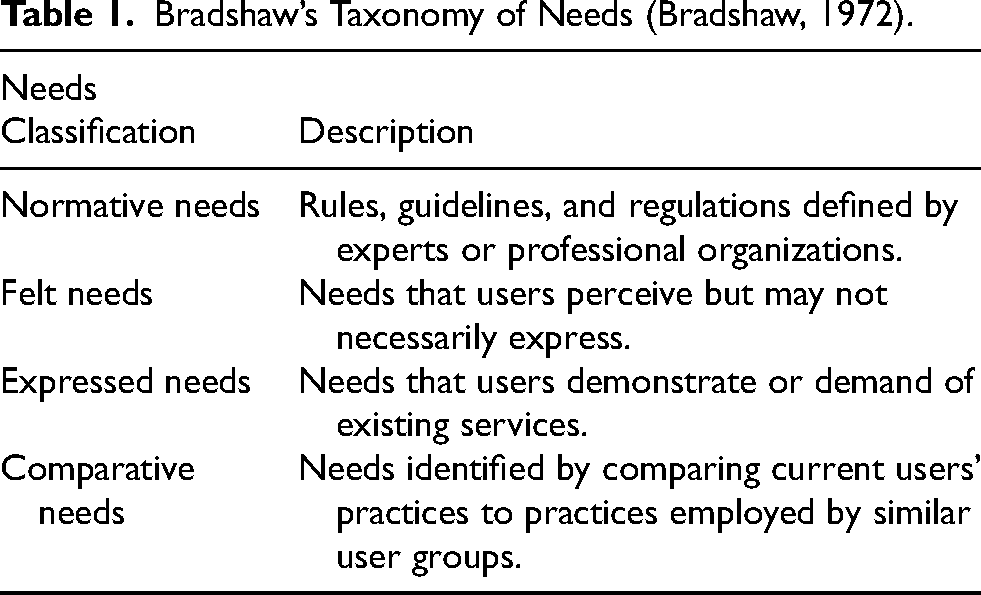
From a sociological perspective, needs are identified based on social service including the recognition of the needs and the way service organizations meet these needs (Bradshaw, 1972). The corresponding taxonomy developed by Bradshaw has been suggested as the most influential and lasting approach in public policy (McGregor et al., 2009). Identifying needs from more than one perspective allows the needs elicitation process to be more genuine (McGregor et al., 2009). In this approach, the permutation of four categories of needs allows policymakers to clarify the variation of needs from various perspectives, thus enabling better decision making to respond to needs. Bradshaw’s Taxonomy of Needs defines four categories as follows: (1) normative needs, (2) felt needs, (3) expressed needs, and (4) comparative needs. Normative needs are defined by experts or professional organizations, and are often cited as one of the indicators to quantify whether the design satisfies the needs (Fry, 1992). This needs category changes with time according to the development of knowledge or values of society. Felt needs are obtained by asking users directly and are usually assumed to be the “real needs”, with a certain level of accuracy due to the limitation of knowledge or the perspective of the users (Carver et al., 2008). It is often found that what people say reflects their perception of needs rather than their real felt experiences of needs (Carver et al., 2008). Also, it is important to note that from a sociological perspective, a felt need is equivalent to a “want” (Bradshaw, 1972). Expressed needs are exhibited by actions that demonstrate the felt needs or that make a demand for existing services (Carver et al., 2008). The last category, comparative needs, reflects the needs identified by comparing available service gaps between population groups that have similar characteristics, based on the assumption that both groups have the same service needs. A summary of the characteristics of needs according to Bradshaw (1972) is presented in Table 1.
Bradshaw’s Taxonomy of Needs (Bradshaw, 1972).
Characterization of Needs and Wants
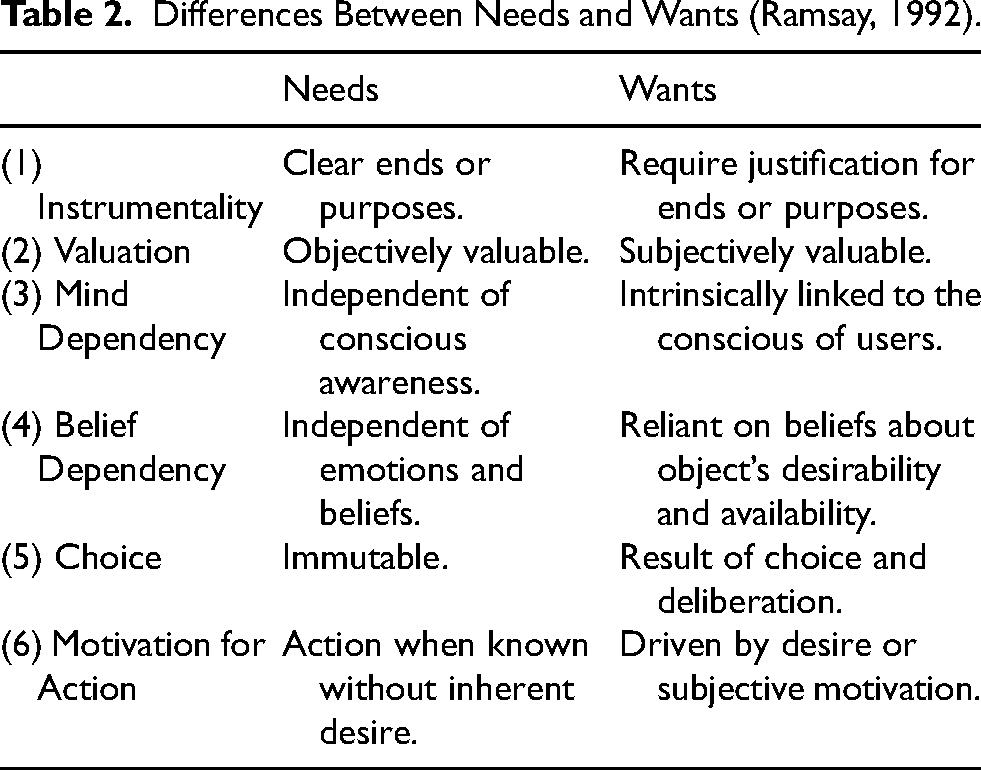
Needs and wants can be confounded due to instinctual reactions and philosophical and theoretical perspectives (Campbell, 2021a; Fry, 1992; Ramsay, 1992). In some disciplines, such as sociology, they may be equivalent (Bradshaw, 1972). They are often communicated as if they are interchangeable (Campbell, 2021a). The intertwining of these concepts can be attributed, in part, to a perception of technology wants and needs where individuals rarely act without technological assistance (Rivers, 2008). Ramsay (1992) elucidates the distinction between needs and wants along six dimensions: Instrumentality, Valuation, Mind Dependency, Belief Dependency, Choice, and Motivation for Action. A summary of this distinction is provided in Table 2.
Differences Between Needs and Wants (Ramsay, 1992).
Campbell (2021a) explained the contrast between needs and wants through the distinction between satisfaction and pleasure. The state of needs can be satisfied by real objects that possess the capacity to provide the satisfaction, while wants involve a “quality of experiences” whereby individuals react to stimuli from an intrinsic property of an object. Wants can be viewed as what people consider to be the most pleasant (Berridge, 2009). An additional distinction is based on the theory of consumption; again according to Campbell (2021a), needs can be expressed with terms such as a requirement, a necessity, or a deficiency. Once these needs are addressed, the expressed terms could be comfort, ease, satisfaction, or utility. On the other hand, associated synonyms of wants are desire, love, attraction, while antonyms include boredom and indifference.
The pursuit of satisfying human wants which are unlimited, and many of which are insatiable, leads to increased resource use and pollution (Bain & Bongiorno, 2022; Campbell, 2021a). In response to the rise of sustainability concerns, an approach is to design products and services that satisfy enough users’ needs, or “satisficing”, without limits on their inspiration and freedom (Sen, 2013). Campbell (2021b) posited that a sustainable future should not focus only on needs, which are imperative for a living, but also on wants, which enough people in a society desire and can afford to purchase.
Conceptual Framework
A conceptual framework is presented below with the aim to improving the understanding of users’ needs by avoiding traditional limitations in needs elicitation, including biases, hidden emotions and motivations, latent needs, and the confusion between needs and wants. Such limitations can lead to misidentifying functions or features of the design technology and reduce users’ emotional engagement while using a product, system, or service. This novel framework integrates the Five Aggregates Model of Buddhism, Storytelling, and Bradshaw’s Taxonomy of Needs, as well as the differentiation between needs and wants. Specifically, this approach augments the storytelling process described by Gausepohl et al. (2016), empowering the engineer to mitigate biases by understanding the flow of mind from a no-self perspective, which is derived from the Five Aggregates Model. To reveal hidden user motivations and increase awareness of existing regulations, which users are usually unaware of (Álvarez Jaramillo et al., 2018), an additional step is developed, inspired by Bradshaw’s Taxonomy of Needs (Bradshaw, 1972). Lastly, considering the sustainable implementation of a technology, differentiation between actual needs and wants is particularly important in resource-constrained developing countries, as it dictates the definition and prioritizes the functions and features to be selected and embodied in the design of technology.
The conceptual framework developed under the research reported herein for needs elicitation to create sustainable technology comprises two primary phases: (1) Storytelling augmented with the Five Aggregates Model and (2) Characterization of user needs. Each phase is discussed in detail in the following sections, with examples of the design of agricultural post-harvest drying processes for MSMEs operating in developing countries. An illustrative diagram of the proposed framework is presented in Figure 1.

Conceptual framework for enhancing the needs elicitation process.
Storytelling Augmented with the Five Aggregates Model
Storytelling has been successfully used in product design and development, enabling users to share experiences in their familiar language, aiding engineers to explore how users perceive their experiences, while identifying potential design opportunities, and fostering empathy toward users by better understanding their context. Moreover, its cross-cultural applicability, regardless of the background of the teller or listener, makes it an effective tool for overcoming cultural differences between engineers and users. This is particularly relevant for MSMEs in developing countries, where external expert support is often required. While aligned with the framework proposed by Gausepohl et al. (2016), storytelling in this context is augmented with the principles of the Five Aggregates Model. This first phase under the conceptual framework for improved needs elicitation consists of three steps (Figure 2): (1) Creating an inventory of a user’s raw needs, (2) Telling stories relevant to each raw need, and (3) Clarifying each user story using the Five Aggregates Model. Prior to the initial storytelling session, it is essential for engineers to establish a relationship with users, fostering an atmosphere in which they sense genuine care and the freedom to express their stories in detail (Connelly & Clandinin, 1990). Storytelling should be conducted in a neutral environment that avoids the generation of negative, fearful, or distrustful feelings of the technology users (Gausepohl, 2012).

Phase 1: Storytelling augmented with the five aggregates model.
The first step, Creating An Inventory Of A User’s Raw Needs, can be started by asking users to enumerate their needs. These untreated user needs are defined as “raw needs” which can be broad thematic needs (e.g., efficient drying techniques, resource optimization, product quality, sustainability practices, and regulatory compliance) or technology needs (e.g., drying technology using renewable energy) and should span across different phases of the design’s lifecycle. At this step, both needs and wants are considered and treated equally, without distinction. This first step aims to elicit high-quantity, rather than high-quality, raw needs to better explore user needs and wants as broadly as possible across the design’s lifecycle. Thus, the aim is not to be specific to particular raw needs early on. When creating an inventory of raw needs, users may also record the names or keywords of relevant events or situations to remind themselves of specific or relevant details.
In the second step, Telling Stories Relevant To Each Raw Need, users are prompted to provide additional details for the raw needs identified in the first step. Storytelling helps elicit user experiences, tacit knowledge, and context of use in product design and development (Buskermolen & Terken, 2016; Gausepohl et al., 2016; Van Der Spuy & Jayakrishnan, 2021). Both habitual and hypothetical story formats are used to cover various stages of the design’s lifecycle. Users will be required to recall and share past situations, experiences, and feelings from their memory, as well as detailed descriptions of ongoing situations (habitual stories). They will also be asked to envision expected outcomes and possible experiences, focusing on the end states rather than the implementation methods (hypothetical stories). The latter stories are useful in identifying new potential needs across the solution’s lifecycle, as once the expected solution is introduced, it could create new additional needs (Rivers, 2008), such as during production, maintenance, or end-of-life. By considering all phases of the design’s lifecycle, engineers can identify both immediate and longer-term user needs, contributing to a more sustainable design strategy. The gaps between future-oriented stories and past and present stories can be used to identify design opportunities (Gausepohl, 2012). Once a user concludes the story for a particular need, engineers will proceed to collect stories from the user for the remaining raw needs. As the meaning of a story is obtained from the links between discrete items and the plot of the story (Gubrium, 1998), it is important to maintain a seamless linkage of narrative flow to best capture the development of user thoughts and emotions.
In the third step, Clarifying each user story using the Five Aggregates Model, engineers use each aggregate to enrich their understanding of seamless links of the narrative flow across discrete events, throughout a design’s lifecycle. As discussed in Section “Storytelling”, storytelling can introduce limitations such as users’ “false memory”, and biases introduced by engineers, leading to a detailed story with subjective “truths” rather than objective “facts”. The Five Aggregates Model, originally employed to objectively explore the present stream of the mind from a first-person perspective for self-reflection and self-understanding (Davis & Thompson, 2013; Karunamuni, 2015), helps address these limitations. The approach takes into account the complex interplay of sensory data, consciousness (e.g., thoughts and values), emotional responses, and past experiences in relation to each category of needs. This approach not only leads to a deeper recognition of user needs, but also fosters a mutual sense of understanding of truths and responsibility between engineers and users (Anuyahong et al., 2023). The application of the Five Aggregates Model herein is mainly informed by Boisvert (1995) and further enriched through practical insights from dialogues with several Buddhist monks. A detailed exposition of each model component is provided in Section “The five aggregates model”.
The first component of the Five Aggregates Model, matter (
The second component, sensation (
The third component, perception (
The fourth component, mental formation (
The fifth component, consciousness (
It is vital to acknowledge the cyclical, interdependent, and non-linear nature of the Five Aggregates Model. Each aggregate can appear in a narrative in any order, alongside with one or more other aggregates. Additionally, it is essential to note that the aggregates may not always manifest simultaneously (Gethin, 1986). In some narratives, one or more aggregates might be absent. The absence of a component in a story does not denote its non-existence, but rather it is an indication that the particular component may not be significant to the user at that time (Boisvert, 1995).
To demonstrate the third step, Clarifying Each User Story Using The Five Aggregates Model, a story of experiences with an agricultural drying process is considered. Such a story might be told as follows (the passage below is created from a generative artificial intelligence chatbot (OpenAI, 2023); words in brackets are added):
Passage
“With the overcrowded drying beds [matter] becoming a regular occurrence [consciousness], our equipment was under constant stress . The drying beds and racks were not designed to handle such loads [consciousness], and they were showing signs of wear and tear. This put an additional burden on our maintenance team and budget [sensation]. The inefficiency in space utilization [perception] meant that we had to constantly rearrange and repair our equipment [mental formation]. This not only delayed the drying process but also increased our operational costs. It was clear that if we didn’t address the issue of limited drying space [mental formation], we would continue to put stress on our equipment and risk frequent breakdowns [perception].”
In the above case, from a traditional engineering design perspective, the focus might be on enhancing the durability and reliability of the equipment. However, by integrating the Five Aggregates Model, focusing on the related underlying sentiments and cognitive processes, engineers can deepen their understanding of user experiences, the decision-making process, and actions taken. Taking into account the situation of regular overcrowded drying beds, the Five Aggregates Model would focus on analyzing the relevant cognitive factors such as sensation, perception, and consciousness, contributing to why repetitive decisions and actions persist, despite awareness of potential inefficiencies. Consequently, this approach facilitates a design process to recognize not only functional needs, but also the psychological and emotional needs of the user. It should be noted that the user responses may not be specific to each aggregate individually, but rather provide more details that relate to several of the aggregates. In this case, further clarifying questions may be needed. It is also important to acknowledge that identifying user story segment according to each of the five aggregates may not yield absolute answers. The primary objective of using the Five Aggregates Model is to comprehend the relevant cognitive factors and their interrelationships. Therefore, engineers should prioritize understanding how each element interacts with the others and their impacts on users, rather than the correctness of identified identifying user story segment according to each of the five aggregates.
Storytelling effectively bridges the communication between users and engineers by surfacing tacit knowledge and contextual usages of the technology. Incorporating the Five Aggregates Model further augments the capacity of the engineer to objectively acknowledge the tangible realities, experiences, and relevant emotions of users. That being said, the user narrative incorporating the Five Aggregates Model, while providing a detailed context of the problem, tends to be subjective, primarily reflecting the user’s perspective, and often lacks specific technical information. To mitigate this effect, in the following phase, this study will focus on defining more holistic structured technical needs.
Characterization of User Needs
The second phase of the framework developed in this research, the “Characterization of User Needs”, aims to delve into the holistic understanding and the nature of each user need obtained from the first phase. To achieve a holistic understanding, it becomes imperative to discern latent needs that might be obvious to engineers, but remain obscured to users. Consequently, this phase applies Bradshaw’s Taxonomy of Needs (Bradshaw, 1972), originally used in sociology adapted to engineering design, for clarifying the variation of needs from different perspectives. To understand the nature of needs, it is also crucial to draw clear boundaries between needs and wants, enabling engineers to establish a clear understanding with users about which elicited needs are imperative and which are optional. This phase is segmented into three steps (Figure 3): (1) Classification of Needs, (2) Generation of Needs Statements, and (3) Categorization of Needs and Wants.

Phase 2: Characterization of user needs.
The first step of this phase, Classification of Needs, aims to identify needs based on Bradshaw’s Taxonomy of Needs (Bradshaw, 1972), comprising normative needs, felt needs, expressed needs, and comparative needs. The process of identifying needs from multiple perspectives has been reported to enhance the authenticity of the elicited needs (McGregor et al., 2009). In the context of engineering design, this taxonomy can enhance the understanding of user needs by not solely relying on engineers’ technical expertise (normative needs) and their experiences with different user groups, solutions, or systems (comparative needs), but also incorporates user experiences and feelings (felt needs) and the direct translation of user needs into actions or solutions (expressed needs).
The user narratives elaborated in the preceding phase provide information under two categories: felt needs and expressed needs. Felt needs capture the intrinsic needs that users perceive and communicate. To illustrate, within the context of the agricultural drying process, felt needs could be protecting the harvested crops from unexpected rain during the drying process. It is important to note that in the original work of Bradshaw (1972), felt needs often refers to “real needs”. In contrast, expressed needs are manifestations of these felt needs into available actionable objectives or realizations. In this study, conceptual solutions awaiting physical realization or tangible actions in progress are classified in this category. For example, users may express the demand for weather-resistant shields for products, thus converting the intrinsic desire for protection against rain into a tangible solution.
Supplementary to the felt needs and expressed needs are normative needs and comparative needs. Normative needs refer to directives and standards prescribed by experts or professional organizations. In this study, normative needs could be specific directives which might require parameters such as upper thresholds for moisture content in dried products, or guidelines endorsing environmentally friendly drying methodologies. Simultaneously, comparative needs can be developed by engineers by extrapolating needs based on their cumulative experiences with other users exhibiting similar characteristics. Identifying these needs facilitates a comparison between MSMEs and leading organizations (e.g., those who may be renowned for their superior coffee quality). As such, comparative needs might emphasize rigorous quality control measures; for instance, system requirements for smaller coffee producers could be inspired by the sorting and inspection protocols used by top-tier coffee producers. Both normative needs and comparative needs enhance holistic nature of needs elicitation by ensuring that evaluated needs align with objective, measurable criteria, which may not be immediately apparent from the user’s perspective. They also help uncover additional needs that may exist beyond the user’s immediate experiences. The consideration of these additional needs could lead to solutions that are both practical and sustainable.
Once the Needs Classification step is complete, it is advisable to ensure alignment between engineers and users. Engineers should actively engage in dialogues with users to iterate on the formulated needs’ stories. Given the additional insights of normative needs and comparative needs, these stories might require adjustment with additional information. Such a collaborative endeavor guarantees that both parties understand the identified needs and that they cover all aspects of the collective needs.
Proceeding onto the next step, Generation of Needs Statements aims to formulate needs statements by combining users’ insights identified in the first phase, Storytelling Augmented with the Five Aggregates Model, and the additional insights elaborated in the Classification of Needs step, into a readily accessible format for engineers. Statement formulation is derived from a user story template, frequently used in agile software development, which encompasses three components (Lucassen et al., 2016): “As a <who>, I need <what> so that <why>.”
In this structure, the who component refers to the user narrating their needs. The what component refers to a specific need or desire and naturally aligns with the information classified in the Five Aggregates Model under matter ( “As a <who: user>, I need <what: matter> so that <why: sensation, perception, mental formation, consciousness>.”
The components of the Five Aggregates Model can support engineers in defining the elements of needs statements. The inclusion of information from sensations, perceptions, mental formations, and consciousness enriches the context of each need, providing information about users’ emotions and motivations, which is crucial to the success of the design.
The following step, Categorization of Needs and Wants, seeks to elucidate the distinction of needs and wants, establishing a clear and common understanding between engineers and users about the nature of users’ needs and expectations. Up to this point, all the elicited needs have been considered as needs. In this step, the elicited needs are analyzed to determine which are actual needs and which are wants. This distinction is crucial to the success of the design as needs are imperative to embody in the design whereas wants are considered optional and flexible.
Needs signify the core, non-negotiable functions that a design must fulfill by real properties of the solutions, often through their degree and kind of utility (Campbell, 2021a; Ramsay, 1992). They are typically described objectively. In contrast, wants refer to optional features or functionalities. Although they may improve user satisfaction or system performance, by providing insights that can support the concept generation process, as well as the search for stimuli that can trigger users’ pleasure responses when engaging with the design (Campbell, 2021a), wants are driven by personal preferences and are not strictly necessary for the fundamental operation of the design. It is crucial to treat wants wisely. When addressing wants, engineers may have to identify users’ relevant needs or motivations behind wants, to ensure that wants are contextualized with an objective view. In the context of agricultural product drying processes, protecting dried cherries against sudden rain is a need, which is critical to the preservation of coffee quality. However, the desire for a specific technology or mechanism to shield dried products can be classified as a want, considering that it is derived from subjective preferences and is not essential for the core function.
Based on the results of the Generation of Needs Statements step, needs can be identified by analyzing the what:matter component, which is usually a concrete requirement, and the why:consciousness component, which reflects critical awareness or knowledge relevant to current and expected changes. Additionally, some elements of the why:sensation, why:perception, why:mental formation components can be identified as needs if they have a significant impact on user decision making or the cognitive process. In contrast, wants can be most often identified from why:mental formation as it is more likely to involve user preferences or features relevant to aesthetics and convenience, as well as elements associated with the non-critical why:sensation, why:perception components.
User Needs Elicitation Template
To enhance the application of the conceptual framework described above, a User Needs Elicitation Template has been created (Figure 4). This template is designed to support the process of capturing and analyzing the multifaceted raw needs of users, incorporating all elements from the Five Aggregates Model, Bradshaw’s Taxonomy of Needs, and the differentiation between needs and wants.
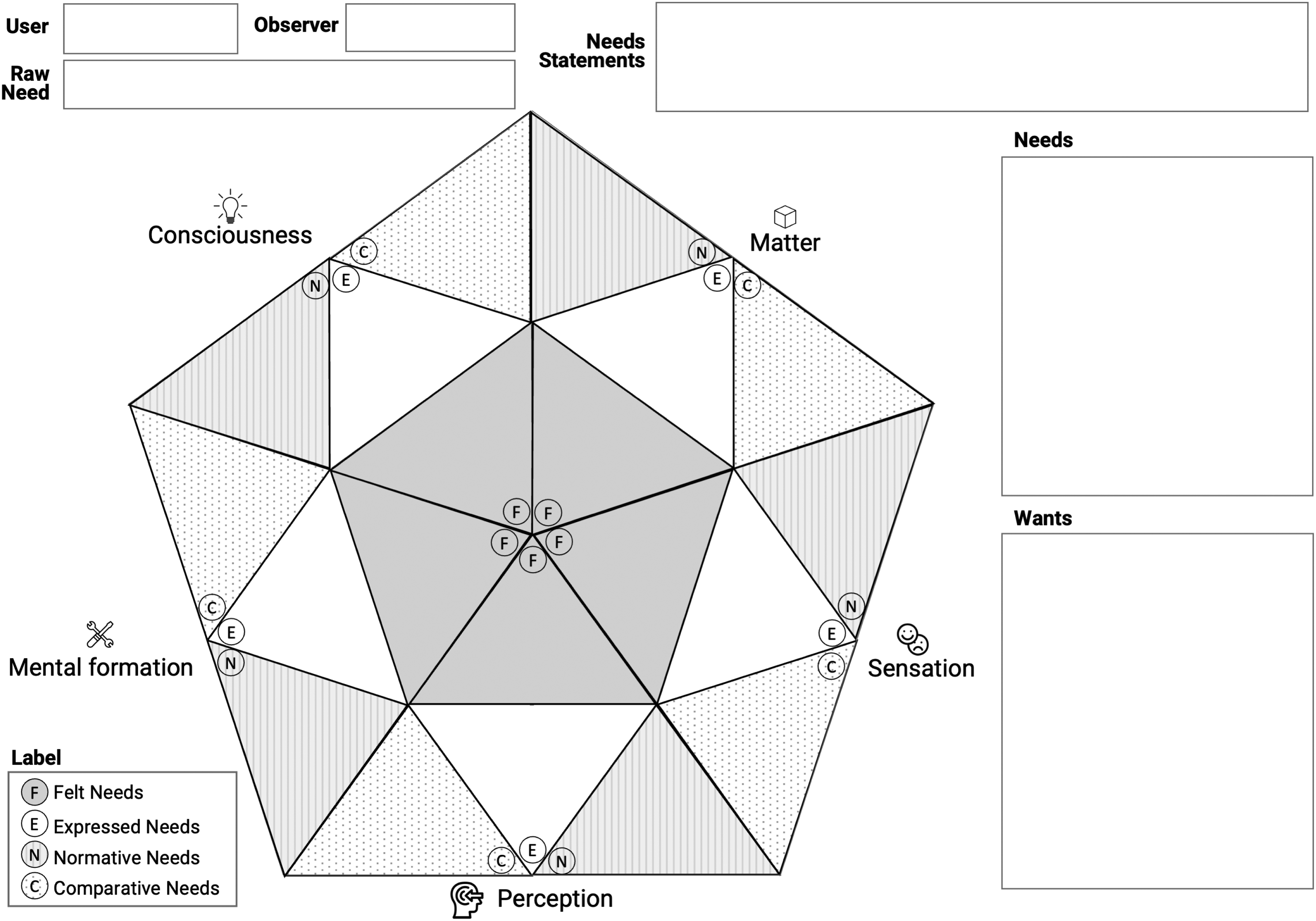
The user needs elicitation template.
The template is structured around the Five Aggregates Model by segmenting the central fields into five distinct sections: matter, sensation, perception, mental formation, and consciousness. Despite their clockwise arrangement, it is important to note that there is no prescribed sequence in which to complete them. Engineers are encouraged to approach these sections non-linearly, in order to benefit from the dynamic nature of the cognitive process. The arrangement of the consciousness component next to the matter component represents the cyclical nature of the Five Aggregates Model, where each aggregate influences the others continuously. Each of the sections consists of four need elements aligned with Bradshaw’s Taxonomy of Needs.
The template can facilitate needs elicitation activities where engineers and users are able to work together to identify, define, and classify various levels of needs and wants. The use of the template begins by providing a brief description of the specific raw needs under consideration in the Raw Need field. The needs elicitation process then proceeds as follows:
This template can be used after completing Storytelling Augmented with the Five Aggregates Model (Phase 1). By employing this template, engineers and users are equipped to navigate the complexities of user experiences, transforming information about raw needs into rational and emotional insights that drive accurate and successful user-centered design solutions. Needs, which are objective-based and independent of emotions and beliefs, can support engineers in accurately defining technical system functionalities, which are also objective-based and solution-independent (Goodwin, 1987; Ulrich, 2019). Wants, which are preference-based, could support the evaluation of users’ experiences and their relevant emotions when owning or using technologies. The linkage of technologies with users’ lives on an emotional level is crucial as it encourages users to repeatedly engage with and utilize the technology (Dandavate et al., 1996; Mattelmäki et al., 2014). Exploring the users’ cognitive process (using the Five Aggregates Model) related to their situations or experiences helps highlight sequences of events and their causality, which can help engineers improve empathy with users early in the technology development process, thus increasing the likelihood of success of the engineered solution (Dandavate et al., 1996).
Demonstration of the Conceptual Framework
The conceptual framework presented above is demonstrated for needs elicitation in designing sustainable engineering solutions for MSMEs, where users lack resources and require support from external experts. In this demonstration, the case of a coffee cooperative in Kenya is chosen. As the authors do not have direct contact with users, information for a Kenyan coffee cooperative available on the Internet has been used to simulate user narratives using a large language model (LLM) (OpenAI, 2023).
User Simulation
Schmidt et al. (2024) suggested using an LLM to support the assessment of needs by creating an “actively interrogate” persona. In this demonstration, ChatGPT 4.0 (OpenAI, 2023) is used to simulate user responses, including user needs and user narratives. This simulation procedure follows the guidelines to improve prompt effectiveness (White et al., 2023), and the use of prompts in the generation of clinical vignettes (Benoit, 2023). The simulation procedure commences by inputting the background story into the system, followed by a series of prompts to generate the needs, related experiences, and their relevant narratives. To generate related experiences, the second prompt used the word “symptoms” as it generated the best events or situations corresponding to what needs to be improved or optimized. The series of prompts used in this demonstration are as follows:
I would like you to imagine that you are a {User}. In your own words, state 10 different needs in your {Process}. Give 10 symptoms associated with the {Need} during the {Process}. Using the above list, in your own words, generate five story vignettes of your experiences associated with the {Need} during the {Process}. Each story should contain one to all of the experiences.
After inputting the first prompt, ChatGPT generated ten user needs. The prompt was repeated until no new substantial responses were produced; ten recurring needs that were consistently generated were collected for further processing. In the next step, the program was asked to generate experiences (symptoms) for each need. Similar to the earlier step, the procedure for generating experiences was repeated until no new substantial responses were produced. Then, ten experiences were collected for each need and used to generate vignettes. These steps were introduced to improve the consistency of narrative generation. After inputting the last prompt, five vignettes were obtained. The vignette that resonated the most with reality was selected. This series of prompts can be repeated to generate user stories or narratives representing various stakeholders.
Case Study: Enhancing the Coffee Drying Process
Background story
This case study simulates experiences of the coffee drying process at a Kenyan coffee cooperative based on information appearing on the internet (Dropcoffee, 2023; Nanetti, 2023; Red Fox Coffee Merchants, 2023). The cooperative consists primarily of smallholders, each managing less than five acres (Feran, 2021) or approximately 100 coffee trees (Dropcoffee, 2023).
Kenyan coffee is well known for being “double washed” or “double fermented”, also known as “Kenyan processing”. Recently, the term “double” is used to refer to two distinct fermentation steps, without specifying the detailed processes (Nanetti, 2023). During the harvest, which begins in early November and spans two months, coffee farmers transport an average of 25–50 kilograms of coffee cherries over several kilometers daily, either on foot or by bike, to the cooperative wash station (Dropcoffee, 2023). At this station, farmers first hand-sort their cherries. The freshly delivered coffee cherries are depulped and then undergo dry fermentation or pre-fermentation for 12–24 hours, followed by a first washing. Next, the workers proceed through conventional wet processes, including second fermentation and final washing. This step was added due to limited drying space (Nanetti, 2023). Although this additional step accentuates the unique acidic and cleaner taste of coffee beans, it increases the time, cost, and labor required. After the final washing, the drying phase is executed on raised beds for a period of 12–20 days. During the drying period, the coffee beans are periodically covered with plastic sheets in the afternoon to prevent them from over drying. A schematic of the process is shown in Figure 5.

Flow diagram of double washed coffee processing.
The cooperative is strategically located within an electricity utility’s service zone, thus it has a consistent energy supply. During peak harvest periods, the cooperative faces several difficulties, particularly the insufficiency of drying space and the absence of a systematic approach to manage coffee drying processes. In addition, in recent years, Kenyan coffee production has faced irregular weather conditions and soil degradation due to climate change (Dropcoffee, 2023). The cooperative is considering modernizing their operations to raise the quality of the product with an emphasis on equitable compensation for members, mitigation of their environmental footprint, and improvement of their resilience to climate change.
Phase 1: Storytelling Augmented with the Five Aggregates Model
After inputting the background story and the first prompt detailed in Section “User simulation” for the user (a coffee cooperative manager), the raw needs generated for the coffee drying process were: (1) Expanded Drying Space, (2) Systematic Workflow, (3) Training Programs, (4) Quality Control Systems, (5) Labor Efficiency, (6) Innovative Drying Techniques, (7) Wastewater Management, (8) Resource Optimization, (9) Renewable Energy Integration, and (10) Regulatory Compliance. After inputting the two remaining prompts, five user vignettes were generated and one of them was selected as most representative of the real-life situation. The user narrative elements were then tagged with the relevant components of the Five Aggregates Model. An example of the tagged user story for the need “Expanded Drying Space” is as follows:
User Story 1 with Five Aggregates Model Tagging
“During one of our peak harvest mornings, I noticed that the drying beds were so packed that the beans were almost overlapping each other (matter). Trying to fit all of the beans from each farmer’s yield (perception), our workers had no choice but to place the beans closer than ideal (mental formation). This caused an inconsistency in drying (consciousness). Some beans, especially those near the edges, appeared drier than those in the center. The dense placement (matter) inevitably extended the drying time for some patches (perception). To make things worse (sensation), our workers had to shuffle between beds to find even a tiny available space (mental formation), slowing down the entire process (perception). I saw frustration on many of our farmers’ faces (sensation) as they waited longer to have their beans accommodated. In an attempt to speed up drying (perception) one afternoon, some of our workers prematurely removed the beans to accommodate the new yield (mental formation). Unfortunately, this led to beans that were not dried adequately. The hurried removal led to some beans getting damaged or even discarded accidentally (consciousness). I saw a worker visibly stressed (sensation), trying to sort out the good beans from the damaged ones - an unplanned task that increased our labor hours for the day (perception). This not only compromised the quality of the beans but also meant potential lost revenue from the damaged beans (consciousness).”
In this user story, two complex mental formation statements relevant to solution designs are “our workers had no choice but to place the beans closer than ideal” and “some of our workers prematurely removed the beans to accommodate the new yield”. Both of these need further clarification, as mental formation encompasses hidden emotions, values, motivations, and cognitive processes that drive users’ behavior in response to the peak harvest situation. Once the mental formation details of all needs are elaborated, the user narratives can be refined and continued in Phase 2, Characterization of User Needs.
It is important to emphasize that there is no absolute right or wrong approach in tagging components of the Five Aggregates. Each tagging choice is valid within its own context. The flexibility in how these components are tagged is not a flaw but a strength, allowing for multiple interpretations that reflect the complex nature of human cognition and behavior. Engineers can leverage this adaptability to explore and uncover hidden layers or insights of user experiences, rather than aiming for perfect correctness in tagging.
Phase 2: Characterization of User Needs
Phase 2 begins with extracting the insights from the user stories. The User Needs Elicitation Template can be used to facilitate this process. Felt needs are entered first for each corresponding aggregate as these needs are the clearest, as communicated by the users, followed by expressed needs, normative needs and comparative needs, the latter two of which are defined based on engineers’ expertise. The example of Needs Classification for the raw need “Expanded Drying Space” is presented in Table 3, using the tagged User Story 1, above.
Needs Classification for the Raw Need “Expanded Drying Space”.
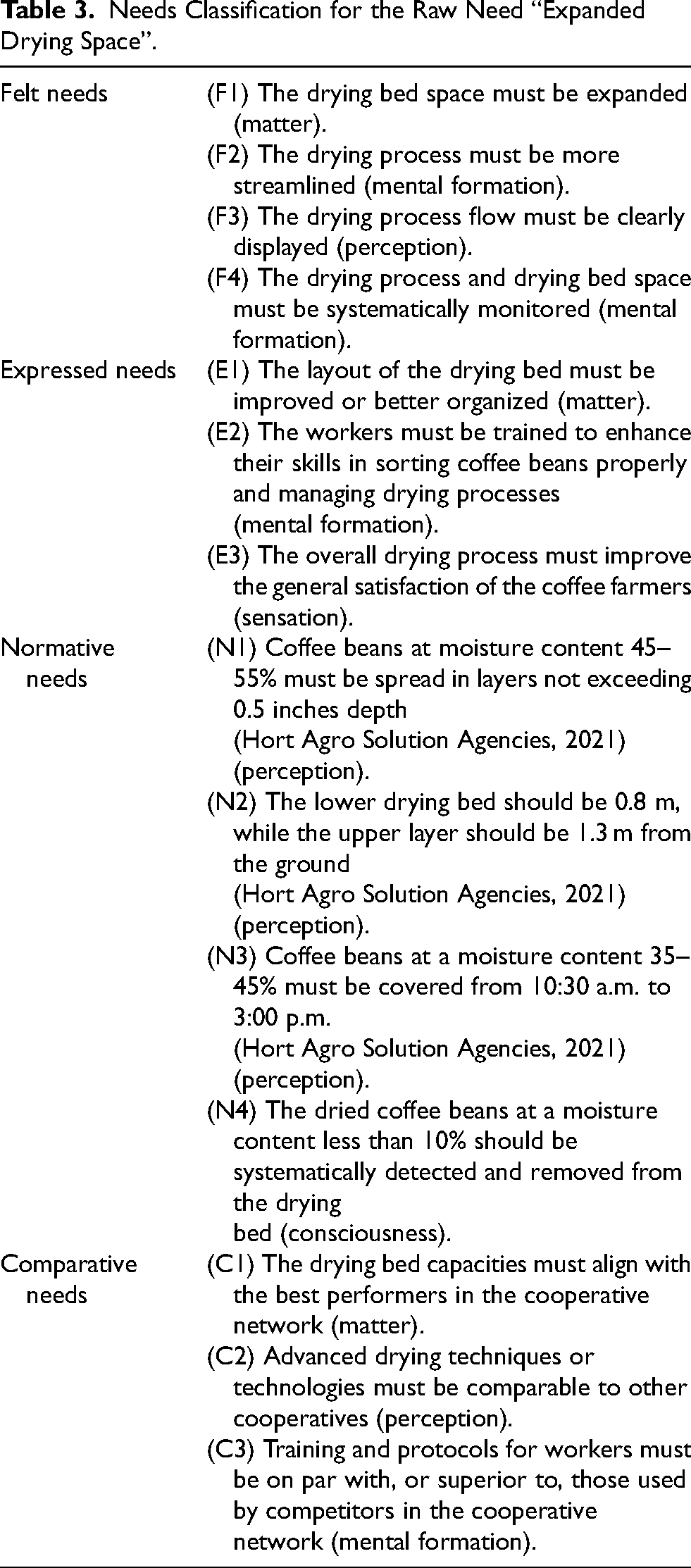
Once the relevant information according to Bradshaw’s Taxonomy of Needs is entered, the users and engineers can proceed to the following step: Generation of Needs Statements. The needs statements are generated based on information from both User Story 1 and Table 3. The what component is derived from information classified under matter incorporating its final desired state or transition process to the desired state. The why component is derived from information classified under the remaining components of the Five Aggregates Model, which is relevant to the specific matter. Examples of needs statements using the components of the Five Aggregates Model are as follows:
Need Statement 1
“As a manager <who>, I need to monitor and optimize drying bed space <what:matter>, so that I can reduce time and effort of workers to locate and place coffee beans <why:mental formation>, reduce workers’ stress during operation <why:sensation>, decrease waiting times for coffee farmers <why:sensation>, and ensure consistent drying of coffee beans <why:consciousness>.”
Need Statement 2
“As a manager <who>, I need to monitor the coffee bean drying process <what>, so that I can prevent inconsistency in drying results <why:consciousness>, avoid prematurely removal of beans <why:mental formation>, ensure compliance with regulations or recommendations <why:perception>, and ensure workers know when to turn the beans <why:mental formation>.”
Need Statement 3
“As a manager <who>, I need to streamline the drying process <what>, so that I can ensure that coffee beans dry uniformly within the optimal time <why:consciousness>, and meet our production quality targets consistently <why:consciousness>.”
In the last phase, Categorization of Needs and Wants, the distinction between needs and wants aims to create a clear and common understanding between engineers and users about the users’ needs and expectations. Based on the three needs statements above, needs, which are non-negotiable and significantly relevant to the survival of the cooperative, can be grouped into needs categories such as drying bed space and drying process, both of which require systematic monitoring and optimization in order to obtain insights about the current drying situation and how to respond. Without efficient space and drying process management, the cooperative faces a challenge in maintaining consistent quality and remaining competitive in the market. In contrast, wants are optional and often relate to personal preferences or specific to technology solutions, for example, the desire to have the drying process flow displayed clearly. The motivation behind this want is to help workers understand and follow the drying process better. However, using a display to achieve this objective is one of the possible solutions. The needs and wants classification are presented in Table 4.
Classification of Needs and Wants Extracted from the Raw Need “Expanded Drying Space”.
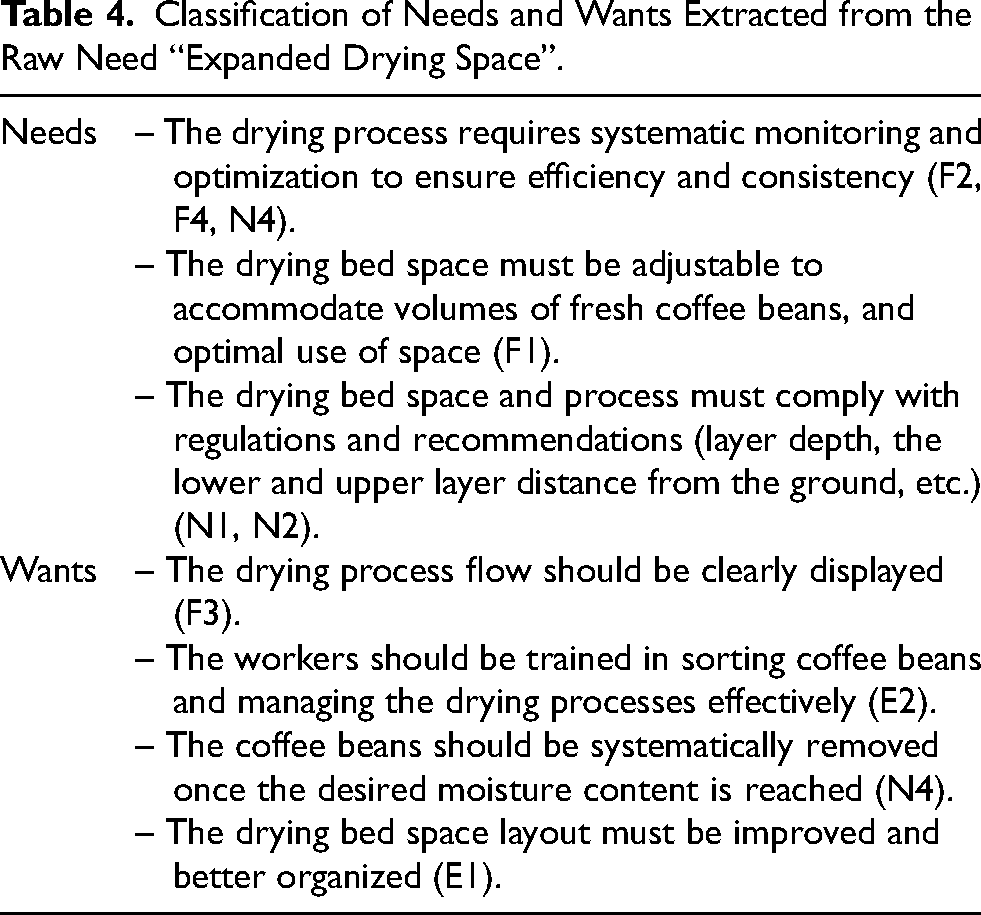
Figure 6 illustrates the application of the User Needs Elicitation Template for the raw need “Expanded Drying Space”. It includes the placement of the raw need, example needs following the Five Aggregates Model and Bradshaw’s Taxonomy of Needs, and the classification of needs and wants.

Application of user needs elicitation template for the raw need “expanded drying space” (The codes on the sticky notes are derived from the classification of needs provided in Table 3).
Conclusion
MSMEs play a crucial role in the success of sustainable development (Sage, 2023), due to their seamless integration into the fabric of society. However, their small size often limits their capacity to participate meaningfully in sustainability initiatives as an individual organization. A key barrier is the lack of expertise in implementing sustainable solutions (Álvarez Jaramillo et al., 2018), forcing them to rely on external engineers. When supporting MSMEs in designing a sustainable energy solution, external experts or engineers often struggle to accurately understand the nuances of MSMEs’ needs, due to contrasting cultural and professional backgrounds, leading to misidentified functions and features for their design solutions.
This research develops a novel framework to address common limitations of needs elicitation processes including difficulties in articulating user needs, and bias and inaccuracy. The framework augments the performance of the traditional storytelling method by integrating the Five Aggregates Model of Buddhism, Bradshaw’s Taxonomy of Needs, and the distinction between needs and wants. Storytelling, which is familiar with most individuals across cultures, helps uncover latent needs information while mitigating biases. The application of the Five Aggregates Model enhances user understanding by clarifying the user’s cognitive process of thought and action, and also deepens connections between engineers and users by acknowledging the psychological and emotional aspects of user needs. The integration of Bradshaw’s Taxonomy of Needs provides a holistic understanding of needs from the perspectives of both users and engineers. Finally, the distinction of needs and wants is applied to prioritize elicited needs that are imperative to be included in the design and those that are optional. Collectively, these three key elements of the framework provide an innovative and effective method to support the translation of users’ needs into engineering requirements, establishing a clear boundary between the problem domain and the solution domain, where needs are used in defining stakeholder requirements in the problem domain (to state what the design has to achieve without reference to any specific solution) and wants are used in defining system requirements in the solution domain (to state how the design will meet the stakeholder requirements). The framework is complemented by a User Needs Elicitation Template, which assists engineers in identifying, defining, and classifying user needs and wants. This tool also aids in fostering communication and creating a mutual understanding between users and engineers.
The conceptual framework developed in this research is demonstrated through examples of agricultural post-harvest drying processes in developing countries within an engineering design context. Consider the case of the need “Expanded Drying Space”, where traditionally, engineers might focus on designing a larger drying space for the cooperative. In empathic design, engineers have to balance between empathizing with an experience and evaluating its context (Battarbee et al., 2014). In the framework devised herein, engineers empathize with users by following their cognitive process of thought, feeling, and action (the Five Aggregates Model), while evaluating the situation from both users’ and engineers’ perspectives (Bradshaw’s Taxonomy of Needs). Moreover, both sides work together to create a common understanding of the needs and wants, some of which are imperative and others are optional, resulting in more accurate and sustainable design solutions.
This framework is flexible and can be implemented along with various other needs elicitation techniques such as focus groups, workshops, or individual interviews. In the preparation phase, where there is limited relevant data on user needs, the framework developed herein can assist engineers in objectively evaluating the context, which could help them in better formulating questions or topics for the needs elicitation process. During needs elicitation, engineers could apply the principles of this framework to remain mindful and objective in gathering insights from users. After the data is collected, the framework further supports engineers in analyzing and evaluating the insights gained and ensuring biases are minimized.
While this study provides valuable insights into the developed framework using a simulated case study with artificially generated needs and story vignettes, we recognize this as a limitation. Future work will, therefore, involve testing the framework with real users in a practical setting. This real-world testing and validation will enable the methods and template to be refined and adjusted based on user feedback and observations. Such evaluation will also help assess the usability and adaptability of the framework. An iterative process of incorporating feedback and additional inputs will ensure that the framework is continuously improved to be more adaptable, culturally sensitive, and efficient in designing sustainable solutions.
Footnotes
Declaration of Conflicting Interests
The author(s) declared no potential conflicts of interest with respect to the research, authorship, and/or publication of this article.
Funding
The author(s) received no financial support for the research, authorship and/or publication of this article.
