




Abstract
Introduction:
Minimally invasive lens cleaning remains a persistent problem. Several internal and external cleaning devices are available, but most products are expensive, interrupt operative flow, require additional materials, or lack universal clinical efficacy. This study evaluates a novel minimally invasive lens cleaner.
Methods:
Patients undergoing a laparoscopic procedure from April to July 2025 were included. The number of times the laparoscope was removed for cleaning during the operation was measured. The duration of cleaning time was measured also. The cleaning time included removal, cleaning, reinsertion, and resumption of the operation. A control group utilized the Clearify© while an experimental group utilized the novel device. The mean number of lens cleaning episodes and duration of lens cleaning were compared using a t test between the two groups with a P < .05 as significant.
Results:
Twenty control and 20 experimental cases were compared, including foregut, biliary, and bariatric procedures. The mean number of cleaning episodes/case for the control group during biliary, bariatric, and foregut procedures was 5.3 ± 1.5, 11.4 ± 6.2, and 11.8 ± 2.7, respectively. The mean number of cleaning episodes/case for the experimental group during bariatric and foregut procedures was .5 ± 0.9 and .3 ± 0 .5, respectively. The mean number of wipes in the foregut and bariatric group was significantly lower for the experimental group (P < .05). The lens cleaner was applicable for 5 mm and 10 mm angled laparoscopes. Longer operations in the control group required more cleaning episodes. However, operative time did not impact the number of cleaning episodes in the experimental group. The mean total time per case in the control group was significantly longer versus the experimental group (P < .05).
Conclusion:
The novel lens cleaner was clinically efficacious and significantly decreased the number of cleaning episodes. The product provided a clear view of the operative field while enhancing procedural efficiency by decreasing the number of times operative flow was disrupted.
Introduction
“Carry out the two fundamental surgical requirements: see what you are doing and leave a dry field.” As Dr. Charles H. Mayo emphasized in 1935, a successful surgical procedure requires clear vision to expose the surgical field. 1 These requirements remain necessary to accomplish any laparoscopic or robotic procedure. Today’s minimally invasive procedures benefit from the advances in videoscopic technology that are more dependable than the initial scopes used in the early 1990’s. Unfortunately, lens cleaning during robotic or laparoscopic surgery remains a challenging problem and has not changed significantly over the last three decades.
Few studies document the degree of visual impairment that occurs during laparoscopic or robotic surgery. In 2016, Yong et al. reported that 37% of the procedural time was spent with an impaired view during 25 laparoscopic procedures and seven percent of the time was required to clean the lens. 2 Venkatayogi et al. reported that 52.5% of the robotic operative time was spent with a compromised visual field after 44.3 hours of robotic-assisted surgery. 3 In addition, this article clarified that during six (21.43%) cases, 90% of the operative time was spent under a compromised visual field, while only two (7.14%) cases did not require a cleaning event.
Currently, most devices for lens cleaning disrupt operative flow since the surgeon or assistant must remove the scope from the abdominal or thoracic cavity. These cleaning modalities include warm water or saline baths, anti-fog sponges, saline-soaked gauze, and the Clearify© product from Covidien. All of these solutions require scope removal from the operative field to clean the lens. While removing the scope, the operative field is lost, and the procedure resumes only when the scope is reinserted and retraction is reestablished. Some products do not require scope removal from the operative cavity, including Floshield© and OpClear©. However, these products are expensive and require extra tubing, a scope cover, and/or a generator-based console. Nabeel et al. commented that the ideal lens cleaner would be a universal, portable, low-energy, low-cost, and highly efficient technology that can remove all contaminants without interrupting the flow of the surgery. 4 Moreover, this technology should be “…autonomous, automatic, and compatible with established surgical instruments.” In addition, any new technology for lens cleaning needs to consider the financial constraints of today’s health care.
Presently, a minute of operative time costs approximately $62 so extra time for lens cleaning impacts the overall cost of patient care. 5 The additional operative time for lens cleaning includes scope extraction, cleaning, reinsertion, and reengagement of the procedure. The length of time to complete the total cleaning process is approximately 60 seconds based on the study from Abbit et al. 6 Abbit’s study from 2017 includes only laparoscopic procedures, so a robotic procedure using the DaVinci system needs to include the time to detach and re-attach the camera to the robotic arm. Overall, there is no definitive inexpensive product that efficiently cleans a minimally invasive camera lens without disrupting operative flow. This study documents the number of lens cleaning events required during a variety of laparoscopic procedures using a novel intra-abdominal lens cleaning device.
Methods
The Institutional Review Board at the VAMC in Washington, DC, approved a retrospective study (#1621468-10) of a prospectively maintained database of Veterans enrolled in general surgery procedures. This study measured the number of lens cleaning episodes and the duration of lens cleaning for an obscured visual field. The study was conducted from April 2025 through July 2025. The inclusion criteria included patients over the age of 18 undergoing a laparoscopic procedure with a BMI of 45 or less. The data included the type of procedure and the number of times the laparoscope was removed from the abdominal cavity for cleaning. In addition, the duration of time was measured for scope removal, cleaning, reinsertion, and resumption of the operation. Intraoperative complications were collected. Continuous variables, such as the number of times the laparoscope was withdrawn and the length of time the laparoscope was withdrawn (in seconds), are expressed as means ± standard deviation (SD). The control group consisted of laparoscopic general surgery procedures using the Clearify©. The experimental group consisted of patients undergoing laparoscopic general surgery procedures utilizing the novel lens cleaning device. The experimental group was compared to the control group.
Device
The novel lens cleaning device is a disposable product that is 5.2 cm long with an 8 mm inner plastic cannula. The outer foam is soft and absorptive (Fig. 1). The device is radiopaque and visible on plain films and fluoroscopy. Once the lens cleaner is placed in the abdomen, the lens cleaner may be secured directly on a 5 mm trocar (Fig. 2) or a Nathanson retractor (Fig. 3). During robotic procedures, the lens cleaner may be placed on the robotic arm. A few drops of fluid are applied to the foam, such as saline, water, or anti-fog solution. When the lens becomes obscured, the lens is gently wiped against the foam without removing the scope from the abdominal cavity.
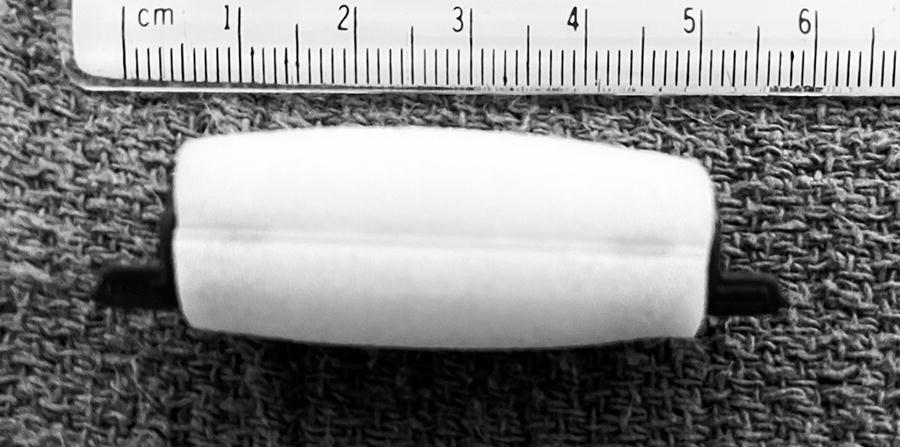
The novel cleaning device.

The novel cleaning device on a 5 mm port.

The novel cleaning device on a Nathanson retractor. The lens cleaner is positioned on Nathanson retractor. The lens cleaner is located at the tip of the arrow.
Data analysis
The mean number of lens cleaning episodes and the duration of cleaning were compared for the control and experimental groups using a t test. All tests were two-sided, and results reaching P < .05 were considered statistically significant. Statistical analyses were conducted with SPSS 24.0 (IBM; Chicago, Illinois, USA).
Results
All cases were completed laparoscopically, and there were no intraoperative complications. The patient demographics were equal between the experimental and control groups. Table 1 displays the breakdown of procedures between the two groups and cleaning episodes. The mean number of times that the laparoscope was cleaned was significantly lower for the experimental group versus the control group for foregut, sleeve gastrectomy, and band removal cases. The mean number of cleaning episodes per case for foregut, sleeve gastrectomy, and band removal cases in the control group were 11.8 ± 2.7, 11.4 ± 6.2, and 4.5 ± 2.3, respectively. The mean number of cleaning episodes per case for the experimental group for foregut, sleeve gastrectomy, and band removal were 0.3 ± 0.5, 0.5 ± 0.9, and 1.0 ± 0.0, respectively (P < .05). The mean total time that the laparoscope was removed from the operative field was also significantly lower for the experimental group versus the control group (Table 2). The mean total cleaning times in seconds for foregut, sleeve gastrectomy, and band removal cases in the control group were 1,255.5 ± 11.9, 832.4 ± 10.8, and 344.3 ± 9.6, respectively. The mean total cleaning times in seconds for the experimental group for foregut, sleeve gastrectomy, and band removal were 0.7 ± 6.5, 0.6 ± 6.0, and 1.1 ± 0.5, respectively (P < .05). As the complexity of the procedure increased, the laparoscope was removed more often for the control group. In the experimental group, case complexity did not impact the number of laparoscopic cleaning episodes. Overall, the mean duration of a single cleaning episode in the control group was 70.1 seconds.
Comparison of Cleaning Episodes
The number of cleaning episodes for significantly less for the novel device versus the control group (*P < .05).
Mean Time per Case Spent Lens Cleaning
The mean time (seconds) per case spent lens cleaning was significantly longer for the control group versus the novel device group (*P < .05).
Discussion
Minimally invasive surgery reduces postoperative pain, shortens hospital stays, produces faster recovery, and improves cosmesis. Unfortunately, obscured vision during laparoscopic and robotic procedures remains challenging secondary to condensation, debris, or bleeding. To date, there are numerous devices for lens cleaning. Overall, these devices are categorized as internal or external cleaning devices.
External lens cleaning devices disrupt operative flow and are susceptible to recurrent fogging and inefficient cleaning. External devices may temporarily clean the lens, but when the scope is reinserted, temperature changes induce condensation with loss of the visual field. Furthermore, the camera lens may encounter debris within the trocar as it is reinserted into the abdominal cavity. This repetitive cycle occurs each time the field becomes obscured. Internal cleaning systems do not disrupt operative flow but may entail costly generators, cables, and disposable accessories. Many of these devices actively warm or physically wipe debris from the camera lens. Unfortunately, generators, batteries, and cables are expensive, and many of the accessories only fit a 5 or 10 mm scope.
This study utilized a novel internal lens cleaning device for both 5 and 10 mm laparoscopes with or without an angled lens. There were no extraneous generators or cables that required further capital. Operatively, this novel device significantly decreased the number of times the scope was removed from the abdominal cavity for several different laparoscopic cases. The novel cleaning device did not impede operative flow. Rather, any debris or fluid that was deposited on the lens was removed seamlessly. Some lens cleaning devices utilize an anti-fog solution. This study utilized anti-fog solution, saline, or water on the foam to resolve condensation or clean debris. Anti-fog solution was used for the majority of cases.
Although the analysis did not evaluate financial costs, there was a significant decrease in the duration of cleaning with the novel device. The significant decrease in the duration of cleaning by several minutes provides a cost savings at $62 per minute based on 2005 estimates. 5 In addition, the decrease in cleaning duration improves operative flow and decreases surgeon frustration. Obviously, a metric for surgeon frustration was not evaluated. However, any surgeon understands the inherent nature of a smooth operation that includes a clear view of the surgical field.
There are limited articles detailing laparoscopic lens cleaning in the literature. Abbit et al. reported that longer cases were associated with more cleaning episodes. The longer cases may simply be more complex (e.g., hiatal hernia) or associated with significant inflammation (e.g., acute cholecystitis). Longer cases translate into more opportunities to obscure the camera lens with liquid or solid debris. Cases with significant inflammation may be longer and result in more condensation against the lens. Similarly, our control data confirmed that case complexity was associated with more cleaning episodes. However, the experimental group that used the novel device did not show a disparity in cleaning episodes regardless of procedural complexity. Moreover, since the laparoscope remains in the abdominal cavity, retraction and exposure of the operative field are maintained. Since retraction and exposure of the operative field are maintained during an intra-abdominal cleaning episode, the novel device provides a much shorter duration of cleaning.
In general, this novel cleaning device seamlessly improves visualization and saves operative time, especially during complex procedures. This novel device is compatible with any reusable or disposable laparoscopic or robotic system, and the cleaning device is significantly less expensive than the control technology used in this study for lens cleaning. Ongoing procedures will clarify the best location and size of the novel cleaning device (5 mm versus 8 mm) for specific surgical cases.
There are a few limitations to this study. The actual number of lens cleaning episodes may be lower with the novel cleaning device. When the novel cleaning device was used initially, the laparoscope was removed from the abdominal cavity several times due to muscle memory. With further utilization and reminders, the scope was cleaned seamlessly in the abdomen while resisting the urge to remove the laparoscope. In addition, we discerned the best placement for the novel device during the initial cases. Ideally, the lens cleaner should be placed on a 5 mm port that is located in between the camera port and the site of pathology. If port placement precludes this placement, the lens cleaner may be placed on the Nathanson retractor for foregut procedures. The learning curve for the lens cleaner appears to be approximately two to three cases to reduce muscle memory and rote removal of the scope. The novel lens cleaner may not require anti-fog solution. A comparison study was not performed with and without a liquid solution on the foam. Presently, we recommend using saline, water, or anti-fog solution on the foam.
Conclusion
The novel minimally invasive lens cleaning device reduces the number of times the laparoscope is removed from the abdominal cavity during several different general surgery procedures. This device plays a critical role in laparoscopic surgery by ensuring a clear visual field and enhancing procedural efficiency.
Footnotes
Authors’ Contributions
Conceptualization: L.B., F.K., and N.R.; Methodology: L.B., F.K., and N.R.; Data analysis: L.B.; Data procurement: L.B., F.K., and N.R.; Writing—original draft: L.B.; Writing—review and editing: F.K. and N.R.
Disclosure Statement
Khambaty, Reed: none to disclose. Brody, Lila: family relation to shareholder.
Funding Information
No funding was received for this article.