



Abstract
Background:
Telesurgery represents a revolutionary milestone in medicine, allowing surgeons to perform complex procedures at a distance through advanced robotic systems. Although the first telesurgery in Brazil was performed in 2000 with a single-arm robotic platform between São Paulo and Baltimore (USA), no telesurgery had ever been conducted between two distinct Brazilian cities with a state-of-the-art robotic system. The aim is to report the first telesurgery performed between two Brazilian cities, connecting Scolla—Surgical Training Center in Campo Largo and CEONC Hospital in Cascavel, both in the state of Paraná, approximately 600 km apart, using high-performance fiber optic technology with 5G redundancy to perform robotic cholecystectomy in a swine model.
Methods:
A prospective experimental study was conducted using a 40 kg swine (Sus scrofa) as an animal model. Connectivity was established through high-speed fiber optic cable, allowing minimal latency and real-time data transmission. A robotic cholecystectomy was performed remotely, with continuous monitoring of delay parameters and connection quality.
Results:
Telesurgery was performed without complications, demonstrating the technical feasibility and safety of the procedure between two Brazilian cities. Transmission delays remained within acceptable limits for robotic surgery, and no technical or surgical complications were observed during the procedure. Image quality and responsiveness of robotic commands remained stable throughout the surgery.
Conclusion:
This study establishes a historic milestone in Brazilian medicine, demonstrating that telesurgery between Brazilian cities is technically feasible and safe. The results open promising perspectives for expanding access to specialized surgical care in remote regions of Brazil, potentially revolutionizing the distribution of medical expertise in the country and Latin America.
Introduction
Telesurgery, defined as the performance of surgical procedures at a distance through remotely controlled robotic systems, represents one of the most significant technological innovations in contemporary medicine.1,2 This surgical modality has emerged as a promising solution to overcome geographical barriers and democratize access to specialized surgical care, particularly in regions with specialist shortages.3,4
The concept of telesurgery is not recent, having its roots established in the late 20th century. The first successful telesurgery was performed in 2001 by Marescaux et al., known as “Operation Lindbergh,” where a surgeon in New York performed a laparoscopic cholecystectomy on a patient located in Strasbourg, France. 5 This historic milestone demonstrated the technical feasibility of transcontinental telesurgery and paved the way for subsequent developments in the field.
In the Brazilian context, the first experience with telesurgery occurred on September 17, 2000, when a team from Hospital Sírio-Libanês in São Paulo, in collaboration with Dr. Louis Kavoussi from Johns Hopkins Hospital in Baltimore (USA), performed a varicocelectomy by videolaparoscopy using the AESOP robot through Internet2. 6 This procedure, which lasted 20 minutes, was considered the first telesurgery performed in the Southern Hemisphere and the third in the world, establishing Brazil as a pioneer in Latin America in this revolutionary technology.
Since then, telesurgery has evolved significantly, driven by advances in communication technologies, state-of-the-art robotic systems, and network infrastructure. The implementation of 5G networks and high-speed fiber optics has been fundamental in reducing latency—one of the main technical challenges of telesurgery.7,8 Studies demonstrate that delays exceeding 150–200 ms can significantly compromise surgical precision and patient safety.9,10
Latency, defined as the delay time between the surgeon’s command and the robotic system’s response, is considered the most critical factor for telesurgery success. 11 Research indicates that delays of up to 100 ms are generally imperceptible to the surgeon, while latencies between 100 and 200 ms may be tolerable depending on the procedure’s complexity.12,13 Above this threshold, surgical performance can be significantly compromised, increasing the risk of complications.
Several countries have invested significantly in the development and implementation of telesurgery programs. Japan established specific clinical guidelines for telesurgery in 2022, regulating technical, ethical, and safety aspects. 14 China has performed multiple telesurgeries using 5G networks, including procedures between cities more than 3000 km apart. 7 In the United States and Europe, telesurgery programs have been implemented for both emergency procedures and surgical training.15,16
In Brazil, despite the historic milestone of 2000, telesurgery remained limited to experimental demonstrations and international collaborations. Factors such as telecommunications infrastructure, specific regulation, and implementation costs contributed to this limitation. 17 Recently, advances in fiber optic infrastructure and the gradual implementation of 5G technology in the country have created favorable conditions for the development of national telesurgery programs with the entry of state-of-the-art robotic systems into the country.
However, until now, there were no experimental models that functioned as a testing platform for implementing telesurgery practice in the country.
In this context, the present study reports the first telesurgery performed between two distinct Brazilian cities, connecting Scolla (Campo Largo, PR) and CEONC Hospital (Cascavel, PR), approximately 600 km apart. This milestone represents a significant advance in telesurgery implementation in Brazil and demonstrates the technological maturity achieved by the country in this area and the technical feasibility of this procedure.
Materials and Methods
Ethical and regulatory approval
This study was conducted in strict compliance with ethical guidelines for animal research. The experimental protocol was submitted to and approved by the Animal Ethics Committee of the Inspirar University, “Comissão de Ética no Uso de Animais” (CEUA) of the responsible institution, under protocol 01/2025, following guidelines established by the National Council for Animal Experimentation Control (CONCEA) and the Arouca Law (Law 11.794/2008). All procedures adhered to the 3Rs principles (replacement, reduction, refinement) and international guidelines for laboratory animal care and use.
The study followed ARRIVE (Animal Research: Reporting of In Vivo Experiments) guidelines to ensure transparency and reproducibility of results. 18 Animal welfare protocols were rigorously implemented, including continuous monitoring of vital signs, adequate analgesia, and specialized trans-operative care.
Animal model
A male domestic swine (Sus scrofa) weighing 40 kg from a certified vivarium with complete health history was used. The choice of the swine model was based on anatomical and physiological similarity to humans, particularly regarding the hepatobiliary system, making it ideal for cholecystectomy procedures. 19 The animal was fasted for 12 hours before the procedure, with free access to water until 2 hours before anesthesia.
Technological configuration and communication infrastructure
Connectivity between Scolla and CEONC Hospital in Cascavel was established through a hybrid infrastructure combining dedicated high-performance fiber optic cable. The total distance between the two institutions is approximately 600 km, representing a significant challenge for maintaining low latency and connection stability.
Fiber optic infrastructure
The primary connection was established through high-capacity fiber optic cable, providing 10 Gbps bandwidth and base latency below 3 ms per 100 km of distance. Fiber optics was chosen as the primary transmission medium due to its stability, low latency, and immunity to electromagnetic interference. 20
Latency monitoring
Real-time monitoring systems were implemented to continuously track network parameters, including: end-to-end latency (total round-trip time), jitter (latency variation), packet loss, available bandwidth.
Robotic system
The procedure was performed using a state-of-the-art surgical robotic system from Edge Medical (Shenzhen, China) model MP1000, equipped with remote surgeon console, patient cart, and high-definition 3D vision system. The system included specialized robotic instruments for laparoscopic surgery, including grasping forceps, scissors, and coagulation devices.
Surgeon console
The surgeon console was positioned at CEONC in Cascavel, equipped with: high-resolution 3D stereoscopic viewer, manual controls (master controls), pedals for energy and camera control, intuitive user interface for parameter configuration (Fig. 1).
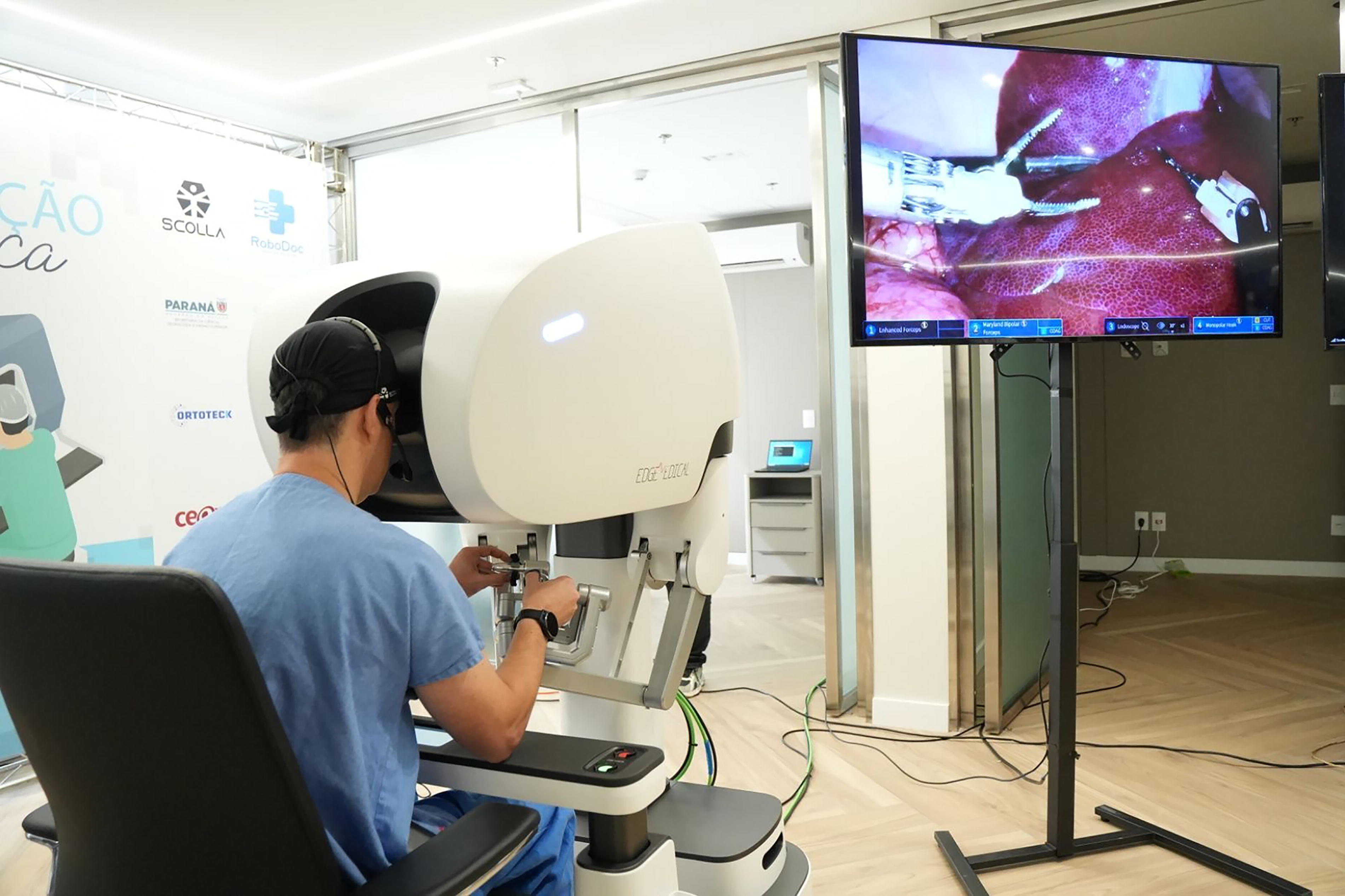
Surgeon console. The surgeon console was positioned at CEONC in Cascavel, equipped with: high-resolution 3D stereoscopic viewer, manual controls (master controls), pedals for energy and camera control, intuitive user interface for parameter configuration.
Patient cart
The patient cart was installed at Scolla, in Curitiba, including: four articulated robotic arms, 3D camera system with optical zoom, interchangeable surgical instruments, safety and emergency stop systems (Fig. 2).
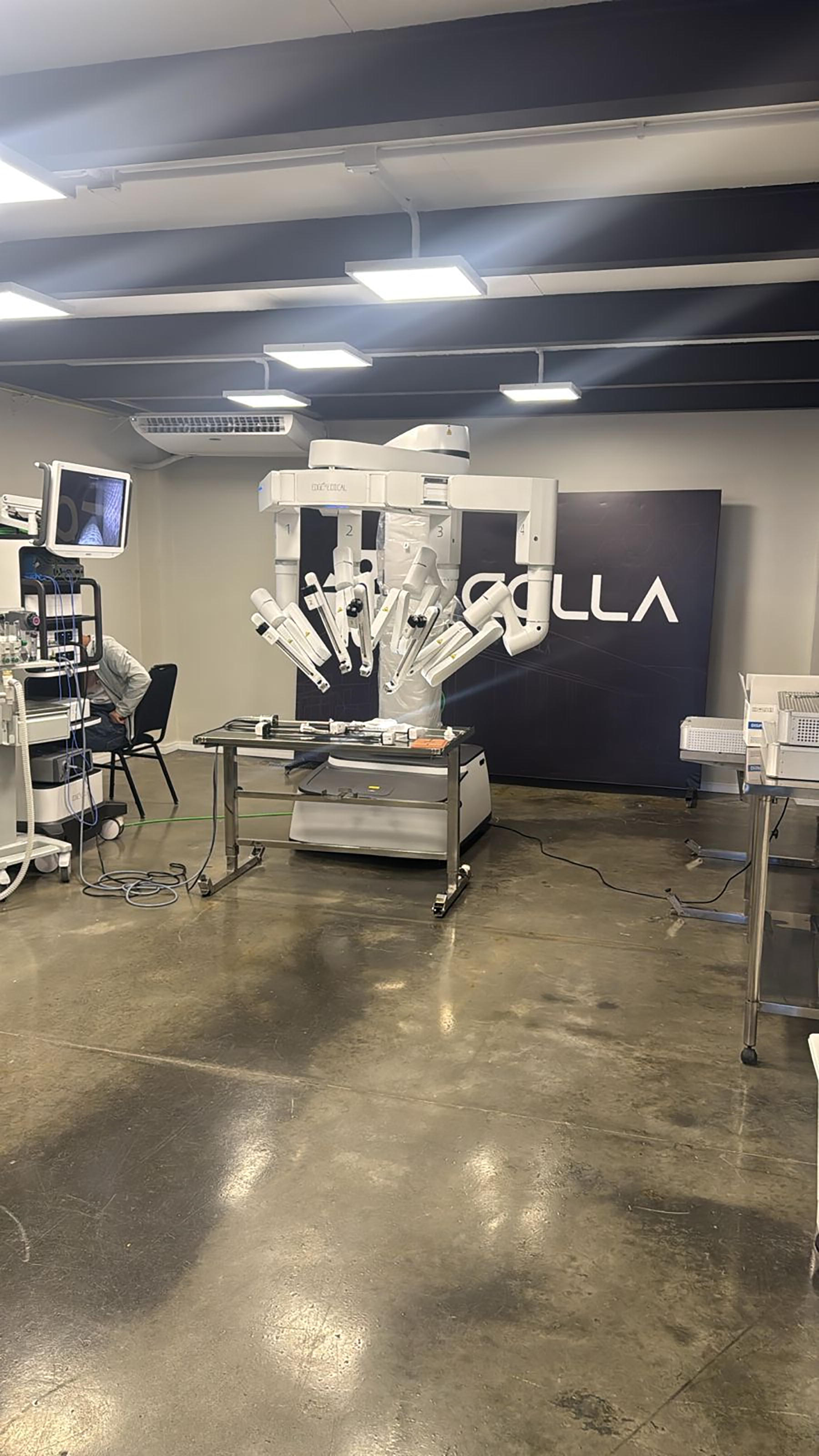
Patient cart. The patient cart was installed at Scolla, in Curitiba, including: four articulated robotic arms, 3D camera system with optical zoom, interchangeable surgical instruments, safety and emergency stop systems.
Telesurgery module
Edge Medical robots are among the few currently capable of safely performing remote robotic surgeries. This is due to the company’s R&D work and the development of the telesurgery module.
Anesthetic protocol
The animal underwent a standardized anesthetic protocol, starting with intramuscular premedication with midazolam (0.5 mg/kg) and ketamine (10 mg/kg). Anesthetic induction was performed with intravenous propofol (3–5 mg/kg), followed by orotracheal intubation and maintenance with isoflurane (1.5%–2.5%) in 100% oxygen. Analgesia was maintained with continuous slow infusion of ketamine 0.3 mg/mL and lidocaine 0.4 mg/mL.
Continuous anesthetic monitoring included: electrocardiography, invasive blood pressure, oxygen saturation, capnography, body temperature, central venous pressure.
After completion of the surgical procedure, the animal was euthanized with anesthetic deepening with propofol, followed by a lethal dose of potassium chloride.
Surgical procedure
Positioning and preparation
The animal was positioned in dorsal decubitus with 15° elevation of the cephalic region (reverse Trendelenburg position). Surgical field preparation followed standard antisepsis protocols with 2% alcoholic chlorhexidine.
Surgical technique
Robotic cholecystectomy was performed following standard laparoscopic technique adapted for the robotic system:
10 mm trocar at umbilicus (camera) Two 8 mm trocars in right hypochondrium (robotic arms) One 8 mm trocar in epigastrium (robotic arm) One 5 mm trocar in left hypochondrium (assistant)
Safety protocols
Rigorous safety protocols were implemented to ensure procedure integrity:
Local safety team
A complete surgical team remained present at Scolla, including: surgeon experienced in experimental surgery, veterinary anesthesiologist, surgical scrub nurse, robotic systems technician.
Interruption criteria
Specific criteria were established for telesurgery interruption and conversion to local surgery: latency exceeding 200 ms for more than 30 seconds, connection loss for more than 10 seconds, animal hemodynamic instability, robotic system technical failure, any surgical complication.
Backup systems
Multiple backup systems were implemented: redundant network connection, uninterruptible power supply, available conventional surgical equipment, local surgical team prepared to assume the procedure.
Data collection
Throughout the procedure, data related to the following were collected:
Technical parameters
Mean, minimum, and maximum latency
Latency variation (jitter)
Image quality (resolution, frame rate)
Robotic control responsiveness
Surgical parameters
Total operative time
Time for each surgical step
Intraoperative complications
Dissection quality
Physiological parameters
Continuous vital signs
Anesthetic parameters
Hemodynamic stability
Pneumoperitoneum response
Results
Procedure characteristics
Telesurgery was successfully performed, representing the first robotic surgical procedure conducted remotely between two distinct Brazilian cities. The procedure had a total duration of 50 minutes, from initial incision to incision closure. Image quality and achievement of the “safety view” of anatomical elements in Calot’s triangle were comparable with conventional robotic cholecystectomy procedures.
There were no technical–surgical complications during the procedure.
Connectivity and latency parameters
Network latency
Continuous latency monitoring throughout the procedure revealed exceptional results for long-distance telesurgery:
Mean latency: 11.2 ± 2.2 ms Minimum latency: 10.1 ms Maximum latency: 15.7 ms Mean jitter: 2.1 ± 0.8 ms
All latency values remained consistently below the critical threshold of 100 ms, considered acceptable for telesurgery, and significantly below the 200-ms limit where surgical performance begins to be compromised. 9
Connection stability
The fiber optic infrastructure demonstrated exceptional stability:
Connection availability: 99.97% Packet loss: 0.003% Total interruption time: 2.3 seconds (distributed in micro-interruptions)
Video transmission quality
The 3D vision system maintained consistent quality throughout the procedure:
Resolution: 4K (3840 × 2160 pixels) Frame rate: Stable 60 fps Subjective quality: Excellent (scale 1–5: 4.8)
Surgical performance
Operative times
Detailed analysis of operative times demonstrated efficiency comparable with face-to-face procedures. The preparation and docking phase took 10.3 minutes, pneumoperitoneum creation required 3.1 minutes, trocar insertion was completed in 8.7 minutes, Calot’s triangle dissection took 8.4 minutes, ligation and section required 6.2 minutes, gallbladder dissection took 8.9 minutes, and removal and closure were completed in 4.4 minutes, for a total operative time of 50.0 minutes. These times are comparable with standard face-to-face robotic cholecystectomy procedures in swine models reported in the literature.
Dissection quality
Technical quality of dissection was evaluated by experienced surgeons present on-site:
Anatomical identification: Complete and precise Structure preservation: 100% (no inadvertent injuries) Hemostasis: Adequate in all steps Ligation quality: Perfect (no misplaced ligatures) Gallbladder integrity: Maintained (no perforation)
Complications and adverse events
Surgical complications
No surgical complications were observed during the procedure:
Bleeding: Absent Inadvertent injuries: None Conversion to open surgery: Not necessary Anesthetic complications: None
Technical events
Minor technical events were recorded without impact on outcome:
Network micro-interruptions: None Instrument recalibration: None occurred Video quality adjustment: None
Surgical team evaluation
Remote surgeon satisfaction
The surgeon operating remotely from CEONC reported:
Visualization quality: Excellent (5/5), identical to traditional robotic system Control responsiveness: Excellent (5/5) and similar to traditional robotic system Comfort during procedure: Excellent (5/5) and similar to traditional robotic system System confidence: High (4.5/5), and similar to traditional robotic system Willingness to repeat: Yes, definitely
Local team evaluation
The team present at Scolla evaluated:
Coordination with remote surgeon: Excellent (5/5) Audiovisual communication: Very good (4.5/5) Perceived safety: High (4.5/5) Procedure efficiency: Excellent (4.5/5)
Comparative analysis with literature
International latency
Comparing with international telesurgery studies, the present study achieved a mean latency of 11.2 ms over 600 km using fiber optic technology, which is superior to Zheng et al. (2020), who reported 135 ms over 3000 km using 5G, comparable with Nakauchi et al. (2022), who achieved 45 ms over 800 km with dedicated fiber, and also better than Morohashi et al. (2022), who reported 20 ms over 400 km with commercial fiber.
Surgical performance
The operative times obtained are comparable with those reported in international literature for telesurgery in animal models, demonstrating that the 600 km distance did not significantly compromise procedure efficiency.
Discussion
The present study tested telesurgery feasibility in our country and serves as a historic milestone in Brazilian medicine by demonstrating the first successful telesurgery performed between two distinct Brazilian cities. Twenty-five years after the first telesurgery in Brazil, performed in 2000 between São Paulo and Baltimore, 6 this procedure represents technological maturity, telecommunications infrastructure evolution, and the entry of a new generation of robots that enable routine telesurgery execution in our country.
The successful performance of this telesurgery between Scolla and CEONC Hospital in Cascavel, 600 km apart, demonstrates that Brazil now possesses the technical capacity and necessary infrastructure to implement national telesurgery programs. This advance is particularly significant considering the country’s continental dimensions and unequal distribution of medical specialists between regions. 7
The latency results obtained (11.2 ± 2.2 ms) are exceptional for long-distance telesurgery and significantly superior to those reported in many international studies. The observed mean latency is well below critical thresholds established in literature: 100 ms for comfortable operations and 200 ms for the safety limit.9,12
Current high-performance commercial fiber optic networks have proven to be an effective strategy for maintaining low latency and connection stability, including redundant backup networks. This approach demonstrates real potential for consistent exploration in future telesurgery implementations in Brazil.
Maintaining 4K video quality is notable and comparable with the best international robotic and telesurgery systems. Visual quality is crucial for telesurgery, as the surgeon depends entirely on video transmission for spatial orientation and anatomical structure identification. 21 The results demonstrate that current Brazilian infrastructure can support the demanding visual requirements of modern telesurgery.
Telesurgery offers transformative potential to “democratize” access to specialized surgical care in Brazil. Regions such as the North and Northeast, which historically face specialist shortages, could benefit significantly from this technology. 22 The ability to connect centers of excellence in the South-Southeast axis and other capitals with regional hospitals could drastically reduce waiting lists and the need for patient displacement.
The importance of telesurgery for Brazil is particularly relevant considering the country’s continental dimensions and unequal distribution of medical specialists. Remote regions, especially in the North and Northeast, frequently lack specialized surgeons, resulting in long waiting lists and the need for patient displacement to urban centers. 17 Telesurgery offers the potential to democratize access to specialized surgical care, allowing medical expertise concentrated in large centers to be made available remotely.
Ethical and regulatory aspects of telesurgery have received growing attention in medical literature.23,24 Issues related to medical responsibility, informed consent, data privacy, and legal jurisdiction in transcontinental procedures require specific regulatory frameworks. 25 The Brazilian Federal Council of Medicine (CFM) regulated robotic surgery in 2022, establishing guidelines for its practice, although specific regulations for telesurgery are still under development. 26
Cybersecurity represents another critical aspect of telesurgery, considering the transmission of sensitive medical data and remote control of surgical equipment.27,28 Advanced encryption protocols, multifactor authentication, and backup systems are essential to ensure procedure integrity and security. 29
The encouraging results allow us to suggest new telesurgery network implementation models based on:
In Asia, telesurgery advances by leaps and bounds. Japan leads telesurgery development, with clinical guidelines established in 2022 and multiple successful procedures performed. 14 Japanese experience demonstrates latencies similar to those obtained in this study (20–45 ms) for comparable distances, validating our results.
China has performed telesurgeries at distances exceeding 3000 km using 5G networks, although with significantly higher latencies (135 ms).7,30 Brazilian results demonstrate superior performance, possibly due to dedicated fiber optic infrastructure.
European and North American studies have focused primarily on transcontinental telesurgery or surgical training.15,16,31 The Brazilian experience is unique in demonstrating feasibility for intermediate distances (600 km) with national infrastructure, filling an important gap in literature.
Broad telesurgery implementation in Brazil requires development of specific regulatory framework. Issues such as medical responsibility, interstate professional licensing, and emergency protocols need clear regulation. 32 The Federal Council of Medicine should develop specific guidelines for telesurgery, expanding existing regulations for robotic surgery.
Although telesurgery can democratize access, there is risk of creating new disparities based on technological infrastructure. Public policies should ensure that implementation does not exacerbate existing inequalities.33,34
Transmission of sensitive medical data and remote control of surgical equipment present cybersecurity risks that must be rigorously addressed.35,36 End-to-end encryption protocols, multifactor authentication, and intrusion detection systems are essential for secure implementation.
Telesurgery requires specific competencies additional to those of conventional robotic surgery. Surgeons must be trained to operate with limited visual feedback, remote communication, and specific emergency protocols.37,38 Structured training programs are necessary to ensure adequate competencies.
Although the swine model is widely accepted for surgical training, anatomical and physiological differences with humans may limit direct extrapolation of results. Future studies should include models closer to human anatomy or, eventually, controlled clinical studies.
Performing a single procedure, although successful, does not allow evaluation of variability between cases, assessment of use in complex cases, or complication management. Larger series are necessary to establish robust safety protocols and surgical guidelines to be adopted in the near future.
Finally, this study was conducted under ideal experimental conditions, with dedicated infrastructure and highly trained teams. Implementation in real conditions may present additional challenges not identified in this study.
Future perspectives
The results of the present study suggest technical feasibility for implementing telesurgery in our country, with greater potential to connect multiple Brazilian regions. Advances in 6G technology, artificial intelligence (AI), and augmented reality can further reduce telesurgery limitations. 39 AI-based movement prediction systems can compensate for residual latency, while advanced haptic feedback can improve remote tactile perception.
Telesurgery can be integrated into broader telemedicine programs, including preoperative teleconsultations, postoperative telemonitoring, and surgical teletraining. 40 This integrated approach would maximize technology impact on the health system.
Telesurgery presents unique ethical considerations related to informed consent. Patients must fully understand additional risks associated with remote surgery, including the possibility of technical failures and the need for conversion to local surgery.41,42
Recommendations
Based on the results obtained, we recommend:
For researchers
Conducting larger series with multiple procedures.
Developing standardized protocols for telesurgery.
Large-scale cost-effectiveness studies.
Investigation of more complex procedures.
For regulators
Development of specific guidelines for telesurgery.
Establishment of certification criteria for centers.
Creation of cybersecurity safety protocols.
Definition of legal responsibilities.
For health managers
Investment in hospital telecommunications infrastructure.
Development of training programs.
Establishment of partnerships between centers of excellence and regional hospitals.
Creation of sustainable financing models.
Conclusion
This study contributes significantly to scientific literature by:
Demonstrating the technical feasibility of telesurgery at intermediate distances with national infrastructure. Establishing performance benchmarks for telesurgery in the Brazilian context. Validating the high-performance fiber connectivity model for telesurgery. Providing initial data for the development of regulations and public policies on telesurgery. Inspiring future research in national telesurgery.
Footnotes
Acknowledgments
The authors thank the teams at Scolla and CEONC Hospital in Cascavel for their dedication and professionalism during this historic procedure. Special thanks to telecommunications technicians who ensured connectivity infrastructure, veterinarians responsible for animal model care, and the Animal Ethics Committee (CEUA) for approval and ethical guidance of the study.
Funding Information
This study was conducted with resources from participating institutions, without specific external funding.
Data Availability Statement
Data supporting the conclusions of this article are available upon reasonable request to the corresponding authors, respecting ethical and privacy considerations.
Disclosure Statement
No competing financial interests exist.