



Abstract
Purpose:
The aim of this study is to evaluate whether the number of linear stapler firings used during rectal division influences the rate of anastomotic leakage (AL) in patients undergoing left hemicolectomy, sigmoidectomy, or anterior resection for cancer.
Methods:
This is a retrospective analysis of prospectively collected data. All consecutive patients with left or sigmoid colon or rectal cancer who underwent elective resection with primary anastomosis from 2013 to 2025 were included. Patients were categorized into three groups according to the number of linear stapler firings used to divide the rectum: rectal division with one stapler firing (group A), rectal division with two stapler firings (group B), and rectal division with three or more stapler firings (group C).
Results:
One hundred and sixty patients were included in group A, 68 patients in group B, and 17 patients in group C. The overall AL rate was 8.2% and rose significantly when multiple stapler firings were used (4.4% versus 13.2% versus 23.5% in groups A, B, and C, respectively; A versus B: P = .04; A versus C: P ≤ .01; B versus C: P = .55). Multivariate analysis confirmed multiple firings as an independent predictor of AL (two stapler firings: odds ratio [OR] = 3.06, P = .04; three or more stapler firings: OR = 5.04, P = .02).
Conclusions:
Multiple stapler firings during rectal transection are linked to increased rates of AL compared with the use of a single stapler firing. Prospective, multicenter trials are needed to validate these findings and to improve anastomotic safety in left colon, sigmoid, and rectal cancer surgery.
Keywords
Introduction
Despite advances in operative and perioperative management, complications following colorectal cancer surgery remain a significant challenge for surgeons.1,2 Among these, anastomotic leakage (AL) is the most feared complication due to its association with serious health risks, the need for reintervention, prolonged hospital stay, and increased health care costs.3–5 Optimal anastomotic healing requires adequate blood supply, healthy bowel margins, and a tension-open-access configuration.6–8
AL rates are significantly higher after low anterior resection compared with right or left hemicolectomy, ranging from 2.8% to 30% in some reports.9–11 In laparoscopic anterior resection, the limited space in the pelvis often necessitates an unfavorable transection angle, which may require multiple stapler firings to complete rectal division. 12 In 1980, Knight and Griffen introduced the concept of double stapling anastomosis for left-sided colonic and rectal resections, combining linear and circular staplers. 13 This double stapling technique (DST) avoids placing a purse-string suture deep in the pelvis and prevents opening the rectal stump, thus reducing rectal spillage and mismatches between bowel ends. 14
However, multiple firings of the linear stapler can elongate and angulate the staple line on the rectal stump, potentially creating weak “dog-ear” configurations when the circular stapler is applied. 15 Although “dog-ears” may occur even after a single firing, their risk may be increased by overlapping or angled staple lines.15–17 These overlapping staple lines have been associated with an increased risk of AL.16,17
The aim of this study is to evaluate whether the number of linear stapler firings used during rectal division influences the rate of AL in patients undergoing left hemicolectomy, sigmoidectomy, or anterior resection for cancer.
Materials and Methods
This is a retrospective analysis of prospectively collected data. Informed consent was obtained from all participants. Ethical review and approval were waived for this study because it involved retrospective analysis of de-identified clinical data and did not include any direct patient intervention.
Patient selection
All consecutive patients with left colon, sigmoid, or rectal cancer who underwent elective left hemicolectomy, sigmoidectomy, or anterior resection of the rectum with primary anastomosis between 2013 and 2025 at the Policlinico di Monza, Italy, were included.
Patients were categorized into three groups according to the number of linear stapler firings used to divide the rectum: rectal division with one stapler firing (group A), rectal division with two stapler firings (group B), and rectal division with three or more stapler firings (group C). Patients under 18 years of age and those undergoing emergency surgery were excluded.
Study outcomes
The primary outcome was to compare the rate of AL among the three groups. Secondary outcomes included overall complication and reoperation rates, as well as length of hospital stay (LOS).
Surgical technique
All procedures were performed by experienced colorectal surgeons. All patients received mechanical bowel preparation the day before surgery. The choice between open and laparoscopic approaches, as well as whether to create a protective ileostomy, was made intraoperatively by the attending surgeon based on tumor location, neoadjuvant chemoradiotherapy (n-CRT), and the outcome of the intraoperative hydropneumatic test. 18 Anastomoses were created using the Knight–Griffen technique in all cases. 13 A hydropneumatic test was performed in all cases by filling the pelvis with sterile saline and insufflating air through a transanal catheter to assess anastomotic integrity.
Data collection
The following variables were recorded: gender, age, American Society of Anesthesiologists grade, history of previous abdominal surgery, tumor location (classified by distance from the anal verge: left colon or sigmoid >15 cm; high rectum 10–15 cm; mid-rectum 5–10 cm; low rectum <5 cm), n-CRT, surgical procedure and approach (open or laparoscopic), intraoperative complications, conversion to open surgery, hydropneumatic test result, ileostomy creation, AL (graded according to the International Study Group of Rectal Cancer [ISGRC]), 19 postoperative complications (graded according to the Clavien–Dindo classification 20 and quantified using the Comprehensive Complication Index [CCI]), 21 LOS, and tumor stage based on the American Joint Committee on Cancer TNM system, 8th edition. 22
A subgroup analysis was conducted on patients with mid- and low-rectal tumors, as deep pelvic anastomoses carry a higher risk of AL.3,23 This allowed a more focused evaluation of whether multiple stapler firings influence AL rates in this high-risk population.
AL definition
AL was defined as a defect at the anastomotic site resulting in an abnormal communication between intra- and extraluminal compartments of the abdomen. 19 AL severity was classified as follows: radiological leak requiring no active intervention (grade A); managed conservatively with antibiotics and/or image-guided drainage (grade B); and required surgical reintervention (grade C). 19 Diagnosis was based on clinical signs, such as fever, abdominal pain, or signs of AL such as the presence of fecal content or gas in surgical drains. Any clinical suspicion of AL was then confirmed by contrast-enhanced computed tomography (CT) scan.
Statistical analysis
Continuous variables were reported as medians with interquartile ranges (IQR), while categorical and ordinal data were summarized as counts and percentages. Comparisons among continuous and ordinal variables were made using the Kruskal–Wallis test. For categorical variables, the chi-square test was used; if expected cell counts were <5, Fisher’s exact test was applied.
Univariate logistic regression was performed for each variable, reporting odds ratios (ORs) with 95% confidence intervals (CIs) to identify associations with AL. Variables showing statistical significance were included in a multivariate analysis using the “introduce” method. 24 Prior to multivariate modelling, collinearity among candidate predictors was assessed using Spearman’s correlation; variables with substantial overlap were excluded.
All analyses were conducted using Jamovi (version 2.6.26). Statistical significance was set at P < .05.
Results
A total of 245 patients were included. Of these, 160 patients (65.3%) were included in group A, 68 patients (27.8%) in group B, and 17 patients (6.9%) in group C. Pre- and intraoperative results are reported in Table 1. Statistically significant differences did not occur among the three groups regarding patients’ characteristics and the use of n-CRT.
Patients’ Characteristics

Statistically significant differences in bold.
ASA, American Society of Anesthesiology score.
In group A, 10 patients (6.3%) had a positive hydropneumatic test, but none of these patients developed an AL. In group B, the hydropneumatic test was positive in six patients (8.8%). Of these, three patients (4.4%) developed an AL. One AL was grade C, and two were grade A according to the ISGRC. In one patient (AL grade A), the surgeon reinforced the anastomosis with an additional suture intraoperatively without ileostomy creation, while in the other two patients (ALs grade A and C), reinforcement was combined with ileostomy creation.
Statistically significant differences in terms of conversion to open surgery and postoperative tumor staging among groups were not observed.
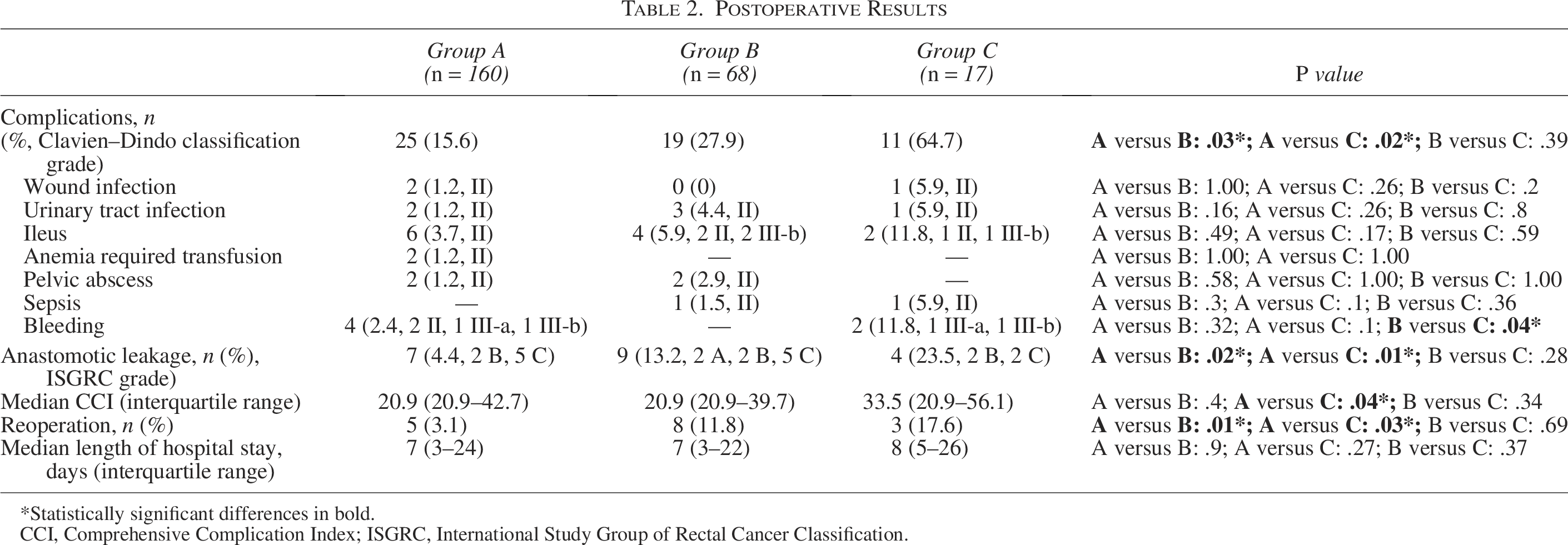
Table 2 reports postoperative results. Complications occurred in 25 patients (15.6%) in group A, 19 patients (27.9%) in group B, and 11 patients (64.7%) in group C (A versus B: P = .03; A versus C: P = .02; B versus C: P = .39). AL occurred in seven patients (4.4%) in group A, nine patients (13.2%) in group B, and four patients (23.5%) in group C (A versus B: P = .02; A versus C: P = .01; B versus C: P = .28).
Postoperative Results
Statistically significant differences in bold.
CCI, Comprehensive Complication Index; ISGRC, International Study Group of Rectal Cancer Classification.
In group A, two out of seven ALs (28.6%) were grade B and five (71.4%) were grade C. All grade B ALs were treated with antibiotic therapy. Regarding the grade C ALs, four patients underwent Hartmann’s procedure, and one patient underwent surgery fashioning a new anastomosis with ileostomy.
In group B, two ALs (22.2%) were grade A, two ALs (22.2%) were grade B, and five ALs (55.6%) were grade C. All grade B ALs were treated with antibiotic therapy. About grade C ALs, three patients underwent Hartmann’s procedure, one patient underwent an ileostomy creation, and one patient was treated by transanal anastomotic reinforcement.
In group C, two ALs (50%) were grade B and two ALs (50%) were grade C. Both grade B ALs were treated by endoscopic drainage, and in both grade C ALs, an ileostomy was created. There was no significant difference in AL severity between groups.
Postoperative ileus occurred in six patients (3.7%) in group A, four patients (5.9%) in group B, and two patients (11.8%) in group C (A versus B: P = .49; A versus C: P = .17; B versus C: P = .59). One patient in group C required ileostomy takedown and recreation of a new stoma (Clavien–Dindo III-b), while two patients in group B underwent ileostomy closure (Clavien–Dindo III-b). All other patients in both groups were treated conservatively (Clavien–Dindo II).
Pelvic abscesses occurred in two patients (1.2%) in group A and two patients (2.9%) in group B (A versus B: P = .58; A versus C: P = 1.00; B versus C: P = 1.00) (Clavien–Dindo II). All abscesses occurred in the absence of an AL and were managed conservatively with antibiotic therapy.
Sepsis occurred in one patient (1.5%) in group B and in one patient (5.9%) in group C (A versus B: P = .3; A versus C: P = .1; B versus C: P = .36) (Clavien–Dindo II). One case was confirmed by positive blood cultures and the other by central venous catheter-related contamination. Both patients were treated with antibiotics in the absence of AL.
Bleeding occurred in four patients (2.4%) in group A and in two patients (11.8%) in group C (A versus B: P = .32; A versus C: P = .1; B versus C: P = .04). In group A, anastomotic bleeding occurred in four patients: two of them were managed with blood transfusion (Clavien–Dindo II), one by urgent endoscopy with clip placement (Clavien–Dindo III-a), and one underwent Hartmann’s procedure (Clavien–Dindo III-b). In group C, one patient experienced hemorrhage from a small vessel near the sacral fascia requiring exploratory laparoscopy for hemostasis (Clavien–Dindo III-b) and one patient with anastomotic bleeding required endoscopy with clip placement (Clavien–Dindo III-a).
The overall severity of postoperative complications, calculated using the CCI based on the Clavien–Dindo classification, was higher in group C compared with group A (median = 20.9, IQR = 20.9–42.7 versus 20.9, IQR = 20.9–39.7 versus 33.5, IQR = 20.9–56.1, in groups A, B, and C, respectively; A versus B: P = .4; A versus C: P = .04; B versus C: P = .34).
Five patients (3.1%) in group A, eight patients (11.8%) in group B, and three patients (17.6%) in group C required reoperation (A versus B: P = .01; A versus C: P = .03; B versus C: P = .69).
In the subgroup analysis of 55 patients with mid- or low-rectal cancer, 28 (50.9%) were in group A, 19 (33.3%) in group B, and 8 (15.8%) in group C. Overall, nine patients (15.8%) developed AL: two patients (6.9%) in group A, four patients (21%) in group B, and three patients (33.3%) in group C, without statistically significant differences (A versus B: P = .2; A versus C: P = .07; B versus C: P = .65). All ALs in groups A and B were grade C, while ALs in group C were two grade B and one grade C, according to the ISGRC classification.
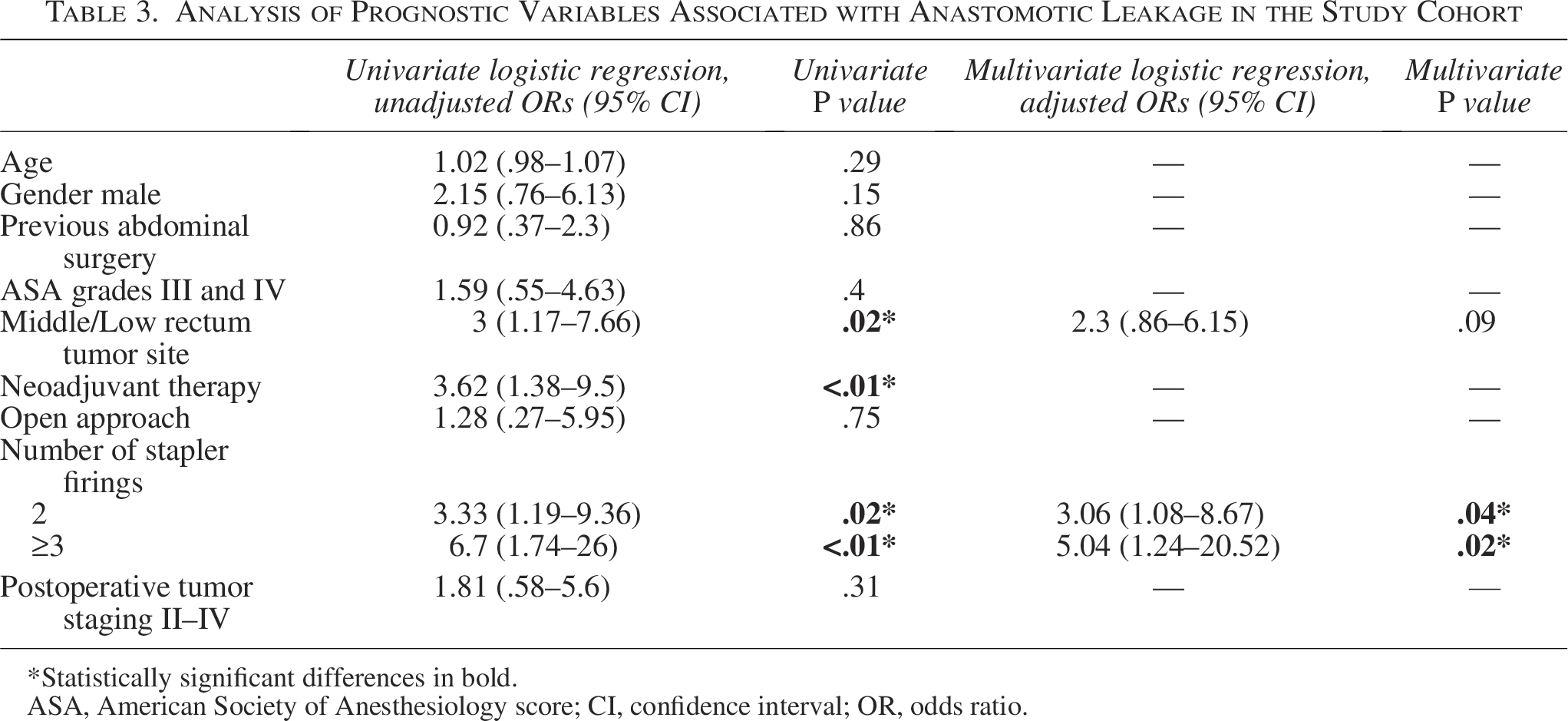
Table 3 presents the risk factors for AL occurrence. On univariate analysis, tumors located in the middle and low rectum carried a higher AL risk compared with left colon, sigmoid, and high rectal lesions, with an OR of 3 (95% CI: 1.17–7.66; P = .02). Similarly, n-CRT was significantly associated with AL (OR = 3.62; 95% CI: 1.38–9.50; P < .01). The use of two stapler firings (OR = 3.33; 95% CI: 1.19–9.36; P = .02) and three or more stapler firings (OR = 6.7; 95% CI: 1.74–26; P < .01) for rectal division also increased AL risk. In multivariate analysis, only the number of stapler firings remained an independent predictor of AL: two stapler firings (OR = 3.06; 95% CI: 1.08–8.67) and three stapler firings (OR = 5.04; 95% CI: 1.24–20.52).
Analysis of Prognostic Variables Associated with Anastomotic Leakage in the Study Cohort
Statistically significant differences in bold.
ASA, American Society of Anesthesiology score; CI, confidence interval; OR, odds ratio.
Discussion
In this study, we assessed how the number of stapler firings used for rectal division affects the AL rate in patients undergoing left or sigmoid colon and rectal cancer resection. Despite the inherent limitations of a retrospective design, our results show a progressive increase in AL incidence with each additional stapler firing.
Multiple stapler firings have been associated with increased AL rates in several studies. 12 Roumen et al. described how “dog-ear” intersections represent a mechanical weak point. 15 Their finding was supported by Kawasaki et al. who demonstrated that the junction of linear and circular staple lines can predispose to AL. 27 In a multicenter cohort of 1609 patients undergoing sphincter-preserving laparoscopic rectal cancer resections, Park et al. identified multiple firings of the linear stapler for rectal transection as a strong independent risk factor for AL (hazard ratio = 6.18; 95% CI: 2.72–14.05; P < .001). 28
In our cohort, the overall AL rate was 8.2%. When stratified by the number of stapler firings, the incidence of AL increased significantly when more than one stapler firing was used. This finding reinforces the clinical and resource-related impact of multiple staples. Furthermore, the likelihood of creating an ileostomy also increased when more than one stapler firing was used, suggesting that surgeons should consider routine diversion when multiple firings are needed. Our findings align with Ito et al., who observed a 5% AL rate (9/180) in patients undergoing laparoscopic anterior resection with DST. 16 In their series, leaks occurred in 15% (4/27) of patients requiring three or more stapler firings versus 3% (5/153) when two or fewer firings were used (P = .02). 16 In the present study, the overall complication rate was significantly higher when more than one stapler firing was used. However, only group C had statistically significant higher CCI scores than group A. Reoperation rates rose when multiple stapler firings were used.
Univariate analysis identified low tumor location, n-CRT, and multiple stapler firings, specifically the use of two or three cartridges, as significant risk factors for AL. Both low-rectal tumors and n-CRT are well-recognized risk factors for leakage.2,29 In multivariate analysis, only the number of stapler firings remained an independent predictor of AL. Our results are similar to those reported by Braunschmid et al., who reviewed 308 patients undergoing colonic and rectal resections for benign and malignant disease and identified the use of three or more stapler cartridges for rectal stump closure as the sole predictor of AL (P = .002).
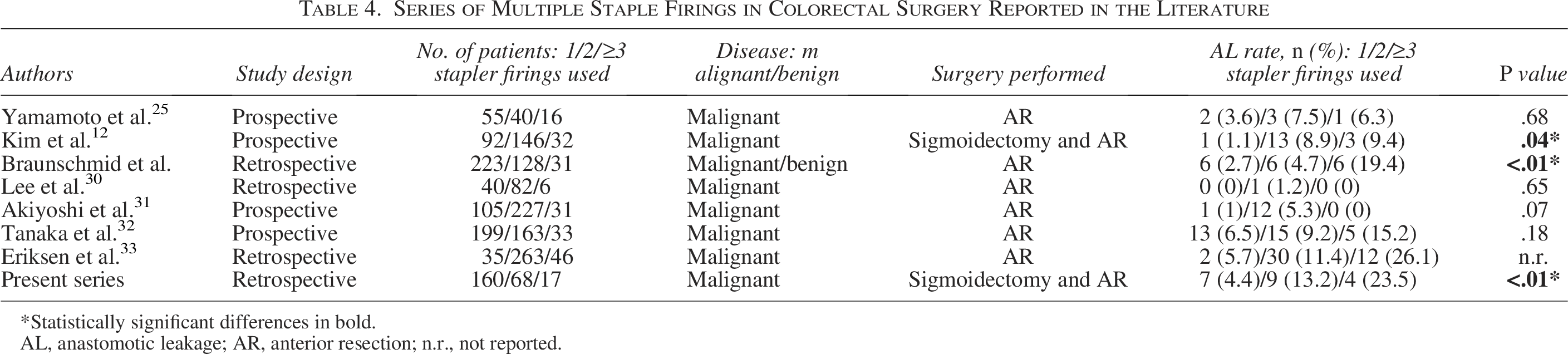
To date, only a limited number of studies have specifically examined the impact of multiple stapler firings on AL rates in colorectal surgery, with heterogeneous findings (Table 4).12,25,30–33 Among these, only two studies identified multiple firings as a significant adverse prognostic factor. 12 Kim et al. examined 270 patients who underwent laparoscopic anterior resection for distal sigmoid and rectal cancer and found that AL rates rose significantly with each additional stapler firing: 1.1% after one firing, 8.9% after two, and 9.4% after three (P = .04). 12 Similarly, Braunschmid et al. reviewed 382 patients undergoing colonic or rectal resection and demonstrated that AL risk rose significantly with each additional stapler firing: 2.7% after one firing, 4.7% after two, and 19.4% after three (P < .01). However, their retrospective series included both benign and malignant lesions, potentially introducing selection bias, whereas our study focused exclusively on malignant disease. Moreover, Eriksen et al. found that using three or more stapler firings for rectal transection nearly tripled the risk of AL after anterior resection for rectal cancer compared with one or two stapler firings (adjusted OR = 2.71; 95% CI: 1.17–6.26). 33 The remaining studies failed to demonstrate a significant association between multiple firings and AL.25,30–32
Series of Multiple Staple Firings in Colorectal Surgery Reported in the Literature
Statistically significant differences in bold.
AL, anastomotic leakage; AR, anterior resection; n.r., not reported.
We then conducted a focused subgroup analysis on the 55 patients with low-rectal cancer, given that low tumor location is a well-established risk factor for AL, with reported rates reaching up to 36%.10,26 In our cohort, the overall AL rate was 16.4% (9/55), aligning closely with the findings of Caulfield et al., who reported a 15.2% leak rate (30/198) in patients undergoing low anterior resection for tumors within 12 cm of the anal verge. 10 When stratified by the number of stapler firings used for rectal transection, AL occurred in 6.9% (2/28) of patients in group A, 21.0% (4/19) in group B, and 33.3% (3/8) in group C. Although these results suggest a clinically relevant trend toward increased leakage with additional stapler firings, the difference did not reach statistical significance. In a meta-analysis of predictive factors for AL after laparoscopic anterior resection for rectal cancer, Qu et al. found an AL rate of 13.2% (34/257) in patients requiring three or more stapler firings, compared with 5.8% (134/2316) in those with one or two firings. 34 Pooled analysis confirmed that using three or more stapler firings significantly increased AL risk (OR = 2.42; P < .01). 34
A meta-analysis by Balciscueta et al. argued that three or more stapler firings are usually unnecessary and recommended focusing future studies on comparing one versus two stapler firings in terms of AL risk. 35 In our cohort, only 17 patients (6.9%) required 3 or more stapler firings for rectal transection. Notably, even when restricting the analysis to groups A and B, use of two stapler firings remained significantly associated with a higher AL rate compared with a single stapler firing (P = .02).
Our study has several limitations. First, its retrospective design may have introduced selection bias and unmeasured confounding variables. Second, the low incidence of anastomotic complications in our cohort, reflecting the modest sample size, limits statistical power and the ability to draw definitive conclusions. Third, we lacked data on patient body mass index, a well-known risk factor for postoperative morbidity, including AL.23,36 Moreover, indocyanine green fluorescence angiography was not utilized in any case, which may have influenced overall outcomes 37 ; however, because neither group received this assessment, it did not introduce comparative bias. Nonetheless, our analysis contributes valuable clinical insights by directly comparing outcomes according to the number of stapler firings used for rectal transection, a topic for which robust comparative data are limited.
Conclusions
In conclusion, our findings demonstrate that multiple stapler firings during rectal transection are linked to increased rates of AL, postoperative complications, and reoperations compared with the use of a single stapler firing. Consequently, surgeons should consider the creation of a diversion ileostomy based on the number of firings. Prospective, multicenter trials are needed to validate these findings and develop evidence‐based guidelines to improve anastomotic safety in left colon, sigmoid, and rectal cancer surgery.
Authors’ Contributions
S.A.: Conceptualization, writing—original draft preparation, writing—review and editing, methodology, data curation, formal analysis, investigation, and visualization. M.S. and M.C.: Writing—review and editing, validation, project administration, investigation, resources, and supervision. A.B.: Writing—review and editing, methodology, validation, project administration, and supervision. C.G., B.D.C., C.A., and V.D.: Investigation and data curation.
Footnotes
Funding Information
No funding was received for this article.
Disclosure Statement
The authors have no relevant financial or nonfinancial interests to disclose.