



Abstract
In the two decades since storytelling was called the “sensemaking currency of organizations,” storytelling scholarship has employed a wide variety of research methods. The storytelling diamond model introduced here offers a map of this paradigmatic terrain based on wider social science ontological, epistemological, and methodological (both quantitative and qualitative) considerations. The model is beneficial for both researchers and reviewers as they plan for and assess the quality and defensibility of storytelling research designs. The main paradigms considered in the storytelling diamond model are narrativist, living story, materialist, interpretivist, abstractionist, and practice all as integrated by the antenarrative process.
Keywords
Storytelling inquiry is especially rich as a vehicle to study processes and material conditions occurring inside the organization. Researchers have long held that storytelling plays a crucial role in creating and sustaining organizational identity (Boje, 1991, 2001, 2008, 2011; Czarniawska, 1998; Gabriel, 2000; O’Connor, 2004; Weick, 2001). Storytelling research can bridge the gap between cause and effect (Gabriel, 2004), clarify strategic ambiguities (Barry & Elmes, 1997), create context infused with meaning and emotion (Shaw, Brown, & Bromiley, 1998), and creatively communicate evidence and theory through “tools that merge the subjective and objective forms of data collection and analysis” (Dundon & Ryan, 2009, p. 569).
Our purpose is to provide specific paradigmatic guidance to those interested in designing storytelling research. How do you know whether one approach is better than others in storytelling research? What are the tradeoffs in choosing the approaches to storytelling in one paradigm over another?
A paradigm is defined here as the confluence of theory, method, and practice, all of which are essential to properly designed storytelling research methods. We provide tables that help scholars identify the six facets of storytelling research design as integrated by antenarrative. In doing so we hope that scholars will be able to use our work to inform the design choices they make.
Essential to this article, we include a discussion of the level of rigor, defensibility, and quality in terms of key features, benefits, limitations, and the researcher’s role and goal, as associated with the various paradigms’ approaches to storytelling, as recommended by Easterby-Smith, Golden-Biddle, and Locke (2008) and Pratt (2008). It is particularly important to evaluate the proximity of the research to the life worlds of those being studied. Our article also offers specific guidelines for research design to help scholars tell if one approach is more appropriate than another in various contexts. Our specific guidelines will also help researchers to evaluate storytelling paradigms, using the standards appropriate to each paradigm and understanding the various benefits and trade-offs of each. Toward this end we provide a checklist for reviewers of organizational storytelling research. In this way, storytelling scholars will be able to assess the fit between research claims and paradigm standards.
In order to orient the reader, we must provide a working definition of what storytelling means to us. Storytelling is defined as the intraplay of grand (master) narratives (epistemic or empiric) with living stories (their ontological webs of relations). Antenarratives make a process connection between narratives and living stories. Here, storytelling is defined as the inclusive broader category and includes the opposition between narrative philosophies and living stories as well as certain antenarrative processes that some scholars suggest are operating in between the storytelling paradigms. This definition of story allows for the study of elite narratives that permeate organizations as well as those that are hidden. It also includes the study of marginalized living stories, thus recognizing and giving voice to the voiceless. From the history of storytelling, we have developed the storytelling typologies and the storytelling diamond model. (Readers who wish to see the comprehensive narratology timeline can find it in Appendices A and B.)
In contemporary studies of storytelling in organizations, there is a presumed interplay between the centering and cohesive forces of petrified narrative (Czarniawska, 2004) and the more collective inclusive process of dialogic story (Boje, 2008; Gabriel, 2000). We have developed the storytelling typologies and the storytelling diamond model (see Figure 1) with the main incommensurable opposition between narrative and living story, which is based on Bakhtin’s (1973) dialogic story. Living story also includes many indigenous scholars’ approaches to reclaim story from Westernized narrative.

Storytelling diamond model.
Because of the frequent and disparate use of storytelling, we have conceptualized the storytelling diamond model as a metatheoretical and methodological tool that allows for a deeper examination of storytelling inquiry. The main paradigms considered in the storytelling diamond model are narrativist, living story, materialist, abstractionist, practice, and interpretivist, as depicted in Figure 1. Our intent is that both seasoned and novice scholars use the model to ensure the quality and substantiate the rigor of storytelling inquiry. The storytelling diamond model makes a unique contribution as a tool that researchers can use to both understand storytelling and direct their storytelling research design. Our main theoretical advancement is that storytelling research may include both the deep Western philosophic traditions of the organizational narrativist paradigm and the more dialogic manner of the organizational living story paradigm as they interact across other major paradigms, through the process of antenarrative. Our contribution to the general methodological conversation is to continue to expand bi-paradigm studies (Romani, Primecz, & Topcu, 2011) by suggesting a multi-paradigm model of storytelling research that is composed of the six facets of the storytelling diamond model. Continued growth of this field may benefit from a map of this complex territory and from using standards of rigor that are consistent with each paradigm.
To introduce the storytelling diamond model and its salience to storytelling research design, this article proceeds as follows. We start by defining some of the key features of the six facets of storytelling research design as integrated by antenarrative. We look next at the key features, benefits, limitations, and the researcher’s role and goal as they relate to each paradigm. After discussing the storytelling diamond model, we look at a decision-making mechanism for researchers to consider when choosing among the storytelling paradigms. In order to help make this theoretical outline salient to the reader, we present illustrations of various paradigms as integrated with or expanded by antenarrative. We show an example of two paradigms that are incommensurate but that some may find tempting to combine. We then show how the same research objectives can be met within a logically consistent, but rarely used, paradigm combination. Finally, we propose an adaptation of Pratt’s (2008) checklist for reviewers, applying it to the storytelling in organization research paradigms. The checklist highlights paths to defensibility, rigor, and quality in storytelling research. This is followed by guidelines for the researcher to use in creating this rigor and quality. We conclude with suggestions concerning the use of storytelling in organizational inquiry.
The Storytelling Diamond Typology
To create the storytelling diamond model of interrelated storytelling in organization paradigms, we adapt the ontological, epistemological, and methodological dimensions suggested by Guba and Lincoln (1996) to be narrative-specific. We include the more indigenous story work in qualitative research (Denzin, Lincoln, & Smith, 2008). We add to these a practice facet.
These are our starting questions:
How can the storytelling inquirer find out from interviews, texts, or gestures whatever can be known (methodology)? What is the nature of Being-in-the-world, and what can be known through storytelling (ontology)? What is the nature of the relationship between storytelling and the inquirer's assumptions about knowledge (epistemology)? How can the storytelling inquirer make a change in practice (practice)?
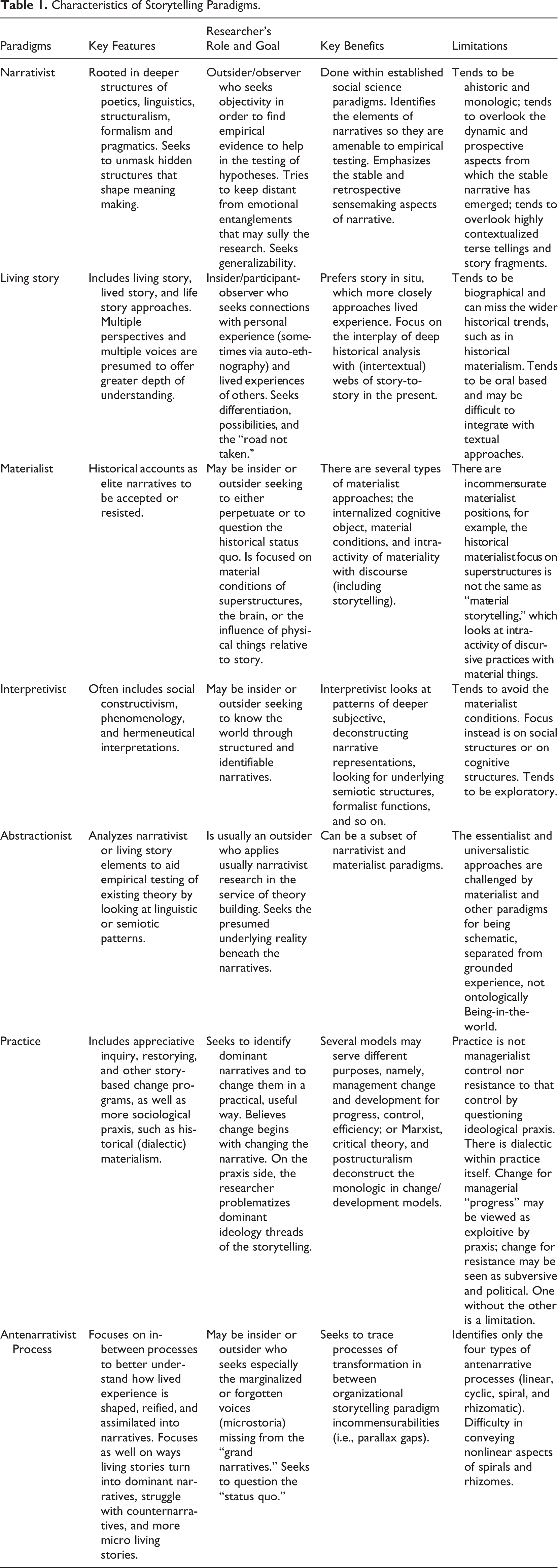
Table 1 summarizes the researcher’s key benefits and limitations that inform choices among the antenarrativist process and organization storytelling paradigms: narrativist, living story, materialist, interpretivist, abstractionists, practice. Each is defined and explained in the following.
Characteristics of Storytelling Paradigms.
Narrativist Paradigm
The narrativist paradigm consists of representative accounts of reality that are unique and generalizable. Fisher (1984, 1985a, 1985b) describes people as homo narrens, yet his focus is on the rhetorical, the probability of the truthfulness of a tale through listening, and the fidelity to the listener’s belief systems. According to Fisher, people also use fidelity to evaluate what they hear in narrative representations against their own experiences and their belief systems. Probability and fidelity demand a narrative rationality of making warrants to bridge grounds and claims. Fisher’s narrative paradigm theory privileges rationality and coherence over living story emergence.
Like Fisher, Czarniawska (1997) says, “A story consists of a plot comprising causally related episodes that culminate in a solution to a problem” (p. 78). In this narrativist paradigm, only certain kinds of stories are admissible. A story must be a “meaningful whole” (Czarniawska, 1999, p. 2); typically this whole represents a beginning, middle, and end (BME) structure. Weick’s (1995) theory of narrative is about retrospective sensemaking of the past. Although Fisher, Czarniawska, and Weick privilege coherence, other researchers extend narrative theory to include a more emergent sense of story. Some researchers, such as Gabriel (2000), on the other hand, view stories as more than narratives, since for them stories generate emotive response on the part of the audience.
Living Story
Living stories are defined as having a material place Being-in-time and part of a collective story. Researchers disagree about how coherent and performative a story must be. Performative stories unfold in the moment and speak to their audiences in order to be relevant, contextualized, and inspirational (Gabriel, 2000). Researchers such as Boje (2008), on the other hand, suggest that a “living story has many authors and as a collective force has a life of its own. We live in living stories” (p. 331). In other work by indigenous scholars (Smith, 1999) or Native American scholars, living stories have a time, place, and mind (Twotrees, 1997) and connect materially to the “life and process of the natural world,” becoming vehicles for the transmission of culture (Cajete, 2000, p. 94). Whereas Western narrative tends to have a beginning, middle, and end, indigenous stories often resist such linearity. For example, in Navajo tribes a story can move in all four cardinal directions: “You start in the east, go south, then west, then north where the problem is finally resolved. Then you return to the east” (Henry Begay, as cited in Eder & Holyan, 2010, p. 28). Finally, indigenous living story, as Vizenor (2008) points out, has a materiality, a survivance of the collective, their material territorial sovereignty, the Native transmotion of these living stories, in an environment (place).
Our point is that a restorying of the past dominant or grand narrative (Lyotard, 1984) into a “new story” of the anticipated future can occur. Some paradigms are more closely aligned, as we shall explore, and in between their more incommensurate natures are antenarrative processes. The living story paradigm, by virtue of its nonlinear and emergent qualities, offers a great deal of compatibility with practice paradigm’s organizational change.
Materialist Paradigm
There are three approaches within the materialist paradigm: micro- and macrohistory, neuropsychology, and posthumanism. In microhistory work (microstoria), the focus is on calling into question the grand narratives of macrohistory by collecting “little people’s” stories. The charge against macrohistory by microstoria is that the former tells only the history of the politicians, business executives, military generals, and other major leaders (Boje, 2001). Neuropsychological perspectives boil the material world down into brain processes by looking at things like how stories impact posttraumatic stress disorder and the rise of the Arab spring (DARPA, personal communication, 2011). Posthumanism is an attempt to move past the anthropocentric perspectives inherent in the linguistic turn and integrate historical materialism (Bennett, 2009).
Interpretivist Paradigm
Interpretivism is a particularly eclectic framework, combining interest in phenomenology, hermeneutical interpretation, interpretive anthropology, symbolic interactionism, and interpretative interactionism with radical and social constructivist thinking (Schwandt, 1996). Interpretivists, such as Geertz, Douglas, and Devereux, seek to unmask the hidden symbolism of stories, reading them as “depositories of meaning and expressions of deeper psychic, interpersonal, and social realities” (Gabriel, 2000, pp. 15-16). Further, Jameson (1981) provides a social symbolic sort of narrative interpretivism. Also familiar to many readers will be the historical hermeneutics of Max Weber (Bauman, 2010). The interpretivist paradigm once included social constructionist work by Berger, Luckmann, and Gergen. Gergen focuses more on the socially constructed aspects that are nonindependently identifiable, while for Berger and Luckmann (1966), the social constructionists have forgotten the subjective origins of their construction, and their constructions are experienced as objective. In modern times though, this regretfully has been transmuted into a much different perspective. Finally, and quite interestingly, Ricoeur (1990) offers a temporal hermeneutics of narrative, an interpretivist perspective that allows for an integration of interesting historical perspectives.
Abstractionist Paradigm
The focus of the abstractionist paradigm is on substituting storytelling experience for abstract labels. Abstractionist inquiry is focused on extracting elements from storytelling so that potentially generalizable facts and claims to truth can be revealed. It is usually an outsider who applies narrativist research in the service of theory building. Unfortunately, this practice has left interesting research questions that are not obtainable without participation outside of abstractionist research. Boje (2011), in a turn in the definition of abstractionist, proposes that the linear and cyclic antenarrative processes allow for both participant observation and a postpositivist scientific abstraction of what has been learned. The trouble with this redefinition of abstractionist is that a transcendent/universalist perspective on such behaviors requires concessions that both objectivist and subjectivist researchers may find offensive.
Practice Paradigm
The practice paradigm includes organizational change and development or the more sociological praxis of ideological critique of institutions. Both involve action and reflection, identifying more entrenched strong organizational culture narratives as well as their living story resistance. Two approaches to practice (as change and development) are restorying and appreciative inquiry. White and Epston’s (1990) restorying theory is a praxis for reconstructing individual and family stories; restorying has been applied to organizations (Rosile, 1998). Restorying involves externalizing the problem-saturated accounts in order to enable people to separate from their dominant narrative and construct a more desirable narrative (White & Epston, 1990, pp. 41-48). Praxis involves active deconstruction of the dominant narrative order that has control over the individual, group, or organization. A second approach to practice is appreciative inquiry (AI), which seeks to supplement a more positive story and discourages collection of negative stories. Appreciative inquiry focuses on the generative potential of positive images, which Cooperrider (1990) calls “anticipatory realities” (p. 96). Both AI and restorying substitute more success-oriented stories for problem-ridden, entrenched, and static organizational narratives. The difference lies in AI’s focus on positive language (discouraging deficit discourse) and collecting positive stories about the past and future as a change strategy, whereas restorying involves a deconstruction and critical inquiry into dominating ideologies running through such narratives, cultivating marginalized points of lived story resistance (or exception) in order to create new stories.
Antenarrativist Process
The antenarrative processes are in between organizational storytelling main paradigms, in particular between narrativist and living story. Antenarratives are mostly in between paradigms and therefore represented by the arrows in Figure 1. Antenarrative is a term with a double-meaning for ante: before narrative cohesion sets in and a bet on shaping the future that is prospective-sensemaking (Boje, 2001). Antenarrative has four types of connection between the dominant narrative and living story: linear-, cyclic-, spiral-, and rhizomatic-antenarrative.
There has been increasing interest in the antenarrative process, such as the work done with the initial formulations (Barge, 2004; Collins & Rainwater, 2005; Durant, Gardner, & Taylor, 2006; Vickers, 2005; Yolles, 2007) and, most recently, Grow (2009), Vaara and Tienari (2011), and Boje (2011). Antenarrative is the process that stands between the incommensurable gaps between organizational storytelling main paradigms. This gap is defined as a parallax “confrontation of two closely linked perspectives between which no neutral common ground is possible” (Zizek, 2006, p. 4).
Applying the Storytelling Diamond Model
We turn now to a different set of storytelling paradigm questions that can lead to insight into how the researcher can uncover more philosophical science concerns with epistemology, ontology, and methodology.
What is the epistemological value of storytelling? Is it a series of unique and generalizable accounts of reality, or is it a phenomenon that explains identity and rationality? Does storytelling give a better understanding of an experienced truth of Being-in-the-world, or does it reflect a reinterpretation of lived experiences? What methods motivate the researcher? Is the goal finding empirical evidence (both qualitative and quantitative) that leads to the testing hypotheses, or is it adding multiple perspectives so that a greater depth of understanding is possible?
We will pause to sum up our main assumptions and model applications. One of the fundamental assumptions concerning the nature of research paradigms is that research questions, and thus outcomes, can vary substantially based on paradigm choices. Application of the storytelling diamond model, then, has value from two perspectives. First, the model highlights for readers and reviewers of research the implicit and explicit assumptions that a researcher has made when using storytelling inquiry and when reporting a study’s findings. Second, the model situates the research question among the various paradigms with an eye toward capitalizing on the key benefits of research from that paradigm. Thus, the storytelling diamond adds to the methodological toolbox of storytelling scholars and allows scholars to better appreciate differing methods that may stem from equally rigorous and consistent, though ontologically and epistemologically different, assumptions.
Next, we examine how researchers can choose among organizational storytelling paradigms. In Table 2, we begin with a research context in the left column. If the situation is one that is faced by the researcher, then the noted paradigm should be considered. If at some point during the research someone using a narrativist perspective finds out that a process understanding of the phenomenon is required, redesigning the research around the living story paradigm is not only possible, but also potentially valuable.
Researchers Choosing Among Organizational Paradigms.
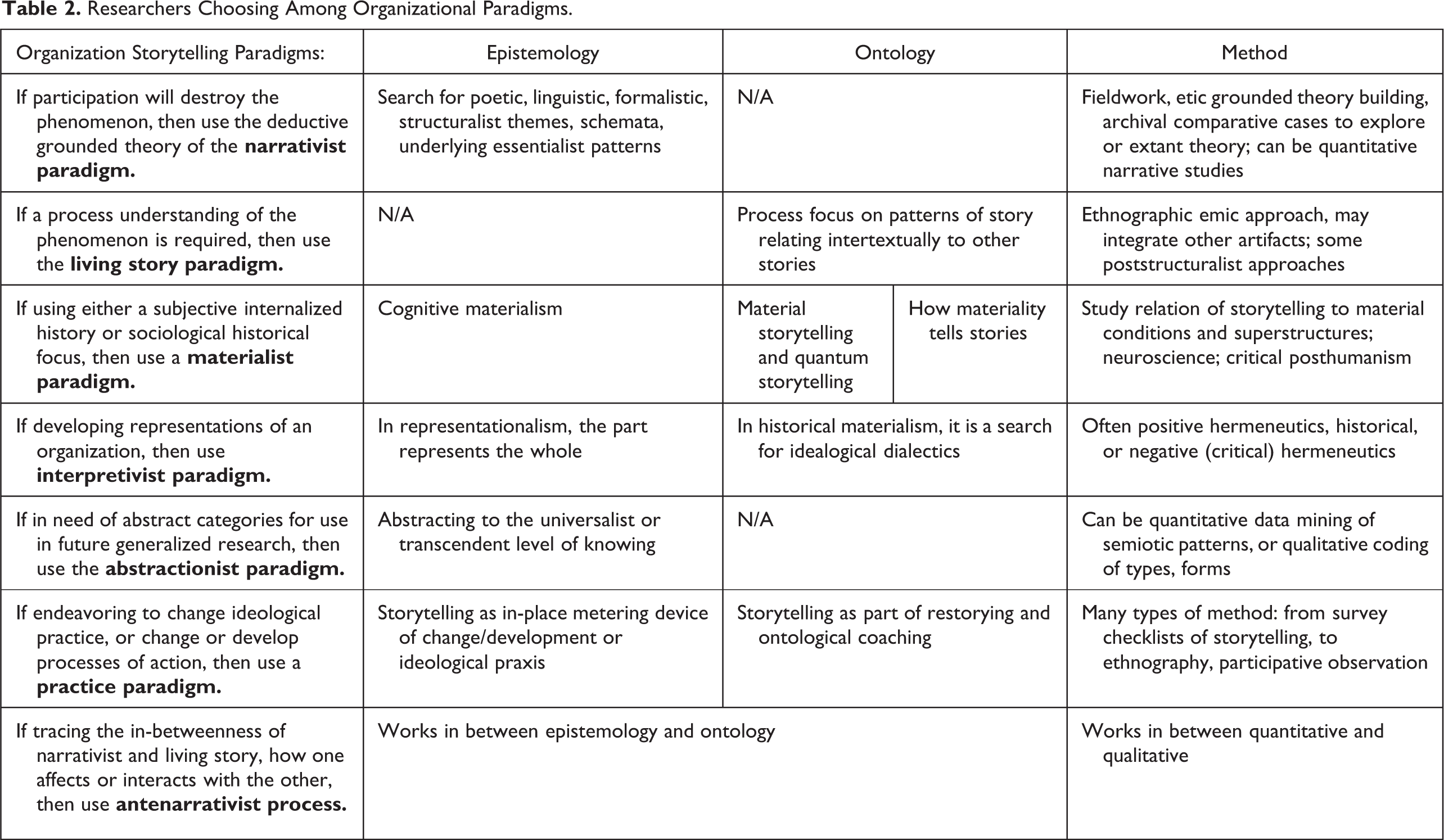
Once the choices have been made, comparisons of epistemology should come first, using the antenarrative process to link any incommensurability between epistemologies. As a check against fundamentally illogical combinations, the ontological assumptions of these epistemological choices should be considered. Again, making compromises through the antenarrative process is highly recommended. Finally, a mixture of methods that best fit the research question should be used, with the potential of gaining a deeper qualitative understanding of any quantitative data that may have been mined from the stories. Greater detail on the exact nature of the antenarrative process can be found in the antenarrative handbook (Boje, 2011).
Table 2 summarizes, in the first column, some of the main considerations in choosing among storytelling paradigms. Then the last three columns look at issues of epistemology, ontology, and method. The intention is to show some places where the epistemology and ontology overlap or predominantly are separated and places where particular methods are chosen more often. In the next section we look at some work that is crossing paradigms in unique ways.
Applying the Model
To see if our storytelling diamond model is useful in understanding published research, we selected a variety of journal articles that use as many differing approaches to living story and narrative as possible. We also wanted to cross disciplinary lines. Namely, we did not focus exclusively on “management” journals or scholars. To identify the narrative inquirers’ uses of storytelling as described by our model, we evaluate the arguments that the scholars postulate regarding the value of story in organizational research. We first identify major and minor premises and conclusions regarding the value of story in organizational research. Next, we ask if these premises and conclusions concern ontological, epistemological, or methodological aspects of story. We end our analysis with a conclusion regarding the researcher’s use of story: Is it primarily surface-level action in the organization, deep structure, or a combination? Using the storytelling diamond model, we discern clearly differentiated paradigms that represent alternative worldviews and basic beliefs about the narrated nature of the world (ontology), narrative knowledge (epistemology), and narrative inquiry (methodology). The following paragraphs provide examples from these paradigms.
Abstractionist Narrativist
For the positivist, an appropriate method in storytelling inquiry is an abstractionist perspective of a narrativist epistemology. This style of inquiry is best used within low dynamical environments by a researcher attempting to generalize across environments of equally low dynamics. The researcher constructs scales that can then be used across phenomenon with theoretically similar contextual variables. For example, in studying organizational change, Heracleous and Barrett (2001) build an abstractionist discourse analysis methodology based on a narrativist epistemology. These authors conclude that narrative has consistent structural properties that point to underlying reasons for the success or failure of a change effort: Our strategy was to interview, within each organization, both individuals who actively used the system and those who did not, so as to compare and contrast their interpretations of key systems features. (Heracleous & Barrett, 2001, p. 760) Our analysis supports a view of organizations as constituted of fragmented, competing, and less often, complementary discourses. (pp. 773-774) Such conflicting discourses can attain the status of system contradictions . . . that have highly adverse effects on the implementation of system wide change processes. (p. 774)
This epistemology informs a methodological intent to abstract what has been found. For example, Heracleous and Barrett (2001) also wrote, We focused on the stakeholder-group level of analysis, exploring the discourses of different stakeholder groups and how they interacted. We focused, in addition, on the market level of analysis in terms of change actions and outcomes. Analysis at these levels presupposed the collection of ethnographic data based on in-depth interviews and observation of individual actors. In this sense, data collection encompassed the individual level, so that we could draw valid inferences at higher levels of analysis. (p. 759)
Contrast Heracleous and Barrett (2001) with Jabri’s (1997) materialist study of organizational change. Jabri builds an abstractionist, narrativist discourse, concluding that discourse itself is inadequate when studying change: Theorizing on change is not past in an objective sense; it is a past that is continually brought forward—often shown and re-remembered through pictures and images. Our memories of the pace of change, restructuring and other episodes (pictures) are a significant part of the myth by which we communicate our experience of change. (p. 28)
Jabri (1997) assumes that narratives reflect the reality of multiple levels. The informant is a tool for obtaining narratives, which are tested against the objectivity of key system features. This method of assessing the veracity and generalizability of a narrative is strongly recommended for a study of the managerial implications of the narrative.
Both examples (Heracleous & Barrett, 2001; Jabri, 1997) illustrate abstractionist, multilevel storytelling inquiry, but the conclusions drawn from studying multiple levels vary greatly. Heracleous and Barrett (2001) contend that studying multiple discourses can uncover significant elements affecting change. By exploring discourses from differing stakeholder groups, they build a number of linear cumulative accounts that help reflect the underlying narrative of interest. Heracleous and Barrett assume that informants’ information reflect the truth of the narratives of interest. After combining the narratives, Heracleous and Barrett reject a null hypothesis regarding the similarity of groups on differing levels and stakeholder contexts. But when employing a materialistic perspective, Jabri (1997) offers a different picture of change: “There are indeed issues in change that cannot be put into words” (p. 26).
While the abstractionist perspective is popular among researchers, a practice perspective may be useful when theory regarding substantive contextual elements has not been properly built. Simply put, a researcher who upholds the abstractionist assumptions of synthesizability and generalizability might fail to see dynamic differences among situations. A way to expand the researcher’s abstractionist approach is to add a praxis-based methodology to the researcher’s narrativist epistemology.
Practice Narrativist
The praxis methodology with narrativist epistemological assumptions offers a useful extension to the abstractionist view. Further, it is a rigorous and consistent research methodology when used on its own. Offering a stark contrast to the assumption of the objective observer in pure positivist science, the practice approach adds depth instead of complexity. A practice perspective is apparent in the work of Gabriel (1995): The workers, it is argued, may submit to management’s cultural assaults but they also resist them, by developing their own sub-cultures and counter-cultures. These may challenge or ridicule the organization’s shibboleths, expressing cynicism and detachment at managerial attempts to whip up commitment and enthusiasm. . . . In this paper I will argue that both debates have tended to adopt an over-managed and over-policed image of organizations, an image in which both politically and symbolically the individual is over-controlled and over-socialized, his or her options being essentially to submit or to rebel. (p. 478)
Practice Materialist
We contrast Gabriel’s (1995) perspectives with those of Dunford and Jones (2000), who adopt a materialist ontology in studying the same phenomenon. Dunford and Jones conclude that the role of managers in any change process “involves the constituting of a new reality in the minds of organizational members.” At times of change, organizational members will construct an interpretation of events and of the implications for them (sensemaking). The senior management of an organization cannot prevent this process occurring, but they can seek to have a major influence on the interpretations that are arrived at by presenting their own construction of events (sensemaking). (p. 1208)
The practice perspective encourages multiple voices. Yet, the way in which the voices are heard varies greatly from encouragement (Gabriel) to silencing (Dunford and Jones). Praxis assumes that the data-tool, that is, the narrator, has changed the narrative in a way that is useful for the individual and moves past the simple linear reflection of reality of the abstractionist. Praxis looks at the identity and rationality that are created by manner of speech. Further, the quotes from Dunford and Jones (2000) reflect a motivation for a solution to the detachment and cynicism that are prevalent in taking a purely managerial approach in organizational science.
Practice Antenarrativist
The influence of the antenarrativist epistemology on methodology is one that has been orthogonal to the assumptions of the abstractionist method. While the antenarrativist epistemological assumption is focused on goals related to the creation of an identity for repressed minority groups, the abstractionist tries to mitigate such contextual differences in an attempt to find a generalizable process. The antenarrativist crisscrossing between ontology and epistemology (see Table 2), while creating frame-breaking research has also been primarily limited to a practice perspective and, thus, has been more palatable to the positivist mind.
Materialist Antenarrative
An exemplar of antenarrative research that utilizes a materialist ontology can be found in the Mills, Boylstein, and Lorean (2001) article on organizational culture in the Saturn Corporation. They conclude that organizational storytelling acts to silence and marginalize workers: The link between organization and a sense of community, affiliation and the development of “team player identity” is communication, or more specifically for this analysis, storytelling. Through storytelling, metaphors arise and the individual and organization develop shared meanings of what “community,” “affiliation” and “team membership” encompass. However, as stated, this style of meta-narrative is oppressive and tends to silence various voices that do not adapt their communicative behaviours to the constructed “team player” discourse. (p. 124)
The interpretivist perspective on the phenomenon of organizational culture and the role that storytelling plays is clearly different as demonstrated by Humphreys and Brown (2002): It is suggested that identity, both individual and collective, and the processes of identification which bind people to organizations, are constituted in the personal and shared narratives that people author in their efforts to make sense of their world and read meaning into their lives. (p. 421)
What is the difference in praxis methodology under an antenarrative working in between epistemological and ontological assumptions? The difference comes in the integration of a sensemaking epistemology that underlies a metanarrative and whether that integration is supportive or oppressive of conditions of “Being.” Furthermore, the teller of the living stories is assumed not to be reflecting an overarching truth, but rather an essence of self that is embodied in the recreation of stories for personal use. With the antenarrative motivation having been changed from the service of management to the service of the disenfranchised (a change in praxis), the multiple perspectives create a deeper understanding. In contrast to the positivist perspective, the antenarrative scholar is an agent for disenfranchised voices. These voices are heard in the previous quote and in their implied resistance to assumed molds. The active motivation for the desired outcome of resolving conflicts hovers around the intention to redistribute power to those who have now been given voices.
Narrativist Living Story
To see an illustration of a combination that does not work, consider the storytelling diamond model and the juxtaposition between narrativist and living story. In Table 2 we see that the methodological assumptions of the narrativist paradigm are incommensurate with the desires of living story. Narrativists want to find the underlying reality of the situation and thus keep themselves from interfering with the storytelling that they are observing. Living story assumes that this is an impossibility, as any level of interaction with the ongoing storytelling process, even just having the story repeated, is itself a part of the process. Furthermore, living story methods require that a deep experiential understanding of the situation take place, as the depth of meaning of lived stories only becomes salient when the experiential context is part of the experiences of the researcher.
It is a logical impossibility to design research wherein the organizational scholar is both constantly distant and actively observant. Attempting this can be a common mistake made by researchers who come from a postpositivist perspective. When the need for deep understanding becomes obvious, new storytelling scholars may still try to say they are using grounded theory in a way that matches the assumptions of postpositivism.
Abstractionist Living Story
The antenarrative process works between quantitative and qualitative and between epistemology and ontology. By using an antenarrative perspective, the link between living story (the necessary method for many research questions) and abstractionist (the epistemological home for many Western scholars) can be brought together. The first step here is to accept that the living stories of one group may be something that helps in understanding another group, an antenarrative concession from the anthropological camp. The second step is to accept that being part of the process is essential to understanding and offers better knowledge than keeping clinical distance, an antenarrative concession from the postpositivist camp.
If there are questions that can only be understood emicly, such as a deep description of process that must be experienced to be understood, then research should be designed around living story. If the audience with whom the scholar wishes to converse is in need of abstractions in order to value the findings, then the deep descriptions of living story should be turned into abstracted categories. It is through a tracing of the potential in between singular narratives and the living stories that antenarrative can link the potential abstractions with the lived experiences. This sort of research will go beyond the monologist categorizations of most abstractionist responses while still providing the usable, but now contextually valid and logically consistent, categorizations that appeal to the scientific assumptions of scholars in the United States. This might look like the abstraction categories that we see in grounded theory; however, in our final section, we propose that in more spiral and rhizomatic antenarrative processes, the focus is on more abductive research inquiry not driven by deductive theory categories.
Situating the Research—Guidelines for the Reviewer
Based on this in-depth approach to understanding storytelling research, a natural question emerges: On what basis will submissions employing storytelling research be adjudicated in the review process? 1 Do reviewers apply to storytelling research the same criteria as applied to other qualitative research? As Easterby-Smith et al. (2008) point out, reviewers and editors must be “informed as to how articles ought to be shaped and judged relative to the traditions from which they emanate” (p. 423). Our storytelling diamond provides that guidance to reviewers so that they can review storytelling research outside of the traditions within which the reviewers might operate, applying criteria consistent with the ontological, epistemological, and methodological traditions of storytelling research.
The criteria used to judge storytelling research are akin to the criteria used to judge ethnography, as provided by Denzin (1997), who distinguishes analytic and storied approaches. Similarly, we distinguish etic and emic approaches to storytelling. An etic approach is abstractionist and based on congruence with existing theory as well as ability to add to the theoretical base. Etic research is incremental and values repeatability; it intends to grow a twig on a branch of a much larger tree. Emic research is oriented to praxis and based on congruence with lived experience and the ability to engage the imagination. Emic research wants a new tree; it values novelty over repeatability. Although the etic researcher is a neutral observer, the emic researcher is an involved participant. In terms of storytelling research, the etic researcher is a narrativist, and the emic researcher is an antenarrativist.
Table 3 gives some guidelines for assessing rigor in the various storytelling paradigms. Pratt (2008) points to a lack of “boilerplate” for evaluating qualitative research: namely, a lack of “standard operating procedures for evaluating qualitative work” (p. 489). Pratt suggests the creation of “checklists” that “point out what elements need to be part of a Method section” (p. 502). According to Pratt, the elements can be “viewed as a series of four nested questions” (p. 502): (1) “Why this study?” (2) “Why study here?” (3) “What am I studying and why?” and (4) “How did I study these things?” Ultimately, as we have demonstrated throughout this paper, criteria for evaluation is dependent upon the paradigm chosen. Narrativist, living story, interpretivist, materialist, abstractionist, and practice organization paradigms have their own socialized community of practice, and therefore their own criteria for rigor. It is inappropriate to use one paradigm's criteria for rigor to denigrate another paradigm, unless the focus is to be cross-paradigm. Rather, we recommend translating the rigor criteria into the rigor criteria of the opposed paradigm. For example, in ethnostatistics, the work is about how to use interpretivist rigor criteria (the qualitative) to look at the steps empiricists used to construct numbers, use statistical packages in ways that violate the mathematical assumptions, and use rhetoric to interpret the next-steps of research or the way number tables are to be read and understood. Thus, although a storytelling boilerplate or template may not be possible, researchers should address these four questions, and reviewers should be able to identify the answers to these questions in storytelling research. Our checklist, which follows Pratt’s outline for choosing among the organizational storytelling paradigms, is found in Table 3.
Checklists for Reviewers.
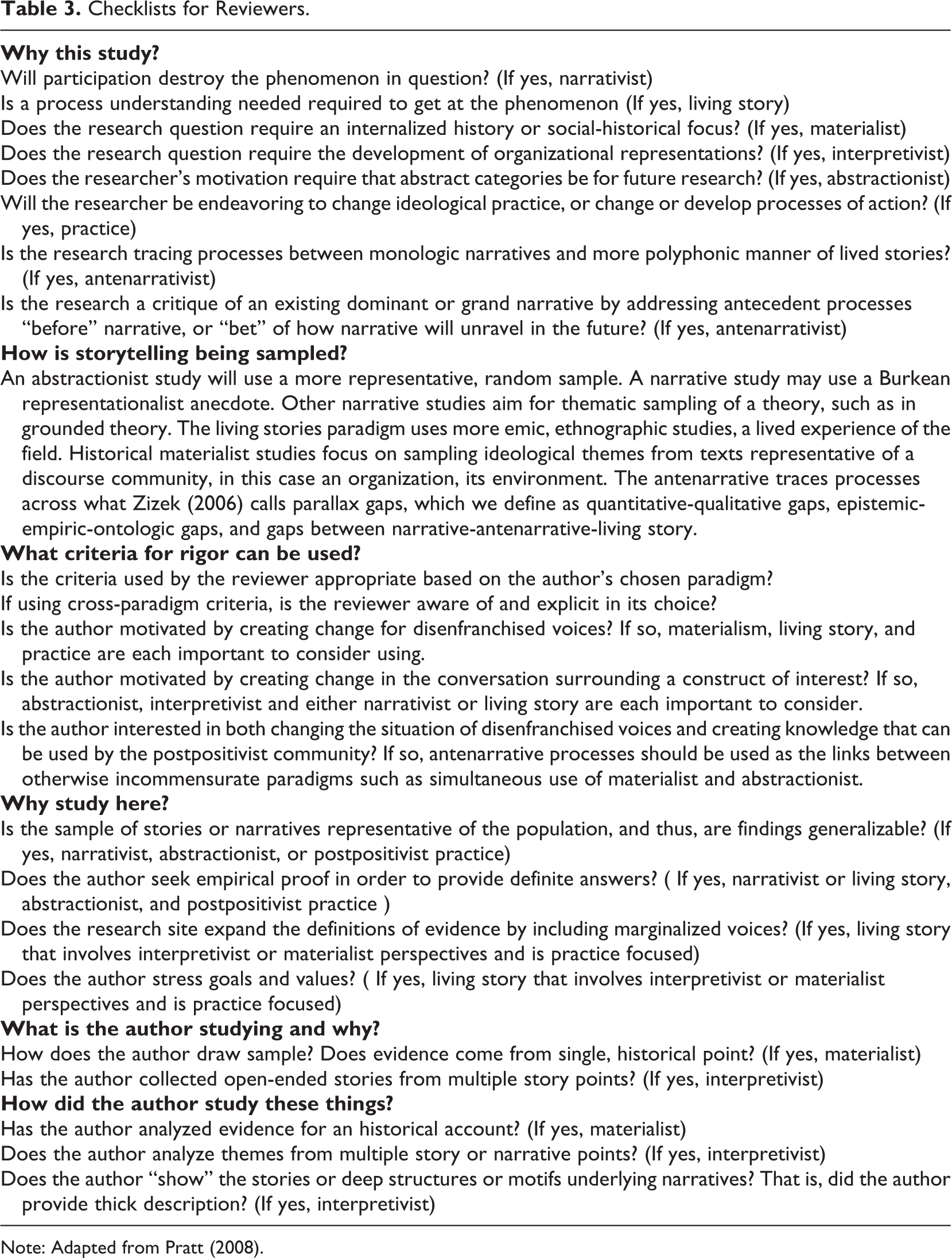
Note: Adapted from Pratt (2008).
Situating the Research—Guidelines for the Researcher
Just as with other forms of qualitative research, storytelling research draws from and is shaped by different theoretical paradigms. Successful execution of this research requires a systematic, detailed, and nuanced approach that results in well-supported research claims. The storytelling model helps a researcher create robust, rigorous storytelling research through a multi-element iterative process that matches ontological and epistemological assumptions with appropriate methods. Table 2 summarizes the characteristics of the six paradigms that constitute the storytelling diamond model.
From a researcher’s perspective, the first major step in situating storytelling research is identifying ontological assumptions—the underlying belief structure of the researcher regarding the nature of being and the essential properties of the human experience. In storytelling research, the question is one of the nature of story and whether it is seen as a reflection of reality (materialist) or as constituting reality (interpretivist). This dimension is in many ways static because while a researcher’s ontological perspective may evolve over time, it is what it is. Thus, this step is one of acknowledgment of the existing ontology, not one of creating or choosing an ontology.
The second step in situating the research regards its goal: Does the researcher intend to uncover existing reality through story (abstractionist) or change the dominant reality (praxis)? Abstractionists prefer predefined categories of stories, such as morality tales or personal success stories, while praxis-oriented researchers prefer to collect stories in situ, which more closely resembles lived experience. This is especially critical when, for instance, the researcher is attempting to compare high- and low-context cultures.
Finally, there is a decision point regarding methodology and how the researcher intends to use data that are collected from stories. The first category is the more traditional narrativist approach to storytelling wherein data are collected, organized, and interpreted based on established theory and proven categorization. This is a “researcher as observer” perspective on data collection. The second possibility is an antenarrative approach that collects stories as they are being played out in lived experience without regard for whether these stories are yet complete.
While the eight paths depicted in the storytelling model are theoretically possible, some combinations are more “natural” fits than others because characteristics of each paradigm can pose theoretical dilemmas. For instance, since narrativist researchers typically prefer etic methods, existing narratives are the empirical evidence used to test hypotheses. Sensemaking is retrospective as individuals reflect on these existing narratives. Thus, narrativist researchers are typically abstractionist oriented. Narrativists also tend to be interpretivists, in part because they assume that the world is knowable through structured and identifiable narratives that are interpreted within existing theoretical frameworks. These narratives form the basis for social and historical processes of meaning making.
A significant drawback to narrativist research concerns the lack of consistent definitions for phenomenon studied across contexts. For instance, personal success may be defined very differently in individualist versus collectivist cultures, leading to misinterpretations of stories. Narrativist approaches, if used at all in emic research, must be used with great care taken to validate the externally imposed categories within the specific cultural context.
This approach may use deconstruction or other analytic methods to reveal the way lived experience becomes “living story” and then may be transformed into narrative. The antenarrativist perspective allows for the study of the same phenomenon across different contexts, especially when the phenomenon is experienced very differently. For example, indigenous storytelling and Euro-Western storytelling can be studied simultaneously, even though the two are very different. Similarly, high-context cultures and “strong” cultures that may have more terse and cryptic narratives than other cultures can also be studied successfully with the different archetypal “antenarrative” formats such as linear, cyclical, spiral, or rhizomatic assemblage patterns.
A major challenge with antenarrative research is the difficulty in generalizing findings to other contexts. Another danger exists if the dominant narratives are not deconstructed because their material conditions may be overlooked. Such an oversight might constrain possibilities for change in those same material conditions.
Conclusion
As we began this study, the one question that arose repeatedly was: How can scholars benefit from clarity in storytelling paradigms or from just knowing that distinctive paradigms exist? We have concluded that benefits accrue in two ways. The first is in richer research designs, and the second is in wider acceptance of storytelling paradigms as vigorous, creative, defensible scholarship.
The richness of a research design can be enhanced in two ways. First, the storytelling diamond model can be used to decide what methodology is most appropriate for the research goals. Second, the model can be used to help extend existing research by providing additional perspectives to study the use of story and storytelling inquiry in organization studies.
One of the advantages of storytelling inquiry is that it is useful at both the theoretical and applied levels. For instance, assume that a researcher is interested in understanding why different actors are telling very different stories about an organizational event. From a theoretical perspective, storytelling inquiry can be used to add context to the stories, thereby giving them meaning and helping to interpret those stories. Stories can be collected, analyzed, and categorized to provide a clearer picture of the differences underlying the varying versions of the event.
At the applied level, again assume that a researcher is searching for managerial tools that work in a given organization situation. Storytelling inquiry can help identify the conditions and processes that are most effective. In fact, this approach to storytelling inquiry allows for a multitude of research designs. Scholars may conduct field studies, collecting data via observation or interview. Alternatively, the researcher may create an experimental design, thereby testing the viability of a range of tools in multiple situations. By using the storytelling diamond model, the researcher has the flexibility to create a unique research design while maintaining precise and rigorous standards that are necessary in organization science.
Extending existing studies is another benefit of using the storytelling diamond model. Typically, scholars adopt a consistent perspective when choosing research designs. Choices are made regarding ontology, epistemology, and methodology. One wonders what would happen, for instance, if scholars who had previously adopted a particular perspective chose to extend their scholarship by seeing what else could be learned with a different lens. We are not suggesting that the scholar should have used a different lens, only that the knowledge gained could be extended with multiple perspectives. For instance, because of the nature of an interpretivist lens, the scholar assumes that narrative is socially constructed and gives equal weight to stories from any and all subjects. Thus, the findings are predicated on the assumption that all stories are created equally. But what happens if the scholars choose to extend their research by adopting a materialist lens and ask the question, Are some of these stories privileged over others? Are some of the stories actually elite narratives that have greater influence in the construction of the objective reality? How do their results change when some narratives are privileged over others? Again, it is not our intention to claim that the scholars should have used a different lens, only that the richness of their study can potentially be enhanced through multiple lenses.
We do suggest that the richness of organization science overall can be enhanced with the rigorous use of storytelling inquiry. The application of the storytelling diamond model provides an interesting window into our acceptance and use of story and storytelling inquiry as a viable approach to organizational research. The model helps us assess the objective reality of storytelling as a qualitative methodology and asks the question, Does a storytelling methodology adhere to sufficient rigor to meet scientific standards? We suggest that it can, as long as the assumptions inherent in the research are clearly articulated and understood by both the scholars who create the research and those who use it to further our understanding of organizations and human interaction. We hope that the storytelling diamond model can help explain why there is value in research methods that reject generalizable conceptualizations in favor of deep description, thereby giving voice to previously disenfranchised methodologies.
We note that practice is not a unitary concept. Practices, in organizational development and change, are not the same practices as praxis in sociology or Marxist ideological critique. Nor are they the practices familiar to positivist or postpositivistic methods, such as survey research feedback done to change practices. Instead, practice is the fundamental outcome desired by the research design. Despite the interested-party nature of practice, postpositivism often hides its move toward practical change in the organization being studied under a thin veneer of pragmatism.
Finally, researchers who are looking at ways of extending organizational inquiry through more expansive narrative might be interested in quantum storytelling and the role that living story plays in it. “Living story” has the potential to open a new door into interpreting narrative not as a coherent, linear account of events but as a living entity itself.
In creating the storytelling diamond we suggest that researchers have more options than previously believed when using story and storytelling in their studies. Furthermore, we help clarify research design so that both implicit and explicit assumptions about narrative are more clearly defined and understood within storytelling inquiry. Our goal has been to offer a guide to the expanding field of storytelling inquiry while increasing rigor and quality in storytelling research designs.
Footnotes
Appendix A
Appendix B
Acknowledgments
We thank the participants in a cross-divisional “storytelling” symposium at an Academy of Management annual conference who served as the impetus for this article. We also gratefully acknowledge and thank ORM Editor Dr. Jose M. Cortina, Feature Topic Guest Editor Dr. Robert Vandenberg, and the anonymous reviewers for their insightful comments regarding the first drafts of this article. We appreciate Carolyn Gardner for her comments on earlier drafts.
Note
Declaration of Conflicting Interests
The author(s) declared no potential conflicts of interest with respect to the research, authorship, and/or publication of this article.
Funding
The author(s) received no financial support for the research, authorship, and/or publication of this article.