



Abstract
Gaining access in fieldwork is crucial to the success of research, and may often be problematic because it involves working in complex social situations. This article examines the intricacies of access, conceptualizing it as a fluid, temporal, and political process that requires sensitivity to social issues and to potential ethical choices faced by both researchers and organization members. Our contribution lies in offering ways in which researchers can reflexively negotiate the challenges of access by (a) underscoring the complex and relational nature of access by conceptualizing three relational perspectives—instrumental, transactional, and relational—proposing the latter as a strategy for developing a diplomatic sensitivity to the politics of access; (b) explicating the political, ethical, and emergent nature of access by framing it as an ongoing process of immersion, backstage dramas, and deception; and (c) offering a number of relational micropractices to help researchers negotiate the complexities of access. We illustrate the challenges of gaining and maintaining access through examples from the literature and from Rafael’s attempts to gain access to carry out fieldwork in a police force.
Researchers must thoughtfully consider whether they have the personal sustenance and resilience for the countless phone calls, follow-up emails, and “courtship rituals” required in order to get access to their chosen scene of study.
Access tends to be dealt with as one of the practical, unreflexive stages of research, and most of what has been written is based on the idea that researchers are granted access if they have a correct set of strategies and are able to manage certain aspects of their relationship with the field (Bell & Thorpe, 2013; Bryman, 2012; Silverman, 2010). This reflects the supposition that access is a linear, neutral, and instrumental task with little or no ethical consequence (Alcadipani & Hodgson, 2009) and that once access is obtained, the fieldwork experience is relatively unproblematic. By framing access in this way, we are in danger of producing a sanitized and anodyne account of our research, which disregards the uncertainties and complexities of the field and oversimplifies the research experience. It also means that we may ignore significant sources of data about the organizations and people we study because the experience of gaining and maintaining access can itself tell us a lot about practices, processes, and power in the organizations we want to study.
In addition, researchers often work in complex social situations and the importance of access can be minimized by (a) viewing it solely as a sampling issue (i.e., the number of organizations/interviews required); (b) attributing too much agency to the researcher and very little to organizational members, or vice versa; (c) ignoring its temporal nature—that access “shapes the inquiry process from beginning to end” (Freeman, 2000, p. 359); and (d) ignoring the political and ethical choices that both researchers and organizational members may encounter before, during, and after fieldwork. As Jack and Westwood (2006, p. 488) note, this omission of “the politics of production and representation” is often fueled by the push toward objectivity, neutrality, and researcher–researched distance in positivist, neo-positivist, and traditional interpretive qualitative research. While we might have a clear research design and project management plan in place, organizations are fluid, complex, and pluralistic with embedded power relationships that may or may not be obvious. Organizational members have their own goals and interests at heart, which often do not coincide with the interests of researchers, who may find themselves facing stipulations, obstacles, and even contradictory requirements when trying to obtain and maintain access.
We need to “relax the taboo” on telling our own stories (Anteby, 2013) and be more reflexive about the politics of knowledge production (Jack & Westwood, 2006) and of our own practice as a means of sharing valuable learning experiences. Crafting qualitative research that generates more exploratory and embedded forms of knowledge requires us to be sensitive to what’s going on around us (Cunliffe, 2011), which means acknowledging the intricacies, challenges, and political and ethical implications of negotiating access and building relationships with research participants.
The purpose of this article is to draw attention to the multifaceted, nonlinear, opportunistic, and sometimes serendipitous nature of access by framing it as an emergent and political process of immersion, backstage dramas, and deception. We build on Feldman et al.’s (2003) claim that access is relational by conceptualizing three different forms of researcher–research participant relationships and elaborating a relational perspective that captures the agentic and reciprocal nature of this relationship. Finally, we offer examples of micropractices that may help researchers make more informed choices around gaining and maintaining access. Understanding access in this way is particularly important when engaging in longitudinal studies, in-depth interviews, participant observation, action research, and case studies because these forms of data collection require close relationships with members of the research site.
Throughout the article we illustrate the challenges of gaining and maintaining access through examples from the literature and Rafael’s attempts to gain access to carry out fieldwork in a police force (PF) in Latin America. The ex-post conceptualization is based on our retrospective sense making of Rafael’s experience. We begin by defining access.
What Is Access?
Access is variously defined as obtaining permission to get in to the organization to undertake research (primary access), and building relationships to gain access to people and information within the organization (secondary access; Brannick & Coghlan, 2007). At a minimum, this means opening the door to an organization, perhaps to interview or survey a group of people over a short period of time. At a maximum, it may involve getting consent “to go where you want, observe what you want, talk to whomever you want, obtain and read whatever documents you require, and do all this for whatever period of time you need to satisfy your research purposes” (Glesne & Peshkin, 1992, p. 33). This can be a time-intensive process that may involve contacting and negotiating with multiple organizations and organization members—who may or may not respond to requests—before a door opens. And while primary access may be granted, secondary access can be challenging as once inside the organization we may find multiple hallways with multiple doors that open and close at any time and are monitored by various gatekeepers (Feldman et al., 2003). These challenges are faced not just by researchers going into the field as an outsider, but also by “insiders” researching their own organization: Crossing departmental boundaries can be difficult and insider-researchers have to balance research requirements with the expectations of their boss (Brannick & Coghlan, 2007).
Becker (1970) talks about access as a research bargain, “a set of loose promises and expectations held by both researcher and hosts as to what will occur before, during and after the study” (Van Maanen, 1978, p. 327). A research bargain is particularly important in secondary access, where subtle negotiation of relationships of trust may need to occur throughout the research. This foregrounds the importance of viewing access as relational (Feldman et al., 2003): a relationship, as we propose later, that may take instrumental, transactional, or relational forms.
The extent and form of access also varies depending on the nature of the research and the type of data required. Secondary data required for quantitative analyses and macro-level studies can often be obtained without having to gain direct access to an organization. Access and freedom of information laws mean that records and information held by various levels of government are available to researchers in at least 80 countries across the world (Walby & Larsen, 2012): data that can provide the basis for both quantitative and qualitative studies. As an example of the latter, textual, discourse, and symbolic analyses of various aspects of organizations can be carried out using data obtained from publicly available sources including government reports, databases, company reports and documents, media statements, anonymized surveys, and web-based resources. But for researchers planning to study culture, in-depth social interaction or unfolding organizational transformations (e.g., Haragadon & Bechky, 2006; Vaast & Levina, 2006), and the “common sense thinking” of organization members (Bryman, 2012, p. 30), then primary data and direct access to people, meetings, and events are essential. Longitudinal qualitative data collection and ethnographic fieldwork can present particularly challenging access issues because they require the researcher to become immersed “overtly or covertly, in people’s daily lives for an extended period of time, watching what happens, listening to what is said, and/or asking questions” (Hammersley & Atkinson, 2007, p. 3). Only in this way can rich, thick, and particularized descriptions and interpretations about the lives of people in a particular context be generated.
Suggestions for how to obtain access include using personal, social, professional, and institutional networks (Bryman, 2012; Gill & Johnson, 2002; Hammersley & Atkinson, 2007); relying on luck by cold calling a selected person in the organization (MacLean, Anteby, Hudson, & Rudolph, 2006); obtaining “bottom-up” access with frontline employees as well as top managers (Silverman, 2010); “hanging around” (Ashforth & Reingen, 2014); and even “enrolling” in the organization. For example, for his study of the craft of boxing, Loïc Wacquant (2004) gained access (initially covertly and after 16 months by approval) by becoming a member of a boxing gym—training three to six times a week, being a sparring partner, attending tournaments, and socializing with the boxers over a period of 3 years. Researchers may have to resort to creative forms of access, as exemplified in Reiter’s (2014) study of mass incarceration in U.S. supermaximum security prisons. On encountering a number of barriers to access, she found herself collecting data from written accounts and historical records; volunteering as a college instructor in a medium-security prison; talking to prison advocacy organizations, former prisoners, and prison workers; collecting oral histories from the prison designers; obtaining archival documents; and talking to and collaborating with other researchers in the field.
Finally, while access is a concern in all types of fieldwork, it may be surrounded by specific difficulties if the research is in “unconventional” contexts (Bamberger & Pratt, 2010); with organizational elites such as CEOs or corporate boards (Welch, Marschan-Piekkarib, Penttinenc, & Tahvanainenc, 2002); in organizations concerned with security such as the government, military, the police (Dick, 2005; Van Maanen, 1974); or in organizations involved with scientific, personal, commercial, informational, or technologically sensitive issues and products. In these types of organizations, as we will show, bureaucratic requirements, suspicion, and political machinations can prevent or limit access. They can also raise a number of ethical issues in relation to the work of the organization and the positionality and responsibility of the researcher.
We argue that gaining and maintaining access entails recognizing its complex, political, ethical, and relational nature, which requires researchers to take responsibility for respecting the position and values of research participants and for understanding the potential consequences of their actions. In other words, it goes far deeper than the procedural requirements of institutional review boards, human subject committees, and ethics committees to obtain informed consent and protect the welfare of individual subjects. In a number of places, including the United Kingdom, North America, and Australia, the days when fieldworkers could, with ease, gather data based on informal consent or on a covert undercover basis (e.g., Dalton’s 1959 study of power and politics was based on his observations while working as a manager in a U.S. factory) are gone because of informed consent requirements. Indeed, Rosenhan’s (1973) article on how eight “sane” fieldworkers got themselves secretly admitted as patients in a U.S. psychiatric hospital—and then found it difficult to get released because even though they claimed they were “normal,” they had been categorized as “insane”—offers an illustration of the dangers of covert approaches!
We will illustrate the intricacies of access by offering an example from an ethnography carried out by Rafael in a PF in Latin America. The purpose of the research was to examine management practices within the institution by observing the day-to-day routines of a unit. Because of the focus of this article, we present information not on data collection, analysis, and findings (which will be covered elsewhere), but on the process of gaining and maintaining access. The study is of particular interest because access was formally authorized in 2012, but informally restricted in practice and the research never started. However, in November 2013, after major riots in June 2013, Rafael was able to gain access to carry out an ethnographic study with the PF and observe them dealing with demonstrations and riot control. His experience therefore illustrates the politics and ethics of both success and of failure. It shows how gaining and maintaining access in fieldwork is influenced by numerous factors including the social context of the organization; its micro-politics; and the researcher’s sensitivity to the field and ability to identify access issues, respond to opportunities, and establish relationships of trust. The access stories that follow are from Rafael’s field diary, written over a period of almost 2 years.
The Illustrative Study: Gaining Access
This example was selected because it illustrates the political, ethical, and relational nature of access through an initially unsuccessful, then successful attempt to gain access to carry out an ethnographic study in a PF in Latin America. As Van Maanen (1978, p. 311) commented, “The police are quite possibly the most vital of our human service agencies. Certainly they are the most visible and active institution of social control.” In some Latin America countries, PFs are responsible for riot control and crime prevention. In countries such as Mexico, Venezuela, and Brazil there are very high rates of robbery, drug-related crimes, rapes, kidnapping, and murder and the sensitive, dangerous, and sometimes controversial nature of police work often means that gaining access to these organizations is difficult.
In addition, despite, or perhaps because of these work conditions, PF officers have a profound love of their organization, and some officers take any criticisms of the institution as a personal attack. They are therefore extremely suspicious of researchers and academics have major difficulties gaining access and collecting data within the organization. Officials are concerned that research reports may portray the institution in a damaging manner. Academics who criticize the police are considered to be “non-friends of the PF,” their access is cancelled, and they are rarely authorized to do research in the organization again.
Access Attempt 1
The first access attempt took place when Rafael discovered that an acquaintance had frequent contact with a PF Commander. He agreed to talk to the Commander about Rafael’s interest in studying the organization, but emphasized that they were not very open to outsiders. Some time later, he gave Rafael the Commander’s business card, saying he was interested in the research and Rafael should email him to set up a meeting, which he did immediately. The Commander replied, asking him to call and schedule a meeting.
A few days later, Rafael called and spoke with Private N, who was extremely polite and transferred him to Major P who, when he knew what it was about, transferred him to Major D who scheduled a meeting in the Commander’s diary. Arriving at the site clean-shaven, in a suit and tie, and with a formal printed research proposal encased in a presentation file, Rafael found himself meeting the Commander and six high-ranked PF officials, armed men in uniforms covered in insignias and stars, who appeared unfriendly. Despite comments that they were “very open,” the research proposal didn’t seem to generate a lot of enthusiasm and Rafael was told that ethnography is “unscientific” and that “proper research uses statistics.” He was therefore surprised when at the end of the meeting he was granted formal access. But in the following months, each attempt to visit the field was unsuccessful as PF officials continually identified difficulties such as the need for another official university letter or refusing access for “security reasons.” Discovering that this was not unusual, he finally gave up—the PF would never say no, but they would also rarely allow the research to start. Trying to start the fieldwork felt like a Kafkaesque process of endless bureaucracy, new formal approvals, and rotating doors that led back outside.
Access Attempt 2
The second attempt took place about one year later. The country was in turmoil, with protests erupting every day. Rather than going the route of formal access approval, Rafael decided to be more opportunistic and observe the police on the streets as they dealt with demonstrations. He turned up at every protest and gave his business card to the official in charge of the operation. At first, senior officials were surprised and annoyed that an academic was hanging around trying to study their work—particularly as they were under extreme pressure as a result of media criticism that they were using disproportional force against demonstrators. After some months, officials at the demonstrations started to act in a friendlier way and Rafael was called to make a formal presentation about his research to a number of officials. The top PF commander in the city, Colonel S, attended the meeting and a number of informal conversations about the demonstrations ensued. Anticipating a more open response, Rafael then visited the Colonel to ask permission to observe meetings and talk to officials at headquarters. Colonel S responded, “You are not going to give up, are you! What do you want?” Rafael explained that he would like to follow preparatory meetings, talk to PF officials at headquarters, observe training sessions, and also follow the officials on the streets as they dealt with demonstrations. The Colonel agreed, saying, “Okay, you are already doing it. We will not formalize it, but you can do it.” So although he was never formally given access, he was allowed to start his research, and was presented as “a friend of the PF” to police officers and officials—a designation that meant he was someone they could trust. While institutions in North America and parts of Europe require formal signed consent documents and other paperwork, this is not the case in Latin America where ethics committees often require only anonymity for organizations and individuals. The second access attempt was successful in this context because Rafael was allowed to observe events, talk to officers, and accompany them in their work—confirmed by an email from the Colonel to his subordinates.
In the remainder of the article, we will illustrate the intricacies of access in organization and management research with examples from this case. Although the PF may be seen as an extreme context, similar issues are experienced to varying degrees by researchers trying to gain access to other types of organizations. Organization members may place obstacles and what we perceive to be unreasonable stipulations on the research, perhaps as a means of preventing access without actually saying “no,” or of testing the researcher’s commitment, stamina, ability, and credibility. This may occur throughout the research, which means that access has to be continually negotiated and renegotiated and decisions made about what it may or may not be possible to do. Developing a reflexive and diplomatic sensitivity to the politics of access can be crucial to success.
The Politics of Access: Three Perspectives on Researcher–Research Participant Relationships
Sociologist Maurice Punch, in his 1986 book The Politics and Ethics of Fieldwork, addressed compellingly the intricacies of access in fieldwork. Punch argues that sociological research is suffused by politics—self-oriented behavior and intentions that may result from differing and multiple interests. This may range from the micro-politics of personal relationships to politics within organizations and even research funding bodies. We argue that politics are also embedded throughout the research in terms of the researcher’s choices about who to interview, what questions to ask, and what data to include or not include in the research account. While we often think of these choices as technical ones, in the sense of being tied to “good scientific” research practice such as sampling, rigor, validity, and so on, they are not neutral. Indeed, the researcher–researched relationship, no matter how “collaborative” it may appear, can be viewed as political in the sense that respondents can be manipulated into divulging data that are then used to (mis)represent and even tell them how to act (M. Fine, 1994; Marcus, 1998). It is therefore important to be reflexive about the nature of researcher–research participant relationships by questioning what we might be taking for granted or “not seeing” (Cunliffe & Karunanayake, 2013; Driver, 2016; McDonald, 2015).
Developing and nurturing relationships with key players in the field is crucial to both gaining and maintaining access (Bryman, 2012; Feldman et al., 2003; Fetterman, 1989). We propose that the researcher–research participant relationship can be conceptualized and enacted from three perspectives: in instrumental, transactional, and relational ways. Table 1 summarizes each.
The Nature of Access: Three Perspectives
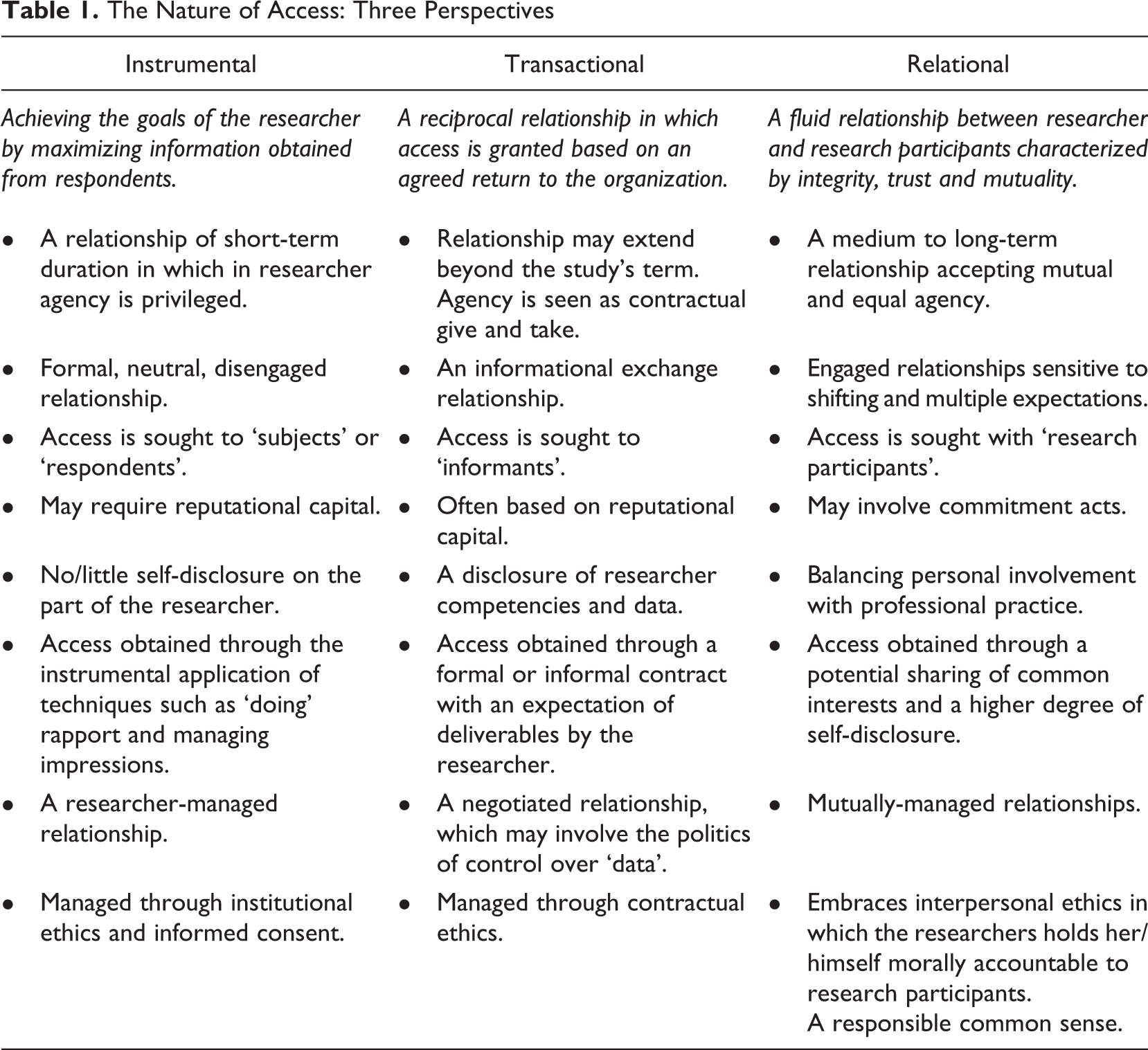
The form of relationship can have a major impact on the nature of access, the degree of transparency and trust between participants, the perceived outcomes of the research, and the agency attributed to researcher and/or research participants. By agency we refer to the degree to which participant intentions, feelings, knowledge, and ability to make informed choices and take action is respected. The issue of agency is crucial to understanding a key difference between how each form of relationship plays out in the field. From an instrumental perspective, agency is unilateral in the sense that the researcher’s intentions, actions, and ability to generate knowledge are privileged over “respondents,” who may be treated as “passive dupes” merely providing data. The outcomes sought are academic ones. A transactional perspective involves reciprocal agency in which the relationship is a contractual one of give-and-take, trade-offs, and compromise, involving a “bargain” over outcomes that benefit both the researcher and the organization. Finally, from a relational perspective, agency is shared between researcher and organization members who are seen as participants in the research—and as being knowledgeable. Diverse intentions, values, and goals are respected. The differences between each perspective are elaborated below.
An Instrumental Perspective
From this perspective the goals of the researcher and how best to obtain information from respondents are uppermost, and the relationship is usually a formal short-term one, based on the length of the study. The researcher perceives herself or himself as a neutral investigator who does not get involved with, nor disclose personal information to, research “subjects” (the people to be studied) because that may bias the research and academic outcomes (journal publications, etc.). Gaining access and managing relationships are often addressed in terms of applying instrumental techniques and staged process models (Dundon & Ryan, 2010). Walford (2001), for example, sees access as a four-stage selling process: (a) the initial approach, (b) engaging interest, (c) creating a desire for the (research) product, and (d) making the sale—or closing the research deal. Establishing relationships are about creating rapport by asking neutral questions, finding a “hook” that gets a gatekeeper’s attention, strategically deploying researcher characteristics (Mazzei & O’Brien, 2009), or learning the lingo (Costas & Grey, 2014). This privileges researcher agency by putting the researcher firmly in charge, especially when it involves managing impressions (which we address in the section on “Deception”) and symbolic management.
A Transactional Perspective
From a transactional perspective, the researcher–researched relationship is framed as one of reciprocity, where access is granted based on offering something of value to the organization in exchange for data collection. The rhetoric of the relationship may be framed in terms of access to “informants” who will provide relevant information to the researcher who is expert academic or consultant providing “deliverables” such as a final report, a presentation of research findings, or training for employees. These deliverables may extend beyond the end of the study. Agency is then displayed in, and contingent on, negotiations around the research bargain between researcher and gatekeepers. Bell and Bryman (2007, p. 68) argue that management and organization researchers often find themselves in a weak bargaining position compared to other disciplines, because business organizations often operate on a transaction or cost–benefit model in which they expect something in return, such as the provision of management or executive training, and may want a degree of control over the research and its dissemination. The politics of control over data may play into access negotiations, and there have been instances where researchers have discovered that the small print of their access agreement determines what can and cannot be disclosed (Ahrens, 2004) and preapproval is required prior to any publications. Such agreements may even include a 1- to 5- or even 10-year moratorium on publishing results.
Reputational capital, that is, the status and credibility of the fieldworker and his or her institution, can be a key factor in negotiating access and establishing relationships—especially in instrumental and transactional access relationships where an organization may perceive benefits from being connected with a “top” academic or institution. This can be particularly important in a bidding system, when large corporations willing to fund research projects call for proposals from research institutions. Medium- to long-term access, often based on a reciprocal relationship, can be granted through such projects.
Reputational capital is also associated with personal factors: whether the researcher is a PhD student or a professor, has successful research projects under his or her belt, and is from a “good” university. Within a transactional relationship, self-disclosure relates to a researcher’s competencies, personal skills, credentials, and track record, which can be an important aspect of building reputational capital. PhD students and early career researchers may therefore need to obtain the sponsorship or support of a more senior academic to gain access (Bell & Thorpe, 2013, p. 14). Two significant reputational factors in Rafael gaining access were his position in one of the top academic institutions in the country and that he had given interviews to national and international media on various issues. Meetings with high-ranked PF officials were granted because of his perceived status, as some officials later confirmed, “Of course our colonel would talk to you. You work for a top university.”
The reciprocity underpinning a transactional relationship may also result in ethical dilemmas for a researcher, who may uncover illegal or unethical actions, or activities that are harmful to employees (e.g., bullying) where she or he must consider what is right and possible: protecting the privacy and welfare of employees against any commitments made to the organization. In the case of the PF, the expected reciprocity related to Rafael taking a public relations role commenting about various aspects of their role and actions to the media. This resulted in a dilemma. For various reasons alluded to previously, he felt unable to critique the force and found himself calling officials before an interview to gauge their reactions. This tempered his comments and meant that on occasions he refused to give interviews.
A Relational Perspective
From a relational perspective, the nature of the relationship between researcher and research participants (people with multiple interests engaged in the research) is about developing relationships characterized by integrity and mutuality and holding oneself morally accountable to others (Cunliffe & Eriksen, 2011). This requires a longer-term orientation to building relationships, and one that acknowledges the agency of research participants in a way that instrumental and transactional approaches do not consider. The degree of trust and recognition of multiple expectations integral to a more engaged relationship are not necessarily present in instrumental and exchange relationships. Transparency is also key to developing trusting relationships, not just in terms of the research, but also in relation to sharing personal experiences, common interests, background, or ties with research participants. For Mikecz (2012, p. 490) it was his “positionality, personal contacts, inside knowledge of Estonian culture and etiquette, and perseverance” that allowed him to conduct in-depth face-to-face interviews with Estonian elites. In Latin American countries, a degree of personal involvement and sharing of personal details is seen as particularly important in helping build trust. This is entirely different to the instrumental presentation of oneself as an objective, disengaged “professional stranger” (Agar, 1996), because such acts mean investing time in relation to potential/existing research participants and may involve self-disclosure on the researcher’s part, especially if she or he is expecting self-disclosure on the part of research participants.
To summarize, the assumption (as in instrumental and often transactional perspectives) that the researcher unilaterally manages the access process and the research relationship by deliberately positioning himself or herself in relation to members of the organization is a naïve one that ignores the agency, expectations, and interests of research participants. In-depth fieldwork requires a recognition of the “relational embeddedness, which may occur at different levels—researcher, research participants, researcher-participant relationships, research project, research institution, and studied organization(s)” (Michailova et al., 2014, p. 147). In particular, a relational perspective on access foregrounds the mutuality of researcher–research participant relationships and influence and requires researchers to be sensitive to the nature and agency of the researcher–research participant relationship, how each is perceived and positioned by the other, and the political and ethical issues that may arise. We will examine these in more detail in the following discussion.
Gaining and Maintaining Access: Immersion, Backstage Dramas, and Deception
The issues identified below that may be encountered in relation to gaining and maintaining access, can be anticipated to a certain extent, but often have to be dealt with as they arise because of the particular and fluid circumstances in which they arise. Therefore while a degree of improvisation is often necessary, a means of making sense of the intricacies of access and the anticipated challenges that may surface is empirically useful. We have therefore framed the process as one of immersion, backstage dramas, and deception—a conceptualization that, as we will explain below, draws on Punch’s (1986, 1989, 1994) work on the politics of fieldwork, Goffman’s (1959/1990) dramaturgical approach, and retrospective sense making of Rafael’s experience. Table 2 outlines the key features of each.
Key Features of Gaining and Maintaining Access
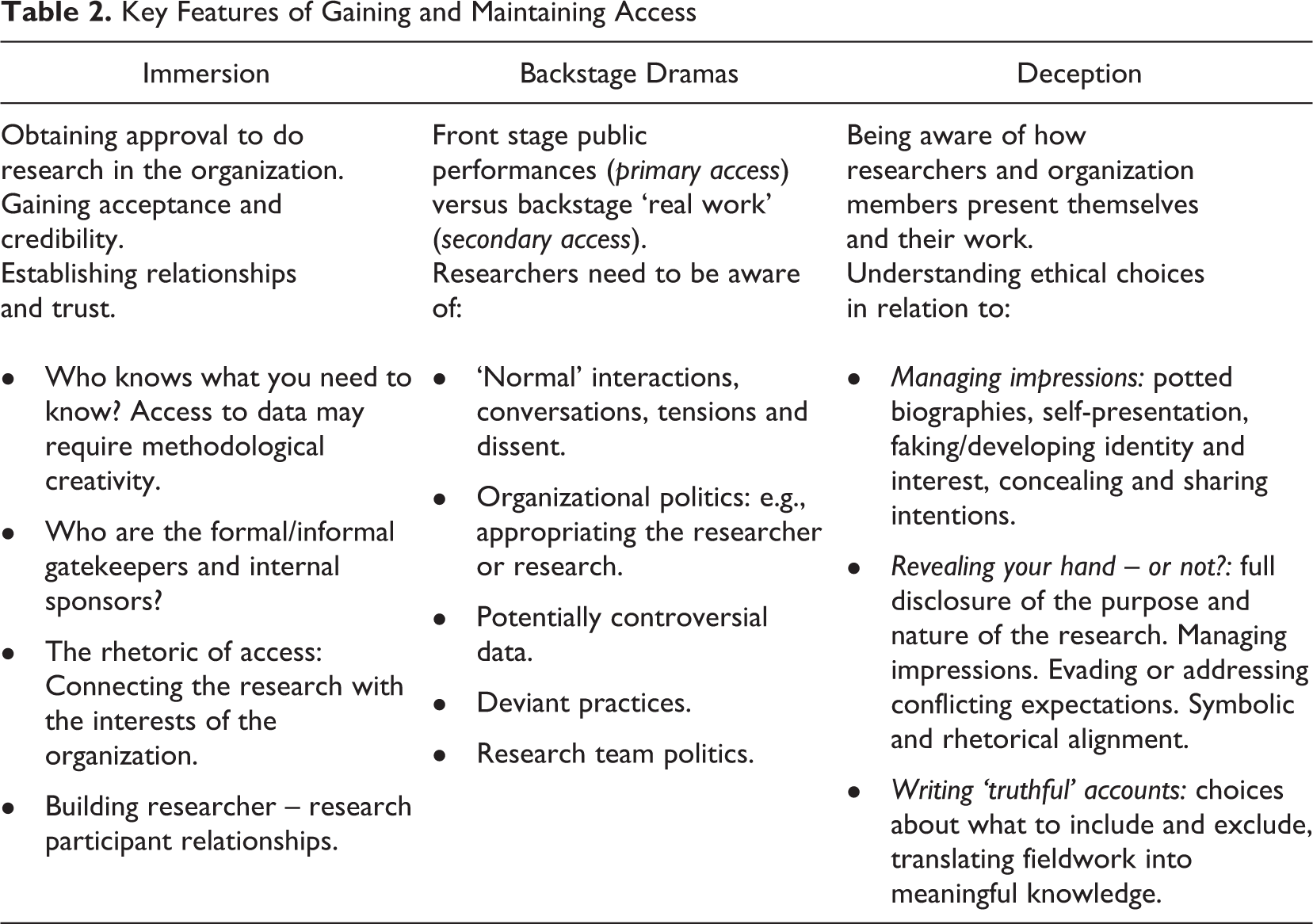
We suggest that framing access as immersion, backstage dramas and deception offers a way of reflexively capturing, making sense, and figuring out how to deal with the dilemmas, politics and micropractices of access. In using this particular terminology, we aim to provoke reflexive consideration of often taken-for-granted political, ethical and relational aspects of our actions and convey the idea that gaining and maintaining access can involve genuine, open and sometimes ethically questionable action on the part of both the researcher and research participants. Immersion highlights the issues researchers may encounter when trying to obtain access at different levels and draws attention to the need to consider the types of relationships that may be established and their impact. Backstage dramas address secondary access: the intricacies of obtaining and maintaining deep immersion in the field—of getting access to the “real” work and lifeworld of the organization. Backstage can offer a deeper understanding of hidden aspects of organizations that are not evident front stage: politics, conflicts, and the intentions, frustrations, ambiguities and joys of organization members. Deception challenges us to think more reflexively about the impact of our actions and decisions: Although we usually do not deliberately set out to deceive our research participants or the organizations we work with, we might do so unintentionally to gain and maintain access. In addition, this framing raises complex ethical choices we may have to make around clashes of personal values, research requirements, restrictive or distasteful organization practices, and disclosure. Throughout each of the three following sections, we examine the political and ethical choices that researchers may face, link them to the three perspectives in Table 1, and offer a number of micropractices for addressing such choices.
Immersion
I use it [infiltration] consciously to emphasize that entry and departure, confidence and trust, and attachment and desertion in the field may sponsor social and moral dilemmas that spell out a virtually continuous process of negotiation of the research role. (Punch, 1989, pp. 178-179)
While these are examples of methods of gaining access, immersion can be suffused with politics, as in the game playing that took place in Access Attempt 1, when PF gatekeepers agreed access in principle but not in practice—a situation probably designed to make the researcher abandon the project while saving face for the organization. As members of an organization responsible for deciding who can and cannot cross the boundary and for maintaining the organization’s culture and image, gatekeepers may also be charged with keeping its secrets (Buchanan, Boddy, & McCalman, 1988; Ganiel & Mitchell, 2006; Gellner & Hirsch, 2001) and PF was clearly concerned about its public image. Early in the fieldwork, when negotiating expectations, Colonel S commented to Rafael, “You are our friend. Friends do not criticize friends in public, you know? Last week I expelled a researcher from PF who accused us of being racist. We are not racists!” the research bargain clearly equating continuance of access with toeing the line. The politics of being “a friend” meant that media interviews were acceptable to officials only if they felt that Rafael portrayed their position in a positive light. “Friendship” also meant concealing any criticisms of PF, even in informal chats with officials.
Immersion may therefore require choices relating to the integrity of the research as well as ethical concerns for the researcher, who may have to balance being seen to support (potentially) deviant organizational practices that contradict her or his own values in order to maintain access—an issue we will discuss throughout the following sections. Given possible clashes of values and the need to protect the integrity of the research project and the researcher, it is important for researchers to be aware of both the intellectual and personal justifications for their study (Van Maanen, 1978) because they can guide how to respond to these clashes: whether they can be ignored, tolerated, or confronted. In addition, whether the researcher takes a transactional, instrumental or relational perspective to their research will influence whether to continue to pursue access, build relationships, or to exit the organization.
Who knows what you need to know?
While the first question in the process of gaining access is usually seen to be “Who are the organizational gatekeepers?” we suggest that an important preconsideration is figuring out what you want to know and who knows what you want to know. And the gatekeeper, or the person with the seemingly appropriate job title, may not be that person. In her study of parental involvement in education, Freeman (2000) began by talking to a school principal, homeschool coordinator, and managers of programs, and then realized there are many perceptions of parental involvement that she needed access to in order to understand its intricacies. A community activist friend (also a parent) connected her with another involved parent, who then gave her another contact, and so on. Discussions with parents gave her a more nuanced and richer understanding of the many forms of, and reasons for, involvement.
So while formal organizational channels may seem the obvious and perhaps easier way to get access to “stakeholder” participants, they don’t necessarily generate the data needed, as the gatekeepers of the organization are not always the people holding the knowledge. This was the case with PF, when Rafael realized that top rank officials usually didn’t know about the actual practices of the police officers on the street. So he began to talk to lower rank officials who were involved in street practices: one of whom commented, “the top rank pretend to know things, but in fact they know nothing of what actually takes place.” Figuring out who has the knowledge you need is therefore a fluid and ongoing process of discovery, of opening various doors, building relationships, and maintaining secondary access once in the field.
The politics of gatekeeping
Determining who has the power to grant access and smooth your entry into the field and facilitate the type of relationship and data collection you are hoping for is key to immersing yourself in organizational life. While the obvious answer is the person at the top, obtaining permission from such a person does not necessarily mean that all employees, as in Rafael’s case, will welcome the researcher. Even though a researcher obtains formal permission, she or he may discover there are many other gatekeepers and doors to open, both formal and informal. Morrill, Buller, Buller, and Larkey (1999) suggest that researchers need to be sensitive to “organizational vocabularies of structure”—the formal authority structures, accounts, and decision-making routines that legitimate an organization’s activities and help employees make sense of what’s going on—for two main reasons. First, in negotiating access one needs to understand these vocabularies to link the research to what is seen as being important in the organization—we suggest this often requires a political and rhetorical alignment from the researcher’s perspective because it may involve rewriting the research proposal to match organizational expectations to gain access. Second, identifying the gatekeepers (who may be individuals or groups located throughout the organization) can tell a researcher a lot about how the organization works. Thompson and Lashua (2014) found in their ethnographic study of U.K. music recording studios that production staff regarded studios as private spaces in which outsiders were “surplus to requirements” (p. 750). Even though he had an existing relationship with production staff, Thompson found his “in” was actually through the musicians—a “vocabulary of structure” that indicated the tacit power relations in the studio. Thus, we need to recognize not only that gatekeepers determine access, but also that identifying formal, informal, helpful, and obstructive gatekeepers can lead to insights into organizational hierarchy, power, and politics. Gatekeepers wanting to exercise control over a project not only decide whether to sponsor the research, but might also determine who can/cannot participate and stipulate what can/cannot be asked, how long access is granted for, and even to whom the knowledge belongs. Managing “organizational bouncers” who obstruct access may therefore become a key issue (Morrill et al., 1999; Ostrander, 1993).
The rhetoric of access
The politics of gatekeeping is also about the rhetoric of access. Organizational gatekeepers often ask questions such as the following: What exactly are you doing? What resources (time, money, space, etc.) will this require? How will it benefit us? What will happen to the data you get? And how can you possibly explain what we are doing? While some of these questions are covered formally in participant consent forms, getting to that point is not easy. It is here that understanding the rhetorical micropractices of access and the “vocabularies of justification” (Jackall, 1988/2010) existing in the organization are important. It’s not only about having an access proposal, euphemistically known as the 2- to 5-minute “elevator speech,” that explains in layperson terms, simply, and directly what you would like to do and why and how it will benefit the organization, it’s also about being able to connect the research with organizational goals and provide gatekeepers with a narrative they can use to legitimate the researcher’s presence to other members of the organization. While from instrumental and transactional perspectives this can be fairly straightforward the goal of the research is associated with improving organizational performance in some way, it can be particularly challenging if the research is based on a relational perspective, uses an interpretive epistemology, or is critically informed and focuses on issues of power, control and resistance.
Ramsey (2014) for example, discovered her interpretive approach based around a cooperative inquiry methodology was “culturally alien” to the engineers on the research project, who found it difficult to accept that solutions would be generated by groups in the organization and not just the researcher. In Jackall’s (1988/2010) powerful study of how bureaucracy shapes moral consciousness, he found himself trying to gain access by writing a “sanitized proposal,” because executives wanted him to avoid the term “ethics” and use instead “decision-making processes” or “executive succession.” Finding this problematic and struggling to gain access, Jackall found a public relations expert who furthered his “linguistic education in the art of indirect rather than pointed statement” (pp. 14-15) and helped him gain access by vouching for him personally. This is not just a case of rhetoric, of translating the purpose of the research into organizational language and expectations, it also raises ethical dilemmas for the researcher in terms of sincerity and full disclosure. Gaining access ostensibly to study management systems while actually studying control and resistance, for example, can/will damage transactional relationships and is alien to a relational perspective where moral accountability to research participants and mutually managed relationships are crucial.
Building researcher–research participant relationships
Obtaining and maintaining access involves building relationships by being continually sensitive to attitudes of suspicion and trust a researcher may encounter when meeting different members of the organization. In PF, Rafael found initially that although officials at demonstrations were willing to talk to him, lower level police officers were not because they were suspicious of his role and relationship with their supervisors. When questioned they would often say, “Sorry, you are a friend of the officials, we cannot trust you.” He also had difficulties finding officials who would give him their story of events. For example, on several occasions, access was denied to meetings that were considered by PF as concerning “sensitive information” about practices and policies in the organization that they did not want Rafael to know, and any questions he had around police violence (for which PF were criticized in the media) were evaded. It was only after some time, that he was able to find three officials who were willing to give in-depth information critical to his research. One strategy for dealing with suspicion is to find “internal sponsors”—organizational members or labor unions who are willing to facilitate and champion the research within the organization, and who may even facilitate and engage in data collection (MacLean et al., 2006; Pritchard & Symon, 2014).
Establishing trust from a relational perspective may involve a researcher proving her or his commitment to research participants and to the research through “commitment acts”, acts that “humanize researchers” because they aim at building trust without necessarily expecting any gain (Daniel-Echols, 2003; Feldman et al., 2003, pp. 36-38). Examples of such acts include ethnographer Steve Barley’s (2011) desperate race across Boston with a hospital technician to get a catheter, and Karen Lumsden’s (2009) driving a “boy-racer” gatekeeper and Fiat enthusiast, to Fiat events—in her Fiat—after his driving license was revoked. For Rafael, his commitment act was his continued presence at demonstrations, which helped him establish the seriousness of his intent. Such acts require a careful balance between becoming too personally involved with research participants and maintaining an ability to step back to theorize from the data. In the PF, maintaining this balance meant Rafael going for a beer or having lunch with officials, but if situations became too personal or uncomfortable he would withdraw from the field for a while. A relational approach to access therefore means paying careful attention to the nature and integrity of the researcher–research participant relationship.
Sameness (as in Mikecz’s case) or being seen to be “one of us” may not be the only issue in gaining access; difference may also help build relationships. Bruni (2006a, 2006b) found that access in some contexts was influenced by being seen to be different because of his physical appearance (in one case he was thought to be gay): Gatekeepers “were intrigued by my physical appearance. They were curious to see how other members of the organization would react, what sort of research I would conduct, and how I would get myself accepted” (Bruni, 2006a, p. 146). He gained access because they were more interested in him than in his research proposal. Identity and positionality may therefore have a major influence on the researcher–research participant relationship, such as whether the researcher is an insider or outsider; the same or different to research participants in terms of gender, ethnicity, values, culture, and so on; engaged with research participants in generating knowledge or a distant “professional stranger” (Agar, 1996); politically active in relation to participant agendas or actively neutral (Cunliffe & Karunanayake, 2013). This positioning influences how researchers are perceived and trusted by organization members and therefore their willingness to share knowledge and thoughts, and means that researchers need to be sensitive and responsive to the shifting and multiple expectations they encounter.
Establishing and developing a relationship is also influenced by the attribution of a researcher’s potential motives and values. Rafael’s initial unsuccessful access attempt was probably because PF officials distrusted his motives and were suspicious, perhaps perceiving researchers as muckrakers aiming to expose transgressive practices (Zickar & Carter, 2010). Alternatively, researchers may be viewed as ivory tower intellectuals whose research will have no benefit to the organization (an instrumental perspective), or as an interloper who will get in the way of doing the job, and in the case of “dangerous” organizations possibly a thrill seeker.
Backstage Dramas
Authentic and candid accounts of the backstage story of research projects are few and far between. (Punch, 1986, p. 18)
We draw on Goffman’s (1959/1990, 1967/2003) work on dramaturgy to frame the issues involving in creating and maintaining secondary or deep access to “go where you want” (Glesne & Peshkin, 1992, p. 33). From Goffman’s dramaturgical perspective, we are all actors engaged in ongoing performances of what is and should be “real.” He differentiates between front-stage and backstage performances. The former are about managing the impressions of outsiders through performances in which appearance, coordinated actions, and consistent language are used to deliberately act out identities and images that maintain an audience’s common perception. Initial access may be only to these front-stage performances, where the researcher is shown only what organizational members want them to see and the discourse is the formal company line. As we have noted, a fear of exposure, lack of trust, or the need to protect the organization’s image may lie behind this. Front stage means presenting a face or mask (an image of ourselves) that may involve also face-saving. In her fieldwork in Hollywood, Powdermaker (1966) found that if the powerful men in charge of studios agreed to an interview, then it was usually only with their public relations aide present, because in front stage both company and personal images had to be maintained! Similarly, Ortner (2010) found immersion a problem when trying to negotiate a participant observation study in Hollywood. While front-stage performances such as the Academy Awards are very public, backstage performances (actual filming, investment and production meetings, guild meetings, etc.) are not, and she found that “there is always an inside further inside the inside” (p. 215). Similarly, even though she had contacts, access to powerful executives was difficult because of their involvement in “confidential deals” and other commitments.
Using this metaphor to think about access offers a way of identifying how deeply we may be immersed in the organization and what type of “data” we are being given. Gaining primary access to the front stage—the public image—is therefore the first step, but does not tell us the whole story. Backstage (secondary access) is where lived experience and real work in organizations happens, where rich, in-depth data lie. As Goffman (1961/1991, p. ix) notes, “Any group of persons—prisoners, primitives, pilots, or patients—develop a life of their own that becomes meaningful, reasonable and normal once you get close to it…. A good way to learn about any of these worlds is to submit oneself in the company of the members to the daily round of petty contingencies to which they are subject.” Therefore researchers, particularly ethnographers, action researchers, and participant observers, need to gain access to the backstage performances where “normal” unmanaged interactions and conversations take place, where meanings and actions are contested, negotiated, and worked out. The complex temporal and relational nature of this degree of immersion is evident not just because it’s about negotiating boundaries between hierarchical levels, different departments and positions, but also because it involves the challenge of gaining trust.
The distinction between front stage and backstage became apparent at the PF. In public, officials never ever criticized each other or showed any sign of tensions. The front-stage image presented was of an organized and professional PF. When Rafael asked about violent cases shown on the media, officials would be selective in giving him details, and always asked him to not talk about it openly. As time passed, he began to realize that backstage the organization had significant tensions, including issues of command. As Van Maanen (1978, p. 321) notes in his U.S. police study, “the internal order in which the police work is anything but a consensual one.” As officers became more familiar and comfortable with Rafael’s presence in the field and noticed that he did not openly criticize the force, they began to trust him and be frank about their views and problems. Glimpses of backstage dramas and dissent emerged as lower rank officers started to comment on high-rank officials, “Of course the colonels like the way things are. They have cars and officers that work exclusively for them, inside their houses.” Officials also started to disclose questionable strategies used in street demonstrations, and even to share personal problems: issues of fragility in relation to family life that Rafael was not expecting to encounter and that were not evident in front-stage performances.
This degree of disclosure—of less heroic and conflicting stories—occurs only with deep immersion, where relationships of mutuality, trust, and confidence exist. However, such backstage dramas may raise political and ethical concerns for the researcher, and even danger. As Punch (1989, p. 184) observes, “Knowledge of, and involvement in, deviant practices within an organization can be dangerous for the field-worker both in terms of sanctions from senior members if caught and of the ethical dilemma as to whether or not one should expose the practices at the cost of terminating the fieldwork.” For example, as Rafael gained trust and entry “backstage,” he was given disturbing information that had to be treated with caution: Claims made by officers (possibly bravado or boasting) are not the same as direct observation, and the prospect of the researcher being called to testify in court cases must be considered. To deal with the tension of maintaining access and possibly encountering deviant practices, Rafael removed himself from any potentially threatening situations, but the implications of this dark side became clear when he was told that he was being watched: “We have a strong intelligence service and I am sure they have a folder under your name. Any time you go to the media, anytime you make a speech about us, they record and analyze what you say!” This caused him to worry that his cell phone and Facebook account were also being monitored. In such situations, researchers have to balance the need for continued access to in-depth data and maintaining good relationships with organizational members, with issues of emotional stress, personal safety, clashes with personal values, and the potential consequences for disclosure and publication. Decisions have to be made about exposing deviant organizational practices, turning a blind eye, or renegotiating the research bargain to address what can or cannot be said—and this can be influenced by whether the researcher is taking an instrumental, transactional, or relational perspective.
Backstage dramas can also surface the subtleties of internal organization politics: Who has power over whom and why? But this degree of immersion can become problematic if a researcher finds herself or himself being drawn into political games as knowledge and influence become commodities to be fought over by members of the organization. In the PF, a number of high-ranking officials were very honored to be invited to make speeches at the business school and officers “made friends” with Rafael, believing he could enhance their reputation in the eyes of important figures in the force. Moreover, he noticed that some units used his presence and interest in their activities to signal their importance to others. Encountering internal politics, even intimidation, may mean continually renegotiating the research bargain, or even withdrawal if a researcher is unable to balance personal values, obligations to organization members, and institutional, social, legal, and funding requirements. Such decisions are contextual and are a matter of ethics committee requirements and personal conscience. From a relational perspective, where more long-term and mutually managed relationships are implicated, honesty about personal and professional tensions and integrity is key.
Finally, backstage dramas may relate not just to the organization, but to researchers themselves. Deep backstage immersion can allow the researcher to use themselves as a source of data, to write a reflexive account of their experience. But dramas can also occur among research team members as Browning and Sørnes (2008) highlight: including issues around work distribution, use of study material by individual team members, receiving credit, and being lead author. Such dramas may occur because of the mix of team members—professors, early career researchers, and graduate students—and cultural, gender, and career differences. Taylor and Land (2014) found themselves dealing with a different backstage dilemma: While organizational and individual anonymity and confidentiality are the sine qua non of gaining approval from ethics committees, this was blown when they discovered an employee had posted photos of the researchers along with an account of their visit on the company’s blog.
Deception
Although researchers are fundamentally honest, as lawyers, clergymen, politicians and car dealers are fundamentally honest, everyone’s goal is to permit life to run tolerably smoothly—to engage in impression management, preserving reputations in local domains. (G. A. Fine & Shulman, 2009, p. 178)
In other words, the nature of research practice inevitably carries with it choices relating to openness, trust, acting out misleading identities, and potential betrayals that challenge the ethical nature of our work. Such choices may be less questionable within instrumental and transactional perspectives to access than within a relational perspective. In the former, “doing” rapport, framing an access proposal in a specific way, and presenting a particular identity is an acceptable part of the process. In a relational perspective, the integrity of our actions and interactions is key to establishing mutual and agentic relationships.
Consequently, we may intentionally or unintentionally mislead research participants by not making our motives transparent. This becomes problematic if we start to take those illusions and deceptions for granted, and do not address their inherent moral challenges nor reflexively question the legitimacy of our actions, methods, and motives. In this section we address potential deceptions in access in relation to managing impressions, revealing your hand, and writing cultural fictions.
Managing impressions
Impression management was a term coined by Goffman (1959/1990) to explain how one presents oneself—rhetorically and symbolically—to others to convey a favorable impression. The type of impression one gives depends on the situation, and may be “idealized” to meet the expectations and/or stereotypes of the audience (p. 40). How the researcher presents herself or himself to gain access can therefore be a form of deception if used to manipulate the perceptions in the organization. One micropractice used to gain access is the researcher’s “potted biography” (Punch, 1989) written to appeal to gatekeepers. Another is how we present ourselves. In his U.S. police study, Van Maanen (1978, p. 312) noted his shift from a shaggy student-like to “a more crisp, military like” appearance while trying to gain access. In Rafael’s case, the PF uniform provides a clear boundary marker between those inside and outside the organization, and the number of stars on the uniform shows immediately the importance of the person. In these, and other less “militarized” access situations, managing impressions through a visual presentation of self can be important. Rafael had no uniform, so tried to manage impressions by wearing a suit similar to high-status judges. He was later told that if he had a haircut and shaved he would look more like a PF official—which would be helpful in establishing relationships in the field.
This potentially deceptive (at a minimum “calculating”) presentation of self can occur and shift throughout the research to maintain access, and Van Maanen (1978) notes four self-presentation roles (p. 344): Member: Becoming a member of a group or organization and engaging in participant activities whenever possible, as in the Barley (2011) and Wacquant (2004) examples. Fan: Accompanying and observing participants as they work in a benign way. This was the impression presented by Rafael to the PF. Spy: Exposing deviant, discriminatory, and bullying behaviors often through secretive means. Access in this case can be extremely difficult. In her study of misconduct in a large U.S. insurance company, MacLean (2002) had to rely on archival data and interviews with former employees. Voyeur: A covert data collection role. Today this is addressed directly by university ethics committees and the need to obtain informed consent prior to data collection.
It’s notable that neutrality is not an option in these roles—we may be deceiving ourselves if we claim to be neutral in relation to our research and research participants because we always have goals, outcomes, and self-interest (our PhD thesis, journal articles, funding body requirements, etc.) at heart. Indeed, Dallyn (2014, p. 259) argues that being open and sensitive to our position and partiality and to the conditions we research from means that we can offer “a more critically sensitive approach to social research.”
We might find ourselves in a position of managing the impressions of research participants to gather data by, for example, portraying sympathy, or appearing to be friendly and interested (G. A. Fine & Shulman, 2009). On several occasions Rafael was asked his thoughts about the force, but understood that senior officials were only interested in compliments … to which he responded in order to continue access. This reflects more of a transactional and instrumental relationship that can be interpreted as “doing rapport,” where friendship with respondents is faked and the relationship managed in the self-interest of the researcher (Duncombe & Jessop, 2012). Instrumentality may also be manifest in the strategic deployment of particular researcher characteristics such as gender, ethnicity, organizational experience, or the performance of fake identities and associated emotional work (Hochschild, 1983) as a means of conveying analogous interests or trustworthiness. Managing this performance can be stressful as researchers may experience tensions of being both observer and observed (Bruni, Gherardi, & Poggio, 2004). But deception is not limited to researchers. Suspicion may lead to organization members engaging in deception by erecting barriers, game playing, protecting face, and managing impressions. For example, Rafael hoped to follow PF patrol and tactics units on duty, but despite general agreement from top officials, it happened only in circumstances controlled by officers, who chose carefully what he could and could not see. Certain meetings were also closed to him, and officers would avoid discussing particular issues in front of him.
Revealing your hand—or not?
Deception may occur when negotiating initial access in terms of the “real” purpose of the research. What if your goal is solely instrumental—to produce papers in top academic journals regardless of outcomes to the organization? Should you reveal to gatekeepers that you are taking a “critical” approach to your research? Van Maanen (1978, p. 330) talks about his use of “cautious sophistry” during his U.S. police study, which included explaining his research in general terms “discovering what it was like to be a policeman” and that his university supervisors might fail him if he didn’t get accurate data. But the discovery of deception can lead to uneasy relationships, a lack of trust, questioning the integrity of the researcher, and even the termination of access.
Wray-Bliss (2003) argued that the ethics and politics of research become particularly acute within critical management studies research, where processes of power, domination and subjection are studied. The challenge of explaining a critical approach to organizational gatekeepers can lead to moral dilemmas for the researcher about whether to be open about his or her goals and intentions. While Rafael’s interest was in understanding how the PF deal with demonstrations and violence from a critical perspective, he felt it would not help to reveal this, and therefore his first research proposal was couched in the rhetoric of “analyzing issues of management practice and culture” and he positioned himself as an academic from “a top business school.” This failed in his first access attempt, and he realized he needed to produce a research proposal based on PF’s “vocabularies of justification” with very clear research questions that were not associated with sensitive issues, and included the expected (positive) results for PF—a transactional perspective.
What if you find the organization’s values or practices questionable, intolerable, or even illegal—should you say something? Rafael found himself having to remain silent and conceal his “critical” views on different occasions, for example, when officials criticized demonstrators as “the poor widows of Marx” or espoused right-wing views.
The ability to collect the necessary data may therefore involve various deceptive micropractices that conceal the particularities and motives of the research to gain access to data in backstage regions. As Punch (1986) observes, “The crux of the matter is that some deception, passive or active, enables you to get at data not obtainable by other means” (p. 41). This may occur as researchers try to achieve anonymity through “displays of a studied lack of interest in one’s fellows, minimal eye contact, careful management of physical proximity” and of “loitering” (Hammersley & Atkinson, 2007, p. 43). This careful management of impressions through a façade of disinterest may belie deep interest and is a deliberate concealment of intentions and identity that Punch (1986, p. 72) calls “ripping and running” ethnography—because upon discovering the researcher’s real role when he or she runs out of the field, organization members feel “ripped off.” In this instance there can be a double betrayal, if building relationships involve both researcher and researched acting in deceptive ways as they try to manage each other’s impressions. While this may happen in instrumental approaches to access, a relational perspective recognizes that exiting the field is “shaped by the web of multiple relationships” and can be an emotional experience for both researcher and research participants (Michailova et al., 2014, p. 147). A relational perspective emphasizes the responsibility that establishing trusting and mutual relationships brings. It also means that a researcher needs to consider the ethics of exiting the site—her or his responsibilities to participants in terms of presenting and publishing “data” after the study is complete.
Tensions in values and role expectations may also occur, which might result in a researcher playing a role as a “fan” when she or he is really a “spy.” It became evident to Rafael that his access was only maintained because the PF expected him to be a “friend” and endorse their actions to the public and academic world. While his immersion depended on these perceptions, it was not an easy, nor a comfortable relationship to manage because it involved finding a balance between collusion and criticism, which required some evasion on Rafael’s part. This was helped by his being an academic from a business school, which was perceived as being much less “dangerous” than being a sociologist! As one colonel commented, “If you are from sociology, you are our enemy … you are from a business school, you are not left wing!” Rafael found he could stay silent about his critical and sociological orientation to research because assumptions were made about his views and values as a business school professor. Managing this dilemma of conflicting expectations and maintaining access requires a degree of emotional balance (Punch, 1989) as a researcher struggles with whether to present a self-image that may be counter to, or stay silent about, personal values.
Therefore continued data collection might mean deceptive micropractices involving a symbolical or rhetorical alignment of the researcher’s interests with those of the organization. During their 6-year ethnography in a U.S. organization, Browning and Sørnes (2008) found themselves dealing with a new, British, gatekeeper, and to maintain access having to play to his emphasis on the “correct” (British) pronunciation of words, for example the British JagUar not the American JagWar. Similarly, Rafael found his credibility with PF officials was boosted because he could speak their language of “management” and “quality.” But he was also advised by an PF official to avoid the word investigation because it was associated negatively with being analyzed, evaluated, and judged.
Wray-Bliss (2003, p. 320), working from a critical perspective, cautions us to recognize that deception and “power relations abound in the interview context” as the (powerful) researcher can position and construct the researched as victim and dupe. A relational (rather than an instrumental or transactional) approach to access means building relationships of integrity and mutuality; acknowledging the agency of research participants and their right to resist such constructions; and reflexively questioning research practices and methods that subordinate the knowledge of organization members.
Writing “truthful” accounts
Clifford (1983) argues that writing accounts of fieldwork is about writing cultural fictions that never lie, but also never tell the whole truth because our actions are constrained by academic standards and textual practices that lead to a “‘conspiracy’ in selling the neat, packaged, unilinear view of research” (Punch, 1994, p. 85). We make personal choices about what to include and omit from our accounts: whether to include gossip, confidential and sensitive information, the dark side of organizational life, potentially damaging information to participants or the organization, and the ethical dilemmas we faced and how we solved them. For example, during Rafael’s research, it became apparent that it would be impossible to write about how PF handled demonstrations and not address issues of violence—given the organization’s reputation in the media. But to do so would likely incur problems in his relationship with them. It was not his intention to expose or legitimate violent practices, which meant walking a fine line in terms of maintaining professional integrity, physical safety, moral stance, research goals, and relationships with organizational members.
Ethical dilemmas also arise in relation to protecting the integrity of the research, the ability to be transparent about the data collection process, and maintaining the anonymity of the organization, that is, how to translate the research experience into meaningful knowledge without compromising the research, researcher and organizational participants. One relational micropractice that can help address this dilemma is collaboration (Burns, Hyde, Killett, Poland, & Gray, 2014), which can extend from a collaborative generation of research questions, researcher self-disclosure so that interviews become in-depth conversations, to collaborative theory building. This openness can establish trustworthiness at many levels: between researcher and organization members, of the validity and authenticity of the data, and of our research practices and identity.
Conclusion
Why is it important to be reflexive about the politics and ethics of access? The obvious answer is that the success of many research projects hinges around obtaining and maintaining access—and this can depend on our ability to identify and deal with the political machinations we may encounter. Much of the advice in the literature takes an instrumental perspective, viewing research as a benign activity and the access process as something to be managed by the researcher. It is rare that thought is given to the complex nature of relationships in the field and to potential political and ethical dilemmas until they arise. Yet researchers face barriers to access based on multiple and sometimes conflicting interests in relation to their research and presence in an organization. By framing access as an interwoven, fluid and emerging process of immersion, backstage dramas and deception, we draw attention to (a) the importance of viewing access as an ongoing and often nonlinear process, as researchers encounter new doors, different people, and new situations; (b) the need to be sensitive to the politics of access and how to address them; (c) ethical dilemmas that may emerge and the emotional stress, work, and personal choices we face in dealing with them; (d) the point that researchers use both positive and questionable (or negative) tactics in attempts to gain and maintain access—and that these have consequences in terms of our relationships with research participants, our sense of self, our personal integrity and credibility, and our ability to publish our work. There are no definitive answers to these dilemmas and to the choices we face about what actions to take or decisions to make. Researchers may have to juggle maintaining access and the integrity of the research with the need to cooperate, trade-off, concede, compromise their values, or even exit the organization. It is important to be aware of the emotional turmoil this may create for both researchers and members of the organization, and that the answer is a personal one influenced by situational factors and personal preferences.
To encourage reflexive consideration of access strategies and how we position ourselves in the field, we extend Feldman et al.’s (2003) argument that access is relational by conceptualizing three different researcher–research participant perspectives. We suggest that prior to negotiating access, researchers need to think about the nature of the relationship they would like with research participants, its implications, and if it is appropriate to the type of research they are doing. Whether one takes an instrumental, transactional, or relational perspective will have a major impact on how one responds to the political and ethical dilemmas that may arise when gaining and maintaining access. To illustrate, researchers working from a critical perspective often focus on “research that challenges or undermines the interests of powerful elites in management and business” (Bell & Bryman, 2007, p. 70). If access is negotiated from an instrumental perspective, exposing and publishing deviant practices is hardly an issue, because this is often the researcher’s goal. Preserving a distant “academic” relationship may be viewed as necessary to maintaining the “righteousness of critique” (Fournier & Grey, 2000). From a transactional perspective, a critical researcher interested in the emancipatory potential of their research may feel obliged to (re)negotiate a research bargain to incorporate an active role in resolving issues of inequality by providing advice and/or training. From a relational perspective, which is predicated on establishing ethical, credible, and agentic relationships characterized by mutual respect, then discussion with research participants and collaboration around the resolution of problems is appropriate.
Researchers also need to be sensitive to the emergent and reciprocal nature of relationships and that the development of such relationships is often nonlinear. The initial research bargain negotiated at the beginning of the access process may shift as one becomes more deeply immersed in backstage life, and what begins as an instrumental relationship may change to a transactional or relational one. Equally, initially friendly and collaborative relationships may change as the researcher uncovers potentially threatening information or practices, decides not to accede to requests to act (or not act), or uncovers findings that challenge the status quo. Understanding the reciprocity of access relationships and the research bargain means recognizing that it is not managed solely by the researcher, but is open to the expectations of organization members, who may consent to, negotiate, or resist the researcher’s expectations. It is therefore important to consider the type of relationship organization members want: Do they want to engage with problems? Do they want an affirmation of the status quo? Are they willing to be frank and supportive, merely to tolerate the researcher’s presence, or use it for their own ends? Rafael found throughout his fieldwork that officials’ expectations shifted from an instrumental toward a transactional relationship based what he could do for the PF in terms of helping them to build a positive image. This may bring ethical dilemmas if the researcher feels that personal values may be compromised and yet she or he wishes to maintain access.
Another consideration is the degree of closeness in researcher–researched relationships that may also shift over time. Macdonald and Hellgren (2004, p. 268) talk about “the hostage syndrome” that may emerge as researchers begin to identify with organization and participant interests. Wacquant’s (2004, p. 4) relationship with the boxers he was studying became a very close relational one, in which he was not only a sparring partner, but also a fan and confidante: a relationship in which the coach became “a second father.” This can also bring challenges. If very close relationships emerge from deep relational access to backstage regions, a researcher’s ability to step back—to critically question, analyze, and theorize—may be impaired, to the point where she or he may find herself or himself defending an organization’s practices. And while instrumental or transactional approaches may facilitate detachment, they can preclude access to rich understandings of improvised actions, conflicts, deep hidden meanings, and what Watson (1994/2001, p. 197) calls the cynicism and hurt of organizational life. The conceptualization of three different relational perspectives therefore provides a springboard for reflexive inquiry into the nature and probity of our relationships with research participants and a way of reviewing them and their impact on our research.
Michailova et al. (2014, p. 144) observe that exiting the field is “an outcome of a constant interplay between unforeseen and planned contingencies in the field and negotiations with research participants,” an interplay that is also characteristic of access. As such, access is neither a staged process, nor a set of activities totally under the researcher’s control. Rather it involves emergent, reciprocal relationships that require simultaneously a well-thought-out plan and improvisation, sensitivity to our impact on research participants and their impact on us, give-and-take on the part of researchers and research participants, opportunism, methodological creativity in circumventing barriers, and serendipity in terms, for example, of taking advantage of chance meetings.
Finally, while political and ethical dilemmas are contextualized to the research site and often unexpected, some are possible to anticipate. Institutional review/ethical conduct boards offer one formal mechanism for managing ethical issues, but are not enough to resolve the unanticipated and situational ethical dilemmas that arise because the field is always changing and researcher–research participant relationships are agentic and fluid. A relational perspective on access foregrounds the need for integrity to the people and organization we are studying, to yourself, and to the research—a responsible common sense, which requires researchers to develop a reflexive sensitivity to social and organizational relationships in the field: to the potential moral dilemmas, political nuances, and the impact of our research on research subjects and ourselves. This means thinking about “subjects” as agentic human beings and research participants, questioning whether we are being unjustifiably intrusive, being open about what we are doing, avoiding betrayals, and not deliberately using others to our advantage. It also means that if we find ourselves compromised by a clash of values, or struggling to balance collusion with criticism, we need to be clear about what we are willing/not willing to give up to maintain access. Punch’s (1989) dictum—the avoidance of harm to anyone—is an apt one to follow.
Footnotes
Declaration of Conflicting Interests
The author(s) declared no potential conflicts of interest with respect to the research, authorship, and/or publication of this article.
Funding
The author(s) received no financial support for the research, authorship, and/or publication of this article.