



Abstract
My article examines how researchers use video recordings to gain insight into organizational phenomena. I conduct a literature review of articles published from 1990 to 2015 in six top-tier organizational journals: Academy of Management Journal, Administrative Science Quarterly, Journal of Management Studies, Organization Science, Organization Studies, and Strategic Management Journal. My review identifies 56 articles where video was central to the research design. My analysis demonstrates how researchers used the audible, visible, and timing affordances of video recordings to investigate organizational phenomena, including rhetoric, emotion, group interactions, and workplace studies. By exploring how researchers studied these phenomena, I show how video illuminates aspects of situated action and interaction that are difficult to evaluate using other kinds of data. My review contributes to the literature on video in organization studies by providing an overview of video-based research in these journals, highlighting the diversity of approaches used to collect and analyze video, and illustrating some of the ways that video helped to advance knowledge around organizational phenomena.
Keywords
Video provides unprecedented opportunities for research in the social sciences. It offers new and highly distinctive ways of collecting data and building records of human culture and activities and enables new forms of analysis, presentation and publication.
Researchers are paying increasing attention to situated action and interaction in organizations. This attention takes many forms, including examining how work is accomplished in organizations (Barley & Kunda, 2001; Bechky, 2011), exploring issues of embodiment and sociomateriality (Balogun, Jacobs, Jarzabkowski, Mantere, & Vaara, 2014; Leonardi & Barley, 2010; Orlikowski, 2007; Orlikowski & Scott, 2008), and using a practice-based approach to gain insight into organizational phenomena (Feldman & Orlikowski, 2011; Jarzabkowski & Spee, 2009; Miettinen, Samra-Fredericks, & Yanow, 2009; Vaara & Whittington, 2012). But studying how people take actions, interact with each other, use objects or tools, or navigate their physical environment can be difficult to do.
To learn more about situated action and interaction in organizations, researchers must use methods for collecting data that enable them to capture fine-grained information about what people are saying and doing as they accomplish their work. Traditionally, researchers have relied on established methods for collecting these type of data, such as interviews or observations. However, many of things that people do are taken for granted—that is, outside of their awareness—so it is often challenging for them to explain what they are doing and why (Dreyfus & Dreyfus, 1986; Garfinkel, 1967). As well, human actions and interactions can unfold so quickly that it is impossible to observe everything in real time (Jordan & Henderson, 1995). Thus, video recordings—which create a detailed and permanent record of events—are particularly well-suited for studying situated action and interaction, either on their own or augmenting more traditional methods, such as interviews or observations.
Video recordings have many features that make them useful for studying organizational life (Gylfe, Franck, LeBaron, & Mantere, 2016; Heath et al., 2010; Heath & Hindmarsh, 2002; Hindmarsh, 2009; LeBaron, 2006). We can think about the features of video recordings as affordances or “action possibilities” that researchers might draw on (Gibson, 1986). Video recordings provide a detailed and permanent record of events, which means that multiple individuals can view the same video—these individuals can include researchers as well as other people, such as research assistants, experts, or even participants in the study. When analyzing video recordings, the ability to rewind the video and watch it over and over again enables quantitative coders to resolve coding discrepancies and qualitative coders to inductively build theory, returning to the video as the focus of their study changes or deepens. Video recordings also have embedded fine-grained timing information, which makes it possible for researchers to precisely measure the frequency, duration, and timing of behaviors. In addition, video recordings capture visible as well as audible information, an affordance that audio recordings do not have. Researchers can use the visible and audible affordances of video together to study nonverbal behaviors (facial expressions, gaze, gesture, etc.), sociomaterial interactions (how people interact with artifacts and the physical environment), and spatial relations (how people and objects are configured in space).
Conversations about how video recordings can provide insight into situated action and interaction have been going on for some time in other social sciences, such as anthropology, communications, education, and sociology (Erickson, 2011; Goldman, Pea, Barron, & Derry, 2006). Until recently, this conversation has been largely absent from our field. More and more, scholars are highlighting the usefulness of video for studying organizational phenomena. However, this discussion has primarily focused on video ethnography (Balogun et al., 2014; Gylfe et al., 2016; Heath et al., 2010; Heath, Luff, & Knoblauch, 2004; Knoblauch, Schnettler, Raab, & Soeffner, 2012; Smets, Burke, Jarzabkowski, & Spee, 2014; Vesa & Vaara, 2014). But, as in other disciplines, there are likely to be a wide range of approaches that researchers might use to collect and analyze video recordings. What is missing in our field is a systematic examination of how video has made a difference in the study of organizations. Many questions remain about how video can help illuminate theoretical questions about organizations. For instance, how have organizational researchers collected and analyzed video recordings? What phenomena have they studied? And what have they learned by using video recordings that they might not have been able to learn otherwise?
To investigate how video is changing our understanding of organizational phenomena, I conducted a literature review, focusing on articles published from 1990 to 2015 in six top-tier organizational journals: Academy of Management Journal, Administrative Science Quarterly, Journal of Management Studies, Organization Studies, Organization Science, and Strategic Management Journal. My review identified 56 articles where video was central to the research design. I examined how researchers used the audible, visible, and timing affordances of video recordings in increasingly complex ways to gain insight into organizational phenomena, including rhetoric, emotion, group interactions, and workplace studies. By discussing how researchers studied these phenomena, I show how video helps to illuminate aspects of situated action and interaction—such as nonverbal behaviors or the temporal unfolding of interactions—that are difficult to study using other kinds of data. My review provides an overview of video-based research in these journals, highlights the wide range of approaches used to collect and analyze video, and illustrates some of the ways in ways that video helps to advance knowledge around organizational phenomena.
Methods
Scope of Literature Review
I focused my literature review on a set of well-regarded and influential organizational journals. While there are many different systems for evaluating the impact of journals in our field, the Financial Times 45 (FT45) list is widely recognized as a list of top-tier journals. From the FT45 list, I identified a set of academic journals (not practitioner-focused journals) concerned with organizational studies that had an impact factor greater than two (note, impact factors were taken from the 2013 Thomas Reuter ISI Journal Citation Report). Using these criteria, the journals included in my literature review were: Academy of Management Journal (AMJ), Administrative Science Quarterly (ASQ), Journal of Management Studies (JMS), Organization Science (Org Sci), Organization Studies (Org Stud), and Strategic Management Journal (SMJ).
This set of six journals was a logical sample of top-tier organizational scholarship for the following reasons. First, all of these journals publish research from scholars around the world. Second, several of these journals represent wide constituencies of organizational scholars: AMJ is the flagship empirical journal of the Academy of Management; Org Stud is the official journal of EGOS, the European Group of Organization Studies; and SMJ is the official journal for the Strategic Management Society. Third, this set includes both journals that tend to publish more qualitative research (e.g., JMS and Org Stud) as well as journals that tend to publish more quantitative research (i.e., SMJ). Fourth, other scholars have noted that publications in these journals are consequential because they are a key metric for evaluating individual scholarly productivity for decisions around tenure and promotion as well as an important component of institutional rankings (Gomez-Mejia & Balkin, 1992; Harzing, 2015; Pratt, 2008).
I bounded the scope of my literature review from January 1, 1990, to December 31, 2015. In the past few decades, there have been significant advances in video recording technology and in methods for the analysis of video data. Organization Science was founded in 1990, which made for a logical starting point, so that I could compare all journals for all the years that were reviewed. To maintain consistency in my comparison across journals, I only considered articles that were in print, not articles published online in advance. Thus, while not exhaustive, my review provides researchers interested in video-based studies with an up-to-date overview of the literature across a selection of top-tier organizational journals, focusing on current practices.
To identify video-based research, I searched for the word video* anywhere in the full text of the articles in these journals. I used a combination of databases to conduct this search because different databases listed full-text coverage for different journals: For AMJ and ASQ, I used the EBSCO/Business Source Premier database; for JMS and SMJ, I used Wiley-Blackwell Journals Backfile Content and Full Collection databases; for Org Stud, I used the Sage Premier/Deep Backfile and Scholars Portal Journal databases; and for Org Sci, I used the INFORMSPubsOnLine database.
When determining whether to include an article for more detailed review, I used the following criteria. First, the article had to be empirical. Thus, theoretical articles, methods articles, editorials, book reviews, and commentaries were excluded from this review. Second, articles had to include studies with video recordings as data. 1 These criteria excluded studies where video generated data, for instance, by using video as an experimental manipulation. Third, the analysis of these video recordings needed to feature centrally in the research design of the study. These criteria centered my review on those articles where video recordings were most essential. For example, articles that listed video as part of a larger archival data set but never identified what video was available or how video was used in the study were excluded. Additionally, articles were excluded if the main function of video was to provide insight into the organizational context for the researcher but the video was not the focus of analysis.
To get a sense of the scope of this literature review and the prevalence of video-based research, please refer to Table 1, which shows (a) the number of articles published for each of the six journals between 1990 and 2015, (b) the number of articles that were identified through the initial video* full-text search for each journal, and (c) the final number of articles that were included in my review, both as an absolute number and as a percentage of articles published in each journal, to account for differences in publication patterns between journals (e.g., quarterly vs. monthly publication schedule).
Number of Video-Based Research Articles Published From 1990 to 2015, by Journal.
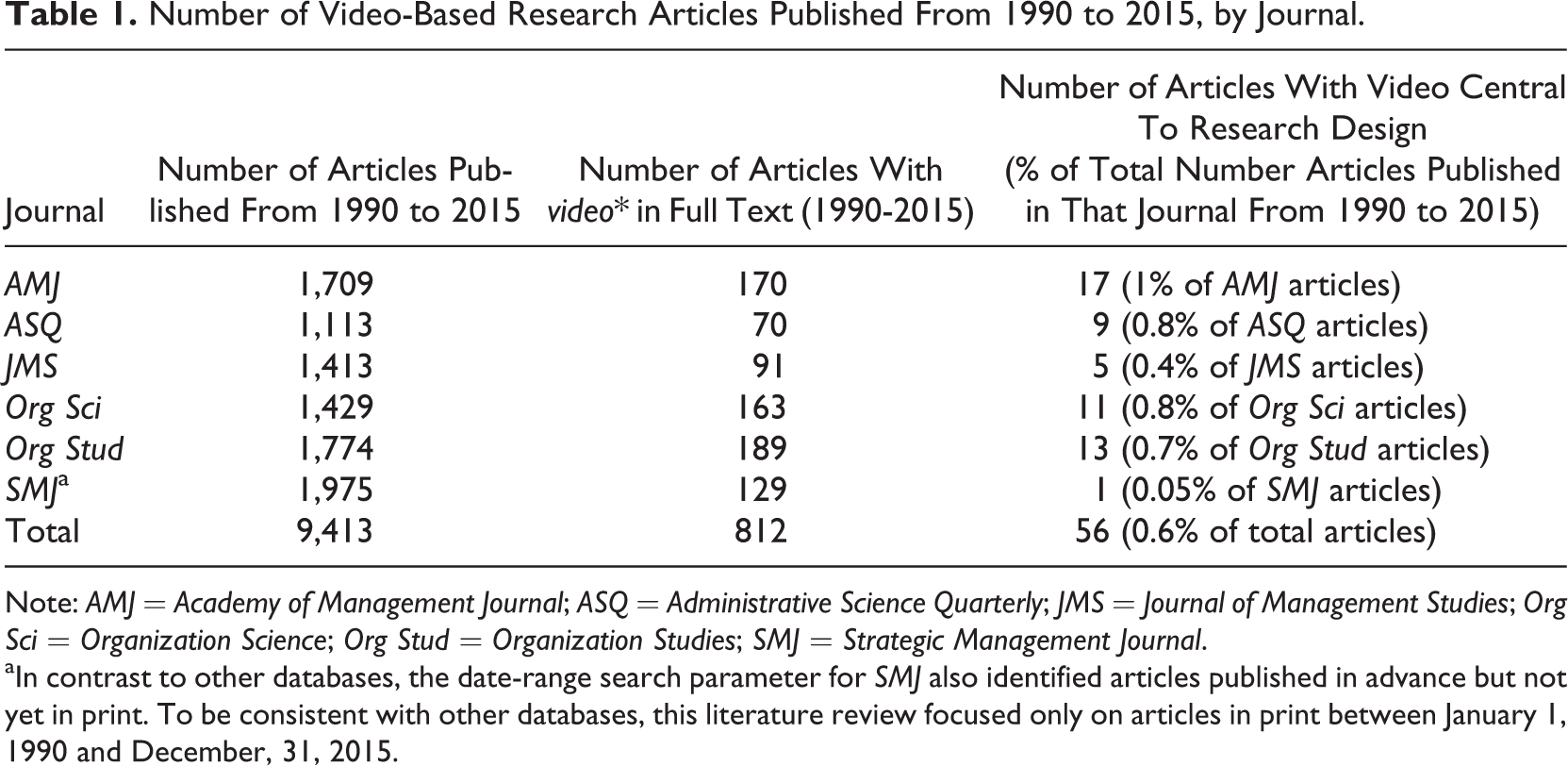
Note: AMJ = Academy of Management Journal; ASQ = Administrative Science Quarterly; JMS = Journal of Management Studies; Org Sci = Organization Science; Org Stud = Organization Studies; SMJ = Strategic Management Journal.
aIn contrast to other databases, the date-range search parameter for SMJ also identified articles published in advance but not yet in print. To be consistent with other databases, this literature review focused only on articles in print between January 1, 1990 and December, 31, 2015.
As Table 1 illustrates, the initial full-text search for video* identified 812 articles. From the initial set of articles that contained video* in the full text, I identified 56 articles that met the criteria for inclusion, which represents a very small portion of the articles published in these top-tier journals (0.6% of total articles). Every journal article identified through the initial search was read by the author (and double-checked by my research assistant) to determine whether the article met the criteria for inclusion for more detailed review. The number of articles published for each journal were obtained from the Scopus database, which provided annual publication data for 1996 to 2014. For the remaining years (1990-1995 and 2015), the number of publications per journal per year were manually counted.
Analysis of Articles
Details about how I gathered the descriptive information for the articles reviewed—the research topics of the articles, the kind of video recordings that were used, the other forms of data that were included in the articles, and so on—are listed in Appendix A. In this section, I focus on the analysis of the theoretical content of the articles. To gain insight into how researchers were actually using video recordings and what phenomena those recordings could help illuminate, I employed a thematic analysis approach (Boyatzis, 1998). I began by examining the research topics in these articles for recurrent themes related to the phenomena under study. The research topics of the articles clustered into broader themes related to rhetoric, emotion, individual performance, dyadic interactions, group interactions, and workplace studies. Taken together, these six phenomena accounted for almost 90% of the video-based research articles that were reviewed. The remaining five articles in the set reviewed used video recordings to investigate other phenomena (coded as other)—for instance, Lawrence and Dover (2015) used video recordings to study the relationship between place and institutional work.
Articles with research topics related to rhetoric—for instance, storytelling in organizations, acquisition discourse, and the dramaturgical analysis of sales encounters—all had in common the use of language or images to persuade others. Articles with research topics related to emotion—for example, emotional dynamics and strategizing processes, emotional contagion, and positive affective displays—all had in common the study of displayed emotion. Articles related to individual performance examined topics such as assessing creative potential or entrepreneurial decision making. In comparison to articles related to rhetoric, articles related to individual performance focused on assessments of features of the individual, not on the language or images used to persuade. Articles related to dyadic interactions examined topics such as negotiations or job interviews. Again, the focus was on assessments of the people in the dyad and their performance—for instance, whether an applicant’s self-esteem affected their behavior during a job interview (Liden, Martin, & Parsons, 1993). Articles related to group interactions focused on the assessment of people in groups and their performance, examining topics such as brainstorming groups, team adaptation and performance, and group pacing behavior under dynamic deadlines. Last, articles related to workplace studies examined topics such as embodiment and situated work practices. Workplace studies articles also all employed a common ethnomethodological/conversation analytic approach for examining video recordings.
As I analyzed these articles, it became clear that researchers were drawing on different features of video recordings to study these organizational phenomena. Gibson’s (1986) notion of affordances—the “action possibilities” of an object or environment—offers useful theoretical handholds for examining how and when researchers might use certain features of video and not others (Goldman, 2006). Affordances define what actions are possible, but affordances are not fully deterministic (Norman, 2013). People may make use of some affordances and not others. For instance, video recordings captured visible, audible, and timing information, but not all researchers drew on these features. Researchers also used the same features to varying degrees and for differing purposes. For example, I found that researchers studying emotion used the visible and audible information in video in radically different ways: Some researchers applied detailed coding schemes (evaluating facial, vocal, physical, and verbal cues) to identify specific displayed emotions (e.g., Liu & Maitlis, 2014), and other researchers used a much more “gestalt” approach, with coders rating positive affective displays on a one to five scale (e.g., Trougakos, Beal, Green, & Weiss, 2008).
I analyzed the articles again, focusing on the affordances of video recordings (Gylfe et al., 2016; Heath et al., 2010; Heath & Hindmarsh, 2002; Hindmarsh, 2009; LeBaron, 2006). For example, I examined how researchers made use of the audible, visible, and timing information captured by video recordings, noting when they used these affordances to study nonverbal behaviors (e.g., facial expressions, gaze, and gesture), sociomaterial interactions (people’s interactions with artifacts or their physical environment), and/or the precise timing of behaviors. These are all aspects of organizational life that are difficult to study using other forms of data. I found that the way in which researchers drew on the affordances of video differed depending on the phenomenon they were studying and the specific research question they were investigating. For instance, many of the articles on rhetoric foregrounded the use of the audible information from video recordings over the visible information. In contrast, workplace studies used both audible and visible information from video recordings to explore the unfolding of situated talk-in-interaction over time. To show researchers used various affordances of video to study organizational phenomena, I turn next to a discussion of my findings.
Findings
To illustrate how video advanced knowledge around organizational phenomena, I have structured the findings section into two parts. First, I begin with a broad overview to give a sense of how much video-based research has been published in top-tier organizational journals and what kind of phenomena have been studied. Second, I take a more in-depth look at the ways in which researchers have used video recordings. Drawing on examples from the articles identified in my review, I demonstrate how researchers use the audible, visible, and timing affordances of video in increasingly complex ways to gain insight into organizational phenomena, including rhetoric, emotion, group interactions, and workplace studies. By discussing how researchers examined these phenomena, I show how video illuminated aspects of situated action and interaction—such as nonverbal behaviors or the temporal unfolding of interactions—that are difficult to study using other kinds of data.
My literature review identified 56 video-based research articles. Although these articles accounted for a very small portion of the total number of articles (i.e., <1%) published in six top-tier journals, there was a trend of more video-based research being published in recent years (see Figure 1). Specifically, there were more than six times as many video-based articles published from 2010 to 2015 (25 articles), compared to 1990 to 1994 (4 articles). This overall increase in publications was due in large part to articles focusing on two organizational phenomena. Over the past 10 years, there was a doubling of the number of video-based workplace studies articles that were published (from 2 in 2005-2009 to 4 in 2010-2015) and a trebling of the number of articles published that included video-based studies of group interactions (from 3 in 2005-2009 to 9 in 2010-2015).

Number of articles using video, organized by phenomenon, published in six top-tier organizational journals from 1990 to 2015.
To give contextual information about the articles where video-based research was used, I summarize some key features in Table 2, including the research topic of the articles and the other kinds of data used in the article, in addition to video recordings. Table 2 displays the variety of topics that researchers have examined using video recordings, ranging from organizational routines (Cohen & Bacdayan, 1994), to brainstorming and innovation (Hargadon & Sutton, 1997; Sutton & Hargadon, 1996), to strategic work by frontline workers (Balogun, Best, & Lê, 2015). Table 2 shows that video recordings were almost always used in concert with other kinds of data. However, there were a few exceptions: In seven studies, video recordings were the only data collected and analyzed (Chang, Bordia, & Duck, 2003; Cohen & Bacdayan, 1994; Llewellyn, 2015; Okhuysen, 2001; Okhuysen & Eisenhardt, 2002; Waller, 1999; Waller, Zellmer-Bruhn, & Giambatista, 2002).
Video-Based Research Articles, Published From 1990 to 2015, in Journals Reviewed.
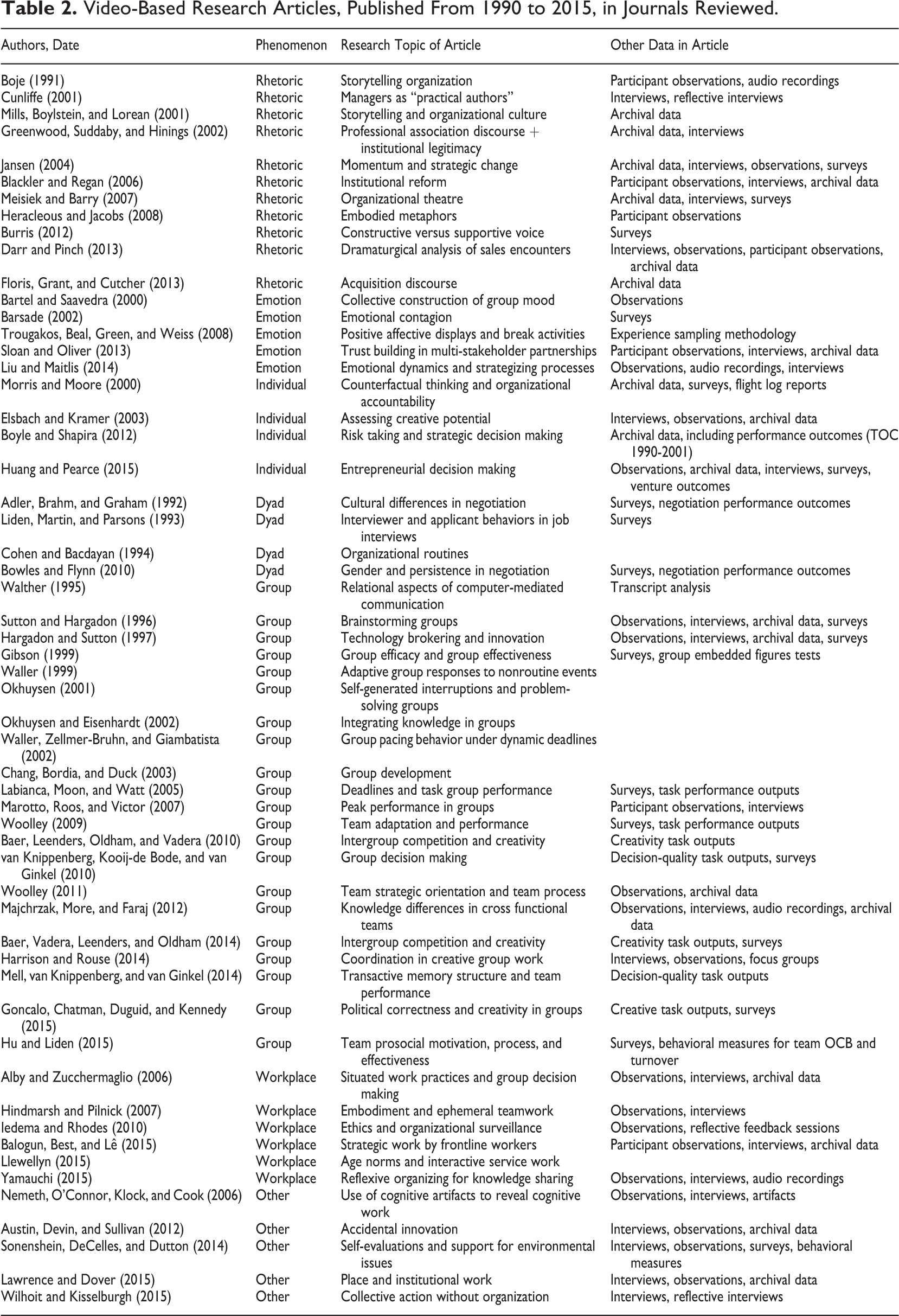
Table 3 presents further detail about the characteristics of the video in each study, including the amount and type of video recordings, the type of methodological approach used to analyze the video, and what form of the video was analyzed (transcript, video, or both). Table 3 also provides an overview of the use that researchers made of the visible information from video recordings for studying nonverbal behaviors and sociomaterial interactions and the timing information from video recordings for studying the precise timing of actions and interactions.
Characteristics of Video Used in Video-Based Research Articles, Published From 1990 to 2015, in Journals Reviewed.
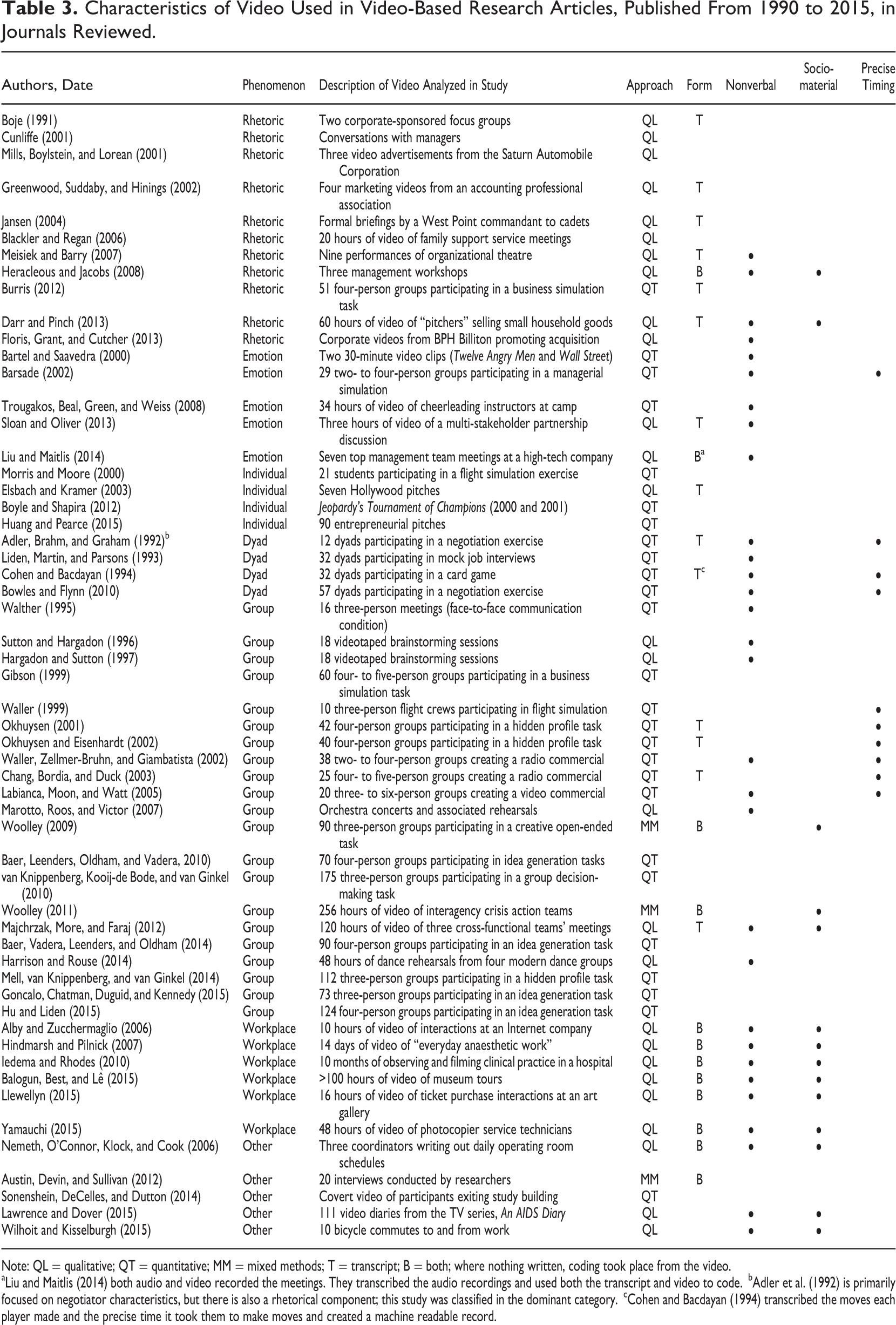
Note: QL = qualitative; QT = quantitative; MM = mixed methods; T = transcript; B = both; where nothing written, coding took place from the video.
a Liu and Maitlis (2014) both audio and video recorded the meetings. They transcribed the audio recordings and used both the transcript and video to code.
b Adler et al. (1992) is primarily focused on negotiator characteristics, but there is also a rhetorical component; this study was classified in the dominant category.
c Cohen and Bacdayan (1994) transcribed the moves each player made and the precise time it took them to make moves and created a machine readable record.
Table 3 highlights the rich trove of video recordings that researchers analyzed. There were video recordings of people participating in more conventional organizational activities, such as meetings (Blackler & Regan, 2006; Liu & Maitlis, 2014; Sloan & Oliver, 2013), focus groups (Boje, 1991), and management workshops (Heracleous & Jacobs, 2008). But there were also video recordings from less conventional organizational settings—for example, video of health care professionals caring for patients (Hindmarsh & Pilnick, 2007; Iedema & Rhodes, 2010), instructors at a cheerleading camp (Trougakos et al., 2008), modern dance groups engaged in rehearsals (Harrison & Rouse, 2014), and counterterrorism teams analyzing potential threats (Woolley, 2011).
Table 3 also shows the equal use of qualitative and quantitative approaches to analyze the video recordings. In addition, there were three articles where both qualitative and quantitative methods were applied to analyze the same video recordings (Austin, Devin, & Sullivan, 2012; Woolley, 2009, 2011). With the exception of the workplace studies—which all used an ethnomethodological/conversation analytic approach—there was no common methodological approach for the organizational phenomena that were studied. Rather, researchers drew on the methodological approaches that best suited their particular research question.
Having provided a broad overview of how much video-based research has been published in top-tier organizational journals and what kind of phenomena were studied using video recordings, I now turn to a more in-depth discussion of articles from this review to demonstrate how researchers use the audible, visible, and timing affordances of video in increasingly complex ways to learn more about organizational phenomena.
Rhetoric: The Usefulness of Video as a Detailed and Permanent Record
Broadly defined, rhetoric is the use of language or images “to persuade or influence others” (Oxford English Dictionary). When studying rhetoric, it is helpful to have a record of what people say and do, and how. Video provides just this kind of detailed and permanent record. All the studies related to rhetoric made use of the affordance of video as a detailed and permanent record, but they differed in terms of how they used the audible and visible information from video recordings in their analysis and presentation of data.
Some researchers analyzed verbatim transcripts that they created from the video recordings (Burris, 2012; Greenwood, Suddaby, & Hinings, 2002), which made use of the audible information from video but not of any of the visible information. Other researchers created and analyzed annotated transcripts (Boje, 1991; Darr & Pinch, 2013; Heracleous & Jacobs, 2008; Meisiek & Barry, 2007), which were verbatim transcripts that were augmented by other audible or visible information from the video—for example, notes about the intonation of what was said or notes about what gestures people made. Last, some researchers worked directly with the video (Blackler & Regan, 2006; Cunliffe, 2001; Floris, Grant, & Cutcher, 2013), which made the full richness of the audible and visible information recorded on video available to researchers. To show this range of approaches, I discuss three studies in more detail to demonstrate how researchers drew on the affordances of video to study rhetoric by using verbatim transcripts (Burris, 2012), annotated transcripts (Darr & Pinch, 2013), and coding directly from video (Floris et al., 2013).
Verbatim transcripts
In order to examine the risks and rewards of employees speaking up, Burris (2012) analyzed video recordings of 51 four-person teams engaged in a business simulation task. This task was designed so that one team member was given information that would cause them to question the strategies proposed by the other team members. Burris’s (2012) focus was on what people said, not what they did, so he used the video recordings to create verbatim transcripts, which made it possible to derive precise measures of how much team members spoke up in support of the main strategy (supportive voice) or in support of the alternate strategies (challenging voice).
Once the verbatim transcripts were created, Burris (2012) further transformed the transcripts by “unitizing” them into speaking turns, where “one unit was the amount spoken by any one person without being interrupted by another team member” (p. 864). Independent coders categorized these speaking turns by evaluating which type of strategy each speaking turn supported. For each team, Burris created measures for challenging and supportive voice by calculating the number of words in each (challenging voice or supportive voice) speaking turn, dividing that number by the total number of the group’s words to control for length of discussion, and converting that number into a percentage. These numerical measures of challenging and supportive voice were entered into a multilevel analysis with other key variables, such as leaders’ evaluation of team member performance.
Burris’s (2012) analysis revealed that how managers responded to subordinates’ speaking up depended on the type of voice exhibited—for example, team members who engaged in more challenging voice were rated as worse performers and were perceived as more threatening by leaders. The verbatim transcripts created from the video recordings made the precise measurement of these different types of voice possible. However, in studies such as this, where audible information is the focus of interest, audio recordings could be used instead of video recordings with no loss of data.
Annotated transcripts
As part of a larger qualitative study into the social organization of sales encounters, Darr and Pinch (2013) examined over 60 hours of video recordings of “pitchers,” who were sales-patter merchants working in open markets, selling small household goods. The video recordings were part of a larger portfolio of data in this article—including interviews, observations, participant observations, and archival data—that were gathered during the pitcher study and two other research projects. In contrast to these other data, video recordings of the pitchers made it possible for Darr and Pinch to create transcripts of sales encounters, which helped them to identify the “scripts” that the pitchers followed as they sold goods. Because they were interested in the role of materiality in sales encounters, they also annotated the transcripts to include actions—for example, gestures that the pitchers or the audience members made.
The annotated transcripts allowed the fine-grained analysis of not only what the pitchers were saying but also what they were doing. Darr and Pinch (2013) found that materiality was crucial in how the sale encounters were staged and to how pitchers created a growing social obligation for the buyers to purchase the goods. For instance, pitchers gave people in the crowd merchandise to hold before they announced its price—in this way, the pitchers were subverting the shopping norm that customers usually take merchandise only after they have paid for it. In addition to facilitating a moment-by-moment analysis of sales encounters, the annotated transcripts also brought the “field” to life during the presentation of data. Darr and Pinch used excerpts from the annotated transcripts in their findings section to illustrate key points. In this article, video recordings enriched the study of the role of materiality in sale encounters by facilitating a more fine-grained analysis and presentation of data.
Coding from video
Along with other archival data, Floris et al. (2013) analyzed corporate videos to gain insight into multimodal discursive practices used during an attempted acquisition. They studied videos that BHP Billiton produced to help garner support for their bid to acquire another mining company, Rio Tinto. When examining video as a mode of discourse, they broke video down into its component parts (submodes)—such as speech, moving image, and music—to see how rhetorical strategies related to pathos (emotion), ethos (authority), and logos (logic) were manifested in each mode. Their analysis and presentation of the video data helped to illustrate the alignment of multimodal rhetorical strategies. For instance, they found that when the rhetorical strategy of logos was being applied, words arguing for the advantage of combining the two companies to create synergies were accompanied by images that visually complemented this argument, for example, maps of the BHP and Rio assets to show how nearby assets were to each other. To present their findings, Floris et al. incorporated excerpts from transcripts and descriptions of visual images. Video recordings broadened the scope of the multimodal rhetorical strategies they investigated so that other modes such as music or moving images could be included.
Taken together, these studies illustrate how researchers draw on the affordances of video in differing ways to study what people are saying and doing as they engage in rhetoric. These ways of working with the detailed and permanent record created by video—verbatim transcripts, annotated transcripts, and coding directly from video—also apply to other organizational phenomena. Table 3 provides a useful summary of whether researchers used transcripts, video, or both to study a wide range of topics.
Emotion: The Usefulness of Video for Examining Nonverbal behaviors
The study of displayed emotions, in contrast to the study of felt or experienced emotions, requires that researchers are able to record and rigorously code nonverbal 2 as well as verbal behaviors. Video recordings are useful for studying emotion because they capture visible and audible information. Coding schemes for displayed emotions involve a constellation of cues—including facial, vocal, physical, and verbal cues—that must be evaluated concurrently. This is difficult to do in real time. Video is also a detailed and permanent record, which can be analyzed over and over again. This affordance is particularly useful for emotions researchers because it facilitates the development of new coding schemes for emotion, helps in the training of future coders, and allows coders to engage in fine-grained coding, compare their coding, and calculate interrater reliability (Barsade, 2002; Bartel & Saavedra, 2000; Liu & Maitlis, 2014; Trougakos et al., 2008). Liu and Maitlis (2014) write that video allowed them to capture the “micro-behaviors and interactions that are the ‘stuff’ of strategic practice … including fleeting, nuanced, and rich emotional expressions” (p. 206). To illustrate how the use of video provided insight into emotion, I again discuss three articles in more depth: Liu and Maitlis’s study of displayed emotions and emotional dynamics, Trougakos et al.’s (2008) study of positive affective displays, and Barsade’s (2002) study of emotional contagion.
Displayed emotions and emotional dynamics
To explore how emotion affected the discursive process through which strategy was constructed, Liu and Maitlis (2014) analyzed video recordings of top management team meetings at a high-tech company. They examined displayed emotions (e.g., excitement, anger, or frustration) as well as emotional dynamics, the sequence of emotions expressed by various team members as they discussed strategic issues. They developed their own coding scheme for displayed emotions—which included facial, vocal, physical, and verbal cues—because they found that existing coding schemes did not capture the range of emotions present in their data. Using the circumplex model of emotion as an organizing framework to account for both the hedonic valence of emotion and the level of activation associated with each emotion, they modified existing coding schemes to create a new coding scheme that encapsulated a wider spectrum of emotions, including less intense emotions such as excitement or annoyance.
By analyzing displayed emotions and the sequencing of those emotions during conversations around 10 strategic issues, Liu and Maitlis (2014) showed how the emotional dynamics within top management team meetings shaped the way in which strategizing took place. For instance, they found that the amused reactions of team members to a leader’s proposal allowed them to reject the proposal but still move the discussion forward, suggest an alternate proposal, and reach a decision that was accepted by all. Video recordings made it possible for Liu and Maitlis to develop a coding scheme appropriate for the range of displayed emotions in their data and to rigorously study the unfolding patterns of those displayed emotions within teams over time—something that would be difficult if not impossible to do any other way.
Positive affective displays
As part of a study on emotional labor and customer service interactions that investigated the relationship between what people do during work breaks and how they subsequently feel and perform at work, Trougakos and colleagues (2008) analyzed video recordings of 64 cheerleading camp instructors. The video recordings were used to evaluate positive affective displays, which were a measure of work performance. The researchers videotaped instructors engaging in camp duties and gathered two 2-minute video recordings of each instructor over eight teaching sessions, for a total of 32 minutes of video per instructor. Trougakos et al. also used experience sampling methodology to gather data about break activities and experienced positive and negative emotions.
The coding of displayed emotions in this study differed significantly from the coding of displayed emotions in the previous study (Liu & Maitlis, 2014). Instead of using a detailed coding scheme for nonverbal behaviors, pairs of trained coders used a more “gestalt” approach and rated the video recordings using a one to five scale to assess the four dimensions of positive affective displays (spirit/enthusiasm, energy, alertness, and sincerity). The ratings from each coder were then averaged together, and this average rating was further consolidated so that ultimately there was a single numerical score for positive affective displays for each instructor during each session. Trougakos et al. (2008) used multilevel modeling to examine the relationship between work break activities, experienced emotions, and displayed emotions (positive affective display score). They found that employees who engaged in more respite activities during their breaks, such as napping or socializing, exhibited higher levels of positive affective displays after their breaks, even when the impact of positive emotional experiences were taken into account. As was the case for Liu and Maitlis (2014), video recordings made it possible for Trougakos et al. to evaluate displayed emotion in a real-world setting. In this study, the ability to examine displayed emotions as well as experienced emotions was important for advancing knowledge around how work break activities influence how people perform and feel at work.
Emotional contagion
To investigate emotional contagion, the transfer of moods among people in a group, Barsade (2002) designed a lab experiment to induce emotional contagion and study its effect on group dynamics. The experiment involved video recording 29 groups of students participating in a simulated managerial exercise, where one of the group members was a trained confederate who enacted one of four different mood conditions (2 × 2 design: pleasant/unpleasant emotional valence and high/low energy). Video recordings were essential to this study because they were used to evaluate both emotional contagion and group dynamics, specifically group cooperativeness and group conflict.
This study included both fine-grained coding and “gestalt” coding of emotion from video recordings. Research assistants coded the video recordings for emotional contagion by examining participant mood and changes in mood over time. Specifically, they used the nonverbal cues—facial expressions, body language, and verbal tone—that Bartel and Saavedra (2000) identified as being associated with pleasant group mood and rated the level of each participant’s pleasant mood every two minutes. These individual participant pleasant mood scores were then aggregated across coders for the second half of the experiment to create a Time 2 mood scale. In addition to this detailed coding of participant mood, research assistants also coded their perception of the overall pleasant mood for each group on a one to seven scale. As well, research assistants coded the video recordings for group dynamics, rating their assessment of group cooperativeness and group conflict on a one to seven scale.
To complement the data coded from video recordings, participants also self-reported their own ratings of mood at Time 1 and Time 2 as well as their ratings of their own performance and other group members’ performance related to the group task. Barsade (2002) used both kinds of data related to mood because video-coder ratings allowed better access to the mood being expressed by participants and self-report data provided insight into internal feeling states. Barsade found strong evidence for emotional contagion for both positive and negative moods. Moreover, she found that positive emotional contagion was associated with increased group cooperation and less group conflict. Video recordings helped to advance knowledge by providing a way of reliably measuring and tracking changes in mood in groups over time and evaluating the impact of emotional contagion on group dynamics.
Taken together, these studies illustrate some of the different ways in which researchers used the affordances of video to examine nonverbal behaviors in the study of emotion. Specifically, these articles demonstrate how researchers make use of the visible and audible information on video recordings to code—in more and less fine-grained ways—for a range of nonverbal cues, including facial expressions, body language, and verbal tone. The usefulness for video for studying nonverbal behaviors is particularly relevant for the study of emotion but also extends to other organizational phenomena (see Table 3 for other articles where nonverbal behaviors are evaluated).
Group Interactions: The Usefulness of Video for Studying the Temporal Aspects of Interaction
In the study of group interactions, more than the other phenomena reviewed, researchers used video recordings to examine the temporal aspects 3 of interactions. Researchers studying group interactions not only made use of the affordance of video as a detailed and permanent record of unfolding events, they often made use of its affordance related to precise timing. The study of how processes unfolded over time in groups was facilitated in three main ways by video recordings. First, in the lab, video recording permitted fine-grained coding of the behaviors in small increments of time, such as 10 seconds or 60 seconds. Researchers used the affordance of precise timing to calculate the duration, frequency, clustering, and timing of behaviors (Okhuysen, 2001; Okhuysen & Eisenhardt, 2002; Waller, 1999; Waller et al., 2002). Second, video recordings also allowed researchers to examine the temporal pacing of group activities. For example, specific segments of the video could be coded to examine behaviors that occurred before and after the midpoint of a task or in response to deadlines (Chang et al., 2003; Labianca, Moon, & Watt, 2005; Waller et al., 2002). Third, in the field, video allowed researchers to record interactions that took place over the course of days or weeks (Harrison & Rouse, 2014; Majchrzak, More, & Faraj, 2012; Marotto, Roos, & Victor, 2007; Woolley, 2011). This record could be used to create a timeline of events and to examine how group dynamics emerged and changed over time. As well, video recordings could be watched over and over, which helped to facilitate the inductive development of theory. To illustrate several different ways in which researchers made use of video to study the temporal aspects of group interactions, I discuss three articles in more depth: Waller’s (1999) examination of the frequency and timing of behaviors, Labianca and colleagues’ (2005) investigation of temporal pacing in groups, and Harrison and Rouse’s (2014) study of emergent group dynamics.
Frequency and timing of behaviors
To study how groups responded to nonroutine events, Waller (1999) used video recordings of 10 three-person flight crews participating in flight simulation exercises. The combination of video recordings and simulation allowed for the rigorous examination of nonroutine events that are, by their very nature, unexpected and difficult to study. Waller used a method of coding the video that enabled an extremely fine-grained examination of how often and when behaviors occurred in the groups.
All variables in the study were coded directly from video recordings. Coders created activity logs, where they coded for the presence or absence of key behaviors (information collection and transfer, task prioritization, task distribution) in 10-second increments as well as coding for the time the crews noticed something was happening (“nonroutine event verbalization”) and for the subsequent average response times for task prioritization and task distribution activities. In addition to using the video recordings to evaluate key adaptive behaviors, video recordings were also used to evaluate team performance. Expert observers and two other coders evaluated crew performance from the video, counting the frequency of errors, in order to divide the sample into high performers (five teams above median) and low performers (five teams below median).
Using such fine-grained behavioral coding had at least two methodological advantages. First, it allowed for the calculation of the frequency of key behaviors, and second, it allowed for the analysis of those behaviors over time. By being able to distinguish between the frequency and timing of behaviors, Waller (1999) identified a key difference between high- and low-performing teams in response to unexpected events: It was not the frequency of behaviors that mattered; it was the timing. In comparison to the low-performing teams, high-performing teams are much more likely to follow comments about nonroutine events with task prioritization and distribution activities. Thus, the high-performing teams could respond more quickly to nonroutine events. Video recordings literally made this study possible, being the only form of data collected, and the fine-grained coding of the video advanced knowledge by illuminating how and why some teams were able to adapt to nonroutine events when others were not.
Temporal pacing in groups
To learn more about how perceptions of deadlines in groups influence pacing and performance, Labianca et al. (2005) studied video recordings of 20 groups of three—six students engaged in an experimental task where they had to create a video commercial. Researchers manipulated the starting time of the task so that it was either prototypical (e.g., on the hour) or atypical (e.g., beginning 7 minutes after the hour). Research assistants coded the video for various time measures related to pacing, including time consciousness (number of times group members checked time or made a time statement), staging variable (the amount of time groups spent acting and rehearsing commercial), time calculations (the number of times group members made announcements or inquired about time left), and temporal imprecision (how accurate the time calculations were). The commercial that the students produced was also coded by a different set of coders: two experts (ad executives from MindShare, a NYC advertising firm), who provided an evaluation of group performance by ranking each commercial’s suitability to run in national primetime spot (and get people to buy the product).
As you can see from the measures related to time, video recordings made it possible for coders to count the frequency of statements about time, evaluate the accuracy of those statements, calculate how long the groups spent on various tasks, and identify exactly when key transitions took place. Through this detailed coding of temporal pacing from the video recordings, Labianca et al. (2005) found that groups with atypical deadlines were more likely to miscalculate the time left to complete the tasks and were more likely to delay the transition to actually staging the commercial, leaving them less time to rehearse, which resulted in a lower quality product.
Emergent group dynamics
To examine how groups balance dynamics that “pull the group together” with dynamics that “pull the group apart” during the coordination of creative work, Harrison and Rouse (2014) studied 48 hours of video recordings of dance rehearsals of four modern dance groups. The video was part of a portfolio of data, including interviews and observations. Harrison and Rouse had an unusually detailed methods section where they explained how they used these data together to study coordination. They write, [W]e used video to document the majority of the groups’ rehearsals, so that we could review their interactions later. This proved invaluable during our analysis and during the review process, allowing us to enrich our theoretical memos and enlarge our understanding of the phenomena as we were challenged by reviewers. (Harrison & Rouse, 2014, pp. 1263-1264)
By using video recordings to augment and extend complementary forms of data, such as observations, Harrison and Rouse (2014) were able to examine emergent group dynamics and develop a process theory of creative coordination that showed how participants balanced autonomy and constraints and progressed through a series of stages: from surfacing boundaries, to discovering discontinuities, which lead to parsing solutions. In their presentation of the data, they used verbatim annotated excerpts from the video recordings to illustrate how these processes were actually accomplished in practice. In this way, video recording facilitated their examination of how processes unfold over time in groups, both in the analysis and the presentation of data.
Taken together, these studies show some of the ways in which video recordings can be used to gain insight into the temporal aspects of interaction. Although these studies focus on group interactions, the techniques that were described could be used for the study of other phenomena where temporal issues are relevant. Table 3 highlights other studies where the researchers made use of the precise timing affordance of video recordings.
Workplace Studies: The Usefulness of Video for Studying Multimodality
Of all the articles reviewed, workplace studies demonstrated the most complex use of video recordings. Researchers not only coded for what people said and what they did, they also coded for how people interacted with each other, material artifacts, and their physical environment. Multimodal analysis examines how all these factors are interwoven during the accomplishment of situated action and interaction (Streeck, Goodwin, & LeBaron, 2006). Workplace studies (Luff, Hindmarsh, & Heath, 2000) are concerned with multimodality, specifically the ways in which people in organizations “organize their conduct and make sense of each other’s actions for the practical purposes at hand. This includes how verbal, bodily, and material resources are deployed in the coordination of work and organizational practice” (Llewellyn & Hindmarsh, 2013, p. 1403).
Researchers in the workplace studies tradition draw on methodological approaches that stem from ethnomethodology (Garfinkel, 1967, 1986) and conversation analysis (Sacks, 1992) to gain insight into the micro-foundations of interaction. Not only do workplace studies involve a fine-grained analysis of behavior, they also involve a fine-grained presentation of data, showing the sequential organization of talk and action, through a frame-by-frame analysis of images from video as well as a turn-by-turn analysis of transcripts of conversations. This highly detailed approach to analyzing data is time consuming but is also a powerful way of gaining insight into issues such as embodiment or sociomateriality, which are otherwise difficult to study. To illustrate how workplace studies use video recordings to shed light onto the multimodal nature of situated practices, I will discuss three studies in more depth: Hindmarsh and Pilnick’s (2007) study of embodiment in the workplace, Balogun et al.’s (2015) examination of frontline strategic work, and Iedema and Rhodes’s (2010) study of reflective practice.
Multimodality and embodiment
To learn more about embodiment in the workplace, Hindmarsh and Pilnick (2007) analyzed 14 days of video recordings of anesthetists (and resident anesthetists) working together in and around operating theatres, specifically focusing on the moments when anesthetists were intubating patients (putting the “breathing tube” in place). Hindmarsh and Pilnick searched through the video recordings and edited together a “collection of instances” of all the intubation sequences onto a single tape for analysis. This approach allowed for the fine-grained analysis of unfolding sequences of action and interaction while also permitting comparison across multiple examples of the same activity.
Hindmarsh and Pilnick (2007) made both an empirical and a methodological contribution with their article: Their video-based study of everyday anesthetic work revealed insights about the role of the body in coordinated action in teams while at the same time demonstrating the usefulness of this type of methodological approach for studying embodiment. Hindmarsh and Pilnick found that much of the coordination of embodied conduct occurred without discussion: Using a series of frame grabs, accompanied by annotated excerpts of transcripts, they showed the wordless ballet that participants engaged in as they coordinated their actions to accomplish their work—for instance, by providing a piece of equipment at just the right moment. Through their study, Hindmarsh and Pilnick demonstrated how people use their body and their “intercorporeal knowledge” to recognize opportunities to provide assistance in the service of coordinating their work.
Multimodality and strategic practice
Building on an increasing number of studies concerned with the practice of strategy, Balogun and colleagues (2015) analyzed more than 100 hours of video recordings of museum tours at the Victoria and Albert Museum and 78Derngate to study how the strategic aims of the museums (audience engagement, entertainment, and education) were realized in the everyday practice of frontline workers. In addition to the large amount of video, they also analyzed a range of other data, including participant observations, observations of other tour guides, interviews, and archival data. These other data were meant for contextualizing understanding to facilitate the analysis of the video recordings. They drew on the classic ethnomethodological/conversation analytic approach used in workplace studies, reviewing the data to identify key moments, extract fragments, and then analyze those fragments. However, unlike Hindmarsh and Pilnick (2007), the fragments that Balogun et al. extracted were not instances of the same part of the routine but instead spanned across the work practices that were being investigated.
They found that strategic aims were achieved through the complex interplay of multiple factors: the physical context; the audience features; the “moral order”; the talk, actions, and gestures of the tour guide; and the talk, actions, and gestures of the audience. Because Balogun et al. (2015) were simultaneously analyzing so many dimensions of strategic work, their article had a correspondingly complex presentation of data. Their article included (a) frame grabs of images from the video that were combined with (b) annotated excerpts from the transcript and (c) a larger data table, which showed the interrelationship between guide and audience actions over a longer time period (more than just a few conversational turns), and (d) a description of the process in the article itself, where text that described key factors was underlined. This presentation of data illustrates some of the complexity and challenge associated with representing multimodal processes in a conventional journal format. Through this detailed analysis, Balogun et al. were able to parse the components of the “interactional competence” that workers had to enact to engage in frontline strategic work. Their findings also demonstrated the multimodal entanglement of everyday practice by emphasizing the importance of materiality in the accomplishment of this frontline work and highlighting the involvement of the audience.
Multimodality and reflective practice
As part of a larger study on the everyday practices of health care professionals, Iedema and Rhodes (2010) collected video recordings, over a period of 10 months, of staff working in the spinal unit of a hospital. As was the case with the other workplace studies, they were interested in studying the multimodal entanglement of talk and action as health care professionals went about their everyday work. However, in contrast to the other workplace studies reviewed in this article, Iedema and Rhodes had a particular interest in using video recordings not only to record behavior but to explicitly change behavior. They designed their study as a video-based intervention, aimed at changing infection control practices in the hospital, especially related to hospital-acquired infections, including antibiotic-resistant super-bugs, like methicillin-resistant staphylococcus aureus (MRSA).
Iedema and Rhodes (2010) selected footage from the video they had been recording, focusing on video of the problem of hospital-acquired infections, and held feedback sessions to show this footage to the health care professionals on the spinal unit. Showing participants video footage of themselves was a reflective practice, intended to prompt discussion. Iedema and Rhodes were interested in whether “surveillance,” in the form of video recordings, could create an opportunity for health care professionals to reflect on the materiality and embodiment of their own everyday practices and the impact those practices had on others.
After watching video recordings of their everyday practices, Iedema and Rhodes (2010) found that health care professionals became more aware of their own infection control practices, more attentive to each other’s practices, and more alert to sources of infection or other risks they had not previously recognized. These changes in practice had a striking impact: Over the course of this study, infection rates fell from 34 cases per year in 2004, when the project started, to 27 cases per year in 2005, and to only 7 cases in 2006. Therefore, above and beyond contributing to insight about organizational phenomena, this study affected real-world changes in behavior that significantly reduced the infection rates on this unit. Showing video recordings of everyday practices to participants is a generative methodological approach for researchers to gain insight into the reflective practitioner (Schön, 1983). This type of video-based participatory action research, although rare in organizational and management literature, is more commonly used in other social sciences (Haw & Hadfield, 2011; Pink, 2013).
Taken together, these examples illustrate different ways in which researchers have used the affordances of video to examine issues of multimodality in workplace studies. The complexity of analysis in workplace studies—simultaneously considering what people say, what they do, how they interact with others, and how they interact with artifacts and their environment—reflects the complexity of the phenomena these researchers are investigating.
Discussion
To learn more about how researchers have used video to study organizational phenomena, I conducted a literature review of articles published from 1990 to 2015 in six top-tier organizational journals. The articles that I identified through my literature review provided a generative starting point for examining how researchers used the audible, visible, and timing affordances of video recordings in increasingly complex ways to gain insight into organizational phenomena, including rhetoric, emotion, group interactions, and workplace studies. By exploring how researchers investigated these phenomena, I showed how video helped to illuminate aspects of situated action and interaction that are challenging to evaluate using other kinds of data.
Much of the discussion around the use of video in the social sciences has focused on qualitative approaches to analyzing data (Gylfe et al., 2016; Haw & Hadfield, 2011; Heath et al., 2010; Knoblauch, 2012; Knoblauch et al., 2012; Knoblauch, Tuma, & Schnettler, 2013). However, my review revealed that—within the organizational literature—researchers used quantitative approaches just as often as they used qualitative approaches to analyze video recordings. Moreover, the methodological diversity within these quantitative and qualitative studies highlights the range of options available to researchers for the collection and analysis of video recordings. Even in the dozen articles that I reviewed in depth, there were many different strategies for working with video recordings. For example, some researchers transformed video recordings into verbatim transcripts (Burris, 2012) or annotated transcripts (Darr & Pinch, 2013). Some researchers worked with unedited video footage (Harrison & Rouse, 2014; Labianca et al., 2005; Waller, 1999), while other researchers identified fragments of the video to code (Balogun et al., 2015). Still other researchers selected and edited “collections of instances” onto a video tape, either so they could analyze the video (Hindmarsh & Pilnick, 2007) or show the video to participants (Iedema & Rhodes, 2010).
Although my review identified a number of ways in which the affordances of video helped to generate insight, my review also identified issues for further consideration. I found variation within and across the phenomena in terms of the degree to which the affordances of video were employed. In the articles reviewed, much of the use of video recordings focused on audible information, that is, what people were saying. This was true for the articles where video recordings are transformed into transcripts, which were then analyzed, but it was also true for some of the articles where coding occurred directly from the video. For example, in many of the group interaction studies, research assistants coded video for what group members were saying, such as the degree to which they elaborated information (van Knippenberg, Kooij-de Bode, & van Ginkel, 2010).
With the exception of workplace studies, articles using the visible information from video tended to focus on nonverbal behaviors—such as facial expressions—rather than how people interacted with objects or their environment. This relative inattention to issues of materiality represents an important opportunity for future research, especially with increasing calls to study these very topics (Balogun et al., 2014; Leonardi & Barley, 2010; Orlikowski & Scott, 2008). Workplace studies, which bring together video recordings and other ethnographic data with the methodological approaches of ethnomethodology (Garfinkel, 1967) and conversation analysis (Sacks, 1992; Silverman, 1998), are a particularly powerful way to examine the sequential organization of talk and action, examine the role of the body in organizing, and investigate how people interact with artifacts and their environment.
There were also opportunities for more widespread use of the timing information associated with video recordings. Coupling timing information with a detailed record of what people are doing and saying can be useful for studying a variety of topics. This use of the precise timing affordance of video was used by some group researchers to study temporal aspects of group interactions (Chang et al., 2003; Okhuysen, 2001; Okhuysen & Eisenhardt, 2002; Waller, 1999; Waller et al., 2002). In addition, other studies made use of this affordance. For example, Cohen and Bacdayan (1994) devised an elegant experiment and timed how long it took people to learn and perform recurrent patterns of action, which shed light on how organizational routines developed. In terms of future research, the precise timing affordance of video could also be useful for the study of nonroutine events. For example, video recordings are frequently used by researchers in other fields who study organizing in high-risk contexts, such as resuscitations by medical teams (Xiao & Mackenzie, 2004), where every second matters. As my review also highlighted, simulation and video recordings together are a powerful combination for studying how groups notice and respond to nonroutine events (Waller, 1999).
Given that video recordings are mostly used in concert with other forms of data, it is important for researchers to consider the role of video as they design studies, particularly in terms of what video recordings can reveal above and beyond these other types of data. Although technological advances in recording equipment have made video recordings much less expensive to collect and advances in data storage have made it possible for researchers to easily store video recordings (which generate gigabytes of data), there is still significant effort involved in obtaining video recordings and, more importantly, in processing and analyzing the data. For studies where researchers only need a permanent record of audible information and have no current or future need for the associated visible information, audio recordings may be a better way of gathering these type of data. Audio recordings can also be easier for transcriptionists to transcribe, and audio recordings avoid the ethical issues associated with collecting data that includes the identifiable images of participants.
There are also opportunities for researchers to make even greater use of video that they have already collected. For instance, some researchers were successful in publishing more than one article from the same set of video recordings in these top journals (Hargadon & Sutton, 1997; Sutton & Hargadon, 1996). Other researchers used the transcripts that they had created during the analysis of video in previous studies (Okhuysen, 2001; Okhuysen & Eisenhardt, 2002) to conduct a new study (Okhuysen & Waller, 2002). Researchers also collected video for purposes outside the scope of this review—for instance, as a backup for observations (Fayard & Weeks, 2007) or as a validity check for other measures (Zhu & Chen, 2015a, 2015b)—but this video could also be fruitfully analyzed on its own in future studies.
In future research, as discourse becomes more nuanced around video-based research methods in organizational studies, it may be helpful to include more detail about how video is being collected and analyzed in the methods sections of articles. Theoretical and ethical issues related to the collection and transformation of video recordings are important considerations for researchers to keep in mind when using video but were infrequently mentioned. For instance, researchers almost never discussed the placement of the video camera as a theoretical choice (cf. Barsade, 2002; Llewellyn, 2015). There was also little discussion of how transcripts were created from video recordings: This was either mentioned in passing or talked about in terms of which notation system was used (e.g., Jeffersonian notation in the workplace studies articles) but never problematized, despite the complexity of transforming video data into transcript form (Mondada, 2007).
My review identified challenges associated with the collection and representation of video. Sometimes recording equipment failed and data were lost (Baer, Leenders, Oldham, & Vadera, 2010; Baer, Vadera, Leenders, & Oldham, 2014; Burris, 2012; Liu & Maitlis, 2014; van Knippenberg et al., 2010; Waller et al., 2002). For instance, Baer and colleagues (2010) lost half their data (35/70 recordings) due to technical difficulties with one of their video cameras. There were also challenges related to the representation of video in journal articles. Video data had to be transformed when it was presented—in the journals that I reviewed, researchers had three ways in which they could provide evidence from their video data: numerical, textual, or visual. That is, researchers could transform the video data into some kind of score or index, which was the case in many of the quantitative articles; they could use words to describe what was happening in the video; or they could use still images (usually a frame grab, or series of frame grabs) to highlight key aspects of the video. The challenge around representing video data was particularly acute for articles that included multimodal analyses, where the conventional journal format made it difficult to show the complexity of the findings (e.g., Balogun et al., 2015). Other options for representation are slowly being introduced into the field. Some journals, for instance the Academy of Management Discoveries, are making it possible for researchers to include short video excerpts hyperlinked within the articles.
To end, I want to highlight that compared to other social sciences, the use of video recordings is still fairly new in organizational studies. We still have much to learn from each other and from other fields, where the use of video is more established where the use of video is more established (Appendix B lists some articles and books that may serve as useful resources for the reader). Hopefully this review is one step toward making it easier for organizational researchers to learn from each other.
Conclusion
As the epigram to this article states, video provides unprecedented opportunities for research in the social sciences. My literature review of over 25 years of articles (1990-2015) published in six top-tier organizational journals maps out how researchers are using video to study organizational phenomena. By identifying and analyzing a set of 56 empirical articles where video was central to the research design, I show how researchers draw upon the audible, visible, and timing affordances of video recordings to examine situated action and interaction in organizations. My review contributes to the literature on video in organization studies by providing an overview of video-based research in these journals, highlighting the diversity of approaches used to collect and analyze video, and illustrating some of the ways that video helped to advance knowledge around organizational phenomena.
Footnotes
Appendix A
Appendix B
Acknowledgments
I would like to thank Paula Jarzabkowski for her editorial guidance and support throughout the process. I also would like to thank three anonymous reviewers for their thoughtful and constructive comments. Additional thanks to the special issue editors for hosting the “Organizational Research Methods” mini-conference in Sundance, Utah, which created a generative space for discussion among participants. I would also like to thank Holly Inglis and the Business Information Centre staff for their help with the literature review and Ken Yang for his research assistance. Finally, my thanks to Curtis LeBaron, Katy DeCelles, and Mary Waller for their thoughtful comments on previous drafts.
Declaration of Conflicting Interests
The author(s) declared no potential conflicts of interest with respect to the research, authorship, and/or publication of this article.
Funding
The author(s) received no financial support for the research, authorship, and/or publication of this article.