




Abstract
Researchers are exposed to multiple interpretive challenges in the journey from field data to theoretical understanding. A common response to these challenges is to turn to the guidance of templates such as the Gioia methodology—currently a preferred template for interpretive management research. Given its popularity, we examine how this methodology approaches the interpretive process of fieldwork. We find that the inductive route to theory that it offers does not address the challenges of interpretation. As an alternative, we propose a return to the epistemological tradition of hermeneutics. We argue that fieldwork informed by a hermeneutic orientation is able to generate credible and novel theory by confronting the challenges of interpretation head on. This process cannot be represented by the orderly steps of a template. We argue that a return to a hermeneutic orientation opens the way to more plausible and insightful theories based on interpretive rather than procedural rigor, and we offer a set of heuristics to guide both researchers and reviewers along this path.
Introduction
One of the greatest challenges in social research, and qualitative interpretive research in particular, is how to deal with the subjectivity of the social world without being seen as unscientific. Interpretive researchers affirm that social action is imbued with meaning that cannot be understood through observation and measurement alone but must be interpreted. As researchers, this exposes us to multiple challenges in the journey from the field to theoretical understanding: how to access the subjective meaning of those we study, how to manage our own subjectivity while theorizing from field data, and how to establish the rigor and credibility of the interpretive process so that the theories we produce merit scientific status.
In qualitative management research, a common response to these interpretive challenges has been to turn to the guidance of templates (Langley & Abdallah, 2011; Reay et al., 2019). Templates offer widely recognized and institutionalized “recipes” that reduce the epistemological and methodological dilemmas of doing research to a clearly delineated set of steps. The “Gioia template” (Reay et al., 2019) is particularly relevant to our discussion in this article not only because it has become increasingly popular in qualitative management research but also because to some degree it has become the standard for conducting interpretive research (Langley & Abdallah, 2011)—even though the authors themselves refer to it as a methodology open to innovation, not a step-by-step template or “cookbook” (Gioia et al., 2013, p. 26).
The popularity of the template raises the question of how it deals with the challenges of interpretation—an important consideration for anyone who might contemplate following it. In this article, we identify two distinct epistemological orientations toward interpretation—the naturalist and the hermeneutic—that differ significantly in how they deal with the interpretive process of empirical research. In the 2013 article outlining their methodology, Gioia et al. made use of terms from both orientations. We therefore analyze their article to uncover which orientation underlies the Gioia methodology (as its authors termed it). We critically assess how, according to this methodology, knowledge about the social world is generated: in other words, we trace its epistemological assumptions. We argue that despite the mixed signals, the Gioia methodology is based on a naturalist orientation.
A naturalist orientation starts from the premise that informants’ meaning can, through an inductive process of reasoning, be faithfully accessed from a specific field setting and transmitted to the abstract theoretical domain (Johnson & Duberley, 2000). From this perspective, credible and plausible theory is assured through systematic procedures for organizing and structuring data. This orientation toward interpretive research gained ground in the 1980s, and it was appealing at a time when top journals were skeptical toward qualitative research. In such an environment, systematic and standardized steps for data management and processing, as offered by the Gioia methodology, provided researchers with insurance against the charge of not being scientific. However, as we argue, despite the apparent rigor of this process, it inadequately addresses the fundamental challenges of interpretation. Demonstrating a systematic process—procedural rigor—does not necessarily lead to interpretive rigor and thus restricts the development of interesting and plausible theory.
In contrast, a hermeneutic orientation invites a much more critical attitude toward the interpreted nature of data, the role of the researcher as an interpreter, and the resultant knowledge claims. For researchers who adopt this hermeneutic orientation, rigor means challenging their—as well as their participants’—understanding of what is really going on or being said in the field setting. Revelatory theoretical insight requires interpretive rigor that relies on a process of discovery—of following redirections, clues, and new avenues of inquiry—to arrive at a deeper understanding of the social phenomena being studied. We illustrate the methodological implications of this very different interpretive orientation by using Van Maanen’s (1979) hermeneutic approach to field research. Although Gioia et al. (2013) referred to Van Maanen as the source for some of the key concepts they used in representing the interpretive process, these concepts were applied very differently to fit a naturalist approach.
The hermeneutic approach cannot be captured in a linear step-by-step pathway, making templates ill equipped to act as a guide. Instead, we distill a set of guiding heuristics for field researchers to address the challenges of interpretation. In this context, the term heuristics does not refer to mental shortcuts but rather to aids for discovery that stimulate generative thinking, creativity, and imagination; for example through thought experiments, metaphors, analogies, or probing questions that broaden one’s thinking (Cornelissen, 2006; Klag & Langley, 2013; Kornberger & Mantere, 2020). 1 When used to aid the process of interpretation, they help detect what could easily escape one’s attention: such as double meanings, omissions, hidden agendas, and biases that are inherent to any process of interpretation and meaning-making. Heuristics add depth and rigor to interpretation and thus help researchers produce more insightful explanations of the social phenomena they study.
Our article makes three contributions to interpretive qualitative research in management. First, we address the question as to what sort of interpretive research the Gioia methodology represents. We identify its naturalist roots, in doing so exposing the methodological limitations of this orientation. Although the key features of the Gioia template-in-use have attracted increasing attention (Cornelissen, 2017; Langley & Abdallah, 2011; Reay et al., 2019), its naturalist assumptions have not been thoroughly examined. Our second contribution is to reconnect management research with the hermeneutic orientation as a more promising basis for interpretive studies. We argue that the hermeneutic orientation, with its approach of directly confronting the challenges of interpretation, provides a pathway for generating deeper theoretical insight. Last but not least, we contribute to making this pathway a viable alternative in management research by offering a set of heuristics and probing questions to support the interpretive process.
The article is structured as follows. We first introduce the naturalist orientation and its approach to the challenges of interpretation. We show how these naturalist assumptions are imprinted on the guidance offered by the Gioia methodology, but we also outline their shortcomings in dealing with the challenges of interpretation. We then outline the hermeneutic alternative, using Van Maanen’s fieldwork methodology as an illustration. We conclude by offering our way forward: a hermeneutically oriented approach to qualitative management research guided by a set of heuristics and probing questions. This approach encourages the interpretive rigor that is the basis for both the plausibility and novelty of our knowledge claims.
Two Orientations for Interpretive Research: Naturalist Versus Hermeneutic
Interpretive qualitative research has a long and rich heritage, encompassing many different philosophical traditions and methodological approaches. These many variants of interpretivism all share a commitment to the principle that social scientists must contend with the subjective and interpreted nature of the social world (Prasad, 2005). Interpretation is unavoidable because the meaning of social action cannot be gained from direct observation alone. This meaning is not given but is constructed, both by those involved and by the researchers seeking to explain it. The subjective nature of meaning-making poses interpretive challenges for researchers throughout the course of inquiry: in the field, when seeking to understand the research setting in theoretical terms, and when establishing the plausibility of these theoretical conclusions. These three challenges are all fundamentally epistemological in nature because they relate to how knowledge about the social world can be generated. Any interpretive methodology—including those used as a template—is explicitly or implicitly based on a set of epistemological assumptions about how to approach these challenges. We demonstrate that this epistemological orientation affects the route to theorizing a methodology provides, with implications for the types of theories it produces.
Two epistemological orientations in particular have been important to the evolution of interpretive research methodologies in management: we refer to them as the naturalist and hermeneutic orientations. In this section, we commence with an overview of the assumptions underlying the naturalist orientation. We then turn to the Gioia methodology, illuminating its naturalist underpinnings and the risks of descriptive theories and naïve induction that these assumptions pose. Next, we outline how the hermeneutic orientation provides a very different set of assumptions about how to address the three challenges of interpretation. As a contrast to the Gioia methodology, we analyze Van Maanen’s approach to fieldwork, which allows us to draw out how the very different methodological implications of this orientation offer a more promising route to delivering both plausible and interesting theoretical insights into the social phenomena researchers study.
The Naturalist Orientation Toward Interpretation
Naturalist inquiry rose to prominence in the 1970s and 1980s: a time when interest in qualitative research was growing but the legacy of logical empiricism still dominated the social sciences. The premise of this methodological tradition is that the researcher can access the subjective meaning with which participants imbue their actions by faithfully reproducing their experiences, as related through their own actions and words (Gubrium & Holstein, 1997). Although the immediate inspiration for this methodological approach was symbolic interactionism (Athens, 2010), the naturalist orientation has deep philosophical roots that can be traced back to phenomenology and its concern to provide an accurate description of lived experience as the basis for theories in the social sciences (Brinkmann, 2018). Introductory “how-to” guides grounded in a naturalist approach were among the earliest methodological resources available to qualitative researchers. They were widely used (notably Denzin 1970; Guba & Lincoln, 1982; Lincoln & Guba, 1985; Lofland & Lofland, 1971) and retain their influence in management research today, particularly Lincoln and Guba (1985; see also Guba & Lincoln, 1982), whom we accordingly use as the illustrative example in this section.
The early naturalist texts present themselves as offering a new approach or even “paradigm” in direct opposition to quantitative research. Indeed, their epistemological stance toward the task of interpretation is a distinctive one. As Guba and Lincoln (1982) explained, naturalist inquiry does not deny that the researcher and the researched influence each other; on the contrary, “the appropriate response of inquirers to this natural and unavoidable interactivity is to…exploit the insights it lends” (p. 250). Far from being seen as a threat, researcher subjectivity—in particular, the researcher’s ability to respond emotionally as well as intellectually to social cues—is seen as an advantage in overcoming the first challenge of interpreting subjective field data (see Table 1). It enables researchers to establish a connection with study participants and encourage them to reveal their authentic selves (Josselson, 2004). To achieve this, Lincoln and Guba (1985) argued, requires training and skill. Researchers need to practice their use of empathy, bracket their own preconceptions and judgments, and report the meaning of research participants faithfully. The underlying epistemological assumption is that it is possible for meaning to be transmitted from the researched to the researcher in a relatively unproblematic way, provided the researcher manages his or her own subjectivity and knows how to use it effectively as a resource.
Three Challenges of Interpretation, Two Orientations.

Similarly, a naturalist orientation exhibits confidence that the researcher’s skilled use of particular analytical procedures will overcome the second interpretive challenge: the researcher’s subjectivity in the theorizing process. The use of these procedures will ensure that the theory is grounded in the data, keeping the researcher’s own theoretical preferences and subjective biases at bay. The analytical procedures for this inductive process include systematic techniques developed by grounded theorists, such as thematic coding (see e.g., Lincoln & Guba, 1985). The underlying assumption is that careful data management and processing enable the identification of abstract categories that remain true to the actions and words of study participants. In this way, “theory arises from the data rather than being imposed on them” (Guba & Lincoln, 1982, p. 244).
The naturalist response to the third interpretive challenge—how to demonstrate the plausibility of theoretical interpretations—is consistent with the assumption that theory must emerge from the data. Plausibility is achieved through traceability and transparency: demonstrating a tight fit between data and theory. Thus, an important quality criterion is “isomorphism or verisimilitude between the data of an inquiry and the phenomena those data represent” (Guba & Lincoln, 1982, p. 246). In other words, theories must represent and be traceable to participants’ accounts. To achieve this, a high degree of dependence is placed on showing the use of procedures to expunge the researcher’s own “biases” and “distortions” while in the field and during the course of data analysis (Lincoln & Guba, 1985). This includes following and documenting “trustworthiness” procedures that are now well known to qualitative researchers, such as establishing an audit trail and triangulating data.
However, the naturalist orientation risks amounting to a form of naïve inductivism: in other words, the assertion that one’s understanding of the world is simply derived from one’s observations of it. This is a position that has long been criticized in philosophy (Godfrey-Smith, 2003) but also by qualitative researchers themselves (Reichertz, 2013), and it sets aside the interpretive challenges of accessing and understanding the social world. What participants say and do in social settings offers by no means a clear “window” into their authentic inner worlds—any more than researchers are able to bracket their own preconceptions when theorizing about what they observe (Silverman, 1989; see also Alvesson, 2003; Whitaker & Atkinson, 2019). Silverman (1989, 2020)—perhaps the most persistent and trenchant methodological critic of naturalism—warned against mistaking participants’ accounts for an explanation of their actions. Building theories by categorizing the themes found in what participants say is descriptive rather than analytical. Silverman (2013) denoted this form of data processing as indistinguishable from “‘human interest’ journalism.” It ignores how data are socially produced and how participants’ talk and action cannot be understood without reference to the broader social structures and processes that give them meaning (Silverman, 1989). The end result is theory that is little more than an abstracted description of informants’ accounts. Although theory-data linkages might be made transparent, that does not imply they represent the most insightful and plausible understanding of the social setting under investigation.
The inductivist assumptions about theory generation underlying naturalism resemble those to be found in the original version of grounded theory (Glaser & Strauss, 1967), which is also dominated by inductive “emergence talk” (Kelle, 2005). Lincoln and Guba’s (1985) guide to naturalist inquiry reinforced this association by explicitly incorporating a grounded theory approach to inductive analysis. But the so-called second-generation grounded theorists (Morse et al., 2009) who followed Glaser and Strauss have explicitly rejected these inductivist foundations (Bryant, 2017), as have contemporary critics of grounded theory (e.g., Tavory & Timmermans, 2014). Even prominent advocates of naturalist inquiry themselves have renounced the inductive assertion that reliable and theoretically novel conclusions can be inferred from faithfully reported data. For example, Lincoln (1995) later criticized her earlier guidelines as falling short. In hindsight, she judged them as having “rested in assumptions that had been developed for an empiricist [i.e., inductivist] philosophy of research” (p. 276). Yet, the interpretive how-to guide currently enjoying popularity in management research—the Gioia methodology—still draws on these early inductivist assumptions. Its methodological sources are Lincoln’s earlier work (Lincoln & Guba, 1985) and the original versions of grounded theory rather than the more recent revisions. We now turn to the Gioia methodology, finding that it is not epistemologically neutral but is based on the inductivist assumptions of a naturalist orientation—with far-reaching implications for how interpretive research is conducted.
The Gioia Template: Example of a Naturalist Orientation
In 2011, Langley and Abdallah referred to the Gioia methodology as the most popular and broadly accepted template for interpretive qualitative research. This template is based on a methodology developed in the 1980s, when Gioia and a co-author were seeking to publish an ethnographic study (Gioia & Chittipeddi, 1991) in a top management journal still hostile to qualitative research (Gioia, 2017; Gioia et al., 2013, p. 18). The popularity of this template soared in the years following Gioia et al.’s award-winning article published in Organizational Research Methods in 2013, in which they presented their methodology in detail (see Reay et al., 2019).
To understand how and to what extent the Gioia methodology has been adopted, we reviewed seven journals in management and its subfields from 2014 to 2018 (for more details, see the Appendix). Our results, similar to Reay et al.’s (2019) review of qualitative/interpretive articles in the Academy of Management Journal (AMJ), confirmed that the Gioia methodology—in particular the use of its so-called data structure based on first- and second-order concepts—has indeed had a strong influence in this period. The methodology is now an established template in the general management journals we reviewed (particularly AMJ, where it has amounted to the journal’s “house style” for qualitative research), with indications that more recently it is being diffused to journals in more specialized domains (i.e., information systems, international business, and operations management).
In this section, we show how this methodology is aligned with the assumptions of a naturalist orientation. Inducing theory from observational data through a rigorous analytical process makes the Gioia methodology compatible with the standards of a predominantly quantitative discipline, as the authors themselves observed (Gioia et al., 2013). Just as Lincoln (1995) reflected that in hindsight, the tenets of naturalism did not escape the enduring influence of logical positivism, the same judgment can be made about the Gioia methodology. The methodology reconciles interpretive research with the quantitative mainstream: The concepts and models produced from rigorous coding procedures are amenable to the development of measurable constructs that can be tested. In this way, the Gioia methodology is presented as complementary to, not as a repudiation of, “traditional” research (Gioia et al., 2013, p. 22).
We now examine how the Gioia methodology addresses the three challenges of interpretation we have identified: how researchers access the subjective meaning of research participants, how they confront their own subjectivity in the theorizing process, and how they establish the plausibility of the resulting theory given the subjective nature of the social world. As well as establishing naturalism as the epistemological basis for this methodology, we also show how it reflects the weaknesses of this orientation and falls short of providing a route to credible and insightful theory.
First Challenge: Interpreting Subjective Field Data
In the Gioia methodology, the process of transmitting meaning from interviewee to interviewer is depicted as unproblematic, provided the interviewer faithfully reproduces participants’ utterances and stays as close as possible to their own words. Interviewees are cast as “knowledgeable agents”: They “know what they are trying to do and can explain their thoughts and actions” (Gioia et al., 2013, p. 17). Researchers “are pretty knowledgeable too” (Gioia et al., 2013, p. 17). As a “glorified reporter,” the researcher strives to report the experiences of informants with minimal distortion (Gioia et al., 2013, p. 17). The reporter analogy implies the researcher is able to record the interviewees’ meaning in an unbiased way, avoiding the risk of “going native” (Gioia et al., 2013, p. 19). Any misunderstandings can be clarified by following up with the interviewees themselves, who can (and do) correct the researcher’s interpretations and whose testimony as experts can be relied on. This strong faith in the unproblematic transmission of meaning is consistent with a naturalist orientation.
The meaning of informants is then crystallized in what are termed first-order codes, a term attributed to Van Maanen (1979). First-order codes are defined as informant-derived categories in that they stay as close as possible to the voice of the informants themselves. The process of first-order coding is depicted as the thematic grouping of informants’ talk, with theory held at bay. Initially, codes will proliferate, but they are further sorted and refined to produce “a more manageable number” by focusing on the similarities and differences between these initial categories (Gioia et al., 2013, p. 20). This inductive process of organizing informants’ talk is described as the process of “discovering grounded theory,” with reference not just to Lincoln and Guba (1985) but also to grounded theory (e.g., Strauss & Corbin, 1990). The main challenge at this stage is seen to be remaining faithful to informants by using their own terms as much as possible to label the codes that are generated while performing the necessary task of managing the volume of data and codes.
Throughout this process, data are considered best left untouched (as much as is feasible) by the researcher’s prior theoretical understanding, so as not to risk “putting the blinders on” (Gioia et al., 2013, p. 21). This is consistent with the inductivist assumption that theoretical preconceptions can be bracketed when in the field. Yet it is obvious that theory is present from the start of the research process—even before entering the field. Without it, it would be impossible to select an appropriate research site or draw up an initial set of interview questions. As Gioia et al. (2013) clarified, the starting point for a study is a “well-specified, if rather general, research question” (p. 18), which is described as having a guiding role. Thus, despite claims of being informant-derived categories, first-order codes, as presented in the Gioia methodology, are inevitably already imprinted by the researcher’s theoretical starting point.
Second Challenge: Confronting Researcher Subjectivity in the Theorizing Process
In the Gioia methodology, theorizing is seen only to commence when first-order codes are converted into abstract theoretical concepts, termed second-order codes. As a result, first- and second-order concepts are the analytical tools used for converting interviewee talk into theoretical categories. As is typical for an inductivist approach to theorizing, distinguishing the two types of codes in this way maintains a separation between data and theory. Only when translating the informant-derived first-order concepts into theoretically informed second-order codes and themes does the researcher emerge from his or her self-imposed state of “semi-ignorance” and moves from being a “glorified reporter” to being a “knowledgeable agent” (Gioia et al., 2013, p. 20)—knowledgeable, that is, of relevant theories.
Like first-order coding, second-order codes are data containers, and the process of generating them is presented as a process of further sorting, reducing, and aggregating codes. The difference is that second-order coding involves using successively more abstract categories. Little guidance is provided as to how to go about the process of abstraction. In particular, it appears to be taken for granted that the researcher will be able to select the most appropriate theoretical perspectives and concepts for this stage of the process. The researcher commands a “higher-level perspective” (Gioia et al., 2013, p. 19) as well as intimate familiarity with informant accounts, so at this stage the researcher “can (and must) think at multiple levels simultaneously” (Gioia et al., 2013, p. 20). It is this combination of theoretical and field knowledge that enables the researcher to identify the patterns emerging from the data. The end point of these two phases of coding is a set of abstract, theoretical redescriptions of informant categories. The coding stages are summarized in an accompanying diagram—the so-called data structure—that resembles the visual representation of a factor analysis (Cornelissen, 2017).
The final stage in the analytical process is a “dynamic” model (Gioia et al., 2013, p. 24) specifying the relationships between second-order concepts that could be tested for potential generalizability and more sharply defined and measurable “constructs” (Gioia et al., 2013, p. 16). Consistent with this objective, the dynamism of the model is modest. It conforms to a traditional, linear input-output model using “classic boxes-and-arrows terms” (Gioia et al., 2013, p. 22), linking together antecedents and consequences. As Cornelissen (2017) pointed out, this model is clearly aligned with what he termed “propositional forms of explanation” or “styles of theorizing”. Gioia et al. (2013) noted that the relationships in the process model can also be expressed in propositional form, although they stressed that this is a useful communicative tool rather than a requirement.
Although the analytical stages of the research process are articulated in considerable detail, the process by which the model is constructed remains underspecified. Gioia et al. (2013) commented that this critical step of moving from the aggregated dimensions to a model may entail a “creative leap” or “Shazzam!” (p. 22). They argued that this creative leap is the result of “deep immersion” in the data and the data structure that has been generated. In other words, even when conceptual leaps are involved, it is the data that play the revelatory role—again, an inductivist position commonly found in the naturalist orientation. Apart from this reference to deep immersion as a source of creativity, there is little indication as to how to make a creative leap (cf. Klag & Langley, 2013); the reference to “Shazzam” suggests it is equivalent to a “Eureka” moment or flash of inspiration.
Third Challenge: Establishing Plausibility of Theoretical Conclusions
A key motivation for developing the Gioia methodology was, its authors explained, “to bring ‘qualitative rigor’” to interpretive research (Gioia et al., 2013, p. 15). However, rigor is not a term traditionally favored by interpretive researchers, and the authors did not define it. Implicitly, they regarded rigor as being procedural in nature: that is, researchers achieve it by demonstrating their use of systematic measures to structure the data and emerging theory. Rigor is largely assured by showing the faithful processing and structuring of informant talk, using clearly specified and sequential steps. This enables the reader to be able to trace the theoretical constructs (second-order) back to the data (first-order) to show that the researcher “is not making this up” (Gioia et al., 2013, p. 23). Such tracing is possible because the analysis is tied to representative interviewee quotes displayed in tabular form. These analytical procedures can be accompanied by interrater reliability scores as “another way to bolster our own confidence in our assertions and findings” (Gioia et al., 2013, p. 22). In other words, the rigor of the procedures generating the theoretical claims is fully transparent to readers.
However, we caution that following a systematic and rigorous process does not in itself necessarily lead to plausible and novel theory. By depicting concepts and relationships as emerging from the data, the inductive approach downplays the role of the researcher’s subjectivity during theory construction. Furthermore, tying the theory too tightly to the statements of participants risks producing a theoretical account that is based on decontextualized data. The resulting interpretation may lack depth and explanatory power because it has been removed from the social setting that imbues participants’ talk with meaning. In other words, a holistic understanding of the social setting that makes for plausible theory may not have been gained. Moreover, it may lead to theory that, rather than being revelatory and insightful, is incremental in nature. Given that participant statements are elicited from questions that were asked by the researcher using existing theoretical preconceptions, the data may not serve the goal of novel theory.
In conclusion, given the focus on stepwise and transparent procedures, it is perhaps not surprising that the Gioia methodology has been adopted as a template. However, we have pinpointed junctures in the pathway from data to theory that are not so transparent—weaknesses that can be attributed to the naturalist orientation more generally (Tavory & Timmermans, 2014). First, the methodology makes the unrealistic assumption that researchers enter the field tabula rasa, not imposing their theoretical presuppositions on their participants’ actions and accounts. Second, the methodology is silent about how the researcher can best go about selecting to which theoretical, second-order categories the first-order categories should be linked. Third, the creative aspects of developing theoretical relationships and dynamic models are not articulated—instead, the methodology falls back on hoping for a moment of “Shazzam.” In this regard, the Gioia methodology risks quasi-transparency because the actual theorizing process involves far more than applying analytical procedures that enable theory to “emerge” from the data. This is articulated and made visible in the hermeneutic alternative, to which we now turn.
Hermeneutic Orientation Toward Interpretation
Researchers adopting a hermeneutic orientation have dealt with the challenges of interpretation in a very different way to those following a methodology informed by naturalism (see Table 1). Instead of exhibiting a strong “faith” in the possibility of capturing the true meaning of a source (Tomkins & Eatough, 2018)—the unproblematic transfer of knowledge and understanding between the researcher and the researched—there is a presupposition of suspicion and doubt. Researchers following a hermeneutic orientation emphasize the fallibilistic nature of the knowledge we produce as subjective interpretive beings. Apprehension of the social world is always mediated by our own preconceptions, meaning is context dependent, and participants themselves may not be able to provide an adequate account of their own experiences. In contrast to naturalism, this orientation problematizes the nature of data, the role of the researcher as an interpreter, and the resultant knowledge claims. To draw plausible theoretical conclusions, researchers need to confront the challenges of interpretation head on by constantly questioning participants’ accounts, as well as the lens through which they interpret these accounts and the theoretical explanations they come up with.
As one of the foundations underlying qualitative research, the influence of hermeneutics has a far broader influence than on those who explicitly position themselves in this tradition (Schwartz-Shea & Yanow, 2013). There is also a rich and varied history of philosophers who have contributed to this tradition and multiple strands that range from the more critical to the realist (for a review, see Prasad, 2002; Thatchenkery, 2001; Tomkins & Eatough, 2018). In this article, we confine ourselves to the epistemological foundation that hermeneutics offers and to the contribution of Alfred Schütz (1954, 1960, 1964). Although his work preceded and is not as well known as that of Gadamer (1989), it is the origin of the concepts of first and second order. Schütz was a phenomenologist and as such advocated the need to seek understanding of the meaning with which we imbue our actions. He combined this phenomenological concern for the meaning of social action with an epistemological stance informed by the hermeneutic tradition (Eberle, 2014). We show how this tradition adopts a very different position on the challenges of interpretation—in particular, first- and second-order concepts.
As Table 1 highlights, the epistemological assumptions of a hermeneutic orientation lead to a very different response to the first interpretive challenge, that of interpreting field data. Whereas the naturalist orientation is confident about the unproblematic transmission and reproduction of meaning and urges faithful adherence to field observations and participants’ accounts, the hermeneutic alternative problematizes the transmission of meaning, assuming that there is no ready access to participants’ subjective meaning. Even the most skillful fieldworker cannot circumvent the socially mediated nature of participants’ accounts. Although research participants in a study may be willing and able to provide full accounts of their actions, the researcher will not necessarily share the same contextual frame of reference to understand them or be able to identify and bracket out his or her own subjectivity. The hermeneutic tradition emphasizes the need for researchers to exercise suspicion by undertaking source criticism—that is, critically evaluating the origins and standpoint of interview accounts—and by placing these accounts (the part) in their broader context (the whole) (Alvesson & Sköldberg, 2009; Schaefer & Alvesson, 2020).
Just as the subjective meaning of participants is not directly accessible from observing what they say and do, this evidence also does not provide a straightforward route to theory. The second interpretive challenge, that of generating theory from field data, is not achieved by letting the data speak; on the contrary, this would be a sign that the data have not been properly analyzed (Silverman, 2017). Rather than emerging from the structuring of data, analysis involves destabilizing data. Researchers need to expand their analytical gaze by actively questioning how, why, and where data were produced (Silverman, 1989). Theoretical insight is a result of this process, which involves researchers being prepared to relinquish their initial interpretations of participants’ talk and actions and search for a more holistic understanding of the social situation—even if this contradicts participants’ own accounts of their actions as well as the initial theoretical starting point for the study (Table 1).
It is through this very process of constant questioning of both theory and evidence, of both their own subjective understanding and that of those they research, that researchers can meet the third interpretive challenge: establishing plausibility. There is indeed rigor in an interpretive study, but only if the term is recast. Rigor lies not in demonstrating a tight correspondence between data and theory through the coding process but rather in the thoroughness of the interpretive process (Table 1). The guiding principle in this process is being attentive to refutability (Silverman, 2020). This involves demonstrating that the research has incorporated an active search for evidence from the social setting that can refute the preliminary theoretical explanation. A theoretical explanation is only plausible when no such evidence or no better alternative explanation to explain the available evidence can be found. This does not mean the explanation can claim truth status: rather, that it can hold until it is found to be deficient through further investigation that draws on other theoretical perspectives and other sources of evidence.
However, as Table 1 shows, the hermeneutic orientation is not without risks either. By accepting that researchers are engaging in interpreting the interpretations of those they study, the hermeneutic orientation risks being viewed as unscientific. This is where Schütz made an important contribution, turning this argument on its head. He cautioned that theories in the social sciences that are not based on the subjective understanding of participants risk replacing “the world of social reality” with “a fictional non-existing world constructed by the scientific observer” (Schütz, 1964, p. 8). To find out what happens in a social setting, researchers must commence with an examination of what constitutes the social reality for the actors who inhabit it. The starting point is to answer: “What does this all mean for the actor?” (Schütz, 1960, p. 217). He referred to this as the first order or layer of interpretation. Although the innermost thoughts of another person are inaccessible, there is a shared or intersubjective aspect to meaning that makes this first level of interpretation possible—although not straightforward. The second layer of interpretation constitutes the conceptual schemes of researchers: constructs of the constructs made by the actors whose behavior the researcher tries to explain. These second-order concepts can never reach “empirical certainty” (or mathematical probability), only plausibility or subjective likelihood (Schütz, 1954).
Although empirical certainty is unobtainable, this does not mean that theories based on subjective meanings cannot be scientific. But in the social sciences, theories need to be more than procedurally rigorous, that is, pass the scientific tests of formal logic, reasoning, verifiability, and the following of the “procedural rules” of science (Schütz, 1954). Instead, they must be tested on their plausibility. They must demonstrate they are an adequate reconstruction of the social world they claim to represent; that is, they must be recognizable to those whose actions they are modeling. This, however, does not mean that there will be—or should be—correspondence between first- and second-order concepts because they serve different purposes. The explanatory models of the social scientist are not meant to mirror the commonsensical understanding of social actors that first-order concepts represent and are judged by different standards. In this way, Schütz insisted on the possibility of an objective social science based on the subjectivity of the social world. But for him, objective means being open to criticism and verification rather than signifying it is free from subjectivity (Gephart, 2017).
Although Schütz’s influence can be seen in early work in organizational sociology (including the work of David Silverman; see Holt & Sandberg, 2011), this interest has not been maintained. The untapped potential of Schütz’s approach was noted by Gill (2014) and Gephart (2017). There is also little recognition of the contribution that a hermeneutically informed epistemology can make to interpretive research by avoiding naïve inductivism. This is despite the fact that one of the seminal articles on qualitative research in management—by Van Maanen (1979)—drew heavily on a hermeneutic orientation and made explicit use of the concepts of first and second order. Unlike Schütz, who was a philosopher providing the epistemological arguments for an interpretive social science, Van Maanen considered the practical implications of a hermeneutic orientation for the researcher in the field. We now turn to his analysis of the fieldworker’s interpretive task, showing how in this hermeneutically informed approach, first and second order are no longer consecutive stages in the data-structuring process but refer to the processes by which researchers delve into their own and their participants’ subjective understanding of the social world.
Van Maanen’s Reflections on Fieldwork: Example of a Hermeneutic Orientation
The interpretive challenges of fieldwork have been a persistent theme in Van Maanen’s work. We primarily draw from his 1979 article, not only because it is cited by Gioia et al. (2013) but also because it clearly explains his hermeneutically informed approach to interpretive research. Reflecting on the central dilemma of the qualitative researcher seeking to understand the “lived experience” of participants, Van Maanen (1979) argued that facts “do not speak for themselves” (p. 540)—and that the process of moving from field observations and talk to theoretical insight is mediated through two layers or “orders” of interpretation. This means that a researcher engages with “some very basic hermeneutic issues” in the course of fieldwork (Van Maanen, 2011, p. 94). How to use these layers of interpretation as the basis for a plausible and insightful theoretical understanding of what is being observed or experienced is a theme he returned to in later writings (particularly Van Maanen, 2011; Van Maanen et al., 2007).
We now show how this different epistemological basis forms a contrast to that of the Gioia methodology (for a summary, see Table 2). We have seen that the methodology risks underestimating the challenges of interpretation, instead exhibiting confidence that the subjective meaning of participants can be captured in abstract theoretical concepts through processes of data recording and management. In contrast, Van Maanen confronted the challenges of interpretation by maintaining a skeptical attitude. He showed that interpretive rigor involves subjecting data to intensive questioning and provisional theoretical understanding to multiple rounds of testing and verification.
Contrasting the Gioia Methodology with Van Maanen’s Reflections on Fieldwork.
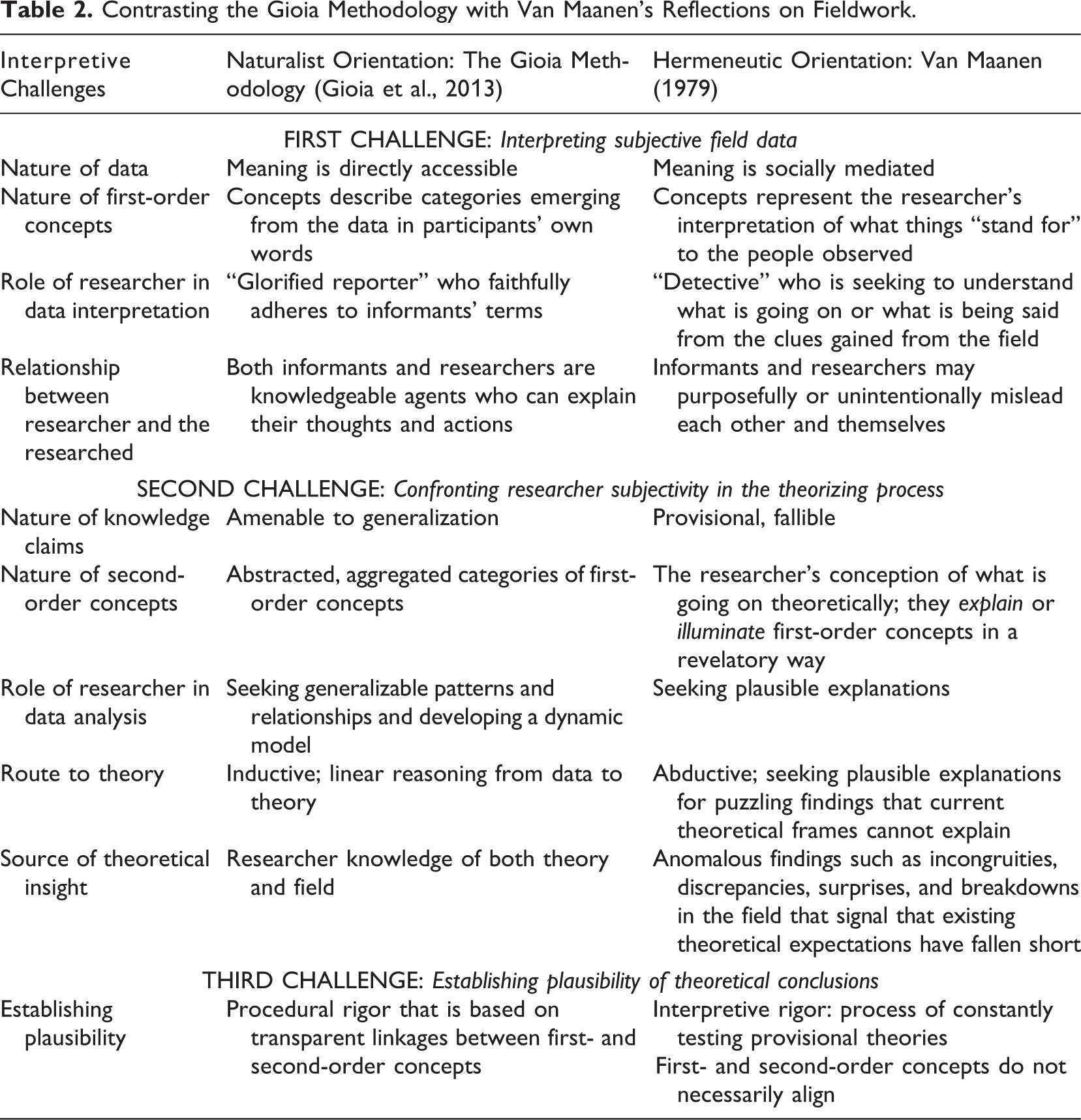
First Challenge: Interpreting Subjective Field Data
Van Maanen’s (1979) background as an ethnographic organizational researcher sensitized him to the need to interpret behavior in light of the shared meaning it holds for actors in the social setting under study. He did not assume that the fieldworker—who is not a member of the group being studied—has direct access to this shared understanding. He likened the role of the fieldworker not to a reporter but to a detective (“Sherlock Holmes”) trying to understand the meaning of what is going on or what is being said. His orientation toward data from the field was one of suspicion: Data are in need of interrogation for layers of meaning to be revealed. His concern was that all too often, the interpreted nature of data is overlooked. In line with Schütz (1964), he used the concepts of first and second order to highlight the multiple layers of interpretation involved in transforming field data into theory.
In Van Maanen’s (1979) conceptualization, first-order concepts represent the researcher’s interpretation of “what things ‘stand for’ to the people observed” (p. 542). This meaning is mediated rather than directly accessible to the researcher. It is derived from field data that can take the form either of “operational data”—actual behavior—or “presentational data”—the verbal reports provided by participants. He cautioned that the researcher cannot assume either data type represents “facts” about the social world. When it comes to operational data, even direct observation of participants can be misleading. In the case of presentational data, research participants may purposefully or unintentionally mislead the fieldworker. Even if they do not intentionally set out to deceive, they may mislead simply because they are unaware of their own biases or take them for granted and do not articulate the contextual detail that is essential to substantiate their accounts. No matter how willing they are to open up to the researcher, participants are not sufficiently reliable guides to the social worlds they inhabit to provide a sound basis for theorizing. For these reasons, knowing which presentational data can be relied on and even whether data are operational or presentational in nature are not self-evident questions.
Van Maanen (1979) devoted considerable attention to how the first interpretive challenge can be met. Understanding the believability of participants’ accounts involves checking them against each other and against observed behavior, engaging in follow-up questioning and probing, embarking on more targeted observations, or seeking out additional participants. Penetrating beyond the evasions, omissions, idealizations, and other conscious or subconscious misrepresentations hidden in participants’ accounts requires a commitment to revisiting the field and paying attention to contradictions and differences across situations, social divisions, and participants’ accounts.
In addition to these measures, a researcher needs to take the additional hermeneutic step of expanding the analysis from part to whole: that is, how participants’ talk and actions are “situationally, historically, and biographically mediated” (Van Maanen, 1979, p. 540). Reflecting on his own fieldwork experiences, Van Maanen (1979) cautioned that the meaning of even seemingly straightforward terms is not easy to grasp due to their inherent embeddedness in a social structure whose rules and norms are so taken for granted that they are not articulated by participants and can only be inferred. This is why contextualization is needed to avoid misunderstanding. Both behavior and member depictions of such behavior, he argued, must be situated within their social and historical structures (Van Maanen, 1979, p. 541). To understand the taken-for-granted social routines and rules of a social group, Van Maanen highlighted “breaches” as being one opportunity for the researcher to become aware of these rules: that is, instances when normal social routines have broken down. Such occasions allow the researcher to catch glimpses of the social structures in which organizational activities are embedded. Exceptions, outliers, rarities, and minority views can be more important in generating understanding of underlying social structures than what is frequently seen or heard (i.e., the majority view).
Second Challenge: Confronting Researcher Subjectivity in the Theorizing Process
Second-order concepts, according to Van Maanen (1979), are “the researcher’s conception of what is going on” (p. 540) theoretically. Although this is seemingly close to the way Gioia et al. (2013) defined them, Van Maanen did not regard second-order concepts as abstract and aggregated labels that theoretically describe the first-order concepts; rather, they explain or illuminate first-order concepts in a revelatory way. Such explanatory concepts cannot be induced from the data: they are generated by the researcher. But as in the case of settling on first-order concepts, the analytical step toward second-order concepts is also considered to be prone to misinterpretation. The initial second-order concepts that the researcher proposes are likely to be erroneous because they reflect the researcher’s social world and “perceptual screen” (Van Maanen, 1979, p. 547) rather than what is actually going on in the world of the participants. The interpretations that the researcher formulates therefore start as no more than “tentative speculations, commonsensical hunches, and other tenderly held presuppositions” as he or she tries to “grasp, and perhaps decode empirical phenomena” (Van Maanen, 1979, p. 539).
To minimize the potential for erroneous interpretations to persist, initial understandings need to be “tested, retested, and tested again in the field” (Van Maanen, 1979, p. 549). This is a forensic, detective-like search for clues that can support—or reject—the provisional explanation. Generating a plausible explanation is thus a painstaking task in which incongruity, discrepancies, surprises, and breakdowns in the field play an important role. In later work, Van Maanen (Van Maanen et al., 2007) characterized anomalous findings as being a trigger to generate novel, revelatory theory. Discrepancies encountered in the course of a research project are the signal that existing theoretical expectations have fallen short, prompting the search for a better explanation. This process of reasoning is abductive, not inductive as in the naturalist orientation. In other words, a plausible explanation is sought for puzzling findings that current theoretical frames cannot explain (Van Maanen et al., 2007). Typically, this process involves multiple cycles of explanation seeking rather than a “bold stroke” or “ah-ha” epiphany (Van Maanen et al., 2007, p. 1148). Theory does not emerge from the data but is actively and imaginatively constructed by the researcher.
Third Challenge: Establishing Plausibility of Theoretical Conclusions
Given the precarious and provisional nature of interpretations, Van Maanen (1979) rejected the possibility that a researcher’s account of participants’ organizational lives would ever amount to the mirroring of facts. Good theories are useful, revelatory insights into the social world but not facts. Elaborating on this in later work, he specified that theory should aim for “plausible connections and relationships that have not [previously] been glimpsed” (Van Maanen et al., 2007, p. 1148). But although he denied truth claims of any possibility of epistemological certainty, Van Maanen (1979) maintained that interpretive studies can and should be “sound” and “faithful.” That is, researcher accounts can do better or worse at seeing and understanding what is occurring within the world of their participants.
However, being faithful does not mean aligning second-order concepts with the talk of participants. Too much convergence between them may suggest that there has been insufficient probing and contextualizing of what the researcher has heard participants say and seen them do. It is therefore not sufficient for second-order concepts simply to be based on the categories used by informants: this suggests a lack of critical engagement with the interpreted nature of data. In developing second-order concepts, the researcher needs to avoid “parroting back the normative abstractions…used by members of the studied group” (Van Maanen, 1979, p. 544). Hence Van Maanen (1979) advised that “[s]econd-order concepts are perhaps most interesting when they do not converge [with first order-concepts] for it is here that the fieldworker may have something novel to say” (p. 541). The data present the researcher with puzzles and with clues. They provide both the need and the material for generating an explanation.
The process of constantly testing provisional theories and searching for new clues is why lengthy time periods need to be spent in the field. Rather than rigor being assured through systematic data structuring—that is, procedural rigor—Van Maanen (1979) placed the emphasis on the thoroughness of the interpretive process and the maintenance of suspicion: that is, what we have termed interpretive rigor. 2 In this process, “fit” between data and theory does not constitute a tight correspondence between participant statements and the abstract concepts aggregated from them. Rather, fit is achieved when the theory that has been (re)constructed offers a better explanation of “what was going on”—including the apparently anomalous data fragments—than existing theoretical frameworks do.
Although Van Maanen (1979) used the terms first- and second-order concepts to address the subjective challenges of interpretation, he did not produce a readily actionable and stepwise template for others to follow. Nor would a standardized and repeatable template be consistent with the principles of interpretation that we have shown to underlie a hermeneutic orientation. Interpretation is a process of “drift” rather than “design” (Van Maanen, 1979, p. 539)—of following redirections, clues, and new avenues of inquiry—that does not result in a neatly linear, orderly pathway that is readily applied in a formulaic fashion. However, as we elaborate in the next section, Van Maanen’s account of fieldwork does offer a way forward by providing the basis for a set of heuristics to guide the interpretive process.
A Way Forward: Heuristics for a Hermeneutic Orientation
In the previous section, we showed that reconnecting with the hermeneutic approach to interpretation has the potential to address the concerns raised by the naturalist orientation. But although the hermeneutic alternative addresses the interpretive challenges head on, it does not offer template-like guidance to researchers and their reviewers. This raises the question as to how a rigorous interpretive process can be followed and how this process can be communicated to others. We argue that this conundrum does not call for another template. Rather, it necessitates a different approach to ensure that both the data and the patterns one detects in the data are subjected to constant interrogation, destabilization, and revision.
As a way forward, we propose a shift from naturalist templates to heuristics as a way to guide the interpretive process of a hermeneutically oriented study without sacrificing its underlying epistemological commitments. Heuristics are thought patterns to assist the generation of new questions and new insights (Abbott, 2004: Huffman & Tracy, 2018). As Abbott (2004) pointed out, heuristics have long been suggested as cognitive strategies to aid the process of discovery in qualitative research (see also, Klag & Langley, 2013). They encourage a very different approach to inquiry than a template. Naturalist templates are potentially reductionist, confining theorizing to categorizing the text of interviewee transcripts. In contrast, heuristics encourage theorizing by opening up the process of interpretation to additional insights. Theoretical understanding of social phenomena requires a forensic process of discovery that pushes us as researchers to go beyond what we hear participants say and what we see they do: of following puzzles, redirections, clues, and new avenues of inquiry when the evidence does not line up. The rigor of this process depends on the depth of inquiry as well as systematic and continuous questioning that prevents the researcher from settling on initial, premature theorizing without further investigation and probing. This is the hallmark of a strong investigation. In contrast, adherence to a template’s prespecified set of procedures is likely to limit this process of discovery, and thus the theoretical insights it can produce.
As Table 3 shows, our proposed heuristics address each of the three interpretive challenges we have identified: how to interpret field data, how to generate meaningful theoretical interpretations, and how to improve the rigor of the interpretive process and plausibility of theoretical claims while explicitly taking one’s own subjectivity into account. For each challenge, we list the heuristic aids that we distilled from Van Maanen’s methodology, accompanying them with examples of relevant probing questions that can activate heuristic thought patterns during the course of a research project. These questions need to be asked throughout the process of inquiry to avoid settling prematurely on a seemingly well-fitting explanation or a set of concepts that nonetheless does not penetrate beyond the incremental or obvious. Indicative questions are listed in Table 3, but they are not meant to be exhaustive. The same probing questions can also be used by reviewers seeking to evaluate the quality of interpretive research.
A Guide to Interpretive Rigor: Heuristic Aids and Probing.
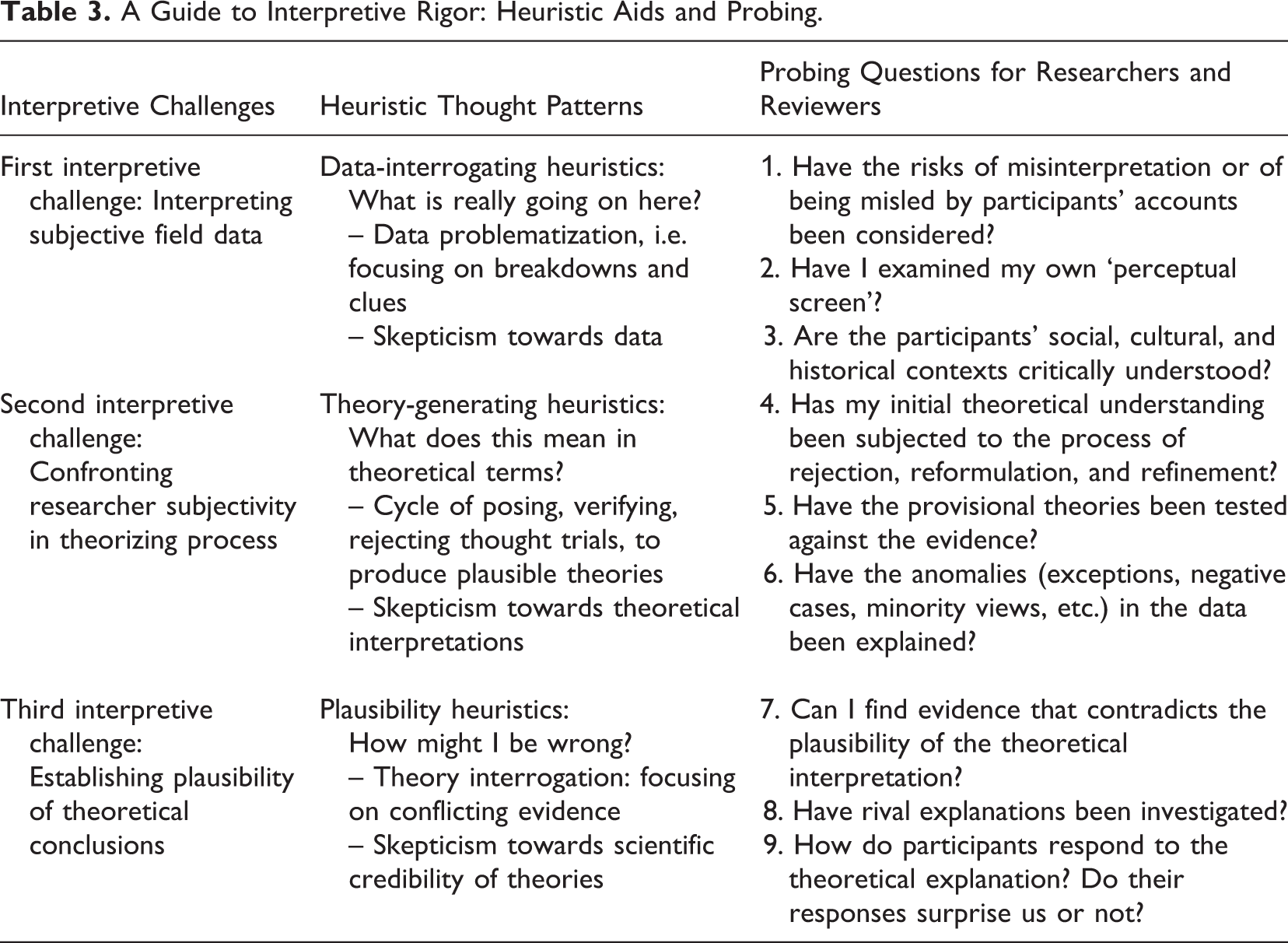
As shown in Table 3, the first set of heuristics—data-interrogating heuristics—guides the researcher when addressing the first interpretive challenge in the research setting: “What is really going on here?” The key heuristic, or thought pattern, is to adopt a skeptical attitude toward data, problematizing their subjective nature. As we have seen, this means not taking participant statements and actions at face value, that is, the task of the researcher is to sort presentational from observational data (Van Maanen, 1979). Actionable probing questions for dealing with participants’ subjectivity in the course of interpreting data include “Have the risks of misinterpretation or of being misled by participants been considered?” But as we have seen, it also entails interrogating the researcher’s own interpretations: “Has the researcher examined his or her own perceptual screen?” The heuristics of data problematization steer the researcher’s attention toward discordances: data that present puzzles because they do not fit the researcher’s initial assumptions and impressions, and raise clues for addressing the new questions that arise. As well, the process of data problematization requires a focus on the silences, that is, what participants might not have articulated, such as the historical context or the taken-for-granted social rules that shape their meaning-making. A relevant probing question to stimulate further thinking is: “Are the participants’ social, cultural, and historical contexts critically understood?” These are all questions not just to be asked in the field but throughout the process of inquiry (see Table 3) as initial interpretations of data are reexamined.
Table 3 also displays a second set of heuristics—theory-generating heuristics—to aid the researcher in meeting the next interpretive challenge: addressing “What does this mean in theoretical terms?”; in other words, “What is this an instance of theoretically?” Here it becomes important to maintain a skeptical attitude toward the researcher’s own subjectivity. As heuristic aids, we propose a series of thought trials: an ongoing cycle of posing, verifying, and rejecting initial concepts and patterns that already starts during fieldwork. As the probing questions in Table 3 show, this encourages the analysis to be extended beyond common patterns and themes to outliers, negative cases, and variations in the evidence (e.g., across cases, time, and place). Plausible theoretical explanations are explanations that are not rejected based on the evidence, including outliers: although fallible, they may be found to have “practical adequacy” (Sayer, 1992). Our probing questions encourage researchers to ask whether their initial theoretical understanding has been subjected to the process of rejection, reformulation, and refinement; whether provisional theories have been tested against the evidence from the social setting as a whole; and whether the anomalies in the data have been explained (see Table 3).
The last set of heuristics—plausibility heuristics—addresses the third challenge of how to establish the plausibility of the theoretical conclusions (see Table 3). The key heuristic in this case is to maintain a skeptical attitude toward the theory that has been constructed: of constantly asking “How might I be wrong?” This means interrogating whether any conflicting evidence can be found. Probing questions involve asking: “Can I find evidence that contradicts the plausibility of the theoretical interpretation?” and “Have rival explanations been investigated?” The reactions of participants may also provoke the researcher to revisit his or her conclusions. Participants may not agree with the researcher’s interpretation, but whether positive or negative, their reactions are data that may serve to confirm the results or else prompt a reconsideration of the evidence. This leads to the probing questions of “How do participants respond to the theoretical explanation, and do their responses surprise us or not?” (see Table 3). As a result of this further probing, the researcher can show that although other interpretations of the data cannot be ruled out, the proposed explanation is well supported by a contextualized analysis of the evidentiary base.
Our discussion suggests that theoretical explanations of the social world will always remain provisional (Van Maanen, 1979). However, they can and should be subjected to a rigorous process of questioning resulting in either more or less plausible explanations. Again, we do not claim that the aforementioned set of heuristics and probing questions is exhaustive or that all the questions we provide can meaningfully be applied to a single study. But we do contend that a systematic use of these questions would promote greater interpretive rigor in qualitative research, potentially leading to more revelatory and interesting theory (and even methodology sections) than strict adherence to the processual rigor found in templates. To demonstrate this in practice, in Exhibit 1 we summarize how Katherine Kellogg (2009, 2011, 2012) went through a similar process of using probing questions, such as those listed in Table 3, to develop revelatory and interesting organization theory. This interpretive process should not be seen as a solitary activity, but as a collective effort (see also, Golden-Biddle & Locke, 2007). Kellogg (2011, p. 187-190) explained that some of the probing questions were actually posed by her close colleagues—established academics—who apprenticed her and provided direction (see also, Smith, 2002, who described a similar process).
An Example of Interpretive Rigor in Action.
Kellogg (2009, 2011, 2012) conducted her fieldwork in the health care industry. She was intrigued by how and why a reform to reduce working hours with no change in pay in three U.S. hospitals was fiercely resisted by some. These hospitals were comparable in terms of a number of characteristics, such as the external resources and pressures, industry sector, work organization, and prior organizational performance. Yet they differed in terms of change trajectories and outcomes. Whereas institutional change ultimately failed in two hospitals, the reformers were victorious in one. Like a detective, Kellogg (2011) sought “to explain what led to the different outcomes at the three hospitals” (p. xi).
Although Kellogg had previously worked in the health care industry, she could not get “her head around” two aspects about the reform: “first, how eighty hours a week could be a reduction in work hours, and second, how anyone in their right mind could resist such a reduction” (Kellogg, 2011, xi). To understand what was really going on in the hospitals, she interrogated the data by means of a “[c]lose inquiry” (Kellogg, 2009, p. 675). She purposely did not ask her informants to specify the number of hours they had been working before and after the reform because they might be pressured “to misreport their work hours so that the hospitals would not risk sanction” (Kellogg, 2012, p. 1551). Instead, she focused on the most relevant pockets of data and followed a forensic analytical strategy by coding selectively and intensively to solve the puzzle (Kellogg, 2009). She constantly questioned her data by comparing three cases with each other over time, with the literature, and with her own expectations.
Puzzlement arose in Kellogg’s study because the reforms did not turn out as anticipated. She acknowledged that the processes of change she observed in the three hospitals “did not fit well with the processes described” by any of the theories (Kellogg, 2011, p. xi). We would consider this a sign of abductive reasoning (even though Kellogg did not use the term herself), leading Kellogg away from a macro-institutional to a micro-institutional approach to change. She entered into a critical dialogue with different schools of institutional theory to rule out alternative explanations for the difference in the outcome of the medical reform between the hospitals. Finally, she arrived at the most plausible explanation, which she supported with insights from personal interviews and observations as well as relevant aspects of the historical, professional, and intraorganizational context of the hospitals. The length of the fieldwork (18 months) allowed Kellogg to familiarize herself deeply with the research sites and her participants.
Kellogg’s study is an instance of why much institutional change inside organizations fails despite all the agency and the resources that collective and individual actors possess (Kellogg, 2012, p. 1564). She found that she had to adopt a micro-institutional approach to change that differs from the dominant macro-institutionalist approach. Kellogg did not argue “that the macro-institutional approach is wrong”; rather, she suggested “that it tells only half the story” (Kellogg, 2011, p. 171). She emphasized that “[w]e need to understand the other half of the story, the half occurring inside organizations, to fully explain why and how institutional change occurs” (Kellogg, 2011, p. 171). Her findings contribute in a revelatory way to understanding “when institutional change inside organizations is likely to succeed” (Kellogg, 2011, p. 174).
Conclusion
In the past, qualitative research has had to justify its place in a world where the traditional scientific method dominated. But as qualitative research methodology has come of age, it has demonstrated that to be meaningful and to stay relevant to the world we as researchers investigate, we must and can deal head on with the subjective and interpreted nature of the phenomena we study. In this article, we have therefore advocated a hermeneutic orientation to interpretive management research. We emphasize the importance of approaching data with suspicion and theories with doubt. We have introduced a set of heuristics and probing questions that can encourage these thought patterns and the search for plausible explanations.
This way forward is aligned with other voices in qualitative management research who have recently advocated the usefulness of generative thought patterns—in other words, heuristics. Locke et al. (2008) emphasized the importance of the discovery process following thought trials (“hunches,” p. 213) and cultivating doubt to arrive at greater “excellence in theorizing” (p. 911). Klag and Langley (2013) also argued that a greater number of diverse thought trials, or “conjectures,” produces better theory (see also Kornberger & Mantere, 2020). Other possible heuristic aids are metaphors, and analogical thinking (Cornelissen, 2006), which can prompt the researcher to start to make unexpected connections between theoretical perspectives (Ketokivi et al., 2017). There is scope for future research to propose additional heuristics, thereby not just promoting ways to further encourage rigor in the interpretive process but also providing interpretive researchers with an alternative to the inductive vocabulary that has been inherited from an earlier generation of researchers.
In its reliance on naïve induction, the Gioia methodology is far from alone. In fact, other templates for qualitative management research—“first-generation” grounded theory (as codified by Strauss & Corbin, 1990) and Eisenhardt’s (1989) case study roadmap—share the same inductivist assumptions (on grounded theory, see Alvesson & Sköldberg, 2009; on Eisenhardt’s roadmap for the case study, see Piekkari & Welch, 2018). These templates date from a similar period in the 1980s: one in which qualitative researchers were still struggling to legitimize their studies in the eyes of their scholarly communities (Piekkari & Welch, 2018). As we have discussed, an inductive stance toward the process of inquiry is attractive because it enables a reconciliation with the still predominantly quantitative mainstream. In line with the positivist cycle of knowledge production, qualitative researchers can be positioned as producing the “emergent constructs” that can be turned into “measurable constructs” for others to test (Gioia et al., 2013, p. 25). Given that qualitative research is more established in the management field than it was in the 1980s, there is now an opportunity to move beyond the legacy of naïve induction. Thus, reconnecting interpretive management research with the hermeneutic tradition has relevance to the community of qualitative researchers more generally.
Our analysis has broader implications not only for qualitative researchers working across diverse traditions but also for quantitative social researchers (Zyphur & Pierides, 2017). They too run the risk of denying the subjective nature of the social world they investigate, and their data are equally in need of interpretation. Ignoring this may lead to findings that lack meaning in the real world. All forms of research into the social world confront a process that, as Van Maanen (2011) warned us, is by nature “unruly, conflict ridden, and always problematic” (p. 139). We have argued in this article that the way forward is to acknowledge this problematic nature of fieldwork, the interpretive challenges that it poses, and the fallibility of one’s own theories. This provides a pathway to develop theory that is not just more likely to represent a plausible reconstruction of the social setting but also enables one to understand this setting in different and revealing ways.
In proposing our interpretation of hermeneutics as an alternative to a naturalist orientation, we acknowledge that ours is not the only alternative. Although some qualitative researchers would agree with the way we have characterized the hermeneutic orientation and addressed the challenges of interpretation, others may disagree with our position and emphasize that the struggle over meaning is inherently political and ideological (e.g., Willmott, 2008). But what these more critical perspectives have in common with the orientation we have presented in this article is a commitment to move beyond the limitations of mainstream research based on naïve induction. We hope that this article makes the case for doing so.
Yet more will be needed. As others have noted, the taken-for-granted structures and incentives of the management field place strong institutional pressures on researchers to mimic what they view as formulae for success (Alvesson & Gabriel, 2013), that is, to follow templates. To move beyond this deadlock, Czarniawska (2016) promoted a greater commitment to “dialogical reflection” in our field over “the way research is done and what research is done” (pp. 617-618). Critically questioning the templates and conventions researchers use in qualitative research—as we have done in this article—is, we hope, a contribution to this dialogical reflection.
Footnotes
APPENDIX
Acknowledgments
We would like to acknowledge the useful comments received from participants in the 15th Vaasa Conference on International Business in Vaasa in August 2019, the 13th GEM&L International Conference on Management & Language in Sheffield in June 2019, and at research seminars held at Leeds University and the University of Technology Sydney in May and June 2018. We have also benefited from the feedback provided at the Professional Development Workshop at the Academy of Management meeting in Atlanta in August 2017. We are truly indebted to John Van Maanen and Hugh Willmott, who read and commented on previous versions of this article, and the guidance provided by the guest editors. Finally, we are grateful to Valentina Arrieta, Ngoc Nguyen, and Matilda Saarinen for their help as research assistants; to David Jones for his insights into heuristics; and to all the PhD students whom we have taught over the years at the EIASM EDEN advanced course on the case study in management and business studies and the AIDEA Capri Summer School. They have challenged us in further refining the ideas presented in this article.
Declaration of Conflicting Interests
The author(s) declared no potential conflicts of interest with respect to the research, authorship, and/or publication of this article.
Funding
The author(s) received no financial support for the research, authorship, and/or publication of this article.

Notes
References
Supplementary Material
Please find the following supplemental material available below.
For Open Access articles published under a Creative Commons License, all supplemental material carries the same license as the article it is associated with.
For non-Open Access articles published, all supplemental material carries a non-exclusive license, and permission requests for re-use of supplemental material or any part of supplemental material shall be sent directly to the copyright owner as specified in the copyright notice associated with the article.
