



Abstract
Interdependence is a defining characteristic of groups and teams. However, a vast range of constructs and conceptualizations for interdependence has left researchers with a dizzying array of frameworks, metrics, and perspectives with which to evaluate interdependence. This situation leaves researchers with little guidance on how to theorize about or measure interdependence. As a solution, we propose a network-based perspective of interdependence. This network-based framework moves beyond network approaches to understanding interdependence that have been proposed in the past in three ways. First, this framework is applied generally to interdependence and not to an isolated form of interdependence. Second, building on previous network-based perspectives of interdependence, we present a procedure to conceptualize a team's interdependent relationships in terms of networks. Third, we utilize the network perspective to present a standardized index of interdependence. Using illustrative examples, we demonstrate the utility of this network-based approach and present various recommendations discussing how these approaches advance the study of interdependence.
Modern organizations are composed of interdependent teams and workgroups (Hollenbeck et al., 2012; Kozlowski, 2015; Lee et al., 2015; Mathieu et al., 2014). Accordingly, many researchers have focused their investigations on interdependence and its relationship with key team processes (e.g., conflict, coordination; Marks et al., 2001; O’Brien, 1968) and outcomes (e.g., performance, helping behaviors, reward effectiveness; Barnes et al., 2008; Courtright et al., 2015; Van Der Vegt & Van De Vliert, 2002; Van der Vegt et al., 2003; Wageman, 1995). One challenge in this effort stems from the vast array of different conceptualizations and operationalizations for assessing interdependence (Courtright et al., 2015). As a result, researchers often idiosyncratically apply methods to evaluate interdependence, leaving them with little means to connect disparate studies. To provide a solution for this problem, we present researchers with a network approach to understand, represent, and evaluate interdependence.
Network representations have gained popularity in the organizational literature (Park et al., 2020a), applying widely to informal leadership positions (Carter et al., 2015), instrumental and symbolic job features (Carter et al., 2020), and workplace conflict (Park et al., 2020b). We propose that network perspectives offer similar utility with respect to interdependence for three reasons. First, networks by design inherently express aspects of interconnectedness found among a group of units (e.g., individuals, goals, resources, etc.), which greatly coheres with the current approach to conceptualizing and measuring interdependence. Second, networks can flexibly represent any interdependent construct. Specifically, networks are formed through a pattern of edges (i.e., relationships) and nodes (units; Girvan & Newman, 2002; Roberson & Colquitt, 2005), wherein the nodes and edges can represent virtually any type of relationship or unit. Therefore, researchers can construe nodes to represent any type of target or source unit (e.g., individuals, roles, tasks, resources, etc.) and apply a network to virtually any form of interdependence. Finally, networks open the door for more nuanced considerations of interdependence related to evolving changes in task-flow and group membership (Mathieu & Luciano, 2019). Indeed, Crawford and LePine (2013) recently advocated for a configural approach to operationalizing team constructs precisely because such an approach can more effectively capture the patterns of interaction between team members and allow for a greater understanding of the complexities associated with team-related phenomena than conventional perspectives. Similarly, in their review of the interdependence literature, Courtright et al. (2015) remarked that the configural approach may prove more useful than traditional compositional approaches (Kozlowski & Klein, 2000) by enabling researchers to more “directly measuring workflow or resource dependence patterns across group members to determine who in the team depends on whom to gain access to critical resources or accomplish work tasks, as opposed to capturing generally shared perceptions of the extent to which team members depend upon one another for task completion or resource access” (Courtright et al., 2015, p. 16).
In their recent review of work teams, Park et al. (2020a) found that from 1994 to 2018, 116 studies utilized a network-based perspective. However, we found that only four of these studies (Athanassiou & Nigh, 1999; Franz, 1998; Sackett & Cummings, 2018; Sosa et al., 2004) assessed interdependence. Although recent research on interdependence has begun to take a network-based approach (e.g., Amati et al., 2021; Goldberg et al., 2016; Schecter et al., 2018; Valeeva et al., 2020), these investigations tend to focus on the application of specific network metrics to assess specific interdependence constructs, and generally provide little guidance regarding the use of network analysis to measure organizational interdependence (see also Marsden, 2002).
To address these challenges, we provide a general framework to measure interdependence from a network perspective and provide practical guidelines for using network methods in the study of organizational interdependence. In doing so, we provide multiple contributions to the organizational literature. First, we review and organize existing measures of interdependence based on their operationalization of interdependence. We then describe how these measures of interdependence correspond to aspects of a network and provide a general procedure for representing any operationalization of interdependence as a network. When interdependence is represented as a network, it becomes clear that interdependence constructs do not refer to qualitatively incomparable concepts, but rather different configurations (i.e., patterns of connections) of individuals within the same network. Our process presents a consistent and standard procedure that researchers can use to represent interdependence as a network, which enables researchers to evaluate nuanced aspects of interdependence based on different network configurations across a range of different network indices.
Therefore, in addition to traditional indices such as degree centrality, we also describe a variety of other network indices which are theoretically relevant to interdependence. We demonstrate how these network indices can be applied to interdependence research and provide guidelines on when specific network indices are most appropriate. Finally, we also provide a general index of interdependence based on the proportion of observed interdependence relative to a theoretically derived maximal amount of interdependence. Our index complies with any interdependence operationalization, and when combined with our procedure for deriving a dependence network, our index enables a more consistent representation and method of indexing interdependence. In this fashion, our work can help to stimulate further empirical and theoretical work by facilitating useful comparisons of interdependence estimates and the accumulation of knowledge (e.g., meta-analyses) across studies. To aid the application of our method and index in organizational interdependence research, we provide a tutorial for using our network-based method with example applications and R code (Appendix A).
To organize our discussion, we first briefly review prominent conceptualizations of interdependence and their respective operationalizations to identify systematic patterns in the measurement of interdependence. Based on the results of our review, we advance a network approach to represent interdependence and provide a uniform procedure for indexing interdependence networks. We augment this discussion with an overview of network-based indices and considerations needed to appropriately select methods for indexing the network configuration. We then present tutorials for using our approach to deriving, indexing, and interpreting dependency networks. Finally, we close with recommendations for implementing the network approach in current and future research.
Overview of Interdependence Literature
Interdependence is considered a defining quality of teams (Neuman and Wright, 1999; Kozlowski & Bell, 2003); Lewin (1948) went so far as to propose that interdependence was part of the very essence of groups. Accordingly, interdependence has been extensively studied within the organizational literature. Although interdependence is notoriously difficult to classify (Pennings, 1975), researchers have identified a variety of different forms of interdependence that impact teams (Courtright et al., 2015; Pennings, 1975; Wageman, 1995). Each of these conceptualizations of interdependence has been operationalized in different ways producing a dizzying array of interdependence measures.
To investigate the diversity of interdependence research we conducted a selective review of the myriad of operationalizations of interdependence. We searched Google Scholar using keywords such as “interdependence” and “dependency” 1 and performed forward- and backward citation searches within the relevant articles. We primarily organized our review using a two-dimensional taxonomy. First, we coded types of interdependence following Wageman (1995) typology (i.e., input, process, outcome, or cognitive). Secondly, we coded the directionality of interdependence (i.e., initiated, received, or reciprocal). Additionally, we assessed the target unit, the source unit, each of which was coded by their level of analysis (e.g., individual or team). Because interdependence has complex multi-level impacts identifying the levels at which it is studied provides meaningful information regarding the state and scope of the interdependence literature (Van Der Vegt & Van De Vliert, 2002). Lastly, we identified the measurement approach (e.g., survey, observation, interview) used in each operationalization. The operationalizations we review are presented in Table 1, organized by type, and directionality as defined above.
Selected review of interdependence operationalizations.

Categorizing Interdependence
We use a common approach for categorizing types of interdependence which distinguishes between interdependence in inputs, processes, and outcomes (Wageman, 1995; Wong & Campion, 1991). While the input-process-outcome categorization is well suited for distinguishing aspects of work-centric interdependence it is less well suited for distinguishing social-cognitive aspects of interdependence (Agnew et al., 1998; Cross et al., 2000; Davis & Weigel, 2019). Although these social-cognitive conceptualizations of interdependence are not typically tied directly to a work context, they have been shown to have a significant impact on how individuals work together (Oetzel, 2001) and are therefore worth considering. Accordingly, we extend the input-process-outcome typology to incorporate a fourth category: cognitive interdependence. We distinguish four types of interdependence (i.e., input, process, outcome, and cognitive).
Input Interdependence
Input interdependence is tied to the inputs for a team's tasks and processes. Importantly input interdependence is distinct from aspects of the work processes and tasks themselves. Input interdependence is found in cases where teams rely on shared resources (i.e., resource interdependence; Lundin, 2007), require access to specific skills to perform their work (skill interdependence or horizontal interdependence; Hollenbeck et al., 2012), need critical information (i.e., informational interdependence Ashworth, 2007) and are tied to specific leadership/decision making structures (vertical interdependence; Hollenbeck et al., 2012; Van De Ven & Delbecq, 1976). In each case, the presence of a form of input interdependence indicates a relationship where work processes require or are shaped by shared determinants. Whereas process interdependence defines the relationships between tasks and the flow of work processes, input interdependence is based on the factors required to perform work. As noted previously, the line between input and process interdependence is not always clear. For example, consistent with Wageman (1995) work we include Authority Differentiation and Skill Differentiation (Lee et al., 2015) as forms of input interdependence although they could easily be considered process interdependence.
Process Interdependence
By contrast, process interdependence focuses on the nature of work itself. Process interdependence accounts for the direct impact tasks have on each other, and the requisite nature of workflow in the team. It is studied extensively in terms of roles (Pennings, 1975; Tjosvold, 1986), tasks (Morgeson & Humphrey, 2006; O’Brien, 1968; Pennings, 1975; Wageman, 1995; Wageman & Gordon, 2005), and workflow (Cataldo et al., 2009; Thompson, 1967; Victor & Blackburn, 1987). Although, as stated previously, the line between input and process interdependence is not always clear cut, we find it helpful to distinguish them for the purpose of organizing these concepts.
Outcome Interdependence
Outcome interdependence describes the extent to which the outputs (e.g., consequences, and benefits) of team processes are shared among team members (Van Der Vegt & Van De Vliert, 2002). This has most often been studied with regard goals 2 (Campion et al., 1993; Courtright et al., 2015; Johnson et al., 1983; Rossi, 2008; Somech, 2008; Thomas, 1957; Tjosvold et al., 2004; Van Der Vegt et al., 2003; Wageman, 1995; Wong & Campion, 1991), feedback (Ashworth, 2007; Van Der Vegt et al., 2000) and the to the allocation of rewards/punishment (reward interdependence: Campion et al., 1993; De Dreu & West, 2001; Victor & Blackburn, 1987). But this can extend to interdependence related to any outcome or result of a team's work. The concept of outcome interdependence has often been used to account for the nature of competition and cooperation in groups (i.e., social interdependence: Pennings, 1975; positive interdependence; Janssen et al., 1999). Conceptually outcome interdependence is very broad
Cognitive Interdependence
Researchers have identified various forms of cognitively focused interdependence (Agnew et al., 1998; Davis & Weigel, 2019) that do not necessarily fit into the previous three categories. For example, researchers have studied how strongly one's cognitive self-concept depends on relationships with others (i.e., self-construal: Cross et al., 2000; Niiya & Crocker, 2019; Singelis, 1994). While these forms of cognitive interdependence are not always directly linked to work, research has demonstrated that they impact work processes (Oetzel, 2001). These cognitive conceptualizations of interdependence are often not included in categorizations of job-related interdependence (e.g., Wageman, 1995), but we recognize their potential and importance in this literature, and accordingly include them in our review.
Summary
Overall the review underlines various themes found in the interdependence literature. One prominent theme we uncovered was the relational nature of interdependence operationalizations. Firstly our review underscored the huge amount of variety in the interdependence literature. This is highlighted by the fact that numerous operationalizations fall into each of the four categories and three directionalities that we coded. Interdependence is used to describe a wide assortment of constructs and concepts. Of the four categories of interdependence, we found a general focus within the literature on process-based operationalizations – out of the 51 operationalizations identified, the majority (N = 27) were process-focused. However, the remaining three types of measures were reasonably well represented in the literature. We did find less emphasis on measuring-initiated conceptualizations of interdependence than received or reciprocal (i.e., only 5 of 51 operationalizations were directionally initiated) indicating a preference for received, and reciprocal measures. This indicates that initiated interdependence is an area in need of future evaluation.
Our next observation was regarding the relational nature of interdependence. With few exceptions, each operationalization of interdependence clearly describes a relationship between some source of interdependence (i.e., the thing being depended on) and some target of interdependence (i.e., the dependent thing) or describes a reciprocal relationship where both units rely on each other. The units for these operationalizations varied in form, including an individual's job performance, goals, resources, tasks, etc., and these units were found to be at the individual or the group/team level. Even though only a small number of these operationalizations make any reference to a network perspective of interdependence, the relational nature of these operationalizations strongly indicates the suitability of a network approach to studying interdependence.
The levels of analysis for the operationalization also followed an interesting pattern. More operationalizations had source and target units of interdependence that crossed levels (i.e., the target unit was individual and source unit was team or vice-versa; N = 20) than at either the individual/dyadic (i.e., both target and source are at the individual level though not necessarily the same individual; N = 11) or the group (i.e., both target and source are at the group level; N = 14) level. In short, we found that interdependence is often operationalized in a way that ambiguously refers to the impact of a whole team on an individual instead of considering the specific people, tasks, resources, etc., that impact the individual directly. While such operationalizations are generally not well suited for collecting network data, they indicate that researchers are interested in studying the impact of a group context on individuals. This is something network approaches are powerfully capable of doing. Furthermore, unlike these aggregated approaches which implicitly assume that interdependence is evenly distributed among one's team members, a network-based approach (i.e., built off of a dyadic operationalization) would allow researchers to account for uniqueness in each team members configuration of interdependence, further supporting the use of a network approach. Conveniently, these existing cross-level operationalizations are easily converted into dyadic measures that can be used to derive a dependency network by simply de-aggregating the team-level interdependence source unit. For example, Morgeson and Humphrey (2006) questionnaire (e.g., my job cannot be done unless others do their work) could easily be reworded to yield dyadic data (e.g., my job cannot be done unless [TEAM MEMBER'S NAME] does their job).
Across all types of interdependence (i.e., input, process, outcome, and cognitive) there is a strong correspondence between the level of analysis and the directionality of an index. For instance all the cross-level indices (i.e., team-individual, or individual-team: N = 15) are directionally received measure (N = 13) of interdependence or initiated (N = 2). By contrast, most of the operationalizations where both the target and source units are at the same level (N = 26) are directionally reciprocal (N = 15). Although there may be a theoretical reason for these results, they suggest that researchers tend to overlook the directional (i.e., received or initiated) nature of interdependence when measuring it directly at the team or dyadic level. Here again, we suggest that a network perspective of interdependence may help. Such a perspective will explicitly highlight the relational nature of interdependence, providing a way for researchers to potentially clarify directional attributes of interdependence.
Lastly, we found several operationalizations that examined a mixture of interdependence constructs. For example, a handful of operationalizations combined information (input) and task (process) interdependence (Ashworth, 2007; Lee et al., 2021; Pearce & Gregersen, 1991). The presence of these multi-facetted measures of interdependence is suggestive of a lack of consensus definitions of different forms of interdependence highlighting the need for further clarity and consensus regarding these concepts. Collectively our review highlights the complexity and ambiguity of the interdependence literature while underscoring the relational and directional nature of interdependence as a common attribute of operationalizations of interdependence. This both supports the need for a unifying framework of interdependence and the viability of a network-based approach to conceptualizing and operationalizing interdependence.
A Network Approach to Evaluating Interdependence
As previously mentioned, a key finding from our review was that operationalizations of interdependence contained an implicit measurement of connections between a target and source of dependence. We utilize network analysis as a method for understanding how these connections can affect the outcome(s) of the target and source units of interdependence. In the following sections, we first provide a uniform process for deriving a dependence network and indexing a standardized dependence score across multiple levels of analysis, and we discuss when these dependence scores should be compared. Furthermore, we also highlight a variety of underlying network metrics that can be used to calculate dependence scores for a given level of analysis (Table 2), and how to select a network metric based on the purpose of the study.
Selected raw Network Indices.

Indices that generally assume symmetry.
Indices that generally require networks to be unweighted.
Indices that require a completely connected graph.
Indices that have asymmetrical forms.
Deriving Dependency Networks
Networks are mathematically defined by a set of nodes (units), and a set of edges (relationships) that link any two nodes (Wasserman & Faust, 1994). Nodes of a dependency network will typically represent the target and/or source units from the given operationalization of interdependence. The existence, strength, and directionality of the relationship described by the operationalization are used to define the network edges.
For instance, our review found that some researchers (e.g., Ashworth, 2007; Campion et al., 1993; Lee et al., 2021; Pearce & Gregersen, 1991) take an information-based perspective and describe interdependence in terms of individuals’ informational requirements. In Table 1, we show that Ashworth (2007) operationalized interdependence using a self-report scale that asked individuals (i.e., target units) to rate the amount of advice they received from each of their teammates (i.e., source units). As an example, the item “I have to obtain information and advice from [team member's name] to complete my work” (adapted from Ashworth, 2007; see Table 1) can capture a form of received dependence wherein the target individual depends on their team members.
A straightforward protocol for defining a network based on this operationalization would define network nodes for all individuals answering the questionnaire (i.e., target units) and all individuals identified as sources of advice (i.e., source units). The network edges would be defined as directed relationships from source individuals to target individuals based on the questionnaire. Asking this item to each team member about all other team members would enable a researcher to derive a complete dependency network representing who relies on information from whom. However, this is not the only network that can be defined using Ashworth (2007) operationalization of interdependence. For example, a different network structure could be formed in which nodes are defined by the target units (team members) and the edges represent connections between targets who use the same source unit for information. This dependency network would connect teammates that have the same information because they rely on the same information source. Despite utilizing the same operationalization of interdependence, these two networks would convey different aspects that informational interdependence has on team functioning.
To reduce ambiguity and increase transparency, we propose a three-step process to derive a dependency network. First, researchers should identify a conceptualization or theoretical definition of interdependence. For example, dependency could be theoretically defined in terms of information, role requirements, resources, or any other facet of interdependence discussed in our review. This step is focused on shaping the theoretical construct of interdependence and is important because it will anchor the operational definition to a given theoretical application. Second, researchers should produce an operationalization of dependency relationships based on the theoretical definition. This step is focused on connecting the theoretical definition of interdependence to the measurement of interdependence relationships. An operational definition should clearly define source and target units, as well as the process for measuring interdependence relationships. Third, researchers should define a protocol for deriving a dependency network based on the operationalization of interdependence. This step specifies how nodes and edges are defined in the dependency network. As we discussed above, the same operationalization (e.g., Ashworth, 2007) can produce different networks if the nodes and/or edges are specified differently. In later sections, we discuss this process in greater detail and apply it to two organizational studies focused on interdependence.
Selecting a Network Index
Once dependency networks are defined, researchers can select from a myriad of network indices to help assess the level of interdependence in the network. In a recent review, Park et al. (2020a) examined the use of network indices within the work team's literature and provided a detailed summary of various network characteristics. Based on the results of their review and broader network literature (Wasserman & Faust, 1994), we provide a list of network indices that can prove useful for organizational research. An extensive discussion of each index is beyond the scope of our manuscript but has been presented in previous textbooks (Wasserman & Faust, 1994) and research (e.g., Freeman, 1978). In Table 2, we instead discuss general aspects of a network index that researchers should consider. Specifically, we categorize these network indices by the level of analysis and index type. We also provide illustrative research questions that could be answered using a specific index and equations that researchers can use to calculate a given index (see Table 2).
Level of Analysis
In Table 2, we first classify network indices based on the level of analysis that they target. We separate network indices into three categories (node, dyad, and network). We present node-level indices first because they are usually the level of analysis that researchers wish to target based on Park et al. (2020a) review. Node-level indices are used to calculate separate Standardized Dependency Index (SDI) scores for each unit (e.g., individual, role, resource, task, etc.) in the network. Several network metrics can be used to assess node-level interdependence, and these indices are primarily useful for understanding how dependency affects a target node. Next, we present dyad level indices that focus on measuring interdependence for a pair of nodes. Dyad-level indices are used to calculate SDI scores for a pair of nodes in a network and these indices help researchers measure aspects of a relationship between two nodes or examine whether features of the network differ across pairs of individuals. Finally, we present network-level indices that generate a single score for the entire network based on the network's general configuration or structure. These indices can be used to assess distributional aspects of the node-level SDI scores (e.g., mean or dispersion) that enable researchers to take a multilevel perspective with respect to interdependence. However, selecting an appropriate index requires attending to both the level of analysis at which researchers wish to make inferences, as well as the network characteristic that an index is designed to assess. Therefore, we also separate the indices based on index type.
Index Type
In Table 2, we classified the indices we reviewed into three broad categories: significance, proximity, and community. Distinguishing between these types of indices helps capture qualitatively different aspects of a network. Therefore, it is important for researchers to match the network metric that they choose with the appropriate index type (or types).
Significance Indices
Significance indices measure interdependence based on the prominence of a node, dyad, and the strength of interdependence in the network. Prominent node-level indices include degree centrality and eigenvector centrality. On a dyad level, this is most clearly illustrated simply by edge strength itself. These indices assess how connected or important a given node or pair of nodes is within the network. At the network level, density is a significance index which serves to measure the average strength of connections across the entire network. Significance indices are broadly applicable to numerous theoretical applications and many interdependence research questions could be framed as a question of significance. In Table 2, we provide example research questions that highlight some potential research applications for node, dyad, and network-level significance indices. Broadly, these research questions assess the extent to which a target node, dyad, or network depends on another node, dyad, or network (e.g., number of dependent individuals).
Proximity Indices
Proximity indices focus on measuring interdependence through the distance among nodes within a network. Typically, these indices use the shortest paths between nodes to establish distance measures. Such indices include closeness centrality on the node level, indirect tie strength on the dyad level, and geodesic distance on the network level. A theme in our example research questions is that these indices typically focus on the length of time or number of steps needed to pass from one part to another part of the network. For example, individuals may be impacted by access to directions from leadership (i.e., vertical interdependence; Lee et al., 2015). In this case, closeness centrality or network radius could be useful, depending on the level of analysis a researcher is interested in. Other applications may focus on understanding the distance between networks to gauge how the minimum amount of time it takes before a focal task can be completed or how a critical resource can be accessed (e.g., shortest path length).
Community Indices
Finally, community indices measure interdependence by evaluating an individual or dyad's role in bridging distinct communities (i.e., subgroups) – or at the network level – the number of distinct subgroups. These subgroups can refer to a node or edge's place in the structure of the entire network (i.e., global community) or to the subgroups of nodes and edges closely related to each other (i.e., local communities). For instance, betweenness centrality is a prominent individual-level index of one's position as a core tie holding the network together and would represent a global community-based index. As another example, modularity or connectivity could be valuable to assess how well a network can be divided into largely independent sets of highly independent nodes (i.e., local community). Other community indices focus on the localized nature of network community structures based on what nodes are directly tied to other nodes. Local community-based indices include effective network size (node), structural equivalence (dyad), and transitivity (network). As presented in Table 2, the common questions that these indices target are focused on the strength, number, and similarity of subgroups within the network.
Symmetry and Weighting
In addition to the level of analysis and index type, another important consideration for index selection involves determining the symmetry 3 of network connections and the weighting of network connections. In Table 2, we noted these aspects of network metrics using superscripts. Dependency relationships that are inherently symmetric or undirected (i.e., a connection from A to B implies an equivalent connection from B to A) are theoretically distinct from those that are directed (i.e., A is dependent on B, but B is not dependent on A). When networks are not symmetric, the connection between two units holds a different interpretation for each unit, because one unit will receive the connection (target node) and the other unit will initiate the connection (source node).
Community indices generally assume symmetry because they are primarily focused on assessing the level of connectedness between clusters and nodes or other clusters, and not whether there is a direction to this connection. On the other hand, some proximity indices are inherently concerned with the precedence of nodes, dyads, or networks (i.e., which node, dyad, or network comes first). These indices assume a distinct directionality for each connection and are thus asymmetrical. However, these are not universal rules as some community indices do not assume symmetry and some proximity indices that do not assume asymmetry. For indices that do not make assumptions regarding symmetry, researchers can flexibly use the network metric when directedness is or is not present in the network. In Table 2 we differentiate network metrics that make such assumptions to aid researchers in their choice of index selection. We emphasize that researchers should be cognizant of symmetry in their theoretical definition and operationalization of interdependence because it will impact the network metric they select and the SDI scores they compute. When non-symmetric network data is collected but needs to be transformed into symmetric data, researchers often take the minimum, maximum, or mean of every antiparallel pair of directed edges to create a symmetric network (Csardi & Nepusz, 2006). Nevertheless, although such transformations make computations more accessible, they can change the interpretation of network metrics and researchers should take care to report such actions and ensure that transforming the network does not provide inferences that misalign with the overall research question.
Lastly, a final consideration to make is whether the network is weighted or unweighted. In a weighted network, the connections between nodes can have different weights, whereas in an unweighted network each connection has the same weight. Social network indices typically do not account for weighted connections due to the added complexity inherent in indices for weighted networks (Wasserman & Faust, 1994). However, it is often the case that units may have more or less influence on another unit within a network due to the characteristics of their role or personality (Carter et al., 2015; Park et al., 2020a). Therefore, weighted networks provide an additional level of information and can more accurately describe the data. Although it is possible to index dependency using either type of network, we suggest using weighted network indices whenever possible, because weighted networks are often more representative of social networks. Nevertheless, some indices generally require networks to be unweighted, potentially making it necessary to use an unweighted network representation of interdependence. We again distinguish these indices in Table 2 using superscripts. When the desired network index is not compatible with weighted edges, a researcher must first apply a filter (Serrano et al., 2009) or threshold (McKee & McMorris, 1999) to transform the weights into binary values before calculating the network index.
To aid in the network metric selection process, we provide a decision-making heuristic that guides researchers in aligning their chosen metric with their research question. Figure 1(a)–(c) respectively categorize the network metrics listed in Table 2 by the level of analysis (i.e., node, dyad, and network) and index type (i.e., significance, proximity, and community). Each figure also provides descriptions of different conceptualizations of these index types and the network metrics attached to the specific conceptualization of the index type at the level of analysis. For instance, in Figure 1(a), we categorize node indices by index type, describe the different conceptualizations of significance, proximity, and community indices, and the indices associated with a specific conceptualization (e.g., significance based on direct and indirect connections is associated with eigenvector centrality).

(a) Guide to selecting a network metric at node level of analysis, (b) Guide to selecting a network metric at dyad level of analysis, (c) Guide to selecting a network metric at network level of analysis.
Standardized Interdependence Index
Once the network is derived and a network index is selected, the next step is to calculate raw index scores then standardize them to a uniform format. For clarity purposes, we use the term Raw Dependency Index (RDI) as a label for the value of the given network index selected to evaluate interdependence (e.g., degree centrality). The RDI is then standardized based on a theoretical maximum and minimum amount of interdependence possible. This provides a consistent and precise meaning for both 0 and 1. We define the SDI on the node, dyad, and network levels as follows:


Standardizing the index provides three significant advantages. First, a standardized approach increases interpretability. While many of the indices reviewed in Table 2 are frequently standardized, others are not. Furthermore, standardized network indices are often standardized in different ways. Because SDI scores are computed by standardizing any RDI in the same way there is a common interpretation of an SDI score. An SDI score of 0 always indicates theoretically minimal interdependence, and an SDI score of 1 always indicates theoretically maximal interdependence regardless of the underlying RDI. Secondly, standardization reduces ambiguity. Sometimes network indices can be calculated in different ways. For example, a network's centralization is often standardized but not always. By explicitly requiring SDI scores to be standardized we ensure that researchers can immediately interpret their score without fear of ambiguity. A third point closely related to the second is that many network indices have ranges of scores that are dependent on the network size or operationalization. For example, weighted degree centrality for any node can get as high as (N−1) time the maximum edge weight. Standardization ensures that the constraints of the network size and the operationalization (e.g., a 5-point instead of a 7-point Likert scale) are accounted for.
Comparing SDI Scores
Since there are many ways that researchers can compute SDI scores, it is important to define when and how SDI scores can be meaningfully compared. SDI scores are dependent on the network index used to calculate them. Different network indices will have different distributional characteristics and cannot necessarily be treated as equivalent. As such SDI scores can only be directly compared when they are calculated using the same underlying network index. For example, while it may be informative to evaluate both degree centrality-based SDI scores (SDIDC) and eccentricity-based SDI (SDIEC) scores for the nodes in a network, these scores should be handled separately.
If the underlying RDI used to calculate an SDI score is the same, it is permissible to make general comparisons. For instance, consider comparisons across two dependency networks from the same team. The first dependency network is derived based on Pennings (1975) conceptualization of interdependence where individuals are connected if they depend on each other for advice. The second network is derived based on Liden et al. (1997) coordination-based conceptualization of interdependence. It would be appropriate to calculate SDIDC scores on both network representations for all members of a team and assess whether an individual exhibits relatively more coordination-based interdependence than advice-based interdependence.
Given that SDI scores should only be compared when the underlying network index is the same, it is rarely possible to compare SDI scores across levels. However, in certain instances, the underlying metric for a higher-level SDI score is a linear additive aggregation of the lower-level SDI metric (e.g., mean). In this case, the scores are comparable because they are based on the same metric 4 . For instance, this would occur when researchers wish to compare SDIDC and SDIDen scores because network density is the average of degree centrality scores within the network. In this case, researchers could compare the two SDI scores to determine whether an individual's influence is greater or lower than the average influence in the network. Comparing SDI scores across levels is not appropriate if the underlying metrics differed across levels. For example, algebraic connectivity is a network-level property that is based on a different calculation than degree centrality (see Table 2). Therefore, it would not be appropriate to compare SDIAC and SDIDC scores.
Demonstrations of the Network Approach
To contextualize our methodology, we provide two examples based on existing empirical work which is focused on interdependence. We utilize the three-step process to derive a dependence network and then walk through the decision-making process for selecting a network metric using Figure 1(a)–(c). We calculate SDI scores based on the selected metric demonstrating how the network approach can be flexibly purposed to make a variety of different inferences about interdependence given a clear theoretical definition and operationalization. We also provide R code for performing all operations described here (See Appendix A).
Example 1: Social Interdependence
Step 1: Theoretical Definition
There are many forms of interdependence, and therefore, using the term “interdependence” by itself is generally uninformative (Courtright et al., 2015; Pennings, 1975). Therefore, the first step in deriving a network of interdependence is to clearly state what the overarching concept of interdependence is within the context of the study (e.g., resource-interdependence, task-interdependence, outcome-interdependence, etc.). This is referred to as a theoretical definition. This definition serves an important role by grounding the notion of interdependence in existing forms and definitions of dependence found in the literature. For example, Oetzel (2001) conducted a study investigating the impact of self-construal on group communication effectiveness and performance. The author elected to measure social interdependence in terms of interdependent self-construal, the extent to which individuals internally represent their social context as a part of themselves. The broad conceptualization of interdependence used in this study is an individual-based “connectedness” to one's group. More specifically, we would suggest that interdependence would be conceptualized here as a social-cognitive understanding of one's relationship with their team.
In this stage, a researcher develops a theoretical definition for what constitutes a dyadic dependency relationship and its strength. The researcher should identify what is being connected (e.g., task, role, team, etc.) and generally what the connection or dependency relationship itself represents (e.g., task assignments, social relationships, shared resources, etc.). In terms of the general definition of dependency we have provided, researchers should clearly specify the target unit, source unit, and outcome of dependence as well as the general nature of the relationship. For example, based on the theory of self-construal, dependency in Oetzel's work (2001) could be defined as the extent to which individuals (target units) form a self-understanding (outcome) based on their team (source unit).
Step 2: Operationalization
Once a theoretical definition for dependency relationships has been established, the researchers can use this definition to develop an operationalization of interdependence. The operational definition provides a clear link between the theoretical definition of interdependence and the actual practice which will be employed by the researcher to collect data. The operationalization of dependency relationships would be based directly on the self-construal scales used in Oetzel's study (2001). The source unit for this operationalization is the team, and the target units are the individuals. In this operationalization, team members rank their general level of dependence on the team on a 5-point Likert scale.
Step 3: Network Construction
After gathering data based on the operationalization of interdependence, we can construct an interdependence network from the raw data (e.g., Figure 2). Code and output for this process are presented in Appendix A. The general steps include identifying the network nodes and network edges based on the operational definition's relationships between source and target units. In this study, we define nodes for both the target units (i.e., the participants) and the source units (i.e., the teams). Network edges are defined by the extent to which each individual depends on the team. Figure 2 provides a visual representation of the dependency networks generated by this process for each team. In this case, the dependency network for any one team will be a star-shaped network wherein all team member nodes (i.e., target nodes) are connected to a single central node that represents the aggregate team social context. Appendix A provides code that generates sample raw data and a list of graph objects that visualizes the interdependence network for each team.
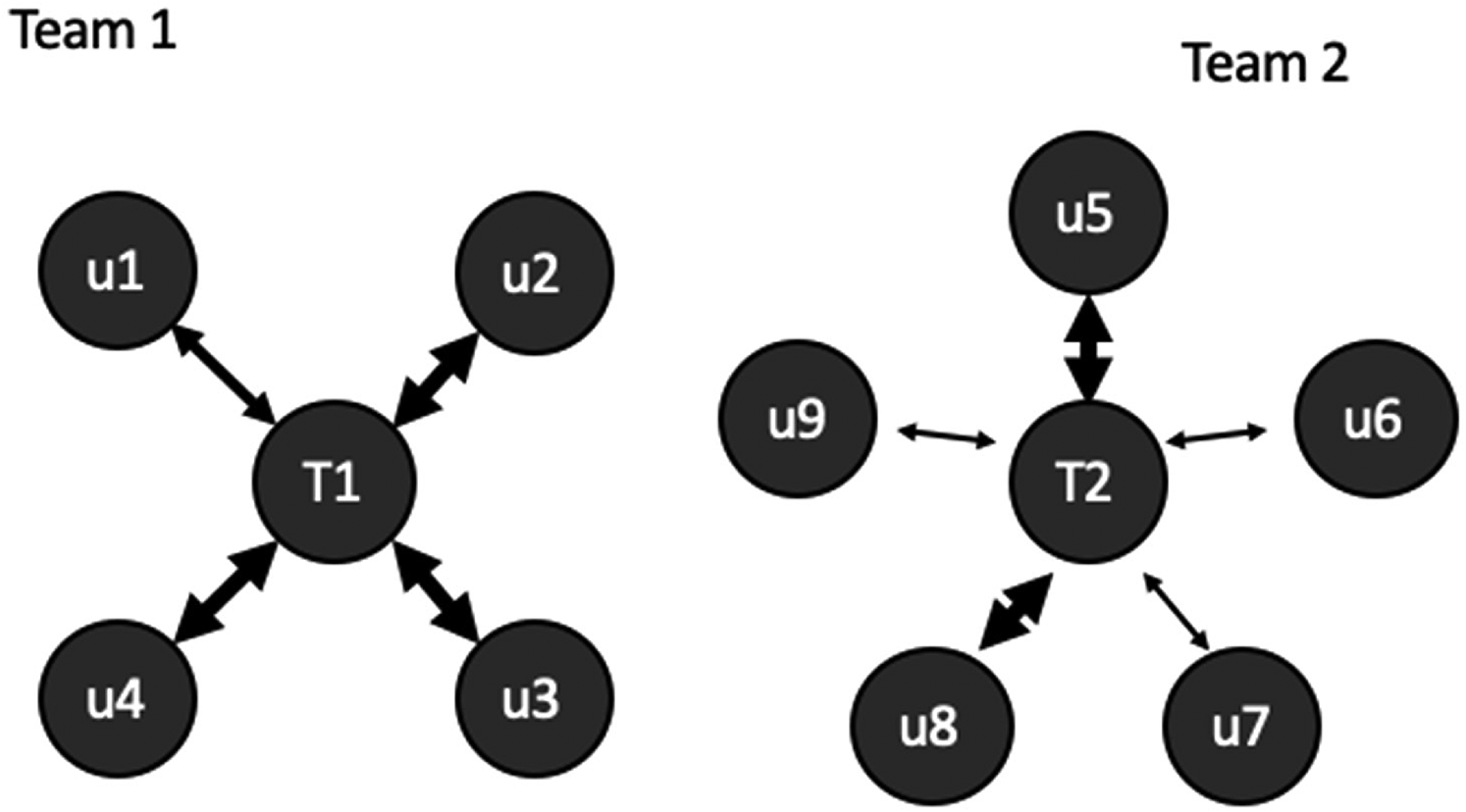
Example network configurations of Oetzel (2001) social interdependence study.
Step 4: Selecting a Network Index
By representing interdependence in terms of a network, researchers can evaluate interdependence based on a variety of network indices (Borgatti & Halgin, 2011; Katz et al., 2004). Each of these indices holds respective strengths and limitations, and their utility will depend on the nature of the researcher's investigation. Oetzel (2001) was interested in a team-level aggregation of self-construal. Although Oetzel did not explicitly use a network-based approach to evaluating interdependence, the author was generally focused on understanding how interconnected (i.e., stronger) construal networks related to team outcomes (e.g., cooperation) compared to less connected construal networks.
Since the authors were interested in a network-level assessment of interdependence, we used Figure 1(c) to determine which index to use. First, the network metric should be at the network level since Oetzel's goal was to examine team-level construal scores. Next, we note that the goal of the paper was to examine the strength of interdependence within the overall network, we should therefore choose a significance-based index. Finally, Oetzel was interested in an average of self-construal not the variability in self-construal. Based on this a density-based SDI score will be more appropriate. Moreover, we note that the given operationalization will likely produce weighed network edges, and density can handle weighted edges.
For illustration purposes, we will also consider the case where Oetzel was interested in individual-level measures of interdependence. Following the same process described previously, we would determine first to use a node-level index (Figure 1(a)) and since we are interested in the overall level of interdependence, we would select a significance index again. Lastly, operationalization lends itself to direct connections more so than indirect connections. We therefore would use a degree centrality index. Again, degree centrality can easily be adapted to handle the weighted nature of the operationalization used.
Calculating SDI Scores
Calculating an SDI score requires three pieces of information. These are the observed RDI scores, the theoretical maximum RDI scores, and the theoretical minimum RDI scores. As mentioned previously, we will use a degree centrality RDI and a density RDI score. Based on the research question of this study, each team member is only connected to the central “team context” node (Figure 2) and therefore has a theoretical maximum score of 5 (based on the Likert scale used in the survey). Similarly, degree centrality has a minimum of 1. Density for this situation will be maximized when all individuals have the maximal level of dependence on the team. In this case, the network will have n nodes, with
To make this example more concrete, we provide example raw data in Table 3. Since the research question focused on individual- and team-level inferences, the data are organized by team and participant identifiers in the first two columns. The third column reflects the self-reported self-construal scores for each participant. Table 4 presents the output of the procedure, with the first two columns containing the node- and network-level identifiers. Note that in this case, team construal was a node since the central premise of this research question was assessing how dependent individual construal was on team construal. The third and fourth columns respectively contain the degree centrality scores for each node and the density scores for each network. Appendix A provides R code for generating the raw data, visualizing the network, and computing the SDIDen and SDIDC scores.
Example of raw Data from a Self-Construal Scale Given to Members of two Separate Teams.

Example of SDI Scores from the Prepared Self-Construal Dataset.

Note: the unit representing the team has an SDI score identical to the aggregated mean SDI score. See Appendix A for detailed code for these functions and example raw data.
Example 2: Helping Behaviors
Overview
Barnes et al. (2008) studied the impact of backing up behaviors, which represents how one individual is dependent on another to perform their assigned tasks. Backing up behaviors can represent a form of interpersonal interdependence. The authors considered interdependence as a person-to-person measure assessing the extent to which individuals rely on other individuals to perform their specific tasks. This is a different concept than Oetzel was concerned with since Barnes and colleagues were focused on individual to individual relationships rather than individual to team relationships.
Theoretical Definition
In this study, dependence relationships are theoretically defined by the amount of effort that one person puts into performing another person's tasks. That is, the theoretical definition is not based on specific behaviors per se, but rather a more general “effort” variable. This clarifies the theoretical connection to other variables of interest. In this case, higher effort on another teammate's task corresponds to greater helping behavior (i.e., interpersonal interdependence).
Operational Definition
Dependency relationships are operationally defined in this study according to the observed number of times that team members perform each other's tasks. The operational definition provides very specific rules regarding how to count helping behaviors. It is common in this scenario to use an interval-based binning procedure where the reported behavioral count would represent the number of intervals in which at least one helping behavior was observed. If an interval-based procedure was used, this could be used to establish the contextual minimum and maximum values for the dependency relationship. For example, this study uses 30-min-long sessions. If we bin behaviors into 30 distinct one-minute intervals, we will define the conceptual maximum number of helping behaviors as 30 and the minimum as 0. For didactic purposes, and without a clearer understanding of the procedure used in this study, we will continue with this range.
Constructing a Network
After collecting data, we need to construct an interdependence network (e.g., Figure 3). We define network nodes for the source units (i.e., each team member that either helped another teammate) and target units (i.e., team members who were helped). Note that in this case, most team members will likely act as both source and target units. Network edges are directionally defined based on how many times the given source helped the given target.

Example network configurations of Barnes et al. (2008) task interdependence study. Note. Arrow thickness indicates the strength of a given dependency relationship. Dashed lines indicate dependency relationships that are negligible (i.e. weights less than 0.1).
Selecting a Network Index
Barnes and colleagues were focused on the impact that helping or receiving help has on performance. Therefore, the authors were primarily focused on individual-level inferences and so we utilized Figure 1(a) to guide our decision-making process for selecting a network index. Given that the authors were interested in the impact or significance of helping, we selected a significance-based conceptualization of interdependence. While indirect impacts of interdependence could be of interest, it appears that the authors were primarily interested in the direct impact of helping each other. We thus conclude that we should use a degree centrality-based SDI score. Note that degree centrality can be understood from a received, initiated, and reciprocal conceptualization. Initiated is most consistent with Barnes et al. (2008) original work, but for illustrative purposes, we will evaluate all three. Additionally, for didactic purposes, we will also evaluate a network-level, density-based SDI score.
While Barnes et al. (2008) research question was most congruent with significance indices, it might also prove interesting to assess a community-based index. For instance, it is possible groups that form strong communities are more resilient. If we were interested in this theoretical consideration, we could elect to use a community-based index focused on the strength of cohesive subgroups. This would be a network-level inference and so we would use Figure 1(c) to guide our decision-making. Based on the index type (community) and conceptualization (cohesive subgroups), we would choose transitivity as the index of interest. Highly transitive networks (i.e., if A helps B, and B helps C, then A usually helps C) could be resilient to problems because even if one source of needed aid is disrupted there is generally another source of redundant aid.
Transitivity is generally defined for unweighted and systemic networks, but our operationalization is both weighted and non-symmetric. As such we will need to redefine the dependency network based on reciprocal relationships wherein at least one of the team members helped another teammate and we will need to use some threshold (mean of all observations) to change the network from a weighted to an unweighted network. Although this approach is reasonable, the implications of transforming the network should be acknowledged. We are no longer evaluating who helps who, but rather which pairs of people help each other more than average. For didactic purposes and to illustrate the flexibility of our framework, we will also evaluate a community-based index on the individual level. From Figure 1(a), we could choose effective network size (ENS) as it is a community index that captures the extent that an individual's connections form a cohesive cluster. Note that we have shifted the level of inference will not be on the extent that the network forms cohesive clusters, but the extent that a node connects to a cohesive cluster.
Calculating SDI
Depending on the nature of the work and helping behaviors, it is possible that helping one person would make it impossible to help another person in the same time period, which would suggest a more stringent theoretical maximum (i.e., the theoretical maximum might be 30 if you could, at most, help one person per time period). Similarly, individuals could have had different levels of exposure to each other. For instance, during a 30-min observation period, one person may have only been present for 15 min; this could merit a much more stringent maximum (e.g., max
As in the previous example, we provide raw data and output to aid in the calculation of SDI scores. Table 5 presents the raw data for calculation, and in this example, we specifically differentiate between a source and target unit because we care about the direction of helping behaviors. Team-level identifiers are also coded, and so are the number of helping behaviors. In Table 6, the nodes and networks are coded and matched to the team identifier. The relevant network metrics are presented at the node- (i.e., SDIDC and SDIENS) and network (i.e., SDIDen and SDITran) levels. Again, we note that in this example, we differentiated between received, initiated, and reciprocal degree centrality, as well as received and initiated effective network size, because we were interested in the direction of helping. Appendix A provides R code for generating the networks, creating visualizations, and computing the SDI scores.
Example of Helping Behavior Data Prepared for SDI Function.

Example of SDI Scores from the Helping Behavior Dataset.

Recommendations for Future Applications of the Network Perspective of Interdependence
As demonstrated in the prior examples, a network approach can be used to flexibly evaluate interdependence regardless of its conceptualization and operationalization. Therefore, we strongly encourage the use of this approach. The network-based approach provides significant theoretical and methodological advantages to the study of interdependence. The perspective helps clarify the concept of interdependence elucidating the relational aspects of interdependence. Furthermore our approach interfaces with a wealth of tools from the social network analysis literature. As such it enables researchers to leverage a multitude of network structural characteristics which have enormous potential for enhancing our understanding of configural aspects of interdependence, but which traditional tools are unsuited to study. For example, the majority of non-network approaches to studying interdependence can be interpreted in terms of significance network indices. The network perspective provides the theoretical and methodological foundation to investigate notions of proximity and community structures in interdependence configurations.
A significant advantage of our framework is the Standardized Dependency Index itself. The SDI provides a general reporting method that can be purposed across different interdependence facets and different operationalizations of the same construct. Researchers can use the SDI associated with specific constructs as a focal predictor in observational and experimental designs when seeking to evaluate the predictive validity of interdependence related to group outcomes. Additionally, computing the SDI as a covariate will help identify the relative importance of interdependence in comparison to other indicators of interpersonal (e.g., communication, conflict), action (e.g., monitoring), or transition (e.g., planning) processes (Marks et al., 2001). Similarly, interdependence can be examined as a moderating variable on the relative impact of these group processes on important group outcomes (e.g., performance). Furthermore, interdependence can represent a process in and of itself, and help explain why group compositions or structures may facilitate or inhibit performance. Finally, as a common metric, the SDI provides researchers with a common variable to include in analyses. As an unscaled effect size, SDI scores can help further meta-analytic studies on the impact of interdependence. In this fashion, researchers can accumulate and integrate interdependence research.
Additionally, the network perspective highlights the inherently multi-level nature of interdependence providing clear tools for theorizing and analyzing at the node, dyad, and network levels. The network perspective enables researchers to take a configural perspective of team interdependence, which can provide unique information regarding the impact of role, task, and/or resource configurations (Courtright et al., 2015) across levels. For instance, it may be that there is one highly interdependent individual who dominates network-level interdependence. Conversely, dependence may be distributed evenly throughout a network. Though the two networks can have the same aggregate SDI score at the network level, the node-level SDI scores would be vastly different based upon the configuration of roles in the network (Humphrey et al., 2009). In this effort, calculating SDI scores across multiple levels of analysis can help uncover the impact of interdependence configurations. Given the advantages of a network approach, we provide recommendations for current and future research to consider when implementing the network approach.
Recommendation 1: Report the Three-Step Process for Deriving Dependency Networks
There are many existing conceptualizations of interdependence and interdependence has consequently been operationalized in many different ways (Courtright et al., 2015). Therefore, there exists a strong potential for researchers to misinterpret or inappropriately compare SDI scores when the procedures used to derive the dependency network and report the SDI are not transparent. We suggest that researchers utilize the three-step procedure outlined in this paper by first providing a theoretical definition of how interdependence is conceptualized. For example, if a study focuses on task interdependence, that should be clearly indicated. Next, we recommend that researchers clarify the operationalization of interdependence that is used (e.g., what instrument or interdependence observational procedure was followed; see Table 1 for some examples) so that the measurement procedure can be replicated. Lastly, we recommend that researchers clearly indicate how network nodes and network edges are defined and quantified so that there is no ambiguity regarding the derivation of the network. We suggest pairing this step with a visualization of the network (e.g., graph diagram) for maximal transparency and interpretability.
Recommendation 2: Consider a Variety of Network Metrics and Align the Selected Metric with the Research Question
Network structures can be characterized by numerous indices beyond centrality (e.g., reciprocity, clustering, modularity, and connectivity). Although the bulk of existing organizational research focuses on degree centrality (Park et al., 2020a), our procedure for representing interdependence as a network connects researchers with a much broader array of network metrics across multiple levels of analysis. For example, centrality can reflect the importance of a member to a team, whereas network connectivity captures how many edges or nodes would need to be removed to separate different parts of a network. Teamwork processes with a low level of network connectivity would be easier to separate and compartmentalize than processes with a higher degree of network connectivity. Whereas centrality would be useful for assessing the influence of an individual, connectivity would be useful for assessing the resilience of a team if a member was removed. We encourage researchers to compare the information provided by various indices and select a set of network indices which most closely aligns with their research question.
Significance network indices are broadly applicable to most theoretical interdependence questions. For the sake of uniformity and cross-study investigations, it may be helpful to report a degree centrality SDI by default. However, we strongly urge researchers who plan to use a degree centrality SDI score to carefully consider additional potential indices to include in their analyses. The network perspective provides a rich array of tools to investigate the deeper structural characteristics of interdependence; it would be disappointing if we ultimately never moved past degree centrality indices. We recommend researchers carefully refer back to Figure 1(a)–(c) which are are heuristic tools for selecting appropriate network indices and Table 2 which is an informative guide for aligning metrics with research questions.
Recommendation 3: Compute SDI Even When Interdependence is not a Focal variable
Although the SDI can prove useful to assess the impact of interdependence on relevant group outcomes, we also recommend that researchers compute SDI scores when they are not focal variables. In many studies, researchers reference one situation, team, or structure as having low or high interdependence (e.g. Beauchamp & Bray 2001; Beauchamp et al., 2002; Jehn, 1995; Shiflett, 1972). In such cases, computing an SDI score can provide an empirical justification claims for normative valuations of interdependence such as “highly interdependent” or “interconnected”, and a clear theoretical explanation of how interdependence is related to the scope of a study. Currently, no empirical or analytical guidelines exist to make normative valuations regarding the size of the SDI score relative to other SDI scores based on the same SDI metric. For instance, an SDIDC of.2 may be large relative to other SDIDC scores computed across interdependence studies whereas an SDIENS of.5 may be smaller than other reported SDIENS values 5 . Standard effect size guidelines have proven impractical to generalize across different methods (e.g., Nye et al., 2019) and seem somewhat specific to research contexts (e.g., Bosco et al., 2015). Therefore, further research can help develop practical guidelines for determining whether the level of interdependence is low, medium, or large for a given network property. Additionally, as previously noted, calculating SDI scores would also enable further research regarding the extent that SDI scores based on different metrics are comparable. If SDI scores based on different network metrics follow the same distribution, then it could be appropriate to make cross-metric comparisons. This would enable a more unified approach to measuring and understanding interdependence that could yield more integrative and novel insights.
Recommendation 4: Consider Machine Learning Techniques When Computing Evaluating Dependency Networks
Building on prior recommendations, we suggest that researchers consider machine learning techniques when studying interdependence. Network metrics often exhibit high levels of multicollinearity, and this is especially true when network metrics from multiple levels of analysis are included in the same model (Duxbury, 2021; Faust, 2007; Snijders, 2002; Snijders et al., 2006). Therefore, collinearity issues can occur when multiple SDI scores are included in the same statistical model, which can present problems for traditional regression models in terms of model convergence and parameter estimation (Duxbury, 2021). However, machine learning techniques can regularize parameters by shrinking the coefficients based on the level of multicollinearity, which results in greater cross-validation than is the case for traditional OLS models (Putka et al., 2018). Moreover, machine learning techniques can offer advantages beyond overcoming statistical hurdles. Specifically, machine learning algorithms based on network metrics related to clustering and centrality can be used as inputs to reliably classify individuals into social hierarchies (Nurek & Michalski, 2020). This approach can enable researchers to use interdependence measures to infer the social hierarchy of a team or organization when such data are difficult to collect with high fidelity. As a result, machine learning may help researchers leverage interdependence data to investigate additional questions beyond interdependence itself.
Recommendation 5: Consider Dynamic Network Analyses When Evaluating SDI Scores Over Time
Teams and organizations are dynamic entities and the connections between individuals often shift over time as groups change structures to meet external and internal demands (Kozlowski, 2015). In a longitudinal data collection, SDI scores can be computed at each time point and used in traditional longitudinal analyses (e.g., cross-lagged panel models, time series analyses, and latent growth models). We recommend that researchers examine interdependence from a dynamic perspective, when possible because the inferences gained from cross-sectional data are unlikely to generalize over time (DeShon, 2013; Kozlowski, 2015). As individuals enter and leave the group, tasks can be restructured, and the interdependence network will change as a function of this reorganization (Mathieu et al., 2014). Dynamic network models enable researchers to model the flow of these changes through time and examine the changes to the structure of the network, predict when connections between nodes disappear, and simulate network outcomes if the nodes or connections are removed (Carley et al., 2007; Maupin et al., 2020). Although this area of research is still growing, dynamic network analyses can provide useful information regarding the diffusion of dependence and its transience within the network through time. Representing these properties helps provide a more representative theory and is therefore useful for researchers to consider when measuring interdependence.
Footnotes
Acknowledgments
We gratefully acknowledge assistance provided by Zachary Neal and Kathleen R. Keeler as we framed the ideas presented in this manuscript. We are additionally thankfully for support provided by the National Defense Science and Engineering Graduate (NDSEG) fellowship program.
Declaration of Conflicting Interests
The author(s) declared no potential conflicts of interest with respect to the research, authorship, and/or publication of this article.
Funding
The author(s) received no financial support for the research, authorship and/or publication of this article.

Notes
Author Biographies
Appendix A: R Code Function Declarations and Examples
###########################
# Function Declarations
#### getNetworkList function
getNetworkList <- function (edges, nodes, groupingVar, directed = T){
groupingVar <- enquo(groupingVar)
groups = unique(nodes[,quo_name(groupingVar)])
netList = list()
for(i in 1:length(groups)){
currentGroup = groups[i]
edges_group = edges %>% filter(!!groupingVar = = currentGroup)
nodes_group = nodes %>% filter(!!groupingVar = = currentGroup)
netList[[i]] = graph_from_data_frame(d = edges_group, vertices = nodes_group, directed = directed)
}
return(netList)
}
#### SDI Function
# Calculates SDI for each unit based on 1) the raw density index 2) the theoretical maximum for # each node, and 3)
# the theoretical minimum for each node.
sdi <- function (rawDensityIndex, max, min){
return ((rawDensityIndex - min)/(max - min))
}
#### tansposeGraph Function
# Code for this function provided by
# (Waldi 2020)
transposeGraph <- function(g) {
g %>% get.edgelist %>%
{cbind(.[, 2],.[, 1])} %>%
graph.edgelist
}
###########################
# Examples
#### Libraries used
library(igraph)
library(dplyr)
library(influenceR)
#### Scripts for example 1
# Step 1. Read in data
selfConstrualEdges = data.frame (source = c(‘u1’, ‘u2’, ‘u3’, ‘u4’, ‘u5’, ‘u6’, ‘u7’, ‘u8’, ‘u9’), target = c(‘t1’,'t1’,'t1’,'t1’,'t2’,'t2’,'t2’,'t2’,'t2’), weight = c(3, 4, 5, 5, 2, 1, 1, 2, 1), teamID = c(1,1,1,1,2,2,2,2,2))
selfConstrualNodes = data.frame (node = c(‘u1’, ‘u2’, ‘u3’, ‘u4’, ‘t1’, ‘u5’, ‘u6’, ‘u7’, ‘u8’, ‘u9’,'t2’), teamID = c(1,1,1,1,1,2,2,2,2,2,2))
# Step 2. create and plot networks
scDependencyNetworks = getNetworkList(selfConstrualEdges, selfConstrualNodes, teamID)
for(i in 1:length(scDependencyNetworks)) plot(scDependencyNetworks[[i]])
# Step 3. Calculate Dependency Index Scores
dependencyTable_sc = tibble(name = character(), level = character(), rdi_dc = double(),
sdi_dc = double(), rdi_density = double(), sdi_density = double())
# Loop across networks
for(i in 1:length(scDependencyNetworks)){
net = scDependencyNetworks[[i]]
n = length(V(net))
# Node Level
RDI_DC = strength(net, mode = “all”)
SDI_DC = sdi(RDI_DC, degree(net)*5, degree(net))
dcTibble = tibble(name = names(SDI_DC), level = “node”, rdi_dc = RDI_DC, sdi_dc = SDI_DC)
# Network Level
RDI_Density = sum(RDI_DC)/(2*n*(n-1))
SDI_Density = sdi(RDI_Density, 5/n, 1/n)
densityTibble = tibble(name = paste0(”team”,i), level = “network”, rdi_density = RDI_Density, sdi_density = SDI_Density)
dependencyTable_sc = full_join(dependencyTable_sc, dcTibble)
dependencyTable_sc = full_join(dependencyTable_sc, densityTibble)
}
#### Scripts for example 2
# Step 1. Read in data
helpingBehaviors = data.frame(source = c(‘u1’, ‘u1’, ‘u1’, ‘u2’, ‘u2’, ‘u2’,’u3’, ‘u3’, ‘u3’, ‘u4’, ‘u4’, ‘u4’, ‘u5’, ‘u5’, ‘u5’, ‘u5’, ‘u6’, ‘u6’, ‘u6’, ‘u7’, ‘u7’, ‘u8’, ‘u8’, ‘u9’), target = c(‘u2’, ‘u3’, ‘u4’, ‘u1’, ‘u3’, ‘u4’,’u1’, ‘u2’, ‘u4’, ‘u1’, ‘u2’, ‘u3’, ‘u6’, ‘u7’, ‘u8’, ‘u9’, ‘u7’, ‘u8’, ‘u9’, ‘u5’, ‘u8’, ‘u9’, ‘u6’, ‘u8’), teamID = c(1,1,1,1,1,1,1,1,1,1,1,1,2,2,2,2,2,2,2,2,2,2,2,2), weight = c(30,2,15,3,12,4,27,3,22,5,2,25,1,7,14,1,16,6,26,1,21,3,1,11))
helpingNodes = data.frame(node = c(‘u1’, ‘u2’, ‘u3’, ‘u4’, ‘u5’, ‘u6’, ‘u7’, ‘u8’, ‘u9’), teamID = c(1,1,1,1,2,2,2,2,2))
# Step 2. Generate and plot Networks
helpingDependencyNetworks = getNetworkList(helpingBehaviors, helpingNodes, teamID, directed = T)
# Generate Grand Mean Threshold Networks
grandMeanWeight = mean(helpingBehaviors$weight)
helpingBehaviors_gmt = helpingBehaviors %>% filter(weight > grandMeanWeight) %>% select(-weight)
helpingDependencyNetworks_gmt = getNetworkList(helpingBehaviors_gmt, helpingNodes, teamID, directed = T)
# Plot Networks
for(i in 1:length(helpingDependencyNetworks)) plot(helpingDependencyNetworks[[i]])
for(i in 1:length(helpingDependencyNetworks_gmt)) plot(helpingDependencyNetworks_gmt[[i]])
# Step 2. create graph object from data
helpingDependencyNetwork = graph.data.frame(helpingData, directed = TRUE)
# Step 3. Calculate Dependency Index Scores
dependencyTable_hb = tibble(name = character(), level = character(), rdi_dc = double(), sdi_dc = double(), rdi_dc_in = double(), sdi_dc_in = double(), rdi_dc_out = double(), sdi_dc_out = double(), rdi_ens_in = double(), sdi_ens_in = double(), rdi_ens_out = double(), sdi_ens_out = double(), rdi_density = double(), sdi_density = double(), rdi_transitivity = double(), sdi_transitivity = double())
# Loop across networks
for(i in 1:length(helpingDependencyNetworks)){
net = helpingDependencyNetworks[[i]]
net_gmt = helpingDependencyNetworks_gmt[[i]]
n = length(V(net))
#Degree Centrality Indices
RDI_DC_in = strength(net, mode = “in”)
RDI_DC_out = strength(net, mode = “out”)
RDI_DC_rec = strength(net, mode = “all”)
SDI_DC_in = sdi(RDI_DC_in, (n-1)*30, 0)
SDI_DC_out = sdi(RDI_DC_out, (n-1)*30, 0)
SDI_DC_rec = sdi(RDI_DC_rec, 2*(n-1)*30, 0)
#Effective Network Size Indices
RDI_ENS_in = ens(transposeGraph(net_gmt))
RDI_ENS_in = RDI_ENS_in[order(names(RDI_ENS_in))]
RDI_ENS_out = ens(net_gmt)
SDI_ENS_in = sdi(RDI_ENS_in,n-1,0)
SDI_ENS_out = sdi(RDI_ENS_out,n-1,0)
nodeTibble = tibble(name = names(SDI_DC_rec), level = “node”, rdi_dc = RDI_DC_rec, sdi_dc = SDI_DC_rec, rdi_dc_in = RDI_DC_in, sdi_dc_in = SDI_DC_in, rdi_dc_out = RDI_DC_out, sdi_dc_out = SDI_DC_out, rdi_ens_in = RDI_ENS_in, sdi_ens_in = SDI_ENS_in, rdi_ens_out = RDI_ENS_out, sdi_ens_out = SDI_ENS_out)
#Density and Transitivity Indices
RDI_Density = mean(RDI_DC_rec)
SDI_Density = sdi(RDI_Density, 2*(n-1)*30, 0)
RDI_Transitivity = transitivity(net_gmt)
SDI_Transitivity = sdi(RDI_Transitivity, 1, 0)
networkTibble = tibble(name = paste0(”team”, i), level = “network”, rdi_density = RDI_Density, sdi_density = SDI_Density, rdi_transitivity = RDI_Transitivity, sdi_transitivity = SDI_Transitivity)
dependencyTable_hb = full_join(dependencyTable_hb, nodeTibble)
dependencyTable_hb = full_join(dependencyTable_hb, networkTibble)
}