




Abstract
Does technology-enablement impact the ability of a service system to co-create value? In this study, we assess and compare the relative importance of Information and Communication Technology (ICT) and human relationships in service systems, by drawing on findings from a multiple case study in the consulting industry and subsequent analysis through a sociotechnical connectivity lens. We present a theoretical model and propositions which indicate that successful technology-enabled value co-creation is contingent upon the quantity and quality of interpersonal relationships, or social connectivity, between humans that interact and exchange resources by means of ICT. Our findings indicate that technology-enablement in service systems does not, in and of itself, influence human behavior, goals, or motivation regarding the value co-creation process, and argue that the ability of these service systems to co-create value is contingent on the levels of social connectivity between its human entities, more so than ICTs that enable the process. The ability to manage social connectivity therefore represents a prerequisite for the successful co-creation of value in technology-enabled environments, and we provide guidelines that help managing social connectivity on requisite levels.
Introduction
Interactions between service providers (SPs) and their customers were traditionally understood to follow the notion of “high touch, low tech” (Bitner, Brown, and Meuter 2000, p. 138), which implied the existence of a physical interface or customer touch point (Gadrey and Gallouj 2002). Today, the advancement of Information and Communication Technology (ICT) has changed, and continues to change, the characteristics of these exchanges (Davis, Spohrer, and Maglio 2011). Specifically, ICTs like video conferencing, teleconferencing and e-mail, enable interpersonal communication that can resemble, and therefore substitute, face-to-face (F2F) contact. In these technology-enabled value co-creation processes, human SPs interact with physically dispersed human customers by means of ICT, and no longer utilize a physical interface (Makarem, Mudambi, and Podoshen 2009).
The recent academic debate in the field of service research, as exemplified through this special issue in the Journal of Service Research, recognizes the need to advance our understanding of the role of ICT in service (Bitner, Zeithaml, and Gremler 2010; Chesbrough and Spohrer 2006; Rust and Miu 2006). Some even postulated that ICT represents a “pervasive force” in service contexts (Ostrom et al. 2010, p. 6), and should be considered as one of the key research priorities within the service science research agenda, as well as in the Information Systems (IS) field (Raj and Sambamurthy 2006). However, understanding the role of ICT in service requires not only to investigate the impact that ICTs might have on the performance of service systems, but to equally explore the social or human dimension underlying such technology-enabled exchanges (Edvardsson, Tronvoll, and Gruber 2011; Vargo, Maglio, and Akaka 2008). Since empirical insights are known to exist predominantly in “face-to-face service encounters [ … ] but not [in] service encounters involving both technology and the human touch” (Makarem, Mudambi, and Podoshen 2009, p. 144), significant opportunities for future research exist in this area.
In order to understand the impact that technology-enablement may have on the performance of a service system, as defined by its ability to co-create value (Spohrer and Maglio 2010), we extend previous inquiries by introducing and applying the connectivity metaphor as a novel sociotechnical analytical lens in service research (Angwin and Vaara 2005; Kolb 2008). We argue that utilizing connectivity is appropriate for investigating technology-enablement in service systems because it incorporates a social and technical dimension, therefore providing the analytical lens called for in the literature. Ultimately, connectivity allows us to assess and compare the relative importance of both ICTs and the human dimension for a service system’s ability to co-create value.
This article is organized as follows: first, we provide a comprehensive overview of existing research addressing ICT in service and introduce connectivity as our analytical lens. Then, we outline the qualitative multiple case study we conducted that investigated technology-enabled value co-creation processes in the consulting industry. The subsequent presentation and discussion of findings is aligned with our inductive theory-building process, and culminates in a conceptual model and propositions that provide insights into the complex interrelationship of ICT and human interaction throughout technology-enabled value co-creation processes. We then discuss the theoretical and managerial implications of our findings, outline limitations, and conclude the article with opportunities for future research.
Technology-Enablement in Service Systems
Technology-Enabled Value Co-Creation
ICTs already helped to “diminish personal interaction in service” (Walker and Johnson 2004, p. 564), thereby resulting in technology-generated self-service, a type of human-computer interaction such as online banking and shopping or e-government (Bitner, Ostrom, and Meuter 2002; Salomann, Kolbe, and Brenner 2006). On the contrary, ICTs also enable interpersonal exchanges that closely resemble F2F contact, and thereby equally alter the ways service customers (SC) and providers interact (Baym, Zhang, and Lin 2004; Davis, Spohrer, and Maglio 2011). For example, within in the consulting industry, the need for physical contact between a consultant and customer, as a mediator for customer input has, due to technological advances, become less relevant. Consequently, technology-enabled interactions have increasingly replaced the physical contact in this industry (Lee and Park 2009; Maglio and Spohrer 2008). Such service processes that rely on technology-enabled interactions are described as technological knowledge-intensive business services (Glückler and Hammer 2011) or technology-enabled service encounters (Makarem, Mudambi, and Podoshen 2009). Despite the varying terminology, the common denominator here is that ICTs enable “interpersonal interaction between a customer and a company” (Makarem, Mudambi, and Podoshen 2009, p. 135). It is this technology-enabled exchange between human actors that represents the key differentiating factor as compared to technology-generated self-services that do not include this element (Glückler and Hammer 2011). Today, the physical location of individual actors in service systems is becoming less relevant because “as the ability to communicate increase the need for transport decreases” (Lusch, Vargo, and Tanniru 2010, p. 23). The resulting shift toward technology-enabled value co-creation processes is demonstrated in Figure 1.
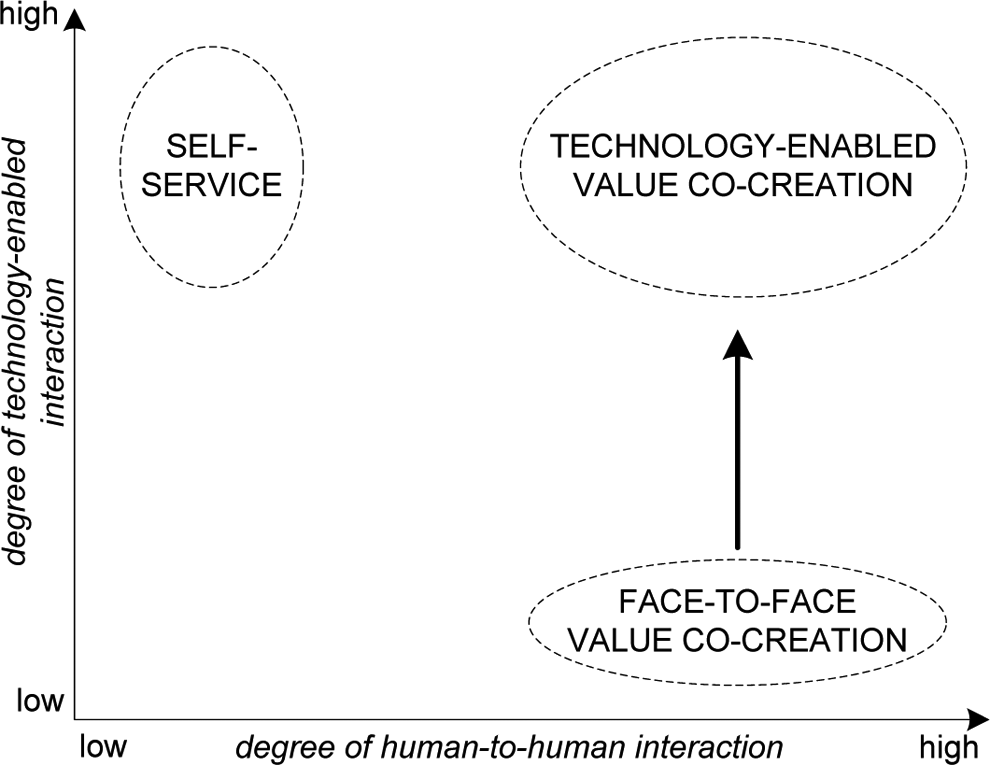
Towards technology-enabled value co-creation processes, adapted from Wünderlich (2009).
In order to understand the impact that ICTs may have on service systems, scholars suggested that it is important to initially explore how “information technology influences the ways in which value can be created,” and to ask: “what approaches do we need to understand the socio-technical context of value creation?” (Vargo, Maglio, and Akaka 2008, p. 151). These questions are especially relevant when taking the human element of value co-creation into consideration, which is, especially in the case of technology-enabled value co-creation processes, suspected to be more important than ICTs enabling the interaction (Ostrom et al. 2010). While Naisbitt foresaw that “the more high technology around us, the more the need for human touch” (1982, p. 52), our understanding of the interrelationship of ICTs and human elements in service is, especially from an empirical standpoint, very limited (Edvardsson, Tronvoll, and Gruber 2011; Makarem, Mudambi, and Podoshen 2009; Ostrom et al. 2010). By introducing and applying connectivity as a sociotechnical analytical lens into service research, we attempt to address this research gap and provide insights into both the technical and social underpinnings of technology-enabled value co-creation processes.
Connectivity as an Analytical Lens in Service Research
Originally introduced to describe technical connections only, the term connectivity has increasingly been used in the context of nontechnical, specifically human and social interaction (Cartwright 2002; Kanter 1999). Though rooted in Giddens’ (1984) work on structuration, the sociotechnical evolution of the connectivity metaphor originated within organizational studies (Angwin and Vaara 2005). Here, the argument has been brought forward that connectivity “can and should be applied to social interactions” (Kolb 2008, p. 140) as well as technical ones, in order to advance our thinking about technology-enabled human exchanges.
In contrast to the virtual team literature that examined technology-enabled interactions by focusing either on the quality or richness of ICTs (Carlson and Zmud 1999; Daft and Lengel 1986) or on socioemotional processes (Baym, Zhang, and Lin 2004; Wong and Burton 2000), connectivity encompasses a holistic sociotechnical multidimensionality that provides us with a novel analytical lens for service research. However, since the term is often used without further clarification, we define connectivity for service research more concisely as:
A multidimensional, holistic sociotechnical construct that incorporates all interactions and links (or lack of) between entities within a service system, whose variance in quantity and quality influences a service systems’ performance.
As implied in our definition, connectivity is known to vary in its levels of intensity through various connective states that are contingent on the quantity and quality of the technical and social links between human entities of a system. We argue that technical and social connectivity represent input factors that either enhance, or impair the performance of interactions between individuals. In this context, Quan-Haase and Wellman (2005) describe a state of hyperconnectivity, while and Wajcman and Rose (2011) investigate constant connectivity. A more comprehensive model suggests that hypoconnectivity (insufficient) and hyperconnectivity (excessive) represent conditions that can negatively influence the performance of a system. Requisite connectivity implies a threshold condition of just enough connectivity, while connective flow suggests an optimum that may be achieved if hypoconnectivity and hyperconnectivity are avoided (Kolb, Collins, and Lind 2008).
Hyperconnected individuals experience too much social and/or social connectivity; they “have too much of a good thing [and are] too connected” (Murphy 2007, p. 17). As an experiential state, this can involve “the instant availability of people for communication anywhere anytime” (Quan-Haase and Wellman 2005, p. 215) or, according to Kolb, Collins, and Lind “information overload, attention-taxing workflow and interruptions [ … ] and ubiquitous computing applications such as wireless email” (2008, p. 182). Hyperconnectivity is conceptually well defined, however, empirical evidence and insights on its causes and consequences are scarce. Existing empirical work is limited to the technical dimension of connectivity, early studies confirm that interruptions and the increasing necessity for coordination between team members can negatively impact their performance (Quan-Haase and Wellman 2005).
Too little, or hypoconnectivity, is equally suspected to negatively impact the performance of a technologically connected workforce. Again, empirical insights are scarce, but hypoconnectivity is linked to technical issues such as weak Internet connections, Internet connections, insufficient mobile phone reception, or a lack of interpersonal understanding, thereby resulting in “not having sufficient connections for the task or job at hand” (Kolb, Collins, and Lind 2008, p. 181).
We suggest that hypoconnectivity and hyperconnectivity can be perceived as connective gaps, or temporary disruptions to tasks and/or relationships, which Kolb, Collins, and Lind define as “all connective absences [ … ], interruptions, and disconnects between two parties” (2008, p. 183). Since connective gaps are likely to inhibit the exchange of resources, and therefore the ability to co-create value in service systems, exploring the emergence and potential means to overcome connective gaps is crucial when attempting to optimize the performance of a service system (Breidbach 2010).
Methodology
Research Objective and Questions
In order to determine if, how, and to what extent technology-enablement in a service system impacts its performance, we investigated the emergence and impact of connective gaps in service systems that exchange resources by means of ICT. As recommended by Eisenhardt (1989) and Perry (1998), we defined the following research questions at the outset of our study:
How do connective gaps emerge in a service system? How do connective gaps impact the ability of a service system to co-create value?
Research Design
Investigating technology-enabled value co-creation processes through a connectivity lens represents an emerging research area. Whenever “little is known about a phenomenon” (Eisenhardt 1989, p. 548), theory building using case studies is considered an appropriate research strategy (Yin 1984) and, as suggested by Colquitt and Zapata-Phelan (2007), we attempt to make a theoretical contribution to service research through this inductive theory building approach.
The service system represented our unit of analysis, as appropriate in service research (Maglio and Spohrer 2008). Using the research context of the consulting industry, as recommended by Payne, Storbacka, and Frow (2008) and Gadrey and Gallouj (2002), each case in this multiple case study incorporates an entire service system that consists of one, or a combination of consulting firms, here referred to as SP, that engage with one, or a combination of customer firms, here referred to as SC, in technology-enabled value co-creation processes of a service target (i.e., the reality to be transformed by that interaction). This approach also addresses a methodological shortcoming in service research identified by Heinonen et al. (2010, p. 532), who criticize existing empirical studies as too “focused on analyzing an individual service system from the company’s point of view,” leading to an “incomplete understanding” of service systems (Heinonen et al. 2010, p. 532). Consequently, we followed their suggestion of including “the roles and input of both the customers and company” (Heinonen et al. 2010, p. 543) in our study.
The benefits of the Service Dominant Logic (SDL) for the advancement of service research are well documented (Ostrom et al. 2010; Vargo, Lusch, and Akaka 2010), and we embedded our study in its foundational premises by assuming that consultants and customers are cocreators of value. However, it is important to point out that contrary perceptions exist. Spohrer and Maglio (2010) argue that interactions in service systems do not guarantee the emergence of value in every instance, while Heinonen et al. (2010) state that the process of co-creation, and value as a potential outcome, are separate end results of an interaction. While we acknowledge the importance of that debate, this article is conceptually rooted in the SDL, and we therefore adopt the perspective that the performance of a service system is judged by its ability to co-create value (Spohrer and Maglio 2010) which, in turn, depends on its ability to exchange resources (Prahalad and Ramaswamy 2004). With information understood as the “essence of service organizations,” (Mills and Marguiles 1980, p. 261), the performance of a service system in the context of the consulting industry, where our study is based, therefore depends on its ability to exchange the resource information between consultant and customer (Xue and Field 2008).
Data Collection
Since the purpose of our study was inductive theory building, the case selection was not concerned with representing an overall population, but driven by purposeful theoretical sampling, which ensured that all cases were (1) comparable and (2) sufficiently represented technology-enabled value co-creation as the phenomenon under investigation (Eisenhardt 1989; Miles and Huberman 1994; Yin 1984). Like other service researchers before us (Neu and Brown 2005), we relied on a criterion-based theoretical sampling approach to ensure these qualities (Miles and Huberman 1994; Perry 1998).
Following Yin (2011), a case protocol helped us to structure the screening of potentially suitable cases. Specifically, we ensured that we (1) gained access to both the consulting and associated customer teams, (2) only included service systems into our study that had experienced connective gaps throughout the duration of their interactions, and (3) only included service systems where the service target was completed. Specifically recommended by Eisenhardt and Graebner (2007), collecting empirical data in retrospect is common in service research, and examples include the work of Bansal and Voyer (2000), or Harris and Ogbonna (2008).
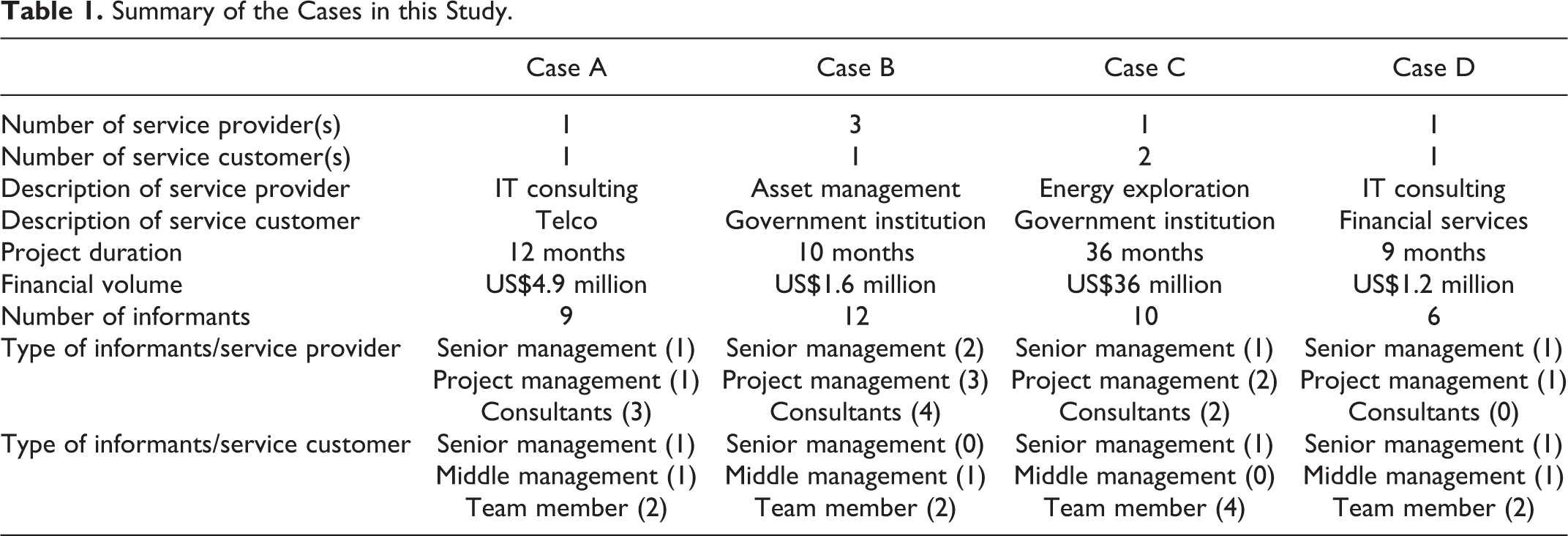
We initially screened 27 consulting firms, of which 16 were potentially suitable. After a series of screening interviews with representatives of both consulting and their customer firms, we incorporated 4 cases in this study that represent a total of 11 organizations located across Australasia, North America, and Europe. The consulting firms that participated in this study include two “Big 4” firms, as well as four boutique consulting firms with specialist expertise in areas like energy exploration, IT consulting, or asset management. Customer organizations include 3 government institutions, 1 telecommunications provider and 1 financial services firm that, on average, interacted with their consultants for 17 months.
The empirical data collected in our 4 cases include qualitative interview data obtained through semistructured in-depth interviews of 37 participants, who are senior managers, project managers, and line employees from both the consulting and customer firms. At the time of the interviews, none of the projects had been completed for more than 12 months, and participants remembered recent events well. We also followed recommendations by Eisenhardt and Graebner (2007) and collected additional data including field notes and case-documentation provided to us. Utilizing multiple sources of evidence was appropriate given the theory building nature of this study (Eisenhardt 1989), realism as our scientific paradigm (Healy and Perry 2000), as well as the multiple case study method (Yin 2011).
The interview questions were developed using the existing literature and avoided academic language, thereby allowing participants to express ideas in their words (Coviello 2005). While participants were interviewed at their own location by the same researcher, 11 interviews were conducted via telephone or video conferencing due to budgetary constraints. We asked each participant the same questions, and focused on the background of the projects, the interaction between the consulting and customer teams, specifically the ICTs and relationships between the two groups, as well as the causes and impact of connective gaps on the service system’s performance, as perceived by the participants. Finally, we also asked participants to evaluate the outcome of the project. Table 1 provides a summary.
Summary of the Cases in this Study.
Data Analysis
We analyzed the data by following recommendations and processes outlined in Yin (2011), Miles and Huberman (1994), and Eisenhardt (1989), and separated the process into within and cross-case stages. The within-case analysis was structured using Yin’s (2011) stages of compiling, disassembling, and reassembling. Compiling involved the cleaning, verification, and organization of data in nVivo 7, and relied on contact summary sheets, memoing, and coding during disassembling and reassembling. Specifically, our coding approach was based on Miles and Huberman’s (1994) descriptive, interpretive and pattern codes, which helped to identify constructs of our emerging theory and relationships thereof.
The cross-case analysis was based on a variable-oriented strategy (Miles and Huberman 1994) that led to the identification of similar themes across cases, thereby resulting in our emerging theory (Eisenhardt and Graebner 2007). We subsequently displayed the core constructs in the form of a box-and-arrow model, and created propositions that describe the key relationships between constructs (Colquitt and Zapata-Phelan 2007; Eisenhardt and Graebner 2007). The following section presents and discusses our findings, and culminates in the conceptual model and propositions.
The Antecedents of Connective Gaps in Service Systems
The Technology Repertoire
Throughout all cases, service customers determined the technology repertoire, or the types of ICT used to exchange resources within service systems. Service providers adapted the ICT infrastructure of their customers, and accepted any constraints regarding its availability or suitability. One project manager of a consulting firm explained:
My client has had the technology, and I’ve used it in that instance because it was available and they [SC] make a practice of using it. Project Manager SP (Case B)
[SC] might not know the tool and have concerns. And is it even possible to use it within their technical infrastructure? And even if that works, they might think ‘that is too complicated,’ and ‘where is the benefit?’ [ … ] So, I think the barriers are just too high. Consultant SP (Case A)
Proposition 1
Relationship Initiation
Though widely regarded as the enabler of information flows, ICTs represent “only part of the connective equation” (Kolb 2008, p. 140), and the role of human relationships in service systems must be considered as well (Makarem, Mudambi, and Podoshen 2009). In this study, we identify two types of relationships between consultants and customers, namely social and interpersonal. Specifically, our participants did not experience or engage in any social relationships, and considered these irrelevant:
I’m reading social as after work engagement [ … ] I don’t think I had any social interactions with the consulting team. I had interpersonal interactions, and I think those are critical to actually be able to talk to someone in a reasonable way [ … ], but I think that’s distinct from ‘let’s go have a beer’. Team Member SC (Case B)
Participants throughout all cases agreed that interpersonal working relationships should ideally be initiated in a F2F setting, and therefore precede technology-enabled interactions, a finding supported by the virtual team literature (Wong and Burton 2000).
At the very beginning of the project we had a start-up team building session [ … ] where we brought together all the team members. I'd say that was probably a big, big factor in the success of the project [ … ] a lot of these people were just meeting for the first time, and it was a good opportunity to put a face to the person, so that when you had subsequent conversations, be it email or telephone, you already had a relationship established. Consultant (Case B)
Proposition 2: Social connectivity within service systems incorporates interpersonal working relationships, and can be initiated as well as managed by service providers and customers throughout technology-enabled value co-creation processes.
Relationship Barriers
Relationship barriers constrain the ability of individuals to initiate and manage interpersonal working relationships, and thereby negatively impact the level of social connectivity in service systems. Specifically, we identified changes to the system configuration and operational challenges as relationship barriers that precede connective gaps.
We define system configuration as the group size and degree of continuity of individuals within a service system. Our findings indicate that small and stable groups in service systems experienced higher levels of social connectivity because it was easier to manage interpersonal working relationships in such an environment:
That reasonably small group of people [ … ] helped, I think, to foster a team atmosphere that then carried through for a much longer time. Team Member SC (Case C)
There were at least two or three persons [consultants] changing during these five months, I found that not very comfortable that people were changing from the [SP] side. Team Member SC (Case A)
[SC] currently has many challenges [ … ], but people are concentrating more on putting those fires down, and not really having the time to improve the social side of the organization [ … ] What has happened [ … ] is that the isolation between [SC’s location] and [SP’s location] has increased. So we are more interacting with people in [SC’s location] here, maybe even more tightly than before, and the [SP] team is concentrating on the topics on their table amongst themselves. [ … ] A couple of months ago we still had weekly [teleconferences] [ … ] but now, since we have so many urgent topics to deal with, people are not attending those [ … ] and therefore the connection is getting looser and looser over time. Team Member SC (Case A)
Proposition 3: Connective gaps are more likely to emerge if relationship initiation is insufficient.
Technology Choices
Technology choices describe an individual’s decision to use, or not use, a particular type of ICT while engaging in a technology-enabled value co-creation process. However, it is important to recall that technology choices were not open to an unlimited array of potentially available types of ICT, but restricted to the technology repertoire that confined the level of technical connectivity (see Proposition 1). Our findings indicate that technology choices of individuals in service systems did not follow the rational choice model that, according to some authors, results in an optimal task-media fit (Daft and Lengel 1986), but were broadly aligned with collective choice models that argue technology choices are influenced by social and individual factors (Riemer and Filius 2009). Once again, the system configuration influenced individuals to choose richer (i.e., one-on-one telephone) over leaner (i.e., e-mail) types of ICT. As discussed previously, service systems consisting of smaller and stable groups experienced higher levels of social connectivity, and were therefore more likely to choose richer types of ICT over leaner ones.
The person I did speak to by phone was actually [Jane] from [SC], and that was because [ … ] I knew her much better than I knew everyone else, so I had a lot more confidence in my ability to speak with her on the phone. Team Member SC (Case C)
A teleconference has the same character like all other speaker situations: one guy is talking, and the others are listening. So you can’t talk about the weather with everyone! [ … ] if you want to socialize, you have to use the telephone. Consultant (Case A)
Technology choices represent a relationship barrier because the individual usage patterns of ICTs influence the levels of social connectivity within a service system, a finding supported by social presence theory, which argues that richer media promote the perceived closeness with others (Schmidt, Montoya-Weiss, and Massey 2001). Consequently, we propose that, as an antecedent leading to connective gaps:
Proposition 4: Individuals in service systems are more likely to choose and use leaner ICTs over richer ones when social ties between them are weak.
The Emergence of Connective Gaps in Service Systems
We identified that the practices of technology use and the process of relationship management are mutually dependent factors that, together with the inability to overcome technical problems, lead to the emergence of connective gaps in service systems.
Practices of Technology Use
Practices of technology use are detrimental behavioral patterns that service systems displayed during technology-enabled value co-creation. We identified safeguarding, impression management, and media misuse as proactive practices of technology use, while the inability to disconnect and fulfilling expectations represented reactive practices. Figure 2 provides an explanation and overview.

Practices of technology use in service systems.
The impact of the practices of technology use on service systems is of particular interest. Both impression management and safeguarding always increased the use, and therefore the total volume, of e-mails within a service system, while impression management also increased the group size during teleconferences. However, large groups are, as indicated previously, undesirable because they decrease the ability to manage interpersonal working relationships, and increase the likelihood of participants engaging in media misuse. Similarly, and as indicated previously, an increased volume and reliance on e-mails is undesirable because this weakens social ties.
We must also extent Quan-Haase and Wellman’s (2005) argument that hyperconnectivity is the result of social norms. Our findings indicate that communication expectations, as a type of social norm, encouraged both service providers and customers to be constantly available for incoming e-mails, while an individual’s intrinsic inability to disconnect further enhanced this condition. Ultimately, not just social norms result in hyperconnectivity as stated by Quan-Haase and Wellman (2005), nor the ubiquitous availability of ICTs as, for example, argued by Wajcman and Rose (2011). Our findings show that the combination, or joint occurrence, of the proactive and reactive practices of technology use results in hyperconnected service systems. While proactive practices of technology use initially increased the volume of e-mails in the system, they did not represent a sufficient condition leading to hyperconnectivity. Instead, the reactive practices of technology use subsequently determined if an increased e-mail volume could interrupt individuals, thereby resulting in a connective gap. Similarly, the combination of impression management and media misuse increased the group size in teleconferences, led to disengaged participants, and interruptions became more common. Consequently, while the proactive practices of technology use enable the emergence of hyperconnectivity, reactive practices of technology use represent a necessary condition:
Proposition 5: Proactive practices of technology use only result in hyperconnectivity when social norms in service systems simultaneously enforce reactive practices of technology use.
Technical Problems
Technical problems describe instances where the quality of technical connections between individuals is insufficient for the tasks at hand, and thereby inhibit the effective exchange of resources. While our findings indicate that technical problems did not represent a major problem in service systems, they did result in hypoconnectivity if no alternative types of ICT were available.
We always have a backup solution, which means if one [teleconference] line doesn’t work, then we make sure that we have a second or third one available. And if that fails, we turn the speaker of our mobile phones on. Senior Manager SC (Case A)
Proposition 6: Technical problems are more likely to result in hypoconnectivity when the available technology repertoire in the service system is limited.
Relationship Management
While the practices of technology use describe how individuals use ICTs, relationship management refers to the behavior of individuals during co-creation that goes beyond the utilization of ICTs. We found that relationship management significantly influenced interpersonal working relationships, and thereby the levels of social connectivity within service systems. It consequently becomes a central element when understanding why connective gaps emerge, but most importantly, how these can be avoided.
Participants reported several behavioral patterns that helped managing interpersonal working relationships with others. Patterns affiliated with the personality of an individual included publicly associating one’s own project achievements with others, fostering compromises when attempting to gather information, avoiding publicly criticizing others, and a level of interpersonal engagement beyond the task.
The personality of a consultant is just as important as his technical skills. And personality implies how they communicate, and this doesn’t include the operational elements, but how someone interacts with others. Senior Manager SP (Case A)
Responsiveness is at the top of the list, assuming technical competence is a given. And responsiveness to just communication, whether it's email or telephone [ … ] you’re submitting things as required; you're meeting your schedule. Project Manager SP (Case B)
In the beginning of the project, we said, “here’s how we’re going to communicate. Here’s what we’re going to do if we have issues” [ … ], so everybody knows what's going to happen because you've discussed it and agreed to it in advance. Project Manager SP (Case B)
1. Reduced need for interactions
High levels of social connectivity enabled individuals to interact more independently because, only then, were service customers willing to “let go.” By decreasing the frequency of technology-enabled interactions, hyperconnectivity became less likely.
If [ … ] your client trusts you, you don't have to bring everything to them. They say [ … ] ‘we don’t talk every week, if you just could send me a progress report every two weeks’. Consultant (Case B)
2. Preference for rich ICTs
High levels of social connectivity increased our participant’s willingness to choose richer ICTs, and their ability to utilize these:
It is really important to [ … ] build that personal contact [ … ] Then you know whom you’re working with, and you’re more willing to call them [SC], instead of just sending an email. Consultant (Case A)
Participants also reported that their dependence on richer ICTs decreased, as the level of social connectivity increased:
When everyone knows each other, and knows how meetings are structured, and what is important for the others—then you don’t need the videoconference anymore. Consultant (Case A)
3. Increasingly efficient technology use
Participants in all cases reported that requisite levels of social connectivity increased the efficiency of their technology-enabled interactions. Specifically, participants were able to use informal language, which resulted in shorter and more concise e-mails, and subsequently increasingly efficient interactions:
The language we used over email was very informal [ … ] I don’t think that would have worked in a more formal setting where you didn't have those trust relationships [ … ] it often can take longer to write this sort of courtesy email, than it can to write the ‘yes, got it’ kind of email. And so you are losing a bit of efficiency by trying to rely on that [formal emails], rather than creating opportunities for the actual relationship to develop. Team Member SC (Case C)
4. Improved understanding of roles
Participants reported that their understanding of the roles of others, as well as project goals, drastically improved after interpersonal working relationships with others had been established, and that this improved understanding was also linked to fewer instances of safeguarding as a proactive practice of technology use:
One reason for why the team worked well was [ … ] that everyone knew what they were supposed to do. If you brought that clear sense to a distributed team, I think that would help if everybody knew what their role was and what the expectations were, so that people didn’t need to spend much time working that out. Team Member SC (Case C)
Ultimately, managing relationships offsets the causes and effects of safeguarding and impression management as proactive practices of technology use, as well as the reactive practices of technology use. For example, defining communication expectations alters social norms, and thereby helps individuals to disconnect and to avoid interruptions. We propose:
Proposition 7: Connective gaps are more likely to emerge if social ties between service system entities are weak.
Proposition 8: Successful relationship management offsets the effects of the proactive and reactive practices of technology use by reducing the volume of e-mails in the service system and by influencing communication expectations.
The Impact of Connective Gaps on Service Systems
We found that the impact of hyperconnectivity on service systems is of an interruptive nature, and rooted in the combination of the proactive and reactive practices of technology use. Hypoconnectivity, on the contrary, is of an inhibiting nature, and related to technical problems and shortcomings affiliated with the technology repertoire. While hypoconnectivity not only interrupts the exchange of resources as commonly described in the literature (Kolb, Collins, and Lind 2008; Wajcman and Rose 2011), it typically prevents these exchanges from happening in the first place. Consequently, we argue that connective gaps impacts the ability of service systems to co-create value by limiting service system entities' ability to access and exchange resources, and by constraining their ability to perform roles.
The impact of connective gaps on service systems is more severe when co-creation processes are frequently interrupted or inhibited. The business model in consulting implies that service customers purchase the time of their consultants. In this context, Murphy discusses the impact of ICTs on today’s work environments, and states that “time has become by far the scarcest factor of production” (2007, p. 18). Since time constraints are common within service systems set in the consulting industry, improving the efficiency of value co-creation processes would imply that avoiding, or at least minimizing the duration of connective gaps, would become pivotal when attempting to improve the overall performance of the system itself. The longer individuals in service systems are constrained in their ability to access resources, or to perform their roles, the more significant are the resulting delays and cost increases likely to be. One senior manager explained:
I say ‘I need the following information, can you deliver my dear customer?’ and they say ‘yes, sure we can,’ [ … ] I tell them ‘you know, without that information, we cannot continue!’ and they say ‘yes, we know that.’ But then - nothing happens. So what can you do? We can’t send the team home [ … ] so, when we have three consultants that cannot work for three days, it is really expensive, and they [SC] just burned US$12.000. Senior Manager SP (Case D)
Furthermore, delays and cost increases represent operational challenges which, in turn, represent a relationship barrier and are an antecedent leading to the emergence of connective gaps. Consequently, our final proposition is:
Proposition 9: Connective gaps limit a service system’s ability to exchange resources and consequently negatively impact value co-creation processes. The longer a service system experiences connective gaps, the greater the impact on its ability to co-create value.
Discussion
Theoretical Implications
We addressed the call for empirical work at the intersection of ICT and service by investigating and analyzing technology-enabled value co-creation processes in the context of the consulting industry. Specifically, by applying the analytical lens of both social and technical connectivity, and by incorporating the perspectives of both service customers and providers, we investigated in depth the previously unexplored role and impact of technical and human relationships on the performance of service systems. Our study therefore extends prior work that focused on service in F2F settings (e.g., Bitner 1990), studies centered on the role of ICT in service (e.g., Froehle 2006), or self-service studies concerned with human–computer interactions (e.g., Bitner, Ostrom, and Meuter 2002; Salomann, Kolbe, and Brenner 2006). As such, this study offers insights into the sociotechnical links between service providers and customers, as well as the impact that these links, or lack thereof, can have on a service system’s performance. Specifically, our inductive theory-building process allowed us to understand how and why connective gaps emerge, and how they impact the ability of a service system to co-create value. We provide a theoretical contribution to service research through an original theoretical model and propositions that explain the antecedents, emergence, and consequences of connective gaps on service systems. Figure 3 provides an overview.
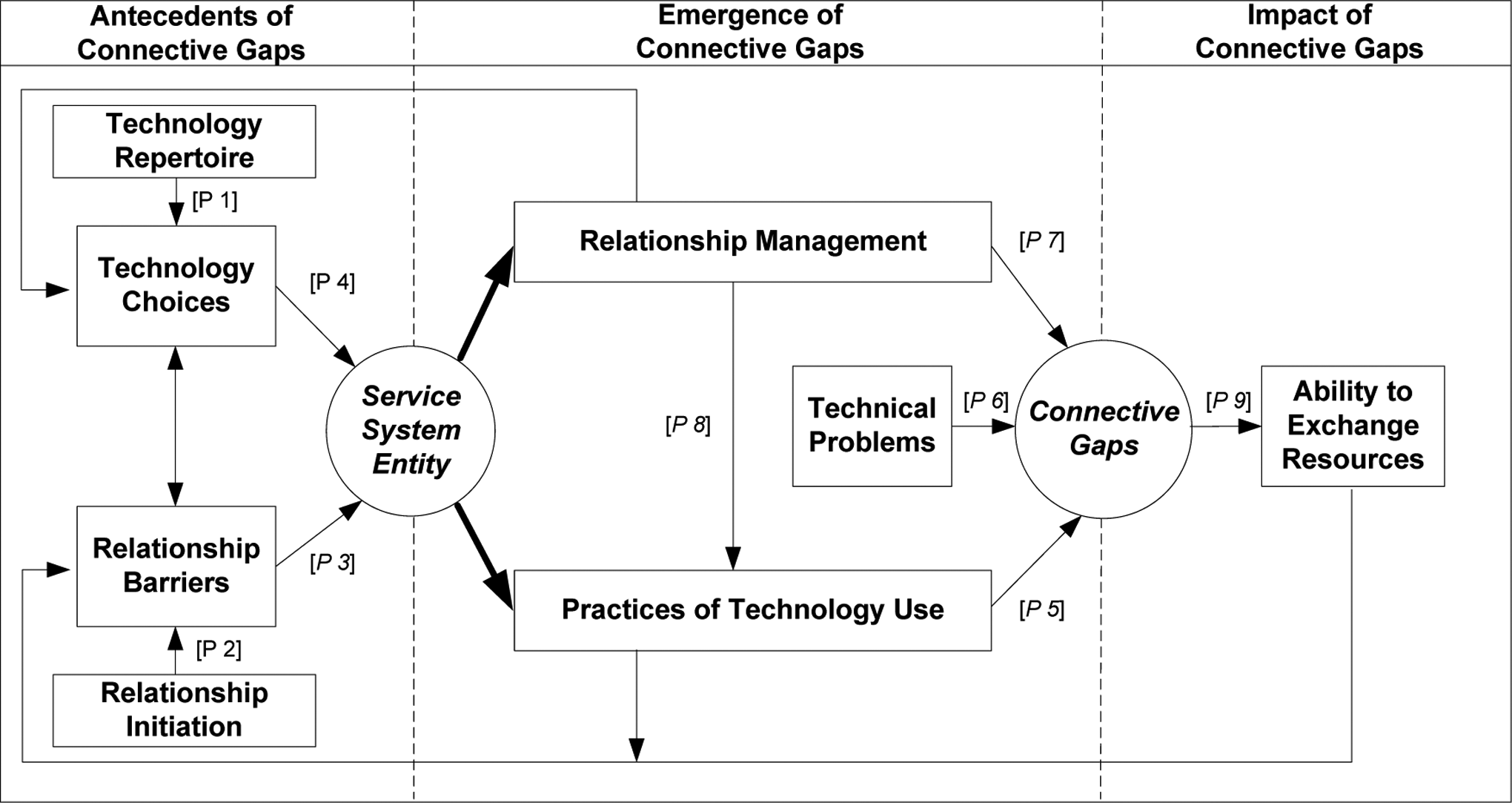
Antecedents, emergence, and impact of connective gaps in service systems.
Focusing on the emergence and impact of connective gaps allowed us to address if, how and to what extent technology-enablement in a service system impacts its performance, specifically its ability to co-create value. We have shown that the emergence of connective gaps is essentially rooted in the actions and behavior of individuals within service systems that utilize ICTs to exchange resources. For example, behavioral patterns like the proactive and reactive practices of technology use (i.e., safeguarding, inability to disconnect) that lead to connective gaps, are driven by an organization’s operational challenges and/or weak social ties between individuals. Consequently, we argue that technology-enablement, per se, does not determine whether or not individuals in service systems will engage in these behavioral pattern, and that it does not negatively impact, or enhance, the ability of a service system to exchange resources, and therefore, to co-create value. Ultimately, the actions and behavior of human entities (while utilizing ICTs) within a service system determine its overall performance, specifically its ability to co-create value.
If the ability of a service system to co-create value is not constrained by its technology-enablement, but rather by the actions of human service system entities that utilize ICTs, then the question arises: what influences these actions? Based on our findings, we suggest that the quality of social ties between individuals, or levels of social connectivity, influence and trigger actions that either result in, or help to avoid, connective gaps. Or, put differently, human motivations and actions play a pivotal role in the success of technology-enabled value co-creation processes while ICTs appear to play a less profound role. As O’Sullivan argued over a decade ago:
Human goals and motivations are not likely to be much different regardless of whether interactions are mediated or not [ … .] new technologies may be providing nothing terribly new—just new ways of doing things that people have been doing throughout the history of social interaction (2000, p. 428).
Indeed, our findings validate O’Sullivan’s suggestion, and we argue that co-creation of value, regardless of whether it is mediated through ICTs or not, is a type of social interaction between humans. By extending the argument brought forward by O’Sullivan (2000), we suggest that the incentives of individuals engaging in technology-enabled value co-creation processes are similar to those engaging within physical touch points (Gadrey and Gallouj 2002). Ultimately, we have shown that human actions and their decisions—not technology—are crucial factors that influence a service system’s ability to co-create value in technology-enabled environments, an insight that improves our field’s understanding of the role of ICTs in service systems.
Finally, the connectivity metaphor provides service researchers with a new lens, terminology and understanding through which to view service systems in a world driven by advances in ICT. We suggest that whenever service researchers adopt the service system as their basic unit of analysis, connectivity represents the appropriate analytical lens through which to assess, compare, and eventually manage, the sociotechnical links within these systems. While this study provides only the first step, we hope that researchers and practitioners will continue to benefit from this perspective.
Managerial Implications
We encourage practitioners to adopt a connectivity lens through which to view, analyze, and ultimately improve, their technology-enabled value co-creation processes. Systematic reviews on team or organizational levels should be the first step toward improving connective practices, for example, minimizing, if not eliminating, the occurrence and duration of connective gaps. As described by our Proposition 9, connective gaps negatively impact the performance of service systems, however, our model and terminology do provide guidance to practitioners, while the comments made by our participants may offer inspiration when analyzing how similar issues arise in individual organizational contexts.
Relationship barriers represent one important antecedent to the emergence of connective gaps. By referring back to our Proposition 3, we suggest that practitioners manage the system configuration (i.e., control the size and degree of continuity within teams that interacts by means of ICT). Small and stable groups are desirable, and individuals should only be removed or introduced into the team if interpersonal working relationships are initiated through F2F “kick-off” events. An improved understanding of roles, project requirements, or communication expectations is the likely result here. Similarly, as indicated in Proposition 4, social connectedness improves shared norms regarding technology choice and use, thereby further reducing the likelihood, frequency, and duration of connective gaps.
By drawing on Proposition 6, we suggest that hypoconnectivity can be avoided when service customers improve the levels of technical connectivity through an increasingly diverse technology-repertoire. Nevertheless, and as outlined in Proposition 5, the practices of technology use, together with the process of relationship management, remain key drivers of hyperconnectivity in service systems. Practitioners should ensure that interpersonal working relationships are managed, and that proactive and reactive practices of technology use are avoided. First, this could be achieved by increasing the awareness for practices like safeguarding and impression management, and by encouraging the frequent use of richer types of ICT like one-on-one telephone calls over e-mails. Second, managers should increase their team’s ability to disconnect, and discourage the perceived need to fulfill communication expectations. Finally, technical training can help avoid media misuse, and may provide another counterweight against hyperconnectivity.
As our findings have shown, successful relationship management offsets the negative impact of the practices of technology use, and is therefore of utmost importance to practitioners attempting to avoid connective gaps (e.g., Propositions 7 and 8). In order to increase the level of social connectivity within a service system, we suggest that service providers, first and foremost, match each customer with appropriate employees who display the right degree of professionalism, responsiveness, and personality necessary. Increasing the frequency of interactions between service provider and customer teams is important, however, the transparency of these interactions should be managed by clearly defining communication expectations, and by acknowledging any operational problems.
Limitations
Retrospective case studies are recommended by Eisenhardt and Graebner (2007) whenever interviews are the main source of evidence, as was the situation in our study. However, retrospective data collection is not without challenges since participants have to rely on their memory, and may attempt to impress the interviewer. We therefore incorporated Eisenhardt and Graebner’s (2007) suggestions on how to mitigate this risk by interviewing participants from (1) different hierarchical levels (i.e., senior vs. project managers vs. line employees/consultants), (2) different groups (i.e., service provider vs. service customers), and (3) different geographies (i.e., the individual service provider and customer groups were physically dispersed).
As with all qualitative studies, the empirical data were subject to interpretation during the analysis. In order to minimize any potential researcher bias, we selected descriptive, interpretive, and pattern codes for the analysis, as these are known to ensure a close relationship of the emerging theory with the data (Miles and Huberman 1994). While we followed recommendations in the literature and conducted our study within the context of the consulting industry, in particular because technology-enabled value co-creation processes are known to be visible here, we cannot argue that the findings of this study are context independent. Like Neu and Brown (2005) before us, we provide analytic, rather than statistical generalization through inductive theory building. As such, our study provides the necessary foundation for future research.
Opportunities for Future Research
While this article introduced connectivity as a novel analytical lens that can, and should, be used to further investigate the role of ICT in service systems, many aspects of connectivity are not fully understood, and therefore provide significant opportunities for future research. The model and propositions provided in this article should be verified through additional empirical (e.g., quantitative) research. While our findings clearly indicate a relationship between connective gaps, time, and the performance of service systems, this particular link has not been fully explored yet. Specifically, future work could rely on a longitudinal research design (Leonard-Barton 1990), with which researchers may be able to conceptualize the evolution of connectivity over time. It also remains unclear how service systems need to be initially designed, in order to achieve the ideal state of connective flow conceptualized in the literature (Kolb, Collins, and Lind 2008). Findings in this area could provide recommendations on how to plan, build, and manage service systems that consistently deliver optimal levels of connectivity. While ICTs like e-mail and telephone were the backbone of technology-enabled value co-creation processes in this study, the degree to which these technologies are utilized might change. Consequently, scholars could ask how technological advances may influence the levels of connectivity in service systems when yet unimagined types of ICT emerge in the future.
Footnotes
Declaration of Conflicting Interests
The author(s) declared no potential conflicts of interest with respect to the research, authorship, and/or publication of this article.
Funding
The author(s) disclosed receipt of the following financial support for the research, authorship, and/or publication of this article: The University of Auckland funded this study through an International Doctoral Scholarship for Christoph F. Breidbach.
References
Supplementary Material
Please find the following supplemental material available below.
For Open Access articles published under a Creative Commons License, all supplemental material carries the same license as the article it is associated with.
For non-Open Access articles published, all supplemental material carries a non-exclusive license, and permission requests for re-use of supplemental material or any part of supplemental material shall be sent directly to the copyright owner as specified in the copyright notice associated with the article.
