



Abstract
This article examines the transformation of service systems through actors’ resource integration and value cocreation in contention. It is based on a netnographic study focusing on the use of information and communications technology (ICT) tools by online activists during the “Arab Spring.” The transformation of service systems is conceptualized on the basis of existing service research and on the theory of strategic action fields. Focusing on Syria, the findings suggest that activists transformed four interdependent service systems—the media, the social movement, health care, and the financial service systems—during the Arab Spring by means of integrating resources and cocreating value within several ICT tools. A key contribution to transformative service research is the fact that the positive transformation of service systems derives from the conflict between two types of actors, namely, incumbents and challengers. This article also contributes to our knowledge of triggers of service system transformation, what motivates actors to transform service systems, how service system transformation is enabled by actors’ integration and use of ICT tools serving as opportunity spaces, and the transformative roles actors adopt. In addition, this article contributes to the conceptualization of service systems and to the understanding of resource integration and value cocreation.
Keywords
Introduction
On March 6, 2011, 14 children from Daraa, a city in the largely rural south of Syria, wrote the slogan of the Arab Spring uprisings in Tunisia and Egypt, “As-Shaab Yoreed Esqaat Al Nizam!” (The people want the downfall of the regime!), on the wall of their school. Soon after, they were arrested by the Syrian secret police and brutally beaten. They were also burned with cigarettes and had their fingernails pulled out. Upon release, videos of them were shared by activists on social media platforms and reported on by traditional media. This triggered the start of the Syrian part of the “Arab Spring”—the uprising against and removal of (in several countries) repressive autocratic regimes.
Through a service research lens, this and many other similar tragic incidents suggest transformation through actors’ resource integration and value cocreation in contention enabled by information and communications technology (ICT). Service research has shown that service is conducted in service systems that are embedded in social systems that shape resource integration and value cocreation (Edvardsson, Tronvoll, and Gruber 2011; Spohrer et al. 2007; Vargo and Lusch 2008). However, empirical studies on how service systems are transformed to make actors better off have been neglected in service research. On the basis of recent advances in social theory (Fligstein and McAdam 2011, 2012), we argue that a key driver of the transformation of service systems is conflict or contention. We ask the following research question: How is the transformation of service systems accomplished through actors’ resource integration and value cocreation in contention?
To investigate this, a netnographic (Kozinets 2010) study of online Arab Spring activists in Syria was carried out. We focused on Syria because one of the authors is a Syrian net activist, granting us unique access to the data. The Syrian Arab Spring context is a fruitful empirical basis for exploring the transformation of service systems through resource integration and value cocreation in contention. Syrian net activists strove to transform service systems by integrating resources using ICT tools with the aim of improving both their own and others’ well-being in sharp conflict with the regime, which was protecting an autocratic order. We argue that the transformation of service systems in contention is not unique to the Arab Spring context but characteristic of transformation in competitive markets and within most organizations and networks, both business and social.
By focusing on the transformation of service systems, we contribute to the emerging field of transformative service research (TSR), that is, “ … service research that centers on creating uplifting changes and improvements in the well-being of both individuals and communities” (Anderson 2010, p. 9). The focus of this study thus lies well within the TSR research agenda and contributes to our knowledge of the transformation and conceptualization of service systems, as well as to value cocreation and resource integration in contention.
Literature Review
Value Cocreation and Resource Integration
Service is accomplished through engaged actors’ activities and interactions (Edvardsson, Gustafsson, and Roos 2005). Actors, who can be either individuals such as customers or collectives such as organizations, operate on and integrate resources through activities and interactions with the intention of creating value for themselves and/or others—the latter is a critical criterion as regards referring to any actions or interactions as service (Vargo and Lusch 2008). Many actors, and not just market actors, cocreate service. Activities conducted by actors as diverse as public hospitals, hair salons, banks, aid organizations, and political online activist communities may all be thought of as service as long as they create value for an actor. The service and value that these entities cocreate range from improved health, a nice haircut, owning a home, stilling hunger, and finding freedom of expression. Thus, service does not necessarily have to be associated with revenue-making private businesses.
Resource integration refers to actors’ efforts to combine and use resources to create intended value (Vargo and Lusch 2008). Resources may be intangible, such as knowledge, skills, and information, or they may be tangible, such as raw materials and tools. In line with recent service research (see, for instance, Kleinaltenkamp et al. 2012), we argue that resources “become,” meaning that they possess potential value but that this value may only be realized when actors integrate and operate on them during a resource integration process. Resource integration may be conducted by one actor in isolation from other actors when creating value-in-use and also during direct interaction between two or more actors. In the latter case, the resource integration is referred to as the cocreation of value.
Value cocreation is a key concept in service research (Grönroos and Voima 2013; Vargo and Lusch 2008). Some argue that the dyadic interaction between firms and customers is the locus of value cocreation (Grönroos and Voima 2013). Based on Vargo and Lusch (2008), we adopt a broader understanding. Vargo and Lusch explain that, “ … while we initially focused on exchange between two parties, we have increasingly tried to make it clear that it needs to be understood that the venue of value [co]creation is the value configurations—economic and social actors within networks interacting and exchanging across and through networks” (p. 5). Accordingly, value cocreation commonly takes place between different types of linked actors at different levels and may be of an economic, social, and cultural kind.
Service Systems Embedded in Social Systems
One term that has been used increasingly to refer to the networked type of value cocreation is service systems. 1 Service systems are dynamic configurations of actors and resources that enable value cocreation through the integration and use of resources, benefitting actors within and across linked service systems (Mars, Bronstein, and Lusch 2012; Spohrer et al. 2007; Vargo et al. 2010). Spohrer et al. (2007, p. 74) define a service system as a “value-coproduction configuration of people, technology, other internal and external service systems, and shared information (such as languages, processes, metrics, prices, policies, and laws).” Many systems can be viewed as service systems, including families, countries, companies, and, indeed, an uprising against a repressive regime (Maglio et al. 2008). The narrative in the introduction to this article is an example of a service system involving actors and their use of resources; activists disseminating videos of tortured children via social media and traditional media companies reporting on these videos on TV programs. This service system enabled value cocreation by triggering and building up support for the Syrian part of the Arab Spring and also by providing TV channels with material to broadcast and by increasing the pressure on other nations to act (by building, e.g., refugee camps in Turkey).
Edvardsson, Tronvoll, and Gruber (2011) contend that not only are service systems formed by actors and resources but also that they are embedded in surrounding social systems. Actors enact resource integration and value cocreation roles through the structures, norms, and rules of the social macro context, which frames how they perceive value. Hence, Edvardsson, Tronvoll, and Gruber argue for the concept of value-in-social-context. Elaborating on this, Edvardsson, Skålén, and Tronvoll (2012) use structuration theory (Giddens 1984) to position service systems as a dualism between the social system and actors’ actions. The social system refers to the institutional realm, the historical accumulation of values, norms, rules, and resources, comprising three dimensions—signification, domination, and legitimation (Giddens 1984). The term actors’ actions refers to the action realm in which value cocreation unfolds, through resource integration in service systems, moment by moment, guided and framed by the prevailing social system. However, the social system does not determine the actors’ value cocreation in service systems. Actors are reflexive and have the capacity to learn and change, thus transforming the social system in which service systems are embedded, a process called structuration (Edvardsson, Skålén, and Tronvoll 2012).
However, one shortcoming of Giddens’s structuration theory, and the service research informed by it, is the lack of specific concepts that are able to account for transformation. Structuration emerges as a rather abstract process. Furthermore, research has largely portrayed value cocreation as a harmonious process that is free of conflict and that does not provide incentives encouraging any actor to strive for radical transformation (Ertimur and Venkatesch 2010). However, some research suggests that value cocreation takes place within a context of contention that prompts transformation (Echeverri and Skålén 2011). For this reason, the transformation of service systems is a black box in-service research. To study the transformation of service systems through value cocreation in contention, we draw on Fligstein and McAdam’s (2011, 2012) theory of strategic action fields (SAFs), which elaborates on Giddens’s structuration theory.
Transformation and Contention
According to Fligstein and McAdam (2011, 2012), SAFs are the fundamental units of collective action in society. “A strategic action field is a meso-level social order where actors (who can be individual or collective) interact with knowledge of one another under a set of common understandings about the purpose of the field, the relationships in the field (including who has power and why), and the field’s rules” (Fligstein and McAdam 2011, p. 3). An SAF may be a family, a company, a country, or a social movement that integrates resources to cocreate value. The fact that actors in SAFs operate with a common understanding means that they are embedded in a social system. SAFs are thus quite similar to service systems as described previously.
The fact that SAFs are embedded in a common social system does not imply, however, that its actors are in agreement about the field’s constitution. Rather, SAFs are characterized by competition for power, position, contention, and overt conflicts between reflexive actors, of which there are two basic types, namely, incumbents and challengers. “Incumbents are those actors who wield disproportionate influence within a field and whose interests and views tend to be heavily reflected in the dominant organization of the SAF … Challengers … occupy less privileged niches within the field and ordinarily wield little influence over its operation … [Challengers] can usually articulate an alternative vision of the field and their position in it” (Fligstein and McAdam 2011, pp. 5-6).
As service systems, SAFs are linked to other fields. Turbulence in one field is likely to affect related fields and may lead to the violation of field norms as well as spark transformation by challengers. This may lead to an episode of contention characterized by incumbents and challengers acting in new and innovative ways toward one another, as well as uncertainty/crisis regarding the rules and power structures of the field. Eventually, contention leads to settlement, either by means of the status quo being reasserted or by means of a transformed SAF being established. Transformation is initiated by the destabilization of an SAF, which is generally an effect of external shocks originating from narrow SAFs, extreme events such as war and depressions, or invasions by groups from other fields that change the prerequisites for resource integration and value cocreation in the focal SAF (Fligstein and McAdam 2011). Many of these transformation-related circumstances feature in the uprising against the regime in Syria.
Conceptualization: The Transformation of Service Systems in Contention
In this article, we study how the transformation of service systems is accomplished through actors’ resource integration and value cocreation in contention. Building on our research review, we conceptualize the transformation of service systems in contention as shown in Figure 1. Service systems are configurations of actors and resources in which actors cocreate value by integrating available resources to benefit individuals or collectives. Figure 1 suggests that service systems are embedded in a social system that enables and constrains the engaged actors’ resource integration and value cocreation. We argue that service systems have much in common with SAFs. Service systems are units of collective value cocreation linked to other service systems. The latter implies that a service system is sensitive to external shocks from linked service systems (see left part of Figure 1), possibly leading to an episode of contention characterized by conflict between incumbents and challengers (see center of Figure 1), in our case, the Syrian regime and democracy activists. Episodes of contention are followed by settlement that either comes as a retention of the status quo or a transformation of the service system through the value cocreation and resource integration taking place during these episodes (see right part and bottom of Figure 1). However, incumbents will try to impede transformation by drawing on the institutionalized social system that supports their endeavors. Thus, in order to accomplish a manifest transformation of a service system, a corresponding transformation of the social system needs to take place, directly via episodes of contention or indirectly via transformation of the service system (see arrows at top right of Figure 1). However, just how the transformation of service systems takes place in detail is an unresolved issue. In order to illuminate this, we turn to our case.

Transformation of service systems.
Method
Research Design
The research design of this study is netnography (Kozinets 2010), developed to capture online activity. Kozinets (2010, p. 25) defines netnography as “a specialized form of ethnography adapted to the unique computer-mediated contingencies of today’s social world.” Like the ethnographer, the netnographer collects data by means of participant observation but does so online. Thus, the researcher becomes part of the studied online context and retrieves data by collecting the comments, posts, and images that the studied actors produce.
Netnography has been previously used to investigate consumer activism in online communities (Kozinets and Handelman 1998). One reason for conducting a netnographic study is that activist activity is increasingly taking place online. This was particularly so for the Arab Spring revolution. Our second author is a net activist who was particularly involved in the Syrian part of the Arab Spring. He was trusted by the activists and knew the online context. This involvement granted us extraordinary access to data and made it possible for us to understand the messages sent between activists, which were mostly in Arabic and sometimes coded.
Data Collection
We focused on collecting data from the Syrian part of the Arab Spring. We also collected online data from other Arab Spring countries in order to provide additional support for our findings. In line with the netnographic approach, we studied activists’ activities on different online platforms, focusing on how transformations of service systems took place through value cocreation and resource integration based on ICT tools. An initial period of screening pointed us in the direction of surveying, in more detail, the short message service history of activists’ cell phones; international media websites such as Al Jazeera and Al-Arabiya; the revolution’s Facebook pages, posts, and comments written by Syrian activists and some well-known figures in the Syrian opposition; images shared on social media by activists; the Skype history log of some activists; and YouTube channels with video content that ranged from reports, documentaries, and TV news about the revolution to videos created by the activists themselves, such as videos that documented a demonstration.
The following protective measures were taken to ensure that no one would be placed at risk of being harmed in any way as a result of our research. When activists and organizations appear under their real names in official media, and have a public profile, we refer to them using their real names. We use pseudonyms for all other informants, organizations, and other collectives. All informants, organizations, and collectives in the latter category consented to be a part of our research. We also changed some dates and locations concerning activities organized by activists to ensure their anonymity.
Data Analysis
Data analysis was framed by our conceptualization and research question, as presented previously, but it also remained open to emerging themes. Analysis was ongoing and iterative in a process consistent with emergent design and the constant comparative method (Strauss and Corbin 1990). Our data analysis process started with open coding, entailing that we identified concepts, as well as their dimensions and properties, with respect to the transformation of service systems. This was followed by axial coding that related concepts to categories, building up themes that empirically illuminated the research question of the study. This process helped us to identify both the ICT tools used and the service systems transformed by the activists to facilitate value cocreation and resource integration, as well as the regime’s attempts to impede transformation. The results of this part of the data analysis are presented in the Findings section.
To increase the trustworthiness of the data (Wallendorf and Belk 1989), we conducted open and axial coding of the data collected from revolutionary contexts other than Syria. The results of this coding are not presented here; however, it suggest that ICT tools were used in similar ways in Tunisia and Egypt as in Syria. We also carried out selective coding in order to integrate our themes with previous research and our above-mentioned conceptualization, further validating our results. On the basis of selective coding, we articulate our contribution.
Background
Syria has been dominated by an autocratic social system since the successful military coup led by Hafez al-Assad, the father of Syria’s current dictator, Bashar al-Assad, in 1970. Security forces and the army, as well as the Ba’ath Party, led by the Assads, have employed a multitude of practices, such as censorship, corporal penalties, and false information, to uphold this autocratic system (George 2003). Along with their relatives, the Assads have firmly controlled the Syrian economy either through state regulation or by ownership of the country’s major businesses (BBC News July 19, 2012). Syria is ranked 165th of the 175 countries in the Reporters Without Borders (2010) press freedom index and is on the list of the “Enemies of the Internet.” Under the Assads’ rule, people critical of the regime have been afraid to talk to the media about politics. The people of several other Arabic countries, such as Tunisia, Algeria, Libya, and Egypt, have been living under similar autocratic regimes for the past 30–40 years (Khader 2011).
As a protest against these autocratic social systems, Tunisian street vendor Mohamed Bouazizi set himself on fire on December 17, 2010. Images and film clips of this horrible event spread quickly across different social media, such as Facebook and YouTube. This protest became a strong symbol of the deep sense of frustration with the autocratic regimes felt by many citizens of the Arab countries, leading to peaceful demonstrations and protests in Tunisia. These were also reported on social media and further reported by international media, triggering similar actions by activists in other Arab countries, including Syria. In itself, Bouazizi’s self-immolation is considered to have triggered the Arab Spring, the uprising against repressive autocratic regimes in some Arab countries. On the basis of the previous conceptualization of service systems, which was informed by SAF theory (Fligstein and McAdam 2011), the Arab countries may be described as webs of service systems/SAFs linked to one another. Bouazizi’s self-immolation, together with the early demonstrations and the reporting of them, sent shockwaves through these webs of service systems/SAFs. Indeed, these events must be described as an external shock to the autocratic regimes, causing episodes of contention, that is, conflict between incumbents (the autocratic regimes) and challengers (the Arab Spring activists).
For the Tunisian president, Ben Ali, the situation became unmanageable and thus he stepped down from power on January 14, 2011. The president of Egypt, Mubarak, did the same thing less than 1 month later, on February 11. In other Arab countries, such as Jordan and Yemen, the regimes/incumbents managed to suppress the protests of challengers, thus securing the status quo. In Syria, the process was more ambiguous. There, people followed the Arab Spring protests in other countries on social media because the traditional media had been censored. As shown in the introduction to this article, the trigger for the Syrian part of the Arab Spring was the film clips showing how the secret police had tortured children as a punishment for having written the Arab Spring slogan on the wall of their school. This event led to peaceful protests by activists, organized through social media, demanding democratic reforms. Many of the activists/challengers were young (aged between 16 and 35) and proficient in using different types of Internet-based ICT tools and social media. Some of them had formal IT training. Many of them suffered from oppression, social and economic injustice, and widespread corruption, and could not see any future for themselves in Syria. They were thus motivated, and had the necessary knowledge and skills, to challenge the regime.
However, the protests in Syria did not overthrow the regime, but the regime/incumbents did not manage to silence the protesting activists either. Individuals loyal to the regime, such as the security forces, the army, and state institutions, belonged mostly to an older generation and were not as proficient in ICT as the activists. Eventually, the Syrian regime responded to the protests with violence (Human Rights Watch 2012). Many of the soldiers in the Syrian Army refused to fire on protesters, with some defecting from the pro-government forces to jointly form the Free Syrian Army with the activists. Thus, the peaceful protests evolved into an expression of armed resistance aimed at overthrowing the regime. This episode of contention (Fligstein and McAdam 2011) in Syria became very violent.
It needs to be noted that the uprising against the Syrian regime was not a uniform movement but consisted of forces with somewhat different intentions acting both in tandem and in competition. In this article, we focus on what at least during the early phase was the biggest group of activists, who had democratic aims and used ICT tools to integrate resources and to develop forms of collaboration between actors, some being outside Syria, to advance the Arab Spring through service system transformation.
Findings
In this section, we report on how the transformation of service systems was accomplished by activists’/challengers’ resource integration and value cocreation in contention by using Internet-based ICT tools during the Arab Spring in Syria. We also report on how the regime (incumbents) tried to impede this transformation.
ICT Tools Used by the Challengers
Smartphones
One key ICT tool used by the activists was the smartphone, which played a significant role in furthering the Syrian revolution. The Syrian activists used smartphones to capture photos and videos of protests, to coordinate and organize demonstrations through various applications (e.g., Voxer, Viber, and WhatsApp), and to pass information on to the outside world. For example, the Syrian activists filmed demonstrations using smartphone cameras and these films were then uploaded to YouTube (see below under “YouTube”) and shared on Facebook (see below under “Facebook”), thus sharing information about details concerning demonstrations with other activists and the international media.
To exemplify, Heba, a member of a female activist network, organized demonstrations in Mezzeh, an upper-class area east of the capital, Damascus. Heba depended heavily on the Viber smartphone application to delegate tasks to other activists in her network. With the help of Viber, users can make calls, share locations, and send text messages and pictures to groups and individuals free of charge over the Internet. On February 18, 2012, Heba called her friends on Viber saying, “Come and join the funeral of the martyr Husam Asfar today after afternoon prayers at the Grand Mezzah Mosque.” Husam Asfar had been killed by Assad’s forces the day before. The activists frequently turned funerals into demonstrations.
Live-stream tools
Smartphones were also used by the activists to stream demonstrations and other protests in real time on the Internet using free live video-streaming tools such as Ustream, Justin.tv, Livestream, and Bambuser. Digital cameras and computers with web cameras were also used for the same purpose. People watched the streams live on the Internet, but these streams were also commonly aired live on international TV channels. The streaming process requires a digital camera or smartphone with a camera, an Internet connection, and the relevant streaming application.
For example, Idlib is a remote city in rural northern Syria, where there are no free journalists. To address the information vacuum, the activist Hazem decided to start live-streaming local demonstrations. On February 6, 2012, a large demonstration took place in the main square. Hazem positioned himself in a high building that gave him an overview of the square and filmed the demonstration using the high-resolution camera on his smartphone. Using the Bambuser application and an Internet connection, Hazem live-streamed the demonstration, which was then aired live by Al Jazeera Live. Hazem commented on the demonstration thus: “Hundreds of free people from Idlib city gathered to tell the criminal Bashar that we don’t want him. Let the whole world hear: Bashar is a criminal, and Syria will be free.”
Skype
Another ICT tool that was used by Syrian activists was Skype. Skype is a free software application that enabled the activists to communicate and cooperate collectively via chat, voice, and video using a computer. Because of the censorship of cell phone networks by the regime, Skype was used as a relatively secure method of communication by the activists on the ground and outside the country, and with the media outside Syria. The image provided above (see Figure 2) shows the famous activist Abo Ja’afer, who used Skype to provide his observations of the events in Homs to Osman Ayfarah, an Al Jazeera news presenter, broadcast live on May 31, 2012.
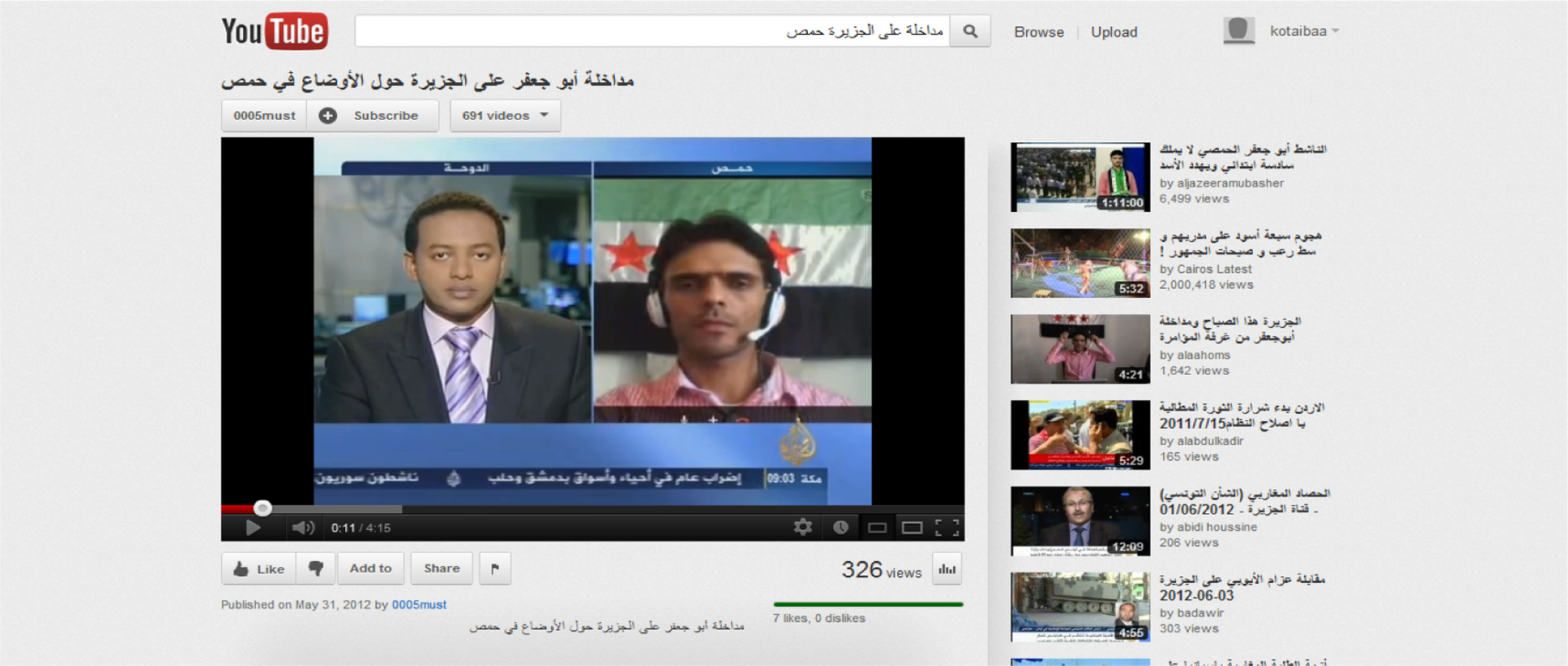
Skype video call between activist Abo Ja’afer and Al Jazeera news presenter Osman Ayfarah.
YouTube
Activists also used YouTube, a video-sharing website, to share and archive video clips (see Figure 2). YouTube was used to document demonstrations, attacks against civilians, and human rights abuses by the Syrian regime. International media corporations have used activist-produced films extensively.
For example, Milad, a young activist in Hama, was specialized in filming the demonstrations in his local area and then uploading them to YouTube. On December 30, 2011, thousands of people demonstrated against Bashar al-Assad’s regime. Milad filmed the whole demonstration using his mobile phone camera. When the demonstration was over, Milad uploaded the film to YouTube. The title of the film is A Demonstration in Hama, Alhamedieh Neighborhood, 30 December 2011. The film shows protesters chanting in unison “Ash-shab yurid isqat an-nizam” [The people want the downfall of the regime].
Activists also used Facebook, a social networking platform, in different ways to cocreate the Syrian uprising. Facebook helped to keep people informed about ongoing events and gave real-time information about the users’ current situation through news feeds. The feeds provide status updates, new photos, film clips, information about events, and other events.
For example, Aleppo Now was a Facebook page that provided real-time information about the situation on the ground in Aleppo, a city in northern Syria. On the timeline of its Facebook page, on November 4, 2012, Aleppo Now posted that, “There has been no electricity in Nile Street since the morning and for a couple of days in Al Khaldiah, Zahra, and Al Hizb neighborhoods.” Another post from the same day states, “Columns of smoke have been rising from Al Khaldiah and Al Shihan after attacks by military aircraft.” Aleppo Now posts received lots of comments from page followers. Fadia elaborated on the last post: “I just got to know that the attacks left seven people injured, including two women.” The international media used the material produced by some reliable Facebook pages in their news shows.
Media and Social Movement Service Systems Organized by Challengers
Two service systems based on value cocreation and resource integration in ICT tools were used early on by the activists/challengers to advance the uprising against the regime/incumbents: the media service system and the social movement service system.
Media service system
Activist actions and interactions enabled by ICT tools, and the resources these integrated, transformed the media service system in Syria and made it possible to engage in activities that resembled free reporting. Previously, the regime harshly censored the media and punished journalists who did not follow its rules. The media service system based on ICT tools became an open and free system in which several actors integrated resources to cocreate value—local activists who produced texts, film clips, and reports; international media companies that edited and broadcast the material produced by the activists; and ICT companies, such as Facebook, Skype, and YouTube, which provided the necessary platforms. Within this service system, some activists turned into self-taught journalists and thus took on new roles.
The media service system was inspired by similar systems in other Arab Spring countries, and it was these that spread the Arab Spring to Syria. During the early phases, the media service system was used to report on protest activities conducted by the activists, such as demonstrations, civil disobedience, and how the police and army used force to break up protests. For example, on June 17, 2011, thousands of people gathered in the Hassan mosque for Friday prayers in the Midan neighborhood, a southern district of Damascus. This gathering turned into a demonstration. The people were shouting, “Freedom! Syria!” as they headed out of the mosque. A few minutes later, the security forces attacked the protesters, injuring several activists. One activist engaged in the demonstration phoned Al Jazeera on his smartphone and described what was happening. His call was broadcast live and was heard by millions of people. The caller said, “The mosque is besieged by hundreds from the security forces, who are preventing people from getting out of it. We have injured people inside the mosque. They are bleeding from severe injuries caused by the security forces, and we cannot get them out for treatment.” The call immediately prompted larger anti-regime demonstrations in the surrounding areas, some of them now archived on YouTube. The spread of the demonstrations put a lot of strain on the security forces who decided to withdraw from the area.
During later phases of the uprising, the media service system was used to report on the armed conflict. For example, Assad imposed a siege on Baba Amr, a suburb of Homs. Civilians in this area were completely cut off from the outside world and living in extreme danger. Activists were able to end the communication vacuum using Facebook, live-streaming services, Skype, and YouTube to leak information about the siege, including the number of civilians killed and their names, the people’s humanitarian needs, and images and film clips from various parts of the city that had been bombed by the regime. Those in Syria and elsewhere directly involved in the uprising followed these events on social media, but the information was also quickly edited and broadcast by international TV channels and reported on by newspapers all around the world. For example, on March 1, 2012, Al-Arabiya aired a video shot by activists showing Baba Amr being shelled by the Syrian army, with bodies scattered across the streets. The channel commented on the video thus: “Local committee coordination announced that a massacre had taken place in Baba Amr. The coordination appealed to the International Committee of the Red Cross for immediate access to Baba Amr to provide humanitarian needs for 4,000 persons who are still under siege.” In a video shared on YouTube in January 2013, a man calls for urgent help and rails against the silence of the international community regarding the siege: “There is nothing in our houses that can be consumed, no electricity, no water, and no gas. The water is not drinkable.”
Another example of usage of the media service system during later phases of the uprising concerns the dissemination of videos of the gas attacks of August 21, 2013, shot by activists and shared on social media platforms. An activist in one video said, “Our medical reports revealed that there are more than 600 bodies in East Gouta, all of them killed during a sarin attack. I hold the Assad regime responsible for this. I tell Assad that we will not surrender and our revolution is continuing even if he attacks us with nuclear bombs.” Soon after these videos were aired on TV channels, Valerie Amos, UN Under-Secretary-General for Humanitarian Affairs and Emergency Relief Coordinator, and representatives of the Red Crescent, met Syrian foreign minister Walid al-Moualem in Damascus to urge the Assad regime to allow humanitarian access to the devastated cities. Amos and her team got access to some of the sites and further negotiated bringing humanitarian and medical aid to civilians.
Social movement service system
The activists’ actions on the ground, their protests and demonstrations, and the coordination of these via ICT tools created a social movement service system in Syria aimed at fostering democratic change. Activists regularly used this service system to communicate with each other both inside and outside Syria and to discuss and plan further actions. This service system also made it possible for the activists to take on new roles, such as that of online activist, as well as protest organizer and communications officer.
Syrian activists used the five ICT tools described previously to organize the revolution. They relied on these tools to organize rallies, combine forces, and disseminate information about the location and time of the next protest and about the movements of the security police. For instance, smartphones were used to launch joint actions. The activists used the bulk text messaging service WhatsApp, and other similar services, to communicate with each other. For example, on May 24, 2011, the activist Tahir used WhatsApp to send a message to his friends, notifying them about the time and place of a demonstration: “Come and bring the guys to the party at six at Abo Hassan café.” This meant that the demonstration would start at six o’clock at the Al-Hassan mosque (a well-known place in Damascus).
Social media platforms were also used effectively to organize the revolution. Different Facebook groups were created to facilitate communication between activists. Facebook groups helped the activists to share information about the date, time, and place of protests and the means required to start a demonstration. For example, Freedom Friends was a closed Facebook group consisting of different Syrian activists from both inside and outside Syria. Members of this group held discussions and shared information. Ahmad wrote a post on the group’s wall on July 20, 2012: “There will be a demonstration at 7:00 p.m. in Al-Jdidah Alle in Roken Al-Ddin. Please don’t come earlier than the designated time, and don’t attract attention. Don’t share this link with other groups.” Other members of the group added comments containing further information. Homamz asked, “Who will take care of the flyers and who will spray the walls?” to which Obaidah immediately replied, “I will take care of the flyers, and Naser will bring spray paint to use on the walls [to paint revolutionary slogans].” After the protest, the activists checked that all the group members were safe by posting messages. For instance, Ahmad posted, “I am back from the protest alive ⌣.” Other members replied with messages such as, “I made it as well.”
A second example of a Facebook group used to organize the revolution is the group called Rebels for Rights. On April 17, 2012, one activist in the group called Najem suggested a demonstration in Qassion Mall, in the northeast part of Damascus. Najem posted the following: “Today is independence day. We need the flags of the revolution and banners. We also need one guy to paint the walls [with slogans] during the demonstration, and it is very important that one guy films the demonstration and uploads it to YouTube and shares the link with everyone we know.” Ahmed, another activist in the group, commented on this post: “I can be the cameraman; I have a mobile with a high-resolution camera.” Ziad, another member of the group commented, “I can provide flags and banners. I still have some left from the previous demonstration, but Ahmed, don’t film our faces while we are demonstrating or spray painting the walls. [If you do that by mistake], please edit the film before you upload it.” Najem replied, “I suggest that 7.00 p.m. is a good time to start the demonstration as it will be dark outside, and the people will be back from their schools and jobs and available for the protest.” Adnan, another activist in the group, uploaded a picture from Google Maps pointing out the square where the demonstration had been planned to take place. He also pointed out the escape routes to use if the police showed up. After the demonstration, Adnan posted a comment: “Is everyone back?” and the rest of the group members all replied either “yes” or “⌣.” Ahmed uploaded the video of the demonstration to YouTube and shared the link on the group page. Ziad replied, “Don’t forget to share the link with the TV channels.”
The findings suggest that activists use ICT tools to transform service systems through resource integration and value cocreation, but also that service systems are intertwined and interdependent. The reporting of the gas attack described previously was not only a piece of self-journalism belonging to the media service system but also contributed toward organizing the revolution by bringing international aid, thus making it a part of the social movement system. The previous descriptions also suggest that activists use Facebook to organize protests and to share information about how the protest went, thus acting within the social movement and the media service system simultaneously.
Counteractions of the Incumbents
Even though the regime met some of the activists’ demands, such as revoking the 1963 Emergency Act in 2011, the main goal of the regime and its associated groups, as it is usually for incumbents, was to counteract the uprising and secure the status quo (Fligstein and McAdam 2011).
Regime intervention in the social media service system
As a reaction to the activists’ successful transformation of the media service system, Syrian pro-government groups launched the so-called Syrian Electronic Army (SEA) in May 2011 to counter activists’ actions on the Internet. The SEA did not appear to have any official relationship with the government, but Assad said in June 2012, “There is the electronic army which has been a real army in virtual reality” (Harding 2013). The SEA claims that it seeks to counter what it calls “fabricated news” about the Syrian conflict broadcast by Arab and Western media. Operating via social media platforms such as Facebook, Twitter, and YouTube, the SEA launched organized spamming campaigns as well as campaigns arguing that activists and international media spread false news. The SEA’s targets were activists’ e-mail and Facebook accounts, political opposition groups, and western websites, mainly those of media organizations, educational institutions, and human rights groups, in addition to some smartphone applications. The SEA hacked the accounts of many Syrian activists and political figures. It also attacked the websites of the Associated Press, National Public Radio, Al Jazeera, Al-Arabiya, the BBC, the Financial Times, the Daily Telegraph, Harvard University, and Human Rights Watch, and President Barak Obama’s Facebook account.
In one case, the SEA took control of the official Twitter feed of the Associated Press and sent out a false message about two explosions at the White House. The SEA claimed that its attack was legitimate because the Associated Press was spreading “lies about Syria.” On another occasion, the Al Jazeera TV channel’s Facebook account, which reports on the Syrian conflict, was hacked in such a way that it carried links to pro-Assad messages and graphics, in addition to false news regarding demonstrations. One post by the SEA was a video of thousands of demonstrators supporting the president, the post read, “Millions and millions of Syrians in the squares in support of the president, Bashar al-Assad.” A further example is SEA attacks on the Facebook page of Revolution Leadership Council in Homs, a credible source of information for many media companies. The SEA sent thousands of reports to Facebook claiming, falsely, that the Facebook page had violated Facebook terms. In these reports, the SEA argued, for instance, that the page contained hatred of a race or an ethnic group and should be deleted: “The page [of Revolution Leadership Council in Homs] is a partner in killing Syrians and inciting sectarian strife” and “I don’t think this page should be on Facebook; it targets a race or ethnic group.”
The SEA aimed to achieve many of its goals by conducting such activities. The main goals were to gain information about the activists, carry out surveillance aimed at discovering the identities and locations of Syrian rebels, blur the truth, create support for the regime inside and outside Syria, and prevent the media service system that the activists had created from functioning efficiently. The SEA example suggests that ICT tools are a mixed blessing as regards the transformation of service systems: They can be used to further transformation but also to secure the status quo.
Physical force
To counter the social movement service system, and the actions on the street that it was organizing, the regime used the established service systems based on institutionalized actors and structures of power, such as the secret police and judicial structures, with the result that many demonstrations ended up in demonstrators being injured and killed. For example, on June 27, 2011, some activists from Barzeh, a district 5 kilometers north of Damascus, organized a demonstration. The security forces cracked down on the whole area and opened fire on the protesters directly, killing five people, including two children. One of Barzeh’s citizens filmed the demonstration with a mobile phone camera. The film was uploaded to YouTube on June 28, 2011, and was aired on different TV channels. The film shows several members of the Syrian security forces beating three protesters brutally. One of them is bleeding severely and eventually faints. The video spread across the Internet quickly.
Health Care and Financial Service Systems Organized by Challengers
As the conflict escalated and became more violent, activists transformed/established service systems related to health care and finance.
Health care service system
The Syrian regime did not provide any medical services to activists, and medical services provided to civilians were restricted because of the fighting. Using ICT tools, the activists were able to set up a rudimentary health care service system. Skype, YouTube, and similar online platforms were used to integrate the expertise of medical doctors and nurses, as well as the scarce medical resources available to them, to provide medical services. This service system created value for those injured in the fighting, but it also created value for civilians.
Many doctors and other medical providers created “Skype rooms” to ensure secure communications so that they could rapidly help people who were wounded and injured, during protests, for instance. The Skype rooms functioned as communication and logistics tools, whereby local doctors could meet and discuss the medical needs of the field hospital in a certain area, as well as helping connect injured people with the closest field hospital available. For example, Medical Aid was a Skype room consisting of around 20 Syrian doctors and medical providers. On October 20, 2011, protesters in Al-Dmenih arranged demonstrations that were thwarted by the regime using violence, leaving many of the protesters dead and injured. Activists managed to send an injured demonstrator to a secure place to get the required medical assistance. To do so, Doctor A, a member of Homs Doctors Coordination, sent a message to the Skype room asking for information on the nearest available field hospital: “I have an injured person in Al-Dmenih, and he has to be sent ASAP to the nearest field hospital. Do you know if anyone can take him?” Soon after, this message was replied to by Doctor B “Talk to Doctor C, a member of the room as well, who works in the Field Hospital in Al-Bowedah [a small town close to Al-Dmenih].” Soon after, Doctor A contacted Doctor C directly and arranged to send the injured person to his field hospital in the car of a civilian.
A second example of a health care service system being organized through ICT tools relates to the siege of the city Homs by Assad forces. During the siege, many injured and sick people were not able to get the right treatment. Rima was shot in the leg by security forces in March 2012, before the siege. She received medical aid directly after, but her recovery was not so successful. Because of the siege, Rima was unable to leave the neighborhood to see a doctor. One activist communicated with VCD Medical Aid, a Skype room that consisted of some volunteer doctors managed by Doctor D. He created another room on Skype that allowed direct contact between Rima and her doctor, E, using the webcam and the voice function. The following is an excerpt from their conversation on Skype (which took place in May 2012):
When did the complications with your wound arise?
Two months ago, and I also have a high temperature.
You have to go on antibiotics ASAP.
As you know, because of the siege, there’s no medicine in the local pharmacy, and it isn’t possible to buy the medicine from a pharmacy in another neighborhood because of the presence of security forces.
Use honey instead of antibiotics, if you can get some.
I think it’s possible that one of the neighbors has some.
I hope you recover quickly. Get back to me on Skype and keep me updated if anything occurs.
YouTube was also used for medical support in the form of teaching. Syrian activists used YouTube to upload videos about how to administer first aid to injured people during a demonstration. A video shared on YouTube on July 17, 2012, shows a Syrian activist giving a first-aid course (see Figure 3). First-aid course on YouTube.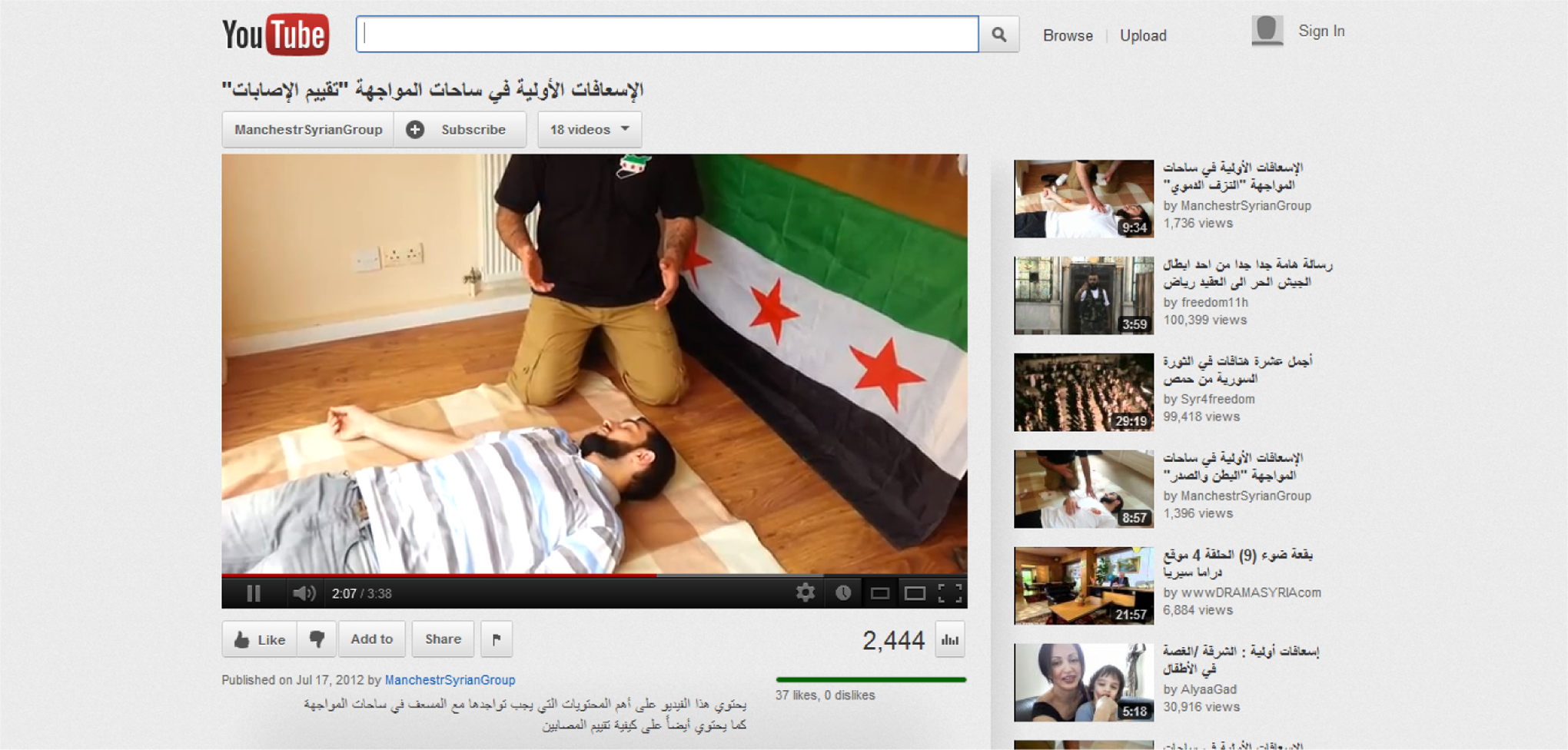
Financial service system
The activists were able to configure service systems that raised money for the revolution by using ICT tools such as Facebook and bulk text messages. This created value for those directly involved in the struggle and also for those not directly involved who desired a positive transformation. As the conflict went on, the need to supply the increasing number of Syrian refugees with humanitarian aid became vital.
Akkad Aljabal organized a Facebook relief campaign, which started on June 5, 2013, and was called the National Campaign for the Relief of All Major Cities Besieged and Stricken. It benefited from extensive participation by many members of the Syrian diaspora. One of the donors, Ghada, wrote on Akkad’s Facebook wall, “Dear Akkad, my children decided, in sympathy with the Syrian children, to donate half of their pocket money, which amounts to 150 Saudi Riyals (approx. $40) every month. I add this amount to my previous donation of 500 Saudi Riyals (approx. $130).” Another contributor, Hadeel, wrote, “I have transferred a sum of $4,130, collected from some Syrian expatriates in the United Arab Emirates.” Atif posted, “Dear wonderful friend Akkad, thanks for your time and cooperation. I donate 200 Saudi Riyals (approx. $50). With thanks.”
Another example of how ICT tools were used to garner financial support for the uprising is the many text message campaigns started by members of the Syrian diaspora. For example, Nordisk Hjälp [Nordic Aid], a Swedish nonprofit-making organization, arranged a 24-hour fund-raising by text message campaign in April 2012 called Emergency Help for Refugees from Syria. Zaid, the spokesman of the Syrian Association in Sweden, said; “We of the Syrian Association in Malmö, Sweden, in cooperation with Nordic Aid, have collected money for Syrian refugees in Southern Turkey. The money was used to buy clothes, blankets, medical equipment, and ambulances.” Zaid explained how the money was collected: “We announced the campaign on the Nordic Help website, and we then sent text messages to all our members, friends, and people whom we thought might be interested in our campaign. The donor sends a text message to 72,970 to donate 100 or 50 SEK (approx. $14/7).” According to Zaid, Nordic Aid was able to collect a decent sum of money in 24 hours, although he could not disclose how much due to security concerns.
The Syrian regime implemented several measures to stop the financial service system from functioning. For instance, a law that allows Syrian authorities to detain people who raise funds for displaced people was put in place. Bringing this law to bear, Syrian authorities detained an activist named Sham Rose for 3 months for being a member of a Facebook group that raised money for displaced people. In addition, Syrian security forces detained persons holding foreign currencies, assuming that they had acquired the money from abroad to help activists.
Discussion, Contributions, and Further Research
This section discusses the contribution made by this article to service research and TSR by answering its research question: How is the transformation of service systems accomplished through actors’ resource integration and value cocreation in contention? This section also outlines policy implications and suggestions for future research.
Transformation of Service Systems
Recent service research has drawn on social theory to understand the social embeddedness of service systems, value cocreation, and resource integration (Edvardsson, Skålén, and Tronvoll 2012; Edvardsson, Tronvoll, and Gruber 2011). This study extends this research by contributing knowledge of the transformation of service systems. This is accomplished by drawing on Fligstein and McAdam’s (2011, 2012) theory of SAFs and the above study of service systems, value cocreation, and resource integration in contention.
External shock
SAF theory and previous service systems research (Edvardsson, Skålén, and Tronvoll 2012; Mars, Bronstein, and Lusch 2012; Maglio et al. 2008; Spohrer et al. 2007) suggest that service systems are interlinked, implying that turbulence in one service system may spark transformation in another service system, referred to in SAF terminology as an external shock. This study of the Arab Spring suggests that this is true. Extreme actions, such as self-immolation and protesting against autocratic regimes in Tunisia and Egypt, sent shock waves to Syria via the Internet-based ICT tools in which actors’ resources were integrated, thus sparking the Syrian part of the Arab Spring. Hence, this study contributes knowledge by suggesting how linkages between service systems, in this case in the form of ICT tools, foster transformation.
Episodes of contention
An episode of contention is characterized by overt conflict between incumbents and challengers, motivating the latter to challenge the former’s privileged position (Fligstein and McAdam 2011). Incumbents’ privileged positions are reflected in the social system that embeds service systems (Edvardsson, Tronvoll, and Gruber 2011; Edvardsson, Skålén, and Tronvoll 2012), the autocratic social system in the present case. An episode of contention is informed by the challengers’ envisioned alternative, a democratic social system in our case, as well as by the knowledge and skills challengers use to realize this alternative. Our findings show how Arab Spring activists, based on their knowledge of ICT tools and social skills, developed forms of collaboration that integrated many types of resources within ICT tools with the goal of realizing a democratic Syria. This transformed the media, the social movement, health care, and the financial service systems.
While we are focusing on conflict, previous research has largely adopted a “harmony” view of service systems (Edvardsson, Skålén, and Tronvoll 2012; Mars, Bronstein, and Lusch 2012; Maglio et al. 2008; Spohrer et al. 2007). The harmony view neglects the actors’ motivations for transforming service systems (Kleinaltenkamp et al. 2012). This article’s contribution lies in arguing that it is the conflict between incumbents and challengers that motivates the latter, in particular, to transform service systems. However, motivation is not enough to accomplish resource integration that leads to transformation: Appropriate knowledge and skills are also needed. In the case reported on here, both incumbents and challengers had access to the same ICT tools; however, the challengers managed to use these more efficiently to realize their ends due to their superior technical knowledge and social skills.
Opportunity spaces
The social system consists not only of structures of domination that gives incumbents power but also of structures of signification and legitimation that provide actors with interpretative schemes and regulations concerning what roles, identities, norms, and rules are considered appropriate in a specific context, making it very challenging to act against institutionalized social systems (Edvardsson, Skålén, and Tronvoll 2012; Giddens 1984). On this basis, how is it possible, more precisely, for challengers to break free from institutionalized social systems and accomplish transformation? The present case suggests that the activists/challengers relied on several Internet and social media–based ICT tools. We argue that the ICT tools in the present case function in terms of what Normann (2001) referred to as “opportunity spaces,” in which the institutionalized social system is put out of play. In opportunity spaces, actors can cocreate value, integrate resources, and form service systems in new and innovative ways without being constrained by institutionalized structures. Previous research has argued that reflexive service system actors may use their agency to accomplish change and transformation, despite being embedded in social systems (Edvardsson, Gruber, and Tronvoll 2011; Edvardsson, Skålén, and Tronvoll 2012). This article contributes knowledge by arguing that this transformative reflexive agency is performed under the special circumstances referred to as opportunity spaces.
Transformative roles
The discussion about actors’ reflexive agency in opportunity spaces has implications for the roles that service systems actors adopt. We argue that challengers in opportunity spaces adopt what we refer to as transformative roles. Such roles are inconsistent with the roles fostered by the institutionalized social system and are characterized by actions aimed at transforming service and social systems. Actors taking on transformative roles bear similarities with what Normann (2001) labels “the invaders”—actors who redefine service systems by creating opportunity spaces.
The primary transformative role visible in our case is that of the democracy activist. As the present case suggests, if a person living in an autocratic state steps into this role, he or she will no longer be a disciplined server of the dictator but someone who questions, takes issue with, and fights totalitarian rule. However, we also observe other transformative roles: the self-taught journalist, the fund-raiser, the film-clip producer, the expert TV commentator, and the warrior. When a sufficiently large number of people take on transformative roles in opportunity spaces, collective action will ensue that may transform service and social systems.
In line with previous service systems research (Edvardsson, Skålén, and Tronvoll 2012; Edvardsson, Tronvoll, and Gruber 2011), this article argues that roles are powerful because they give agency a collectively shared direction. However, previous research has somewhat overemphasized the embeddedness of roles in social systems. This article suggests that the adoption of transformative roles is informed by social contexts other than the institutionalized social system in which service systems are embedded. Adopting the role of the democracy activist was inspired by the Arab Spring social movements in other Arab countries, not by the autocratic Syrian social system.
Settlement
SAF theory suggests that an episode of contention is followed by settlement characterized by a reassertion of the status quo or by the establishment of a transformed SAF/service system. If we view Syria as a whole as an SAF/service system, no settlement has taken place by the time of writing; the conflict between incumbents and challengers is ongoing. However, this conflict has become much more complicated and diverse.
In this article, we have focused on the early part of the conflict in which democracy activists challenged the autocratic regime. As we have described, the conflict started peacefully but gradually turned into an armed conflict as an effect of the forceful measures that the regime invoked to stop demonstrations and other protests. A key development after that part of the conflict is several foreign groups entering, such as Hezbollah, Liwa Abu al-Fadl al-Abbas, al-Qaeda, and the Islamic State of Iraq and the Levant (ISIL). The last group, in particular, changed the nature of the conflict due to its successes in the war. According to Human Rights Watch (2014), ISIL uses methods that are extremely violent and brutal against everyone they capture who is not a Muslim or does not convert to Islam and live according to the fundamentalist Sharia rules that ISIL imposes. ISIL has proclaimed a caliphate and claims religious authority over all Muslims throughout the world. The immediate aim of ISIL is to establish an Islamic state in the Levant, which is a part of Syria and neighboring countries. However, its long-term goals are more ambitious than that: This organization aims to bring all parts of the world inhabited by Muslims under its control. The UN has described ISIL as a terrorist organization and, on September 25, 2014, the United States and some of its allies began air strikes against ISIL positions. Thus, the outcome of the Syrian revolution has not yet been decided. One possibility is that the conflict develops into an international armed conflict and becomes part of the so-called war against terrorism, led by the United States.
However, the service systems which we reported on in the Findings section and which were transformed by challengers are still in operation, but with some decline in activity and size due to the militarization of the revolution. In these systems, the potential and the actual value cocreation and resource integration are quite different from those in place before the Arab Spring. These service systems no longer benefit just the regime but also challengers with democratic ambitions, and they may even be used to impede the value cocreation of the regime.
Summing up key contributions
By developing a new conceptualization of service system transformation, this study contributes theoretically to TSR because some present service systems need to be transformed to improve the well-being of individuals and communities. The key contribution made is that the transformation of service systems derives from the conflict between two types of actors—incumbents and challengers—within episodes of contention. In addition, this article also contributes to knowledge of how external shocks in interlinked service systems trigger transformation, how service system transformation is enabled by the actors’ integration and use of ICT tools serving as opportunity spaces, and the transformative roles that actors adopt and how these transform service systems. These conclusions will most likely be relevant to typical business-oriented service research as well, because service markets are characterized by competition, and thus contention, between firms and other actors. However, as noted subsequently, future research needs to extend the conclusions of this article to other contexts.
Conceptualization of Service Systems, Value Cocreation, and Resource Integration
In the literature review, we argued, on the basis of previous research (Edvardsson, Skålén, and Tronvoll 2012; Maglio et al. 2008; Mars, Bronstein, and Lusch 2012; Spohrer et al. 2007), that the constitutions of SAFs (Fligstein and McAdam 2011, 2012) and service systems have much in common. This study supports this presupposition, which has several implications for the conceptualization of service systems and for the understanding of value cocreation and the resource integration that takes place within them, as articulated in the six propositions that follow.
According to our study, service systems consist of two types of actor—incumbents and challengers—who have different goals and who cocreate value and integrate resources quite differently. Previous research has argued that service systems are configurations of actors (Edvardsson, Gruber, and Tronvoll 2011; Spohrer et al. 2007; Vargo et al. 2010). The present paper helps to specify who these actors are.
At some point, the opposition between incumbents and challengers is latent, as exemplified by the pre–Arab Spring period. During such periods, the institutionalized social system dominates actions, favoring incumbents and obstructing challengers’ preferred value cocreation and resource integration. The Arab Spring turned the latent opposition into overt conflict. When a service system is characterized by overt conflict, it becomes clear that value cocreation for the incumbents is not value cocreation for the challengers and vice-versa. The social movement service system and the counteractions of the SEA show this clearly. That service systems are characterized by latent and overt conflict between incumbents and challengers is something that advances previous research (Edvardsson, Skålén, and Tronvoll 2012; Maglio et al. 2008; Spohrer et al. 2007), which has adopted a “harmony” view.
As a consequence of the above, our study suggests that a particular resource-integration process in service systems is not associated with value cocreation in the case of every actor or actor group. Rather, resource integration is sometimes associated with value codestruction (Echeverri and Skålén 2011), the diminishment of value-in-use for some actors, implying a reconceptualization of service systems. Maglio et al. (2008), in their initial definition, which has informed the bulk of studies, claim that service systems are value cocreation configurations of actors and resources. Describing service systems as value cocreation configurations may result in a misleading understanding because it presupposes only positive outcomes (Ertimur and Venkatesch 2010). What actors do in service systems is to integrate resources to act and interact collectively. This may result in the cocreation or codestruction of value. On the basis of our study, our contribution is a reformulated conceptualization: Service systems are configurations of resources and actors—incumbents and challengers—that integrate resources in such a way that value is cocreated or codestroyed.
Our understanding of service systems, as populated by two types of actors, enables us to reflect upon the issue posed by Kleinaltenkamp et al. (2012) pertaining to what motivates actors to integrate resources. This study’s contribution to this issue is the finding that incumbents and challengers are motivated by the struggle between them for power and position. Challengers are motivated to integrate resources because they want transformation since existing service systems are unable to cocreate the value they want. By seizing power, they gain better opportunities to cocreate value the way they prefer. Incumbents are motivated by the desire to retain the status quo because it enables them to integrate resources and cocreate value in their preferred way.
Discussing what motivates actors’ resource integration taps into a more general problem in service systems research, namely, the relationship between structure and agency discussed previously (see under “Opportunity Spaces” and “Transformative Roles”) and extended to implications regarding the constitution of service systems here. In line with previous research (Edvardsson, Skålén, and Tronvoll 2012) that has used structuration theory (Giddens 1984), this study suggests that service systems are a function of the dualism between the social system and actors’ actions. On one hand, the institutionalized autocratic social system grants the regime the opportunity to defend the status quo, while on the other, Arab Spring activists conduct actions that break with this social system. While previous research has been clear in articulating how social systems constitute service systems and the resource integration within them, it has been less clear about the role of actors’ actions in service systems, a problem inherited from structuration theory. This study contributes by suggesting that it is the conflict between incumbents and challengers that drives the agency of actors.
According to Kleinaltenkamp et al. (2012), a key task of service research is to define actors’ resource integration in the context of technology. Our study suggests that ICT directs resource integration, as exemplified by Facebook groups that structure activists’ resource integration through the functions provided, that is, posting messages, writing on Facebook walls, and so on. In addition, the study also suggests that ICT is a resource that actors integrate with other resources both within and across (a) service system/systems. This is exemplified by doctors integrating their knowledge and skills in Skype rooms in order to treat patients.
Future Research and Limitations
In this study, we have focused on how the transformation of service systems through actors’ resource integration and value cocreation in contention comes about through the use of ICT tools. A limitation to the present research is that it is based on a study in only one context. Therefore, future research should aim to generalize the findings of this study, for example, the propositions outlined previously, through quantitative research. Future research should also extend the findings of this article to other contexts by conducting qualitative research, by studying service systems with little or no repression, for example, business-related service systems. Are all service systems characterized by conflict between incumbents and challengers? What transformative roles do actors in other service systems take on? Do ICT tools serve as opportunity spaces in these systems as well? What linkages exist between service systems and how are they embedded in one another? More specifically, do service systems send external shocks to linked service systems, causing episodes of contention? Is it true that all service systems not only cocreate value but also codestroy value, as this study suggests?
Future research also needs to focus on why and how actors join forces in order to transform social systems, something which was touched upon in this study but which was beyond its scope. According to SAF theory, challengers operate with a future vision of a social system when conducting transformation. How do such visions transform social systems through the transformation of service systems? Moreover, what is the interdependence between transforming service systems and social systems? Does transformation in the latter drive transformation in the former, as some social theory would suggest, or is the relationship reciprocal? Such studies will increase knowledge of the social embeddedness of service systems.
This study points to the importance of power relations and conflicts, topics to a large extent neglected in service research. We therefore suggest that future TSR approaches not only the transformation of service systems but also related topics, such as service innovation, service infusion in manufacturing, and service encounters, from an explicit power perspective. We believe that such studies may generate new insights into service systems, resource integration, and value cocreation.
Policy Implications
A great deal of emphasis is placed on the role of the Internet and social media ICT tools in accomplishing positive transformation. Functioning as opportunity spaces, ICT facilitates people’s creativity and imagination in building alternative social and service systems, spurring transformative action. This transformative potential of ICT is particularly important in contexts in which ordinary sources of transformation, such as a free press, democratic institutions, progressive cultural movements, and entrepreneurial activity, are limited.
Thus, in order to promote positive transformation, nongovernmental organizations, international organizations such as the UN, and governments should develop policies that create an Internet that is accessible to all people. This should be done in combination with the implementation of educational programs, perhaps in the form of Massive Open Online Courses that reach beyond borders, informing students about democracy and basic human rights, freedom of expression, social movements, and activism by using Internet and media ICT–based tools. Investment to promote the wider use of ICTs, particularly among younger students and the younger computer-literate segments of society, is an especially important initiative. Educational institutions, including service researchers, may contribute to such endeavors.
This article shows that ICT tools such as social media platforms, streaming, and communication services, as well as smartphone applications, are important in accomplishing positive transformations in autocratic countries. Companies providing such ICT tools could play a more active role in promoting positive transformation by, for instance, suggesting how democracy activists can use the tools in the best way, how they can link them together, and how they can be linked to traditional media. Traditional media not only need to broadcast material from activists, and have activists on their programs, they also need to proactively inform the general public about how transformation is accomplished by activists who use ICT tools.
Footnotes
Acknowledgments
The authors wish to thank the special issue editors Laurie Anderson and Amy Ostrom as well as the three anonymous reviewers for their help in improving this article.
Declaration of Conflicting Interests
The author(s) declared no potential conflicts of interest with respect to the research, authorship, and/or publication of this article.
Funding
The author(s) received no financial support for the research, authorship, and/or publication of this article.
Note
References
Supplementary Material
Please find the following supplemental material available below.
For Open Access articles published under a Creative Commons License, all supplemental material carries the same license as the article it is associated with.
For non-Open Access articles published, all supplemental material carries a non-exclusive license, and permission requests for re-use of supplemental material or any part of supplemental material shall be sent directly to the copyright owner as specified in the copyright notice associated with the article.
