



Abstract
The context in which service is delivered and experienced has, in many respects, fundamentally changed. For instance, advances in technology, especially information technology, are leading to a proliferation of revolutionary services and changing how customers serve themselves before, during, and after purchase. To understand this changing landscape, the authors engaged in an international and interdisciplinary research effort to identify research priorities that have the potential to advance the service field and benefit customers, organizations, and society. The priority-setting process was informed by roundtable discussions with researchers affiliated with service research centers and networks located around the world and resulted in the following 12 service research priorities: stimulating service innovation, facilitating servitization, service infusion, and solutions, understanding organization and employee issues relevant to successful service, developing service networks and systems, leveraging service design, using big data to advance service, understanding value creation, enhancing the service experience, improving well-being through transformative service, measuring and optimizing service performance and impact, understanding service in a global context, and leveraging technology to advance service.
For each priority, the authors identified important specific service topics and related research questions. Then, through an online survey, service researchers assessed the subtopics’ perceived importance and the service field’s extant knowledge about them. Although all the priorities and related topics were deemed important, the results show that topics related to transformative service and measuring and optimizing service performance are particularly important for advancing the service field along with big data, which had the largest gap between importance and current knowledge of the field. The authors present key challenges that should be addressed to move the field forward and conclude with a discussion of the need for additional interdisciplinary research.
Keywords
Introduction
The context in which service is delivered and experienced has, in many respects, fundamentally changed. Advances in technology, especially information technology, are leading to a proliferation of revolutionary services and changing how customers serve themselves before, during, and after purchase. As Rust and Huang (2014) discuss, rapidly evolving information technologies (e.g., Internet of Things, social network technology, mobile technology, and cloud computing) enable ubiquitous customer communication and the acquisition, storage, and analysis of big data, presenting opportunities for more personalized, higher quality service, and deeper customer relationships. Moreover, many companies, facing commoditization of offerings and intense competition, are looking to service to help establish differentiation and fuel growth. As a result, the importance of service research and the need for new service-related knowledge have never been greater.
Accompanying the growing importance of service research is an increasing global focus by a diverse set of academic fields. According to Spohrer, Kwan, and Fisk (2014, p. 493), more than 24 academic disciplines investigate service from their own point of view, highlighting the need for a new transdiscipline—service science (and arts)—“with a unique focus on the evolution of service systems and value cocreation phenomena.” The wide-ranging interest in service research has spawned new service-systems-focused publications (e.g., Service Systems and Innovations in Business and Society collection edited by Spohrer and Demirkan [2012]). Moreover, interest in service research is spreading globally, with a growing number of university-affiliated service centers and academic-oriented networks being established around the world (e.g., California Center for Service Science, Centre for Service Management at Loughborough University, and the Latin American Service Research Network). Increased attention is also coming from practitioners. Recently, a professional association, the International Society of Service Innovation Professionals, 1 was formed, with the goal of promoting education; professional development; and practice, research, and policy centered on service innovation. The complexity, scale, and rapidly changing nature of the service domain, coupled with an engaged global service research community, suggests a substantial opportunity and need to continue to identify and signal important service topics worthy of research.
Given the significant changes and growing research interest in the service domain since the previous research-priority-setting work by Ostrom et al. (2010), it is useful to develop a new iteration of priorities that leverages both global and diverse discipline input. It is also worthwhile to uncover critical research-related issues currently facing the service field and to explore ways of addressing them to advance the field. Thus, the goals of this research are: to identify a set of priority topics and subtopics worth studying to advance theory and benefit consumers, practitioners and their organizations, and society more broadly, to assess service researchers’ perceptions of the importance of and the field’s current knowledge about these priority topics and subtopics, and to leverage the global and interdisciplinary perspectives of service researchers to identify critical research challenges and opportunities in an effort to strengthen the field and its impact going forward.
Our research makes three important contributions. First, by obtaining input on a global scale from service researchers across multiple disciplines, we develop research priorities based on common interests around key topic areas (rather than a single discipline). Second, while research priorities are often established, researchers’ reactions to those priorities—in terms of their perceived importance and level of current knowledge—are seldom measured. Third, the difficult but important research-oriented tasks that we spotlight and advocate for can advance the field in meaningful ways in the coming years.
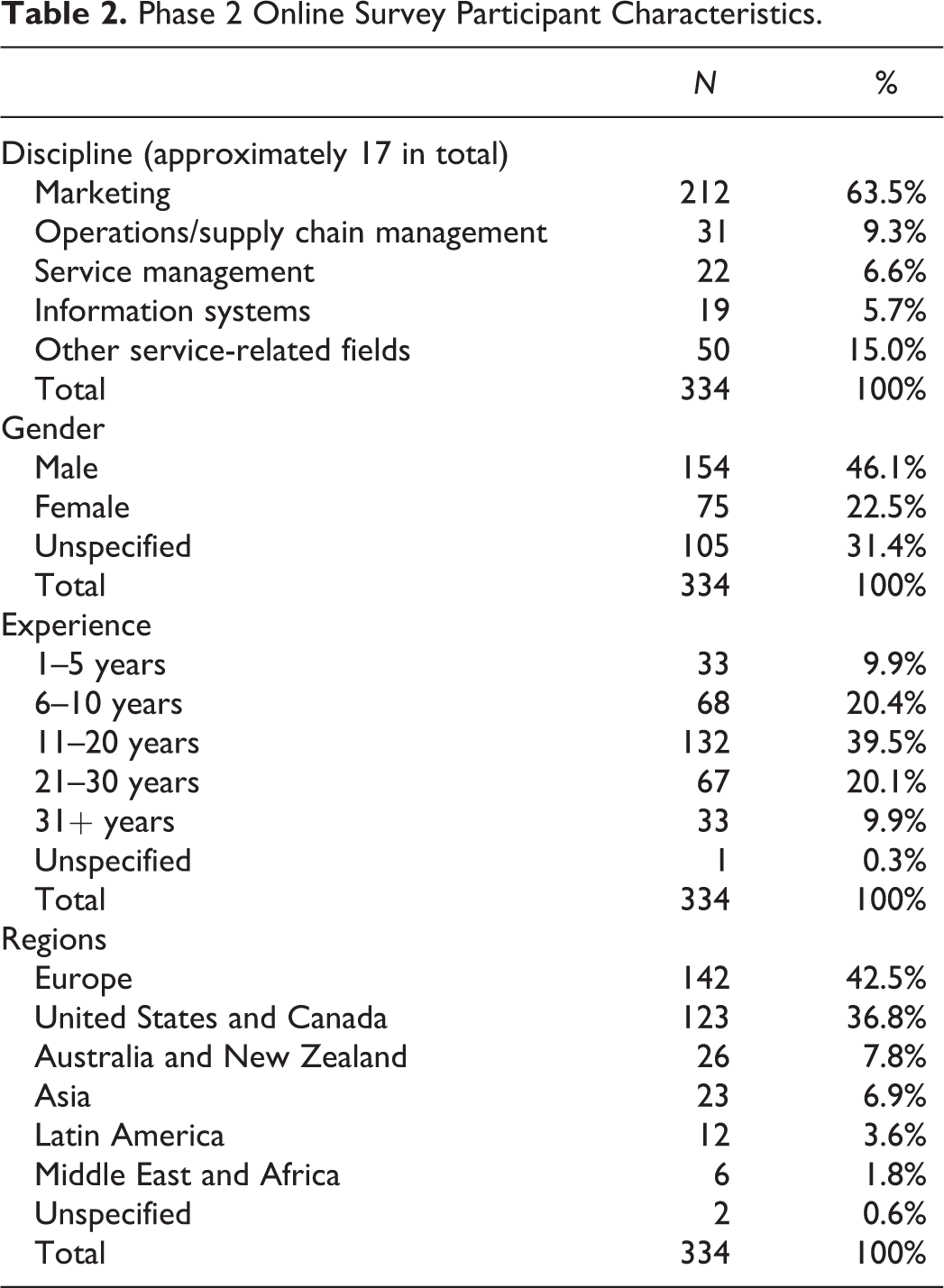
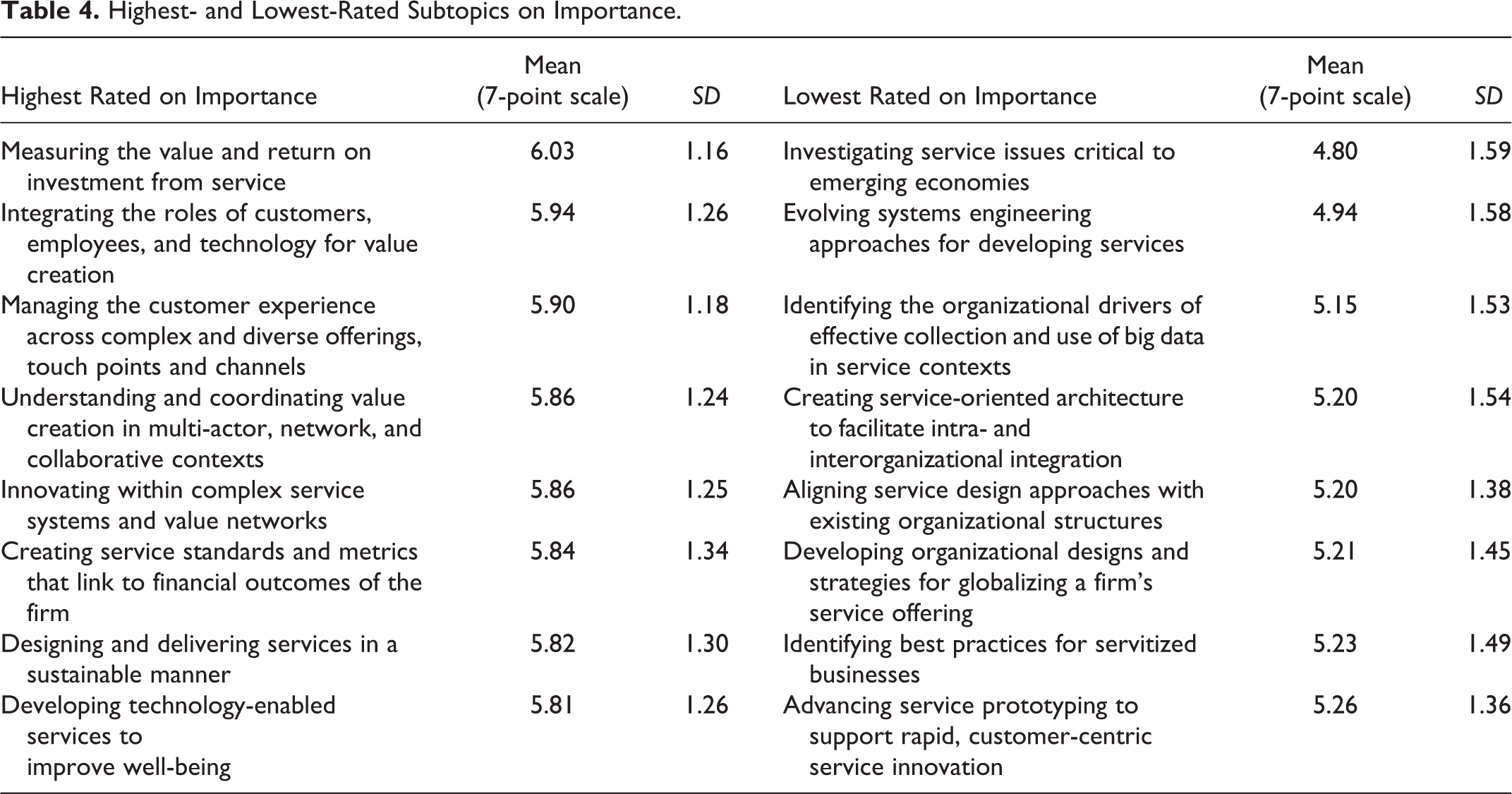
The priorities and their related subtopics were identified and assessed through a two-phase data collection process (Appendix A provides more detail about the methodology). Phase 1 consisted primarily of roundtable discussions and/or interviews with academics and practitioners conducted on behalf of the research team by 19 service centers and networks located around the world. More than 200 participants from a diverse set of service-related disciplines provided input in Phase 1. Table 1 lists the participating centers/networks and the service researchers who took the lead in organizing the roundtables and summarizing the results. Analysis of the Phase 1 data led to the identification of 12 broad research-priority topics and 80 related subtopics. Phase 2 involved an online survey in which participants ranked their top 3 of the 12 priorities in terms of importance and assessed the importance and current knowledge level of the subtopics. The survey participants also assessed the current state of the field and provided their thoughts about the most dramatic change likely to affect the service field in the future. More than 330 service researchers from 37 countries, and representing 17 disciplines, completed the survey. Table 2 contains a summary profile of the survey respondents, and Table 3 lists their ratings of the 12 priorities in terms of importance, knowledge level, and research gap. Table 4 lists the subtopics evaluated as most and least important, and Table 5 lists subtopics about which the field possesses the most and least knowledge. Table 6 provides the means for respondents’ level of agreement with statements regarding the state of the field. Appendix B provides the means for importance and current knowledge level for each of the 80 subtopics. An online appendix contains a list of the participants in Phases 1 and 2, who agreed to be identified.
Phase 1 Roundtable Contributing Centers and Networks.
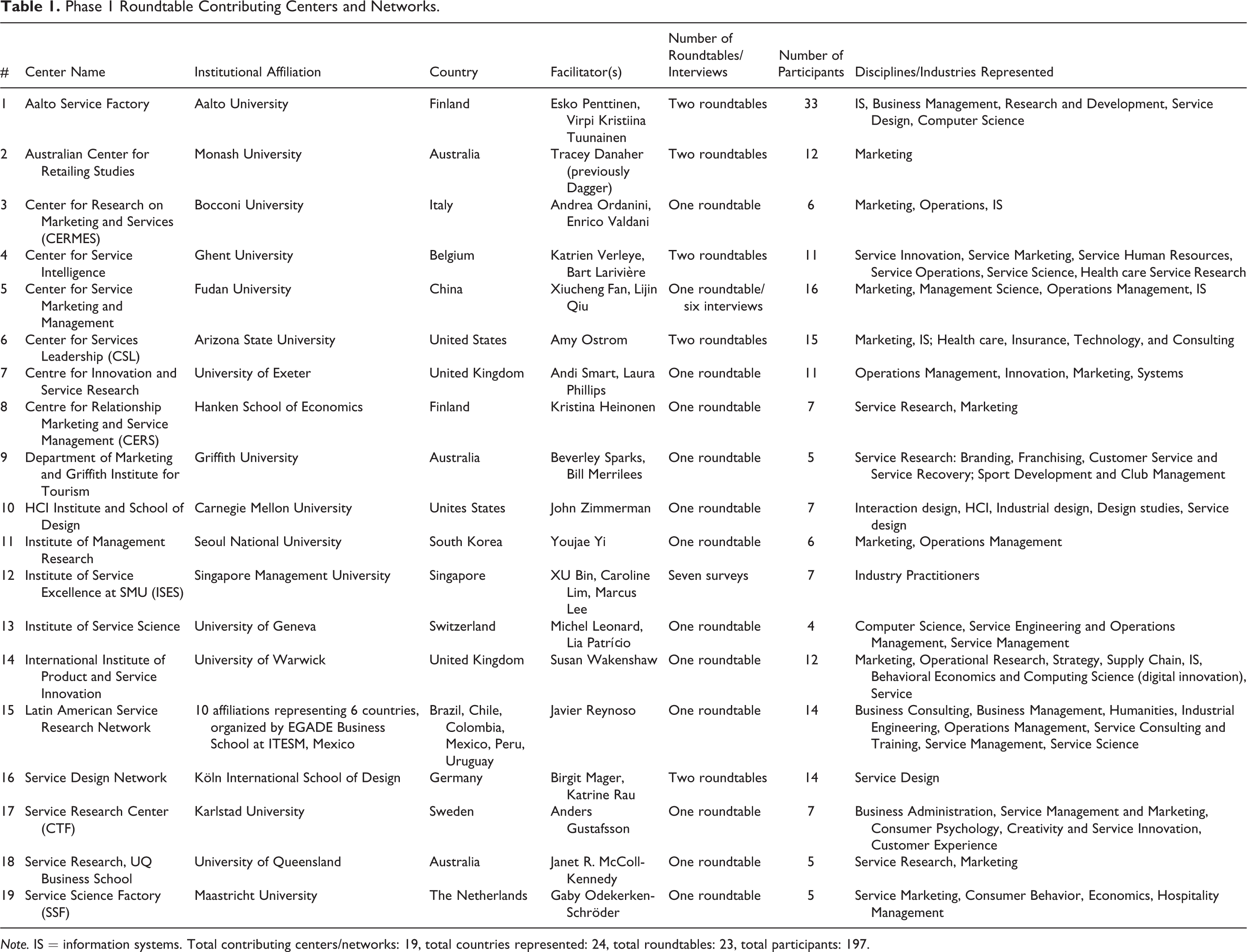
Note. IS = information systems. Total contributing centers/networks: 19, total countries represented: 24, total roundtables: 23, total participants: 197.
Phase 2 Online Survey Participant Characteristics.
Importance and Knowledge Level of Priorities Based on Average Ratings across Subtopics (Ordered With Highest Research Gap First).

Highest- and Lowest-Rated Subtopics on Importance.
Highest- and Lowest-Rated Subtopics on Current Knowledge.
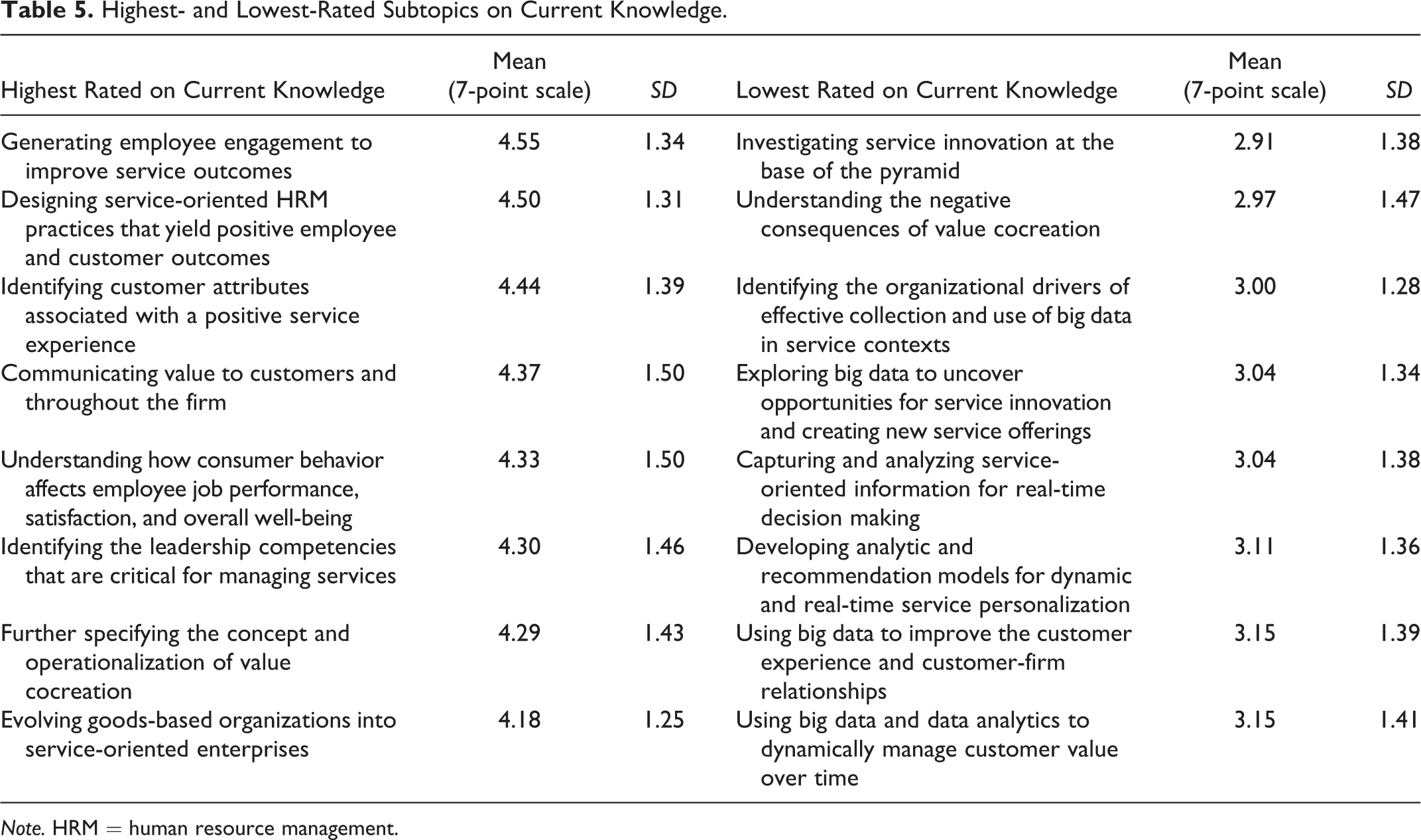
Note. HRM = human resource management.
State-of-the-Field Perceptions.
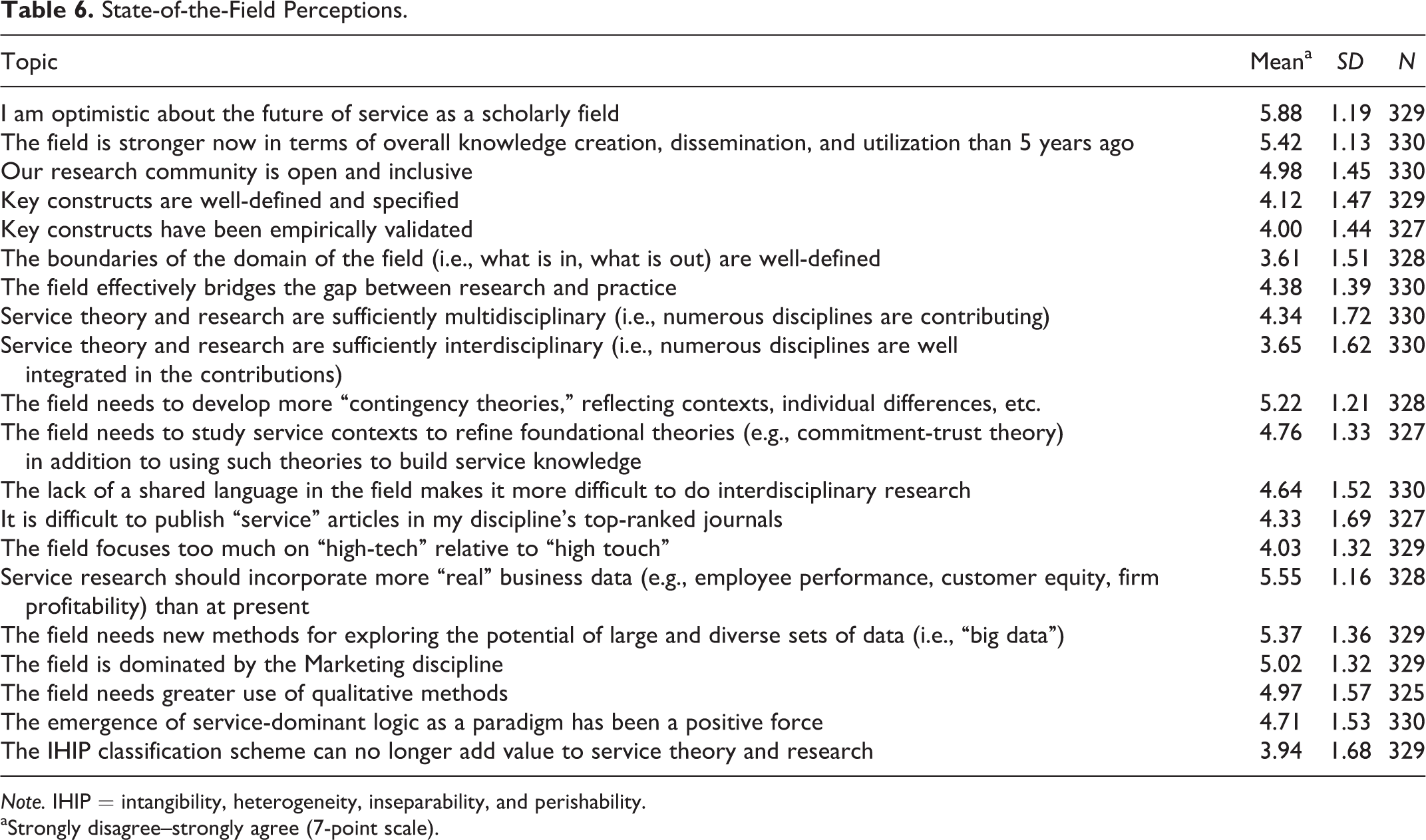
Note. IHIP = intangibility, heterogeneity, inseparability, and perishability.
aStrongly disagree–strongly agree (7-point scale).
In the remainder of this article, we first introduce an organizing framework for the 12 research priorities. We then provide an overview of each priority topic, list the subtopics, discuss some of the prominent subtopics, and offer related research questions to illustrate the types of issues that need to be studied to advance service theory and practice. We conclude with a discussion of overarching challenges and opportunities for moving the field forward.
Service Research Priorities
Figure 1 provides a pictorial representation of the 12 broad research priorities and their interrelationships (depicted by dotted arrows). Three of the priorities (stimulating service innovation; facilitating servitization, service infusion, and solutions; and understanding organization and employee issues relevant to successful service) are categorized as strategic priorities in that they help shape how service processes and systems are conceptualized. Three priorities (developing service networks and systems, leveraging service design, and using big data to advance service) are labeled as design/delivery priorities. They encompass key drivers that influence how service is configured and rendered. Two of the priorities (understanding value creation and enhancing the service experience) are value creation priorities, which focus on value as perceived by customers and their service experience. The two outcome priorities (improving well-being through transformative service and measuring and optimizing service performance and impact) emphasize the effect of service on people, firms, and systems. We label the final two priorities (understanding service in a global context and leveraging technology to advance service) as cross-cutting priorities because they are interrelated with each of the other priorities and have the potential to influence almost every aspect of service.

Service research priorities 2015: An organizing framework.
Although on the surface the service research priorities identified appear similar to several of those in Ostrom et al. (2010), meaningful differences exist in terms of how the 12 priorities are conceptualized and the subtopics under each. 2 A substantial change from 2010 was the compelling case for including big data as a priority in 2015, given the focus on how data can be used to design and enhance service. In addition, whereas improving well-being through transformative service was included in 2010 as a strategic priority with the observation that “there has been little study of the transformative aspects of services” (Anderson 2010, p. 9), in 2015, the well-being-related aspects and outcomes of service figured prominently in the roundtable discussions, and thus it is depicted as an outcome priority in this iteration, which is more consistent with its well-being focus. Furthermore, this 2015 iteration witnessed something of a “global” revolution, with increased mention of the global aspects of service and much global flavor in the qualitative data, leading to its addition as a cross-cutting priority.
Although the priorities and their subtopics are important in and of themselves, we view the overall framework as a dynamic constellation of interconnected areas that are fertile ground for future research. The priorities, and their interactions, also fit well with the domain of service science, which Maglio and Spohrer (2008, p. 18) define as “the study of service systems, which are dynamic value cocreation configurations of resources (people, technology, organizations, and shared information).” We encourage readers to examine questions that lie at the intersection of multiple priorities and that involve their interplay.
In the sections that follow, we describe each of the priorities and present their related subtopics. We group the priority topics according to the five broad categories shown in Figure 1. In the section describing each priority, for completeness, we list all the subtopics evaluated in the online survey and present them in decreasing order of perceived importance. We then discuss some especially noteworthy subtopics and offer specific research-worthy issues related to each. We randomly label the 19 centers/networks that provided qualitative data through the roundtable discussions as Center A through Center S so that the insights and quotes attributed to them in the following priority descriptions are anonymous.
Strategic Research Priorities
Three priorities influence how service processes and systems are conceptualized: stimulating service innovation; facilitating servitization, service infusion, and solutions; and understanding organization and employee issues relevant to successful service. Although many of the priorities have strategic characteristics, these priorities are “strategic” in a broad sense of the term, consistent with how strategy is defined in recent literature on service-dominant logic (e.g., Karpen, Bove, and Lukas 2012). Thus, we categorize them here as strategic priorities.
Stimulating service innovation
“Competing based on service relies on innovation and creativity” (Center A). The rapidly evolving context of service presents a major challenge for service innovation as it becomes increasingly complex. Our research identified three critical contextual factors leading to the following five important directions for future research in service innovation: Innovating within complex service systems and value networks; Identifying drivers of sustained service innovation; Managing customers’ and partners’ collaboration throughout the service innovation process; Innovating services through crowdsourcing and open innovation; and Understanding the interrelationships among service-product, service-process, and business-model innovation.
The first contextual factor is that service innovation is increasingly taking place within ecosystems (Lusch 2011). There is much to learn about the complexity of innovation in ecosystems as opposed to traditional research-and-development settings (Center C). Especially important is understanding how service innovation takes place in complex service systems and networks (#1; Tax, McCutcheon, and Wilkinson 2013), which was the fifth highest ranked among all 80 subtopics in terms of importance (Table 4).
The second contextual factor is the rapidly changing technological context in which innovation now often takes place. The ubiquitous nature of technology and its implications for service innovation call for new research approaches. The connection between cutting-edge technology, networks, and innovation is illustrated by their use in redesigning a U.K. organization’s headquarters. Body sensors were employed to track face-to-face interaction between individuals, and the data were used in designing the building’s layout to foster encounters that could lead to innovative ideas (Marks 2014). Many of the roundtables perceived technology, particularly digital technology, as one of the key opportunities and challenges related to service innovation.
The third rapidly changing contextual factor is that of involving external entities in the focal organization’s service innovation process through open innovation and crowdsourcing (#4), which several roundtables noted as a key area for future research (Centers C, I, F, G, and S). An example of the research questions this raises is, how can companies effectively use the innovation capability of their user base through crowdsourcing? (Center C). The customer’s role in innovation has long been recognized, but in today’s context the research agenda needs to broaden to address issues about how to manage customers’ and partners’ collaboration throughout the service innovation process (#3). Research should also address service innovation that involves new or changed roles of service firms, customers, and employees, such as when conventional employee roles are delegated to customers (Center N). Such a research agenda should also include employee-customer coinnovation issues such as whether and how the objectives might differ across stages of the innovation process (e.g., idea generation vs. idea execution) and the consequent implications for coinnovation performance (Center A).
Traditionally, service innovation has focused on either the service itself or the service process. We need to have a better understanding of innovation in the service, manufacturing, and digital domains and how various types of innovation in these areas interact to inform value creation and address new markets. In particular, it is important to investigate the interrelationships among service-product, service-process, and business-model innovation (#5) to capitalize on the potential for new value creation (Centers A, E, and Q). For example, nearly half of the leading service innovations at the world’s largest cellphone company used more than one of these types of innovation and 17% used all three.
Service innovation is intertwined with several other research-priority areas. For example, what is the role of design in driving and facilitating service innovation? How can big and deep data be leveraged to generate more effective service innovation? What should the role of technology be in service innovation—for example, high-tech versus low-tech? How can the potential of technology be harnessed to bring about meaningful service innovation? Clearly effective service innovation research and practice require expert inputs from multiple areas and disciplines. The challenge for service researchers is to move away from their traditional disciplinary silos and design and conduct research involving multidisciplinary partnerships.
Facilitating servitization, service infusion, and solutions
This priority builds on two converging streams of research. The first is the marketing-led work on “service infusion,” defined as “the process of adding customer-centered services … to a product-centric business model” (Zeithaml et al. 2014, xiv). This work has focused on areas such as developing new value-led propositions for goods-services offerings and the evolution of manufacturing firms into service-led enterprises (Gebauer et al. 2010). The second stream is the operations- and systems-led work on “servitization” (Kastalli and Van Looy 2013), which focuses on the development of new business models, the organizational and structural transformation processes required, and the technologies (e.g., sensors and digital interfaces) to support them. Five specific topics pertaining to this broad priority emerged from our research: Identifying business models for growth based on servitization and solutions; Designing integrated goods-services solutions; Understanding the impact of servitization and solutions on companies, industries, and service systems; Evolving goods-based organizations into service-oriented enterprises; Identifying best practices for servitized businesses.
Companies, both service- and product-led, are increasingly seeking service-led growth (Zeithaml et al. 2014) and “there is the need for nontraditional service companies (product, distribution, etc.) to build a value-added services and solutions business” (Center D). Faced with low-cost competition, many companies are looking to services and solutions for survival to compete both locally and globally, underscoring the need for research. Many high-profile examples of companies transforming themselves through servitization exist. For example, Rolls-Royce has moved from the selling of aeroengines to a service-led business that delivers power by the hour to many of its customers. The customer buys the power delivered by the engine, and Rolls-Royce provides all the required support. This strategy has been mutually beneficial for Rolls-Royce and its customers. However, despite such examples of success—and promises of revenue growth, robust margins, and long-term customer relationships—the transformation to a service-led, solution-based business is challenging for many product companies. For example, Neely (2008) observes that firms that had servitized were less profitable than those that had not and concludes that implementing servitization is problematic and has hidden risks. A key challenge is successfully evolving from a goods-based organization to a service-oriented enterprise (#4) and doing so profitably. This calls for further research on multiple issues covering different aspects of such a transformation, including organizational adaptation, design of integrated goods-services solutions, the nature of supplier-customer contracts, and the transfer of mind-sets from manufacturing to service.
The second major challenge, and an area requiring much additional research, is developing mutually beneficial business models for growth based on servitization and solutions (Center L; #1). Such business models are difficult to develop, and even when there is a clear, win-win value model, convincing customers to commit to the often necessary long-term contracts may be a challenge. Questions such as what factors affect customers’ willingness to pay for bundled products and services, particularly in the context of rapidly changing technology, require new research attention. Smart technologies are aiding organizations in changing their business models from product-centric to solution-based (Brax and Jonsson 2009). Identifying the most effective ways to leverage such technologies to develop and refine new business models is a fertile area for further research.
The development of manufacturing-services hybrids is still at a nascent stage and holds promise for developing new business models and services, such as genuine personalization and incomplete product capability—in which products or services evolve through their lifetime and customers self-create new capabilities by, for example, downloading apps on a smartphone (Yoo et al. 2012; Center L). Areas such as the Internet of Things are not yet fully understood in a service context, nor are their implications for servitization and solutions-oriented offerings. Overall, there is a need to move on from mere rhetoric that service infusion and servitization are the basis of service-led growth and focus more on investigating how to make this happen successfully.
Understanding organization and employee issues relevant to successful service
The relevance of employees, particularly the frontline, in successful service appears to be less compelling as the context of how service is delivered and experienced has evolved. In practice, for example, technology can increasingly substitute for employees. Our open-ended survey responses included the “dehumanization of services” as one of the most dramatic changes that will continue in the next 5–10 years. In theory, there has been a shift from a provider to a consumer perspective on value creation (Lusch and Vargo 2014; Vargo and Lusch 2004). Consistent with these trends, this priority rated 9th of the 12 in importance (i.e., only three priorities were rated lower), and it was rated the highest in terms of the field’s knowledge level (i.e., the field has the most knowledge about it) by a considerable margin. In short, organization and employee issues relevant for successful service were scored as relatively less important than other priorities and as already well understood. Yet, within this changing context, we identified nine topics related to organization and employee issues for successful service that are important to address: Coordinating the interdependent roles of employees and customers in cocreation; Fitting together service strategies and organizational designs and climates to drive positive customer experiences; Generating employee engagement to improve service outcomes; Identifying the effects of technology on service employees; Changing organizational cultures to support servitization; Identifying the leadership competencies that are critical for managing services; Designing service-oriented human resource management (HRM) practices that yield positive employee and customer outcomes; Understanding how consumer behavior affects employee job performance, satisfaction, and overall well-being; and Incorporating the “voice of the employee” in service innovation.
Coordinating the interdependent roles of employees and customers in cocreation (#1), which was mentioned in the roundtables (e.g., Center J), was rated the most important subtopic for this priority and had the largest research gap. Cocreation of value has gained prominence over the years and has made salient the need to determine how to coordinate the embedded interdependencies between customers and employees. Health care and, especially, cases of chronic disease are dramatic examples of where coordination of provider and patient roles in treatment is essential (e.g., Holman and Lorig 2000). Thus, additional research on the coordination mechanisms (e.g., structures, scripts, and shared norms) appropriate for managing different forms of interdependencies among employees and customers in cocreation is necessary.
Another important subtopic involved “fitting together service strategies” with internal organization arrangements to drive positive customer experiences (#2). Center G stressed the “interaction between strategy and service science” as one of the most important topics for the next 5 years. The link between climates and customer outcomes has been addressed considerably (for reviews, see Bowen and Schneider 2014; Hong et al. 2013), so the “research gap” is likely more about the much-less-studied service strategy and how organizational and customer elements must be fitted with it. Recently, marketing strategy in service has been addressed, with Bettencourt, Lusch, and Vargo (2014) detailing marketing’s role in achieving strategic advantage by helping customers accomplish their goals and also with a special issue of Journal of Service Management (Klaus and Edvardsson 2014) on marketing as an organization’s core strategy (e.g., getting marketing on senior management’s agenda).
For business and corporate strategy, an interdisciplinary (marketing and management) convergence of the focus of strategy as customer value creation is emerging. In marketing, for example, “From an S-D [service-dominant] logic perspective, strategy is about making choices about how best to facilitate and enhance value cocreation with network partners such as customers for mutual and long-term betterment” (Karpen, Bove, and Lukas 2012, p. 22). However, in the strategic management literature, consumers have historically received relatively little attention (Priem 2007), owing to a greater focus on the supply/provider side than on the demand/consumer side. This reflects the dominant resource-based view of strategic management (e.g., Barney 1991), in which the firm’s internal resources drive competitive advantage (Priem and Butler 2001). However, Priem and his colleagues (2001, 2007, 2013), whose 2001 article won the Academy of Management Review “Decade Award” in 2011, have advanced a consumer-benefit-experienced perspective in strategy that “brings value creation for consumers to a more central position in the field” (Priem, Butler, and Li 2013, p. 471). As to how to frame research on “fit,” the concept of configurations, or a coalescence of strategy, structure, and environment in a way that these attributes are internally consistent and mutually reinforcing (Miller 1986), has been used to investigate strategy-organizational arrangement matches in service infusion and servitization (e.g., Bowen, Siehl, and Schneider 1989; Gebauer et al. 2010; Raddats and Burton 2011) and could be applied to service strategy more broadly.
An overarching research question is, “Where does the employee fit in a service operation?” in contrast with “Where does the customer fit in a service operation?” posed some 40 years ago by Chase (1978, p. 137; Bowen forthcoming). As the context evolves from just dyadic, interpersonal service encounters between a service organization employee and a customer to contexts of technology infusion (#4), customer empowerment and customer-dominant value creation, and/or multi-actor service systems, what roles do individual employees play in creating the customer service experience (Bowen forthcoming)? What personal attributes and competencies must they possess to add value? For example, one answer has been that technology cannot substitute for human creativity (Byrnjolfsson and McAfee 2011). Ironically, though, “Incorporating the voice of the employee” in service innovation (#9) was rated the least important subtopic. Finally, how do the employees’ service experience (their well-being and value acquired) and the customers’ service experience affect each other, a research question suggested by subtopic #8?
A research recommendation from the Center Q roundtable offers a summary perspective on these organization and employee issues; there is a “need to rethink the way in which companies are internally structured and align it with the way in which companies show themselves to the outside world” and to broaden “the service concept to include both outward-looking phenomenon and inward-looking phenomenon” and “other beneficiaries than [the] final customer.”
Design/Delivery Research Priorities
The following three priorities encompass key drivers that influence how service is configured and rendered: developing service networks and systems, leveraging service design, and using big data to advance service. We label these as service design/delivery priorities.
Developing service networks and systems
Services are increasingly designed, produced, and consumed in networked constellations involving actors others than just buyers and sellers (Center C). These constellations are often enabled by networked infrastructures, such as interlinked information systems (IS), enabling new ways of collaborating, at times even with direct competitors. Five important research areas related to service networks and systems emerged from our research: Fostering service network collaboration to enhance customer experiences; Building adaptive and flexible service systems to respond to dynamic environments; Developing service platforms for value networks and service ecosystems; Creating service architecture and modularization in the context of value networks; and Evolving systems engineering approaches for developing services.
The roundtable discussions highlighted the need to consider the network of service relationships at hand (Center S), including the growing importance of social networks (Centers A, B, C, J, N, Q, and S). An example is the emergence and importance of public-private collaboration in service development. The rise of different social media services has enabled new types of value cocreation between governments/companies and citizens/consumers. Services are increasingly “prosumed” (produced and consumed) in settings that combine actors from multiple sectors, creating a “demand for research that moves from bilateral supplier–customer service–value cocreation to a multi-actor perspective and [an] ecosystem service–value cocreation” (Center C). In particular, research is necessary to examine how fostering service network collaboration can enhance customer experiences (#1).
Another major research imperative centers on service architecture in the context of networks and systems. For example, modularization of services is underemphasized in existing research (Center S). Developments in information technology have enabled service processes to be modularized so that the tasks can be divided among different actors within a value network (e.g., in health care, medical practices in developed countries can now outsource the interpretation of X-ray images to well-qualified, but considerably less-expensive, radiologists in emerging countries). Such developments raise a host of research questions related to service architecture and modularization in the context of value networks (#4). For example, how can service firms efficiently allocate resources and divide tasks between different actors in a value network? What can be modularized effectively, and when and how does the interdependence of customers affect what can be modularized (Center D)? Can we distinguish between types of modularity and investigate economic implications of modularity (Center S)? In addition, businesses are forming wider, connected ecosystems that are enabled by platforms (Center F; Akaka, Vargo, and Lusch 2012; Eisenmann, Parker, and Van Alstyne 2011). For example, Oxfam, whose mission is mobilizing the power of people against poverty, delivers its transformative services in many countries and locations through its network involving 17 international affiliates. It has developed a cloud-based collaboration platform to link and support this network (Venkatraman 2014). Such platforms, in which much of the control remains with individuals (rather than organizations), require new understanding of and approaches for value creation (Center C). This calls for research on how best to develop effective and efficient service platforms for value networks and service ecosystems (#3; Center I).
The complexity of service systems and networks requires input from disciplines and expertise outside the traditional service research arena—for example, drawing on theories from design science and engineering (Center Q). This priority is therefore tightly connected with the leveraging service design priority and is illustrative of the rich research opportunities at the intersection of priority topics. An example is systems engineering, a well-established approach for production and IS design, which holds promise for integrating IS expertise with other aspects of service design. Systems engineers view service systems as complex sociotechnical systems that enable value cocreation (Böhmann, Leimeister, and Möslein 2014). This is a novel and important perspective that calls for research focused on evolving systems engineering approaches for developing services (#5). In addition, because services are complex, adaptive systems (Choi, Dooley, and Rungtusanatham 2001), research is also necessary on how to build flexible service systems that can effectively respond to dynamic environments (#2; Centers D, F, I, H, and Q). In summary, shedding the historical narrow view of services and instead considering services part of ecosystems and complex networks opens up exciting new avenues for further research.
Leveraging service design
Service design was frequently mentioned as a high research priority in both the roundtables and the online survey. Service design has significantly expanded in the recent past, as evidenced by the multiple articles on the subject (e.g., Mager and Sung 2011; Patrício et al. 2011; Wetter-Edman et al. 2014; Zomerdijk and Voss 2009). Service design represents a human-centered, creative, iterative approach to the creation of new services (Blomkvist, Holmlid, and Segelström 2010) that incorporates multiple contributions from service marketing, operations, and information technology, all integrated through design-based methods and tools (Patrício and Fisk 2013). Eight subtopics highlight the important areas in need of further research. Involving customers through participatory design and codesign to enhance service experience; Using service design to develop more autonomous and dynamic customer experiences; Using service design approaches to innovate complex service systems and value networks; Involving multidisciplinary teams in service design; Leveraging service design to foster service innovation; Fostering service design thinking throughout the organization; Advancing service prototyping to support rapid, customer-centric service innovation; and Aligning service design approaches with existing organizational structures.
Service design’s creative potential can play a key role in fostering service innovation (Center H; #5) because it generates and brings service ideas to life by understanding customer experiences, envisioning new service offerings, and prototyping them. However, to make this potential come true, research questions arise, such as how should service design methods and tools evolve to play a broader role in new service development and service innovation? How can service design broaden its scope to facilitate the creation of entirely new business models? For example, the Marie Curie European Training Network, recently established to stimulate research on Service Design for Innovation, has brought together six universities and two large organizations to develop a research training program in this domain, covering industries such as utilities, health care, and information technology.
In the new technology-enabled service context, customers increasingly create their own experiences in a more dynamic and autonomous way (#2). To respond to these challenges, how can services be designed with multiple channels, social media, and smart services, while enabling smooth service experiences for customers? How can services be designed for flexibility and cocreation, instead of focusing on predefined service scripts (Center R)? Services are increasingly provided through value networks and, as such, a smooth customer experience requires consistency and integration across the constellation of partners (e.g., health care). Roundtable participants (Centers C, E, F, H, and R) stressed the need to investigate research questions such as the following: How can service design evolve to innovate services at network and ecosystem levels (#3)? Subtopics 2 and 3 have the widest gap between importance and knowledge in the service design priority as rated by survey respondents.
Roundtable participants also highlighted the need to advance service design methods (Centers E, I, and K), especially in three areas. First, more active ways to engage customers in the service design process, such as participatory design and codesign, should be explored (Centers C, E, F, and M; #1). In these approaches, customers and other stakeholders actively generate new ideas along the design process. Participatory design has a long tradition in other fields (Halskov and Hansen 2015), but service research should investigate questions such as the following: How can participatory approaches be effectively used in service design? and how do different customer engagement approaches affect service design processes and outcomes?
Second, to reduce the chances of costly new service failures, rapid and customer-centric service experimentation is necessary (Center D; #7). Prototyping is well established in the product development field, but prototyping services may require different approaches (Center E). Some research centers and organizations already combine virtual reality labs with service theaters to simulate service environments (e.g., Fraunhofer’s Servlab in Germany; Meiren and Burger 2010), while others create service living labs in which customers, employees, and other service actors are brought together to create and test new services (e.g., Experio Lab created by the County Council of Värmland in Sweden). However, there is a need to address research questions such as the following: How can service prototyping materialize an integrated set of service system components, such as the people, the process, the technology, and the physical evidence? and how can complex and networked service systems be prototyped and tested?
Third, designing complex service systems involves multidisciplinary teams with different approaches. Service design is one of the areas in which the support of interdisciplinary dialogues and integration of theories is crucial (Center I). Therefore, key questions include the following: How can shared methods, models, and language be established to aid multidisciplinary teams in working together effectively (#4)? How can bridges between service design and other organizational areas such as IS and operations be created so that the transition between design and implementation is more effective? and how can service design methods evolve to support organizations in using service design more widely? These are important research directions to advance service design research and its contribution to the service field.
Using big data to advance service
Technology has allowed for the collection of large and diverse sets of data from sales records, customer messages, social network posts, sensor signals, and so forth. Big data can be characterized by huge volume (measured in exabytes and petabytes), high velocity of real-time information generation, and a wide variety of data sources and types (McAfee and Brynjolfsson 2012). Many of the roundtables discussed the implications of big data (Centers A, C, D, E, F, G, H, J, L, O, Q, and S), and the results from the subsequent online survey also indicated that using big data is a priority, with the widest gap between the importance and the knowledge ratings. The following seven areas were identified as the subtopics in most need of further research: Using big data and data analytics to dynamically manage customer value over time; Understanding conflicts between customers’ desire for privacy and their desire for personalized service; Using big data to improve the customer experience and customer-firm relationships; Developing analytic and recommendation models for dynamic and real-time service personalization; Exploring big data to uncover opportunities for service innovation and creating new service offerings; Capturing and analyzing service-oriented information for real-time decision making; and Identifying the organizational drivers of effective collection and use of big data in service contexts.
Many organizations that have gained access to massive amounts of data are faced with serious data overload (Center Q). In this context, research should investigate questions such as the following: What service system changes are needed to prepare service organizations to effectively collect and use big data (Center F; #7)? and how can organizations capture and analyze the constant flow of service-oriented information to support real-time decision making so that they can respond rapidly to market changes (#6)?
Through a constant flow of data from multiple sources (Center A), organizations get to know their customers as never before, not only from what they purchase but also from what they search on the Internet, from their location through sensors, and from their social network activity. In this context, data-driven services are becoming increasingly relevant (Center D). For example, Wal-Mart’s text analysis, machine learning, and synonym mining have been used to improve search results and increase the percentage of online shoppers completing a purchase (Laskowski 2013). Roundtables highlighted the potential of sophisticated recommendation models to allow more “genuine” personalization (Center L) and dynamic management of value as perceived by the customer over time (#1), as described by Rust and Huang (2014). However, further research is necessary for a more systematic understanding of the potential of big data and how to make it effective. Research questions arise, such as how can companies most effectively develop analytic and recommendation models for dynamic and contextualized service personalization (#4)? What new analytics (Centers D and G) are needed to create value for the service organization and to develop service offerings customers perceive as valuable? and how will this more sophisticated personalization affect the relationship between customers and service providers?
Another emergent area is the exploration of big data to capture customer insights, discover opportunities for service innovation, and develop new service offerings (#5; Centers C and E). For example, Zynga, the game maker of FarmVille, analyzes 25 terabytes a day from its games to devise new features for the next generation of games. Then, instead of traditional test marketing, game designers test different versions of new features by putting them in the game to judge which is more popular (Rosenbush and Totty 2013). Big data provides fertile ground for discovering innovative service ideas (Center E), but service research needs to explore questions such as the following: How can methods such as text mining uncover customers’ service-related needs and preferences that traditional methods cannot reveal (Center Q)? and how can these new methods be integrated with existing service innovation approaches?
Finally, while acknowledging the importance and potential benefits of big data, roundtable participants also noted its drawbacks and the need to better understand and address them. In particular, it is important to understand the following: What are the conflicts between customers’ desire for privacy (Center Q) and their desire for personalized service (#2)? and what strategies can be devised by service organizations for establishing the right balance between the two so privacy concerns do not hamper big data’s potential for value cocreation? Interdisciplinary approaches integrating information technology and service perspectives can provide valuable help to leverage the potential of big data for creating value in this new service context.
Value Creation Research Priorities
Two of the priorities focus on value as perceived by customers and their service experience, namely, understanding value creation and enhancing the service experience. We categorize them as value creation priorities.
Understanding value creation
The reigning view is that the value of service is perceived by customers but often created from input from many actors. Although value creation is a fundamental goal of service, it is characterized by substantial complexity involving integration of roles and resources. As such, enhancing knowledge of value creation continues to be a critical research area, with the following six specific issues worthy of further investigation: Integrating the roles of customers, employees, and technology for value creation; Understanding and coordinating value creation in multi-actor, network, and collaborative contexts; Understanding the negative consequences of value cocreation; Understanding the customer as a resource integrator; Further specifying the concept and operationalization of value cocreation; and Communicating value to customers and throughout the firm.
Although extensive discussion on value creation appears in the extant literature, there is more to learn “about the process of value creation, when it starts, what it includes, [and] when it ends” (Grönroos 2011, p. 282). Of particular interest is how to successfully integrate the roles of customers, employees, and technology to create value (#1), rated as the second most important research-worthy subtopic across all 80 our research identified. Illustrative of specific issues that deserve research attention are the following: How should the roles of employees and technology be designed in relation to the roles customers are willing and able to undertake in the value-cocreation process? What factors are critical in determining the nature and extent of each of the entities’ roles? and how do variations in the size and scope of roles lead to different value outcomes? Companies are increasingly facing decisions about the nature and effective integration of these roles. For example, to help customers take more control over and better care of their health, Walgreen has explored changing the role of its pharmacists, giving them iPads and altering how they interact with customers, thereby creating a new type of community pharmacy that “seamlessly integrates new roles, digital tools, and spaces to help people live healthier everyday lives” (IDEO 2010).
The complexity of value cocreation stems not only from the need to integrate employee, technology, and customer roles but also from the significant coordination effort necessitated by the nature of the cocreation context, which is increasingly characterized by multi-actors, networks, and/or settings, with extensive collaboration among the various parties (#2). For example, the Center P roundtable stressed the importance of “understanding the everyday reality of the customer” and how “customers manage … resources and actors in … context,” while the Center R roundtable noted that “it is unclear what individuals in the network actually do and how they interact to cocreate a service experience.” This subtopic also rated in the top 5 (out of 80) in terms of importance, highlighting the need to investigate questions such as the following: Who should oversee the coordination in these multi-actor, network settings? How should coordination take place? and how does the nature of the coordination impact the cocreated value?
Also of research interest are potential drawbacks of cocreating value with customers. Although previous work has identified some negative employee outcomes in this regard (e.g., elevated job stress; Chan, Yim, and Lam 2010), additional research is necessary to better understand key issues such as what happens when customers resist performing their coproduction roles or find it mentally challenging and stressful to integrate resources to obtain the value they desire. The Center D roundtable noted that customers now have more to do and thus play a greater role in service development and delivery and that, even when technology assists them in such roles, more is expected of them. A better understanding of when value cocreation might lead not to positive outcomes but to value codestruction is necessary (#3; Center L; Echeverri and Skålén 2011; Plé and Chumpitaz Cáceres 2010). In terms of the current level of knowledge, this subtopic was rated as second to last out of 80, highlighting the opportunity for further research. There is the need to address questions such as the following: What happens to customers when they refuse to participate? What negative outcomes and value reduction occur for customers themselves and other network members, including other customers who may be affected? and what are the financial consequences to companies of customer nonparticipation? Answers to such questions can move researchers beyond just considering service failures to a more complete and nuanced understanding of value cocreation.
Enhancing the service experience
Both practitioners and researchers continue to be interested in ways to improve the service experience for customers. The changing service context in which customers are playing greater roles and having more control in creating their experience has significant implications for what research is needed to improve the service experience. Our investigation led to the following seven issues that are important to address: Managing the customer experience across complex and diverse offerings, touch points, and channels; Understanding the implications of the increasing autonomy of customers in creating their own experience; Enhancing the customer experience in increasingly open contexts (e.g., networks of actors, technology-enabled search, and information sharing); Creating a positive customer experience in the context of dynamic expectations; Creating, managing, and measuring the impact and returns of customer communities; Generating customer engagement especially when there is a greater demand for increased participation; and Identifying customer attributes associated with a positive service experience.
Although considerable attention has been devoted to better understanding the ingredients of superior service experiences, given the extensive popular-press coverage on the importance of creating effective omnichannel experiences for customers (e.g., Carroll and Guzmán 2013; Renfrow 2014; Rossi 2014), there still remains a need to investigate how to manage the service experience across the entire customer journey, including different offerings, touch points, and channels (#1). Rated as the third most important subtopic of the 80, this issue is especially critical given the myriad ways that customers interact with companies online and off-line and the consequent challenge of delivering a seamless experience for customers. Currently, many companies fall short in this regard. For example, Forrester (2014) found that while 71% of consumers expect to be able to see in-store inventory on a retailer’s website and 50% expect to be able to pick up online purchases in-store, only one third of retailers have these capabilities. Given the complexity and pace of change of service contexts, a key question is where and how companies should invest resources to create a more seamless experience.
The challenge of creating a seamless experience is heightened by the idea that service customers’ experience is being affected by their growing autonomy (#2) and the increasingly open nature of service cocreation involving networks of actors, information sharing, and technology-enabled search (#3). These developments, in turn, can result in customers having dynamic expectations (#4). Discussing the issue of customer autonomy, the Center C roundtable noted, “In the services of the future, new kinds of freedom can be provided to the users, allowing them to control and self-service [an] increasingly large part of the service process. This has great implications for service research.” Customers also have the opportunity to quickly and easily obtain information from others, for example, through social media and Internet searches at any time, often on mobile devices that can affect how they navigate and perceive a service experience. Technology is removing barriers between online and off-line, affecting consumer knowledge and behavior and retailer actions and reactions (e.g., ski resorts are now less likely to exaggerate snowfall amounts because skiers have access to third-party apps with real-time snow condition information; Brynjolfsson, Hu, and Rahman 2013). Research can address questions such as the following: How are new technologies, mobile devices, location-based apps, and in-store tracking of customers influencing transparency for both customers and retailers? How are they influencing the nature of the service experience? How does customer heterogeneity involving, for example, different levels of expertise, desire for involvement, and norms and values of Generation Y (generally defined as those born in the 1980s and 1990s; discussed as an important group to understand by Centers D and Q) influence customers’ perceptions of and behavioral responses to their increasing autonomy? and how does customer heterogeneity influence customers’ use of social media and technology-enabled search and their impact on the service experience?
In addition to examining the service experience of individual consumers, research should investigate the role of customer communities and how best to develop and maintain such communities that have positive outcomes for both customers and firms (#5). Recent research examining online customer-support communities has shown that certain types of customer participation in communities can decrease the use of traditional customer support, thereby lowering the firm’s costs (e.g., Bone et al. 2015). However, there is more to learn about the nature of these communities and how they affect both firms and members. Research should investigate potential positive and negative outcomes for customers from participating in these types of communities and how the nature of their participation affects those outcomes (Bone et al. 2015). Also needed is research on returns to the firm from investments in customer communities, including how to measure those returns accurately.
Outcome Research Priorities
Two priorities focus on outcomes and emphasize the effect of service on people, firms, and systems: improving well-being through transformative service and measuring and optimizing service performance and impact.
Improving well-being through transformative service
“The service area has been very good at delivering company value but we need to be more relevant to society” (Center J). Interest has substantially increased in examining the relationship between service and well-being, as evidenced by this priority being ranked as the most important (18.6% of survey respondents) and being discussed during 15 of the 19 centers’/networks’ roundtables. The label “transformative service research” is the overarching term for all service research, regardless of discipline, that has a central goal of investigating the well-being implications of service. It has been more formally defined as service research that aims to “create uplifting changes and improvements” in the well-being of individuals (as consumers and as employees), collectives (e.g., families and communities), and ecosystems (Anderson 2010, p. 9; see also Anderson et al. 2013). Although any service area could be investigated in relation to its impact on well-being-related metrics (e.g., quality of life, discrimination, and security), the subtopic areas highlight eight of the most pressing issues requiring research attention. Designing and delivering services in a sustainable manner; Developing technology-enabled services to improve well-being; Exploring services as a driver of societal change to advance well-being for both individuals and collectives (e.g., families and communities); Designing services for vulnerable consumers (e.g., poor and aging); Investigating service innovation at the base of the pyramid (largest but poorest segment of the world’s population); Enhancing access to critical services (e.g., health care and education); Improving government/public services to improve well-being; and Investigating how service systems affect societal well-being.
Enhancing well-being through service research will require, in many cases, shifting efforts to focus on different segments of society. One of the most important is investigating service issues relevant to the base of the pyramid, which has been defined as “the low-income socio-economic segment that lives primarily in the informal sector” (London, Anupindi, and Sheth 2010, p. 583). Although many well-being-related questions could be addressed in this context (for a research agenda focused specifically on the base of the pyramid, see Gebauer and Reynoso 2013), highlighted here is the importance of understanding service innovation that occurs among this segment and its relationship to well-being and the alleviation of poverty (#5). This subtopic was rated as the one that the service field knows the least about among all 80 subtopics evaluated. Understanding the creativity harnessed by those possessing few financial resources and determining what it means for service theory and practice are key issues to explore.
Relatedly, in line with the roundtable discussions emphasizing the importance of examining service needs of the elderly or those facing health problems (Centers C, D, and P), a key area for research centers on the effective design of services that can improve the well-being of the poor but also other potentially vulnerable consumers, such as those who are ill (#4). Vulnerable consumers are a central focus of transformative consumer research (see Mick et al. 2012). However, inadequate attention has been given to investigating how service, in particular, can reduce or enhance vulnerability, though some work focuses on the role of health care (e.g., Berry and Bendapudi 2007; Rosenbaum and Smallwood 2013). One example of a new health-related service that can improve well-being especially for vulnerable consumers is PillPack, a home-delivery service that provides presorts of prescription and over-the-counter medications and vitamins into individual packets with the day and time they should be taken, helping patients take the right pills at the right time (IDEO 2014). Research can tackle questions such as the following: What characteristics of service and cocreation activities enhance well-being, especially for vulnerable consumers? and which ones reduce health and other disparities that exist across consumer groups?
It is not just the design of services but also the issue of service availability that remains a challenge and deserves research attention, as billions of people around the world lack access to needed medical care, financial services, and other relevant well-being services (#6). As the Center K roundtable noted, “Increasing productivity of services is fundamental to ensure that the one billion people becoming middle class in the next 20 years have adequate provision of services, including health, education, transportation, and government.” Issues of service access are complex and require research that examines the nature of service systems that may limit access or lead to restricted choice (e.g., Bone, Christensen, and Williams [2014] investigate systemic restricted choice experienced by minority consumers) as well as community, family, and individual characteristics and resources that may affect service access.
Given the significance of technology in the lives of consumers, several roundtables also mentioned the role of technology-enabled services in affecting well-being (#2). As the Center C roundtable discussed, “Aging society creates pressures for welfare services. On one hand, ICT [information and communications technology] can be used to enhance the efficiency of current services provided. On the other hand, ICT offers possibilities for totally new types of services.” Important questions for research in this area include the following: How can ICT and technology advances in e-medicine, remote health monitoring, and smart devices that track and analyze health information positively affect well-being? and under what conditions might use of these technology-based services reduce well-being? In line with Gebauer and Reynoso (2013), research can also explore how technology advances related to water, sanitation, and energy services can positively benefit the base of the pyramid.
Service contexts not often examined in traditional service research but ones that have a profound impact on the well-being of individuals, communities, and societies globally are government and publicly provided services. Understanding how these services are delivered, cocreated, and experienced by consumers in both developed and emerging economies is a key area for service research (#7). Consistent with Anderson et al. (2013), how do social services, such as welfare and other government assistance, affect the lives of consumers and the employees who help deliver these services in both positive and negative ways?
Finally, the roundtables specified service sustainability as of upmost importance, and it was rated as the most important well-being-related subtopic. For example, Center H emphasized the need to “incorporate sustainability into services” and “go beyond environment to [achieve] a more holistic view of sustainability, including triple bottom line.” Determining how to design and deliver service in ways that reduce its negative impact on the environment and that are financially viable for businesses is an area worthy of continued attention (#1). This includes a focus on issues such as how services can be designed so that they protect the environment and how customers and employees can be influenced and/or incentivized to take on roles that reduce a service’s negative environmental impact.
Measuring and optimizing service performance and impact
The inadequacy of extant approaches for assessing service performance and its downstream effects was a recurring theme in the roundtable discussions. For example, Center J stressed that “the tools we use today are simply too blunt,” and Center C indicated that there is a need for metrics that “go beyond conventional satisfaction measures.” The implied imperative for developing better measures of service performance and its impact was rated highly in the online survey as well (highest importance mean averaged across subtopics among the 12 priorities and third highest in terms of the importance-knowledge gap). Key issues within this priority warranting further research include the following: Measuring the value and return on investment from service; Creating service standards and metrics that link to financial outcomes of the firm; Developing metrics to assess service productivity from the customer, organization, and service network perspective; Understanding the appropriate time horizons and financial and nonfinancial metrics for assessing service investments; Integrating service value and the costs of service delivery into joint optimization models; and Optimizing trade-offs between the different perspectives on service productivity.
Although approaches for determining the return on service investments (#1) have long been proposed (e.g., Rust, Zahorik, and Keiningham 1995), this subtopic emerged as the most important among all 80 research subtopics rated by our online survey respondents. A need and an opportunity still exist for developing finer-grained metrics and methodologies for assessing the impact of service investments, not only in terms of the traditional financial returns to the firm (#2) but also in terms of their broader and nonfinancial consequences from the perspectives of multiple stakeholders (#3).
Regarding the types of research questions pertaining to this priority that call for further investigation, consider the service philosophy and investments of Zappos, arguably one of the most successful U.S.-based online retailers. Tony Hsieh, CEO of Zappos, firmly believes that the fundamental driver of the company’s success, despite its being an online business, is its call center, and so the firm invests heavily in recruiting, training, and supporting its call-center employees (Hsieh 2010). Hsieh eschews conventional metrics in assessing and rewarding call-center employees: “At Zappos we don’t hold reps accountable for call times. And we don’t upsell—a practice that usually just annoys customers. We care only whether the rep goes above and beyond for every customer. We don’t have scripts, because we want our reps to let their true personalities shine during every phone call.” And apparently he is not enamored by modern-day, high-tech approaches to interacting with customers: “There is a lot of buzz these days about social media and ‘integration marketing.’ Our belief is that as unsexy and low-tech as it may sound, the telephone is one of the best branding devices out there” (Hsieh 2010, p. 3).
While Zappos’s overall financial performance attests to the soundness of its CEO’s beliefs—and the service-related investments stemming from such beliefs—are they likely to be applicable and beneficial in other contexts? In particular, will such beliefs hold and be as effective in other types of firms (e.g., “legacy” firms with ingrained cultures, technology systems, managerial styles, and employee and customer expectations)? For example, as widely discussed in the popular press, J. C. Penney, a longtime high-performing retailer, has recently been struggling for survival, largely due to drastic, expensive in-store changes that the former CEO instituted—including ripping out traditional fixed-location cash registers and replacing them with roving sales associates equipped with special iPads to facilitate on-the-spot checkout anywhere in the store—from his strong belief that the changes would enhance the company’s image and the customer’s shopping experience (Nash 2014). Important research questions worth addressing include the following: What are appropriate approaches for ascertaining a priori the potential effectiveness of major service investments that are based primarily on senior management’s beliefs? Which contextual factors at the industry, firm, employee, and customer level are likely to moderate the nature and extent of the link between service investments and outcomes relevant for different stakeholders in a service system or network? and can a conceptual model incorporating such moderating factors and their effects be developed to serve as a comprehensive contingency framework for guiding service investments?
Some progress has been made in developing service-productivity frameworks that incorporate the perspectives of both the firm and the customer (e.g., Grönroos and Ojasalo 2004; Parasuraman 2010). However, much work still remains to be done in terms of developing metrics and measures to operationalize the extant productivity frameworks. Research is also needed to extend those frameworks by incorporating additional stakeholders (e.g., employees and business partners in the service network) and service outcomes (e.g., employee well-being).
Finally, several issues related to the time horizons used in assessing the impact of service investments (#4) are worthy of further investigation. In this regard, Zappos’s CEO states, “Usually when marketing departments do their [return on investment] calculations, they assume that the lifetime value of a customer is fixed. We view it as something that can grow if we create positive emotional associations with our brand …. Our warehouse is open around the clock every day, which is costly. The most efficient way to run a warehouse is to let orders pile up, so that when a worker walks around picking up orders, the picking density is higher …. But we are not trying to maximize picking efficiency. We are trying to maximize the customer experience” (Hsieh 2010, p. 3). Specific research questions that arise include the following: Should the time horizon for assessing service investments be treated as dynamic rather than fixed? If so, what is the best way to model the resulting endogeneity due to the time horizon influencing, and being influenced by, the brand-enhancing effects of the service investments? Regardless of how the time horizon is viewed, (1) which types of metrics for evaluating service investments are most appropriate (e.g., efficiency or effectiveness metrics or a combination of the two) and (2) what factors might influence this determination?
Cross-Cutting Priorities
The final two priorities, understanding service in a global context and leveraging technology to advance service, are interrelated with each of the other priorities and have the potential to influence almost every aspect of service. Thus, we categorize them as cross-cutting priorities.
Understanding service in a global context
“We live in a global world and we need to start to realize the implications of this; after all there are multiple ways to live lives, run businesses, and govern countries. We need more global studies that try to understand and explain differences” (Center J). Global issues are diverse, and our research identified six research-worthy areas: Customizing service offerings for different cultural contexts; Understanding the drivers of insourcing and onshoring; Understanding how differences in service ecosystems across countries affect the design and delivery of services; Understanding the consequences of outsourcing services to other cultures; Developing organizational designs and strategies for globalizing a firm’s service offering; and Investigating service issues critical to emerging economies.
The first challenge for service in a global context is designing services for global delivery. Services are typically developed for domestic consumption, raising the question, “Do we design differently for global services?” (Center E). Culture is one context that has an impact not just on customers but on employees and partners as well. For example, guanxi, the importance of business relationships in China (Xin and Pearce 1996), may well affect all aspects of service design and delivery within a network context in China. However, cultural differences are not confined to the obvious contexts; even within clusters of similar cultures, substantial differences can exist. For example, in complaining styles and behavior, Harris and Russell-Bennett (2014) found differences between U.K. and Australian consumers and Voss et al. (2004) between U.K. and U.S. consumers.
Designing a service for global delivery goes well beyond culture. A service is designed to be delivered in a particular service ecosystem, but the ecosystems in other countries or regions may be very different—for example, differences in the availability of trained staff, the financial and regulatory context, the technological infrastructure, the business models, and the culture associated with the service. Many choices are associated with modes of market entry and whether and how to work with local partners. Thus, it is important to understand how differences in service ecosystems across countries affect the design and delivery of services (#3). An especially critical issue is whether services need to be customized for different national contexts (#1). Take, for example, Western organizations attempting to deliver service in China. On one hand, Western hotel chains modify significant aspects such as layout and services to match local preferences. On the other hand, for Mamma Mia, the first Western musical to be successfully produced in China in Mandarin, the producers chose to make no changes except language.
The second challenge is managing a global network of services; there is currently limited guidance for management on how to create and improve distributed service networks globally (Center R). For example, in addition to physically delivering services in multiple countries, the digital economy enables an organization from the United States to deliver its service from Ireland to customers in Japan. This path can create challenges related to online communication between the service provider and the customers across cultures (Center B). Globalization of and focus on emerging markets, such as Asia, highlights research questions such as the following: “How [can firms] enable different levels of service for different segments and appropriate provisioning to ensure different costs to serve and hence profitability?” (Center D). Thus, it is important to understand how to successfully develop organizational designs and strategies for globalizing a firm’s service offering (#5).
As service becomes global, research and theory need to reflect this. An underlying challenge is that though service researchers tend to research locally, they need to consider the context-dependent nature of their findings and theory. Many of the principles of service management are generally regarded as applicable across different countries and regions. However, this should be questioned. For example, most of these principles originate from developed countries, so there needs to be a broadening of perspectives to more developing countries (Centers K, Q, and S). Considering the exponential growth of service sectors in emerging markets, increased service outsourcing from these markets, and the often people-intensive service delivery in them, the cross-cultural aspects of service provision require greater attention (Center R); extant understanding of this area is limited, and there is a strong need for investigating service issues critical to emerging economies (#6).
Leveraging technology to advance service
Given the proliferation of a variety of rapidly advancing technologies (e.g., smartphones, cloud computing, and wearable health-tracking devices) that can potentially affect virtually all aspects of service provision and consumption, we labeled this topic as a cross-cutting research priority (Figure 1). Providing research-based guidance for effectively employing service-related technologies for the mutual benefit of both customers and organizations surfaced as a critical issue in most of the roundtables. Moreover, when online survey respondents were asked to pick the 3 most important (out of 12) research-priority topics and to rank order them, “Leveraging Technology to Advance Service” was in the top three for approximately 30% of the respondents, with more than one third of those ranking it first. This broad priority topic comprises the following more-specific issues worth exploring: Exploring how social media enables new forms of value creation for customers and service providers; Examining how the Internet of Things and smart services can enhance the customer experience and influence relationships between customers and service providers; Building business models for new service technologies (e.g., smart services and cloud computing); Examining how mobile technologies, context-aware technologies, and cloud-based systems can enable the creation of new ubiquitous services to enhance the customer experience; Understanding the impact of high-tech versus high-touch service delivery on customers and employees; Enhancing firm-customer relationships in technology-enabled service; Accelerating adoption and usage of emergent technology-enabled services by customers and employees; and Creating service-oriented architecture to facilitate intra- and interorganization integration.
Articles in the popular press cover social media frequently and extensively and from a wide variety of perspectives—case studies of how specific companies are using (or misusing) social media, “dos and don’ts” for individuals and organizations, privacy concerns, and so on. In contrast, scholarly literature on the topic is relatively sparse, especially in terms of providing research-based practical guidance for effectively harnessing social media to create added value for customers and doing so profitably (#1). As one participant in the Center G roundtable observed, “[Managers] don’t have much science behind [their tech-related investments] …. They spend a lot of money … but they don’t know why they are doing that. Especially the social media stuff. They are just doing it because everyone else is doing it.”
In the domain of service recovery, which is just one service facet for which social media are potentially relevant, the following are the types of research questions worthy of scholarly investigation: How effective are social media–based self-help groups—compared with company-based customer-contact employees—in addressing and resolving service issues experienced by customers? In what types of service contexts and for what types of service issues are social media–based recovery efforts more (or less) effective than company-based recovery efforts? What are the critical drivers of social media members’ motivation to form and actively participate in self-help groups? and what are the most effective ways for companies to monitor customers’ social media postings/conversations and generate appropriate responses when warranted?
The ubiquity of the Internet and the increasing number of technology-enabled devices and services connected with it call for systematic research on a host of issues pertaining to service provision/consumption and customer-company relationships (#2). For example, “wearable technologies” (e.g., a technology-enabled wristband capable of continuously monitoring the wearer’s health-related metrics and transmitting that data via the Internet in real time) are now being explored by insurance companies as a means for fine-tuning insurance premiums by more accurately assessing the health risk of each customer and adjusting their insurance premiums accordingly (Olson 2014). The wearable-technology context is virtually uncharted territory from a scholarly research standpoint and raises several questions worth investigating: What are the key contributors to and inhibitors of customer adoption of potentially intrusive technologies such as wearable devices? Although extant research has examined factors influencing readiness to adopt technologies in general (e.g., Meuter et al. 2005; Parasuraman and Colby 2015), the revolutionary nature of some of the latest service-related technologies calls for a more nuanced understanding of their adoption. In particular, research is needed on the privacy and public-policy implications of such technologies. Yet another research-worthy issue is whether and how the use of wearable technologies and the information they feed back to wearers might lead to more healthful lifestyles. Alternatively, are adopters of wearable technologies predominantly “self-selected” in that they already have healthful lifestyles and are merely seeking confirmatory feedback?
The rapid emergence of cutting-edge technologies is creating exciting opportunities for companies to enhance their service offerings. However, trying to make money from those offerings is a challenge that seems to rely more on trial-and-error experimentation than on sound planning informed by research-based insights, highlighting the need for more scholarly work in this area (#3). A case in point is mobile payments. Services such as Google Wallet “have struggled to take off after launching with a limited number of compatible banks, credit-card issuers and retailers. And customers have been wary of trusting their banking information to the omnipresent cloud in an era of endless data breaches, especially when credit cards work just fine” (Luckerson 2014, p. 14). As in the context of wearable technologies, basic consumer research geared toward gaining an in-depth understanding of inhibitors and motivators pertaining to adoption and usage of mobile-payment systems is necessary for determining appropriate target markets, pricing schemes, and “business models” for launching such services. Moreover, the successful introduction and eventual profitability of mobile payments (and other similar technology-based services) requires the creation and smooth operation of a network of business partners (e.g., banks, merchants, and phone companies). As such, research is also needed to develop alternative approaches for structuring such networks (e.g., how should revenue be shared among partners?) and to identify the conditions that could make one approach more appropriate than others in a given context.
Summary Remarks
The 12 broad priorities and 80 subtopics collectively constitute a rich research agenda for advancing service theory and making significant contributions to business practice as well as individual and societal well-being. Although the priorities are presented as distinct, with each giving rise to specific research-worthy issues, important research questions also lie at the intersection of the priorities. This is implied by the two cross-cutting priorities (related to technology and the global context) highlighted in Figure 1, as well as by the intertwining of some subtopics across priorities. For example, “Using service design approaches to innovate complex service systems and value networks” in the service design priority and “Integrating the roles of customers, employees, and technology for value creation” in the value creation priority do overlap, leading to questions such as how to use service design principles to integrate different entities in a service network so as to maximize value creation. As one survey respondent mentioned, “The topics are not independent. Service innovation, for instance, requires consideration of understanding value creation, role of service employees and leveraging technology, and designing service systems that are self-directed and self-learning.”
The research priorities also overlap at a higher level, in that technology and the interconnected global world can be viewed as overarching service contexts that are dynamic and will continue to reshape the service landscape, thereby triggering new challenges and opportunities for service researchers in relation to the other priorities and the interlinkages shown in Figure 1. Investigating these macro-level interconnections and how they are likely to change over time, as well as the implications of those changes, has potential for advancing service theory and practice.
Another noteworthy overall finding is that the two outcome priorities—measuring and optimizing service performance and impact and improving well-being through transformative service—and some of their related subtopics, stood out as particularly important in the online survey. Thus, there is a strong need for service work that not only is relevant to and positively affects business but also is socially relevant and contributes to overall well-being. Informed by insights from our priority-setting efforts, in the next section, we discuss challenges and opportunities associated with doing such service work and, more generally, with strengthening the service field going forward.
Advancing the Service Field: Challenges and Opportunities
Our analysis of the roundtable discussions and the online survey data, including comments received in response to open-ended questions, as well as our own experience as service researchers, led us to identify six key challenges, with commensurate opportunities, that service scholars should tackle to move the field forward. The first three deal specifically with the rapidly changing context in which service is taking place: researching issues related to technology, which is driving much of the change; investigating the implications this new context has for the role of employees in service delivery; and addressing the desire by companies and service networks to achieve service seamlessness. The next two challenges pertain to two broad areas that heretofore have received relatively sparse scholarly attention: examining the implications of global contexts for service delivery and studying socially relevant service issues that aim to improve well-being. The final challenge—fostering more effective interdisciplinary service research—is one that pervades the preceding five challenges. Successfully tackling this final challenge is a prerequisite for making progress on addressing the first five challenges.
Technology Is a Game Changer: How Does the Service Field Keep Up and Contribute?
Technology emerged in roundtables and survey comments as a service game changer. When asked about the most dramatic change likely to occur in the service field, 126 of the 190 survey respondents referred to technology issues. Figure 2, containing a word cloud of those survey comments, reiterates the emergence of a new technology-dominated service context: a ubiquitous, always on, always connected, smart, and global world, as depicted in Figure 3. This new world is leading to profound changes in customer experience and value cocreation; front-stage and backstage service provision; and service organizations, networks, and service ecosystems.
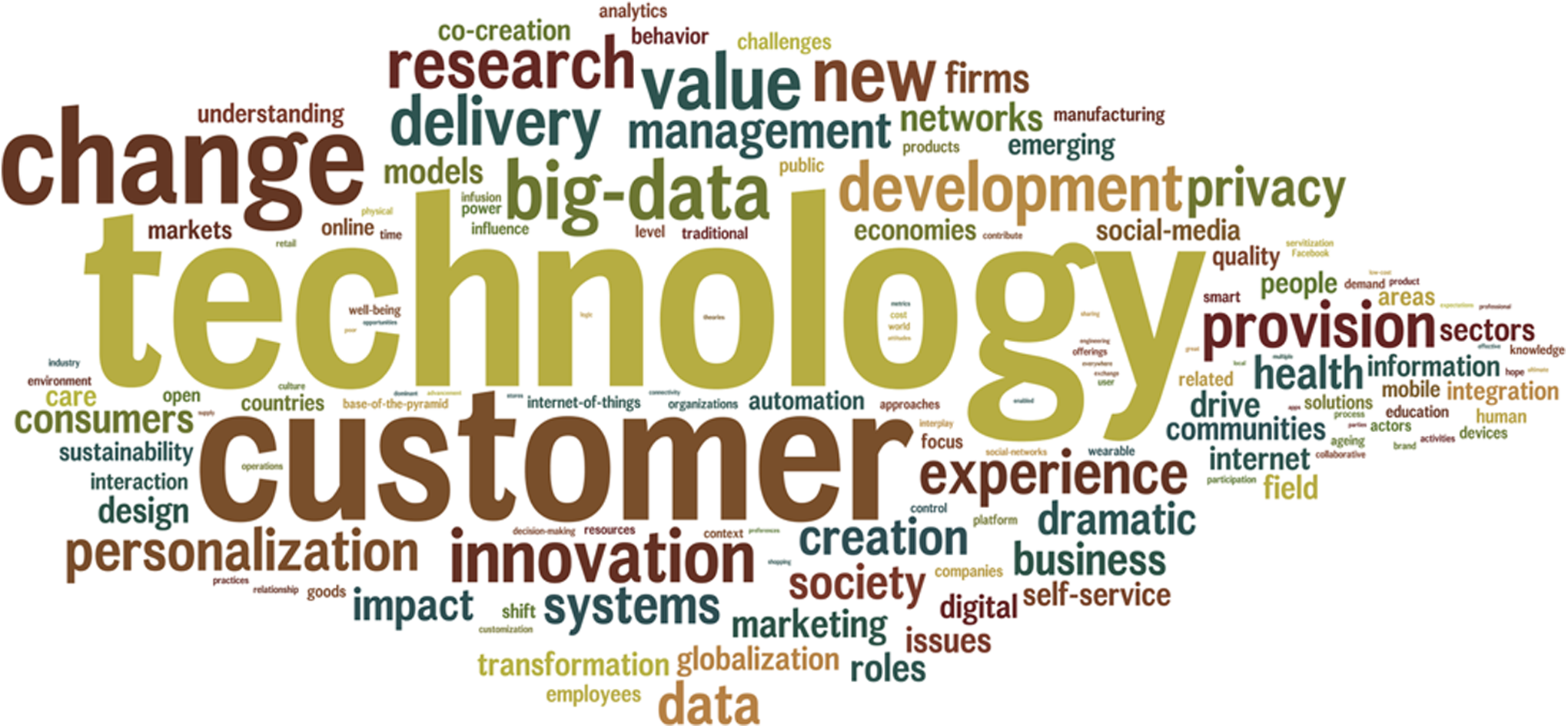
Most dramatic change in the future of the field: Word cloud based on survey comments.
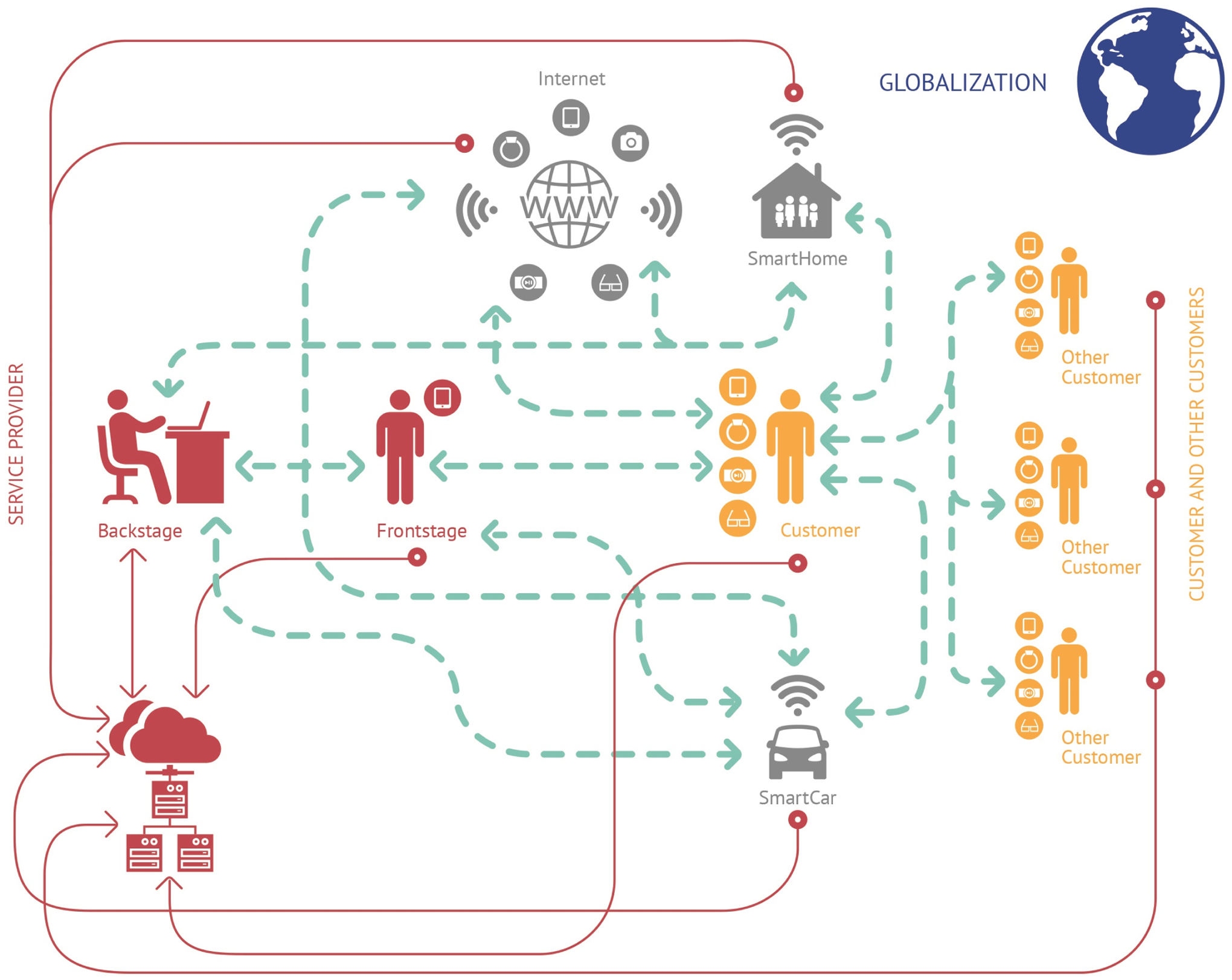
The changing context of service.
As the dashed arrows in Figure 3 show, technology-enabled wearable devices, home appliances, cars, and so forth, can now sense their own condition and surroundings, facilitating real-time data collection, continuous communication, and interactive feedback that enable the provision of smart services (Wünderlich, Wangenheim, and Bitner 2013; Wünderlich et al. forthcoming). In addition, customers themselves are connected with service providers and other customers in real time through instant messaging, commenting, or posting on social media, such as Facebook, iMessage, and Twitter. This environment represents a radically new context for providing and experiencing service. Service experienced through traditional face-to-face, dyadic provider-customer interactions is increasingly being replaced by a more high-tech and networked service experience. Greater access to information and technology, as well as increasing capability to connect in real time with service providers and fellow customers, is also giving customers more autonomy in cocreating and personalizing their service experiences.
With multiple technology channels such as the Internet, mobile phones, and wearable devices, person-to-person interactions may become less frequent, but no less important, being reserved, if not required, for providing high-value service to select customers. As such, understanding the interplay between personal and information technology-supported service and finding the right blend of the two for different customer segments and situations are emerging challenges for both researchers and practitioners. A related critical challenge is ensuring that customers have a seamless service experience as they interact with multiple entities in the service network (firms, employees, and other customers) through multiple modes (personal/face-to-face, self-service, automated, and social media).
The rapidly evolving technology context also has significant implications for HRM (discussed in detail in the next section). Front-stage service employees need to be well-informed about new interactive technologies and able to provide value-added information and personal service that sets the firm apart in the new technology-enabled and increasingly competitive service environment. At the same time, backstage service employees need to acquire new competences that combine data analytics and IS knowledge with customer- and service-orientation skills. Backstage service operations need to be redesigned as well to better support service provision in this new environment.
The fundamental role of service organizations themselves needs to be reexamined in light of the aforementioned distinct characteristics of the current service environment. Organizations need to evolve from focusing on dyadic management of their relationships with customers to understanding and managing their role and contributions in many-to-many contexts involving value networks and service ecosystems, in which service provider-customer boundaries are blurring and multiple forms of service provision, by multiple network players, are possible. The way to go about accomplishing this is a challenge for service organizations and an opportunity for service scholars to generate new knowledge.
The accelerated pace of technology growth and the consequent continuous evolution of service networks and ecosystems raise the critical issue of how service researchers can keep up and contribute. They need ready access to relevant data, which in turn calls for building more and stronger partnerships with companies that possess the data and can serve as settings for conducting research. Moreover, the research, apart from being theoretically relevant and rigorous, needs to be conducted quickly enough for the findings to be timely and have practical value. Although this may be happening within IS and other fields focused on technology, it may need to occur more broadly across disciplines. Yet another important issue to be addressed is that though rapid technology evolution opens up new opportunities, technology experts often struggle to make the transition from technology breakthroughs to new services that have practical appeal. Bringing a service perspective to technology innovation can help with this transition. For this to happen, however, there needs to be greater collaboration between the service research and the technology research communities.
What Is the Role of Employees in a Changing Service Context?
As implied by the discussion in the preceding section, the service context has become much more diverse and complex than when the traditional “service encounter,” representing human, dyadic customer-employee interactions, was the primary mode of service provision. In addition, as technology has grown, it has replaced employees in some service settings (e.g., online banking), and one perspective in service theory argues that value is created by customers for customers (Heinonen et al. 2010). The notion that employees may be viewed as less relevant in this context is also indicated in the WordCloud of survey comments on the most dramatic changes in the future of the service field (Figure 2), that is, “employees” appears in very small print. In summary, whereas long ago the question to be answered was, “Where does the customer fit in a service operation? (Chase 1978, p. 137),” as noted previously, the question now could be, “Where does the employee fit in a service operation?” (Bowen forthcoming).
The management literature, particularly organizational behavior and HRM, with its focus on employees, would seemingly offer insights into the role of employees in differing service contexts. Yet, in their review of the services management literature, Subramony and Pugh (2015) conclude that it had paid little attention to differences in context and their implications for employee behaviors in serving customers. Indeed, a significant portion of studies reviewed focus on short-term service encounters between employees and customers. Partly in response to the lack of work on this issue, Bowen (forthcoming) explicitly addresses the evolving role of employees, suggesting four roles that service employees will increasingly play: “Innovators” (technology cannot substitute for human creativity as the source of new ideas for services and their delivery), “Differentiators” (the nonsubstitutable personal touch avoids the commoditization of services), “Enablers” (employees, including the understudied back office, ensuring that both customers and technology are able to perform their given roles in coproduction and value creation, overall), and “Coordinators” (integration of resources and collaboration across multiple actors in the service system). Directions for researching the competencies necessary for these roles and the HRM practices needed to build them is just one perspective. Service researchers need to do more work to further evaluate this perspective and explore other possible perspectives to augment knowledge about “Where does the employee fit in a service operation?” amid the complexity of current service contexts. Doing so effectively might require multidisciplinary and even interdisciplinary contributions from different fields such as operations management, marketing, IS, and OB/HRM.
How Do Companies Achieve “Seamlessness?”: Actor Interdependencies in Value Cocreation
The data on several priorities, taken together, suggest an overarching need for research on how to achieve effective coordination among interdependent actors in value cocreation. To illustrate, consider the following four research priorities and the subtopic within each that received the highest mean importance rating:
Priority—understanding organization and employee issues relevant to successful service; Subtopic—“Coordinating the interdependent roles of employees and customers in cocreation.” Priority—developing service networks and systems; Subtopic—“Fostering service network collaboration to enhance customer experiences.” Priority—understanding value creation; Subtopic—“Integrating the roles of customers, employees, and technology for value creation.” Priority—enhancing the service experience; Subtopic—“Managing the customer experience across complex and diverse offerings, touch points and channels.”
The most highly rated subtopics reveal a consistent underlying theme that amounts to a call for research on coordination mechanisms for tackling interdependencies among actors, including virtual (technology), and across touch points in value cocreation.
This can also be viewed as a return to an emphasis on delivering “seamless” service, an expression used frequently in the service field’s past, but one that now entails a higher level of complexity. In the past, the term “seamlessness” was used somewhat narrowly to connote coordination across organizational functions before, during, and after service delivery, often in the narrow context of a service encounter. The complex challenge now is to achieve seamlessness in the extended context of multiple individuals, organizations, networks, and technologies, with customers being viewed as far more active participants in coproduction and value cocreation. Needed are the “portfolios of coordination mechanisms” (Larsson and Bowen 1989, p. 213) for differing patterns of interdependence. Examples of extant work that can serve as a starting point for more extensive future research on seamlessness include Moeller et al. (2013) on collaborative value creation patterns, McColl-Kennedy et al. (2012) on customer value cocreation practice styles, Gittell and Weiss (2004) on integrating the intraorganizational coordination of patient care with external partners, Van Bruggen et al. (2010) on creating a seamless experience in channel multiplicity, and Patrício et al. (2011) on designing a smooth customer experience across channels.
How Does the Service Field Better Incorporate Global Contexts in What It Studies?
Our first round of data collection involved feedback from service groups and centers in five of the seven continents, providing a window into possible differences in service approaches and perspectives. Global issues tended to be rated as of lower importance than other priorities (Tables 3 and 4 and Appendix B). However, we argue that this may be due to a lack of knowledge of service issues outside our own countries or regions. Take, for example, the 2014 launch of Apple Pay, a system allowing payment by smartphone. The Wall Street Journal (Fowler 2014) stated that “Apple Pay changes the way we look at our phones, not to mention wallets full of credit cards and bits of paper.” This seems revolutionary, but a similar cellphone payment system, M-Pesa, was launched in Africa by Safaricom in 2007. By 2013, it had 14.2 million users in Kenya alone and millions more in other developing countries (Cisco 2013). What are the implications for service research? First, we are probably not aware as much as we think we are of what is happening in service management across the globe. Second, some of our assumptions—for example, that compared with the West, services in less developed nations are unsophisticated—need questioning. Finally, and most important, M-Pesa emphasizes the importance of global context for service development and research. It is a service developed to meet the local context characterized by a lack of landline telecommunications and poor financial infrastructure, which are not typically issues in the West.
Global contextual issues relate to every aspect of service. Many of the roundtables argued that all the topics are both regional and global (Center N) and all the issues are global in application (Center B). The roundtables also highlighted the need to understand local contexts. Systems of service may differ greatly between individual advanced economies and among developing economies; for example, Center F noted that much could be gained from international comparison of complex systems such as health care. Overall, there is a substantial need to be sensitive to—and to capitalize on—different contexts as well as perspectives/paradigms from different parts of the world.
The desire to advance service theory and practice by focusing on local contexts globally calls for more “intellectual” collaboration on a global scale. Several new initiatives are underway that may help facilitate this, including the efforts to develop a global consortium of service research centers spearheaded by Parsu Parasuraman and the Base of the Pyramid Service Research Network being created by Javier Reynoso. If our field is to advance understanding of service beyond developed countries, we need to do a better job of working together globally to truly understand service and the variety of different settings in which it takes place. This is difficult but worthwhile.
Doing Well (as a Field) by Doing Good
The priority ranked as most important was improving well-being through transformative service, highlighting service researchers’ high regard for socially relevant work. First, if the field is to truly enhance well-being, we need to investigate important well-being-oriented service contexts that are rarely examined, collaborate more often and more effectively, and make a greater effort to study well-being-related issues over time. Although some researchers are already working in important novel contexts (e.g., social services by Steven Rayburn forthcoming, prisons by Ronald Hill and colleagues [2015], a homeless shelter for pregnant women by Elise Riker [2014]), as service researchers, we need to venture out from traditional contexts and gain a greater understanding of service and its relation to well-being by investigating other understudied contexts. Relatedly, we need to examine consumers for whom well-being issues are paramount, with none more pressing than those at the base of the pyramid. Much service research focuses on consumers in developed countries who are middle to upper class. We need a more concerted effort to galvanize service research that addresses well-being issues involving the billions of people globally who have low income and live in the informal economy (for specific recommendations to help advance service research at the base of the pyramid, see Fisk et al. forthcoming). As a field, we need to investigate what is important and understudied versus what is convenient. This also includes focusing on the well-being of collectives rather than just individuals. Consumers live their lives as part of collectives, yet scant service research has focused on the role of service in affecting the well-being of families, communities, and society at large (Anderson et al. 2013). Of particular importance is the impact of service on families. For example, how do families cocreate services in ways that enhance or reduce well-being? How does access to and the quality of education, health care, food retailers, and financial services affect families over time?
Second, to advance well-being, we need to enhance our efforts as a field by collaborating with a variety of different stakeholders. Consistent with Fisk et al.’s (forthcoming) recommendations, we need to collaborate with consumers themselves using methods such as community action research and service design to better understand their lived experience, to ensure that what we are studying is relevant and that we are helping to innovate and create change that will truly improve well-being. We also need to collaborate with nonprofits, nongovernmental organizations, government agencies, and other firms that will not only play a critical role in helping us study well-being issues in relevant service contexts but also implement changes that will positively enhance the lives of individuals and families in developing and developed countries. Although efforts are being made at conferences to bring service researchers into contact with practitioners, we need a more concerted effort to bring about more long-term partnerships that lead to sustained well-being improvements (e.g., University of Porto’s collaboration with the Portuguese Ministry of Health to develop citizen-centered electronic health care records; Arizona State University and ASU’s Center for Services Leadership’s partnership with Mayo Clinic on multiple projects that have well-being implications). As with many service topics, additional progress to advance well-being can be made if service researchers in different disciplines with interest in well-being and access to and knowledge about relevant consumer groups band together on research collaborations. We encourage service researchers interested in issues related to well-being and service to seek out opportunities for collaboration, such as joining the Base of the Pyramid Service Research Network (tinyurl.com/BoPServiceResearchNetwork) and discussing well-being topics as members of the Transformative Service Research Facebook page and LinkedIn group.
Finally, similar to many service research topics, well-being could benefit from longitudinal investigations. Because well-being is dynamic, complex, and affected by many factors, viewing it as a snapshot at one point in time does not provide a full picture in terms of its change, the speed and trajectory of the change, and how such change might ebb and flow over weeks, months, and years. Consistent with Bolton’s (2014) discussion of the importance of thinking of service in relation to time (e.g., to better understand issues such as cohort and maturation effects, service encounter sequences, relationships over time, and extended consumption experiences), we need to examine the relationship between service and well-being over time, which in turn will have implications for the choice of research design and data to be collected.
Moving the Field Forward Requires Succeeding at Interdisciplinary Research
For a long time, there has been a call in service research for more cross-disciplinary research, and maybe it is time for us to finally achieve this. (Center J)
The imprecise use of the term “interdisciplinary,” relative to related terms such as “multidisciplinary” and “transdisciplinary,” can hinder progress toward achieving interdisciplinarity (Siedlok and Hibbert 2013). Multidisciplinary research involves two or more disciplines approaching a research topic by each using its own framings and methods; there is cooperation but no integrative collaboration. Survey respondents modestly agreed that the field is sufficiently multidisciplinary (M = 4.34), though there was fairly strong agreement that it is still dominated by marketing (M = 5.02). In contrast, interdisciplinary research combines disciplinary perspectives to yield a synthesized and collective outcome, but the original disciplines continue to exist independently. Survey respondents modestly disagreed that the field is sufficiently interdisciplinary (M = 3.65). Transdisciplinary research is a fusion of disciplines that focuses on developing coherent, unified knowledge in which disciplinary boundaries are reshaped and may even become irrelevant. This highest level of disciplinary integration was not assessed per se in our survey, though such integration might well be the underlying objective of calls for more interdisciplinary research in the service field. For example, as noted previously, the definition of service science includes a goal of evolving into a “transdisciplinary” field (Spohrer, Kwan, and Fisk 2014). Furthermore, a team of service scholars recently opined that transdisciplinarity should be the goal for service scholarship, with advances in interdisciplinarity paving the way toward that goal (Gustafsson et al. forthcoming).
Achieving interdisciplinarity in service research has several challenges. First, what exactly constitutes the service field’s domain is unclear, complicating the issue of what disciplines are needed to study it. For example, service-dominant logic (Lusch and Vargo 2014; Vargo and Lusch 2004) defines service as the application of competencies for the benefit of others, adding that all exchange is service. Ironically, the “Intangibility, Heterogeneity, Inseparability, Perishability” (IHIP) paradigm, largely dismissed by the service-dominant logic perspective, was an attempt to draw a boundary between goods and services, and the service field was bounded by a study of offerings possessing the IHIP characteristics, which also then had limitations. There is support in our findings for the theoretical value of both perspectives. For example, our survey respondents mildly agreed (M = 4.71) that “The emergence of service-dominant logic as a paradigm has been a positive force.” At the same time, they slightly disagreed (M = 3.94) that “The IHIP (intangibility, heterogeneity, inseparability, and perishability) classification scheme can no longer add value to service theory and research.” Perhaps future work anchored in service-dominant logic could still benefit by incorporating insights from IHIP and other earlier concepts in advancing the service field and even attracting other disciplines to the field.
A second challenge is the lack of a shared language, which makes it difficult to collaborate on interdisciplinary research (M = 4.64). This issue is likely an impediment to interdisciplinary research in many other fields as well. However, our findings suggest a third challenge to integrating disciplines that may be unique to the service field. This pertains to how specialization and competence within a discipline are often a prerequisite for “interdisciplinarity” across disciplines (Siedlok and Hibbert 2013). As Gustafsson et al. (forthcoming) note, intradisciplinarity is actually the starting point for multi-, inter-, and transdisciplinary research. In this general vein, the relatively low mean scores on “Key constructs are well-defined and specified” (M = 4.12) and “Key constructs have been empirically validated” (M = 4.00) suggest a lack of shared understanding and acceptance of some of the core conceptual content of the service field, which can hamper attempts at achieving interdisciplinarity. The field needs theory refinement and research to address this.
A fourth challenge is that disciplines do not integrate; rather, researchers motivated to collaborate and network do. For example, services management, which ideally should be a significant contributor to multi-, inter-, or transdisciplinary development, is “still in its infancy in contrast to the field of services marketing” (Subramony and Pugh 2015, p. 350). Relatively few management scholars are frequent contributors to service research, and their contributions are focused on applying that discipline’s constructs to service as a context (e.g., climate for service) more so than developing service constructs and theories in the manner of service-dominant logic (Bowen forthcoming).
Despite these challenges, there are reassuring signs of the potential for researchers from different disciplines to collaborate even further on service. For example, a social network analysis study of service’s scientific community examined the coauthorship relationships among researchers who have published in the top journals of operations, marketing, human resources, and services management from 1995 to 2010 (Martins et al. 2012). The results showed that though the social structure of the researchers’ collaborative network was highly fragmented, overall the researchers were “connected to others outside their group through a small number of intermediaries. This type of structure is favourable both to knowledge flow and development” (Martins et al. 2012, p. 455).
Several initiatives are underway in the service field that leverage the relative ease in connecting intermediaries. Indeed, the coauthorship structure of the current article on service research is a case in point. In addition, novel efforts by journals are playing a role in fostering collaboration among scholars from different disciplines. For example, IEEE Transactions on Services Computing and INFORMS Service Science are publishing a dual special issue focusing on New Alignment on Service Research to “reconcile business service systems and systems of systems ideals with services computing’s formal methods, standards, best practices, and repeatable processes” and to “catalyse transdisciplinary and risk-taking research” that will lead to service research being viewed from “a common, global, societal lens” (Goul, Hung, and Maglio 2014, p. 1). The efforts to build a global consortium of service research centers mentioned previously and the various center-based faculty networks that exist can also aid in developing needed collaborations, including those that help facilitate the integration of research methods across service-relevant disciplines. For example, methods traditionally used in information technology can be valuable for designing and innovating technology-enabled services, such as design science research (Hevner et al. 2004; Peffers et al. 2007). However, more efforts are necessary to help both doctoral students and established service researchers become more “T-shaped,” by gaining a deep understanding of more than one discipline and enhancing their ability to communicate across disciplines. Rather than thinking about whether the field is sufficiently interdisciplinary, perhaps the more appropriate question is, “Am I as a service researcher sufficiently interdisciplinary?”
Finally, regarding how to become more interdisciplinary and where to set boundaries, perhaps the best approach is to appreciate the evolution toward interdisciplinarity already underway in the service field and even accept that a revolution in this direction is neither possible nor necessary, at least right now. Given that the service field is relatively young, attempting to move too quickly beyond “multidisciplinary” might run the risk of losing the identity and contributions of truly new and diverse disciplines seeking a voice in the field. Alternatively, perhaps the goal should be the pursuit of interdisciplinary research as “paving the way to transdisciplinary research” (Gustafsson et al. forthcoming). Thus, there is a need for service scholars to continue addressing the challenges to interdisciplinary research we have identified. We hope that the service field will continue attracting new disciplines and pushing the field’s boundaries as we encounter compelling new research questions that require it.
Limitations and Conclusion
As with any extensive, global-scope investigation, our research is not without limitations. Although we made considerable efforts to engage academics in a variety of disciplines throughout the world, we still received more responses to the online survey from marketing academics than from other disciplines, and few academics in engineering, computer science, and more context-specific service areas (e.g., nonprofit, education) are represented. Seeking input from across disciplines also involved potential concerns with terminology and its interpretation. We strived to use terms that would be understandable across disciplines, but it is quite likely that some concepts and topics resonated more with researchers in some disciplines than in others.
In addition, the majority of the respondents were from Europe and the United States. Our ability to attain participation in some regions may have been low because the survey was only made available in English. However, given the complexity and challenges in conducting global research, we are heartened by the participation that did occur and hope that academics interested in service research, regardless of discipline or region/culture, can react to, build on, and pursue important service research highlighted by the priorities.
Although the emphasis of this research was on the perceptions of academics, it would be useful to assess how service practitioners view these priorities. Given that their buy-in and collaboration are critical for effectively investigating many of the service issues highlighted as being research worthy, it is important to understand what they consider pressing problems in comparison with the research priorities identified here.
As a concluding observation, our findings suggest an overall positive outlook for the service field (e.g., the state-of-the-field item with the highest level of agreement was “I am optimistic about the future of service as a scholarly field”). We hope that service scholars, encouraged by and building on this positive outlook, will advance the field’s frontiers by making novel contributions to theory, practice, and societal well-being, especially within the new technology-enabled, interconnected, global context in which we live.
Footnotes
Appendix A
Appendix B
Priority Subtopics’ Importance and Knowledge Means.
| Importance | Knowledge | |||||
|---|---|---|---|---|---|---|
| Mean | SD | n | Mean | SD | n | |
| Stimulating service innovation | ||||||
| 1. Innovating within complex service systems and value networks | 5.86 | 1.25 | 306 | 3.59 | 1.34 | 297 |
| 2. Identifying drivers of sustained service innovation | 5.78 | 1.23 | 316 | 3.88 | 1.26 | 303 |
| 3. Managing customers’ and partners’ collaboration throughout the service innovation process | 5.60 | 1.23 | 317 | 3.83 | 1.36 | 304 |
| 4. Innovating services through crowdsourcing and open innovation | 5.56 | 1.34 | 309 | 3.39 | 1.44 | 298 |
| 5. Understanding the interrelationships among service-product, service-process, and business-model innovation | 5.53 | 1.32 | 302 | 3.54 | 1.36 | 293 |
| Facilitating servitization, service infusion, and solutions | ||||||
| 1. Identifying business models for growth based on servitization and solutions | 5.64 | 1.35 | 305 | 3.75 | 1.22 | 289 |
| 2. Designing integrated goods-services solutions | 5.61 | 1.28 | 314 | 4.13 | 1.30 | 302 |
| 3. Understanding the impact of servitization and solutions on companies, industries, and service systems | 5.56 | 1.34 | 308 | 3.96 | 1.33 | 294 |
| 4. Evolving goods-based organizations into service-oriented enterprises | 5.54 | 1.35 | 318 | 4.18 | 1.25 | 307 |
| 5. Identifying best practices for servitized businesses | 5.23 | 1.49 | 310 | 4.00 | 1.32 | 300 |
| Understanding organization and employee issues relevant to successful service | ||||||
| 1. Coordinating the interdependent roles of employees and customers in cocreation | 5.77 | 1.29 | 320 | 4.14 | 1.27 | 317 |
| 2. Fitting together service strategies and organizational designs and climates to drive positive customer experiences | 5.58 | 1.30 | 317 | 4.17 | 1.29 | 303 |
| 3. Generating employee engagement to improve service outcomes | 5.54 | 1.24 | 316 | 4.55 | 1.34 | 308 |
| 4. Identifying the effects of technology on service employees | 5.42 | 1.22 | 316 | 4.13 | 1.28 | 307 |
| 5. Changing organizational cultures to support servitization | 5.38 | 1.4 | 313 | 4.16 | 1.32 | 298 |
| 6. Identifying the leadership competencies that are critical for managing services | 5.37 | 1.42 | 310 | 4.30 | 1.46 | 295 |
| 7. Designing service-oriented human resource management (HRM) practices that yield positive employee and customer outcomes | 5.36 | 1.31 | 312 | 4.50 | 1.31 | 300 |
| 8. Understanding how consumer behavior affects employee job performance, satisfaction, and overall well-being | 5.33 | 1.39 | 318 | 4.33 | 1.50 | 312 |
| 9. Incorporating the “voice of the employee” in service innovation | 5.32 | 1.39 | 317 | 4.16 | 1.39 | 308 |
| Developing service networks and systems | ||||||
| 1. Fostering service network collaboration to enhance customer experiences | 5.66 | 1.18 | 295 | 3.54 | 1.31 | 272 |
| 2. Building adaptive and flexible service systems to respond to dynamic environments | 5.63 | 1.32 | 291 | 3.29 | 1.37 | 266 |
| 3. Developing service platforms for value networks and service ecosystems | 5.51 | 1.32 | 275 | 3.36 | 1.30 | 258 |
| 4. Creating service architecture and modularization in the context of value networks | 5.36 | 1.34 | 281 | 3.38 | 1.36 | 260 |
| 5. Evolving systems engineering approaches for developing services | 4.94 | 1.58 | 268 | 3.55 | 1.37 | 247 |
| Leveraging service design | ||||||
| 1. Involving customers through participatory design and codesign to enhance service experience | 5.72 | 1.20 | 308 | 3.89 | 1.32 | 287 |
| 2. Using service design to develop more autonomous and dynamic customer experiences | 5.54 | 1.31 | 296 | 3.53 | 1.24 | 278 |
| 3. Using service design approaches to innovate complex service systems and value networks | 5.54 | 1.32 | 286 | 3.39 | 1.30 | 266 |
| 4. Involving multidisciplinary teams in service design | 5.42 | 1.33 | 303 | 3.80 | 1.42 | 284 |
| 5. Leveraging service design to foster service innovation | 5.37 | 1.36 | 290 | 3.72 | 1.29 | 268 |
| 6. Fostering service design thinking throughout the organization | 5.34 | 1.30 | 303 | 3.64 | 1.26 | 284 |
| 7. Advancing service prototyping to support rapid, customer-centric service innovation | 5.26 | 1.36 | 288 | 3.44 | 1.36 | 263 |
| 8. Aligning service design approaches with existing organizational structures | 5.20 | 1.38 | 295 | 3.63 | 1.28 | 270 |
| Using big data to advance service | ||||||
| 1. Using big data and data analytics to dynamically manage customer value over time | 5.71 | 1.36 | 284 | 3.15 | 1.41 | 270 |
| 2. Understanding conflicts between customers’ desire for privacy and their desire for personalized service | 5.67 | 1.44 | 300 | 3.14 | 1.43 | 283 |
| 3. Using big data to improve the customer experience and customer-firm relationships | 5.66 | 1.43 | 299 | 3.15 | 1.39 | 280 |
| 4. Developing analytic and recommendation models for dynamic and real-time service personalization | 5.59 | 1.41 | 290 | 3.11 | 1.36 | 270 |
| 5. Exploring big data to uncover opportunities for service innovation and creating new service offerings | 5.58 | 1.46 | 298 | 3.04 | 1.34 | 280 |
| 6. Capturing and analyzing service-oriented information for real-time decision making | 5.53 | 1.44 | 291 | 3.04 | 1.38 | 270 |
| 7. Identifying the organizational drivers of effective collection and use of big data in service contexts | 5.15 | 1.53 | 292 | 3.00 | 1.28 | 268 |
| Understanding value creation | ||||||
| 1. Integrating the roles of customers, employees, and technology for value creation | 5.94 | 1.26 | 319 | 4.15 | 1.39 | 308 |
| 2. Understanding and coordinating value creation in multi-actor, network, and collaborative contexts | 5.86 | 1.24 | 300 | 3.62 | 1.47 | 293 |
| 3. Understanding the negative consequences of value cocreation | 5.78 | 1.25 | 309 | 2.97 | 1.47 | 296 |
| 4. Understanding the customer as a resource integrator | 5.48 | 1.38 | 303 | 3.96 | 1.42 | 293 |
| 5. Further specifying the concept and operationalization of value cocreation | 5.47 | 1.50 | 312 | 4.29 | 1.43 | 305 |
| 6. Communicating value to customers and throughout the firm | 5.35 | 1.48 | 304 | 4.37 | 1.50 | 295 |
| Enhancing the service experience | ||||||
| 1. Managing the customer experience across complex and diverse offerings, touch points, and channels | 5.90 | 1.18 | 309 | 4.01 | 1.33 | 302 |
| 2. Understanding the implications of the increasing autonomy of customers in creating their own experience | 5.71 | 1.33 | 304 | 3.48 | 1.36 | 291 |
| 3. Enhancing the customer experience in increasingly open contexts (e.g., networks of actors, technology-enabled search, and information sharing) | 5.65 | 1.33 | 303 | 3.41 | 1.30 | 287 |
| 4. Creating a positive customer experience in the context of dynamic expectations | 5.61 | 1.26 | 298 | 3.85 | 1.42 | 285 |
| 5. Creating, managing, and measuring the impact and returns of customer communities | 5.56 | 1.27 | 292 | 3.65 | 1.34 | 281 |
| 6. Generating customer engagement especially when there is a greater demand for increased participation | 5.55 | 1.39 | 297 | 3.66 | 1.38 | 284 |
| 7. Identifying customer attributes associated with a positive service experience | 5.34 | 1.49 | 303 | 4.44 | 1.39 | 289 |
| Improving well-being through transformative service | ||||||
| 1. Designing and delivering services in a sustainable manner | 5.82 | 1.30 | 325 | 3.44 | 1.32 | 304 |
| 2. Developing technology-enabled services to improve well-being | 5.81 | 1.26 | 323 | 3.91 | 1.39 | 311 |
| 3. Exploring services as a driver of societal change to advance well-being for both individuals and collectives (e.g., families and communities) | 5.75 | 1.39 | 320 | 3.31 | 1.30 | 301 |
| 4. Designing services for vulnerable consumers (e.g., poor and aging) | 5.73 | 1.35 | 321 | 3.22 | 1.40 | 301 |
| 5. Investigating service innovation at the base of the pyramid (largest but poorest segment of the world’s population) | 5.69 | 1.36 | 316 | 2.91 | 1.38 | 298 |
| 6. Enhancing access to critical services (e.g., health care and education) | 5.65 | 1.48 | 321 | 3.82 | 1.31 | 296 |
| 7. Improving government/public services to improve well-being | 5.65 | 1.37 | 320 | 3.57 | 1.35 | 302 |
| 8. Investigating how service systems affect societal well-being | 5.57 | 1.39 | 320 | 3.24 | 1.25 | 305 |
| Measuring and optimizing service performance and impact | ||||||
| 1. Measuring the value and return on investment from service | 6.03 | 1.16 | 312 | 3.92 | 1.41 | 297 |
| 2. Creating service standards and metrics that link to financial outcomes of the firm | 5.84 | 1.34 | 308 | 3.67 | 1.36 | 288 |
| 3. Developing metrics to assess service productivity from the customer, organization, and service network perspective | 5.80 | 1.28 | 300 | 3.55 | 1.47 | 284 |
| 4. Understanding the appropriate time horizons and financial and nonfinancial metrics for assessing service investments | 5.61 | 1.32 | 295 | 3.50 | 1.45 | 272 |
| 5. Integrating service value and the costs of service delivery into joint optimization models | 5.47 | 1.37 | 279 | 3.58 | 1.36 | 262 |
| 6. Optimizing trade-offs between the different perspectives on service productivity | 5.42 | 1.47 | 277 | 3.50 | 1.42 | 255 |
| Understanding service in a global context | ||||||
| 1. Customizing service offerings for different cultural contexts | 5.46 | 1.45 | 306 | 3.21 | 1.44 | 285 |
| 2. Understanding the drivers of insourcing and onshoring | 5.41 | 1.51 | 304 | 3.74 | 1.49 | 284 |
| 3. Understanding how differences in service ecosystems across countries affect the design and delivery of services | 5.39 | 1.46 | 300 | 3.38 | 1.39 | 277 |
| 4. Understanding the consequences of outsourcing services to other cultures | 5.30 | 1.45 | 303 | 3.53 | 1.44 | 287 |
| 5. Developing organizational designs and strategies for globalizing a firm’s service offering | 5.21 | 1.45 | 302 | 3.64 | 1.41 | 276 |
| 6. Investigating service issues critical to emerging economies | 4.80 | 1.59 | 269 | 3.90 | 1.49 | 249 |
| Leveraging technology to advance service | ||||||
| 1. Exploring how social media enables new forms of value creation for customers and service providers | 5.78 | 1.32 | 306 | 3.68 | 1.41 | 290 |
| 2. Examining how the Internet of Things and smart services can enhance the customer experience and influence relationships between customers and service providers | 5.77 | 1.36 | 292 | 3.43 | 1.36 | 275 |
| 3. Building business models for new service technologies (e.g., smart services and cloud computing) | 5.72 | 1.43 | 298 | 3.53 | 1.34 | 281 |
| 4. Examining how mobile technologies, context-aware technologies, and cloud-based systems can enable the creation of new ubiquitous services to enhance the customer experience | 5.70 | 1.40 | 291 | 3.47 | 1.40 | 264 |
| 5. Understanding the impact of high-tech versus high-touch service delivery on customers and employees | 5.59 | 1.41 | 293 | 3.92 | 1.41 | 273 |
| 6. Enhancing firm-customer relationships in technology-enabled service | 5.45 | 1.36 | 294 | 3.97 | 1.31 | 275 |
| 7. Accelerating adoption and usage of emergent technology-enabled services by customers and employees | 5.35 | 1.45 | 292 | 3.84 | 1.38 | 273 |
| 8. Creating service-oriented architecture to facilitate intra- and interorganizational integration | 5.20 | 1.54 | 273 | 3.68 | 1.30 | 247 |
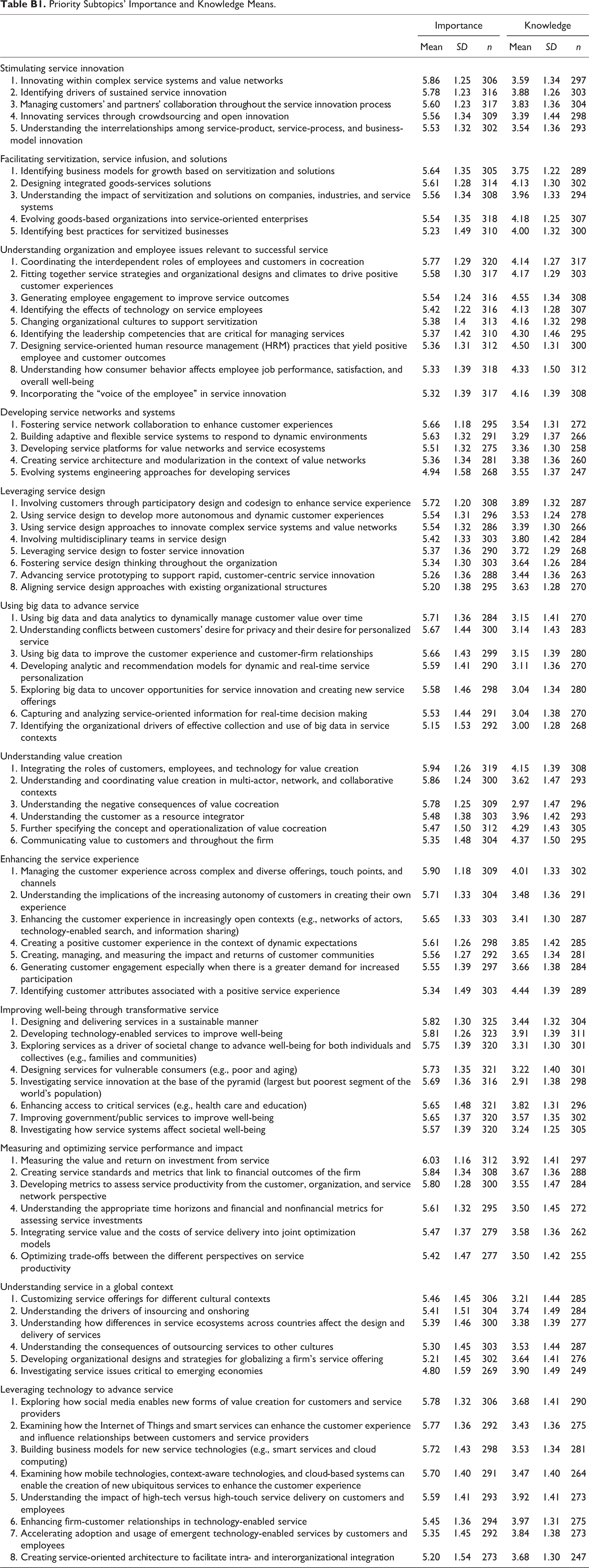
Acknowledgments
The authors offer their sincere thanks to JSR’s former editor Katherine N. Lemon for her immense help and expert guidance in her role as a guest editor of this article. The authors also thank the six anonymous reviewers for their extensive and constructive feedback. Thanks also go to Ranjit M. Christopher and Daniel C. Brannon for data analysis assistance, Sofia Coutinho for developing the aesthetics for the changing-context-of-service figure, and Nancy Gray for her efforts in helping to improve the design aesthetic of the service-research-priorities framework. The authors also acknowledge all the efforts of Darima Fotheringham, Center for Services Thought Leadership Project Manager, and thank her for her substantial contribution to the project. The authors thank the Center for Services Leadership at the W. P. Carey School of Business at Arizona State University for providing financial support for the research. Finally, the authors thank all the service centers/networks and roundtable facilitators for their important contributions to the research as well as all of the service researchers and practitioners who participated in the research-priorities-setting process.
Declaration of Conflicting Interests
The author(s) declared no potential conflicts of interest with respect to the research, authorship, and/or publication of this article.
Funding
The author(s) disclosed receipt of the following financial support for the research, authorship, and/or publication of this article: The authors thank the Center for Services Leadership at the W. P. Carey School of Business at Arizona State University for providing financial support for the research.
Notes

References
Supplementary Material
Please find the following supplemental material available below.
For Open Access articles published under a Creative Commons License, all supplemental material carries the same license as the article it is associated with.
For non-Open Access articles published, all supplemental material carries a non-exclusive license, and permission requests for re-use of supplemental material or any part of supplemental material shall be sent directly to the copyright owner as specified in the copyright notice associated with the article.
