




Abstract
Challenging the conventional perception that “power corrupts,” the authors assert that activation of customer power before a service encounter can lead to less negative behavioral manifestations toward a service provider after a service failure. Three experimental studies help substantiate this contention. Study 1 shows a sequential mediation process of how increased power leads to a more positive secondary appraisal and lessens the perceived severity of a failure. This process ultimately leads to (1) lower intentions for revenge and (2) lower demanded compensation. Study 2 solidifies these findings using stimuli for power inducement easily replicable by service managers. Study 3 establishes the boundary conditions and finds that the positive effects of power in postservice failure only holds for a single service failure context but not a double deviation context. This research offers an integrated explanation of how power leads to more positive behavioral actions through a sequential mediation effect involving cognitive appraisals. In doing so, this research sheds light on the nuances of power in affecting customer behavior. The practical method of activating perceived power may motivate service managers to apply it to buffer the potential negative effects of service failure. However, caution is advised, as such effects may diminish in the context of a series of failed resolution attempts.
Keywords
Relationships between customers and service providers are multifaceted and, like many other forms of relationship, often susceptible to contraventions, mistakes, and injuries. In their attempt to understand the factors that determine certain outcomes of service encounters, researchers have begun exploring the effects of customer power on behavior (e.g., Rucker and Galinsky 2009; Rucker, Galinsky, and Dubois 2012). The question of how customers’ sense of power alters their experiences and subsequent behavior following service failures has, however, received little attention. In the context of this study, we define “power” as the perception of having the means and discretion to asymmetrically enforce one’s will over others (Sturm and Antonakis 2015). This type of power can affect myriad customer behaviors, such as the desire to acquire status products (Rucker and Galinsky 2008), resistance against peer pressure (Galinsky et al. 2008), and benevolence toward transgressors in the context of interpersonal conflict (Karremans and Smith 2010). Thus, it is plausible that such findings could have strong implications for service research, yet literature remains largely silent on the subject.
Recent findings suggest that power can bring about prosocial effects in situations in which the outcome of the conflict is undecided. In the context of social relationships, perceptions of greater power in social situations when dealing with an initial transgression lead to more instances of forgiveness (Karremans and Smith 2010) and decreased vengefulness (Strelan, Weick, and Vasiljevic 2014). However, the limited number of service literature studies on power has mostly emphasized its negative consequences. For example, research has found that perceptions of a service provider’s coercive power hinder customers’ intentions to vocalize their response to a failure (Bove and Robertson 2005) and that a perceived power imbalance in favor of the provider intensifies customer dissatisfaction (Lee 2010). Grégoire, Laufer, and Tripp (2010) demonstrate that customers who perceive themselves as having power over a company are more likely to engage in direct revenge behavior after a failed service recovery. Consequently, they suggest that companies take steps to ensure that “no consumer [perceives] that his or her patronage is indispensable” and then to “stoke [the customer’s] fear” (p. 754) of the company’s ability to counterretaliate. We contend that this conclusion is largely derived from a double deviation context—that is, “a situation in which a service firm failed to serve the [customers] adequately, and when the [customers] complained, failed to redress the situation to their entire satisfaction,” suggesting that nothing else could have been done to redress the harm (Grégoire, Laufer, and Tripp 2010, p. 745). Thus, although research reveals the negative effects of perceived power after unsatisfactory failure resolutions, it cannot conclude that power in the hands of a customer should be unilaterally avoided.
The aim of the current research is to use contemporary findings that perceived power may also produce altruistic and prosocial tendencies (Chen, Lee-Chai, and Bargh 2001; Hirsh, Galinsky, and Zhong 2011) as a basis to advance studies on power in the field of service research, in particular in the area of service failures. We do this by developing a framework that provides a more nuanced explication of the positive effects of customers’ power (Keltner, Gruenfeld, and Anderson 2003; Rucker, Galinsky, and Dubois 2012) on their behavioral responses and then examine its effects in single versus double deviation service failure contexts. More specifically, we unpack this effects through customers’ cognitive appraisal (Lazarus 2006; Lazarus and Folkman 1984; Stephens and Gwinner 1998) of service failure, thereby revealing the underlying mechanisms that facilitate prosocial manifestations of customer power.
The contributions of this research are threefold. First, to our knowledge, this research is the first to demonstrate that increasing customer power leads to more manifestations of reconciliatory behaviors following service failures. In addition to enriching the literature on the positive effects of power in an underresearched context, such a finding advances the literature in service that so far deems customers’ power as primarily a negative phenomenon. Second, we attempt to establish the boundary conditions of customer power by examining it in both single and double deviation contexts of service failures. Third, we offer a novel approach to activating customers’ power in ways that are feasible for service managers to emulate. This application augments the more traditional priming methods of power commonly used in social psychology (e.g., Anderson and Berdahl 2002; Bargh et al. 1995). Furthermore, this approach is intended to bridge the gap between the wealth of robust and evenly weighted research on power in social psychology and the dearth of power research in the service literature. Consequently, the findings offer fresh ideas to service managers by showing how they can effectively interweave customer power into service encounters to reduce negative behavioral responses in the case of service failure incidents.
Literature Review
Differing Perspectives on Power
The literature is rich with seemingly conflicting findings regarding the effects of power on behavior. These inconsistencies occur largely because power itself is not a neutral concept; it is an intriguing concept to investigate but also often treated with suspicion. Traditional research on the effects of power has largely considered power as a corruptive force in human behavior (Fiske 1993; Kipnis 1972). This stream of research, termed the dominance perspective of power (Overbeck 2010), primarily considers power as a necessary instrument of coercion or a tool to prevent chaos and disorder (Lenski 1966). Research has shown that powerful people are more likely to be overconfident (Fast et al. 2012), to engage in self-serving behavior (Chen, Lee-Chai, and Bargh 2001), and more likely to initiate sexual advances toward others (Bargh et al. 1995). In light of these findings, as well as the many anecdotes about the corrupt behavior of powerful people, the dominance perspective of power is easy to accept (Overbeck 2010), despite some researchers’ warnings that it does not necessarily represent the whole spectrum of power’s effects on behavior (Karremans and Smith 2010).
A contrast to the dominance perspective is the functionalist perspective (Overbeck 2010), which views power as a means rather than an end in itself (Russell 1938). From this perspective, power is primarily a neutral force that enables approach and goal-seeking behavior (Keltner, Gruenfeld, and Anderson 2003). Power may serve as an amplifier of chronic personality traits (Chen, Lee-Chai, and Bargh 2001), which means that power is as likely to produce prosocial behavior as antisocial behavior. There has been a resurgence of research that tried to reconcile these conflicting ideas between the dominance and functionalist perspectives by focusing on the conditions and contexts that differentiate when and how power shifts from being a catalyst of negative to positive behavior, and vice versa (Chen, Lee-Chai, and Bargh 2001; Cho and Fast 2012; DeCelles et al. 2012). For example, Hirsh, Galinsky, and Zhong (2011) argue in favor of power’s neutral role by showing that it increases disinhibition, much like the effects of alcohol or anonymity, thereby “liberating” people to act on their chosen response to stimuli, regardless of whether it has pro- or antisocial consequences.
A common thread in both perspectives is the acknowledgment that experiencing and possessing power overlaps with an increased sense of ability to control (Fast et al. 2009; French and Raven 1959), so much so that some researchers define power as the asymmetric control over valued resources (Inesi 2010; Rucker, Galinsky, and Dubois 2012; Smith and Galinsky 2010). However, we agree with Sturm and Antonakis (2015) that, though positively correlated, power and control are distinctly separate concepts. The sine qua non of power is not limited to control (Sturm and Antonakis 2015). Control may refer to instances when a person’s voluntary response affects the consequence of an event (Seligman 1975) or when a person imposes his or her values, beliefs, thoughts, and actions on others in an attempt to alter their behavior. Thus, control implies a mastery over a particular object and being efficacious when acting on it. However, power can be manifested passively without deliberate effort, as the mere presence of a powerful person can be sufficient to induce changes in others that coincide with the powerholder’s will. Power can also be experienced vicariously (Goldstein and Hays 2011), such as when people associated with a powerholder feel and act as if they themselves are powerful, even outside the boundaries of the association. Last, a sense of power can be cognitively embedded in individuals, which they can then recall and activate through semantic cues, and thus affect their behavior in downstream behavioral situations unassociated with where the sense of power originated (Galinsky, Gruenfeld, and Magee 2003).
Power and Perceived Power
Contemporary research affirms that power can also be experienced as a perception of having (or lacking) the means and discretion to assert one’s will over others, regardless of one’s current and factual sociostructural indicators of power (Anderson, John, and Keltner 2012). This conceptualization encompasses power as both an experienced psychological state and a sense of “feeling powerful,” in addition to the more traditional notions of “being powerful” (Galinsky, Gruenfeld, and Magee 2003). Power can thus be experienced as an enduring, chronic trait and as a more dynamic “sense” of experienced power. This type of perceived power (hereinafter used interchangeably with power) is the focus of the current study.
Rucker, Galinsky, and Dubois (2012) argue that, except for extreme cases, everyone has experienced power (and powerlessness) at some point in their lives. Therefore, perceptions of power are embedded in individuals’ cognitive systems and can be recalled or reactivated by cues that evoke sensations of power, despite the absence of a tangible basis traditionally associated with power, such as wealth or high social standing (Galinsky, Gruenfeld, and Magee 2003). Exposing participants to power-related words (Bargh et al. 1995), certain role-playing tasks (Anderson and Berdahl 2002), status-related furniture (Chen, Lee-Chai, and Bargh 2001), and power-related posture (Carney, Cuddy, and Yap 2010) are some of the methods research has employed to trigger perceived power. These studies also imply that a contextually activated sense of power is a better predictor of behavior because it supersedes the chronic sense of power to influence individuals’ responses.
Studies exploring the effects of feeling powerful have become the mainstay of contemporary research on power (Sturm and Antonakis 2015). Many studies describe various situations in which an activated sense of power in one context affected the person’s reaction in a subsequent, unrelated domain; activating perceived power led to more optimism than that in a control group (Anderson and Galinsky 2006). Similarly, activation of power leads to higher risk tolerance (Carney, Cuddy, and Yap 2010) as well as increased physical pain thresholds (Bohns and Wiltermuth 2012). These elaborations indicate that perceived power can (1) lead to positive behavioral effects and (2) be experienced as a transitory state, triggered by “levers” that might not objectively indicate actual power but nonetheless change the person’s response in a host of subsequent domains. In other words, the effects of activating a sense of power using such cues can carry over to subsequent activities, even though it is unrelated to the domain in which power was activated. These notions formed the foundation for the studies we conducted, with the central thesis that customers with an elevated sense of power evaluate their negative service experience differently. We argue that these customers perceive service failure as less severe, thus resulting in more prosocial behaviors toward the service provider.
Hypotheses Development
Service failure severity refers to a customer’s perceived intensity of a service problem: The more intense or severe the service failure, the greater is the customer’s perceived loss (Weun, Beatty, and Jones 2004). Consequently, how customers react to a service failure largely hinges on how severe they perceive the failure to be. Such reactions may range from remaining silent to switching to other service providers (McCollough, Berry, and Yadav 2000; Thøgersen, Juhl, and Poulsen 2009). Smith and Bolton (2002) find that emotional responses to the perceived severity of a failure contribute significantly to customers’ satisfaction with service recovery. Tsarenko and Tojib (2012, 2015) find that perceived severity directly influences customer forgiveness of a failure.
According to Oliver (1996), perceptions of failure severity, a distinct and cognitive construct, arise when customers deal with service failures. Stephens and Gwinner (1998) focus on the role of cognitive appraisals to explain how customers process a service failure event and the subsequent consequences of that appraisal. However, while studies have extensively explored the consequences of failure severity, they have largely ignored the antecedents that determine how customers construct this evaluation. Prior research has highlighted the psychological variables of emotional intelligence (Gabbott, Tsarenko, and Mok 2011), rumination (Strizhakova, Tsarenko, and Ruth 2012), and self-efficacy (McKee, Simmers, and Licata 2006) as significant influencers of customers’ perceptions of a failure’s severity. We argue that another influential factor affecting the evaluation of service failure is the customer’s sense of power. Specifically, we hypothesize that power influences perceived severity indirectly through cognitive appraisal.
According to appraisal theory (Lazarus 2006), people who are confronted with a transgression engage in appraisals. Primary appraisals involve evaluating transgressions as a threat to one’s values and beliefs or, in other words, as “whether anything is at stake” (Lazarus 2006, p. 76). Secondary appraisals refer to a cognitive-evaluative process focused on what can be done about a stressful encounter and the evaluation of the person’s coping potential. That is, in a secondary appraisal, the person evaluates what, if anything, he or she can do to overcome or prevent harm or to improve the likelihood of benefiting. Secondary appraisals involve evaluating the constraints and affordances of a transgression with the goal of restoring well-being, which in turn determines how that person will respond to a transgression (Lazarus 2006). Lazarus (2006) also notes that the differences between primary and secondary appraisals are not about timing but about the content of the appraisal; thus, primary appraisals do not necessarily occur first.
Service failures often reflect an unambiguous and explicit threat to customers’ goals and well-being. Thus, when customers experience service failure, appraisals occur quickly, if not reflexively (Anisman 2015). However, aside from the failure itself, other cognitive factors, such as whether and how people have been primed, significantly influence the appraisal and consequent behavior. As Anisman (2015, p. 23) explicates, “it is impressive how sensitive our appraisals are even to fairly subtle cues that serve to prime us to think or behave in certain ways.” Consequently, we argue that customer power is one of these cognitive influencers of secondary appraisals. Having an elevated sense of power to impose one’s will over others should positively skew the appraisal, such that the person faces a transgression more as a challenge than a threat and also expects less harmful consequences. In other words, customers with a high sense of power will have a more positive frame of coping potential with the failure. Through the priming of power, customers will perceive themselves as better capable of managing the service failure and therefore will perceive the service failure as less severe. Thus, we hypothesize the following:
In line with our objective to provide insight into the role of customer perceived power, we investigate the relationship between power and behavioral manifestations in the aftermath of service failure, such as (1) intentions for revenge and (2) demanded compensation. Marketing literature has defined revenge as customers’ need to punish and cause harm to firms for the damage caused (Bechwati and Morrin 2003; Grégoire and Fisher 2006). Research has described the desire for revenge as a “fighting” strategy in the “fight versus flight” framework, and it lies at the origin of most retaliatory behaviors (Grégoire, Tripp, and Legoux 2009). For the current investigation, revenge is an aggressive behavior intended to rectify perceptions of inequity (Huefner and Hunt 2000) or the infliction of punishment in return for perceived wrongdoing (Zourrig, Chebat, and Toffoli 2009). These conceptualizations are based on punitive retaliatory actions, such that the more intense the perceived harm, the stronger is the desire for revenge.
We previously argued that higher perceived power leads to a more positive frame of secondary appraisals, which in turn lead to lower perceived severity of the failure. As discussed, customers’ perceived severity of the failure is a significant determinant of how they will react to said failure. More pertinent to this investigation, Roggeveen, Tsiros, and Grewal (2012) report that lower perceived severity results in a decreased desire for retaliatory behavior (e.g., revenge). This implies that the sequence we propose can be further extended. Specifically, we contend that a sequential mediating process occurs between an increased sense of power and decreased revenge intentions, through more positive secondary appraisals and lower perceived severity. Formally, we hypothesize the following:
When customers experience service failures, they often feel a certain degree of loss (Newton and McIntosh 2010). Compensation is one of the most conventional service recovery strategies for overcoming loss (Gelbrich, Gäthke, and Grégoire 2014; Tax, Brown, and Chandrashekaran 1998; Walster, Berscheid, and Walster 1973), and thus we use demanded compensation as a proxy to measure how much reimbursement customers believe is appropriate to counteract the perceived loss they experience after a negative service encounter (Zeithaml, Berry, and Parasuraman 1993). A reasonable assumption is that the level of demanded compensation is closely linked to the intensity of the loss resulting from the service failure (Gronroos 1988). Smith, Bolton, and Wagner (1999) indicate that this intensity positively correlates with the perceived severity of the failure.
In the same direction as our hypothesis on power’s impact on revenge intentions, we propose that the outcome of secondary appraisals within the cognitive appraisal process is that customers will ask for lower demanded compensation. This outcome occurs because the alleviation of perceived failure severity leads customers to appraise the negative service encounter as less harmful. That is, if consumers perceive the damaged relationship with the service provider as of lower significance, their need to restore the loss will be reduced (Roggeveen, Tsiros, and Grewal 2012). In line with the cognitive appraisal process, such sequential thoughts occurring during the evaluation of the service failure but before customers’ final reactions lead us to posit the following:
Although we primarily aim to investigate the effects of power in a single service failure, we extend our exploration to the context of double deviation to establish parity with prior research. Bitner, Booms, and Tetreault (1990) indicate that double deviation, defined as instances in which the provider’s response to a failure is inadequate to rectify the initial failure, magnifies the negative evaluation as a whole. Furthermore, several studies (e.g., Bechwati and Morrin 2003; Grégoire and Fisher 2008) note that double deviations or “recovery failures” cause customers to feel violated twice and conclude that the company does not or will not care anymore. Double deviation significantly intensifies the violation of trust after the initial failure (Basso and Pizzutti 2016) and may trigger acts of customer revenge (Grégoire, Tripp, and Legoux 2009) as well as feelings of rage (Surachartkumtonkun, McColl-Kennedy, and Patterson 2015).
From the literature on power, Cho and Fast (2012) find that people who feel powerful but perceive a threat to their sense of competence actively try to disparage the source of the threat, partly to restore their sense of social worth. Similarly, Fast and Chen (2009) find that the powerful become more aggressive when they feel incompetent in their perceived domain of power and argue that this effect is driven by ego defensiveness. Double deviation could be interpreted as a deprivation of customers’ sense of competence because it means that customers could not manifest a recovery that by rights should have been attainable. Thus, by merging the two streams of literature and following the reasoning of our previous hypotheses, we expect that for customers with a high sense of power, a single failure will lead to lower revenge intentions and demanded compensation than double deviation. Formally, we state the following:
In addition to revenge, Grégoire, Laufer, and Tripp (2010) find that powerful people exhibit stronger anger after a double deviation failure. Prior research indicates that the intensity of negative emotions after a failure depends on the results of the customer’s appraisal (Smith and Bolton 2002; Stephens and Gwinner 1998). As we have argued, in a double deviation context, the service provider not only unsuccessfully rectifies the first failure but aggravates it even further, thereby hindering the positive effects of power on cognitive appraisal. Thus, we concur with Grégoire, Laufer, and Tripp’s (2010) findings, but in keeping with our previous rationales, we expect that for customers with a higher sense of power, a single failure will lead to lower anger. Formally, we state the following:
We conducted three studies to test our hypotheses. The conceptual framework presented in Figure 1 integrates all developed hypotheses. Studies 1 and 2 focus largely on different power manipulation methods within a single failure context (Hypotheses 1 to 3). Study 3 investigates these relationships in both single failure and double deviation contexts (Hypothesis 4).
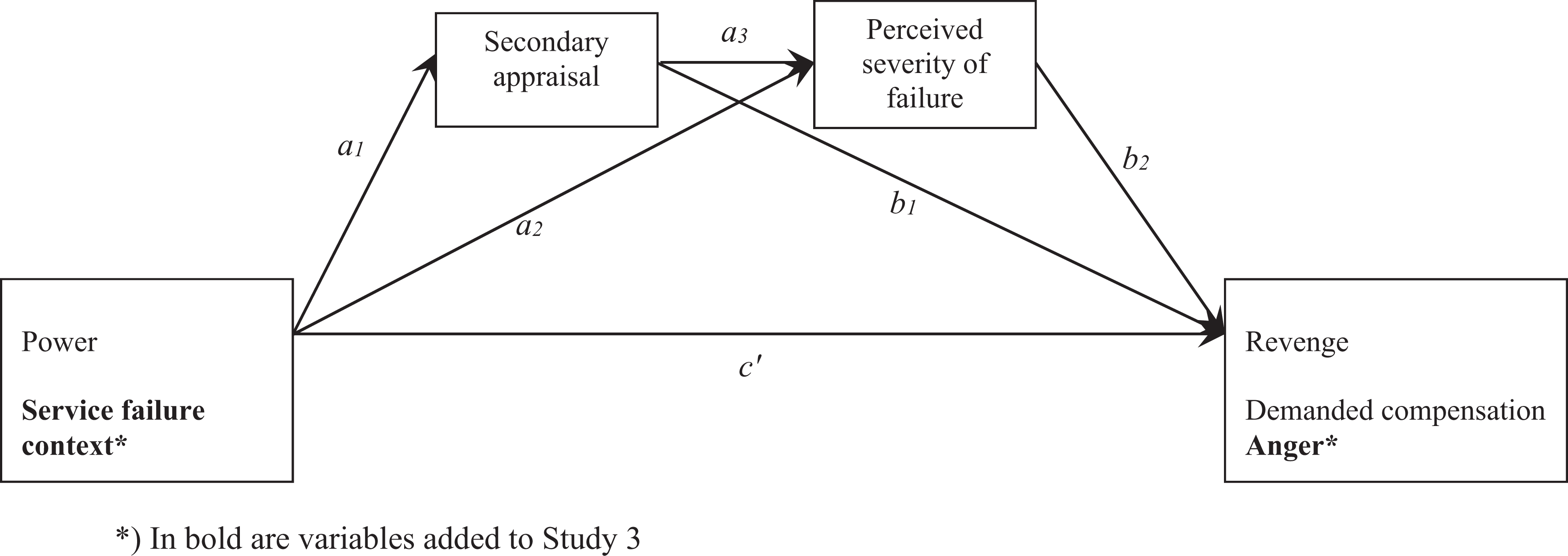
Conceptual framework.
Study 1
Study Design
Procedure
We recruited 120 U.S. participants from the online panel Amazon Mechanical Turk. We eliminated six participants because they failed an attention check, and three did not fully complete the survey, thus resulting in a final pool of 111 participants (Mage = 35.3, SD = 11.1; 47.4% male). The majority of participants had a college education or higher (56%) and an annual income of more than US$25,000 (54.5%).
The study was designed to compare individuals with elevated perceived power and a control condition. Following previous research on power and its effects on subsequent behavior (e.g., Anderson and Berdahl 2002; Fast et al. 2009), we designed our power manipulation task to appear as two unrelated tasks. Participants in the powerful condition took part in a role-playing exercise adapted from Anderson and Berdahl (2002). They first answered the 10-item scale of self-esteem (Rosenberg 1965), masquerading as a leadership test, and were told that their scores enabled them to play the role of manager in the next part of the exercise. This measure also served as a covariate for the study, alongside measures of mood and service quality expectations. 1 These “managers” were told that they would judge and reward other participants assigned as subordinates, but before doing so, they would need to answer a scenario involving a service, unrelated to the subordinate judging task (see Appendix A). In actuality, there were no subordinates in this exercise, and participants exited the study after the service scenario. Participants in the control condition underwent a similar procedure but instead were told that the purported 10-item scale was a personality test to determine their traits. Afterward, those in the control condition also took part in the same service scenario and exited the survey.
The manipulation check for perceived power was adopted from prior research (Briñol et al. 2007; Dubois, Rucker, and Galinsky 2012) and asked for participants’ agreement with three statements: “I am feeling powerful,” “I feel in charge of the situation,” and “I feel in control of things” (α = .84, M = 4.65, SD = 1.40). A one-way analysis of variance (ANOVA) revealed that the manipulation was successful, F(1, 109) = 22.6, p < .01, η2 = .17. Participants in the high-power condition reported a higher level of perceived power (Mhigh power = 5.26, SD = 1.03) than those in the control condition (Mcontrol = 4.10, SD = 1.47). Both age, rage(111) = .09, p = .3, and gender, rgender(111) = −.03, p = .74, were not significantly correlated with perceived power.
The service scenario in the second part of the study was a restaurant setting. Participants were told to imagine reading about a newly opened restaurant in their neighborhood that served their favorite dish and that they were planning to visit it. Appendix B details this scenario. Participants were then asked to imagine dining at this restaurant and ordering a meal with a side salad. To manipulate the service failure, we used a scenario in which the customer’s order took a long time to arrive at the table; such a situation illustrates the flawed delivery of the core service (Smith, Bolton, and Wagner 1999). We pretested the scenario for realism on a different sample set (n = 34) on a 7-point scale (1 = not realistic at all, 7 = very realistic). The results revealed that participants perceived the scenario as highly realistic (M = 6.39, SD = 1.42). After reading this scenario, participants completed a list of questions related to the dependent variables, manipulation check, and demographic questions.
Measures
We adapted our measurement for secondary appraisal from Gaab et al. (2005) by asking 4 items reported on a 7-point scale (1 = strongly disagree, 7 = strongly agree; α = .88, M = 4.52, SD = 1.16): “I am able to determine a great deal of what happens next in this service failure,” “It mainly depends on me whether this service failure will have a positive outcome,” “My behavior will enable me to best recover from this failure,” and “A positive outcome of this service will be dependent on my effort and personal commitment.”
We adopted the measure for perceived severity from Grégoire, Laufer, and Tripp’s (2010) 7-point scale (1 = very minor, 7 = very major; α = .87, M = 3.77, SD = 1.33): This service failure “is a … problem,” “is [an] … inconvenience,” and “causes … aggravation.” We measured demanded compensation by asking participants the amount they believed was appropriate as reimbursement in terms of a percentage of what they paid. We used a slider that participants could move from 0% (no compensation) to 200% (double what they paid). To avoid anchoring participants’ thinking, no specific amount of what they paid was mentioned. We measured revenge intentions toward the provider with 3 items adapted from McCullough, Root, and Cohen (2006) assessed on a 7-point scale (1 = strongly disagree, 7 = strongly agree; α = .88, M = 2.21, SD = 1.18): “I hope that they will lose business,” “I want to see them hurt and miserable,” and “I will make them hurt for what they did.”
Results
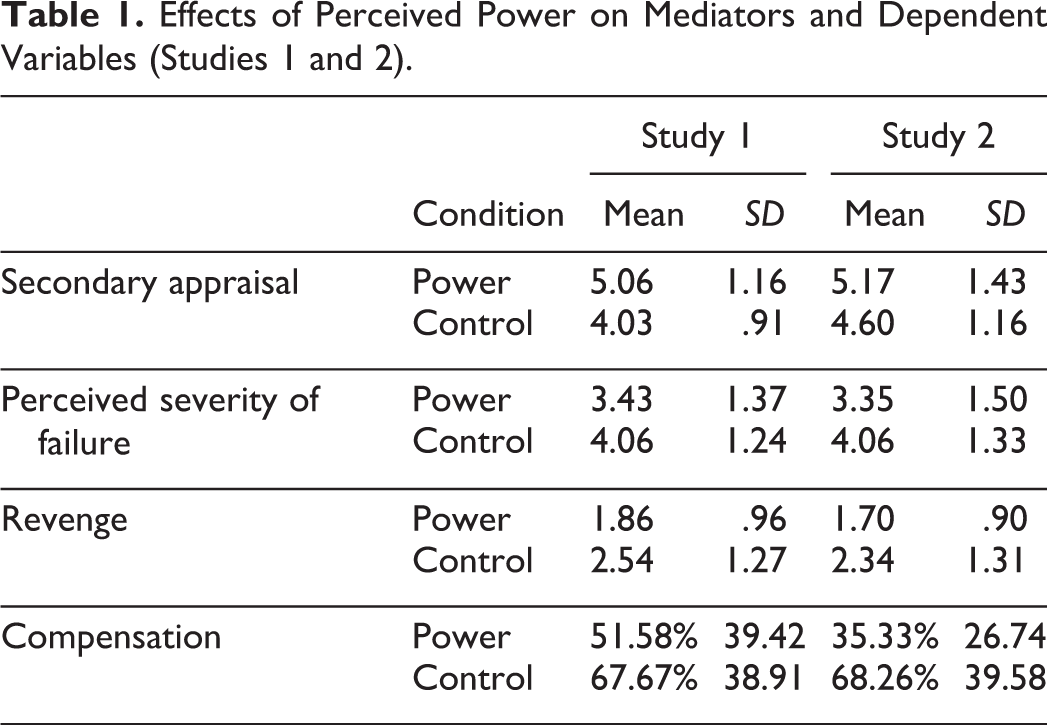
Analysis of the direct effects revealed that exposing participants to the perceived power manipulation had a significant effect on secondary appraisal, F(1, 106) = 26.98, p < .01, η2 = .18, and perceived severity, F(1, 106) = 4.42, p = .04, η2 = .04. As Table 1 shows, those primed with higher perceived power also had lower intention for revenge, F(1, 106) = 8.91, p = .01, η2 = .07, and lower demanded compensation, F(1, 106) = 5.53, p = .03, η2 = .05, than those in the control condition.
Effects of Perceived Power on Mediators and Dependent Variables (Studies 1 and 2).
To test whether secondary appraisal mediates the relationship between perceived power and perceived severity of the service failure, we used the bootstrapping method (Hayes 2013). For this analysis, we mean centered the mediator variable of secondary appraisal. The analysis confirms the positive effect of perceived power on secondary appraisal (b = .98, p = .001) and the negative effect of secondary appraisal on perceived severity (b = −.41, p = .001). It also shows a significant indirect effect, and the confidence interval does not include zero (b = −.41, 95% confidence interval [CI] = [−.81, −.16]). This finding provides support for Hypothesis 1; customers with higher perceived power perceive the service failure as less severe because of the mediating effect of secondary appraisal. The direct effect of power on perceived severity after we controlled for the indirect effect was nonsignificant (b = −.10, p = .68).
To test Hypothesis 2, we conducted a sequential mediation analysis using Hayes’s (2013) bootstrapping method. For this analysis, we mean centered the mediating variables of both secondary appraisal and perceived severity. As Table 2 shows, the specific indirect path IND2 (a1a3b2) was significant (b = −.18, 95% CI [−.38, −.07]), providing support for Hypothesis 2. The total indirect effect was significant (b = −.34, 95% CI [−.63, −.06]), and the direct effect of perceived power on revenge intention after we controlled for the indirect effects was nonsignificant (b = −.31, p = .14).
Studies 1 and 2 Sequential Mediation Analysis.

Note. Perc. = perceived; Sec. = secondary; IV = independent variable; DV = dependent variable; LLCI = lower level confidence interval; ULCI = upper level confidence interval.
aIND1 = a1b1, IND2 = a1a3b2, IND3 = a2b2.
**p < .01. ***p < .001.
To test Hypothesis 3, we conducted a similar analysis to that of Hypothesis 2 but replaced revenge with demanded compensation as the dependent variable. We found a similar pattern of results for demanded compensation. The results (Table 2) show that the specific indirect path IND2 (a1a3b2) was significant (b = −2.97, 95% CI [−8.19, −.66]), indicating an indirect effect of secondary appraisal and perceived severity on mediating the relationship between perceived power and demanded compensation. The total indirect effect was significant (b = −6.10, 95% CI [−13.23, −.89]), and the direct effect of perceived power on demanded compensation was nonsignificant (b = −9.44, p = .18).
Study 2
Our findings in Study 1 indicate that higher perceived power leads to a more positive failure appraisal, which in turn leads customers to perceive service failure as less severe. We also find that higher perceived power leads to more reconciliatory behaviors (i.e., lower revenge intentions and demanded compensation) preceded by the sequential mediating effects of secondary appraisal and perceived severity of the service failure. These findings suggest that service managers could benefit by elevating customers’ sense of power when they enter service encounters. However, the priming method we used to activate a heightened perception of power in Study 1 is not feasible for use in actual service encounters. To support the growing trend of developing ways to practically manipulate power (e.g., Carney, Cuddy, and Yap 2010; Dubois, Rucker, and Galinsky 2012), we conducted Study 2 to test a method for activating perceived power.
The method we tested used a slogan printed on a promotional brochure. This approach is similar to the method that Dubois, Rucker, and Galinsky (2012) used to prime power in a field study, in which they found that exposing participants to banners containing power-related words influenced the amount of free food the participants consumed. Another study, which also exposed individuals to power-related words to activate power’s effects, unobtrusively primed male participants with power-related words and found that they showed an increased inclination to sexually approach a female colleague (Bargh et al. 1995). Applying the same principle, we tested whether exposing participants to power-related words in a brochure would activate the same effects as priming them with power using a role-playing exercise.
Study Design
Procedure
We recruited 90 participants from the same online panel as in Study 1. Eight people failed an attention check and one person did not fully complete the survey, thus resulting in 81 usable data points (Mage = 37.62, SD = 12.66; 43.9% male). Similar to Study 1, the majority of participants had a college education or higher (63%) and an annual income of more than US$25,000 (62.5%).
We divided participants randomly into either the high-power condition or a control condition. Those in the control condition were first asked to complete the self-esteem measures and then were presented with the promotional brochure of a new restaurant. Those in the high-power condition followed the same procedure, except that the slogan “You have power over us and your experience with us determines our future!” was printed on the promotional brochure. This slogan served as our perceived power manipulation. We chose it to reflect our definition of perceived power, and pretesting it with 40 people from the same online panel revealed that it successfully manipulated perceived power compared with those who read no headline, Mbrochure = 5.45, SD = 1.75; Mcontrol = 4.27, SD = 2.08; F(1, 38) = 4.95, p = .03, η2 = .12.
All participants then proceeded to read the scenario previously used in Study 1, which depicted them as visiting a restaurant and experiencing a delay in receiving their food, which arrived only after they had asked the waitress about it. After reading the scenario, participants answered the same set of measures as in Study 1.
We performed a manipulation check for perceived power using the same items as in Study 1 (α = .92, M = 4.86, SD = 1.34). The results of a one-way ANOVA again showed a significant difference in perceived power, F(1, 79) = 26.32, p < .01, η2 = .25. Participants in the promotional brochure condition perceived themselves as significantly more powerful than those in the control condition (Mbrochure = 5.56, SD = .89; Mcontrol = 4.22, SD = 1.38), suggesting that, consistent with prior research, exposing participants to power-related words in the context of a service succeeded in elevating their perceived power. Age, rage(81) = .07, p = .52, and gender, rgender(81) = −.07, p = .51, were not significantly correlated with perceived power.
Measures
We measured secondary appraisal (α = .88, M = 4.87, SD = 1.32), service failure severity (α = .92, M = 3.71, SD = 1.45), revenge intentions (α = .88, M = 2.03, SD = 1.17), and demanded compensation using the same items as in Study 1.
Results
Analysis of the direct effects revealed that exposing participants to the slogan had a significant effect on secondary appraisal, F(1, 76) = 3.96, p = .05, η2 = .05, and perceived severity, F(1, 76) = 5.13, p = .02, η2 = .06. Table 1 shows that priming power through the slogan printed on the promotional brochure resulted in values consistent with those of Study 1; participants in the high-power condition exhibited lower intentions for revenge, F(1, 76) = 6.50, p = .01, η2 = .07, and demanded compensation, F(1, 76) = 18.94, p < .01, η2 = .19, than those in the control condition.
To test Hypothesis 1, we conducted mediation analysis using the same bootstrap method as in Study 1. Consistent with Study 1, we find a positive effect of perceived power on secondary appraisal (b = .57, p = .05) and a negative effect of secondary appraisal on perceived severity (b = −.33, p < .01). The analysis also shows a significant indirect effect, and the confidence interval does not include zero (b = −.19, 95% CI [−.55, −.01]). This finding reconfirms Hypothesis 1; high perceptions of perceived power lead to lower perceived severity of the service failure through the mediating effect of secondary appraisal. The direct effect of power on perceived severity was also again nonsignificant (b = −.51, p = .09).
We conducted the same analysis as in Study 1 to test Hypotheses 2 and 3. For this analysis, we again mean centered the mediating variables of both secondary appraisal and perceived severity. As Table 2 shows, the results revealed an indirect effect of secondary appraisal and perceived severity on sequentially mediating the relationship between perceived power and revenge intentions. The specific indirect path IND2 (a1a3b2) was significant (b = −.06, 95% CI [−.21, −.01]), confirming Hypothesis 2. The total indirect effect was significant (b = −.22, 95% CI [−.52, −.01]), and the direct effect of perceived power on revenge intention was nonsignificant (b = −.31, p = .08).
We found a similar pattern of results for demanded compensation. The specific indirect path IND2 (a1a3b2) was significant (b = −1.27, 95% CI [−5.69, −.01]), lending support to Hypothesis 3. The total indirect effect was significant (b = −5.17, 95% CI [−14.41, −.13]), and the direct effect of perceived power on demanded compensation was significant (b = −26.21, p = .03).
Taken together, these results reconfirm Hypotheses 2 and 3. Furthermore, the study reveals that exposing customers to power-related words is a viable means of activating a heightened perception of power and its subsequent behavioral consequences.
Study 3
Our findings from two studies consistently indicate that high perceived power leads customers to demonstrate more reconciliatory behaviors. However, to more robustly establish our findings in relation to those of Grégoire, Laufer, and Tripp (2010), we situate this investigation in different contexts of service failure: a single service failure and a double deviation. As mentioned previously, we expect that our findings will hold only in single failure scenarios, whereas a double deviation context will yield results consistent with prior research.
Study Design
Procedure
We recruited 200 participants from the same online panel as in the previous studies. In total, 22 people either failed an attention check or did not fully complete the survey, thus resulting in 178 usable data points (Mage = 35.73, SD = 11.74; 51.7% male). More than half the participants had a college degree or higher (60.1%), and the majority had an annual income of more than US$30,000 (62.4%).
Study 3 was a 2 (power vs. control) × 2 (single service failure vs. double deviation) between-subjects experiment. The context of the scenario involves a service encounter at a hotel. We randomly distributed participants into either the power or the control condition before undertaking the survey. We manipulated power using a similar method of exposure to power-related slogans to that in Study 2. Those in the power condition were told to imagine that when checking into the hotel, they noticed the hotel’s promotional video playing on the television in the lobby and featuring the hotel’s service mantra “Customers have power over us! Your experience determines our future.” Conversely, those in the control condition were told to imagine that when checking into the hotel, they noticed the hotel’s promotional video playing on the television in the lobby.
The second part of the scenario indicated the negative service encounter. Participants in the single failure context read a scenario adapted from Gelbrich (2010), in which the participant, playing the role of a hotel guest, was awakened abruptly at dawn by noises coming from the kitchen near his or her room. Those in the double deviation context read a similar scenario, with additional details depicting the failure recovery situation to highlight the double deviation context. More specifically, they were asked to imagine that they asked the reception to switch rooms. Their request was fulfilled, but they noticed that they were given a room next to an elevator shaft that was even noisier than the previous room. Participants judged these two scenarios as equally realistic, t(176) = −1.27, p = .20, and equally easy to imagine, t(176) = −0.51, p = .60.
We performed a manipulation check for perceived power using the same 3 items as in the previous studies (α = .96, M = 2.85, SD = 1.52). The results indicated that participants who were exposed to the service mantra reported feeling more powerful, F(1, 176) = 16.51, p < .01, η2 = .08, than those in the control condition, Mpower = 3.31, SD = 1.73; Mcontrol = 2.41, SD = 1.16. Age, rage(178) = −.05, p = .49, and gender, rgender(178) = .01, p = .86, again were not significantly correlated with perceived power.
Measures
We measured secondary appraisal (α = .82, M = 4.80, SD = 1.13), service failure severity (α = .94, M = 4.43, SD = 1.44), revenge intentions (α = .87, M = 2.31, SD = 1.19), and demanded compensation using the same items as in the previous studies. We measured anger using the same 4-item scale as Grégoire, Laufer, and Tripp (2010; “I feel … outraged, resentful, indignant, and angry”; α = .89, M = 4.07, SD = 1.38).
Results
Multivariate ANOVA revealed an interaction effect of failure context and power on perceived severity, F(1, 174) = 4.41, p = .04, η2 = .03; secondary appraisal, F(1, 174) = 11.68, p = .01, η2 = .06; revenge intentions, F(1, 174) = 3.96, p = .05, η2 = .02; demanded compensation, F(1, 174) = 4.12, p = .04, η2 = .02; and anger, F(1, 174) = 4.18, p = .04, η2 = .02. The pattern of differences between the powerful and control conditions in the single failure scenario is consistent with those in Studies 1 and 2. In addition, participants in the powerful condition exhibited lower anger than those in the control condition. However, in the double deviation scenario, these differences became nonsignificant, with participants in the powerful condition reporting similar scores to those in the control condition (see Figure 2).
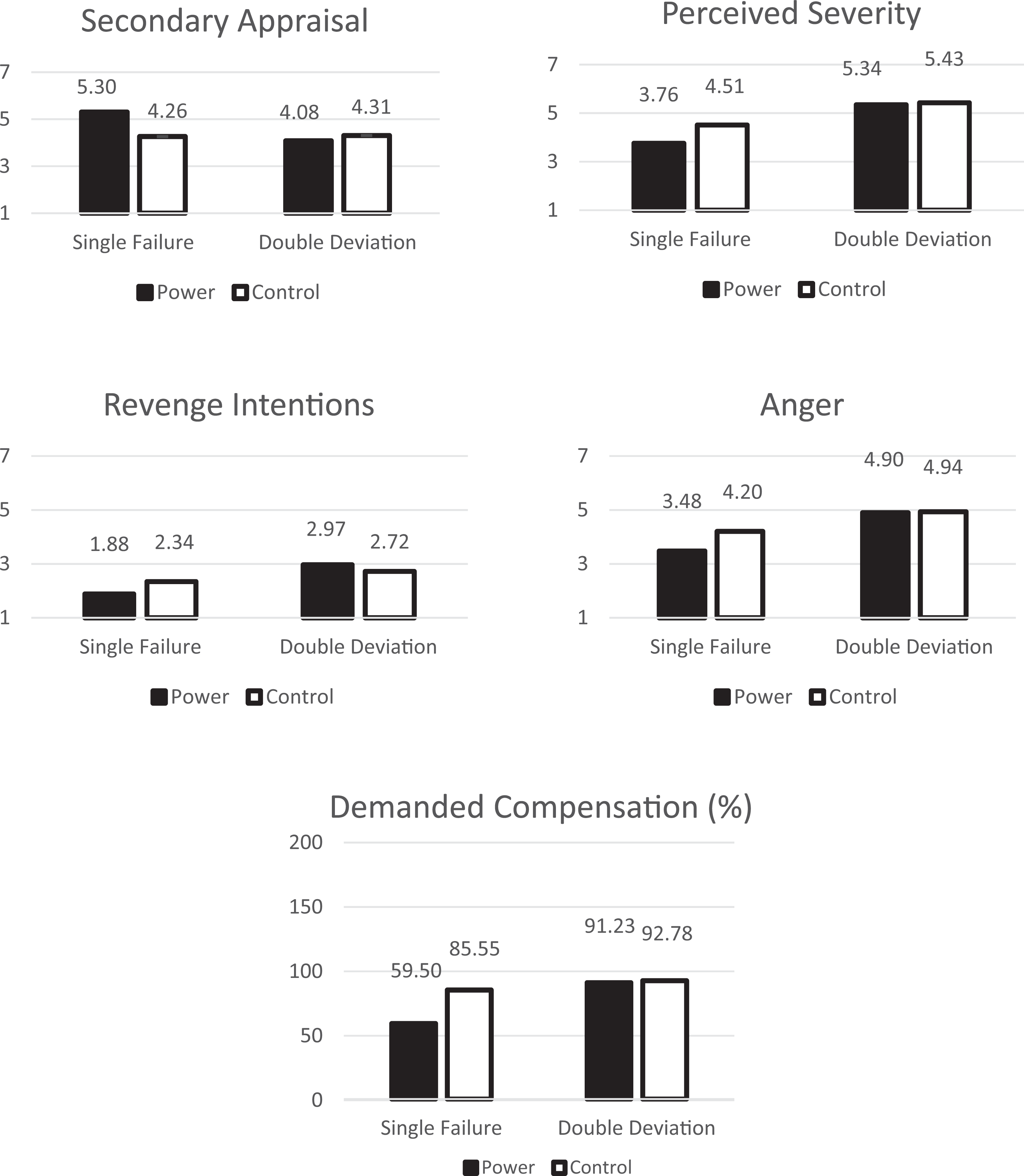
Study 3: Behavioral responses as a function of context of service failure and power.
To test Hypotheses 4a and 4b, we conducted the same sequential mediation analysis as in Studies 1 and 2 for each dependent variable. For model estimation, the interaction between power (control = 0 vs. high power = 1) and context of service failure (single failure = 0 vs. double deviation = 1) was the independent variable; secondary appraisal and perceived severity were the first and second mediators, respectively; and revenge intention was the dependent variable. We repeated a similar model estimation for the other two dependent variables, anger and demanded compensation. For all analyses, we again mean centered the mediating variables of both secondary appraisal and perceived severity.
Table 3 shows the results of the analysis, indicating that the indirect IND2 (a1a3b2) effects of the interaction variable on the dependent variables were significant. Secondary appraisal and perceived severity sequentially mediated the relationship between the interaction variable and revenge (b = .02, 95% CI [.01, .10]), compensation (b = .79, 95% CI [.05, 3.24]), and anger (b = .07, 95% CI [.01, .21]). Table 3 also lists the total indirect and direct effects. These results provide support for both Hypotheses 4a and 4b.
Study 3 Sequential Mediation Analysis.
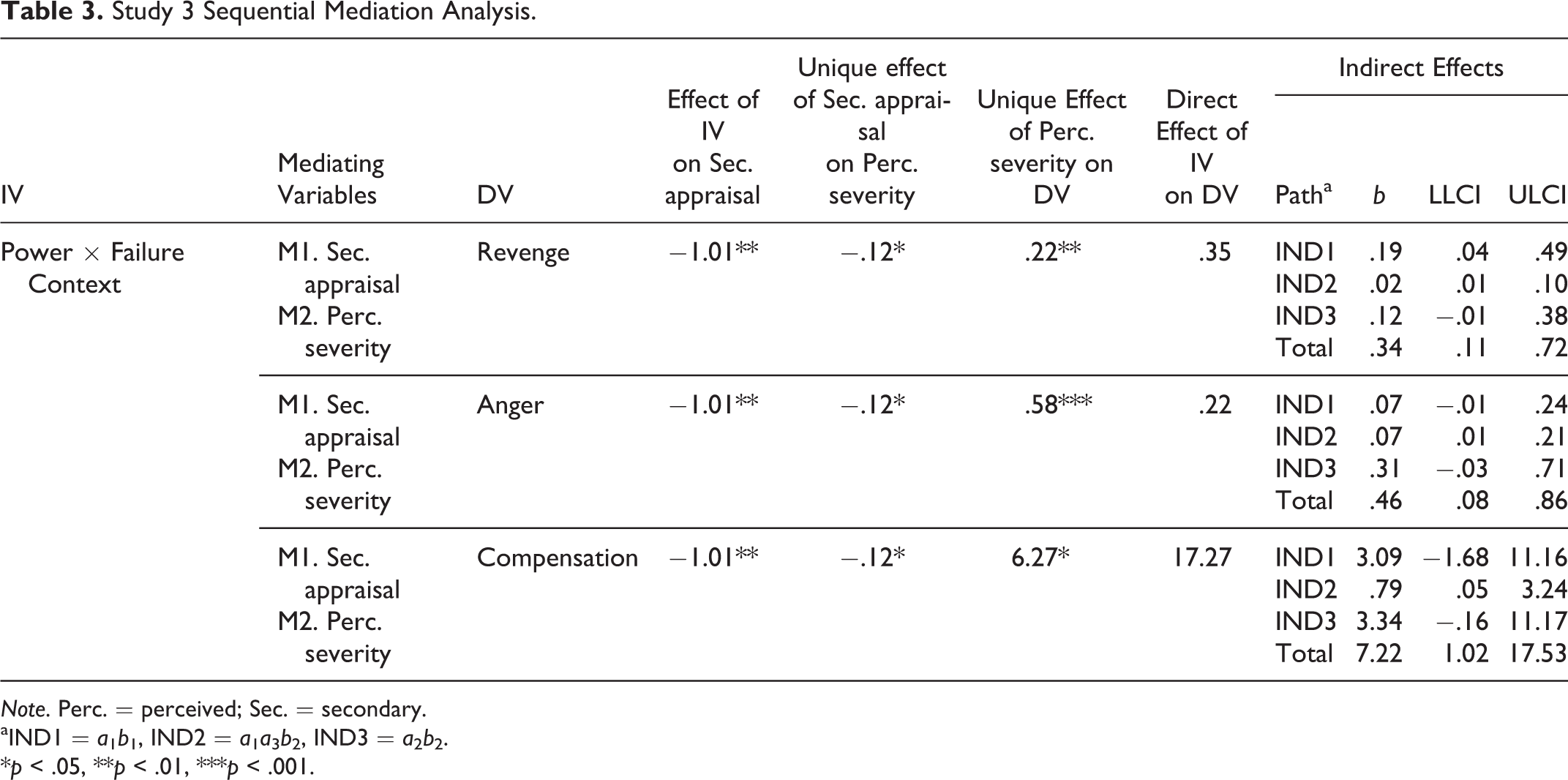
Note. Perc. = perceived; Sec. = secondary.
aIND1 = a1b1, IND2 = a1a3b2, IND3 = a2b2.
*p < .05, **p < .01, ***p < .001.
General Discussion
One of the key objectives of our research was to demonstrate that higher customer perceived power results in lower perceptions of the severity of the service failure and less negative behavioral manifestations. All three studies fulfilled this objective, using different perceived power manipulations (i.e., role playing and slogan), service settings (i.e., restaurant and hotel), and service failure contexts (single and double deviation). In particular, our findings confirm that the relationship between a higher sense of perceived power and a lower perception of severity of the service failure can be explained through the more positive framing of secondary appraisal. Our findings further confirm that a higher sense of perceived power leads to lower intentions to take revenge and lower demanded compensation, sequentially mediated by secondary appraisal and perceived severity of the service failure. However, these findings should be interpreted with caution, as Study 3 revealed that such effects are applicable only to a single service failure not to a double deviation failure. We further contend that the failure of service recovery serves as a signal that effectively negates the impact of perceived power on secondary appraisal evaluations and subsequent behavioral responses. Our results lend support to our reasoning, in that the reported secondary appraisal scores for participants primed with a high sense of power were not significantly different from those in the control condition in the double deviation context, whereas their scores were significantly different in the single failure context. Moreover, the results of our sequential mediation analysis show that in the condition primed with a high sense of power in the double deviation context, customers experienced more negative framing of secondary appraisal, which in turn led to higher perceptions of service failure severity and higher levels of anger, revenge intentions, and demanded compensation. Overall, these findings confirm the importance of secondary appraisals and perceived failure severity in determining how customers with a high sense of power would react to a negative service encounter.
Another main objective was to investigate how to activate perceived power in ways that are feasible for service managers to emulate. We confirm that the role-playing method, commonly used in the literature to elevate perceived power (Anderson and Berdahl 2002; Briñol et al. 2007), produced consistent results when adapted to the service failure context. This finding increases our confidence in our theoretical framework, particularly because scant research has explored the positive effects of perceived power in the service failure context. Adapting prior studies that use power-related words to activate perceived power, in Studies 2 and 3, we exposed participants to a slogan to activate perceived power; the slogan indeed worked as expected in both studies. These patterns of results confirm that various “levers” of activating a heightened sense of power can be used interchangeably to achieve the same results (Rucker, Galinsky, and Dubois 2012; Sturm and Antonakis 2015).
Finally, as our findings in Study 3 showed, powerful customers demonstrate a higher level of anger and are more vengeful in a double deviation context, a result that significantly contrast with the prosocial effects of power in a single failure context. Importantly, these effects occurred with the same sequential mediation processes as in the previous studies.
Theoretical Implications
This study makes several important theoretical contributions to the literature. First, it sheds more light on the role of perceived customer power in service encounters. More specifically, this study advances theoretical research on the relationship between the effect of perceived power on service failure severity evaluations and behavioral outcomes such as revenge intentions and demanded compensation. In a broader sense, this study extends understanding in that the perceived severity of a service failure could actually be influenced to mitigate the negative effects of service failures.
Second, this study draws on appraisal theory (Lazarus 2006) to show that after being exposed to a failure event, people triggered by certain priming could alter their assessments of such an event, which may significantly influence their subsequent behavioral reactions. In the context of our study, the findings of the sequential mediation significantly enhance our understanding of the appraisal process by showing that the priming of a higher sense of power, even in an instant and/or through subtle priming, can influence customers’ secondary appraisals, perceptions of service failure severity, and subsequent behavior. To the best of our knowledge, this study is the first to unpack this cognitive process, in particular showing the intrinsic dynamics of customers’ psychological processes during the failed service encounter. Furthermore, in line with appraisal theory, our findings explain how the secondary appraisal process influenced by perceived power results in less negative evaluations of the service failure.
Third, this study also shows that perceived customer power may function as an enabler of positive and prosocial behavior in the context of a single failure transgression. More specifically, our findings consistently reveal that people who hold power before a negative service encounter show less aggressive or extreme behaviors after their appraisal process in this context. To the best of our knowledge, this study is the first to empirically show the positive aspects of customers’ power in a service failure situation. This study further contributes by confirming and complementing Grégoire, Laufer, and Tripp’s (2010) study, which indicates that powerful customers demonstrate a higher level of anger and are more vengeful in a double deviation context. Indeed, we found a similar result; however, we also demonstrated contrasting results in the context of a single service failure, as previously explained. This finding offers a more balanced view of the multifaceted effects of perceived power on customer behavioral intentions.
Managerial Implications
Service failures are inevitable and unpredictable; as such, the current research should be of great interest to service managers. First, this study demonstrates that service managers can influence how their customers perceive the severity of the service failure by allowing them to feel powerful when entering service encounters. If done successfully, such perceptions of power might provide greater benefits to both customers and service providers. For service providers, the positive outcome is straightforward—customers would perceive the service failure as less severe and therefore would demonstrate more reconciliatory behaviors. For customers, because they perceive the service failure as less severe, their stress levels would be reduced, and consequently the negative impact on their well-being would decrease. Such perceptions might also instill a desire to reestablish communication with the provider, so that they feel more comfortable voicing their dissatisfaction and complaining in a constructive and friendly manner (Chebat, Davidow, and Codjovi 2005; Tsarenko and Strizhakova 2013). In these situations, the well-being of both service providers and customers would be better protected.
Second, our study shows that enhancing customers’ perceived power leads to more favorable and less aggressive behavioral responses to a single service failure. As such, we encourage service managers to be more open to the idea of managing their customers’ power perceptions before they enter a service encounter. Conventional perception suggests that those who feel powerful also often feel entitled to receive better treatment. However, contrary to this notion, our results show that increasing customers’ sense of power leads to less demand for recovery gestures, such as the amount of compensation, implying that the powerful are more appreciative if the company decides to engage in recovery efforts. Nonetheless, managers should be aware of the diminished effects of customers’ sense of power in the context of failure recovery.
Third, the power priming method through the use of slogans developed in this investigation allows managers to adopt similar principles in a variety of settings. In addition, managers could experiment with other methods shown in the literature to prime the power mind-set. For example, a servicescape may benefit from using status-boosting furniture to activate power (Chen, Lee-Chai, and Bargh 2001). Managers should also avoid designing a service environment that may induce a low sense of power or constrict customers’ ability to adopt “open” body postures, as constrictions of postures are associated with powerlessness and can lead to detrimental effects such as elevated stress (Carney, Cuddy, and Yap 2010; Huang et al. 2011). In summary, service providers should create a buffer that can safeguard their business in problematic situations through the elevation of power perceptions before customers enter the service encounter.
Last, our finding that recovery failure dissipates the effects of power on cognitive appraisals confirms the negative impact of double deviation. However, with this study, we emphasize that the key driver of customers’ negative responses is not power, and thus service providers should not be discouraged from actively managing their customers’ sense of power.
Limitations and Further Research
As with most studies, this research has several limitations. First, we employed scenario-based experiments, which limit the generalizability of the results to real-world service transgressions. Further research might consider employing a field study using this study’s method of activating perceived power to test its effects. Second, our findings with regard to revenge indicate generally low intention scores. Thus, research should consider testing this relationship in either a life-threatening or highly risk-negative service encounters in which revenge is more likely to manifest. Third, cognitive appraisals and an increase in perceived ability to cope can play a role in determining the likelihood of voicing a complaint rather than silently defecting (Chebat, Davidow, and Codjovi 2005; Stephens and Gwinner 1998). Further research could focus on investigating the role of power in this context. Finally, scholars should take into consideration the cultural orientations of individuals with regard to how they view power. Research has shown that culture moderates how power influences purchase decisions (Wong, Newton, and Newton 2014; Wong and Shavitt 2010), service performance appraisal (Mattila 2000), response to service recovery (Patterson, Cowley, and Prasongsukarn 2006), and revenge (Zourrig, Chebat, and Toffoli 2009).
Footnotes
Appendix A
Appendix B
Declaration of Conflicting Interests
The author(s) declared no potential conflicts of interest with respect to the research, authorship, and/or publication of this article.
Funding
The author(s) received no financial support for the research, authorship, and/or publication of this article.
Note
References
Supplementary Material
Please find the following supplemental material available below.
For Open Access articles published under a Creative Commons License, all supplemental material carries the same license as the article it is associated with.
For non-Open Access articles published, all supplemental material carries a non-exclusive license, and permission requests for re-use of supplemental material or any part of supplemental material shall be sent directly to the copyright owner as specified in the copyright notice associated with the article.
