



Abstract
To facilitate efficient and effective service delivery, firms are introducing self-service technologies (SSTs) at an increasing pace. This article presents a meta-analysis of the factors influencing customer acceptance of SSTs. The authors develop a comprehensive causal framework that integrates constructs and relationships from different technology acceptance theories, and they use the framework to guide their meta-analysis of findings consolidated from 96 previous empirical articles (representing 117 independent customer samples with a cumulative sample size of 103,729 respondents). The meta-analysis reveals the following key insights: (1) SST usage is influenced in a complex fashion by numerous predictors that should be examined jointly; (2) ease of use and usefulness are key mediators, and studies ignoring them may underestimate the importance of some predictors; (3) several determinants of usefulness impact ease of use, and vice versa, thereby revealing crossover effects not previously revealed; and (4) the links leading up to SST acceptance in the proposed framework are moderated by SST type (transaction/self-help, kiosk/Internet, public/private, hedonic/utilitarian) and country culture (power distance, individualism, masculinity, uncertainty avoidance). Results from the meta-analysis offer managerial guidance for effective implementation of SSTs and provide directions for further research to augment current knowledge of SST acceptance.
Self-service technologies (SSTs) are “technological interfaces that enable customers to produce a service independent of direct service employee involvement” (Meuter et al. 2000, p. 50). Service firms have strategically supplemented or even replaced traditional “high-touch and low-tech” interpersonal encounters with “high-tech and low-touch” service options. For example, banks provide customers with a variety of technology-based self-service options, including automated teller machines (ATMs), telephone banking, and Internet and mobile banking. SSTs offer benefits to firms such as reducing labor costs (Bitner, Ostrom, and Meuter 2002). However, firms will not see the benefits unless sufficient numbers of customers adopt the technology.
This article presents a meta-analysis of the factors that influence customer acceptance of SSTs. As such, we make three important contributions. First, previous SST studies use various theories to develop acceptance models, such as the technology acceptance model (TAM; Davis, Bagozzi, and Warshaw 1989) and the unified theory of acceptance and use of technology (UTAUT; Venkatesh, Thong, and Xu 2012). As a result, the constructs included in those models differ significantly, so that factors impacting SST acceptance remain unclear. As the first attempt to synthesize prior studies, we integrate constructs from various theories into a comprehensive model of SST acceptance. Results document that our model outperforms any individual theory, so that we confirm the value of the various theories as complementary perspectives and provide a more complete understanding of what factors influence SST acceptance and how much influence each factor has.
Second, the literature is unclear about whether SST research should address mediators. Some studies refer to TAM, which proposes that usefulness and ease of use fully mediate the effects of several SST acceptance predictors (Oh, Jeong, and Baloglu 2013), whereas other studies hypothesize direct effects on SST use, as suggested by UTAUT (Jia et al. 2012). We analyze mediation to determine how different antecedent factors influence SST acceptance. Exploring the mediating role of usefulness and ease of use broadens understanding of both the predictors of SST acceptance and the mechanisms through which various predictors exert influence. Establishing usefulness and ease of use as key mediators also provides managers with a concise and actionable set of factors for influencing SST acceptance behavior.
Finally, empirical studies testing the influence of predictors show inconsistent findings, ranging from significant effects to no effect at all. Such inconsistencies indicate that the relevance of predictors may depend on the specific context (e.g., SST type). Accordingly, SST research should investigate potential moderators in order to account for variations in findings, although no systematic and comprehensive investigations of moderators have yet emerged. Our moderator analysis resolves ambiguities and assesses generalizability of the inconsistent results, offering insights into when different factors influence SST acceptance. By examining differences in SST acceptance across cultures and technology types, we provide managers with specific guidance about primary factors of concern when introducing different types of SSTs in different cultures. Cross-cultural differences are of particular value for service firms planning global rollout of SSTs.
Literature Review
Theories on Technology Acceptance
Several theories provide a conceptual foundation for SST acceptance studies. TAM has been widely used to explain the acceptance of various technologies, including SSTs (Lin, Shih, and Sher 2007). The theory postulates that perceived usefulness and ease of use determine adoption and use of technology and that other factors influence technology acceptance only through these two determinants (Venkatesh and Bala 2008).
Although relatively new, the major technology acceptance theory UTAUT proposes a different set of technology acceptance determinants for SST studies to be incorporated either explicitly or implicitly (Venkatesh, Thong, and Xu 2012). UTAUT posits that individual differences (e.g., age, gender) also influence technology acceptance. In practice, some studies include individual differences as moderators (Weijters et al. 2007), while others use them as determinants (Meuter et al. 2005).
Innovation diffusion theory (IDT) holds that an individual’s decision to adopt or reject an innovation is determined by five major innovation characteristics: relative advantage, complexity, observability, compatibility, and trialability (Rogers 1995). This theory is relevant because, in service production and delivery, SST is often considered a technological innovation. SST research has used IDT to investigate consumer acceptance behavior, although less frequently than other theories (Walker et al. 2002).
Comparison of these theories reveals important similarities and differences that drive and justify our conceptual development. Although different theories propose different sets of acceptance determinants, we find that some determinants are conceptually very similar. Such overlap indicates the critical importance of these determinants, but treating the similar constructs as distinct complicates the literature. Venkatesh et al. (2003) call for moving toward a comprehensive view of technology acceptance through review and synthesis of the acceptance literature. Table 1 details definitions and theoretical roots of key constructs.
Construct Definition and Theoretical Roots.

Note. SST represents constructs outside TAM, UTAUT, and IDT, but relevant in SST research. Constructs in brackets are synonyms in respective theories. UTAUT = unified theory of acceptance and use of technology; SSTs = self-service technologies; IDT = innovation diffusion theory; TAM = technology acceptance model.
We also find differences among theories. While IDT focuses exclusively on technology-related determinants, TAM and UTAUT incorporate user-related factors—demographics and psychographics. Additionally, these theories propose different relationships between technology acceptance and the determinants of acceptance. UTAUT and IDT suggest that all determinants impact technology acceptance directly, whereas TAM distinguishes between direct and indirect influences and proposes mediation mechanisms.
Recognition that each theory contributes to SST acceptance research is confirmation that no single theory is entirely adequate. Therefore, although individual SST studies may have a reason to use a single theory, progressing toward a more complete view of SST acceptance requires integration of different perspectives into a coherent framework. Existing TAM meta-studies focus mainly on usefulness and ease of use as the drivers of technology acceptance (King and He 2006; Schepers and Wetzels 2007), and they do not combine predictors from different theories (Venkatesh et al. 2003).
Moderators in Technology Acceptance
Recent developments in technology acceptance theory identify several factors that may moderate the influence of acceptance determinants. For example, TAM proposes that user technology experience and voluntariness of use influence the effectiveness of some determinants (Venkatesh and Bala 2008). UTAUT incorporates user age, gender, and experience as additional moderators for technology acceptance (Venkatesh, Thong, and Xu 2012).
Empirical studies on technology acceptance also investigate moderators. For instance, in their meta-analysis of TAM, King and He (2006) examine type of user and type of technology use as moderators. Sun and Zhang (2006) propose that perceived usefulness is more relevant for work-oriented technologies and ease of use has greater relevance for entertainment-oriented technologies. In a study of hedonic and utilitarian technologies, van der Heijden (2004) finds that enjoyment is more powerful for predicting user acceptance of hedonic technologies than it is for utilitarian technologies. A culture-based meta-study on TAM concludes that usefulness is more important in Western cultures, but ease of use matters more in Eastern cultures (Schepers and Wetzels 2007). In their study of technology acceptance, Cardon and Marshall (2008) observe mixed results for the moderating effect of uncertainty avoidance as a specific cultural dimension.
While information systems (IS) literature provides evidence that technology acceptance may depend on technology type, user, or country culture, in SST, research moderator analysis has only recently become a focus. Collier et al. (2014) reveal that customer perceptions of control and convenience differ between public and private SSTs. Mortimer et al. (2015) test the SST Intention to Use Model in Australia and Thailand and find that the model does not hold across the two countries. The limited availability of research on technology and culture moderators may be because comparing different technologies and countries requires comprehensive data sets that often can only be found in meta-studies.
By examining two sets of moderators—technology type and country culture—our study establishes important distinctions from prior moderator studies. First, rather than focusing on one specific cultural dimension or contrasting West versus East generally, we examine all of Hofstede’s (2001) cultural dimensions. We also look at the moderating effects of cultural dimensions that have not yet been tested in technology acceptance studies. Second, we extend the studies of hedonic versus utilitarian technology and public versus private technology with investigations contrasting kiosk and Internet technology and transaction and self-help technology. Third, we move our moderator tests beyond the predictors of perceived usefulness and ease of use targeted in TAM studies. Finally, building on the TAM meta-studies that combine diverse technologies, our meta-study examines moderating effects in the specific context of SST.
Conceptual Model and Hypotheses
The conceptual framework guiding this meta-analysis is illustrated in Figure 1. To develop the framework, we reviewed SST literature and technology acceptance theories regarding (1) potential determinants of SST use, (2) mediators and outcomes, and (3) contextual moderators. First, we selected relevant determinants from key acceptance theories and created four groups based on the underlying theory. Second, consistent with TAM, we hypothesized ease of use and usefulness as two key mediators. We also included attitude toward use as a mediator, as proposed in the original TAM (Davis, Bagozzi, and Warshaw 1989) and as used in models of several SST studies. However, because the relationships among the three mediators are well established and supported in the literature, we did not derive hypotheses for them. Third, to account for possible contextual differences across studies, we examined cultural dimensions and technology types as moderator sets. Research design and sample composition served as control variables.
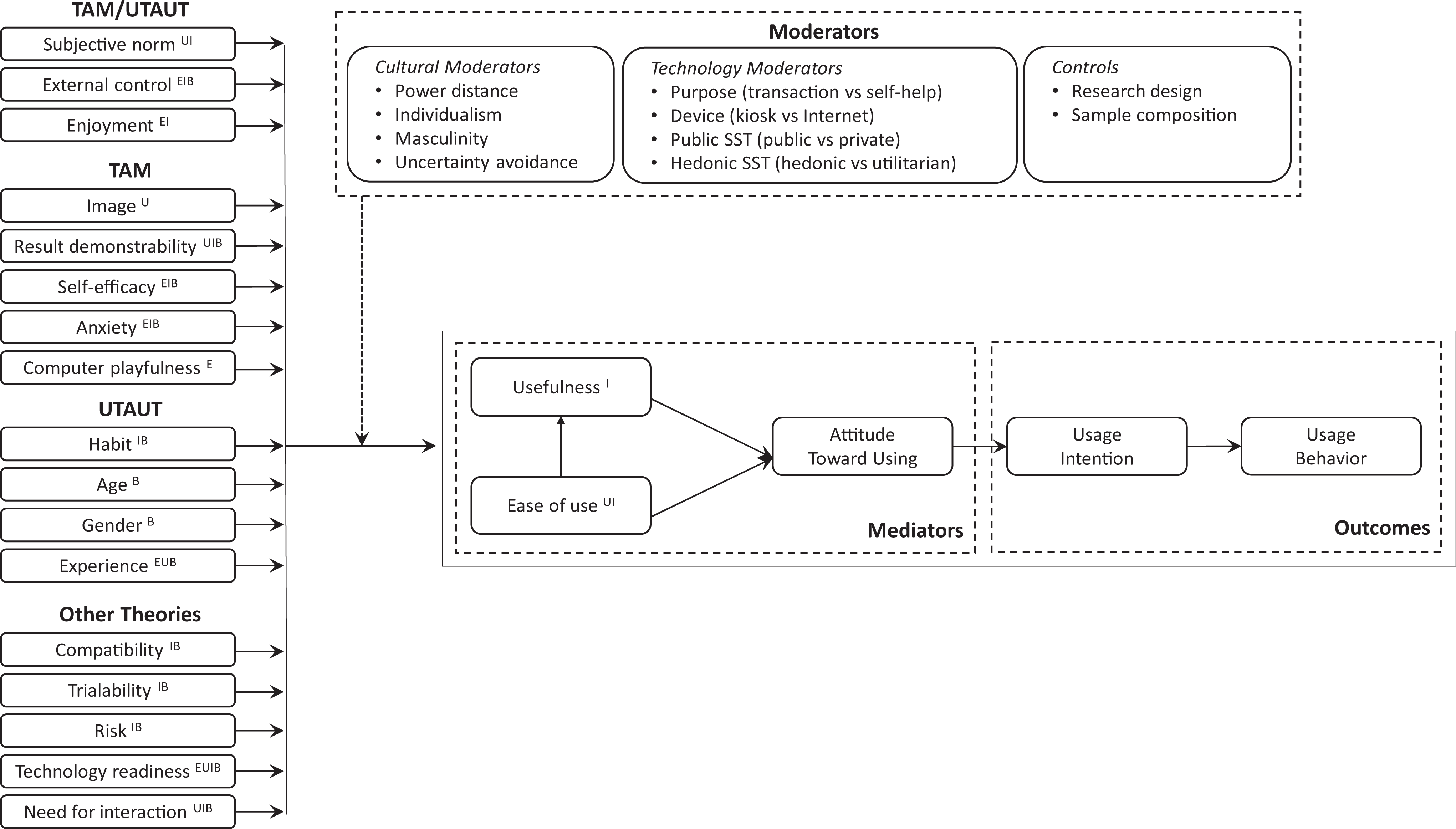
Self-service technology acceptance meta-analytic framework. Note. Superscripts (E/U/I/B) indicate that we hypothesize a relationship between the predictor and ease of use/usefulness/usage intention/usage behavior. We also hypothesize moderating effects for usefulness and ease of use on other mediators and outcomes. For visual clarity, these effects are not incorporated in the figure.
Our hypotheses of determinant influences on SST acceptance developed from key acceptance theories (TAM, UTAUT, and IDT) and findings in the SST literature. In cases where SST research finds additional relationships that are not proposed in those theories, we also included them in our hypotheses. When SST research and acceptance theories differed in how they position variables (e.g., demographics are treated as determinants in SST studies and as moderators in UTAUT), our hypotheses followed SST research models (i.e., we treated demographics as determinants rather than moderators). Tables A and B in the Supplementary Materials detail our theoretical justification and empirical support for various determinants on SST acceptance.
Effects of TAM/UTAUT Determinants on SST Acceptance
Usefulness
Consumers perceive SSTs to be useful when they save time/costs and when they are convenient (Ding, Verma, and Iqbal 2007). To specify the causal link between usefulness perception and usage intention, TAM refers to the theory of reasoned action (Venkatesh 2000). TAM assumes that individuals who believe a technology will be useful are more likely to display positive behavioral intentions.
Ease of use
Referring to the theory of reasoned action, TAM proposes that when customers perceive a technology as simple to use, they are more likely to use it (Gelbrich and Sattler 2014). TAM also argues that ease of use is a direct determinant of usefulness (Davis, Bagozzi, and Warshaw 1989) because the less effort a technology requires, the more likely that use of the technology will increase task performance.
Subjective norm
TAM suggests that the subjective norm has a direct effect on usage intention. The rationale is that people may intend to perform a behavior, even if they are not themselves favorable toward the behavior or its consequences, if they believe that one or more important referent individuals approve the behavior. Furthermore, TAM argues that when important referents communicate a belief in SST usefulness, people can change their own beliefs in agreement.
External control
For users of new technologies such as SSTs, prior technology introductions impact perceptions of external control. According to TAM, these general perceptions are technology independent and serve as situational anchors in the formation of perceived ease of use (Venkatesh 2000). This theory assumes that, lacking substantial knowledge of the new technology, customers base their perceptions of the technology’s ease of use on generalized abstract criteria. While the other predictors impact only usage intention, UTAUT holds that external control also determines usage behavior. UTAUT explains that external control acts similarly to perceived behavioral control in the theory of planned behavior, thereby influencing intention and behavior.
Enjoyment
TAM proposes that when technology-specific enjoyment increases, the salience of perceived ease of use also increases as a determinant of intention. Accordingly, a stronger perception of technology use as enjoyable may increase perceived ease of use for the target technology. UTAUT also suggests that enjoyment is a critical determinant of behavioral intention, independent of ease of use perceptions (Venkatesh, Thong, and Xu 2012). Thus,
Effects of TAM Determinants on SST Acceptance
Image
As an extension of TAM, Venkatesh and Davis (2000) propose a positive relationship between the perceived image of a technology and its usefulness. They argue that image enhancement and associated social support are significant influences for individuals who perceive technology use as a means of improving task performance.
Result demonstrability
TAM argues that when task performance gains are not readily attributed to the use of technology, even effective technologies can fail to gain user acceptance. Therefore, result demonstrability positively influences perceived usefulness. In addition, SST studies propose that result demonstrability directly influences usage intention and behavior (Meuter et al. 2005). It is argued that opportunity to observe and communicate with others about an SST increases the chance that it will be used.
Self-efficacy
TAM indicates that self-efficacy is linked to perceived ease of use (Venkatesh and Davis 1996). When users have direct experience with a technology, their general confidence in technology knowledge and ability is the basis for judging ease of use for new technology. The SST literature also proposes a direct effect of self-efficacy on usage intention and behavior. Meuter et al. (2005) argue that in technology-mediated environments, the perceived confidence in ability to engage in a task influences the likelihood of technology use.
Anxiety
According to TAM, computer anxiety negatively influences perceived ease of use (Venkatesh 2000). Classic anxiety theories propose that anxiety negatively impacts cognitive responses, particularly process expectancies. An underlying assumption is that individuals with high computer anxiety are more likely to negatively assess the process of using technology. According to the SST literature, anxiety may lead to technology avoidance behavior and to greater reluctance to use an SST.
Computer playfulness
While enjoyment is related to direct experiences with a specific technology, computer playfulness is related to general perceptions about technology use. Playfulness represents an abstraction of openness to the process of using technologies, and it serves as an anchor for perceived ease of use for a new technology (Venkatesh 2000). TAM argues that those customers who are generally more “playful” with technologies can be expected to use a new technology simply for the sake of using it rather than for specific positive outcomes associated with its use. Because they enjoy the process itself, these playful individuals may tend to underestimate the difficulty of the means or process of using a new technology. Therefore,
Effects of UTAUT Determinants on SST Acceptance
Habit
UTAUT proposes direct effects of habit on usage behavior and intention (Venkatesh, Thong, and Xu 2012). This theory presumes that repeated performance of a behavior produces habituation and that behavior can be directly activated by stimulus cues. In this way, a repeated similar situation can be sufficient to trigger an automatic response.
A ge
Previous studies on the adoption of innovations have examined demographic characteristics (Rogers 1995). Older people are more likely to encounter difficulty in processing new or complex information, which affects their ability to learn new technologies. Therefore, they are less likely to use new technologies.
Gender
Meuter et al. (2005) suggest that men are generally more interested in technology than women and therefore use technology more frequently. Prior SST studies also provide evidence for a significant direct relationship between customer gender and SST acceptance (Ding, Verma, and Iqbal 2007).
Experience
Heavy users of technologies are more confident in their ability to use the technology and are therefore more likely to try SSTs (Meuter et al. 2005). The IS literature provides further evidence that experience increases ease of use and usefulness perceptions (Gefen, Karahanna, and Straub 2003; Karahanna, Straub, and Chervany 1999). Because hands-on experience with technology increases knowledge and confidence, experienced customers perceive a technology to be easier to use than do customers with less experience (Hackbarth, Grover, and Yi 2003). The literature also suggests that consumers who are more experienced with an SST may understand how to use it to better advantage, resulting in a stronger belief in its usefulness. Hence,
Effects of Other Determinants on SST Acceptance
Compatibility
IDT argues that increased compatibility with personal values/lifestyle increases the odds of trying an SST (Moore and Benbasat 1991). Because adoption of an incompatible innovation requires prior adoption of a new value system, which is a slow process, compatibility is positively related to SST usage intention and behavior (Meuter et al. 2005). To date, however, IDT predictors have received little attention in the SST literature.
Trialability
The SST literature supports a direct effect of trialability on usage by referring to IDT (Rogers 1995). This theory suggests that trials of innovations can reduce uncertainty for potential adopters, with particular importance in the early stages of SST use. As well, the literature indicates that the opportunity to observe other SST users (indirect trial) also influences usage intention (Eastlick 1996).
Risk
The SST literature also proposes that risk has an impact on adoption decisions (Meuter et al. 2005). Using an SST often involves some level of potential risk to customers, such as a transaction failure due to technical or human error. Thus, customers’ perception that an SST is likely to malfunction lowers their intention to use the technology and prompts a turn to personal service (Curran and Meuter 2005). Risk, therefore, negatively impacts SST usage intention and behavior.
Technology readiness
While technology anxiety focuses specifically on users’ negative state of mind regarding ability and willingness to use technology, technology readiness is a broad, trait-like construct, focusing on such issues as innovativeness and the tendency to be a technology pioneer (Parasuraman and Colby 2015). Customers who are highly technology ready are more likely to try a technology. They are also assumed to have fewer problems exploring technology benefits and find the technology less difficult to use (Chen, Chen, and Chen 2009). Thus, this predictor reveals a link to ease of use, usefulness, usage intention, and usage behavior.
Need for interaction
The presence of contact between customers and service staff is a key difference between personal service and an SST, indicating that the self-service experience is inherently tied to need for interaction. This predictor is infrequently examined in SST studies, although customer needs research shows that needs influence decision-making. Customers with a need for interaction find SST technology less useful, demonstrate less willingness to use it, and show a greater likelihood of avoiding it (Curran and Meuter 2005). Thus,
Moderating Effects of Cultural Dimensions
Power distance
Power distance belief is the extent to which people accept inequality in a system (Hofstede 2001). In high-power distance cultures, customers place greater reliance on the more powerful members of society than they do on themselves, and they expect the powerful members to provide support and structure (Hofstede 2001). In this condition, predictors related to support have more importance, while predictors associated with a person’s own capabilities lose importance. Service providers can support customers through organizational and technical resources (external control) and through availability of service employees (need for interaction). In cultures where customers are expected to have greater reliance on the SST firm, individuals are less likely to rely on assessments of their own capabilities (self-efficacy) and past experiences. Thus,
Individualism-Collectivism
Individualism refers to the extent to which people in a country prefer to act independently (individualism) in contrast to interdependent action (collectivism; Steenkamp and Geyskens 2006). Customers in individualistic societies “place their personal goals, motivations, and desires ahead of those of others, whereas collectivistic cultures are conformity-oriented and show a higher degree of group behavior and concern to promote their continued existence” (Steenkamp and Geyskens 2006, p. 139). In individualistic societies, a person’s attitude and behavior are strongly regulated by individual preferences and less so by group needs (Hofstede 2001). Predictors related to personal needs gain importance in individualistic cultures, while predictors related to group needs and effort associated with need satisfaction lose importance. As a predictor for SST use, enjoyment is more relevant in individualistic cultures because it strongly relates to the fulfillment of personal needs. Persons in individualistic cultures are less likely to complain about effort and anxiety for technology that satisfies their personal needs. Thus, self-efficacy and anxiety are less relevant in individualistic cultures. In collectivistic cultures, people care more about the collective well-being and are therefore more likely to be influenced by subjective norm and need for interaction. Hence,
Masculinity-Femininity
The cultural dimension that encompasses masculinity and femininity captures the extent to which “tough” (masculine) values prevail over “tender” (feminine) values in a society (Hofstede, Hofstede, and Minkov 2010). Masculinity is described as an agentic orientation (He, Inman, and Mittal 2008), demonstrating characteristics of assertiveness, competitiveness, focus on maximizing upsides, and functional orientation. In contrast, a feminine orientation—or a communal orientation—shows characteristics of reciprocity, relational values, benevolence, focus on minimizing downsides, and experiential orientation. Predictors related to tough values in society would therefore gain importance in masculine culture, while predictors related to tender values would lose relevance. In the context of SST acceptance, customers in masculine cultures are more likely to rely on their own abilities (self-efficacy) and their own past experiences than are customers in feminine cultures, who are more likely to appreciate exchange with others (subjective norm, need for interaction). Experientially orientated feminine cultures show enjoyment to have a greater effect. The literature presents masculine cultures as more willing to take risks, making risk less relevant as a predictor. Hence,
Uncertainty avoidance
Uncertainty avoidance refers to “the extent to which the members of a culture feel threatened by uncertain or unknown situations” (Hofstede 2001, p. 161). Individuals in high-uncertainty avoidance cultures embrace predictability and avoid ambiguity. We assume that predictors capable of reducing risk are more important in high-uncertainty avoidance cultures, while predictors lose relevance in these cultures that are assessed as less capable. In high-uncertainty avoidance cultures, customers are more likely to reduce risk by relying on recommendations from other customers (subjective norm). Additionally, customers with greater computer playfulness are more likely to reduce risk by interacting directly with technology and gaining direct experience with the technology. Subjective norm, computer playfulness, and experience are more important in these cultures. Customers conventionally believe nonprovider information sources (friends, personal experience with technology) to be particularly reliable and should, therefore, use these information sources more often than others. Technology-(ease of use, usefulness) and provider-related information (interaction with service employees) should be less relevant for customers in high-uncertainty avoidance cultures who demonstrate more skepticism and greater tendency to rely on friends and family for information. Hence,
Moderating Effects of SST Types
Transaction vs. self-help SSTs
We distinguish between transaction SSTs that are for direct transactions (e.g., online payment) and self-help SSTs for other self-help purposes (e.g., airport self-check-in kiosks). These technologies differ regarding their extent of process standardization and potential negative consequences of use (Goodhue 1995, Meuter et al. 2000). Process standardization influences relevance of prior experiences and need to rely on others or on well-designed technology interfaces. Thus, predictors related to prior experience gain importance for technologies with standardized processes, while technology-related predictors and support lose relevance. Transaction SSTs have a more standardized service process. For example, the online payment procedure is similar for many commercial websites. Therefore, consumers’ previous experience should be highly relevant for adoption of a new transaction SST, and external technology characteristics such as usefulness, ease of use, and external control should be less important. Self-help SSTs usually have different procedures for different services, even within the same technology. The process for using online banking to open an account is quite different from the process for updating personal information at the same bank. In this situation, we expect past experience to lose relevance and acceptance of an SST to be driven by external characteristics of the focal technology. IS studies suggest that ease of use and sense of control are especially important if users are to accept a system with nonroutine tasks. Because users typically acquire new information from existing technology, they are more likely to be frustrated by frequently encountering unfamiliar processes (Goodhue 1995).
Risk-related predictors are also assumed to differ in relevance and have greater importance for technologies with more severe negative consequences. Because of the potential financial risk associated with transaction SSTs, risk may still be important as a technology characteristic. To minimize such risk, we expect that consumers will desire availability of personal assistance, even if they do not typically enjoy interacting with service staff. Thus, we expect the negative effects of risk and need for interaction on technology acceptance to be stronger for transaction SSTs. Hence,
Kiosk versus Internet SSTs
According to Dabholkar (1994), kiosk SSTs are provider based and Internet SSTs are primarily customer based. In provider-based SSTs, the service provider establishes access technology and sets up specific terminals, such as ATMs or check-in kiosks. Alternatively, users can access customer-based SSTs through their own technological devices, such as a PC or smartphone. These technologies differ in several aspects, including connectivity/interactivity, system security, and physical appearance. We assume that predictors related to these characteristics gain importance for the respective technology.
We expect that subjective norm plays a more important role in driving consumer acceptance of Internet-based SSTs, because many of these technologies have now been integrated into social networking sites and apps that connect people and social groups. To live up to the expectations of their social groups, consumers will be highly motivated to use the Internet-based social SSTs. Moreover, Curran and Meuter (2005) find that risk affects adoption of online banking but does not influence ATM use. In line with this finding, online data security concerns lead to a belief that Internet SSTs are generally riskier to use than kiosk SSTs. For kiosks, the infrastructure and security measures imply service provider oversight for risk. In the case of Internet SSTs, however, the lack of immediate personal support increases consumers’ perception of risk. The impact of playfulness on consumer acceptance is expected to have a greater impact for kiosk SSTs. Compared with Internet SSTs with the same interface, kiosk SSTs vary significantly in terms of physical appearance, which may satisfy the consumer need to be spontaneous during use. Therefore,
Public versus private SSTs
SST firms can now provide both onsite and offsite technologies (Dabholkar and Bagozzi 2002). Public SSTs are onsite technologies located where social interaction between the customer and other patrons can take place (e.g., ATMs, pay-at-the-pump gasoline terminals). These public technologies provide different levels of customer visibility, so that predictors related to potential embarrassment of individual users gain importance. Offsite technologies are private SSTs located where a customer can interact with a technology but does not interact with others (e.g., online banking at home). Customers using public SSTs typically do not want to delay other customers, or to be embarrassed themselves, and so they need assurance of quick and successful SST use (Gelbrich and Sattler 2014). This assurance develops from a perception that the technology is easy to use or from the customer’s past experience. We also expect that the inhibiting effect of anxiety may be enhanced in a public situation. Persons who are anxious using technology tend to avoid SSTs generally, and the social pressure of using a public SST makes acceptance even less likely. For the same reason, we also suggest that risk is more important in driving acceptance for public SSTs than for private SSTs. Therefore,
Hedonic versus utilitarian SSTs
Finally, we distinguish between hedonic SSTs that provide hedonic services (e.g., self-serve yogurt) and utilitarian SSTs that provide utilitarian services (e.g., ATMs, grocery checkout machines). These technologies differ, however, with regard to the type of benefits that they provide to users. Motivation theory, useful for evaluating hedonic and utilitarian SSTs, posits that human behavior is driven by two types of motivation—extrinsic and intrinsic (Deci 1975). Our model represents extrinsic motivation through usefulness, ease of use, and subjective norm, which focus on instrumental benefits external to the use of an SST. Alternatively, the model indicates intrinsic motivation through computer playfulness and enjoyment, which focus on inherent pleasure and satisfaction derived from SST use. We expect that extrinsic motivators are more important in driving the acceptance of utilitarian SSTs because consumers often use these SSTs to achieve an external goal. We further expect that intrinsic motivators are more important in driving acceptance of hedonic SSTs because, for consumers who use such SSTs mainly to enjoy the service experience, a fun and playful process is important. Therefore,
Method
Data Collection and Coding
We began the literature search using electronic databases such as ABI/INFORM, Proquest, Scopus, Web of Science, Google Scholar, and EBSCO (Business Source Premier). As well, we conducted additional web searches to produce a comprehensive list of empirical studies, and manually reviewed numerous journals and reference lists of collected studies. We contacted authors and requested unpublished studies. In total, we collected 96 usable articles published between 1994 and 2015 (Supplementary Materials). We employed two independent coders to code study characteristics, with an agreement rate of 96%. Coders used the construct definitions in Table 1 to classify variables.
Integration of Effect Sizes
For our research, we used correlation coefficients as effect sizes. When such information was not available, we transformed regression coefficients to correlations (Peterson and Brown 2005). If we realized during coding that some samples contained more than one correlation on the same association between two constructs (e.g., due to the use of multiple measures of the same construct), we calculated the average across these correlations and reported the data as a single study (Hunter and Schmidt 2004). In total, we gathered 1,306 effect sizes extracted from 117 independent samples that we extracted from 96 articles. The combined sample includes 103,729 respondents.
To calculate averaged correlations, we employed the random-effects approach suggested by Hunter and Schmidt (2004). As well, we corrected correlations for measurement error in both dependent and independent variables using reliability coefficients. We divided the correlations by the product of the square root of the respective reliabilities of the two involved constructs (Hunter and Schmidt 2004). Our method also corrected for the dichotomization of a continuous dependent variable and independent variable as well as for range restriction. We weighted the artifact-adjusted correlations by sample size to adjust for sampling error, after which we calculated standard errors and 95% confidence intervals for each sample size-weighted and artifact-adjusted correlation.
We assessed the homogeneity of the effect size distribution and the need for moderator analysis using a χ2 test of homogeneity and the 75% rule of thumb (Hunter and Schmidt 2004). To assess the robustness of our results and to evaluate potential publication bias, we calculated Rosenthal’s (1979) fail-safe N (FSN; also referred to as File-drawer N), which refers to the number of studies averaging null results needed to bring significant relationships to a barely significant level (p = .05). Finally, we calculated the statistical power of our test as suggested by van Vaerenbergh et al. (2014).
Evaluation of Causal Model
We used structural equation modeling (SEM) to test mediating effects, and we calculated a complete correlation matrix, including the effect sizes of all variables that the collected studies examined most often. To test our model, the correlation matrix was used as input to LISREL 8.80. We used the harmonic mean of all sample sizes (N = 1,730) as the sample size in our analyses.
Moderator Analysis
For our analysis, we assessed the effect of moderators using multivariate, multilevel meta-regressions. Hox (2010) argues that studies reporting multiple measurements are unlikely to be considered independent of one another. We calculated 12 multilevel models—one for each determinant. Similar to van Vaerenbergh et al. (2014), the reliability-corrected correlations served as the dependent variable, and we regressed the correlations on 14 variables, including cultural variables, SST-type variables, and method variables. We also included four dummy variables to represent each variable that correlated with one of the predictors (e.g., ease of use; van Vaerenbergh et al. 2014). A detailed description of our coding, integration, and analysis procedures can be found in Supplementary Materials.
Results
Descriptive Statistics
As displayed in Table 2, the strongest effect sizes can be observed for the TAM/UTAUT and TAM predictors, but predictors from UTAUT and other theories were also significant.
Descriptive Statistics on the Outcome-Related Correlations.
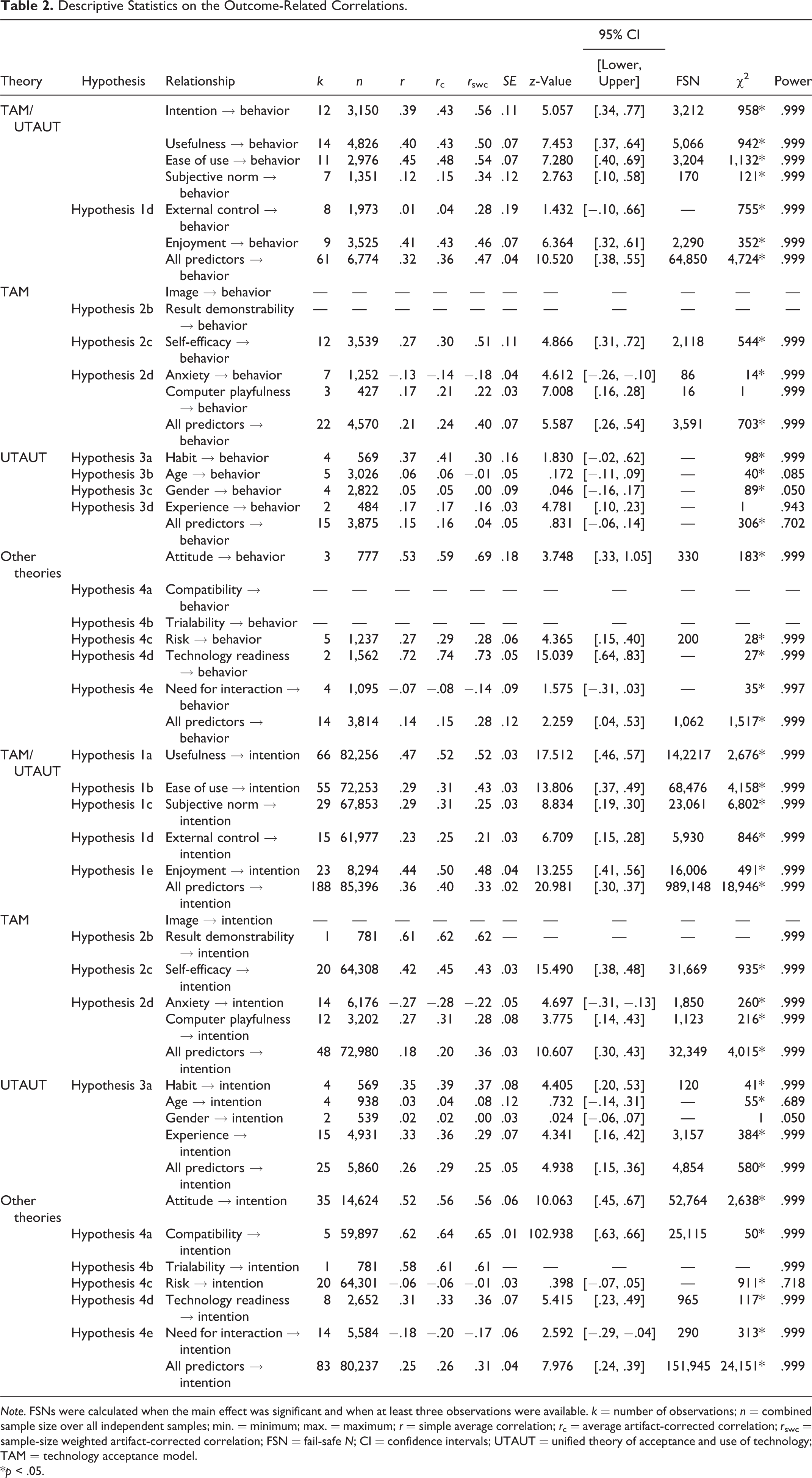
Note. FSNs were calculated when the main effect was significant and when at least three observations were available. k = number of observations; n = combined sample size over all independent samples; min. = minimum; max. = maximum; r = simple average correlation; r c = average artifact-corrected correlation; r swc = sample-size weighted artifact-corrected correlation; FSN = fail-safe N; CI = confidence intervals; UTAUT = unified theory of acceptance and use of technology; TAM = technology acceptance model.
*p < .05.
TAM/UTAUT determinants
In line with Hypotheses 1a to 1e, we observe that all TAM/UTAUT predictors are related to usage intention, including usefulness, ease of use, subjective norm, external control, and enjoyment. Interestingly, we also find all predictors to be related to usage behavior, except for external control. While external control is related to intention, it is not related to usage behavior, which contradicts our assumption in Hypothesis 1d. This predictor impacts usage behavior indirectly because it is a weak proxy for actual behavioral control (Venkatesh, Thong, and Xu 2012).
TAM determinants
The results for TAM predictors support theorized effects for self-efficacy and anxiety as proposed in Hypotheses 2c and 2d. In addition, we find that computer playfulness has a direct effect of on usage intention, which we did not anticipate. According to attitude/intention theories, beliefs about an innovation are related to behavioral intentions. The influence of result demonstrability on behavior proposed in Hypothesis 2b lacked effect sizes and could not be tested. We do, however, find support for usage intention.
UTAUT determinants
The UTAUT predictors include habit, age, gender, and experience. While experience is related to usage behavior, which supports Hypothesis 3d, habit is related to intention but not behavior, giving partial support for Hypothesis 3a. The demographic characteristics were insignificant, so Hypotheses 3b and 3c are rejected. The SST literature discusses demographic variables as a much weaker predictor compared to other predictors such as habit and experience (Meuter et al. 2005).
Other determinants
While Hypotheses 4a and 4b, associated with compatibility and trialability, could not be tested because they lack effect sizes for usage behavior, we find that these predictors impact usage intention and so support the hypotheses. Hypothesis 4c is rejected because risk is not related to usage intention but is positively related to usage behavior. Attentional control theory (Eysenck et al. 2007) suggests that for less complex tasks such as SST usage, individuals’ concerns can motivate them to improve their task performance to avoid failure and negative evaluation, thereby implying a positive association between risk and SST usage. We also find support for Hypotheses 4d and 4e. Although technology readiness is related to usage behavior and intention, the need for interaction is unrelated to behavior and exerts only indirect influence through intention.
We determined all significant relationships to be robust against publication bias. In most cases, significant χ2 tests of homogeneity suggest moderator analysis. The employed tests have sufficient power (Supplementary Materials). We also used descriptive statistics to examine the impact of predictors on mediators (Table C, Supplementary Materials). Results indicate that of the 40 predictor-mediator relationships we examined, 28 relationships (70%) are significant; Thus, we test mediating effects in the causal model.
Results of Causal Model
We calculated the SEM for all constructs for which we could derive a complete correlation matrix (Table 3), and tested the proposed model against TAM and UTAUT (Figure 2). Although our model outperforms these theories, modification indices suggest inclusion of further relationships (Table 4). The causal model provides insights on mediating mechanisms as well as additional relationships to consider.

Testing rival acceptance models.
Correlations Among Latent Constructs.

Note. Harmonic mean across all collected effects is 1,730. Entries in the diagonal are weighted mean Cronbach’s α coefficients.
Results of Structural Equation Model.

Note. TAM = Technology Acceptance Model; UTAUT = Unified Theory of Acceptance and Use of Technology; CFI = comparative fit index; AGFI = adjusted goodness of fit index; RMSEA = root mean square error of approximation; SRMR = standardized root mean square residual.
aThis relationship was excluded from the revised model 3b because it was insignificant and the model would be saturated.
*p < .05 (one tailed).
First, we find that usefulness represents a partial mediator and should be considered in future studies. Seven of the eight tested predictors are related to usefulness of the SST. As well, usefulness is significantly related to attitude toward using the SST, usage intention, and usage behavior. The calculated relative importance (47%) underscores the relevance of this mediator (Table D, Supplementary materials).
Second, we find that ease of use represents a partial mediator. Because all predictors are related to ease of use—which is related to usefulness, attitude, intention, and behavior—future SST studies should address this mediator.
Third, the SEM indicates existence of crossover effects that have not been discussed in the literature. We find that predictors of ease of use and usefulness do not influence one mediator exclusively. With regard to usefulness, we find external control, self-efficacy, and computer playfulness to be significant predictors, and conclude that confidence in personal abilities provides a more accurate assessment of usefulness. Customers who enjoy interaction with computers, therefore, are more likely to appreciate the benefits of SSTs. For ease of use, we see that subjective norm and need for interaction are related. Strong subjective norms appear to motivate customers to adapt ease-of-use beliefs of key referents. Also, customers with greater need for interaction tend to assess ease of use more negatively. Without the social support, they exhibit less confidence for independent use.
Finally, the SEM shows further important relationships. Contrary to Hypothesis 2d, we find that anxiety is positively related to usage behavior and is unrelated to usage intention. As we saw for risk perception, anxious individuals try avoiding failure and embarrassment, which in turn may motivate them to improve their task performance (i.e., use SSTs successfully). Furthermore, computer playfulness shows a strong negative effect on ease of use, which is contrary to Hypothesis 2e. Customers who enjoy spending time with computers tend to have experienced more varied technologies; thus, they may be more demanding with respect to the effort needed to use the technology. Similarly, results showing that customer experience negatively impacts usage behavior and ease of use counter our prediction in Hypothesis 3d. These findings suggest that more experience may also lead to higher customer demands. Finally, need for interaction is positively associated with usefulness (Hypothesis 4e). Customers who prefer personal service often demonstrate less understanding of the benefits of the technology and may overestimate its usefulness.
Results of Moderator Analysis
Cultural moderators
We find support for most moderating effects of cultural dimensions, which largely supports Hypotheses 5 to 8 (Tables 5 and 6). Only three moderating effects show a direction contrary to our predictions. In Hypothesis 5b, the need for interaction is weaker in high-power distance cultures because firms are less considerate of customers (Hofstede 2001). Furthermore, and contrary to our prediction in Hypothesis 7c, the subjective norm is stronger in masculine cultures. This condition can be explained by the heightened functionality orientation of masculine cultures that is mirrored in the functionality characteristics of SSTs and other technologies. Contradicting Hypothesis 7d, the need for interaction is stronger in masculine cultures. The greater functional orientation of these cultures motivates customers to appreciate information exchange about functional aspects of the technology.
Influence of Moderators on Predictors’ Effectiveness.

Note. The table reports unstandardized coefficients. While cultural dimensions were measured on Hofstede’s (2001) cultural dimensions using an index ranging from 0 to 100, the other variables were measured with dummy variables of either 1 or 0. A dash indicates that a moderator could not be tested.
aThe coefficients in this table can be read as follows: The reliability-corrected correlations of usefulness are weaker for countries with high-uncertainty avoidance (−.003), for transaction SSTs than for self-help SSTs (−.073), for Kiosk than for Internet (−.087), for the usefulness-intention correlation (−.105), and for usefulness-behavior correlations (−.251). bThe main effects of need for interaction, anxiety, and risk are negative, which must be considered when interpreting the moderating effects. cBecause the predictor-outcome moderators were dummy coded and can be presented as linear combinations of each other, one moderator must be excluded.
*p < .1 (one tailed). **p < .05 (one tailed).
Summary of Moderating Effects.

Note. SSTs = self-service technologies; ns = nonsignificant.
Beyond our hypotheses, we observe further moderating effects. First, enjoyment is more relevant in higher power distance cultures. These individuals expect more support from a firm, which allows them to care less about their own capabilities. As a result, they have increased appreciation for positive aspects of SST such as enjoyment. Second, compatibility is less important in individualistic countries, where persons tend to be driven by achievement. Such customers will apply more effort to using the SST, showing less concern for compatibility with values and lifestyle. Third, self-efficacy is less relevant in high-uncertainty cultures. These customers rely more on external quality cues for decision making, giving less consideration to internal factors such as self-efficacy.
Technology moderators
Our results lend support for the moderating effects of SST types, as proposed in Hypotheses 9 to 12. Observations in Tables 5 and 6 detail effects of SST types that we did not hypothesize. First, we find that both usefulness and experience are more important for Internet SSTs than they are for kiosk SSTs. Because kiosks are used infrequently, customers are willing to accept processes that take more time and that are more complex, and they find prior experience more valuable. Second, we observe that external control is more important for hedonic SSTs, while self-efficacy and experience are more relevant for utilitarian SSTs. To ensure a pleasurable service experience, customers of hedonic SSTs rely more on company support, while for utilitarian SSTs, the customers are more willing to contribute more effort themselves.
Method moderators
When comparing the results of method moderators, we find little evidence for systematic differences across different research designs and sampling approaches (Table 5).
General Discussion
This study aims to provide a comprehensive and coherent understanding of consumers’ SST use by applying a meta-analytic technique to synthesize previous research. To accomplish this, we develop a comprehensive theoretical model of SST acceptance by integrating theories, constructs, and relationships from prior studies. Empirical results support our model and provide insights into what factors influence SST acceptance as well as demonstrating how and when those factors exert their influence.
First, we find that all TAM/UTAUT determinants and most TAM determinants drive SST acceptance. Results for UTAUT and other theory determinants are mixed, however. We had anticipated that influences of age and gender would be insignificant, as prior studies indicate that individual differences have a limited or weak impact on SST adoption (Dabholkar 1996). Our results suggest that demographic variables are not effective predictors of SST acceptance and that they are better used as control/moderator variables—as is the case for UTAUT.
Relative impact varies for the significant determinants, suggesting that not all determinants have equal importance in driving SST acceptance. The most influential predictors are usefulness, ease of use, subjective norm, enjoyment, self-efficacy, compatibility, trialability, and technology readiness. These results indicate that every theory contributes to predicting SST acceptance behavior, but no single theory is sufficient, thus providing strong justification for integrating these theories into our comprehensive theoretical model. Empirical testing also confirms that our model outperforms the individual use of TAM or UTAUT (Table 4).
Second, we use SEM to test the mediating roles of usefulness and ease of use. With few exceptions (Meuter et al. 2005), mediators have not been explicitly examined in previous SST research. However, mediators can deepen our understanding about the processes involved in SST acceptance. We follow TAM for our model, examining usefulness and ease of use as key mediators. The results show partial mediation in nearly all relationships (not limited to those proposed in TAM), although usefulness and ease of use mediate different determinants. For example, while our bivariate analysis finds experience to be a positive influence for SST acceptance, our SEM-based mediator analysis reveals that the underlying mechanism of that positive effect may be usefulness perception. As a consequence, experienced consumers can better understand how to gain more advantages from an SST, which may motivate use of the technology.
In contrast to Venkatesh and Bala’s (2008) hypothesis and results on TAM, we find evidence for crossover effects, as some usefulness determinants impact ease of ue, and vice versa. This is not limited to TAM determinants, indicating that the mediating mechanisms usefulness and ease of use do not work separately, as suggested by TAM, and that some determinants may influence SST acceptance through both mediators. Examination of these crossover effects helps to develop a more comprehensive nomological network around key acceptance theories.
Third, our moderator analysis reveals that SST type influences the strength of relationships between SST acceptance and its determinants. This result provides new insights regarding conditions, in which determinants influence SST acceptance. For example, prior observations regarding the role of enjoyment are inconsistent, with many studies reporting a weak or insignificant influence on technology acceptance (Davis, Bagozzi, and Warshaw 1992), while others find a strong impact (Collier and Barnes 2015). Our results suggesting that the influence of enjoyment is stronger for hedonic SSTs and weaker for utilitarian SSTs offers an explanation for previous mixed findings, thereby advancing a broader understanding of SST acceptance.
Fourth, we also find that a country’s culture represents an important moderator. Many SST acceptance models have been developed in the United States, but we show that it is necessary to develop cultural adaptations for these models before applying them to global markets. Our study confirms that cultural dimensions alter the effectiveness of acceptance factors for SSTs introduced in different countries. Thus, we extend SST acceptance research by considering how it is shaped by culture (Table 6).
Managerial Implications
For practitioners, this meta-analytical research also has several implications. First, our results show that demographic variables such as age and gender are not effective predictors of SST acceptance and should therefore be avoided as segmentation variables for SST acceptance (Table 1). The individual-level characteristic of technology readiness presents a more promising method. This approach agrees with Parasuraman and Colby (2015), who recently used a streamlined technology index to segment customers. Drawing on their work, and consistent with our finding that technology readiness matters for SST acceptance, we recommend that when firms introduce an SST to a market, they initially target “explorers” (who have higher degrees of motivation and lower levels of resistance) and “pioneers” (who tend to hold strong positive views about technology).
Second, our mediation analysis results enable practitioners to better appreciate both direct and indirect ways in which SST determinants influence SST acceptance. In particular, our results reveal the important roles of usefulness and ease of use in translating the effects of determinants on SST acceptance. Using this insight, firms may (a) decide to launch a marketing communication campaign geared toward increasing SST usefulness perceptions and (b) improve customers’ SST acceptance by developing SST interfaces that are more intuitive. Because this is as much a technical challenge as it is a marketing communications challenge, firms must ensure the close cooperation of customer service, IT, product development, and marketing communications departments.
Third, practitioners should realize that the importance of SST acceptance predictors is context specific. In particular, results indicate that service firms are better positioned to secure SST acceptance among their customers by taking into account the moderating roles of cultural dimensions and SST types. More specifically, a standardized global rollout of an SST in culturally diverse service markets is likely to be problematic. Table 6, for example, reveals that for service markets that are low in uncertainty avoidance, increasing provider- and technology-related information reduces customers’ risk perceptions.
Finally, our moderation analysis results point to the importance of SST type for designing effective rollout and subsequent management of SSTs (Table 6). For instance, to counter the heightened negative influence of anxiety and ease of use for SST acceptance, firms should invest serious effort in preventing embarrassment of public SST users (e.g., thoughtful location of self-service kiosks) and/or to increase SST ease of use.
Limitations and Further Research
The findings of our study can be effectively used to guide future research. First, we recommend that SST studies combine different acceptance theories. Beaudry and Pinsonneault (2010) propose complementing the more cognitive acceptance models (e.g., TAM, UTAUT) with approaches that are more emotion based, such as an appraisal tendency framework. For instance, sad people are more likely to attribute failure of a new event to situational factors rather than to themselves and will adapt their behavior accordingly. Thus, depending on the emotional state, different predictors may matter when considering SST users’ emotions and thought processes.
Second, Venkatesh, Thong, and Xu (2012) argue that some factors are more important than others for initial assessment of technologies. In a longitudinal study, future research should examine whether the relevance of computer self-efficacy, perceptions of external control, computer anxiety, and computer playfulness diminishes over time and should investigate whether perceived enjoyment gains importance with more hands-on experience.
Third, we find strong crossover effects between predictors, which is contrary to TAM. For instance, we find that external control lowers usefulness perceptions. Customers may conclude that the need for a company to provide additional support indicates that deficiencies in the technology. Future research should investigate the types of SST customers for whom this effect occurs, and the types of support for which the effect can be anticipated. With regard to ease of use, we find that subjective norm and the need for interaction also impact this mediator. To date, however, researchers have examined social processes only with regard to usefulness perceptions. Future studies should expand understanding of the influence of a reference group for perception of effort.
Fourth, we find that the importance of predictors depends on the type of SST. Future research should extend the investigation into differences between public and private SSTs. Individuals using SSTs in public may feel embarrassed if things go wrong but, conversely, public use offers the opportunity to receive help from others. Future studies should expand knowledge that helps to identify customers who are most likely to feel embarrassed and those who will seek support from other SST users.
Fifth, Hofstede’s dimensions may not capture all of the rich differences across cultures, such as the degree to which a culture is horizontal or vertical. Triandis and Gelfand (1998) propose that both individualism and collectivism may be horizontal (emphasizing equality) or vertical (emphasizing hierarchy). For instance, they argue that American individualism is different from Swedish individualism, depending upon the relative emphasis on horizontal and vertical social relationships. Using their measurement in a cross-country survey would further expand comprehension of SST use across cultures.
Footnotes
Declaration of Conflicting Interests
The author(s) declared no potential conflicts of interest with respect to the research, authorship, and/or publication of this article.
Funding
The author(s) received no financial support for the research, authorship, and/or publication of this article.
