



Abstract
This article contains a set of six invited commentaries written by leading scholars, expressing varied perspectives on the future of frontline research and on the frontline domain itself. The article accompanies the Journal of Service Research special issue on organizational frontlines. In their commentaries, the authors share insightful views on areas of personal interest ranging from employee emotion and customer relationship building to the effect of technology and its implementation at the organizational frontline. Included within each commentary are managerial insights and suggestions for needed research in the highlighted area.
The following commentaries highlight forward-looking perspectives in frontline research. The authors were selected based on their extensive work in the field of organizational frontline research (OFR) as well as their interest in developing a particular aspect of the OFR agenda. Each author was invited by the guest editors of this special issue to share his or her vision for where frontline practice/research may evolve. The thoughts of the scholars are presented independently, and it is quite apparent that the visions for the future, not surprisingly, take a variety of forms. Each commentary shares a unique perspective, with each making a unique contribution toward sparking thought and scholarship addressing the organizational frontline.
The commentaries are presented in an order that, the guest editors feel, is most conducive to flow and topic cohesiveness. The result is the following combination of commentaries, presented through the eyes of several of the field’s thought leaders. Although there is a strong bent toward the current/future influence of technology, especially as it relates to the interface component of a frontline interaction, there is also a firm appreciation for the fact that there is still much to be learned about the human element of the frontline domain. Along these lines, the commentaries begin with Rafaeli and Altman’s call to reconsider what we know about emotion in frontline service encounters, and the question of whether emotion, especially the display of positive emotion, is always the correct route to dealing with frontline customer interactions. Then, we move to a focus on the role of employees in a technology-driven world, with Gremler’s observations about the roles of humans versus technology in cultivating interpersonal connections with customers. In many instances, Gremler points out, there is a strong desire for the human touch, and he questions whether effective relationships can be developed in a meaningful manner with technology.
Continuing this theme, Huang then discusses the implications of how frontline technology has evolved, and how the nature of service interaction has evolved with it. Building on the previous two commentaries, Huang suggests there may be a time when technology may know the “correct” emotion to display and be able to deal with the complex situations that are now, seemingly, inconsistent with technology’s frontline role. Additionally, Huang notes that although technology currently plays a dominant role in standardizing frontline services, it also is quickly becoming an important enhancement to frontline service provision through the collection and creation of timely information that helps to predict and address customer needs. This theme is further developed by Grewal and Iyer’s commentary in relation to “smart” technology and how it has changed, and will continue to change, customer service experiences and expectations.
Continuing this theme of how technology, and its role in both scholarship and practice, continues to evolve, the commentaries conclude with two discussions focused on the importance of scholarship leading practice in relation to technology and the frontline. Parasuraman directly calls for frontline research that drives technology practice rather than the other way around. Indeed, if we, as academics, are to play a more prominent role in guiding business practice, it is with the application of technology as a conduit to change at the intersection of interfaces and interactions that this promise may be most meaningfully achieved. In the final commentary, de Ruyter’s call for research on the applications of augmented reality (AR) technology on the frontline provides an example of one domain where scholarship can take this lead.
In the sections that follow, each commentary is individually titled, including author names, and all references are jointly presented at the end of the article.
Emotion in Frontline Service: Much Ado About Nothing?
Anat Rafaeli and Daniel Altman, Technion–Israel Institute of Technology
There is an implicit assumption that constant display of positive emotions by frontline employees is essential for effective service and positive customer word of mouth. Frontline employees are therefore selected, trained, and rewarded for displaying positive emotions. Perhaps this assumption should be reconsidered? We pose questions regarding the goals of emotion dynamics in service interactions, effective responses to customer emotions, and data sources and analytic tools that new technology-mediated service presents for studying emotion in frontline service.
What Are the Goals of Emotions in Frontline Service?
Current thought on emotion in service maintains the (unstated) assumption that employees’ display of pleasant emotion is essential for “customer satisfaction” and that customer positive emotion is a foundation of quality service. It is time to challenge this assumption and to consider alternative effects of emotions. For example, employee or customer positive emotion may not necessarily promote a resolution of customer problems. Pleasant emotions, which lead to superficial rather than systematic analyses of problems (Forgas and East 2008), can hamper employees’ solving of customer problems. So positive emotions can actually hamper critical goals such as “first call resolution” or low “mean resolution time.” Employee cheerfulness can also take time and cause delays in service interactions (Sutton and Rafaeli 1988), not to mention the costs that requiring employees to display cheerfulness produces by impairing agents’ health, and increasing burnout (Grandey, Rupp, Brice 2015; Hülsheger and Schewe 2011). So positive emotions actually can hurt organizational financial goals (cf. de Melo, Carnevale, Gratch 2012).
Research must revisit the “emotion and customer service” equation and especially the unequivocal value of positive emotions. Effective emotion dynamics rest on four foundations: context, customer emotion, customer behavior, and customer needs and expectations. Employee cheerfulness may be out of place in busy environments (Rafaeli and Sutton 1990), and if customers prefer attention to core service over smiles (Dimitriadis and Koritos 2014). “Emotional labor” rules commanding displays of positive emotions are disrespectful to employees and to customers (Grandey, Rupp, Brice 2015). Most importantly, service research needs to develop tools for effective identification and reaction to customer needs and emotions (cf. de Melo et al. 2014; Diefendorff, Greguras, Fleenor 2014). The constant display of positive emotions regardless of customer actions may miss the point.
What Are Appropriate Responses to Customer Emotions?
The question of how frontline service employees should react to customer emotions is a black hole. Emotions are inherently interpersonal, but research is yet to unravel how emotions unfold in interpersonal interactions. So, when individuals Ia and Ib interact, how does the display of emotion E 1 by Ia influence Ib ? And what about behaviors of Ia (B 1, B 2,…, Bk ), what is their influence on Ib ? What is an effective response to angry, embarrassed, or pleasant customers? How does employee cheerfulness in each case influence organizational service goals? There is ample folklore on this, and limited scientific insights. Research on such questions is scant and is essential for effective customer service (Hareli and Rafaeli 2008).
New Methods for Studying Emotion in Frontline Service?
Traditional emotion research tools are too limited for answering these challenges; new technology-mediated service platforms, coupled with emergent sentiment analysis tools, can offer substantial insight into service effectiveness as a function of employee and customer needs and emotions. Indicators of quality of service, including customer satisfaction, churn rate, resolution time, and first call resolution, are continuously collected in technologically mediated service and (along with sentiment analyses tools) allow tests of the effects of employee and customer emotions. Technology-mediated service also allows for more refined and accurate analyses of relationships between emotion dynamics and workload issues (e.g., number of hours worked, number and type of customers handled, simultaneous handling of multiple customers, and length of shift or tenure) as well as human resource (HR) indicators (e.g., tardiness, absenteeism, and turnover).
In short, assumptions regarding emotions in frontline service must be updated, to consider complex dynamics of human emotion and their implications for diverse service criteria. The correct model for emotion in frontline service is far from obvious. Electronic platforms for service delivery and the data and analyses they afford provide fertile ground for this important research.
Cultivating Interpersonal Connections With Customers: When Might “High Touch” Trump “High Tech”?
Dwayne D. Gremler, Bowling Green State University
The more technology becomes an integral part of a firm’s interactions with customers, the more difficult it will become to develop lasting bonds with customers; without a strong connection, customers are more likely to switch providers. Recent work by Giebelhausen et al. (2014) suggests technology can be beneficial in enhancing personal connections between customers and employees in some service settings. Although some customers may prefer to interact with a firm’s technology such as when transferring funds between bank accounts, purchasing airline tickets online, or checking into a hotel, in such interactions, firms have limited opportunities to develop interpersonal bonds with their customers. And, sometimes customers prefer to interact with a person rather than technology. Consider the following: For “emotionally charged” service encounters, such as when a service failure occurs, customers often want to interact with humans, not machines. Customers often want to vent their frustrations, explain their situation and/or how they have been inconvenienced, and clearly articulate the urgency of getting a resolution to the service delivery failure. Expressing their feelings/emotions with a machine is not the same thing as expressing them with a human. In “bad news encounters” where a service failure has not occurred, but where customers receive news that is not what they wanted (their hard drive laptop cannot be repaired and data cannot be retrieved, or their beloved pet has inoperable cancer), customers’ emotions cannot be easily “managed” by technology. The emotional competence of an employee (i.e., perceiving, understanding, and regulating customer emotions; Delcourt et al. 2016) can be far superior to technology when delivering such “bad news.” When looking for ideas on how best to do something (install a cobblestone vs. flagstone vs. paver walkway in the backyard, sew an unusual pattern in a quilt), having a conversation with an employee who has had extensive experience with or knowledge of the issue, or who knows the customer well, is often preferred to trying to find information via technology (i.e., searching the Internet).
My research on customer-employee interactions has included an examination of rapport, which we have defined as a customer’s perception of having an enjoyable interaction with a service provider employee, characterized by a personal connection between the two interactants (Gremler and Gwinner 2000, p. 92). Studies undertaken since 2000 suggest rapport is significantly related to customer satisfaction, loyalty, service evaluation, and service recovery satisfaction (e.g., DeWitt and Brady 2003; Giebelhausen et al. 2014; Gremler and Gwinner 2008). Certainly, many sales managers would consider the cultivation of rapport (i.e., developing a personal connection) to be a key requirement for their sales force’s interactions with current and potential clients. It is the “personal connection” dimension which, I contend, has the greatest potential to connect customers to companies.
However, the personal connection aspect of service interactions (Giebelhausen et al. 2014; Gremler and Gwinner 2008) can be challenging in those interactions driven by technology. As technology advances and customers have increased opportunities to interact with it rather than with employees, I believe we will see an even greater need/desire for employees who can connect with customers. Although the recent Giebelhausen et al. (2014) study has shed some light on the role of both technology and personal connections in service interactions, several questions remain unanswered:
When/how should personal connection attempts be made in service settings? Should employees attempt to cultivate personal connection between employees and customers? Or, should personal connections be left to customers to initiate? Are such attempts better in initial service encounters rather than ongoing (recurring) ones? Or vice versa?
Can personal connections be made through technology? Some firms (e.g., The Geek Squad) prefer to interact with customers via online chat sessions rather than via telephone. Can personal connections between employees and customers be done strictly through text (such as e-mail or real-time chat sessions), where there are limited nonverbal communication clues present, and when there is often pressure to complete the interaction in a timely manner? Although it has not been as widely accepted/used as a means for employees to connect with customers, might social media be used to facilitate such personal connections?
Can personal connections be made with technology? Lowe’s is prototyping a robot that can direct customers to specific parts of the store and answer questions. Can customers develop a personal connection with a service firm through such a machine, a computer, or their mobile phone? Can customers develop rapport with an organization rather than an individual employee? Do they want to? If so, under what conditions?
Can emotional regulation of customers be accomplished through technology? For emotionally charged service encounters, when might technology be used instead of employees to deliver bad news to customers and temper their emotions? Can technology demonstrate emotional competence?
Technology in the Frontline: From Dumb to Thinking to Feeling
Ming-Hui Huang, National Taiwan University
Technologies are not just hardware. They include hardware (e.g., iPhone), software (e.g., App Store and apps), and information (e.g., big data). Technologies advance over time, and consequently, the optimal use of technologies for productivity and customer satisfaction increases (Rust and Huang 2012). Figure 1 illustrates a three-generational technology evolution (from automated to thinking to feeling technology) and an overview of the way they can be used in frontline service. This three-generational technology innovation includes three defining components: (1) whether the technology is used for standardization that enhances productivity or for personalization that enhances customer satisfaction, (2) whether the technology replaces or augments frontline employees, and (3) whether the technology facilitates thinking or feeling. The automated, thinking and feeling distinction in technology’s generational advances and capabilities is nested. That is, thinking computing subsumes automated technologies, just as feeling technologies subsume thinking and automated capabilities. Technology is cumulative in other words.
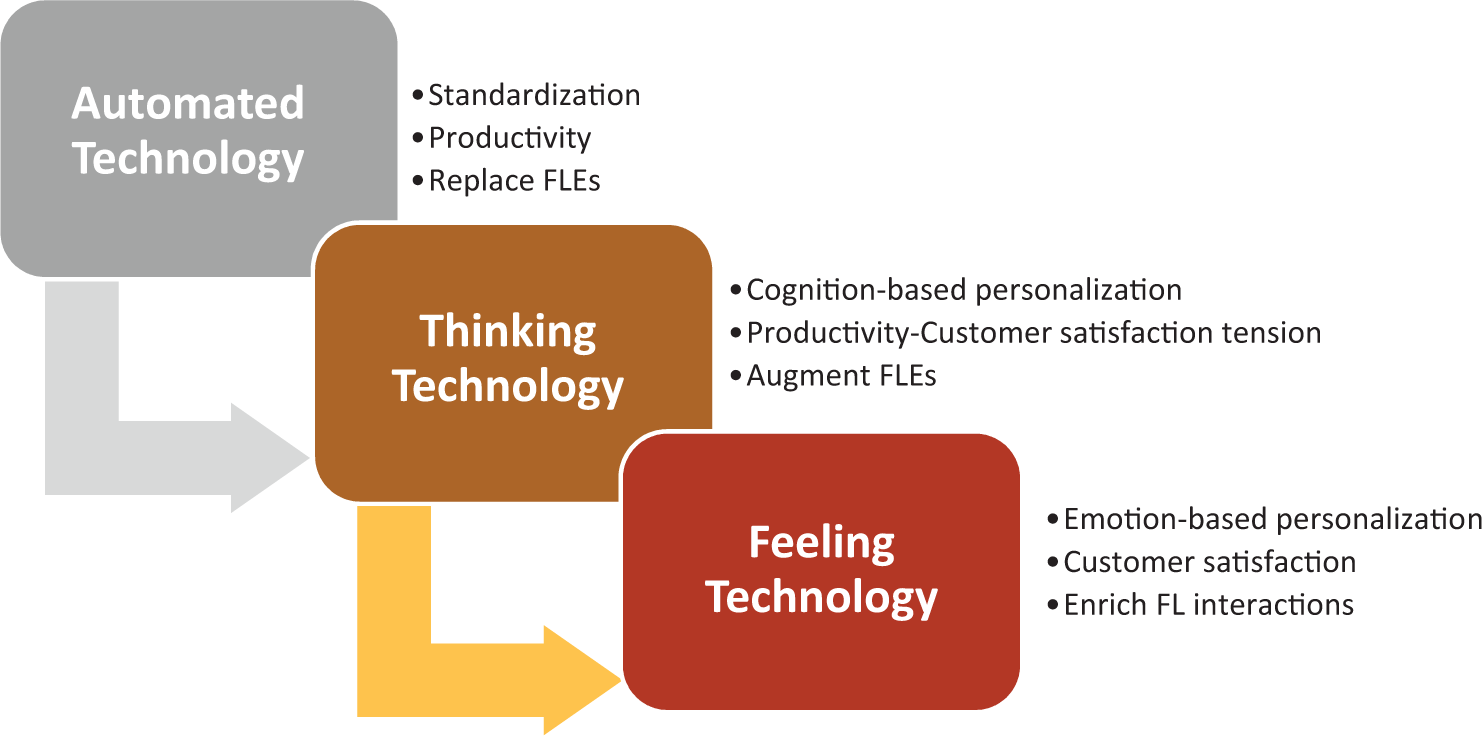
Three-generational technology innovation.
Automated technologies are the traditional (yesterday’s) frontline technologies. They were mainly developed for productivity, which achieves greater output with less input by standardization. Examples include the use of automatic teller machine, check-in kiosks, and automated telephone menu to replace FLEs.
Thinking technologies are today’s foremost frontline technologies. They are designed to handle cognition-based personalization for customer satisfaction. They are not used to replace FLEs but to augment or empower them. For example, call centers using real-time big data and analytics to match service agents and to tailor service to appropriate customers and credit card companies using mobile apps to create and deliver personalized and location-based coupons in real time during retailing encounters (D’Emidio, Dorton, and Duncan 2015).
Feeling technologies are tomorrow’s frontline technologies. They will be able to handle emotion-based personalization that enriches frontline interactions. For example, computers that mimic facial expressions, and emotionally aware devices, are portrayed in the 2013 science fiction movie “Her,” in which a man is deeply psychologically connected with his emotionally aware digital assistant, which is enabled by mining emotional big data from consumers.
So far frontline technologies have done a better job in automation for standardization, are currently becoming smarter for handling cognition-based personalization, and have mostly untapped potential for dealing with human emotions. As technologies continue their evolutionary path, more personalized and emotionally rich interactions can be enabled. For example, on the customer-technology end, customers can interact virtually with computer-generated FLE faces, equipped with conversational user interfaces for real human-like online frontline interactions, or customers can be served by artificially intelligent robots that can avoid FLEs’ personal mood fluctuations and on the positive side enhance social interaction and engagement. On the employee-technology end, FLEs equipped with feeling technology can collect real-time emotional data, react accordingly, learn over time, and tailor service delivery to customers, such as whether a customer prefers to have conversations or prefers not to be bothered today. Organizations can also deploy feeling technology as a back-end technology to collect and mine big emotional data of employees and customers that better target and position their service based on sentiments.
In conclusion, given the multiplicity of technology, we should not limit ourselves to using automated technology for frontline productivity; instead, we should explore how to use the right technology for the right purpose in the right context by the right frontline employees for the right customers and explore the current boundary conditions to create customer-driven technology innovation. Possible directions for future research to advance OFR include: What would the frontline service strategies be that leverage the nested three-generational technology advancement? Technologies compete and collaborate with each other and with FLEs, and optimal service strategies need to be sought. How to collect and analyze emotional data, act and react, and learn from it over time to deepen customer interactions is a challenge for frontline research. This typically involves multidisciplinary collaboration, including experts from marketing, HR, computer science, and neuropsychology, among others. Whether feeling technology will replace or enrich FLEs is still a major concern of many people. A thinking robot is intimidating, not to mention a robot that can think and feel. Is it possible that someday we simply have high-touch interactions with machines? The macrosocietal impact and micromarketing impact of feeling technology on frontline research need to be studied to clear the cloud of this concern.
The Age of Smart Products and Services: Changing Expectations
Dhruv Grewal and Bala Iyer, Babson College
As virtually every product transforms into a smart product that generates vast volumes of data, service providers encounter new customer expectations, purchases, and usage behaviors. In particular, the ready availability of information, gathered from smart products, social media, and other data collection technological advances, has raised the bar on consumers’ service expectations. To respond, companies and researchers must interpret and make sense of these data, integrating them with relevant, complementary information to derive a 360° view of the customers. This information often spans multiple systems and multiple organizations, and integrating the information from all these sources can be costly and difficult, although the arrival of application programming interfaces (Iyer and Wyner 2012)—technical mechanisms that enable companies to selectively share and provide controlled access to their data and services with third parties and partners—is changing this value equation.
Where is this information coming from? Some of it is coming from the product itself, as we now have the ability, using the Internet of things, to collect detailed information about products in use (Gubbi et al. 2013). Customer relationship management and other transaction processing systems are capturing some of this information. To add to the influx, social media is generating information about products and services that captures insights, likes/dislikes, arousal levels, and peer influences (Ludwig et al. 2013; Villarroel-Odenes et al. 2015). The ready availability of information raises the customer expectation bar, as they interact with service firms and their frontline employees. Researchers need to explore how integrating both the valence and the arousal levels in the sentiments being expressed on the frontline with customer relationship management data would allow frontline employees and marketers to better serve their customers.
Information on products in use allows companies to anticipate problems and provide many services. Smart cars collect data on engine performance and passenger driving habits, which should enable them to contact a service station as needed to schedule a service appointment and then send the relevant customer information to the service providers. Frontline researchers need to explore how service providers can provide such offers to increase customer satisfaction and encourage purchase.
The key data for service providers include customer demographics, product/service usage, likes/dislikes, peer opinions, and locations. When companies understand the various sources of these data and integrate them, they can improve their service offers to customers. In turn, data management and analytics capabilities will prove instrumental for supporting the next generations of smart products and services (Parise, Iyer, and Vesset 2012). Products in constant contact with manufacturers, retailers, and service providers can adapt and produce better solutions as well as achieve minor upgrades and maintenance services.
In response, service researchers should consider exploring the following topics:
Big data and analytics: As more and more firms commit to developing big data storage, computing, and analytical capabilities, it will likely lead to data visibility and usability across all levels. For example, the Kroger-Dunnhumby partnership exemplifies a strong organizational commitment by Kroger to build its big data and analytic capabilities. Thus, frontline researchers need to explore what would be optimum strategies for employees to use the data to improve their interface with customers. Furthermore, how does the enhanced usability translate into greater loyalty and profitability?
Processing data: Most firms can deal with structured data, but they might learn more from the vast and difficult-to-analyze volume of unstructured data (e.g., reviews, tweets, blogs, and e-mails). Appropriate sentiment analysis and natural language coding algorithms can uncover insights. Again, the arena for sentiment analysis in the service domain, such as service failure and recovery efforts, is a ripe area for future research.
Predictive analytics: Customers will accept offers that reflect their prior behaviors and relevant contextual information, such that acceptance reflects human psychology more than segmentation. Then, accepted offers can provide service providers a better understanding of how unique human traits lead to acceptance of a service offer. Research needs to explore the various characteristics of offers by frontline employees that ultimately enhance acceptance of the offer and generate improved loyalty.
Real-time design and delivery capabilities: The service design and delivery platform can be designed to combine direct marketing, e-mails, mobile ads, short message service, in-store offers, and in-person offers. Such alignments will provide service providers an effective offer management system that can better organize and align their service provision. Recent research has highlighted the personalization-privacy paradox (Aquirre et al. 2015). Thus, frontline researchers need to better understand what types of offers will provide greater personalization benefits and activate less privacy concerns.
Interconnected customers: Increasingly, customers are connected via social media networks. Outbound marketing techniques are failing, and influencers are playing an increased role in product choice. Additional research is needed to understand how brands can be built in the age of connections and influence. Customers are simultaneously participating in multiple networks like Twitter, Facebook, LinkedIn, or even multiple communities within them. What kinds of networks are influential for branding a particular product or service?
As firms think about how to make their product and service offerings smarter, they will need to pull information from every service encounter and store it in corporate databases, then leverage these databases, together with other sources of information, to provide insights that help the firm and its service personnel anticipate customer needs and find appropriate solutions. Researchers need to investigate how customer expectations are changing and how frontline service personnel can use these technological solutions to anticipate and satisfy these evolving needs and expectations.
A Call for “Practice-Driving” Organizational Frontline Research
A. Parasuraman, University of Miami
Rapid technological advances in the service arena and the increasing incidence of technology-driven service provision and frontline practices have profound implications for OFR. Research examining the consequences and implications of technology-induced changes abound in the scholarly literature—for example, see Meuter et al. (2000, 2005) focusing on self-service technologies (SSTs) vis-à-vis conventional service encounters involving employee-customer dyads, Belanger and Crossler (2011) examining issues surrounding the privacy of individual-level data, and Patel, Asch, and Volpp (2015) discussing the nature and extent of the impact of wearable devices on health-related behavior.
Scholarly research such as that cited above offers important insights for researchers and practitioners interested in technology-triggered changes at the service organization-customer interface. However, such research to date has primarily been practice-driven—rather than practice driving—in that technological advances and associated changes at organizational frontlines have typically preceded scholarly research on the implications of those changes. In the realm of technology-induced modifications at the organization-customer interface, scholarly research has focused primarily on post hoc assessments of the antecedents and consequences of those modifications. There is a pressing need—and a great opportunity—for more practice-driving OFR that (a) transcends specific contexts and technologies and (b) generates general insights and frameworks that can serve as theoretically sound bases for organizations to evaluate beforehand potential benefits and pitfalls of specific technology-based solutions pertaining to the customer interface.
At a fundamental level, a research-based articulation of what constitutes an organizational “frontline” in a continuously evolving, technology-driven context would be beneficial. For instance, should the frontline construct be limited to customer-facing employees or should/could it be broadened to encompass electronic interfaces such as SSTs and virtual service representatives? What about backstage, behind-the-scenes employees who support customer-facing employees and/or electronic interfaces? What about employees who design, operate, and/or monitor electronic interfaces (e.g., virtual service agents) and open social platforms (e.g., Facebook, Twitter) with which customers interact? What about machine-to-machine communications (e.g., between an Internet-enabled refrigerator and an online grocery store) that results in automated delivery of information, products, or services to a customer?
Developing a comprehensive typology of different kinds of frontlines, along with managerial guidance vis-à-vis the most appropriate frontline type(s) for different organizational contexts and contingencies, is one example of potentially practice-driving OFR. Such a typology can also serve as a springboard for further practice-driving OFR on critical issues such as the evolving (perhaps vanishing) role of the traditional frontline employee (Ostrom et al. 2015). For instance, will traditional service employees be relegated to dealing with service problems and exceptions as routine service transactions are increasingly handled through SSTs and service robots? If so, what are the implications for human resources management (HRM)—recruiting, training, evaluating, and rewarding service employees?
Rapid technological advances are also permeating HRM practices far ahead of research-based evidence to assess their effectiveness. A case in point is the growing use of people analytics, “the most buzzed-about buzzword in HR circles at the moment” (Gray 2015, p. 44), by companies such as JetBlue to recruit the most suitable frontline employees. Based on a combination of a variety of individual-level data (including responses to extensive batteries of personality tests) and sophisticated statistical analyses to mine those data for discernable patterns, people analytics generates predictive algorithms for categorizing recruits according to their likely performance on criteria such as customer satisfaction. While there is a fast-expanding people-analytics industry that offers recruiting assistance to organizations, research-based guidance for rigorously examining the logic underlying the technique and its robustness is sparse at best. Instead, the business community apparently has “nearly unbridled faith in data…[wherein] correlation is king, even when causation is far from clear” (Gray 2015, p. 44).
Some prominent HR professionals have raised cautionary flags in this regard, spotlighting the need for practice-driving OFR that precedes and guides business decisions. For instance, according to Laszlo Bock, senior Vice president of people operations at Google, Google can tell you with very high confidence what phrase you are going to type, six letters in. [But] on the people side, the levels of confidence are very, very different…[and] the impact is much greater. If I get a bad auto-suggest, my life doesn’t change. But if somebody makes a bad assessment based on an algorithm or a test, that has a major impact on a person’s life…If you could figure out a robust way to assess people’s capabilities…and if you could actually assess what makes people perform well…you could go a long way to[wards] matching people to jobs…You need to actually understand how jobs and employment work…. (Quoted in Gray 2015, p. 46)
Assessing the Impact of AR on the Organizational Frontline
Ko de Ruyter, Cass Business School, London City University, United Kingdom
A new vision on both the off-line and online service experience is emerging. This vision extends customer perceptions to include a virtual overlay of the servicescape, adding or subtracting visual and/or verbal information to it. Car dealers, for example, are introducing mobile apps that allow customers to view how different wheel designs look on their favorite model or see how the air flows over the car’s body. When taking the car for a test drive, information is projected on the windscreen that is relevant to the ride, X-ray vision in the rearview mirror allows for effortless parallel parking. Customers who browse the Ikea website can embed an image of their sofa of choice within a picture of their living room on their tablet. In the process, they can also opt to change the color of their wallpaper and mark up a picture of themselves with the latest pair of Ray-Ban sunglasses.
These functionalities are commonly referred to as AR. AR is the application of mobile and wearable technologies that enable real-time and virtual enhancement of sensory perceptions of the physical reality (Poncin and Mimoun 2014). As companies are starting to add AR applications to their frontline operations, recent industry reports predict AR will be established firmly as a pivotal customer experience design technology. At same time, initial AR technology failures (e.g., Google Glass) and a fear of overloading consumers with too much sensory information feed the growing skepticism about how customers can derive value from AR. As a result, there is a pertinent managerial need to gain in-depth insight into how AR can play a value-added role in service experience and to uncover the underlying mechanisms that drive this role.
The extant literature has focused primarily on how AR technology can be applied by companies as a way to augment back-office operations. There is virtually no research that recognizes that AR also has the opportunity to influence the dynamics of the frontline service encounter and empower consumers to actively shape their own service experience (e.g., by viewing that sofa in the context of their living room) and make choices that are consistent with personal goals and/or contribute to their well-being. Initial lab experiments show that respondents who view product assortments in a “simulated” supermarket through the screen of a mobile app make healthier food choices. For instance, removing the color from all but the healthier options and thus reducing the influence of packaging and product shelf positioning empowers customer to make the choices that are consistent with their diet and lifestyle goals. Empowering customers to add a virtual layer to the service delivery mix and foster “better” decisions provides a real opportunity for service providers to, for example, allocate weight watchers’ points to each product or include peer reviews.
As the opportunities to augment the service delivery reality abound (Huang and Liao 2014), future research is needed to provide theoretical and empirical anchoring. As a first direction for future research, I argue that the emphasis should be on the psychological mechanisms that contribute to the transfer of technological functionalities to customers’ value experience (Schwarz 2006). It is essential for the effectiveness of AR that people suspend their disbelief and become convinced that what they are experiencing is real and authentic. A central concept is presence, or the development of a sense of being there (Schultze 2010; Wirth et al. 2007). Customers will only experience the benefits of an AR-enabled service (e.g., choosing healthy food options while shopping) in case they are able to accept and believe that superimposed virtual objects or information are an integral part of their reality. Secondly, future research should consider AR’s implications for frontline employees and investigate whether it enables employees to work more productively. Future research designs could focus on information processing and sorting tasks to see whether AR assists increasing productivity while reducing error rates. Thirdly, it could be examined whether AR can be used to safeguard financial or safety compliance in encounters with customers. Fourthly, regarding the relationship between AR and employee engagement, research is needed that assesses whether the use of AR results in higher levels of psychological empowerment, motivation, reduced mental effort, and even decreased role stress (e.g., measured in terms of physical parameters, such as average heart rate variability). Finally, taking a dyadic perspective, future research could examine how trade-offs between (information) control, privacy concerns, and empowerment are made in frontline service encounters and redefine the roles of both employees and customers.
Footnotes
Authors’ Note
Although the commentaries are titled separately, the article is meant to be considered as a whole, with the correct citation being, Rafaeli, Anat, Daniel Altman, Dwayne D. Gremler, Ming-Hui Huang, Dhruv Grewal, Bala Iyer, A. Parasuraman, and Ko de Ruyter (2016), “The Future of Frontline Research: Invited Commentaries,” Journal of Service Research.
Declaration of Conflicting Interests
The author(s) declared no potential conflicts of interest with respect to the research, authorship, and/or publication of this article.
Funding
The author(s) received no financial support for the research, authorship, and/or publication of this article.