




Abstract
Service interactions run a gamut from an instrumental self-focus to full social appreciation. Observing another customer’s incivility toward a frontline employee can emphasize social concerns as guiding principles for the observer’s own service interaction. Five studies test these dynamics; the results reveal that an incivility incident leads observers to prioritize social over market concerns. This reprioritization becomes manifest in a subsequent service interaction through increased feelings of warmth toward the employee who experienced incivility. In turn, feelings of warmth prompt observers to provide emotional support to the affected employee. Yet such prosocial inclinations are less likely when an employee is held responsible for or reciprocates incivility. Finally, this article also examines the effects of different employee reaction strategies on observers’ inferences about the employee and the service firm, showing that observers are most positively disposed toward the employee and the firm when the former reacts to incivility with a polite reprimand. Together, the results suggest that, contrary to past theorizing, observing customers may contribute to employee well-being, contingent on appropriate employee responses. Notably, the commonly prescribed polite, submissive employee reaction that requires emotional labor may not be the most desirable reaction—neither for the employee nor for the firm.
Keywords
Services are fundamentally social interactions as the two parties in a service exchange are basically two people (Bradley et al. 2010; Czepiel 1990; McCallum and Harrison 1985). However, service interactions are not like all other social interactions because they are imbued with market concerns, which are likely to attune customers to the instrumental value of a customer service employee, rather than to an employee’s well-being (Bauer et al. 2012; Clark 1984; Heyman and Ariely 2004; Solomon et al. 1985). Customers regarding employees as an element of the service equation, rather than as human beings, may explain the troubling phenomenon of customer incivility 1 (Haque and Waytz 2012), which manifests as rude and condescending behaviors toward employees (e.g., Walker, van Jaarsveld, and Skarlicki 2013). Customers are frequent instigators of interpersonal mistreatment of employees in the workplace (Grandey, Kern, and Frone 2007). Uncivil customer behaviors pose severe threats to employee well-being (Lim, Cortina, and Magley 2008), challenge quality management, and affect service firms’ bottom line (Pearson and Porath 2009). Theoretical accounts suggest that these negative effects can be magnified by the behavior of observing third parties (i.e., other customers) who adopt similar disrespectful behaviors (Andersson and Pearson 1999; Elfenbein 2014).
In contrast with such accounts, and drawing from social psychology and service research (Batson 2014; Ijzerman and Semin 2009; Solomon et al. 1985), we argue that observed incivility may shift customers’ instrumental self-focus to a socially oriented other-focus, thus making salient the basic, social nature of service interactions. We further propose that feelings of warmth (Ijzerman and Semin 2009) represent the most important manifestation of this prioritization of social concerns in customer service interactions. Specifically, we predict that observing another customer’s uncivil behavior leads observers to feel more warmth toward a victimized employee, which in turn stimulates prosocial, emotionally supportive behaviors toward that employee. Thus, observers can be potential sources of alleviation rather than aggravation of employee well-being, in that they display more rather than less prosocial behavior toward a targeted employee.
Customer emotional support has great practical relevance, with potential restorative effects on employees’ well-being that can counteract the harmful effects of incivility by other customers (Lilius 2012; Zimmermann, Dormann, and Dollard 2011). We show that customers’ inferences of an employee’s warmth are crucial in guiding their emotional support behavior. Our results also suggest that characteristics of the situation shape these inferences, and we identify two important moderators: blame and the employee’s response to customer incivility.
We contribute to existing knowledge on service interactions and customer incivility in four important ways. First, by focusing on observer reactions to customer incivility, we contribute to research on the social nature of discrete service interactions (Czepiel 1990; Grandey et al. 2005; Solomon et al. 1985). Our findings that incidents of customer incivility prompt observers to adopt prosocial behaviors offer strong evidence that incivility can shift a behavioral script toward a more social focus. Second, in response to repeated calls to examine the potential effects of uncivil customer-employee exchanges on bystanders (Fisk et al. 2010; Groth and Grandey 2012; Schilpzand, De Pater, and Erez 2016), we show that observing customers may be stress alleviators rather than additional stressors for targeted employees. Third, in the context of research on the effect of uncivil customer behavior on observers (Harris and Reynolds 2003; Porath, MacInnis, and Folkes 2010), we identify warmth as a dimension that guides observers’ anti- and prosocial behaviors. Fourth, we offer insights into reactions that service managers can prescribe for employees who encounter customer incivility, beyond standard, polite, and submissive responses that emotional labor literature has described (Grandey, Kern, and Frone 2007). We demonstrate that employee responses that highlight inappropriate behaviors of customers may be more effective for both employees and firms.
Conceptual Background and Hypotheses Development
The Role of Warmth in Service Interactions
Service interactions tend to be task focused, with clearly defined goals and deindividuated behavioral patterns (i.e., scripts) that are agreed on by society (thus implicitly binding customers and employees; Schau, Dellande, and Gilly 2007; Solomon et al. 1985). Customers at times even hold a “customer is king” mind-set, which can deviate considerably from general social concerns with equality and mutual respect (Kern and Grandey 2009). That is, when people assume the role of customers, they are likely to be less attuned to social concerns in their interactions (e.g., Bauer et al. 2012; Heyman and Ariely 2004). However, some events can increase the extent to which customers consider an employee’s human experience, and we propose that the incivility of another customer toward an employee is one such event. Observing customer incivility toward an employee can break the normative script of a service interaction (Solomon et al. 1985), in which self-focused market concerns dominate other-focused social concerns and attune an observer to the social nature of the situation. This is because incivility creates a sense of discomfort for observers and a sense that something wrong is happening (De Waal 2008; Goetz, Keltner, and Simon-Thomas 2010; Hoffman 1978). People tend to have an automatic reaction to such antisocial behaviors and situations, even if they are not personally affected by these situations (Cropanzano, Goldman, and Folger 2003). Such dynamics are likely to unfold when customers observe another customer act in an uncivil manner toward a customer service employee. Thus, we predict that as incivility increases customers’ attunement to their social surroundings, they will be increasingly guided by social concerns after witnessing an uncivil customer-employee interaction. Formally,
If observing incivility increases observers’ attention to the social context of their environment, the question is how this might affect their interaction with the frontline employee. We argue that observing incivility highlights the employee as a person and endows the situation with affective valence for an observing customer, thereby eliciting spontaneous feelings and acts (Solomon et al. 1985). Thus, a disruption to standard service by customer incivility may lead an observer to recognize the employee as a human being and not merely as a (deindividuated) organizational representative. As such, we propose that the increased saliency of the social nature of the interaction between a customer and an employee induces warmer feelings toward the employee.
Feeling warmth toward another person represents “one of human beings’ most central abstract ideas” (Ijzerman and Semin 2009, p. 1214). Holding warm (vs. cold) feelings toward another person reflects the social proximity (distance) of the perceiver to the target person. Thus, a socially oriented other focus is associated with warmth, and an instrumental self-focus is associated with coldness. Feeling more warmth toward another person who has been hurt (i.e., the employee) predicts helping behaviors (Batson et al. 2007; De Waal 2008). Customers who experience warmth toward an employee are likely to act in supportive ways; customers who do not feel warmth, or feel coldness, toward an employee are likely to refrain from engagement beyond service-relevant, instrumental interactions. Thus, an uncivil interaction will augment observers’ feelings of warmth toward a victimized employee and, in turn, increase their emotionally supportive behavior. Formally,
Blame as a Boundary Condition to Prosocial Observer Reactions
Exploratory work on the effect of uncivil customer behavior on bystanders supports Hypotheses 1 to 2b, in that employees reported that customer observers sympathize with victimized employees when they notice customer incivility (Harris and Reynolds 2003). However, less common instances of observers not displaying prosocial behavior are also reported, suggesting that particular situational factors can determine whether and when increased social concerns lead observers to feel warmth and offer emotional support toward an employee.
One such factor might be customer blame attributions toward a service employee or an organization in response to a service failure (Bitner 1990; Gelbrich 2010; Joireman et al. 2013; Strizhakova, Tsarenko, and Ruth 2012). Attributing blame involves identifying who is responsible for an event (Weiner 2013). A customer observing customer incivility and ascribing the blame for the service failure to the employee likely presumes that the employee deserves the uncivil treatment (Porath, MacInnis, and Folkes 2011) and may be less likely to offer support to the employee. Blame attributions similarly can attenuate a perceiver’s positive affect and helping behavior toward the target employee (Weiner 1980). Appraising the uncivil interaction in a manner that deprives the victim of the deservingness to be helped leads observers to refrain from approaching the victim and feeling warmth toward him or her (Goetz, Keltner, and Simon-Thomas 2010). Therefore, regardless of increased social concerns, observers who blame an employee for poor service that gives rise to customer incivility are likely to feel less warmth toward the employee and are less likely to offer emotional support than observers who ascribe the blame to a source outside the employee’s control (e.g., to the service organization). Formally,
Efficacy of Different Employee Responses to Customer Incivility
Additional boundary conditions in the context of service interactions are likely to counteract a victimized employee’s deservingness of help (Goetz, Keltner, and Simon-Thomas 2010). One such factor is the reaction of an employee to customer incivility. Examining employee responses is important and critical, because companies rarely provide employees with guidelines and scripted reaction strategies of how to best react to rude customers (e.g., Pearson and Porath 2005), though customer sovereignty and emotional labor prescriptions urge employees to suppress and regulate their reactions (Rafaeli and Sutton 1987). By default, employees are likely to display subservient behavior toward customers in service interactions (Shamir 1980); however, they may also resort to a quid pro quo response to incivility (van Jaarsveld, Walker, and Skarlicki 2010), and such reciprocation may undermine observers’ helping behavior (Goetz, Keltner, and Simon-Thomas 2010; Porath and Erez 2007). Indeed, rude employees are frequent triggers for customer anger and therefore are likely to receive decreased observer warmth and emotional support in the face of incivility by another customer (Menon and Dubé 2000).
Figure 1 provides an integrated overview of our predictions. To test these predictions, we conducted five experiments. Our approach complements previous research that documents incivility in an aggregated form, rather than in a specific service encounter (e.g., Walker, van Jaarsveld, and Skarlicki 2013), and with data collected from employees and focusing on employee-relevant outcomes (Schilpzand, De Pater, and Erez 2016). We investigate the consequences of observing incivility for customers’ prioritization of social over market concerns as well as the implications for their own interaction with a service employee. In doing so, we uncover underlying mechanisms and boundary conditions as advanced in Hypotheses 1 to 4. Table 1 provides an overview of the main studies and the hypotheses they address.
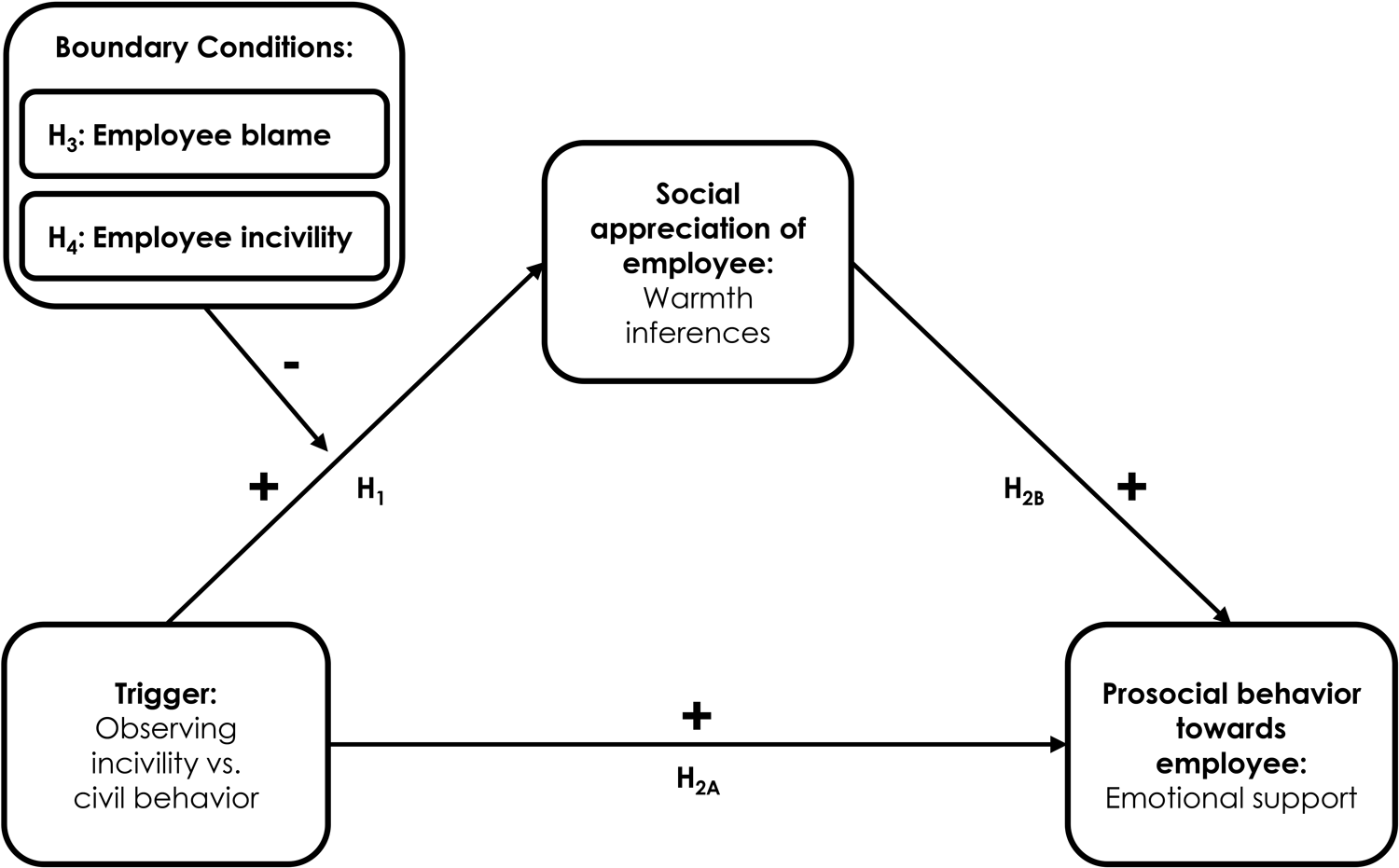
Overview of main research model: Incivility as a trigger to social customer-employee interaction.
Overview of Studies, Tested Hypotheses, and Results.
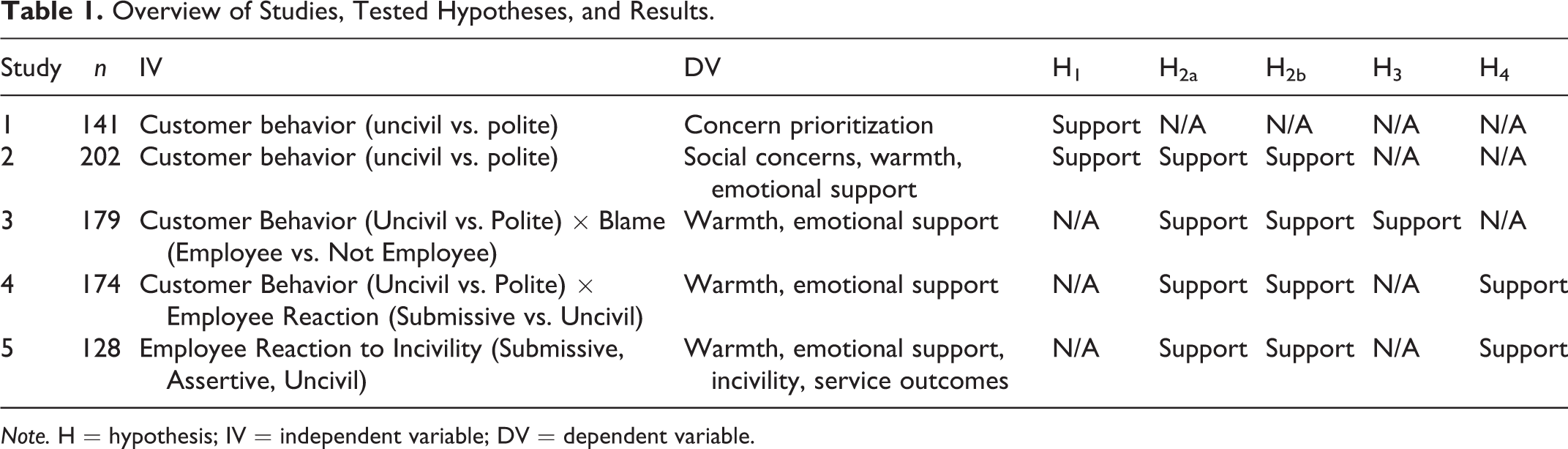
Note. H = hypothesis; IV = independent variable; DV = dependent variable.
Study 1: Prioritization of Social Over Market Concerns
Study 1 offers initial support for the notion that customer incivility focuses observing customers on the social nature of a service situation. Specifically, it shows that (1) market concerns dominate over social concerns in regular marketplace interactions and (2) among customers observing an incivility episode, the opposite pattern occurs, and social concerns dominate over concerns.
Participants, Design, and Procedure
We randomly assigned 141 students (57.4% female, Mage = 20.5) at a large Dutch university, who received partial course credit for participation, to one of the two customer service scenarios in a retail clothing store: uncivil and civil. All participants were asked to imagine that they were waiting in line for a fitting room behind another customer who was only carrying a T-shirt. They were then asked to envision a store clerk inviting the customer ahead of them to enter the changing rooms by saying, “You may go in now. How many items do you have? Only one?” at which point the incivility manipulation was introduced. In the civil condition, the customer replied in a friendly tone, “Indeed, I only have one.” In the incivility condition, the customer replied in a hostile tone, “Can’t you count? One.” A manipulation check confirmed that participants perceived the customer’s behavior in the incivility condition as significantly less respectful, considerate, and polite (α = .96, adapted from Porath, MacInnis, and Folkes 2011) than that in the civil condition, Muncivil = 1.85, Mcivil = 5.03; t(137) = 13.79, p < .001.
Dependent Measures
After reading the scenario, participants were asked about guiding principles that would be important to them in this specific shopping situation. They responded to a 10-item measure, with 5 items representing self-focused market exchange principles and 5 items representing other-focused social principles (adapted from Diekman et al. 2011). The social concern items were “serving community,” “altruism,” “helping others,” “connecting with others,” and “attending to others” (α = .77); the instrumental exchange-related items included “status,” “focus on the self,” “independence,” “financial reward,” and “individualism” (α = .70). All items were presented in random order, each followed with a 7-point response scale (1 = not at all important, 7 = extremely important).
Results
We conducted a mixed analysis of variance with the incivility (vs. civil) manipulation as a between-subjects factor and the social (vs. market exchange) principles measure as a within-subject factor to test for the relative importance of the respective guiding principles in each situation. As expected, we found a significant interaction effect, F(1, 137) = 9.47, p < .01, and simple effects confirmed that customers who observed incivility prioritized social over market concerns (Mmarket = 4.08, Msocial = 4.46, p < .05), while for customers who observed an ordinary civil interaction, the default emphasis was on individual, market exchange issues (Mmarket = 4.45, Msocial = 4.03, p < .05). No other effects were significant (all F < 1, all p > .77).
Discussion
Study 1 provides initial support for our theoretical framework by showing that customers are guided by market concerns in regular service interactions, whereas witnessing customer incivility induces them to prioritize social concerns. The following studies build on this framework to investigate the immediate dynamics of observing incivility in a customer’s interaction with a service provider.
Study 2: Implications of Heightened Social Concerns for the Service Interaction
Study 2 promotes two goals: First, it provides a conceptual replication that observing an uncivil (vs. civil) episode increases observers’ attention to social concerns. Second, it documents the immediate consequences of increased, other-focused social concerns on an observer’s own interaction with an employee. Our prediction is that the saliency of the social nature of the interaction induces an observing customer’s feelings of warmth and expression of emotional support for an employee who experienced incivility by another customer. Study 2 used the same manipulation as in Study 1 and tested its effects on feelings of warmth toward and social appreciation of the employee by participants acting as observers of the interaction.
Participants, Design, and Procedure
A sample of 202 students (62.4% female, Mage = 21.1) at a large Dutch university, who received partial course credit for participation, was randomly assigned to one of the customer service scenarios described in Study 1. A manipulation check again confirmed that participants perceived the customer’s behavior in the incivility condition as significantly less respectful, considerate, and polite (α = .98) than that in the civil condition, Mcivil = 4.78, Muncivil = 1.39; t(200) = −3.06, p < .01.
Dependent Measures
After reading the scenario, participants completed three dependent measures. First, we measured social concerns by asking participants to describe what came to mind when they read about the situation in the clothing store. We analyzed these written responses using the linguistic inquiry and word count text analysis program (Tausczik and Pennebaker 2010), which allocates each word in a given text to classifications of words included in its internal dictionary. To measure participants’ social concerns, we examined the presence of social words (i.e., words belonging to the social category, such as “friendly,” “he/she,” “help,” “interpersonal,” “person,” “talk”) in their descriptions (Lasaleta, Sedikides, and Vohs 2014). To account for varying lengths of the thought protocols, we calculated the percentage of social words from the total number of words.
Second, we captured participants’ feelings of warmth toward the employee following the protocol of social relation mapping studies. Participants rated their feelings on a continuous feeling thermometer, from 0 (cold) to 100 (warm; Ijzerman and Semin 2009; Weisberg and Rusk 1970).
Third, we assessed emotional support toward the employee using 5 items on which participants rated the likelihood that they would offer emotional support to the employee. Sample items adapted from Rosenbaum and Massiah (2007) were “How likely are you to…cheer up the employee/reassure the employee/tell the employee not to lose courage/show your understanding to the employee/sympathize with the employee?” (α = .81). Table 2 provides an overview of the key measures employed in Studies 2 to 4.
Means, Standard Deviations, and Cronbach’s α of Key Measures Across Studies.

Note. N/A = not applicable.
Results
An independent samples t-test with the amount of social words as the dependent measure and the incivility manipulation as the independent variable lent further support to Hypothesis 1; observers used significantly more social words in the incivility condition than in the civil condition, Muncivil = 6.68, Mcivil = 4.84; t(200) = 17.49, p < .001. A sequential mediation analysis verified that the increased social concerns led to increased feelings of warmth and emotional support. The analysis comprised bootstrapping (Hayes 2013, PROCESS Model 6) with 1,000 samples and customer behavior (0 = civil, 1 = uncivil) as the independent variable, percentage of social words as the first mediator, warmth as the second mediator, and emotional support as the outcome variable. The results verify our theory: The indirect effect (IE) of observed customer behavior through the use of social words, via warmth, on emotional support was significant (95% confidence interval [CI] = [0.02, 0.10]; IE = 0.05).
Discussion
Study 2 results provide support for Hypotheses 1 to 2b: Observers of customer incivility show increased social concerns, and these concerns manifest themselves as feelings of warmth toward a targeted employee, leading to the provision of emotional support to the employee. The following studies enhance external validity of these findings and examine boundary conditions to our theory.
Study 3: Blame as a Boundary Condition
Study 3 tested Hypothesis 3 by examining blame as a boundary condition for increased social appreciation of the employee. We propose that employee responsibility for the other customer’s uncivil behavior counteracts an observing customer’s social concerns by reducing feelings of warmth toward the employee. To enhance external validity, Study 3 tested our theory with a nonstudent sample from a different cultural context.
Participants, Design, Procedure, and Measures
U.S. consumers (n = 179, 58% female, Mage = 36.1) responded to an online experiment on Amazon Mechanical Turk (MTurk); this online panel offers high-quality and representative data (Buhrmester, Kwang, and Gosling 2011; Paolacci and Chandler 2014). The study featured a 2 (customer incivility: present vs. absent) × 2 (poor service: employee blame vs. employee no blame) between-subjects design. Participants read one of the four randomly assigned scenarios describing an encounter between a customer and an employee in a retail clothing store. They were asked to imagine that they were waiting in line for a fitting room behind another customer who was not granted access by the employee. The employee no blame condition revealed that all the changing rooms were occupied; in the blame condition, not all changing rooms were occupied. In the civil condition, the customer addressed the clerk in a friendly tone: “Excuse me, would you be so kind to let me in?” In the incivility condition, the customer addressed the clerk in a hostile tone: “What, are you stupid? Let me in already!” The dependent measures assessing emotional support (α = .93) and warmth were identical to Study 2 (see Table 2), and all responses were on 7-point bipolar scales (1 = strongly disagree, 7 = strongly agree).
The manipulation checks confirmed that participants in the blame condition perceived the employee as significantly more to blame, responsible, and at fault for the customer not getting immediate access to a changing room (α = .97, Lei, Dawar, and Gürhan-Canli 2012) than those in the no blame condition, Mblame = 5.11, Mno blame = 3.10; F(1, 178) = 50.98, p < .001. At the same time, they perceived the employee as more to blame in the civil versus the incivility condition, Muncivil = 3.69, Mcivil = 4.57; F(1, 178) = 9.29, p < .01. Importantly, the interaction effect was not significant (p > .84). Likewise, participants perceived the customer described in the incivility condition as significantly less respectful, considerate, and polite (α = .99) than the customer in the civil condition, Muncivil = 1.16, Mcivil = 5.14; F(1, 178) = 404.74, p < .001. The main effect for incivility and the interaction effect with blame were both insignificant (all p > .61).
Results
Participants in the incivility condition reported offering significantly more emotional support than those in the civil condition, Muncivil = 4.66, Mcivil = 2.94; F(1, 178) = 52.15, p < .001, in further support of Hypothesis 2a. In addition, participants who witnessed an uncivil customer reported more warmth (Muncivil = 69.60) toward the employee than those who witnessed a civil customer, Mcivil = 48.36; F(1, 178) = 47.26, p < .001, in further support of Hypothesis 2b. The main effects of blame were not significant for both emotional support and warmth (all p > .32), and these effects were qualified by a marginally significant interaction effect on warmth, F(1, 178) = 2.94, p = .088.
In support of Hypothesis 3, an analysis of simple main effects revealed that in the uncivil customer condition, participants ascribed almost 10 scale points less warmth to the employee in the blame condition, Mblame = 65.44, Mno blame = 73.84; F(1, 88) = 3.50, p = .065, whereas there was no difference in the civil condition, Mblame = 49.43, Mno blame = 47.19; F(1, 87) = .08, p > .77. A test of the moderated mediation prediction, with customer behavior (0 = civil, 1 = uncivil) as the independent variable, warmth as the mediator, blame as the moderator, and emotional support as the dependent variable, using bootstrapping with 1,000 samples (Hayes 2013, PROCESS Model 7), confirmed the significant moderating effect of blame (90% CIuncivil × blame [−20.90, −0.37]), with significant IEs for both levels of the moderator (90% CIno blame [0.94, 1.59]; IE = 1.25; 90% CIblame [0.39, 1.13]; IE = 0.75). Thus, observers discounted warmth inferences when they blamed the employee for a service failure that preceded an observed uncivil interaction.
Discussion
Study 3 affords further support to Hypotheses 2a and 2b: Perceived warmth toward an employee mediates the effect, such that observers of customer incivility offer emotional support to employees. In addition, Study 3 offers evidence of a moderated mediation, as proposed by Hypothesis 3: Blame attenuates the increase of social concerns. Observing customers who hold an employee to blame for an uncivil customer’s behavior are less likely to provide emotional support.
As a final leg of our theory, Hypothesis 4 predicts effects of employees’ reactions to customer incivility on observers’ emotional and behavioral reactions to a targeted employee. Study 4 tests Hypothesis 4 in a controlled setting, and Study 5 offers increased external validity to this test by comparing the effects of different employee reactions on observers’ reactions.
Study 4: Employee Reaction as a Boundary Condition
Study 4 builds on and extends Study 3 by using as stimulus an uncivil incident that arose from a service failure caused by the employee. In addition, Study 4 recognizes potential variations in the degree of hostility in a customer’s uncivil behavior, by adding a comparison of two levels of customer incivility to the civil baseline condition. Comparing a milder form of incivility (rudeness) with a more hostile form (aggressiveness) adds robustness to our test.
Participants, Design, and Procedure
A group of 174 U.S. consumers (61% female, Mage = 34.8), recruited from MTurk, participated in an experiment, with a 3 (customer incivility: rude vs. aggressive vs. civil) × 2 (employee response: polite vs. uncivil) full-factorial, between-subjects design. The instructions asked participants to envision a situation of waiting in line at a Starbucks and observing another customer interacting with an employee. In the rude incivility condition, the customer responded to receiving coffee in a condescending tone: “I won’t drink that. I asked for the coffee with milk foam, not cream. Can you make me the coffee the way I asked for?” In the aggressive incivility condition, the customer replied in a hostile tone “Are you stupid? I said milk foam and NOT CREAM! Dealing with incompetent employees like you really pisses me off! Now, make me the right one!” In the civil condition, the customer merely stated in a friendly tone: “Thanks, but I think you accidentally made the coffee with cream instead of milk foam. Would you please be so kind to fix me the right one?”
The scenarios also included a manipulation of the employee response. In the employee polite reaction condition, the employee took back the coffee and replied, “I am really sorry; of course I will fix you another one right away.” In the employee uncivil reaction condition, the employee said, “Take it or leave it. If you wanna have another one, line up again.” Dependent measures were identical to Study 3 (see Table 2).
Manipulation checks with planned contrasts confirmed that participants rated the customer as significantly less respectful, considerate, and polite (α = .98) in the aggressive incivility condition (Magg = 1.39) than in the rude incivility condition, Mrude = 2.21; F(1, 168) = 9.19, p < .01, and the civil condition, Mcivil = 5.36; F(1, 168) = 132.01, p < .001. Participants also rated the customer as more polite in the uncivil employee reaction condition than in the civil reaction condition, Mcivil = 2.77, Muncivil = 3.10; F(1, 168) = 4.60, p < .05. The interaction effect between customer incivility and employee response was insignificant (p > .48). Participants perceived the customer in the rude incivility condition as significantly more hostile (offensive, aggressive, intended to offend the employee, α = .96) than in the civil condition (Mrude = 4.50, Mcivil = 1.82, p < .001) but as significantly less hostile than in the aggressive incivility condition (Magg = 5.63, p < .001). The main effect for employee reaction and the interaction effect with customer incivility were both insignificant (all p > .59).
Participants also rated the employee as significantly more respectful, considerate, and polite (α = .99) in the civil condition than in the incivility condition, Mcivil = 5.98, Muncivil = 2.25; F(1, 168) = 266.30, p < .001. However, the interaction effect was significant (p < .01), such that participants perceived the employee as equally polite in the polite reaction condition (p > .69) but as significantly more polite when the customer was aggressive (M = 3.16) rather than merely rude (M = 1.90, p < .01) or civil (M = 1.58, p < .001), possibly reflecting a contrast effect in which the aggressive customer made the employee appear more polite (Bless and Schwarz 2010). The difference between the rude incivility and the civil condition in perceived employee politeness was not significant (p > .68).
Results
The results offer further support for Hypothesis 2a, extending our previous results to a different service context; participants in the aggressive incivility condition reported that they would give the employee significantly higher emotional support than those in the rude incivility condition, Magg = 5.06 vs. Mrude = 4.30; F(1, 167) = 9.69, p < .01, and reported emotional support in both incivility conditions was significantly higher than in the civil condition, Mcivil = 3.34; F(1, 167) = 15.17, p < .001.
The results also offer support for Hypothesis 4; participants reported they would offer significantly less emotional support to the employee in the employee uncivil reaction condition, Mcivil = 5.22, Muncivil = 3.25; F(1, 167) = 177.89, p < .001. The interaction effect between customer incivility and employee response was significant, F(2, 167) = 21.33, p < .01. A bootstrapping procedure with 1,000 samples supported the moderated mediation effect of employee reaction to observing aggressive (vs. rude) customer incivility on emotional support through feelings of warmth (95% CI [0.83, 2.09]; IE = 1.45; Preacher, Rucker, and Hayes 2007, PROCESS Model 8). Likewise, moderated mediation was significant when observing rude (vs. civil) customer behavior (95% CI [0.02, 1.18]; IE = 0.48). An uncivil employee response had a negative effect on observers’ reactions, and observing customers were less likely to report they would provide emotional support to the employee, in support of Hypothesis 4.
Discussion
Study 4 confirms that an employee who reacts in a polite way to an uncivil customer may be acting in his or her own best interest; the study shows that observing customers are more likely to offer emotional support to a polite employee. In contrast, employees reciprocating incivility lose the potential of receiving social support from observing customers. Thus, employees who reciprocate incivility not only violate the implicit service protocol for polite behavior but also deprive themselves of potential emotional support from other customers who observe the interaction. These findings shed new light on the merit of emotional labor (Rafaeli and Sutton 1987). Prior research has focused on the troubling effects of emotional labor on employees, in terms of employee burnout and emotional exhaustion (Brotheridge and Grandey 2002); our analysis complements these findings by showing that the investment of effort in responding politely to an uncivil customer can benefit employees’ psychological well-being. Emotional labor increases the likelihood that observing customers will offer emotional support and reduces the chances that they will also engage in uncivil behavior.
The effect of customer incivility on other customers also raises a question about potential training programs. Service organizations need policies that promote multiple criteria (e.g., the firm’s bottom line, employee well-being, customer satisfaction). A polite employee response is presumed beneficial in terms of observers’ emotional and behavioral reactions; however, the realm of polite employee responses to customer incivility includes options beyond standard subservience, and their implications are important to discuss.
First, it is possible to reprimand a customer in a polite way (van Jaarsveld, Walker, and Skarlicki 2010): An employee can respond to customer incivility politely but with an assertive rather than a submissive component. Second, if a reprimand does not have the desired effect on an uncivil customer, a plausible service policy may be “three strikes and you’re out,” threatening to terminate the relationship with selected uncivil customers (Shin, Sudhir, and Yoon 2012). Such policies can empower employees, encouraging polite responses to a customer who fails to comply with previous reprimands. Our final study tests the potential effects of such responses. In Study 5, both alternative employee responses are delivered in a polite way, and we expect them to generate the same levels of warmth and emotional support as a standard, submissive polite response. Thus, we do not formulate specific hypotheses but test the effects of polite employee responses in an exploratory manner, while also testing their implications for a battery of service-relevant outcomes.
Study 5: Nonsubservient Employee Responses to Customer Incivility
Study 5 aims to lend further support to Hypothesis 4 and to show the undesirable effects of uncivil employee responses on observing customers, when the employee is not responsible for a service failure. Study 5 also extends the previous studies, by testing effects of alternative employee reaction strategies on observers, and adds an assessment of effects beyond the warmth and emotional support of observers, thus documenting effects on global service outcomes and suggesting concrete implications for firms’ bottom line. Thus, Study 5 extends the focus of Studies 3 and 4 on boundary conditions to observers’ prosocial behavior toward employees to provide initial evidence of the implications of our theory for the service firm at large.
Participants, Design, and Procedure
Students at a large Dutch university of applied sciences (n = 128, 31.3% female, Mage = 20.9) were asked to watch an uncivil customer service interaction and to report their reactions. To create a realistic context and ensure high internal validity and full control of the dynamic emotional cues, we used videotaped service interactions (Scott, Mende, and Bolton 2013). The videos were set in a retail store and showed a customer acting in an uncivil way while returning some recently bought merchandise. There were four videotapes showing four conditions of employee reactions to customer incivility (polite and submissive, uncivil, polite and assertive, and politely asking the uncivil customer to leave). Participants were randomly assigned to one of the four conditions and asked to imagine themselves in the store watching the situation in the video and then to answer a series of questions.
A professional production company produced the videos in a shoe store, and professional actors played the role of the customer. The video showed the interaction of an uncivil customer with an employee from the perspective of an observing customer. To mitigate gender effects, both the customer and the employee were female. There were four versions of the video, which created the manipulation of the employee reaction: (1) polite and submissive response, with the employee exercising emotional labor (submissive condition); (2) polite and assertive response, with the employee reprimanding the customer (reprimand condition); (3) polite and assertive response, with the employee reprimanding the customer for the disrespectful behavior and demanding she leave the store (leave condition); and (4) impolite response, with the employee responding rudely, reciprocating the customer incivility (uncivil condition). All videos were approximately 1 minute long. The full transcript of the four clips is available in the Online Appendix.
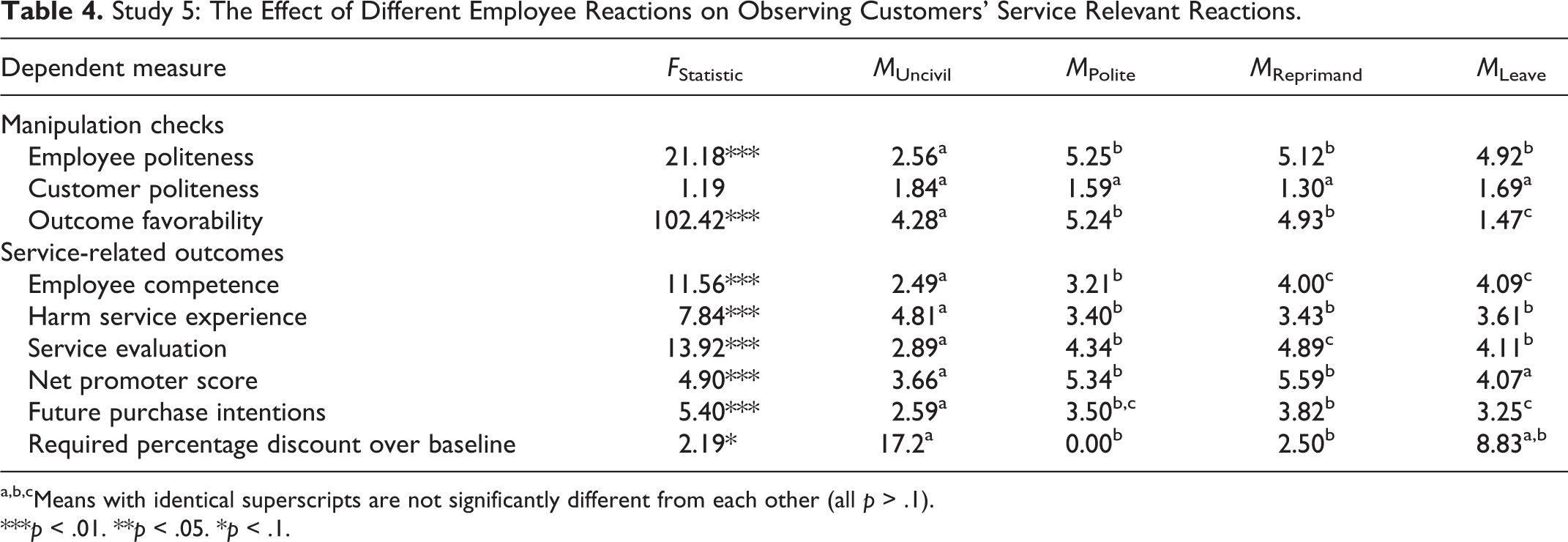
As manipulation checks, we measured perceived customer politeness (similar to the previous studies) and perceived employee politeness. We also conducted a pretest examining the outcome favorability 2 for the uncivil customer’s service interaction across the four employee reactions (Hui et al. 2004). Table 3 reports the corresponding measurement items and statistics. Planned contrasts confirmed that participants perceived the employee as significantly less respectful in the uncivil condition than in the other three (polite) response conditions (see Table 4). Table 4 shows that the participants perceived the customer as consistently uncivil across conditions, while they rated the outcomes of the interaction as significantly least favorable in the leave condition and most favorable in the reprimand and submissive conditions.
Overview of Manipulation Checks and Service-Related Measurement Scales Employed in Study 5.
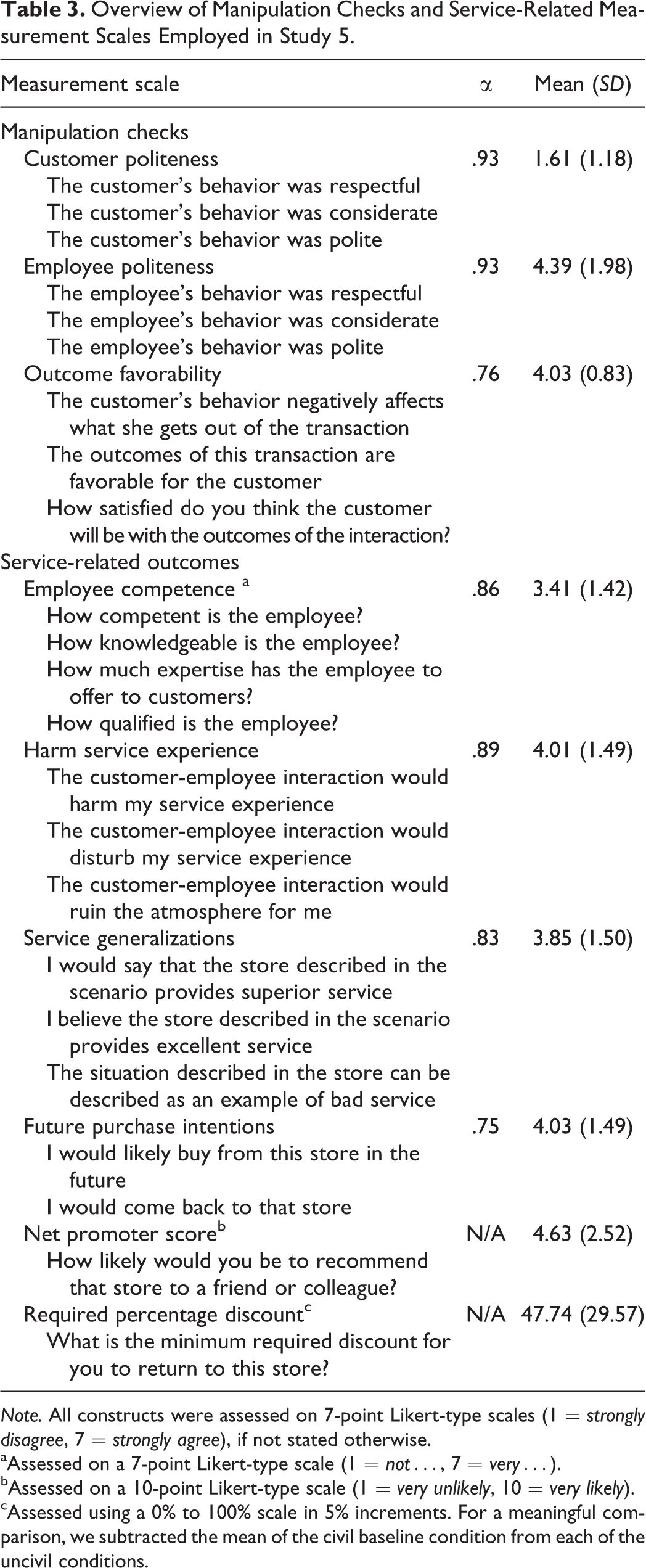
Note. All constructs were assessed on 7-point Likert-type scales (1 = strongly disagree, 7 = strongly agree), if not stated otherwise.
aAssessed on a 7-point Likert-type scale (1 = not…, 7 = very…).
bAssessed on a 10-point Likert-type scale (1 = very unlikely, 10 = very likely).
cAssessed using a 0% to 100% scale in 5% increments. For a meaningful comparison, we subtracted the mean of the civil baseline condition from each of the uncivil conditions.
Study 5: The Effect of Different Employee Reactions on Observing Customers’ Service Relevant Reactions.
a,b,cMeans with identical superscripts are not significantly different from each other (all p > .1).
***p < .01. **p < .05. *p < .1.
Dependent Measures
After watching the video clip, participants responded to the same measure as in Studies 2 and 3, reporting the likelihood they would offer emotional support and how much warmth they felt toward the employee. They also responded to a battery of service-related measures associated with the firm’s bottom line, including a measure of the overall service experience (adapted from Porath, MacInnis, and Folkes 2011), overall perceived service quality (Brady and Cronin 2001), repurchase likelihood (Palmatier et al. 2009), net promoter score (Reichheld 2003), and employee competence (Thompson and Ince 2013). Finally, they indicated the minimum percentage discount they would require to revisit the store (based on Palmatier, Scheer, and Steenkamp 2007). Table 3 provides an overview of all scale items and statistics.
Results
The results again confirm that feelings of warmth toward the employee determine the emotional support an observer of customer incivility is likely to offer the employee. A mediation analysis with bootstrapping on 1,000 samples replicated the role of warmth (Muncivil = 61.41, Mpolite = 41.25) in determining customer emotional support (Muncivil = 3.49, Mpolite = 4.06) when comparing the polite and uncivil employee reactions. The IE of the employee’s response (0 = civil, 1 = uncivil) through warmth on emotional support was significant (95% CI [−0.85, −0.25]; IE = −0.49), while the direct effect was not. Thus, warmth fully mediated the path from uncivil versus polite employee behavior to emotional support. Post hoc tests revealed no significant differences across the three polite conditions in terms of warmth (e.g., Mreprimand = 63.47, Mleave = 66.83, all p > .35) or emotional support (Mreprimand = 4.09, Mleave = 3.96, all p > .70).
Table 4 summarizes the effects of the different reaction strategies on the global service-relevant measures. We replicated the individual-level results reported in Study 4, such that an uncivil employee response produced the most negative effects on observing customers and thus is most likely to hurt (future) business. However, the normative, submissive response was not superior to a polite reprimand; with most measures, it did not even outperform the reprimand in which the customer was asked to leave.
As Table 4 shows, a polite reprimand did not create significantly more harm to the service experience, as overall service was not evaluated significantly better following a polite response, and neither purchase intentions nor the net promoter score was significantly higher when the employee responded in a submissive way than by politely reprimanding the customer. Moreover, participants perceived the employee as significantly more competent when reprimanding the customer than when responding in a polite and submissive manner. A follow-up bootstrapping analysis with 1,000 samples revealed that competence mediated the path from employee reaction (polite and submissive = 0, reprimanding = 1) to an observer’s perceived service quality, as indicated by the significant IEs (95% CIleave vs. submissive [0.06, 0.53]; IE = 0.27; 95% CIreprimand vs. submissive [0.03, 0.36]; IE = 0.17).
Discussion
Study 5 tests a viable alternative reaction for employees faced with customer incivility and shows that reprimanding uncivil customers does not harm the service organization but enables employees to reap the benefits of a subsequent social interaction in which an observer is likely to offer them emotional support. The study shows that another customer’s incivility leads to comparable levels of warmth and emotional support toward an affected employee, whether the employee reacts with a polite, assertive reprimand or a polite, submissive reaction. Moreover, customers perceive the employee as more competent when reprimanding a customer than when simply staying polite and “smiling away” the incivility. These noteworthy findings suggest that service managers can help employees avoid the negative psychological and physical health consequences that emotional labor presumably creates (Grandey, Dickter, and Sin 2004) by allowing or encouraging them to politely reprimand uncivil customers. The only type of employee behavior that seems harmful to the organization is an uncivil employee reaction, as Study 4 also shows.
General Discussion
Our theoretical starting point was that customers, whose thoughts and actions in regular service interactions are primarily guided by market concerns, enact social concerns when they observe other customers behaving in an uncivil way toward an employee. Our theory proposes, and our findings confirm that understanding whether and when customers focus on social or market concerns is of theoretical and practical interest. Theoretically, the conceptual distinction between social and market concerns suggests that service interactions can follow diverse behavioral scripts. Our empirical findings show that local triggers prescribe which script a specific service interaction may follow. Across five studies, we find consistent evidence that an incident of customer incivility evokes prosocial rather than antisocial reactions in observing customers. That is, incivility has the power to disrupt a scripted (market oriented) service interaction and shift the focus from market to social concerns. We thus contribute to literature on the social nature of service interactions (Heyman and Ariely 2004; Solomon et al. 1985) by identifying triggers that can transform a pure marketplace interaction into a more social one.
Our work also untangles the immediate dynamics of customer incivility in a face-to-face service encounter (Groth and Grandey 2012; Harris and Reynolds 2003; Schilpzand, De Pater, and Erez 2016; van Jaarsveld, Walker, and Skarlicki 2010). As all our studies are experimental, we establish cause-and-effect dynamics of customer incivility. Prior research on incivility in customer service has tended to rely on self-reported, isolated incidents, with limited connections with the broader service context and the social nature of service interactions. Our studies document that dysfunctional customer behavior prompts positive reactions from bystanders to employees in a variety of service contexts and show why such effects do or do not appear in some situations, specifically situations in which an employee is held accountable for an instance of incivility.
The prosocial observer reactions we find also challenge a central tenet of incivility research that postulates that uncivil acts usually spill over to infect observers (Andersson and Pearson 1999). Instead, we demonstrate that customers observing incivility by other customers may experience prosocial feelings toward the target and provide emotional support to an employee targeted by incivility from another customer. We identify feelings of warmth as the underlying mechanism and as pivotal to the increase in customers’ prosocial tendencies when witnessing other customers’ incivility. Thus, observers offer a potential source of alleviation for employees. Our findings are in line with the positive transformative potential of service interactions for employee well-being, as proposed by transformative service research (Anderson and Ostrom 2015), and our studies emphasize the need to move beyond a purely negative image of customers as origins and causes of problems for service employees (e.g., Kern and Grandey 2009; Rafaeli et al. 2012; van Jaarsveld, Walker, and Skarlicki 2010; Walker, van Jaarsveld, and Skarlicki 2013).
Our work also identifies some boundaries on the goodwill of customers to employees. Although an incivility incident prioritizes social concern in observers, this other focus does not translate into increased feelings of warmth toward the employee, if the latter is not deserving of support from the observer’s perspective (Goetz, Keltner, and Simon-Thomas 2010). If the employee is to blame for a service failure that gave rise to customer incivility, an observing customer is less likely to feel warmth or offer emotional support. We thus contribute to literature on blame attributions in service failure episodes by showing that such attributions affect the social dynamics in a service interaction (Bitner 1990; Gelbrich 2010; Joireman et al. 2013; Strizhakova, Tsarenko, and Ruth 2012).
Another contribution of our work lies in unpacking the interactive nature of service interactions and illuminating the efficacy of different employee reaction tactics to determine the support they elicit from the social environment. Our work sheds new light on emotional labor, suggesting potentially positive effects of assertive but polite employee reprimands on employee well-being (e.g., Brotheridge and Grandey 2002; Grandey, Kern, and Frone 2007). A polite but assertive reprimand is not inferior to “pure and complete” emotional labor subservience and may even seem superior in terms of perceived employee competence. Additional research could further explore whether, when, and where employees can personally gain from different reaction patterns to uncivil customers.
By accounting for uncivil employee reactions (Walker, van Jaarsveld, and Skarlicki 2013), we also shed light on the spread of incivility in a customer service context: An employee who reciprocates incivility may infect observing customers with cold and socially distant feelings and may cause them to instigate further incivility (Magee and Smith 2013). These findings suggest that what may seem like a direct spillover effect from one customer to another is in fact a secondary spiral from one customer through the employee’s reaction to the second customer (Andersson and Pearson 1999). The emergence of negative spillover effects may be at least partially under the control of the employee and is clearly worthy of further research.
Managerial Implications
The instrumental, self-focused frame of mind presumed to typically inhabit customers in regular service interactions, often culminates in detrimental health consequences for frontline employees (e.g., Cortina et al. 2001) and negative bottom-line effects for service organizations (e.g., Pearson and Porath 2009). Our findings demonstrate triggers that can lead customers to be more attuned to social concerns in marketplace environments and specifically the human side of employees. Managers should acknowledge the default guiding principles of customers and appreciate the power of the (social) service environment to shift customers’ priorities. A wide range of elements is conceivable to emphasize the social nature of a service interaction and the service employee. Our findings suggest concrete prescriptions on designing service elements (e.g., employee reaction, servicescape) in order for employees to benefit from increased social concerns in observers of customer incivility.
Customer incivility is a discomforting element of frontline service work and a burden to employees, managers, and, potentially, the firm. The dynamic nature of service interactions also means that the problem is rarely restricted to individual, isolated episodes of incivility. Instead, our results suggest that incivility has reliable effects on other people, such that an uncivil episode has the potential to affect observers’ experience of warmth and provision of emotional support toward the employee. Social support is important to employees, as a buffer against counterproductive workplace behavior and employee burnout (Halbesleben 2006; Sakurai and Jex 2012). Employees can thrive when they recognize customers as potential sources of alleviation rather than as aggravators of the negative effects of incivility. Observers may go out of their way to cheer up and reassure employees, though it is ultimately the responsibility of the employee to bring out these human aspects in a service interaction. Employees whose internal models of customer service (e.g., Di Mascio 2010) recognize the potential benefits of human interactions with customers are best positioned to receive social support from them. Adopting such a view of customers may even promote a self-fulfilling prophecy, in which customers perceive well-intentioned employees as warm and their prosocial acts help employees in need. Our results thus show how recovery at work might be enforced in practice by replenishing customer interactions after a prioritization of social concerns (Lilius 2012).
Our results also have important ramifications for training and coaching employees. A spontaneous reaction to customer incivility is to retaliate (van Jaarsveld, Walker, and Skarlicki 2010), though following such instincts is hazardous for employees, because they can induce a spiral of incivility. That is, the uncivil customer provokes an uncivil response from an employee, whose incivility, in turn, prompts observing customers to behave uncivilly toward this employee too. Becoming a repeated target of incivility likely triggers a vicious cycle that can lead to further deterioration of customer service (e.g., van Jaarsveld, Walker, and Skarlicki 2010), employee depletion (e.g., Baranik et al. 2014), and counterproductive workplace behaviors. Such effects on employees, colleagues, managers, and firms are hazardous (e.g., Sliter, Sliter, and Jex 2012). Training employees to react appropriately to customer incivility thus should be a priority for service managers to preserve employee well-being and firm outcomes. Our research uncovers polite reprimands as a particularly promising tactic that can benefit both the individual employee and the firm.
The benefits in practice are 4-fold. First, well-trained employees who issue polite reprimands elicit more positive service-related evaluations and purchase intentions from observing customers. Second, the alternative reaction to customer incivility does not require emotional labor, thus reducing the emotional toll of frontline service and leaving the employee with more resources to devote to job tasks (Rafaeli et al. 2012). Third, this alternative reduces the risk that the employee will reciprocate incivility, which benefits the firm’s bottom line. Fourth, a polite reprimand still helps observing customers prioritize social concerns in the service interaction and provide emotional support to employees.
The positive customer reactions that our studies demonstrate are also important for managers who want to estimate the true costs of customer incivility for their organization. Customer-employee interactions occur in a social context and attempts to capture the negative bottom-line effects of incivility (e.g., Pearson and Porath 2009) are likely over rather than underestimated. A single uncivil customer episode has immediate negative consequences on employee well-being and job performance, but interventions of third-party customers may counteract these effects by offering emotional support.
The benefit obtained from other customers also has important implications for servicescape designs. From a customer incivility perspective, it is preferable for employee well-being to keep waiting customers in physical proximity rather than serving them in isolation. In industries that require privacy (e.g., banking, hospitals), such proximity would be challenging; supervisors in these sectors have a particular responsibility to train employees to deal with customer incivility, because the potential for receiving emotional support from observers is limited. Such environments may be particularly fertile grounds for incivility to grow, in that customers are less likely to experience warmth toward targeted employees and less prone to go out of their way to comfort them.
Limitations and Further Research
As with any research, our investigation is not without limitations. Our central goal was to document the proposed relationships in a controlled setting, so that we could identify the underlying mechanism and boundary conditions for the positive effects of customer incivility on the prosocial tendencies of observing customers toward affected employees. Therefore, we strived for diverse samples and methods and collected data in the lab and online in different cultural settings to add robustness to our results. Additional studies are essential, however, to further increase external validity. All our data rely on imagined interactions and roles. Field data regarding how customer incivility shapes observers’ social concerns in live service interactions would further validate our theory.
Another limitation of our work is the focus on customer incivility as a disruptor of a scripted service encounter that leads observing customers to prioritize social concerns and act accordingly toward employees. Arguably, other triggers could lead to similar transitions. An exciting avenue for research might be to identify such triggers, their effects, and their boundary conditions. Some triggers might stimulate a stronger social focus in service employees; identifying these triggers and their effects on employee behavior and subsequent organizational outcomes would be a fruitful direction. For example, Rafaeli (1989) suggests that social conversations with customers serve as triggers to social control and a social focus by customers. However, prioritizing social concerns may not always be positive. For example, employees might be manipulated through social interactions to provide preferential service to undeserving customers (e.g., Brady, Voorhees, and Brusco 2012). The boundaries to the positive effects of focusing on the social essence of service interactions are therefore another angle for future research.
In our investigation of uncivil customer incidents, we alternate the employee’s responsibility for a service failure. As we show in Study 3, the effects of a heightened social focus and increased emotional support in response to witnessing incivility hold even if the employee has caused a service failure. Additional studies might also examine how different motivations for uncivil customer behavior affect observers. Perhaps the severity of the service failure caused by the employee moderates the effects we propose. Service failures beyond a certain severity level or failures that affect the observer directly might not evoke supportive behavior in the observing customer. For example, if observers perceive an uncivil customer’s behavior as strengthening his or her bargaining position, they may be more inclined to mimic that behavior (i.e., prioritizing market-related concerns over social concerns). Similar effects may occur when observers experience lower distributive, procedural, or interactional justice or interact with large rather than small service firms (Wirtz and McColl-Kennedy 2010).
Our work adds to the known beneficial effects of emotional support from coworkers and supervisors (Halbesleben 2006) the idea that customers can be a source of social support and well-being. Customer emotional support is likely more common than previously recognized because customers are the primary interaction partners for employees. Another research avenue might investigate alternative routes that service providers can use to elicit supportive customer behaviors. Personality characteristics and situational issues might determine which customers are more or less inclined to offer emotional support.
Future research may further challenge the widely held belief that positive emotional displays are a universal requirement for an optimal service delivery (Rafaeli et al. 2016). Not even uncivil employee behavior may be as unequivocally harmful across different cultures and throughout all service organizations. For example, in France, an uncivil employee response might produce more positive effects than in the American and Dutch settings that we studied (Grandey et al. 2010). Furthermore, a strategic alignment of employee behavior with the service organization’s brand positioning produces the most favorable brand evaluations (Sirianni et al. 2013). A budget service brand’s image, defined by cost savings and a curt communication style with customers, might even benefit from less civil employee responses to customer incivility.
Footnotes
Authors’ Note
This article is based on the first author’s dissertation.
Acknowledgment
The authors thank participants at the 2014 EMAC doctoral colloquium advanced track in consumer behavior as well as participants at the 2014 Frontiers in Service Conference for their helpful comments. The authors also want to express their gratitude to the editor and the review team for their immense dedication to improving this article.
Declaration of Conflicting Interests
The author(s) declared no potential conflicts of interest with respect to the research, authorship, and/or publication of this article.
Funding
The author(s) received no financial support for the research, authorship, and/or publication of this article.

Notes
References
Supplementary Material
Please find the following supplemental material available below.
For Open Access articles published under a Creative Commons License, all supplemental material carries the same license as the article it is associated with.
For non-Open Access articles published, all supplemental material carries a non-exclusive license, and permission requests for re-use of supplemental material or any part of supplemental material shall be sent directly to the copyright owner as specified in the copyright notice associated with the article.
