



Abstract
This study introduces customer-perceived service climate, which captures an individual customer’s perception of the extent to which a service organization teaches, prioritizes, and recognizes outstanding customer service through organizational practices and procedures. Such a perception is found to significantly and positively influence the outcomes of a customer’s already positive interactions with other customers as well as temper outcomes associated with a customer’s negative experience of another customer’s dysfunctional behaviors. Longitudinal results demonstrate that customer-perceived service climate creates a potential “spillover” effect, where positive influences of a strong service climate benefit an organization in two ways—both through employee actions (as previous research shows) and through customer actions toward one another (i.e., supportive behaviors—as the current study demonstrates). The development of such supportive behaviors among customers is shown to be critical, as it is these support behaviors from other customers, and not positive or negative customer-to-customer (C2C) interactions themselves, that ultimately influence a customer’s judgment of organizational service quality. Service organizations should be aware of the importance of developing positive customer perceptions of service climate to help in positively influencing C2C interactions as well as focusing upon the development of a service environment that enables C2C support behaviors.
Keywords
In many forms of service setting, the simultaneous presence of multiple customers is common. The influence of other customers is important to service performance and outcomes, resulting in a growing body of research investigating the effects of customer-to-customer (C2C) interactions on customer satisfaction (Moore, Moore, and Capella 2005), customer loyalty (Gruen, Osmonbekov, and Czaplewski 2007), and perceived service quality (Yoo, Arnold, and Frankwick 2012) as well as proposing a categorization of varied influence modes represented in C2C interactions (Colm, Ordanini, and Parasuraman 2017). On the positive side of such interactions, Gruen, Osmonbekov, and Czaplewski (2007) argue that value creation frequently occurs through C2C interactions when the perceived benefits of a firm’s offering are improved as a result of other customers. For example, organizers of river raft trips, professional conferences, and recreation programs realize that overall service value is created dependent not only on how well they perform at providing key services but also on how well the participants interact with one another. This supports the idea that the presence of other customers potentially plays a significant role in value creation and overall service evaluation.
Others note, however, that C2C interactions are not always positive (L. C. Harris and Reynolds 2003; Schaefers et al. 2016). Akin to frontline employees’ sabotage behaviors, customers may engage in dysfunctional behaviors that (un)intentionally disrupt other customers’ service experiences (Lovelock 1994). Specific forms of customer misbehavior may go so far as to include both verbally and physically abusive behavior toward others (e.g., Black Friday sales events) or employees (Henkel et al. 2017), but it certainly need not be this extreme to still influence a service experience in a detrimental manner (e.g., loud talking in a restaurant or movie theater). In this regard, Lovelock (1994) created the term “jaycustomers,” referring to customers who engage in such dysfunctional behavior.
Given the importance of C2C interactions, it is not surprising that prior studies have investigated the mechanisms that underpin specific forms of C2C behaviors (either positive or dysfunctional) and their relationship to emotional/attitudinal responses of customers. There is limited empirical work, however, examining how C2C interactions influence subsequent behaviors directed toward other customers. Specifically, there is a need to examine the ability of C2C interactions to generate a desire among other customers to provide support to their fellow customers, which may then ultimately influence an overall judgment of service quality for the focal customer. Such an investigation is especially relevant, given recent work suggesting that such supportive behaviors, labeled proactive instrumental interactions, are part of a common motivation for interaction in the presence of other customers (Colm, Ordanini, and Parasuraman 2017).
Further, providing a better understanding of organizational actions that might nurture such C2C interactions and help in converting the interactions into supportive behaviors and positive evaluations of the service experience is an area ripe for investigation. Although recent empirical work has been conducted to investigate the influence of C2C joint production of value in a service context (or intention for C2C joint production of value—e.g., Finsterwalder and Kuppelwieser 2011), the process through which C2C interactions may help to form the basis for a customer’s perception that other customers in the service space will be helpful has not been empirically investigated.
The goal of the current study is to demonstrate that customer judgments of an organization’s service quality may ultimately be created as a result of C2C interactions, the support of other customers, and the perceived service climate in which interactions and supportive behaviors take place. The development of strong service quality judgments is certainly nontrivial. The linkage of service quality to such things as customer satisfaction (Yi and Gong 2009) and through customer satisfaction to customer retention is well established (Mittal and Frennea 2010; Oliver 2010). Therefore, to accomplish this goal, our proposed model (see Figure 1) presents a path that integrates both C2C interactions and customer-perceived service climate (i.e., capturing individual customer perceptions of an operative service climate). We propose that the firm can influence the development of service quality judgments through influencing customers’ individual perceptions of organizational service climate and that such perceptions may serve as a significant moderator of the relationship between positive and/or dysfunctional forms of C2C interactions and support from other customers.
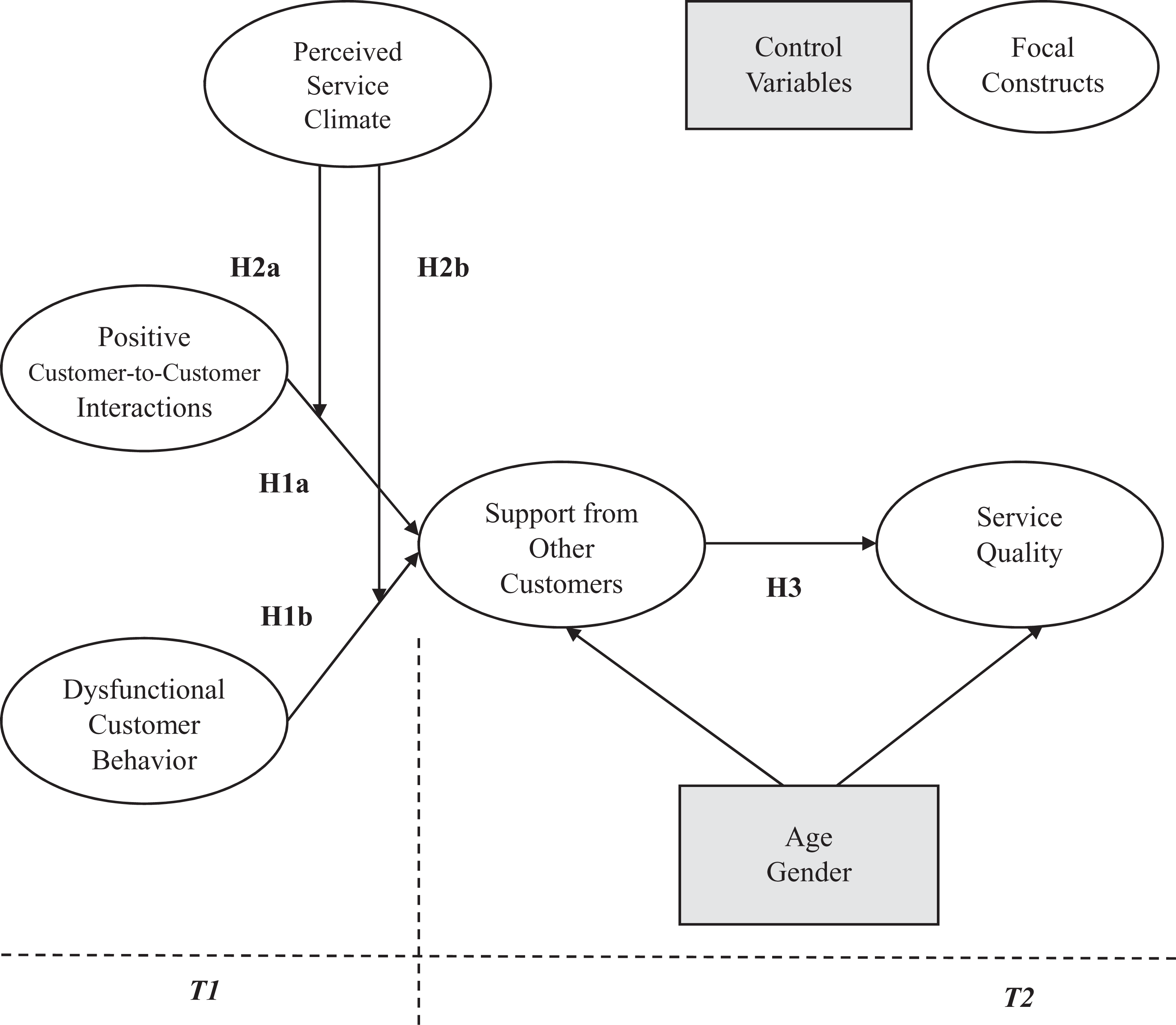
Hypothesized model.
The remainder of the article is structured as follows: First, a discussion of service climate and the current C2C context is presented. Next, drawing on service climate principles and theory, hypotheses are developed. Following this, the research methodology is described and our results are presented. This article concludes with a discussion of managerial and theoretical implications as well as a presentation of study limitations.
Service Climate and C2C Interaction
Due to the potentially uncontrollable and unpredictable nature of C2C interactions, it may seem that service companies would be challenged to manage their beneficial and/or detrimental effects with organizational policy and practice. Potentially addressing such an issue, however, Mayer, Ehrhart, and Schneider (2009) argue that service climate is most vital in uncertain and unpredictable service situations, because the service climate provides indirect control mechanisms to such continuous or even discrete service encounters. In this regard, we introduce the concept of a customer perception of an organizational service climate, defined as a customer’s perception of the extent to which a service organization teaches, prioritizes, and recognizes outstanding customer service through organizational practices and procedures, as an indirect control factor for C2C interactions.
Consistent with this, we focus upon the context where C2C interactions are likely to be “substantive” as subsequently defined. Martin and Pranter (1989) identify seven characteristics associated with C2C intensive services, which include customers being in close physical proximity to one another, verbal interaction among customers being likely, customers engaged in numerous and varied activities, the service environment attracting a heterogeneous customer mix, the core service is compatibility, customers must occasionally wait (together) for the service, and customers are expected to share time, space, or service instruments with each other. As Nicholls (2010) notes, if one of these characteristics is present in a service context, C2C issues should be relevant to management. If more than one characteristic is present, C2C issues are likely to be substantive, and managerial oversight should be of paramount concern.
It is not difficult to envision a service context where C2C issues are substantive (e.g., a health club with shared interactions and shared equipment usage), yet there is very limited research that investigates the nature of C2C interactions and the perception of other customers as being supportive (or harmful) in developing the service experience, while also investigating managerially controllable elements of the service context. For example, Finsterwalder and Kuppelwieser (2011) investigate how customers will perceive both their own and other customers’ contributions toward achieving a service outcome (e.g., an enjoyable rafting trip), which will then influence a perception that other customers made a positive contribution to the service experience, but elements related to managerial influence were not included. Similarly, Schaefers et al. (2016) investigate how customer misbehavior may be “contagious,” with certain misdeeds being perpetuated from C2C, but the focus is upon consecutive interactions with a shared product (e.g., a rental car) and not with concurrent C2C interactions. Finally, there are studies that investigate how an organization may manage C2C interactions, such as through either strategic or structural tools and techniques (see Nicholls 2010, for a thorough review), but a focus upon how customer management might be balanced with promoting perceptions of other customers offering/building a supportive service context has not been investigated.
Drawing on service climate theory, we suggest that a high level of customer service climate, as viewed through the eyes of customers, enhances the effect of positive C2C interactions and dampens the influence of dysfunctional C2C interactions, which subsequently affects the support received from other customers. To our knowledge, this study is the first to utilize a boundary condition of customer-perceived service climate to examine how customers’ perceptions of an organizational factor may influence C2C interactions and related outcomes. In short, if an organization can develop individual customer perceptions that the organization highly values service (i.e., a strong climate for service exists), how will this, then, interact with other judgments of the individual customer? Consistent with Colm, Ordanini, and Parasuraman (2017), who propose that customer perceptions of organizationally controlled design elements, such as service layout and flow patterns, will influence outcome variables such as a customer’s service experience, we propose that judgments of organizationally controlled service climate will ultimately interact with other variables to influence a customer’s overall judgment of service quality.
With a two-stage longitudinal design, we aim to demonstrate that C2C interactions will influence service quality judgments beyond emotional responses of customers. Our study provides a better understanding of the mechanisms that explain how C2C interactions affect the development of service quality judgments. We propose that both positive and dysfunctional C2C interactions will be influenced by the service organization’s customer-perceived service climate at the point of interaction (Time 1). In accordance with the time-delayed effect of service quality judgment development (i.e., after the service experience), the judgments of other customers’ support and organizational service quality will then be displayed in a later period (Time 2—see Figure 1).
Hypotheses Development
Positive C2C Interaction
In many service settings, multiple customers receive simultaneous service provisions (Wu 2007). For example, substantive C2C interactions frequently occur in public places such as diners (Rosenbaum 2006), beauty salons (Price and Arnould 1999), gyms (Unger and Johnson 1995), or academic classrooms (Masterson 2001), in which many customers gather with an understanding of the likelihood of, and a potential appreciation for, social engagement. In relation to other customers, Goodwin (1996), Rosenbaum and Massiah (2007), and Brocato, Baker, and Voorhees (2015) mention that individuals in service settings may form close relationships with one another (even developing friendships and acting as friends). Consistent with this, we define positive C2C interaction as the extent to which a customer experiences enjoyable and friendly interactions with other customers within a service context (Goodwin 1996; Moore, Moore, and Capella 2005).
Indeed, utilizing a critical incident technique, Grove and Fisk (1997) find that (1) the presence of other customers frequently occurs and (2) this generates friendly incidents, including many situations in which other customers are amicable or friendly, which may ultimately result in customers’ judgments of emotional and social support from others. And, indeed, grounded theory results from Colm, Ordanini, and Parasuraman (2017, p. 5, italics added) clearly suggest that customers may see fellow customers as “…preferred sources of information, support, or expertise….” Such findings are consistent with appraisal theory, which suggests that customers may formulate primary appraisals of the service context based upon their interpretation of initial interactions with others, which would subsequently lead to evaluations of whether others may be potentially beneficial (or harmful) to them. For example, a new member to a health club might at first seem a bit overwhelmed by the size and scope of exercise options, but if initial encounters with other clients provide the impression that people at the club are friendly (e.g., smiling, offering greetings, and appearing friendly), this would likely shape positive and supportive subsequent encounters with others. Without such exposure to interactions with other customers, customers cannot, of course, assess if other customers are potentially supportive. In this regard, positive C2C interactions are a form of social exchange among customers and are indicative of shared and potentially positive experiences (Davies, Baron, and Harris 1999).
In their empirical analysis of river rafting, Arnould and Price (1993) suggest that companionship among customers is expected to develop from extended and intimate experiences during the service delivery (i.e., positive C2C interactions), providing each other with emotional–social (Rosenbaum and Massiah 2007) and practical (Verleye, Gemmel, and Rangarajan 2014) support. Even in less “intensive” service contexts, such bonding may occur. For example, K. Harris, Baron, and Ratcliffe (1995) find that 25% of IKEA shoppers believe that their short-lived interactions with unacquainted customers can increase their enjoyment of the shopping experience as a result of interactions with such previously unacquainted “friends,” as any overwhelmed first-time visitor to an IKEA who is looking for guidance can attest.
We further propose that such positive social encounters will set the stage for more instrumental support from other customers. Indeed, Rosenbaum and Massiah’s (2007) research provides a framework for understanding such varied aspects as social–emotional interaction versus instrumental support from other customers. Social–emotional interaction provides customers with an outlet for expressing their overall views of the service context in an informal and friendly manner, while instrumental support provides customers with practical help concerning the service context. As Yi and Gong (2009) suggest, support from other customers is increased as a result of an organization’s facilitating such positive social–emotional exchanges. Such support from other customers is defined as the extent to which customers get reliable and helpful support or advice from fellow customers within a service context (Verleye, Gemmel, and Rangarajan 2014). That is, we propose that positive socio–emotional interactions set the stage for other customers being helpful. Yi and Gong (2009) further mention that customer support behaviors are especially likely to occur when customers build relationships with other customers as friends, although friendship would not be a necessary requirement of receiving such support (cf. Colm, Ordanini, and Parasuraman 2017). As per the IKEA example, the helpful customers would not necessarily be friends, but could be exhibiting a friendly demeanor, which is followed by instrumental behaviors.
Similarly, Brocato, Baker, and Voorhees (2015) find that it is the social bonds created among customers (as well as between customers and employees) that drive a customer’s sense of attachment to a retail location, which subsequently leads to helping behaviors directed toward the firm (i.e., engaging in positive word of mouth to support the firm). Although they did not report results related to helping behaviors targeted toward other customers within the retail establishment, the key is that it was the social bonds that drove the sense of attachment and subsequent behaviors. It is certainly plausible that a view of other customers as being friendly (or friends) would drive a view of other customers as being supportive in such a context.
In relation to supportive outcomes, satisfying encounters with fellow customers are likely to ultimately provide quality information that reduces uncertainty about the service firm and its service provision (Adjei, Noble, and Noble 2010). This may well serve to provide socialization and “guidance” among actors in a service setting (Arnold et al. 2013). In a similar way, Gruen, Osmonbekov, and Czaplewski (2007) maintain that because C2C exchange is seen as a source of additional benefits by customers, subsequently bringing additional value, customers with higher levels of positive C2C exchanges should perceive fellow customers as being supportive. For example, the initial friendly greetings at a health club may lead to subsequent interactions and the sharing of beneficial information (e.g., which instructor to take for certain classes or the optimal time to use certain equipment). It is expected that when customers experience positive C2C interactions in a service context, they will then judge fellow customers to be more supportive.
Dysfunctional Customer Behavior
According to Reynolds and Harris (2009), dysfunctional customer behavior is a behavior by other customers that is unpleasant, unexpected, and/or inappropriately in violation of the behavioral norms of a service environment. Although Reynolds and Harris (2009) developed this concept in relation to evaluations of “fellow customers” at a more general level, our current work is focusing solely upon the elements of such behavior that an individual perceives in a negative manner, thereby creating a dysfunctional service context. Prior research suggests that such negative experiences are key factors linked to overall negative service evaluations (e.g., Daunt and Harris 2012). L. C. Harris and Reynolds (2003) also highlight that poor consumption experiences are significantly affected by such negative behavior. In this regard, customers who experience such dysfunctional customer behavior from others will not likely view others as being sources of support or learning (but rather as individuals to be avoided). For example, sports fans attending a game where they find themselves seated among rowdy, loud, and potentially intoxicated fellow fans may view help from the organization (and/or proper authorities) as their only course of action, as at least a subset of the fellow fans are viewed as the problem, not the solution.
Given the nature of dysfunctional C2C interactions, it is not surprising that dysfunctional customer behavior makes it difficult to envision getting support from other customers. If such support were to exist, it might take the form of other fans speaking up to the offenders and saying such things as “Our fans don’t behave like that” or some other form of highlighting a normative violation (cf. Colm, Ordanini, and Parasuraman 2017). Similarly, movie or restaurant patrons are likely to ask offensive customers to “turn off your cell phone,” “stop talking so loudly, and so on,” in an effort to make the experience more enjoyable for all. We propose that although some individuals are just prone to engage in such actions to stop such dysfunctional behavior, such supportive actions may be more likely to occur when the dysfunctional behavior takes place where a strong service climate exists. The main effect of dysfunctional behavior, however, is still predicted to link negatively to perceptions of other customers as being helpful. In other words, the likelihood of viewing other customers as being helpful is very much driven by the context in which the dysfunctional behavior takes place.
Existing literature also indicates that dysfunctional customer behavior may trigger a domino effect on the conduct of other customers (L. C. Harris and Reynolds 2003; Schaefers et al. 2016). The negative form of the domino effect becomes pervasive by the spreading of dysfunctional customer behavior from a single dysfunctional customer to those within a closed service setting (i.e., poor behavior begets poor behavior). The contagion of dysfunctional behavior leads to negative service contexts and limited personal relationship development with other customers, which limits the likelihood of receiving support from other customers. In addition, when dysfunctional C2C interactions are pervasive, customers are more likely to display hostile behavior and even take revenge toward others. Thus, it is more difficult for customers to receive support from each other.
Moderating Role of Customer-Perceived Service Climate
As noted previously, Mayer, Ehrhart, and Schneider (2009) suggest that when a service situation is largely unpredictable and uncontrollable, it should be managed indirectly through maintenance and improvement of a high level of service climate. In this study, as noted, we introduce the concept of a customer’s individual perception of an organization’s service climate (i.e., a customer’s perception of the extent to which a service organization teaches, prioritizes, and recognizes outstanding customer service through organizational practices and procedures). Much as employees may develop perceptions of service climate (e.g., Bowen and Schneider 2014), we anticipate that customers may also develop perceptions of the structured service climate of a given service firm with which they interact. Such a view is consistent with the operative norm of a perceived climate in which both employees and customers share impressions of their common experiences due to the closeness of the service interactions (Schneider, White, and Paul 1998). As a result of these observations, customers may reach conclusions regarding the overall quality of the service received (Schneider, White, and Paul 1998).
Given the importance of one’s interpretation of service climate in an employee setting, Howell, Dorfman, and Kerr (1986) mention that a positive service climate acts as a situational enhancer and further strengthens the positive link between employee attitude and employee service performance. Schneider et al. (2005) argue that service climate serves as a behavioral signal to employees regarding how to serve customers in that service setting. Therefore, a positive service climate provides specific goals for service employees and underscores providing superior service and building a good customer relationship as a focal point of a competitive service strategy.
Similar to the impact of service climate on employees, customers also perceive the tone and atmosphere in which an organization supports its employees to better serve customers (Schneider 1973). In this regard, we propose that customer-perceived service climate may serve as a critical moderator of positive and dysfunctional C2C interactions in relation to the experience of support from other customers. Based on service climate theory, if customers feel that an organization attempts to improve and maintain excellent service levels and provides its employees with tools and technology for better service delivery, positive C2C interactions should have a stronger effect on available support from other customers because such a service climate complements the effective interaction among customers by creating an enjoyable atmosphere (potentially significantly limiting dysfunctional behaviors or at least their related outcomes). In effect, the positive service climate complements and aids in the interpretation of actions among those who are within the service organization. As a result, customers are more likely to experience other customers’ support.
For example, we would predict that in a classroom context where the instructor exemplifies helpful and beneficial actions toward students, the effect of already positive interactions among students would take on a heightened meaning and the likelihood of students experiencing helpful behavior from other students would be amplified. That is, the positive service provision helps to promote an environment where the operative norm supports and develops helpful behaviors. Similar effects may be witnessed in other “everyday” service settings. For example, Southwest Airlines is famed for promoting a service-focused climate among its employees, as many customers are aware. Further, Southwest has helped to develop a sense among customers that flying Southwest is a unique experience, which helps customers to feel that they share a bond with other flyers. We believe such a combination helps promote supportive behavior among customers through helping one another to board and deplane in an efficient manner, helping to transform what could be a chaotic environment (i.e., no assigned seating), into a usually fast and efficient process where customers are prone to helping one another to enable to process.
In a similar way, when customers perceive that service climate is high, they are likely to anticipate less of a chance of having to endure other customers’ dysfunctional behavior (even when it occurs) because service structures and processes are in place to monitor and prevent behaviors that may trigger negative customer experiences (Bowen and Schneider 2014; Huang et al. 2014). This will help to prevent both the creation and spreading of dysfunctional behaviors. As such, the potentially negative effect of dysfunctional customer behavior on support from other customers will be attenuated under a higher level of customer service climate. Such logic is similar to the findings of Schaefers et al. (2016), where the organization’s development of a “communal identification” among customers, or the development of a sense of obligation to help others in a community, is demonstrated to mitigate the continuation of hurtful consumption behaviors among service customers.
As an example of customers helping customers, most major movie theater chains now show announcements regarding accepted patron behavior before the playing of the movie (e.g., no cell phone usage, taking crying babies out of the theater). This creates salience for the consideration of others (i.e., the group sharing the service experience) as well as demonstrating the theater’s concern for enjoyable entertainment in a distraction-free environment. Such an announcement makes it easier to voice displeasure to those who break the rules, thus enhancing the expectation for a better service experience through customers “policing” other customers’ behaviors, which ultimately benefits the entire group. That is, the service climate interacts with the dysfunctional behaviors to minimize negative outcomes. Consistent with such predictions, we hypothesize two important interactions.
Support From Other Customers and Judgments of Service Quality
Prior research has extensively reported that social or functional support from a service provider facilitates service quality and customer satisfaction (e.g., Cronin and Taylor 1994) because customers feel that they are treated in a fair and positive manner while being served. As Evanschitzky et al. (2011) find, employee satisfaction has a strong and direct influence upon customer satisfaction, while also indirectly and positively influencing customer purchase behaviors, thereby demonstrating the importance of employee support in a service context. Further, the importance of service quality judgments is obvious, with service quality widely recognized as a key influential factor in the formation of a customer’s purchase intentions and loyalty (e.g., Taylor and Baker 1994) as well as a strong predictor of overall customer satisfaction (Mittal and Frenea 2010). In this study, we propose that overall, individual perceptions of service quality, or a customer’s judgment that the service provided by an organization is excellent, is a focal outcome of the support received from other customers. Such a relationship highlights the importance of the service support element of other customers and drives home the significance of developing such behaviors. Also, the definition of service quality we use highlights its distinction from a customer’s perception of the service climate in that perceptions of climate relate to perceived practices and procedures (i.e., service “methods”), while service quality is a general perception of overall service excellence in the form of what a customer has experienced in service deliverables.
In recognition of the important role played by support behaviors, it has been demonstrated that employees who feel supported by an organization are more likely than those who do not provide helping behaviors to customers and enhance service quality judgments (Vandenberghe et al. 2007). Along a similar vein, customers within a service context who experience support from one another would likely perceive the context more positively. For example, Rosenbaum and Massiah (2007) suggest that because C2C interactions frequently occur in many service encounters (e.g., spas or salons), it is possible for customers to serve as partial employees to support other customers, thereby enhancing the service experience. Verleye, Gemmel, and Rangarajan (2014) demonstrate that support from other customers can render customers more prepared for service encounters by providing knowledge and skills. Therefore, it is expected that support from other customers may influence overall service quality because the customer support will positively influence a customer’s overall assessment of the organization. Yi and Gong (2009) demonstrate that support from other customers enhances customer service context perceptions (i.e., satisfaction) in a manner that is independent from the support provided by either the organization or frontline employees, which again demonstrates the significant role of not just C2C interactions, but C2C interactions that are viewed as being supportive of one’s overall experience. We hypothesize the following:
Method and Analyses
Sample and Procedure
Data were collected from customers (members) of a recreational center participating in general health/fitness classes over a 6-month period in Seoul, South Korea. Such a context exhibits elements, to at least some degree, of all seven characteristics of a C2C-intensive service (Martin and Pranter 1989). Over this 6-month period, roughly 150 courses were offered to the public. The courses at the recreation center included weight lifting, aerobics, table tennis, yoga, billiards, tae kwon do, and dance.
The current selection of subjects is deemed appropriate for the proposed model for two reasons. First, customers may frequently interact with one another to accomplish service goals and outcomes (highlighting a key element of a C2C-intensive environment), and therefore, C2C interactions are highly expected (Zeithaml and Bitner 2003). Second, dysfunctional behaviors may occur in such a context and would be a major concern (Lawrence and Green 2005). Furthermore, the recreation setting generally contains a high level of interaction with service employees (instructors) and customers (members) over time. Therefore, it is expected that like employees at a workplace, customers may perceive the service climate related to how the public recreation center prioritizes customer service delivery with its practices and procedures (Schneider, White, and Paul 1998) as well as getting a sense of employee satisfaction (Evanschitzky et al. 2011). In sum, positive C2C interactions, dysfunctional customer behavior, customer supportive behavior, and customer-perceived service climate are readily perceived by participants.
A repeated measures field study was employed to capture our focal constructs: positive C2C interactions, dysfunctional customer behavior, customer-perceived service climate, support from other customers, and service quality during a three 3-month span. Specifically, positive C2C interactions, dysfunctional customer behavior, and customer-perceived service climate were measured by customers at Time 1 (2 months into the course). Then customers were asked to report other constructs of interest (e.g., support from other customers and service quality) at the conclusion of the fifth month of the course. There are several reasons to choose a 3-month span between Surveys 1 and 2. The courses at the recreation center are planned to complete learning activities during a 6-month period—we believe that 2 months into each course is enough time for customers to interact with fellow customers and accurately perceive the service climate in the recreation center. Then customers evaluate course activities, instructors’ abilities, teaching/learning methods, and relationships with fellow customers developed by the recreation center at the end of the fifth month. In this regard, we believe that customers can correctly report the amount of support from fellow customers and service quality, minimizing potential biases that may affect relationships among variables.
At Time 1, we distributed 580 surveys, which were completed by 362 customers across the 150 courses. After 3 months, we distributed 432 surveys, of which 334 were completed. We then matched the two time-frame surveys based on the participants’ names. In addition, we asked participants to report their class identification codes, ensuring that they were attending the same recreation programs. Sixteen customers who completed the survey at Time 2 did not participate in the survey at Time 1 and eventually were excluded from the final sample. The final sample consisted of 318 customers. The sample demographics were as follows: 51% were male, and 35.7% were under the age of 40, with a minimum of 19 years and a maximum of 54 years.
Measures
For this study, the survey instrument was developed in English and then translated into Korean. As a part of the translation process, the translated version of the survey instrument was assessed by two bilingual judges (i.e., English and Korean). In addition, in order to minimize any systematic bias, the survey was evaluated by the back-translation process in which the translated instrument reflects the same item content (meaning) as the original version. Measurement items for all constructs are shown in the Appendix.
To measure dysfunctional customer behavior, we used the Reynolds and Harris (2009) 6-item measure, 2 items of which are reverse-scored. The measures were originally developed to assess dysfunctional customer behavior in the hospitality industry (e.g., hotel and restaurant). We thus modified the original scales to gain a better understanding of dysfunctional customer behavior in recreation program settings. Ultimately, the 2 reverse-scored items were removed because they were very similar to items in positive C2C interactions (e.g., I enjoy being around other customers in the recreation center), which made it difficult to obtain discriminant validity. All items used response anchors of 1 = strongly disagree to 7 = strongly agree.
To assess positive C2C interactions, a 4-item measure from Moore, Moore, and Capella (2005) was used. According to Price, Arnould, and Tierney (1995) and Grove and Fisk (1997), the primary manifestations of positive C2C interactions are in the formation of interpersonal bonds such as friendships and the enjoyment of time spent in the service encounter with other customers. All items used response anchors of 1 = strongly disagree to 7 = strongly agree. The measure of customer-perceived service climate was adapted from Schneider, White, and Paul (1998) to be given to customers in order to understand the individual perceptions of service climate. All 6 items were anchored with 1 = strongly disagree to 7 = strongly agree. These three constructs were measured at Time 1.
Next, at Time 2, the measure of support from other customers was taken, with items adapted from Verleye, Gemmel, and Rangarajan (2014). The items reflect the key characteristics of support from other customers (e.g., “other customers are very helpful”). All items used response anchors of 1 = strongly disagree to 7 = strongly agree. The service quality measure was captured using 3 items from the Bansal, Taylor, and James (2005) study, utilizing items that were originally developed from Taylor and Baker (1994). All items used response anchors of 1 = strongly disagree to 7 = strongly agree.
Finally, we included two control variables: gender and age. Demographic characteristics are considered as potential factors that affect relationships among variables. Thus, we included two control variables to parcel out their potential effects in the model. Descriptive statistics for the constructs including mean, standard deviation, average variance extracted (AVE), composite reliability, and correlations are shown in Table 1.
Descriptive Statistics and Intercorrelations.
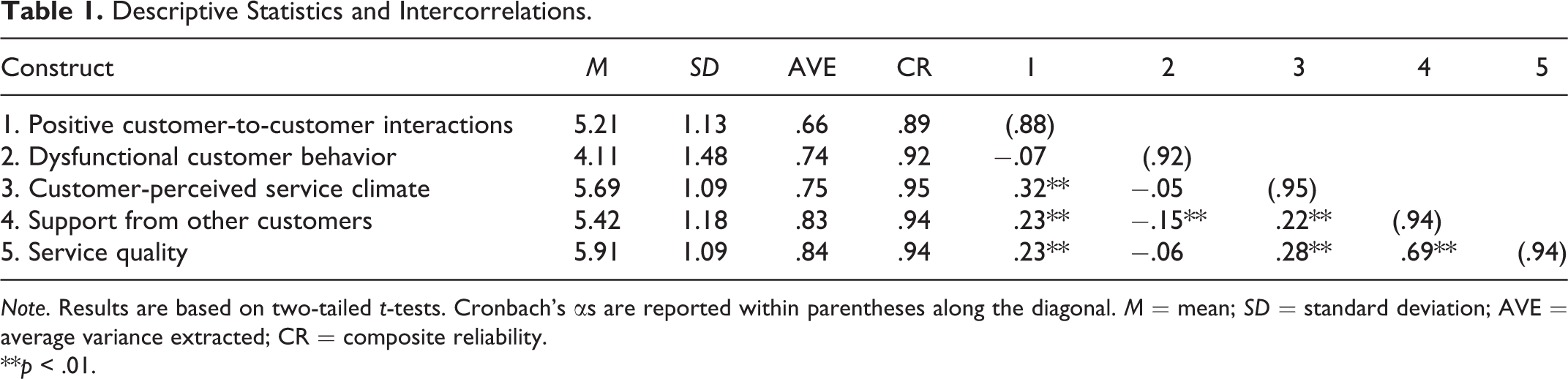
Note. Results are based on two-tailed t-tests. Cronbach’s αs are reported within parentheses along the diagonal. M = mean; SD = standard deviation; AVE = average variance extracted; CR = composite reliability.
**p < .01.
Common Method Variance (CMV) Test
To assess common method possibilities, we employed the Harman’s single-factor test and a partial correlation technique (see Podsakoff et al. 2003). These results indicate that CMV is not likely to exist in the data. In addition, predictor (e.g., positive C2C interactions) and criterion variables (e.g., service quality) were collected at different time points: (1) predictor variables were measured at Time 1 and (2) criterion variables were measured at Time 2. The multiple time-lagged data collection minimizes concerns associated with CMV.
Measurement Model
Measurement properties and conventional fit statistics (e.g., discriminant validity) were evaluated by using a confirmatory factor analysis (CFA; Anderson and Gerbing 1988). We conducted this analysis using Mplus Version 6.12. The resulting measurement model provided an excellent fit to the data: χ2(160) = 284.21, p < .01, Comparative Fit Index (CFI) = .98, Tucker-Lewis Index (TLI) = .97, Root Mean Squared Error of Approximation (RMSEA) = .05, Standardized Root Mean squared Residual (SRMR) = .04. As shown in Table 1, the AVE of all constructs is above .50 (ranging from .66 to .84), with composite reliability scores greater than .70 (ranging from .89 to .95). These results provide evidence in support of convergent validity.
The AVE for each of the constructs exceeds its shared variance with any of the other constructs in the measurement model (Fornell and Larcker 1981), providing discriminant validity. Additional evidence of the measures’ discriminant validity is provided by pairwise CFAs for all pairs of constructs, comparing the fit of a single-factor model to that of the two-factor model. Taken together, the measurement properties appear to be both reliable and valid.
Hypothesis Tests
Test of main effect hypotheses
First, we estimated two ordinary least squares (OLS) regressions to test main effect relationships. Then, we used a bootstrapping technique to test mediation effects, as recommended by Preacher and Hayes (2008).
Hypotheses 1a and 1b investigate the effects of positive C2C interactions and dysfunctional customer behavior on support from other customers. In Table 2, we demonstrate that positive C2C interactions have a significant and positive effect on support from other customers (β = .234, p < .01), while dysfunctional customer behavior has a significant and negative effect on support from other customers (β = −.109, p < .05) after controlling for effects of gender and age. In addition, none of the control variables is significant in the model (gender: β = .195, ns; age: β = −.010, ns). Thus, Hypotheses 1a and 1b are fully supported.
The Mediating Role of Support From Other Customers on Service Quality.

Note. Unstandardized regression coefficients are reported. All variance inflation factors are less than 1.5, so multicollinearity is not a concern.
*p < .05. **p < .01.
The remaining main effect prediction, Hypothesis 3, investigates the effects of support from other customers on service quality. In support of Hypothesis 3, the results indicate that support from other customers positively influences service quality perceptions (β = .627, p < .01). When both independent (positive C2C interactions and dysfunctional customer behavior) and mediator variables (support from other customers) appear as predictors of service quality, only support from other customers has a statistically significant effect (β = .627, p < .01), and the effects of positive C2C interactions and dysfunctional customer behavior on service quality are not significant (positive C2C interactions: β = .074, ns; dysfunctional customer behavior: β = .035, ns; see Table 2). Also, none of the control variables is significant in the model (gender: β = .020, ns; age: β = −.003, ns). These results indicate that support from other customers fully mediates the relationships between positive C2C interactions and dysfunctional customer behavior and service quality. In addition, the variance inflation factors (VIFs) of predictor variables are less than 2, which suggests that a multicollinearity problem is not present in the applicable model.
Further, we employed a bootstrapping technique (n = 5,000 bootstrap resamples), which builds on an empirical estimation of the sampling distribution of the indirect effect. These analyses allowed us to examine the magnitude and statistical significance of mediation effects (Preacher and Hayes 2008). The analysis reveals that the indirect effect of positive C2C interactions on service quality is positively significant at the .05 probability level (effect = .152, LLCI: −.073, ULCI: .253). In addition, the indirect effect of dysfunctional customer behavior on service quality is negatively significant at the .05 probability level (effect = −.079, LLCI: −.135, ULCI: −.028). The results of indirect effects are shown in Table 3.
Indirect Effects of Positive Customer-to-Customer Interactions and Dysfunctional Customer Behavior on Service Quality.
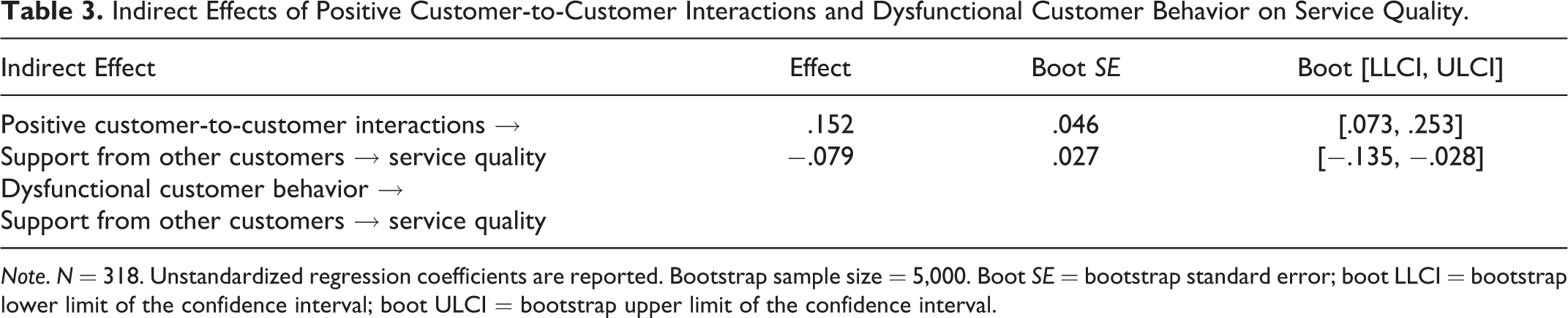
Note. N = 318. Unstandardized regression coefficients are reported. Bootstrap sample size = 5,000. Boot SE = bootstrap standard error; boot LLCI = bootstrap lower limit of the confidence interval; boot ULCI = bootstrap upper limit of the confidence interval.
Test of interaction hypotheses
In Hypotheses 2a and 2b, we propose interaction effects (1) between positive C2C interactions and customer-perceived service climate and (2) between dysfunctional customer behavior and customer-perceived service climate in the prediction of support from other customers.
To investigate the interaction effects, we performed a series of OLS regressions: (1) a model with only covariates, (2) a model with covariates and main effects, and (3) a model with covariates, main effects, and interaction effects. First, we tested the covariates model. The results show that none of the control variables is significant in the covariates model (see Table 4). Second, we tested the main effects model. The results reveal that positive C2C interactions and dysfunctional customer behavior are significant. Finally, we investigated moderating effects with a moderated regression approach. The moderating effects of customer-perceived service climate are assessed by forming interaction terms by multiplying the corresponding predictor variables: (1) Positive C2C Interactions × Customer-Perceived Service Climate and (2) Dysfunctional Customer Behavior × Customer-Perceived Service Climate. To reduce multicollinearity, main effects variables are mean-centered before constructing two interaction terms. The VIFs of predictor variables are less than 2, which suggests that the multicollinearity problem is not present in the applicable model. Consistent with our expectation, the interaction between positive C2C interactions and customer-perceived service climate in the prediction of support from other customers is positive and significant (β = .109, p < .01); the interaction between dysfunctional customer behavior and customer-perceived service climate in the prediction of support from other customers is positive and significant (β = .112, p < .01). Table 4 summarizes the moderating effects.
The Moderating Role of Customer-Perceived Service Climate.
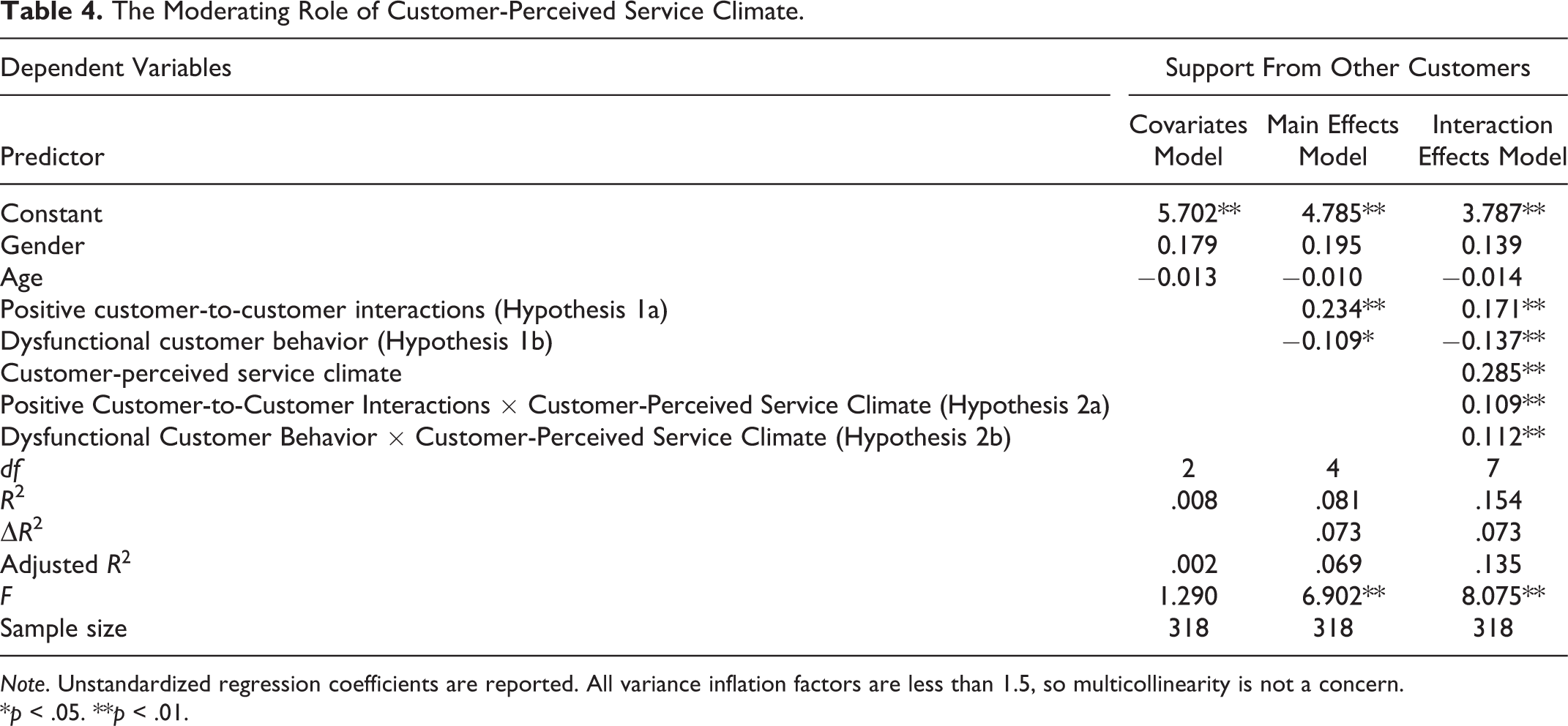
Note. Unstandardized regression coefficients are reported. All variance inflation factors are less than 1.5, so multicollinearity is not a concern.
*p < .05. **p < .01.
To interpret the interaction effects, we performed graphical analyses suggested by Preacher, Curran, and Bauer (2006). Figure 2a illustrates the influence of positive C2C interactions on support from other customers at two levels of customer-perceived service climate (high vs. low: one SD above and below the mean). The analysis reveals that when customer-perceived service climate is low, positive C2C interactions are unrelated to support from other customers (effect: .107, ns); when customer-perceived service climate is high, positive C2C interactions boost support from other customers (effect: .299, p < .01). Figure 2b illustrates the influence of dysfunctional customer behavior on support from other customers at two levels of customer-perceived service climate (high vs. low: one SD above and below the mean). The analysis reveals that when customer-perceived service climate is low, dysfunctional customer behavior is negatively related to support from other customers (effect = −.258, p < .01); when customer-perceived service climate is high, the negative relationship is not significant (effect: −.033, ns).
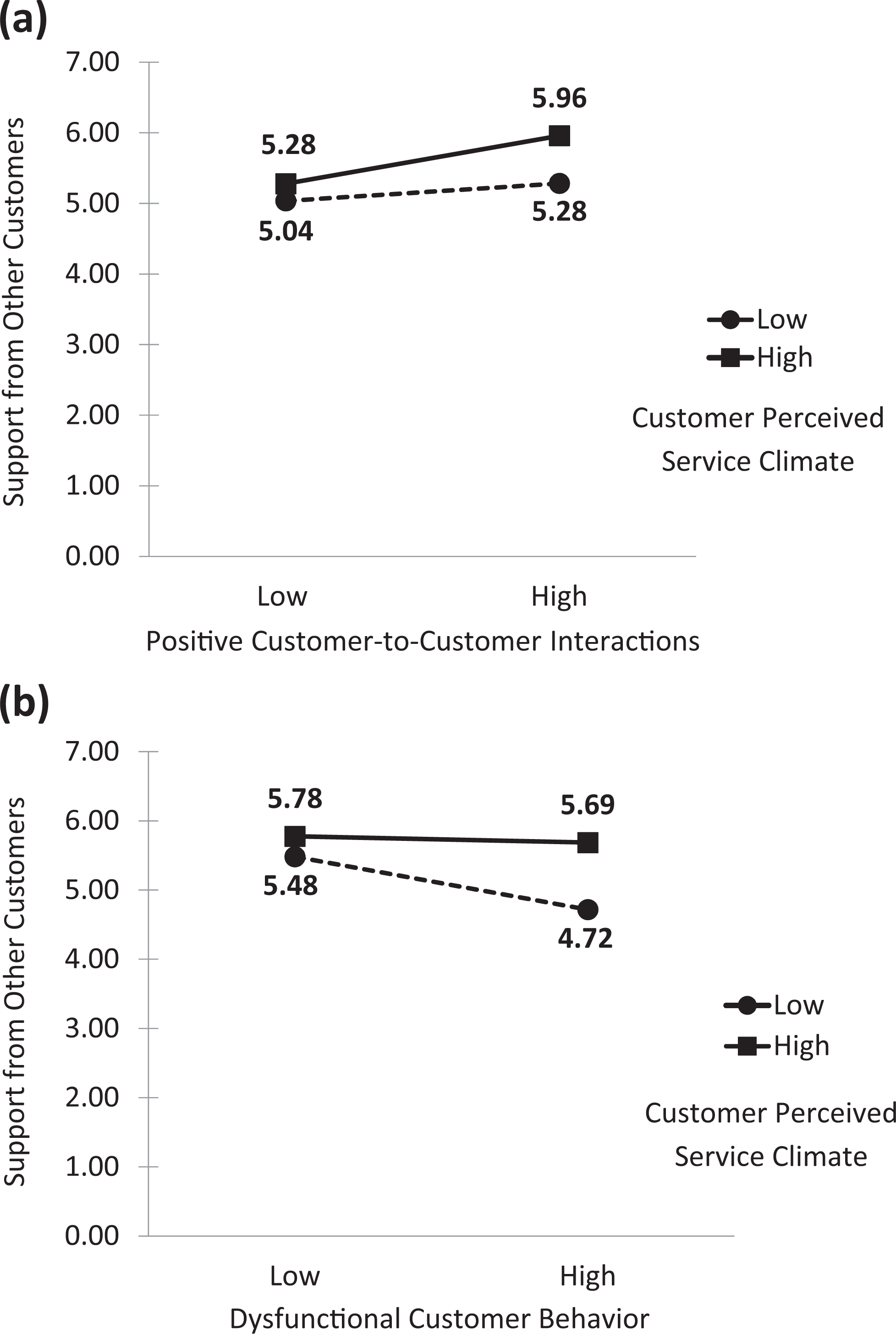
The effects of (a) positive customer-to-customer interactions and (b) dysfunctional customer behavior on support from other customers: The moderating role of customer-perceived service climate.
Discussion
The current study contributes to the marketing and services literature in both theoretical and practical ways. In relation to theory, our results demonstrate the potential importance of customers perceiving the existence of a service climate among the employees of an organization. Although previous research is very clear on the importance of employees perceiving a service climate within their organization (Bowen and Schneider 2014), the importance of customers perceiving such a climate had not been addressed. And, as with employees, it appears that such perceptions of climate interact with events occurring within a service context (i.e., positive and dysfunctional C2C interactions) then influence judgments upon significant outcomes (i.e., supportive behavior among customers). As suggested by general climate theory, judgments of climate moderate the effects of events on outcomes (Parker et al. 2003), which are further demonstrated in the current research. Also, as is clearly demonstrated by the discrimination between customer judgments of service quality and perceived service climate, the effects of the judgments appear to be distinct. It seems likely that a customer perceives service quality and the existence of a service climate in distinct manners (one may exist without the other), which suggests the importance of exploring outcomes related to each concept.
Further, the effects of customer-perceived service climate are apparently quite strong. Importantly, the perceptions that customers possess an organization’s service climate seem capable of dramatically influencing the effects of interacting with other customers, whether such interactions are positive or dysfunctional (perhaps a “spillover” effect of the positively perceived climate that exists). Positive interactions are significantly complemented by perceptions of a service climate in relation to experiencing support from other customers, which implies that a customer’s judgments of an organization’s service climate make interactions with other customers all the more positive, which then positively influences the development of supportive interactions with other customers. Further, even when customers observe or experience dysfunctional behaviors from other customers, if the sense among customers is that the organization has policies and procedures in place to deal with such issues (i.e., a high level of service climate), this tends to buffer the negative effects of the jaycustomers, and still allows for a significantly higher level of customer support (see Figure 2b), which then positively translates into judgments of service quality. In combination, such effects seem to imply the possibility of a “double benefit” of an effective service climate for an organization. That is, not only will the organization benefit from the exceptional service that the frontline employees are providing (see Bowen and Schneider 2014), but such positive service will be enhanced by the effects of customer perceptions of such a service climate in interpreting other occurrences in the service context (i.e., C2C interactions and their meaning).
Further, the strong mediation results observed in the study suggest a sequence of events that would appear to take place in relation to the development of judgments of an organization’s service quality. First, in relation to a time line of events, the C2C interactions (either positive or dysfunctional) take place. The nature of such interactions, at this point, appears to interact with the perceptions among customers of the operative service climate of an organization. Then, subsequent to these interactions, support from other customers is exhibited, which then influences judgments of service quality. Such a process highlights the apparent fact that C2C interactions and customer supportive behaviors are each an important and distinct occurrence at least in relation to a customer’s forming a judgment of organizational service quality. C2C interactions do not, in the presence of customer support behaviors, influence service quality judgments (either positively or negatively). Critically, it appears to be the experience of support from other customers that influences the overall evaluation of service quality. Further, such an occurrence, at least in this context, is time-lagged, which seems logically consistent with the phenomenon. First, C2C interactions occur, and over time, their experience in association with the influence of the service climate influences the development of supportive behaviors among customers.
Finally, in relation to the findings, it is important to highlight the nature of the context where the data were collected. Classes at a recreation center are indicative of a substantive C2C context (Martin and Pranter 1989). In such a context, the likelihood of interaction, as well as the likelihood of having to share service resources, is very high. Of course, not every service context is like this, and there are many instances where other customers are present. But it is not a certainty that one will need to (or want to) interact with them (e.g., fast food, banking). The results of the current study, and the likely importance of customer support behaviors and a perception of organizational service climate, are proposed to be significant largely within only a substantive C2C context. The application to other, less C2C-intensive, service contexts would need to be explored.
Managerial Implications
The importance of managerial influence of C2C interactions is highlighted in the current study. Although the myth that the service organization has no control over C2C interactions and associated outcomes still seems operant (Nicholls 2010), the findings of this study suggest otherwise. Although C2C interactions are obviously somewhat uncontrollable and unpredictable, the reality is, of course, that the service organization does have control over the context in which C2C interactions take place. Managing such an interactive context should take on added concern when C2C interactions offer such strong potential for affecting either positive or negative experiences (Nicholls 2010). Through the development of a positive service climate among employees (which is managerially controllable), there appears to be the added benefit of the behaviors and interpretation of events that occur among customers (at least as each customer relates to another customer). This knowledge may be able to provide managers with more confidence to encourage and facilitate interactions among customers, with the ability to anticipate positive outcomes of such interactions, at least in the presence of a strong service climate. Again, the “double bonus” of such a climate appears to be operative, especially in relation to final judgments of service quality among customers.
The creation of such a context is now a reality in some organizations, and other organizations could certainly attempt to mirror them. For example, Disney has excelled over the years at capitalizing upon a double benefit of a strong employee service climate that spills over to customers as well. That is, as a means to temper negative outcomes related to dysfunctional behavior among customers, Disney characters appear at opportune times to diminish negative behaviors and refocus attention upon fun. 1
Another example may be found in Ramdas, Teisberg, and Tucker (2012), where they highlight options now being afforded to patients within medical settings scheduling multipatient appointments, where individuals are fully aware that the appointment will be a “joint” experience with anywhere from 10 to 12 patients who share a common ailment. Such a context facilitates informal interaction among waiting patients while brief, private physical exams take place. Following these private exams, the doctor (or doctors) then discusses treatment protocol, prescriptions, testing, and so on, for each patient while all other patients are present. Such discussion helps patients to better understand their own situations, while also giving each patient more “face time” with the doctor (90 minutes in a group environment as opposed to 10–15 with an individual appointment). Such exposure to a doctor and the dedication of his or her time to patients is suggestive of a strong service climate. And, in such instances, the patients have a greater understanding of the doctor’s skills and abilities. Such an experience allows them to “…observe his or her expertise and empathy in dealing with many patients” (Ramdas, Teisberg, and Tucker 2012, p. 100), with obvious implications for judgments of service quality as well as the development of support behaviors among patients. That is, the facilitated interaction among patients in combination with the high level of service provision sets the stage for customers engaging in subsequent helpful behaviors for one another as often happens postexam (Ramdas, Teisberg, and Tucker 2012). To further improve perceptions of service climate and aid C2C interaction, the hospital facilitates the patients’ interaction beyond the shared appointment by sponsoring classes and exercise groups. Such a service context seems to be pleasing to patients, with customer satisfaction scores as high as 98% (Ramdas, Teisberg, and Tucker 2012). Such a relationship between C2C interaction, judgments of service quality, and customer satisfaction also has been seen in empirical studies (e.g., Price, Arnould, and Tierney 1995; K. Harris, Davies, and Baron 1997).
Finally, the importance of developing a service climate among employees to such a level that it will be consistently observed among customers seems highly important. Managers need to be aware that such a perception among customers will go a long way, as suggested by the current results, to both enhancing the effects of positive interactions with fellow customers and dampening the negative effects of dysfunctional customer behaviors on customer supportive behaviors; even the best service organizations cannot always ensure that every customer will behave in a normatively desired manner. That is, consistent with positive–negative asymmetry theory (e.g., Anderson and Mittal 2000), we know that dysfunctional customer behavior (negative) has a greater impact on perceptions of customer supportive behaviors than do positive C2C interactions (positive; see Figure 2a and b). The results suggest that forming a positive perception of service climate greatly reduces a negative effect of dysfunctional customer behavior on customer support behaviors. Ultimately, managers may be able to minimize the influence of bad behaviors upon service quality judgments by creating a higher level of service climate. Although suggested but not directly explored here, future research could explore whether the development of a strong service climate may facilitate the development a strong norm for positive behaviors among customers, which may be “enforced” not only by the organization but other customers as well (cf. Arnold et al. 2013). It seems likely that a customer’s view of a strong service climate would be a likely antecedent to the development of such behaviors.
Limitations and Future Research
As with all research, this study has limitations that may be addressed in future research. Our nonexperimental method prevents causal relationships from being inferred. Although our longitudinal study permitted conclusions about temporal sequencing compared to past research on C2C interactions, causal inferences among variables could be questionable. For more conclusive evidence about causality, attempts should be made to collect data at multiple points in time, separated by varying intervals, in order to keep track of the rate and direction of change.
Also, data were obtained exclusively through self-report measures. This means that response biases might have influenced the assessment of single variables; however, we attempt to avoid potential concerns by measuring variables with a time-lagged study design and common method bias was not likely to exist in the data.
Furthermore, all measures were captured on 7-point scales, with measures of positive and dysfunctional C2C interactions being taken separately. Although the constructs are certainly separate, it is acknowledged that their influences may be relative (i.e., to what degree are overall interactions positive vs. dysfunctional) as well as affected by the frequency of such occurrences, respectively. Future research could focus upon these alternative forms of operationalization.
Additionally, our study showed low correlations between dysfunctional customer behavior and other constructs. The lack of correlation might be due to the fact that some customers take recreation lessons to achieve their own learning goals, rather than for general consumption purposes (e.g., eating at a restaurant). In such instances, learners (customers) are highly motivated to learn and considerate of other learners’ activities (which also is consistent with South Korean norms). Thus, they are less likely to engage in dysfunctional behaviors to others. This may be less true in a general consumption context, where egoistic and self-focused tendencies may be exhibited (Reynolds and Harris 2009). Certainly, further study is needed to address the effects of dysfunctional customer behavior in different contexts.
In relation to future study, especially in a health club setting, it would be interesting to investigate how customer support behaviors influence the perceived value of the course taken or the likelihood of taking another class. In short, can support behaviors among customers promote increased consumption? Such investigation of other important outcomes would add considerable theoretical and managerial contribution.
Finally, it seems likely that the benefits of C2C interactions may be linked to such things as the development of brand communities among target customers. Certainly, the development of brand community is facilitated by the interaction of customers, as well as encouraging customers to help one another, which then helps with evaluations of the organization. Beyond this, if it is within the service organization where the initial seeds for C2C interactions are sown, there is also the possibility that the organization may be seen as a “part” of the community, which previous research has demonstrated to be valuable as well (Arnold et al. 2013).
Footnotes
Appendix
Declaration of Conflicting Interests
The author(s) declared no potential conflicts of interest with respect to the research, authorship, and/or publication of this article.
Funding
The author(s) received no financial support for the research, authorship, and/or publication of this article.
Supplemental Material
Supplementary material for this article is available online.
Note
References
Supplementary Material
Please find the following supplemental material available below.
For Open Access articles published under a Creative Commons License, all supplemental material carries the same license as the article it is associated with.
For non-Open Access articles published, all supplemental material carries a non-exclusive license, and permission requests for re-use of supplemental material or any part of supplemental material shall be sent directly to the copyright owner as specified in the copyright notice associated with the article.
