



Abstract
Service employees’ emotional and behavioral responses to angry customer complaints were examined to help firms improve their service recovery performance. Role-played complaints were conducted in a field experiment set in fast-food restaurants. Actors played customers who complained in an angry fashion to service employees. Employees’ immediate emotional (i.e., expressed anger) and delayed behavioral responses (i.e., restitution offered) were observed. A follow-up scenario-based experimental study was used to retest the hypotheses and add controls to rule out potential rival explanations. In both studies, level of customer status (low vs. high; true experimental design) and strength of a restaurant’s service climate (weak vs. strong; quasi-experimental design) were manipulated. The findings confirm that employees in a weak service climate expressed more anger and were less likely to offer restitution to low- compared to high-status customers. In contrast, in a strong service climate, employee responses were less dependent on customer status and converged at a low level of anger and high probability of restitution offered. Furthermore, the consistent immediate affective and delayed behavioral responses suggest that a strong service climate is internalized by frontline employees. This study contributes to service theory by establishing a customer status main effect on both affective and conative employee responses and by confirming service climate as a boundary condition for the customer status main effect. A key implication for managers is that establishing a strong service climate is important for achieving effective service recovery in increasingly diverse societies.
Keywords
Service failures are a frequent cause of customers expressing anger to vent their dissatisfaction (Bougie, Pieters, and Zeelenberg 2003). From a firm’s perspective, employees should not jeopardize service recovery efforts by retaliating customer anger in kind. Rather, employees should remain friendly to all customers during service recovery as part of the “service with a smile” premise (Grandey et al. 2010), which in turn has been related to the firm’s overall evaluation (Tax, Brown, and Chandrashekaran 1998; Wirtz and Mattila 2004). Therefore, frontline employees’ recovery responses to complaining and angry customers should be designed, trained, empowered, and motivated to be positive and professional (Dallimore, Sparks, and Butcher 2007). To achieve this, global chains such as Starbucks and McDonald’s work hard to instill a global service climate that is high in professionalism and comes along with standardized service recovery procedures (Grandey et al. 2010).
The interactions between customers and service employees have been examined extensively (Rafaeli et al. 2017; Wirtz and Jerger 2017). However, to our knowledge, no research has focused on customer and organizational variables that might determine how employees respond in service recovery situations. In this article, we studied two important and interrelated customer (i.e., customer status) and firm (i.e., service climate) variables whereby we examine whether efforts of building a strong service climate are effective in guiding employees in their responses and reduce predicted status effects. Furthermore, we examined both employees’ immediate emotional (i.e., expressed anger) and delayed behavioral responses (i.e., restitution offered) to examine whether a strong service climate is internalized by frontline employees. Given our increasingly diverse societies, it becomes critically important that employees treat all customers equally friendly and courteous, independent of their status, and this study contributes to our understanding of how this might be achieved. Figure 1 provides an overview of our conceptual model.

Conceptual model of the effects of customer status and a firm’s service climate on employee responses to angry customer complaints.
Literature Review and Hypotheses Development
Service Employee Responses to Customer Anger
Anger can be a powerful but harmful emotion (Averill 1983). In a service context, customer anger and aggression can lead to negative consequences for service employees, including negatively affecting their service orientation (Harris 2013); job satisfaction (Harris and Daunt 2013); emotions (Dallimore, Sparks, and Butcher 2007; Wang et al. 2011); well-being (Akkawanitcha et al. 2015); stress and frustration (Harris and Reynolds 2003); emotional exhaustion and absenteeism (Grandey, Dickter, and Sin 2004); and retaliation, revenge, and sabotage intentions (Harris 2013; Wang et al. 2011). Customers displaying anger can be seen as violating social and moral norms (Harris and Reynolds 2003) and give rise to perceptions of unfair employee mistreatment (Groth and Grandey 2012). In turn, injustice perceptions lead employees to experience anger (Rupp and Spencer 2006) and threaten their self-interest and social identity (Cropanzano and Rupp 2003). As such, one can view a service failure as the potential beginning of a negative exchange spiral between customers and employees, with the former starting with an aggressive complaint and the latter counterattacking and retaliating as they feel unfairly treated (Groth and Grandey 2012). In this article, we propose that whether employees respond to expressed customer anger with an effective service recovery or retaliate with anger and other counterproductive responses depends at least partially on two variables: status of the complaining customer and the firm’s service climate.
Customer Status
Social status positions are present in everyday life, whereby social status perceptions shape expectations of and behaviors toward high- versus low-status individuals (Tiedens, Ellsworth, and Mesquita 2000). In general, high-status individuals are characterized as having power over resources and holding influential and valued positions in the society (Locke 2003). Furthermore, high-status individuals are seen as more capable than low-status ones (Tiedens, Ellsworth, and Mesquita 2000) and as more independent and thereby less influenced by others’ attitudes and actions (Fiske 1993). Their power, influence, and position also mean that high-status individuals are less likely to experience negative social consequences should they express negative emotions toward lower status individuals because of the latter’s lower power position in society with less resources and influence (Locke 2003). Therefore, people generally pay more attention to high-status individuals (Fiske 1993; Keltner and Robinson 1997), expect more anger expression in unpleasant situations from high-status individuals than from low-status ones (Tiedens, Ellsworth, and Mesquita 2000), and even suppress their own anger with higher status individuals (Allan and Gilbert 2002; Lively and Powell 2006).
In the context of service encounters, we therefore expect that service employees, who experience an angry customer complaint, would respond according to the perceived customer status. Specifically, employees might suppress negative emotions more strongly toward high- compared to low-status customers and be more accommodating in trying to recover a service failure for high-status customers. That is, we expect the status effect to have an impact on both employees’ affective (i.e., expressed anger) and conative (i.e., restitution offered) responses.
If both employees’ affective and conative responses are congruent, it suggests that these responses are authentic and on a level of deep acting (Grandey 2003; Hennig-Thurau et al. 2006; Hochschild 1983). This would be akin to the central and peripheral route of elaboration and processing (Petty and Cacioppo 1986). In our context, employees’ affective responses might take the peripheral route as emotions tend to be more spontaneous and immediate in nature and generally take a lower level of elaboration. In contrast, conative responses tend to be more reflective and delayed via the central route because service employees think about the decision to offer restitution carefully, which takes more time than immediate affective responses (cf. Douglas et al. 2008). We expect status responses to be internalized and thus advance:
Service Climate
Employee responses to customer anger depend at least partially on the firm’s service climate. Service climate is the shared sense of an organization’s employees with regard to its service-focused policies, practices, and procedures and the service-related behaviors employees observe being rewarded, supported, and expected by the organization (Bowen and Schneider 2014; Schneider, White, and Paul 1998). Therefore, an organization’s service climate impacts how employees deliver service, and it thereby shapes customer experiences and their perceptions of service quality (Bowen and Schneider 2014). That is, employees operating in strong service climates show service-oriented behaviors toward their customers (Schneider, White, and Paul 1998).
Service climate and organizational climate are related constructs, whereby service climate is more explicitly related to service than organizational climate, and the latter has a generic focus relating to variables including interpersonal relationships, job attributes, style of supervision, and fairness of reward systems (Bowen and Schneider 2014). Furthermore, service climate can be differentiated from both organizational and service culture. Organizational culture concerns the basic internalized assumptions and shared values that guide an organization’s actions (Bowen and Schneider 2014). Service culture again is more specific to the service aspects of an organization and defines the assumptions and shared values as related to service encounters. In this sense, a service climate emerges from culture as it guides the development of service policies and routines making it a more direct correlate to customer experiences (Bowen and Schneider 2014).
In addition to policies and routines, a service climate guides employees to display appropriate emotions toward customers (Diefendorff, Richard, and Croyle 2006; Hochschild 1983; Rafaeli and Sutton 1987). In the context of our study, this means that display rules are part of the service climate as they prescribe employees’ emotional expressions and behaviors toward customers.
Furthermore, a service climate can vary in strength (Schneider, Salvaggio, and Subirats 2002). The concept of situational strength (cf. Mischel 1976) holds that in weak situations, people do not perceive same events in the same way, and they may react differently and individually in their responses, as they expect a wide range of responses to be appropriate (Mischel 1976). In the context of service climate, it means that service employees do not have consensus on what an appropriate set of responses is in a particular service situation (Bowen and Schneider 2014). If a service climate is weak, employee behavior toward customers will differ and show greater variability according to different perceptions of the service climate (Schneider, Salvaggio, and Subirats 2002). In contrast, a strong climate fosters consistent employee behaviors, as there is a common understanding of expectations, policies, routines, and rules (Bowen and Schneider 2014). A strong climate ensures that different customers experience consistent overall service (Schneider, Salvaggio, and Subirats 2002) as they are served by employees who have established a common understanding of how to deliver service (Schneider, White, and Paul 1998).
Following this definition, service climate also affects service recovery responses whereby a strong service climate prescribes how employees should respond when handling angry customer complaints through a common understanding of service policies and routines (cf. Schneider, Salvaggio, and Subirats 2002). Further, a strong service climate means that delivering good service recoveries (including appropriate emotional display rules) and customer centricity are internalized, employees engage in deep acting (Grandey 2003), and display authentic emotions toward customers (Grandey 2003; Hennig-Thurau et al. 2006; Hochschild 1983). That is, we expect that in organizations with a strong service climate employees’ immediate emotional and their delayed behavioral recovery responses should follow prescriptions of good service as employees share a common understanding of what is expected of them.
In contrast, in weak service climates, policies for good service, behavioral prescriptions, and appropriate employee skills are weak or even absent (Schneider, Salvaggio, and Subirats 2002). Therefore, employee behaviors are more likely to be determined by other influences including their individual backgrounds and beliefs (e.g., shaped by their personality and the society they operate in) instead of an organization-wide service climate. For instance, some employees might feel that it is acceptable to retaliate customer anger in kind.
In sum, we expect that a strong service climate will be associated with employee responses that more closely follow prescriptions of good service in terms of their affective and conative responses (i.e., display less anger and are more likely to offer restitution) than employees in a weak service climate.
Interaction of Customer Status and Service Climate
Combining the effects of customer status and service climate, we propose that the main effect of customer status is weakened in a strong service climate (Schneider, White, and Paul 1998). Specifically, we suggest that employees operating in a strong service climate will be less influenced by their personal and societal cultural norms in both their spontaneous emotional and their reflective behavioral responses. Rather, their responses will be shaped by their firm’s strong service climate which they are likely to have internalized (Bowen and Schneider 2014; Schneider, Salvaggio, and Subirats 2002). That is, the presence of a strong service climate will weaken the impact of other influences such as customer status and move employee behaviors toward normative behaviors as prescribed by the firm’s service climate.
In contrast, when a firm does not have a strong service climate, employees’ responses to a complaining customer are likely to be driven by their personality and societal cultural norms resulting in a greater variance of responses. These norms tend to be less accepting of anger displays from low-status individuals and more accepting of displaying anger toward them (cf. Allan and Gilbert 2002; Lively and Powell 2006; Tiedens, Ellsworth, and Mesquita 2000). Therefore, we expect that employees operating in a weak service climate respond to low-status customers more negatively both in their spontaneous emotional and reflective behavioral responses than to high-status customers.
Study 1: Field Experiment
Method
Field experiments are rarely used in service failure and recovery research in spite of their advantages. In Study 1, we used a field experiment rather than a laboratory setting because we wanted to observe real life responses and not hypothetical ones. Specifically, to examine service employees’ responses to customer anger, we designed role-played field experiments (cf. Dallimore, Sparks, and Butcher 2007) in Germany.
Our field experiments consisted of a 2 (low/high customer status) × 2 (weak/strong service climate) factorial design. Customer status was manipulated in a true experimental design, whereby trained actresses played customers who complained in service settings with weak or strong service climates. The actresses were randomly presented as a low- or high-status customer (operationalized via outfit, makeup, and hair style). Service climate was operationalized in a quasi-experimental design as the service setting was not manipulated but randomly chosen.
We chose fast-food restaurants as the service encounter context because these face-to-face frontline jobs are typically characterized as lower status jobs and are often confronted with rude and unfriendly customers (Hochschild 1983; Leidner 1993). Furthermore, our service situation (i.e., the purchase of a meal in a fast-food restaurant) was a typical transaction that is brief, mundane, and takes place in public (Mattila and Enz 2002).
Moreover, we used unobtrusive measures of our dependent variables to rule out social desirability and other potential biases (cf. Webb et al. 1966). Unobtrusive measures have remained largely unused in service recovery research, although they can avoid common method biases (MacKenzie and Podsakoff 2012), halo effects (Wirtz and Bateson 1995), memory or hindsight biases (Pieters, Baumgartner, and Bagozzi 2006), social desirability effects, and response biases that detract precise self-assessments (Paulhus 2002). In sum, we feel that a field experiment with unobtrusive measures seems to be an excellent method to explore employees’ affective and conative responses to angry customer complaints.
In total, 80 different service employees were observed. Their predominant gender was female (60%), and 64% were in the approximate age range of 20–40 years.
Independent Variables
Customer status
Customer status was manipulated by letting the actresses play their customer roles in two different outfits and appearances. We used a casual outfit with jeans and T-shirt to operationalize the low-status condition (i.e., low power position) and a business suit for the high-status (i.e., powerful position) condition. Furthermore, the business role had a well-groomed appearance with makeup and professionally styled hair, whereas in the low-status condition, the actresses did not wear makeup and did not have professionally styled hair. To add, cosmetics and makeup influence how females are perceived by others regarding their competence (Etcoff et al. 2011). The customer status manipulation conditions were randomly presented, whereby the actresses conducted a series of experiments in one status condition and then the next set in the other condition.
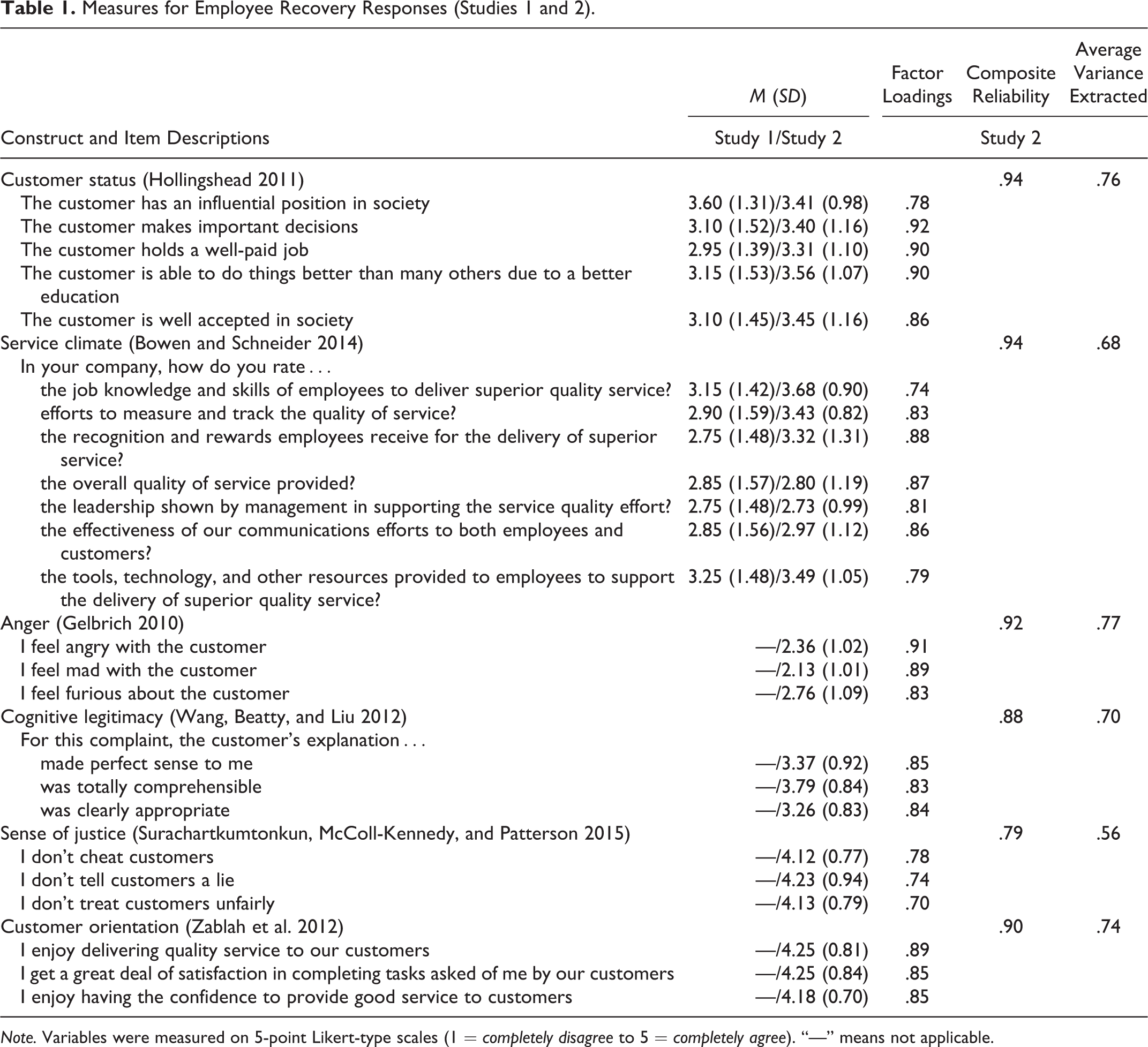
The manipulation was pretested with 20 independent respondents randomly intercepted in a shopping mall. They rated the perceived status of the actresses’ two appearances on photos. Each respondent was shown only one of the two photos that were randomly presented. Hollingshead’s (2011) four-factor index of social status was adapted to the customer context (see Table 1). Respondents were asked how “low” or “high” they perceive the status of the person shown in the photo. High values on the scale imply a perception of a high status. The pretest suggests that the customer status manipulation was successful (M low status = 2.02, M high status = 4.34, t = −9.02, p < .001).
Measures for Employee Recovery Responses (Studies 1 and 2).
Note. Variables were measured on 5-point Likert-type scales (1 = completely disagree to 5 = completely agree). “—” means not applicable.
Service climate
Service climate was operationalized in a quasi-experimental design whereby we conducted the experiments in two different types of restaurants. One type was globally operating fast-food chains that aim to provide consistent service around the world, have well-designed and sophisticated customer service processes, and conduct rigorous employee training on service processes, including complaint handling and service recovery (i.e., they have a strong global service climate; cf. Grandey et al. 2010). The weak service climate setting was operationalized through local fast-food restaurants that were not part of a chain. They have little process standardization, few service rules, and little, if any, formal employee training on customer service (i.e., they have a weak service climate; cf. Bowen and Schneider 2014).
To establish that we have chosen settings with different strengths of service climate, we surveyed real employees in both types of settings using Bowen and Schneider’s (2014) Service Climate Scale (see Table 1). We asked 10 randomly chosen employees currently working in each service climate setting to rate their service climate, whereby we approached 10 different locations for each climate. The mean values suggest that the quasi-manipulation was successful (M weak service climate = 1.64, M strong service climate = 4.16, t = −8.49, p < .001). Care was taken not to interview employees in the pretests who were later involved in the main study.
Dependent Variables
Employees’ emotional and behavioral recovery responses were our two dependent variables, whereby “expressed anger” represented the spontaneous emotional part in the service interaction and “restitution offered” the more reflective and delayed conative response as part of the service recovery process (cf. Douglas et al. 2008; Petty and Cacioppo 1986).
Anger
The rating scale for anger was adapted from Dallimore, Sparks, and Butcher (2007). It was measured through observation of verbal and nonverbal anger attributes demonstrated by the employees in the service encounter. The verbal (e.g., raised voice, aggressive tone) and nonverbal anger poles (e.g., pursed lips, squint, and confrontational stance) were divided into six categories (see Table 2) and covered the main parts of verbal and nonverbal communications (Gabbott and Hogg 2001). We used Dallimore, Sparks, and Butcher’s (2007) anger attributes as scale anchors (e.g., category voice: 1 = soft, 5 = raised to shouting). Overall, the Anger Scale showed good reliability (factor loadings of .89 and higher), a composite reliability (CR) score of .99, and an average variance extracted (AVE) of .84 (note that due to the small sample, these results have to be interpreted with caution).
Measures for Employee Expressed Anger in Study 1.

Source. Adapted from Dallimore, Sparks, and Butcher (2007).
Note. Variables have been assessed on 5-point Likert-type scales (1 = absolutely nonangry; 2 = unlikely to be angry; 3 = not obvious, neither nonangry nor angry; 4 = angry; and 5 = absolutely angry).
Restitution
Our second dependent variable was measured through the recording of whether the service employee offered restitution to the customer or not. Providing restitution such as offering compensation or a refund is a common step in service recovery responses (Tax, Brown, and Chandrashekaran 1998). As fast-food restaurants generally offer low-priced food, a typical service recovery consists of replacement of the food item the customer complained about rather than providing a refund or vouchers. We therefore recorded whether a replacement was offered by the employee (i.e., restitution offered) or not (i.e., no restitution offered). Restitution was offered in 74% of all observed service encounters.
Control Variables
Characteristics of employees and the service situation can shape the recovery outcome. Therefore, we controlled for the employees’ gender (McColl-Kennedy, Daus, and Sparks 2003) and age (Giardini and Frese 2007). Furthermore, the observers recorded the level of busyness (Rafaeli and Sutton 1990) of the fast-food store. This variable was calculated on the basis of three parameters: (1) number of counters open in relation to the total number of counters available, (2) number of seats occupied in relation to the total number of seats available, and (3) number of other people waiting in the queue in front of the service counter. All three measures were standardized and then added up to a composite score. We then used a median split and categorized the lower half of the sample as “less busy” and the higher half as “more busy.”
Procedure
We conducted 80 role-played complaints as field experiments in fast-food locations over a 2-week period, resulting in cell sizes of 20 due to the 2 × 2 factorial design. Actresses played customers who complained in an angry fashion to service employees, whereby observers recorded employees’ expressed anger and recovery behaviors. A list of fast-food locations in the vicinity of the research institute was generated. Actresses and observers randomly selected a location from this list to run the next set of experiments, whereby the experiment was conducted in each location only once. Further, customer status was manipulated randomly whereby the actresses played a series of either high- or low-status roles.
As we conducted experiments akin to mystery shopping, we adhered closely to ethical guidelines. Following the research standard of the European Society for Opinion and Market Research (ESOMAR), we kept the complaining interactions brief as to not interrupt daily operations. Further, we did not video- or audio-record employees’ responses, did not record the names of the employees, and did not report employee performance to the company or any other third party to safeguard employees’ confidentiality and privacy. As such, all employee observations stayed completely anonymous.
Actors
We followed the recommendations of Harmon-Jones, Amodio, and Zinner (2007) for designing and conducting experiments that examine anger responses. To standardize our experimental procedure, we recruited two professional actresses for the customer roles. Both were members of a theater group at a large research university, had more than 5 years of acting experience as part of studying theater, and were familiar with fast-food restaurants. We chose actresses as females as “emotion managers” (Hochschild 1983) are generally able to express emotions well (Buck, Miller, and Caul 1974).
The actresses were trained to display the anger attributes as described by Dallimore, Sparks, and Butcher (2007), including verbal (e.g., aggressive tone of voice) and nonverbal anger display (e.g., no smile, staring eyes, and confrontational stance). The training included videos of angry customers sourced from YouTube to develop appropriate role descriptions. The actresses were trained to play every attribute at a standardized level that might commonly be expressed in such transactions to allow for emotional responses from service employees and trigger potential perceptions of norm violation and retaliation. The customer complaint was performed with an angry voice of the customer targeted at the employee but with no physical violation. To ensure credibility and consistency of the actresses’ angry customer play, the training was supervised and included several encounter plays for practicing and improvement of the customer role.
By keeping the actresses blind to the research hypotheses, we designed a role description for an angry female customer hidden in a cover story (cf. Harmon-Jones, Amodio, and Zinner 2007). Their customer role was designed as a woman in either her leisure time or while working. The story described that both character roles had a heavy day and wanted to have a relaxing lunchtime with their favorite meal (cf. Wirtz, Mattila, and Tan 2000), which they expected to be perfect.
The service encounter was set in fast-food restaurants, where standard service encounters are often brief and mundane (e.g., akin to buying a cinema ticket or payment in a supermarket). In the experiments, it was designed that ordering, paying, and picking up the food took on average less than 2 minutes, so that employees were unlikely to develop a more personal relationship with the customer, that their responses were primarily determined by the subsequent complaint interaction with the customer and her appearance (i.e., status manipulation), and that other potential factors were randomized out.
The script for the service encounter was as follows: The role-played customer ordered the meal (i.e., burger or sandwich) at the food counter, received it from the serving employee, and took a seat inside the restaurant. After opening the meal (i.e., opening the box or unwrapping the sandwich), the customer pretended to be dissatisfied with some aspect of the presentation or quantity of the food. The actress then walked back to the counter to the employee who served her earlier, voiced an angry complaint about the presentation of the meal or the serving size, and waited for a service recovery response. The duration of each complaint interaction was controlled (cf. Barger and Grandey 2006; Giardini and Frese 2007; Mattila and Enz 2002) to last between 1 and 2 minutes from the start of voicing the complaint to the end of the interaction to keep it brief. The discussion between customer and employee ended automatically when restitution was offered as service recovery. If the employee did not offer restitution within 2 minutes, the complaint interaction was terminated.
The perceived service failure was standardized across all encounters. Fast food such as burgers and sandwiches often look less appealing, fresh, and crispy from what is advertised on pictures on counter displays and menus. Furthermore, serving sizes can appear smaller and the food can get squished and toppings drop out of burgers and sandwiches. To ensure that the service failure scenario is credible, we examined the perceived severity of our service failure scenario in additional testing. Pictures of unwrapped fast food akin to what was encountered in our study (i.e., a burger and a sandwich) were presented to random respondents in a shopping center together with photos taken of the meals in counter displays. We asked the respondents on a 5-point Likert-type scale as how severe a service failure they perceive the deviation between the two photos (1 = absolutely not severe to 5 = extremely severe). Overall, a mean value of M = 3.98 suggested that customers viewed it as a moderately severe failure.
The perception of a service failure’s severity is subjective, which can lead to self-serving fairness and recovery expectations of customers (Wirtz and McColl-Kennedy 2010). Therefore, frontline employees may feel in many instances that customers are picky, difficult, and even unreasonable and may even be unhappy for reasons unrelated to the service encounter (e.g., had a bad day or argument with someone else before the encounter), but nevertheless employees still should aim to recover a customer (cf. Wirtz and McColl-Kennedy 2010).
Observers
The emotional and restitution response behaviors of service employees were recorded by two independent observers. We chose female observers familiar with experimental marketing research for recording the employees’ visible responses, whereby the observation and recording procedure followed the recommendations of Whiting and Whiting (1970). We chose female observers as women are known to be more expressive in their emotions (Kring and Gordon 1998), implying that they are also better able to catch and decode other peoples’ emotions compared to men (Fujita, Harper, and Wiens 1980). Further, as we expected more female employees to serve in the restaurants, we considered same-gender conditions regarding female observers as appropriate to reduce variance to increase the power of the study. Finally, the observers were blind to the objectives of the study and were therefore unlikely to produce biased results.
The observers were trained in rating service employees’ emotions (see Table 2). As part of the training, the observers were asked to watch YouTube videos on angry employees and rate their anger intensity on the anger scales. After each video, the observers discussed their individual ratings with each other and the experimenter to achieve a common understanding and use of the anger scales for the experiments proper.
The fast-food restaurant setting allowed our observers to code real-life employee responses independent from another by taking different seats inside the location (cf. Barger and Grandey 2006). The recording took place on a specially designed coding sheet. Our observers’ ratings showed a high consistency, suggesting a high level of reliability of the ratings (Intraclass Correlation Coefficient = .95, p < .001).
Study 1 Findings
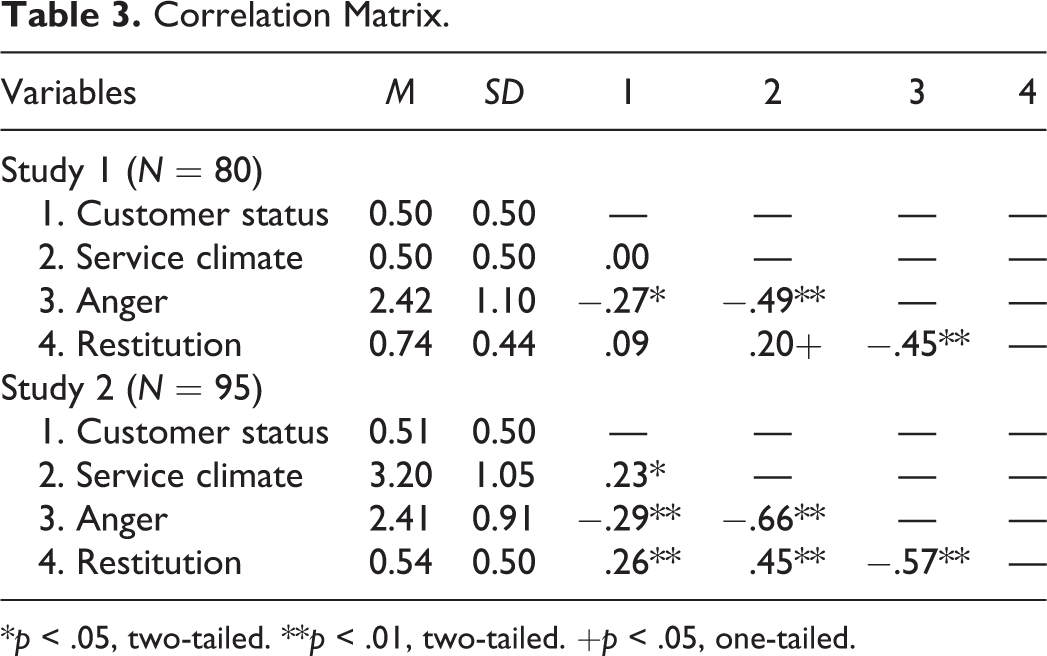
We used the partial least squares (PLS) approach to structural equation modeling (SEM) with SmartPLS (Version 3.2.6; Ringle, Wende, and Becker 2015), as it has minimal restrictions on sample size (Chin, Marcolin, and Newsted 2003) and allows testing of our conceptual model in one analysis. Except anger, all variables were single-item manipulations for observations. Anger showed good factor loadings, CR, and AVE (see Table 2), its Cronbach’s α was .89, and discriminant validity seemed good as the square root of AVE for anger was higher than the correlation between any two of the measured constructs (see Table 3). The standardized root mean square residual (SRMR = .062, t = 3.07, p = .001) suggests a satisfactory goodness of fit of the model.
Correlation Matrix.
*p < .05, two-tailed. **p < .01, two-tailed. +p < .05, one-tailed.
To test our hypotheses, we integrated service climate and customer status as dummy-coded variables (0/1) into the PLS model, whereby we conducted a baseline model (without interaction term) and a theoretical model (with interaction term; service climate as moderator variable; see Table 4; Chin, Marcolin, and Newsted 2003). We used a bootstrapping procedure with 1,000 subsamples for each model to test for significant path coefficients. We first estimated the models with our control variables of employee gender and age, and busyness of the restaurant, and as neither showed significant results, they were dropped from the final model. The results show that the interaction term included in the theoretical model is significant and explains added variance as is shown by the effect sizes for expressed anger (f 2 = .03) and restitution offered (f 2 = .07).
Results of Studies 1 and 2 Using Partial Least Squares Approach (Structural Equation Modeling).
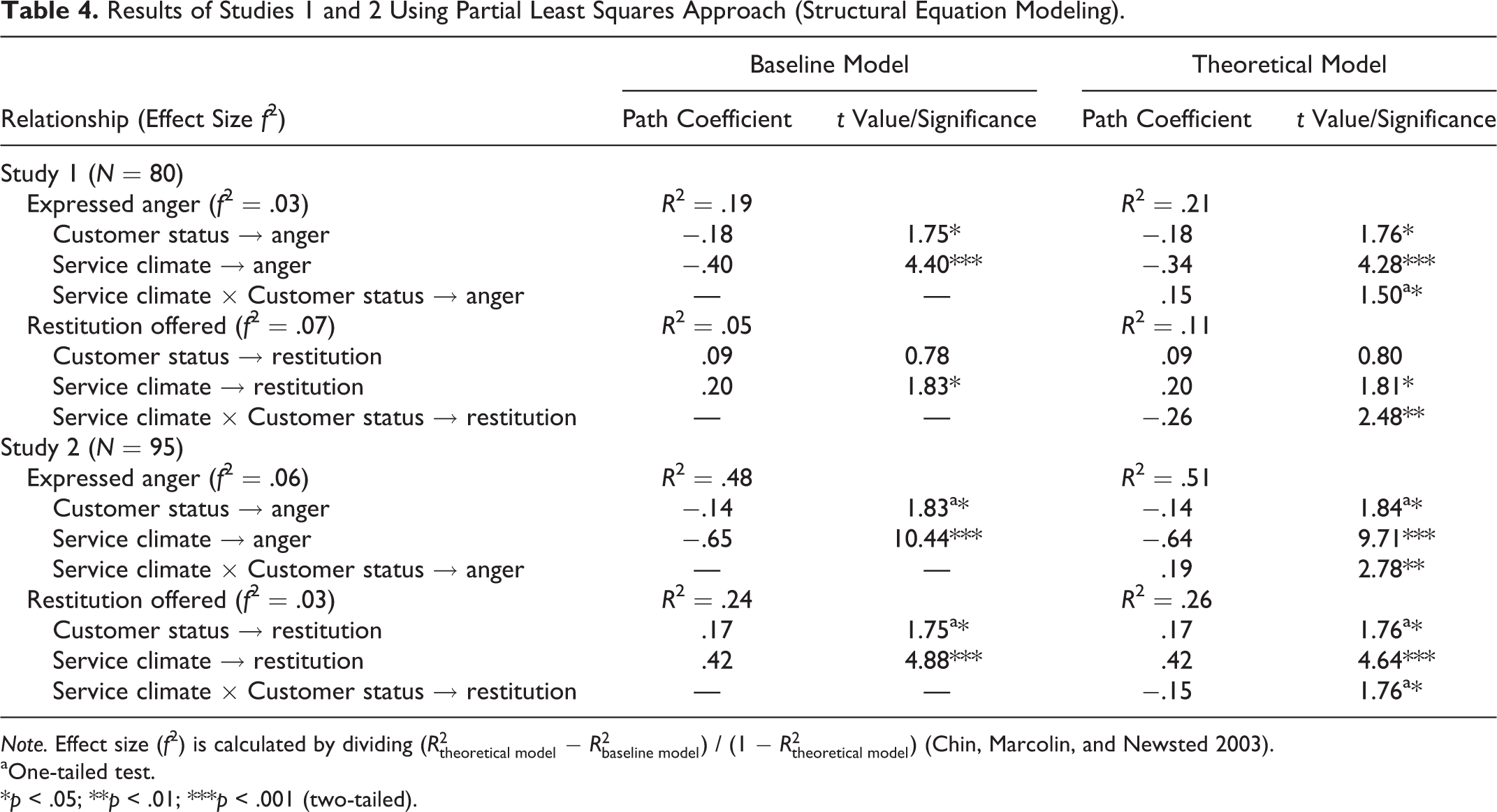
Note. Effect size (f
2) is calculated by dividing (
aOne-tailed test.
*p < .05; **p < .01; ***p < .001 (two-tailed).
Hypothesis 1 proposed employees’ emotional and behavioral reactions to differ according to the perceived status of the complaining customer. We found a significant main effect of status regarding employee expressed anger (path coefficient = −.18, t = 1.76, p = .04) but not on restitution offered (path coefficient = .09, t = 0.80, p = .22). That is, employees expressed more anger to low-status compared to high-status customers, supporting only Hypothesis 1a.
Furthermore, service climate showed a significant effect on expressed anger (path coefficient = −.34, t = 4.28, p < .001) and on restitution offered (path coefficient = .20, t = 1.81, p = .04). That is, employees expressed less anger and were more likely to offer restitution when working in a strong service climate compared to a weak one, supporting Hypothesis 2.
Hypothesis 3 advanced that employees’ recovery responses would be moderated by the strength of firm’s service climate. As expected, the interaction effects on both expressed anger (path coefficient = .15, t = 1.50, p = .03, one-tailed) and on restitution offered (path coefficient = −.26, t = 2.48, p = .009) are significant.
We predicted that the customer status effect would be weakened in a strong service climate. Our findings confirm that differential treatment according to customer status is lower in a strong service climate. In fact, customer status did neither reach significance for expressed anger (M strong service climate/low status = 1.94, M strong service climate/high status = 1.82, p = .45; see Figure 2a) nor for restitution offered (M strong service climate/low status = 90%, M strong service climate/high status = 75%, p = .23; see Figure 3a).

Employees’ immediate emotional response (i.e., expressed anger) to angry customer complaints. (a) Study 1 and (b) Study 2.
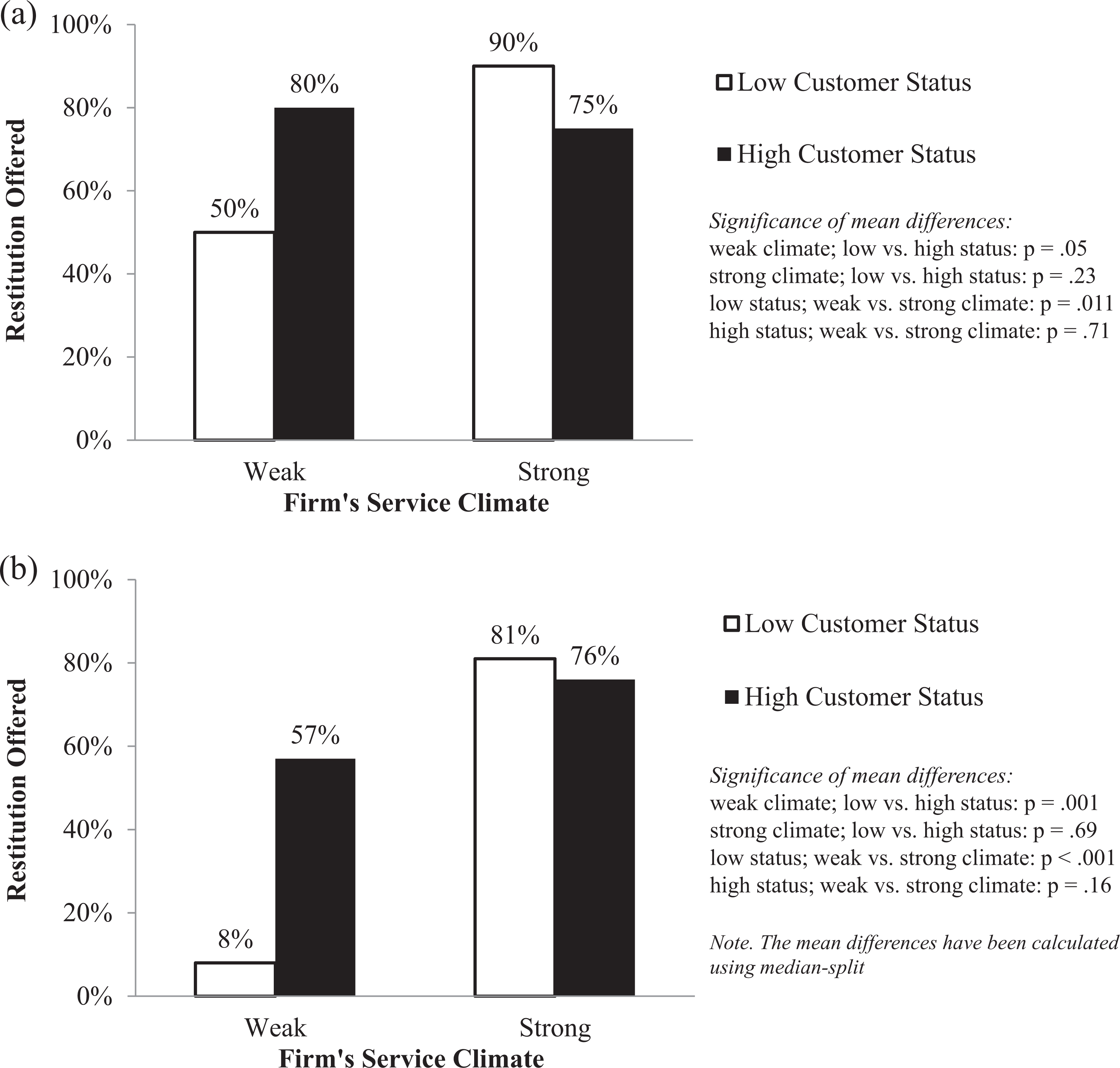
Employees’ delayed behavioral response (i.e., restitution offered) to angry customer complaints. (a) Study 1 and (b) Study 2.
In contrast, we advanced that employees in a weak service climate treat customers according to their status, whereby low-status customers are expected to be treated with more anger and are less likely to receive restitution than high-status customers. Examining the cell means confirms that employees expressed more anger toward low-status customers (M weak service climate/low status = 3.49, M weak service climate/high status = 2.42, p = .007) and were less likely to offer restitution to low-status customers (M weak service climate/low status = 50%, M weak service climate/high status = 80%, p = .05) compared to high-status customers. These findings provide support for Hypothesis 3.
In sum, our findings show that employees in strong service climate organizations were, independent of customer status, overall less likely to express anger and more likely to offer restitution compared to employees operating in weak service climate firms. In contrast, employees operating in weak service climates treated low-status customers worse than high-status ones. Furthermore, note that although Hypothesis 1b was not supported in the PLS model, the significant mean differences show that it is supported in the weak service climate condition but not in the strong one. That is, the service climate-customer status interaction effect is so strong that the customer status main effect becomes insignificant in a strong service climate and that service climate constitutes a boundary condition for Hypothesis 1.
Study 2: Survey-Based Experiment
To replicate our field experiment and test for potential rival explanations of our observations in Study 1, we conducted a second study using a scenario-based experiment with employees. Study 2 extends Study 1 in a number of ways. First, we placed a stronger focus on the employee perspective of the complaint encounter and used employees’ responses to a hypothetical situation set in the restaurant they worked in rather than field observations. Next, we used a male customer rather than the female actresses in Study 1 to test for potential gender effects on employee recovery responses. Additionally, we did not limit the experimental context to fast-food restaurants and gathered responses from employees serving in various types of restaurants. Finally, we changed the type of service failure from an outcome failure (i.e., presentation and portion size of a meal) to a process failure (i.e., time to serve a meal).
We added a number of controls that could not be observed in Study 1 that might potentially impact employee responses. First, variables regarding the respondents’ perceptions of the complaint situation and complaining customer were measured. They included severity of the service failure (Smith, Bolton, and Wagner 1999), cognitive legitimacy of the complaint (Wang, Beatty, and Liu 2012), and perceived attractiveness of the complaining customer (cf. Ohanian 1990).
Second, we added restaurant-type variables as controls and measured restaurant type (e.g., typical family restaurant, café, and beer garden), restaurant model (i.e., franchise/chain restaurant or single-site outlet), number of employees, number of tables, and price level. We expected that especially large restaurants belonging to global franchise chains have established service recovery policies and a strong service climate.
Third, we measured a number of employee background variables. These included employees’ sense of justice (Surachartkumtonkun, McColl-Kennedy, and Patterson 2015) and customer orientation (Zablah et al. 2012). Finally, respondents’ demographics were collected including gender, age, education, and frontline work experience in years.
Method
We invited respondents to participate in an online scenario-based experimental survey, whereby we posted the survey link in restaurant forums for a 2-week period in social media to obtain a sample of restaurant service employees. Respondents were screened at the beginning of the survey to have worked in a restaurant as a server in the last 24 months. If yes, they were asked to provide details about the last restaurant they worked for (i.e., measurement of restaurant-type variables). With this procedure, we wanted to aid respondents to better recall that restaurant in question. Next, respondents rated that restaurant’s service climate using the service climate items from Bowen and Schneider (2014; see Table 1).
Respondents were then presented with a scenario describing a male customer and were asked to imagine that the following scenario was happening in their restaurant: The customer requested to be served fast as he was in a hurry around lunchtime. Next, a picture of the hypothetical customer was presented through which customer status was manipulated (true experimental design using pictorial stimuli). One experimental condition showed the customer in a suit (i.e., high-status customer) and the other the same customer in the identical pose but dressed in a casual outfit with jeans, T-shirt, and visible tattoos on his arms (i.e., low-status customer). The scenario continued with describing that meals are usually served quickly during lunchtime, but this customer had to wait for 30 minutes; the customer became angry and started complaining about the slow service.
Following this, the dependent variables were measured. That is, respondents were asked to state the intensity of experienced anger toward the customer (items were adapted from Gelbrich 2010; see Table 1) and the offer of a potential restitution (i.e., restitution offered or not offered).
In the final section, we included the manipulation check for customer status using Hollingshead’s (2011) customer status items, various control variables regarding the respondents’ perceptions of the complaint situation, and respondent background variables (see Table 1). The duration of each scenario experiment was between 5 and 8 minutes.
Sample
The final sample consisted of 95 valid responses, of which 73% were female employees (more females work in customer-facing roles in restaurants in Germany), and the average age was between 20 and 40 years. The restaurant context they reported in the scenario was typical family restaurants (31%) and cafés (22%), with a medium price level (60%). The restaurants were mostly independent and not part of a chain (64%), and the remainder were chain outlets (36%). The restaurants had mostly between 5 and 20 employees (59%) and more than 10 tables (71%).
Manipulations
The true experimental manipulation of customer status was successful (M low status = 2.60, M high status = 4.15, t = −13.72, p < .001). In contrast to Study 1, service climate was included as a continuous variable in our analysis.
Study 2 Findings
As for Study 1, we used PLS to SEM to test our hypotheses. All multi-item constructs had good psychometric properties in terms of CR (≥.79) and AVE (≥.56; see Table 1). All factor loadings were .70 or higher, and the square root of the AVE for every factor was greater than the highest correlation between two of the measured constructs (see Table 3). The goodness of fit of the model was satisfactory (SRMR = .075, t = 11.80, p < .001).
To test our hypotheses, we constructed a baseline model, whereby customer status was dummy coded (0/1), and service climate was mean centered to avoid multicollinearity and was included as a continuous variable (cf. Chin, Marcolin, and Newsted 2003). For the theoretical model, we integrated service climate directly as moderating variable into the path model. For each model, we ran a bootstrapping approach with 1,000 subsamples to test for significant path coefficients.
Further, we controlled for a number of variables in both analyses which revealed significant effects of employee customer orientation (p = .003) and gender (p = .002) on expressed anger and of cognitive legitimacy (p = .016) on restitution offered. The findings were robust when comparing the model with and without controls (albeit significance levels were marginally lower in the model with controls) and suggest little relevant impact of the controls on our hypotheses testing. Therefore, we report in the remainder of this analysis the findings without controls to avoid issues related to reduced statistical power and potential spurious suppression that might be introduced by the controls (cf. Carlson and Wu 2012; Spector and Brannick 2011).
As in Study 1, the findings show that the interaction term in the theoretical model is significant and explains added variance as is shown by the effect sizes for expressed anger (f 2 = .06) and restitution offered (f 2 = .03; see Table 4). The detailed results show significant main effects of customer status on anger (path coefficient = −.14, t = 1.84, p = .04, one-tailed) and restitution (path coefficient = .17, t = 1.76, p = .04, one-tailed), providing support for Hypothesis 1. Likewise, the main effects of service climate were also significant on anger (path coefficient = −.64, t = 9.71, p < .001) and restitution (path coefficient = .42, t = 4.64, p < .001), providing support for Hypothesis 2. Furthermore and consistent with Hypothesis 3, customer status and service climate showed a significant interaction effect on anger (path coefficient = .19, t = 2.78, p = .009) and restitution (path coefficient = −.15, t = 1.76, p = .04, one-tailed).
We conducted a median split of service climate to make the figures and testing comparable to Study 1 (see Figures 2b and 3b). The findings show that employees in a strong service climate did not treat low-status customers worse than high-status customers with regard to perceived anger (M strong service climate/low status = 1.91, M strong service climate/high status = 1.88, p = .91) and restitution offered (M strong service climate/low status = 81%, M strong service climate/high status = 76%, p = .69). That is, there was no significant mean difference for anger and restitution. In contrast, employees in a weak service climate treated low-status customers with more anger (M weak service climate/low status = 3.31, M weak service climate/high status = 2.45, p < .001) and were less likely to offer restitution (M weak service climate/low status = 8%, M weak service climate/high status = 57%, p = .001).
These findings provide support for Hypothesis 3 as a strong service climate mitigated the customer status effect on affective and conative employee responses. Again, service climate proved to be a boundary condition for Hypothesis 1, as the customer status effect became insignificant in a strong service climate.
Discussion, Implications, and Further Research
We studied actual employee recovery responses to angry customer complaints by conducting a field experiment, followed by a scenario-based experiment across two levels of customer status (true experiment) and two service climates (quasi-experiment). Furthermore, we assessed both employees’ immediate emotional and their delayed behavioral responses to angry customer complaints. Our findings confirm that a strong service climate moderates the effects of customer status on employees’ response behaviors in both studies. The consistent immediate and delayed responses suggest that a strong service climate is internalized by frontline employees and governs even their instantaneous affective responses. As a result, employees’ service recovery behaviors converge at what is generally considered good practice in customer service. Our findings are robust across methods (i.e., field- vs. scenario-based experiment), samples (i.e., ratings based on employee observations versus employee self-assessments), stimuli (i.e., female vs. male customers), service failures (i.e., outcome vs. process failure), and restaurant type (i.e., fast food vs. a range of restaurant types).
Implications for Theory
Both studies revealed main effects of customer status and service climate on employee responses regarding expressed anger and restitution offered, whereby service climate constituted a boundary condition for the customer status effect. Low-status customers experienced more anger and were less likely to be offered restitution, but only so in the weak service climate condition. This finding in the weak service climate condition is congruent with previous findings in the social psychological literature, which holds that, first, anger expression tends to be more accepted from high-status individuals and, second, anger responses tend to be more suppressed toward them (Allan and Gilbert 2002; Lively and Powell 2006).
A weak service climate is generally characterized by fewer service rules, less process standardization, and little training (Bowen and Schneider 2014). Our findings suggest that in such a climate, employees’ responses are determined more by respondents’ individual personalities and societal norms (cf. Eid and Diener 2001) rather than the organization’s service climate. Moreover, employees respond with greater variability as they expect their individual behaviors to be appropriate (Schneider, Salvaggio, and Subirats 2002). For example, if individuals perceive customer misbehavior as unacceptable in their culture (cf. Grandey et al. 2010) and view it as a social norm violation that is accompanied by injustice perceptions (Shao et al. 2012), employees may be more likely to show negative emotional and behavioral responses (Dallimore, Sparks, and Butcher 2007; Harris and Reynolds 2003; Wang et al. 2011) as such responses are not suppressed by strong service expectations, policies, and routines that come with a strong service climate.
In contrast, a strong service climate is typically accompanied by strong organizational rules, routinization of recovery processes, better employee skills and knowledge, and guidance by leadership (cf. Bowen and Schneider 2014). That is, in a strong service climate, employees know what is expected from them in service encounters, which leads to less variation in their responses (Schneider, Salvaggio, and Subirats 2002). Our findings confirm this and show that a strong service climate leads to better service recovery outcomes and that employees did not treat low-status customers worse than high-status ones. It seems that service climate mitigates the influence of employees’ own personalities and societal norms and prevents employees from retaliating angry customer complaints and from treating low-status customers worse than high-status ones.
Importantly, our findings show that service climate governs both employees’ immediate affective and delayed conative recovery responses. This suggests that a strong service climate is authentic, internalized, and on a level of deep acting (Grandey 2003; Hennig-Thurau et al. 2006) and therefore is potentially effective in governing employee responses in difficult situations and in establishing emotional display rules (cf. Diefendorff, Richard, and Croyle 2006; Rafaeli and Sutton 1987).
Finally, the differential effect of the control variables on the immediate emotional and delayed conative employee responses confirms that we tapped into two separate response mechanisms. Anger expression was affected by employee background variables (i.e., anger was lower for employees who were more customer-oriented and female), whereas the likelihood to offer restitution was affected by a conative process (i.e., a higher assessed cognitive legitimacy of the complaint resulted in higher likelihood to offer restitution).
Managerial Implications
It is not uncommon that service recovery is unsuccessful, whereby a failed recovery further intensifies dissatisfaction (Maxham 2001; Wirtz and Mattila 2004) and can lead to customer switching (Keaveney 1995). Therefore, a strong service climate seems important for achieving customer satisfaction and loyalty through effective service recovery (cf. Schneider, Salvaggio, and Subirats 2002).
One major input to developing a strong service climate is training to develop employee knowledge and skills (cf. Bowen and Schneider 2014). A strong service climate seems a necessary requirement for effectively dealing with angry customers as employees have to respond immediately in such “moments of truth.” Therefore, employees should be trained even in handling their feelings and how to use emotional displays in an appropriate manner. As our findings suggest, especially for organizations with a weak service climate, this training needs to include on how to treat customers equally and independent of potential biases employees may have. As employees internalize a service climate, emotion displays toward complaining customers are pushed to a level that is known as deep acting, whereby employees display genuine and authentic emotions toward their customers (Grandey 2003; Hennig-Thurau et al. 2006; Hochschild 1983).
In our weak service climate conditions, a few employees reacted friendly to angry customers. Given the absence of a strong service climate, there might be employee characteristics that determine their response behaviors beyond societal norms. For example, it could be the employees’ natural disposition (e.g., not be aggressive, be relaxed) or perhaps that these employees had worked in a firm with a strong service climate before and developed a service-oriented mind-set in general. As developing a strong service climate requires significant resources (e.g., for training and process and policy development), small firms could explore hiring employees with natural service predisposition or who have prior work experience in firms with a strong service climate. Furthermore, industry associations could be more proactive in helping small firms with training on how to manage angry customers and deliver effective service recovery.
Limitations and Further Research
As any research, our study has limitations that offer potential avenues for further research. First, our two experimental studies used relatively small sample sizes (approximately 20 cases per cell) with the associated low power. Although the majority of hypotheses was confirmed and our findings were consistent across both studies, none of our control variables in Study 1 and only a few in Study 2 reached significance. Their relevance should be explored in future research with larger samples.
Second, both studies showed that directionally low-status customers were more likely to receive restitution in a strong service climate than high-status customers. Although in each study not statistically significant, this pattern may suggest that while internalized immediate responses are customer status independent, employees may overcompensate low-status customers in the delayed conative response. That is, the better conative response to low-status customers may indicate a conscientious effort by employees not to treat low-status customers worse than high-status customers, and it seems that employees overcompensate in that process (cf. Burns, Isbell, and Tyler 2008). It would be interesting to examine these effects directly in future studies with higher statistical power.
Third, the employees in our studies worked in restaurants. Compared to professional service roles (e.g., consultants, doctors), these jobs have a relatively low status. It would be interesting to explore potential customer status effects at increasing status differential between employees and customers. For example, customers have reported that they sometimes deal with snobbish service employees (Bitner, Booms, and Tetreault 1990), and it would be interesting to explore how these employees respond to low-status customers.
Fourth, additional employee variables that may provide a better understanding of employee responses to angry customers include job satisfaction, self-esteem, justice perceptions, and type of training. In particular, job satisfaction and improved self-esteem (cf. Akkawanitcha et al. 2015) may motivate employees to better internalize a firm’s service climate and more closely follow service recovery rules and procedures. Justice perceptions, drawing on the theory of stress and coping, might offer further insights on how employees can better deal and respond to angry customers (cf. Akkawanitcha et al. 2015; Surachartkumtonkun, McColl-Kennedy, and Patterson 2015).
Fifth, our studies used mild customer anger manipulations, but employees’ recovery responses might depend on the intensity of anger displayed. For example, the higher the customer’s anger intensity, the more unfairly might employees feel treated, and the required strength of the service climate may have to be higher to prevent employees from retaliating customer mistreatment. Future research could explore the impact of anger intensity and different forms of anger behavior, such as verbal intimidation or even physical expression (cf. McColl-Kennedy et al. 2009; Patterson, Brady, and McColl-Kennedy 2016).
Finally, both our studies were set in a Western European country characterized by lower power distance (Hofstede 2001), where it can be expected that complaints to service employees are common. Patterson, Brady, and McColl-Kennedy (2016) found that customers from Eastern cultures are slow to express anger toward frontline employees compared to those from Western cultures, however, when pushed beyond a threshold they “will eventually ‘explode’ and express their anger more forcefully and aggressively than Westerners” (p. 253). As customer anger expression differs across cultures, it would be of interest to also extend our studies on the matching employee responses to high power distance and collectivistic cultures. For example, employee recovery responses may be even more strongly determined by customer status in Eastern cultures due to higher power distance (cf. Hofstede 2001).
Executive Summary
It is not uncommon that customers behave aggressively in service encounters, especially after experiencing a service failure. This study examines whether a customer’s status determines how well service employees respond when they get confronted with an angry customer complaint and whether a firm’s strong service climate can help to reduce customer status effects.
Specifically, to assess employees’ emotional (i.e., expressed anger) and behavioral (i.e., restitution offered) service recovery responses, the authors conducted role-played complaints in field experiments in fast-food restaurants and observed employees’ actual responses. Additionally, the authors conducted scenario-based experiments with restaurant waiters to control for potential employee background and personality effects.
The studies’ findings confirm that in weak service climate conditions, employees treated low-status customers significantly worse with expressing more anger, and they were less likely to offer restitution. In contrast, a strong service climate moderated the effects of customer status on employees’ response behaviors in both studies. As a result, employees’ service recovery behaviors converged at what is generally considered good practice in customer service. The strong organizational rules, routinization of service recovery processes, better employee skills and knowledge, and guidance by leadership meant that employees knew what is expected from them and lead to better service recovery outcomes. Importantly, employees did not treat low-status customers worse than high-status ones.
Furthermore, the findings show that service climate governs both employees’ immediate affective and delayed behavioral recovery responses. This suggests that a strong service climate is authentic, internalized, and on a level of deep acting and therefore is effective in governing employee responses in difficult situations including in establishing emotional display rules.
Christina Jerger stated, In today’s diverse societies, it is critically important to avoid discrimination and employee responses that are driven by perceived customer status. A strong service climate that comes along with employee training and standardized rules for service recovery is important for achieving customer satisfaction and loyalty through effective service recovery. A strong service climate seems a necessary requirement for effectively dealing with angry customer complaints. Employees should be trained in handling their feelings and how to use emotional displays in an appropriate manner. Especially for organizations with a weak service climate, this training needs to include on how to treat customers equally and independent of potential biases employees may have. As employees internalize a service climate, they display genuine and authentic emotions towards their customers, known as deep acting.
Footnotes
Acknowledgments
The authors gratefully acknowledge the valuable feedback provided by Michael Frese from the National University of Singapore to earlier versions of this article.
Declaration of Conflicting Interests
The author(s) declared no potential conflicts of interest with respect to the research, authorship, and/or publication of this article.
Funding
The author(s) received no financial support for the research, authorship, and/or publication of this article.