




Abstract
A service provider’s conspicuous consumption can undermine customer attitudes and behavioral intentions toward the provider—a so-called penalty effect of conspicuous consumption. Four studies investigate customer and contextual factors that moderate this penalty effect. The results show that customers low in materialism penalize service providers who consume conspicuously (e.g., decreased patronage intentions). In addition, as another facet of the penalty effect, a service provider’s conspicuous consumption undermines customer cost-benefit assessments (decreased perceived value and price fairness), which function as mediating variables. However, service providers can use “service warmth” as a protective strategy to attenuate the penalty effect. Notably, materialistic customers do not react more favorably to service providers who engage in conspicuous consumption (in contrast with their established tendency to favor conspicuous goods). Taken together, the results provide a deeper and theoretically nuanced understanding of when and how customers respond negatively to conspicuous service providers, with meaningful implications for the management of services. For example, when service firms design their aesthetic labor strategy, they should consider their customers’ levels of materialism accordingly. In addition, service firms need to educate their frontline employees about the potential downsides of displaying conspicuous consumption cues.
Conspicuous consumption—the display of luxury products to fulfill social needs, such as signaling status (Braun and Wicklund 1989; Veblen 1899)—can elicit various benefits in social interactions (e.g., increased willingness to comply with requests; Nelissen and Meijers 2011). Accordingly, service providers might believe that displaying luxury items when promoting their services (e.g., in advertisements, on websites) or when interacting with customers will benefit them (Friedman and Ostrov 2008). For example, physicians might pose in ads dressed in executive designer suits and wearing luxury wristwatches and cuff links (Gunderman 2012) or realtors might post pictures on their website of themselves in front of their luxury car (O’Brien 2013; see Online Supplemental Appendix A for real-world examples).
However, while observers tend to rate wealthy people as highly competent (e.g., intelligent), they also tend to consider them to be less warm (e.g., less caring; Christopher and Schlenker 2000); in short, observers perceive “rich people…as smart but not nice” (Fiske, Cuddy, and Glick 2007, p. 81). Therefore, conspicuous consumption may have negative consequences in service relationships, which we refer to as the “penalty effect” of conspicuous consumption. Consistent with this idea, Scott, Mende, and Bolton (2013) find that a service provider’s conspicuous consumption undermines customer attitudes and patronage intentions in communal service relationships, which emphasize interpersonal warmth (e.g., caring, trust). Given the importance of warmth in many service settings, these findings suggest that displaying conspicuous cues puts service providers at risk of harming their customer relationships. Therefore, we examine the following questions: When and why does a penalty effect of conspicuous consumption emerge? How can service providers attenuate it?
To answer these questions, we draw on social perception research (e.g., Fiske, Cuddy, and Glick 2007) and emphasize that perceiver effects and context effects influence perception. That is, characteristics of the perceiver can influence the response to a target (perceiver effects; Kenny 1994), and shifts in context can cause differences in “response to the same target by the same perceiver” (context effects; Higgins and Stangor 1988, p. 263). Against this conceptual background, our research makes three contributions to the service literature.
First, research on conspicuous consumption in services (e.g., Scott, Mende, and Bolton 2013) has not focused on whether the penalty effect (e.g., conspicuous consumption undermines patronage intentions) lies in “the eye of the beholder.” Therefore, guided by the nomological network of conspicuous consumption (e.g., Flynn, Goldsmith, and Pollitte 2016), we examine the moderating role of customer materialism as a driver of perceiver effects (Studies 1A/B, 2, and 3). We find that the penalty effect is driven by low levels of customer materialism and mediated by a change in customer cost-benefit assessments (i.e., perceived value and price fairness).
Second, in addition to exploring perceiver effects (customer materialism), we incorporate context effects (provider choice/firm policy). Prior research assumes that conspicuous consumption reflects a personal choice and therefore is diagnostic of the individual’s traits (Scott, Mende, and Bolton 2013). However, organizations can display conspicuous cues as part of their staff’s appearance (e.g., some hotels use stylish designer uniforms for their staff; Amey 2015; Trejos 2016) or as facets of their servicescape (e.g., luxury cars used as a hotel’s shuttles; McCarthy 2015). We investigate the joint effects of customer materialism and individual choice/firm policy on customers’ cost-benefit assessments (Study 2). We find that, regardless of their level of materialism, customers penalize organizations that consume conspicuously; however, the penalty effect does not emerge among materialistic customers when the provider personally chooses to consume conspicuously.
Third, our research provides evidence of the psychological mechanism, as well as boundary conditions, on penalty effects of conspicuous consumption. We theorize that the penalty effect emerges from its impact on customers’ cost-benefit assessments and provide empirical evidence of these assessments’ role through perceived value and price fairness (Studies 1A, 1B, 2, and 3). Finally, we link this novel finding with the established insight that conspicuous consumption can signal that service providers lack warmth (Scott, Mende, and Bolton 2013). Accordingly, we identify a protective strategy that providers can use to mitigate the penalty effect: signaling service warmth (i.e., caring and empathetic service provision; Study 3).
Together, our four studies provide a theoretically nuanced understanding of when and why customers respond negatively to service providers’ conspicuous consumption—with meaningful managerial implications. Studies 1A and 1B investigate the impact of conspicuous consumption by service providers as a function of customer materialism (Hypothesis 1) and examine the mediating role of customer cost-benefit assessments (operationalized via perceived value and price fairness; Hypothesis 2). Study 2 integrates perceiver and context effects by examining the interplay among customer materialism, personal choice/firm policy, and conspicuous consumption (Hypothesis 3). Finally, Study 3 tests service warmth as a protective strategy against the penalty effect (Hypothesis 4). Figure 1 provides an overview of our framework.
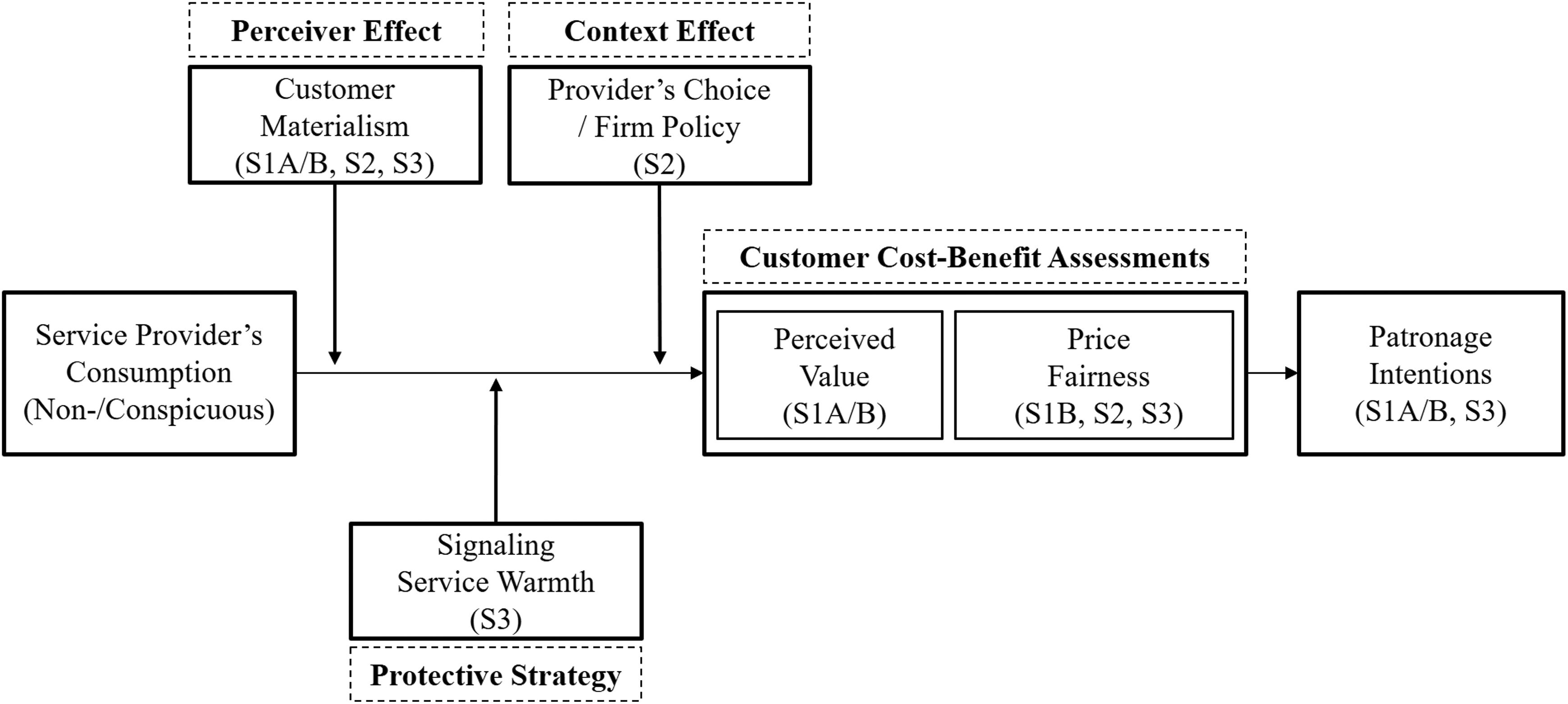
Conceptual framework: Customer responses to conspicuous consumption by service providers in light of perceiver and context effects. S1A/B, S2, and S3 stand for the studies that demonstrate the corresponding effects.
Conspicuous Consumption by Service Providers: The Roles of Customers’ Materialism and Their Cost-Benefit Assessments
Social Perception and Perceiver Effects
Person perception has attracted wide scholarly attention (Uleman et al. 2012). According to prominent frameworks, such as the continuum model of impression formation (Fiske, Lin, and Neuberg 1999), people form spontaneous impressions about others by automatically classifying them into social categories and inferring associated personality traits; notably, features that are visually accessible (e.g., appearance, age, gender) or easy to interpret are usually dominant for this initial categorization (Skowronski and Carlston 1989). An observer’s response to a person is then driven by emotions, cognitions, and behaviors associated with this categorization.
However, when making inferences, observers typically integrate multiple cues related to a target into an overall impression (N. H. Anderson 1981). Therefore, social categorization does not always dominate individuation (i.e., the consideration of personal qualities of each individual; Bodenhausen, Macrae, and Sherman 1999). Rather, a focal category will only be applied to the target when other information about this target is consistent with the implications of that category (Brewer 1988). If observers deem the initial categorization inappropriate in light of inconsistent cues, they will use the new information to recategorize the target. In short, initial categorizations are strengthened by the presence of converging cues but weakened by diverging cues (McCarthy and Skowronski 2014).
The notion of perceiver effects stems from the reality that all stimuli are processed within the perceiver’s personality system (Mischel and Shoda 1995). Thus, perceiver effects describe general tendencies to perceive or judge others in particular ways (Wood, Harms, and Vazire 2010). For example, a perceiver’s personality (e.g., narcissism) can influence which information this person pays attention to when forming impressions about others (De Bruin & Van Lange 2000). In evaluating perceiver effects, we draw from the nomological network of conspicuous consumption (e.g., Flynn, Goldsmith, and Pollitte 2016) and examine whether consumers’ materialism influences how they assess service providers who engage in conspicuous consumption.
The Interplay Between Customers’ Materialism and Their Cost-Benefit Assessments
Customer materialism
Materialism is “an exaggerated belief in the importance of goods in one’s life” (Flynn, Goldsmith, and Pollitte 2016, p. 761). Materialistic consumers want to display their status to others and employ branded goods to do so (Flynn, Goldsmith, and Pollitte 2016; Richins 2004). Seeking social status is a core aspect of materialism, and materialistic status seeking is closely related to conspicuous consumption (Eastman, Goldsmith, and Flynn 1999; Tatzel 2002). Research has shown various (negative) consequences of materialism (e.g., compulsive buying, unhappiness; Kasser 2016). While understanding its maladaptive effects is important, we focus on how materialism influences customer reactions in service settings, a question that has received scant attention. Whereas prior research suggests that materialistic consumers are drawn to conspicuous goods (Eastman, Goldsmith, and Flynn 1999; Richins 2004), the evidence is less clear for services. Moreover, we posit that customers’ cost-benefit assessments should also be considered, as discussed below.
Cost-benefit assessments
We propose that materialism will alter customers’ cost-benefit assessments of service providers who engage in conspicuous consumption. It is well-established that consumers conduct cost-benefit assessments (Zeithaml 1988); that is, when evaluating offerings, consumers assess their corresponding economic and psychological costs and benefits (Bolton and Drew 1991; Brodie, Whittome and Brush 2009). Accordingly, Zeithaml (1988, p. 14) notes that customer-perceived value is the trade-off between “what is received and what is given.” We theorize that customers’ materialism and the provider’s consumption jointly affect cost-benefit assessments and, in turn, patronage intentions as follows.
First, we argue that customers may be especially attentive to the cost-benefit ratio delivered by service providers who engage in conspicuous consumption. Prior research found that being exposed to luxury cues can lead people to adopt a business mind-set, which focuses them on their own interests and benefits (Chua and Zou 2009). Likewise, reminders of money can motivate consumers to protect their financial resources and avoid wasting money (Tong, Zheng, and Zhao 2013). More broadly, reminders of money can trigger a cost focus that makes consumers “spend more time searching for price-relevant information” and “consider what they are giving up for what they will get in return” (Vohs 2015, p. 86, emphasis added). Hence, conspicuous consumption may lead to heightened customer focus on the cost-benefit ratio offered by the focal service provider.
Second, given heightened cost-benefit assessments with regard to conspicuous service providers, customers may rely on consumption cues as signals of the costs and benefits delivered by the service provider. Indeed, in service contexts, quality can be difficult to assess (Darby and Karni 1973); consequently, customers may draw inferences based on other informational cues—such as the provider’s consumption. We expect that their level of materialism influences what inferences regarding costs and benefits consumers draw from a provider’s conspicuousness.
Materialism not only influences how individuals interpret themselves but how they categorize and judge others (Hunt, Kernan, and Mitchell 1996). While materialistic people link consumption to the pursuit of happiness, their nonmaterialistic peers typically reject this idea: Nonmaterialistic people tend to oppose the overacquisition of goods and strive to resist consumerism. These nonmaterialistic individuals tend to be concerned about the negative impact of excessive consumption on personal well-being, society, and the environment (Lee and Ahn 2016). Insofar as conspicuous consumption is seen as spending money on “frivolous and wasteful goods” in order to increase one’s status (Griskevicius et al. 2007, p. 87; Nelissen and Mijers 2011), cost-benefit assessments should decline due to perceptions of wastefulness. Moreover, observers tend to rate wealthy people as competent but less warm (Christopher and Schlenker 2000). Warmth can be an important component of service delivery (Parasuraman, Zeithaml, and Berry 1988) and, by resembling an affluence cue, conspicuous consumption may undermine inferred warmth (Scott, Mende, and Bolton 2013). Such negative inferences seem especially likely to emerge among consumers low in materialism and should undermine their patronage intentions (the anticipated affective state and action tendencies regarding a service provider; Babin and Babin 2001; Baker, Grewal, and Parasuraman 1994).
In contrast, we do not expect a similar penalty effect for consumers high in materialism. Materialistic individuals are less concerned about negative aspects of consumption (e.g., wastefulness; Lee and Ahn 2016). Indeed, these consumers are favorably disposed toward consumption and status seeking and endorse the importance of enjoying personal success, stature, and appearance (Flynn, Goldsmith, and Pollitte 2016; Richins 2004). Furthermore, materialism is associated with an information-processing tendency to judge people’s worth based on their material possessions (Hunt, Kernan, and Mitchell 1996). Hence, materialism might enhance perceived benefits related to a conspicuous service provider: The service offering itself may be seen as more beneficial related to the provider’s conspicuous possessions, and materialistic consumers may also derive greater social benefits, such as self-enhancement, from this service (Richins 2017); consequently, such benefits might counteract a penalty effect.
Taken together, we predict that customers’ materialism will affect their cost-benefit assessments regarding service providers who engage in conspicuous consumption. We do not expect effects of customer materialism when the service provider consumes nonconspicuously because, unlike the strong signal of conspicuous consumption, modest consumption should not stand out and thus trigger a differential response as a function of customer materialism. As previously noted, our research focuses on the penalty effect of conspicuous consumption because past research suggests that displaying conspicuous cues can put service providers at risk of harming their customer relationships (Scott, Mende, and Bolton 2013). Hence, our hypotheses focus on this penalty effect and the conditions under which it is attenuated. Formally,
Hypothesis 2 predicts that cost-benefit assessments will mediate the interactive effects of customer materialism and provider consumption on patronage intentions, which is consistent with prior studies on the mediating role of cost-benefit considerations (e.g., Bolton and Drew 1991; Brodie, Whittome, and Brush 2009; Cronin, Brady, and Hult 2000; Zeithaml 1988). Our empirical studies will operationalize cost-benefit assessments via measures of perceived value and price fairness (Bolton and Drew 1991; Brodie, Whittome, and Brush 2009). Perceived value has been conceptualized previously as a cost-benefit trade-off (Varki and Colgate 2001; Zeithaml 1988). Likewise, price fairness reflects cost-benefit assessments (Bolton, Warlop, and Alba 2003; Xia, Monroe, and Cox 2004): For example, equity theory argues that fairness is a function of the inputs-to-outputs ratio (costs to benefits) between relationship partners (Adams 1965). When customers evaluate a service provider, their cost-benefit assessments can therefore be represented by perceived value and price fairness (as we do in our subsequent empirical work).
Studies 1A and 1B: The Moderating Role of Customer Materialism
Studies 1A and 1B investigate the impact of conspicuous consumption by service providers as a function of customer materialism (Hypothesis 1) and examine the mediating role of customer cost-benefit assessments (Hypothesis 2). Specifically, Study 1A tests our hypotheses in a tax-advising context and examines the mediating role of perceived value. Study 1B tests the hypotheses in an event-planning context and examines the mediating roles of both perceived value and price fairness.
Study 1A: Design, Participants, and Procedure
The experiment employed a 2 (consumption: non-conspicuous/conspicuous) × (measured: customer materialism) design; consumption was a between-subjects factor. Participants were members of the Amazon Mechanical Turk (MTurk) panel in the United States (N = 95; M age = 35.27; 41.05% female). To enhance external validity, we conducted this study during the 2 weeks after the U.S. tax deadline and recruited consumers who had used a tax adviser.
Participants were asked to imagine needing to work with a tax adviser to complete their taxes and visiting a company’s website to learn about its services. Participants then viewed a webpage highlighting the services provided and including a section labeled “Meet our Team” that introduced the tax adviser (similar to how consumers search for information and how service companies can feature employees online). The webpage manipulated conspicuous consumption via the tax advisor’s shirt (using an established manipulation of logo size; Han, Nunes and Drèze 2010) and car (Cadillac Escalade vs. Ford Escape; Scott, Mende, and Bolton 2013). This manipulation is arguably conservative insofar as only the logo size and three words (of 150 words) varied across conditions. All other aspects were held constant (see Online Supplemental Appendix B for stimuli).
After viewing the website, participants indicated their patronage intentions and perceived value. Participants then responded to a manipulation check for conspicuous consumption (“The clothing and car in the scenario seem: in/expensive, modest/conspicuous, and moderate/luxurious”; 7-point bipolar scale, α = .96). Finally, participants responded to an established Materialism Scale and provided sociodemographics (e.g., age, gender). See Table 1 for exact wording of key measures.
Measurement Items by Study.
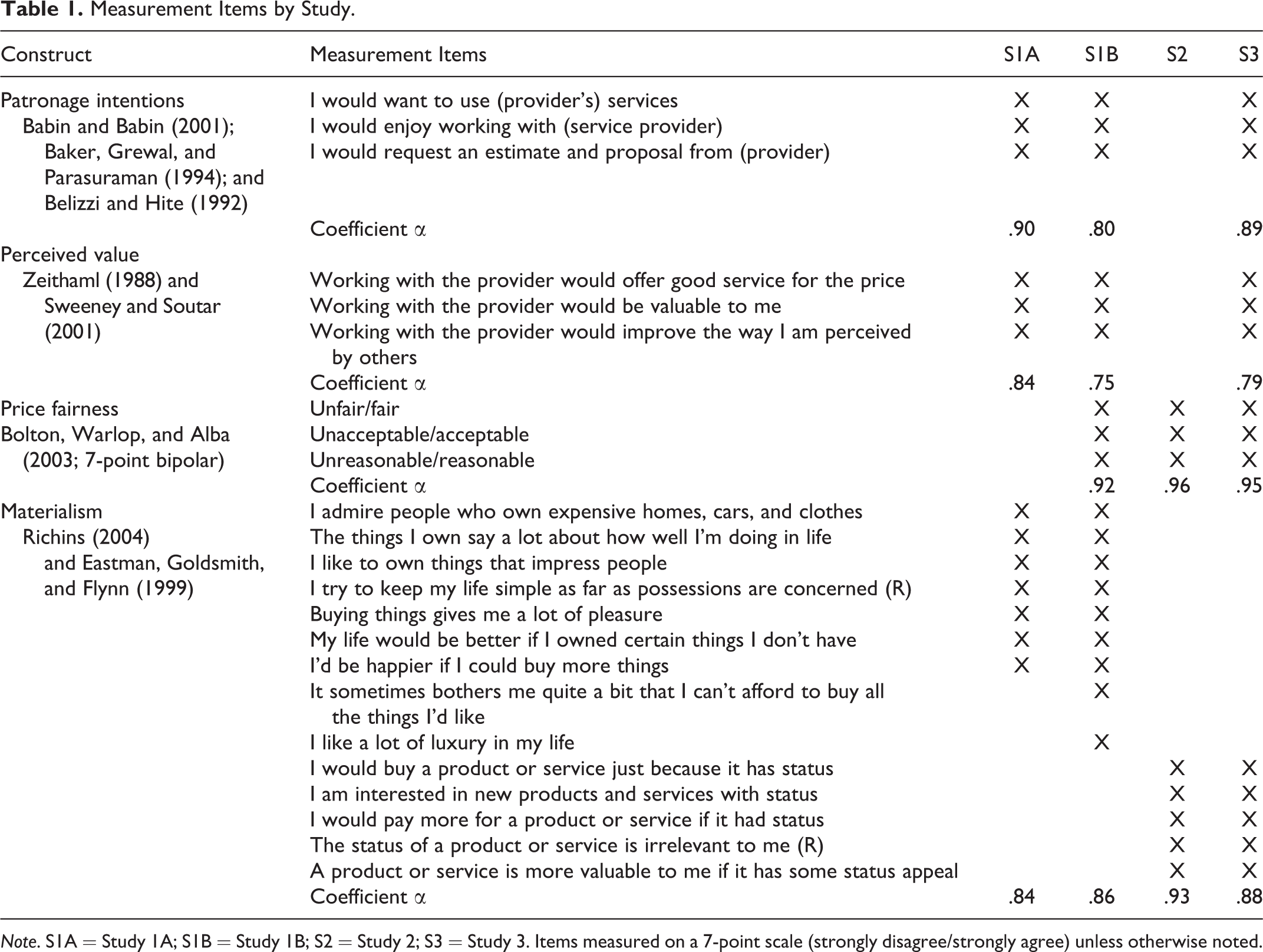
Note. S1A = Study 1A; S1B = Study 1B; S2 = Study 2; S3 = Study 3. Items measured on a 7-point scale (strongly disagree/strongly agree) unless otherwise noted.
Study 1A: Results
Manipulation Check
Analysis of covariance (ANCOVA) of conspicuousness perceptions revealed a main effect of conspicuous consumption, M NC = 3.65 vs. M C = 5.93, F(1, 91) = 11.15, p < .001; materialism and the interaction were nonsignificant, F(1, 91) = 2.36, p > .10; F < 1. Thus, our manipulation performed as intended.
Patronage Intentions
We analyzed patronage intentions as a function of conspicuous consumption, customer materialism, and their interaction, controlling for age, gender, and income. (Control variables were nonsignificant and will be discussed only when they are significant.) ANCOVA revealed main effects of conspicuous consumption, F(1, 88) = 8.97, p < .005, and materialism, F(1, 88) = 5.52, p < .05, qualified by their two-way interaction, F(1, 88) = 4.15, p < .05.
To explain the interaction, we assessed simple effects at higher and lower levels of customer materialism. Participants low in materialism (−1 standard deviation [SD]) penalized the provider for conspicuous consumption, indicating lower patronage intentions (M NC = 3.81 vs. M C = 1.94; t = −4.01, p < .001). Participants high in materialism (+1 SD) were unaffected by whether the provider engaged in conspicuous consumption (M NC = 3.93 vs. M C = 3.39; t = −1.19, p = .24). These results, illustrated in Figure 2 (Panel A), provide support for Hypothesis 1 (see Online Supplemental Appendix D for a summary of hypothesis support by study).

Effects of service provider conspicuous consumption and customer materialism (Study 1). Figures graphically denote significantly different contrasts related to the focal hypothesis test. In addition to the simple effects of nonconspicuous consumption noted in the graph, the simple effects of materialism are significant under conspicuous consumption but are not significant under nonconspicuous consumption—a pattern that emerges in this and all subsequent studies (ps < .05). For completeness, additional contrasts for each study are also reported in Online Supplemental Appendix C.
Mediating Role of Cost-Benefit Assessments (Perceived Value)
We conducted a mediation analysis (Hayes 2013; Model 7; 5,000 resamples), with patronage intentions as the dependent variable, conspicuous consumption as the independent variable, materialism as the moderator, and perceived value as the mediator; control variables were age, gender, and income. At low levels of customer materialism (−1 SD), value mediated the relationship between conspicuous consumption and patronage intentions (a × b = −1.12; 95% confidence interval [CI] [−1.92, −0.36]); at high levels of customer materialism (+1 SD), value did not mediate the relationship (a × b = −0.19; 95% CI [−0.99, 0.64]). These results provide support for Hypothesis 2.
Study 1B: Design, Participants, and Procedure
The experiment employed a 2 (consumption: nonconspicuous/conspicuous) × (measured: customer materialism) design; consumption was a between-subjects factor. Participants were undergraduate students in the United States (N = 224; M age = 19.53; 47% female).
Participants were asked to imagine that they needed to work with a professional event planner at a hotel to plan a family event and visited a company’s website to learn about its services. Participants then viewed a webpage highlighting the services provided and including a section labeled Meet our Team. The webpage manipulated conspicuous consumption through the event planner’s shirt (Louis Vuitton vs. no logo) and vehicle (Cadillac Escalade vs. Ford Escape). All other aspects of the webpage were held constant (see Online Supplemental Appendix B).
After viewing the webpage, participants indicated patronage intentions, perceived value, and price fairness (see Table 1 for all items). Participants also responded to a manipulation check for conspicuous consumption (“The clothing and car in the scenario are for someone who…wants to blend in/wants to stand out, does not seek social status/seeks social status”; 7-point bipolar scale, r = .84). Finally, participants responded to measures of customer materialism, sociodemographics (e.g., age, gender, and socioeconomic status [SES]), and prior experience with event planning.
Study 1B: Results
Manipulation Check
ANCOVA revealed a main effect of conspicuous consumption (M NC = 3.89 vs. M C = 5.89), F(1, 220) = 11.93, p < .001; the main effect of materialism and its interaction with conspicuous consumption (Fs < 1) were nonsignificant. Thus, our manipulation performed as intended.
Patronage Intentions
We analyzed the patronage intentions index as a function of conspicuous consumption, customer materialism, and their higher order interaction, while controlling for age, gender, SES, and experience with event-planning services. ANCOVA of the patronage intentions index revealed a main effect of conspicuous consumption, F(1, 216) = 5.30, p < .05, qualified by its interaction with customer materialism, F(1, 216) = 5.05, p < .05. The main effect of materialism was nonsignificant (F < 1); gender was the only significant covariate, F(1, 216) = 6.41, p < .05.
To follow up on the interaction, we assessed patronage intentions at higher and lower levels of customer materialism. Participants low in materialism (−1 SD) penalized the provider for conspicuous consumption, indicating lower patronage intentions (M NC = 5.13 vs. M C = 4.64; t = −1.96, p = .05). Participants high in materialism (+1 SD) were unaffected by conspicuous consumption (M NC = 4.84 vs. M C = 5.15; t = 1.25, p = .21). These results, illustrated in Figure 2 (Panel B), provide support for Hypothesis 1.
Mediating Role of Cost-Benefit Assessments (Perceived Value and Price Fairness)
We conducted a serial mediation analysis at each level of conspicuous consumption (Model 6, 5,000 resamples) to test the following serial mediation path: customer materialism → perceived value → price fairness → patronage intentions. Control variables were age, gender, SES, and experience. When consumption was conspicuous, the serial mediation path was significant (a × b = 0.0381; 95% CI [0.0082, 0.1091]); when consumption was nonconspicuous, the serial mediation path did not emerge (a × b = 0.0008; 95% CI [−0.0028, 0.0165]). 1 These results support Hypothesis 2.
Discussion
Studies 1A and 1B lend empirical support to Hypothesis 1: Customers’ levels of materialism influence how they judge providers who engage in conspicuous consumption in two service contexts (tax advising and event planning). The results illustrate a penalty effect, such that customers low in materialism report lower patronage intentions toward providers engaging in conspicuous consumption than their more materialistic peers. Notably, materialistic customers do not report a penalty effect. As such, these studies reveal a novel perceiver effect within service settings and identify a boundary condition (customer materialism) on the penalty effect of conspicuous consumption by service providers.
Studies 1A and 1B also support Hypothesis 2 regarding the mediating roles of customers’ cost-benefit assessments (perceived value in Studies 1A/B, price fairness in Study 1B), which drive the penalty effect by undermining patronage intentions among customers with low levels of materialism. Our finding that cost-benefit assessments play a mediating role not only is consistent with related literature (e.g., Brodie, Whittome and Brush 2009; Cronin, Brady, and Hult 2000) but reveals the novel insight that service provider conspicuousness drives nonmaterialistic customers to scrutinize what they are giving up for what they are getting from the conspicuous service provider.
Context Effects: Personal Choice or Firm Policy?
Inference making is sensitive to contextual cues (Blair 2002). Accordingly, “a difference in context causes a difference in response to the same target by the same perceiver” (Higgins and Stangor 1988, p. 263). Thus, changing the context in which a person is presented can modify an observer’s attitudes toward this person (Wittenbrink, Judd, and Park 2001). Context effects emerge because perceivers make both spontaneous trait inferences about others and spontaneous situational inferences (to account for situations others are in). In sum, observers infer properties of situations and integrate those into their inferences about a person (Todd et al. 2011).
Personal Choice Versus Firm Policy
Our theorizing accounts for aspects of the service context that might alter the diagnosticity of conspicuous consumption for inference making. Prior research assumes that people who consume conspicuously have made a deliberate decision or lifestyle choice (Bagwell and Bernheim 1996; Ordabayeva and Chandon 2011). If this assumption is true, consumption choices are diagnostic for making inferences about a person, such that observers can consider conspicuous cues as providing reliable information about this person’s underlying traits (Skowronski and Carlston 1989).
However, the assumption that conspicuous consumption is a service provider’s choice may not always be true. Rather, a provider’s display of consumption cues might be externally driven; it could be part of a firm’s aesthetic labor strategy (i.e., organizational efforts to manage employee appearance; Pounders, Babin, and Close 2015). For example, newly hired attorneys at law firms are often referred to a tailor that cuts suits for all the firm’s attorneys for a uniform organizational aesthetic (Bliss 2008). Similarly, some hotel chains (e.g., Marriott, InterContinental) collaborate with high-fashion designers to develop custom-made, stylish uniforms for their staff (Amey 2015; Sims 2009; Trejos 2016). Other companies use luxury cars as corporate vehicles: For example, the beauty company Mary Kay provides its top salespeople with Cadillacs and recently added luxury brand BMW to its corporate fleet (Woodyard 2014).
Such company-level decisions to consume conspicuously have both pragmatic and theoretical importance. Recall that diverging cues weaken initial categorizations in social perception, that is, when observers deem their initial categorization inappropriate in light of inconsistent cues, they use additional information to recategorize the target (McCarthy and Skowronski 2014). Thus, if service providers display conspicuous consumption chosen by the firm, the diagnosticity of such cues for inference making is undermined inasmuch as the focal conspicuous consumption does not provide reliable information about the specific service provider. How might this factor (the provider’s personal choice vs. firm policy) influence the interplay between customers’ level of materialism and their assessment of providers displaying conspicuous cues?
Our prediction regarding this three-way interaction builds on our previous line of reasoning as follows. Customers low in materialism reject the importance of material possessions: As we have argued, they are more likely to perceive conspicuous consumption as wasteful (Lee and Ahn 2016) and conspicuous service providers as lacking in warmth (Christopher and Schlenker 2000; Scott, Mende, and Bolton 2013). Furthermore, conspicuous cues cause low-materialistic customers to adopt a cost focus that motivates them to scrutinize what they are giving up for what they are getting in return (Tong, Zheng, and Zhao 2013; Vohs 2015). Regardless of whether consumption is personally chosen or firm policy, conspicuousness implies wastefulness and a lack of warmth to consumers low in materialism; consequently, we expect their cost-benefit assessments will be undermined. Because customers use employee-based cues to make inferences about the company itself (Folkes and Patrick 2003), we expect a similarly unfavorable response (penalty effect) to arise regardless of whether the conspicuous consumption is an employee’s personal choice or firm policy.
However, for materialistic customers, whether consumption is a personal choice or firm policy may matter. On the one hand, materialistic customers put importance on possessions and display their status through branded goods and conspicuous consumption (Belk 1984; Flynn, Goldsmith, and Pollitte 2016; Richins 2004). Thus, consistent with Hypothesis 1 and Studies 1A and 1B, we do not expect a penalty effect to emerge among materialistic customers. On the other hand, when conspicuous consumption is firm policy, these customers might respond more favorably because they are willing to pay for social impression benefits (Goldsmith, Flynn, and Kim 2010). For example, status-seeking consumers take “the price as an index of the product’s prestige value and that prestige value is the desired characteristic of the product” (Braun and Wicklund 1989, p. 184); thus, the cost-benefit assessment for materialistic customers may be enhanced when conspicuous consumption is firm policy. In other words, materialistic consumers might feel they are receiving social status benefits from their affiliation with a company that systematically engages in conspicuous consumption (rather than the idiosyncratic behavior of an individual employee). This favorable response is consistent with the idea of “basking in reflected glory” (Cialdini et al. 1976), which describes people’s desire to associate themselves with winners. Therefore, we expect that materialistic customers respond to conspicuous consumption that is driven by firm policy more favorably because they are likely to gain greater personal and social benefits (e.g., status signaling and self-enhancement) by associating themselves with this firm.
Together, Hypotheses 3a and 3b predict a three-way interaction of customer materialism, personal choice/firm policy, and a provider’s conspicuous consumption. Specifically, Hypothesis 3 predicts (i) a penalty effect when customers are low in materialism, regardless of personal choice (as in Studies 1A and 1B) or firm policy, (ii) a null effect when they are materialistic, but conspicuous consumption is the provider’s choice (as in Studies 1A and 1B), and (iii) a positive effect when customers are materialistic and conspicuous consumption is due to firm policy.
Study 2: The Moderating Role of Personal Choice/Firm Policy
Study 2 tests Hypotheses 3a and 3b and integrates perceiver and context effects by examining the interplay among customer materialism, personal choice/firm policy, and conspicuous consumption. Given the findings of Studies 1A and 1B that price fairness is the link between perceived value and patronage intentions, this study focuses on price fairness as the outcome variable.
Design, Participants, and Procedure
The experiment employed a 2 (consumption: nonconspicuous/conspicuous) × 2 (choice: personal/firm) × (measured: customer materialism) design; consumption and choice were between-subjects factors. Participants were drawn from MTurk in the United States (N = 194; M age = 34.59; 45.88% female).
The study was conducted in the context of a hotel’s event-planning services. As in Study 1B, participants viewed a webpage highlighting the services provided and including a section labeled Meet our Team. The webpage manipulated conspicuous consumption through the shirt logo prominence and vehicle brand as in Study 1A. We manipulated personal choice/firm policy through the webpage’s Q&A section as follows: Team members are happy to help and are always easy to find in their white button down shirts. We give employees [the option to choose their own shirt, provided it is white/white shirts that are part of the company uniform]. My job involves a lot of leg work. You may see me running event errands in [my/the company’s] blue Cadillac Escalade/Ford Escape.
After viewing the website, participants reported their price fairness perceptions. Participants also responded to manipulation checks for choice (“The employee has a lot of input into what he wears to work” and “It is the employee’s choice which shirt he can wear to work”; 1 = strongly disagree, 7 = strongly agree; r = .74) and conspicuous consumption (“The clothing and car in this scenario are for someone who…wants to blend in/wants to stand out, wants to be discreet/wants to be noticed”; 7-point bipolar scale, r = .92). Finally, participants responded to measures of materialism and provided demographics (age, gender, and income as control variables).
Results
Manipulation Checks
ANCOVA on the choice manipulation check revealed a main effect of choice (M firm = 2.46 vs. M employee = 4.69), F(1, 186) = 14.47, p < .001; all other effects were nonsignificant (ps > .21). ANCOVA on the conspicuous consumption manipulation check revealed a main effect of consumption (M NC = 4.18 vs. M CC = 5.99), F(1, 186) = 15.60, p < .001; all other effects were nonsignificant (ps > .22). Thus, our manipulations performed as intended.
Price Fairness
ANCOVA of price fairness revealed main effects of consumption, F(1, 183) = 9.80, p < .005, and materialism, F(1, 183) = 29.55, p < .001, and their two-way interaction, F(1, 183) = 4.76, p < .05, qualified by the expected three-way interaction, F(1, 183) = 4.01, p < .05 (see Figure 3). All other effects were nonsignificant (ps > .10).

Effects of service provider conspicuous consumption, customer materialism, and personal choice/firm policy (Study 2).
To explain the three-way interaction, we conducted simple effects tests at lower and higher levels of customer materialism. When conspicuous consumption was the employee’s personal choice, conspicuous consumption undermined price fairness for consumers low in materialism (−1 SD; M NC = 4.66 vs. M C = 3.47; t = −3.40, p < .001) but had no effect for those high in materialism (+1 SD; M NC = 5.12 vs. M C = 5.43; t = −0.86, p = .39). This is consistent with Studies 1A and 1B. When consumption was firm policy, conspicuousness undermined price fairness for consumers both low in materialism (−1 SD; M NC = 4.54 vs. M C = 3.65; t = −2.42, p < .05) and high in materialism (+1 SD; M NC = 5.32 vs. M C = 4.49; t = −2.38, p < .05. These results provide full support for Hypothesis 3a and partial support for Hypothesis 3b.
Discussion
Study 2 supports Hypothesis 3a: Customers low in materialism perceive a company’s prices to be less fair when its employees display conspicuous consumption cues, regardless of whether consumption is the employee’s personal choice or firm policy. This is consistent with Studies 1A and 1B as well as prior research showing how consumers make inferences about the wider organization based on employee cues (Folkes and Patrick 2003). Study 2 finds partial support for Hypothesis 3b. On the one hand, materialistic customers’ price assessments are unaffected by conspicuous consumption that is the employee’s personal choice (as in Studies 1A and 1B). On the other hand, we expected that materialistic customers would respond more favorably when conspicuous consumption is firm policy—instead, a penalty effect emerges. This pattern suggests that materialistic consumers do not perceive benefits from affiliating with a conspicuous service company: We speculate that materialistic consumers more readily pay to enhance their own conspicuous consumption (which delivers status benefits more directly; Goldsmith, Flynn, and Kim 2010) but not a service firm’s conspicuous consumption (which only provides indirect status benefits).
Signaling Service Warmth: A Protective Strategy
Our research thus far demonstrates the role of perceiver and context effects in driving the penalty effect of conspicuous consumption. As a strategy to attenuate this penalty effect, we propose signaling “service warmth” (e.g., empathy, responsiveness).
Our rationale is based on the signaling effects of conspicuous consumption. As we have noted, conspicuous consumption serves as a signal of wealth (Bagwell and Bernheim 1996). Wealth cues have been shown to undermine inferences of warmth, both when assessing individuals (Christopher and Schlenker 2000; Fiske, Cuddy, and Glick 2007) and service providers (Scott, Mende, and Bolton 2013). According to our theorizing, such negative effects are more likely to emerge among customers low in materialism who are particularly likely to view conspicuous consumption as frivolous and wasteful (Lee and Ahn 2016). Studies 1A and 2 provide support for this theorizing via cost-benefit assessments and downstream patronage intentions.
However, drawing on social perception research (McCarthy and Skowronski 2014), we expect that a provider who signals service warmth provides a cue that is inconsistent with the lack of warmth that observers (especially those low in materialism) associate with conspicuous consumption. This diverging cue, which provides direct evidence for the provider’s warmth, should drive individuation (i.e., consideration of the provider’s personal qualities) and counteract the inference based on conspicuous consumption. We expect that the positive effects of signaling service warmth will be especially influential among consumers low in materialism who would otherwise infer a lack of warmth based on the provider’s conspicuousness. (Consumers high in materialism are unlikely to infer a lack of warmth, and hence a warmth cue will have minimal effect since warmth is not in question.) Accordingly, we predict a three-way interaction of customer materialism, conspicuous consumption, and a service warmth signal such that:
Study 3: Signaling Service Warmth as a Moderator
Study 3 tests Hypothesis 4 in the context of tax services and examines our theorizing, with patronage intentions as the final outcome variable and price fairness as the mediator.
Design, Participants, and Procedure
The experiment employed a 2 (consumption: nonconspicuous/conspicuous) × 2 (service warmth cue: present/absent) between-subjects design, with measured customer materialism. Participants were U.S. members of MTurk (N = 201; M age = 36.22; 48.5% female); one participant was removed who indicated not filing taxes, leaving a sample size of 200. To enhance the external validity, given the context of tax advising, we conducted the study 1 month before the U.S. tax deadline.
The study used the same webpage as Study 1A (Online Supplemental Appendix B). Service provider consumption was manipulated via a dress shirt (Louis Vuitton or no logo) and car (Ford vs. Cadillac). A customer testimonial about the service provider was manipulated to either cue service warmth or not (square brackets included or omitted): John worked closely with us and mom to make sure every aspect of mom’s tax planning would lead to a carefully planned retirement. [Since we were out of town, John volunteered, after work on his own time, to drive mom to the county assessor’s office. Mom still talks about that ‘kind young man’ who helped with her taxes]. (S. Ashley)
Results
Patronage Intentions
We analyzed patronage intentions as a function of conspicuous consumption, warmth cue, materialism, and their higher order interactions, controlling for age, gender, SES, and prior experience with tax-advising services. Age was the only significant covariate, F(1, 188) = 4.91, p < .05). ANCOVA revealed main effects of the warmth cue, F(1, 188) = 6.77, p < .01; materialism, F(1, 188) = 8.09, p < .005; and the interaction of conspicuous consumption and the warmth cue, F(1, 188) = 11.09, p < .001, qualified by the expected three-way interaction, F(1, 188) = 11.07, p < .001 (see Figure 4).
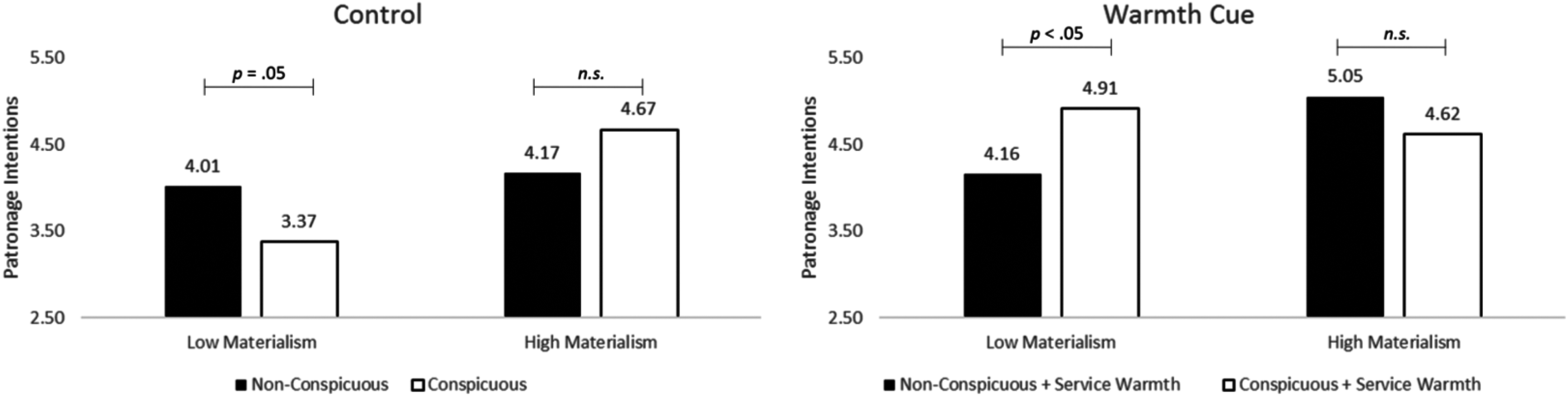
Patronage intentions as a function of service warmth cues, customer materialism, and conspicuous consumption (Study 3).
To follow up on the three-way interaction, we conducted simple effects tests at lower and higher levels of materialism. For consumers low in materialism, patronage intentions reflected a penalty effect of conspicuous consumption (M NC = 4.01 vs. M CC = 3.37; t = −1.93, p = .05); however, this effect was reversed in the presence of a warmth cue (M NC = 4.16 vs. M CC = 4.91; t = 2.14, p < .05). In contrast, consumers high in materialism were unaffected by conspicuous consumption, regardless of the warmth cue (absent: M NC = 4.17 vs. M CC = 4.67; t = 1.36, p = .18; present: M NC = 5.05 vs. M CC = 4.62; t = −1.28, p = .20). These results support Hypothesis 4.
Mediating Role of Cost-Benefit Assessments (Price Fairness)
We conducted a mediation analysis (Hayes 2013; Model 12; 5,000 resamples), with patronage intentions as the dependent variable, conspicuous consumption as the independent variable (0 = nonconspicuous, 1 = conspicuous), warmth cue and customer materialism as moderators, and price fairness as the mediator; covariates were age, gender, SES, and experience. Mediation by price fairness on the higher order interaction was significant (a × b= −0.52, 95% CI [−0.87, −0.21]). In the absence of a warmth cue (i.e., control condition), price fairness mediates when customer materialism is low (a × b = −0.66, 95% CI [−1.07, −0.29]) but not high (a × b = 0.07; 95% CI [−0.30, 0.47]), consistent with our prior findings (Studies 1A and 1B). In the presence of a warmth cue, price fairness does not mediate for consumers low in materialism (a × b = 0.27; 95% CI [−0.2028, 0.74]) or high in materialism (a × b = −0.39, 95% CI [−0.83, 0.01)]. These findings support our theorizing and Hypotheses 1, 2, and 4.
Discussion
Study 3 shows how service providers who engage in conspicuous consumption can proactively attenuate penalty effects. Conceptually, we draw on the notion that diverging cues weaken initial categorizations in social perception (McCarthy and Skowronski 2014). Because the penalty effect is driven by an inferred lack of warmth (Scott, Mende, and Bolton 2013) and kindness is a definitional indicator of warmth (Cuddy, Fiske, and Glick 2008), we expected and found that signals of service warmth protect against the penalty effect—an insight that provides service firms with an actionable protective strategy.
General Discussion
Customers make spontaneous inferences about service providers within moments, often before any verbal exchange occurs (Ambady, Krabbenhoft, and Hogan 2006; Pounders, Babin, and Close 2015). These inferences then influence customers’ behavioral intentions toward those providers (Scott, Mende, and Bolton 2013). Although scholars have explored how customers assess employee appearance (e.g., gender, age, dress; Fischer, Gainer, and Bristor 1997; Luoh and Tsaur 2011; Shao, Baker, and Wagner 2004) and how design cues influence perceptions of servicescapes (e.g., Babin and Babin 2001; Baker, Grewal, and Parasuraman 1994; Bitner 1992; Bitner, Booms, and Tetreault 1990; Wall and Berry 2007), many crucial aspects remain underresearched (Pounders, Babin, and Close 2015). One question that research has overlooked is how customers respond to service providers’ conspicuous consumption and, more generally, how consumers interpret conspicuous consumption (Gurzki and Woisetschläger 2017). One exception is Scott, Mende, and Bolton (2013), who find that conspicuous providers are penalized in communal relationships (e.g., decreased patronage intentions). Expanding this work, we examine whether this penalty effect is situationally malleable. We draw on perceiver effects and context effects in person perception (Fiske, Lin, and Neuberg 1999; Higgins and Stangor 1988) to identify novel boundary conditions. Our studies show that inferential adjustments are driven by customer materialism (Studies 1A and 1B) and by whether the conspicuous consumption is a provider’s choice or firm policy (Study 2). Notably, service warmth attenuates penalty effects (Study 3). These findings (summarized in Online Supplemental Appendix D) offer a deeper theoretical understanding of how customers decode conspicuous consumption in service settings.
Theoretical Contributions
Penalty effects and customer materialism
Consistent with research on perceiver effects (De Bruin and Van Lange 2000), we find that how customers respond to conspicuous consumption by service providers lies in “the eye of the beholder.” The penalty effect emerges primarily for customers low in materialism, who view conspicuous consumption negatively, which undermines their cost-benefit assessments and patronage intentions. In contrast, materialistic customers do not penalize providers who choose to consume conspicuously; however, and unexpectedly, these customers do penalize a firm’s policy of conspicuous consumption. These findings contribute to the emerging body of evidence regarding the impact of consumption cues on social perception (Nelissen and Meijers 2011), while also providing new insights to service research.
Employee choice versus firm policy
To the best of our knowledge, this research is the first investigation of how customers perceive an organization that consumes conspicuously through firm policy. As one illustration of such a policy, “Crowne Plaza employees will soon get uniforms fashionable enough to be worn on a runway” (Trejos 2016, emphasis ours) because InterContinental Hotels (similar to other hotels) is now working with high-fashion designers to develop employee uniforms (Amey 2015; Sims 2009). While this topic requires further research, our results question whether conspicuous consumption by firms is always beneficial for customer relationships. At the heart of this concern is our finding that consumers both low and high in materialism judge a firm’s prices less favorably when conspicuous consumption is firm policy. With regard to materialistic customers, this seems surprising in light of research suggesting that these consumers are drawn to conspicuous goods (Flynn, Goldsmith, and Pollitte 2016). However, prior work on the linkage between materialism and conspicuous consumption has typically focused on goods rather than services. Our finding might therefore suggest a systematic difference related to services: Because of their intangible nature, services offered by a firm that engages in conspicuous consumption might not provide the same signaling benefits (status, self-enhancement) to materialistic consumers as corresponding (tangible) goods do.
Signaling service warmth as a protection strategy
Our research demonstrates how service providers who engage in conspicuous consumption can attenuate a penalty effect by cueing service warmth. This effect emerges because signals of service warmth (a diverging cue) undermine the diagnosticity of the provider’s conspicuous consumption. This finding is consistent with research on social perceptions in organizations and the idea of warmth being a “disarming mechanism” that people who otherwise might be a target of unfavorable inferences (e.g., Black executives) can use to attenuate negative inferences (Livingston and Pearce 2010). Moreover, it is well-aligned with seminal research on the relevance of warmth as an important facet of service delivery and, furthermore, suggests another benefit of emphasizing service warmth—its protective benefits (Bitner, Booms, and Tetreault 1990; Parasuraman, Zeithaml, and Berry 1988).
Managerial Implications
Service providers are a major part of an organization’s public face because they represent the organization “in their appearance and behavior” (Vilnai-Yavetz and Rafaeli 2011, p. 161). Therefore, first impressions in service encounters are crucial because they influence the process of relationship building (Ambady, Krabbenhoft, and Hogan 2006). Accordingly, companies increasingly strive to understand and manage the symbolic appearance of their employees as part of their aesthetic labor efforts (Pounders, Babin, and Close 2015). Our findings reemphasize that managers should know how customers judge conspicuous consumption by service providers. This is relevant in service settings because customers often lack the expertise to fully assess service quality (Zeithaml 1988). Consequently, they often use provider-based cues to make inferences, which then influence their behavior toward the company (Folkes and Patrick 2003). Against this background, our work has implications for managing the symbolic appearance of frontline employees and other elements of the servicescape (e.g., corporate vehicles).
First, managers should consider perceiver and context effects that are most applicable to their organization. Our findings suggest a need to examine levels of customer materialism. Current technology and the ability to track customers make this increasingly realistic. For example, firms could incorporate corresponding measures (e.g., of materialism and status consumption) in their market research and then segment consumers accordingly. In addition, firms can scrape publicly available information posted by consumers on social media (e.g., brands that consumers follow). Moreover, companies can buy third-party data about their customers that can serve as proxies for materialism. For example, data brokers (companies that collect consumers’ personal information and resell that information) obtain detailed, transaction-specific data about purchases from retailers and catalog companies. Such information can include the types of purchases…, the dollar amount of the purchase, the date of the purchase, and the type of payment used. Several of the data brokers also obtain information from magazine publishers about the types of subscriptions sold. (Federal Trade Commission 2014, p. 13)
Second, frontline employees frequently display conspicuous consumption in service encounters (see Online Supplemental Appendix A). Some employees might signal their self-image by displaying conspicuous products at work; others might deliberately display conspicuous cues because of the proclaimed favorable inferences associated with luxury products (Friedman and Ostrov 2008; Nelissen and Meijers 2011). Hence, firms should educate employees regarding the downside of displaying conspicuous cues (e.g., unfavorable cost-benefit assessments, patronage intentions); this seems crucial because it runs counter to the conventional wisdom of “dress to impress” (Ramsey 2009), which might help explain why some companies (e.g., hotels) deliberately dress their staff in designer outfits (Amey 2015; Sims 2009).
Third, our findings have implications for organizational guidelines for employee appearance and servicescape design (Bitner 1992). Many service firms are implementing increasingly detailed dress codes to instruct their employees on how to “dress the part” (Solomon 1998). For example, UBS bank developed a 43-page dress code that advised its employees on how to impress customers with a polished appearance and encouraged them to wear timepieces because they signal reliability and care for punctuality (Berton 2010). Related to the broader aspect of servicescape design, Fairmont Hotels & Resorts recently finalized an agreement with Cadillac to use the automaker’s vehicles as shuttles for its guests in the United States (McCarthy 2015). When (or before) making such decisions about conspicuous aspects of the servicescape, service firms should examine whether penalty effects might occur.
Fourth, frontline employees should (be trained to) leverage service warmth as a protective strategy. If service providers and companies display conspicuous consumption cues, signals of warmth (e.g., in promotional contexts such as websites or in zero-acquaintance encounters with customers) can attenuate the penalty effect. We note that some research suggests that salespersons’ arrogant behaviors in luxury stores might increase customer purchase likelihood because customers aim to overcome feelings of social rejection (Ward and Dahl 2014). However, we urge service firms to adopt a broader perspective that emphasizes the overall service experience (Lemon and Verhoef 2016), which, we posit, is more positive in light of experiences associated with service warmth rather than social rejection.
Limitations and Further Research
Our studies are not without limitations, which point to avenues for further research. First, using established approaches to examining person perception (Fiske, Cuddy, and Glick 2007), the experiments employed self-report measures and scenarios with undergraduate and MTurk participants. While this approach allows insights into the psychological mechanism that drives customer intentions, an examination of the generalizability of our findings to actual customers would be fruitful. Although MTurk has limitations in certain circumstances (e.g., character misinterpretations; Sharpe-Wessling, Huber, and Netzer 2017), our studies seem less vulnerable to character misrepresentations because we measure social perception. Moreover, prior research has demonstrated the basic reliability of data gathered through MTurk (e.g., Goodman, Cryder, and Cheema 2013). Second, perceiver and context effects deserve additional research. Regarding perceiver effects, other personality aspects (aside from materialism) might also shift the response to conspicuous consumption, including basic traits (e.g., Big Five personality dimensions; Wood et al. 2010), consumers’ religion, or well-/ill-being (e.g., health conditions), with the latter being crucial in transformative services (e.g., health care; L. Anderson et al. 2013). Regarding context effects, an intriguing question is whether the penalty effect might “flip” in some contexts, such that service providers are penalized for not being conspicuous: Are there service settings (e.g., six-star hotels) in which conspicuous consumption is part of customers’ minimum expectations and the absence of conspicuousness undermines their experience?
Third, we focused on penalty effects, but Scott, Mende, and Bolton (2013) also showed that conspicuous consumption triggers reward effects (e.g., increased competence perceptions, behavioral intentions) in exchange relationships. It would be fruitful to examine the malleability of both reward and penalty effects. In doing so, it would be helpful to examine more closely the nature of customers’ cost-benefit assessments. Value is a multidimensional construct (Sweeney and Soutar 2001), and future research could examine more closely how service provider consumption affects (which dimensions of) customer-perceived value. Relatedly, first impressions are relatively stable over time and predictive of judgments in subsequent relationship stages (Ambady, Krabbenhoft, and Hogan 2006). This raises the question of how penalty (or reward) effects related to conspicuous consumption might influence relationship development over time; longitudinal research could examine such long-term effects.
Another question concerns why materialistic consumers do not respond more favorably to conspicuous (vs. nonconspicuous) consumption by service providers. Materialistic individuals tend to respond positively to luxury consumption in order to signal (their own) social status and for motives of self-enhancement (Kasser 2016). We speculate that these benefits of consuming conspicuous services (vs. goods) are less direct inasmuch as consumption is “mediated” by the service provider, so the benefits first accrue to the provider and then must “transfer” to the consumer (in contrast to goods where the benefits accrue directly to the consumer). We also note that conspicuous consumption by service providers could lead to social comparison (Richins 2017) and undermine some of the benefits—for example, because of competitiveness and heightened desire for self-enhancement (Bauer et al. 2012), because of self-presentation concerns (akin to jealousy and dislike of attractive service providers; Wan and Wyer 2015, p.579), or because of self-threat and feelings of inferiority (Munichor and Steinhart 2016). If this is the case, then consumer perceptions of, and reactions to, conspicuous services may differ in important ways from that of goods—and merits future service research.
Supplemental Material
Supplemental Material, Executive_Summary_All_That_Glitters_Is_Not_Gold_JSR-15-089 - All That Glitters Is Not Gold: The Penalty Effect of Conspicuous Consumption in Services and How It Changes With Customers and Contexts
Supplemental Material, Executive_Summary_All_That_Glitters_Is_Not_Gold_JSR-15-089 for All That Glitters Is Not Gold: The Penalty Effect of Conspicuous Consumption in Services and How It Changes With Customers and Contexts by Martin Mende, Maura L. Scott, and Lisa E. Bolton in Journal of Service Research
Supplemental Material
Supplemental Material, All_that_Glitters_is_Not_Gold_-_Web_Appendix_FIN - All That Glitters Is Not Gold: The Penalty Effect of Conspicuous Consumption in Services and How It Changes With Customers and Contexts
Supplemental Material, All_that_Glitters_is_Not_Gold_-_Web_Appendix_FIN for All That Glitters Is Not Gold: The Penalty Effect of Conspicuous Consumption in Services and How It Changes With Customers and Contexts by Martin Mende, Maura L. Scott, and Lisa E. Bolton in Journal of Service Research
Footnotes
Authors’ Note
All authors contributed equally.
Declaration of Conflicting Interests
The author(s) declared no potential conflicts of interest with respect to the research, authorship, and/or publication of this article.
Funding
The author(s) received no financial support for the research, authorship, and/or publication of this article.
Supplemental Material
Supplemental material for this article is available online.
Note
References
Supplementary Material
Please find the following supplemental material available below.
For Open Access articles published under a Creative Commons License, all supplemental material carries the same license as the article it is associated with.
For non-Open Access articles published, all supplemental material carries a non-exclusive license, and permission requests for re-use of supplemental material or any part of supplemental material shall be sent directly to the copyright owner as specified in the copyright notice associated with the article.
