



Abstract
Experiential purchases, such as movies, theme parks, and vacations, represent a unique, and exceedingly popular, type of marketing behavior. Despite the increasing popularity of purchased experiences, the question of what makes one experiential purchase superior to another remains elusive. Using a multimethod, grounded theory approach, the authors perform two qualitative studies that reveal high-quality experiential purchases are composed of five dimensions: uniqueness, fun, escapism, servicescape quality, and social congruence. Next, an empirical model of experiential purchase quality (EPQ) and its outcome variables is tested in two different settings. The results find support for the EPQ conceptualization and uncover that a high-quality experiential purchase can positively influence braggart word of mouth, nostalgia, and self-connectedness to the experience while also lowering price consciousness perceptions to repeat the experience. A comparison of short and long experiences found that customers put a heavier weighting on concepts such as escapism and social congruence in shorter experiences where longer experiences had a heavier emphasis on the servicescape and perceptions of fun. From a managerial perspective, our results highlight that a one-size-fits all approach in experiential management is problematic. Managers need to understand that customers have different evaluative criteria depending on the length of an experiential purchase.
Keywords
Experiential purchases are a unique, important, and yet understudied type of marketing behavior. A purchased experience is distinctive in that a physical, tangible product is not provided, nor is there a traditional service performed for the customer. As defined in Van Boven and Gilovich (2003, p. 1194), experiential purchases “are those made with the primary intention of acquiring a life experience: an event or series of events that one lives through,” while material purchases “are those made with the primary intention of acquiring a material good: a tangible object that is kept in one’s possession.” Examples of experiential purchases include movies, theme parks, concerts, and vacations. Experiential purchases also differ from material purchases in that experiential purchases will live on only in the memory of the consumer (Carter and Gilovich 2010; Van Boven and Gilovich 2003). Experiential purchases are also fundamentally more social (Van Boven 2005). As there are no tangible remnants of an experiential purchase, the stronger the purchased experience is to the consumer, the more powerful the memory stemming from the experience.
According to a 2013 Forbes industry report, experiential purchases are increasing in popularity worldwide, and although global experiential purchase behavior is nearly impossible to measure in its entirety, the industry report estimates worldwide revenue generated by consumable entertainment media, tourism, and theme park markets exceed over US$3 trillion. Star Wars: The Last Jedi was the highest grossing movie of 2017, grossing over US$1 billion worldwide, despite opening in mid-December (McNary 2018). Hence, Disney is leveraging the power of the Star Wars movie franchise to transform another experiential purchase offering as it plans to add major Star Wars attractions to each of their U.S.-based theme parks by 2019 (T. Smith 2017). It is as important to note as it is fascinating that all the revenue generated by the Star Wars franchise stems from an extremely positive reaction to a high-quality experiential purchase made by moviegoers almost 40 years ago.
With the popularity of experiential purchases on the rise, and the profits available to firms providing quality experiential purchases becoming more evident, the question of what makes one purchased experience better than another takes on greater importance. Indeed, a firm’s ability to maximize the returns of their experiential purchase offerings wholly depend on their ability to produce, offer, and deliver an experiential purchase of high quality. Whereas Disney is able to leverage consumer’s love of Star Wars into hundreds of millions of dollars in profit, they are not immune to failure. Disney’s 2013 release The Lone Ranger and 2015 release Tomorrowland, both based on existing popular intellectual properties, lost US$190 million and US$132 million at the box office, respectively (Sahagian 2016). Understanding what factors go into high-quality experiential purchases can help experience providers avoid expensive and potentially crippling market failures.
Contrary to concepts such as service quality, the quality of an experiential purchase takes on a much bigger scope (Klaus and Maklan 2012) and has a stronger emphasis on the emotions derived than can be captured in a Traditional Service Quality Scale. Verhoef et al. (2008) note that customer experience quality is a separate construct altogether than service quality and cannot be measured using the same customer satisfaction models such as SERVQUAL (Parasuraman, Zeithaml, and Berry 1988). In other words, SERVQUAL cannot simply be translated into an experiential measurement. The emotional aspects of an experience are declared as a leading reason for this difference between experience quality and service quality. Additionally, experiential purchase quality (EPQ) differs from other experiential marketing concepts such as “brand experience” which is conceptualized as “subjective, internal consumer responses (sensations, feelings, and cognitions) and behavioral responses evoked by brand-related stimuli that are part of a brand’s design and identity, packaging, communications, and environments” (Brakus, Schmitt, and Zarantonello 2009, p. 53). In fact, many of the brands used to measure brand experience by Brakus, Schmitt, and Zarantonello (2009) are product-based such as Lego and Victoria’s Secret. Hence, the term “experience” has been used in a variety of contexts in the marketing literature, but the scope of this research is focused exclusively on experiential purchases, that is, the purchase of a lived-through event.
To date, we still know very little about how customers judge the quality of experiential purchases. In short, what makes one purchased, lived-through event superior to another? While previous research has made exploratory attempts to capture this construct (Swanson and Timothy 2012), we still do not have a clear picture of the dimensions of a high-quality experiential purchase or the outcomes stemming from a high-quality experiential purchase. To address these issues, we use a multistudy, holistic approach by first conducting depth interviews followed by a critical incident study to qualitatively capture what dimensions encompass a high-quality experiential purchase. Based on these findings, we formally conceptualize and define EPQ as a consumer’s overall evaluation and judgment on the excellence of a lived-through experience based on the dimensions of fun, escapism, social congruence, service quality, and perceived uniqueness. Next, we quantitatively test the proposed dimensions of EPQ along with proposing outcome relationships such as braggart word-of-mouth behavior, decreased price consciousness, and nostalgia. To increase the generalizability of our empirical findings, we capture multiple settings to examine the potential differences that could exist between experiential purchases lasting multiple days to short and intense experiential purchases that might only last a few hours. The goal of our research is to provide a better understanding of what customers want in a high-quality experiential purchase along with strengthening our managerial understanding of how high-quality experiential purchases can be achieved and the subsequent influence on customers’ attitudes and behavior.
Experiential Purchases
Holbrook and Hirschman (1982) present an “experiential view” of marketing in which the consumption process does not simply follow a logical and dispassionate process of exchange but is rather guided by the consumer’s pursuit of fantasies, feelings, and fun. Consumption is not a process of unemotional inputs and outputs but is driven by a need and desire for emotion, self-expression, playfulness, and excitement. The emotional aspect of the experiential view has been the catalyst for much of the literature concerning experiential purchases and its place in marketing. Pine and Gilmore (1998) expand on this emotional aspect of experiential purchases by arguing that the emotional sensation derived is the primary driver of demand for experiential purchases. Similarly, Koenig-Lewis and Palmer (2008) who demonstrate that an emotional response to a lived-through experience is a better predictor of constructs such as repurchase intention and positive word of mouth than is overall satisfaction with the experience. Van Boven and Gilovich (2003) make the conclusion that experiential purchases do indeed make the consumer happier than material purchases and present three reasons for their findings. First, experiential purchases are more open to positive reinterpretation. As experiential purchases are intangible and exist solely in the memories of the consumer, fantasizing and reimagining the experience can take place in ways that are motivated by the intention of the consumer. With experiential purchases, negative thoughts can be suppressed and positive thoughts can be strengthened (Wildschut et al. 2006). Van Boven (2005) suggests that because experiential purchases are reimagined in a way that the consumer chooses to reimagine them, the consumer’s perceptions of purchased experiences will improve with time. Second, experiential purchases are more central to one’s identity. Carter and Gilovich (2012) suggest that people are essentially what they do, not necessarily what they have. Thus, emphasizing that shared memories provide greater insight into people’s true selves than do material purchases. Finally, experiential purchases have greater social value and are fundamentally social in their nature. This suggestion mirrors concepts described in Ramanathan and McGill (2007) implying that sharing powerful experiences with others can strengthen social relationships between the consumer and with whom the experience is shared. Further, many experiential purchases take place with both direct and indirect contact with others that can enhance or diminish the power of the experiential purchases. In short, experiential purchases do not take place in a social vacuum.
Although still in its infancy, relevant contributions to the experiential consumption research stream can be found in Table 1. It is important to note that previous research on experiential marketing such Tynan and McKechnie’s (2009) holistic experience, Pine and Gilmore’s (1998) experience economy, and Holbrook and Hirschman’s (1982) experiential view are just what they state and claim to be, conceptualizations. These are not presented as empirical examinations into the dimensions and outcomes of an overall experience or the quality of experiential purchases, but rather outlines of what factors could or should be present before, during, and after a purchased experience takes place. We look to fill this gap by first understanding what customers’ value in an experiential purchase and empirically examining the importance of each EPQ dimension. Further, we look to explore how the memory of a high-quality purchased experience can influence subsequent customer behaviors.
Relevant Experiential Literature.

Study 1: Qualitative Framework
Empirical studies looking at the components that make a quality experiential purchase, as well as the outcomes stemming from high-quality experiential purchases are sparse. In order to explore these concepts, depth interviews are initially employed in order to gain a deeper understanding of the factors that make up and the outcomes that stem from an experiential purchase. For these initial interviews, a judgment sample of 14 respondents was recruited through word of mouth and personal connections. The interviewer made a purposeful effort to achieve a diverse representation of respondents and experiences. To qualify for the interview, interviewees had to have made a high-quality, highly memorable experiential purchase. All interviewees were initially screened and asked a series of questions to assure they had a high-quality, highly memorable experiential purchase that they could recall and describe in detail. After the interviewer confirmed that they met the criteria, interviews were conducted either in person or by telephone. Interviews were recorded electronically and then transcribed by the interviewer. Respondents were informed that their response to the interview questions would be confidential, that they could choose not to answer any questions they did not wish to answer, and they were free to stop the interview at any time. The interview participants were 57% female, with ages ranging from 24 to 47.
An interview guide was developed and was used for semistructured interviews. After recording the demographic information, respondents were asked to recall a high-quality experiential purchase. Definitions and examples of material and experiential purchases, using terminology inspired by Van Boven and Gilovich (2003), were provided to ensure the respondent was clear on the desired response. After the respondent had acknowledged that they had indeed recalled such an experience, they were asked what the chosen experiential purchase was and to provide a brief description.
All interviews were conducted on a one-to-one basis with the respondent and the interviewer. Using a grounded theory methodology of coding, suggested by Strauss and Corbin (1998), responses were read, notes were made by the interviewer, and the interviews were then reread and initial themes emerging from the interviews were developed. From these themes, the authors developed a critical incident technique (CIT) study in order to gain a deeper understanding of the factors that make up and the outcomes that stem from a high-quality experiential purchase. The CIT was chosen for this qualitative investigation as it has shown to be effective in establishing the proper groundwork for a new construct (Gremler 2004) and for providing an in-depth understanding of a phenomenon (Bitner 1990).
Amazon MTurk was used to recruit survey respondents as this medium has revealed to be a quality source for representative data (Paolacci and Chandler 2014), especially with respondents giving qualitative accounts of prior experiences. Respondents were paid 75 cents for successfully completing the survey, and the average survey took 13 minutes. Congruent with similar types of research and suggestions available from the literature, such as Gremler (2004) and S. C. Smith et al. (2016), qualitative screening questions to identify and describe the experiential purchase were captured to encourage authentic responses. Definitions and examples of both experiential and material purchases were provided to the respondents to clarify the requirements of the survey. 1 Specifically, we described how an experiential purchase, where the sensation of the experience and the memories created were the primary reason for purchase, differed from a material purchase of a tangible object or the functional benefits of a service. This method resulted in 334 responses. Thirty-four responses were ultimately excluded from analysis due to incompleteness or failure to provide an appropriate experiential purchase in presurvey screening questions. This resulted in a final total of 300 usable responses. Of the respondents, 54% were female, and the average age was 34.
For our MTurk sample, steps were taken to ensure that data were only collected from U.S.-based experiential purchase customers. Specifically, we limited the survey to U.S.-based IP addresses only. We also asked each customer two qualitative questions concerning the experience at the beginning of the survey and another at the end of the survey. If these responses did not line up, or if the respondent did not answer these questions with an actual purchased experience, they were dropped from the survey. Additionally, MTurk worker ID’s were identified, and each worker could only take our survey once.
After the responses had been compiled, three judges familiar with the experiential purchase literature sorted responses for each question into a series of categories and subcategories. A constant comparison method was used, allowing judges to read, sort, and reread responses, combining these responses into larger categories. During the first part of the analysis, one judge employed open coding to identify categories of responses. These categories were then coded and briefly defined. The developed categories, their codes and their definitions were then supplied to the second and third judges, who were then instructed to classify each response into its appropriate category. Instances where coding discrepancies arose, or in instances where the subsequent coders believed that new codes should exist, which was infrequent, were resolved through discussion between the judges. Interrater agreement showed consistency with values ranging from .90 to .95. To further validate the coding, Perreault and Leigh’s (1989) index was calculated. The index for each question was also above .80, with values ranging from .87 to .96, demonstrating support for the coding process. To see the response categories and frequencies for each question, see Table 2.
Results From Critical Incident Technique Analysis.

Note. Many responses listed multiple categories per response leading to the sum of the responses to be greater than 100%. WOM = Word-Of-Mouth.
Findings
Question 1
Question 1 asked respondents to identify, explain, and describe the factors that went into making their chosen experiential purchase so memorable. A variety of responses emerged. See Table 2 for illustrative quotes from each category. Consistent with previous research, the preponderance of responses mentioned the experiential purchase took place in a social context where direct and indirect interaction was present. In the coding of responses, percentages represent the frequency of a particular category across the entirety of the response. Because multiple categories could, and often would, emerge from a single response, the sum of the responses could be greater than 100%.
The largest (34.44%) category consisted of comments regarding the servicescape in which the experience took place. Responses in this category noted that the quality of the physical environment where the experiential purchase took place was a factor in its success. Respondents (29.47%) also reported that this was their first exposure to this lived through event which added to the memorability of the experiential purchase. Fun (17.88%) was also a positive factor in the memorable nature of the experiential purchase. Since many of the responses could be considered fun simply by their very nature, the response was only coded for this category when the respondent explicitly stated as such. Also, some respondents (17.22%) stated the uniqueness or the novelty of the experiential purchase is what made it so memorable. Further, respondents (14.57%) reported that the experiential purchase was more memorable because the group of people at the event had a sense of congruity in terms of wanting the same or similar benefit from the experiential purchase. Finally, respondents (13.59%) described the experiential purchase as being memorable because it took them away from the stress and worry associated with their everyday lives.
Question 2
Question 2 asked respondents to describe their thoughts on if, how, and why they would like to relive this experiential purchase again. The majority (86.75%) of respondents stated they would like to relive this experiential purchase again in some way. Five categories of outcomes arose from the analysis.
The largest (33.51%) category consisted of respondents who stated that they would want to relive this experiential purchase again but would like to change the experiential purchase in some way. Next, responses classified as nostalgia (14.24%) noted instances where the respondents explicitly stated they wanted to relive the experiential purchase because of their attachment to memories of the past. In the third category, “repurchased,” respondents (9.33%) reported that they had already repurchased and relived this experience again. In the next category, a smaller percentage of the respondents (7.95%) stated that the experiential purchase could no longer be repeated due to some circumstance. Of note is the fact that just because these responses reported that this experiential purchase was impossible to relive in the same way, many of them did respond that they would still like to relive the experience. In the last category, “singular experiences,” respondents (7.62%) were specific in their belief that if they were to make this experiential purchase again, it would either not be as successful as the first time or the second experience would somehow ruin the memories of the first experiential purchase. Thus, these respondents, without exception, indicated that they would not want to relive this experiential purchase again.
Question 3
Question 3 asked respondents to identify, explain, and describe their behaviors and motivations for how they shared the experiential purchase with others after the experience was over. The majority of the respondents (86.09%) stated that they did feel the need to share the experiential purchase with others. Three categories of outcomes associated with word-of-mouth behaviors arose from the analysis.
One of the largest categories that emerged was respondents engaging in bragging/word-of-mouth (41.39%) or word-of-mouth behavior driven by the desire for positive recognition and increased self-esteem (Angelis et al. 2012). Respondents were surprisingly open about their desire to brag about their experience to others, sometimes in an explicitly stated attempt to make others jealous or out of self-admitted pride felt by having engaged in the experience. Next, evangelizing behaviors arose (14.24%) where respondents reported that they actively attempted to recruit others to go on this experiential purchase or a similar kind of experience. In many ways, these responses revolved around the fact that the respondent wanted others to partake in the experiential purchase so that they could have someone with whom to share stories. Lastly, an “in-group” category (9.33%) consisted of respondents who only talked about their experiential purchase with either people who shared the same interest or people who were also at the purchased experience.
Question 4
Question 4 asked respondents to recall an experiential purchase that was bad, terrible, or disappointing. While negative experiential purchases are not the focus of this research, knowledge gained from this question was used to confirm the importance of factors previously identified. For this question, respondents were asked to describe, again with as much detail as possible, the factors that went into making this experiential purchase so disappointing. Not surprisingly, the results were similar to the results for Question 1; however, there were some interesting and enlightening distinctions stemming from this question. The servicescape of the experiential purchase continued to play a strong role in experiential quality perceptions, as did the congruency between the respondent and other customers in an experience. When customers attended an experience for different reasons or wanted to engage with the experience in different ways as those with whom the experience was shared, it had a strong negative impact on the overall evaluation. For example, a fan watching a favorite football team playing for a national championship surrounded by (A) other fans for the same team, (B) fans for the opposing team, or (C) people that do not care about football at all. In each of these three scenarios, those with whom the experience is shared will have an impact on the overall evaluation of the experience. Lastly, respondents mentioned that the experience was boring or lacked a “fun” component.
Study 2: Empirical Conceptualization
For Study 2, we wanted to further explore the concept of EPQ or specifically what makes one lived-through event superior to another. Using key constructs identified through the grounded theory design, an empirical model was developed to quantitatively test the proposed relationships. Based on the depth interviews and the CIT study, five dimensions were proposed to encompass the quality of an experiential purchase. These five dimensions are the level of perceived fun, the uniqueness of the experience provided, the quality of the experiential purchase servicescape, the level of escapism provided, and the level of social congruence between the customer and those with whom the experiential purchase is shared. These five dimensions were selected as they comprehensively capture both the emotional and cognitive components of an experiential purchase. As well, these dimensions represent the most impactful parts of a consumer’s experiential purchase based on our own and previous research on the topic. Thus, we formally define EPQ as a consumer’s overall evaluation and judgment on the excellence of a lived-through experience based on the dimensions of fun, escapism, social congruence, service quality, and perceived uniqueness.
In addition, outputs stemming from EPQ were identified through the grounded theory design and CIT study. These outputs were recognized as the customer feeling nostalgic about the experiential purchase, using self-enhancing/braggart word-of-mouth behaviors, feeling a sense of self-connection to the experience, desiring to relive the experience, and possessing decreased levels of price consciousness regarding a future experiential purchase. Using the knowledge gained through the qualitative studies, relationships concerning the outcomes of EPQ are hypothesized, and a conceptual model of EPQ and its outcomes is presented (see Figure 1 for details).

Conceptual Framework Measuring Experiential Purchase Quality and Its Outcomes.
Dimensions of EPQ
EPQ is conceptualized as a higher order formative construct composed of five first-order constructs: fun, escapism, servicescape quality, social congruence, and uniqueness. Previous research has noted that a construct that has multiple dimensions need to be conceptualized as a higher order construct (Bollen and Lennox 1991). Additionally, N. Podsakoff, Shen, and Podsakoff (2006) noted that researchers should use higher order models when the construct is complex because such models treat each dimension as an important component of the construct. Thus, a higher order model seems the most appropriate way to conceptualize this construct while capturing the importance of each dimension along with the collective influence as a whole.
After deciding on a higher order construct, the issue now remains should the first-order dimensions be reflective or formative to the higher order construct. The work of Jarvis, MacKenzie, and Podsakoff (2003) provide a nice roadmap in making that determination. The authors note that if a first-order dimension can be dropped and not alter the conceptual domain or if the first-order dimensions can be seen as interchangable, then a reflective conceptualization should be used. With the EPQ conceptualization, the five different first-order constructs are all having a distinct influence on the higher order construct and thus no indicator can be dropped or seen as interchangeable with another. Based on these criteria and decision rules laid out by Jarvis, MacKenzie, and Podsakoff (2003), EPQ can only be conceptualized as a higher order formative construct. By specifically conceptualizing EPQ as a higher order formative construct, we can capture the comprehensive evaluation of the experience while still including the impact of individual dimensions.
Perceived Fun
Fun is defined as the overall level of perceived hedonic enjoyment (Dabholkar 1994), stemming from the experiential purchase. The aspect of fun is one of the primary components of the Holbrook and Hirschman (1982) and Holbrook (2000) conceptualizations of the experiential view of marketing and is identified as being a value source of experience quality in the Tynan and McKechnie (2009) holistic experience model. The level of perceived fun has been shown to be a primary driver of experiential purchase choice and has been shown to decrease tension when making an experiential purchase (Laran and Janikzewski 2011).
Escapism
In this context, escapism is defined as the perceived level to which the experiential purchase allowed the respondent to remove themselves away from the demands of daily life (Mathwick, Malhotra, and Rigdon 2002). Patrick and Park (2006) established that when customers were forced to think about real-world costs during a purchased experience, customers reported being taken away from the experience and quality evaluations decreased. In other words, the consumer did not want to think about real-world stress factors during the purchased experience. Similarly, attitudinal evaluations of video game experiences have been shown to increase as respondents felt more separated from the worries of their actual lives and, ultimately, used the game as a tool to escape from reality (Molesworth 2009).
Servicescape Quality
Servicescape quality is the consumer’s evaluation of the physical environment where the experiential purchase took place, including the exterior and interior design, ambient conditions such as temperature and noise as well as tangible parts such as hotel rooms, concert halls, and restrooms (Wakefield and Blodgett 1996). Servicescape quality (sometimes under the banner of tangibles) is one of the fundamental pillars of service quality (Parasurman, Zeithaml, and Berry 1988) and has been shown to increase evaluations of service quality in numerous service studies (Thompson and Arsel 2004). Although EPQ differs in abstraction and value sources than service quality (Pine and Gilmore 1998; Tynan and McKechnie 2009), it stands to reason that quality evaluations of the physical environment where the experiential purchase takes place would have similar effects.
Social Congruence
Social congruence is defined as the degree to which an individual views a similarity and congruency between their desired outcome of the experiential purchase and the perceived desired outcome of those with whom the experiential purchase is shared (Rindfleisch, Burroughs, and Wong 2009). The responses from the CIT, and previous conceptualizations of experiential purchases such as Van Boven (2005), suggest that purchased experiences are essentially social in nature and an experience cannot fully divest itself from social interaction. Even if the consumer were to make an experiential purchase alone, indirect social interaction would almost certainly take place during the experience itself. This concept is explored in Van Boven and Gilovich (2003), where increased social value is identified as a defining characteristic of experiential purchases. However, the CIT responses suggest that simply having others present during the experiential purchase does not influence quality perceptions alone, but it is having the right kind of people to interact with during the experience. Congruency with others in experiential purchase situations has been shown to add to hedonic stimuli (Raghunathan and Corfman 2006) and increased enjoyment (Ramanathan and McGill 2007).
Uniqueness
Uniqueness is defined as the level of perceived novelty and distinctiveness offered by the experiential purchase (Franke and Schreier 2008). Uniqueness (novelty) is presented as an experiential value source in the Tynan and McKechnie (2009) holistic experience conceptualization, and the Pine and Gilmore (1998) experience economy conceptualization. According to Keinan and Kivetz (2011), experiential customers will seek out events that are novel, placing more value on experiences that possess high levels of uniqueness. Uniqueness as a quality source is seen multiple times through the CIT analysis with responses such as “it has to be different than what you would expect, it can’t be something routine, and mine was that. It can’t be something that happens all the time.”
EPQ Outcomes
Nostalgia
Nostalgia is an affect-laden reminiscence of an experience (Muehling, Sprott, and Sprott 2004). As a purchased experience is highly connected to the self, self-enhancement theory suggests that memories created by an experience should be done in a way that enhances that self-connection. Wildschut et al. (2006) and Vess et al.’s (2012) conceptualizations of nostalgia suggest that nostalgic memories are positively charged memories developed by the individual in order to remember events as the individual chooses to remember them. It is further suggested that these memories will focus on the aspects of the event that enhance one’s self-esteem. Also, the concepts behind retrospective impact bias (Wilson, Meyers, and Gilbert 2003) suggest that individuals will enhance and exaggerate their sense of happiness stemming from recalled positive events and experiences. It stands to reason that nostalgic thoughts should be strong following an experiential purchase of high quality and the desire to remember it in a self-enhancing way will be powerful. Thus,
In addition, nostalgia should positively impact repurchase intention and negatively impact price consciousness. Repurchase intention is defined as the likelihood that a customer will purchase this experience again in the future (Oliver and Swan 1989). Strong relationships between nostalgia and repurchase intention have been established in previous research (Sierra and McQuitty 2007). Nostalgia, by its very definition, consists of an individual remembering a previous time fondly and wanting to return. It stands to reason that high levels of nostalgia (high levels of wishing to return to when the experience took place) should positively impact repurchase intentions. Decreased price consciousness, the buyer’s willingness to pay more for the experience (Lichtenstein, Ridgeway, and Netemeyer 1993), was a factor that emerged strongly from the initial depth interviews. When asked about how much they would spend for their next experience, respondents replied with quotes such as “You want to go back. If it costs more, then it costs more. It doesn’t matter,” and “every time we go back, I would probably pay double and still be happy.” Furthermore, extant literature suggests nostalgia should have a negative impact on price consciousness as affect-laden constructs have a negative effect on price consciousness (Fullerton and Bruneau 2013). In a study on nostalgia and price, Fullerton and Bruneau (2013) determine that consumers are willing to pay more for tickets to baseball stadiums when the consumer feels a sense of nostalgia. As such, we hypothesize:
Experience Self-Connection
Self-connection is defined in Park et al. (2010) as a cognitive and emotional bond between the (experience) and the self. Previous research has demonstrated that high-quality experiential purchases do indeed become deeply connected to and attached to one’s sense of self and that purchased experiences define whom consumers see themselves as individuals much more than do material purchases (Carter and Gilovich 2012). Also, research has shown that respondents feel closer to others who have purchased the same experience (Kumar, Killingworth, and Gilovich 2014). Experience self-connection is personified in many of the CIT responses, such as “if you are a Disney person, you love Disney World and you want to go back. You can really only explain it to people that like Disney World. Others just don’t care, and they look at you like you are nuts because they don’t understand.” Thus,
Similar to nostalgia, self-connection to the experiential purchase should have a positive impact on repurchase intention and decrease price consciousness. Previous research (Fedorikhin, Park, and Thomson 2008) has demonstrated that the stronger a bond between the purchase and the consumer’s sense of self, the more likely a repurchase may occur and the more tolerant the consumer may be to an increase in price. This phenomenon is demonstrated in Orth et al. (2012) where increased levels of brand attachment for an experiential purchase lead to increased levels of brand loyalty and tolerance to price increases. As such, we hypothesize:
Braggart Word of Mouth
Self-enhancing word of mouth, also referred to as braggart behavior or boastful word of mouth, is defined as word-of-mouth behaviors concerning the experience, which are driven, implicitly or explicitly, by one’s desire for positive recognition from others and to boost one’s own sense of self-esteem (Angelis et al. 2012). Contrary to simple word of mouth that is focused on the evaluation of a firm, braggart word of mouth is the spread of communication for the direct purpose of enhancing the self. While simple positive word of mouth has been a frequently measured outcome in numerous marketing studies on product quality and service quality (Herr, Kardes, and Kim 1991), experiential purchases have a higher attachment to the self than either one of these economic offerings (Carter and Gilovich 2010, 2012; Van Boven 2005; Van Boven and Gilovich 2003), and motivation for self-enhancing word of mouth should reflect this. Baumeister and Finkel (2010) states that individuals will act in ways that enhance one’s sense of self. As such, when purchased experiences become deeply connected to and attached to one’s sense-of-self, word-of-mouth behaviors concerning experiences of high quality should be motivated by the individual’s desire for self-enhancement.
Research Method
In order to test the proposed model, a survey was developed for the purpose of measuring the 10 latent constructs in the model. EPQ is conceptualized as a higher order formative construct made up of five dimensions: fun, uniqueness, servicescape quality, social congruence, and escapism. These five first-order dimensions were reflectively measured by adapting existing scales into an experiential purchase context from Dabholkar (1994); Sprott and Shimp (2004); Franke and Schreier (2008); Mathwick, Malhotra, and Rigdon (2002); and Rindfleisch, Burroughs, and Wong (2009). For the outcomes of EPQ, scales for nostalgia, price consciousness, and repurchase intention were adapted similarly from Muehling, Sprott, and Sprott (2004); Sinha and Batra (1999); and Oliver and Swan (1989). An extensive review of the extant literature found no scales that could adequately be adapted to capture braggart word of mouth. Therefore, a scale was developed based on the self-enhancing word-of-mouth behaviors described in Angelis et al. (2012). Scales were all on a 7-point Likert-type scale (1 = strongly disagree to 7 = strongly agree), with the exception of repurchase intention, fun, and servicescape quality, which employ 7-point semantic differential scales. In addition, based on the suggestions of Jarvis, MacKenzie, and Podsakoff (2003), two holistic reflective indicators of EPQ were collected for identification of the formative model.
To test the validity of these scales, a pretest was performed. Respondents were recruited through Amazon MTurk. In order to qualify for this study, participants had to be U.S. citizens and had to be over the age of 18. Participants were compensated for their participation in the study. The definitions and examples of both experiential and material purchases were provided to the respondents in order to clarify the requirements of the survey, and attention checks were used throughout the survey. Respondents were asked to recall and describe in detail a memorable experiential purchase that took place in the past. Keeping this experiential purchase in mind, respondents were then asked to fill out the survey. This method resulted in 321 responses. Twenty-one responses were ultimately excluded from the analysis due to incompleteness, vagueness in describing the experience in a prescreening qualitative question, or failure of an attention check measure. This resulted in a final total of 300 usable responses. Of the respondents, 60% were female, and the average age was 32. Since we were asking about recalled experiences, we examined if age differences were present for any of our constructs and our analysis found no significant differences between any age-group.
The categories of experiential purchases provided by the respondents primarily fell into three categories: (1) vacations, (2) theme parks, and (3) music concerts. Other experiential purchases listed with less frequency were sporting events, conventions, plays/shows, and museums/exhibits. An exploratory factor analysis was conducted, and all items loaded on their respective construct with no substantial cross-loadings. The composite reliability for each construct measure was also calculated, and all scales exhibited an acceptable level (construct reliability > .80).
After assessing the validity of the scales, the final data collection was performed by capturing two different experiential purchases. Based on the qualitative results of Study 1, the length of the experiential purchase could play a key role in determining if the importance of certain EPQ dimensions varies across the type of experience. By capturing an experiential purchase of two different time horizons, we can examine if differences exist between a short and intense experiential purchase compared to an experiential purchase that can last multiple days, thus providing a more holistic understanding to experiential purchases. Experiential purchase categories of differing lengths were derived from the experiences described in the CIT study. For the short and intense experience, we used a concert setting, and for the experience lasting multiple days, a weekend (or 2–3 day) vacation was used. To qualify for a concert setting, the experience had to last for less than 1 full day and did not include an overnight stay. For the weekend vacation, the experience had to include one or two overnight stays in the experiential physical environment.
Respondents for each type of experiential purchase were recruited from Amazon MTurk and were asked to recall a high-quality, memorable experiential purchase (concerts or weekend vacation). To qualify for the study, participants had to be U.S. citizens and over the age of 18. Respondents were also compensated for their participation in the study. As well, the respondents were provided with a detailed description of each experiential purchase category (concert or vacation) to clarify the experiential setting for each data collection. The respondents were also taken through a series of questions in order to ensure that the experiential purchase was appropriate for the collection. A total of 301 respondents were recruited for the concerts survey along with 327 respondents in the weekend vacation survey. The average age for the concerts experience was 36, and the sample was 53% male. For the weekend vacation experience, the average age was 35, and the sample was again 53% male.
Next, the validity of the measures was assessed again for both samples. A confirmatory factor analysis was performed for each sample to assess the unidimensionality of the measurement items. The results of the confirmatory factor analysis indicate that each item loaded on its respective underlying concept and all loadings were significant for both the concert and weekend vacation samples. Construct reliabilities were also assessed for every construct across both groups. To view the complete list of items, loadings, and reliabilities, see Table 3. For means, correlations, and average variances extracted for each group, see Table 4. The model fit indices also suggest that the measurement model was a good fit to the data (concert: χ2 = 1,498.81, df = 726, p < .001, Comparative Fix Index [CFI] = .94, Tucker Lewis Index [TLI] = .93, Root Mean Square Error of Approximation [RMSEA] = .06; weekend vacations: χ2 = 1,324.62, df = 726, p < .001, CFI = .95, TLI = .95, RMSEA = .05). We assessed the convergent and discriminant validity of the measures by following Fornell and Larcker’s (1981) recommendation of calculating the average variance extracted and comparing it to the shared variance between constructs. For both samples, each construct had an average variance extracted over .50, providing evidence of convergent validity. No shared variance between constructs exceeded the average variance extracted per construct, which supports the discriminant validity of the construct items. To assure that any differences found between the groups was not due to the survey, an invariance test was performed across the groups. Configural invariance was initially found and partial metric invariance (Δdf = 24, χ2 = 32.26, p = .12) was also established following the suggestions of Hair et al. (2006).
Confirmatory Factor and Reliability Analysis (Concerts and Weekend Vacations).

Note. Model fit statistics: Concert: χ2 = 1,498.81, df = 726, p < .001, TLI = .93, CFI = .94, RMSEA = .06, RMSEA confidence interval [.055, .064]. Weekend vacations: χ2 = 1,324.62, df = 726, p < .001, TLI = .95, CFI = .95, RMSEA = .05, RMSEA confidence interval [.046, .055]. CR = construct reliability.
aA constrained relationship to 1.00 in order for identification.
Correlations, Means, and Average Variance Extracted (AVE) for Concert and Weekend Vacation Settings.

Note. AVE is on the diagonal. SD = standard deviation.
Since the data collection for both samples took place at a single time, a test of common method bias was performed. As suggested by P. M. Podsakoff et al. (2003), a common latent factor method was included in the analysis to determine if bias was present. The results of a χ2 difference test for both samples was less than 1 (
The sample covariance matrix was then used in AMOS to test the structural model along with the dimensionality of the higher order construct of EPQ. For the concerts and weekend vacation sample, the results of the analysis found that the model fit the data relatively well (concerts: χ2 = 1,937.07, df = 830, CFI = .92, TLI = .91, RMSEA = .06; weekend vacations: χ2 = 1,706.58, df = 830, CFI = .94, TLI = .93, RMSEA = .05). After establishing the model fit, the relationships between the constructs were analyzed. The dimensionality of EPQ was initially assessed across both samples. All the first-order dimensions of fun, uniqueness, escapism, servicescape quality, and social congruence had a significant relationship to the higher order construct of EPQ for both concert and weekend vacation experiences. Although all the first-order dimensions were significant, there were some considerable differences in importance depending on the type of experiential purchase. To assess these differences, we performed a two-group analysis across the samples to see if these potential differences were to a significant level. Using a χ2 difference test, we individually tested each dimension in AMOS by constraining the first-order relationship to be equal across the groups and comparing that to the unconstrained model. This test was performed for each of the first-order dimensions to the higher order construct of EPQ. To see the full details of the two-group analysis, refer Table 5. The results of this analysis found noteworthy differences in numerous areas. The construct of escapism had a significantly stronger influence on the quality of an experiential purchase with concerts compared to the longer weekend experience. The idea of “escaping into an experience” appears to be a strong influence on short and intense experiential purchases, but the idea of escapism loses its effect over multiple days. The construct of servicescape quality was also significantly different across the settings with respondents noting that the servicescape had a much stronger influence on longer weekend experiences than a shorter experiential purchase like a concert. With a short and intense experience, customers might tolerate a subpar servicescape as the experience takes place for only a short time. If the experience is extended, the servicescape appears to take on a much more prominent role. The construct of social congruence also showed differences across the groups but achieved a marginal level of significance (Δχ2/1df = 3.04). The standardized regression weights for social congruence showed a slighter stronger effect for the concerts than the weekend vacations (concerts = .19 vs. weekend vacation = .09). In both settings, the congruency to other customers present influenced the quality of the experience but it appears that in the shorter and intense experiential purchases this has a slightly stronger impact than longer experiential purchases. The construct of fun was highly significant for both settings. Fun had the strongest influence on how customers judge the quality of an experiential purchase with weekend vacations (regression weight = .49). Additionally, fun had a significantly stronger influence with the longer experience setting than the shorter concert setting. The last construct of uniqueness was also highly significant for both experiential purchase settings. The two-group analysis did not show a significant difference between the groups with the regression weighting roughly the same across settings (concerts = .36 vs. weekend vacations = .32). Of all the first-order constructs in the concert setting, uniqueness had the strongest relative influence compared to the other first-order constructs.
Dimensions of Experiential Purchase Quality (EPQ).

Note. Squared multiple correlation for higher order experiential purchase quality (EPQ) construct: concerts = .774, weekend vacations = .925. Multigroup model fit statistic: χ2 = 851.91, df = 338, p < .001, TLI = .95, CFI = .96, RMSEA = .050, RMSEA confidence interval [.045, .054].
In regard to the hypothesized structural relationships, both the concert and weekend experiential vacation purchases had similar findings. For the full list of standardized regression weights and t values, see Table 6. EPQ had a strong and significant relationship to nostalgia, supporting Hypothesis 1. Additionally, nostalgia had a positive relationship with customers’ intentions to repeat the experience in the future (Hypothesis 2), and these nostalgic feelings also decreased the price consciousness of customers to relive the experience (Hypothesis 3). Evaluations of EPQ also had a strong relationship with experience self-connection for both settings, supporting Hypothesis 4. Like nostalgia, experience self-connection had a significant relationship to customers’ intentions to relive the experience (Hypothesis 5) along with a decreased price consciousness with future experiences (Hypothesis 6). Lastly, experience self-connection also had a relationship with customers’ braggart motivation for spreading word of mouth after a high-quality experiential purchase, supporting Hypothesis 7.
Structural Model and Mediation Test Results for Concerts and Weekend Vacation Samples.
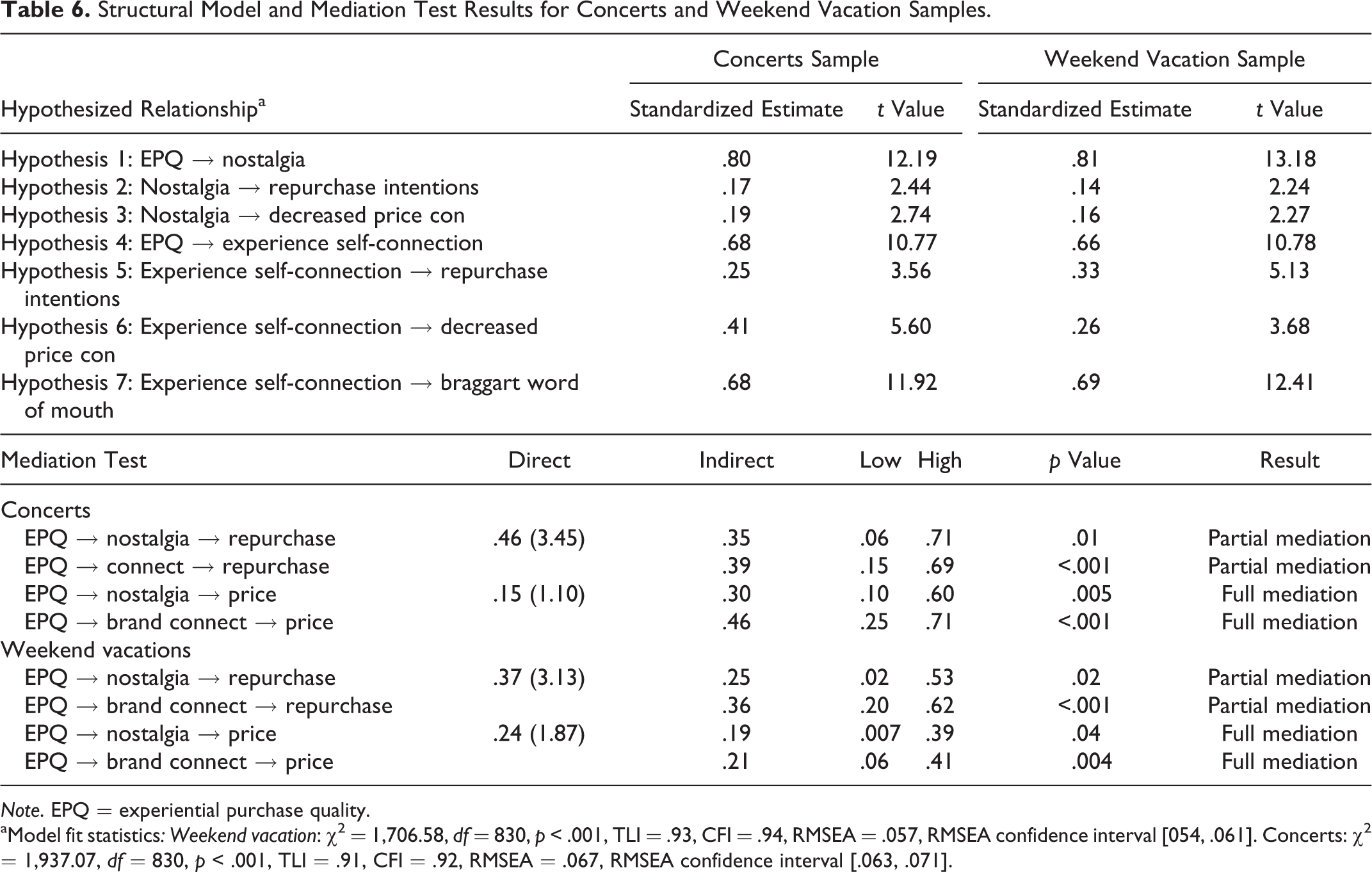
Note. EPQ = experiential purchase quality.
aModel fit statistics: Weekend vacation: χ2 = 1,706.58, df = 830, p < .001, TLI = .93, CFI = .94, RMSEA = .057, RMSEA confidence interval [054, .061]. Concerts: χ2 = 1,937.07, df = 830, p < .001, TLI = .91, CFI = .92, RMSEA = .067, RMSEA confidence interval [.063, .071].
With the strong relationships found from EPQ to the outcome variables, we wanted to explore if the effect of EPQ was fully mediated through nostalgia and experience self-connection to customers’ intentions to repurchase the experience and their price consciousness to future offers. We did not include braggart word of mouth in the mediation test because this construct is directed at enhancing one’s self-image via the connection one feels to the experience. Its very definition implies a need or a strong desire to enhance one’s sense of self. Thus, braggart word of mouth is a function self-connection not necessarily the quality of the experience.
The mediation test used a bootstrap analysis with 5,000 samples and a 95% bias-corrected confidence interval. For the full details of the mediation test, see Table 6. The results of the test found EPQ’s influence on repurchase intentions was partially mediated with both nostalgia and experience self-connection. This finding was consistent across both the concert and weekend vacation setting. EPQ had a significant indirect effect but also a strong direct effect on repurchase intentions. A surprising and interesting finding was the influence of EPQ on price consciousness. With both the concert and weekend vacation settings, EPQ’s influence was fully mediated through both nostalgia and experience self-connection to customers’ price consciousness feelings about future experiences. This finding highlights that a high-quality experience itself may not influence price consciousness but when providers can spur nostalgic feelings about an experience and ultimately foster feelings of self-connection, customers’ price conscious perceptions are lowered to repeat the experience. To further explore if differences were present, we ran a moderated mediation test to see if significant differences were present across the groups. The results of the analysis found that across the weekend and concert setting, the mediation results did not significantly differ (nostalgia = Δχ2/1df = .056, p = .81; experience self-connection = Δχ2/1df = 2.25, p = .13). Ultimately, this test of mediation emphasizes the importance of including both nostalgia and experience self-connection constructs in understanding how EPQ ultimately influences consumers’ in future intentions to repeat an experience.
Discussion
This research provides numerous theoretical contributions to the study surrounding experiential purchases as relatively few empirical studies have explored what makes one experiential purchase superior to another. By testing an empirical model of the dimensions and outcomes of EPQ, this research aims to fill this gap and provide insight into this underexplored area of marketing. These findings add support to the work of Verhoef et al. (2008) that states dimensions of product quality or service quality cannot simply be translated over to experiential quality. Experiential purchases are distinctive as an economic offering and should be studied and theorized as such. It is demonstrated that high-quality experiential purchases are formed from multiple factors. Among these factors, the ability to allow consumers to escape from their everyday worries and the sense of congruence between the consumer and those with whom the experience is shared are identified as contributing to the value of an experiential purchase. In a sense, by being an active participant with others in the purchased experience, the consumer can add value to that experience. Also, high-quality experiences contain a level of hedonic enjoyment for the experience goers and are distinctive from other experiences. Nostalgia and experience self-connection are shown to stem from high-quality experiential purchases. As nostalgia is an idealizing of the experience, often in ways that enhance one’s own self-esteem needs (Vess et al. 2012), the consumer can remember the experience better than how it actually took place. High levels of personal attachment are at the core of a high-quality experiential purchase and behaviors stemming from the experience, such as braggart word of mouth, are driven by the desire to enhance the experience and one’s connection to the experience. Nostalgia, as it relates to an experience, has not been studied thoroughly in the marketing literature. Further, the differences in EPQ dimensions and outcomes discovered to exist across two different experiential purchases add to the significance of this research. The findings from the analysis add support for a potential optimal point where fun, escapism, and servicescape quality contribute to the value of the overall experience.
With the differences in the dimensions of EPQ based on the length of experience, managers should focus on enhancing specific qualities of the experience to gain the maximum returns of their experiential offering. For instance, escapism has its greatest impact on shorter experiences. For some consumers, the idea of forgetting their troubles for a couple of hours is a welcomed retreat and enhances the experiential purchase. Conversely, escapism loses some of its effect with longer experiences because the retreat to normal activities is further delayed, subsequently losing some of the intensity of escaping. This finding is meaningful for providers of both long and short experiences, such as all-inclusive vacation destinations and cruise lines. For example, by reminding patrons to silence their cell phones and having specialized areas set aside for louder children, experiential providers such as movie theaters and concert halls can keep experience goers immersed in the experience and provide a higher quality overall experience. For longer experiences, such as all-inclusive vacation destinations and cruise lines, fully removing the customer from the outside world may not have the same impact but should still be a focus. Internet access and news channels need to be available during a weeklong vacation, but proactively providing customers with up-to-the-minute news headlines during the purchased experience can reduce the level of escapism and possibly dampen the quality of the experiential purchase.
Social congruence is also an important factor for experiential managers to understand and focus on to maximize customer perceptions of experiential quality. An experience does not exist in a social vacuum. The congruence of other patrons during an experience can have a considerable influence on the overall evaluation. The idea of social congruence has started to creep into the marketing strategies of many experiential firms who are now looking to segregate customers. For instance, movie theaters such as AMC and Hollywood Premier are offering matinee movies catering to families with children where disruptions are more tolerated. Hence, patrons who desire no interruptions in their movie-watching experience can find a more consistent experience with later show times. Other examples are churches with traditional and contemporary services or coffee bars that separate customers who want to socially interact from those who want to read or study uninterrupted. In other words, experiential managers should attempt to group patrons together who have similar desired outcomes from the experience. For longer experiences, this could be done with meet-and-greet sessions for specific interests or cruise ships providing more attitude and lifestyle-centric descriptions for shore excursions. Sporting events having separate areas for home and away fans, as well as a separate area for nondrinking fans, can allow for a diverse group of experience goers to feel a sense of unity with the group. While it may be difficult to control the social environment of an experience on a large scale, interactions that could upset the overall balance of the experiential social environment should be reduced as much as possible.
One of the interesting findings from our study was how braggart word of mouth resulted from a high-quality experiential purchase. Consumers were bragging to others under the disguise of word of mouth in order to enhance perceptions. This self-focused word of mouth highlights the internal benefits to the consumer long after the experiential purchase has ended. As word-of-mouth stemming from the attachment to an experience is motivation for self-enhancement, experiential firms need to not only understand this self-enhancing word of mouth, but they should also attempt to facilitate it as much as possible. To better shape this message, firms should encourage patrons to use specific hashtags on social media sites and take pictures or videos of specific locations or events. For example, Disney has a very large, fan-driven Instagram community that posts pictures for events such as “Spaceship Earth Sunday” and “Magic Kingdom Monday.” Disney could encourage and participate in this community and highlight new attractions to get these consumers back into the theme park for new Instagram-based events and showcase fans who are currently posting from inside the theme park. This activity could encourage and bolster self-enhancing word of mouth and create a desire to return to the primary experiential purchase offering. Also, advertising and promotional efforts should be directed at consumer interaction after the experience takes place and promoting word-of-mouth behavior.
The level of connection between the experiential purchase and the consumer’s sense of self can also drive repurchase intention and decreased price consciousness. An experiential purchase becomes much more intertwined and connected to the consumer’s identity than through traditional product-based purchases. Experiential managers need to understand this key difference and appreciate the nature of this unique offering. An experiential purchase of high quality is not necessarily something that is quickly forgotten by the consumer, but it can become something much greater. Many people enduringly identify themselves as “Disney” people, “beach” people, “Jimmy Buffet (parrotheads)” people, and so on. As self-connection can drive purchase behavior far beyond the initial experiential purchase, firms should take steps to brand these types of identifications. Experiential firms should have a long-term vision of their experiential offering and understand that consumption behavior and self-connection stemming from the experiential purchase do not simply end when the consumer goes home, and these firms may be leaving money on the table if they treat their experiential offering as a onetime purchase.
Another outcome of experiential quality that managers of experiential firms should focus on is nostalgia. Nostalgia is highly impacted by EPQ in both short and extended experiential settings. As nostalgia positively impacted repurchase intention and decreased price consciousness, experiential firms should direct their promotional efforts toward previous customers in ways that stimulate nostalgic memories. While new potential customers may not have the same nostalgia-laden memories as repeat customers, narrative style advertisements have been shown to be effective for experiential services for novice and expert experiential customers (Mattila 2000). Disney engages in this type of behavior with a promotional campaign asking customers to “remember the magic.” By focusing promotional efforts on the enjoyment that the customer derived from their engagement with a previous experience, the experiential firm can perhaps stimulate customer nostalgia leading to the identified positive benefits. The findings of this research suggest that experiential firms can motivate future experiential purchases by reminding the customer about past experiential purchases.
Limitations and Future Research
With any study there are limitations, and we would be remiss not to address the limitations of this research. While many respondents were more than willing to tell us about their braggart behavior after an experience, some respondents might have felt apprehensive about admitting this behavior. Future research could further explore this phenomenon to capture the impact and effects of this behavior comprehensively. There were also limitations regarding the sampling method, specifically this research only examined responses from customers of two different purchased experiences, concerts, and vacations. By focusing solely on these two types of experiences, responses and insight from other types of experiences were not captured. Future research should include responses that allow the model to be examined from multiple different experiences. Finally, as with any online sample, there exists the possibility that the data collected was not a true representative sample. Although multiple steps were taken to ensure representativeness of the sample, this is a potential limitation of the current research.
With consumers feeling a connection to an experience, future research could explore if merchandise sales, to tangibilize the experience, has a stronger connection than traditional product marketing that is devoid of an experiential component. While the focus of our article was on positive experiential purchases, the examples of bad experiential purchases from Study 1 highlight that negative experiential purchases are unique onto themselves and should be investigated more thoroughly in future research. Additionally, future research can build upon these results to examine if other constructs impact the evaluation of an experience. In this research, we did not control for how far in the past the experience took place. Examining this aspect would allow for further examination of EPQ dimensions and outcomes based on how long ago the experience occurred. Moreover, are there any differences in the model depending on whether the experiential purchase took place recently as opposed to an experiential purchase that took place long ago? Additionally, the strong relationship between EPQ and the outcome of braggart word of mouth was an interesting outcome of this analysis. The popularity, influence, and impact of braggart behavior on social media sites deserves further exploration. Finally, differences in expectations of not just length of experiential purchases but in experiential purchase offerings themselves should be explored. Does the specific type of experience influence consumers’ evaluations? Are certain experiences going to emphasize more fun components at the expense of the servicescape quality? Lastly, does the ultimate price of the experience influence these evaluations where inexpensive experiences do not have to meet the same criteria as expensive ones. Exploring these questions are warranted as we further understand experience purchase quality.
Supplemental Material
Supplemental Material, Executive_Summary - Experiential Purchase Quality: Exploring the Dimensions and Outcomes of Highly Memorable Experiential Purchases
Supplemental Material, Executive_Summary for Experiential Purchase Quality: Exploring the Dimensions and Outcomes of Highly Memorable Experiential Purchases by Mark J. Pelletier, and Joel E. Collier in Journal of Service Research
Footnotes
Declaration of Conflicting Interests
The author(s) declared no potential conflicts of interest with respect to the research, authorship, and/or publication of this article.
Funding
The author(s) received no financial support for the research, authorship, and/or publication of this article.
Supplemental Material
Supplemental material for this article is available online.
Note
References
Supplementary Material
Please find the following supplemental material available below.
For Open Access articles published under a Creative Commons License, all supplemental material carries the same license as the article it is associated with.
For non-Open Access articles published, all supplemental material carries a non-exclusive license, and permission requests for re-use of supplemental material or any part of supplemental material shall be sent directly to the copyright owner as specified in the copyright notice associated with the article.
