



Abstract
In recent years, service providers have identified the proactive postsales service (PPS) as a viable measure for preempting service failures and their negative consequences. Due to the high costs associated with PPSs, companies are looking for ways to increase their efficiency. To understand how companies can increase their revenues and lower their costs, this study investigates how cross-selling activities and different media types affect the impact of a PPS on inbound service calls and customer churn. Based on a large-scale field experiment in the telecommunications industry, as well as a controlled lab experiment, the results demonstrate the overall effectiveness of the PPS and indicate two mediating effects. While the effect of cross-selling on customer churn and service calls is mediated by the customers’ uncertainty regarding the company’s motives, it is the customers’ perception of privacy invasion that mediates the influence of the contact medium on the effectiveness of the PPS. Our finding that PPS contacts have to be clear in their message and should not be perceived as invasive is an indication of the importance of service-(post)sales ambidexterity.
Keywords
For years, companies have been using proactive postsales services (PPSs) to manage the negative consequence associated with customer cocreation and to prevent service failures (e.g., due to the heterogeneity in customer abilities to perform service-related tasks; Parasuraman, Zeithaml, and Berry 1985). In contrast to service contacts where companies react to customer requests, a PPS is a supplier-initiated service recovery strategy that promises faster the delivery of service to a wider number of customers (Challagalla, Venkatesh, and Kohli 2009). Specifically, PPS activities include the service company contacting the customer for the following reasons: (i) to evaluate the service performance to preempt service failures (i.e., proactive prevention), (ii) to advise the customer on how to use the service properly (i.e., proactive education), or (iii) to ask for customer feedback (i.e., proactive feedback seeking). Rather than waiting for a customer complaint, the customers’ perceptions may change when the company uses a PPS as a service recovery strategy and proactively identifies and successfully remedies the customers’ existing and potential problems (Maxham and Netemeyer 2002). Such proactive efforts, for example, inoculate customers against future service failures (Mikolon, Quaiser, and Wieseke 2015), foster rapport with the customers (DeWitt and Brady 2003), and positively affect the customer service experience in general (Shin et al. 2017); additionally, these efforts have a positive impact on customer complaints and switching behaviors (Retana, Forman, and Wu 2015).
Despite these indisputable advantages, because such support activities are labor intensive (Aksin, Armony, and Mehrotra 2007), a PPS comes with the downside of high operational costs that might offset the efficiency increases from fewer complaints and higher retention. Since companies show an increasing interest in using PPSs for onboarding newly acquired customers efficiently with regard to customer complaints and switching behaviors, this study analyzes the effectiveness and efficiency of different deployments of known PPS strategies.
Considering that the efficiency of a PPS can be increased by either increasing revenues or reducing costs (Rust, Moorman, and Dickson 2002), this study focuses specifically on the impact of cross-selling activities and different media types on PPSs. To increase revenues, companies could, on the one hand, decide to sell add-on services during the service encounter (Aksin and Harker 1999). While this dual pursuit of service and sales goals can be beneficial for companies’ productivity (e.g., Gabler et al. 2017; Yu, Patterson, and de Ruyter 2013), it could also have negative implications for its effectiveness, as it comes with organizational requirements (Homburg, Müller, and Klarmann 2011) and affects the customers’ perceptions about the company’s motives (DeCarlo 2005). On the other hand, companies can reduce costs by considering the efficiencies of using different types of contact media for their PPS. Provided that the contact media differ regarding the costs they incur and the invasiveness to the customers’ privacy, the contact medium presumably not only affects the efficiency of the PPS but also its effectiveness (Challagalla, Venkatesh, and Kohli 2009). Considering the unclear effects of both factors, this study uses a large-scale field experiment in the telecommunications industry and a lab experiment to analyze the impact of cross-selling activities and the use of different contact media on the effectiveness of PPSs.
More specifically, the study contributes to the service literature by providing implications for companies regarding the impacts of cross-selling activities and different media types on the effectiveness of PPSs regarding complaints (i.e., inbound service calls) and customer switching (i.e., immediate service cancellations). Both complaint actions (e.g., Singh 1990) and customer switching behaviors (e.g., Keaveney 1995) have important negative implications for companies—especially early in a customer’s tenure with a company. Due to newly acquired customers’ lack of technological and procedural knowledge, their complaints need to be handled with great care, and recovery, therefore, comes with considerable personnel costs for the service company (Tax, Brown, and Chandrashekaran 1998). Equally negative for companies are the customers’ early switching behaviors (i.e., within the first 2 weeks after signing up) because they preclude further revenues and can even cause companies to incur losses due to high acquisition costs in many highly competitive service industries. Depending on the service, churn rates can reach values from 19% (for a cloud infrastructure service, see Retana, Forman, and Wu 2015) to up to 85% after the first week (for mobile apps; AppsFlyer 2019), indicating the necessity of viable onboarding mechanisms for newly acquired customers.
In addition to confirming the overall effectiveness of PPSs as an onboarding strategy leading to lower customer switching and fewer service calls, this study demonstrates that its effectiveness is significantly affected by cross-selling activities. The mediation analysis shows, however, that the influence differs between service calls and customer churn. A PPS with cross-selling increases the customers’ uncertainty in the company’s motives, which leads to an increase in customer churn and to a decrease in service calls. We also find that the influence of the contact medium on the effectiveness of a PPS is mediated by the customers’ perception of privacy invasion, that is, the more invasive the communication medium is perceived, the higher the customer churn is and the lower service calls are. The results not only show interdependences between customer churn and service calls but illustrate the importance of service-sales ambidexterity in the context of a PPS. Considering the influence of motive uncertainty and privacy invasion, companies that plan to compensate for the costs of PPSs by generating additional revenues with cross-selling have to ensure that their PPS contacts are clear in their message and not perceived as invasive.
Literature Review
By analyzing the impact of cross-selling activities and different media types on the effectiveness of PPSs, this study combines the two highly relevant fields in the service research—namely, those of the effects of PPSs and the implications of the dual service and sales orientations of service employees. The conceptual framework for PPSs that was developed by Challagalla, Venkatesh, and Kohli (2009) in their seminal paper indicated that companies benefit from (i) proactive prevention, (ii) proactive education, or (iii) proactive feedback seeking. Among those three dimensions, the use of a PPS as a preemptive strategy for service recovery to prevent unintended customer reactions has attracted the most attention from researchers. For instance, Shin et al. (2017) show that customers value when companies take the initiative to reach out to them before they have to contact the companies because of a service failure. In case of service failures (Cranage and Mattila 2006), proactive recovery attempts can mitigate negative effects by building a rapport with customers (DeWitt and Brady 2003) and immunizing customers against service failures (Mikolon, Quaiser, and Wieseke 2015), thereby positively influencing the subsequent customer perceptions (Smith, Bolton, and Wagner 1999) and customer behaviors (De Jong and De Ruyter 2004).
Beyond these critical incidents, the extant studies found it beneficial for companies to preemptively gather customer feedback and identify service problems before they occur (Berry and Leighton 2003). By allowing customers to voice their experiences, companies can determine potential sources of dissatisfaction and react with service improvements (Best 2005; Van der Heijden et al. 2013). Additionally, if potential product-related pitfalls are known to providers, they can use PPSs to prevent the risks of malfunction and mishandling before they occur. Both the greater customer voice and lower risk result in positive mental frames and increased customer satisfaction (Beverland, Farrelly, and Woodhatch 2004; Maxham and Netemeyer 2002). The benefit of advising the customer on how to use the service properly has only been shown by Retana, Forman, and Wu (2015), demonstrating that proactive education positively influences important company metrics, such as customer retention and demand for service calls. Hence, their study provides the basis of this research, which also investigates proactive education and its effect on customer churn and service calls.
Extending the findings of Retana, Forman, and Wu (2015), this research specifically deals with the question regarding what implications on the PPS’s efficiency it may have if companies try to generate additional revenues, for example, by selling add-on services (Aksin and Harker 1999). Enhancing service encounters with cross- or upselling activities has been found to result in productivity gains for service companies (e.g., Gabler et al. 2017; Yu, Patterson, and de Ruyter 2013). However, finding the optimal level of sales and services orientation might cause problems (Homburg, Müller, and Klarmann 2011), as could the customers’ perceptions about the company’s motives (DeCarlo 2005). The service literature refers to the combining of service interactions with sales intentions as service-sales ambidexterity. While numerous articles exist that focus on the necessity of salespersons to be service-oriented (e.g., adaptive selling; Agnihotri et al. 2017; Ahearne, Mathieu, and Rapp 2005), much less research deals with the service personnel’s ability and willingness to additionally engage in sales activities. This distinction is relevant because service-sales ambidexterity must meet certain requirements regarding the qualification of the service agents (Jasmand, Blazevic, and De Ruyter 2012) and the organizational (Evans, Arnold, and Grant 1999; Rapp et al. 2006) and technological conditions (Ahearne et al. 2008). Table 1 provides an overview of the existing literature on service-sales ambidexterity.
Existing Literature of Research on Service-Sales Ambidexterity.
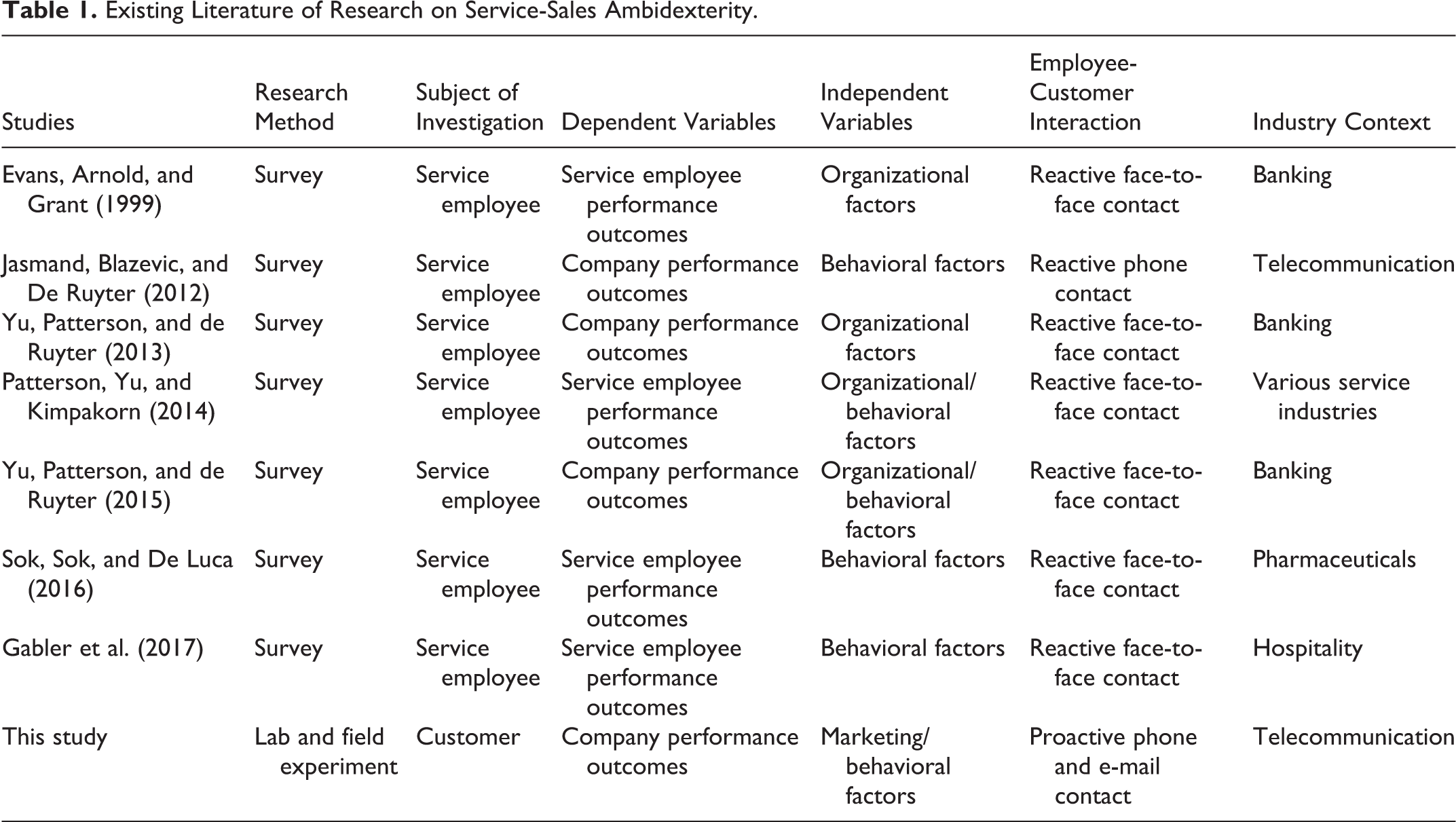
Across various service industries, the articles have empirically investigated different aspects of the implications of dual service and sales responsibilities of service employees. Specifically, the studies focused on the effect of numerous organizational and/or behavioral factors on service-sales ambidexterity and/or the impact of service-sales ambidexterity on a variety of performance outcomes affecting either the company or the service employee.
Among the organizational factors that are used in the studies to explain service-sales ambidexterity are variables such as job characteristics, role ambiguity, and centralization (Evans, Arnold, and Grant 1999), empowerment, team support, and transformational leadership (Yu, Patterson, and de Ruyter 2013), the service-sales climate, and leader-member exchange (Patterson, Yu, and Kimpakorn 2014), as well as performance management and social support (Yu, Patterson, and de Ruyter 2015). Behavioral factors encompass variables that relate to the service employee’s effect, such as team identification, bounded discretion, and locomotion and assessment orientation (Jasmand, Blazevic, and De Ruyter 2012; Sok, Sok, and De Luca 2016), as well as self-efficacy, job experience, and goal orientation (Patterson, Yu, and Kimpakorn 2014; Yu, Patterson, and de Ruyter 2015). The performance outcomes of service-sales ambidexterity used in the studies either measure the impacts on the company level, such as customer satisfaction, sales performance, and efficiency (Jasmand, Blazevic, and De Ruyter 2012; Yu, Patterson, and de Ruyter 2015), financial performance (Yu, Patterson, and de Ruyter 2013; Yu, Patterson, and de Ruyter 2015), or on the service employee-level, such as satisfaction, stress, perception of the service experience, the customer-cross-selling ratio, the number of transactions (Evans, Arnold, and Grant 1999), the commitment to service quality, sales performance, role conflict, and creativity (Gabler et al. 2017).
By investigating the impact of cross-selling via different contact media on customer churn and service calls, this study extends the existing literature on service-sales ambidexterity not only with respect to the dependent and independent variables but also regarding the methodology and the subject of investigation. While all previous studies focused on surveying service employees, this study uses a lab and a field experiment to analyze the customers’ reactions to the combined service and sales activities of service employees. Furthermore, this is the first study to test dual service and sales responsibilities in a proactive (rather than reactive) setting using phone and e-mail (rather than face-to-face or only phone) contact methods. The question regarding the contact medium is highly relevant since the type of contact media companies choose to use to approach the customers is the foremost factor determining the costs of the PPS (Aksin, Armony, and Mehrotra 2007; Walther 1996).
Conceptual Framework
While the positive aspects of a PPS develop over the long term, this study deals with two important outcome metrics that have short-term profit implications for companies—the prevention of immediate churn and inbound service calls. First, according to cognitive dissonance theory (Festinger 1957), immediate churn happens as a consequence of customers regretting their choices and alleviating the emotionally uncomfortable state by returning the product or terminating the service contract shortly after purchase. Usually, service providers grant cancellation periods in which the service can be terminated without the customer incurring costs. In some countries, service providers are legally obliged to grant immediate cancellation periods (e.g., 14 days, as in this study’s example). During this period, the cancellation rates can be substantial (depending on the sales channel 1 ), as remorseful customers may cancel without incurring high early cancellation fees. Since the short time frame does not allow companies to create positive experiences regarding the product or service, a PPS in the form of proactive education could be an appropriate means of building positive mental frames to reduce cognitive dissonance, thereby reducing immediate churn.
Second, a PPS in the form of proactive education should prevent customer frustration and possible service failures that would normally result in inbound customer service calls. Incoming calls from customers at companies’ call centers inquiring for assistance with technical (e.g., installation of software) or service-related matters (e.g., billing issues) are among the largest postsale cost factors for service providers (e.g., Xue and Harker 2002). Depending on the service level (Aksin and Harker 1999), calls can reach costs of US$2.50 per minute (Rumburg 2017). Hence, reducing such costly inbound service calls results in direct profit implications (Aksin, Armony, and Mehrotra 2007).
While the overall notion of a positive influence of proactivity is in line with previous studies (e.g., Retana, Forman, and Wu 2015; Shin et al. 2017), possible downsides exist with respect to the implementation of a PPS that have not been investigated. Certainly, a PPS incurs costs for which companies may want to compensate with cross-selling activities. Despite the advantage to organizations that are truly ambidextrous and that may reach higher levels of productivity (e.g., Yu, Patterson, and de Ruyter 2013), several studies warn of the possible negative consequences to companies that try to achieve service-sales ambidexterity. Service-sales ambidexterity must meet certain requirements regarding the qualification of the service agents (Jasmand, Blazevic, and De Ruyter 2012) as well as organizational (Evans, Arnold, and Grant 1999; Rapp et al. 2006) and technological conditions (Ahearne et al. 2008); problems may also result for the employees (Gabler et al. 2017) and the company (Aksin and Harker 1999; Rust, Moorman, and Dickson 2002).
For PPSs, in particular, cross-selling activities may cause negative implications from motive uncertainty (Challagalla, Venkatesh, and Kohli 2009; Shin et al. 2017). Ambiguity about a company’s motives arises when customers perceive mixed signals about the company’s marketing activities, such as when service contacts supposedly for the customer’s benefit are used for cross-selling activities from which the company benefits. This problem occurs notwithstanding the fact that—depending on its coercive intensity (Plouffe et al. 2016)—cross-selling could also be perceived as beneficial for the customers.
2
Nevertheless, customers may attribute marketing activities to a company’s self-interest rather than to altruistic motives (DeCarlo 2005). Instead of developing positive mental frames, the ambiguity, similar to the invasion of privacy, leads to irritation and reactance, rendering the PPS more costly (Aksin and Harker 1999; Aksin, Armony, and Mehrotra 2007) and less effective. Hence, we posit the following:
The foremost factor determining the costs of a PPS is the type of contact media companies choose to use to approach the customers. Those media range from computer-mediated communication via e-mail or text message to personal interactions between call center agents and customers (Aksin, Armony, and Mehrotra 2007; Walther 1996). While the former contact media types provide a relatively inexpensive communication channel to the customer, the intensive use of human labor causes the latter to be much more expensive (up to the factor 10 in the case of the industry partner for our empirical study).
In addition to the cost, however, companies must consider a specific implementation issue that may affect the effectiveness of the PPS when choosing the adequate communication medium. This problem may arise when customers perceive the PPS as an invasion of privacy (Challagalla, Venkatesh, and Kohli 2009), similar to other forms of marketing communications (see Edwards, Li, and Lee 2002). Defined as the degree to which an unwanted marketing communication is deemed to intrude into one’s private space, the invasion of customer privacy results in unfavorable emotional reactions and behavioral outcomes. Since consumers have little or no control over receiving unwanted commercial information, they feel, for instance, a loss of control leading to irritation or avoidance (Milne, Rohm, and Bahl 2004; Morimoto and Chang 2006). Additionally, customers tend to resist actions they find coercive. According to reactance theory, customers who feel their freedom has been intruded upon could react conversely to the expected response (Brehm 1966; Brehm and Brehm 1981).
Although perhaps not as strong as other forms of direct coercion, a PPS may be perceived as an intrusion, eliciting similar emotional and behavioral reactions. The degree, however, to which a PPS invades the consumers’ privacy and invokes negative reactions depends on the type of communication that companies choose—personal or impersonal contact media. The possibility that customers perceive a PPS as an intrusion of their privacy is the highest in the use of personal contact media. In this case, the company proactively reaches out to the customer via telephone to provide the postsales service. Although this communication type has the advantage of providing an interactive environment, allowing agents to cater the call to individual service needs, downsides to interactivity exist. Since the use of personal contact media requires the customer to be available and willing to communicate, a high chance exists that customers cannot be reached with proactive calls. The necessity of repeatedly trying to contact customers further increases the already high (personnel) costs of personal contact media use (Aksin, Armony, and Mehrotra 2007).
On the other hand, impersonal contact media, such as e-mails or other text messages, are comparably much less invasive because their interactivity is limited. Sent out once with a static service proposition, the impersonal contact media message can be processed (without coercion) at the customers’ discretion, invoking much lower costs compared to telephone calls. Considering the implications of the media type on the customers, we assume that both who initiates the PPS (Shin et al. 2017) and how the PPS is initiated are relevant. Thus, we hypothesize the following:
As a consequence of the invasion of privacy and motive uncertainty, PPSs would not result in increased customer satisfaction and cross-selling but rather in negative attitude formation, lower levels of customer satisfaction, and the deliberate disclaimer of cross-selling (Ha 1996). However, given that the types of communication differ with respect to their intrusiveness on customer privacy, the effectiveness of a PPS is highly dependent on the medium. By conducting a field experiment (Study 1) as well as a controlled lab experiment (Study 2), this study focuses on how the impact of a PPS on two important outcome metrics with short-term profit implications (i.e., the prevention of immediate churn and the number of inbound service calls) is affected by cross-selling efforts as well as the media type (i.e., telephone and e-mail).
Empirical Analyses
Study 1
Data
To analyze the impacts of the types of cross-selling activities on the effectiveness of a PPS regarding immediate churn and the number of inbound service calls (as postulated in Hypothesis 1), we designed a large-scale field experiment in cooperation with a European mobile phone provider. We chose a mobile telecommunication service because of its ubiquity and the high accessibility to customers via phone and e-mail due to the nature of the core service.
The goal of the field experiment is to test the effect of a PPS with and without cross-selling activities on the likelihood of immediate churn and inbound service calls for newly acquired customers in a real-life situation. These customers were contacted 5–7 days after the adoption of the mobile phone service. 3 Waiting for that period of time guaranteed that customers had sufficient time to become acquainted with the service but ensured they had not yet cancelled since it was sufficiently early in the cancellation period. Within the cancellation period, which is 2 weeks after signing the contract, customers are allowed by law to withdraw from the contract without incurring any costs. The reason for the considerable number of customers that immediately churn is the relatively large number of customers acquired through sales partners and the high early cancellation fees, approximately US$800, that customers would be charged after the 14-day period. Inbound service calls refer to the number of calls directed to the company’s service center (i.e., first- and second-level support) initiated by the customers during the observation period.
Our experimental design consists of two treatment groups and one control group. New customers were contacted by phone in the first and second treatment groups. In the first group, based on Challagalla and colleagues’ (2009) suggestions for PPSs, the service agent asked customers for feedback, helped them with optional service features (e.g., setting up the mailbox), and provided information on common pitfalls (e.g., international roaming)—all based on a compulsory script. In the following, we refer to this treatment group as No-Cross-sell.
In the second group, customers were contacted with a similar service call, but in contrast to the first group, the call additionally contained a proactive sales element with the service agent trying to sell the customer insurance for his or her mobile phone at the end of the call. To motivate the sale pitch, the script for the call used an inspirational appeal (see Plouffe et al. 2016). The service agent used this soft-coercive tactic by describing how the add-on service could serve as an opportunity to fulfill the customers’ needs (i.e., to be fully insured in case the phone breaks or gets stolen). We refer to this treatment as the Cross-sell group. The customers in the Control group were not approached.
Overall, 7,652 newly acquired customers were randomly assigned to one of the three groups (2,742 customers in the No-Cross-sell, 2,279 customers in the Cross-sell group, and 2,131 customers in the Control group). Table 2 shows the descriptive statistics of the experimental groups.
Descriptive Statistics of Study 1.
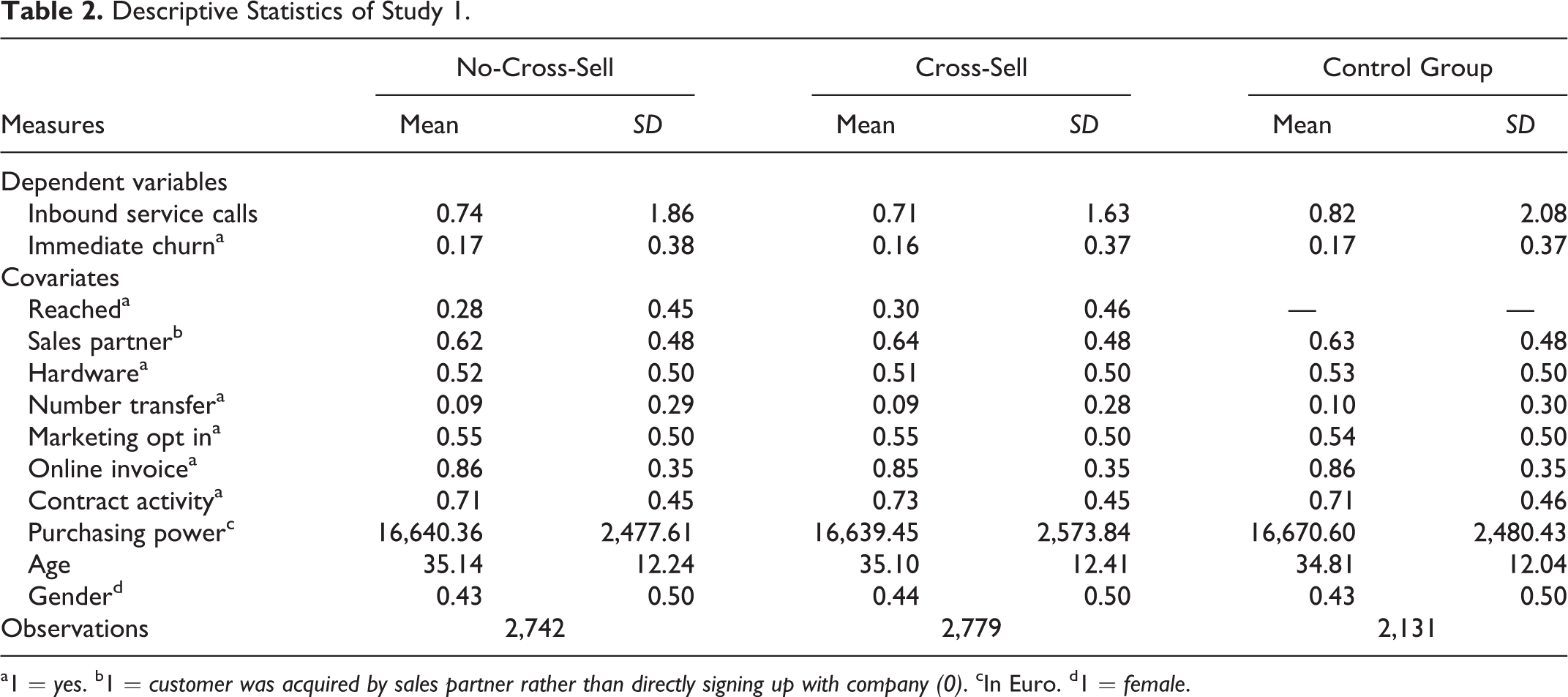
a1 = yes. b1 = customer was acquired by sales partner rather than directly signing up with company (0). cIn Euro. d1 = female.
Measures and Methodology
In our study, we use a set of regression and probit models to analyze the effectiveness of a PPS on inbound service calls and immediate churn. Therefore, we estimate the impact of a specific PPS treatment group on the number of inbound service calls through a linear regression in which we regress the focal PPS treatment group variable and a set of control variables on the number of inbound service calls. Analogously, we use the same set of variables as in the linear regression as explanatory variables to estimate the likelihood of contract termination with a probit model.
Specifically, the focal independent variable in our analyses is the PPS treatment group in the experiment, that is, the No-Cross-sell, Cross-sell, or Control group. The two dependent variables are the number of inbound service calls and the likelihood of a contract termination per customer. We use a broad set of control variables to account for the heterogeneity in the customer base as well as to avoid an omitted variable bias. Following discussions with the cooperation partner, we included those variables as controls that were seen as potentially having the most influence on our two dependent variables. Hence, we include information regarding the customer characteristics, such as age and gender (older and female customers tend to be less tech-savvy and thus more frequently seek help from customer service) and the customer’s purchasing power 4 (particularly customers from very low-income areas may be happy to be accepted for a mobile contract). As customers are exposed to calls in our study, we incorporate the customers’ attitudes toward marketing efforts in general (measured through whether they opt-in to receive marketing newsletters). An additional control variable is whether the customer bought the service from a sales partner rather than direct (the partner channel is more prone to hard selling, which results in higher cancellation rates). Finally, we also include variables describing the customer-company relationship, in particular, whether customers had their numbers transferred (which implies a higher commitment that lowers the risk of churn but may increase the potential necessity of service contacts) and whether they bought hardware (usually a mobile phone) when signing up for the service (which usually increases the number of service contacts due to additional hardware-related problems).
Equation 1 depicts our regression model, and Equation 2 depicts the probit model.
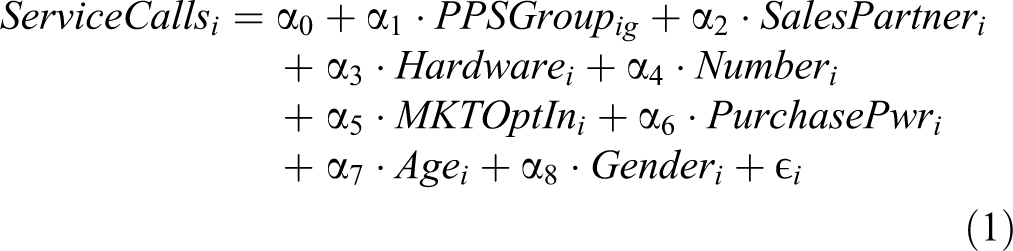
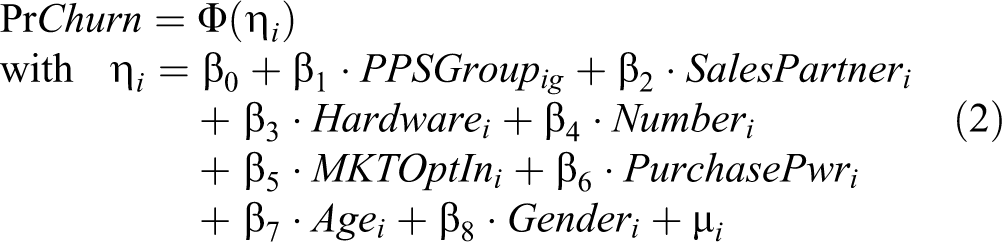
where ServiceCallsi = number of inbound service calls to customer i; PrChurni = probability of immediate churn of customer i; PPSGroupig = treatment of customer i in PPS treatment group g (1 = yes); SalesPartneri = customer i bought the service from a sales partner (1 = yes); Hardwarei = customer i bought hardware (1 = yes); Numberi = customer i had his or her number transferred (1 = yes); MKTOptIni = customer i opted-in to receive marketing newsletters (1 = yes); PurchasePwri = purchasing power (average income level in €) in the zip code of customer i; Agei = age of customer i; Genderi = gender of customer i (1 = female); ∊i, µ
i
= error terms; i = 1, 2,…, Ig number of customers in PPS treatment group g; and g = 1, 2, 3, 4: number of PPS treatment groups.
To test our hypotheses regarding the effect of a PPS on inbound service calls (Equation 1) and customer churn (Equation 2), we analyze the two treatment groups in comparison to the Control group. We also compare the No-Cross-sell to the Cross-sell group. Additionally, we test the effect of the PPS by comparing the sum of No-Cross-sell and Cross-sell groups with the Control group.
An important aspect is whether the subjects in the treatment conditions have actually received the treatment. As shown in Table 3, only 28% of the intended subjects in the No-Cross-sell group and 30% in the Cross-sell group were reached. 5 Customers not being reached may be due to a number of reasons, for example, customers deciding not answering the phone or customers not being able to answer the phone (e.g., because they are away from their phone or travelling). Given these possible systematic and random reasons for the probability of reaching a customer in the treatment groups, we have adapted the instrumental variable approach commonly used to account for possible noncompliance to treatment assignment in medical studies (Angrist, Imbens, and Rubin 1996). This method has been developed to correct for the fact that some subjects who have been assigned to a treatment group are noncompliant, that is, are not willing or able to take the focal medication or could not be reached in a phone-based experiment (de Matos, Pedro, and Rodrigo 2018). In our case, we estimate the probability of reaching a customer through a first-stage probit model based on a set of demographic as well as behavioral covariates. Therefore, we control for whether customers were (likely) to be reached by weighting the customer’s exposure to a treatment (PPSGroupig for the No-Cross-sell and the Cross-sell group) with the predicted probability of being treated to test our hypotheses in the second-stage regression and probit models from Equations 1 and 2.
Regression Results for Testing Impact on Inbound Service Calls (Study 1).

aFocal PPS condition is named first, for example, “PPS versus Control”: PPS = 1. b1 = customer was acquired by sales partner rather than directly signing up with company (0). c1 = yes. dIn Euro. e1 = female.
*p < .05. **p < .01 (two-tailed significance).
Note. ns = not significant.
The first-stage probit model estimates a customer’s probability of being reached using purchasing from a sales partner, purchasing hardware, having a number transferred, receiving online instead of paper invoices, and having contract activity, as well as his or her age and gender as explanatory variables (see Equation 3). See the Appendix A for the first-stage probit model estimates.

where
PrContacti = probability of customer i being reached by phone;
OnlineInvoicei = customer i received online instead of paper invoices (1 = yes); and
Activityi = customer i had contract activity (1 = yes).
Results
The regression results for the impact of a PPS on the number of inbound service calls are depicted in Table 3, and the probit results for the impact of a PPS on immediate churn are displayed in Table 4. In line with the previous research, the results show that a PPS is indeed effective, as it has an attenuating effect on the number of inbound service calls (α1 = –.48, p < .01; Table 3), as well as on immediate churn (β1 = –5.31, p < .01; Table 4).
Probit Results for Testing Impact on Immediate Churn (Study 1).
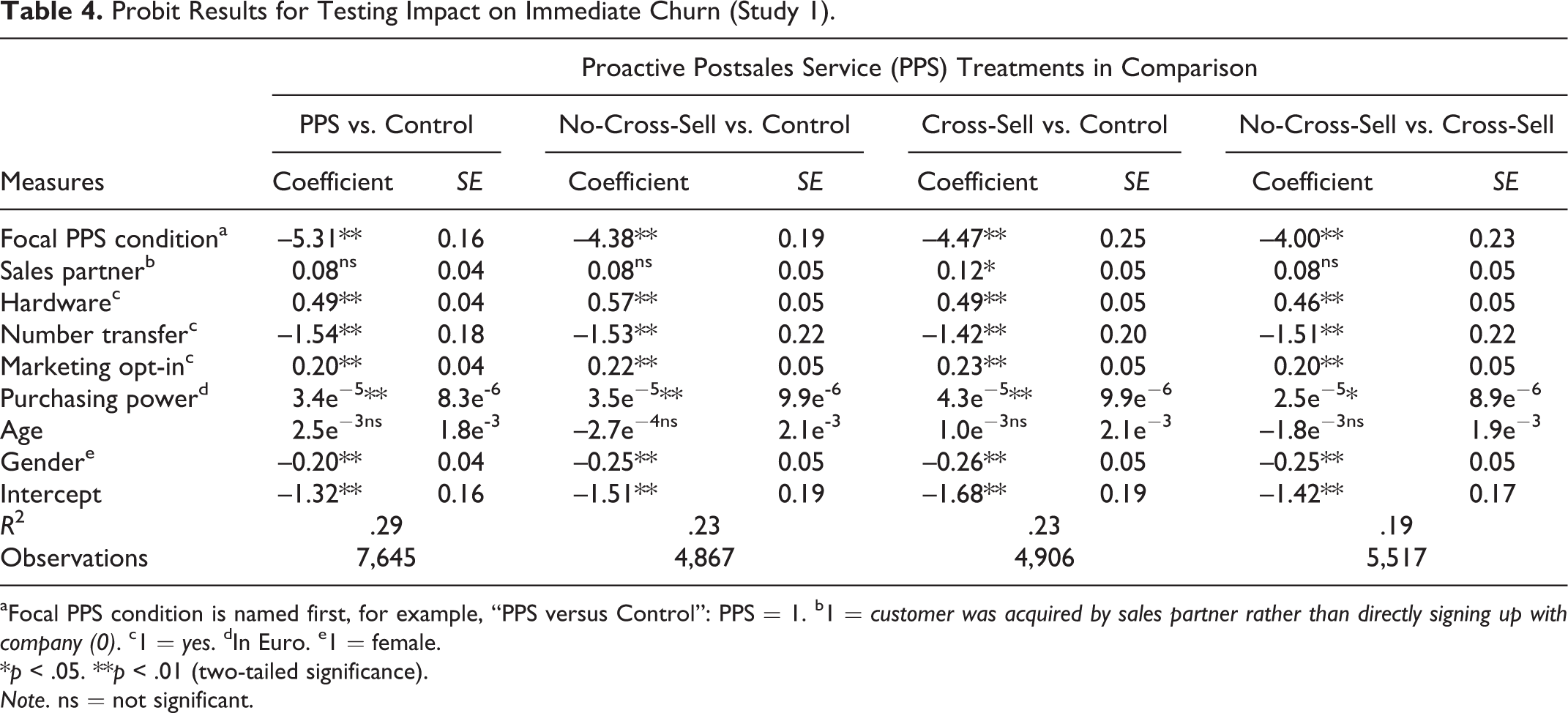
aFocal PPS condition is named first, for example, “PPS versus Control”: PPS = 1. b1 = customer was acquired by sales partner rather than directly signing up with company (0). c1 = yes. dIn Euro. e1 = female.
*p < .05. **p < .01 (two-tailed significance).
Note. ns = not significant.
Furthermore, we predicted in Hypothesis 1 that additional cross-selling efforts would reduce the effectiveness of the PPS. The results indicate that although the coefficients for the comparison of the Cross-sell versus Control group are smaller compared to those of No-Cross-sell versus Control (α1 = –.36, p < .05 vs. α1 = –.49, p < .01; Table 3), there is no significant difference between the two treatments with respect to inbound service calls (α1 = –.24, p > .05; Table 3). However, in contrast to service calls, there is a substantial difference between the impact of a PPS on immediate churn in the Cross-sell condition versus the No-Cross-sell condition (β1 = –4.00, p < .01; Table 4). Hence, we find Hypothesis 1 to be supported for immediate churn. Overall, the results demonstrate that the main goal of a PPS remains effective when combined with cross-selling efforts.
The control variables indicate significant influences of the customer characteristics on PPS effectiveness. While female customers have a lower likelihood of immediate churn across experimental groups (β8 = –0.20 to –0.26, p < .01; Table 4; 12.0% of women churn vs. 20.6% of men), age shows no significant effect, indicating that experience with mobile phone services does not affect inbound service calls or immediate churn. For customers who purchased hardware (i.e., a new mobile handset) as part of the new contract, we observe an increase in the likelihood of immediate churn across all groups (β3 = 0.46–0.57, p < .01; Table 4). This result is not unexpected because such hardware devices influence customers’ perceptions of service quality; therefore, they are potential sources of dissatisfaction, for example, due to technical failures, unfamiliarity with user interfaces, or expectations regarding physical appearance (weight, color, and built quality; see Gerpott, Rams, and Schindler 2001; Lee, Lee, and Feick 2001). Consumers opting in to receive marketing newsletters have a higher likelihood of immediate churn across experimental groups (β5 = 0.20–0.23, p < .01; Table 4), which can be explained by consumers being more susceptible to promotions, thus having a higher need to revoke impulsive buying decisions.
Conversely, the likelihood of immediate churn is reduced across all groups if customers had their numbers transferred (β4 = –1.42 to –1.54, p < .01; Table 4). This can be explained by high perceived switching costs (Kim and Yoon 2004) resulting from limited choices for other providers (i.e., customers with a low credit score are happy simply to have a mobile phone contract). The latter can be explained by the substantial administrative effort required for a number transfer and the risk of losing the number due to a miscommunication between providers. Other control variables have insignificant or contrasting results across experimental groups.
Overall, the findings from Study 1 that cross-selling attenuates the effectiveness of a PPS only with respect to immediate churn requires a second study to further investigate the impact of cross-selling activities on the effectiveness of a PPS and their underlying influences. Alongside testing the effect of cross-selling, the field experiment also encompassed an e-mail treatment (without cross-selling). Due to the absence of an e-mail with a cross-selling condition as well as technical issues, we abstain from reporting the results. Simple comparisons between the contact media types of phone (no-cross-sell) and e-mail, however, provided an initial indication that differences regarding their effect on the dependent variables exist. The following Study 2 specifically focuses on the effects of different contact media types with the help of a controlled experiment.
Study 2
Procedure and Participants
To examine the causal effects behind the Hypotheses 2–4, we conducted a controlled experiment with a between-subject, 2 (cross-selling) × 2 (contact media type) factorial design. To exclude potential confounds, we chose a scenario that closely resembled the setting in Study 1. Specifically, participants were presented a scenario that suggested they had just recently subscribed to a new mobile phone provider (see Appendix B). In the following, the participants were randomly assigned to five different (pretested) conditions in which they were shown screenshots of a company-initiated communication where the customers were either contacted (i) by e-mail with a cross-selling offer, (ii) by e-mail without a cross-selling offer, (iii) by phone with a cross-selling offer, (iv) phone without a cross-selling offer, or (v) not contacted (control condition). After reading the setting, the participants were asked on a 7-point Likert-type scale how likely it is that they would (a) terminate the service and (b) contact the service hotline.
To assess the perception of motive uncertainty (see Hypothesis 2), we employed a 4-item scale based on Shin et al. (2017). The scale contained the items “MyMobile is interested in my well-being and benefit,” “My relationship with MyMobile is for our mutual benefit,” “MyMobile has ulterior motives in communicating with me,” and “MyMobile is primarily motivated by self-interest”; the subjects were asked the extent to which the statements apply to them. 6 Furthermore, privacy invasion (see Hypothesis 4) was measured with items based on Li, Edwards, and Lee (2002), which analyze the perceived intrusiveness of the contact medium. The subjects were asked to rate the communication with MyMobile as being “annoying,” ”disturbing,” “pushy,” and “forced.” Both constructs were measured using a 7-point Likert-type scale ranging from 1 (strongly disagree) to 7 (strongly agree). With Cronbach’s α coefficients of .68 and .93, the scales demonstrated acceptable degrees of reliability. Finally, we asked for the participants’ gender and age.
Overall, our sample consisted of 324 participants from the same country as the customers in Study 1 recruited online through a representative consumer panel (see the descriptive statistics in Table 5). We chose the number of participants on the basis of the five experimental conditions, altering the cross-selling activities and contact media, as well as our aim of obtaining at least 60 participants per condition that were knowledgeable regarding the service. The mean age was 38.7 years (SD = 17.8), and 48% of our participants were female (SD = 0.50).
Descriptive Statistics of Study 2.

aMeasured on a 7-point rating scale, 1 = strongly disagree, 7 = strongly agree. b1 = female.
To examine the process underlying the effect of cross-selling activities on terminating the service and contacting the service hotline (Hypothesis 2), we conducted a statistical mediation analysis. We employed a bootstrapped test of mediation (Model 5 in the PROCESS macro; Hayes and Preacher 2014) with the cross-selling activities (yes vs. no) as the multicategorical independent variable, the contact media type as the moderator, the participants’ perception of motive uncertainty as the mediator, and the likelihood to (a) terminate the service and (b) contact the service hotline as the dependent variables.
Analogously, we conduct a mediation analysis for the process underlying the effect of the contact media type on terminating the service and contacting the service hotline (Hypotheses 3 and 4). We employed the same test of mediation (Model 5 in the PROCESS macro) with the contact media type (e-mail vs. phone) as the multicategorical independent variable, the cross-selling activities as the moderator, the participants’ perception of privacy invasion as the mediator, and the likelihood to (a) terminate the service and (b) contact the service hotline as the dependent variables.
Results
The results of the mediation analysis in Table 6 reveal that the effect of cross-selling activities on the likelihood to contact the service hotline (estimate = –.12; lower level of 95% bootstrap confidence interval [LLCI] = –.25, upper level confidence interval [ULCI] = –.02) as well as the likelihood to terminate the service (estimate = .25; LLCI = .09, ULCI = .42) are both mediated by the perception of motive uncertainty in the cross-selling conditions. Thus, cross-selling activities increase the perception of motive uncertainty (estimate = .41, SE = .13, t = 3.13, p < .01), and motive uncertainty decreases the likelihood of contacting the service hotline (estimate = –0.28, SE = .10, t = –2.85, p < .05) but increases the likelihood of immediately terminating the service (estimate = .60, SE = .08, t = 7.17, p < .01). Analogous to Study 1, we find Hypothesis 1 to be supported for immediate churn. Furthermore, the results showing the mediating effect of motive uncertainty support Hypothesis 2.
Regression and Mediation Results for Testing Impact of Cross-Selling Activities (Study 2).
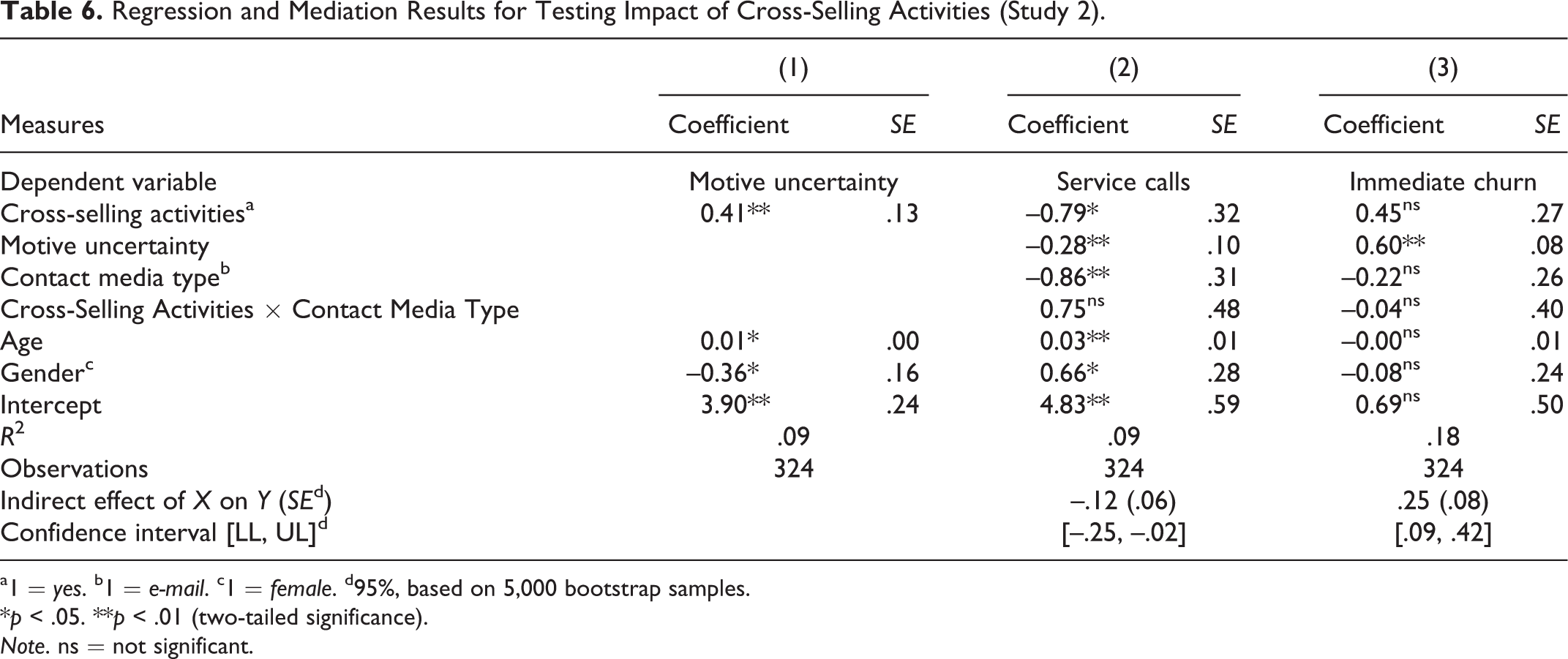
a1 = yes. b1 = e-mail. c1 = female. d95%, based on 5,000 bootstrap samples.
*p < .05. **p < .01 (two-tailed significance).
Note. ns = not significant.
The results in Table 7 reveal that the effect of the contact media type on the likelihood to contact the service hotline (estimate = .10; LLCI = .01, ULCI = .22) as well as the likelihood to terminate the service (estimate = –.18; LLCI = –.35, ULCI = –.02) are both mediated by the perception of motive uncertainty in the cross-selling conditions. Thus, the e-mail contact media type (vs. phone) decreases the perception of privacy invasion (estimate = –.42, SE = .18, t = –2.37, p < .05), and privacy invasion decreases the likelihood of contacting the service hotline (estimate = –.24, SE = .07, t = –3.28, p < .01) but increases the likelihood of terminating the service (estimate = .43, SE = .06, t = 6.82, p < .01). Hence, the results provide support for Hypotheses 3 and 4. As already indicated in Study 1, we find differences in the effects between immediate churn and service calls.
Regression and Mediation Results for Testing Impact of Different Media Types (Study 2).

a1 = e-mail. b1 = yes. c1 = female. d95%, based on 5,000 bootstrap samples.
*p < .05. **p < .01 (two-tailed significance).
Note. ns = not significant.
Discussion
Research Implications
Our study contributes to the service literature in several ways. While the previous research has focused on the PPS as a homogenous concept, we extend the existing research by analyzing the impact of cross-selling activities on the effectiveness of proactive customer education. Since cross-selling in this context requires the service employees to manage service and sales responsibility alike, our study also contributes to the literature on service-sales ambidexterity. Using a methodologically different approach (experiments rather than a survey), we focus on the customer (rather than the service employee) to investigate the effect of both behavioral and technological factors on company performance outcomes (rather than outcomes related to the performance of the service employee). Therefore, the study provides several novel insights.
In particular, the two studies allow us—in addition to replicating the previous findings that a PPS leads to the reduction of customer switching and service calls—to demonstrate that its effectiveness is significantly affected by cross-selling activities. The mediation analysis shows, however, that the influence differs between service calls and customer churn. A PPS with cross-selling increases the customers’ uncertainty regarding the company’s motives, which leads to an increase in customer churn and to a decrease in service calls as well. We also find that the influence of the contact medium on the effectiveness of a PPS is mediated by the customers’ perception of privacy invasion, that is, the more invasive the communication medium is perceived, the higher the customer churn is and the lower the service calls are. The results not only show the interdependences between customer churn and service calls but also illustrate the importance of service-sales ambidexterity in the context of a PPS. Considering the influence of motive uncertainty and privacy invasion, companies that plan to compensate for the costs of a PPS by generating additional revenues with cross-selling have to ensure that the PPS contacts are clear in their message and are not perceived as invasive.
Managerial Implications
Our findings have a number of relevant managerial implications, particularly regarding the interface of sales and customer service. For many industries, immediate churn is a key metric with a direct impact on profitability, particularly in the context of digital sales channels, for which the legal requirements for cancellation or return policies are strict. Considering the significant positive effects of PPSs on churn and service calls, a growing demand is likely for PPS applications.
The nature of such PPS approaches requires a close interaction between service and sales functions because the respective call center agents would have to successfully manage service-sales ambidexterity. Achieving churn prevention and cross-selling, however, requires certain standards regarding the quality and training of service agents and their management (Gabler et al. 2017; Yu, Patterson, and de Ruyter 2013). A PPS call perceived by the customer as only a thinly veiled sales approach is—due to motive uncertainty—bound to fail and may even trigger earlier contract cancellations or product returns. Thus, effective training in both domains is essential. Depending on the contributions of prevented churn versus additional cross- and upselling events, managers need to calibrate the focus of their PPS calling activities.
Similarly, important for management practice is an aspect that evolves from the analysis of the contact medium used for the PPS—the question of privacy invasion. A PPS that is perceived as intrusive to the customers’ privacy may evoke so much bad will that those customers are likely to churn (independent of cross-selling activities). In addition to the financial aspects that have to be considered when choosing the contact medium, companies have to factor in how invasive it is perceived.
Considering the findings of the underlying constructs of motive uncertainty and privacy invasion, the findings from Study 2 provide interesting insights into the interrelationship between customer churn and service calls. While the PPS call in Study 1 included an extensive set of recommendations for use of the service (the calls took, on average, more than 4 minutes), the scenario used in Study 2 was rather short, referring only to the provider’s website for information. Hence, it is unsurprising that, in this setting, the customers who are unlikely to churn may have remaining questions, which, then, lead to higher service call volumes. The results indicate that insufficient proactive education may lead to higher churn and (if customer does not churn) to increased service calls. Companies should, therefore, carefully assess which information to provide in a proactive postsales activity to provide an informational benefit for the customers.
Limitations and Directions for Further Research
Given the early stage of and limited attention given to the PPS research so far, several avenues for future research remain that could not be sufficiently addressed in our study. First, our experimental studies focus solely on service contracts for telecommunication services. While such services are a core field of application for PPS approaches, the findings of this study may extend to the field of tangible products. Considering the high return rates, tangible products might also benefit from the implementation of PPSs. This situation might be particularly true for complex products with a substantial risk that customers will fail to install, setup, or use the product properly.
Second, our study reveals significant differences in the immediate churn behavior between sexes, with men being much more likely to cancel early. One reason for this difference could be that male customers are less willing to reach out for help if they fail to properly setup or install an item, particularly in technical fields in which men feel they are or should be more competent (Hargittai and Shafer 2006). Thus, PPS strategies should be tested for gender-specific approaches, which could include, for example, communication strategies or controlled variations of the gender of the calling agents.
Third, a key concern regarding PPS activities is the breach of privacy that occurs when a customer receives an unsolicited call from a service agent. While our studies tested only “pure” approaches, namely, call versus e-mails versus no contact, combinations of these approaches could also be viable options. For example, firms could send short text messages to check whether new customers would be interested in receiving a call. While this additional step would certainly reduce the number of customers taking calls, its economic consequences are unclear and could lead to superior outcomes (e.g., reduced share of ineffective calls, calls perceived as less intrusive).
Fourth, future research could study the effects of PPS and cross-selling activities in industries experiencing both positive and negative churn, for example, online dating (Dechant, Spann, and Becker 2019). For example, PPSs may be used in these industries to reduce negative churn and monetize additional cross-selling potential when positive churn occurs.
Fifth, service-sales ambidexterity requires further assessment in the context of PPSs. In Study 1, we did not specifically select call center agents according to their capabilities in sales and service delivery. However, agents with specific experiences, training, or character traits may be able to handle settings in which they must balance both the sales and service aspects of a customer interaction. Such drivers of service-sales ambidexterity would be worth testing in a future study and could lead to further substantial improvements in PPS activities combined with cross-selling. Somewhat more related to the agents’ instructions are the sales tactics used by the companies. In this study, we tested only one specific (soft-coercive) sales condition. Considering that cross-selling efforts may range from helpful knowledge brokering to hard-selling sales tactics, the customers’ perceptions of its usefulness may vary and should be assessed based on their effect on the link between PPS and churn or inbound service calls.
Sixth, in Study 1, all new customers within a certain time period were included, and those who received PPS activities were randomly selected. However, specific customer groups might be more open to such activities (thereby showing higher conversion and even lower churn), while others might not be accessible, particularly when the PPS is combined with cross-selling. Thus, the specific drivers of a positive attitude toward PPS activities within the customer base require further examination. Our study also supports the need for further research, as the limited number of controls indicates significant heterogeneity among customers with regard to their responsiveness to PPSs.
Seventh, our studies do not use data reflecting the financial upsides of the cross-selling condition; therefore, it does not provide information on the monetary effects of the PPS in combination with cross-selling. Since the results depend heavily on the company’s cost and profit structure, we would like to encourage future research investigating the cross-selling implications in different company and industry settings.
Eight, the findings provide avenues for further research that could seek to identify further potential mediators and moderators of PPSs. Possible mediators could involve user experience with the service, and moderators, such as the customer lifetime (see Harmeling et al. 2015), could provide valuable insights into the underlying mechanisms of PPSs.
Finally, a key hurdle for profitable PPS activities is the high cost of personal telephone calls. However, we currently observe a dynamic evolution in the area of communication tools based on artificial intelligence concepts, such as IBM Watson (Huang and Rust 2018). Such concepts have already entered text-based customer communication, and voice-based applications are likely to be available soon at the quality level needed for PPS calls. This feature would open a further trade-off decision between human callers (with higher cost) and scalable calling bots (with potentially lower conversion rates due to actual or perceived imperfections). Future research may test the effectiveness of PPSs (and related cross-selling efforts) for different levels of personal communication (e.g., ranging from e-mail to textual chat bots, voice bots, and human service representatives). In summary, we feel that the field of PPSs still has significant untapped potential for implementation in managerial practice and merits more thorough investigation via academic research.
Supplemental Material
Supplemental Material, PPS_Executive_Summary_final - Impact of Proactive Postsales Service and Cross-Selling Activities on Customer Churn and Service Calls
Supplemental Material, PPS_Executive_Summary_final for Impact of Proactive Postsales Service and Cross-Selling Activities on Customer Churn and Service Calls by Jan U. Becker, Martin Spann and Christian Barrot in Journal of Service Research
Footnotes
Appendix A
Probit Results for Probability of Being Reached via Phone (Study 1).

| Measures | Coefficient | SE |
|---|---|---|
| Sales partnera | –0.09* | 0.04 |
| Hardwareb | –0.15** | 0.04 |
| Number transferb | –0.04ns | 0.06 |
| Online invoiceb | 0.28** | 0.06 |
| Contract activityb | 1.21** | 0.06 |
| Age | 1.5e−3ns | 1.5e−3 |
| Genderc | 0.11** | 0.04 |
| Intercept | –1.76** | 0.09 |
| Pseudo R2 | .11 | |
| Observations | 5,521 | |
a1 = customer was acquired by a sales partner rather than directly signing up with the company (0). b1 = yes. c1 = female.
*p < .05. **p < .01 (two-tailed significance).
Note. ns = not significant.
Appendix B
Authors’ Note
All authors contributed equally.
Acknowledgments
The authors gratefully acknowledge the constructive input of Niko Goretzki.
Declaration of Conflicting Interests
The author(s) declared no potential conflicts of interest with respect to the research, authorship, and/or publication of this article.
Funding
The author(s) received no financial support for the research, authorship, and/or publication of this article.

Notes
References
Supplementary Material
Please find the following supplemental material available below.
For Open Access articles published under a Creative Commons License, all supplemental material carries the same license as the article it is associated with.
For non-Open Access articles published, all supplemental material carries a non-exclusive license, and permission requests for re-use of supplemental material or any part of supplemental material shall be sent directly to the copyright owner as specified in the copyright notice associated with the article.
